
I’ve learned that SEO is evolving beyond just marketing and into the realm of organizational design. It’s about structuring, validating, and aligning information across the business to enhance visibility.
When our information becomes fragmented, visibility suffers, leading to more than just rank instability; it threatens our brand’s interpretation and mentions.
For those of us leading SEO, the choice is clear: remain as channel optimizers or become architects of systems that define brand understanding and citation. With AI systems now assembling information at scale, this transformation isn’t happening in isolation.
The visibility shift beyond rankings
As we look to the future, LLMs will shape organic search alongside traditional algorithms. Simply chasing rankings isn’t enough. We need to optimize for interpretation, citation, and synthesis across AI systems.
While our click rates may vary, the real transformation means treating visibility as an interpretation issue rather than just positioning. AI systems rely on cohesive data, narratives, and mentions. Discrepancies lead to inconsistent output.
Now, collaboration can’t be casual. LLMs demand clarity and consistency in the information they process. When our messages and data are fragmented, so too is our visibility.
This is a leadership challenge. Our visibility shouldn’t exist in silos but as a system that manages information creation, validation, and distribution across our organization.
If we want structural visibility, we must build the system to support it.
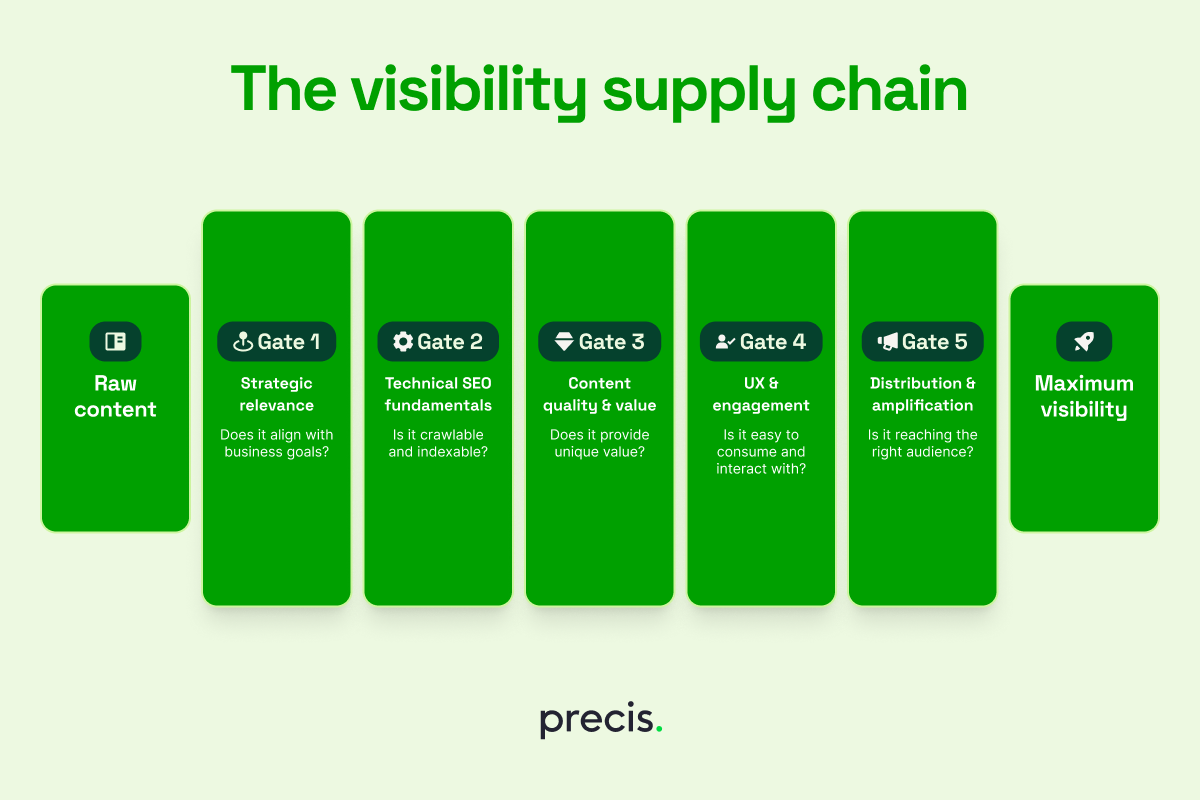
Building the visibility supply chain
I’ve realized that collaboration needs to be ingrained in the supply chain. It shouldn’t rely on the relationship between the SEO manager and PR manager.
For a seamless transition from a marketing silo to an operational framework, we must treat content as a product needing precise refinement before entering the broader ecosystem.
Enter visibility gates—nonnegotiable checkpoints filtering brand data for AI consumption.
Implementing visibility gates
Think of our content moving through a pipeline. At each joint, a gate refines the output:
- The technical gate (parsing)
- Does the product page template use valid schema.org markup (product, FAQ, review)? The goal here is to ensure that the data is structured for seamless AI consumption.
- The brand signal gate (clustering)
- Does our PR align with core entities? Are we using consistent terminology to help LLMs cluster our brand? This phase aims to prevent linguistic drift.
- The accessibility/readability gate (chunking)
- Is the content ready for RAG systems? Here, we focus on delivering high-information-density prose suitable for AI retrieval.
- The authority and de-duplication gate (governance)
- Does this asset induce “knowledge cannibalization” or unnecessary noise? This step filters out conflicting information to ensure a single source of truth.
- The localization gate (verification)
- Is entity information consistent globally? This ensures alignment in cross-referencing data to build trust in models.
While gates guard the ecosystem entry points, accountability is key to ensure changes translate into actions.
Embedding visibility into cross-functional OKRs
Alignment without visible results can’t sustain change. Sophisticated infrastructure will fail without cross-functional influence.
To advance beyond mere collaboration, visibility must be embedded into our organizational performance strategy.

We need shared visibility OKRs, not just SEO-specific goals.
When stakeholders are incentivized with visibility KPIs, SEO becomes more than just a team job. It becomes a vital business priority.
- For product teams: “Achieve 100% schema validation and <100ms time-to-first-byte for top-tier entity pages.”
- For PR and communications: “Increase ‘brand-as-a-source’ citations in LLM responses by 15%.”
- For content teams: “Ensure 90% of new assets meet ‘high information density’ for RAG retrieval.”
This collective focus aligns our organization with modern search engine mechanisms.
Measuring visibility across the organization
While gates assess the quality entering our ecosystem, a unified dashboard measures output, enhancing transparency.
If PR teams understand which mentions drive AI citations, they’ll focus on authoritative publications rather than any media outlet.
We need to transition from rank reporting to assessing entity health and Share of Model (SoM). This dashboard becomes our brand’s single truth source.
While systems and incentives are important, they need active management.

Dig deeper: Why most SEO failures are organizational, not technical
Join us at Semrush for tools to enhance your brand’s visibility.
Hiring for AI-era visibility
Building a visibility system isn’t enough; we need a workforce matching this model. We should hire beyond generalists, focusing on two pillars: the hacker and the convincer.
| Feature | The hacker (technical architect) | The convincer (visibility advocate) |
| Core mission | Ensuring the brand is discoverable by machines. | Ensuring the brand is supported by humans. |
| Primary domain | RAG architecture, schema, and LLM testing. | Cross-departmental OKRs, C-suite buy-in, and PR alignment. |
| Success metric | Share of model (SoM) and information density. | Resource allocation and budget growth. |
| The gate focus | Technical, accessibility, and authority gates. | Brand signal and localization gates. |
The hacker: The engine room
The technical visionary, constantly pushing boundaries. They optimize beyond just search bars, ensuring our brand’s discoverability by AI.
The convincer: The social butterfly of data
This individual bridges technical insights with business results, ensuring the hacker’s ideas are realized in practice.
Dig deeper: Why governance maturity is a competitive advantage for SEO
Leading the transition in the first 90 days
As we adapt to operational SEO, consider these first steps:
- Set the vision: Define what visibility-first looks like for your business.
- Take stock of talent: Do you have the hackers and convincers? Evaluate for skills and mindset.
- Audit the gaps: Identify and address communication breakdowns between SEO and PR, or SEO and product teams.
- Shift the KPIs: Focus on authority, impressions, sentiment share, and revenue, not just rankings.
- Be radically transparent: Share data in real time, without siloed thinking.
During the first 90 days, focus on:
- Days 1-30 (Audit): Map your brand’s entity footprint to identify conflicts.
- Days 31-60 (Infrastructure): Integrate visibility gates into your CMS or project management tools like Jira or Asana.
- Days 61-90 (Incentives): Link 10% of PR and product teams’ bonuses to entity integrity or citation growth in AI.
The SEO leader as a systems architect
As AI advances, an effective SEO leader transitions to becoming a systems architect, crafting the infrastructure for both machine and human brand interactions.
This journey is complex, demanding upfront changes to ingrained processes and transparent communication.
The future goes beyond keywords to optimizing how information flows through the digital ecosystem, embracing this transition will build a resilient organization visible by default.
Dig deeper: AI governance in SEO: Balancing automation and oversight
Inspired by this post on Search Engine Land.

Leave a Reply