As I’ve navigated the evolving landscape of SEO over the years, one truth remains: our biggest challenges often come from within. We’re standing at the brink of 2026, and it’s becoming clear that our organization’s internal issues might be the most significant threat to SEO success.
In recent discussions, AI tools and their impact on visibility have taken center stage. Yet, the conversation often overlooks a crucial issue. The real danger lies within our organizations—fragmented data, unclear KPIs, and poor collaboration silently erode even the most well-crafted SEO strategies.
I want to share a few internal threats that we should start addressing now to ensure our SEO efforts remain effective.
Many of us lean heavily on AI for tasks ranging from brief creation to data analysis. While AI expedites these processes, it’s essential to avoid falling into the trap of a one-size-fits-all solution. AI can provide speed, but the key is still in our unique perspective—what differentiates our content from the rest?
Another concern is our fragmented data landscape. Despite advancements, we still struggle with incomplete information about our users’ journeys. Users engage with AI tools, forming product perceptions before reaching us, but we lack visibility into these early interactions.
This brings us to another challenge: setting appropriate KPIs. While traditional metrics like traffic remain relics of past success, we now need to focus on visibility, considering the evolving role of AI. We’re being pulled towards metrics that may not directly align with business outcomes.
Furthermore, our roles must adapt beyond mere SEO execution to influencing broader strategic goals. Holding ownership without execution leads to misalignment. Instead, our insight should guide multi-platform visibility strategies, while leadership assigns responsibility for execution.
I’ve noticed the absence of cross-team collaboration in leveraging AI visibility. If AI visibility isn’t a shared priority across teams, then executing a unified strategy becomes difficult. Our job includes rallying all teams around common goals.
As SEO shifts to adaptability in a fast-paced AI-influenced world, action becomes vital. We can’t afford to stall in strategizing without executing. As I’ve experienced, prompt action allows us to learn quickly and adapt strategies effectively.
Ultimately, strong collaboration defines successful SEO execution. As our field becomes integral to broader company capabilities, continued team effort ensures sustainable visibility.
I urge you to see beyond traditional SEO. Embrace it as a dynamic business capability. The organizations that recognize this will lead the way in efficient discovery and sustainable growth.
When I first encountered the Visibility Governance Maturity Model (VGMM), it struck me as a tool most SEO programs desperately need. It’s not merely about how we execute SEO; it’s about clear ownership and documented processes that prevent undoing our hard work by teams unfamiliar with our efforts.
But how do I score something so foundational yet intangible? It all starts with tailored governance questions specific to each business domain. These aren’t about auditing tools or execution but focus on governance and accountability.
The VGMM questions reach out to managers and the C-suite—those who should know governance but often remain unaware. Meanwhile, I’m familiar with the documented standards and quality assurance processes that exist.
Through VGMM, I learned that the real test is whether our organization can maintain its capabilities without me. When I go on vacation, get promoted, or leave, can everything still run smoothly?
Managers often respond with phrases indicating gaps like ‘I don’t know the answer’ or ‘I’d have to ask Sarah’. These gaps reveal that our processes aren’t institutionalized.
Single points of failure (SPOF) questions can hold our organization back. I could be that SPOF, the go-to person for SEO solutions, which feels secure but is actually limiting. Identifying SPOFs helps leadership provide resources for documentation and training.
The VGMM process involves a few steps where each domain—whether it’s SEOGMM, CGMM, or another—yields a maturity score. I see these scores as a reflection of whether we’re documenting and sharing SEO knowledge across the team.
We don’t compare scores with competition because they vary by business model, domain combinations, and organizational context. Instead, I track our progress over time, marking improvements as we address governance gaps and SPOF conditions.
For me, VGMM scoring shields me from unjust blame. It highlights systemic issues and demonstrates our impact when we improve organizational capabilities. Over time, I can see our organization evolving from hero work to sustainable SEO.
Recently, I’ve been diving into McKinsey’s ‘Organize to Value’ strategy, a fascinating blueprint for transforming marketing into a positionless model. According to a comprehensive analysis, it’s not technology that’s holding back operational transformations; it’s unclear objectives, uncommitted leadership, and a stagnant culture that are to blame.
Implementing new AI technologies to drive marketing efforts seems simple. However, the real challenge lies in empowering marketing teams to utilize these tools independently, decisively, and at scale. The primary obstacle? It’s us, the humans.
For as long as I can remember, marketing teams have aimed to keep up with consumers, delivering timely, relevant messages and optimizing customer lifetime value to boost loyalty and ROI. While this goal isn’t new, the AI technologies that help us analyze data and create personalized messages at scale are continuously evolving. Unfortunately, our ability to fully harness this technology has fallen behind.
Despite these challenges, progress is being made. Some marketing teams have overcome these hurdles, yielding remarkable results. Take Caesars Entertainment for example. They reduced campaign execution time from five days to just five minutes. As Asadul Shah, the vice president of player revenue strategy notes, this transformation was ‘a massive game changer.’
Before their transformation, marketers at Caesars manually built targeting lists and coordinated efforts across disconnected systems, often waiting on multiple teams before launching campaigns. This made it difficult to target players with precision and timing. By partnering with Optimove, Caesars combined data, orchestration, and execution into a single platform. This change didn’t just improve efficiency; it allowed the marketing team to react more dynamically to players’ needs.
What truly made this transformation effective wasn’t just the technology—it was the implementation of Positionless Marketing. This framework liberated marketers from fixed roles, empowering every team member to act independently. Optimove provided the platform, while Caesars developed the necessary team structure. This synergy of technology and human ingenuity brought Positionless Marketing to life.
Organizations that achieve such transformation are embodying what McKinsey describes as ‘organizing to value.’ This involves a deep rethinking of structure, decision-making, and accountability, transforming marketing teams into operations that continuously drive value—ultimately optimizing customer lifetime value, fostering loyalty, and delivering measurable ROI.
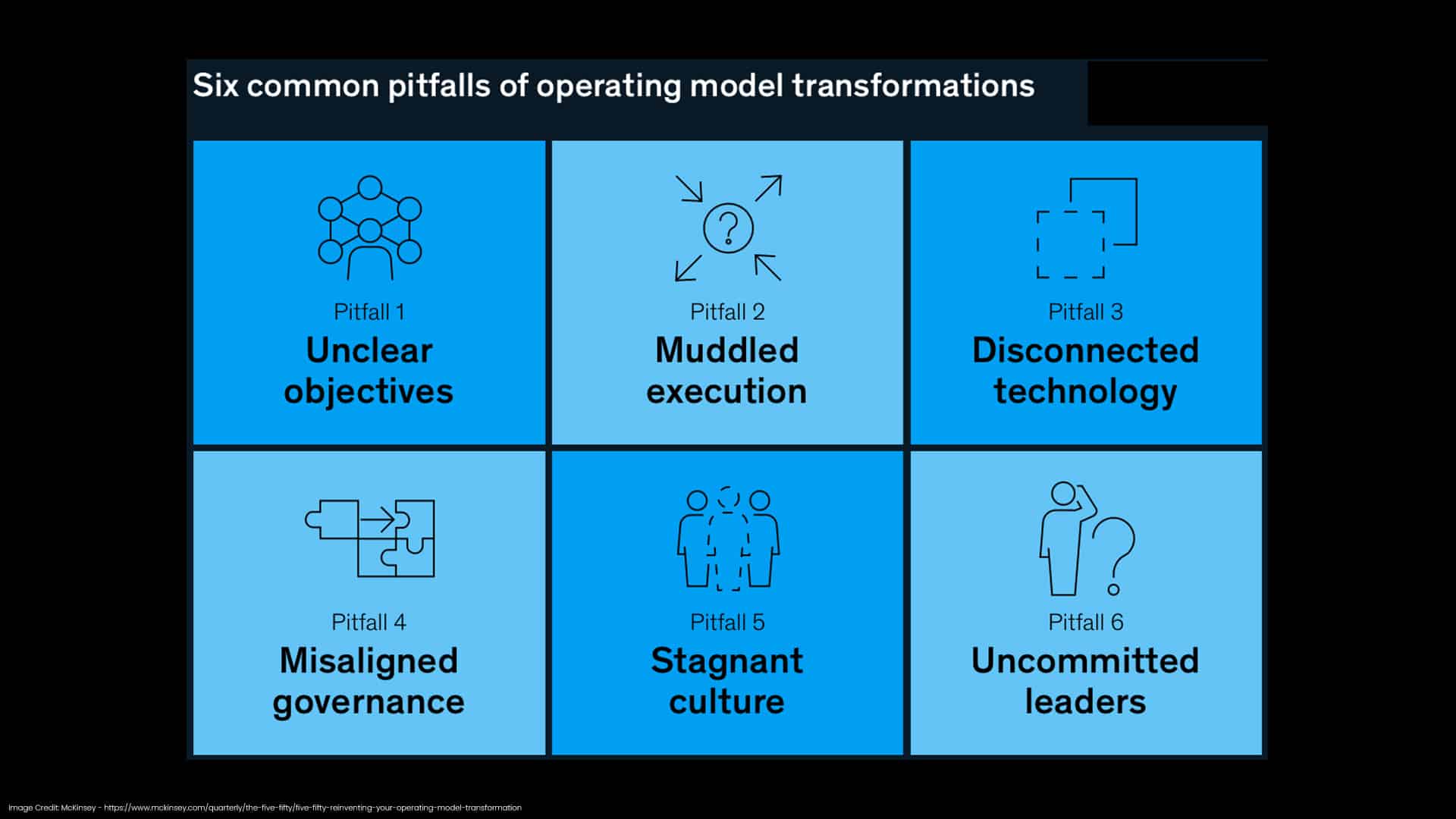
Yet, McKinsey highlights six pitfalls many teams face when trying to adopt the Positionless model, with only one being technological. The rest involve leadership and organizational issues.
Some key barriers include unclear objectives causing a focus on activity metrics over outcomes, misaligned governance that slows decision-making, and leaders who reinforce silos instead of enabling autonomy. Other obstacles are a stagnant culture resistant to change, muddled execution with no clear accountability, and disconnected technology further compartmentalizing efforts.
This kind of ‘assembly-line’ marketing, where tasks are segmented among different teams, hinders value creation. Peter Drucker famously said, “The purpose of business is to create and keep a customer.” However, when insights, creativity, and activation are siloed, value gets lost in between.
McKinsey’s ‘Organize to Value’ offers a practical path forward. It suggests designing organizations around value creation and impactful outcomes, rather than rigid job titles and processes designed to control.
To truly embrace Positionless Marketing, leaders must apply pragmatic solutions focused on improving marketing execution. This involves starting with a clear purpose, restructuring work to emphasize outcomes, streamlining decision-making processes, and aligning governance, technology, and talent. It empowers marketers to transcend traditional roles and independently deliver results.
This transformation requires commitment but staying with an outdated assembly-line structure is even costlier. Organizations like FDJ United and a major retailer have already seen the benefits: improved execution speed, increased purchase rates, and better use of resources.
As I see it, the window to act is narrowing. AI and data technologies are advancing rapidly, and customer expectations for personalized experiences are growing. Those who are quick to adapt will stay ahead, while those who hesitate may fall behind.
McKinsey’s insights confirm that the right structure and technology can unleash human potential, transforming marketing from within. Positionless Marketing is more than a strategy; it’s the future we need to embrace.
I’ve learned that SEO is evolving beyond just marketing and into the realm of organizational design. It’s about structuring, validating, and aligning information across the business to enhance visibility.
When our information becomes fragmented, visibility suffers, leading to more than just rank instability; it threatens our brand’s interpretation and mentions.
For those of us leading SEO, the choice is clear: remain as channel optimizers or become architects of systems that define brand understanding and citation. With AI systems now assembling information at scale, this transformation isn’t happening in isolation.
The visibility shift beyond rankings
As we look to the future, LLMs will shape organic search alongside traditional algorithms. Simply chasing rankings isn’t enough. We need to optimize for interpretation, citation, and synthesis across AI systems.
While our click rates may vary, the real transformation means treating visibility as an interpretation issue rather than just positioning. AI systems rely on cohesive data, narratives, and mentions. Discrepancies lead to inconsistent output.
Now, collaboration can’t be casual. LLMs demand clarity and consistency in the information they process. When our messages and data are fragmented, so too is our visibility.
This is a leadership challenge. Our visibility shouldn’t exist in silos but as a system that manages information creation, validation, and distribution across our organization.
If we want structural visibility, we must build the system to support it.
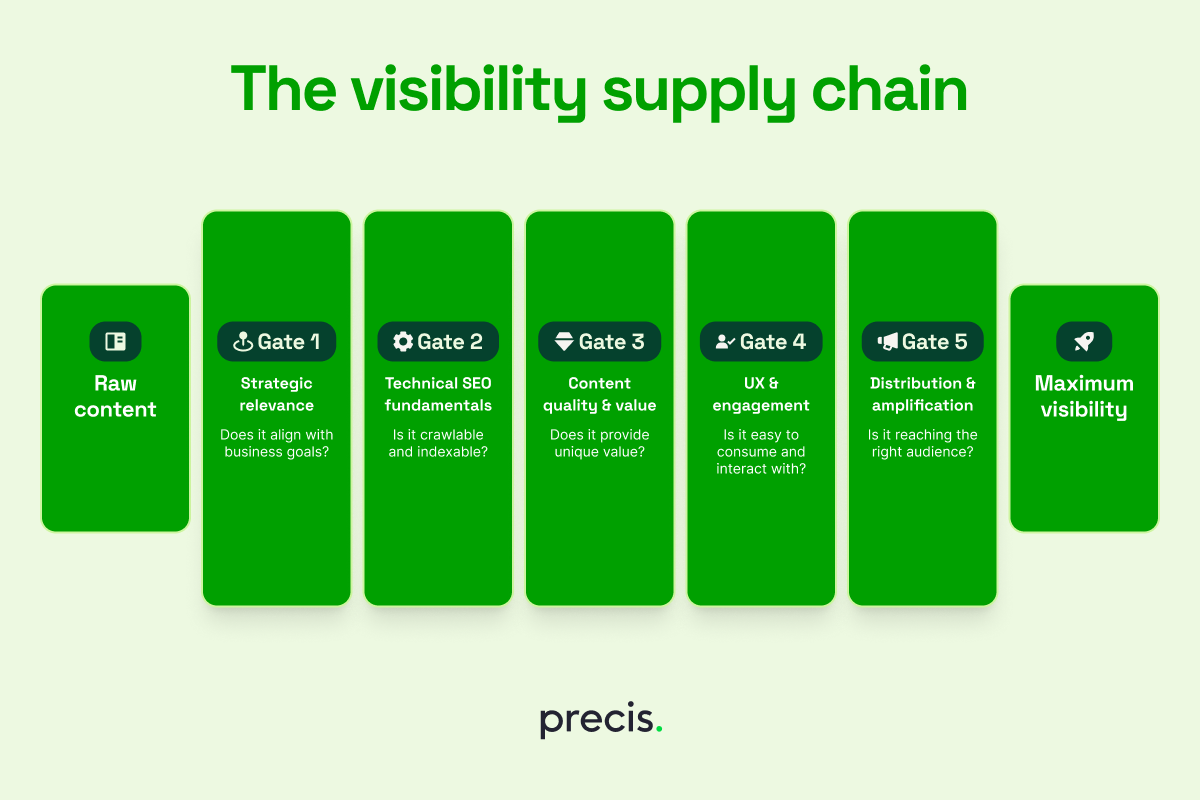
Building the visibility supply chain
I’ve realized that collaboration needs to be ingrained in the supply chain. It shouldn’t rely on the relationship between the SEO manager and PR manager.
For a seamless transition from a marketing silo to an operational framework, we must treat content as a product needing precise refinement before entering the broader ecosystem.
Enter visibility gates—nonnegotiable checkpoints filtering brand data for AI consumption.
Implementing visibility gates
Think of our content moving through a pipeline. At each joint, a gate refines the output:
The technical gate (parsing)
Does the product page template use valid schema.org markup (product, FAQ, review)? The goal here is to ensure that the data is structured for seamless AI consumption.
The brand signal gate (clustering)
Does our PR align with core entities? Are we using consistent terminology to help LLMs cluster our brand? This phase aims to prevent linguistic drift.
The accessibility/readability gate (chunking)
Is the content ready for RAG systems? Here, we focus on delivering high-information-density prose suitable for AI retrieval.
The authority and de-duplication gate (governance)
Does this asset induce “knowledge cannibalization” or unnecessary noise? This step filters out conflicting information to ensure a single source of truth.
The localization gate (verification)
Is entity information consistent globally? This ensures alignment in cross-referencing data to build trust in models.
While gates guard the ecosystem entry points, accountability is key to ensure changes translate into actions.
Embedding visibility into cross-functional OKRs
Alignment without visible results can’t sustain change. Sophisticated infrastructure will fail without cross-functional influence.
To advance beyond mere collaboration, visibility must be embedded into our organizational performance strategy.
We need shared visibility OKRs, not just SEO-specific goals.
When stakeholders are incentivized with visibility KPIs, SEO becomes more than just a team job. It becomes a vital business priority.
For product teams: “Achieve 100% schema validation and <100ms time-to-first-byte for top-tier entity pages.”
For PR and communications: “Increase ‘brand-as-a-source’ citations in LLM responses by 15%.”
For content teams: “Ensure 90% of new assets meet ‘high information density’ for RAG retrieval.”
This collective focus aligns our organization with modern search engine mechanisms.
Measuring visibility across the organization
While gates assess the quality entering our ecosystem, a unified dashboard measures output, enhancing transparency.
If PR teams understand which mentions drive AI citations, they’ll focus on authoritative publications rather than any media outlet.
We need to transition from rank reporting to assessing entity health and Share of Model (SoM). This dashboard becomes our brand’s single truth source.
While systems and incentives are important, they need active management.
Join us at Semrush for tools to enhance your brand’s visibility.
Hiring for AI-era visibility
Building a visibility system isn’t enough; we need a workforce matching this model. We should hire beyond generalists, focusing on two pillars: the hacker and the convincer.
Feature
The hacker (technical architect)
The convincer (visibility advocate)
Core mission
Ensuring the brand is discoverable by machines.
Ensuring the brand is supported by humans.
Primary domain
RAG architecture, schema, and LLM testing.
Cross-departmental OKRs, C-suite buy-in, and PR alignment.
Success metric
Share of model (SoM) and information density.
Resource allocation and budget growth.
The gate focus
Technical, accessibility, and authority gates.
Brand signal and localization gates.
The hacker: The engine room
The technical visionary, constantly pushing boundaries. They optimize beyond just search bars, ensuring our brand’s discoverability by AI.
The convincer: The social butterfly of data
This individual bridges technical insights with business results, ensuring the hacker’s ideas are realized in practice.
As we adapt to operational SEO, consider these first steps:
Set the vision: Define what visibility-first looks like for your business.
Take stock of talent: Do you have the hackers and convincers? Evaluate for skills and mindset.
Audit the gaps: Identify and address communication breakdowns between SEO and PR, or SEO and product teams.
Shift the KPIs: Focus on authority, impressions, sentiment share, and revenue, not just rankings.
Be radically transparent: Share data in real time, without siloed thinking.
During the first 90 days, focus on:
Days 1-30 (Audit): Map your brand’s entity footprint to identify conflicts.
Days 31-60 (Infrastructure): Integrate visibility gates into your CMS or project management tools like Jira or Asana.
Days 61-90 (Incentives): Link 10% of PR and product teams’ bonuses to entity integrity or citation growth in AI.
The SEO leader as a systems architect
As AI advances, an effective SEO leader transitions to becoming a systems architect, crafting the infrastructure for both machine and human brand interactions.
This journey is complex, demanding upfront changes to ingrained processes and transparent communication.
The future goes beyond keywords to optimizing how information flows through the digital ecosystem, embracing this transition will build a resilient organization visible by default.
Through over 20 years of experience in varying SEO roles, I’ve witnessed a recurring theme: the root of SEO performance issues often stems from organizational factors, not technical glitches.
Many times, problems manifest through decision rights, lack of ownership, and insufficient processes. These often precede noticeable traffic dips, obfuscating the real issues beneath the surface.
The technical fixes may expose symptoms but rarely uncover why progress has stalled.
No governance
The real limitations become apparent much earlier, rooted in reporting structures and decision-making authority. When SEO stumbles, governance—or lack thereof—is often to blame.
I discovered that when ownership of CMS templates was unclear or when cross-departmental priorities conflicted, SEO suffered. It wasn’t until I understood governance that the underlying issues became clear.
Only two companies in my career had the right conditions, with clear ownership and structured release pathways. Leaders recognized the importance of deliberately managing visibility, rather than reacting post-traffic drops.
Elsewhere, metadata and schema often didn’t limit performance. Organizational behavior did.
Beware of drift
Quarterly sales pressures often lead to sites making numerous small, seemingly innocuous changes that accumulate over time. These can range from navigation alterations by a new UX hire to content wording tweaks.
Individually, these shifts may not seem detrimental; however, collectively, they contribute to a decline in performance. This is something industry commentary often glosses over—while tangible technical fixes are more teachable, they aren’t where SEO outcomes are typically determined.
SEO loses power when it lives in the wrong place
I’ve observed how such drift can negatively impact rankings, with SEO unjustly taking the fall. Often, the actual cause was a lack of governance, which became apparent when outside agencies confirmed conclusions I had already reached.
The placement of SEO within an organization’s structure profoundly influences whether potential issues are identified early or only discovered post-launch. It affects whether changes are implemented promptly or languish for months.
SEO embedded under marketing, product, or IT each faces a unique set of challenges, restricting its effectiveness when placed too low on the organizational hierarchy.
Changes by engineering, product, or marketing often ship without SEO input, leading to misalignments that can reduce the efficacy of SEO strategies.
Positioning the SEO function
When SEO lacks proper placement within the organizational framework, it devolves into a reactive, cleanup role. The best results come when SEO is sufficiently integrated to influence early decision-making processes.
Organizations where SEO achieved significant success had the SEO function near leadership, ensuring visibility into upcoming changes and the ability to coordinate across departments.
The most favorable outcomes arose in environments where SEO acted as an integrated part of the infrastructure, reinforcing its importance as a contributor to long-term visibility and consistency.