I’ve been diving into some recent updates from Google regarding keyword match types, especially for those of us working with AI Overviews (AIO) and AI Mode ad placements. It’s crucial to understand these changes, particularly for those testing AI Max and using various match-type strategies. Let’s break it down so we can all optimize our ad reach effectively.
Why this matters to us. As the digital advertising landscape embraces AI-powered placements, it’s more important than ever to grasp which keywords are ready to serve ads and avoid unintentionally limiting our ad reach or misjudging performance metrics.
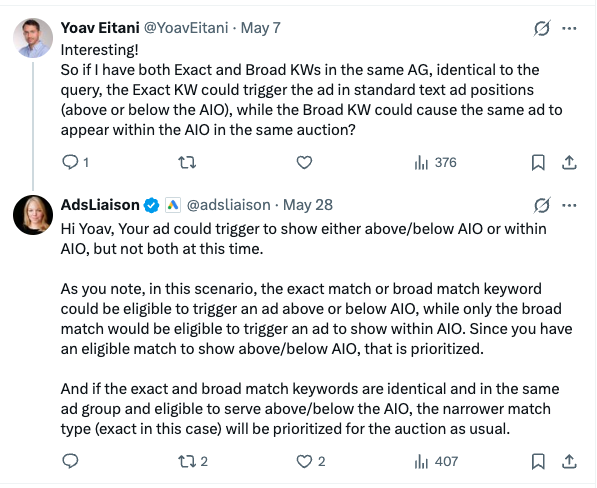
In May’s developments. When I followed the conversation between Marketing Director Yoav Eitani and Google’s Ads Liaison, Ginny Marvin, it was clarified that ads can serve either above or below an AI Overview—or appear within—but not in both placements simultaneously. Marvin stated, “Your ad could trigger to show either above/below AIO or within AIO, but not both at this time.”
When we talk about ad placements, it turns out both exact and broad match keywords can trigger ads above or below AIO. However, only broad match keywords (or those using keywordless targeting) have the privilege to appear within the AI Overviews.
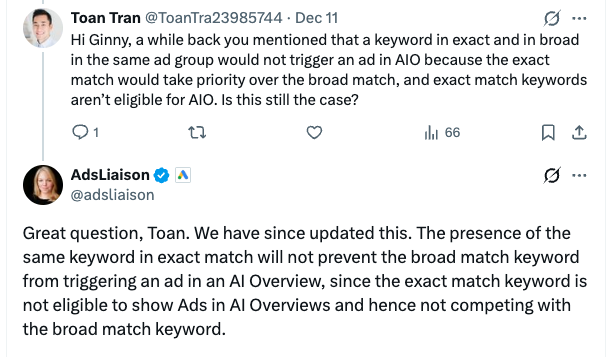
What’s different now. In a later discussion with Paid Search specialist Toan Tran, Marvin provided further insight into Google’s updated eligibility criteria. Before this update, the presence of an exact match keyword could block a broad match keyword from filling AIO spots. But thanks to Google’s revisions, that’s no longer an issue.
Marvin detailed, “The presence of the same keyword in exact match will not prevent the broad match keyword from triggering an ad in an AI Overview, since the exact match keyword is not eligible to show Ads in AI Overviews and hence not competing with the broad match keyword.”
This adjustment means that with exact and phrase match keywords not qualifying for AI Overview placements, they won’t compete with broad match keywords in those auctions. So, a broad match can still trigger successfully even if its exact match counterpart is present.
The broader perspective. Google’s strategic update strengthens the distinction between traditional keyword matching and AI-powered intent matching. Ads in AI Overviews now depend on a keen understanding of both user queries and AI-generated content, requiring broader targeting signals.
The takeaway for us. If you, like me, are pushing into AI Max and AIO placements, it’s clear that broad match and keywordless strategies are key to tapping into Google’s AI-driven ad spaces. Exact and phrase match keywords might not appear in AI Overviews, but crucially, they won’t stop us from leveraging broad matches.
Inspired by this post on Search Engine Land.

Leave a Reply