As I navigate the ever-evolving world of SEO, evaluating tools in 2026 has become a complex task. Rising costs and the AI frenzy often make it difficult to justify the investment in new platforms.
The challenge lies in demonstrating the business value of these tools to leadership, who are more interested in results than in the number of keywords we can track or the speed of content optimization.
Most tools fail to meet the demand to connect SEO work directly to business outcomes. The offerings often come bundled in convoluted packages, further complicating the decision-making process.
This article offers a framework to approach SEO tool evaluation in 2026, focusing on must-have features, efficient tool comparison methods, and effective vendor conversations.
Understanding the forces reshaping SEO tools can help. Many platforms lag in connecting SEO to measurable business value, complicating budget approvals.
AI advancements are setting new expectations. Whether to train a custom AI agent or invest in a ready-made tool is a key question every team faces.
Small teams need automation that truly saves time. Without context, many tools only generate noise, failing to deliver tailored insights for specific markets or businesses.
Technical SEO tools remain relatively stable, yet the assumption that AI can solve all problems presents a budgeting challenge.
Real impact in tool evaluation lies in focus areas like advanced data analysis, SERP intelligence, meaningful automation, robust multilingual support, and transparent pricing.
To avoid wasting time comparing tools, start with clear pricing, align tests with typical weekly tasks, and ensure you always secure a free trial.
When it comes to vendor interactions, concise goals and informed questions can streamline discussions and facilitate more productive evaluations.
Business considerations should include presenting a range of options, avoiding overpromising, and ensuring that proposed tools align with strategic business objectives.
As we look to the future of SEO tools, connecting searches to tangible business outcomes will define premium offerings, though such solutions remain rare.
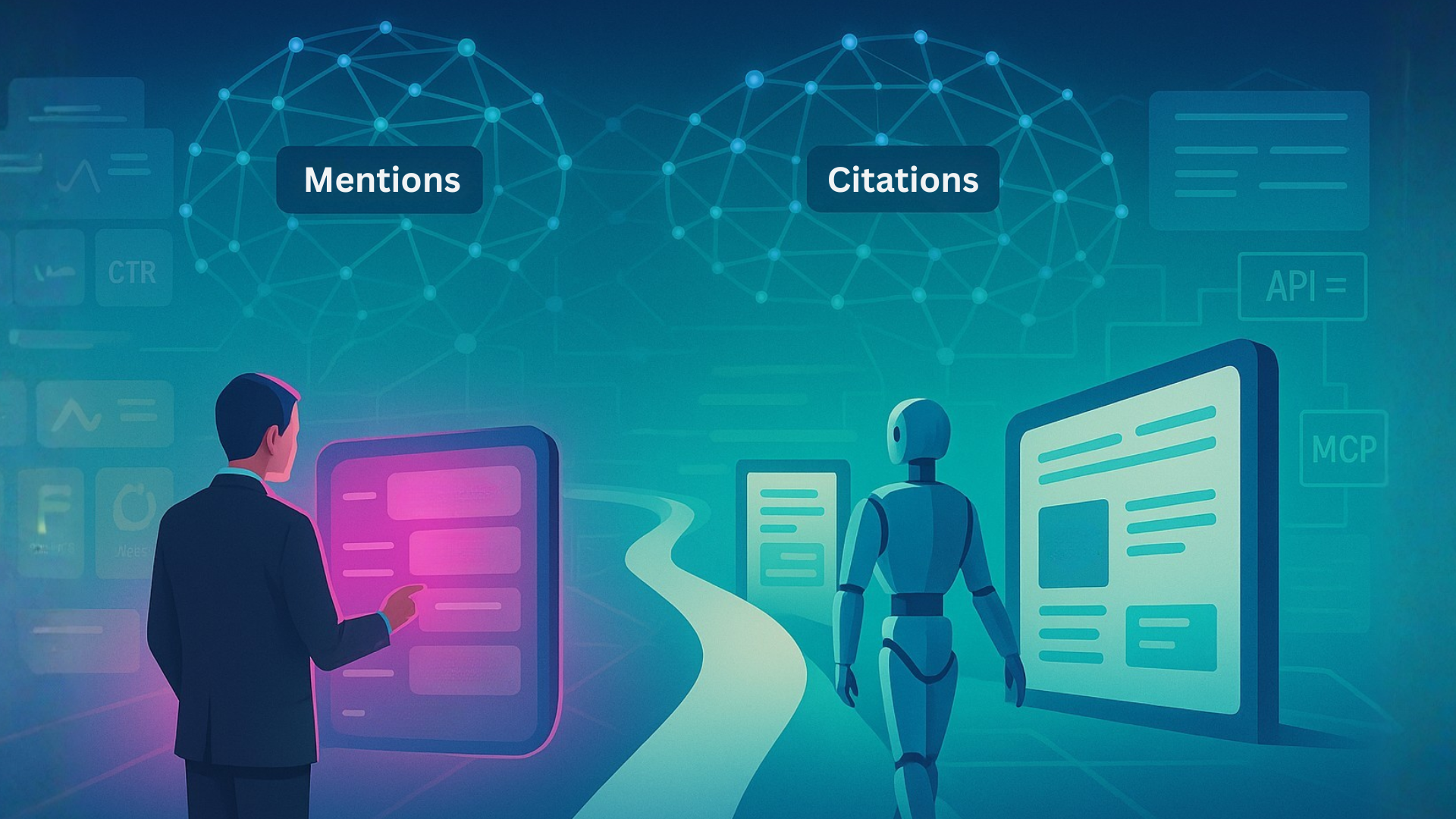
In my new content strategy for 2026, I’ve learned that the focus now lies in the signals models perceive, rather than the pages users visit. It’s crucial to adapt our content before digital agents dominate the journey.
Generative systems like ChatGPT, Gemini, Claude, and Perplexity have started reshaping the discovery phase. This stage once drove millions to our websites, but now it’s all about getting referenced in models.
Metrics like impressions, sessions, and CTR are still important but tell an incomplete story. Mentions, citations, and structured visibility signals are emerging as the trustworthy paths to revenue.
In this article, I’ve compiled insights from Siege Media’s content performance study, Grow and Convert’s findings on conversion, Seer Interactive’s AI research, and firsthand experiences within generative platforms. They guide us on how visibility, engagement, and purchasing intent are reshaping as AI covers more of the user journey.
Content Type Popularity and Engagement Trends
The team at Siege Media conducted an extensive performance analysis across various industry blogs, covering more than 7.2 million sessions. Kudos to them for sharing such a substantial dataset with us.
Notably, the data is focused on blog content, which may not align perfectly with other formats such as videos or landing pages.
Here’s what I’ve learned from their findings.
TL;DR of the Siege Media Study
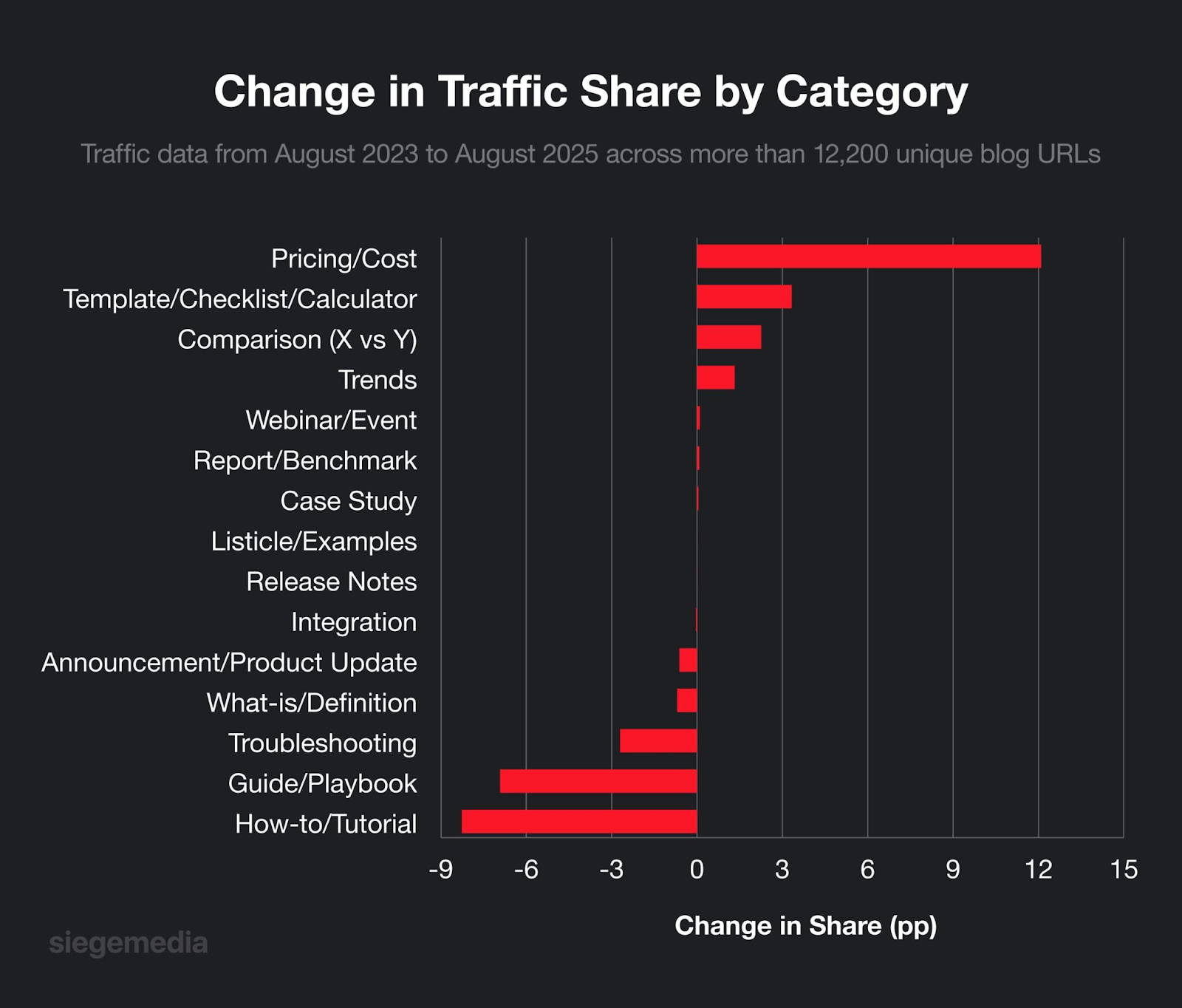
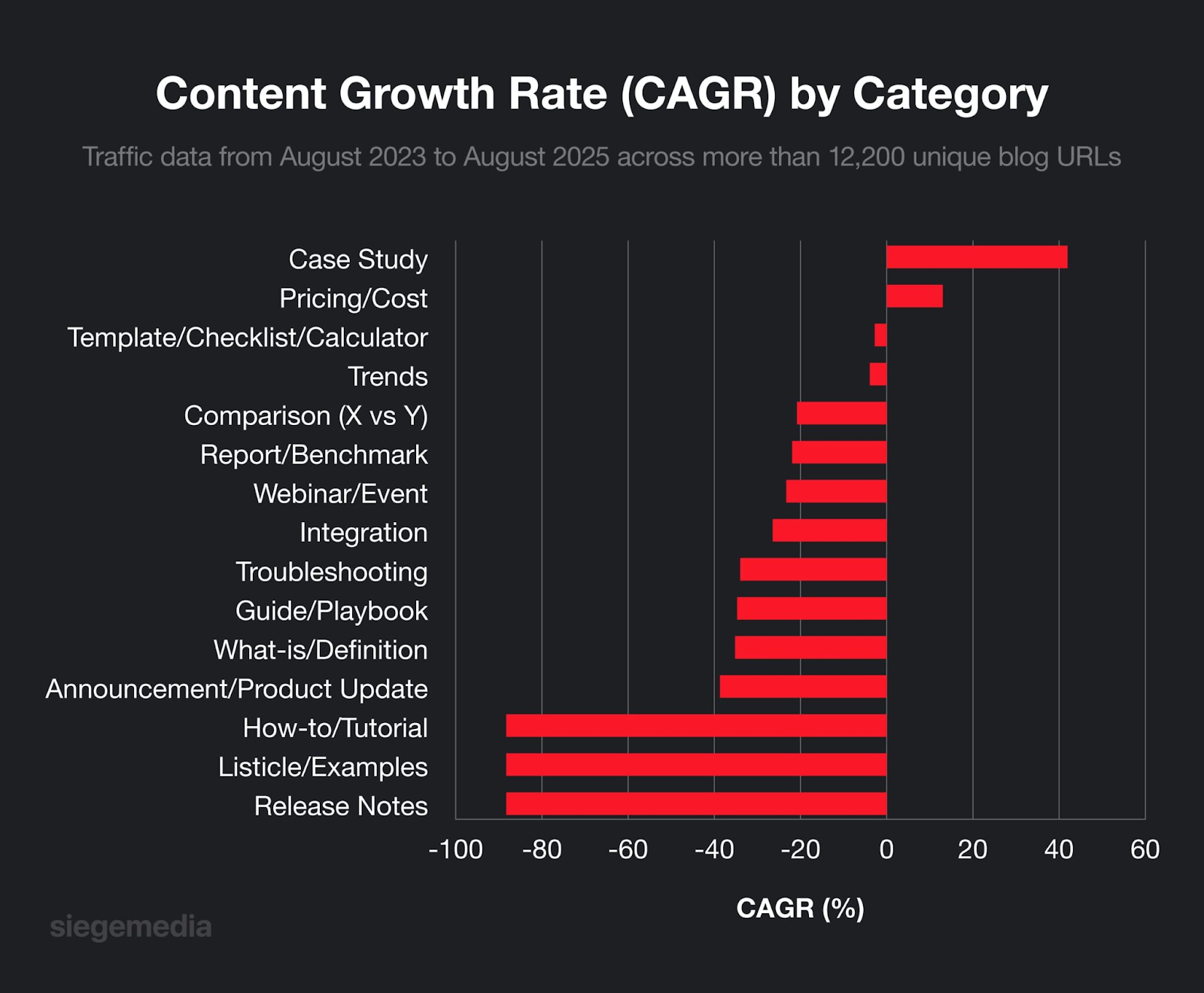
Pricing and cost-related content has shown the strongest growth, contrasting the sharp decline of top-of-funnel guides and “how-to” posts. It appears pricing pages have risen at the expense of TOFU content, but I see it differently. As user habits change, buyers are now likely to initiate research generatively and only move to high-intent queries as they near a decision.
The data highlights substantial growth in pricing and comparison content, whereas traditional guides have significantly declined. We’ll revisit this trend later.
Despite setbacks in certain content forms, major categories are seeing increased engagement. Users are completing more research within generative engines, thus reaching sites with a higher intent and readiness to act.
As a data-focused SEO professional, this could be an indicator to prioritize bottom-of-funnel content, but there’s more to consider…
Don’t Forget the TOFU!
I never thought I’d say this, but keeping up with TOFU content is essential. We might need even more of it to ensure sustained visibility and engagement.
Reflecting on SEO’s legacy, we see how it has evolved over time. Grow and Convert’s research from 2023 indicates that despite high TOFU traffic, its conversion rates are notably lower compared to BOFU, a trend seen across channels like PPC.
Generative engines now manage most of the TOFU journey, often keeping users within platforms for research before they cross over for decision-specific interactions.
For example, when I used ChatGPT to plan a trip, it engaged me deeply in TOFU and MOFU stages. This involved numerous opportunities to encounter new brands before reaching my final decision.
The pivotal learning here is that TOFU and MOFU interactions set the stage for conversion decisions. This dynamic reveals the importance of being part of the TOFU stage to imprint on potential clients.
Why Do These Protocols Matter to a Content Strategist?
Protocols like AP2 and Computer Use are game-changers. They are reshaping the role of clicks from human navigation to transactional steps for AI agents. Understanding this shift is imperative for content strategists.
As Siege Media’s data shows, while pricing and calculators excel because humans still drive these choices, AI agents may soon undertake this task, potentially replacing human site visits with bot interactions validating costs through technical verification.
The 2026 Strategy
This evolving landscape demands a strategic pivot. To achieve success in 2026, I believe a dual focus is necessary. First, optimize BOFU content for seamless technical execution. Second, reinforce TOFU efforts by enhancing mentions and citations to establish trust and recognition in generative answers.
As clicks turn into a commodity managed by AI, the value of mentions will soar, making them the new battleground for visibility. It’s time to bolster TOFU efforts, ensuring they contribute significantly to our broader strategy.
I’m always fascinated by how technology evolves, especially when it comes to AI models. Recently, I stumbled upon some compelling data showing how these AI systems are reshaping brand hierarchies and influencing buyer decisions at an unprecedented speed.
AI models like ChatGPT, Gemini, and Claude have become a part of our daily interactions, from search to content creation and product recommendations.
According to a survey conducted by Responsive, a significant 80% of tech buyers now use generative AI to research vendors just as often as they use traditional search methods. This shift in how buyers build trust with AI-driven discovery tools quietly determines which brands stay top-of-mind and which fade into oblivion.
At Previsible, we’ve been analyzing this intriguing phenomenon through what we call LLM perception drift. It’s a new metric revealing how AI models are dynamically organizing brands within specific categories over time. (Disclosure: I am the CEO and co-founder of Previsible.)
Our case study on project management software, comparing data from September to October 2025, highlights just how quickly AI brand perception can change. This volatility is set to become the next major metric for SEO strategies.
Key insights
The concept of LLM perception drift is emerging as a crucial visibility metric in SEO and B2B marketing.
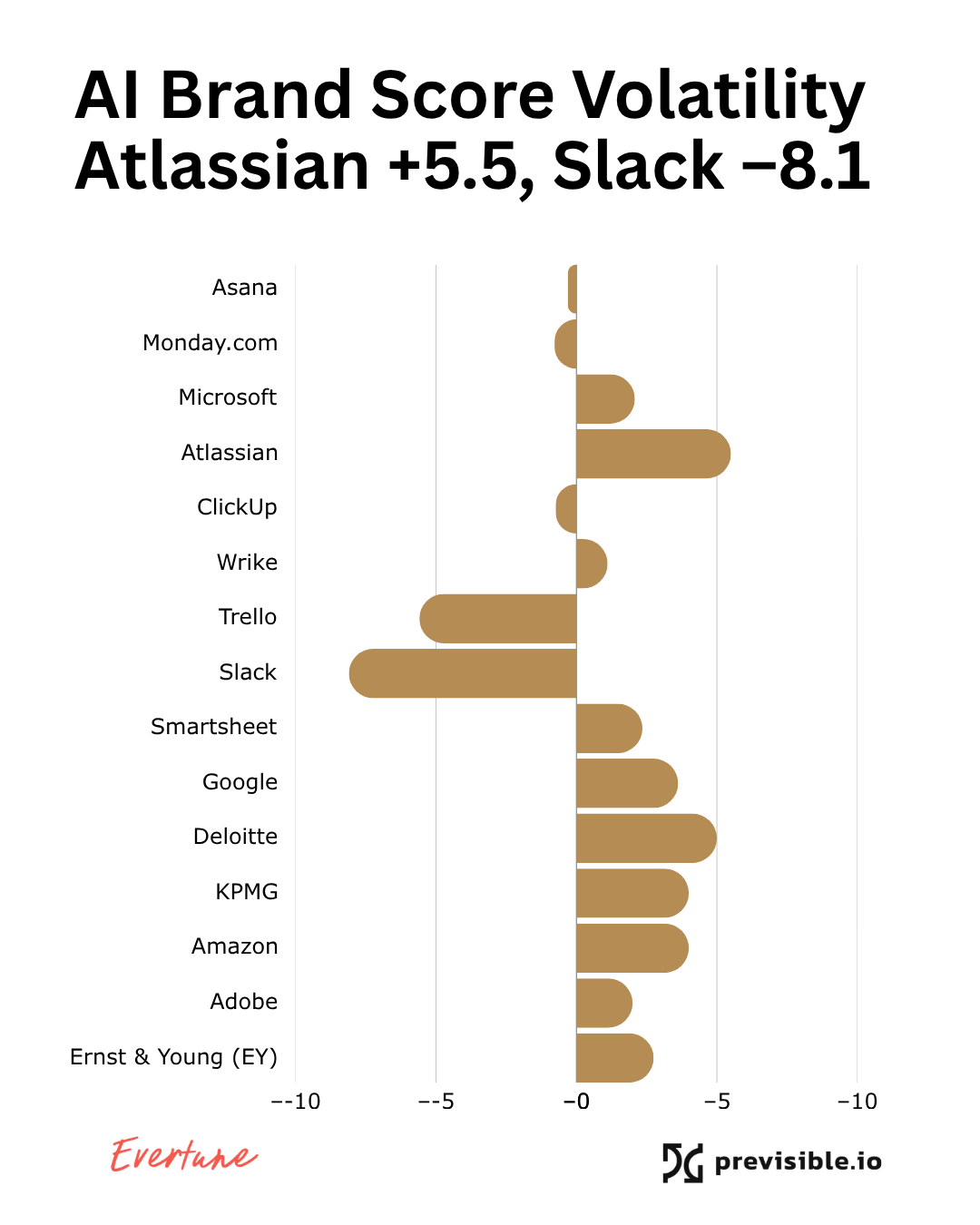
Brands like Atlassian gained prominence, while others like Trello and Slack saw declines, indicating the dynamic nature of AI perception.
Understanding AI brand perception is pivotal for marketers aiming to grasp authority and relevance in language models.
By 2026, maintaining digital visibility will hinge on AI brand signal stability as LLMs rapidly evolve.
A subtle shake-up inside the AI mind
Evertune’s AI brand score provides insights into how likely a model is to recommend a brand without specific prompting. It measures both visibility and ranking within AI responses.
September to October shifts highlight considerable changes in the internal brand landscape of AI models. Notably, Slack saw a significant decline, while Atlassian experienced a boost.
This seemingly simple reshuffle reveals a deeper transformation in AI’s nonspecific brand awareness, altering how the model discerns and prioritizes brands despite market stability.
The meaning behind the drift
We’re seeing two main forces driving these shifts:
Category entanglement
Rather than declining, categories are blurring — project management tools are being integrated into broader conceptual frameworks.
Operations
Digital transformation
Workflow orchestration
Enterprise productivity
IT consulting
Names like Deloitte and KPMG rise alongside Smartsheet and Atlassian.
Ecosystem advantage
Brands with multi-product ecosystems are getting noticed more. Atlassian’s lift, for example, stems from its robust documentation and integration abilities. Brands like Microsoft, Google, and Amazon are also seeing positive movement.
Models increasingly prefer brands that span multiple ecosystems, echoing entity-based SEO patterns but at a faster, more volatile pace.
We observe emerging trends in newer brands like Celoxis and Workfront, showcasing how fine-tuned LLMs draw from diverse datasets.
SaaS directories
GitHub repositories
Technical documentation
Reviews
Community content
For smaller B2B brands, this represents a gateway to visibility without needing to dominate traditional SEO metrics.
Why this shift matters for B2B discovery – and why it’s speeding up
Traditional SEO focuses on visible search results, whereas LLMs synthesize knowledge based on associations and contextual richness.
This means that brand recall in AI systems relies on deeper semantic connections, and these can fluctuate significantly over short periods.
Understanding and leveraging this LLM perception drift is crucial — being consistently recognized in AI outputs is now as vital as traditional search rank.
A new AI optimization KPI: AI brand signal stability
In working with B2B clients, we’re focusing on AI brand signal stability as an emerging metric — tracking how consistently a brand’s presence is maintained in AI outputs.
Fluctuations suggest fragile brand perception, influenced by data changes and model retraining, while stable scores indicate strong semantic grounding.
In coming years, AI brand signal stability will be essential alongside share of voice and traditional SEO metrics.
From project management to every B2B vertical
This transformation isn’t limited to project management — it’s happening across all B2B sectors.
The recalibration of category contexts by AI models alters the buying journey, influencing brand appearance in AI-generated content.
The rise or fall of brand attention affects which brands occupy summative or comparative outputs, making AI memory a new realm of marketing focus.
This shift marks SEO’s evolution — from focusing on search indices to emphasizing model memory optimization. Our goals now include measuring how AI interprets and recalls brand identity.
It’s about ensuring that AI systems correctly interpret and represent brands across their expansive digital landscapes.
This demands new strategies and tools tailored to how dynamic perception systems function, rather than treating them as static outcomes.
Evertune’s dataset highlights more than monthly position changes — it showcases a quick shift in AI’s category perception, which marketing teams must monitor to stay competitive.
By 2026, brand appearance in AI-generated summaries will play a bigger role in decision-making than traditional metrics like pageviews or clicks. Brands that effectively manage their model-driven visibility will set themselves apart as AI becomes a mainstay in digital research.
Embarking on the complex B2B journey can feel like navigating a labyrinth. I know this from firsthand experience, especially when it comes to optimizing campaigns amidst long sales cycles and low conversion volumes.
In the realm of selling high-value items, waiting for months to see tangible results can be frustrating. That’s where I discovered the power of proxy metrics, or micro-conversions, to drive faster optimization.
Let’s dive into the specifics of proxy metrics and their transformative impact on B2B campaigns.
Understanding Proxy Metrics
From my perspective, proxy metrics are like the early indicators of success that help predict final outcomes. Think of them as a weather vane pointing towards future achievements.
Engagement rates hint at potential conversions, while add-to-cart events often precede sales. Watching these early signs allows me to course-correct campaigns sooner and optimize budget allocations.
Proxy metrics also prove invaluable when navigating Google’s 90-day latency window. I’ve learned to identify key predictors within this time frame to maintain tracking efficiency.
In my work with digital ad platforms like Google and Meta, I’ve seen the crucial role of machine learning in campaign optimization. Feeding these systems with early signals like micro-conversions enhances their ability to target quality users effectively.
With metrics like time on site and scroll depth, I can refine targeting even when conversion data appears sparse, creating training signals that define algorithms’ paths.
Building Audiences and Gaining Insights with Proxy Metrics
Segmentation through proxy metrics opens up smarter audience building. By identifying engaged users, I craft lookalike audiences that mirror high-value customers, shifting focus from mere click-through metrics.
I’m also able to expedite testing cycles by employing leading indicators instead of waiting for long-term data, thereby speeding up hypothesis validations and subsequent decisions.
Proxy metrics frequently offer more robust statistical significance in models than distant revenue markers, enabling reliable market assessments.
Evaluating the Trustworthiness of Proxy Metrics
I’ve learned that not all proxy metrics pack the same punch. Some signal genuine interest more effectively than others. Newsletter signups, for example, often predict engagement, whereas add-to-cart events can be misleading due to frequent abandonment.
To choose the right proxies, I measure correlation strength, timeliness, actionability, and stability to ensure they provide reliable guidance for strategic decisions.
By focusing on these factors, I navigate the intricate path of B2B optimization with confidence, leveraging insights to drive impactful outcomes.
I’m excited to share with you that SMX Advanced is gearing up to make its mark in Boston from June 3rd to 5th, 2026, hosted at the Westin Boston Seaport. This is the premier event for those of us committed to mastering search marketing.
We’re really keen on highlighting the advanced strategies in SEO, PPC, and AI, and we can’t do it without your expertise.
The world of search is evolving incredibly fast.
As SEOs, we find ourselves adapting to AI SEO trends, making sense of AI Overviews dominating SERPs, and navigating Google’s ever-changing landscape and algorithm updates.
For those in PPC, there’s the challenge of making informed, data-driven decisions while seamlessly integrating new AI tools and maintaining that essential human touch.
We’re looking for speakers at SMX Advanced who can provide real solutions to these complex issues.
Do you have proven, high-level strategies for today’s marketing landscape? Now is the perfect time to share your session idea with us. Even if you haven’t spoken at SMX before, in person or virtually, we encourage diverse voices and perspectives to come forward.
The deadline for submitting your SMX Advanced session pitch is January 30th. Don’t delay—spots are limited and fill up quickly.
Consider these tips for crafting a compelling session proposal:
Ensure that your topic is truly advanced and tailored for intermediate to advanced professionals in search marketing.
Introduce an original idea or a unique session format.
Include a case study or specific examples to illustrate your points.
Be mindful of what can realistically be covered in a 20-minute timeframe.
Provide clear, actionable takeaways for participants to implement.
Clarify what skills or insights attendees will gain from your session.
I’m excited to share that Profound has been recognized as the definitive Leader in G2’s Winter Reports for the AEO (Answer Engine Optimization) category. This achievement highlights our continued dedication to innovation and excellence in AEO.
Our hard work and commitment to improving search optimization solutions have clearly paid off, reaffirming Profound’s position at the forefront of the industry. It’s rewarding to see our efforts acknowledged by such a respected platform.
I recently had a thought-provoking conversation with Nils Rooijmans, a respected figure in the world of Google Ads and a top PPC influencer. He shared with me a critical experience that highlights the importance of not overlooking Google’s consent mode warnings.
On episode 333 of PPC Live The Podcast, Nils revealed how a seemingly small oversight led to a significant drop in conversions and traffic for one of his managed accounts. This experience serves as a stark lesson for all of us in the paid search industry.
The story began with a rushed account onboarding after Nils’ existing client acquired another company involved in airport parking services. The client sought to avoid additional fees for a proper onboarding process, setting the stage for future challenges.
Nils agreed to transition the account into their existing setup gradually. However, this compromise led them to neglect the new account, which soon proved to be an expensive mistake.
After six weeks of minimal oversight, clicks and conversions plummeted. Upon investigation, Nils found that Google had been sending warnings about incorrect consent management implementation, threatening to halt conversion tracking if unresolved.
Ignoring these emails, originally thought to be routine noise, allowed the issue to escalate. As Nils admitted, this oversight stopped Google from processing conversion data, leading their smart bidding algorithm to adjust bids, reducing traffic further.
The root cause was identified as a bypassed onboarding process. Without this critical step, the account missed essential safeguards, including monitoring scripts and regular health checks.
Breaking this news to the client was complicated, especially since the financial implications were severe. The CFO demanded compensation despite actual bookings continuing, demonstrating further complications from the original oversight.
Technically resolving the issue was also challenging. Although Google support was contacted multiple times, they couldn’t fix the flagged domain problem, necessitating a workaround.
This story taught several key lessons: never skip onboarding, monitor conversion tracking meticulously, and pay close attention to Google’s communications. These steps can prevent minor issues from becoming major problems.
In the broader picture, embracing mistakes as learning opportunities strengthens team dynamics and enhances PPC strategies. Nils’ experience is a testament to the value of maintaining vigilance and the power of systematic approaches in digital marketing.
I’ve discovered incredible ways to optimize for Perplexity Shopping. Join me as I explore how AI-driven search is transforming the eCommerce landscape, giving brands like ours the opportunity to shine in ‘Shop Like a Pro’ outcomes.
I’ve learned that off-page SEO has come a long way from just building links. It’s now about crafting strategies that enhance authority, reputation, and visibility across various platforms.
In today’s fast-evolving digital landscape, search has moved well beyond simple blue links. Now, people find information not just on Google but also on platforms like TikTok, Pinterest, Amazon, and YouTube, as well as AI systems that provide synthesized answers from trusted sources.
As search engine results pages (SERPs) shift towards rich results and AI summaries, users can get what they need without even clicking. This change means brand authority extends beyond your website’s domain; it crosses platforms and content formats, influencing how AI systems learn from and use your content.
Modern off-page SEO demands strategies that cater to both search engines and AI models that recognize and highlight your expertise. This guide delves into what off-page SEO tactics work today and offers best practices for 2026.
What is off-page SEO today?
Off-page SEO encompasses all efforts made beyond your website to elevate its ranking and visibility in search engines. It includes strategies to secure inbound links, citations, and brand mentions, each contributing to your site’s authority and search engines’ trust.
Over time, search algorithms have advanced. While earlier algorithms focused heavily on backlinks to assess domain authority, search engines like Google now use a diverse array of factors, including expertise, authoritativeness, trustworthiness, and experience, commonly referred to as E-E-A-T.
Enhancing E-E-A-T involves:
Producing content with actual subject-matter experts.
Being transparent about your information sources and company details.
Gaining citations and mentions from authoritative sites relevant to your industry.
Backlinks vs. inbound links
Throughout this discussion, I prefer using the term “inbound links” instead of “backlinks,” as it carries fewer negative connotations associated with outdated, manipulative practices. The focus is on earning connections that are authoritative and relevant, offering genuine value to users.
This approach reflects a broader strategy—link building as a content-driven initiative, not a manipulative shortcut.
How important is off-page in your overall SEO strategy?
Off-page SEO is critical to building your site’s credibility. Each link or mention serves as an endorsement of your brand, akin to word-of-mouth recommendations, thus influencing your online reputation positively.
The more high-quality, relevant endorsements from credible sources you receive, the more authoritative your website appears to search engines.
Off-page and the rise of answer optimization
In today’s AI-driven search landscape, off-page SEO’s importance is magnified. AI systems not only index content but also interpret, summarize, and generate answers based on reliable sources.
This means that off-page signals like brand mentions, links, and social sentiment shape not only Google rankings but also how AI models perceive your brand’s authority.
Structured data, a consistent brand identity, and third-party mentions are crucial for AI to connect your content with relevant topics, ensuring visibility and authority in AI-generated answers.
I’ve witnessed firsthand how AI agents are taking over traditional browsing methods by executing tasks directly. This shift makes web clicks and the funnels that depend on them increasingly obsolete.
In this evolving landscape, it’s crucial for brands like mine to optimize for machine users. Becoming favorable to AI systems will determine which brands succeed moving forward.