Tag: SEO

  • Mastering SEO and AI: Building Long-Term Brand Authority

    Mastering SEO and AI: Building Long-Term Brand Authority

    I’ve embarked on a journey to understand how we can transition from traditional SEO to an approach I call brand-focused algorithmic education. With algorithms powering AI-driven results, this multi-speed strategy aims to strengthen our brand’s authority and online presence.

    It all started when I recognized the importance of an AI-driven resume for brands. This asset has become a critical part of our strategy, especially as we explore various research modes to align with evolving technologies.

    To thrive in this new landscape, I realized we need to shift our focus from just ranking to educating these algorithms. This involves understanding platforms like Google AI, ChatGPT, and Microsoft Copilot, which synthesize information instead of just providing links.

    Conversations I had with industry leaders, such as Google’s Gary Illyes and Bing’s experts like Frédéric Dubut, have been enlightening. They all emphasize the importance of mastering what I call the algorithmic trinity.

    Let’s dive into each part of this trinity.

    Firstly, traditional search engines form the foundation, offering real-time web data. AI uses this for current events and niche topics, acting as its “here and now” window.

    Next, knowledge graphs serve as the AI’s encyclopedia, storing a brand’s core identity. Google’s Knowledge Graph is massive, and maintaining accuracy here is crucial for avoiding AI hallucinations.

    Finally, large language models (LLMs) are the conversational face of AI, synthesizing information to deliver user-friendly answers.

    For our brand strategy to succeed, we must operate on three timelines: short-term, mid-term, and long-term. Each requires a nuanced approach.

    In the short term, boosting our visibility through search results is key. Implementing simple SEO tactics can get us noticed in AI search results quickly.

    Mid-term, we focus on educating the Knowledge Graph over several months, ensuring our brand’s factual foundation is robust and accurate.

    Long-term, our aim is to become part of an LLM’s training data, ensuring our brand is ingrained in AI knowledge over many years. This is the pinnacle of algorithmic authority.

    Central to achieving these goals is building our strategy on solid entity SEO. I’ve even expanded on Google’s E-E-A-T framework to include notability and transparency, aligning with the underlying questions algorithms ask: Who are we, can we be trusted, and are we authorities?

    Looking ahead, AI’s role as a decision-making assistant is growing. I’ve personally tested ChatGPT to assist in purchasing decisions, and its potential as a personal agent is vast.

    In essence, our digital strategy must continually evolve. We can no longer chase outdated SEO strategies but should instead cultivate comprehensive algorithmic education for our brand.

    To thrive, our content must be frictionless for bots, digestible for accurate indexing, and tasty to establish authority. This ensures we remain top of mind for AI engines.

    Let’s commit to this holistic strategy today, as AI assistive agents of tomorrow are already preparing. Our work will not only build a formidable AI resume but establish a lasting brand legacy.


    Inspired by this post on Search Engine Land.


    crushpress.ai community screenshot
  • Unlocking Instagram’s Algorithm: Boost Your Brand’s Visibility

    Unlocking Instagram’s Algorithm: Boost Your Brand’s Visibility

    Instagram recently unveiled a groundbreaking tool called Your Algorithm in the U.S., empowering me to discover what the algorithm thinks I prefer and even tweak it. This exciting feature could redefine how brands are found on Reels.

    Why I care. This new capability could substantially change my content discovery experience. By indicating my interest in particular niches, like vintage fashion or fitness gear, Instagram might show me more content relevant to those interests, which is fantastic news for brands aiming to extend their reach through Reels.

    How it works for me. A newly introduced Reels icon gives me access to a personalized array of topics Instagram’s AI believes I’m currently into, such as sports, horror movies, or skateboarding. Here’s what I can do:

    • Discover how to see more or less of any topic, or introduce my own suggestions.
    • Share my algorithm snapshot on Stories.

    The future of exploration. Instagram plans to roll out this tool globally to other sections like Explore and the search tab, with controls broadening beyond Reels in due time.

    ```json
{
  "alt": "Three smartphone screens showing social media interface with videos and interests.",
  "caption": "Explore your personalized social media algorithm showcasing unique interests like skateboarding and creativity.",
  "description": "The image displays three smartphone screens. The first screen shows a social media video of people interacting with shopping carts in a parking lot. The second screen highlights an algorithm customization interface, listing interests such as sports and skateboarding. The third screen depicts a skateboarding video, emphasizing the dynamic and engaging nature of personalized content recommendations. This image illustrates the modern interactive experience and content curation on social media platforms."
}
```

    Insights from Instagram. Tessa Lyons, Instagram’s VP of Product, expressed to Fast Company how they aim to enhance my Instagram experience by giving me more control: “We want our users to feel like they are in charge of their Instagram journey, tailoring what they see based on their evolving interests.”

    Comparison to TikTok’s feature. Though TikTok previously introduced Manage Topics, its offerings are broader and less tailored to individual behavior compared to Instagram’s more personalized suggestions.

    A declaration by Adam Mosseri. The head of Instagram, Adam Mosseri, shared the announcement directly on Instagram.


    Inspired by this post on Search Engine Land.


    crushpress.ai community screenshot
  • Semify Expands Global Reach with Dragon Metrics Acquisition

    Semify Expands Global Reach with Dragon Metrics Acquisition

    Semify acquires Dragon Metrics

    I’m excited to share that Semify, a leading white-label digital marketing platform, has acquired Dragon Metrics, a prominent international SEO and AI reporting provider based in Hong Kong. This acquisition marks a significant enhancement in our reporting capabilities and AI optimization tools as we adapt to a shifting search landscape increasingly focused on AI.

    Why this matters to you. If you’re a Dragon Metrics customer, you can continue to expect the same great service, along with more frequent product updates. According to co-founder Simon Lesser, who shared on LinkedIn, the platform will still operate as an independent brand retaining its existing contacts and product experience. Additionally, you’ll now benefit from Semify’s expanding AI optimization strategies and the potential for future software integrations.

    Details of the acquisition. On December 8th, Semify announced the acquisition of Dragon Metrics:

    • Semify was founded in 2008 and operates as a U.S.-based white-label digital marketing platform.
    • Dragon Metrics was founded in 2011 and supports multinational brands and agencies in over 50 countries, especially in regions where Google isn’t the main search engine, like China, Korea, and Japan.
    • This acquisition provides Semify with an enterprise-grade reporting system and comprehensive global data coverage as we intensify our focus on AI-driven metrics.

    The finer points. Simon Lesser will take on the role of chief product officer at Semify, steering our AI optimization product strategy.

    • The Dragon Metrics engineering team will join forces with Semify’s team under the leadership of CTO Brian Sappey.
    • Our resellers are set to experience improved reporting capabilities via Dragon Metrics accounts, with more integrated solutions on the horizon.
    • Dragon Metrics customers will remain on their distinguished platform but with the advantage of increased engineering support.
    • White-label fulfillment will continue to be exclusive to approved agencies, aligning with our existing reseller model.

    Inspired by this post on Search Engine Land.


    crushpress.ai community screenshot
  • How Google Discover’s Shifts Impact Content Visibility

    How Google Discover’s Shifts Impact Content Visibility

    I’ve noticed a shift in how Google is choosing content for its Discover feed, and it seems less tied to traditional search rankings these days.

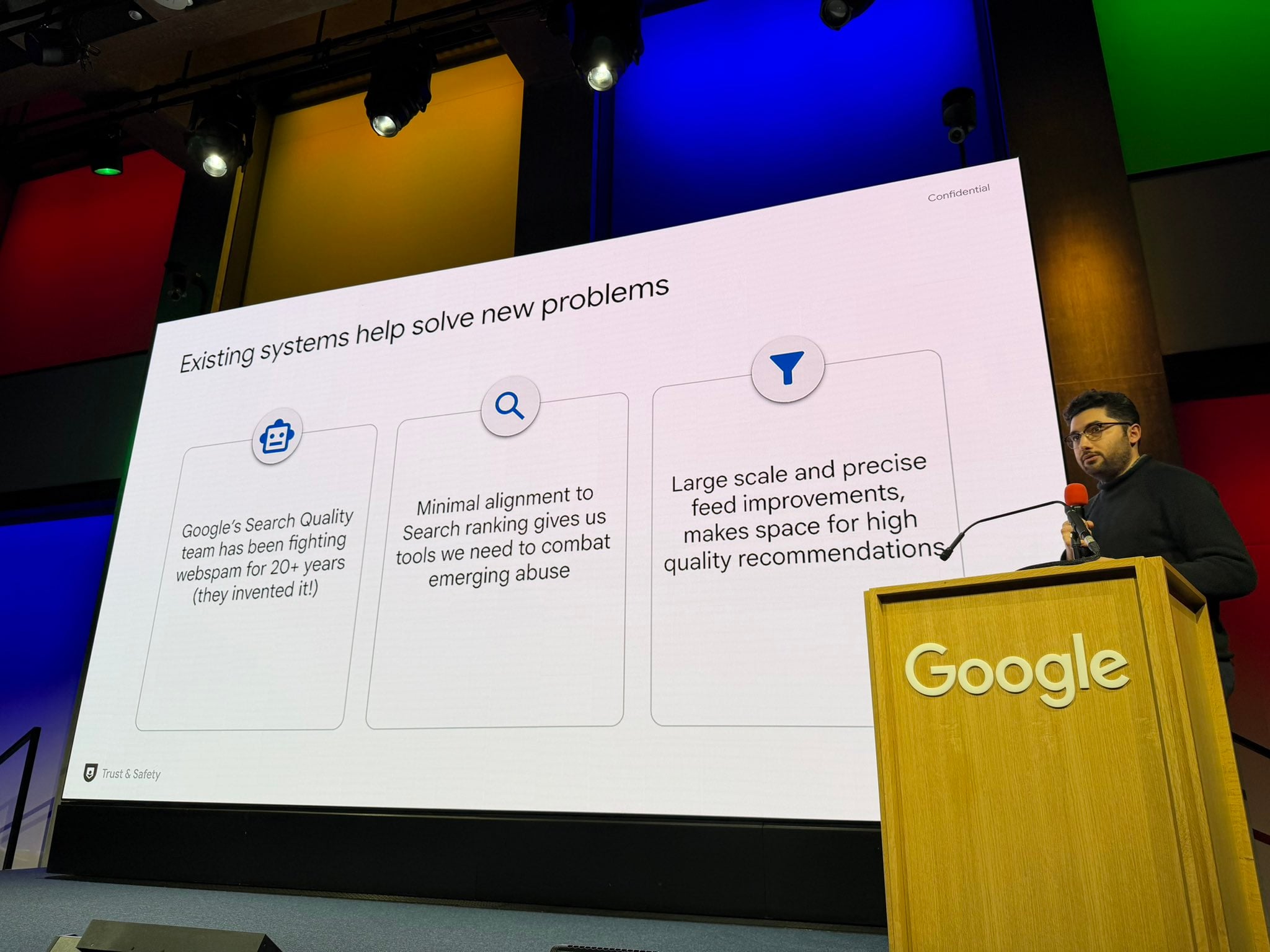
    Yesterday, Andy Almeida from the Google Trust and Safety team shared some insights at the Google Search Central Live event in Zurich. He mentioned that Google Discover isn’t as closely aligned with Google Search rankings as it once was.

    Andy presented a slide illustrating how existing systems assist the Google Discover team in addressing challenges. The slide highlighted:

    “Minimal alignment to search ranking gives us the tools we need to combat emerging abuse.”

    Understanding the Implications. This indicates that Google Discover is moving away from relying heavily on Google’s established search systems, particularly concerning combating platform abuse.

    ```json
{
  "alt": "Person presenting at a Google event about search quality systems on a stage with colorful lights.",
  "caption": "A speaker at a Google event discusses solutions in combating web spam and enhancing search recommendations.",
  "description": "The image shows a speaker presenting at a Google event, standing at a wooden podium with a red microphone. On the large screen, there's information about Google's efforts to combat web spam through its search quality systems. The background features a colorful light display, emphasizing Google's innovative environment. Keywords: Google, presentation, search quality, web spam, technology event."
}
```

    When I asked Andy what this meant for publishers, he explained that Google Discover aims to showcase content from lesser-known and smaller publishers. It seems while Google Search may not always favor them, Discover does, focusing more on its own evaluation systems.

    The Challenge with Spam. I’ve been aware of the significant spam issues confronting Google Discover, primarily caused by sites exploiting expired or throwaway domains for spam content. This is a challenge not as prevalent in Google Search.

    Back in 2019, Google stated that its core ranking systems affected visibility in Google Discover, especially after a core update. However, this new approach seems to diverge from that stance.

    Why This Matters. As Google continues to address these spam problems, it’s balancing the visibility of smaller sites on Discover while curbing spam. This is great news for emerging publishers who focus on niche topics, as long as the spam issue can be effectively managed.


    Inspired by this post on Search Engine Land.

    crushpress.ai community screenshot
  • Google Quietly Releases Unannounced Core Updates

    Google Quietly Releases Unannounced Core Updates

    I recently learned that Google has been rolling out smaller core updates without any announcements. This revelation came from a new section added to the core updates documentation for developers. While Google has mentioned this before, they’ve now made it official in their documentation.

    What’s New: Google included the following new information:

    We don’t have to wait for a major core update to see the impact of any improvements we’ve made. Google’s search algorithms are continually evolving through minor core updates. These updates may not be announced because they’re usually not very noticeable. However, they’re another opportunity for improved content to climb in search rankings.

    Google’s Explanation: According to Google, this addition to the documentation helps site owners understand that significant improvements can lead to better positions in search results without awaiting a major core update.

    Even Danny Sullivan, the former Google Search Liaison, shared similar insights with us back in August 2019. He explained how broad core updates occur every few months and improvements might not reflect until the next one. However, he emphasized that Google’s ongoing algorithm tweaks, like these smaller updates, can help recovery if content has been improved.

    A Larger Update Is On The Way: At the Google Search Central Live event in Zurich, John Mueller from Google hinted that a core update is in the works and might be released soon. He thinks it’ll take a bit longer than a couple of weeks but left us with no exact date.

    Why It’s Important: This confirmation is a reminder that Google regularly implements these smaller core updates. It’s crucial to keep our content optimized and anticipate a significant core update soon, which could lead to even more prominent changes in search results and rankings.


    Inspired by this post on Search Engine Land.


    crushpress.ai community screenshot
  • AI Chats: Unveiling the Surprising Lack of Commercial Intent

    AI Chats: Unveiling the Surprising Lack of Commercial Intent

    I recently discovered something fascinating about how people interact with AI. It turns out most AI chats don’t have any commercial intent! This insight came from a thorough analysis by Dan Petrovic, the director of AI SEO agency Dejan, who scrutinized millions of conversational turns to shed light on actual AI assistant usage.

    Why is this important to us? As someone involved in SEO and marketing, I’m often focused on optimizing for AI. However, Petrovic’s research suggests we might be misunderstanding how people genuinely engage with AI assistants. They don’t typically flood AI with purchase queries. Instead, they explore issues and weigh options.

    By the numbers, Petrovic dived into 4.4 billion characters across 613 million words and 3.9 million conversation turns. Here’s what that looks like:

    • Median chat: Just 2 turns, usually involving a quick question and an immediate response.
      • While most interactions are short, there are lengthy sessions when users paste documents for summarization or analysis.
    • Median words per session: 430 words.
      • Astonishingly, more than 80% of chats contain fewer than 1,000 words.
      • Only a small fraction, 4.2%, exceed 2,500 words. These are often complex tasks, like editing, coding, or tutoring.
    • Mean words: 732. This statistic is heavily influenced by long document submissions.
    • Assistant output: Typically, it’s 1.5 times more than what users contribute.
    • Median user contribution: Users make up about 16-17% of the conversation.

    In exploring how people utilize AI assistants, Petrovic examined 24,259 sessions across 42 intent categories. Surprisingly, 64.6% of chats didn’t align with any purchase funnel. People used AI for writing, brainstorming, planning, learning, analyzing, or just simply chatting. Here’s the breakdown:

    • Other: 25%
      • Included are jailbreak attempts, role-playing, and specific requests.
    • Brainstorming: 7.7%
    • Planning: 6.5%
    • Conversation / emotional support: 6.2%
    • Analysis: 5.7%
    • Learning: 4.7%
    • Transformation (summaries, translations): 4.6%
    • Creation (writing, code, docs): 3.9%

    Only 35.4% of chats showed any commercial intent, and most were in the early stages of the buying process. Other insights:

    • Awareness (10%) and consideration (8.5%) combined to form 18.5%, which Petrovic noted as prime territory for product content.
    • Post-purchase needs (5.1%) outpaced transactional support (4.8%), discovery (4.1%), and decision support (2.8%), suggesting users seek AI more for ‘How do I use or fix this?’ rather than ‘Should I buy this?’

    Bottom line, my takeaway is that AI assistants are utilized far more for creation, cognition, and conversation than for commerce.

    If you’re keen to dive deeper into the findings, check out the full report titled How do people use AI assistants?


    Inspired by this post on Search Engine Land.


    crushpress.ai community screenshot
  • AI Shopping Insights: Google vs. ChatGPT Citation Trends

    AI Shopping Insights: Google vs. ChatGPT Citation Trends

    I recently came across some eye-opening data highlighting the distinct approaches Google AI and ChatGPT take in citing sources when it comes to retail information. While Google mentions retailers only 4% of the time, ChatGPT cites them 36% of the time. This significant gap of nearly nine times suggests that each platform guides shoppers in noticeably different directions, and this insight comes from the latest BrightEdge data.

    Why is this important to us? Nowadays, millions of shoppers are relying on AI to discover deals and gift ideas. However, the process differs greatly between the top AI search platforms. Google tends to focus on what users are saying, while ChatGPT zeroes in on where you can actually purchase items.

    Regarding what each AI prioritizes, Google AI Overviews are inclined to reference YouTube reviews, Reddit discussions, and various editorial sites. In contrast, ChatGPT frequently cites retail giants such as Amazon, Walmart, Target, and Best Buy.

    Let’s break down the priorities further. Google AI Overviews tend to cite:

    • YouTube reviewers and unboxings.
    • Reddit threads and community consensus.
    • Editorial reviews and category experts.

    Meanwhile, ChatGPT emphasizes:

    • Major retailer listings.
    • Brand and manufacturer product pages.
    • Editorial sources (secondary).

    This citation divide is quite telling. On Google, retailers show up only about 4% of the time, as it leans more towards user-generated content and expert reviews—acting more as a research tool rather than a purchase assistant. Top reference sources include:

    • YouTube
    • Reddit
    • Quora
    • Editorial sites like CNET, The Spruce Eats, and Wirecutter

    Conversely, ChatGPT features retailers about 36% of the time, functioning as both an explainer and a shopping assistant, hence why retailer links are far more prevalent. Key sources often cited include:

    • Amazon
    • Target
    • Walmart
    • Home Depot
    • Best Buy

    About the data: BrightEdge scrutinized tens of thousands of e-commerce prompts across Google AI Overviews and ChatGPT during the 2025 holiday season, identifying and categorizing citation sources. Domains were sorted by type—retailer, UGC/social, editorial, and brand—and directly compared using identical prompts.

    The detailed report is available here: Who Does AI Trust When You Search for Deals? Google vs. ChatGPT Citation Patterns Reveal Different Shopping Philosophies


    Inspired by this post on Search Engine Land.


    crushpress.ai community screenshot
  • Google’s Search Deals Limited to One Year by Judge’s Order

    Google’s Search Deals Limited to One Year by Judge’s Order

    I recently learned about a significant ruling that will impact Google’s longstanding agreements with tech giants like Apple and Samsung. This decision means that moving forward, Google will only be able to secure its place as the default search engine on devices for one year at a time. Despite this change, I’m not expecting a major shift in Google’s dominance over the search market anytime soon.

    Here’s what’s driving the news: On Friday, Judge Amit Mehta described this one-year cap as a crucial step in enforcing antitrust measures. This follows his 2024 decision, which concluded that Google was unlawfully monopolizing the realms of search and search advertising. According to Business Insider, the requirement aims to enforce fair competition in the industry.

    Additionally, Judge Mehta’s earlier ruling outlined restrictions for Google:

    • Google must avoid any exclusive contracts regarding the distribution of Google Search, Chrome, Google Assistant, and the Gemini app.
    • They cannot condition licensing agreements of the Play Store on the preloading of these applications on devices.
    • Revenue sharing cannot be contingent on placing or maintaining these applications on devices beyond one year.
    • Partners are free to distribute alternative GSEs, browsers, or GenAI products simultaneously.

    Why I care: This landscape shift could mean that user searches originate from a wider array of platforms. If AI-powered competitors like OpenAI, Perplexity, or Microsoft make even modest advances, we could see a more diverse and challenging search terrain emerge.

    Reality check: In my view, this is more of a bump in the road rather than a disruption. Google’s financial resources, brand strength, and user habits continue to provide significant leverage in annual negotiations.


    Inspired by this post on Search Engine Land.

    crushpress.ai community screenshot
  • Unlock Insight with Google Search Console’s New Reports

    Unlock Insight with Google Search Console’s New Reports

    I’m thrilled about the latest update from Google Search Console, which now offers both weekly and monthly views in their performance reports. This change allows me to dive deeper into the data, providing a more detailed analysis beyond the usual 24-hour view.

    What it looks like. At the recent Google Search Central event in Zurich, I snapped some photos of the announcement. It was a fantastic experience to see these changes unveiled in real-time.

    ```json
{
  "alt": "Presenter on stage with a large screen displaying 'Weekly and Monthly Views' at a Google event.",
  "caption": "On stage at a Google event, a presenter delivers key insights about 'Weekly and Monthly Views' to an engaged audience.",
  "description": "This image captures a presenter speaking at a Google event. The stage features a large screen with the text 'Weekly and Monthly Views,' emphasizing a new update. The setting is a modern auditorium with colorful lighting and a Google-branded podium, indicating a professional tech environment. This scene highlights a focus on new features or metrics relevant to Google's audience, suitable for discussions on data analysis, business insights, and innovation."
}
```

    Why we care. These updates, though small, are invaluable for SEOs, publishers, and site owners like me. The granular data now available helps me investigate changes in performance more effectively, whether it’s over a specific month, week, or day.

    ```json
{
  "alt": "Presenter explaining the Time Granularity Selector feature on stage at a Google event.",
  "caption": "A speaker at a Google event introduces the Time Granularity Selector, a tool for data aggregation, with a dynamic presentation.",
  "description": "The image captures a speaker at a Google event explaining the Time Granularity Selector feature, which allows users to view data aggregated by weeks or months. The stage is set with a colorful backdrop, and the presenter stands next to a podium with the Google logo, holding a clicker. The large screen displays a visual representation of the feature. This presentation highlights Google's focus on data management solutions."
}
```

    Inspired by this post on Search Engine Land.


    crushpress.ai community screenshot
  • Embrace Positionless Marketing: Think Beyond Traditional Limits

    Embrace Positionless Marketing: Think Beyond Traditional Limits

    In 1997, Apple launched a groundbreaking campaign that I often think about: “Think Different”. It celebrated those who dared to break the mold, challenging norms to change the world. Apple grasped a vital truth: the constraints stifling creativity weren’t real; they were assumed, passed down through tradition.

    Fast forward to today, and I see that marketing finds itself in a similar “Think Different” moment. The barriers that once constrained our industry have vanished. Thanks to technology, AI generates countless variations, data platforms provide up-to-the-minute insights, and orchestration tools bridge every channel instantaneously.

    Yet, I notice many marketers are still functioning within an outdated paradigm. They wait for others—the data teams, creative teams, or engineers—to move projects along, not realizing technology has already unlocked those doors.

    We no longer need to follow a linear, assembly-line process that passes tasks from one department to the next. The box has disappeared, but old habits die hard.

    Here’s to the marketers who refuse to wait for approval

    I find inspiration in those who see a customer need at 3 p.m. and launch a personalized campaign by 4 p.m., driven by urgency rather than seeking permission.

    These are the marketers who don’t send multiple briefs to multiple teams—they pull the data, create content, and execute campaigns independently. Not to sideline experts, but to seize on moments that matter now.

    Their constant experimentation, running multiple tests and iterations, proves essential in crafting insights. They know, as I do, that perfection comes from trial and error, not waiting around for analysis.

    Here’s to the ones who see campaigns where others see dependencies

    For them, it’s not about passing data to an analytics team; it’s about directly accessing and utilizing customer insights instantly.

    They bypass traditional creative approvals with AI tools that produce tailored assets swiftly, enabling personalization on a grand scale.

    They aren’t beholden to engineering delays but leverage orchestration platforms to automate journeys smoothly, sans tickets.

    They’re not reckless nor cowboys

    Instead, they work at the speed technology allows, guided by strategic thinking and judgment rather than rigid processes.

    This ethos is at the heart of Positionless Marketing: using Data, Creativity, and Optimization powerfully and in tandem, not due to a lack of specialists, but because technology removed those earlier dependencies.

    This isn’t just about speed; it’s about potential

    In times when marketers managed long processes, their role was merely about coordination. Today, I see it as enabling potential, pushing everyone, including you and me, to do what we’re capable of with unchained boundaries. I no longer see the brief as a roadblock, but a stepping stone to instant creativity and autonomous coordination.

    Teach people to think outside the box by showing them there is no longer a box

    Now, I can see how the data analyst can transcend report creation to build real-time predictive models. The campaign manager can independently design, test, and optimize entire journeys. The creative strategist can not only craft briefs but execute ideas across platforms.

    This is the real impact of technology; not just getting the work done, but dismantling barriers that once held us back, releasing the talents we’ve always possessed.

    The Positionless Marketers of today are doing the same thing

    They refuse to delay action when immediate responses are needed. They reject the notion that insights take forever when available in seconds. They aren’t bound by bygone constraints.

    By thinking differently, not for defiance’s sake, but because the past ways no longer align with the new potential.

    Apple once said, “The people who are crazy enough to think they can change the world are the ones who do.” In our era, those who believe they can seamlessly deliver customized experiences and instigate rapid-fire campaigns without relying on dependencies will lead the charge.

    The constraints are gone. The assembly-line marketing box can no longer exist.


    Inspired by this post on Search Engine Land.


    crushpress.ai community screenshot