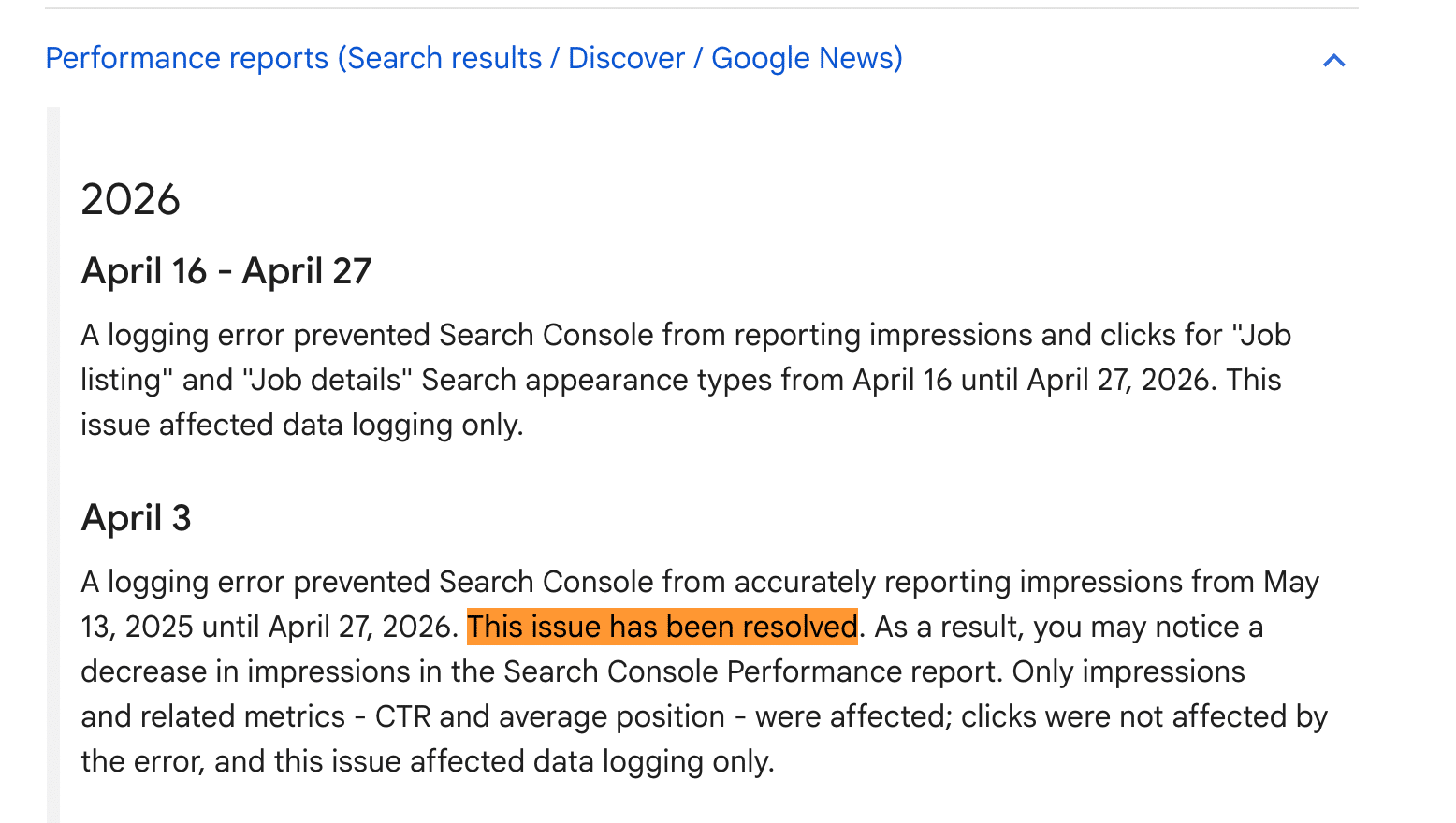
It feels like a moment of relief as Google recently announced a resolution to a longstanding data logging issue within Google Search Console. This glitch affected data between May 13, 2025, and April 27, 2026, spanning approximately 50 weeks. However, it’s important to note that while the root cause has been addressed, historical data from this period remains unfixed.
Google shared this update in a rather understated post, bringing light to a problem that many of us have been grappling with for quite some time. According to their post, “A logging error prevented Search Console from accurately reporting impressions from May 13, 2025, until April 27, 2026. This issue has been resolved.” It was a relief to hear, but also a bit frustrating knowing that impressions, CTR, and average position data were affected for such a significant period. Thankfully, clicks weren’t influenced by this error, which was some consolation.
As I sift through my Search Console data, I must remind myself of this anomaly, particularly when analyzing metrics from that problematic timeframe. The good news is that any data collected from this point forward should be accurate.
Further confirmation came from John Mueller on Bluesky, who reiterated that past data would not be retroactively corrected, but the issue has indeed been resolved going forward.
This development is crucial for all of us who rely heavily on precise data for SEO strategies. If your impressions appear lower and, consequently, your CTR and average position figures seem skewed during this period, this is likely why.
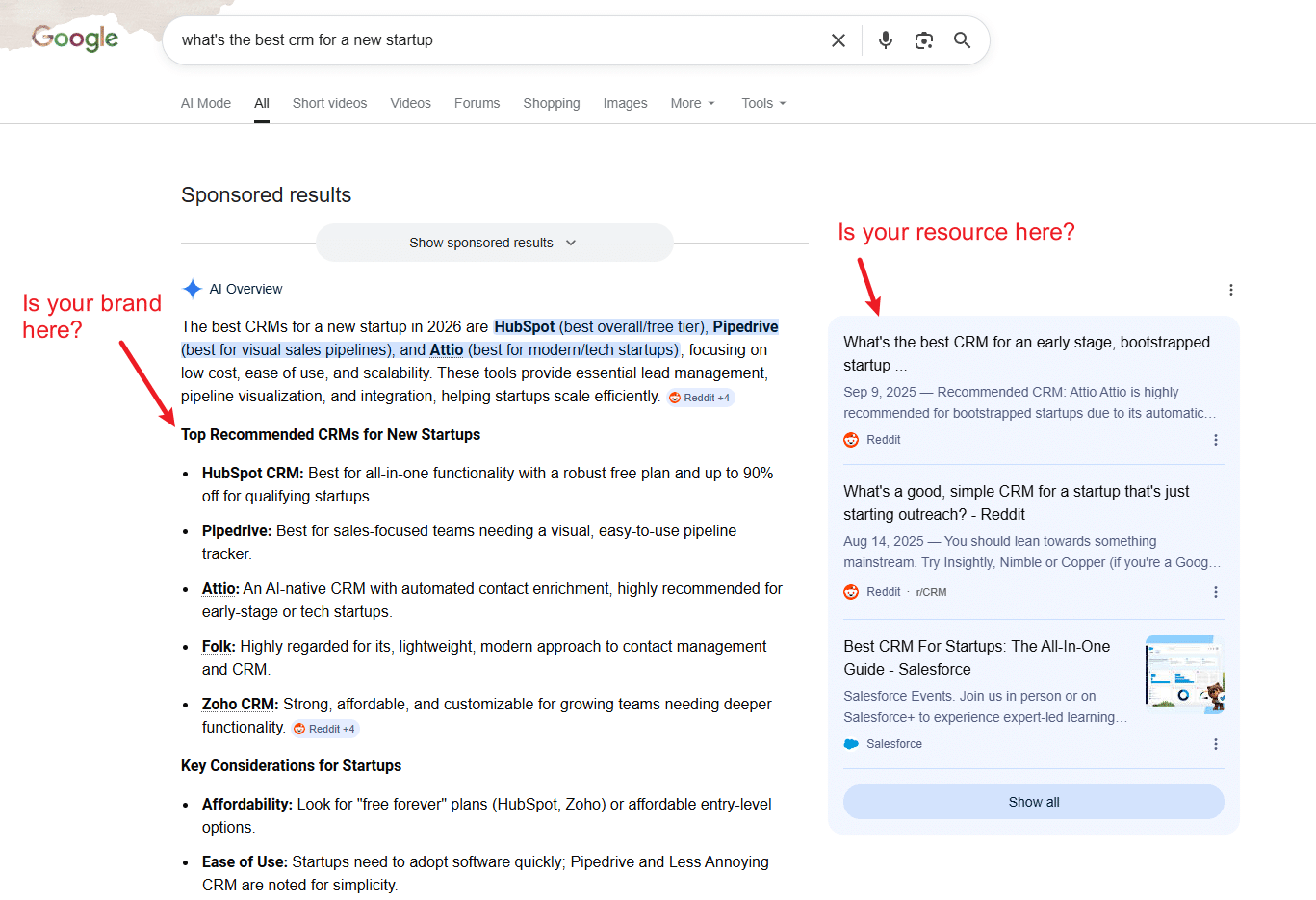
I’ve discovered a fascinating truth about search in the age of AI: brand authority often outshines topical authority. The landscape of search has shifted, and it’s time for us to adapt.
While topical authority remains a beloved concept among SEO consultants pitching content, brand authority holds the reins in today’s AI-driven search landscape. Marketers have long discussed brand authority, though it was often dismissed or left to brand teams post-sitemap adjustments.
AI’s emergence has upended the traditional approach, revealing underlying issues. Search is crucial for the global economy, and the industry’s marketing approach needs re-examination. More content doesn’t automatically confer authority. In fact, AI search champions brands gaining notable visibility, mentions, and real demand.
Too many SEOs overlook the reasons people choose, trust, and remember brands. In this new world of AI search, such ignorance stands out even more. That’s why brand authority prevails—but not in the way our typical SEO tools might suggest.
Previously, the meaning of topical authority was intended to highlight genuine expertise through useful work, citations from others, and a growing associated reputation. This builds your brand’s association with a topic, which in turn, creates authority and fosters brand development.
However, the industry often marketed topical authority commercially, emphasizing volume over value. Technical SEO became a niche, links were outsourced or repackaged, but content was the consistent agency engine.
Pre-AI, this made sense. Creating good content involved rigorous processes and offered substantial value, earning rankings and supporting commercial interests. In contrast, topical authority introduced the misguided idea that mere keyword coverage equated to expertise, diluting the concept’s original intent.
Another intriguing aspect of authority is understanding what others say about you, rather than solely focusing on self-published content. Google’s Jun Wu highlighted the importance of ‘mention information’—how search engines discern topics, identify sources, and map relationships.
Our modern term for this is brand co-occurrence. Being consistently mentioned by authoritative sites and communities solidifies your brand’s association with a topic, elevating market perception and authority.
Many might pitch the concept of topical authority as building a comprehensive keyword strategy, but actual authority requires originating valuable data and sharing insights that engage audiences and capture media attention.
The changing economic landscape of AI means that traditional advertising methods through content must evolve. With AI offering direct answers, the value of certain traditional SEO practices is diminishing. Users, like my AI-liking father, prefer quick, synthesized information over cumbersome web browsing.
The rise of AI citations in search metrics has become a focus, but they differ from authentic human endorsements. Real influence is reflected through human testimonies, where your brand is discussed, cited, and recommended.
If measuring brand authority, brand searches present a clearer indicator of growth. If more people search specifically for your brand, it signals rising demand and market presence—a more accurate reflection of impact than solely relying on AI citations.
Traditional SEO still plays a role, ensuring you’re found where it matters—be it in search rankings or marketplaces. Yet, brand authority distinctly drives recommendations, and AI search is starting to favor consolidated options, often mentioning specific brands and solutions.
The future echoes the demand for meaningful engagement and widespread brand visibility. Though SEO isn’t dead, a simplistic keyword-centric approach is fading. A holistic approach integrating positioning, PR, reviews, and content as interconnected elements is pivotal.
In an era where fitness and visibility are equal determinants of success, brands must excel in products and services while ensuring their market presence is robust and omnipresent. After all, brand authority is what truly wins, confirming that mediocrity no longer warrants attention.
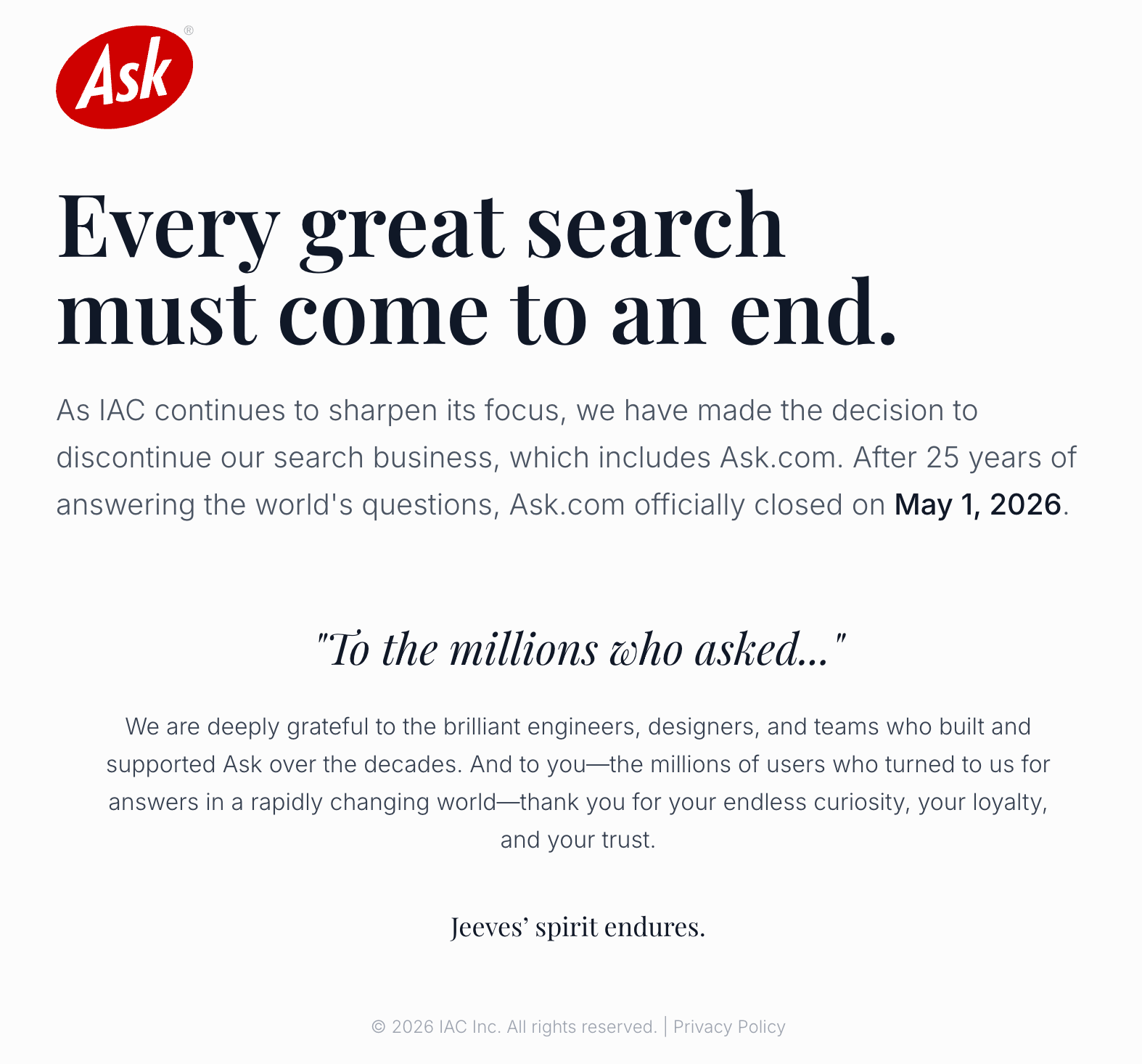
As someone who has been on the internet exploration journey for years, today’s news hits home. Ask.com, which many of us fondly remember as Ask Jeeves, officially closed down on May 1, 2026, after a remarkable 29 years of service. It launched on June 3, 1996, even before Google made its debut.
Upon visiting the now-closed Ask.com, we are greeted with a heartfelt farewell message that feels like a trip down memory lane:
Every great search must come to an end. As IAC continues to sharpen its focus, we have made the decision to discontinue our search business, which includes Ask.com. After 25 years of answering the world’s questions, Ask.com officially closed on May 1, 2026.
I can’t help but feel gratitude as they graciously acknowledge, “To the millions who asked…”. They expressed appreciation for the brilliant engineers and loyal users who have been a crucial part of their journey. And yes, Jeeves’ spirit indeed lives on.
For those of us who relied on this answer engine in its early days, Ask.com and the iconic Jeeves butler will always hold a special place. In a world now dominated by AI and competitive answer engines, it’s understandable why IAC, the parent company, decided to step back in such a challenging market.
Ask.com has left a significant impact on the search marketing industry, and saying goodbye is indeed bittersweet. Until we meet again in some digital form, dear Jeeves.
When I first heard about Google Analytics introducing their new Task Assistant, I was intrigued. This tool promises to be a game-changer for those of us who want to maximize our use of Google Analytics without needing deep technical know-how.
It’s exciting to see Google simplify such a complex product. Task Assistant is designed to help advertisers and analysts like me gain more value from our data effortlessly.
What’s New. With the rollout of Task Assistant, Google Analytics offers a guided workflow tool that surfaces tailored recommendations. This means improving property setup, data collection, and reporting is easier than ever.
How It Works. Located in the left-hand navigation, Task Assistant organizes recommendations into clear categories like connecting accounts and enhancing reporting. I can mark tasks as complete or skip items not aligning with my goals, making the setup more flexible.
Why We Care. Identifying gaps in tracking quickly helps ensure I’m working with reliable data. Task Assistant minimizes the risk of missed insights or inaccurate reporting, allowing for confident optimization of campaigns and budgets.
Between the Lines. Analytics platforms, as powerful as they are, can be underutilized due to poor configuration. I’m glad Google is turning setup into a step-by-step process rather than leaving it as a daunting manual audit.
The Bottom Line.Task Assistant is all about making Google Analytics more actionable. It guides users toward better data quality and effective measurement, all with less guesswork.
When I learned that Google’s Preferred Sources feature now supports all languages, not just English, I was thrilled. This exciting update means more people can tailor their news experience, regardless of the language they speak.
According to a recent post on Google’s blog, ‘Preferred Sources is now rolling out globally in all supported languages.’ This gives me, and everyone else, more control over the news we see on Search, allowing us to choose our preferred outlets to appear more frequently in Top Stories.
It’s fascinating to reflect on how this feature initially rolled out in December, but was limited to English. Now, it’s a comprehensive tool available globally, no matter the language.
Interesting Stats: Google shared some compelling data with this launch. For instance, readers are reportedly twice as likely to click on a site after marking it as a Preferred Source. Also, over 200,000 unique sites have already been selected by users—from local niche blogs to major global news platforms.
Preferred Sources: This feature lets me star my favorite publications in the Top Stories section of Google Search. By doing so, Google uses that interest to show more stories from those sources. I learned it started in beta back in June and was initially available in the U.S. and India by August, but now it’s part of a worldwide expansion.
How it Works: It’s simple! I just click the star icon next to the Top Stories header in my search results. This allows me to pick preferred sources, provided these sites are constantly updating their content.
Once selected, Google promises to showcase more updates from my favorite sites in Top Stories, provided they have fresh content relevant to my search.
For more detailed information, I can visit this page.
Why it Matters: In the competitive area of Google Search traffic, marking my site as a preferred source can make a significant impact. Google indicated these users are twice as likely to engage, which could help in driving more traffic to my site.
So, I’m adding the preferred source icon to encourage my audience to sign up. If you’re interested, you can make Search Engine Land a preferred source by clicking here.
For over two decades, I’ve witnessed backlinks as foundational to SEO. Google’s PageRank revolutionized search by using backlinks as proxies for trust.
Backlinks were more than just pathways; they were votes of confidence. The more votes you gathered from authoritative sources, the better your rankings soared.
But times have changed. As Google advanced, AI systems evolved, and the necessity for hyperlinks diminished as entity-based understanding gained ground.
Today, visibility isn’t solely dependent on links. It’s amplified by the broad range of signals signifying your brand’s mentions, citations, and trust across well-regarded platforms.
This shift sees search engines and AI prioritize these overarching signals.
AI’s Role in Evolving SEO
Modern AI models assess trust and expertise in unprecedented ways. They’ve reshaped authority, focusing less on backlinks and more on diverse digital signals.
AI can now:
Identify and relate entities online.
Interpret sentiment and context.
Spot artificial link patterns.
Gauge brand prominence sans hyperlinks.
Evaluate reputation from reviews and citations.
Integrate information across varying sources.
Mentions in respected publications, even link-free, enhance entity authority. Consistent expert citations affirm expertise. These are the signals forging a new era where authority becomes a rich network.
The Shift to Entity-First SEO
With Google’s move away from pure link signals, the notion of entities—people, brands, concepts—gains importance. Google elevates brands based on identity and conversation rather than just their backlink profile.
In essence, entity-first SEO involves mapping and understanding brand interactions and references across trusted sources.
An example: An outdoor brand with a modest backlink profile gained visibility in AI Overviews for “best hiking backpacks” due to mentions in Reddit discussions and YouTube reviews, illustrating real-world relevance sans hyperlinks.
If your brand consistently figures positively in related talks, it’s seen as relevant and trusted—characteristics essential for success.
Volume-focused link building loses ground as AI discerns unnatural patterns. Quality-driven, relevant links, coupled with PR signals, grow increasingly essential.
Editorial PR links from credible sources signal genuine credibility, like a trusted expert affirming a brand’s significance.
AI not only checks link presence but evaluates surrounding context, striving to reward the most authoritative entities.
Building Multi-Signal Authority
The potency of multi-signal authority lies in blending various signals. As the digital landscape evolves, quality shines over quantity.
AI prompts this evolution by advancing traditional, relevance-based links alongside diversified brand signals.
Strategic placements can yield:
Brand mentions affirming presence.
Citations validating expertise.
Positive sentiment enhancing trust.
Topical relevance and growth-enabling links.
Boosted Knowledge Graph associations.
Secondary coverage spreading influence.
Multi-signal authority offers AI the understanding that your brand is recognized, trusted, and worth conversation.
PR signals, albeit crucial, are but a fragment of the comprehensive authority ecosystem AI evaluates.
Decoding the New Authority Framework
Today, authority hinges on varied and consistent validation signals, akin to human assessment—through reputation and recognition.
It’s no longer just links. Authority encompasses:
Brand strength: Upward branded search and direct traffic echo real-world recognition.
Reputation signals: Trust reflected in reviews, citations, sentiments.
PR signals: News, interviews, industry mentions bolster relevance.
These interwoven signals forge a comprehensive authority profile, which AI recognizes. The dominating brands have the most impactful multi-signal authority footprint.
Brand Strength’s Quiet Influence
Brand strength silently prevails over other signals. Data reveals brands ranking in the top 25% for web mentions average far higher AI Overview citations than their counterparts.
This aligns with Ahrefs’ analysis of ~75,000 brands, underscoring branded web mentions and search volume as indicators of genuine brand presence.
Consider two fitness apps: one with extensive generic backlinks, another actively part of social and media conversations. The latter’s real-world engagement ensures consistent AI Overview visibility.
Leading brands in AI Overviews have robust brand presence supported by consistent links, mentions, and relevance.
Future Predictions for 2027 and Beyond
By 2027, link building evolves from a numbers focus to a confidence-driven model with new metrics like Share of Authority.
Here are my predictions:
Prediction 1: Visibility via “Share of Model” Metric
Strategies will shift towards “seeding” information in places AI relies on, moving away from mass low-tier blog outreach to user-chosen platforms like Reddit, which AI values.
Brands frequently appearing in AI training data will gain visibility, defining the new authority landscape.
Prediction 2: Brands as Primary News Sources
In AI-led ecosystems, proprietary data will emerge as critical, offering natural, highly trusted authority signals.
Data evolves from mere content to a powerful signal engine, enriching PR coverage, citations, and discussions.
Traditional link building remains vital, but data-driven assets are vital accelerants.
Prediction 3: Rising Value of Unlinked Mentions
While foundational, traditional links will gain strength from semantic context and relate directly to brand mentions enhancing entity strength.
Exploring AI’s Expanding Role in SEO
The off-page SEO future merges traditional link building with AI-driven signals recognizing links as just one part of a broader array AI processes.
Both remain essential: links for foundational relevance, AI for context, sentiment, and entity evaluation.
Links are the foundation. Signals construct the skyscraper.
I recently had the chance to dive into SE Visible, a tool that pairs quite well with SE Ranking. After thorough testing, I’m here to share my insights.
While SE Visible offers decent integration, it’s held back by its limited LLM coverage and lack of optimization features. I’ll explore these aspects and compare them to Profound.
If you’re considering this tool, join me as I break down its strengths, weaknesses, and how it stacks up against alternatives.
I’ve discovered that rankings alone no longer guarantee visibility in AI search. In today’s digital landscape, four key signals dictate whether a brand appears in AI-generated responses and how they’re portrayed.
Ranking and visibility have diverged. For years, SEO was all about securing that sweet spot on the SERPs, boosting visibility, clicks, and traffic. This connection is unraveling.
Earlier this year, Ahrefs reported that only 38% of pages featured in Google AI Overviews also ranked in the traditional top 10. Compare this to eight months prior when it was 76%, and you’ll see the shift.
The message is clear: a high rank doesn’t necessarily mean visibility.
Visibility in AI-generated responses hinges on inclusion and the portrayal of your brand upon inclusion, determined by a unique set of signals.
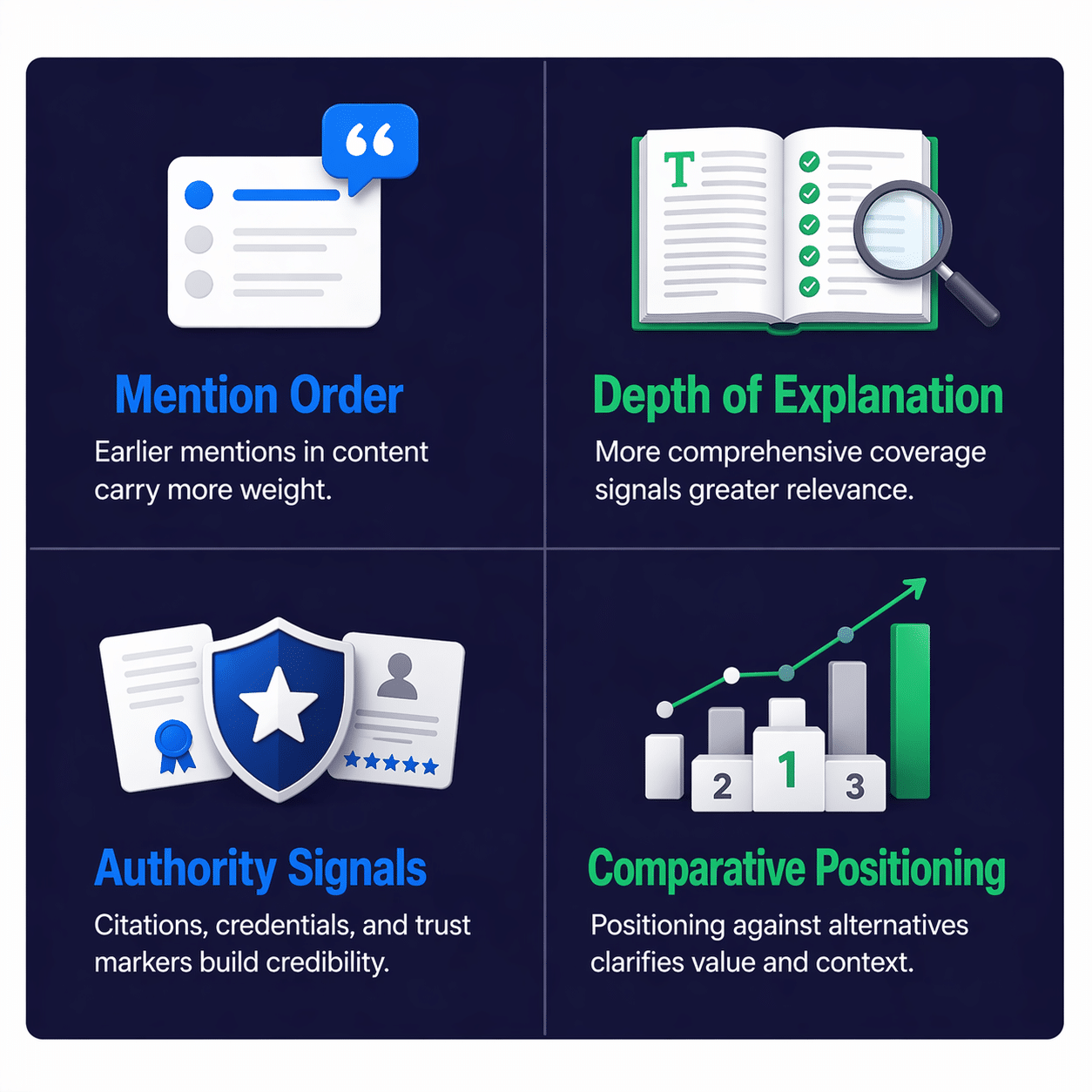
So, how exactly does visibility work within the realm of AI search? There are four critical signals I need to focus on:
Mention order.
Depth of explanation.
Authority signals.
Comparative positioning.
Let me dive deeper into them, starting with mention order.
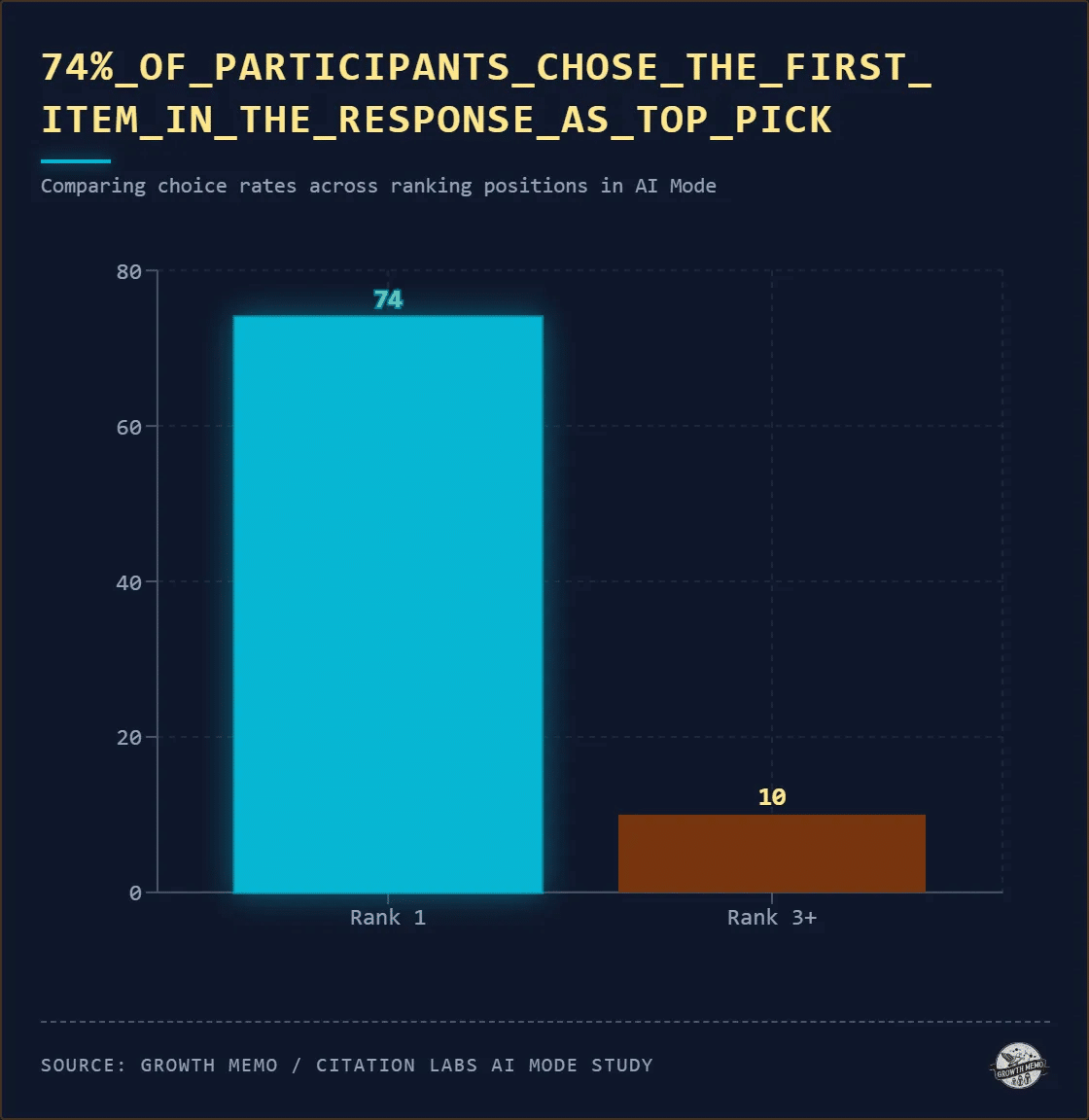
The order in which AI models list options is crucial. According to a study by Growth Memo and Citation Labs, a whopping 74% of users tend to go with the AI’s top suggestion.
Yet, 26% of users overturn the AI’s order if they recognize a brand they trust. This is quite a change from traditional search behavior. In AI Mode, most users accept the AI’s shortlist without further checks.
However, the mention order is unstable. SE Ranking’s research shows AI Mode only overlaps with itself 9.2% of the time when running the same query thrice, indicating variable sources and order.
Lesson learned: While mention order gives an edge, it’s not a sure thing. Brand recognition can surpass position.
Next, let’s explore the depth of explanation.
Not every mention is equal. Some brands earn only a sentence, while others get full paragraphs detailing their strengths and uniqueness.
This comes down to how much citation-worthy information AI systems have gathered about you.
When Semrush launched its AI Visibility Awards in December 2025, it reviewed over 2,500 prompts using ChatGPT and Google AI Mode. Category leaders like Samsung in consumer electronics didn’t just show up more—they received more in-depth mentions.
Challenger brands, like Logitech in gaming accessories, appeared too, but typically with shorter, focused mentions highlighting a single differentiator.
Pages that are comprehensive, answering “what is it,” “who uses it,” and “how to choose” in one place, rose to the top in AI citations.
Lesson learned: If AI systems only find sparse data on your brand, expect sparse mentions.
Third on the list: authority signals.
AI systems not only cite but also characterize sources by tone, indicating how much confidence they place in a brand’s authority.
HubSpot’s AEO Grader classifies brands as leaders, challengers, or niche players, labels influencing how AI conveys their authority.
Semrush’s data shows that brands identified as leaders exhibit less than 20% monthly volatility in AI share of voice, maintaining consistent authority.
Leaders are described using strong terms like “the industry standard,” while challengers are termed “gaining traction.”
Lesson learned: AI doesn’t just name-drop; it frames your reputation.
Finally, comparative positioning is akin to traditional rankings in AI answers—how you’re positioned among multiple brands.
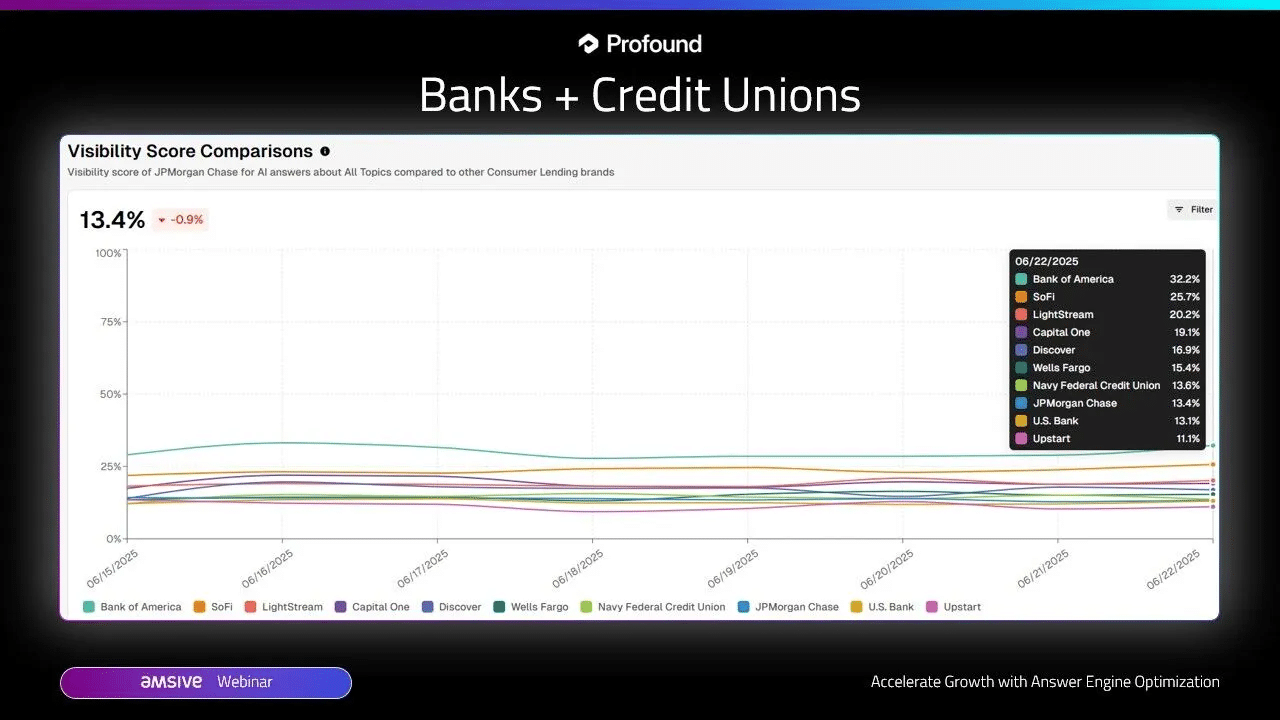
Amsive’s research demonstrates clear positioning hierarchies within sectors.
In banking, Bank of America leads, followed by SoFi and LightStream.
In healthcare, Mayo Clinic stands out significantly.
Kevin Indig’s research highlights how users self-select based on AI’s framing, regardless of actual capabilities.
Lesson learned: It’s not about being number one; it’s about owning a niche in AI’s mental map.
Traditional rankings’ correlation with AI visibility is minimal. The concept of query fan-out explains why visibility dropped so swiftly.
During an AI Overview, Google processes not just the top pages for a query but various sub-queries to synthesize a complete response.
This means your page might rank first for one query but may be overlooked if AI finds more relevant passages elsewhere.
Research shows Google’s Gemini 3 update altered approximately 42% of cited domains, making traditional rank positions less predictive.
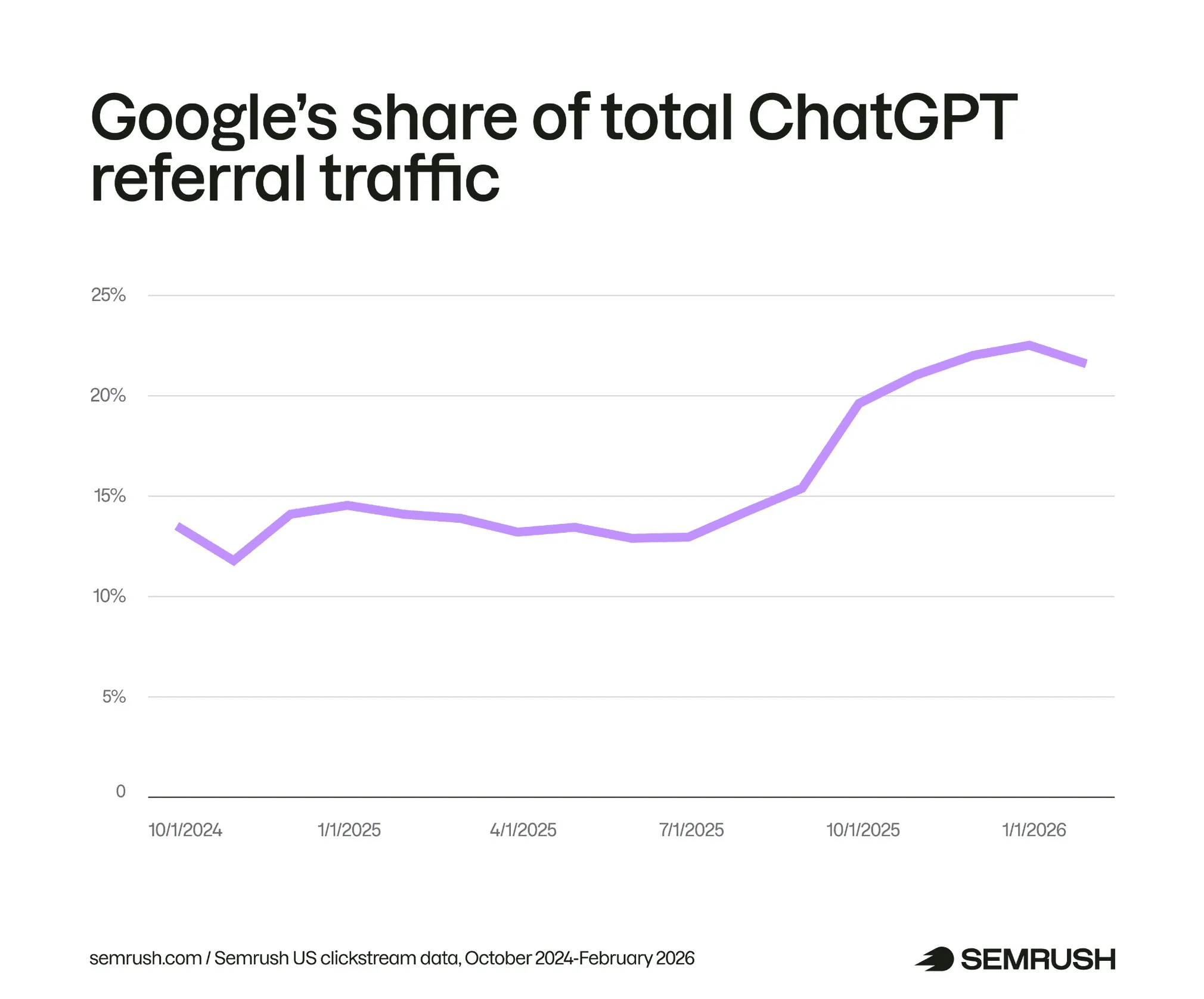
Where does AI traffic land? Interestingly, a substantial portion of ChatGPT traffic eventually ends up on Google. Users seek answers from ChatGPT, then confirm their findings on Google.
Most prompts to ChatGPT are too specific for traditional keywords, intensifying the shift.
So, how can I measure visibility in AI answers?
Track citation frequency to gauge how often your brand appears in AI answers.
Measure brand mention rate for category penetration.
Focus on recommendation rates, especially in B2B and high-consideration sectors.
Analyze sentiment and context of mentions to evaluate impact.
Citation position provides an edge, even if it’s not organic rank.
The 2026 measurement model demands dual tracking—traditional and AI-focused metrics for accurate visibility insights.
New tools have emerged for this purpose, complementing but not replacing traditional SEO tools.
For citation tracking, platforms like Profound and Peec AI keep tabs on cited URLs across AI responses.
For brand analysis, tools like Semrush’s AI Visibility Toolkit check mention frequency, portrayal, and recommendations.
For competitive positioning, Bluefish and HubSpot’s AEO Grader assess your brand’s AI categorization against competitors.
Traditional rank obsession persists, but visibility in AI requires a broader view with a distinct measurement model.
I recently realized that search engines, including those powered by AI, are not changing the ultimate goal—they’re raising the bar. Creating content that provides clear, in-depth answers with expertise is more important than ever.
The March 2026 core update from Google focused on surfacing relevant and satisfying content for users across all sites. This underscores a simple truth: people turn to Google for answers.
In our fast-paced, on-the-go lives, searchers want content that solves their problems, imparts new knowledge, or assists decision-making. If my content delivers, it thrives. Otherwise, no SEO trick will push it to page one or get it featured in AI Overviews.
How modern search systems surface helpful content
AI Overviews have grown from covering 6.49% of queries in January 2025 to 15.69% by November 2025, according to a Semrush study. Currently, they appear for 25-50% of searches, highlighting how search engines and LLMs are efficiently collaborating. It’s an exciting period for SEO professionals like me, eager to create content that aligns with user intent.
Techniques like retrieval-augmented generation (RAG) and query fan-out come to my aid, helping my useful content feature prominently in AI Overviews.
RAG empowers AI to source relevant information from multiple places before responding to a query, while query fan-out decomposes a search into related queries for a comprehensive response. These concepts underscore a shift in SEO, now focusing beyond keywords to genuinely satisfy user questions and intent.
Why this raises the bar for SEO in 2026 and beyond
Emerging systems are increasingly adept at filtering out thin, redundant content. Instead, Google’s focus on TurboQuant illustrates a push toward recognizing substantial, unique content that shares authentic experiences and original research. As SEOs, we must pivot toward creating content with true depth, clarity, and expertise.
Depth: No longer about word count, depth means addressing main and follow-up questions comprehensively.
Clarity: My audience is busy, seeking quick, understandable answers. The ability to scan and grasp information easily is key.
Expertise: I need to demonstrate real-world know-how and credibility that my audience can trust.
It’s refreshing to see that it’s no longer just about ticking SEO boxes. The emphasis on providing genuine value elevates what’s considered good SEO beyond core basics.
Why visibility matters more than clicks for local SEO
Small and service-based businesses depending on SEO-driven leads can apply these strategies, as success now hinges on visibility over clicks. AI platforms frequently recommend businesses without direct website links, shifting the narrative to maximize brand visibility online.
While tools exist to measure AI metrics, they can be costly. As Elizabeth Rule notes, measuring visibility is like gauging a wave with a ruler—hence the importance of open dialogue between stakeholders and SEO teams when defining success.
What ‘helpful content’ looks like in practice
Here are five strategies I utilize for creating genuinely helpful content:
1. Answer follow-up questions
I explore overarching queries and anticipate subsequent questions my audience might have. The People Also Ask section on SERP is a valuable resource, offering new angles and questions to address in my content.
2. Show expertise and experience
By sharing my specialized knowledge and firsthand insights, I build trust and connect with my audience. This approach aligns with the principles laid out in the helpful content update of 2022.
3. Structure content clearly
Recognizing that readers often skim, I employ clear structures that leverage headings and bullet points to facilitate quick and easy information retrieval, crucial for both mobile and desktop users.
4. Be authentic
Authenticity resonates best with my audience. Avoiding fluff and filler, I aim to deliver concise, relevant content right to the point of the user’s query.
5. Ask ‘who, what, and how?’ about your content
I reflect on semantic triples rooted in relevance engineering to provide structure and substance. Who am I reaching, what needs do they have, and how can I satisfy those requirements?
As the only narrator of my story, I’m in a unique position to explain my processes and convey why my business or brand is impactful and worthwhile.
Helpfulness is the competitive edge
The cornerstone of an effective SEO strategy persists through each core update: Create truly helpful content. Focus on resolving audience issues, answering queries completely, and leveraging personal expertise to foster engagement.
In a landscape driven by AI and sophisticated retrieval systems, thin, generic content falls by the wayside. If I align my content with the genuine needs of searchers, we soar to the forefront, no trickery required.
I’ve gathered insights into the top B2B content marketing agencies of 2026, evaluating them based on these seven crucial factors:
Year Established: A longer tenure often correlates with an ability to produce top-notch work and adapt to economic changes.
Founder Led: Agencies still led by their founders tend to maintain their original commitment to excellence.
Leadership Experience Score: We assessed the experience of each agency’s top executives in content marketing, scoring them from 1-5 based on online bios and LinkedIn profiles.
Average Reviews: We averaged client reviews from B2B businesses to gauge satisfaction.
Median Employee Tenure: Longer employee tenure indicates strong institutional knowledge and better results.
Media References: We estimated how often each agency’s content is cited by media or high-authority publishers.
Notable Clients: Past work with high-profile clients showcases potential for success.
Approach to Content Marketing: We value agencies focusing on quality content and long-term ROI.
Below, I’ve presented our findings in a detailed table.
The Top B2B Content Marketing Agencies of 2026
I’ve detailed each agency’s strengths and provided insights into their services, from expert leadership to standout client experiences. Dive in to explore how these agencies can transform B2B marketing strategies.