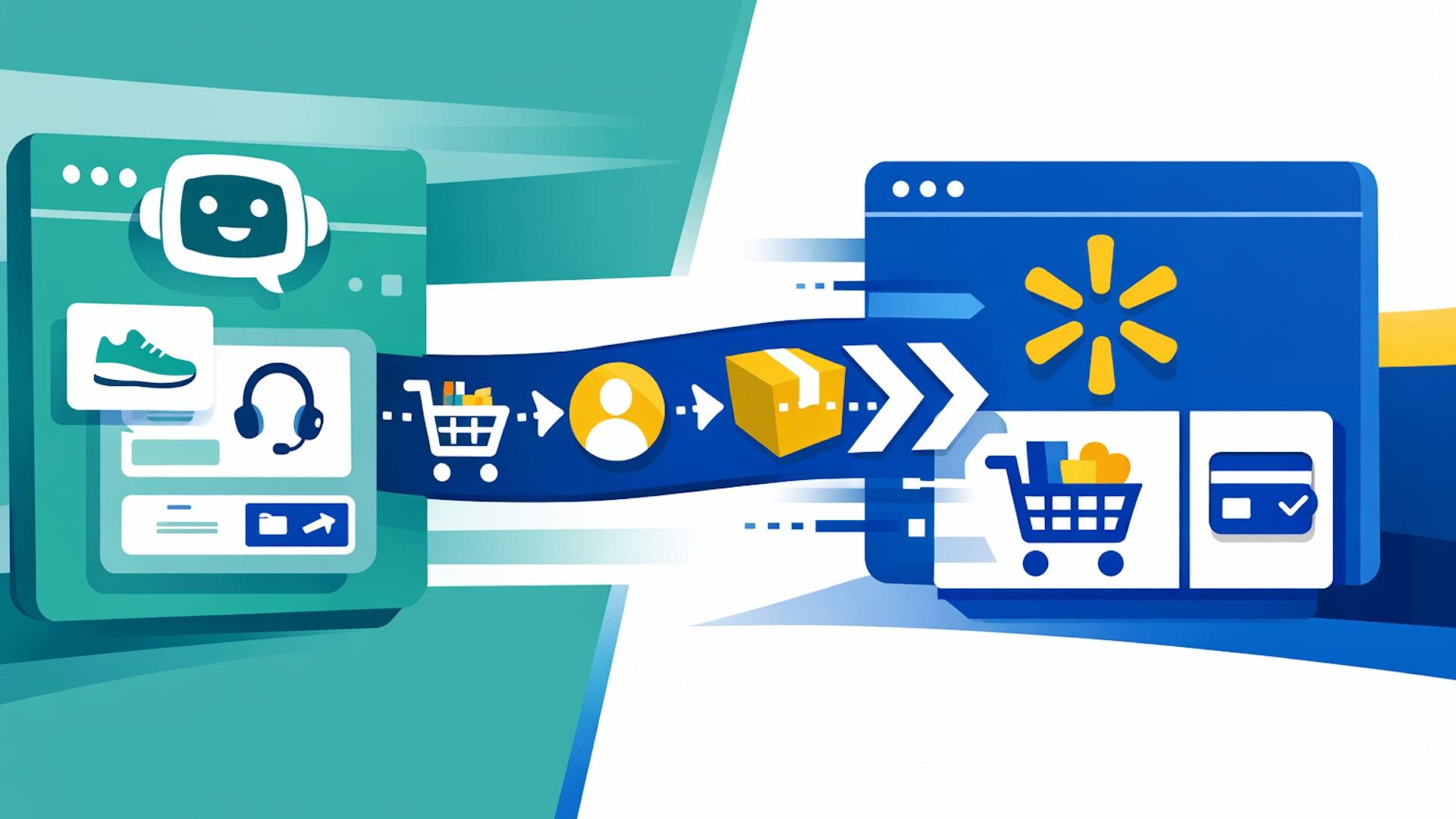
When I first heard about Walmart’s experiment with ChatGPT’s Instant Checkout, I was intrigued. But after testing 200,000 items, Walmart discovered that conversions through this method were three times lower compared to their website.
Why This Matters: This experiment highlights an important point: traditional shopping environments still hold the crown when it comes to conversions. Even in a world dominated by AI, guiding users to owned environments proves more effective.
The Experiment Details: Starting last November, Walmart introduced around 200,000 products available for purchase directly inside ChatGPT through OpenAI’s Instant Checkout. The goal was to let users buy items without ever leaving ChatGPT.
Daniel Danker, Walmart’s EVP of Product and Design, revealed that these purchases had a conversion rate one-third lower than similar transactions on their website. He described the experience as “unsatisfying,” which prompted Walmart to reconsider their approach.
Farewell to Instant Checkout: Originally, Instant Checkout aimed to complete transactions within ChatGPT. However, OpenAI recently confirmed plans to phase it out, leaning towards merchant-handled app checkouts.
Changes on the Horizon: Walmart plans to integrate its own chatbot, Sparky, within ChatGPT. This will allow users to log into Walmart’s system, sync their carts across platforms, and finalize purchases seamlessly.
A similar integration with Google Gemini is expected next month, broadening Walmart’s technological reach.
The WIRED Report: For those interested in the comprehensive story, WIRED provides further insights into how Walmart and OpenAI are revolutionizing agentic shopping (subscription required).
As I look back on 2025, it’s astonishing to see the AI search traffic growth leap by an impressive 180% year-over-year. I’m diving into the data to better understand how this impacts our visibility strategies. We’ll explore insights on ChatGPT, Gemini, Perplexity, and Claude usage trends in this review.
With AI technologies rapidly advancing, I’ve noticed how they continue to reshape how we think about search and brand visibility. The increased use of AI-powered tools signifies a pivotal shift in the way we approach digital marketing strategies.
In 2025, ChatGPT saw a remarkable surge in use, closely followed by interest in platforms like Gemini and Claude. This data is crucial as we plan for future visibility tactics, ensuring that our brand remains competitive in an ever-evolving digital landscape.
How does this data affect your brand’s approach? I believe understanding and leveraging these trends will be key to optimizing AI-driven search capabilities and visibility while crafting more personalized and effective content strategies.
I’ve been following the latest updates from OpenAI, and they recently made some significant changes to their privacy policy, especially with the introduction of ads in ChatGPT. These updates are designed to allow advertisers to run personalized ads while ensuring that our chats remain private and secure.
OpenAI shared these updates with ChatGPT users, detailing how ads will function within the platform and clarifying what data is accessible to advertisers. It’s a refreshing assurance that our personal interactions remain confidential.
Why this matters to me. Privacy is paramount, and OpenAI emphasizes that personal chats and histories remain shielded from advertisers. They utilize anonymized engagement signals for ad personalization, ensuring advertisers can target relevant users without accessing sensitive information.
This method allows advertisers to evaluate the performance of their ads within a privacy-first framework, fostering user trust.
Ads in ChatGPT For users like me on Free and Go plans, ads might start appearing, but if you opt for paid tiers like Plus, Pro, Enterprise, Business, and Education, you can enjoy an ad-free experience. OpenAI promises clear labeling and separation of ads from chatbot responses.
Importantly, the content generated by ChatGPT remains unbiased and unaffected by these advertisements.
How ad targeting is handled. OpenAI uses in-platform signals such as ad interactions to personalize ads, but advertisers do not get access to our conversations, chat histories, or personal information.
Advertisers receive only aggregated metrics like total views or clicks, ensuring our personal data stays protected.
Additional privacy updates A new feature allows for optional contact syncing, helping us connect with friends who also use OpenAI services. It’s up to us whether to enable this feature.
They also provided more transparency on data storage durations, processing methods, and user control options, helping us understand our data management better.
Safety and product enhancements. The update encompasses new safety tools and age prediction systems aimed at ensuring a safer environment for teenagers. Documentation for new features like Atlas, Sora 2, and parental controls for teen accounts has also been included.
The bottom line. With the expansion of advertising in ChatGPT, OpenAI is committed to maintaining strict boundaries concerning user privacy, offering advertisers valuable insights without infringing on personal conversations or data.
This update was first spotted by Paid Media expert Arpan Banerjee, who shared insights on LinkedIn. It’s a promising move towards privacy-centric advertising in AI-powered platforms.
I recently came across an intriguing study that shows AI tools are now responsible for generating 45 billion monthly sessions globally. This accounts for an impressive 56% of all search engine activity, according to Graphite.io CEO Ethan Smith.
The analysis combines web and mobile app usage across leading AI platforms and suggests that AI activity matches 56% of global search use and 34% in the U.S.
The surge is particularly evident in mobile applications like ChatGPT, Gemini, Perplexity, Grok, and Claude.
Why it matters: AI is broadening the horizons of discovery, rather than limiting the demand for search. Since 2023, combined usage across search engines and AI assistants has increased by 26% globally. It’s clear that having visibility in both LLMs and traditional rankings is crucial.
Key insights: The report dives into the performance of the top five LLM products—ChatGPT, Gemini, Perplexity, Grok, and Claude—and compares them to the biggest search engines. Here are some standout insights:
AI platforms generate 45 billion monthly sessions worldwide.
Within the U.S., AI accounts for roughly 5.4 billion monthly sessions.
An astounding 83% of global AI usage takes place within mobile apps (75% in the U.S.).
ChatGPT is leading the charge, representing 89% of AI sessions globally.
When looking at search-like prompts, AI usage constitutes 28% of the global search and 17% within the U.S.
The report leaves out prompts in the “doing” or “expressing” categories. According to OpenAI, around 52% of prompts focus on seeking information, akin to traditional search queries.
Reading between the lines: Most forecasts comparing AI and search focus only on website traffic, often just Google.com and ChatGPT site visits. This approach overlooks much of AI’s impact.
The research suggests these comparisons undervalue AI activity by a factor of 4-5 times because a significant chunk occurs on mobile apps.
The analysis takes into account various LLMs and search engines, rather than only comparing Google and ChatGPT.
What to keep an eye on: Google remains a dominant force in discovery, but the report estimates its share of search-related activity has declined from 89% in 2023 to 71% by the fourth quarter of 2025.
While global AI usage seems stabilized since July 2025, the U.S. usage is still on a rapid climb—up about 300% year over year by December 2025.
I’ve been keeping an eye on the latest developments in AI advertising, and it’s time to prepare for something big: ChatGPT ads are on the horizon. As consumers shift towards shopping through AI prompts, ChatGPT could potentially rival search as a powerful demand-capture channel, leading to a redirection of ad budgets.
Recently, OpenAI began testing ads in ChatGPT for a limited group of U.S. users, clearly marking these placements as sponsored content. Based on the platform’s internal dynamics, it won’t be long before this feature becomes widely available.
As advertisers, we have a unique opportunity to tap into a fresh demand-capture channel. However, it’s crucial to approach this space with clear expectations and understanding.
For ChatGPT advertising to truly succeed, consumer behaviors will need to evolve. And even if they do, remember that ChatGPT won’t expand the market but rather, redistribute it.
Why ChatGPT is Embracing Ads
It’s no shock that ChatGPT is moving towards advertising. Running an LLM query is estimated to be ten times the cost of a simple search query. With users generating 2.5 billion prompts daily, expenses pile up swiftly.
The core difference here isn’t just a model shift; it’s the data landscape. Over the years, users have fed personal information into ChatGPT, giving it insights unmatched by traditional advertising tools. The burning question is how ChatGPT will use this data to target its users effectively.
Advertisements have traditionally relied on repetition to generate demand, whereas search meets buyers with intent. ChatGPT might forge a similar path, equipped with more user context.
Imagine this: asking which security camera works with a certain system and receiving an informed answer and purchase link because the platform already knows about your existing setup.
Should this happen, ChatGPT could be the first new demand-capture channel since Google’s PPC ads launched two decades ago. Yet, obstacles remain.
Today’s AI queries largely lack buying intent, serving more informational needs. When buying happens, the conversion tracking might fall short due to users completing purchases on platforms like Amazon or Google after doing their research on ChatGPT.
Don’t be discouraged; such challenges are surmountable. Google’s journey from a homework help tool to shopping powerhouse wasn’t overnight. Likewise, ChatGPT will need time to educate consumers about shopping through AI.
While a brand-new demand-capture platform is exciting, have realistic expectations about its potential.
Market Share Reality Check
Despite the capabilities of AI, it won’t expand the advertising marketplace. ChatGPT ads won’t magically bring a wave of new consumers.
Instead, it will capture pieces of the existing market shared by Google, Meta, and Amazon. It’s more about shifting budgets rather than expanding them.
Competition will be fierce, particularly with Google’s AI platform, Gemini, presenting a formidable challenge. Market consolidation seems inevitable as AI races towards profitability.
The Differentiator: Hyper-Personalization
AI’s true edge might be in hyper-personalization. With their vast knowledge of user preferences, these platforms can deliver perfectly tailored recommendations.
This feature could make AI incomparable, offering personalized results seamlessly. However, this comes with risk, as hyper-personalization might feel invasive to some users.
If AI can maintain trust and avoid crossing privacy boundaries, its personalized convenience will likely be favored by most.
Steps to Take Now
While widespread ChatGPT advertising is still on the horizon, preparation is key. Here’s how to get ahead:
Align on Measurement: Consider research-heavy metrics and assisted conversions.
Optimize Mobile UX: Ensure a smooth, fast purchasing experience to avoid loss in demand capture.
Plan Early Tests: Testing carries risks but can provide an early competitive edge.
Being strategic now will set the stage for success when ChatGPT advertising becomes fully operational.
If your shopping plan starts and ends with getting products into a native ChatGPT checkout, it is aimed at a moving target. The more durable opportunity is to help ChatGPT understand your products, select them for the right shopping questions, and send an informed buyer into a purchase path that works.
Treat ChatGPT as a decision channel, not merely a checkout
A shopper rarely begins with your product identifier. They begin with a constraint: a budget, use case, compatibility requirement, delivery concern, size, material, feature, or reason another option did not work. ChatGPT can influence which products enter the shortlist before the shopper reaches a retailer.
Build around three separate jobs:
Eligibility: Give AI systems enough accurate product information to determine when an item fits the request.
Selection: Supply clear evidence, limitations, comparisons, and policies that help the shopper choose among plausible options.
Conversion: Preserve the selected product, variant, price, and context when the shopper moves to your site or connected app.
Do not combine these jobs into a single metric. A product can be recommended but lose the sale during the handoff. It can receive qualified visits but fail because the product page contradicts the information used during discovery. It can also convert well once visited yet remain absent from relevant AI answers because its differentiators are vague or inaccessible.
Use a measurement ladder instead. Monitor whether your products appear for a stable set of relevant shopping questions. Track identifiable traffic from AI surfaces when a referrer, campaign parameter, or app link survives the handoff. Measure product-detail views, variant selections, add-to-cart actions, checkout starts, and purchases. Add a post-purchase discovery question if your analytics cannot observe the complete journey. Keep those signals separate so that a weak checkout does not get mistaken for weak discovery.
Build a product truth layer before creating more content
AI shopping optimization breaks when the same product has different facts across its page, structured data, feed, app, and checkout. A persuasive description cannot compensate for conflicting prices, ambiguous variants, or stale availability. Establish one operational product record and make every public representation inherit from it.
For each product and variant, maintain the fields a buyer actually needs to make a decision:
A stable product identifier, variant identifier, canonical URL, and exact product name.
Brand, category, intended use, defining features, dimensions, materials, compatibility, and other category-specific attributes.
Current price, currency, availability, condition, and a clear relationship between the parent product and its variants.
Images that correspond to the selected variant rather than a generic family image.
Shipping scope, fulfillment limitations, return conditions, warranty terms, and any purchase restrictions that can change the decision.
Evidence for material claims, with unsupported superlatives and vague labels removed.
Use Product and Offer JSON-LD to represent applicable facts in a machine-readable form, but treat markup as a copy of the truth rather than a separate marketing layer. The name, price, currency, availability, URL, image, brand, SKU, and offer details in the markup should agree with the visible page. If a rating, price range, or availability claim is not supported on the page, do not manufacture it in structured data.
JSON-LD is also not an inclusion switch for ChatGPT. It reduces ambiguity and gives machines a cleaner representation of the page; it does not guarantee that a product will be discovered, recommended, or ranked. Visible product copy still needs to explain fit, tradeoffs, and purchase conditions in language a shopper can understand.
Before expanding the work, run a sampled audit that compares the visible page, rendered JSON-LD, feed output, app view, cart, and checkout. The release gate should be simple: no sampled price, currency, availability, product identity, or variant mismatch. If you cannot meet that gate, adding more discovery content will amplify unreliable information.
Create pages around shopping constraints, not keyword permutations
A conventional product page often describes what an item is without explaining when someone should choose it. ChatGPT shopping questions tend to expose that gap because the user can combine several conditions in one request. Your content needs to resolve those conditions explicitly.
Build a question map from the language already present in customer support, on-site search, product reviews, returns, sales conversations, and merchandising filters. Group the questions by decision type:
Fit: Who is this product for, and when is another option more suitable?
Compatibility: What systems, sizes, accessories, materials, environments, or use cases does it support?
Tradeoffs: What does the buyer gain, and what must they accept in exchange?
Comparison: Which factual criteria distinguish this item from the closest alternatives?
Purchase conditions: What will shipping, setup, returns, replacement, or ongoing use require?
Map each question to the most appropriate page instead of forcing every answer into the product description. Put item-specific facts on the product page. Use category pages to explain selection criteria. Use comparison pages when buyers repeatedly choose between named options. Use support content for setup and compatibility details, then link it directly from the commercial page.
On a product page, answer the decision in a useful order: state the best-fit use case, show the facts supporting that fit, disclose meaningful limitations, explain the available variants, and present the purchase conditions. A clear not-suitable-for statement is often more useful than another paragraph of universal claims. It helps an AI system and a human buyer avoid a recommendation that will produce a return or a poor experience.
Comparison content should define the decision rule before declaring a winner. If the correct choice changes with budget, environment, compatibility, or desired feature, say so. Do not create a false universal ranking merely to target a best-product query. A conditional answer is more accurate and more reusable across the specific prompts shoppers actually ask.
Keep decisive facts in visible HTML. Structured data can reinforce those facts, but it should not contain essential claims that a shopper cannot verify on the page. The same principle applies to FAQs: publish them when they answer recurring purchase questions, not as a container for hidden keyword variants.
Make the external handoff trustworthy and measurable
The handoff is now a core part of ChatGPT shopping strategy. If discovery occurs in an AI conversation and the purchase occurs in a retailer app or site, any lost product context creates friction at the point of highest intent.
Resolve links to the exact product and selected variant whenever the originating surface provides that context. Show the same name, image, price, availability, and offer conditions the shopper just encountered. Keep return and shipping information easy to find before checkout. Avoid sending a buyer to a category page where they must reconstruct the selection from scratch.
Trust matters alongside technical capability. Consumers are accustomed to familiar purchase processes such as Apple Pay, Google Wallet, and Amazon. An external checkout is not automatically a strategic failure if it gives the buyer a recognizable, reliable place to complete the transaction. The failure is an external handoff that changes the offer, loses the variant, hides important terms, or cannot be measured.
Instrument the journey with a shared product and variant identifier across the landing view, variant selection, add-to-cart, checkout start, and purchase events. Add campaign parameters to links you control, but do not depend on referrer data alone. App transitions and privacy controls can interrupt the chain. Use session-level analytics, transaction data, and a customer-reported discovery field to create a more defensible view.
Run a narrow pilot before rebuilding your commerce stack:
Select a category in which buyers ask meaningful comparison or compatibility questions.
Audit the product truth layer and correct disagreements across pages, schema, feeds, apps, carts, and checkout.
Create or revise content for the real constraints that determine product fit.
Test every discovery-to-product link, including variant resolution, offer consistency, mobile behavior, and return paths.
Record baseline discovery, referral, engagement, cart, checkout, and purchase signals before judging the pilot.
Review failed recommendations and abandoned handoffs as separate problems, then fix the layer responsible for each one.
Expand only when the pilot can answer three operational questions: Did the right products appear for the right constraints? Did the landing experience preserve what the shopper selected? Did qualified AI-led visits produce downstream commercial actions? If one answer is unclear, improve its measurement before scaling.
Key takeaways
Optimize first for accurate product discovery and selection; native ChatGPT checkout is not the only route to value.
Separate eligibility, selection, and conversion so you can locate the actual failure in the journey.
Create one product truth layer and keep visible pages, JSON-LD, feeds, apps, carts, and checkout consistent.
Answer fit, compatibility, tradeoff, comparison, and purchase-condition questions in visible content.
Treat an external checkout as a designed handoff, preserving the exact product, variant, offer, and measurement context.
Pilot connected commerce narrowly and expand only after catalog accuracy, customer trust, and attribution are working together.
Start with a narrow product category and inspect the journey from a constrained shopping question through the completed order. Fix the first point where product truth, decision support, or handoff context breaks. That work will remain useful whether ChatGPT sends the transaction to your site, a connected app, or a future commerce protocol.
If you’re trying to get a product into ChatGPT’s shopping carousel, start by identifying which part of the system is failing. A purchase-oriented prompt must first activate a shopping response. Only then does product sourcing determine which items appear.
That gives you two separate jobs: test the prompts that open the shopping experience, then improve product visibility in the systems supplying the carousel. Treating both jobs as one leads to wasted content changes, misleading screenshots, and rankings that never translate into inclusion.
Separate the shopping trigger from the product source
Once shopping activates, a different process decides what fills the carousel. Across more than 40,000 observed carousel products, 83% could be tied to Google Shopping through shopping query fan-outs. Those figures describe different populations, so don’t multiply them or treat product sourcing share as the probability that an arbitrary prompt will show shopping.
Layer
Question to answer
What to measure
Trigger
Does this exact prompt activate shopping?
Shopping response present or absent, followed by a next-day retest
Sourcing
Which product system appears to supply the carousel?
Carousel overlap with Google Shopping results for related queries
Selection
Why does one eligible product appear instead of another?
Google Shopping position, product-data consistency, and unexplained selection gaps
This separation also explains why a conventional SEO win may not produce a carousel win. Shopping fan-outs appear to use a distinct retrieval path from standard search fan-outs. Your category page can perform well as an informational result while your products remain weak or absent in the shopping pipeline.
Test shopping intent as a matrix, not a magic keyword
There is no supported universal phrase that forces ChatGPT to shop. Build a prompt matrix around the purchase decisions your customers actually make. The templates below are experimental cells, not guaranteed triggers:
Category discovery: “best [category] for [use case]”
Budget constraint: “best [category] under [budget]”
Feature constraint: “[category] with [feature] for [audience or situation]”
Product comparison: “[product A] vs [product B] for [use case]”
Replacement search: “alternative to [product] with [constraint]”
Exact-product shopping: “where can I buy [brand, model, and variant]?”
Build the first version from language in onsite searches, support questions, sales conversations, and product reviews. Preserve the customer’s wording instead of converting every query into polished SEO language. You are trying to model a real buying conversation.
Run each prompt in a clean conversation and record the exact wording. Change one element at a time: the use case, constraint, category, product, or comparison. If you change several elements together, a new carousel won’t tell you which change mattered.
Internal shopping fan-outs tend to be shorter and more item-specific than ordinary search fan-outs. Do not confuse those internal retrieval queries with the user’s full prompt. Copying a conversational prompt word for word into product titles is therefore a weak strategy. Make the product easy to identify for concise category, model, feature, and variant queries instead.
When a prompt activates shopping, repeat it unchanged the following day. A previously successful trigger had an 83% chance of triggering again on the next day, which makes short-term retesting useful but does not make the behavior permanent. Prompt-level tracking is more informative than a broad label such as “laptops trigger shopping” because two superficially similar requests can behave differently.
Use trigger testing to map demand, not to promise a user-interface outcome. You can create pages that answer a purchase question clearly, but no wording change on your site can guarantee that ChatGPT will activate its shopping experience for someone else’s prompt.
Treat Google Shopping visibility as a distribution requirement
Google Shopping is the practical starting point once you have confirmed that a target prompt can trigger a carousel. In the observed matches, almost 84% appeared within Google’s top 20 organic shopping positions. Only 0.16% of products were exclusive matches with Bing, making Bing-only optimization a poor first response to a missing ChatGPT product.
The word “organic” matters. These observations do not establish that buying Google Shopping ads buys placement in ChatGPT. Paid campaign performance and organic product visibility should remain separate measurements unless you have evidence connecting them in your own results.
Audit the distribution layer in this order:
Confirm that the exact product and variant are visible in Google Shopping for the market you are testing. A neighboring model or a different retailer’s offer does not establish visibility for yours.
Search with concise item and attribute combinations related to the target prompt. These are better proxies for item-specific fan-outs than the entire conversational question.
Record the product’s position for each proxy query. Visibility within the top 20 is a useful diagnostic benchmark because most observed matches came from that range, but it is not a guarantee of ChatGPT inclusion.
Check that the product feed and landing page agree on brand, model, variant, price, availability, and the attributes that distinguish the item. Conflicting facts make the offer harder to identify reliably.
Make the product title specific enough to separate one offer from another. Include meaningful model and variant information, but do not turn the title into a list of every possible query.
Recheck the live product page after feed changes. A corrected feed paired with stale or contradictory page content leaves the underlying identity problem unresolved.
Product structured data belongs in this consistency work. Use Product schema to express the same facts that users and shopping systems see on the page. However, no direct role for JSON-LD as a ChatGPT shopping trigger was demonstrated here. Schema is machine-readable hygiene, not a switch that forces carousel inclusion.
Rank also does not explain every selection. If a product is consistently visible for relevant Google Shopping queries but remains absent from triggered carousels, examine context around the item: whether the use case fits, whether the selected variant matches the constraint, and whether product sentiment may differ from competing choices. Sentiment is a hypothesis to test, not a proven ranking factor, so address genuine reputation or product issues rather than manufacturing reviews or mentions.
Build monitoring that survives model changes
A single carousel screenshot is evidence of one response, not durable visibility. Trigger behavior can persist from one day to the next, yet model updates have coincided with overnight resets. When the model or shopping experience changes, rebuild the baseline instead of comparing the new state with an old experiment as though nothing changed.
Keep one row for every exact prompt and record:
The complete prompt, including constraints and product names.
The intent family, such as category discovery, comparison, replacement, or exact-product lookup.
Whether shopping activated.
Whether the same prompt activated shopping on the following day.
The products and retailers shown, in their displayed order.
Whether your product appeared and whether the correct variant was shown.
Your approximate Google Shopping position for the related short, item-specific queries.
Any conflicting price, availability, model, or variant information.
The model or interface state visible during the test, especially when a broad change appears across many prompts.
Calculate each metric with the right denominator. Shopping activation rate is the share of tested prompts that produced shopping. Brand inclusion rate is the share of triggered carousels containing your product. Next-day persistence is the share of successful triggers that remained successful when retested. Keeping those rates separate tells you whether the problem is demand activation, sourcing, or selection.
Classify the failure before changing anything
No shopping response: work on the trigger test. Try a more explicit buying task or a single meaningful constraint, while preserving the original prompt as your control.
Shopping appears, but your product is weak in Google Shopping: fix product distribution, data quality, and query-level visibility before changing editorial content.
Your product appears with the wrong facts or variant: reconcile the feed, retailer offer, landing page, and structured data.
Your product ranks strongly in relevant shopping results but remains absent: investigate selection context, product fit, and reputation as hypotheses. Do not assume rank alone guarantees inclusion.
Many previously stable prompts change together: mark a new baseline and rerun the full prompt set. The trigger system may have changed, so isolated page edits are unlikely to explain the pattern.
This diagnostic order prevents the most common strategic error: editing content when the prompt never triggered shopping, or rewriting schema when the product simply lacked competitive Google Shopping visibility.
Key takeaways
ChatGPT shopping visibility has at least two distinct gates: the prompt must trigger shopping, and the sourcing pipeline must select the product.
Shopping activated for fewer than 10% of tracked prompts, so measure exact purchase-intent prompts instead of assuming every commercial query opens a carousel.
A successful trigger is often repeatable the next day, but model changes can reset the pattern. Retest after any broad shift.
Google Shopping is the main sourcing priority supported by current observations: 83% of analyzed carousel products could be tied to it, and most matching products appeared in its top 20 organic shopping positions.
Neither paid Shopping ads nor Product schema has been established as a direct route into ChatGPT carousels. Keep product data consistent, but don’t treat either as a guaranteed trigger.
Measure trigger rate, brand inclusion, next-day persistence, and Google Shopping visibility separately. The first failing metric tells you where to work.
Start with the purchase questions your customers already ask. Establish whether each one activates shopping, inspect the sourcing layer only after it does, and fix the first point of failure. That sequence turns ChatGPT shopping optimization from a screenshot hunt into a manageable distribution and measurement process.
As a B2B company, I’ve noticed a significant shift in how buyers conduct vendor research, especially with the growing use of AI-driven platforms like ChatGPT. This trend presents a unique opportunity for us to increase our visibility and be recommended during the buying process.
To capitalize on this, it’s essential to understand how AI search works and how we can optimize our presence to stand out. By leveraging AI visibility strategies, we can make sure our company appears at the top of vendor search results.
One of the key tactics I’ve explored is incorporating AI-powered SEO tools to fine-tune our website and content. This approach not only enhances our searchability but also aligns with the evolving digital landscape where AI is becoming a primary decision-making tool.
Moreover, staying informed about market trends and continuously adapting our strategies ensures that we remain competitive. Engaging with our audience through personalized content and targeted campaigns can build the brand authority needed to get recommended by AI systems.
In conclusion, as AI continues to reshape the purchasing journey, positioning ourselves strategically in AI searches is vital. By embracing these changes, we can effectively increase our B2B visibility and ensure we’re on the radar of potential buyers.
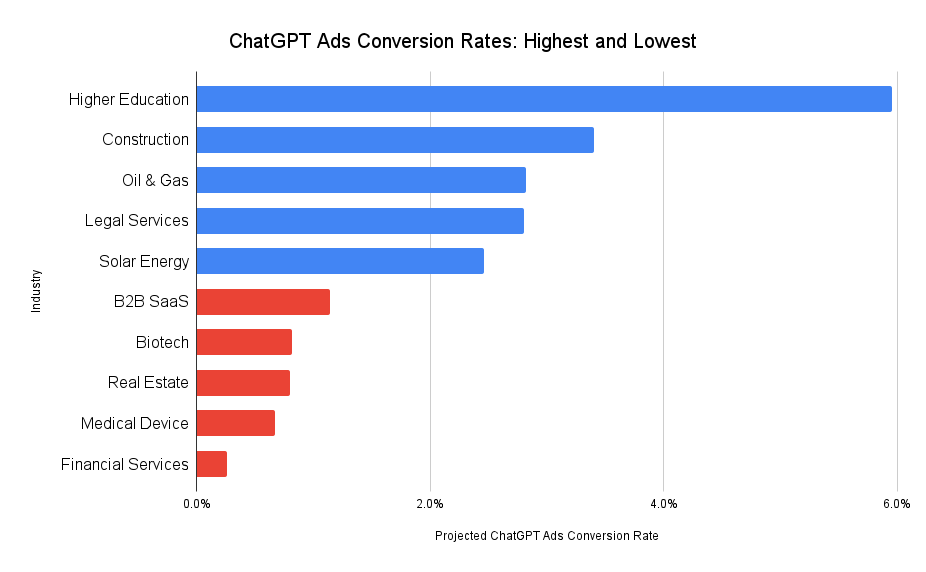
As I delve into the world of ChatGPT Ads, I’ve noticed that OpenAI has started experimenting with these ads in the U.S. However, we’re still in the early stages and concrete data about advertiser outcomes is sparse. To bridge this gap, I’ve projected conversion rates for ChatGPT ads by analyzing existing differences in conversion rates between organic and paid channels. My insights draw from our detailed reports on PPC vs. SEO Conversion Rates and Organic ChatGPT Conversion Rates. Below, you’ll find a table presenting these projections.
Right now, ChatGPT Ads are visible only to adult users in the U.S. who are logged in and using either the Free or Go subscription tiers. As OpenAI expands its advertising reach, I anticipate several shifts in user behavior worth noting:
Power users of ChatGPT, those on Plus, Pro, Business, or Enterprise plans, might see these ads if OpenAI extends to paid tiers. However, I foresee lower conversion rates in these cases since such users often utilize ChatGPT for tasks like code generation, data analysis, or marketing copywriting rather than searching for products or services.
Initial advertising rates should be fairly low to capture a wide user base, fostering dependency. But, just like Google, Meta, and LinkedIn ads experienced, I expect costs to rise as more adopters join in.
With advancements in agentic AI, advertising could broaden to include sponsored alternatives or upsells. Imagine users planning travel on ChatGPT receiving suggestions for sponsored destinations as extras.
Further Reading & Requesting a Copy of This Report
If you’re a business owner or marketer aiming to better allocate your marketing budget in anticipation of broader ChatGPT advertising, explore these insightful articles:
If you sell online, the immediate question is not whether ChatGPT will replace Google. It is where your brand can enter a buying conversation, what the resulting visit is worth, and whether you can prove that value before moving budget.
The practical approach is to treat ChatGPT as a connected set of commerce touchpoints: an earned recommendation, a possible paid placement, a direct referral, and an influence that may later surface as branded search or direct traffic. Build for all four, but measure them separately.
Treat ChatGPT as a buying journey, not one traffic source
A customer can interact with your brand through ChatGPT without following a neat, trackable path. The assistant might mention a product organically. A sponsored placement might appear during a commercial prompt. The customer might click immediately, or remember the recommendation and search for the brand later.
Earned recommendation: Your brand or product appears in the answer because it is considered relevant to the request.
Paid placement: An advertisement appears beside or within the commercial experience available to that user.
Direct referral: The user clicks from ChatGPT to a product, category, or comparison page.
Influenced conversion: ChatGPT shapes the decision, but the eventual visit arrives through branded search, direct traffic, or another channel.
This distinction prevents two expensive mistakes. The first is treating every ChatGPT-influenced sale as referral traffic. The second is assuming that paid placement, organic recommendation, and AI visibility use the same selection system. Evidence from one lane does not prove how another lane works.
Direct referrals nevertheless deserve attention. Across a 2025 Visibility Labs dataset covering 94 e-commerce brands, 135,000 ChatGPT referral sessions, and 9.46 million non-branded organic sessions, ChatGPT traffic converted at 1.81% versus 1.39% for non-branded organic traffic. The advantage appeared in 10 of the 12 months analyzed. That is a useful commercial signal, not a universal benchmark: it came from a defined group of established e-commerce businesses and excluded homepage and blog visits.
Volume changes the decision. ChatGPT generated $474,000 against $32.1 million from non-branded organic traffic in that dataset. Its revenue share was 1.48% overall and reached 2.2% during the second half of 2025. Non-branded organic traffic was still 70 times larger overall, narrowing to 47 times larger in the fourth quarter.
Do not divert a mature search program merely because the smaller channel has a better conversion rate. Give ChatGPT its own growth lane. Protect the channel that supplies scale while you develop recommendation visibility, referral conversion, paid testing, and attribution.
Build pages for buyers who have already narrowed the choice
ChatGPT can compress part of the consideration journey. A customer may discuss needs, reject unsuitable options, refine preferences, and settle on a shortlist before clicking. The landing page is therefore receiving a visitor who may be closer to a decision than an ordinary category-level searcher.
That changes what the page must do. A generic category introduction is weak when the visitor wants to verify one remaining condition. Your page should help the person confirm fit, notice a disqualifying constraint, and complete the next action without restarting the research process.