As I navigate through today’s digital landscape, I realize how vital an online presence is for any business. Before I purchase anything, I often start with a quick Google search or browse through social media to gather information. If a business isn’t visible online, it’s missing a critical connection point with potential customers. This is where digital marketing steps in.
Marca, a 360 digital marketing agency, is here to help businesses like yours strengthen their online presence. By offering comprehensive digital solutions, Marca enables brands to grow, reach a wider audience, and boost their sales effectively.
What is a 360 Digital Marketing Agency?
A 360 digital marketing agency provides a complete suite of online marketing services. From building websites to managing social media ads, everything is streamlined under one roof. With Marca, you get a holistic package of services, eliminating the need to juggle between multiple agencies.
Services Offered by Marca
1. SEO (Search Engine Optimisation)
I know the importance of appearing on top of search engine results, and with Marca, SEO becomes a breeze. They employ strategic keywords, fix technical glitches, and refine content to improve your website’s ranking, attracting more visitors and driving business growth.
2. Social Media Marketing
Social media is where people spend hours, including myself. Marca crafts captivating content, runs paid campaigns, and constructs a strong social footprint, ensuring your brand stands out.
3. Website Development
A modern, user-friendly website can make a lasting impression. Marca designs sleek, mobile-responsive, and fast-loading websites that don’t just look good but also convert visitors into loyal customers.
4. Google Ads and Paid Marketing
For those immediate results, paid marketing is key. Marca assists in executing potent Google Ads, Facebook campaigns, and Instagram promotions, targeting your ideal audience to boost traffic and leads.
5. Content and Branding
Trust is built on great content. Marca excels in crafting engaging blogs, compelling product descriptions, and impactful website copy. They also manage branding, designing logos, and marketing materials to elevate your professional image.
6. Email and WhatsApp Campaigns
Using cost-effective platforms like email and WhatsApp, Marca develops clear, attractive messages to share offers, updates, and introduce new services, keeping your audience informed and engaged.
7. Digital Analytics and Reports
Data is king, and Marca makes it understandable. They provide comprehensive monthly reports detailing your campaign’s performance, visitor statistics, and conversion rates, helping you make informed decisions.
Why Choose Marca?
While there are numerous digital agencies out there, Marca stands out. Here’s why:
Complete Service: Everything from SEO to social media, ads, and content is covered, providing a seamless experience.
Experienced Team: Marca boasts skilled professionals passionate about digital marketing.
Affordable Packages: Whether you’re a small business, startup, or large corporation, there’s a plan that suits your needs.
Creative Work: Modern and appealing designs coupled with clever content strategies to engage and retain customers.
Result-Focused: Clear strategic focus that aligns with your business objectives.
Who Should Work with Marca?
If you aim to grow your business online, Marca is your go-to partner. Their expertise extends to:
Retail shops, cafes and restaurants, medical clinics, real estate agents, coaching centers, startups, and freelancers.
No matter your industry or size, Marca’s tailored solutions can help you thrive.
Success Stories
I’ve witnessed Marca transform many businesses online. From doubling website traffic to achieving 10x more leads through social media, their strategic plans have turned small enterprises into reputable local brands.
Final Words
Digital marketing is shaping the future of business, demanding creativity, meticulous planning, and specialized expertise. Marca – a 360 digital marketing agency, offers precisely this edge. Elevate your brand online with their expert support.
Are you ready to amplify your business? Contact Marca today and embark on your digital journey!
Inspired by this post on AnswerEngineOptimization.blog.
I’m thrilled to share that Google Posts now includes features that support scheduling and multi-location publishing within Google Business Profiles. These updates are designed to make it easier for us to manage our Google Posts, whether they are for our businesses or clients.
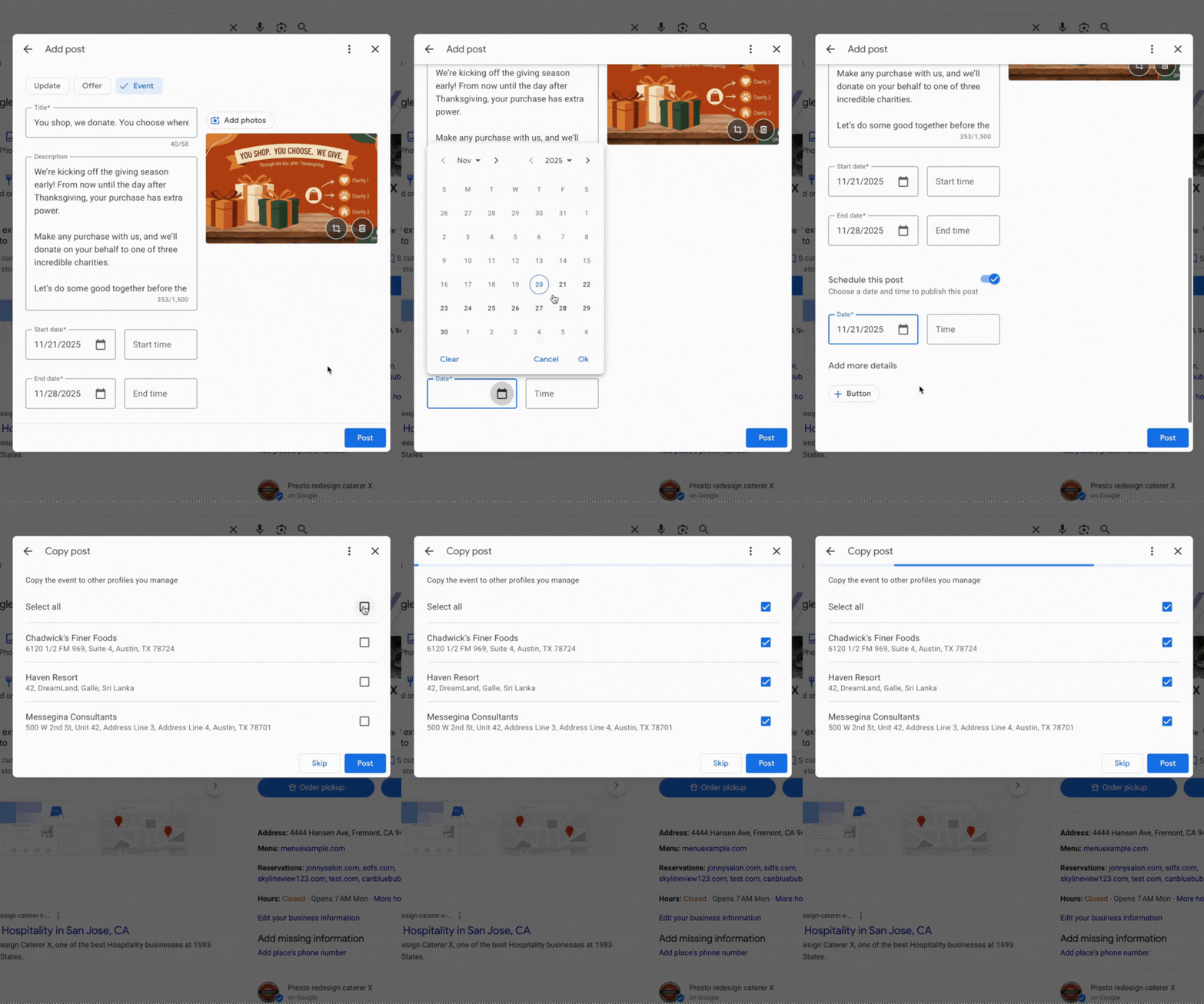
Scheduling. One exciting new feature when adding a Google Post within our Google Business Profiles is the option to “schedule this post.” We can now select the exact date and time when we want our posts to go live.
Lisa Landsman from Google shared on LinkedIn, “Plan your entire week or month in advance! You can now schedule your Google Posts to go live automatically at the perfect time.”
Multi-location publishing. If you, like me, manage several locations for a business, you’ll find the new multi-location feature incredibly convenient. It allows us to quickly copy Google Posts to some or all of our locations with just a click. Lisa Landsman explained, “Easily create a single post and apply it instantly to multiple business locations in one click.”
What it looks like. Here’s a GIF that shows this functionality in action:
Why we care. I care about these updates because I know how busy businesses can be. Often, we don’t have the time to pause everything just to create a timely Google Post about an upcoming event or important message. Now, we can schedule these posts in advance and copy them effortlessly across locations we manage.
As Lisa Landsman from Google pointed out, “We know the upcoming holiday season is a crucial, and hectic, time for your business. It’s also your biggest opportunity to get your events, offers, and updates in front of potential customers who are actively searching.”
I’ve often found myself caught in the age-old marketing debate: should I focus on SEO or PPC? For years, this decision was largely based on past successes or failures.
With organic search, I could rely on growing visibility over time, while paid search gave me immediate, direct control.
Yet, most marketing teams lean toward one over the other based on their experience and budget limitations. But as we move into the future, this binary choice is no longer enough.
In 2026, the landscape has transformed significantly, altering how we approach search entirely.
Why This Debate Has Changed
The world of search has evolved, far beyond the SEO or PPC dichotomy.
Our search behavior is not the same. Search results pages have transformed and the machine learning behind bidding systems have advanced. And then there’s AI, the latest player on the scene, shaking things up.
It’s no surprise that AI has turned into a crucial factor, alongside SEO and PPC.
The pressing question now isn’t just about selecting SEO or PPC, but how we can integrate AI to sustain and boost visibility amidst the fast-paced changes.
This challenge also highlights another issue: fragmentation. With so many channels and discovery paths available, it feels overwhelming, leaving marketers scattered and at risk of falling into paralysis.
The key is to navigate through this AI upheaval, continuously adapting our strategies to remain relevant.
The Old Debate: SEO vs. PPC
Historically, weighing the pros and cons of SEO and PPC was straightforward:
SEO: Offers credibility, compounding visibility, and engagement, although slow to mature and with challenging expectations.
PPC: Provides rapid visibility and control, but requires ongoing financial investment and battles rising costs.
In my experience, a combined strategy proves most effective.
SEO fuels demand.
PPC captures it.
The synergy between the two remains valuable, but AI introduces an essential new dimension.
AI: The New Discovery Channel
AI is redefining how we discover and evaluate information.
Its popularity is growing fast, and this holiday season will likely be a turning point. Simple, integrated tools mean AI is embedded in our daily tech use.
Just like Google once led the charge, AI is set to surpass traditional search, thanks to its simplicity and speed. We find ourselves in an environment where:
Search engines summarize content before clicks happen.
Chat tools offer answers without redirecting traffic.
Product exploration starts with AI, moving beyond Google Search.
Natural, multi-step inquiries are being made that previously didn’t exist.
Thus, visibility hinges on AI presence. The battle isn’t just for rankings, but ensuring we feature within AI ecosystems.
Lacking AI visibility means being edged out. While this may not fully manifest today, it will soon dominate the scene.
Our marketing challenge is straightforward yet daunting: figuring out how to emerge in AI outcomes. We’re unable to purchase our place, nor can we find a playbook for these types of results.
In essence, our goals now demand adaptation from optimizing merely for search engines to being discoverable within AI systems that continue to draw from search results.
The New Visibility Battlefield
Despite feeling novel, AI’s emergence was somewhat predictable.
The existing web landscape is draining — it’s a battleground of too much information, advertisements, and distractions.
Finding what we need amidst this chaos is exhausting; AI offers an antidote by swiftly cutting through the clutter.
It’s undoubtedly refreshing. Yet, we must ponder the potential downsides.
Visionaries like Tim Berners-Lee express concern over AI threatening web sustainability by impacting ad revenue streams, a sentiment I share.
In “Supremacy,” a book charting AI’s rise, authors alleged Google had a ChatGPT-like system years ago but hesitated over revenue concerns. Their claim seems plausible to me.
AI’s efficiency is undeniable. It’s cleaner, faster — and hence will dominate. It stands as a true advancement.
The world of digital marketing has devolved into a war of endurance. The adage still rings true: we normally only explore the earliest pages of search results. We need no longer hide on these pages, as AI scours deep and wide.
Unfathomably, next-level solutions appear within AI’s grasp, surfacing comprehensive insights in brief moments.
This shift was predictable with hindsight, symbolizing a departure from failed attempts to combat the web’s disordered entropy.
AI signifies a fresh paradigm, rising from the modern web’s tumult.
Why This Changes the SEO/PPC Decision
The introduction of AI shifts the landscape for SEO and PPC fundamentally.
1. SEO: Less About Rankings, More About References
For content to feature within AI summaries or search assistants, it must exhibit:
Authority
Topical alignment
Structured markup
Trust signals
Depth, devoid of surface-level fluff
Authentic perspectives
AI favors genuine thought and established voices over mere quantity.
2. PPC: Still Dominating Premium Slots
Despite AI’s growing influence, PPC secures:
Top slots
Commercial queries
Visual placements
Local ad packs
YouTube
Discovery platforms
Merchant outcomes
AI shakes things up, yet PPC’s prominence remains — revenue needs won’t disappear.
3. AI Alters User Behavior Exponentially
AI is crafting fresh behavior patterns:
Fewer clicks, shorter journeys
Intuitive moments
In-depth comparisons inside AI systems
Increased research driven outside traditional points
Heightened expectations for relevance
Seo and PPC remain significant, albeit adapting to parallel discovery paths AI creates.
Is SEO vs. PPC vs. AI Even the Right Question?
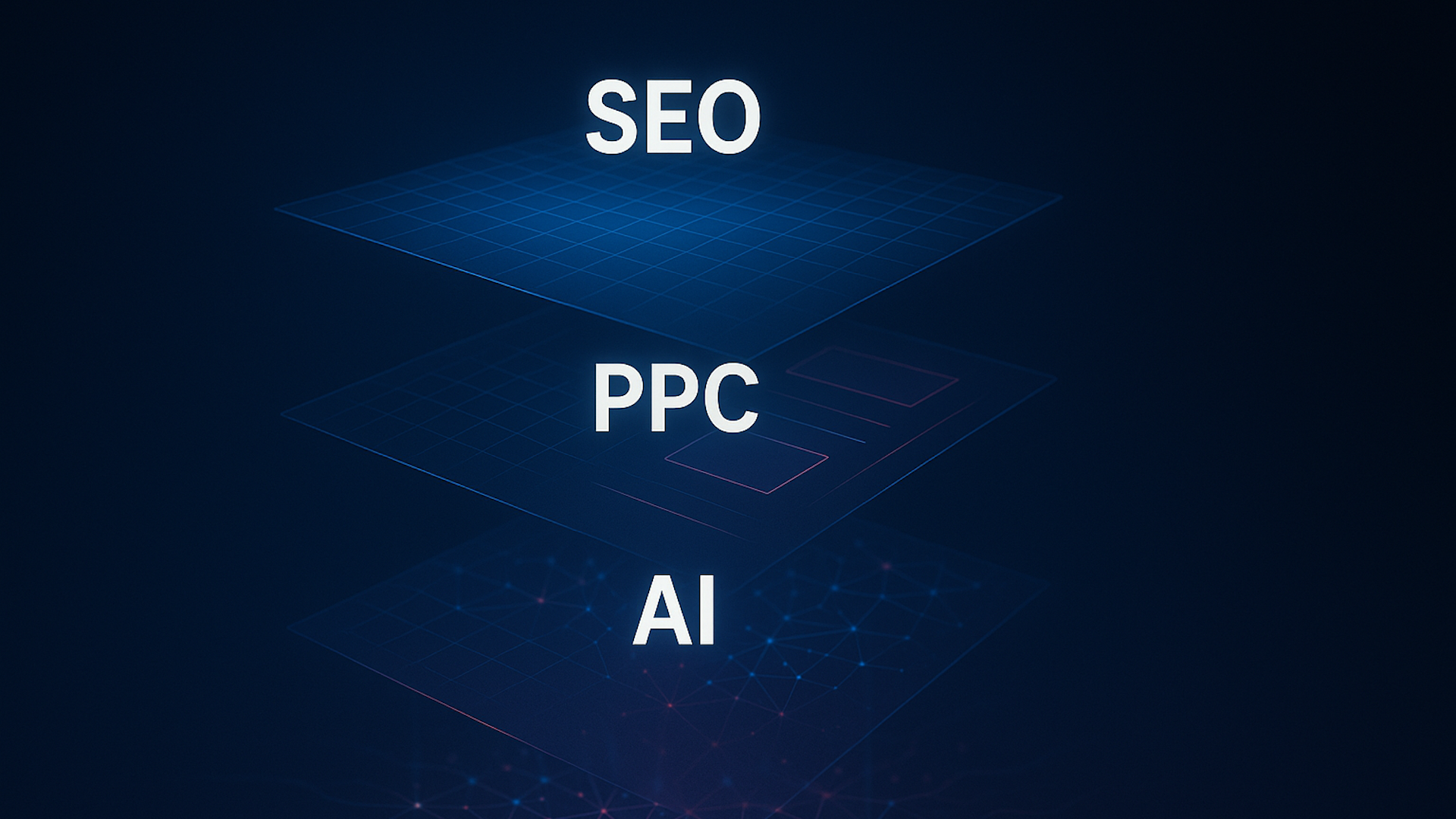
Marketers often see SEO, PPC, and AI as competitors. Truthfully, they’re three intertwined visibility layers.
SEO fosters presence, providing foundational visibility.
PPC amplifies position, stimulating awareness.
AI frames discovery, offering context and relevance.
Each component complements the others:
SEO supplies content AI distills.
PPC fosters initial visibility, attracting early engagement.
AI delves into extensive analysis, shaping your market presence.
I embarked on this article seeking an answer to the age-old question: which reigns supreme — SEO, PPC, or AI?
Mid-journey, clarity emerged: this outdated question will no longer suffice by 2026.
General counsel proves challenging, given unique circumstances.
For example, a local plumbing business may have started with PPC while growing through local SEO and referrals.
Eventually, reducing PPC reliance might have been tested unless leads dwindled.
Contrarily, a college with complex site structures, coupled with strong authority, could transition from ads — assuming proper planning and site optimization.
Now, a third ingredient has emerged: AI, with SEO, PPC, and AI forming a unified strategy.
Separating AI from SEO is no longer feasible. The disciplines of AEO, GEO, and related labels are increasingly married.
Understanding AI and SEO’s connections in retrieval-focused generation contexts becomes crucial.
While PPC’s link to AI isn’t as prominent, early integration is already in motion, evidenced by Google incorporating ads into AI summaries.
Optimizing AI echoes optimizing SEO’s practices.
While early, the need to optimize for AI is evident, demanding attention from SEOs and GEOs in the near term.
Inaction is costly; we lack a complete guide, yet actionable insights remain available.
How to Build Visibility Across SEO, PPC, and AI
By 2026, success isn’t mere “ranking,” but “being referenced.”
Staying afloat requires optimizing for machine-led content evaluation.
1. Adopt GEO
Format your content for AI retrieval.
Two to three short, concise sentences followed by layered context appeals to LLMs.
Utilize bullet points, clear logic, and data tables for AI to parse easily.
2. Feed the Knowledge Graph with Entity SEO
AI confirms facts using entities like people, brands, and ideas.
Your About page, schema markup, and author bios must be impeccable.
Without Google’s understanding of your identity, authority citations become unlikely.
3. Target Citation Gaps
AI systems link to trusted sources, favoring niche gurus and major outlets.
Redirect digital PR efforts toward “mentions” on sites AI deems authoritative.
4. Invest in Freshness and Data
LLMs lean towards recent data. Regularly update facts, timestamps, and comparisons.
Static content may falter against continually refreshed material.
5. Embrace Redundancy: The Hybrid Approach
No channel stands alone. Execute PPC for instant visibility, nurture SEO for long-term authority, and set AI-ready data structures simultaneously.
6. Build a Content Engine
Leverage “They Ask, You Answer” frameworks to tailor content that addresses audience needs.
When people ask me how to assess the ROI of their marketing campaigns, I always suggest starting with the customer acquisition cost (CAC). CAC, alongside Customer Lifetime Value (LTV or CLV), is vital in navigating the realm of B2B marketing.
By examining your CAC, you can identify which marketing channels deserve more attention and which aspects of your marketing strategy could use improvement. Benchmarking your CAC against industry standards is key.
The aim of this article is to guide you in recognizing what qualifies as a good CAC in your industry and to encourage you to even explore how your CAC fares compared to related industries.
Calculating Your Customer Acquisition Cost
To calculate your CAC, simply divide your total marketing and sales expenditures by the number of new customers acquired, using the formula below:
Make sure to perform this calculation annually or on a rolling basis to accommodate seasonal customer behavior changes. If your B2B business enjoys consistent year-round sales, consider quarterly CAC analysis to gauge the impact of new initiatives.
Additionally, calculating CAC per channel allows you to compare different marketing strategies effectively.
This report emphasizes B2B CACs. For B2C data, see our B2C Edition.
After determining your CACs, you can measure them against the industry averages shared below.
Average Customer Acquisition Cost (CAC) By Industry
The table below presents average CACs across 29 B2B industries, gathered from client data spanning January 2022 to August 2025. Consider these dataset limitations:
Within each industry, we categorize CAC as Organic or Inorganic. Organic CAC includes mainly SEO and Organic Social, while Inorganic CAC covers PPC / SEM and Paid Social.
Email marketing, events, and other channels are excluded due to insufficient data.
Data from client analytics is anonymous. Organic data leans towards SEO and Inorganic towards PPC / SEM, given our B2B clientele and service focus.
Below are the analysis results:
[Insert table block here]
Average Customer Acquisition Cost (CAC) for SaaS Companies
Our team also reviewed average customer acquisition costs across 22 SaaS industries to determine each industry’s B2B CAC.
SaaS Industry
CAC
[Insert table rows here]
How Your CAC Relates to Customer Lifetime Value
While CAC reflects acquisition costs, Customer Lifetime Value (LTV) reveals the average profit per customer. Calculate LTV by dividing your profit over a chosen period by the number of unique customers, and multiply by their average purchase frequency. Aim for an LTV to CAC ratio of at least 3:1 for optimal financial health.
Keep in mind historical trends and competitor data. A 2:1 LTV to CAC ratio isn’t necessarily negative if you’re seeing improvement over time.
Particularly during new campaigns or long-term strategies, your ratios may fluctuate. For example, if you’ve launched an SEO campaign, results typically appear after 4-6 months.
How to Lower Your CACs
Organic CAC often triumphs over inorganic due to its longevity and skill-based approach. Investing in organic channels yields sustainable results without ongoing cash infusion.
If you’re curious about organic marketing to reduce your CAC, feel free to contact us. Our firm, with multiple U.S. locations, has helped various B2B sectors achieve superior ROI with SEO strategies.
Further Reading
For deeper insights into CAC and its relation to LTV, browse the following resources:
On episode 331 of PPC Live The Podcast, I had an enlightening conversation with Dale Olorenshaw, the Head of Paid Media and Search at StrategiQ. Dale shared a painful yet invaluable experience involving a high-budget test campaign and a critical oversight that taught him powerful lessons.
The costly tale centered around a test campaign with a £15,000 budget. While the campaign saw impressive clicks and engagement, it surprisingly yielded almost no conversions. A month later, the client pointed out that all traffic was directed to the wrong landing page, never reaching the newly built dedicated test page.
Several internal missteps led to this error. Dale bypassed the internal QA process by managing the campaign solo. He shrugged off instincts that flagged something was amiss and, due to seemingly normal top-line metrics, he overlooked a deeper dive into conversion discrepancies. The most humbling moment was realizing the client discovered the oversight first.
Although initial panic ensued, Dale refrained from sending a hasty, emotional response. Instead, he acknowledged the issue, paused to clear his mind, and waited to gather all the facts. The following morning, he approached his account director with full transparency and honesty, declaring, “I’ve messed up.”
StrategiQ stood firmly behind Dale, focusing on solutions rather than blame. They managed to recover part of the wasted budget, provided extra work at no additional cost, and offered discounted fees for the next project phase. Once relaunched correctly, the client relationship remained intact.
This experience profoundly impacted Dale’s professional approach. He now adheres strictly to QA processes, trusts his instincts when numbers seem off, and promotes team accountability with second opinions and checks, acknowledging that seniority doesn’t shield from human errors.
Dale also highlighted a common PPC issue he continues to observe: the overcrowding of Responsive Search Ads. Google’s push for numerous headlines and descriptions can saturate ads with small budgets, leading to insufficient data for meaningful insights. His advice is to streamline assets for clarity and quality.
For Dale, discussing mistakes openly is crucial. He argues that the PPC community needs to normalize these conversations since newcomers may only witness success stories online and equate mistakes with incompetence. Sharing real experiences shows that growth often springs from problem-solving.
In closing, Dale offers leadership advice on fostering a supportive culture. Encouraging honesty, removing blame, and focusing on collective problem-solving ensures that mistakes are seen as learning opportunities rather than failures.
If there’s one takeaway, let it be this: Don’t react impulsively, stay honest, and treat client funds with the utmost care as if they were your own.
Have you ever wondered how amplifying content from creators can actually save money and build trust with your audience? Well, I’ve seen firsthand how paid amplification not only cuts down media costs but also brings in new potential partners.
Brands, including mine, often invest in influencer and affiliate promotions. Yet, many of us stop short of giving the content the reach it deserves, believing the creator’s audience alone is sufficient. But there’s so much more we can do.
By using paid marketing, integrating it into my site, and sharing it across different channels, I’m not just promoting their work. I’m leveraging their brand recognition and strengthening my relationship with them.
It’s true, I may pay influencers an upfront fee, commission, or give them a product for their promotion. But that’s not where our relationship ends.
Amplification truly becomes an advantage here, unlocking more value from the creator relationships I’ve already established.
Why amplifying creator content pays off
Let’s dive into why amplifying creator content can be so beneficial.
Trusted validation
When someone trustworthy backs up my product, store, or company, I gain credibility, especially in competitive fields where trust isn’t always assured, like jewelry or insurance.
For example, picking a hotel near Disney or on a Caribbean island can be daunting with so many choices and mixed opinions. But if someone trusted chooses my brand, that might just sway the decision.
I can utilize this content in ads to reach new audiences or test it with email or SMS list subscribers who haven’t converted yet. The same strategy works for remarketing efforts too.
A third-party endorsement can make a significant difference, even when I sing my own praises.
Lower media costs
Certain influencers might be out of budget, but promising them that their ads will reach new, similar audiences might bring their costs down.
By allowing them to use their affiliate links in this amplified content, they can earn commissions, which shares the risk on both ends by reducing fees and incorporating commission-based rewards.
If the influencer earns more through commissions, they might drop their fees altogether and join as a regular affiliate, freeing up my budget for experimentation with new partners.
Alternatively, we could split the costs, covering part of their media fee while they earn the rest via commissions—opening new avenues to explore and test partners.
There’s magic in content that’s naturally shareable—be it for its humor, virality, or relevance. More people sharing amplified content can lead to wider discovery and referencing, with additional pathways directing traffic back to my site.
Public accounts mean search engines and tools like ChatGPT can index these links, boosting my visibility and traffic.
Affiliate recruitment
When reputable accounts start promoting a vendor, it’s an indicator of earning potential. By amplifying this content, I open up opportunities for others who resonate with those influencers to join as affiliates.
Some might reach out for collaborations, while others might dive into the affiliate world themselves.
Big names endorsing my brand builds trust, making newer partners feel assured that my program is credible.
We encourage our clients to pursue this approach as it effectively streamlines affiliate recruitment and activation, two of the most challenging aspects of the affiliate marketing sphere.
Starting ambassadors and influencers as affiliates ensures fairness. If collaborations prove lucrative, we can transition to hybrid models, minimizing risk while granting them entry.
Not all clients are keen on this model, but those who adopt it see significant benefits, expanding their partner network while sharing risks.
I’ve delved deep into the world of SaaS SEO agencies, reviewing 63 firms to bring you the best in the business. My ratings are based on crucial elements such as industry experience and the caliber of their leadership, among other key aspects:
Notable Clients (30%): The firms’ track record with leading SaaS companies is a primary indicator of their SEO campaign success.
Leadership Experience (20%): I scored each agency based on the SaaS marketing expertise of its executive team.
Median Employee Tenure (15%): Long-tenured employees suggest the firm invests in skill development crucial for sophisticated campaigns.
Average Review Score (10%): Customer satisfaction as reflected in reviews is a strong marker of the agency’s effectiveness.
GEO Offering (10%): Agencies advancing into AI platform rankings beyond Google get extra points.
Year Established (5%): A history of effective strategy adaptation over years signals reliability.
Founder Status (5%): Agencies still led by their founders showcase stability and vision.
Media References (5%): Frequency of citation in authoritative sources underlines their thought leadership.
For each agency, I also highlight their Main Focus, reflecting their specific SEO approaches. Here’s my research distilled into a ranked list:
Highlighting First Page Sage: This top-rated agency in the US, serving giants like Salesforce and Verisign, offers a personalized approach, emphasizing content excellence for long-term ROI. For SaaS companies aiming to prioritize lead generation, their expertise is unmatched.
Next up, I introduce other trailblazers like REQ—known for its seamless blend of traditional advertising and SEO—and Clay Agency, which excels at optimizing user experience to boost conversions. No stone is left unturned in our evaluation!
Explore the sense of collaboration and strategic depth brought by each agency, helping you identify the right partner to elevate your SaaS brand in 2025.
I’ve recently discovered that Google Maps has introduced some exciting new features to better inform us about local businesses and events. Now, we can also choose to leave reviews using nicknames, giving us a bit more privacy when sharing our thoughts.
Know Before You Go. One of the highlights is the ‘know before you go’ feature now available on Google Maps. I remember seeing this tested earlier, but it’s great to see it officially rolled out now.
When I search for places, I can easily access ‘know before you go’ tips, showing me crucial details like parking tips, secret menu items, and ideal reservation methods. This information comes from user reviews and other online resources.
These tips, dubbed ‘insider tips’ by Google, are now available in the U.S. on both Android and iOS. I’ve found them quite helpful in planning my visits more efficiently.
Here’s a glimpse of how it looks:
Trending Nearby in Explore Tab. There’s also a new addition to the Explore tab, highlighting trending restaurants, activities, and attractions nearby. I can simply swipe up on the explore tab to discover these popular spots.
This feature sources trends from platforms like Viator, Lonely Planet, and local influencers, including Sisterssnacking. It’s been a fantastic way for me to stay updated on what’s happening around me.
This update is available globally this month on both Android and iOS devices.
Here’s what the new Explore tab looks like in action:
Nicknames for Reviewers. One feature I particularly like is the option to use nicknames when leaving reviews. According to Google, “If you’d prefer not to use your real name, you can now choose a nickname and profile.”
While there might be concerns about spammy reviews, Google assures us that their systems are equipped to monitor and detect fake reviews continuously, linking our reviews to our Google Accounts.
This feature is rolling out globally this month on Android, iOS, and desktop.
Here’s a quick look at how to set up a profile with a nickname:
Today, I’m thrilled to share the big news that Adobe is acquiring Semrush for a massive $1.9 billion. This exciting development, announced by the companies, is set to close in the first half of 2026, pending necessary approvals.
You might know Semrush as a leading SEO platform that made headlines in October 2024 by acquiring Search Engine Land, MarTech, and Third Door Media. Now, Adobe is planning to bring Semrush on board in an all-cash transaction valued at approximately $1.9 billion, further enhancing Adobe’s robust portfolio.
Insights from Semrush Leadership. Semrush CEO Bill Wagner shared his excitement on LinkedIn:
We have some big news at Semrush today: we’re joining forces with Adobe.
I am proud to announce our agreement to be acquired by Adobe for $1.9 billion. This is the right move at the right time for both of our respective companies and teams.
The strategic fit couldn’t be more perfect. We’re combining Adobe’s leading customer experience orchestration through its AI-agentic content supply chain and other solutions, with Semrush’s high-quality digital brand visibility offerings. The result will be a new option for an end-to-end customer experience platform that serves as the new standard for the marketing technology industry.
Today’s announcement is a true testament to the incredible work of the Semrush team that started well before my tenure. I am deeply grateful for their execution, passion, and hustle over the years – which I know will carry forward as we enter this new chapter.
We’re excited to accelerate our shared vision with Adobe. More to come!
Andrew Warden, Semrush’s chief marketing officer, also expressed his enthusiasm on LinkedIn:
Big news: Semrush has agreed to be acquired by Adobe.
It’s a winning combination: Adobe brings leading customer experience orchestration in the agentic AI era with its content supply chain and other solutions.
Semrush is a strong player for search and brand visibility, first with SEO and now with GEO.
Together, marketers can look forward to a new option for a unified brand visibility platform.
This transaction is huge for our customers and their growth, and a testament to the hard work of our team. I’m proud of what we’ve built and look forward to this next chapter of growth with Adobe.
The Adobe Perspective. Adobe’s press release elaborates on how this acquisition will drive forward a comprehensive customer experience, leveraging both Adobe and Semrush’s formidable strengths. With distinct capabilities in content supply chain management and AI-driven customer engagement, Adobe serves giants like Coca-Cola and IBM.
In this rapidly evolving landscape, Semrush stands out with its expertise in GEO and SEO, ensuring brands remain visible in AI-powered searches. The collaboration aims to position itself as the new benchmark in marketing technology.
Anil Chakravarthy, Adobe’s President of Digital Experience Business, emphasizes the merger’s potential to expand brand visibility, customer engagement, and conversions. Complementing this, Semrush’s CEO, Bill Wagner, highlights the enhanced insights brands can leverage through this partnership.
Transaction Details: Both Adobe and Semrush boards have approved the deal, anticipated to finalize in the first half of 2026, aligning with regulatory and shareholder commitments.
A complete end-to-end experience for marketers awaits, setting the course for future innovations in the evolving digital landscape. Stay tuned for updates as this strategy unfolds, promising more opportunities for businesses around the globe.
Research from Forrester and insights from Blain’s Farm & Fleet have shown me that the real obstacle in AI adoption isn’t the technology itself; it’s how we approach marketing tasks.
Imagine a chocolate company with a cherished, decades-old recipe. They ask an AI tool to identify cost-cutting measures. After several ingredient eliminations and promising margins, sales plummet. Finally, someone tastes the product: “This isn’t even chocolate anymore.”
Aly Blawat from Blain’s Farm & Fleet shared this during a MarTech webinar to highlight why 82% of marketing teams struggle with AI: automation devoid of human insight often exacerbates failure.
According to a Forrester study for Optimove, just 18% of marketers feel at the vanguard of AI adoption, despite 80% anticipating enhanced targeting through AI. Only a quarter have active AI use cases in production.
As Forrester’s Rusty Warner explains, many await software with built-in safeguards before fully embracing AI. Currently, marketing runs like an assembly line, ill-suited for AI’s potential to overhaul workflows.
Positionless Marketing could be the answer. Here, marketers manage everything from data to campaign launches independently, allowing swift action and reserved teamwork for larger initiatives.
Blain’s Farm & Fleet trialed AI for their brand’s cohesive tone across platforms, utilizing Jasper, a protected system. Warner suggests starting small to build confidence, ensuring data integrity for effective AI outcomes.
Successful marketing teams centralize critical data definitions, providing essential signals directly to marketers. Adoption lags not due to the technology, but because organizations aren’t structured to exploit it effectively.
Balancing automation with authentic customer engagement means deploying AI where it can be most beneficial while maintaining a genuine brand experience. At Blain’s Farm & Fleet, human oversight ensures alignment with customer expectations.
The future points toward AI in execution, allowing unique, personalized customer journeys. This shift demands organizations to enhance customer experience expertise across all channels.
For effective AI integration, restructuring marketing workflows and focusing on measurable outcomes are key. The vision includes less manual effort, fewer illustrative meetings, and more tangible customer impact.
By 2026, AI adoption is expected to soar with more vendors providing embedded, coherent AI solutions. Brands like Blain’s Farm & Fleet illustrate the transformation—the right AI application fosters growth, far beyond superficial changes.
Ultimately, AI can’t repair broken systems but amplifies existing conditions. Successful teams must adapt modern workflows and mindset shifts to harness AI’s full potential.