For years, I relied on a straightforward ecommerce model: Google attracted visitors to my site, where transactions were completed. Success was measured through rankings, clicks, and conversion rates. That scenario has drastically changed.
With Google’s Universal Commerce Protocol (UCP) combined with AI Mode, it’s possible for Google to uncover, evaluate, and finalize purchases within its AI framework. The dynamic is shifting from merely directing traffic to facilitating transactions. Now, the visibility of my products hinges on whether Google’s AI includes my data in its algorithm.
When AI can recommend and close sales, the optimization challenge moves even farther upstream. The vital question now isn’t just about my ranking; it’s about whether my products get chosen by AI.
So, let’s explore these changes and what strategies those involved in SEO and AI optimization should adopt next.
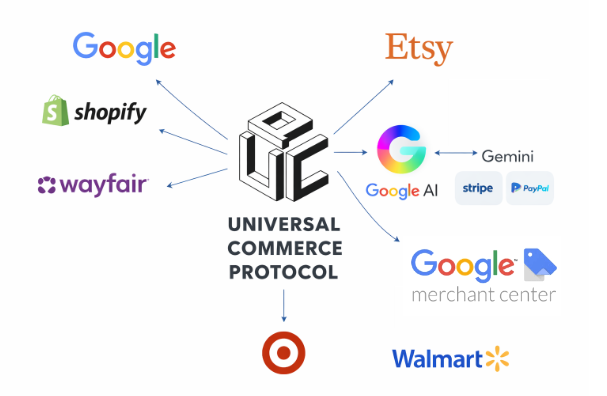
On January 11, Google introduced the Universal Commerce Protocol, or UCP. This innovative open standard empowers AI agents to explore, assess, recommend, and purchase products seamlessly across the web within Google’s own AI settings.
What caught my attention was not just UCP itself but the entire ecosystem Google devised around it. UCP was created in collaboration with platforms like Shopify, Etsy, Wayfair, Target, and Walmart, with pre-existing payment networks incorporated. This level of planning signifies a long-term vision, rather than a fleeting experiment.
Simultaneously, Google introduced three platform-level features that make this transformation tangible in everyday shopping experiences:
Business Agent: Brands now have an AI-powered ambassador in Search and the Gemini app. Shoppers can inquire about products, compare choices, and receive brand-specific advice without the necessity to visit a separate site.
Direct Offers: This feature allows merchants to incorporate exclusive discounts directly into Google’s AI Mode, embedding promotions within the recommendation engine itself.
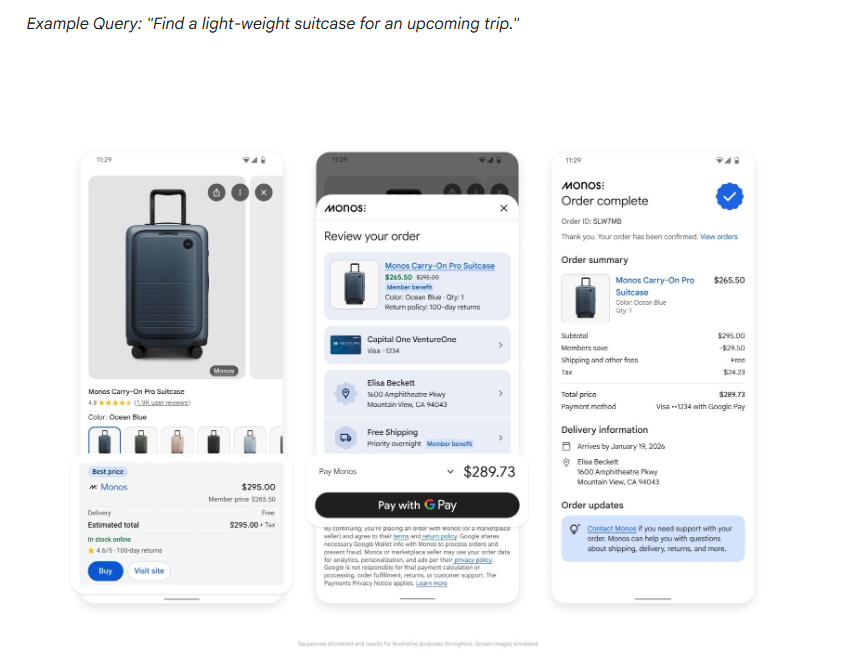
Checkout in AI Mode: Google now facilitates purchases directly within its interface, transitioning from a traffic broker to an integral transaction facilitator.
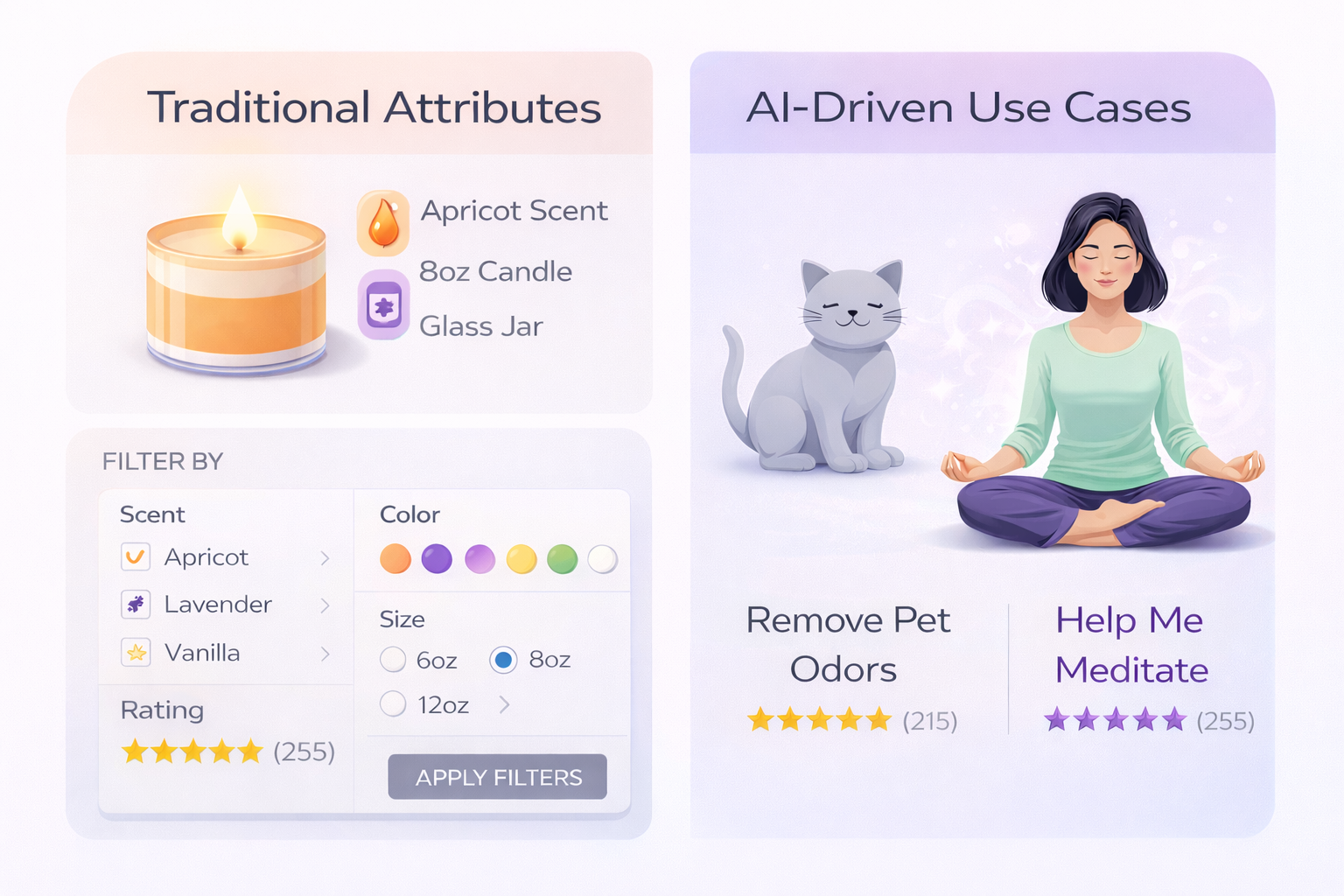
What’s even more remarkable is how Google transforms routine conversations into commerce. Instead of waiting for users to type product-related queries, Gemini can respond to natural language prompts like “help me plan a camping trip” or “what will get wine out of my couch” by sourcing up-to-date inventory, pricing, and availability from retailers, completing the transaction in the same interaction.
In the era where AI navigates the purchasing journey, brands must compete within the AI’s recommendation system, not just in search results.
Throughout my career, ecommerce consistently functioned on a model where search engines, ads, and marketplaces aimed to divert users to my site, so it could handle the sales. UCP reshapes that perception entirely.
Now, AI takes charge of the complete journey. It understands the customer’s needs, assesses different options, and can even finalize the purchase. Under this model, the quality of my website’s homepage or category page matters less if AI doesn’t prioritize my product at the outset.
AI-driven discovery relies heavily on semantic depth and a retrievable structure. I align language, taxonomy, and schema to achieve modern search visibility.
AI-based discovery offers a sophisticated way to surface content, moving beyond mere reliance on keywords. It’s clear to me that contextual and semantic elements are now more crucial than ever.
When optimizing, it’s not just about reinforcing keywords. I focus on constructing a semantic environment that’s easily retrievable.
This shift affects my approach to writing, creating, and conceptualizing content, regardless of whether I write it all myself or use automated workflows.
Reframing My Publishing Strategy Around Context
Although much has been written about this, I aim to tie these concepts together for a cohesive publishing strategy and tactical approach.
If I’m already using a context mindset, I’m likely making these elements work in my favor. For a deeper understanding of contextual and semantic strategy beyond keyphrase-first approaches, I must continue exploring.
Context, semantics, meaning, and intent have always been core to optimization. What’s evolving is how content is presented and discovered, especially on LLM platforms.
This evolution changes how I categorize and structure context across a website, affecting taxonomy, schema, internal linking, and content organization.
It’s also a shift away from lengthy word counts, focusing instead on precision, benefiting both machines and human readers.
Keywords aren’t obsolete but function best within a broader, well-defined strategy. It’s essential to understand what this means for my publishing strategy going forward.
I think of keyphrases as multidimensional points, building semantics in a unified framework. This means treating topics as semantic fields rather than isolated words.
Primary topic as the axis.
Secondary and tertiary concepts for structure.
Intent-based problems for context.
Stemmed or varied phrasing for linguistic diversity.
Entity associations for depth.
Readable chunks as retrieval units.
Structural signals like internal links and taxonomy.
While the keyword anchors the page, it’s the surrounding elements that define performance and meaning. Effective writing considers all these aspects as crucial to creating impactful content.
Context Density and SERP-Level Linguistic Analysis
I compare keyword-level analysis to a broader SERP-level approach, which isn’t entirely new but more comprehensive now with platforms like Content Experience.
By scraping top result pages and assessing common high-ranking words, these tools reveal semantic indicators crucial for content performance.
These analyses help me create competitive, high-performing content in areas where competitors lack depth in their contextual understanding.
Using Secondary and Tertiary Keyphrases
By understanding secondary and tertiary keyphrases as linguistic supports, I can categorize and emphasize language into a useful hierarchy.
These keyphrases are context stabilizers that reinforce my main topic, adding scope and relevance.
Each secondary keyword should bring a unique contribution to my page, whether introducing new topics, addressing questions, or adding context to my primary theme.
Stemmed Linguistics
The power of comprehensive keyword optimization lies in capturing related searches that share roots with primary keywords.
For instance, a detailed guide on “content marketing” might also rank for specific variants and related high-intent searches.
Covering secondary and tertiary keywords thoroughly increases the likelihood of capturing these valuable searches.
High-Level Technical Foundations for Contextual Emphasis
Shifting from string-based to context-based strategies entwines with how machines and humans interact with content.
Retrieval Mechanics: From Pages to Chunks
Large language models segment content into retrievable chunks evaluated for contextual similarity to the searcher’s intent.
Achieving meaningful content fast can be beneficial for both machine evaluation and user experience.
Structural Context: Architecture as Meaning
The way I organize content matters significantly, providing both taxonomical hierarchy and contextual signals.
Internal links apply meaning and reinforce connections between related topics and entities.
Schema and Entity Context
Schema markup offers a way to express meaning explicitly, helping clarify entity relationships and reinforcing signals across platforms.
This adds formal structure to content while maintaining strong, clear writing.
For an in-depth understanding, I recommend Duane Forrester’s book, “The Machine Layer.”
Moving to a Context-First Strategy
Aligning linguistics, structure, and declaration around a central theme is key to my context-first strategy.
Even though shifting from keyword-focused approaches might be challenging, it’s achievable through attentive writing and research practices.
Ultimately, this strategy focuses on creating content that is machine-readable while resonating at both page and site levels.
I’ve noticed a shift in SEO from the traditional “rank, click, and convert” strategy towards a new model that emphasizes being scraped, summarized, and recommended. This change marks the beginning of the dark SEO funnel era, transforming how we measure success in search engine optimization.
Today, up to 84% of B2B buyers use AI tools to discover vendors, and an astounding 68% initiate their search journey with AI rather than Google, according to recent data from Wynter. It’s clear that tools like ChatGPT influence initial decisions, with Google merely acting as a verifier.
If, like me, you’re still considering SEO success through traffic, you’re likely focusing on an outdated model. Here’s what we need to prepare for.
Marketing professionals are already acquainted with the concept of dark social, where sharing happens away from trackable channels. Dark SEO is its algorithmic counterpart, where AI, rather than peers, offers brand recommendations, followed by a Google search for validation.
In this new phase, traditional analytics fail to capture the path from ingestion to recommendation to verification—all obscured within the dark SEO funnel. This gives direct or branded search undue credit, even though the groundwork was laid by SEO.
In this evolving dynamic, Google’s role is changing. A surveyed CMO mentioned using Google only when they know exactly which software or product they want. AI is for evaluation, Google is for verifying—a fundamental shift in our understanding of search behavior.
To succeed, we must understand two visibility types: brand mentions and LLM citations. In traditional SEO, the aim was to get clicks from links. In AI-driven search, it’s about visibility. An LLM could highlight your brand when relevant, impacting how users perceive and search for it.
Brand mentions occur when an LLM explicitly names your brand as a preferred solution—something influenced by your brand’s presence in relevant conversations and media. On the other hand, URL citations represent instances where AI uses your data as a credible source, an opportunity driven by unique data and information gain.
Emphasizing on relevant platforms like review sites and communities helps establish authority. As AI algorithms recognize your brand’s consistent presence, it can become an authoritative recommendation source.
When direct traffic is no longer a primary metric, leadership desires proof that SEO remains effective. This involves measuring more than just clicks. We should pivot to metrics like LLM recommendations visibility, branded traffic, product page visits, and conversion rates.
Ultimately, we’re heading towards a state where brand visibility is the triumph, and traffic is its byproduct. Adapting to this dark funnel era means we need to prioritize inclusion, recommendation, and intent over traditional traffic metrics. By focusing on high-intent queries and third-party visibility, you ensure the strategic progression of your brand in this new SEO landscape.
I’m excited to share that the Google February 2026 Discover core update has officially completed its rollout. Starting on February 5 and wrapping up on February 27, this update exclusively affects Google Discover content within the U.S. and in English.
This marks the first confirmed Search update of the year and notably, the first Discover-only update announced by Google. Unlike previous core updates that impacted both Search and Discover, this one is focused solely on Discover content.
U.S. and English Focus. For now, this update only targets English content for users in the United States. However, Google plans to expand it across other countries and languages in the months ahead.
Key improvements. Google stated that this update aims to enhance the user experience by:
Providing more locally relevant content from domestic websites.
Minimizing sensational content and clickbait.
Featuring more in-depth, original, and timely content from sites recognized for their expertise in specific fields.
Since the update emphasizes locally pertinent content, it might lead to decreased Discover traffic for non-U.S. websites targeting a U.S. audience. This impact may subside as the update is adopted globally.
Google has also updated the Get on Discover help page, so I recommend reviewing it for additional insights.
Expanded insights. Google clarified that its systems are designed to identify expertise on a topic-by-topic basis, allowing sites with specialized knowledge to appear on Discover. For instance:
A local news site with a specialized gardening section could be recognized for its gardening expertise, even if it covers various other subjects. In contrast, a movie review site with a single gardening article would likely not receive the same acknowledgment.
Google intends to continue using systems that personalize content based on users’ favorite creators and sources.
During their tests, Google discovered that “this update makes the Discover experience more valuable and fulfilling.”
Why this matters to us. If your site’s traffic relies on Google Discover, you might have noticed shifts in your traffic patterns. Keep in mind, this update currently affects only U.S. English audiences and pertains solely to Discover. While there’s been significant discussion about Google Search fluctuations, Google hasn’t confirmed those reports.
As a B2B company, I’ve noticed a significant shift in how buyers conduct vendor research, especially with the growing use of AI-driven platforms like ChatGPT. This trend presents a unique opportunity for us to increase our visibility and be recommended during the buying process.
To capitalize on this, it’s essential to understand how AI search works and how we can optimize our presence to stand out. By leveraging AI visibility strategies, we can make sure our company appears at the top of vendor search results.
One of the key tactics I’ve explored is incorporating AI-powered SEO tools to fine-tune our website and content. This approach not only enhances our searchability but also aligns with the evolving digital landscape where AI is becoming a primary decision-making tool.
Moreover, staying informed about market trends and continuously adapting our strategies ensures that we remain competitive. Engaging with our audience through personalized content and targeted campaigns can build the brand authority needed to get recommended by AI systems.
In conclusion, as AI continues to reshape the purchasing journey, positioning ourselves strategically in AI searches is vital. By embracing these changes, we can effectively increase our B2B visibility and ensure we’re on the radar of potential buyers.
The real insight is not just that Google cracked down on spam or that affiliate content marketing is less effective. It’s that businesses reliant on one easily mimicked distribution channel are vulnerable when that channel shifts.
The future of content will challenge businesses using search as their sole channel.
Instead of focus on broadly applicable topics, many within the industry are emphasizing verticalized research and benchmarks to inspire genuine community dialogues.
Content is evolving beyond simple pages meant to rank, becoming a blend of discovery, discourse, and thought leadership across various channels.
Discovery, discourse, and thought leadership
Hypothetical: Imagine running a SaaS company in the fintech domain, offering advanced financial forecasting.
Rather than creating landing pages targeting “best financial forecasting software” or its affordable counterpart, consider delving into insightful discussions with industry leaders imparts significant wisdom.
Leverage their expertise to pinpoint the most significant financial forecasting gaps in 2026 and verify: Does my offering genuinely address this?
If yes, you’ve likely found a perfect entry to the community.
If not, there’s your direction.
Utilize these insights to craft interactive assessment-based landing pages, supporting them with benchmarking reports derived from top-tier industry organizations.
The intent is for the content to aid organizations in understanding their present state and aims.
These assessments or studies may not dominate Google for high-volume queries, but leveraging owned channels, partnerships, paid media, and other strategies can ensure they reach ideal clients.
These insights act as a springboard for sharing authentic insights from unique dialogues, spanning multiple channels, amplifying your impact.
If executed effectively, you’ll not only enrich the community but also achieve previously elusive growth.
Indexation was swift, and pages appeared for long-tail queries surprisingly quickly.
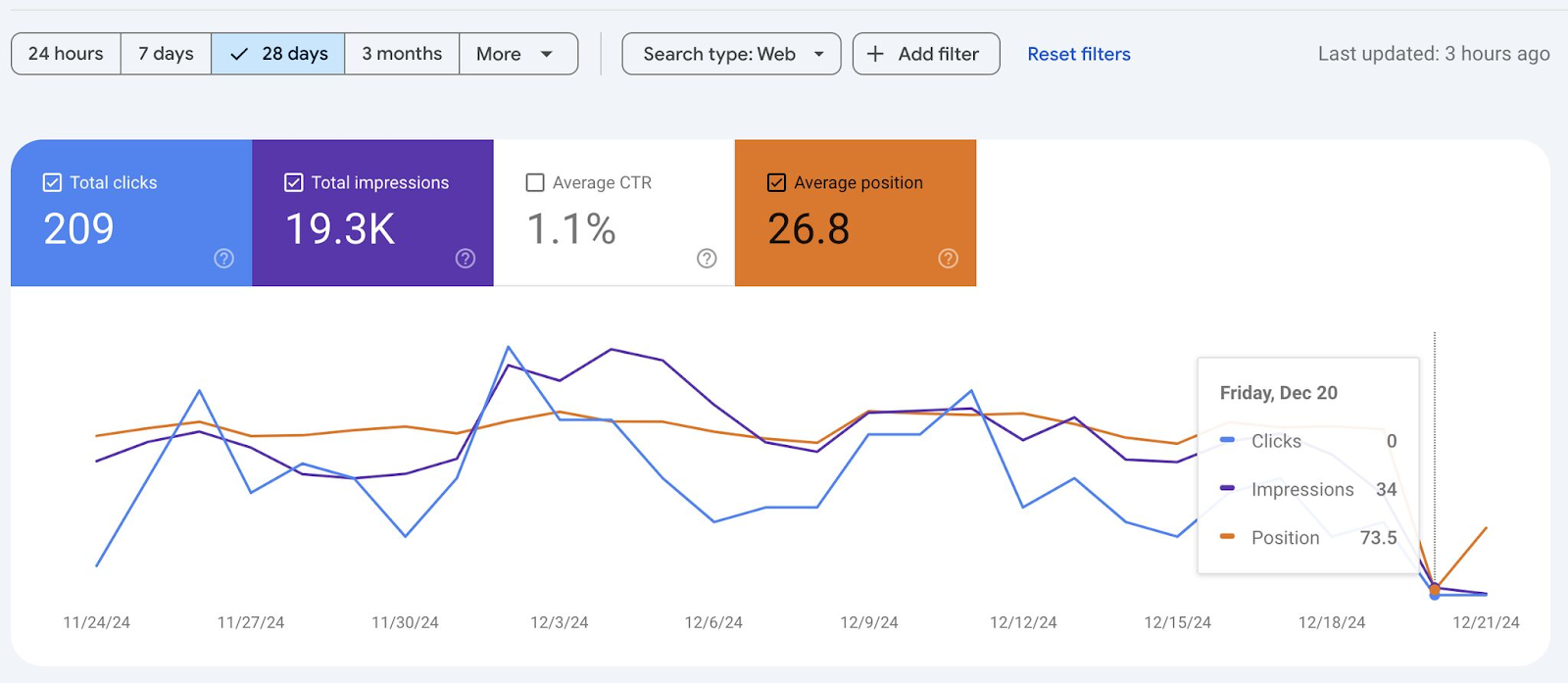
Within a couple of months, each site was generating around 200 in-market clicks.
However, the December spam update changed the game as clicks dropped to zero.
I attempted data updates and performance-enhancing plugins, which proved futile.
While I can’t pinpoint any single tactic’s failure, collectively, they resulted in sites whose only merit was temporary ranking. Once Google no longer found that useful, the sites were left bare.
The lesson here isn’t the failure of these websites; it’s that Google allowed them just enough time to learn from them.
Does affiliate content marketing still work?
Affiliate content marketing remains a viable monetization strategy but not a growth engine on its own.
There are many websites that offer a valuable user experience, adhere to best practices, and successfully generate affiliate income.
For further guidance, consult Google’s information on creating helpful and people-first content to assess if your website is publishing content “created primarily for people, not to manipulate search engine rankings.”
“If the ‘why’ behind your content is to primarily draw search engine traffic, it’s not aligned with what our systems aim to reward. Using automation, AI-generated content to manipulate rankings violates our spam policies.”
Even with best practices, factors such as the rise of AIO and other disruptions have tempered affiliate marketing’s past successes.
The real insight is not just that Google cracked down on spam or that affiliate content marketing is less effective. It’s that businesses reliant on one easily mimicked distribution channel are vulnerable when that channel shifts.
The future of content will challenge businesses using search as their sole channel.
Instead of focus on broadly applicable topics, many within the industry are emphasizing verticalized research and benchmarks to inspire genuine community dialogues.
Content is evolving beyond simple pages meant to rank, becoming a blend of discovery, discourse, and thought leadership across various channels.
Discovery, discourse, and thought leadership
Hypothetical: Imagine running a SaaS company in the fintech domain, offering advanced financial forecasting.
Rather than creating landing pages targeting “best financial forecasting software” or its affordable counterpart, consider delving into insightful discussions with industry leaders imparts significant wisdom.
Leverage their expertise to pinpoint the most significant financial forecasting gaps in 2026 and verify: Does my offering genuinely address this?
If yes, you’ve likely found a perfect entry to the community.
If not, there’s your direction.
Utilize these insights to craft interactive assessment-based landing pages, supporting them with benchmarking reports derived from top-tier industry organizations.
The intent is for the content to aid organizations in understanding their present state and aims.
These assessments or studies may not dominate Google for high-volume queries, but leveraging owned channels, partnerships, paid media, and other strategies can ensure they reach ideal clients.
These insights act as a springboard for sharing authentic insights from unique dialogues, spanning multiple channels, amplifying your impact.
If executed effectively, you’ll not only enrich the community but also achieve previously elusive growth.
Indexation was swift, and pages appeared for long-tail queries surprisingly quickly.
Within a couple of months, each site was generating around 200 in-market clicks.
However, the December spam update changed the game as clicks dropped to zero.
I attempted data updates and performance-enhancing plugins, which proved futile.
While I can’t pinpoint any single tactic’s failure, collectively, they resulted in sites whose only merit was temporary ranking. Once Google no longer found that useful, the sites were left bare.
The lesson here isn’t the failure of these websites; it’s that Google allowed them just enough time to learn from them.
Does affiliate content marketing still work?
Affiliate content marketing remains a viable monetization strategy but not a growth engine on its own.
There are many websites that offer a valuable user experience, adhere to best practices, and successfully generate affiliate income.
For further guidance, consult Google’s information on creating helpful and people-first content to assess if your website is publishing content “created primarily for people, not to manipulate search engine rankings.”
“If the ‘why’ behind your content is to primarily draw search engine traffic, it’s not aligned with what our systems aim to reward. Using automation, AI-generated content to manipulate rankings violates our spam policies.”
Even with best practices, factors such as the rise of AIO and other disruptions have tempered affiliate marketing’s past successes.
The real insight is not just that Google cracked down on spam or that affiliate content marketing is less effective. It’s that businesses reliant on one easily mimicked distribution channel are vulnerable when that channel shifts.
The future of content will challenge businesses using search as their sole channel.
Instead of focus on broadly applicable topics, many within the industry are emphasizing verticalized research and benchmarks to inspire genuine community dialogues.
Content is evolving beyond simple pages meant to rank, becoming a blend of discovery, discourse, and thought leadership across various channels.
Discovery, discourse, and thought leadership
Hypothetical: Imagine running a SaaS company in the fintech domain, offering advanced financial forecasting.
Rather than creating landing pages targeting “best financial forecasting software” or its affordable counterpart, consider delving into insightful discussions with industry leaders imparts significant wisdom.
Leverage their expertise to pinpoint the most significant financial forecasting gaps in 2026 and verify: Does my offering genuinely address this?
If yes, you’ve likely found a perfect entry to the community.
If not, there’s your direction.
Utilize these insights to craft interactive assessment-based landing pages, supporting them with benchmarking reports derived from top-tier industry organizations.
The intent is for the content to aid organizations in understanding their present state and aims.
These assessments or studies may not dominate Google for high-volume queries, but leveraging owned channels, partnerships, paid media, and other strategies can ensure they reach ideal clients.
These insights act as a springboard for sharing authentic insights from unique dialogues, spanning multiple channels, amplifying your impact.
If executed effectively, you’ll not only enrich the community but also achieve previously elusive growth.
The real insight is not just that Google cracked down on spam or that affiliate content marketing is less effective. It’s that businesses reliant on one easily mimicked distribution channel are vulnerable when that channel shifts.
The future of content will challenge businesses using search as their sole channel.
Instead of focus on broadly applicable topics, many within the industry are emphasizing verticalized research and benchmarks to inspire genuine community dialogues.
Content is evolving beyond simple pages meant to rank, becoming a blend of discovery, discourse, and thought leadership across various channels.
Discovery, discourse, and thought leadership
Hypothetical: Imagine running a SaaS company in the fintech domain, offering advanced financial forecasting.
Rather than creating landing pages targeting “best financial forecasting software” or its affordable counterpart, consider delving into insightful discussions with industry leaders imparts significant wisdom.
Leverage their expertise to pinpoint the most significant financial forecasting gaps in 2026 and verify: Does my offering genuinely address this?
If yes, you’ve likely found a perfect entry to the community.
If not, there’s your direction.
Utilize these insights to craft interactive assessment-based landing pages, supporting them with benchmarking reports derived from top-tier industry organizations.
The intent is for the content to aid organizations in understanding their present state and aims.
These assessments or studies may not dominate Google for high-volume queries, but leveraging owned channels, partnerships, paid media, and other strategies can ensure they reach ideal clients.
These insights act as a springboard for sharing authentic insights from unique dialogues, spanning multiple channels, amplifying your impact.
If executed effectively, you’ll not only enrich the community but also achieve previously elusive growth.
Indexation was swift, and pages appeared for long-tail queries surprisingly quickly.
Within a couple of months, each site was generating around 200 in-market clicks.
However, the December spam update changed the game as clicks dropped to zero.
I attempted data updates and performance-enhancing plugins, which proved futile.
While I can’t pinpoint any single tactic’s failure, collectively, they resulted in sites whose only merit was temporary ranking. Once Google no longer found that useful, the sites were left bare.
The lesson here isn’t the failure of these websites; it’s that Google allowed them just enough time to learn from them.
Does affiliate content marketing still work?
Affiliate content marketing remains a viable monetization strategy but not a growth engine on its own.
There are many websites that offer a valuable user experience, adhere to best practices, and successfully generate affiliate income.
For further guidance, consult Google’s information on creating helpful and people-first content to assess if your website is publishing content “created primarily for people, not to manipulate search engine rankings.”
“If the ‘why’ behind your content is to primarily draw search engine traffic, it’s not aligned with what our systems aim to reward. Using automation, AI-generated content to manipulate rankings violates our spam policies.”
Even with best practices, factors such as the rise of AIO and other disruptions have tempered affiliate marketing’s past successes.
The real insight is not just that Google cracked down on spam or that affiliate content marketing is less effective. It’s that businesses reliant on one easily mimicked distribution channel are vulnerable when that channel shifts.
The future of content will challenge businesses using search as their sole channel.
Instead of focus on broadly applicable topics, many within the industry are emphasizing verticalized research and benchmarks to inspire genuine community dialogues.
Content is evolving beyond simple pages meant to rank, becoming a blend of discovery, discourse, and thought leadership across various channels.
Discovery, discourse, and thought leadership
Hypothetical: Imagine running a SaaS company in the fintech domain, offering advanced financial forecasting.
Rather than creating landing pages targeting “best financial forecasting software” or its affordable counterpart, consider delving into insightful discussions with industry leaders imparts significant wisdom.
Leverage their expertise to pinpoint the most significant financial forecasting gaps in 2026 and verify: Does my offering genuinely address this?
If yes, you’ve likely found a perfect entry to the community.
If not, there’s your direction.
Utilize these insights to craft interactive assessment-based landing pages, supporting them with benchmarking reports derived from top-tier industry organizations.
The intent is for the content to aid organizations in understanding their present state and aims.
These assessments or studies may not dominate Google for high-volume queries, but leveraging owned channels, partnerships, paid media, and other strategies can ensure they reach ideal clients.
These insights act as a springboard for sharing authentic insights from unique dialogues, spanning multiple channels, amplifying your impact.
If executed effectively, you’ll not only enrich the community but also achieve previously elusive growth.
Do you remember when partial-match domains and headings could easily rank for commercially intended search queries? I do, and those were simpler times.
With the right strategies and conversion-optimized widgets, I was able to quietly generate tens of thousands of dollars in affiliate revenue each month with minimal upkeep.
Maintaining success was as simple as updating articles for relevancy and freshness signals.
Pressure-testing Google’s spam update
Before launching the experiment, I dedicated several months to scaling an affiliate initiative on a revered website within a YMYL category.
We succeeded by hiring subject matter experts to craft informative content that genuinely educated our readers.
While the newly created content targeted keywords with commercial intent, it wasn’t the sole purpose of the website. We also featured thousands of pages of user-generated content that guided the new writing and encouraged conversions.
Our site boasted brand trust, original research, and expert insights—elements you’d anticipate from a reputable publisher.
This was a perfect combination: a legacy of verticalized user-generated content, numerous earned backlinks, and a commercial element that met existing demand while complying with industry practices. It provided a genuinely helpful user experience.
The experiment: Scaling AI without trust
The initial model was founded on trust and earned authority, but this new venture removed those signals entirely.
During this period, many LinkedIn influencers were employing AI to mass-generate pages by scraping, rewriting content, or programmatically collating public data.
Inspired, I scrounged a few dollars, purchased three domains, and tuned them to match these queries: “best welding schools,” “best plumbing schools,” and “best electrical schools.”
The objective? To test a collection of low-trust, high-scale strategies popular online and observe how long they’d last.
I used AI to enhance the websites visually, fetched public data through a vibe-coded Python API, and crafted templates for subheadings and paragraph text with ChatGPT based on what typically ranks online.
Within hours, thanks to liquid content, I published thousands of bottom-funnel pages across three websites. It allowed me to integrate public data, target specific program types and states with superlatives, and offer a directory with individual pages for each school.
I even utilized aggressive internal linking tactics that favored crawl coverage over user intent.
This arrangement ignored nearly every long-term trust signal, providing a valuable test of system reactions.
The real insight is not just that Google cracked down on spam or that affiliate content marketing is less effective. It’s that businesses reliant on one easily mimicked distribution channel are vulnerable when that channel shifts.
The future of content will challenge businesses using search as their sole channel.
Instead of focus on broadly applicable topics, many within the industry are emphasizing verticalized research and benchmarks to inspire genuine community dialogues.
Content is evolving beyond simple pages meant to rank, becoming a blend of discovery, discourse, and thought leadership across various channels.
Discovery, discourse, and thought leadership
Hypothetical: Imagine running a SaaS company in the fintech domain, offering advanced financial forecasting.
Rather than creating landing pages targeting “best financial forecasting software” or its affordable counterpart, consider delving into insightful discussions with industry leaders imparts significant wisdom.
Leverage their expertise to pinpoint the most significant financial forecasting gaps in 2026 and verify: Does my offering genuinely address this?
If yes, you’ve likely found a perfect entry to the community.
If not, there’s your direction.
Utilize these insights to craft interactive assessment-based landing pages, supporting them with benchmarking reports derived from top-tier industry organizations.
The intent is for the content to aid organizations in understanding their present state and aims.
These assessments or studies may not dominate Google for high-volume queries, but leveraging owned channels, partnerships, paid media, and other strategies can ensure they reach ideal clients.
These insights act as a springboard for sharing authentic insights from unique dialogues, spanning multiple channels, amplifying your impact.
If executed effectively, you’ll not only enrich the community but also achieve previously elusive growth.
Indexation was swift, and pages appeared for long-tail queries surprisingly quickly.
Within a couple of months, each site was generating around 200 in-market clicks.
However, the December spam update changed the game as clicks dropped to zero.
I attempted data updates and performance-enhancing plugins, which proved futile.
While I can’t pinpoint any single tactic’s failure, collectively, they resulted in sites whose only merit was temporary ranking. Once Google no longer found that useful, the sites were left bare.
The lesson here isn’t the failure of these websites; it’s that Google allowed them just enough time to learn from them.
Does affiliate content marketing still work?
Affiliate content marketing remains a viable monetization strategy but not a growth engine on its own.
There are many websites that offer a valuable user experience, adhere to best practices, and successfully generate affiliate income.
For further guidance, consult Google’s information on creating helpful and people-first content to assess if your website is publishing content “created primarily for people, not to manipulate search engine rankings.”
“If the ‘why’ behind your content is to primarily draw search engine traffic, it’s not aligned with what our systems aim to reward. Using automation, AI-generated content to manipulate rankings violates our spam policies.”
Even with best practices, factors such as the rise of AIO and other disruptions have tempered affiliate marketing’s past successes.
The real insight is not just that Google cracked down on spam or that affiliate content marketing is less effective. It’s that businesses reliant on one easily mimicked distribution channel are vulnerable when that channel shifts.
The future of content will challenge businesses using search as their sole channel.
Instead of focus on broadly applicable topics, many within the industry are emphasizing verticalized research and benchmarks to inspire genuine community dialogues.
Content is evolving beyond simple pages meant to rank, becoming a blend of discovery, discourse, and thought leadership across various channels.
Discovery, discourse, and thought leadership
Hypothetical: Imagine running a SaaS company in the fintech domain, offering advanced financial forecasting.
Rather than creating landing pages targeting “best financial forecasting software” or its affordable counterpart, consider delving into insightful discussions with industry leaders imparts significant wisdom.
Leverage their expertise to pinpoint the most significant financial forecasting gaps in 2026 and verify: Does my offering genuinely address this?
If yes, you’ve likely found a perfect entry to the community.
If not, there’s your direction.
Utilize these insights to craft interactive assessment-based landing pages, supporting them with benchmarking reports derived from top-tier industry organizations.
The intent is for the content to aid organizations in understanding their present state and aims.
These assessments or studies may not dominate Google for high-volume queries, but leveraging owned channels, partnerships, paid media, and other strategies can ensure they reach ideal clients.
These insights act as a springboard for sharing authentic insights from unique dialogues, spanning multiple channels, amplifying your impact.
If executed effectively, you’ll not only enrich the community but also achieve previously elusive growth.
The real insight is not just that Google cracked down on spam or that affiliate content marketing is less effective. It’s that businesses reliant on one easily mimicked distribution channel are vulnerable when that channel shifts.
The future of content will challenge businesses using search as their sole channel.
Instead of focus on broadly applicable topics, many within the industry are emphasizing verticalized research and benchmarks to inspire genuine community dialogues.
Content is evolving beyond simple pages meant to rank, becoming a blend of discovery, discourse, and thought leadership across various channels.
Discovery, discourse, and thought leadership
Hypothetical: Imagine running a SaaS company in the fintech domain, offering advanced financial forecasting.
Rather than creating landing pages targeting “best financial forecasting software” or its affordable counterpart, consider delving into insightful discussions with industry leaders imparts significant wisdom.
Leverage their expertise to pinpoint the most significant financial forecasting gaps in 2026 and verify: Does my offering genuinely address this?
If yes, you’ve likely found a perfect entry to the community.
If not, there’s your direction.
Utilize these insights to craft interactive assessment-based landing pages, supporting them with benchmarking reports derived from top-tier industry organizations.
The intent is for the content to aid organizations in understanding their present state and aims.
These assessments or studies may not dominate Google for high-volume queries, but leveraging owned channels, partnerships, paid media, and other strategies can ensure they reach ideal clients.
These insights act as a springboard for sharing authentic insights from unique dialogues, spanning multiple channels, amplifying your impact.
If executed effectively, you’ll not only enrich the community but also achieve previously elusive growth.
Indexation was swift, and pages appeared for long-tail queries surprisingly quickly.
Within a couple of months, each site was generating around 200 in-market clicks.
However, the December spam update changed the game as clicks dropped to zero.
I attempted data updates and performance-enhancing plugins, which proved futile.
While I can’t pinpoint any single tactic’s failure, collectively, they resulted in sites whose only merit was temporary ranking. Once Google no longer found that useful, the sites were left bare.
The lesson here isn’t the failure of these websites; it’s that Google allowed them just enough time to learn from them.
Does affiliate content marketing still work?
Affiliate content marketing remains a viable monetization strategy but not a growth engine on its own.
There are many websites that offer a valuable user experience, adhere to best practices, and successfully generate affiliate income.
For further guidance, consult Google’s information on creating helpful and people-first content to assess if your website is publishing content “created primarily for people, not to manipulate search engine rankings.”
“If the ‘why’ behind your content is to primarily draw search engine traffic, it’s not aligned with what our systems aim to reward. Using automation, AI-generated content to manipulate rankings violates our spam policies.”
Even with best practices, factors such as the rise of AIO and other disruptions have tempered affiliate marketing’s past successes.
The real insight is not just that Google cracked down on spam or that affiliate content marketing is less effective. It’s that businesses reliant on one easily mimicked distribution channel are vulnerable when that channel shifts.
The future of content will challenge businesses using search as their sole channel.
Instead of focus on broadly applicable topics, many within the industry are emphasizing verticalized research and benchmarks to inspire genuine community dialogues.
Content is evolving beyond simple pages meant to rank, becoming a blend of discovery, discourse, and thought leadership across various channels.
Discovery, discourse, and thought leadership
Hypothetical: Imagine running a SaaS company in the fintech domain, offering advanced financial forecasting.
Rather than creating landing pages targeting “best financial forecasting software” or its affordable counterpart, consider delving into insightful discussions with industry leaders imparts significant wisdom.
Leverage their expertise to pinpoint the most significant financial forecasting gaps in 2026 and verify: Does my offering genuinely address this?
If yes, you’ve likely found a perfect entry to the community.
If not, there’s your direction.
Utilize these insights to craft interactive assessment-based landing pages, supporting them with benchmarking reports derived from top-tier industry organizations.
The intent is for the content to aid organizations in understanding their present state and aims.
These assessments or studies may not dominate Google for high-volume queries, but leveraging owned channels, partnerships, paid media, and other strategies can ensure they reach ideal clients.
These insights act as a springboard for sharing authentic insights from unique dialogues, spanning multiple channels, amplifying your impact.
If executed effectively, you’ll not only enrich the community but also achieve previously elusive growth.
Through my recent dive into the latest SDK findings, I’ve discovered why some pages never make it to the Google Discover ranking. Factors like predicted click-through rates, images, and content recency are key drivers.
One thing I’ve learned is that Google Discover operates using a detailed, multi-layered pipeline. This includes publisher blocks, detailed image specifications, a freshness decay model, and extensive experimentation that shapes what appears on users’ feeds, as explained by SDK-level researcher Metehan Yesilyurt.
Why this matters to us. As someone who’s eager to drive significant traffic via Google Discover, I’ve often found the process unpredictable. This research allows me a clearer understanding of how my content might qualify, rank, or get blocked, shedding light on potential pitfalls before a piece even begins to rank.
The nitty-gritty. In Yesilyurt’s exploration, Google Discover’s app framework was deconstructed into a nine-stage process. Here’s how it works:
It all begins with Google crawling and understanding the content I produce.
It examines key meta tags, such as image and title.
It classifies content types, be they breaking news or evergreen material.
Google checks if my content is blocked at any point.
Content is then matched to user interests.
An applied server-side click-through rate prediction model comes into play.
The feed layout is constructed based on these evaluations.
Content is served to users, inviting engagement.
Lastly, user feedback is recorded.
A significant insight. One crucial discovery is that publisher-level blocks occur before matching content to users’ interests. A user’s decision to block a source means my content won’t even make it to the ranking stage.
Such blocks are impactful. A single action to prevent showing content from my site can suppress the entire domain. Unfortunately, no similar sitewide boost exists.
The ranking mechanics. The ranking process leverages elements like my content’s title, image quality, and past engagement history. Google’s servers use a predicted click-through rate (pCTR) to estimate the possibility of clicks. Although the specific model remains unseen, the app indicates which signals Google considers for ranking, including:
The page title, sourced from og:title.
The size and quality of images.
The freshness of the content.
Past click and impression statistics for my URL.
Whether images load correctly on the page.
The importance of freshness. Google’s system groups content based on age:
1 to 7 days old: enjoys the strongest boost.
8 to 14 days old: retains moderate visibility.
15 to 30 days old: sees a drop in visibility.
Over 30 days old: experiences a gradual decline.
While evergreen content might receive special classification, newer content inherently gains an edge.
Image and meta tag criteria. Google Discover examines six key tags at the page level, such as og:image and og:title. Notably, missing images result in the absence of content cards.
Images must be at least 1200px wide for prominent card features. Smaller images often manifest as thumbnails, which typically receive fewer clicks.
Missing tags prompt Google to seek alternatives — if og:title lacks, the Twitter title tag or HTML title might be used instead.
Using meta tags like “nopagereadaloud” and “notranslate” can prevent a page from appearing on Google Discover altogether.
The personalization factors. With Google Discover, personalization hinges on:
Google’s broader interest data interconnected with user behavior.
Publisher signals, which include registration with Publisher Center.
Personal interactions like follows, saves, and story dismissals.
Engagement metrics, like the time users spend reading content.
If a reader dismisses my content, that action is stored permanently for that specific URL, preventing it from reappearing.
Everywhere I look, experiments abound. During moments of observation, about 150 server-side tests were simultaneously active, with an additional 50+ features controlling how content cards were depicted.
This means two users with similar interests can encounter vastly different feeds simply due to being in different experimental groups.
Real-time updates for your feed. Google Discover doesn’t stand still. It can dynamically add, remove, or reorder content in the feed as a user scrolls, no refresh needed.
Key insights for success. Excelling in Google Discover is less about using tricks and more about meeting eligibility criteria, establishing trust, utilizing compelling visuals, and maintaining engagement, especially in a system capable of filtering content before the ranking process even starts.
Publisher blocks occur before any ranking.
The system inherently values content freshness.
High-quality images and clear titles are indispensable.
User dismissals are long-term.
Heavy experimentation leads to a constantly evolving environment.
I’ve come to realize that AI has dramatically simplified the publishing process, but it also means standing out amidst the noise is increasingly challenging. The good news is, by focusing on clarity, intent alignment, and a few strategic SEO adjustments, we can make significant progress.
As AI breaks down the barriers to production, the web is getting flooded with content that is polished, optimized, but often lacks distinctiveness. When everything seems competent, you and I must strive harder to differentiate our voices.
Though AI has transformed how content is churned out, the core of what users seek—intent—remains unchanged. They sift through headlines and descriptions, rewarding clarity and effectiveness. This is why foundational elements matter even more now.
I find that keeping content fresh isn’t about being novel for novelty’s sake. It’s about diving back into what makes content truly unique: distinct messaging, structured delivery, and a deep grasp of our audience’s needs.
The Real Problem with AI Content
The crux of the issue with AI-generated content isn’t its factualness—it’s its sameness. AI draws from vast pools of existing content, often reproducing unremarkable tropes and conclusions. Individually, they seem fine; collectively, they’re indistinguishable.
This homogeneity is why so much content today feels the same. Even when relevant, it seldom provides a unique reading experience.
Both users and search engines are responding in kind. In a sea of similar content, differentiation becomes key. At this juncture, originality, specificity, and intent alignment have taken on heightened importance.
Ironically enough, AI has increased the value of originality. As automated content inundates the web, signals like clarity, usefulness, and intent alignment become beacons of high-quality content.
Many teams falter here, competing with AI by focusing on quantity over quality. Freshness isn’t about novelty; it’s about crafting content that feels distinctly human and undeniably helpful.
Fresh, Unique Content is Still Built on Classic SEO Principles
Ever since content creation tools evolved, what’s been constant is how people interact with search engines. Users still show up with an issue to solve, skimming through results to pick what seems most relevant.
Despite the rise of AI, this behavior endures.
Page titles, headings, and meta descriptions serve as that crucial first contact with the user. They function almost like ad copy, contrary to assumptions that these elements are becoming obsolete.
Classic SEO principles—clear search intent alignment, descriptive language, organized structure—continue to underpin fresh content.
Although these aren’t groundbreaking ideas, their importance has surged. A tweak in clarity doesn’t just help search engines index a page; it helps users find answers to their questions.
Small SEO Changes Can Lead to a Strong Impact
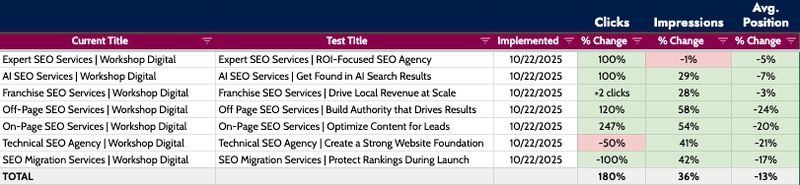
A recent experiment on my website examined whether more descriptive titles could boost clicks without altering the underlying content. We tested the hypothesis by aligning page titles more closely with search intent and user needs.
The result? A greater alignment led to a substantial increase in click-through rates, proving that small changes can powerfully impact visibility and engagement.
Strategies for Keeping Content Fresh in an AI-Saturated World
Remaining fresh in the AI era isn’t about jumping on every new tool but requires intentionality in creating, positioning, and maintaining content.
1. Treat Intent as Strategy
The essence of SEO has always been search intent, not keyword stuffing. Before crafting content, ask what problem the searcher is trying to address and what a good answer would look like in their context.
2. Use Page Titles and Headlines as Tools
In a crowded SERP, an effective title is crucial to catch a user’s attention and make them click.
3. Refresh Before You Create
Oft-overlooked is the power of improving existing content. You don’t need to produce new content incessantly when updates can achieve better results.
4. Lean into Specificity and Constraints
While AI excels at general advice, human-guided content shines through specificity and context, offering expert insights and breaking down misconceptions.
5. Use AI as an Accelerator
AI should accelerate tasks that don’t require judgment. Editorial responsibilities still lie with us, ensuring content aligns with our goals.
6. Measure Freshness by Behavior
It’s not the volume of content but engagement metrics like time on page and scroll depth that define freshness.
7. Accept that ‘Traditional’ Doesn’t Mean Outdated
Mainstays like clarity, structure, and relevance have only gained importance in our AI-driven landscape.
Why Fresh Content Actually Wins
While AI has revolutionized content speed and accessibility, truly effective content remains appealing and relevant, aligning with users’ search intent and preferences.
Incomplete terminology often results in an incomplete strategy. To bridge this gap, I’m here to offer a clearer framework for optimizing when AI systems both recommend and act.
Search engine optimization (SEO) – be found. Answer engine optimization (AEO) – be the answer. AI engine optimization (AIEO) – be the recommendation. Lastly, assistive agent optimization (AAO) – be chosen when there’s no human in the loop. These are four distinct stages, each absorbing the one before it.
The constant term across the latter two stages is “assistive.” It highlights the purpose: what the system provides the user. The shift happens when “engine” becomes “agent,” marking our industry’s move from systems that recommend to those that act.
For me, this naming debate distracts us from the real work. The SEO industry has splintered across multiple terms that essentially describe the same discipline. Each term has its advocates, and while debating these labels, we aren’t progressing with the actual work.
So, let’s cut to the chase: I’ll lay out why AAO is an effective solution so we can all get back to focusing on our jobs.
Every competing acronym offers partial coverage, none captures it all
Every AI system making recommendations or autonomous decisions—be it Google, Bing, ChatGPT, Perplexity, or Copilot—relies on three components: large language models, knowledge graphs, and traditional search. I refer to these as the algorithmic trinity.
The balance of these elements differs by platform, but the trinity itself remains universal. Even those at Google I’ve conversed with agree on this architectural structure.
SEO has always described the engine’s purpose, which I’ve appreciated. Let’s examine how the competing acronyms align against these three components.
GEO describes the mechanism over intent. It involves the LLM layer, includes search as necessary, but overlooks the knowledge graph entirely. This technology-specific term lacks longevity when the technology advances.
Entity SEO covers the knowledge graph layer but only acknowledges search as a delivery mechanism and LLMs secondarily. It fails the glossary test, often confusing non-specialists.
LLM optimization candidly reveals its scope but neglects the knowledge graph and search components entirely.
AI SEO tacks the term “AI” onto the traditional term, making it accessible to outsiders but lacking durability. As we move to 2026, users are more likely researching rather than searching.
All these terms are incomplete, and it naturally follows that incomplete terminology leads to incomplete strategy. Practitioners tend to optimize only for the part their acronym emphasizes, neglecting others.
Assistive agent optimization (AAO) evolves cleanly from answer engine optimization and encompasses everything required for crafting a comprehensive strategy:
“Assistive” clearly defines the purpose for the entire algorithmic trinity.
“Agent” identifies the actor deploying all three components to reach a decision.
“Optimization” captures what we do.
It’s a stable three-legged stool, ensuring consistency, much like sitting on a stool with evenly matched legs—one that doesn’t wobble.
The glossary test shows AAO isn’t flawless, but it’s our best option
Generative engine optimization, entity SEO, and LLM optimization all require niche understanding, failing the glossary test.
Although “assistive” in AAO isn’t instantly recognizable, “agent” is now a part of popular vocabulary. We see every tech company promoting agents, and “optimization” is self-explanatory. Two out of three terms land smoothly, and the third is easily understood.
If you can propose a more fitting term that perfectly covers the algorithmic trinity and passes the glossary test, I’m open to it. After all, what matters is the discipline, not the terminology.
Importantly, AAO describes a role: optimizing so the assistive agent favors your brand. Roles endure beyond technologies. The right term will endure for years, independent of prevailing model architectures or retrieval methods.
What changes when you adopt the AAO framework
Your brand identity becomes foundational rather than optional. When an agent reviews hotel options, supplier choices, or consultant recommendations, it doesn’t thumb through pages seeking the best title tag. Instead, it assesses the brand: its essence, service, audience, reliability, and confidence in those facts.
This trust originates from the entity home—the page you own that roots everything the algorithmic trinity knows about your brand—and extends through all corroborating sources. If your brand isn’t clearly understood, the agent will select one that is.
The funnel resides within the agent now. The well-trodden acquisition funnel (awareness, consideration, decision) used to bounce users around, with search engines acting as traffic sources. Now, under AAO, this entire journey takes place within AI, without users encountering a list of options. The agent becomes aware of, evaluates, and decides on your brand before presenting the result. Your mission is thus to ensure your brand is the answer when the agent processes its funnel internally.
You might think, “We’re not there yet.” Yes, that’s true for most, but the funnel is already within the assistive engine. With platforms like ChatGPT, Perplexity, Google AI Mode driving users to the perfect click—the pinnacle in AI zeroing in on a single user solution—most tend to accept what’s presented. What’s presently lacking is the agent making the purchase decision.
The web index is no longer the sole source of truth it once was. For two decades, it dominated, but that monopoly is crumbling:
Proprietary datasets feed agents directly, evolving search into what I term ambient research, where in-app pushes surface brand suggestions without a query.
Agents and engines utilize APIs, booking systems, and internal databases that don’t intersect traditional web indices. The index will persist as an essential anchor, but it’s no longer the sole gatekeeper. It’s time we strategize with that understanding.
The push layer is also resurfacing. For years, we depended on search engines to understand our content—rendering JavaScript, deciphering complex pages—and they responded. This passive approach will continue, but proactive methods are gaining ground.
IndexNow, nurtured by Fabrice Canel at Bing, along with MCP and whatever Google deploys next, all facilitate one key function: enabling us to push structured data to action-oriented systems instead of waiting for them to retrieve it. It’s reminiscent of the 1990s, with proactive URL submissions and active ecosystem feeding.
Google’s absence from IndexNow isn’t due to the concept’s flaws—it’s quite ingenious—but perhaps because it wasn’t Google’s brainchild, sparking aspirations for a proprietary adaptation.
We must also consider that JavaScript rendering was Google’s generous favor, not an industry standard. Many AI agent bots don’t process JavaScript, so content reliant on client-side rendering may never be seen by an increasing number of agents.
(This all aligns with the 10-gate DSCRI-ARGDW pipeline, which I’ll detail in the next series segment.)
Your SEO skills remain relevant; the focus shifts from engines to agents.
You don’t need to perfect each intermediary step before embracing AAO, as AAO encompasses AIEO, AIEO encompasses AEO, and AEO encompasses SEO—the skills stack remains, only the focus shifts: aim to be chosen by the agent, recommended during research, and mentioned during inquiries.
Those adopting this perspective will consistently build pipeline confidence while others remain entangled in debates over acronyms, further widening the gap over time.
The discipline now has a name, the agents are already operational, the push layer is in play, and the era of complacency has ended.
The initial two articles explored the “what” and the “why.” Next week, I’ll delve into the “how.” I plan to unveil the 10-gate pipeline I’ve been referring to: DSCRI-ARGDW, a crucial conduit between your content and a conversion by an AI engine.
Discovered: The bot becomes aware of your existence.
Selected: The bot deems your data worthy of retrieval.
Crawled: The bot captures your content.
Rendered: The bot transcribes what it retrieves into a readable form.
Indexed: Content is committed to the algorithm’s system memory.
Annotated: The content undergoes classification across various dimensions.
Recruited: The algorithm leverages your content.
Grounded: The content’s credibility is confirmed against multiple sources.
Displayed: The content is showcased to the user.
Won: The moment of triumph – the engine secures the perfect click.
When I first heard the term “contact page,” my mind immediately envisioned a simple space filled with contact info and a form. However, it turns out that this is a major oversight from a local SEO standpoint. Let me guide you on crafting a contact page that not only elevates your Google prominence but also converts more leads.
Google pays special attention to your contact page
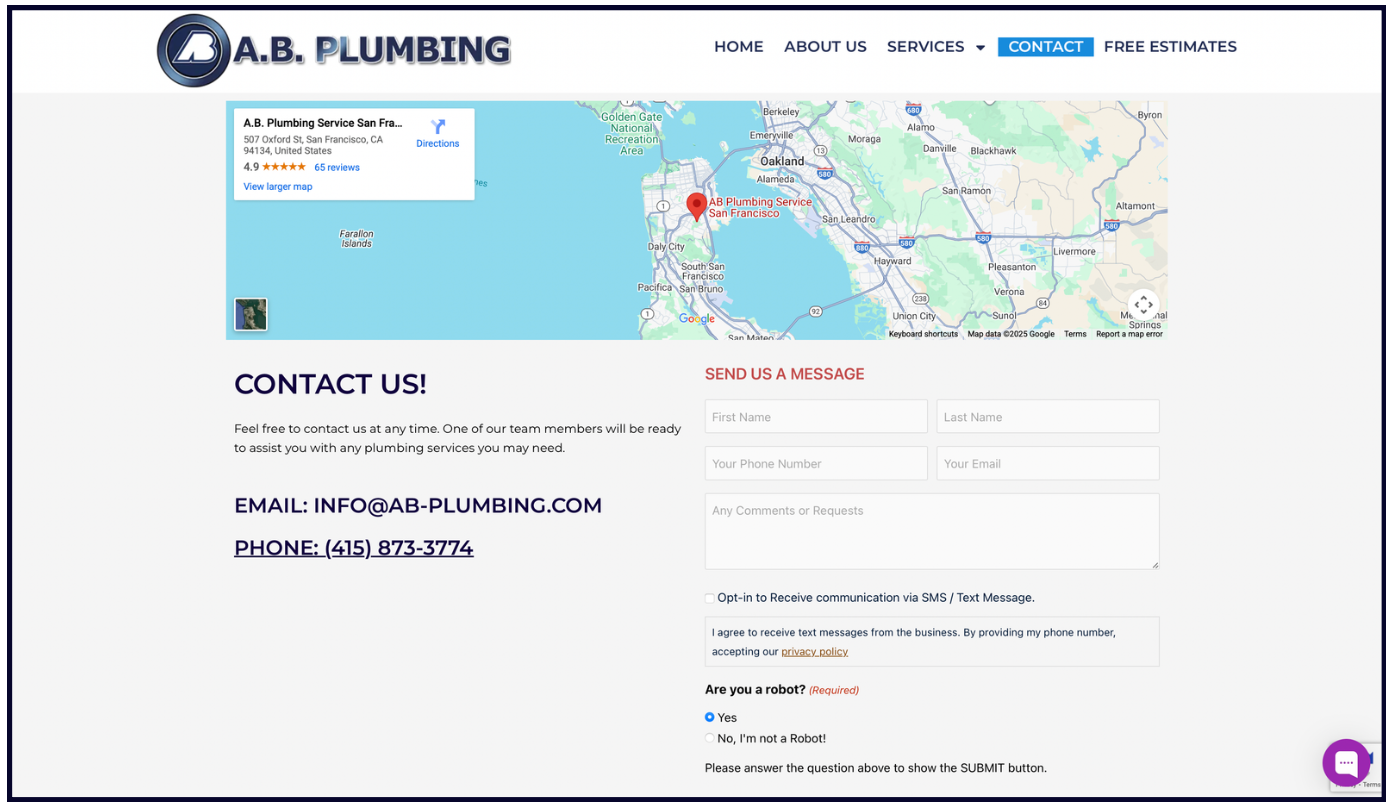
Joel Headley, the former head of Google Business Profile Support, once shared with me that Google actively crawls and interprets your contact page to extract details about your business. This revelation illuminated the common inadequacy of contact pages that simply display a business’s name, address, and phone number (NAP), coupled with a basic contact form.
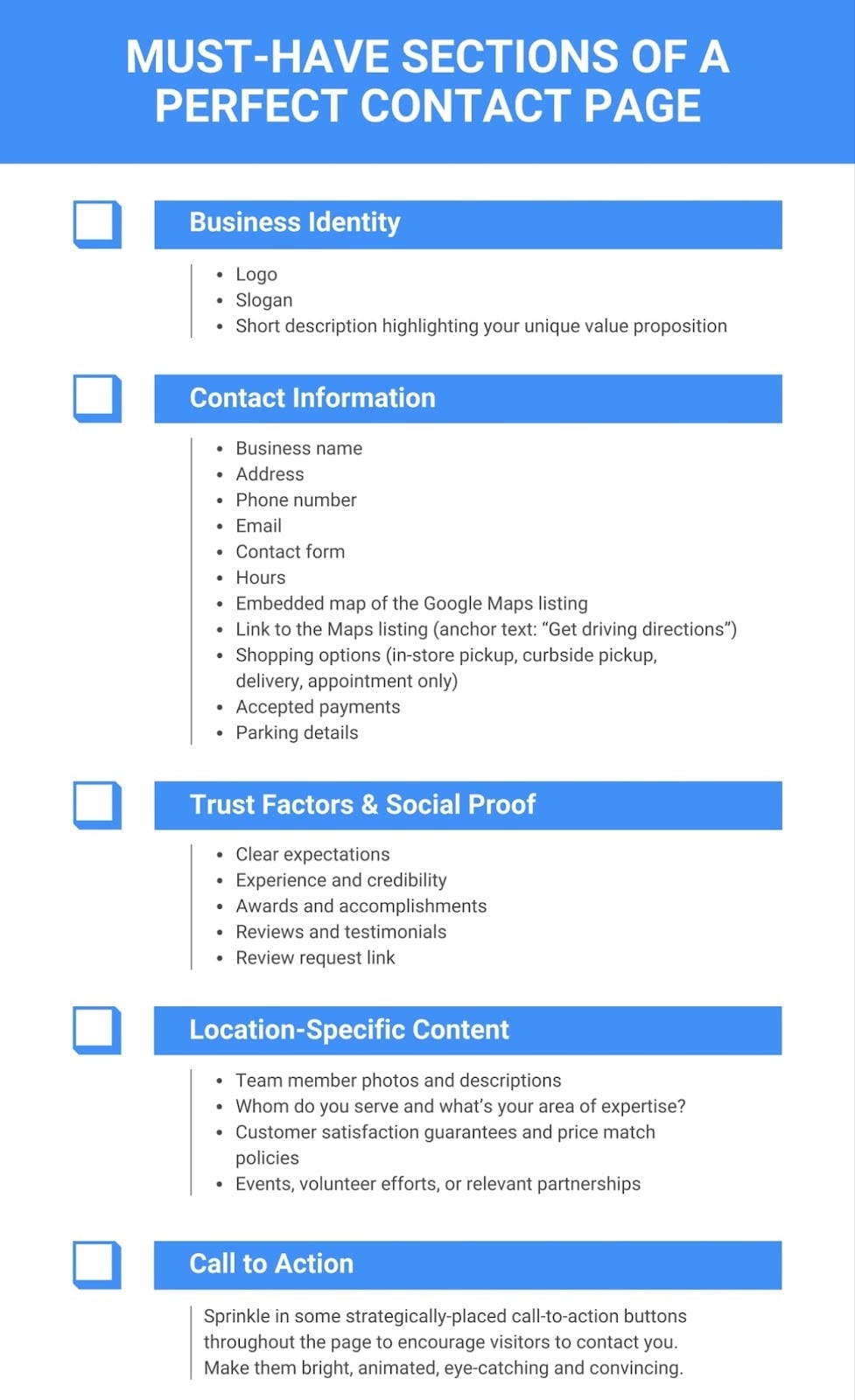
Google is essentially requesting, “Provide me with your business data,” while you might be responding, “No data for you.” Instead, I encourage you to treat your contact page with the same importance as a multi-location landing page. Here’s what your contact page needs to transform visitors into paying clients:
Business identity.
Contact information.
Trust factors and social proof.
Location-specific content.
Amenities.
Call to action.
1. Business identity
Your contact page should be a reflection of your brand, just like every other page on your site. Here’s what to include:
Your business logo, matching all marketing materials and signage.
Your slogan, with potential keywords for SEO enhancement.
A concise introduction detailing your business’s function, location, and unique value proposition (UVP).
Your contact page isn’t just about providing contact avenues; it should convince visitors of their decision’s wisdom before they reach out.
Clear expectations
Clearly communicate what a customer can expect post-contact to solidify their choice to connect with you:
Expected response times.
Upcoming steps and confirmations from your team.
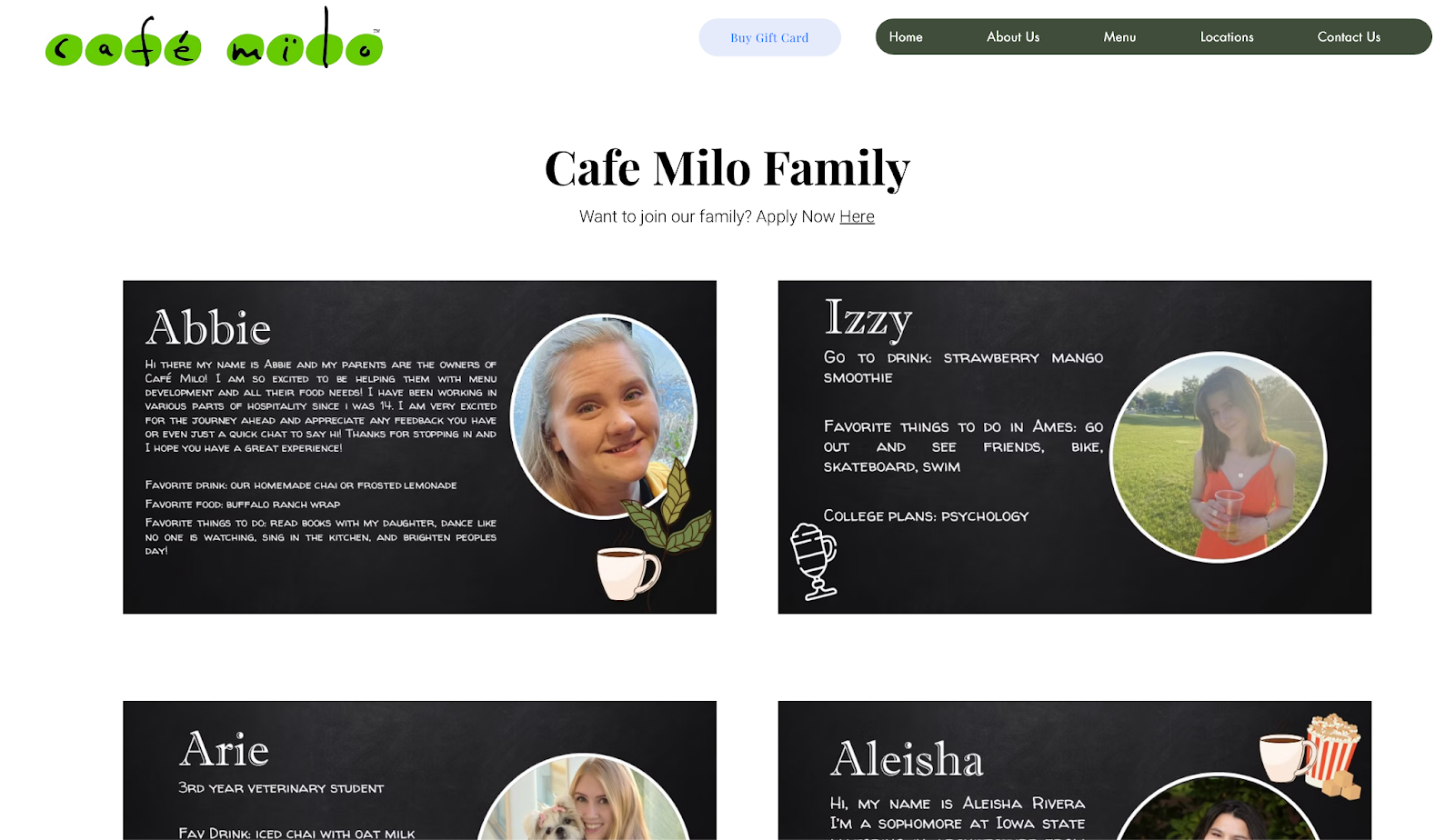
Additional useful information about your team, location, or differentiators.
Experience and credentials
Boost trust and conversion rates by displaying involvement in:
Industry associations, locally and nationally.
Chamber of commerce groups.
Professional organizations.
Meetup and neighborhood associations.
Better Business Bureau ratings.
Tip: Link association names to your business listing on their sites.
Awards and accomplishments
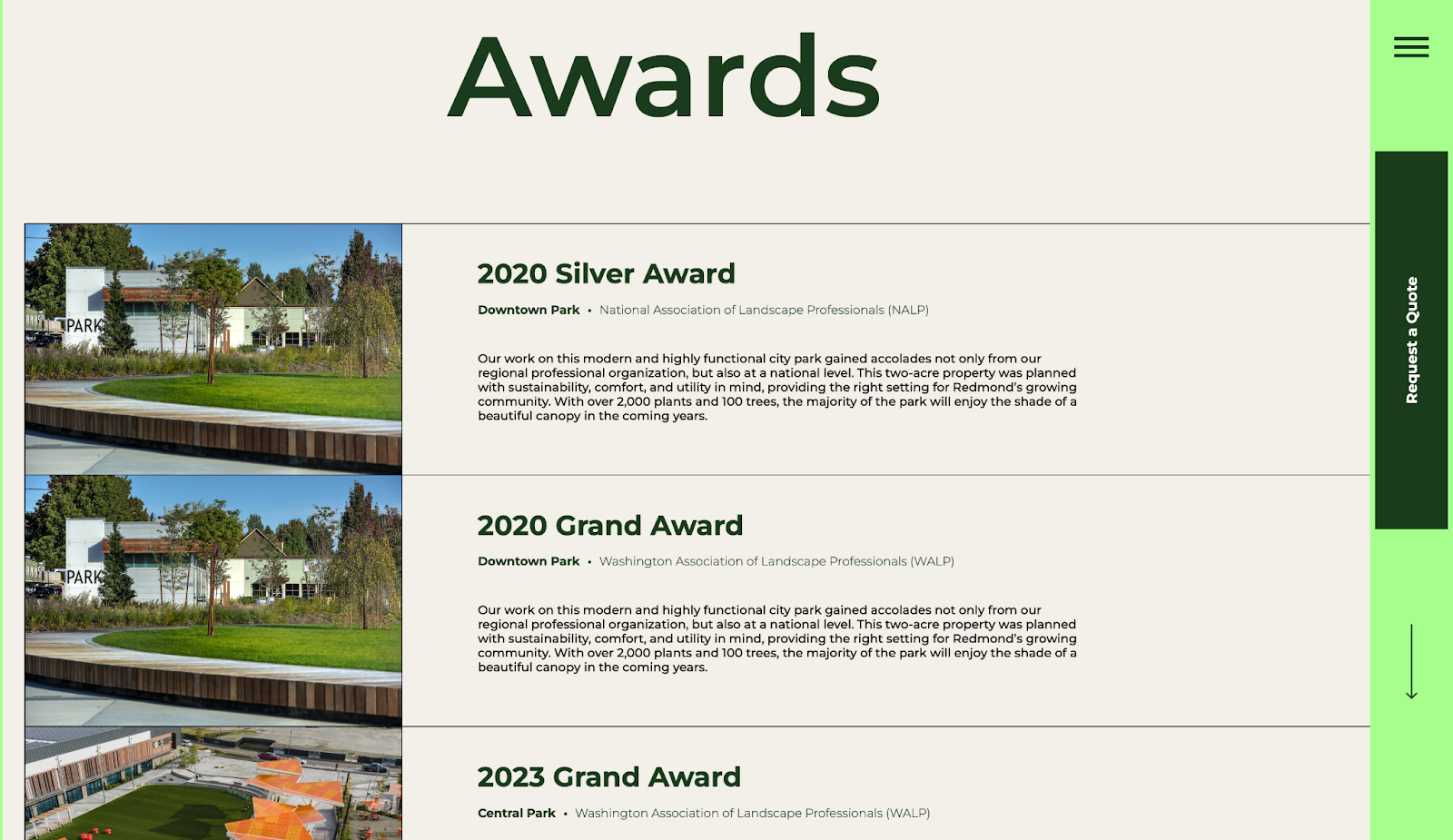
Include any awards and press mentions, with links to the relevant articles or sites. If there are many, consider a dedicated media section.
Reviews and testimonials
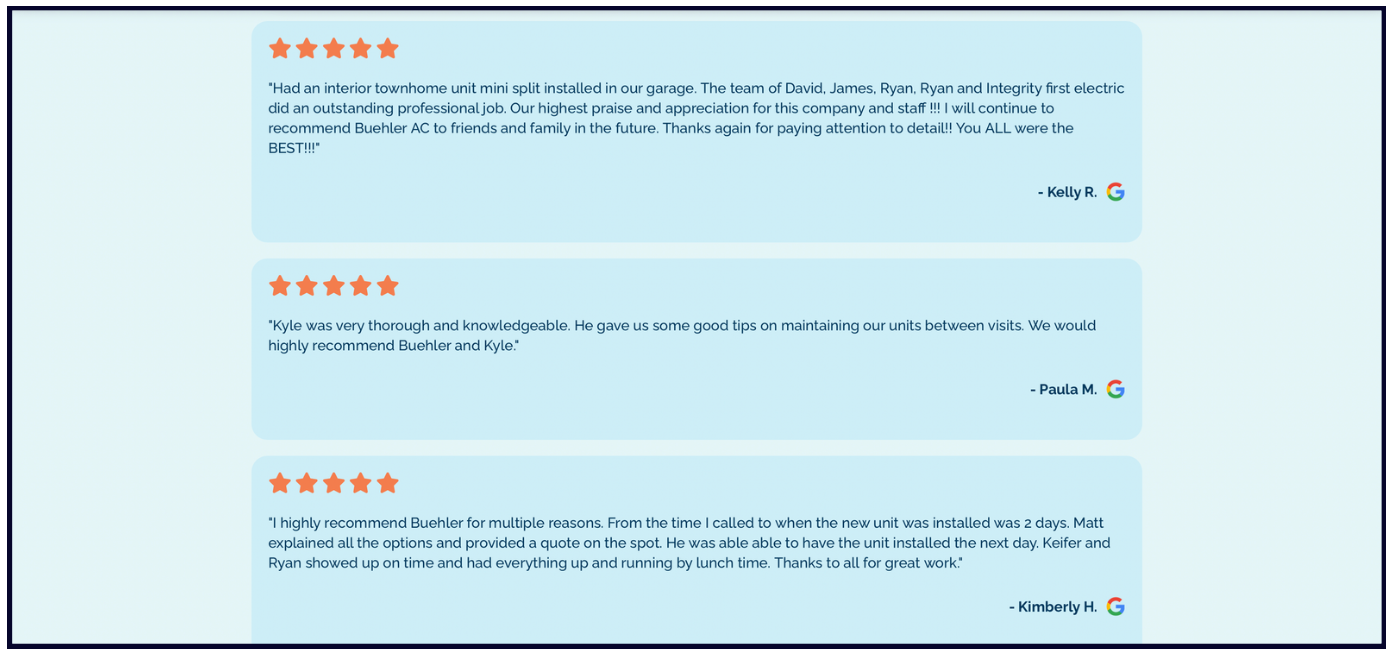
Embed external reviews and include testimonials to enhance trust. Enhance authenticity by showing reviewer photos, names, cities, and profiles.
Your review section is also an excellent place to request additional Google reviews, especially from repeat customers, using a link and call to action.
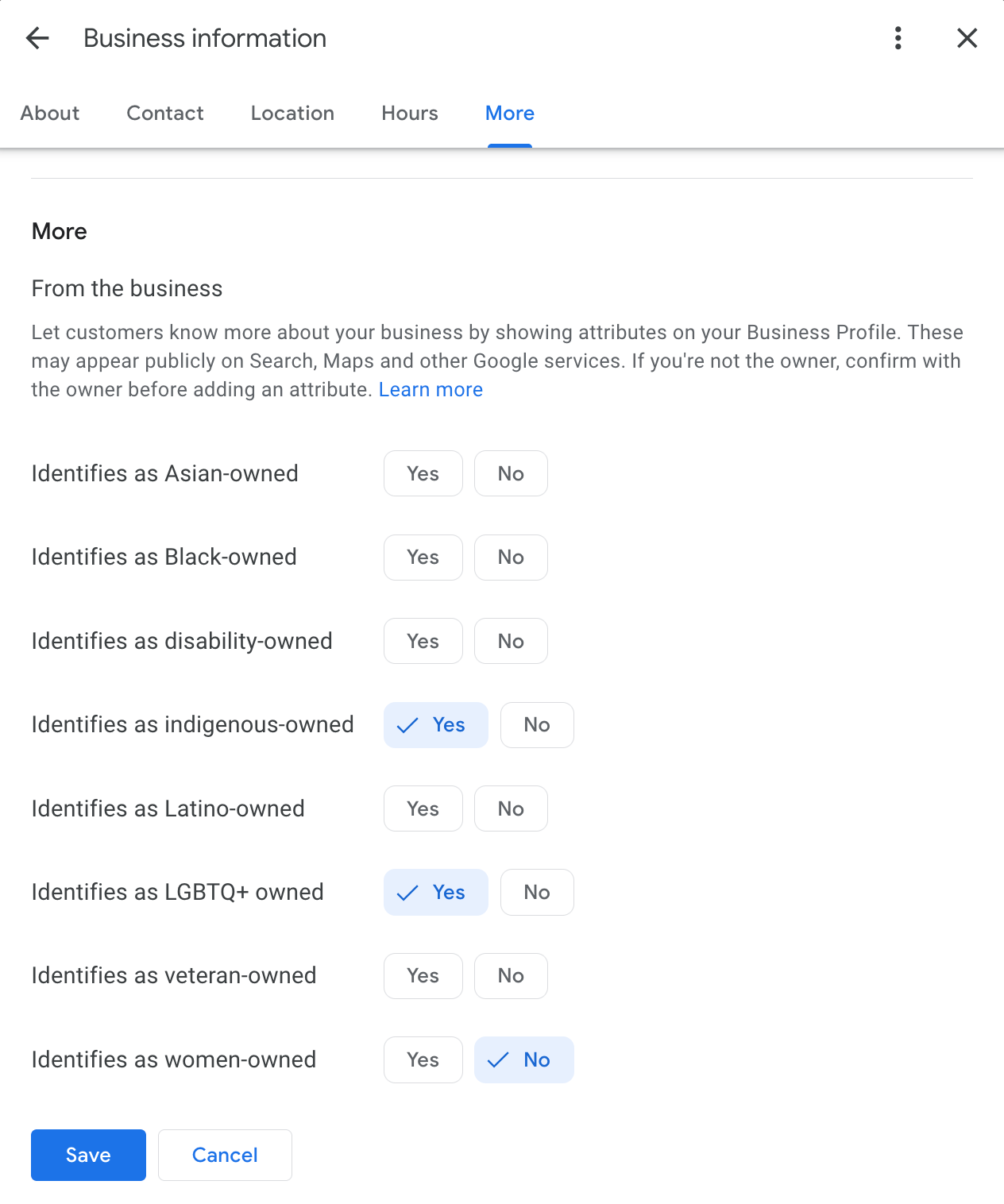
Review your Google Business Profile’s attributes and list those on your contact page, along with other unique attributes. This specificity aids traditional and AI searches in understanding if you meet distinct needs.
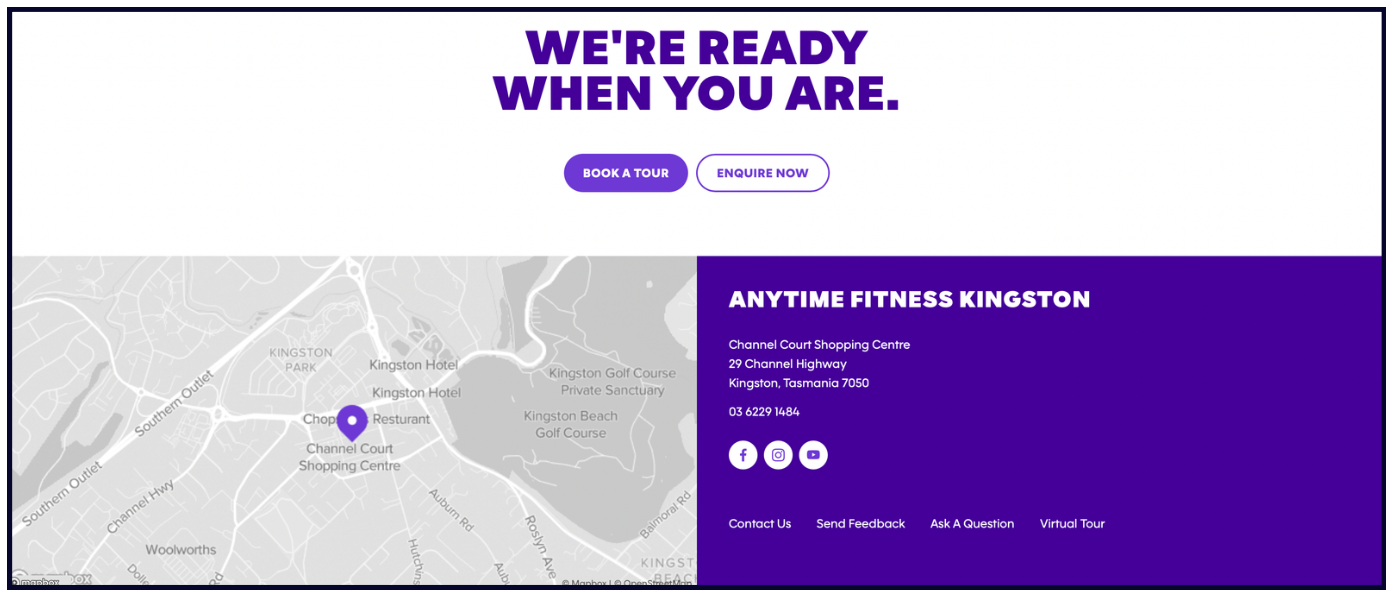
6. A clear CTA button
With a well-structured contact page, a compelling call to action (CTA) is essential. Use vibrant, eye-catching CTAs throughout the page to encourage engagements.
Treat your contact page like a local SEO asset
Your contact page should be seen as a local SEO asset. By investing effort similar to creating a multi-location landing page, you elevate your engagement and conversion rates, surpassing most competitors. Keep this list handy to ensure all necessary sections are covered.