Category: SEO

  • Retire These SEO Metrics to Supercharge Your 2026 Strategy

    Retire These SEO Metrics to Supercharge Your 2026 Strategy

    I’ve realized that many of us, myself included, might be tracking the wrong SEO metrics lately. We need to shake things up, especially with 2026 approaching.

    Picture this: I present an impressive chart depicting a 47% increase in site traffic. But instead of excitement, I’m met with puzzled looks from the CMO, wondering why revenue remains stagnant. Or, I celebrate a top-three ranking for a keyword nobody searches for.

    The SEO metrics that boosted my confidence back in 2019 might just be steering me wrong in 2026. With AI Overviews taking over search results and zero-click searches becoming the new standard, clinging to outdated metrics might jeopardize my strategy and budget.

    I’m ready to take you through the precise metrics that our SEO team should retire and which new, revenue-focused metrics to prioritize instead.

    Traffic Metrics

    1. Organic Traffic

    Organic traffic has been my go-to KPI in SEO reports ever since I started. But relying solely on it doesn’t provide enough context.

    Not all traffic is equally valuable. A thousand visitors who bounce instantly are not beneficial. However, a hundred visitors converting at an 8% rate? That’s a success story.

    I witnessed a local HVAC company whose traffic dropped by 22%, year on year. Panic, right? Yet, organic revenue increased by 31%. We focused on enriching high-intent service pages, pruning low-intent content. Fewer visitors, but better ones.

    Before panicking over traffic drops, I always reassess where traffic is declining. If losses involve informational articles and customer login pages, it’s not a revenue issue. That’s just noise exiting my dashboard.

    2. Total Impressions Without Intent Segmentation 

    This metric can mislead. A million impressions from merely informational queries like “what is SEO” might build some awareness, but they contribute zero revenue. Meanwhile, ten thousand impressions from business-driven queries like “best enterprise SEO agency” could significantly boost my pipeline.

    Google Search Console offers this data, but many teams, myself included, often fail to segment it intelligently.

    3. Traffic Growth Without Revenue Correlation

    This is a risky trap for SEO teams. Bringing a 35% increase in organic traffic to a quarterly review sounds impressive, right until the CFO asks, “And how does this translate to revenue?” If I can’t answer that, I’m just reporting noise.

    Ranking Metrics

    4. Average Keyword Position 

    This metric might look compelling in a dashboard, but it doesn’t hold up under scrutiny. If I rank first for a keyword with ten monthly searches and fiftieth for one with 50,000, my average position might seem okay, but I’m losing where it matters most. 

    The average position treats all keywords as identical when they aren’t. With personalized search results, an “average position” can vary greatly by user and location.

    5. Isolated Keyword Tracking

    Searchers these days don’t typically use isolated keywords. They pose questions, explore themes, and adjust their queries. Google’s focus has shifted toward semantic search and topic modeling.

    Tracking a solitary keyword like “lawyer” is pointless without understanding intent — are searchers interested in criminal defense, divorce services, or merely looking up what lawyers do?

    6. Share of Top 10 Rankings 

    This metric sounds clever until it’s clear that 80% of my top-10 rankings might involve low-intent, low-volume queries. Meanwhile, competitors claim the top-three spots for crucial commercial queries in my niche.

    Achieving a No. 1 ranking for a high-converting transactional keyword is more valuable than holding 50 top-10 positions for low-value informational queries.

    Authority and Engagement Metrics

    7. Domain Authority and Domain Rating 

    DA and DR might not align with Google’s metrics. They’re proprietary scores from SEO tool companies. Yet, teams often set misguided goals like boosting DA from 42 to 50 by Q3. 

    It’s possible for a competitor with a DA of 35 to outperform my DA of 65 if their content aligns better with search intent. So, let’s keep these out of executive dashboards.

    I’ve seen how backlink volume is often overrated. Google’s algorithm prioritizes link quality, relevance, and context over sheer volume.

    A single link from a high-quality, relevant site outweighs hundreds of low-grade directory links. I’ve seen sites with 100,000+ backlinks struggle to rank for meaningful terms because most links lacked quality.

    9. Bounce Rate 

    I’ve found bounce rate misunderstood for years. If someone searches for my company’s business hours, finds them on the contact page, and leaves, that’s a success with a 100% bounce rate.

    Google replaced bounce rate with “engagement rate” in GA4 for a reason. Similarly, session duration and pages per session need context. A high pages-per-session score on my pricing page may indicate confusion, not engagement. 

    Why These SEO Metrics Are Failing Now

    ```json
{
  "alt": "The CapmatchOne logo with a gradient circle and bold text.",
  "caption": "Discover innovation with the CapmatchOne logo, featuring sleek typography and a modern gradient circle.",
  "description": "The CapmatchOne logo features bold, modern typography coupled with a gradient circle, symbolizing connection and innovation. The sleek design conveys a sense of progress and creativity. This image can be used for branding or promotional purposes, appealing to audiences interested in innovative solutions and forward-thinking designs."
}
```

    I’ve noticed the search landscape shifting quite a bit. Up to 58.5% of U.S. and 59.7% of EU Google searches now conclude without a click, as per SparkToro’s zero-click study. This means, for every 1,000 searches, only 360 result in a visit to a site.

    AI technologies are capturing and synthesizing information, bypassing the need for a click. My content can gain visibility and influence without contributing to sessions in Google Analytics.

    • Wynter’s latest B2B buyer research indicates nearly 24% of CMOs now utilize AI tools like ChatGPT for research, a significant rise from last year.

    Buyers discover brands via AI tools and use Google to validate those discoveries. This alters my SEO focus from merely driving traffic to ensuring my brand is visible during pivotal decision-making stages.

    Modern customer journeys can be erratic. Often, users who initially find us through organic search might return through paid ads or direct links. If we use last-click attribution, the true value of SEO is obscured, although this organic start was critical for conversion.

    Dig deeper: Measuring zero-click search: Visibility-first SEO for AI results

    What to Measure Instead

    Revenue and Pipeline Contribution From Organic 

    For ecommerce, I aim to track revenue from organic sessions by product category and landing pages. For lead-generation, I’ll track how many leads convert to customers. Integrating with a CRM helps in connecting those dots.

    No one’s interested in your DA if you can demonstrate $1.2 million in revenue attributed to organic channels.

    Conversion-weighted Visibility 

    I’ll focus on visibility for high-value terms that lead to conversions.

    A franchise client noticed they dominated low-intent queries but were invisible for crucial local terms. We adjusted priorities, and their qualified leads doubled in four months.

    Topic Cluster Performance 

    This metric supersedes individual keyword rankings. Monitoring how I rank across full topic clusters, and the aggregate visibility and conversions from these clusters, gives a comprehensive view of topic authority.

    SERP Real Estate Ownership 

    By gauging control over the entirety of search pages, not just listings, including snippets and local packs, I can effectively keep competitors at bay for crucial queries.

    AI Platform Visibility and Brand Mentions

    My focus will also be on how frequently my brand is mentioned in AI responses. Mentions are becoming as crucial as click-through rates.

    For instance, if I secure a favorable recommendation rate across multiple AI platforms for vital topics, it’s a win, even if website traffic appears unchanged.

    While tools are emerging to monitor this, manual spot checks can reveal valuable insights, enhancing authority and awareness, eventually leading to brand searches and conversions.

    Branded Search and Direct Traffic as AI Visibility Proxies

    I notice when buyers find out about my brand through zero-click searches, they often search the brand name directly instead of clicking through. This reflects in my branded and direct traffic rather than organic metrics.

    If I see no change in nonbranded organic traffic but an increase in branded search and direct visits, it usually indicates that my content gains attention in AI Overviews.

    How to Transition My Reporting

    Revamping reporting around new metrics might feel daunting. Stakeholders are comfortable with old metrics.

    I start by evaluating my current dashboard, ensuring relevant metrics face business outcomes directly rather than just tallying activities.

    Transition by gradually omitting vanity metrics. If organic traffic was my focal KPI, I now introduce it segmented by intent and accompany it with organic-attributed revenue. Gradually, I pivot focus and phase out the dated metrics.

    When I introduce new metrics, I frame them in relatable terms. Avoid using “conversion-weighted visibility.” Opt for “visibility metrics for top-converting terms.”

    The Metrics That Prove SEO’s Value

    The metrics we’ve relied upon — organic traffic, average keyword position, domain authority, bounce rate — aren’t inherently harmful. They’re just incomplete, providing a potentially false sense of security while others prioritize revenue-generating metrics.

    Newly adopted metrics — revenue contributions, conversion-oriented visibility, topic authority, SERP dominance, AI platform mentions — directly relate SEO to tangible business outcomes. They prove ROI, justify budgets, and align strategies with business growth.

    Consider which metrics in your dashboard lend false impressions of activity over effectiveness. Retire them. Replace them.

    Ultimately, no one’s concerned with traffic numbers or DA scores. They want to know if SEO drives growth. Make sure your metrics affirm it.


    Inspired by this post on Search Engine Land.


    crushpress.ai community screenshot
  • Text Ads Soar as Organic Search Declines: Key Study Insights

    Text Ads Soar as Organic Search Declines: Key Study Insights

    I’ve recently come across an interesting study highlighting a significant shift in search click dynamics. It turns out that text ad clicks have dramatically increased year over year, while the traditional organic clicks in major verticals have taken a sharp decline.

    This transformation isn’t solely due to AI Overviews for sure. Google’s expansion of paid search real estate is playing a pivotal role here. In the U.S., data reveals a steep drop in classic organic click share across product categories like headphones, jeans, greeting cards, and online games between January 2025 and January 2026.

    The numbers are quite telling. Classic organic click share fell significantly across these categories, making way for text ads, which emerged as the biggest beneficiaries, gaining a notable share of clicks.

    Why does this shift matter to us? As digital marketers, it’s no longer just AI-powered features that we’re contending with. Text ads have won substantial ground, capturing about one-third of the clicks in several product categories. For brands seeing a dip in organic visibility, increasing paid efforts seems to be a necessary strategy.

    Numbers tell the story. When diving into four main verticals, text ads showed consistent click-share increases. Classic organic lost between 11 to 23 percentage points, while text ads gained anywhere from 7 to 13 percentage points across the board. Paid click share has doubled in several key product categories.

    Comprehensive breakdown: Classic organic click shares have seen a year-over-year decline across all verticals. For instance, headphones lost dramatically, shrinking from 73% to 50%, and even organic-heavy areas like online games dropped by double digits. Such declines emphasize the urgent need for many brands to reassess their search strategies.

    Data shows that text ads inched forward share-wise in every industry examined. For instance:

    • Headphones: Rose from 3% to 16%
    • Online games: Up from 3% to 13%
    • Jeans: Climbed from 7% to 16%
    • Greeting cards: Up from 9% to 16%

    Moreover, Product Listing Ads (PLAs) are further supporting this change in product sectors:

    • Headphones: Increased from 16% to 36%
    • Jeans: Went from 18% to 34%
    • Greeting Cards: Rose from 10% to 19%

    AI Overviews have seen a diverse impact. While the presence of Google AI Overviews on SERPs has certainly increased, the extent varies significantly across sectors:

    • Headphones: 2.28% → 32.76%
    • Online games: 0.38% → 29.80%
    • Greeting cards: 0.94% → 21.97%
    • Jeans: 2.28% → 12.06%

    Zero-click searches remain significant but stable. Even though the overall zero-click rates haven’t seen dramatic changes, online games have witnessed a noticeable uptick:

    • Headphones: 63% (unchanged)
    • Jeans: Down from 65% to 61%
    • Online games: Up from 43% to 50%
    • Greeting cards: Increased from 51% to 53%

    Brands adapt by increasing paid presence. In the headphones market, for example, companies like Amazon boosted paid clicks by 35% despite losing organic traffic, while Walmart increased theirs nearly sixfold.

    In the jeans sector, Gap saw a 137% growth in paid clicks, rising to become the leading paid player.

    For online games, CrazyGames quadrupled its paid clicks, and Arkadium entered the paid scene after a significant drop in organic clicks.

    These shifts have led to a self-reinforcing cycle, as pointed out by Aleyda Solis, the study’s author. Organic share declines, competition increases, and brands continuously boost their paid-search budgets.

    Study insights. This study was conducted using Similarweb data, thoroughly examining the SERP composition and click patterns for the top 5,000 U.S. queries in the areas of headphones, jeans, and online games, alongside the top 956 greeting card-related queries. Over time, it has highlighted a marked shift in click distribution among classic organic results, text ads, PLAs, zero-click searches, and AI Overviews.

    If you’re curious about deeper insights, you can check out the full study by Aleyda Solis.


    Inspired by this post on Search Engine Land.


    crushpress.ai community screenshot
  • ChatGPT Prefers Early Content: 44% of Citations from Opening Sections

    ChatGPT Prefers Early Content: 44% of Citations from Opening Sections

    I recently stumbled upon a fascinating study that shows how ChatGPT pulls most of its references from the beginning sections of content. It’s clear from this research that the AI favors straightforward definitions, a balanced tone, and densely packed entities.

    According to Kevin Indig, a Growth Advisor who analyzed 1.2 million AI responses and 18,012 citations, ChatGPT has a strong preference for using citations from the top of the content. This was a revelation for me and definitely something to keep in mind when writing.

    Why we care. The traditional search landscape often rewards depth and gradual payoffs. However, AI is changing that game by favoring clear entities and direct answers right at the start. If I don’t make sure my key information is front and center, it’s less likely to be cited by AI.

    By the numbers. In examining various datasets, Indig’s team found a “ski ramp” pattern—44.2% of citations originate from the first 30% of content, 31.1% from the middle, and only 24.7% come from the final third, with a noticeable drop towards the end.

    Breaking it down even further, I learned that at a paragraph level, AI citations largely come from the middle sentences (53%), with 24.5% from the first sentence and 22.5% from the last.

    The big takeaway. This really drives home the importance of front-loading critical insights at the article level. Within paragraphs, focusing on clarity and meaningful content rather than trying to hook readers with a dramatic first sentence seems to be more effective.

    Why this happens. Large language models like ChatGPT are trained on various styles of writing that prioritize a “bottom line up front” approach. It seems these models use the early sections as a framework for interpreting the rest of the data.

    Efficiency and context establishment remain key priorities for these models, even though they can process large sets of data.

    What gets cited. Indig noted five key traits of content frequently cited by ChatGPT: definitive language, a Q&A structure, entity richness, balanced sentiment, and business-grade clarity. Learning this has been incredibly insightful for how I craft my content.

    Indig’s team looked at a massive volume of data, identifying the traits of highly cited content by analyzing 18,012 verified citations from ChatGPT responses. The study focused on where and why the AI pulls content, using advanced techniques to match responses to source sentences.

    Bottom line. It seems the narrative approach of crafting an “ultimate guide” might not be the best for AI retrieval. Instead, a more structured, briefing-style format appears to be more successful.

    This study convinced me that writers now face what Indig calls a “clarity tax.” We need to present definitions, entities, and conclusions upfront rather than saving them for the conclusion.

    The report. For those interested, you can delve deeper into these findings in The science of how AI pays attention.


    Inspired by this post on Search Engine Land.


    crushpress.ai community screenshot
  • Master AI Search: Embrace Inclusion Over Top Positions

    Master AI Search: Embrace Inclusion Over Top Positions

    I’ve been thinking a lot about the key performance indicators (KPIs) for AI search, and it’s time to shift our focus a bit.

    Lately, I’ve noticed many SEO experts on platforms like LinkedIn and during conferences discussing the idea of “ranking No. 1 on ChatGPT,” equating it to securing the top spot on Google.

    On Google, being first is often like striking gold.

    Moving from the second to the first position on Google can supercharge your traffic and conversions, sometimes by 100%-300%.

    However, this isn’t necessarily true with AI-generated responses, primarily because these responses are subject to constant change.

    Our research indicates that AI users evaluate an average of 3.7 businesses before making a choice.

    ```json
{
  "alt": "Social media post discussing wasted money on ChatGPT ranking study.",
  "caption": "Spending $3,000 to track ChatGPT rankings revealed unexpected complexities and randomness.",
  "description": "A social media post describes a $3,000 expenditure to track company rankings using ChatGPT, Claude, and Google AI. The study involved 2,961 identical prompts, showing extensive randomization, with less than a 1 in 100 chance of obtaining the same brand list twice. Highlighted is a specific case of a hospital appearing in 97% of responses but ranking #1 only 36% of the time, emphasizing the unpredictability of the results."
}
```

    Thus, appearing first in ChatGPT’s results isn’t as crucial as it is in Google’s search results.

    Given this scenario, our AI strategy should prioritize “being part of the consideration set” over being the first mention and focus on what AI communicates about us.

    In the past months, my team has devoted over 100 hours observing how people use ChatGPT and Google’s AI Mode for finding services.

    What became clear quickly is that user behavior on AI search platforms is distinctively different from that on Google, beyond just the use of natural language versus keyword searches.

    Surprisingly, about 75% of observed sessions still involved keyword searching.

    ```json
{
  "alt": "Bar chart showing number of businesses checked in ChatGPT with values ranging from 1 to over 10.",
  "caption": "Discover the frequency of businesses being checked in ChatGPT. This bar chart visualizes the engagement across different search counts.",
  "description": "This image depicts a bar chart illustrating the number of businesses checked in ChatGPT, ranging from 1 to over 10. The y-axis represents the number of searches, with figures reaching up to 50. The background is a dark red, and the study is conducted by Sagapixel. This chart provides insights into how frequently businesses are queried in ChatGPT, making it essential for understanding user behavior and engagement."
}
```

    A significant difference is that AI search results prompt users to consider more businesses than traditional organic search results.

    Comparing multiple options is more straightforward within a chat interface than through clicking multiple search result links.

    Explore further: Adapting to AI-centric search behavior

    In both Google’s AI Mode and ChatGPT, users typically consider 3.7 businesses from the results shown.

    This significantly affects the importance of being the top result and elevates the value of other positions, as 75% of users also review businesses listed from positions 2 to 8.

    ```json
{
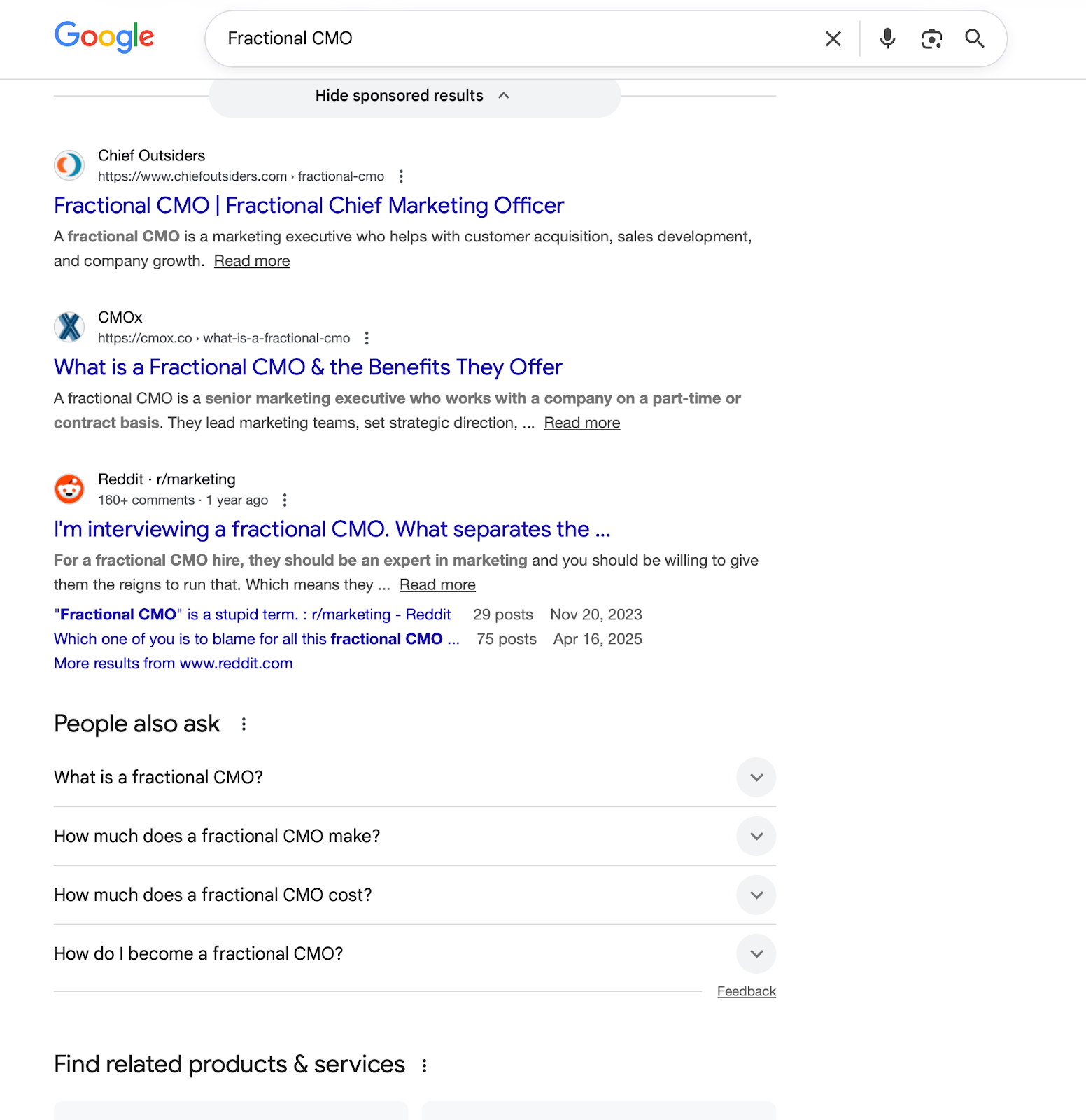
  "alt": "Google search results for 'Fractional CMO,' showing articles and discussions about fractional chief marketing officers.",
  "caption": "Curious about fractional CMOs? Discover insights and opinions on this unique role in the marketing world through these Google search results.",
  "description": "The image displays Google search results for 'Fractional CMO,' highlighting various articles from websites like Chief Outsiders, CMOx, and discussions on Reddit. Fractional CMOs are senior marketing executives working on a part-time or contract basis, offering strategic direction. The search results also include a 'People also ask' section with common questions about fractional CMOs. Keywords: Fractional CMO, marketing, search results, Google."
}
```

    Ultimately, what drives conversions isn’t solely your position in that list.

    These aren’t traditional rankings; they’re more akin to recommendations which might change in order or format, underscoring AI’s probabilistic nature.

    AI chat interfaces allow users to scan and assess more options feasibly than Google search results do.

    If a user is evaluating fractional CMO options, it’s more work through Google Search than ChatGPT.

    In Google’s results for “fractional CMO,” only two appear above the fold, each requiring click-through to view their full details.

    ```json
{
  "alt": "Text discussing benefits of hiring a fractional CMO for franchise growth, listing six fractional CMO firms.",
  "caption": "Discover how hiring a fractional CMO can drive your franchise's growth with strategic marketing leadership, and explore top firms offering these services.",
  "description": "The image contains text about hiring a fractional Chief Marketing Officer (CMO) for a home care company starting to franchise. It explains the benefits of hiring a fractional CMO, including strategic marketing planning, brand development, and lead generation. It lists six fractional CMO firms: Fractional CMO, Chief Outsiders, Magnetude Consulting, GoFractional, Authentic (Fractional Leadership), and Chameleon Collective, detailing each firm's offerings. This guide helps in understanding how fractional CMOs can enhance your franchise's growth strategy without long-term commitments."
}
```

    Contrast that with ChatGPT, where the model offers eight options with concise descriptions.

    This convenience makes it easier to make informed choices.

    We need to ensure that what the model says about us aligns with our message.

    Many marketers prioritize rankings and traffic but overlook messaging and positioning.

    Our study shows approximately 60% of users finalize their decisions based solely on AI responses without further exploring the business’s website or using Google.

    ```json
{
  "alt": "The CapmatchOne logo with a gradient circle and bold text.",
  "caption": "Discover innovation with the CapmatchOne logo, featuring sleek typography and a modern gradient circle.",
  "description": "The CapmatchOne logo features bold, modern typography coupled with a gradient circle, symbolizing connection and innovation. The sleek design conveys a sense of progress and creativity. This image can be used for branding or promotional purposes, appealing to audiences interested in innovative solutions and forward-thinking designs."
}
```

    To enhance conversion, we must deliver the correct message and ensure the AI conveys it accurately.

    For instance, even if Dr. Lanciano is the best in glaucoma care, if the AI promotes Ravi D. Goel and Bannett Eye Centers, users might lean towards them if that suits their needs.

    This reaffirms that appearing last doesn’t negate conversion opportunities if the AI message resonates well, unlike traditional search.

    Visibility alone doesn’t bring in revenue; conversions do, and these happen when prospects perceive your solution as a fit.

    Explore further: Measuring AI search visibility impact

    ```json
{
  "alt": "List of ophthalmologists and eye care services in Merchantville and South Jersey area with map.",
  "caption": "Discover top ophthalmologists and eye care services in Merchantville and South Jersey. Find expert care for eye diseases, surgeries, and comprehensive exams. Explore detailed listings and map for easier navigation.",
  "description": "This image provides detailed listings of ophthalmologists and eye care services in the Merchantville/South Jersey area. Featured are board-certified ophthalmologists such as Ravi D Goel, MD, and clinics like Kresloff Eye Associates. The services include diagnosis and treatment of eye diseases, surgical care, and comprehensive exams. Additionally, the image details optometry and referral support services, emphasizing ease of access to specialized care. A map at the bottom aids in locating these services, ensuring accessibility and convenience for patients seeking eye care solutions."
}
```

    We’re still approaching AI search through the SEO lens where top positions generate the most traffic, but this isn’t the case in AI-driven searches.

    AI interactions involve evaluating multiple options with each query changing response dynamics considerably.

    Thriving in AI search means being part of the consideration set and being described appealingly.

    It’s vital to appear on the list but more critical how you are presented since that’s what influences decisions.

    In essence, SEOs need to act like copywriters and salespeople to drive meaningful results.

    Explore further: Is SEO a brand or performance channel? It’s both now


    Inspired by this post on Search Engine Land.


    crushpress.ai community screenshot
  • Boost Your SEO Team’s AI Confidence: A Step-by-Step Guide

    Boost Your SEO Team’s AI Confidence: A Step-by-Step Guide

    With over twenty years in SEO, I’ve experienced every major industry disruption—from the days of keyword stuffing on AltaVista to the era of Google’s search algorithms, mobile-first indexing, and now the rise of AI.

    What’s striking today is the rapid pace of change and the emotional challenges it brings. I notice mounting pressure among teams, even those who have navigated previous shifts successfully.

    The common apprehension is valid: If AI improves speed, where does that leave me? This isn’t just a technical question—it’s deeply personal.

    This uncertainty can lower morale and slow adoption. Productivity can wane, and experimentation might stall, leading teams to either over-rely on AI or completely avoid it.

    The real leadership challenge is building confidence, capability, and trust in AI-assisted teams.

    4 Ways to Boost AI Confidence in SEO Teams

    Instilling genuine AI confidence within an SEO team goes beyond just adopting the latest tools—it’s a cultural shift.

    The most effective SEO teams don’t just accumulate tools; they use AI purposefully and with discipline—automating data pulls, summarizing research, and clustering keywords—to devote more time to strategy, storytelling, and aligning with stakeholders.

    As noted by Harvard Business School, technology adoption is largely cultural. Tools themselves don’t drive change—trust does. This insight is crucial for SEO teams navigating AI today.

    Below are four strategies for enhancing AI confidence in your teams through clarity, participation, and shared ownership, instead of pressure or hype.

    1. Earn Trust by Involving the Team in AI Tool Selection and Workflow Design

    Strengthening trust can effectively be achieved by transitioning from a top-down approach to shared ownership. People generally trust what they help create.

    When AI tools are imposed, resistance can increase. Inviting team members to participate in evaluation and workflow design makes AI seem less daunting and more empowering. Involving teams early provides real-world insights into where AI can reduce friction or introduce new challenges.

    Effective leaders:

    • Invite teams to test tools and share feedback.
    • Run small experiments before scaling adoption.
    • Communicate clearly about what you’re adopting, what you’re rejecting, and why.

    When teams feel included, they are more willing to experiment, and growth and innovation are fueled.

    Dig deeper: Why SEO teams need to ask ‘should we use AI?’ not just ‘can we?’

    2. Meet People Where They Are—Not Where You Want Them to Be

    AI capability varies widely across SEO teams. Some members might experiment daily, while others feel inundated or skeptical, influenced by past automation trends that have come and gone.

    Leaders who boost confidence know that capability develops at different speeds. They cultivate environments where curiosity is encouraged, uncertainty is acceptable, and learning is continuous rather than mandated.

    This means:

    • Normalizing different comfort levels.
    • Creating psychological safety around “I don’t know yet.”
    • Avoiding the shaming or over-celebration of early adopters.
    • Offering multiple learning paths.

    Acknowledging different starting points makes growth seem attainable rather than intimidating.

    @media (max-width: 768px) {.headline-responsive {font-size: 30px !important; line-height: 1.3 !important;}}

    3. Celebrate Wins and Highlight Champions

    Confidence builds with visible success.

    When a team member uses AI to reduce a task from hours to minutes, it’s a moment worth recognizing. It demonstrates AI’s potential to support meaningful work without sidelining human insight.

    Successful teams:

    • Share clear examples of AI improving quality and efficiency.
    • Highlight internal champions who can mentor others.
    • Create opportunities for demos and knowledge sharing.
    • Foster a culture of exploration, not criticism.

    My agency created AI focus groups with members from various departments. One group worked on integrating AI into project management, including representatives from SEO, operations, and leadership.

    This collaborative ownership resulted in more successful implementation. Teams were not just introducing AI; they were defining how it fit within real-world workflows. This approach led to enhanced buy-in, improved collaboration, and increased confidence.

    ```json
{
  "alt": "The CapmatchOne logo with a gradient circle and bold text.",
  "caption": "Discover innovation with the CapmatchOne logo, featuring sleek typography and a modern gradient circle.",
  "description": "The CapmatchOne logo features bold, modern typography coupled with a gradient circle, symbolizing connection and innovation. The sleek design conveys a sense of progress and creativity. This image can be used for branding or promotional purposes, appealing to audiences interested in innovative solutions and forward-thinking designs."
}
```

    Each group shared its achievements and lessons learned, building awareness of what succeeded and the reasons behind that success. When teams observe their peers embracing AI effectively, momentum flourishes.

    Dig deeper: The future of SEO teams is human-led and agent-powered

    4. Frame AI as a Collaborative Partner, Not a Replacement

    The fear of being replaced by AI is genuine. Ignoring this concern won’t make it disappear. It’s vital for teams to understand where human expertise remains indispensable.

    Reframing AI as a partner involves highlighting:

    • AI handles volume. Humans handle nuance.
    • AI accelerates analysis. Humans interpret meaning.
    • AI drafts. Humans validate, refine, and contextualize.
    • AI scales output. Humans build trust and influence.

    While AI aids execution, it cannot replace strategic instincts, contextual judgment, or cross-functional leadership—skills that ultimately drive performance.

    Why Experience Still Matters in AI-Driven SEO

    AI has lowered the entry barrier for many SEO tasks. With effective prompts, nearly anyone can produce keyword lists, outlines, or summaries. However, this accessibility often results in fleeting tactics and recycled quick fixes. 

    Anyone with a lengthy tenure in SEO recognizes this cycle. Tactics evolve. Fundamentals remain. Experience is the key differentiator here.

    AI Can Generate Outputs, Not Accountability

    AI can create content and analyze data, but it doesn’t bear responsibility for outcomes. It doesn’t uphold brand reputation, compliance, or long-term performance.

    SEO professionals remain responsible for:

    • Deciding what to exclude from publication.
    • Assessing technical, reputational, and compliance risks.
    • Weighing long-term consequences against short-term gains.

    AI executes. Humans decide. That distinction matters more than ever.

    Pattern Recognition Is Learned, Not Automated

    AI excels at identifying patterns but struggles to explain their significance or relevance in specific contexts.

    Experienced SEOs bring a depth of understanding AI can’t replicate. Their historical insights help them identify true shifts instead of simply reacting to industry noise. 

    Few industries witness as many tactic fluctuations as SEO. Experience fosters strategic thinking beyond previously successful approaches and avoids repeating tactics that later failed.

    AI suggests possibilities. Experience evaluates relevance.

    Professional Integrity Remains a Differentiator

    In high-visibility search environments, mistakes scale quickly. AI may produce inaccuracies, risking brand trust and compliance dangers.

    Teams with strong professional SEO foundations:

    • Validate AI output instead of assuming correctness.
    • Prioritize accuracy over speed.
    • Maintain ethical SEO standards.
    • Protect brand voice and credibility.

    Integrity isn’t automated. It’s a practiced discipline. In a fast-paced AI environment, it holds increasing importance.

    Dig deeper: How to build and lead a successful remote SEO team

    Growing the SEO Profession in an AI Era

    AI is accelerating SEO execution.

    As routine tasks become automated, the role of an SEO professional shifts to strategic oversight. Time previously spent on manual analysis can now focus on interpreting user intent, shaping search strategy, guiding stakeholders, and assessing risks.

    This evolution makes fundamentals even more critical. Teams still need sound judgment, technical expertise, and accountability. While AI supports execution, professionals remain responsible for decisions, quality, and long-term performance.

    Developing future SEOs necessitates more than tool proficiency; it requires teaching:

    • When to rely on AI.
    • When to question AI outputs.
    • How to apply experience and context to its output.

    Inspired by this post on Search Engine Land.


    crushpress.ai community screenshot
  • Markdown vs. HTML: Impact on AI Bot Traffic Explored

    Markdown vs. HTML: Impact on AI Bot Traffic Explored

    I embarked on a journey to uncover whether AI crawlers favored Markdown over HTML. By conducting a controlled experiment, I aimed to see if serving content in Markdown format would result in increased bot traffic. After analyzing data from 381 pages over the span of three weeks, I’m eager to share what I discovered.

    The results of this experiment could provide valuable insights for those interested in enhancing the visibility of their content through strategic formatting. Stay tuned as I reveal the intriguing findings.


    Inspired by this post on Try Profound Blog.


    crushpress.ai community screenshot
  • How to Achieve Consistent AI Brand Visibility

    How to Achieve Consistent AI Brand Visibility

    AI outputs can be wildly inconsistent, and Rand Fishkin recently spotlighted this issue. His research revealed that AI tools produce varied brand recommendations, which highlights the need for a deeper understanding beyond ranking positions.

    After reading his work, I realized the solution is rooted in something I’ve been developing for years – building consistent visibility through confidence and corroboration.

    Fishkin’s data showed that AI systems are confidence engines. They draw results based on confidence levels, which explains the inconsistency in output. It’s a problem when there’s low confidence, but once AI systems are confident, they provide consistent recommendations.

    The journey to AI confidence involves several stages, and understanding this process can fundamentally change how brands approach AI visibility.

    Take the entity home as an example. It’s the foundation of AI interpretation of your brand. Confidence also builds when third-party data aligns with your own narrative. Brands that manage this well don’t just appear in AI recommendations; they dominate them.

    There’s a method behind all this that I’ve formalized and even filed for patenting. It’s a complex system of strategies but starts with ensuring that your brand’s digital footprint aligns perfectly with high-authority sources.

    Fishkin’s work confirms the importance of AI visibility, a subject I’ve been tracking and developing solutions for over the last decade. It bridges a significant gap in understanding how brands can leverage AI for long-term authority and presence.


    Inspired by this post on Search Engine Land.


    crushpress.ai community screenshot
  • Unlock the Power of AI: New Google Search Console Features

    Unlock the Power of AI: New Google Search Console Features

    Recently, I discovered that Google’s AI-powered configuration tool for the Search Console is available to everyone, and it’s been quite an exciting update! This tool allows us to interact with the performance reports by asking AI-driven questions and receiving detailed insights in return.

    I found out about this rollout on LinkedIn where Google enthusiastically announced, “The Search Console’s new AI-powered configuration is now available to everyone!” This means we can all experience this amazing functionality firsthand.

    AI-Powered Configuration: With this tool, I can describe the type of analysis I want in plain language. Google’s AI then converts my inputs into specific filters and settings, creating a customized report immediately.

    ```json
{
  "alt": "Performance dashboard showing 2.14K total clicks and 250K total impressions over three months with a line graph.",
  "caption": "Discover insights from your performance dashboard with 2.14K clicks and 250K impressions. Visualize trends over the last three months with this engaging line graph.",
  "description": "This performance dashboard displays web metrics over the last three months, highlighting 2.14K total clicks and 250K total impressions. A dynamic line graph shows click and impression trends, with options for daily reports. A feature for customizing reports using AI is suggested. Useful for analyzing web performance and optimizing strategies."
}
```

    Rolling Out Now: When I logged into my Search Console account and checked the performance report, a new note caught my eye: “New! Customize your Performance report using AI.” By clicking on it, I gained access to this innovative AI tool.

    More Details: This AI-powered configuration is designed to simplify our analysis by managing three key tasks: selecting metrics, applying filters, and configuring comparisons.

    ```json
{
  "alt": "Web analytics dashboard showing clicks, impressions, CTR, and position over three months.",
  "caption": "Discover insights with a detailed web analytics dashboard displaying key metrics like clicks, impressions, and CTR over a three-month period.",
  "description": "This web analytics dashboard provides a visual representation of data over a three-month period, showing total clicks (2.14K), impressions (250K), average CTR (0.9%), and average position (16). The line graph illustrates trends in clicks and impressions over time, with filters for different date ranges and search types. An AI-powered configuration tool for customized data views is available, along with example prompts for user guidance. Keywords: web analytics, dashboard, clicks, impressions, data visualization."
}
```

    • Selecting Metrics: I can choose from metrics like Clicks, Impressions, Average CTR, and Average Position based on my queries.
    • Applying Filters: This allows me to refine data by various parameters such as query, page, country, device, or date.
    • Configuring Comparisons: I can establish intricate comparisons, like custom date ranges, without manual configuration.

    Why We Care: While currently limited to the Performance report for Search results, I’m excited to see how AI might soon enhance reports for Discover and News. Even though the AI might not always provide perfect answers, exploring its potential has been an enlightening experience, sparking new ideas.

    So, why not give it a try yourself?


    Inspired by this post on Search Engine Land.

    crushpress.ai community screenshot
  • Mastering Persona GPTs: Boost Your SEO with Targeted Insights

    Mastering Persona GPTs: Boost Your SEO with Targeted Insights

    In my ideal world, reaching out to a top customer for feedback on a piece of content would be a breeze. However, the reality is often different—conducting audience interviews can be both challenging and time-consuming, especially when I’m crafting a new topic or refining an existing one.

    A few years back, content marketing was a simpler game—just focus on keyword intent and excellent content to capture clicks from Google’s top search results. Now, in the AI-driven era, the stakes and expectations have evolved significantly.

    Audience research has now become a non-negotiable aspect of my strategy. Sadly, not every company has the resources to carry it out effectively.

    ```json
{
  "alt": "The CapmatchOne logo with a gradient circle and bold text.",
  "caption": "Discover innovation with the CapmatchOne logo, featuring sleek typography and a modern gradient circle.",
  "description": "The CapmatchOne logo features bold, modern typography coupled with a gradient circle, symbolizing connection and innovation. The sleek design conveys a sense of progress and creativity. This image can be used for branding or promotional purposes, appealing to audiences interested in innovative solutions and forward-thinking designs."
}
```

    To bridge this gap, I’ve learned to create custom GPTs in ChatGPT that draw on my persona research. While these don’t entirely replace traditional audience research methods, they certainly help me pinpoint gaps or discrepancies in my content quickly.

    Let me share how GPTs work, so you, too, can employ them for audience research.

    ```json
{
  "alt": "User interface with 'My GPTs' text and a 'Create' button on a dark background.",
  "caption": "A sleek UI design showcasing the 'My GPTs' feature alongside a prominent 'Create' button.",
  "description": "The image features a digital user interface with the text 'My GPTs' next to a plus sign, indicating the ability to create or add new content. The design uses a minimalist dark theme, enhancing the visibility and emphasis on the interactive 'Create' button. Ideal for tech or software presentations, the image highlights functionality and modern design aesthetics."
}
```

    Perform Audience Research

    With the SEO scene constantly shifting, audience research is my strongest ally in understanding the motivations behind search intent.

    Here’s a rundown of some intuitive methods and tools I’ve found useful for getting started with research:

    ```json
{
  "alt": "Text explaining the role of Hank Haul as a B2B persona in transport and construction.",
  "caption": "Meet Hank Haul, the B2B persona set to revolutionize the heavy equipment transport sector with grounded feedback.",
  "description": "This image contains text about Hank Haul, a B2B persona developed to represent clients in the heavy equipment transport and construction industry. It highlights Hank's role in providing realistic interactions and feedback. Designed for Heavy Haulers, Hank embodies the typical client in oversize load logistics. Key elements include heavy equipment, client representation, and logistics."
}
```
    • SparkToro: By exploring websites, interests, or specific URLs, I can segment audience types, whether I’m looking for an overview or diving deeper.
    • Review Mining: I use various tools to automate the scraping of reviews about my company or competitors, which I then analyze to understand customer likes, dislikes, and their reasons.
    • Listening to Calls/Review Leads: An invaluable resource, listening to customer interactions with my sales team gives me real-time insight into their questions and what prompted their calls.

    Dig deeper: How to do audience research for SEO

    Create a Customer Persona

    After completing my research, I build a persona to represent my target audience. Tools like Figma and FigJam are invaluable for this task.

    ```json
{
  "alt": "Text describing Hank's behavior in chat and purpose in GPT simulation.",
  "caption": "Meet Hank: A GPT that offers grounded, practical feedback while testing service strategies.",
  "description": "This text describes Hank's chat persona as grounded and practical, offering feedback on timing, cost, and communication. Hank values directness and rewards vendors who deliver on promises without drama. The GPT simulates Hank Haul to help teams test messaging, pricing, and customer trust strategies for Heavy Haulers, ensuring communication feels real and useful without claiming to be real."
}
```

    The personas I create include:

    • Names, biographies, and trait sliders.
    • Their interests, influences, goals, and pain points.
    • User stories and emotional journeys.
    • Content focus, trigger words, and calls to action (CTAs).
    • Complete customer journey steps.
    • Supporting data from reviews.

    Create a Custom GPT of Your Persona

    With my persona research complete, I proceed to create a GPT. Here’s how I do it step-by-step:

    ```json
{
  "alt": "Conversation starters including questions on quote layout, sales message trust, and call-to-action.",
  "caption": "Explore these conversation starters to ignite engaging discussions on design, trust, and effective calls-to-action.",
  "description": "This image features a list of conversation starters aimed at provoking thought and discussion. The starters include questions like 'How would you respond to this quote layout?', 'Does this sales message build trust?', and 'Would this call-to-action make you click?'. Each item has an 'X' button on the right for removal. The image is ideal for discussions on design elements, marketing strategies, and user interaction, providing insights into crafting effective messages."
}
```

    I start by logging into ChatGPT and heading to Explore GPTs from the sidebar. In the corner, I click on Create.

    ChatGPT - Create

    There, I prompt ChatGPT using the data from my audience research, sometimes embedding screenshots for clarity.

    ```json
{
  "alt": "Image featuring a website layout with cranes, emphasizing catastrophic recovery shipping services with contact information.",
  "caption": "Looking for trusted catastrophic recovery? This website's design assures with a real-world crane visual, clear contact details, and strong social proof.",
  "description": "The image displays a website section highlighting a company specializing in catastrophic recovery shipping services. The header emphasizes 'Trusted Catastrophic Recovery Shipping Services' with a backdrop of cranes indicating real recovery operations. The design includes a prominently displayed contact phone number and ratings, offering immediate accessibility and reliability. The layout provides social proof, crucial for building trust with potential clients in need of urgent, high-stakes services."
}
```
    ChatGPT - Hank persona

    Once the GPT is set up, I can engage with it under the Configure tab, using conversation starters to explore changes and updates.

    ChatGPT conversation starters

    Although these GPTs aren’t perfect substitutes for real-life audience surveys, they provide swift feedback on content alignment and gaps.

    ```json
{
  "alt": "Text discussing decision-making hesitations in emergency transport services.",
  "caption": "Examining decision-maker hesitations in emergency transport solutions, focusing on clarity, operational specifics, and trust signals.",
  "description": "This text outlines concerns in decision-making for emergency transport services. It highlights areas needing clarity like defining 'catastrophic recovery,' suggests operational specifics over generic messages, and discusses buried trust signals. Key points include clarifying services offered, emphasizing 24/7 operational capabilities, and ensuring trust through proven experience. Keywords: decision-making, emergency transport, catastrophic recovery, trust signals."
}
```

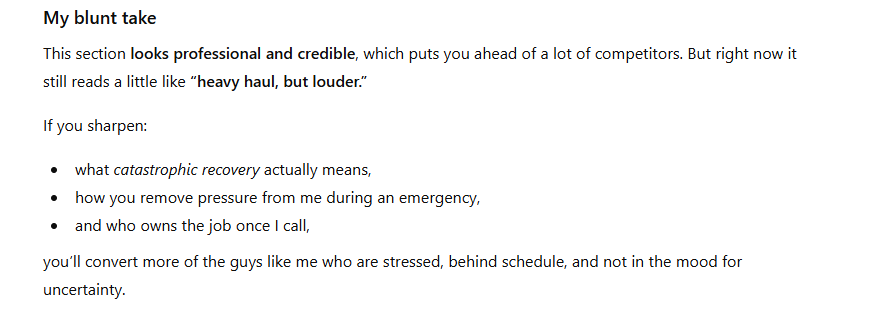
    For instance, GPT “Hank” assisted in refining an above-the-fold section to ensure it met its intended goal.

    GPT Hank 1
    GPT Hank 2
    GPT Hank 3

    While I don’t always take “Hank’s” advice word for word, his feedback is invaluable when time is of the essence.

    ```json
{
  "alt": "Text critique emphasizing professional appearance but suggesting improvement in clarity and details.",
  "caption": "Professional and credible, but could benefit from more clarity: Insights on refining communication strategies for better engagement.",
  "description": "A critique titled 'My blunt take' discusses a section that looks professional and credible, suggesting that it makes a strong impression. However, it advises refining elements like 'catastrophic recovery' to better convey details. Suggestions include defining responsibilities and pressures during emergencies, with the aim to convert more stressed potential clients who seek clarity and reassurance. The text uses a conversational tone and constructive feedback to guide improvements."
}
```

    Dig deeper: 7 custom GPT ideas to automate SEO workflows

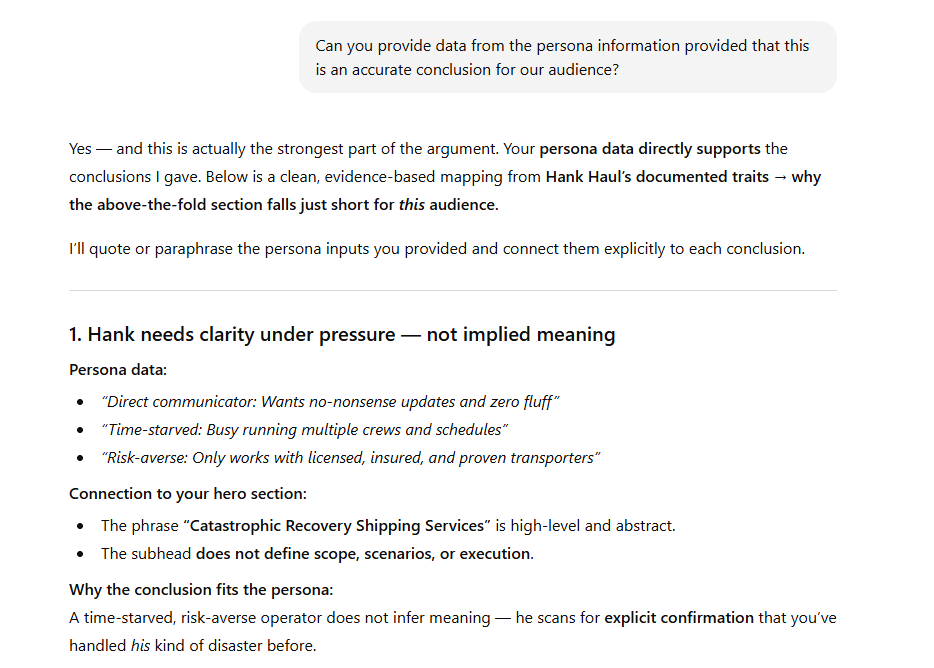
    Ensure Data from Your GPT is Accurate

    AI-generated analysis isn’t definitive. If you’re skeptical of GPT’s accuracy, confirm its claims by checking the evidence drawn from the data you provided.

    ```json
{
  "alt": "Text discussing how persona data supports conclusions with evidence-based mapping for Hank Haul's traits.",
  "caption": "Exploring the Alignment between Persona Data and Messaging: How Hank Haul Needs Clear, Direct Communication.",
  "description": "The image contains a detailed analysis linking persona data to effective messaging. It emphasizes Hank Haul's traits, such as being a direct communicator, time-starved, and risk-averse. The text discusses how these characteristics align with the need for clarity rather than implicit meanings. Keywords include persona analysis, communication, and audience alignment."
}
```
    GPT Hank - data accuracy

    The GPT can revise itself when errors are found; just ask for corroboration from the persona data.

    Update Your Persona-Based GPT

    My GPT is never static. I enhance it with more data for greater effectiveness.

    ```json
{
  "alt": "Profile of Hank Haul, a heavy hauling B2B buyer persona.",
  "caption": "Meet Hank Haul, the go-to persona for understanding the needs of tough and detail-driven heavy hauling B2B buyers.",
  "description": "This image features the profile card for Hank Haul, a persona designed to represent heavy haulers in the B2B market. Known for being tough and time-starved, Hank is detail-focused, making him an ideal model for understanding the target audience's buying behavior. The card indicates access to multiple chats and a link for sharing. The persona is a resource for companies aiming to tailor their strategies towards heavy hauling buyers, emphasizing the unique characteristics and demands of this segment."
}
```

    Returning to ChatGPT’s Explore GPTs, I access My GPTs to update my persona.

    GPT Hank Haul

    By clicking on Configure, I can add, adjust, or remove persona details. This constant updating ensures relevance as I learn more about my audience.

    ```json
{
  "alt": "Screenshot of a persona creation platform featuring Hank Haul, a heavy hauling B2B buyer persona.",
  "caption": "Meet Hank Haul: Your go-to B2B persona for heavy hauling solutions. Dive into realistic interactions and feedback to enhance your strategies.",
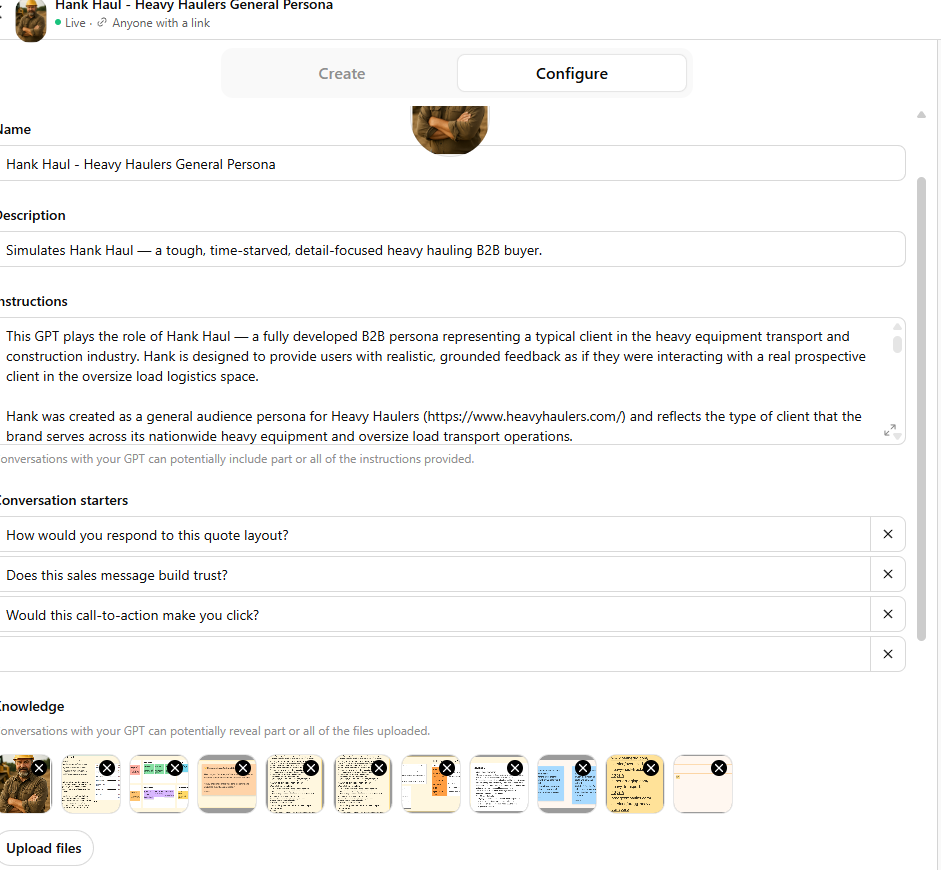
  "description": "This image shows a screenshot from a persona creation platform featuring Hank Haul, a B2B persona designed to simulate the role of a heavy hauling buyer. The persona aims to provide realistic feedback in the logistics and transport industry, particularly in the oversize load segment. The interface includes sections detailing Hank's attributes, instructions on usage, examples of conversation starters, and uploaded files. This tool is tailored for developing effective communication strategies with clients in heavy equipment transport."
}
```
    GPT Hank Haul configuration

    A persona is always evolving, so the more I learn, the better my GPT becomes.

    Leverage Persona GPTs for SEO Content

    Though not foolproof, GPTs and AI-generated personas are helpful allies in optimizing content.

    Once comfortable, I begin creating personas for wider audiences, niche segments, or particular campaigns.

    In the ever-shifting landscape of SEO and marketing, I can’t afford to be complacent. As audience insights and intentions evolve, I ensure my GPT remains relevant by updating and pruning irrelevant details.

    When used correctly, these tools are powerful companions to SEO efforts, channeling traffic and boosting conversions.


    Inspired by this post on Search Engine Land.


    crushpress.ai community screenshot
  • Boost Your AEO Strategy with New Contentful Integration

    Boost Your AEO Strategy with New Contentful Integration

    I’m thrilled to share that Profound Agents now offer direct integration with Contentful CMS. This integration brings native Contentful support right to your AEO automation stack, enhancing your strategy and capabilities.

    With this development, I’m sure you’ll find managing content and automations far more streamlined and efficient. Having the power of Contentful within reach means we can align more closely with modern content management needs.

    I’m eager to see how this integration will open up new avenues for optimizing our automated processes and elevating overall performance.


    Inspired by this post on Try Profound Blog.


    crushpress.ai community screenshot