Category: SEO

  • Mastering SEO in the Age of AI: Boost Your Visibility Now

    Mastering SEO in the Age of AI: Boost Your Visibility Now

    With Google referrals declining and LLM usage on the rise, I’ve discovered that successful discoverability now hinges on metrics, structure, and authority—not just rankings.

    If your organic traffic is decreasing while impressions rise, AI might be citing your content without generating clicks. If both metrics are down, it’s likely your content is being overlooked. Either way, the conventional search behavior that shaped your marketing strategy has transformed, and merely waiting for traffic to rebound is not a viable strategy.

    The year 2026 presents a new reality. According to KEO Marketing, 73% of B2B websites faced significant traffic declines between 2024 and 2025, averaging a 34% year-over-year drop.

    These drops aren’t uniform. Websites with predominantly informational content have been more adversely affected, experiencing declines between 15% and 64% since AI Overviews emerged.

    News publishers, in particular, have been vulnerable, with Google referrals decreasing globally by 33% in the year leading up to November 2025.

    These aren’t typical fluctuations; they signify a fundamental shift in how information is discovered online, posing a threat to business models reliant on site traffic.

    Organic clicks are diminishing due to two intersecting reasons, each necessitating a different approach:

    Google has fostered zero-click behavior through features like featured snippets and knowledge panels. These provide answers directly on the search results page, often eliminating the need to click on search results. While 25% of searches concluded without clicks ten years ago, today it’s over 65%. This trend has rapidly accelerated with AI Overviews, now found in about 16% of desktop searches and 41% of mobile searches.

    On top of that, a growing number of users are bypassing traditional searches entirely. Nearly 52% of U.S. adults now frequently use AI tools, and approximately 28% of employed Americans incorporate AI at work. When they seek answers from ChatGPT or other LLMs, they often get responses without visiting any websites. While your content might contribute to that answer, it doesn’t translate to traffic or attribution.

    Traditional metrics such as impressions, clicks, and page views no longer accurately reflect discoverability. They measure site behavior without informing how your brand performs in AI-mediated interactions, impacting upstream traffic.

    Here are the five key metrics for AI visibility:

    Citations in AI responses indicate how often your content is directly referenced when an LLM responds to a query. A citation suggests your content is valuable, well-structured for AI parsing, and authoritative.

    Brand mentions differ from citations. LLMs may mention your brand without citing your content, often pulling data from review sites, forums, and third-party articles. A mention absent a citation implies your brand is recognized but not sourced from your content, guiding where to focus investments.

    Share of voice measures your frequency of citations and mentions relative to competitors within specific categories.

    Brand sentiment evaluates whether AI-generated responses portray your brand positively, neutrally, or negatively.

    AI-influenced traffic gauges the proportion of traffic generated from LLM referrals. Initial data indicates this traffic has a conversion rate 3-5 times higher than other sources, making it valuable to track even if minor in volume.

    Modern tools can track these metrics at scale, eliminating the necessity for manual LLM prompts. However, even conducting basic benchmarks by querying major LLMs with your target questions and tracking mentions is advantageous over not measuring at all.

    Achieving visibility in AI-driven search doesn’t involve rewriting your content strategy but instead requires shedding ineffective practices and pivoting towards lasting principles.

    Experience, Expertise, Authoritativeness, and Trustworthiness (E-E-A-T) continue to form the foundation of content credibility. LLMs give precedence to sources that demonstrate real expertise and are trusted by authoritative figures.

    By earning citations from reputable sites, producing content authored by subject matter experts, and delving into topics thoroughly, you can outshine content that fails to meet these criteria, regardless of optimization efforts for other factors.

    Structure and clarity are essential because LLMs extract content by pinpointing passages that effectively answer questions. Structuring content around clear questions and answers, utilizing bullet point summaries, and avoiding dense paragraphs enhance retrievability over embedding answers in narrative prose.

    Your information architecture should be comprehensible to both human readers and LLM systems. Introducing a Q&A section or reorganizing posts around clear question-and-answer pairs provides significant improvements.

    Human-written, human-led content has a distinct advantage. After Google’s recent core update, AI-generated content saw an 87% drop in rankings and citation frequency, with keyword-optimized content seeing a 63% fall. LLMs are becoming adept at detecting AI-created content and rank it lower.

    The 2025 demand for AI-produced content has highlighted a quality issue now evident in performance data. Prioritizing quality over quantity is essential. Use AI for drafting and editing, but not for generating final content. Implement a review process to catch generic phrasing or a synthetic tone, either through AI-detection tools or human editors.

    Recency is crucial for AI citations. AI systems consider both the publication and update dates when selecting sources. A high-quality piece from 2022 can be dismissed for a newer version from 2025.

    Audit your high-traffic pages and key assets for outdated data, refreshing them with recent examples and data. It’s a quick yet often overlooked strategy.

    Promotional language will not get cited. If your writing appears too commercial—emphasizing product claims and brand-forward language—answer engines may deprioritize it over more neutral sources.

    This doesn’t mean you should avoid mentioning your product; rather, write about it like an impartial party by acknowledging trade-offs, providing context, and letting facts speak for themselves. Listicles and comparison articles excel here.

    LLMs respond best to organized, objective comparisons—even when one option is clearly preferred.

    If my presence is limited to my own blog, I’m at a disadvantage against a brand with less expressive assets but more robust third-party coverage.

    That is why cultivating an external content ecosystem is critical. Reviews on sites like G2, Capterra, and Google are frequently used in AI curation. User-generated content on forums like Reddit is heavily indexed. Third-party articles, tutorial videos, and newsletter mentions build the multi-source consensus essential for AI citations.

    Content partnerships also deserve focused effort. Sponsoring articles or placing newsletters in relevant publications not only drives referral traffic but also earns trusted, external citations that elevate AI visibility. With a growing readership, newsletters — offering curated, human-authored content — are vital, with YouTube citations becoming increasingly influential. ChatGPT favors authoritative video creators for citations.

    The goal isn’t to merely generate mentions but to consistently express your brand’s narrative through credible external sources so LLMs consistently recognize that narrative. Consistency across partners, review platforms, and third-party content strengthens your AI share of voice.

    With organic traffic plummeting by 30% or more, the visitors arriving at your site are more deliberate and valuable than before, making conversion optimization on landing pages crucial.

    Focus on simplicity: one offer, one message, minimal text.

    Each landing page should focus on a single call to action and a singular argument. If there are multiple conversion goals, develop separate landing pages rather than a single page attempting everything.

    Ensure the header conveys the full value proposition succinctly, with supporting points kept brief. Visitors should instantly grasp the offer and know how to act without needing to scroll.

    This approach contrasts with blog and thought leadership content, which should be detailed, well-sourced, and designed for LLM retrieval. Each serves different objectives and requires varied standards. Conversion-centric landing pages are not the place for nuance or elaborate prose.

    The decline in traffic isn’t a temporary issue that will resolve itself. Users increasingly get answers directly from AI, bypassing websites, and this trend will only intensify. A strategy focused solely on ranking for clicks is now insufficient.

    The new strategy involves a dual focus: optimizing for citations by AI answer engines and cultivating an external brand presence that offers LLMs compelling reasons to consistently mention you. These objectives align with longstanding best practices: crafting clear, authoritative content grounded in expertise.

    AI-driven discovery favors brands excelling in the fundamentals: building real credibility, securing trusted external mentions, and writing for audiences rather than algorithms.

    This approach was always the best, and now AI search makes it essential.


    Written by Tim Burke and Lauren Yanez


    Inspired by this post on Search Engine Land.


    crushpress.ai community screenshot
  • Inside Google AI: Why It’s Citing Itself More Than Ever

    Inside Google AI: Why It’s Citing Itself More Than Ever

    It’s fascinating to see the evolution of Google’s AI Mode and how it increasingly cites Google itself. In fact, almost one out of every five sources in its AI-generated answers now originates from Google, often guiding users back to more Google searches.

    Why does this matter to us? As someone deeply involved in the world of digital content and SEO, I’m aware that AI search should highlight the best online sources. If Google prioritizes its own content, there’s a risk that we might encounter fewer direct links and see a reduction in traffic as users remain within Google’s ecosystem.

    So let’s delve into the details. Research by SE Ranking reveals that Google.com is the most cited source within AI Mode responses, making up 17.42% of all references. This makes Google more mentioned than even the combined total of the next six well-known platforms: YouTube, Facebook, Reddit, Amazon, Indeed, and Zillow.

    In an accelerated trend, back in June 2025, Google referenced itself in only 5.7% of AI-generated answers, but now that figure has tripled.

    Almost one out of five AI citations is from Google. When considering YouTube, Google-owned properties account for about 20% of all sources.

    This self-referencing is quite pronounced, with AI Overviews linking heavily to Google properties such as Maps, Images, and YouTube. AI Mode expands on this by further embedding users within the Google environment, often through presenting additional search results rather than directing them to external sites.

    This strategy keeps users engaged with Google platforms where monetized content such as ads and reviews can be found.

    What’s changed? Previous research showed that Google was mostly citing Google Business Profiles. However, this trend has shifted:

    • Travel: 53.18% of citations
    • Entertainment & hobbies: 48.74% of citations
    • Real estate: 30.54% of citations

    Interestingly, the one area where Google is not the top source is Careers and Jobs, where Indeed appears more than three times as often as Google.

    The data supporting these findings were gathered by SE Ranking, who analyzed 68,313 keywords across 20 industries, reviewing over 1.3 million AI Mode citations to determine how frequently Google.com was referenced.

    If you’re interested, I recommend checking out the full report titled “Is Google stealing your clicks in AI Mode? (1.3M+ citations analyzed)” for an in-depth exploration.


    Inspired by this post on Search Engine Land.

    crushpress.ai community screenshot
    • 59% of citations now direct to conventional Google search results.
    • 36.1% still reference Google Business Profiles.
    • A smaller portion links to Google Support (1.7%), Google Flights (0.1%), and other Google services.
    • Often, these AI citations are accompanied by a mini search results panel beside the answer, effectively creating a new search opportunity.

    Industry differences are also evident. Google dominates citations across several topics, but some sectors show a stronger dependency on Google:

    • Travel: 53.18% of citations
    • Entertainment & hobbies: 48.74% of citations
    • Real estate: 30.54% of citations

    Interestingly, the one area where Google is not the top source is Careers and Jobs, where Indeed appears more than three times as often as Google.

    The data supporting these findings were gathered by SE Ranking, who analyzed 68,313 keywords across 20 industries, reviewing over 1.3 million AI Mode citations to determine how frequently Google.com was referenced.

    If you’re interested, I recommend checking out the full report titled “Is Google stealing your clicks in AI Mode? (1.3M+ citations analyzed)” for an in-depth exploration.


    Inspired by this post on Search Engine Land.


    crushpress.ai community screenshot
  • Exploring Google’s Vision: The Future of Search and Gemini

    Exploring Google’s Vision: The Future of Search and Gemini

    As I delve into the world of Google, I’m fascinated by Liz Reid’s insights on Google Search and Gemini. While these might eventually converge or further diverge, the journey remains equally captivating.

    The big picture Reid painted is compelling. Search mainly helps us connect with the web, while Gemini leans towards enhancing productivity and creativity. But with the rapid evolution of AI, the boundaries feel almost fluid to me.

    What she’s saying. Reid clarified that despite sharing tech, Search and Gemini follow different “north stars.” It’s intriguing to think about whether they might overlap more as time progresses or if their paths will widen further. Here are Reid’s thoughts from her interview:

    • “I don’t know the answer is the short answer.”
    • “Some areas they’re converging more and some areas they’re diverging more, right?”
    • “Are they getting closer or further apart? I think we’ll see.”
    • “Maybe a third product emerges altogether.”

    Gemini vs. Search. Reid’s distinction piqued my interest:

    • On Gemini: “Focused on being an assistant, leaning towards productivity and creation.”
    • On Search: “Information-based, fostering connection and engagement with the web.”

    Agents and the web’s future. Reid’s vision of increased agent activity on the internet is enthralling. Imagine a world where not just people, but agents interact online.

    • “Agents are doing a lot of interaction, not just people.”
    • “Agents communicating with each other as we evolve.”

    Google vs. ChatGPT. Contrary to popular belief, Reid believes we won’t end up with only one dominant AI product, which is enlightening.

    • “Not just one product will dominate the landscape.”
    • “Tech advances allow more questions and tool adoption.”

    Trusted sources. Reid’s emphasis on highlighting trusted or paid sources resonates with me. Google’s Preferred Sources and subscription-aware features are steps in the right direction.

    • “How do you enhance relationships with trusted sources?”
    • “Content from loved or paid-for sources should surface easily.”

    Why we care. Reid’s insights remind us that Google’s long-term role in an AI-centric world is still being defined. It’s an exciting time to follow these developments as AI assistants and search dynamics shift.

    The interview. Check out the insightful conversation in What happens to Google when AI answers everything? with Liz Reid.


    Inspired by this post on Search Engine Land.

    crushpress.ai community screenshot
  • Boost Your AI Visibility with Engaging Social Content

    Boost Your AI Visibility with Engaging Social Content

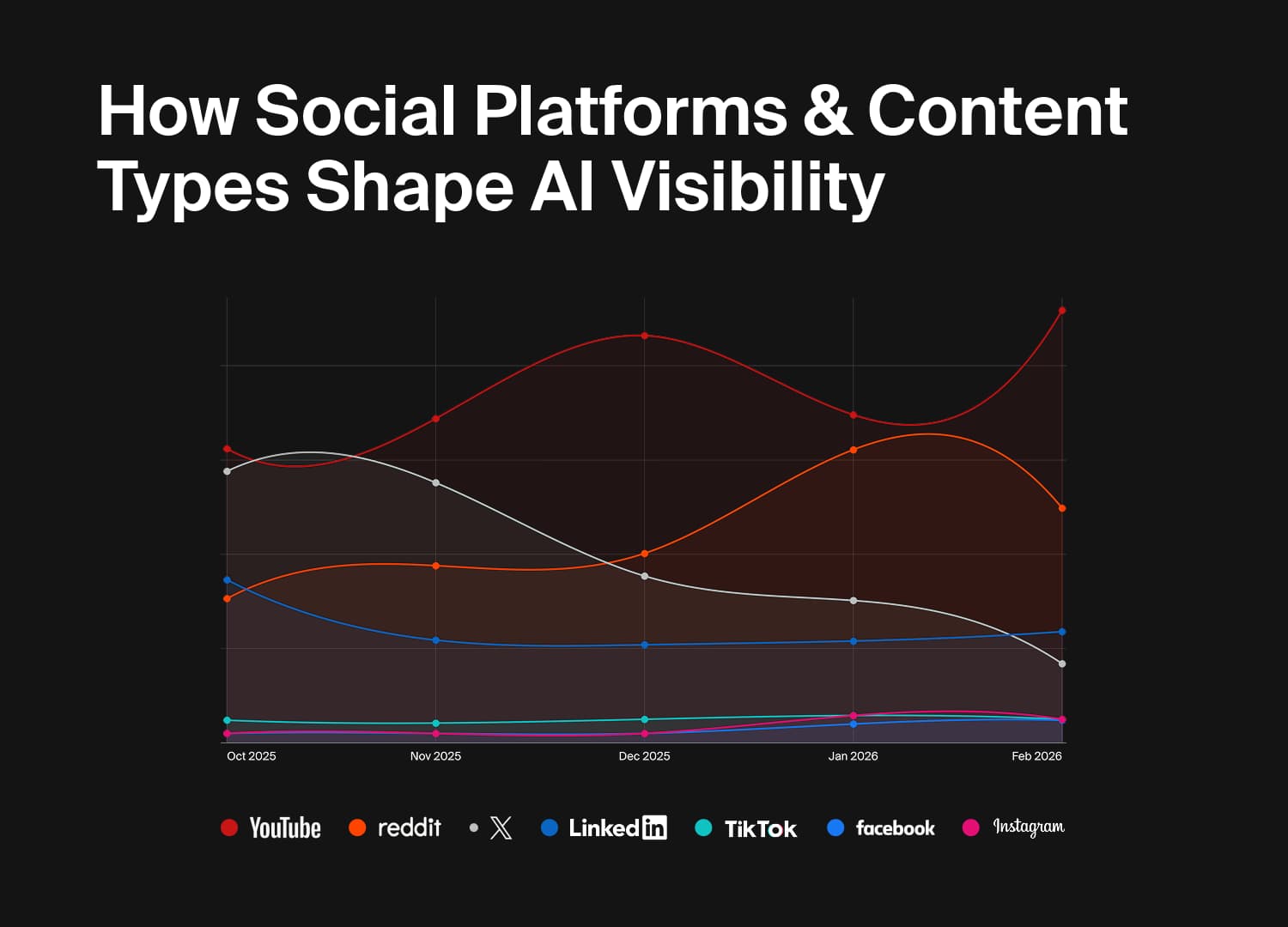
    I’ve been fascinated by the ways social platforms and content formats can enhance AI visibility. Recently, I’ve discovered how platforms like YouTube and Reddit, along with long-form content, significantly influence AI citations.

    The synergy between social media and AI search visibility cannot be overstated. I find it remarkable how the right content type can amplify AI’s reach and impact. Platforms such as YouTube and Reddit are at the forefront, leading the charge with extensive citations attributed to their diverse and dynamic content formats.


    Inspired by this post on HiGoodie Blog.


    crushpress.ai community screenshot
  • ChatGPT Relies Heavily on Google Shopping for Carousel Products

    ChatGPT Relies Heavily on Google Shopping for Carousel Products

    I recently stumbled upon an intriguing revelation: ChatGPT sources a staggering 83% of its carousel products from Google Shopping via shopping query fan-outs. This prompted an investigation into how ChatGPT utilizes shopping query fan-outs and what implications arise from this dependency.

    In November 2025, while delving into the depths of AI research, some colleagues and I unearthed an enigmatic piece of code within ChatGPT. The field called id_to_token_map, encoded in base64, ultimately revealed parameters linked to Google Shopping, such as productid and offerid.

    ```json
{
  "alt": "Top three smartphones under $500: Google Pixel 9a, Samsung Galaxy A36 5G, Motorola Moto G Stylus 2025.",
  "caption": "Explore budget-friendly smartphones: Discover the Google Pixel 9a, Samsung Galaxy A36 5G, and Motorola Moto G Stylus 2025, all under $500!",
  "description": "This image showcases three highly recommended smartphones available for under $500: the Google Pixel 9a priced at $499.00, the Samsung Galaxy A36 5G at $399.99, and the Motorola Moto G Stylus 2025 costing $349.99. These models offer a balance of performance, camera quality, and battery life. Ideal for budget-conscious consumers seeking high value, each phone is prominently displayed with a sleek, modern design. Keywords: Google Pixel 9a, Samsung Galaxy A36 5G, Motorola Moto G Stylus 2025, budget smartphones, under $500."
}
```

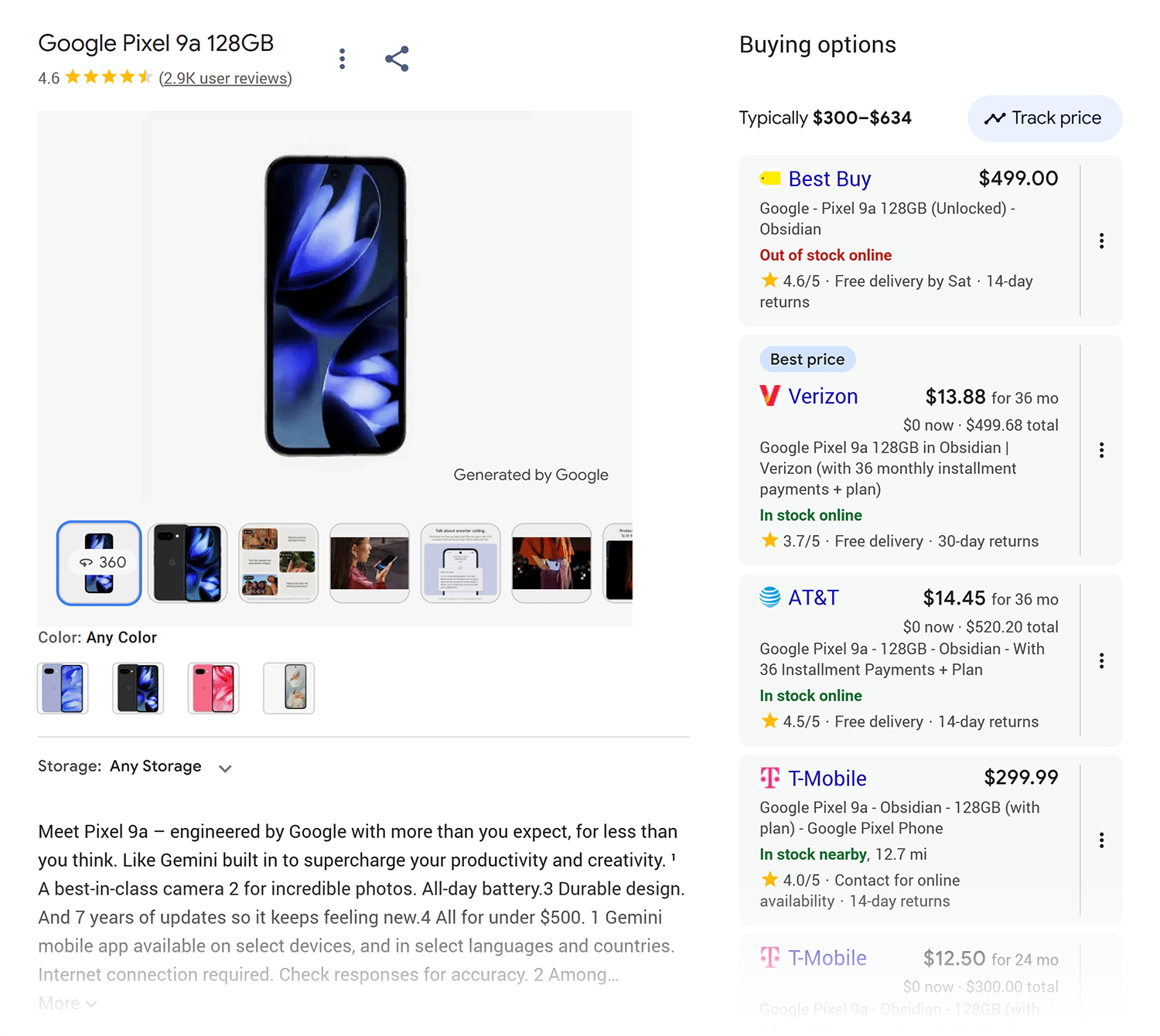
    To validate that this field pointed to Google Shopping, we attempted to reconstruct a shopping URL solely from these decoded parameters. Here’s an example from a ChatGPT carousel showcasing “best smartphones under $500,” showing how this process could replicate Google’s shopping links.

    ```json
{
  "alt": "Google Pixel 9a 128GB with various buying options displayed, including Best Buy and Verizon.",
  "caption": "Discover the Google Pixel 9a 128GB, blending innovative features with sleek design, and explore competitive pricing from retailers like Best Buy and Verizon.",
  "description": "This image showcases the Google Pixel 9a with a black and blue abstract wallpaper. The product page highlights a 4.6-star rating from 2.9K user reviews. Buying options are presented on the right, with prices ranging from $300 to $634. Retailers include Best Buy and Verizon, offering installment plans. Key features include a best-in-class camera, durable design, and long battery life, all delivered under $500. Perfect for enhancing productivity and creativity."
}
```

    The question was whether this shopping link corresponded exactly to products shown in ChatGPT. As it turns out, it did! Yet, it raised more questions about the nature of ChatGPT’s sourcing process. Does this apply across various product categories? Does ChatGPT prefer higher-ranked Google Shopping products?

    ```json
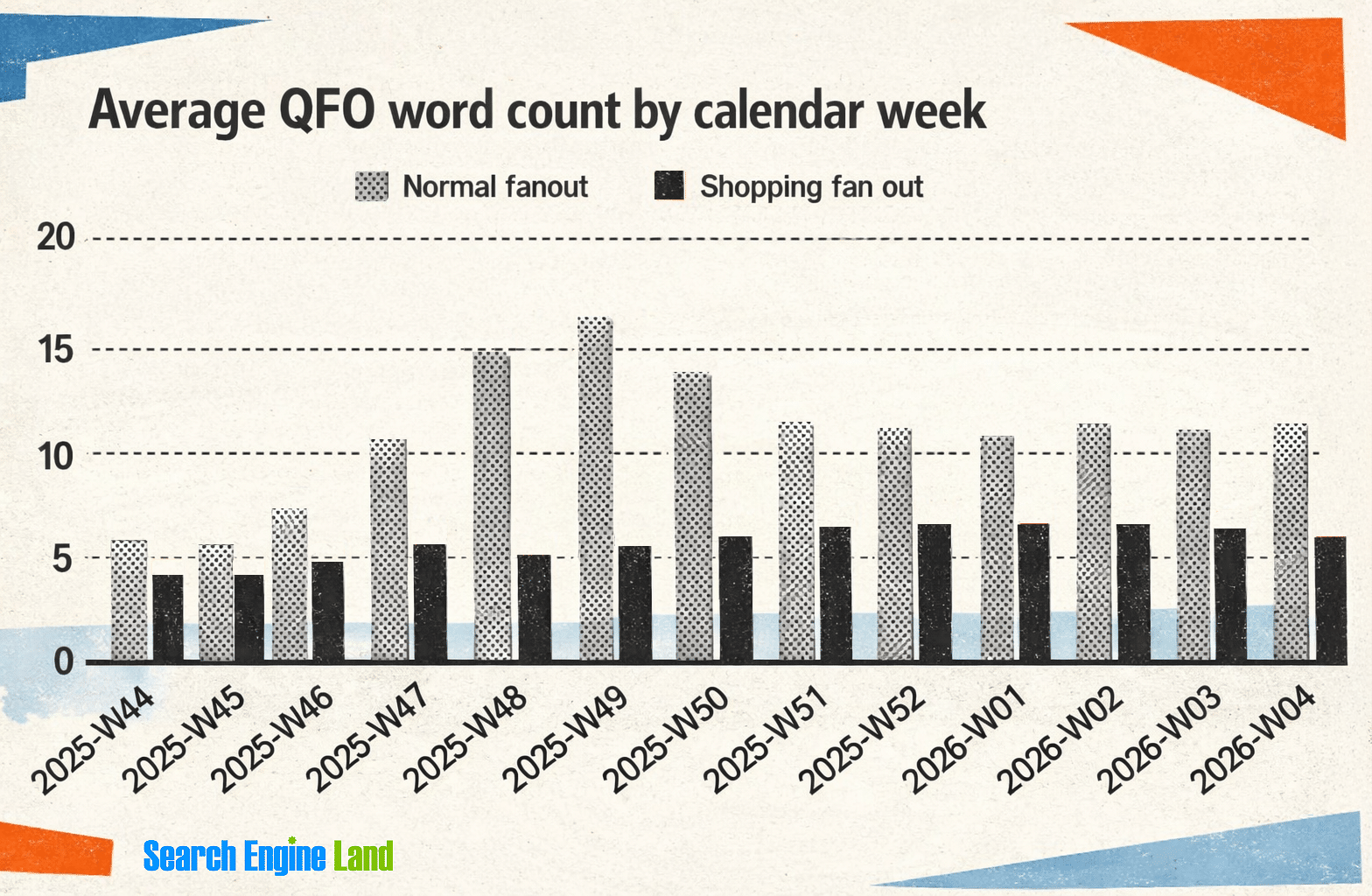
{
  "alt": "Bar chart of average QFO word count by calendar week from 2025-W44 to 2026-W04, showing normal and shopping fanout data.",
  "caption": "Explore the trends in average QFO word count per week from late 2025 to early 2026, highlighting normal versus shopping fanout.",
  "description": "This bar chart illustrates the average QFO word count by calendar week, covering the period from week 44 of 2025 to week 4 of 2026. It compares two data types: normal fanout and shopping fanout. Each category is represented in a distinct pattern, with normal fanout in a lighter shade and shopping fanout in a darker shade. Notable trends in word count variations are visible across the weeks. Keywords: QFO, word count, fanout, bar chart, weekly data."
}
```

    To deeply explore these queries, we investigated over 40,000 carousel products and analyzed the results. By examining the similarity between ChatGPT carousels and Google and Bing organic products, the study shed new light on ChatGPT’s reliance on Google Shopping for sourcing.

    ```json
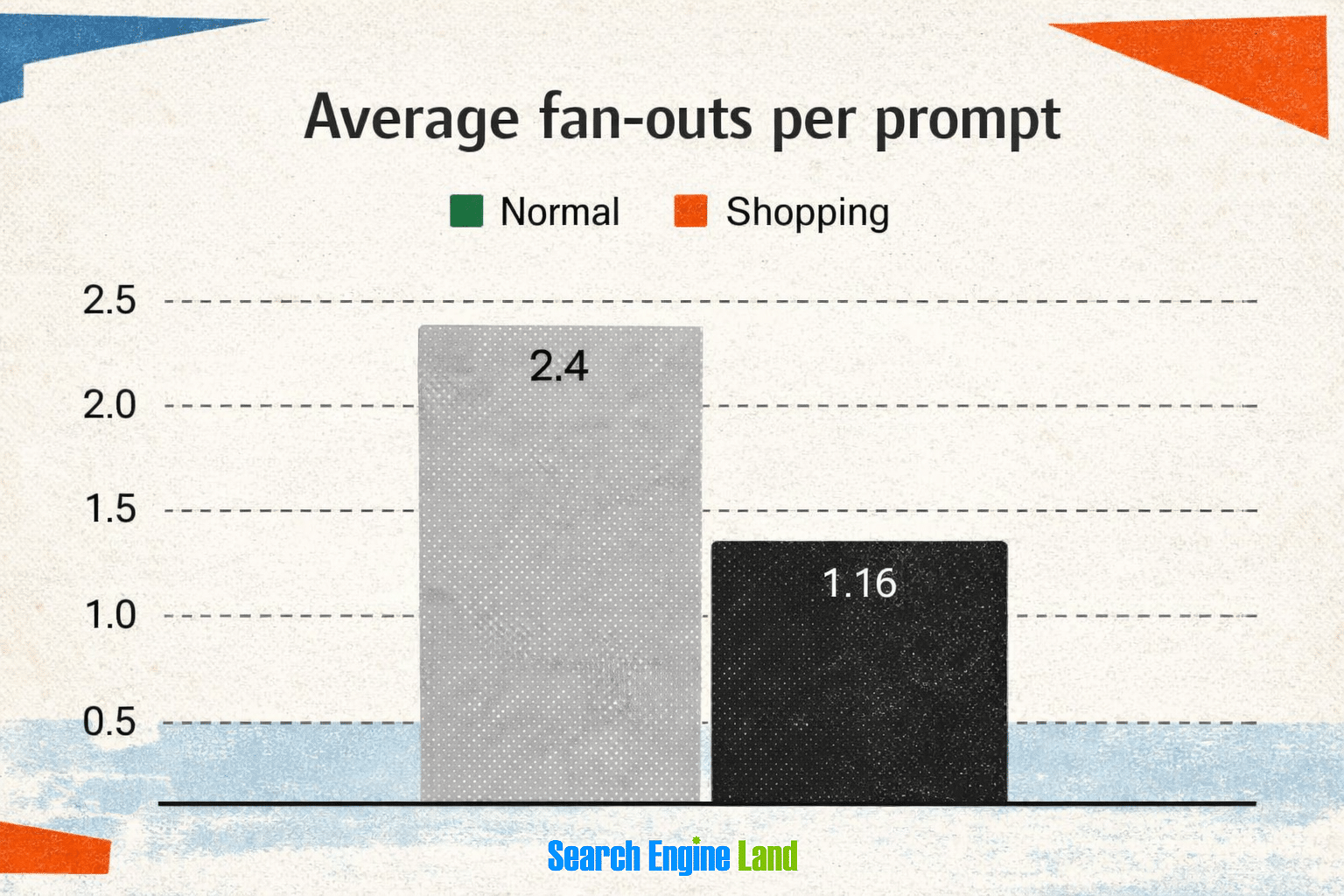
{
  "alt": "Bar chart showing average fan-outs per prompt for Normal at 2.4 and Shopping at 1.16.",
  "caption": "Comparing fan-out averages: Normal prompts lead with 2.4, while Shopping trails at 1.16.",
  "description": "This image displays a bar chart that compares average fan-outs per prompt between two categories: Normal and Shopping. The Normal category has a fan-out average of 2.4, represented by a taller bar, and the Shopping category has an average of 1.16, shown by a shorter bar. The chart uses distinct colors for each category, with Normal in green and Shopping in orange. This visual data, sourced from Search Engine Land, highlights differences in engagement or response levels across these categories, making it useful for digital marketing analysis."
}
```

    Diving into our findings, we see a stark difference between normal search and shopping query fan-outs. Notably, shopping fan-outs are typically shorter, aiming to fetch specific items rather than broader contextual information. This suggests ChatGPT optimizes these fan-outs specifically to compile its product carousels.

    ```json
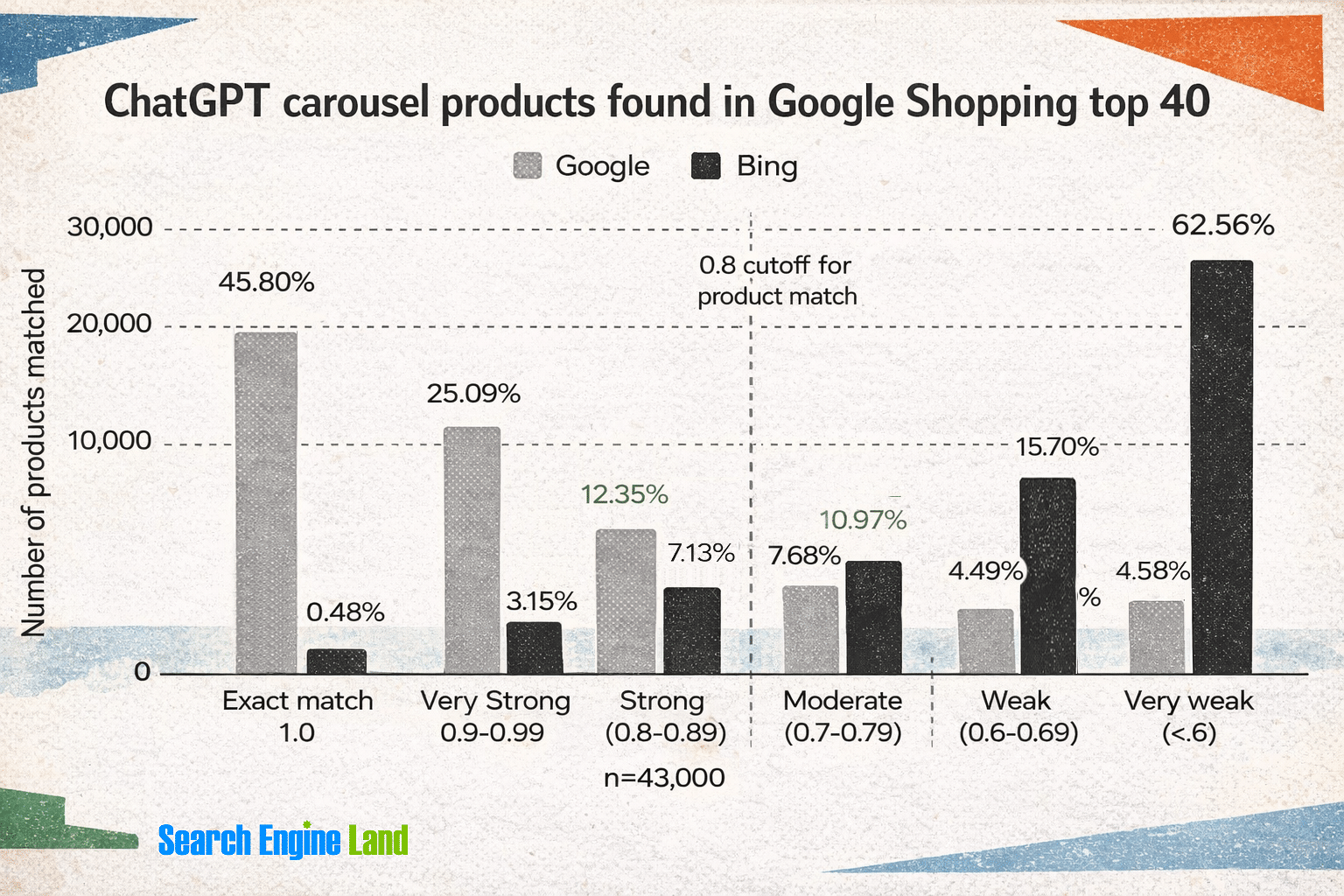
{
  "alt": "Bar chart comparing ChatGPT carousel product matches in Google Shopping top 40 between Bing and Google across various match strengths.",
  "caption": "Exploring the match strength of ChatGPT's carousel products in Google Shopping's top 40, this chart highlights differences between Google and Bing.",
  "description": "This bar chart displays the match strength of ChatGPT's carousel products, comparing their presence in Google Shopping's top 40 results between Google and Bing. Categories range from 'Exact match' to 'Very weak,' with varying percentages, such as 45.80% for exact matches in Google and 62.56% for very weak matches in Bing. A total of 43,000 products were analyzed. Keywords: ChatGPT, Google Shopping, Bing, product match."
}
```

    Further, the data indicates most ChatGPT carousels mirror Google’s organic shopping results. Almost 84% of similar products matched within Google’s top 20 positions, reinforcing a clear preference for Google’s top-performers.

    ```json
{
  "alt": "Bar chart comparing Google and Bing's product match percentages with ChatGPT; Google at 83.24% and Bing at 10.77%.",
  "caption": "Google far surpasses Bing with a remarkable 83.24% product match rate with ChatGPT, highlighting a significant difference in effectiveness.",
  "description": "This image features a bar chart from Search Engine Land showing the percentage of strong product matches (.8+) with ChatGPT. Google achieves an impressive 83.24% match rate, while Bing is considerably lower at 10.77%. The chart uses contrasting colors to differentiate Google's and Bing's performance, illustrating the superior match capability of Google with ChatGPT."
}
```

    Interestingly, ChatGPT’s sourcing from Bing was minimal, with a mere 0.16% exclusive matches, indicating a predominant preference for Google’s data. This stark contrast highlights ChatGPT’s systemic approach to product sourcing.

    ```json
{
  "alt": "Bar chart showing 73.81% of good product matches found by Google but not Bing, and 0.16% by Bing but not Google according to ChatGPT.",
  "caption": "Google's prowess shines in this analysis, finding 73.81% of good product matches that Bing missed, while Bing only helped with 0.16%.",
  "description": "A bar chart displays data on the overlap of good product matches with ChatGPT. It shows that 73.81% of matches were found by Google but not by Bing, while a mere 0.16% were found by Bing but not by Google. The analysis is sourced from Search Engine Land, highlighting significant disparity in search engine effectiveness between Google and Bing in this particular study. Keywords: Google, Bing, product matches, ChatGPT, search engine comparison."
}
```

    These findings are crucial for brands aiming to feature in ChatGPT’s carousels. Monitoring your Google Shopping rank is integral, yet understanding additional contextual factors—like product sentiment—could enhance visibility.

    ```json
{
  "alt": "Line graph showing Google Shopping position match by ChatGPT carousel position with mean and median lines.",
  "caption": "Analyzing the alignment of ChatGPT carousel positions with Google Shopping results, this graph reveals trends in mean and median matches over seven positions.",
  "description": "This image features a line graph comparing Google Shopping product positions with ChatGPT carousel positions. The x-axis represents ChatGPT carousel positions from 1 to 7, while the y-axis details Google Shopping product positions, ranging from 0 to 15. Two lines indicate the mean and median values, showcasing a rising pattern. The graph is credited to Search Engine Land."
}
```

    For the field of AI, this study underscores that ChatGPT employs a distinct, independent pipeline for its product carousel, separate from the standard search query fan-outs. Future changes in ChatGPT’s methods remain a possibility, but for now, a systematic reliance on Google Shopping has been firmly established.

    ```json
{
  "alt": "Bar chart showing cumulative ChatGPT match percentage versus Google Shopping rank from Top 5 to Top 40.",
  "caption": "Analyzing AI and e-commerce: This chart illustrates how ChatGPT’s cumulative match percentage aligns with the Google Shopping ranking from Top 5 to Top 40.",
  "description": "This bar chart compares the cumulative match percentage of ChatGPT to the Google Shopping rank, ranging from Top 5 to Top 40. Each bar represents a different Top range, with increasing cumulative percentages as the range expands. The visual highlights the alignment between AI recommendations and e-commerce rankings. Presented by Search Engine Land, it provides valuable insights into AI's performance in product matching."
}
```

    Inspired by this post on Search Engine Land.


    crushpress.ai community screenshot
  • Why AI Search Challenges Persist Across Industries: Insights and Solutions

    Why AI Search Challenges Persist Across Industries: Insights and Solutions

    For two decades, I’ve witnessed the web operate on a simple transaction: create content to fulfill needs, secure a high search ranking, attract traffic, and then monetize through various channels like products, services, or ads.

    However, zero-click answers and AI search are redefining this dynamic. The key question now is whether AI acknowledges you as a source and if that recognition translates into revenue.

    In my quest to understand this shift, I conducted over 200 AI visibility audits spanning ten industries.

    What I discovered was a pattern: most websites are easily scanned but rarely referenced. Surprisingly, those industries that depend most on organic traffic inadvertently make themselves the hardest to access.

    How I Conducted the Audit

    I executed 201 audits using a consistent rubric, generating an overall AI visibility score plus four detailed subscores:

    • Freshness.
    • Structure.
    • Authority and evidence.
    • Extractability.

    Spanning ten industries:

    • Coupons.
    • Affiliate reviews.
    • Travel booking.
    • Local directories.
    • Personal finance comparison.
    • Health information.
    • Legal directories.
    • Online courses.
    • Job boards.
    • Recipes.

    The dataset leaned heavily toward homepages, which are often more marketing-driven and less substantiated by concrete evidence.

    I also monitored access issues, finding that 38 of the 201 audits (18.9%) returned errors, indicating AI systems were obstructed or couldn’t reliably retrieve content.

    Eight more audits scored zero due to missing subscores, pointing to poor content extraction or problematic rendering styles that hinder accessibility.

    When analyzing score distributions, I focused on successful audits (163 sites) to differentiate between “unreachable” and “low quality.” Each industry’s error rate acted as a signal of whether AI systems could consistently use a site as a source.

    Where Industries Stand in AI Visibility

    The table below displays industry performance based on the audits conducted:

    RankIndustryError rateMedian overallMedian authorityMedian extractabilityAt risk
    1Travel booking and trip planning33.3%45.531.052.0High
    2Job boards and career marketplaces40.0%64.044.074.0High
    3Legal directories and lead gen35.0%63.044.074.0High
    4Coupons and deals20.0%62.036.074.0High
    5Local directories and lead gen5.3%64.038.074.0Medium
    6Online courses and learning marketplaces30.0%67.546.580.0Medium
    7Health info and symptom lookups15.0%69.052.080.0Low
    8Personal finance comparison5.0%67.052.078.0Low
    9Affiliate product reviews0.0%69.554.074.0Low
    10Recipes and cooking content5.0%75.055.581.5Low

    What the Audits Actually Revealed

    The findings illuminated that very few websites were consistently citation-friendly. Here are the critical insights:

    Access Issues Are Bigger Than Most Teams Realize

    A significant 18.9% of websites experienced access errors. In certain sectors, the issue intensified markedly: job boards (40%), legal directories (35%), travel booking (33%), and course marketplaces (30%).

    Therefore, a substantial section of these markets is essentially inaccessible to AI by default.

    Most Sites Are Caught in the Middle

    Looking at the 163 successful audits:

    • Average overall score: 61.6
    • Median overall score: 66
    • 70.6% fell into “Inconsistent visibility” (60 to 79)
    • Only 4.9% achieved “Strong foundation” (80 to 94)
    • 0% reached “Exceptional” (95 plus)

    Conclusion: Most brands aren’t constructed for predictable use and citation.

    The Gap Lies in Proof, Not Formatting

    Median sub-scores across the audits revealed:

    • Structure: 92
    • Extractability: 74
    • Authority and evidence: 48
    • Freshness: 45

    While pages are easily parsed, fewer justify citation. Key issues included:

    • 114 instances lacked a “last modified header,” demonstrating missing freshness.
    • Citations or outbound links were rare, appearing only 13 times.

    Rather than fearing traffic loss, the larger risk is exclusion from AI’s consideration set.

    Explore further: What AI Search Experiments Reveal About Attribution


    Industries disappear for specific reasons, fitting three failure modes:

    ```json
{
  "alt": "The CapmatchOne logo with a gradient circle and bold text.",
  "caption": "Discover innovation with the CapmatchOne logo, featuring sleek typography and a modern gradient circle.",
  "description": "The CapmatchOne logo features bold, modern typography coupled with a gradient circle, symbolizing connection and innovation. The sleek design conveys a sense of progress and creativity. This image can be used for branding or promotional purposes, appealing to audiences interested in innovative solutions and forward-thinking designs."
}
```

    1. Access Failure: AI Can’t Reliably Reach Your Content

    If AI agents can’t consistently access your material, they may bypass you, compensating with data from alternative sources.

    What access failure entails:

    • Strict bot protections or WAF rules treating agents as hostile entities.
    • App-like rendering prevents critical information from loading with initial HTML.
    • Barriers like popups or scripts impede content access.

    How this causes vanishing:

    • AI’s inability to extract makes citation impossible.
    • Other sources or AI-native solutions satisfy the user’s query instead.

    2. Trust Failure: AI Can Read You, But Can’t Justify Citing You

    Trust failure is subtle: your page is understandable, yet lacks authoritative proof for AI to source it.

    This was a common trend. In simple terms, the content reads well, but lacks defensibility.

    A telling observation compares page types:

    • Articles’ median authority score: 76
    • Homepages’ median authority score: 45

    A crisp homepage isn’t proof of authority. Citable proof resides in articles, policy pages, and similar in-depth resources.

    3. Utility Failure: Even If You’re Visible, the Click May Not Happen

    Utility failure is frustrating. You’re visible, potentially cited, but if your value is purely informative, AI creates an answer and the user never visits.

    Visibility dictates your role in discussions, but utility affects revenue realization.

    An applicable perception:

    • If your page answers the question, AI can replace it.
    • Where your product or service completes a user’s need, AI still requires you.

    Access issues leave you ignored, trust issues mean you’re bypassed, and utility failures get your content summarized.

    Why Certain Industries Are Vulnerable

    Examining access, trust, and utility together reveals why some industries appear particularly exposed.

    Categories repeatedly showing high risk in my findings shared three characteristics:

    • Inconsistent access due to blocking and extraction issues.
    • Content easily condensed into a single-answer format.
    • Limited business progression after the user obtains an answer.

    This is why travel booking, job boards, legal directories, and coupons emerged as the most exposed in my analysis.

    The larger implication is that while your business might thrive, your website might inadvertently be structured for exclusion.

    Explore deeper: Each AI Search Study Tells a Unique Story

    The Critical Point You Shouldn’t Overlook

    This transformation impacts some industries more than others. Websites sustained by high-volume searches face heightened zero-click risks. However, even in these realms, a singular focus on information is perilous.

    The misstep lies in equating AI search changes with ranking shifts; it’s truly an economic shift. From the audits, I realized:

    • Many industries render themselves inaccessible, ensuring models circumvent them.
    • Even when models interpret a page, lacking proof often prevents mentioning it.

    The danger is becoming invisible. Triumph doesn’t come from concealment; it comes from proving your worth and offering something indispensable post-answer.

    Trust combined with utility forms the new moat. Anything else remains outdated strategy.


    Inspired by this post on Search Engine Land.


    crushpress.ai community screenshot
  • Uncover the Impact of the DOM on SEO and Web Crawling

    Uncover the Impact of the DOM on SEO and Web Crawling

    Have you ever wondered how the structure of your webpage affects its visibility on search engines? As someone who regularly dives deep into the technicalities of SEO, understanding the DOM (Document Object Model) is crucial for optimizing your site.

    I’ve often encountered discussions about the DOM with developers, and maybe you’ve seen it referenced in tools like Google Search Console. But why does it matter so much for SEO? Let me walk you through its significance and how to optimize it.

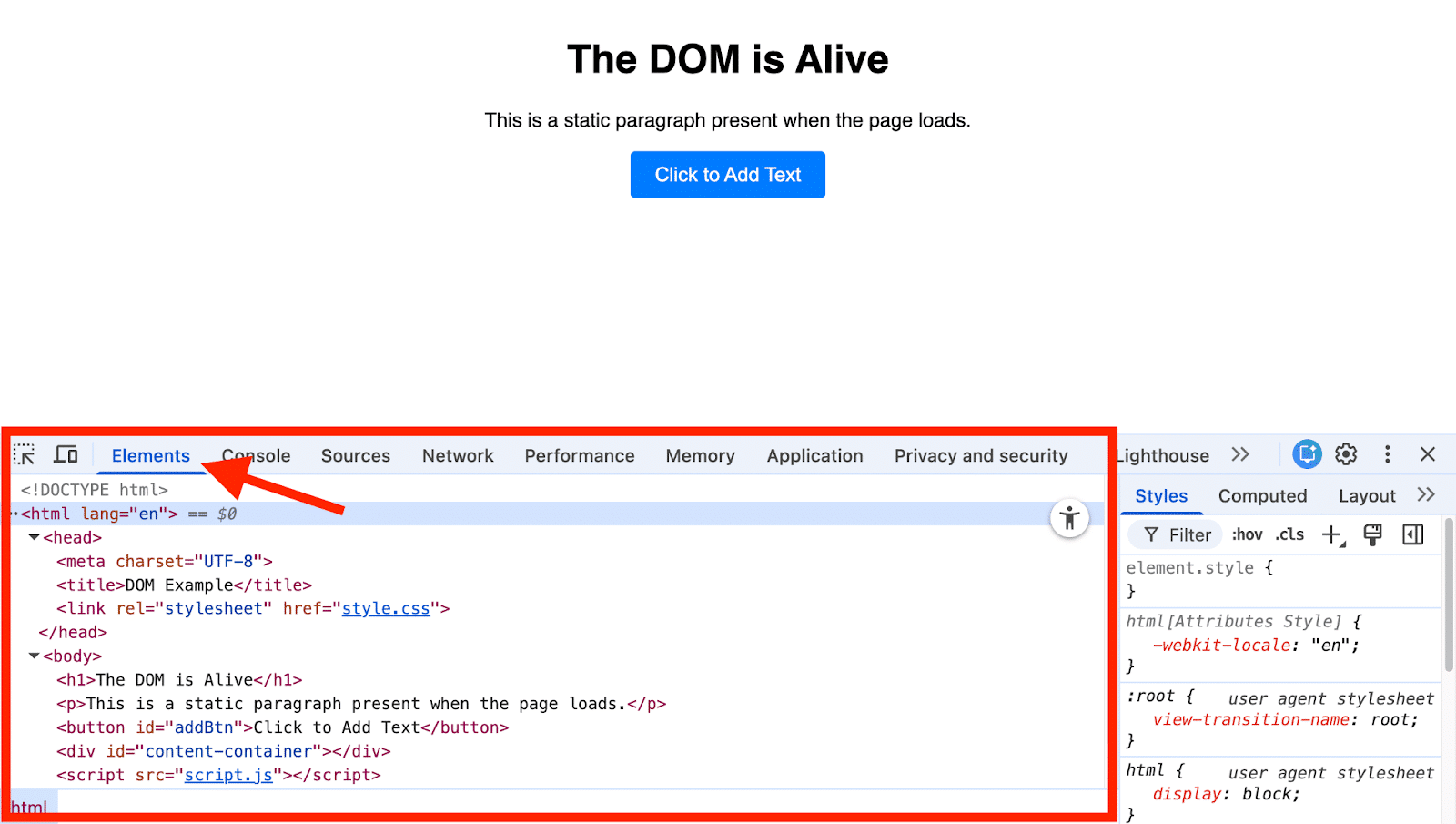
    In essence, the Document Object Model is the browser’s dynamic, in-memory representation of your webpage. It serves as a bridge that allows programs, notably JavaScript, to interact with your content.

    ```json
{
  "alt": "Screenshot showing HTML document structure in the browser's Developer Tools.",
  "caption": "Explore the living DOM! This browser Developer Tools snapshot reveals the dynamic structure of a webpage.",
  "description": "The image shows a browser page with Developer Tools open, highlighting HTML code structure. The page title reads 'The DOM is Alive' with a button 'Click to Add Text'. The Developer Tools display the HTML structure, including document type, head, and body elements. This visual is useful for web developers and those learning about the Document Object Model (DOM) and HTML coding."
}
```

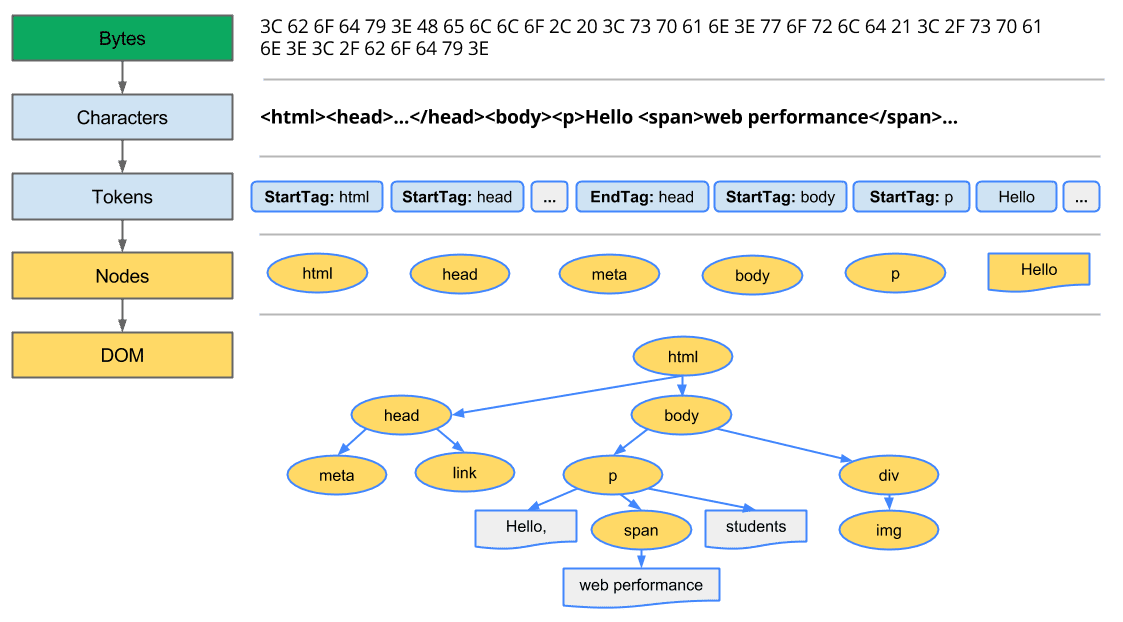
    The DOM is structured like a family tree:

    The document: Acts as the root of this tree.

    ```json
{
  "alt": "The CapmatchOne logo with a gradient circle and bold text.",
  "caption": "Discover innovation with the CapmatchOne logo, featuring sleek typography and a modern gradient circle.",
  "description": "The CapmatchOne logo features bold, modern typography coupled with a gradient circle, symbolizing connection and innovation. The sleek design conveys a sense of progress and creativity. This image can be used for branding or promotional purposes, appealing to audiences interested in innovative solutions and forward-thinking designs."
}
```

    Elements: HTML tags such as <body> and <p> transform into branches or nodes.

    Relationships: There are parent-child-sibling relationships among elements.

    ```json
{
  "alt": "Diagram of web page rendering process from bytes to DOM structure.",
  "caption": "Explore the intricate process of transforming bytes into a fully structured DOM in web development.",
  "description": "This image illustrates the web page rendering process, detailing how a webpage transitions from raw bytes to a structured Document Object Model (DOM). It includes steps of parsing characters, generating tokens, and forming nodes, culminating in a visual DOM tree that displays HTML tags and their hierarchical relationships. Key elements such as 'html', 'head', 'body', and text nodes are depicted. This educational diagram is invaluable for understanding web performance and optimization."
}
```

    This hierarchy is key for the browser and search engines in understanding your content’s structure, helping them discern, for instance, which paragraph is associated with a given heading.

    The exploration of the DOM doesn’t end there. Let’s look at how you can inspect it directly.

    ```json
{
  "alt": "Webpage showing dynamic DOM update where a button click adds paragraphs to the page.",
  "caption": "Witness the dynamic power of the DOM! With just a button click, new content seamlessly appears, illustrating interactive web elements.",
  "description": "This image demonstrates a dynamic change to the Document Object Model (DOM) on a webpage. A button labeled 'Click to Add Text' is clicked, resulting in new paragraph elements appearing on the page. The browser's developer tools window displays the HTML structure, showing the added paragraphs within a highlighted red box. The process exemplifies real-time updates and user interactions in web development, highlighting concepts such as DOM manipulation and JavaScript interactivity. Useful keywords include DOM, web development, JavaScript, and dynamic content."
}
```

    The DOM, a JavaScript object, can be viewed in a format akin to HTML using browser DevTools—just right-click on your page, select Inspect > Elements, and you’ll see the Elements panel.

    In this panel, it’s easy to dive into the structure by:

    ```json
{
  "alt": "Flowchart illustrating web crawling process from crawl queue to index and rendering.",
  "caption": "A visual guide to web crawling and indexing, showing the journey from URLs to rendered HTML.",
  "description": "The image presents a flowchart of the web crawling process. It starts at the 'Crawl Queue,' moves through 'Crawler,' 'Processing,' and ends at 'Index.' There’s a side process involving 'Render Queue' and 'Renderer,' culminating in 'Rendered HTML.' This illustrates the sequence and relation between different stages in page indexing and rendering."
}
```

    Expanding and collapsing nodes to explore hierarchy,

    Searching for elements using Ctrl+F (Cmd+F on Mac), and

    ```json
{
  "alt": "Google Search Console URL Inspection tool displaying example.com test-page details.",
  "caption": "Google Search Console confirms example.com/test-page is indexed and visible in search results, showcasing effective SEO health.",
  "description": "This image shows the Google Search Console URL Inspection tool analyzing 'https://example.com/test-page'. The page is indexed and available on Google, with enhancements like HTTPS and breadcrumbs. The right panel displays HTML code from the crawled page. The console interface shows options for page indexing and enhancements, essential for tracking website SEO performance."
}
```

    Identifying JavaScript-added or -modified elements as they flash briefly on change.

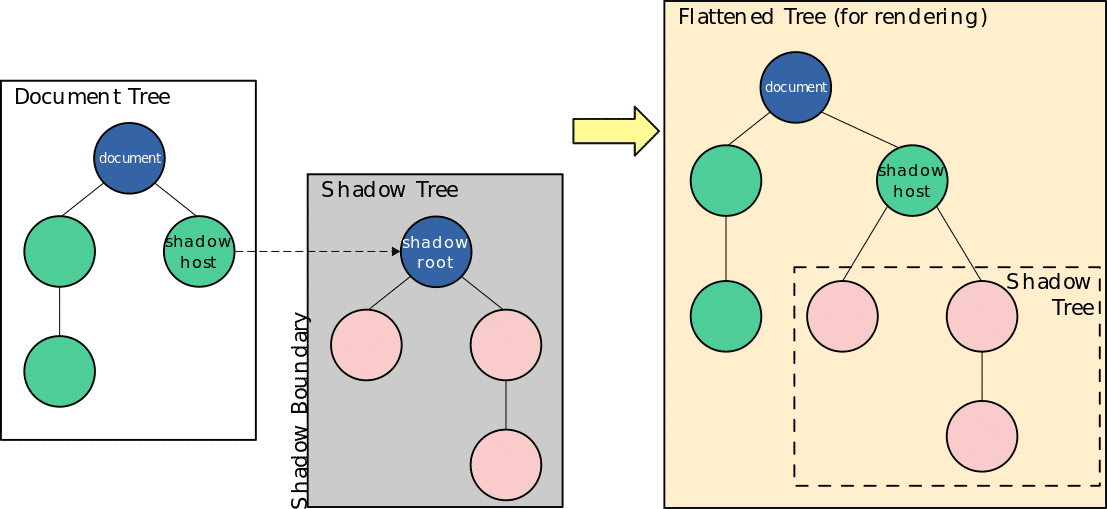
    However, do remember that this tool sometimes shows a different view from what Googlebot crawls. I’ll delve into this discrepancy a bit later.

    ```json
{
  "alt": "Diagram showing the relationship between a Document Tree, Shadow Tree, and Flattened Tree.",
  "caption": "Exploring HTML Structures: This diagram illustrates the integration of a Shadow Tree into a Document Tree, forming a Flattened Tree for rendering.",
  "description": "This image presents a visual representation of how an HTML Document Tree interacts with a Shadow Tree to create a Flattened Tree for rendering purposes. The Document Tree includes a 'document' node leading to a 'shadow host'. The Shadow Tree branches off from the 'shadow host' and contains a 'shadow root' with two child nodes. The Flattened Tree diagram illustrates how these components combine, using a dashed box to indicate the embedded Shadow Tree structure. This visualization aids in understanding web component architecture and rendering processes."
}
```

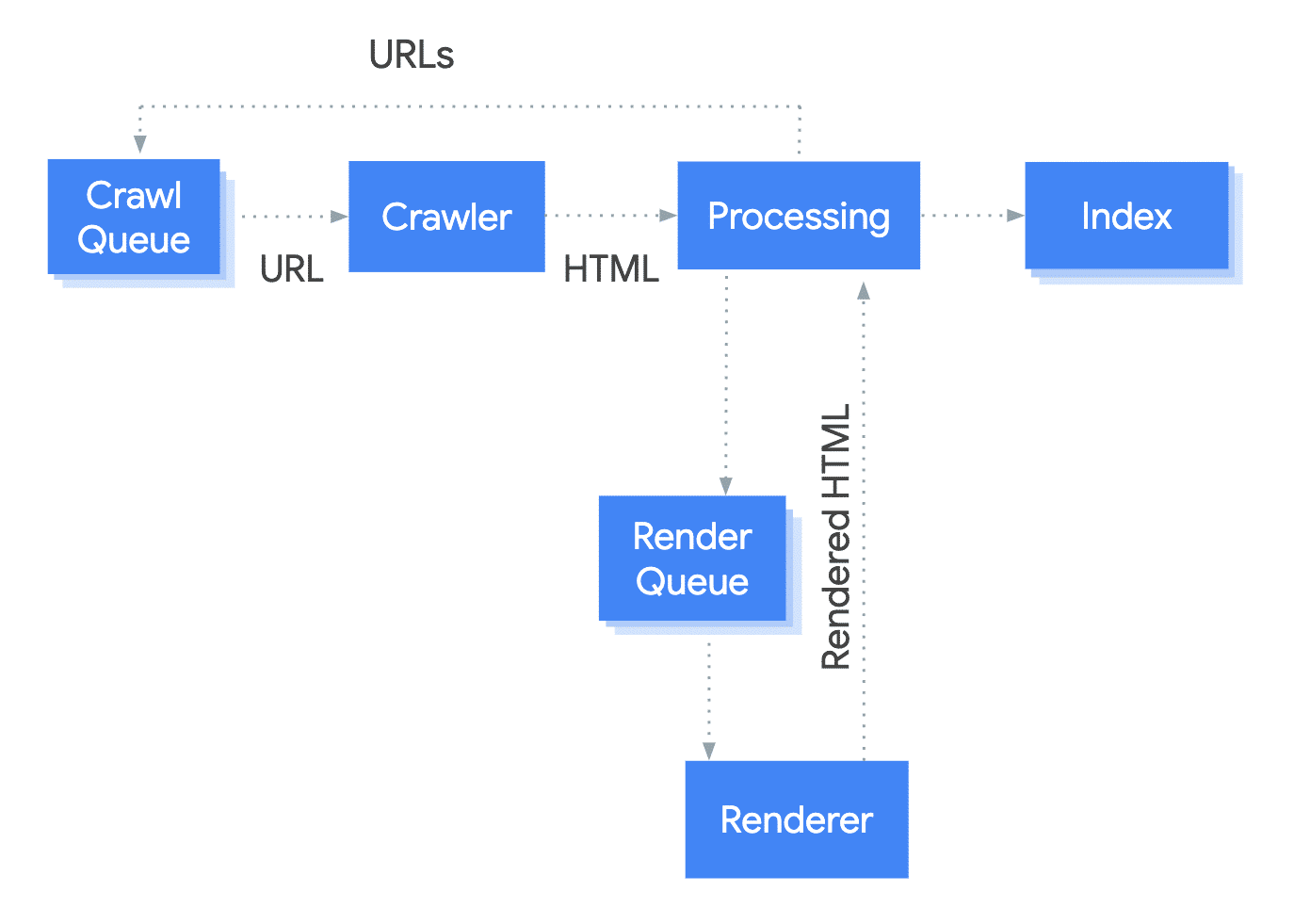
    Next, understanding how the DOM is built is essential. It starts with the browser converting the HTML file retrieved from a server line-by-line into tokens, which are then turned into nodes forming a tree structure.

    This tree-building process allows browsers to create a hierarchical structure necessary for rendering the web page you see, which also includes building a CSS Object Model (CSSOM), but this is less crucial for SEO than the DOM.

    ```json
{
  "alt": "Screenshot showing the DOM inspector with shadow DOM elements highlighted.",
  "caption": "Exploring the shadow DOM: A screenshot reveals how elements are isolated within the shadow tree using developer tools.",
  "description": "This image is a screenshot of a browser's developer tools, showcasing the Document Object Model (DOM) inspector with an emphasis on shadow DOM elements. Highlighted in red, the image shows the HTML structure with styling applied inside a shadow root. The display includes elements such as buttons, divs, and scripts, offering a visual guide to shadow DOM implementation and CSS styling. Key terms include DOM, shadow DOM, web development, and CSS."
}
```

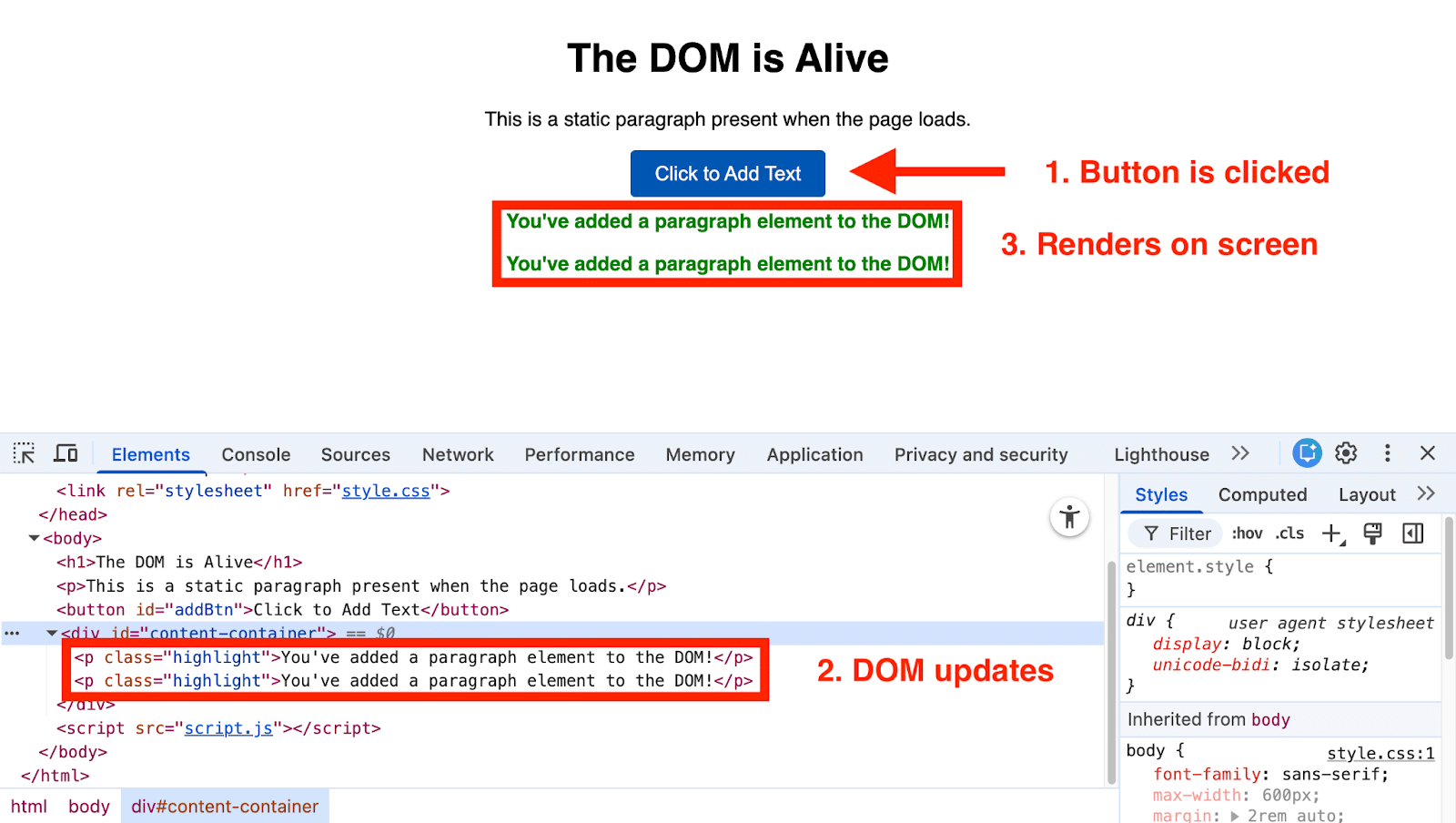
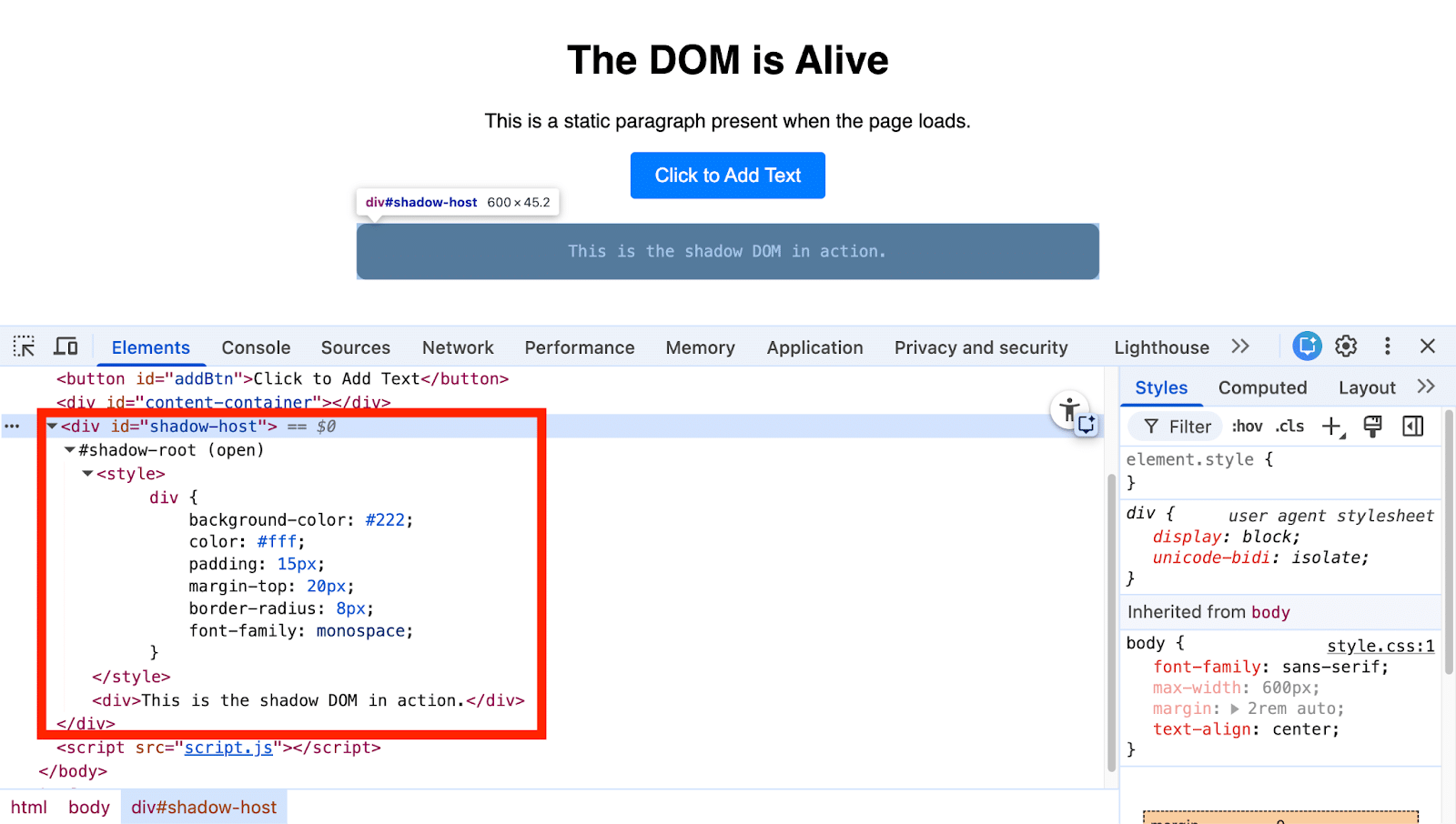
    JavaScript often runs during this DOM construction. On encountering a <script> tag without async or defer attributes, the browser pauses to execute the script before continuing. These scripts might modify the DOM by adding content or changing links, differing from the initial HTML code.

    Let me illustrate this: Each click on a button dynamically adds a paragraph to the DOM, changing the page’s visible content.

    ```json
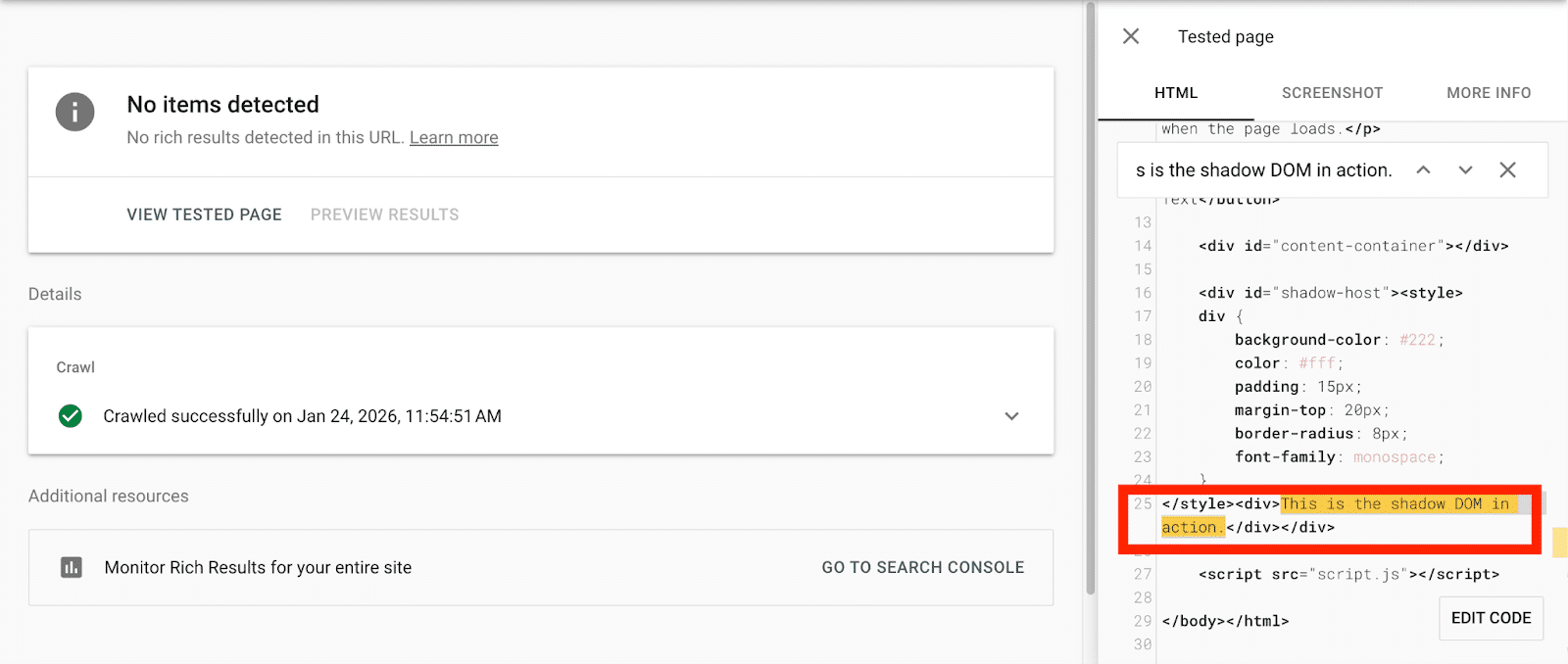
{
  "alt": "Google Search Console report showing no rich results detected and HTML code with shadow DOM highlighted.",
  "caption": "A Google Search Console report reveals the absence of rich results, alongside highlighted shadow DOM code.",
  "description": "This image displays a Google Search Console report indicating 'No items detected' for rich results. The HTML code on the right highlights the shadow DOM section, showcasing a 'This is the shadow DOM in action.' message. The crawl was completed successfully on Jan 24, 2026. Keywords: Google Search Console, rich results, shadow DOM, HTML code, web development."
}
```

    The original HTML is just a starting blueprint; the final constructed DOM is what the browser utilizes. It can dynamically change based on JavaScript operations.

    Why does the DOM matter for SEO? Modern search engines like Google render pages using headless browsers (Chromium). They evaluate the DOM, not just the initial HTML response.

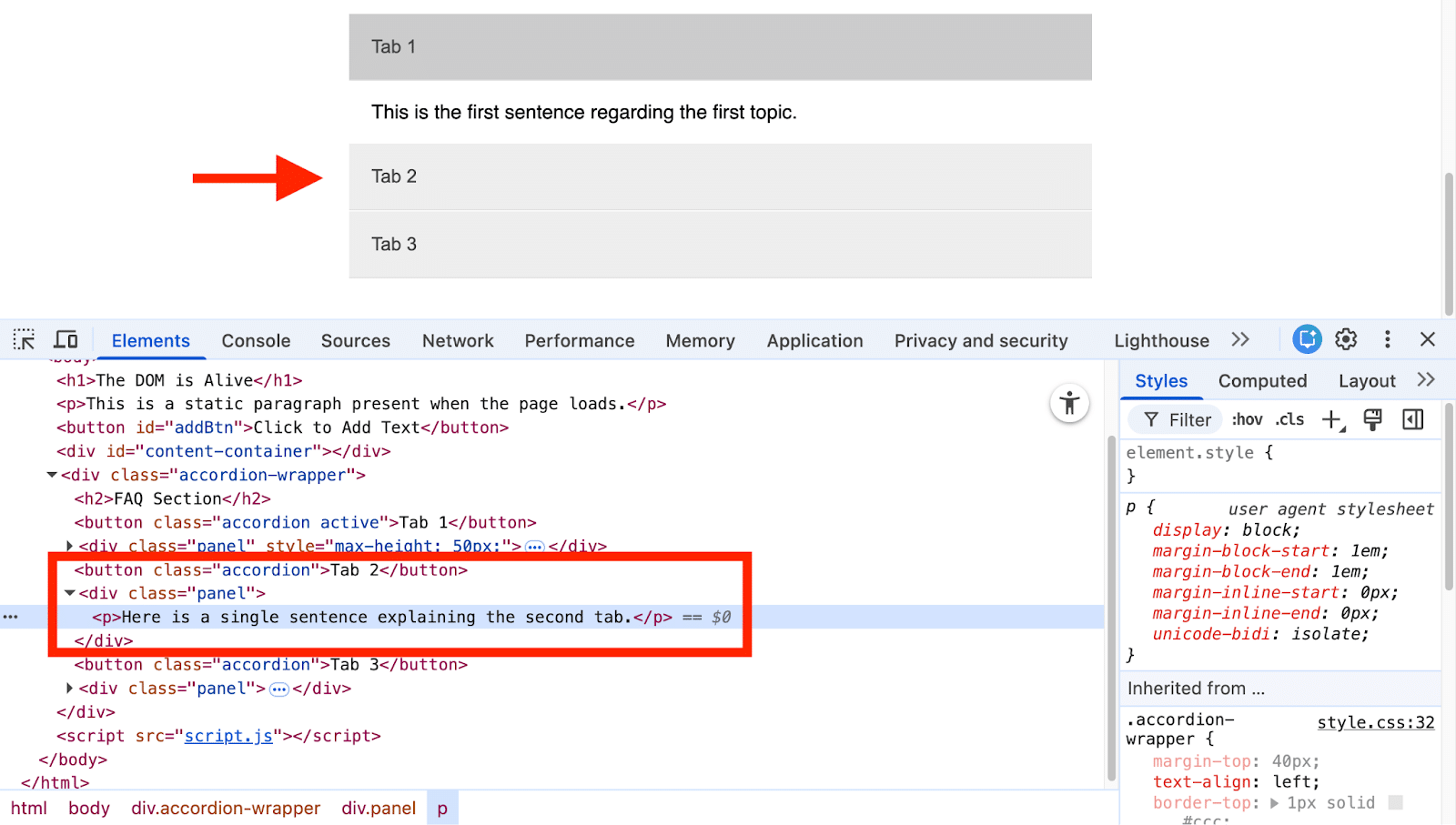
    ```json
{
  "alt": "Web development interface showing HTML and CSS code for an accordion tab.",
  "caption": "Dive into the code! This web development screenshot showcases an accordion menu with tabs and a focus on 'Tab 2'.",
  "description": "This image displays a web development interface with HTML and CSS code for an accordion menu. In the screenshot, an orange arrow points to 'Tab 2', highlighting its content within the HTML code. The browser's developer tools are open, with the 'Elements' and 'Styles' panels visible, providing insight into the code's structure and styling. Keywords: HTML, CSS, accordion, web development, code inspection."
}
```

    Googlebot’s crawl process includes parsing HTML, executing JavaScript, and taking a DOM snapshot for indexing. However, remember:

    Googlebot doesn’t interact with pages like humans—content triggered by user actions might go unnoticed.

    ```json
{
  "alt": "HTML snippet showing a paragraph with a hyperlink and an arrow pointing to it.",
  "caption": "Discover how a simple HTML structure with a hyperlink can enhance webpage interactivity. Dive into code and learn more with just one click!",
  "description": "This image displays an HTML code snippet featuring a paragraph element with static text and an embedded hyperlink labeled 'Learn more' linking to 'https://example.com'. A red arrow points towards the hyperlink, emphasizing its clickable feature. The image highlights basic webpage structure elements, contributing to understanding HTML interactivity. Keywords: HTML, hyperlink, web development, code snippet."
}
```

    Other crawlers might not render JavaScript, missing out on JavaScript-dependent content.

    With AI agents harnessing DOM data for task execution, a well-structured and accessible DOM becomes ever more crucial.

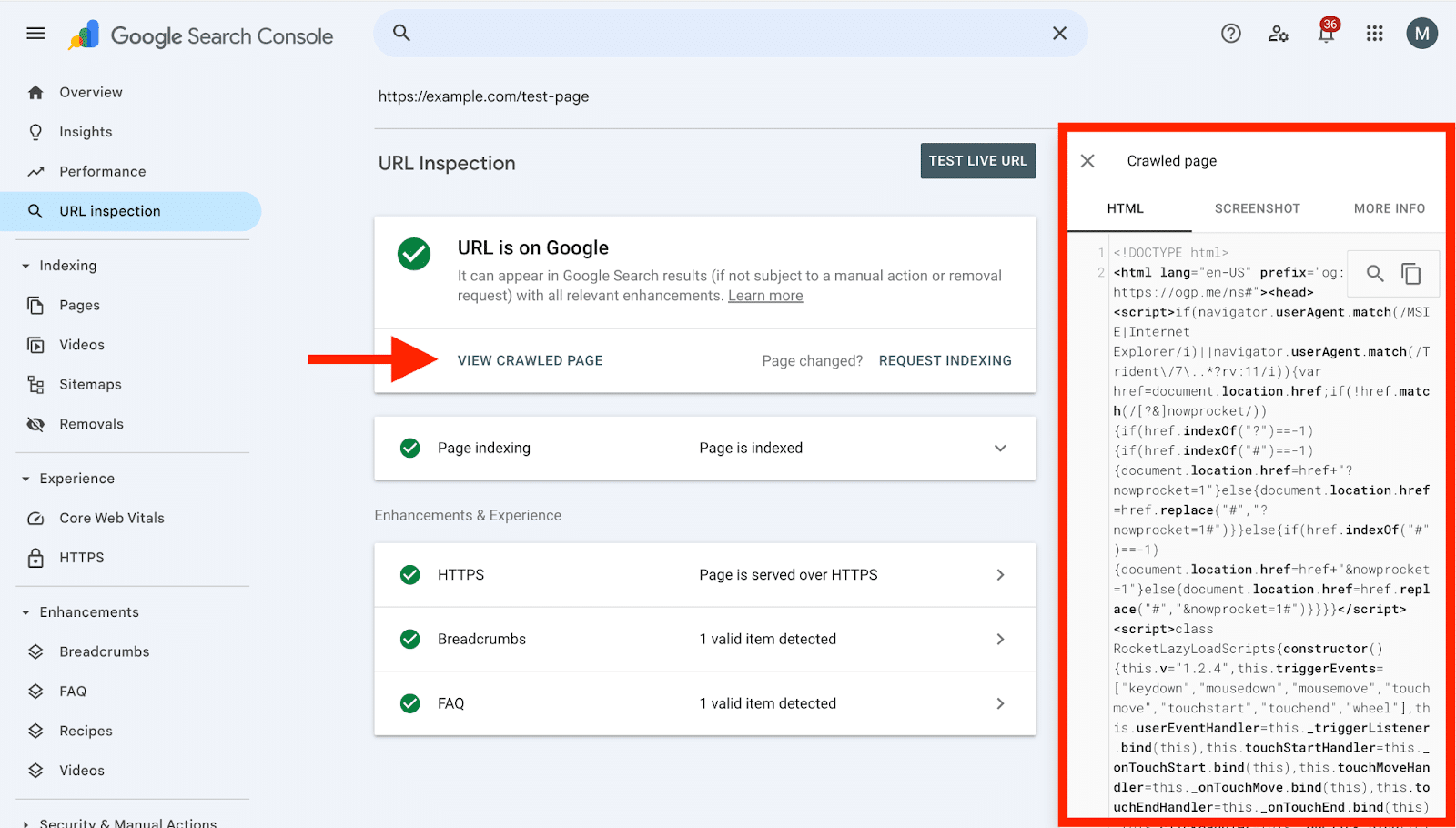
    Verifying what Google sees via Google Search Console’s URL inspection tool reveals the rendered HTML version indexed by Google, showcasing any issues.

    Using this tool can alert you to discrepancies in what Google indexes versus what you expect, impacting your SEO efforts if overlooked.

    For instances without console access, you can resort to Google’s Rich Results Test for similar page insights.

    To ensure your webpages are crawled and indexed well, here are some best practices:

    Make sure significant content loads in the DOM by default—Googlebot doesn’t interact beyond initial page loads.

    Use proper <a> tags to ensure links are crawlable, avoiding JavaScript-based navigation that search engines don’t execute.

    Maintain a clear semantic HTML structure. Search engines rely on tags like <header>, <article>, and <section> to understand content organization, unlike ambiguous <div> nesting.

    Keep your DOM lean—under about 1,500 nodes—to avoid performance lags and enhance user experience.

    In a digital landscape increasingly reliant on AI interactions and advanced crawling methods, understanding and optimizing the DOM is key to maintaining your site’s SEO competitiveness.


    Inspired by this post on Search Engine Land.

    crushpress.ai community screenshot
  • Boost SEO with AI Without Sacrificing Your Unique Brand Voice

    Boost SEO with AI Without Sacrificing Your Unique Brand Voice

    As someone navigating the world of SEO and content marketing, I’ve noticed a looming problem: everything is starting to sound eerily similar. It’s the same phrases, the same structure, and a robotic tone that seems to dominate.

    The web is overflowing with content that’s perfectly optimized yet fails to engage readers. That’s the real danger, not AI replacing SEOs or causing penalties. The biggest threat is losing our unique brand voice in the quest for efficiency.

    Rather than flattening our content, AI should enhance our SEO efforts. It should make us faster and more adaptable, without stripping away what makes our brand stand out. Here’s how I ensure AI doesn’t turn my brand into a faceless entity.

    To me, AI works best when it complements a clear strategy. It’s not a substitute for a marketing plan or brand direction. Just like tools such as Google Analytics or Semrush, AI is a support system, not a replacement.

    In my experience, without a deep understanding of our audience, AI merely churns out content that lacks distinction. That’s why defining who you are as a brand is crucial before turning to AI as an assistant.

    I’ve found AI shines when handling large data sets, spotting trends, or identifying content gaps. It accelerates my processes, allowing me to focus on the strategic aspects of SEO.

    ```json
{
  "alt": "The CapmatchOne logo with a gradient circle and bold text.",
  "caption": "Discover innovation with the CapmatchOne logo, featuring sleek typography and a modern gradient circle.",
  "description": "The CapmatchOne logo features bold, modern typography coupled with a gradient circle, symbolizing connection and innovation. The sleek design conveys a sense of progress and creativity. This image can be used for branding or promotional purposes, appealing to audiences interested in innovative solutions and forward-thinking designs."
}
```

    However, AI falls short in areas that depend on creativity and emotional engagement. It doesn’t truly understand brand values or ethical nuances. It can mimic, but not truly connect or empathize.

    Therefore, I let AI handle data-driven tasks, while keeping the heart of my branding – its voice and soul – firmly within human hands.

    Before using AI, I clarify my brand’s tone, language, and boundaries. A well-defined brand voice ensures AI assists without diluting our identity.

    In practice, I use AI for research and framework creation, but ensure human inputs sculpt the final content. Editing and authenticity checks are critical steps I never skip.

    The key takeaway is that AI amplifies whatever brand essence you feed it—it can’t create it from scratch. Maintaining clarity and a distinct brand voice is what sets successful SEO apart.


    Inspired by this post on Search Engine Land.

    crushpress.ai community screenshot
  • Google Enhances AI Recipe Searches to Empower Bloggers

    Google Enhances AI Recipe Searches to Empower Bloggers

    I recently discovered that Google is refining its AI Mode for recipe searches, which is great news for those of us who blog about food. According to Robby Stein from Google, they’ve listened to our feedback about AI Mode’s recipe results.

    They’ve made these changes to help us connect better with our audience online. Though I’m still unsure if AI might simplify our recipes too much, these updates should make it easier for users to visit our sites directly.

    Starting today, when people look up meal ideas like “easy dinners for two,” they’ll be able to tap on dishes to find links to our recipes and even get a quick overview to spark their culinary creativity.

    What it Looks Like Take a look at this video showcasing the feature in action:

    More Recipe Details Google is also adding cook time and other details to the results. They found that having this information helps users decide on which recipe to try.

    Stein mentioned that more updates are on the horizon, which is promising for us content creators.

    Why We Care This update is crucial because traffic from Google’s AI features hasn’t been kind to our visitor numbers. Google’s efforts to make these AI interactions lead more users to our blogs is a step we all welcome.

    Will these enhancements bring significant changes? Only time will tell, but I’m hopeful.


    Inspired by this post on Search Engine Land.

    crushpress.ai community screenshot
  • Google Updates JavaScript SEO: Accessibility Advice Removed

    Google Updates JavaScript SEO: Accessibility Advice Removed

    I recently discovered that Google has adjusted its JavaScript SEO guidelines by removing the ‘design for accessibility’ section. This decision was made because the advice was deemed outdated. Nowadays, Google handles JavaScript smoothly.

    When Google announced the change, they explained the section was no longer as useful as it once was. Previously, they warned that JavaScript might obscure content from Google, but clearly, that’s not an issue anymore.

    The Old Advice. Here’s what the original guidance stated:

    “Design for accessibility: Create pages for users, not just search engines. When designing your site, consider users who might not use a JavaScript-capable browser, like those with screen readers or less advanced mobile devices. Test your site’s accessibility by viewing it with JavaScript turned off or in a text-only browser like Lynx. This can help identify content hard for Google to see, such as text in images.”

    Why It Was Removed. Google clarified:

    • “The information was outdated and less helpful. Google Search has successfully rendered JavaScript for years, so using it for content loading doesn’t hinder visibility.”
    • “Most assistive technologies can now handle JavaScript as well.”

    The Importance. Even though Google is adept at processing JavaScript, it’s still critical to verify what Google Search sees. I recommend using the URL inspection tool within Google Search Console to ensure everything checks out.

    Remember, while Google and probably Microsoft Bing manage JavaScript efficiently, some emerging AI engines might not render it as effectively.


    Inspired by this post on Search Engine Land.

    crushpress.ai community screenshot