Category: Opinion

  • Transform Your SEO with AI: 20 Practical Applications

    Transform Your SEO with AI: 20 Practical Applications

    20 practical ways to use AI in SEO

    After almost two decades in digital marketing, AI significantly impacted how I work. It’s been a game-changer by saving time, cutting down on repetitive tasks, and speeding up challenging ones.

    However, AI doesn’t operate as a magic wand. It won’t do the entire job for you or transform everything overnight. In the hands-on world of SEO, armed with real clients and deadlines, AI serves as a handy tool to ease workloads but doesn’t eliminate the necessity of hard work.

    Below are 20 ways I’ve integrated AI into my SEO strategies. Some are specific to SEO, while others benefit anyone in the industry. Each usage is practical, tested, and transparent about its constraints.

    Content creation and copywriting

    1. Writing first drafts

    The best way to leverage AI in content is to see it as a rapid first-draft creator rather than expecting it to deliver polished, ready-to-publish pieces. Provide it with your brief, target keywords, audience, and angle to get a structured draft.

    Focus on rewriting this draft in your voice by injecting your unique expertise. Enhance AI-generated content with personal stories, case studies, stats, and your professional insights.

    AI helps avoid the daunting starting point of a blank page, saving valuable time.

    2. Generating meta title and description variations

    Provide your target keyword, page topic, and character limits to Claude or ChatGPT, and request 10 variations for your meta titles and descriptions. You might choose one or mix two for the best effect, reducing creation time from 20 minutes to just two!

    Many tools will let you upload CSVs, add AI-generated suggestions, and download them for review. However, always ensure a human review for optimal results.

    3. Refreshing underperforming content

    If a page or blog post is underperforming, paste it into an AI tool to get feedback on missing elements, extensible parts, and outdated information. Although not always perfect, it offers a fresh perspective without needing to reread everything yourself.

    Detailed prompts with context yield better results than simply pasting content cold.

    4. Generating FAQ sections

    Ask AI to generate the top 10 questions around your target keywords and check them against ‘People Also Ask’ and your research. By providing well-crafted answers, you get an FAQ section, potential featured snippets, and a content gap analysis in around 10 minutes.

    5. Writing alt text at scale

    Crafting alt text for numerous images can be a tedious task. Describe the image, its page context, and include the target keyword for AI to generate appropriate alt text descriptions. While not glamorous, it’s essential and much faster.

    Running a site through Screaming Frog, exporting it, and using AI to write alt text can quicken the process if file names are descriptive. Human oversight remains a necessity, focusing on speed rather than full automation.

    Dig deeper: How to use AI for SEO without losing your brand voice

    Technical SEO

    6. Understanding error messages and log files

    AI proves invaluable for those without a developer background by translating technical error messages, interpreting server logs, and identifying why a page isn’t being indexed. Paste in your output, ask for explanations and recommended fixes, verifying the insights before implementation.

    7. Writing schema markup

    Schema markup can be tedious. Provide AI with page content descriptions and schema type (like FAQ or Article), and let it generate the JSON-LD code. Always verify it with Google’s Rich Results Test to ensure correctness. The process now takes me only five minutes per page type!

    8. Creating regex for Google Search Console

    If you’re utilizing regex in GSC filters and aren’t an expert, AI can lend a hand. Describe what you need to filter and request the regex string. It usually gets it right and can even explain the logic for your understanding.

    9. Analyzing crawl data with prompts

    Export crawls from Screaming Frog or Sitebulb. If you’re uncertain what to prioritize, input the data into an AI tool and receive guidance on the highest-priority issues for site goals. It’s a great assistance when diagnosing plenty of issues under tight timings.

    Dig deeper: 6 tactical ways to responsibly use AI for everyday SEO

    Reporting and analysis

    10. Writing the narrative around the numbers

    One underrated AI use in SEO work involves creating narratives around the data. You have the facts, but forming a coherent narrative explaining fluctuations and future expectations takes effort. Share your key metrics, contextual events, and have AI draft the narrative for you to refine and enhance.

    This method helps blend information from multiple sources. I save hours monthly while compiling reports.

    ```json
{
  "alt": "The CapmatchOne logo with a gradient circle and bold text.",
  "caption": "Discover innovation with the CapmatchOne logo, featuring sleek typography and a modern gradient circle.",
  "description": "The CapmatchOne logo features bold, modern typography coupled with a gradient circle, symbolizing connection and innovation. The sleek design conveys a sense of progress and creativity. This image can be used for branding or promotional purposes, appealing to audiences interested in innovative solutions and forward-thinking designs."
}
```

    11. Summarizing long reports for clients

    Not every client wishes to examine a 12-page report. Task AI with summarizing it into an executive five-bullet summary for better engagement. The comprehensive report remains optional for those who seek details.

    Providing a simple, easy-to-understand executive summary bridges understanding gaps for clients not familiar with SEO intricacies.

    12. Identifying anomalies in data

    Input your keyword rankings or traffic data and let AI detect unusual trends or patterns that deviate from expectations, such as drops or unexplained gains.

    While it won’t replace comprehensive analysis, it is beneficial for a preliminary review when overwhelmed by data.

    Dig deeper: How to build AI confidence inside your SEO team

    Research and competitor analysis

    13. Conducting competitor content gap analysis

    List your top competitors and yourself, asking AI to identify potential content gaps based on competitors’ strategies and positioning.

    Use AI-generated insights to guide targeted keyword research, starting the manual process with hypothesis-generating edge.

    14. Understanding a new industry quickly

    For unfamiliar industries, rely on AI to guide you with key terminology, major players, buying cycles, search habits, and common pain points. This approach saves you time on initial discovery calls.

    15. Identifying search intent mismatches

    Ask AI to categorize your target keywords by search intent, then check for disparities in your current page targeting approach. It’s straightforward yet tedious when dealing with numerous keywords.

    Dig deeper: How to use AI response patterns to build better content

    Client communication and account management

    16. Drafting difficult client emails

    AI eases the burden of crafting challenging emails, whether explaining dropped rankings or missed deadlines. Provide situation details, needed actions, and let AI draft a professional message to edit and send, saving emotional energy.

    17. Writing SOPs and process documentation

    To document processes, verbalize or note down rough steps and let AI turn them into structured SOPs. This approach helps overcome procrastination, offering a framework to refine further.

    18. Preparing for client calls

    Before client calls, recap recent report data, outstanding issues, and planned agenda with AI assistance for structuring and anticipating potential client queries. This primes you for a well-prepared meeting experience.

    Productivity and admin

    19. Processing your own thinking

    I frequently turn to AI when grappling with strategic or creativity blocks. I discuss challenges aloud and AI helps clarify thoughts, aiding in quicker and easier decision-making processes.

    Ask AI for honest feedback to bypass mere agreement, ensuring you receive pertinent, challenging insights.

    20. Building prompts you actually reuse

    The greatest productivity surge from AI arises by crafting a repository of tailored prompts for your workflow. Save successful prompts to establish a library, avoiding the need to reinvent each time. Consistent reuse of effective prompts compounds productivity gains over time.

    Top tip: Many premium AI tools permit project creation with specified instructions, saving time spent repeatedly inputting detailed information for prompts.

    Dig deeper: Why SEO teams need to ask ‘should we use AI?’ not just ‘can we?’

    What these use cases don’t replace

    These AI tips augment, but do not replace, the expertise and relationships crucial to excellent SEO practice. AI lacks nuanced understanding of business intricacies, account histories, and client relationships.

    By lessening time spent on monotonous tasks, AI allows more room for expert work. Always employ AI as a tool, remain cautious of the hype, and ensure to personally review content before presenting to a client.

    Dig deeper: Could AI eventually make SEO obsolete?


    Inspired by this post on Search Engine Land.


    crushpress.ai community screenshot
  • Mastering AI Visibility: Beyond ‘Publish and Wait’

    Mastering AI Visibility: Beyond ‘Publish and Wait’

    In 1998, I found myself meticulously submitting websites to search engines. I remember the drill well: AltaVista, Yahoo Directory, Excite, Infoseek, Lycos, and others. Each had its own form and wait time, leaving us to wonder if our URLs would make the cut.

    Back then, we submitted a whopping 18,000 pages, manually. While this was happening, Google was just emerging. Yet, they already had a vision that would render manual submissions almost obsolete.

    Google’s PageRank meant that if a site had incoming links, it didn’t necessarily need to submit. While other search engines waited, Google proactively discovered content, streamlining what was once a tedious process.

    ```json
{
  "alt": "The CapmatchOne logo with a gradient circle and bold text.",
  "caption": "Discover innovation with the CapmatchOne logo, featuring sleek typography and a modern gradient circle.",
  "description": "The CapmatchOne logo features bold, modern typography coupled with a gradient circle, symbolizing connection and innovation. The sleek design conveys a sense of progress and creativity. This image can be used for branding or promotional purposes, appealing to audiences interested in innovative solutions and forward-thinking designs."
}
```

    For two decades, the rule was simple: you published, you waited, and the bots would come. But now, the landscape is shifting. Not because Google has lost its edge, but due to an expanded game where merely waiting won’t capture all available revenue streams.

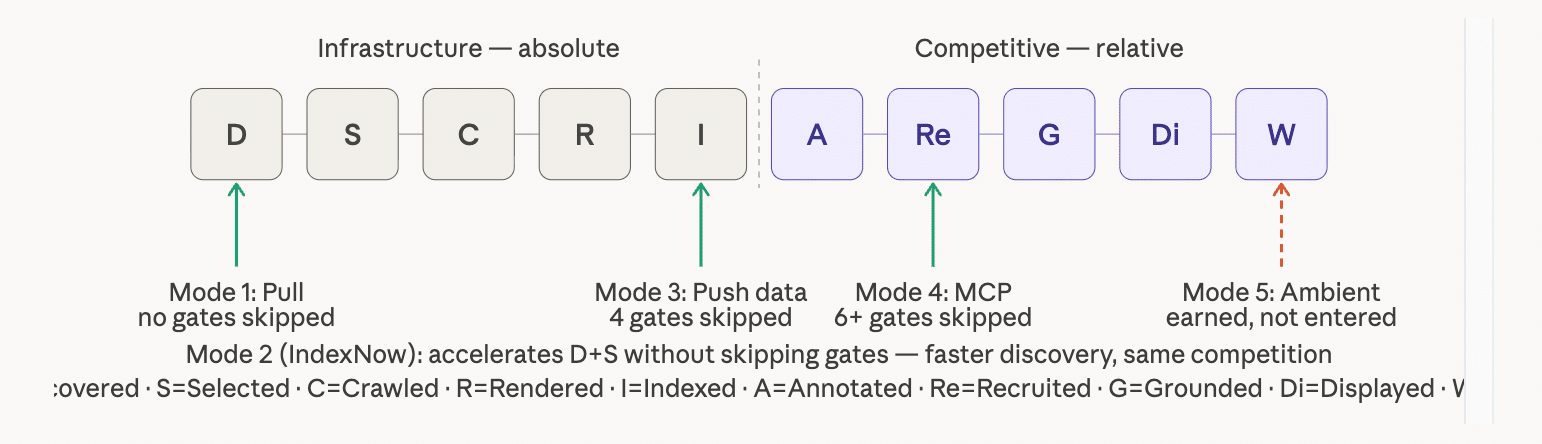
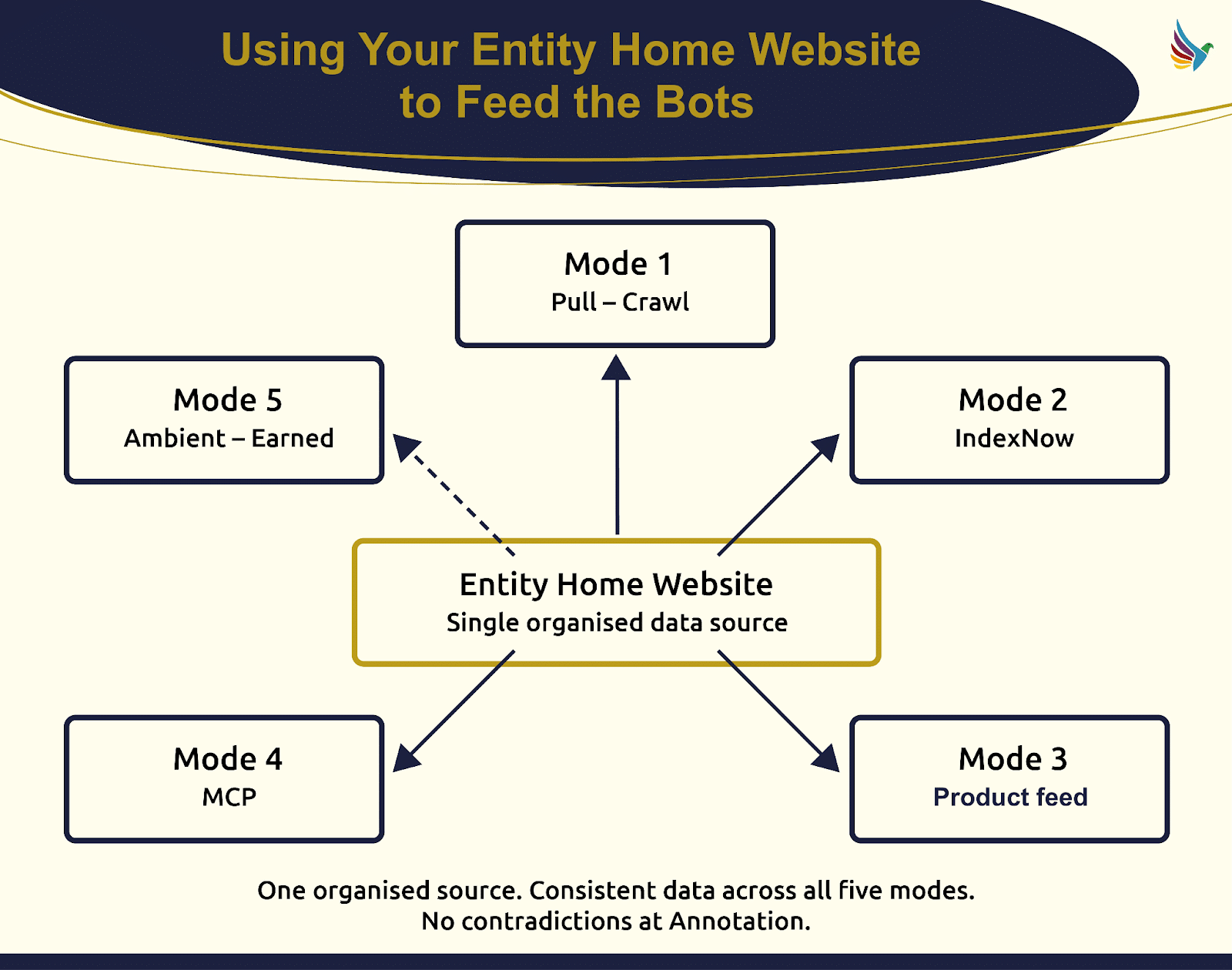
    The pull model, which depends on search bots, is no longer the only method of content discovery. We now have five modes of entry into the AI engine pipeline, and the single entry mode of the past has evolved dramatically.

    ```json
{
  "alt": "Bar chart comparing surviving signals for Mode 1 Pull, Mode 3 Push Data, and Mode 4 MCP.",
  "caption": "Explore the efficiency boost in data modes: See how Mode 3 and Mode 4 outperform the baseline Mode 1 in surviving signals.",
  "description": "This bar chart illustrates the surviving signal percentages for three data modes: Mode 1 Pull (baseline), Mode 3 Push Data, and Mode 4 MCP. Mode 1 acts as the baseline at 100%, Mode 3 surpasses it slightly, and Mode 4 achieves a significant increase, reaching over 700%. Annotations mention speeds and gate skipping specifics, with Mode 4 skipping six or more gates. This contextual data is part of a larger article series examining data mode advantages."
}
```

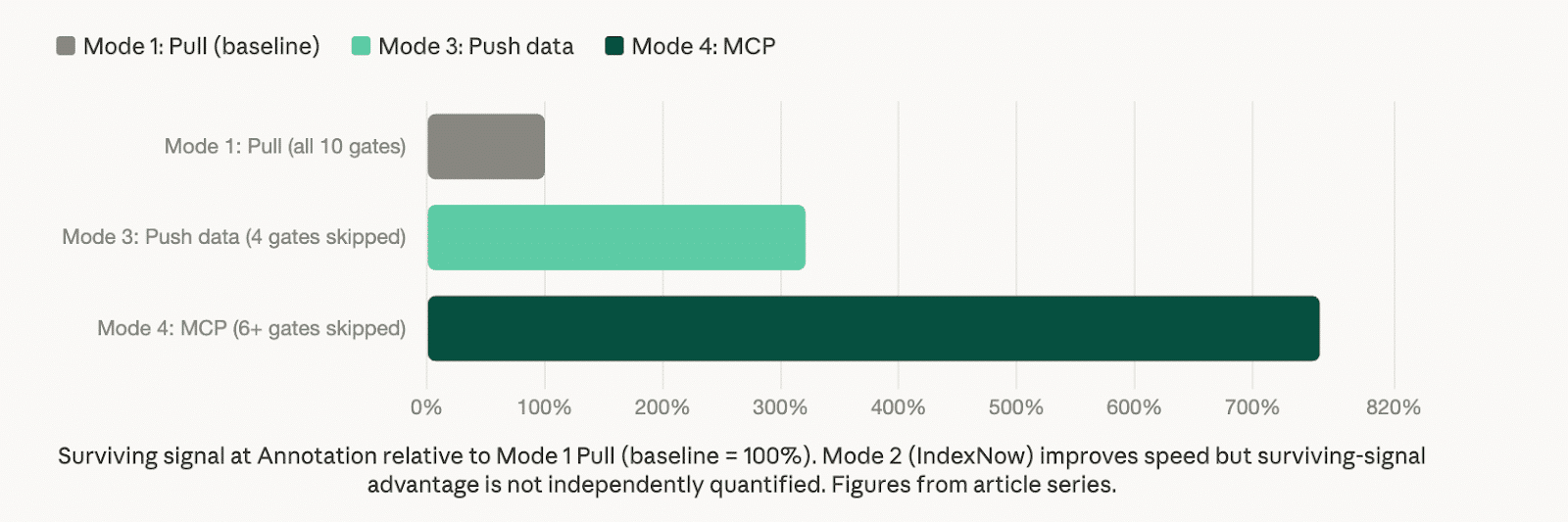
    I’ve identified these modes to show how they each confer unique advantages at the crucial stages of indexing and annotation, which determine a content’s competitive edge.

    First up, the traditional pull model remains, where bots fetch and decide everything. It offers no structural leverage, leaving content entirely dependent on the bot’s schedule.

    ```json
{
  "alt": "Infographic on how algorithmic confidence affects AI research modes: explicit, implicit, and ambient research with varying confidence levels.",
  "caption": "Discover how algorithmic confidence shapes the reach and effectiveness of explicit, implicit, and ambient AI research modes, impacting audience engagement.",
  "description": "This infographic details how algorithmic confidence affects three research modes in AI: explicit, implicit, and ambient research. Explicit research involves a narrow audience with low AI confidence requirements, implicit research reaches a wider audience with medium confidence needs, and ambient research targets the widest audience but demands high confidence. It highlights that most brands invest heavily at the explicit level, while the highly valuable audience is reached through ambient research."
}
```

    Next, push discovery is a proactive approach, notifying systems of new or updated content. Tools like IndexNow by Bing expedite this process significantly, allowing content to be recommended much sooner.

    Push data skips the bot entirely, using structured data to directly feed AI systems. Here, seamless indexing from a machine-readable format offers a major competitive edge.

    ```json
{
  "alt": "Diagram showing how an Entity Home Website feeds data to various modes for bots including pull-crawl, IndexNow, product feed, MCP, and ambient-earned.",
  "caption": "Discover how your Entity Home Website serves as a hub for feeding essential data to bots, ensuring consistent and organized information flow across five strategic modes.",
  "description": "This diagram illustrates the role of an Entity Home Website as a central repository for structured data, facilitating information flow across five different modes. These include Mode 1: Pull-Crawl, Mode 2: IndexNow, Mode 3: Product Feed, Mode 4: MCP, and Mode 5: Ambient-Earned. Arrows indicate the connection from the Entity Home Website to each mode, emphasizing the importance of having a consistent, organized data source that avoids contradictions in annotation. Keywords: Entity Home Website, bots, data source, SEO, IndexNow, product feed."
}
```

    Push via MCP allows AI agents to access real-time data directly, transforming how content enters the competitive arena. Brands without MCP-ready data risk losing out to those with real-time access capabilities.

    Finally, ambient entry is about AI recommending content without explicit user queries, often seen in tools many of us use daily.

    All modes converge at the annotation phase, a critical step for successful content visibility in AI systems. As we shift focus on entity management and centralized data, brands can optimize for all entry modes, ensuring readiness for any future developments.


    Inspired by this post on Search Engine Land.

    crushpress.ai community screenshot
  • Master Media Optimization in Long Sales Cycles

    Master Media Optimization in Long Sales Cycles

    In my experience, navigating long sales cycles is like orchestrating a complex symphony, with people, timing, and operations all playing vital roles. I’ve learned that when I value leads appropriately, I can give paid media platforms the clarity they need to perform better.

    In these extended sales journeys, much of the action post-lead submission revolves around the human element. If I focus my campaign optimization efforts solely on sales outcomes, I’m essentially allowing ad platforms to react based on the sales team’s monthly performance, which often overlooks lead quality—a dilemma no amount of tweaking can resolve.

    The advice to “optimize the full funnel” suggests monitoring media expenditure through to revenue generation. However, beyond capturing leads, the factors that drive sales often exist outside the realm of paid media—it’s tied to the sales team composition, their workload, and other myriad factors beyond your control with targeting or creative updates.

    When My Sales Team Becomes the Signal

    With over 15 years in financial services marketing under my belt, I’ve seen this phenomenon extend beyond industries like mortgages or insurance. If human interactions are a key part of your sales process, this will resonate with you.

    Picture someone like Dave in your organization. For example, in my case, Dave is a talented mortgage advisor, but in your world, he might be your leading enterprise sales rep, an outstanding business development manager, or the star project estimator.

    Dave isn’t just successful because he gets better leads. His natural gift for establishing connections, asking insightful questions, and reassuring clients enables him to close deals at a rate far exceeding his peers.

    But Dave isn’t omnipresent. He deserves vacations, he might pursue new career opportunities, or your company may recruit more like him. Consequently, the composition of your sales team is in constant flux. A surge of seasoned closers one month might juxtapose a shortfall the next, influenced by recruitment drives or personnel departures like Dave moving on with two coworkers.

    This variability can lead to targeting conundrums. When conversion rates plummet as a junior rep fills in during Dave’s absence, algorithms may misinterpret it as a targeting issue rather than a staffing concern.

    If my campaigns are programmed to optimize towards sales, the algorithm might surmise, “Targeting malfunctioning—these clicks now yield lower quality conversions; time to redirect spending.”

    Such assumptions can lead to previously effective keywords being disabled, active audience engagement dwindling, and overall account performance declining, despite leads remaining unchanged.

    Dig deeper: Diagnose and Overcome the Largest PPC Growth Barriers

    Operational Influences on Conversion Data

    There’s more at play than merely the sales team’s structure. Imagine this scenario:

    During Q4, workloads often intensify as everyone races to finalize deals by year-end. Response times may surge from two days to over a week, prompting impatient clients to look elsewhere.

    Market dynamics could shift abruptly, leading to the withdrawal of your most competitive product. Or, summer vacations reduce staffing, resulting in some leads growing cold long before follow-up. Then, in September, everything stabilizes again.

    These are just typical examples of everyday operational hiccups. Be it budget sanctions being stalled, fluctuating product ranges, or project delays, each can uniformly distort your conversion metrics.

    The algorithm may misinterpret targeting effectiveness when, in reality, your team is simply juggling leads from other originations.

    When Dave Becomes Unstoppable: The Santa Claus Rally

    The Santa Claus Rally, often referred to as the December Effect, is a fascinating instance I’ve witnessed where human actions can throw algorithmic targeting for a loop.

    Every December around the third week, something peculiar unfolds in the financial services arena: lead-to-sale conversion rates soar, with uplifts skyrocketing up to 150% compared to usual weeks.

    Optimizing for sales might lead the algorithm to deduce, “This week’s strategy is phenomenal!” Yet, reality hits during the holiday week, plummeting conversion rates to fractions of their regular levels.

    None of this is attributable to paid media strategies. By week three, individuals like Dave enter ‘goal-accomplishment’ overdrive. They’re motivated by year-end bonuses, pushing through one last campaign before the break—swiftly reaching out to leads, following up assertively, and converting deals they might usually spend longer nurturing. Dave’s productivity hits a new high.

    With the advent of the holiday week, everyone checks out mentally. Customers stop answering calls, and Dave finally uses his PTO. Meanwhile, those still working spend more time planning family events than business goals.

    The lead attributes, targeting, and ad placements remain consistent. The program simply adjusts bids and valuations based on the seasons, reflecting when Dave and team take their much-deserved vacations.

    ```json
{
  "alt": "The CapmatchOne logo with a gradient circle and bold text.",
  "caption": "Discover innovation with the CapmatchOne logo, featuring sleek typography and a modern gradient circle.",
  "description": "The CapmatchOne logo features bold, modern typography coupled with a gradient circle, symbolizing connection and innovation. The sleek design conveys a sense of progress and creativity. This image can be used for branding or promotional purposes, appealing to audiences interested in innovative solutions and forward-thinking designs."
}
```

    Investigate further: Streamline Your Marketing Funnel and Eliminate Costly Gaps

    Knowing When to Cease Optimization

    So, if I find that sales-focused optimization skews due to uncontrollable factors, I wonder where this optimization boundary should be drawn. How can I curb this distortion while ensuring the right leads?

    The answer lies in finalizing control at lead submission—but evaluating leads isn’t about counting them. It requires ascertaining their probability of conversion and the financial worth of the final sale.

    An issue with high-value industries is their frequently low sales numbers, making it nearly impossible for automated systems to gather meaningful insights. Lead valuation counters this by providing a greater volume of conversion events as opposed to sparse sales data.

    Consequently, automated bidding performs efficiently, facilitating campaign testing and audience analysis, while maintaining data accuracy. Optimizations draw from lead quality before Dave—or the sales crew—steer the wheel.

    Importantly, while downstream conversions or revenue may be imported into platforms powerfully, it only succeeds if volume is ample, conversion delays are short, and sales processes are stable.

    Stay informed with our most trusted marketing newsletter.

    MktoForms2.loadForm(“https://app-sj02.marketo.com”, “727-ZQE-044”, 16298, function(form) { // form.onSubmit(function(){ // }); // form.onSuccess(function (values, followUpUrl) { // }); });

    Creating Lead Valuation Systems

    I begin with a robust analysis of historical data, preferably spanning a year, although six months can suffice. My goal is to discern which leads converted and assess their value, identifying any shared characteristics evident at inquiry.

    For financial endeavors, relevant metrics might include loan value or terms. In a B2B context, relevant dimensions might involve business size or industry. Construction projects often boil down to scope and immediacy.

    Afterward, I categorize leads by their conversion probability and typical deal size, then assign an estimated revenue value.

    The checkpoint for accuracy is straightforward: ensure that your leads’ cumulative projected value closely mirrors actual generated revenue over a timeline. If discrepancies exist, the model needs adjusting. It’s prudent to revisit these models routinely, ideally quarterly, in response to dynamic campaign and operational changes.

    For instance, I might qualify a high-probability lead at $850, a median lead at $420, and lesser-chance leads at $120.

    Upon formulating this, conversion tracking is configured to relay anticipated values back to platform conversion actions, thereby deploying value-based bidding (like Google Ads’ target return on ad spend) to guide the algorithm towards valuable leads.

    Dive deeper: Harness Automation for Lead Gen Success in PPC

    Focusing on Controllable Aspects

    The advice to “optimize the full funnel” resonates as common sense till we grasp how much we can’t control. For instance, I can shape targeting, craft compelling creatives, enhance landing pages, and streamline initial form engagements. Thereafter, it’s primarily on Dave or the sales team and extraneous factors far removed from my campaigns.

    Expecting an algorithm to optimize for invisibles misleads it into chasing erroneous audiences from flawed assumptions.

    Instead of ceasing post-lead tracking, I recommend sustained monitoring, as it sheds light on areas of triumph and those needing rectification. Consider these pointers:

    • With steady lead quality and declining sales, it’s an operational challenge, not a paid media dilemma.
    • Simultaneous drops in both lead quality and sales might prompt campaign evaluations.
    • Sudden sales surges with stagnant lead quality often indicate Dave excelling, not improved targeting.

    Such detailed insights are invaluable but shouldn’t dictate optimization strategy.

    Develop robust lead value assessments, convey expected valuations back to your systems, and allow algorithms to excel at identifying optimal leads. Leave other aspects to Dave’s capable hands.

    It’s essential to delineate where your control ceases, marking where optimization should logically end.


    Inspired by this post on Search Engine Land.

    crushpress.ai community screenshot
  • Unveiling the True Drivers of AI Recommendations

    Unveiling the True Drivers of AI Recommendations

    I often encounter discussions about the charts that go viral on LinkedIn, highlighting AI citation data. It’s common knowledge now that Wikipedia and Reddit top the list of domains cited by major LLM platforms. CMOs seem eager to jump on this data.

    But this is where the challenge lies. Just do a search for any BOFU software query, and you’ll see Reddit threads prominently ranking. This explains why there’s a proliferation of ‘Reddit SEO’ agencies these days.

    ```json
{
  "alt": "Bar graph showing top cited domains on LLMs in October 2025, led by reddit.com and linkedin.com.",
  "caption": "Explore the most cited domains by language models in October 2025, with Reddit and LinkedIn topping the list.",
  "description": "This bar graph illustrates the top cited domains by large language models (LLMs) including ChatGPT, Google AI Mode, and Perplexity as of October 2025. The data, derived from a Semrush study of 230,000 prompts, highlights reddit.com, linkedin.com, and wikipedia.org as the leading sources. The chart displays the percentage of LLM responses featuring a citation from each domain, with percentages ranging from above 2.5% to nearly 10%."
}
```

    However, I believe it’s crucial to pause here. Shifting your entire GEO strategy towards platforms like Reddit or Wikipedia, based solely on this macro context, is typically a strategic misstep for most B2B brands.

    ```json
{
  "alt": "Search results about Reddit SEO agencies with related discussions and forums.",
  "caption": "Navigating the world of Reddit SEO, these results reveal top agencies and insightful discussions to boost your brand's online presence.",
  "description": "The image displays a search results page focused on Reddit SEO services. It includes listings for various agencies like Scalerrs and Timmermann Group, alongside discussions from platforms like Quora. The results highlight strategies to enhance brand visibility through Reddit. Keywords such as 'Reddit SEO agency' and 'optimize your brand's presence' feature prominently, offering insights into digital marketing avenues that utilize Reddit's community engagement."
}
```

    The hype around these platforms is largely due to algorithmic shifts favoring large community forums and encyclopedias. While these charts might accurately reflect data, they’re often strategically misguided when misapplied as a universal strategy playbook.

    ```json
{
  "alt": "The CapmatchOne logo with a gradient circle and bold text.",
  "caption": "Discover innovation with the CapmatchOne logo, featuring sleek typography and a modern gradient circle.",
  "description": "The CapmatchOne logo features bold, modern typography coupled with a gradient circle, symbolizing connection and innovation. The sleek design conveys a sense of progress and creativity. This image can be used for branding or promotional purposes, appealing to audiences interested in innovative solutions and forward-thinking designs."
}
```

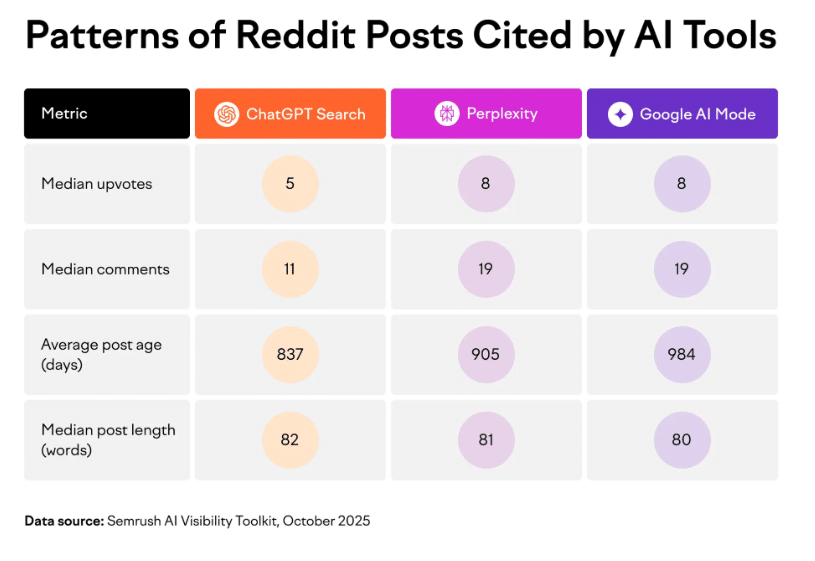
    Reddit is often targeted because it’s seen as easier to manipulate, unlike Wikipedia with its stringent editorial rules. This reflects a classic marketing Whiplash Syndrome, where foundational principles are sacrificed for new, shiny tactics.

    ```json
{
  "alt": "Comparison of Reddit post patterns cited by AI tools: ChatGPT Search, Perplexity, and Google AI Mode.",
  "caption": "Explore the patterns of Reddit posts cited by AI tools. This table reveals insights across ChatGPT Search, Perplexity, and Google AI Mode, highlighting differences in upvotes, comments, and post age.",
  "description": "This image presents a comparative table depicting patterns of Reddit posts used by AI tools: ChatGPT Search, Perplexity, and Google AI Mode. It displays four metrics: median upvotes, median comments, average post age (in days), and median post length (in words). Key observations include ChatGPT's lower upvotes and comments, and Google AI Mode's higher average post age. Data sourced from Semrush AI Visibility Toolkit, October 2025. Keywords: Reddit, AI tools, ChatGPT, Perplexity, Google AI Mode, data analysis."
}
```

    Understanding why Reddit and Wikipedia are high-effort but low-upside channels for most brands requires looking beyond ignored contexts. Engaging with these platforms needs a comprehensive understanding of their dynamics and not a superficial chase for citations.

    ```json
{
  "alt": "Chart comparing AI response similarity to Reddit posts for ChatGPT Search, Perplexity, and Google AI Mode.",
  "caption": "AI vs Reddit: This chart reveals how closely responses from ChatGPT Search, Perplexity, and Google AI Mode mirror Reddit posts. Discover which model aligns most closely!",
  "description": "This image showcases a chart titled 'How Closely AI Responses Mirror Reddit Posts.' It compares ChatGPT Search, Perplexity, and Google AI Mode. Each AI model has two metrics: prompt vs Reddit post similarity and AI response vs Reddit post similarity. Notably, ChatGPT Search shows a significant AI response similarity of 0.54, while Perplexity and Google AI Mode both report 0.53. Data source: Semrush AI Visibility Toolkit, October 2025."
}
```

    Studies show that citations are aggregated from a randomized keyword database ranging from pop culture to consumer advice, which is why massive sites like Wikipedia, Reddit, and YouTube naturally garner more citations.

    ```json
{
  "alt": "Screenshot displaying Reddit URLs with columns for brand mentions, competitor mentions, page topics, prompts, and responses.",
  "caption": "Dive into Reddit discussions with this analytical screenshot showcasing brand and competitor mentions across cybersecurity and remote work topics.",
  "description": "This image is a screenshot from a tool analyzing Reddit discussions. It lists URLs related to cybersecurity and remote work with columns indicating brand mentions, competitor mentions, and engagement metrics, like page topics, prompts, and responses. The rows show data points, such as third-party mentions, with numerical metrics for prompts and responses. Useful for understanding online conversations, this image is an example of social media analysis in action."
}
```

    Reddit threads that rank high on BOFU queries can’t simply be reproduced, as these rankings come from authentic, peer-reviews and ongoing discussions, not quick marketing hacks.

    ```json
{
  "alt": "Dashboard showing URL, brand and competitor mentions, page topics, and activity metrics.",
  "caption": "Explore detailed analytics with metrics on brand and competitor mentions, page topics, and user activity monitoring.",
  "description": "This image displays a dashboard summarizing analytics for a Wikipedia URL. It includes data on brand mentions (marked as 'No'), competitor mentions ('ActivTrak'), and page topics such as 'Employee Monitoring' and 'User Activity Monitoring.' Also shown are metrics like prompts, responses, citation consistency, and influence score. This is useful for understanding web activity and monitoring online presence. Key terms: analytics, brand mentions, competitor mentions, user activity."
}
```

    The illusion of hacking Reddit and Wikipedia for AI visibility backfires when you consider how LLMs process data. The data shows Reddit citations are based on historical consensus, not manufactured virality, and Wikipedia’s editors remain cautious.

    ```json
{
  "alt": "Image showing a keyword analysis for trucking management software with topics, prompts, and visibility percentages for ChatGPT, Perplexity, and Google AIO.",
  "caption": "Dive into the world of trucking management software with this insightful keyword analysis, showcasing various software-related prompts and visibility scores across different AI platforms.",
  "description": "The image provides an analysis of keywords related to trucking management software, highlighting 24 topics and 120 prompts. Visibility percentages are displayed for ChatGPT (20%), Perplexity (0%), and Google AIO (60%). Sample prompts include questions about improving efficiency and comparing software. Green tags indicate ranked visibility for brands across platforms, supporting logistics and hauling business queries. This comprehensive analysis aids in exploring software options and understanding market presence."
}
```

    If you decide to pursue strategies involving Reddit or Wikipedia, it’s important to approach these communities with respect to their unique ecosystems rather than attempting to circumvent their core principles for short-term gains.

    ```json
{
  "alt": "Comparison chart of project management software visibility across ChatGPT, Perplexity, and Google AIO.",
  "caption": "Explore the visibility levels of various project management software queries as analyzed by ChatGPT, Perplexity, and Google AIO.",
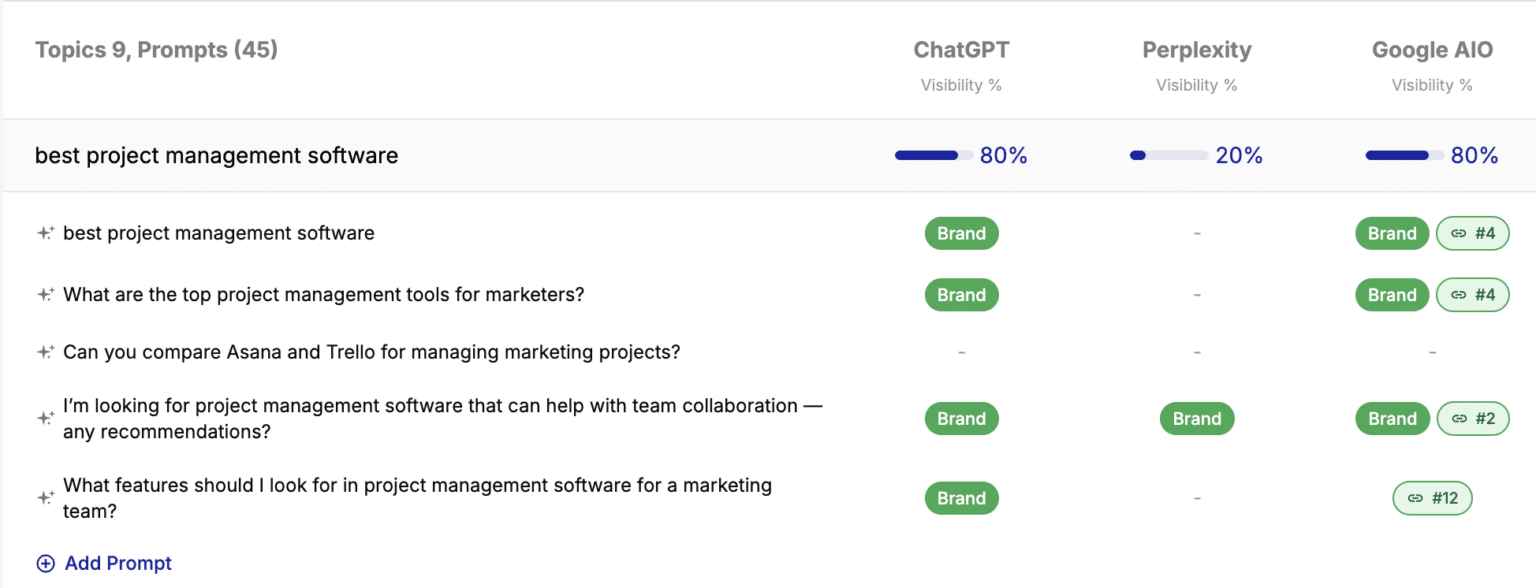
  "description": "This image presents a comparison chart showcasing the visibility percentages of project management software queries evaluated by three platforms: ChatGPT, Perplexity, and Google AIO. ChatGPT and Google AIO both show an 80% visibility for the queries, whereas Perplexity displays a 20% visibility. The image includes specific prompts related to project management, such as comparing Asana and Trello, and seeking recommendations for team collaboration tools. Keywords: project management software, visibility comparison, ChatGPT, Perplexity, Google AIO."
}
```

    Inspired by this post on Search Engine Land.

    crushpress.ai community screenshot
  • Unlock Your Control Over Performance Max Campaigns

    Unlock Your Control Over Performance Max Campaigns

    When I first delved into Performance Max, I shared the sentiment that it felt like a black box. But as I’ve explored its functionalities over time, it’s become an essential part of my marketing toolkit. Google’s quarterly updates have continued to enhance its visibility and usability.

    While the additional reporting is helpful, I focus on leveraging the aspects I can control for meaningful impact. Although not everything is adjustable in Performance Max, there are several key levers that I utilize for optimizing my campaigns. Here’s how I get more out of Performance Max by controlling the controllable aspects.

    Control what you can: Search terms and placements

    One of the best updates to come to Performance Max is the ability to add campaign-level negative keywords. No more cumbersome processes with Google; now, I can directly update these within my campaigns.

    Thanks to the search terms report, I can directly select a keyword and add it to my campaign’s negative keyword list, much like other campaign types, maximizing efficiency and minimizing wasted spend.

    Another optimization opportunity lies within the placements report. Google’s recent change moved the Performance Max placements report from general reporting to the campaign’s ‘Where ads have shown’ section, simplifying analysis. Here, I review impressions and decide on negative placements at the account level if needed.

    Though impression-level reporting can be limiting, I use these insights to decide if certain ads, like those appearing in kids’ programming, should be excluded due to high impressions from unintended sources like mobile apps.

    ```json
{
  "alt": "The CapmatchOne logo with a gradient circle and bold text.",
  "caption": "Discover innovation with the CapmatchOne logo, featuring sleek typography and a modern gradient circle.",
  "description": "The CapmatchOne logo features bold, modern typography coupled with a gradient circle, symbolizing connection and innovation. The sleek design conveys a sense of progress and creativity. This image can be used for branding or promotional purposes, appealing to audiences interested in innovative solutions and forward-thinking designs."
}
```

    Use budget signals to improve efficiency

    Another area I monitor closely is the ad schedule found in the ‘When and where ads showed’ section. Even without an initial schedule, Google provides hour-by-hour data, which helps me refine ad timing to match budgets more efficiently.

    When working with a limited budget, I optimize ad schedules to avoid non-converting hours, thus maximizing my ROI. I adjust ad timings in ‘Campaigns > Audiences, keywords, and content > Ad schedule’ to align with peak performance times.

    Dig deeper: Top Performance Max optimization tips for 2026


    Refine targeting with the right constraints

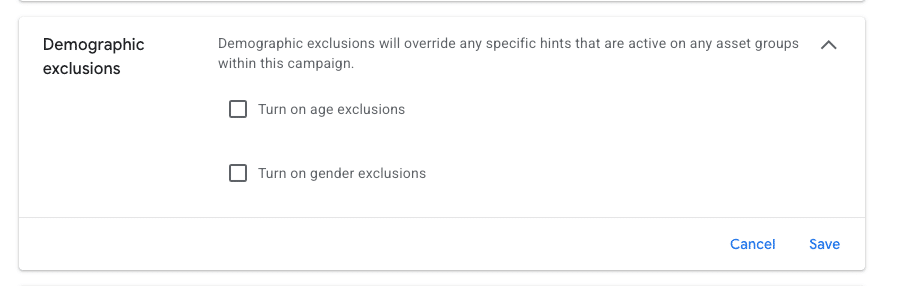
    Campaign settings now include demographic exclusions, which I find particularly valuable for excluding non-converting audiences based on demographics.

    This feature is quite useful when specific demographics are unlikely to engage with my offerings. To make these adjustments, I navigate to ‘Campaign-level settings > Other settings > Demographic exclusions’, enabling me to refine my target audience further.

    ```json
{
  "alt": "Demographic exclusions settings in a campaign interface, with options for age and gender exclusions.",
  "caption": "Configure your campaign with demographic exclusions to tailor your audience based on age and gender preferences.",
  "description": "The image shows a section of a campaign interface titled 'Demographic exclusions.' It offers options to turn on age and gender exclusions, which will override any specific hints that are active on asset groups within the campaign. The interface includes 'Cancel' and 'Save' buttons, providing flexibility in adjusting these settings. This feature enhances campaign targeting by allowing precise audience customization."
}
```

    Although PMax originally lacked device-level insights, the new device targeting features help me review and adjust devices for better performance. It’s crucial to periodically evaluate which devices are contributing positively to the campaign goals.

    Based on performance insights, I decide which devices to include or exclude under ‘Other settings’. This approach enhances my strategy by ensuring my ads appear on devices that align best with my objectives.

    Improve inputs: Creative and AI assets

    Creative assets are critical to the success of Performance Max campaigns, especially across display, YouTube, and Discover networks. To bridge the gap in quality creative, I’m incorporating AI assets more often.

    AI-generated assets are becoming increasingly sophisticated, helping me more effectively target these networks. As AI technology evolves, it’s unlocking new possibilities for creating compelling visuals and video content.

    Google’s AI assets, derived from shopping feed products, are impressively close to replacing traditional creative methods. However, producing glitch-free AI-generated videos remains a future goal I’m keenly observing.

    ```json
{
  "alt": "Device selection interface for ad appearances with options for computers and mobile phones checked.",
  "caption": "Customize where your ads appear with options selected for computers and mobile phones. Ensure targeted advertising with this easy-to-use interface.",
  "description": "The image displays a device selection interface from an ad platform, showing checkboxes for selecting where ads appear. 'Computers' and 'Mobile phones' options are checked, while 'Tablets' and 'TV screens' are unchecked. This setup helps advertisers target specific devices, optimizing ad reach and effectiveness. Keywords: ad targeting, device selection, advertising platform."
}
```

    Dig deeper: How to reduce low-quality leads from Performance Max campaigns

    Understand the limits of control in Performance Max

    I appreciate the channel controls report for the insights it offers on ad placements, even though actionable adjustments are limited at times, which can be frustrating.

    Looking forward, I expect Performance Max to offer more control similar to Demand Gen campaigns. Until then, I adjust my creative and bidding strategies to influence where my ads appear, using feed-only campaigns to focus solely on shopping.

    Performance Max continues to transform from an opaque platform to an integral tool for marketers. With each update, it offers more actionable levers like negative keywords, placements, and smart scheduling to optimize efficacy.

    Using these tools strategically, I ensure my campaigns are as precise and efficient as possible, moving beyond the ‘set-it-and-forget-it’ mindset.


    Inspired by this post on Search Engine Land.

    crushpress.ai community screenshot
  • How I Achieved Sub-$10 CPL with LinkedIn Ads on a Budget

    How I Achieved Sub-$10 CPL with LinkedIn Ads on a Budget

    Have you ever wondered if it’s possible to run effective LinkedIn Ads without breaking the bank? I’m here to tell you it absolutely is, and I’ve got the playbook to prove it. By focusing on content depth, timing, and precise targeting, I managed to lower CPCs and improve lead quality in our LinkedIn campaigns.

    LinkedIn Ads often deliver top-notch B2B leads but have a reputation for being costly in both CPC and CPL terms. So, I embarked on an experiment to see if a high-value, audience-specific content piece could achieve low-cost leads on LinkedIn.

    ```json
{
  "alt": "Campaign data showing costs, impressions, clicks, leads, and cost per lead for a lead generation campaign.",
  "caption": "Deep dive into campaign performance: A detailed look at spending, leads generated, and cost efficiency in a lead generation setup.",
  "description": "This image showcases performance metrics of a lead generation campaign titled 'Lead Gen - Prospecting - 2026 Demand Gen Guide - Software Dev + Similar Industries.' It highlights the spending of $584.81, garnering 108 clicks with an average CPC of $5.41. The campaign achieved 14,958 impressions, generated 60 leads, and had a cost per lead of $9.75. Such detailed metrics are crucial for understanding and optimizing the effectiveness of advertising strategies."
}
```

    Though our agency primarily runs LinkedIn Ads for clients, I decided to test this theory on Saltbox Solutions itself, where I serve as the Director of Strategy. I wanted full control to see just how big of an impact we could achieve.

    ```json
{
  "alt": "The CapmatchOne logo with a gradient circle and bold text.",
  "caption": "Discover innovation with the CapmatchOne logo, featuring sleek typography and a modern gradient circle.",
  "description": "The CapmatchOne logo features bold, modern typography coupled with a gradient circle, symbolizing connection and innovation. The sleek design conveys a sense of progress and creativity. This image can be used for branding or promotional purposes, appealing to audiences interested in innovative solutions and forward-thinking designs."
}
```

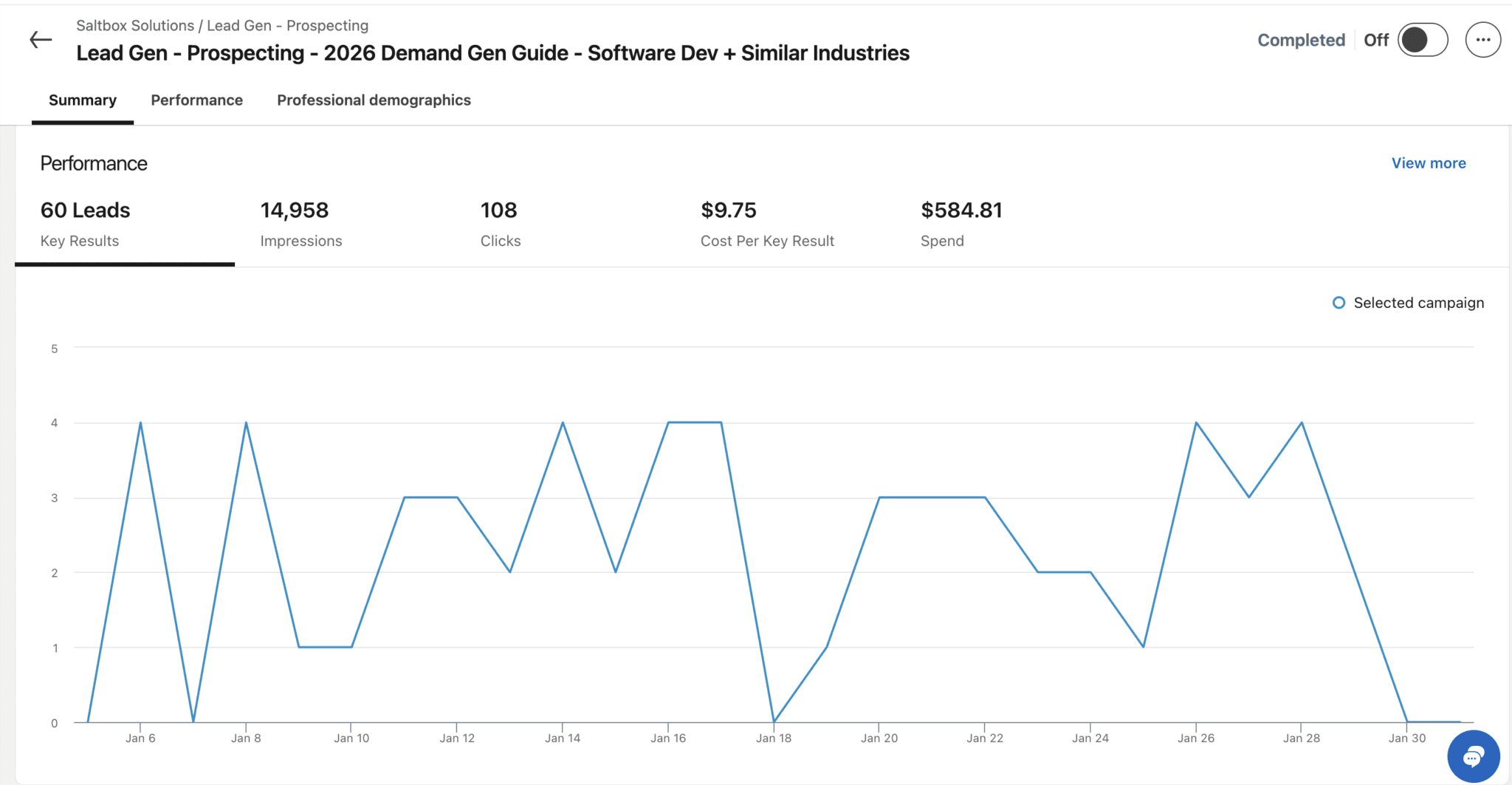
    We spent under $1,000 and generated a wealth of leads at less than $10 CPL. For those with limited budgets, LinkedIn Ads might not be as out of reach as you think—it just requires a well-thought-out strategy.

    ```json
{
  "alt": "Filter options for company size, industry, revenue, seniorities, and functions.",
  "caption": "Explore targeted search filters for company size, industry, revenue, and job seniorities to refine your professional outreach.",
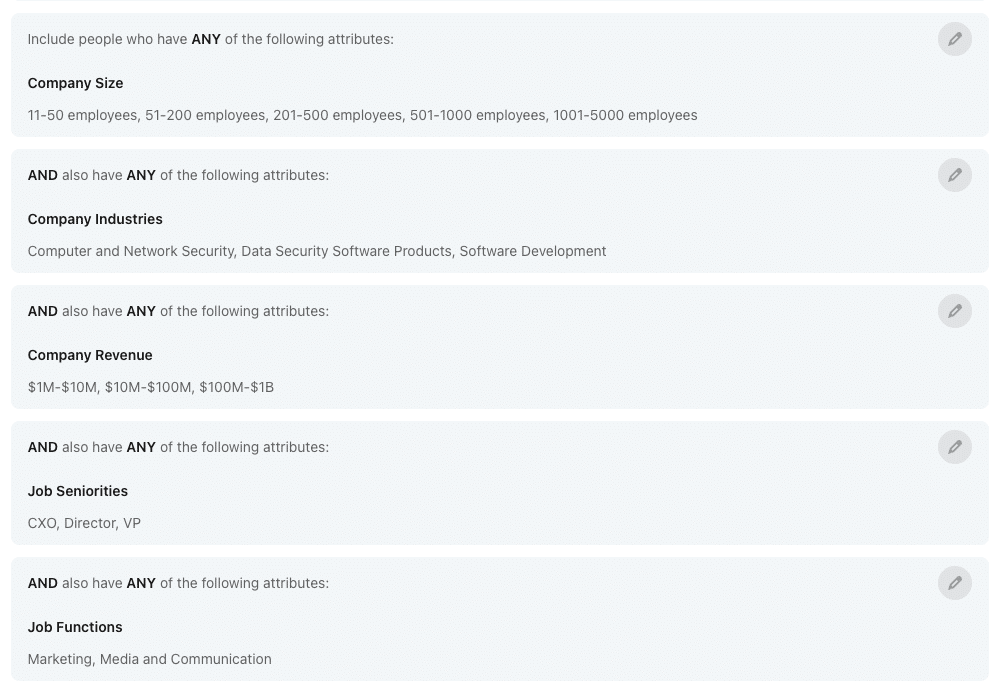
  "description": "This image shows filter criteria options in a professional networking or recruitment platform. Filters include company size ranging from 11-5000 employees, industries like computer security and software development, revenues between $1M and $1B, job seniorities like CXO and Director, and functions like marketing and media. These filters help in targeting specific audiences for business networking and recruitment purposes."
}
```

    Want to know how I did it? I’ll break down every detail, from the setup to execution, so you can replicate it regardless of your budget.

    ```json
{
  "alt": "Exclusion criteria including job seniorities, company size, specific company, and job functions.",
  "caption": "Discover how exclusion criteria can shape targeted outreach by narrowing down job seniorities, company size, specific businesses, and job functions.",
  "description": "The image outlines exclusion criteria for filtering contacts based on attributes such as job seniorities like entry, senior, manager, training, unpaid; company size (myself only); specific company (Saltbox Solutions); and job functions (sales). Perfect for targeted marketing strategies, these filters refine audience selection efficiently."
}
```

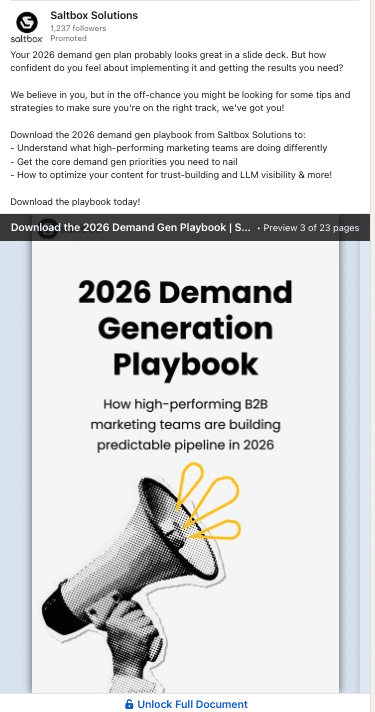
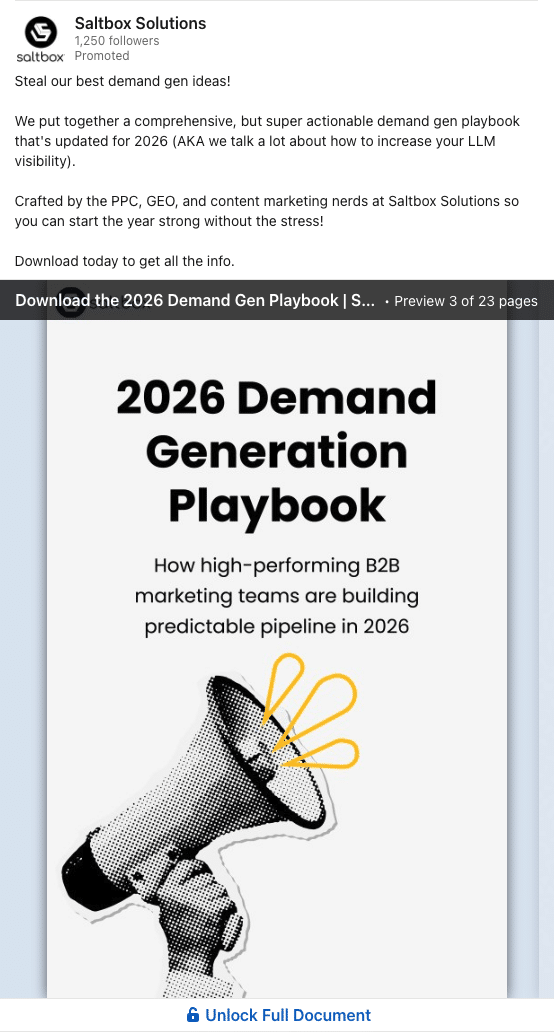
    The campaign targeted B2B marketing decision-makers by offering a 23-page Demand Gen Playbook for 2026. The timing was key, as it aligned with the planning cycle for many marketing leaders.

    ```json
{
  "alt": "Promotional post by Saltbox Solutions about the 2026 Demand Generation Playbook, featuring a megaphone illustration.",
  "caption": "Discover the secrets behind 2026's most successful B2B marketing strategies with Saltbox Solutions' 2026 Demand Generation Playbook. Are you ready to boost your pipeline?",
  "description": "This image showcases a LinkedIn post by Saltbox Solutions, promoting their 2026 Demand Generation Playbook. The post emphasizes the importance of implementing successful demand generation strategies. It features an eye-catching illustration of a megaphone, suggesting the idea of amplifying marketing efforts. Ideal for B2B marketers looking to optimize their tactics for 2026."
}
```

    I chose a document ad format with a lead generation objective, allowing audiences to preview content before downloading. The form had minimal friction thanks to LinkedIn’s autofill options.

    ```json
{
  "alt": "2026 Demand Generation Playbook cover with megaphone illustration by Saltbox Solutions.",
  "caption": "Discover high-performing B2B marketing strategies with the 2026 Demand Generation Playbook by Saltbox Solutions. Elevate your pipeline strategy today!",
  "description": "This image promotes the '2026 Demand Generation Playbook' by Saltbox Solutions, featuring a stylized megaphone illustration. This document offers actionable tactics for B2B marketing teams to build a predictable pipeline. Updated for 2026, it emphasizes increasing LLM visibility and features insights from PPC, GEO, and content marketing experts."
}
```

    With a $600 lifetime budget and a $15 manual bid strategy, we focused on optimizing our spend efficiently.

    ```json
{
  "alt": "Advertisement for 2026 Demand Generation Playbook by Saltbox Solutions featuring marketing strategies.",
  "caption": "Discover high-performing B2B marketing strategies with the 2026 Demand Gen Playbook. Saltbox Solutions guides you to a predictable pipeline.",
  "description": "This image is an advertisement for the '2026 Demand Generation Playbook' by Saltbox Solutions. It features a stylized megaphone illustration and text detailing insights on high-performing B2B marketing teams' strategies for building a predictable pipeline in 2026. The ad encourages downloading the playbook for tips on demand gen priorities, trust-building, and LLM visibility, appealing to professionals seeking effective marketing strategies."
}
```

    Our audience research was rigorous. I aimed to understand the true needs and concerns of B2B marketing leads by mining client interactions and using tools like SparkToro to identify engagement patterns.

    ```json
{
  "alt": "Performance summary graph showing lead generation data with fluctuating values over January.",
  "caption": "Analyzing January's lead gen results: 60 leads from nearly 15,000 impressions reveal dynamic performance in software development.",
  "description": "This image shows a performance summary for a lead generation campaign titled '2026 Demand Gen Guide - Software Dev + Similar Industries.' The data highlights 60 leads obtained from 14,958 impressions and 108 clicks, with a cost per key result of $9.75 and total spend of $584.81. The line graph displays fluctuating performance across January, offering insights into campaign effectiveness. Useful for marketers focusing on software industry trends."
}
```

    This meticulous research resulted in an asset that truly resonated with the audience, achieving a stellar 76% lead form completion rate.

    ```json
{
  "alt": "Summary of ad performance for the 2026 Demand Generation Playbook by Saltbox Solutions.",
  "caption": "Explore the performance metrics of the 2026 Demand Gen Playbook ads by Saltbox Solutions, showcasing clicks, costs, and conversions!",
  "description": "This image displays a performance summary of three ads for the '2026 Demand Generation Playbook' by Saltbox Solutions. It includes key metrics such as amount spent, clicks, average CPC, impressions, average CTR, and leads generated, providing a comprehensive overview of each ad's effectiveness. The image shows specific data for each version of the ad, titled v1, v2, and v3."
}
```

    The targeting strategy was layered, combining job titles and company roles to address a 54,000-person audience, efficiently refining the reach of our ads.

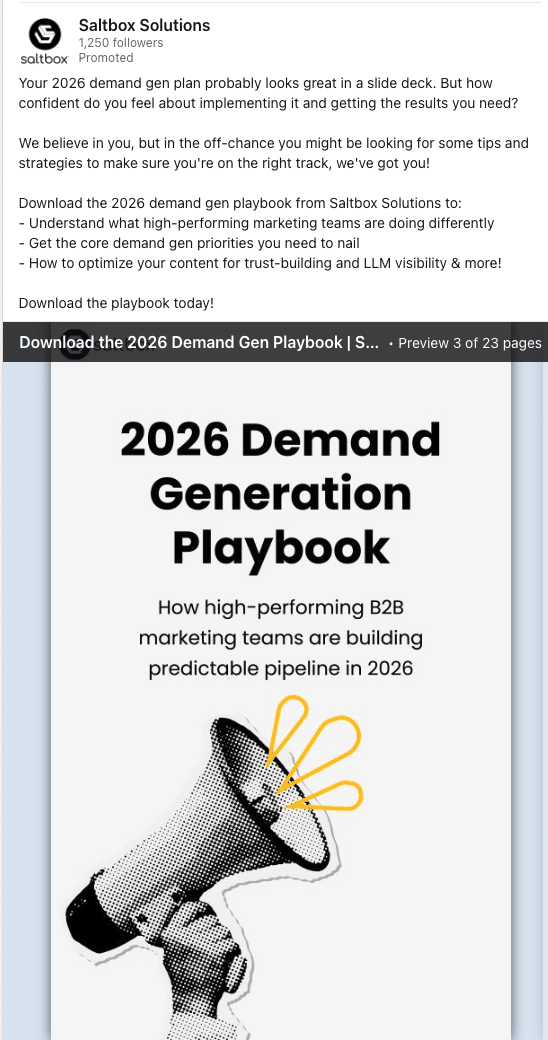
    Ad copy was crafted with an inviting tone, leaning on hooks like “Steal our best demand gen ideas” to captivate and engage.

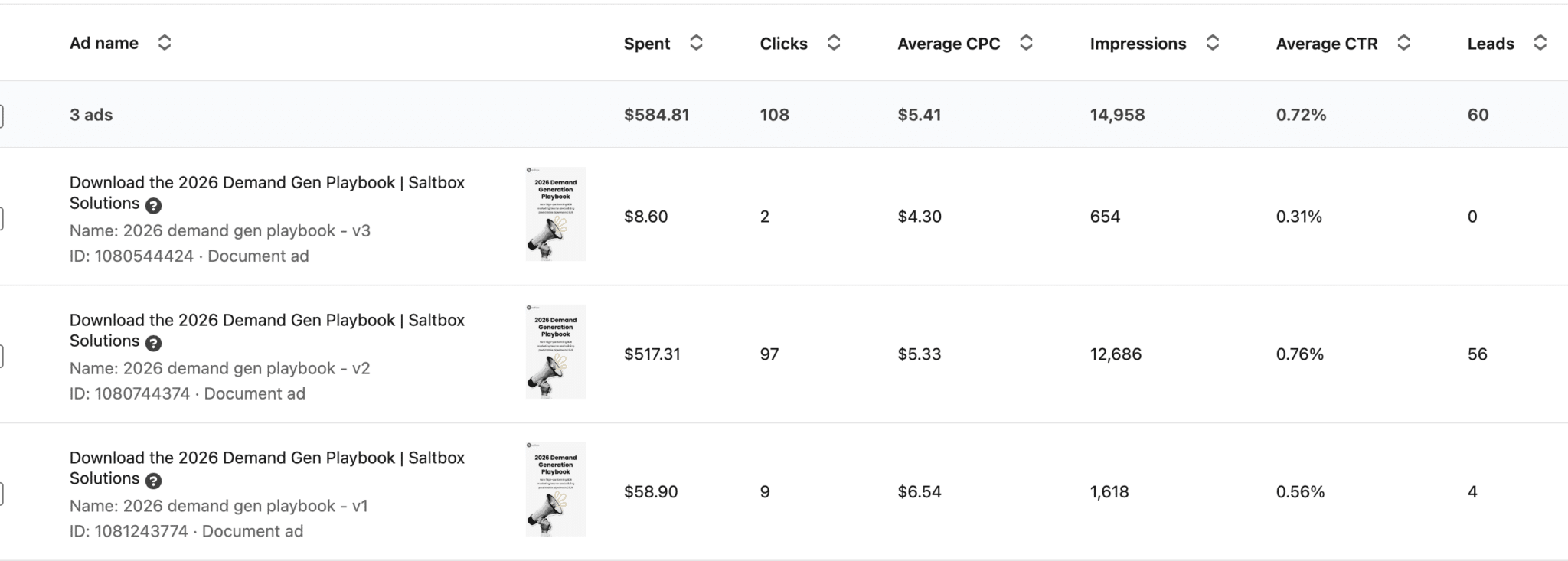
    The result? An average CPC of $5.41—shattering expectations given our $15 bid ceiling. The campaign not only surpassed LinkedIn’s typical CTR benchmarks but also generated 60 qualified leads.

    This test validated a model that I plan to relaunch, incorporating feedback from initial downloaders to further fine-tune the playbook.

    If you want results like mine, start with audience research before creating your asset. Build meaningful, timely, and well-targeted content to see better ROI from your LinkedIn Ads.


    Inspired by this post on Search Engine Land.


    crushpress.ai community screenshot
  • How Rising CPC Affects Your Business and Ways to Counter it

    How Rising CPC Affects Your Business and Ways to Counter it

    I’ve noticed that the cost-per-click (CPC) is increasing across most industries, and I’m sure you’re observing the same. Let’s dive into what’s causing this trend and explore strategies to safeguard your profit margins.

    According to WordStream by LocaliQ’s 2025 benchmarks, nearly 87% of industries saw their CPCs rise year-over-year. The average CPC for Google Ads across sectors is now at $5.26 per click. In high-intent verticals, such as legal services, the average is $8.58, with some competitive B2B segments reaching $8 to $9 per click.

    These increases reflect significant shifts in the design of search results pages, the optimization of auctions, and inefficiencies that accumulate across paid search accounts. Often, these issues remain hidden until a detailed PPC audit brings them to light. To begin reclaiming your budget, especially your branded terms, you need to understand the current landscape.

    Here are the five trends every advertiser needs to grasp at this moment.

    What’s Driving Your CPC?

    More Advertisers Are Chasing the Same Limited Inventory

    At its core, search advertising is an auction. As more advertisers target the same keywords, prices naturally increase. While global PPC spending continues to rise (Quantumrun Research), the number of available click slots on search results pages hasn’t expanded at the same pace. This results in higher CPCs, as more money competes for limited inventory.

    The pandemic has had a permanent effect on this shift. Brands that previously didn’t invest in paid search have now joined Google’s auction and have stayed active.

    Google’s AI Overviews Are Taking Over

    Over the past decade, one of the most significant changes in paid search is happening right within the Search Engine Results Page (SERP). Google’s AI Overviews now dominate the space for informational and exploratory questions. As they grow into 2024 and 2025, they diminish the number of organic and paid listings visible above the fold.

    A late-2025 analysis by Seer Interactive, reviewing 3,119 search terms across 42 organizations, revealed that the paid click-through rate (CTR) on queries with AI Overviews declined by 68%—from 19.7% to 6.34%.

    The straightforward mechanism is that AI Overviews take more real estate (Skai), reducing the number of visible paid placements above the fold. As a result, impression share tightens, and automated bidding becomes more aggressive, driving up prices.

    The important detail here is that users who navigate beyond an AI Overview tend to be further in their purchasing journey. WordStream data indicates approximately 65% of industries experienced higher conversion rates despite the increase in CPCs. This suggests the need to shift budgets toward high-intent transactional queries where AI Overviews are less likely to dominate, and away from informational queries where they are prevalent.

    Smart Bidding Is Raising Auction Costs

    Modern Google Ads campaigns more heavily rely on automated bidding strategies like maximizing conversions or targeting CPA. According to Google’s Smart Bidding documentation, the system precisely sets bids for each auction based on predicted conversion chances, prioritizing performance over cost control.

    ```json
{
  "alt": "Bluepear advertisement offering brand audit with a shield icon and promo code BRANDAUDIT.",
  "caption": "Discover who's bidding on your brand! Register with Bluepear and receive a personalized report within 48 hours using the promo code: BRANDAUDIT.",
  "description": "This image is an advertisement for Bluepear, spotlighting their service to uncover bidding activities on your brand. It features a sleek shield icon with a lock, set against a dark blue background. The text invites users to register for a custom report in 48 hours with promo code BRANDAUDIT. The attractive design aims to engage businesses seeking brand protection."
}
```

    As almost every competitor utilizes the same logic, there’s a self-reinforcing loop of rising bid pressure, a market-wide dynamic that you need to adapt to rather than reverse.

    Unauthorized Brand Bidding Is Inflating Costs Internally

    Although platform algorithms and macroeconomics are beyond your control, one significant driver of CPC inflation is something you can manage.

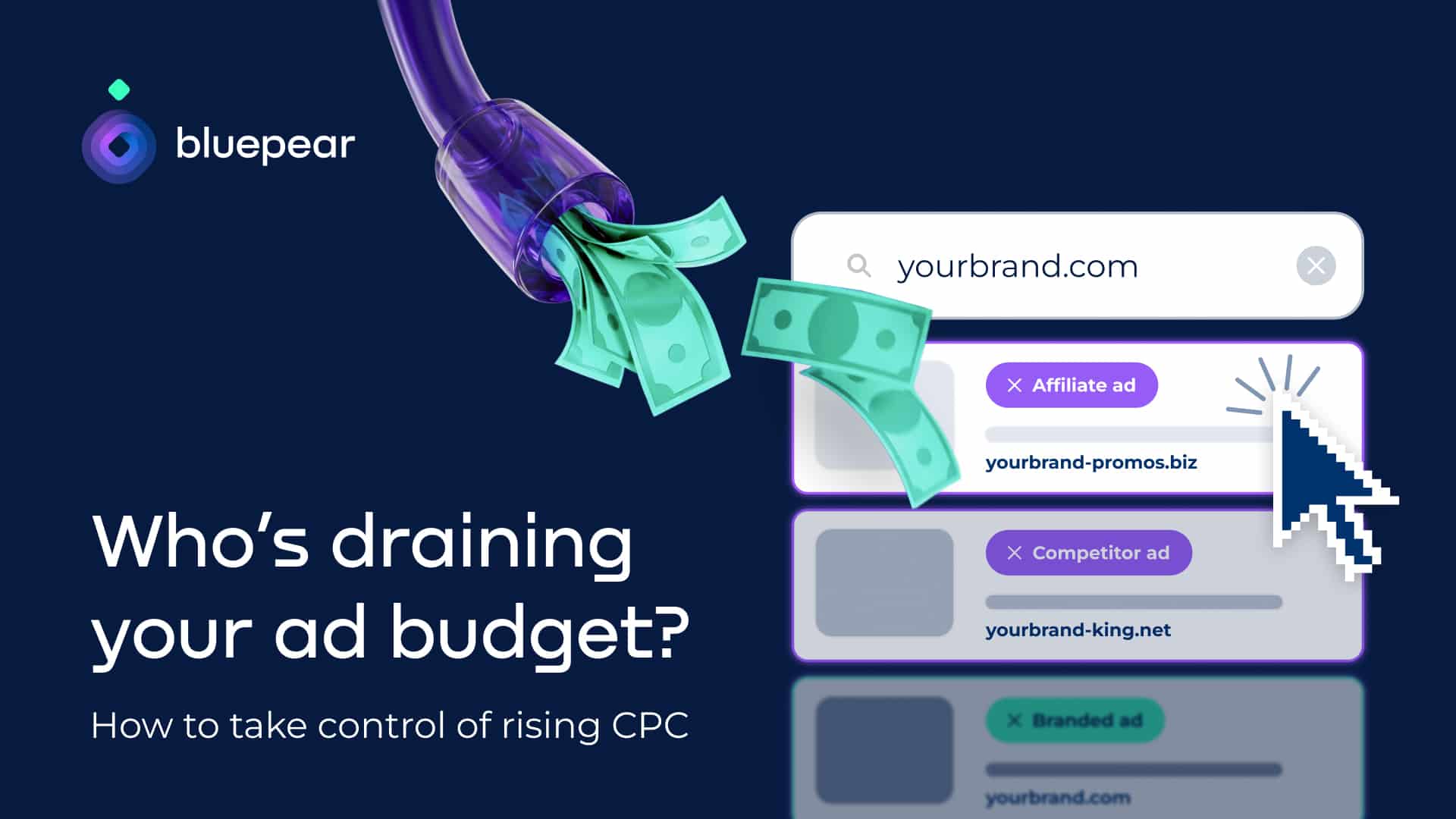
    When affiliates, partners, or competitors bid on your trademarked keywords, they enter an auction that should have minimal competition. Each additional bidder elevates your branded CPC, making you pay twice: once to create the demand, and again when third parties capture that same searcher at the bottom of the funnel.

    The impacts accumulate. AI Overviews have already condensed available click inventory; unauthorized brand bidding further inflates the inventory cost you actually secure.

    Detecting violations goes beyond manual SERP checks. Unauthorized bidders frequently use cloaking—geotargeting away from your headquarters or dayparting outside business hours—to evade detection. With a platform like Bluepear, you can implement automated 24/7 monitoring across search engines, geographies, and devices, capturing ad copy and landing page evidence to contest invalid affiliate commissions and enforce trademark guidelines at scale. Fewer bidders on your branded terms mean less auction pressure and lower CPCs for traffic you rightfully own. It’s one of the few paid search levers that doesn’t need a comprehensive strategic overhaul to be effective.

    What To Do About It: Three Priorities for Advertisers

    The gathered data indicates three clear priorities as you navigate this environment:

    • Protect your branded baseline. Your branded keywords represent demand you’ve already generated. Rigorously monitor competitors in those auctions and eliminate unauthorized bidders with automated brand protection tools—an essential high-leverage action at present.
    • Anchor optimization to cost per acquisition. Based on WordStream’s 2025 benchmarks, higher CPCs can bring a higher-quality, further-down-funnel user, leading to a lower CPA. The headline CPC figure is becoming an unreliable measure for campaign health.
    • Build first-party data infrastructure. The best defense against continued CPC inflation is leveraging high-quality, proprietary conversion signals for your bidding algorithms, thus minimizing reliance on the platform’s broad audience approximations.

    Average CPCs are reaching new heights and this trend is unlikely to reverse. Advertisers who effectively manage costs have already adjusted their strategies in response.

    Unsure how many unauthorized bidders are in your branded auction at the moment? Register with the promo code BRANDAUDIT to receive a personalized audit of your branded search landscape from the Bluepear team within 48 hours!

    For continuous insights into branded search and paid search protection, follow Bluepear on LinkedIn.


    Inspired by this post on Search Engine Land.


    crushpress.ai community screenshot
  • Master AI Search: Craft Machine-Readable Content

    Master AI Search: Craft Machine-Readable Content

    In the 1990s, web copywriting was a wild ride of keyword stuffing and meta tag mayhem. Those days are long gone, as SEO copywriting has evolved alongside smarter algorithms.

    Today, with advanced retrieval systems, our priorities have shifted. It’s no longer about tricking crawlers with repetitive keywords. We need a fresh, more sophisticated approach.

    Let me share a playbook focusing on AI-friendly copywriting. It’s packed with actionable insights and high-density concepts that are ready to be implemented.

    The ‘Grounding Budget’: Quality Over Quantity

    Large language models, or LLMs, don’t need more information—they need better information. According to DEJAN AI’s analysis, Google’s Gemini uses a set budget of information, making precision crucial.

    Your content allocation is roughly 380 words per webpage, so accuracy in those words is key to helping the AI accurately match your content.

    • Weak retrieval: “Coffee maker” (Generic)
    • Strong retrieval: “Semi-automatic espresso machine” (High density)

    Moving Structure Inside the Language

    Think of Schema.org as the building’s skeleton, and structured language as the supportive internal framework. This framework makes sentences machine-readable, enhancing the power of “semantic triplets”—subject, predicate, object.

    For Google and AI models like ChatGPT, properly structured sentences are key. They require specific criteria sure to aid in retrieval.

    • Names entities: Clearly identifies subjects and objects (e.g., “Notion Team Plan”).
    • States relationships: Defines interactions with clear verbs (e.g., “costs”).
    • Preserves conditions: Adds context for authenticity (e.g., “$10 per user per month”).
    • Includes specifics: Offers verifiable detail over fluff (e.g., “includes 30-day version history”).

    Transitioning from marketing fluff to structured language not only boosts readability but also enhances machine utility.

    Best Practices for AI-Friendly Copywriting

    Like a line of dominoes, traditional copywriting flows smoothly. But AI technology “chunks” text, breaking that flow if sentences aren’t independently robust.

    Rule 1: Every Sentence Must Survive in Isolation

    Each sentence should be able to stand alone, naming its subject clearly. Vague pronouns are problematic when content is extracted by AI.

    • Broken: “It also includes unlimited cloud storage.”
    • Anchorable: “The Dropbox Business Standard Plan includes 5TB of encrypted cloud storage.”

    Rule 2: State Relationships, Don’t Just List Entities

    Keyword stuffing leads to errors; clear, structured language explicitly states the relationships between entities.

    • The keyword dump: “We offer SEO, PPC, and content marketing services.”
    • The structured relationship: “Our agency integrates PPC data into SEO strategies to lower cost per acquisition (CPA) by an average of 15% within 90 days.”

    Rule 3: Build ‘Anchorable Statements’

    Deliver clear claims with evidence, ensuring your passages hold weight in dense AI environments.

    • “Ramon Eijkemans specializes in enterprise SEO with a focus on platforms exceeding 100,000 pages. He developed the LLM Utility Analysis framework, which includes five lenses crucial for content scoring.”

    The AI Inverted Pyramid: Engineering ‘Citation Bait’

    Research shows claims positioned near the start or end of text are more likely to be extracted by LLMs. Therefore, too much additional content can dilute effectiveness.

    • “Pages under 5,000 characters see around 66% extraction. Exceeding 20,000 characters reduces this to 12%.”

    For creating effective citation bait, follow these four steps:

    • The direct answer: Begin with a concise answer in 40-60 words.
    • Context and detail: Continue with nuanced, dense information.
    • Structured evidence: Provide easy-to-extract data through lists, tables, etc.
    • Follow-up alignment: Use clear subheadings for potential queries.
    ```json
{
  "alt": "The CapmatchOne logo with a gradient circle and bold text.",
  "caption": "Discover innovation with the CapmatchOne logo, featuring sleek typography and a modern gradient circle.",
  "description": "The CapmatchOne logo features bold, modern typography coupled with a gradient circle, symbolizing connection and innovation. The sleek design conveys a sense of progress and creativity. This image can be used for branding or promotional purposes, appealing to audiences interested in innovative solutions and forward-thinking designs."
}
```

    Improving the relevance (cosine similarity) to AI, clear headings assist by up to 17.54%.

    The 5 Lenses of LLM Utility

    Ramon Eijkemans developed a robust scoring system measuring content’s citation likelihood:

    • Structural fitness: Builds clear hierarchies and relationships.
    • Selection criteria: Ensures information density.
    • Extractability: Avoids broken references or vague pronouns.
    • Entity completeness: Clearly names subjects and relationships.
    • Natural language quality: Is structurally rich but not robotic.

    Practical Content Testing Tips

    Four tests to ensure your pages are programmatically extractable:

    The Isolation Test

    Action: Select a random sentence from the webpage middle. Can it stand alone?

    Goal: Ensure each sentence is self-contained, avoiding reliance on prior text.

    The Context Test (‘Scroll Twice and Read’)

    Action: Scroll the homepage until the banner disappears, start reading.

    Goal: Ensure mid-page text can standalone without the primary layout for context.

    The Disambiguation Test

    Action: Read sentences aloud. Avoid generic language.

    Goal: Specific language ensures AI maps statements to correct entities.

    The URL Accessibility Test

    Action: Test your live URL with an LLM agent.

    Goal: Ensure readability without blockers like JavaScript or bot protection.

    AI Search Content Optimization FAQs

    Here are some frequently asked questions about optimizing for AI-driven search.

    Is Generative Engine Optimization (GEO) Legitimate?

    Yes, it is. Focused on optimizing citation frequency, GEO uses dense, structured sentences. It’s about embedding explicit entity relationships into copy.

    What’s the Ideal Section Length for Chunking?

    Start with a tight 40-60-word statement. Long, buried information is often ignored by AI.

    Does AI Search Copywriting Help Traditional SEO?

    Yes! Structured content for AI also boosts traditional visibility due to vector embeddings.

    Is Longer Content Better?

    No, it’s not. Dense information beats length. Pages below 5,000 characters see more effective extraction.

    What is the AI Copywriting Inverted Pyramid?

    The pyramid strategy involves placing key details upfront for seamless machine extraction.

    Write for Humans, Structure for Machines

    As a content creator, I see my role evolving into one of a machine-readability engineer. Crafting content that both engages humans and can be precisely extracted by neural networks is crucial.

    Without explicit entity relationships and self-contained, anchorable statements, AI might overlook your content entirely.


    Inspired by this post on Search Engine Land.


    crushpress.ai community screenshot
  • Unraveling the Myth: The Truth About First-Party Data

    Unraveling the Myth: The Truth About First-Party Data

    I’ve noticed over the past few years that the marketing world has been shifting, grounded in a straightforward principle. We’re seeing the decline of third-party data and the rise of privacy concerns. Everyone said first-party data was the answer.

    So, the plan was to gather more of it, centralize it, and build a comprehensive customer view around it.

    I agree that in many respects, this transformation was essential. Direct customer relationships are more reliable than merely renting an audience. Plus, consent and transparency genuinely matter. Organizations that were ahead of the game, investing early in their own data platforms, are now better off than those dependent on external indicators.

    However, I’ve observed that many marketers have put so much faith in first-party data that they’ve missed a more complex reality.

    Just possessing customer data doesn’t mean we automatically understand our customers.

    Many marketing leaders, including myself, have sensed this tension. Despite having cutting-edge technology stacks, we continue to grapple with familiar questions. For instance, which records truly represent active individuals? Which identities are outdated or wrongly attributed? How much of our customer view is based on current behavior versus old assumptions?

    These aren’t just theoretical issues. They come up in daily operational decisions. There are campaigns that don’t reach as many actual customers as we anticipated. Personalization efforts that hit a plateau. Our measurement models seem precise, yet produce inconsistent results.

    The issue isn’t the absence of data. Quite the opposite, actually.

    The real problem is assuming that the data in our systems still matches reality.

    When First-Party Data Becomes Historical Data

    I’ve found that one unnoticed aspect of customer data is how swiftly it changes from being current to historical.

    Typically, organizations collect identity information during interactions like account creation, purchases, and service requests. These events generate solid records entered into CRM systems, marketing platforms, and data warehouses.

    From there, the records usually remain as they were when captured.

    What changes is everything else around them.

    Consumers switch devices. Email addresses may go from primary to secondary. People relocate, change jobs, create new accounts, and abandon others. Behavioral patterns shift with new platforms, habits, and privacy controls.

    The record still exists, but the certainty of the identity starts to loosen.

    I’ve seen how marketing teams grapple with this reality in subtle ways. Lists that seem robust but show declining engagement. Customer profiles that break up across systems. Identity graphs requiring constant adjustment as signals stray from alignment.

    This doesn’t imply first-party data is wrong. It merely means it ages.

    The moment of collection is precise. However, as months and years pass, that precision diminishes.

    The Gap Between Records and Reality

    Creating a unified customer profile has become essential in modern marketing infrastructure. Customer data platforms, identity graphs, and advanced analytics attempt to merge scattered signals into a coherent picture.

    When these signals align, the outcomes are powerful.

    But I’ve noticed the effectiveness of these systems heavily relies on the integrity of the input identifiers. Email addresses, login credentials, device links, and other identity anchors act as the joint between records.

    When those anchors drift, the unified profile loses clarity.

    This isn’t a technology failure. Most identity platforms work as intended, connecting the available signals.

    The issue is, much of those signals were captured possibly months or years ago, at times when systems had limited visibility into the surrounding identity context.

    As the digital environment evolves, original records become just one of many reference points.

    Marketing leaders, myself included, recognize this gap when technically accurate profiles still fail to explain current customer behavior. Our databases mirror past knowledge while customers reflect the present narrative.

    Bridging that gap requires something more dynamic than static attributes.

    The Value of Activity Signals

    Lately, some organizations, including mine, have begun focusing on signals indicating whether an identity is active in today’s digital ecosystem.

    Activity signals provide a different intelligence aspect.

    Instead of focusing on past information, we ask if the identity tied to it still shows real-world behavior today.

    • Is the email address still actively used?
    • Does the identity show up in recent digital interactions?
    • Are these signals reflective of genuine consumer activity?

    These questions have become crucial for us in marketing and risk management.

    For marketing, activity signals help us determine which audiences are still reachable versus identities that have quietly faded. For fraud detection, they help us differentiate real consumers from synthetic ones that might seem valid but lack authentic behavior patterns.

    Ultimately, both areas strive to answer a fundamental question.

    Does this identity belong to a real person actively engaging in the digital world now?

    Stored data alone seldom answers this with certainty.

    A More Resilient Identity Anchor

    Among numerous identifiers used digitally, one stood out for its resilience.

    Email.

    For decades, it’s been both a communication medium and a steadfast identity anchor. It surfaces in authentication, commerce, subscriptions, customer support, and many online touchpoints.

    This ubiquity results in a secondary advantage. Email addresses generate a constant stream of activity signals showing how identities progress online.

    When analyzed across vast networks, they reveal trends far beyond a company’s customer database alone.

    They can show whether an identity is active or has gone dormant. They spot inconsistencies showing risk. They expose connections reconciling fragmented customer views.

    In essence, they transform a basic identifier into a dynamic indicator of identity health.

    Organizations understanding this dynamic, myself included, treat email differently. It becomes less about reaching a campaign endpoint and more about understanding identity across channels.

    Rethinking How We Know Our Customers

    Marketing technology has been incredible at storing and organizing data. Today, few organizations lack the infrastructure for handling vast data volumes.

    Our next frontier isn’t more accumulation, but validation instead.

    Knowing our customers means verifying identities in a database correspond to real individuals with continuous digital activity.

    This change transforms how teams assess data quality.

    Rather than only focusing on data completeness, forward-thinking organizations pay attention to vitality. Which identities remain active, which have faded, and which show fraud or synthetic signs.

    These distinctions affect campaign reach, attribution accuracy, and risk exposure.

    Strong identity signals make the entire marketing ecosystem more reliable. Personalization becomes relevant. Measurements reflect true outcomes. Customer experiences accurately align with actual behavior.

    When signals weaken, even the most advanced tools face uncertain ground.

    Moving Beyond the Illusion

    The industry’s shift towards first-party data corrected years of dependency on obscure third-party sources.

    Yet, owning data doesn’t guarantee clarity.

    Customer records capture a moment. The people behind them continually change.

    For real customer understanding, the challenge isn’t just about accumulating data. It’s about maintaining a genuine connection between stored identities and actual activity.

    It involves extending beyond the database to the signals that reveal if an identity is still alive digitally.

    Companies embracing this shift uncover something valuable.

    The most valuable customer data isn’t just the information collected.

    It’s the intelligence that keeps data connected to real people over time.


    Inspired by this post on Search Engine Land.


    crushpress.ai community screenshot
  • Uncovering SEO Threats: Is Your Organization Ready for 2026?

    Uncovering SEO Threats: Is Your Organization Ready for 2026?

    As I’ve navigated the evolving landscape of SEO over the years, one truth remains: our biggest challenges often come from within. We’re standing at the brink of 2026, and it’s becoming clear that our organization’s internal issues might be the most significant threat to SEO success.

    In recent discussions, AI tools and their impact on visibility have taken center stage. Yet, the conversation often overlooks a crucial issue. The real danger lies within our organizations—fragmented data, unclear KPIs, and poor collaboration silently erode even the most well-crafted SEO strategies.

    I want to share a few internal threats that we should start addressing now to ensure our SEO efforts remain effective.

    Many of us lean heavily on AI for tasks ranging from brief creation to data analysis. While AI expedites these processes, it’s essential to avoid falling into the trap of a one-size-fits-all solution. AI can provide speed, but the key is still in our unique perspective—what differentiates our content from the rest?

    Another concern is our fragmented data landscape. Despite advancements, we still struggle with incomplete information about our users’ journeys. Users engage with AI tools, forming product perceptions before reaching us, but we lack visibility into these early interactions.

    This brings us to another challenge: setting appropriate KPIs. While traditional metrics like traffic remain relics of past success, we now need to focus on visibility, considering the evolving role of AI. We’re being pulled towards metrics that may not directly align with business outcomes.

    ```json
{
  "alt": "The CapmatchOne logo with a gradient circle and bold text.",
  "caption": "Discover innovation with the CapmatchOne logo, featuring sleek typography and a modern gradient circle.",
  "description": "The CapmatchOne logo features bold, modern typography coupled with a gradient circle, symbolizing connection and innovation. The sleek design conveys a sense of progress and creativity. This image can be used for branding or promotional purposes, appealing to audiences interested in innovative solutions and forward-thinking designs."
}
```

    Furthermore, our roles must adapt beyond mere SEO execution to influencing broader strategic goals. Holding ownership without execution leads to misalignment. Instead, our insight should guide multi-platform visibility strategies, while leadership assigns responsibility for execution.

    I’ve noticed the absence of cross-team collaboration in leveraging AI visibility. If AI visibility isn’t a shared priority across teams, then executing a unified strategy becomes difficult. Our job includes rallying all teams around common goals.

    As SEO shifts to adaptability in a fast-paced AI-influenced world, action becomes vital. We can’t afford to stall in strategizing without executing. As I’ve experienced, prompt action allows us to learn quickly and adapt strategies effectively.

    Ultimately, strong collaboration defines successful SEO execution. As our field becomes integral to broader company capabilities, continued team effort ensures sustainable visibility.

    I urge you to see beyond traditional SEO. Embrace it as a dynamic business capability. The organizations that recognize this will lead the way in efficient discovery and sustainable growth.


    Inspired by this post on Search Engine Land.

    crushpress.ai community screenshot