We’re stepping into an era where the visibility of web content is spreading across a multitude of search and social platforms. Google has always been a force to reckon with, but it’s no longer the only player in the search experience. Video-based social media platforms like TikTok and community sites such as Reddit are carving out spaces as go-to search engines for their dedicated audiences.
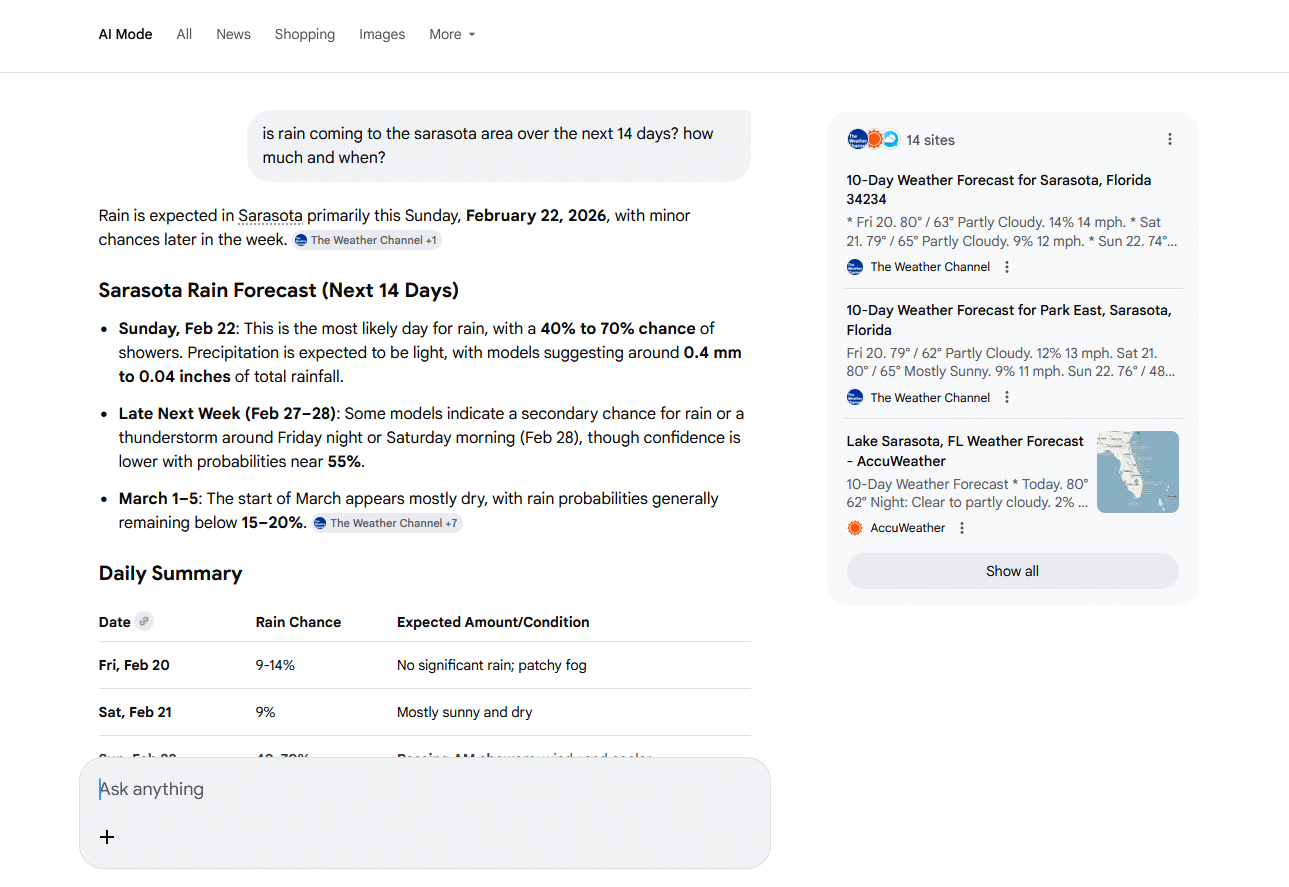
This evolving landscape is reshaping how we consume news content. Google’s news SERP is adapting to the era of personalized query responses afforded by LLMs and the influence of social media platforms. To keep up, Google has introduced AI-powered SERP features like AI Overviews and AI Mode. These features prioritize content that is “helpful, reliable, and people-first,” drawing heavily from social media platforms.
As search and social media intertwine more closely than ever before, we need to embrace a new strategy. This involves creating newsroom teams comprising social media experts, SEO specialists, and AI enthusiasts working together towards a unified content visibility goal.
When I optimize news content for social platforms, I also consider the potential performance of these posts on the Google SERP. I’ll delve into optimizing specific SERP features, but first, let’s explore making news content friendly for social platforms.
First, let me offer some sanity tips. It’s tempting to optimize content for every social media platform, but I find it more effective to focus on one or two where my audience is active and my growth opportunities are highest. By reviewing analytics and conducting audience surveys, I can identify the platforms where my audience consumes news content.
Optimize News Content for Social Media Platforms
I begin by considering how my content might appear on different platforms. Here’s my breakdown of which content types work best on each platform and how they might appear on Google:
YouTube
Creating YouTube video content involves following video SEO best practices. With guidance from this comprehensive YouTube SEO guide, I create a successful video strategy by ensuring my video titles align with the content.
Google prioritizes YouTube’s search ranking through relevance, engagement, and quality. I make sure my metadata accurately reflects my video content to ensure it stands out as relevant in a search.
One trend I’ve noted is that older event content on YouTube continues to rank well on Google, even after related articles have faded. Similarly, explainer videos show longevity on the SERP.
Facebook
Facebook, though perhaps not as trendy as it once was, still reaches a diverse audience. This platform excels with community-based content and entertainment news that incites conversation.
Even though Facebook’s dedicated news tab was removed, its posts are becoming more visible on Google’s SERP, which might make it worth reconsidering from a search perspective.
X
Since Elon Musk’s takeover, X’s audience has shifted more to the political right, while its role as a hub for breaking news, live updates, and political content remains strong. Sports content also performs well here, especially in the U.S.
Instagram
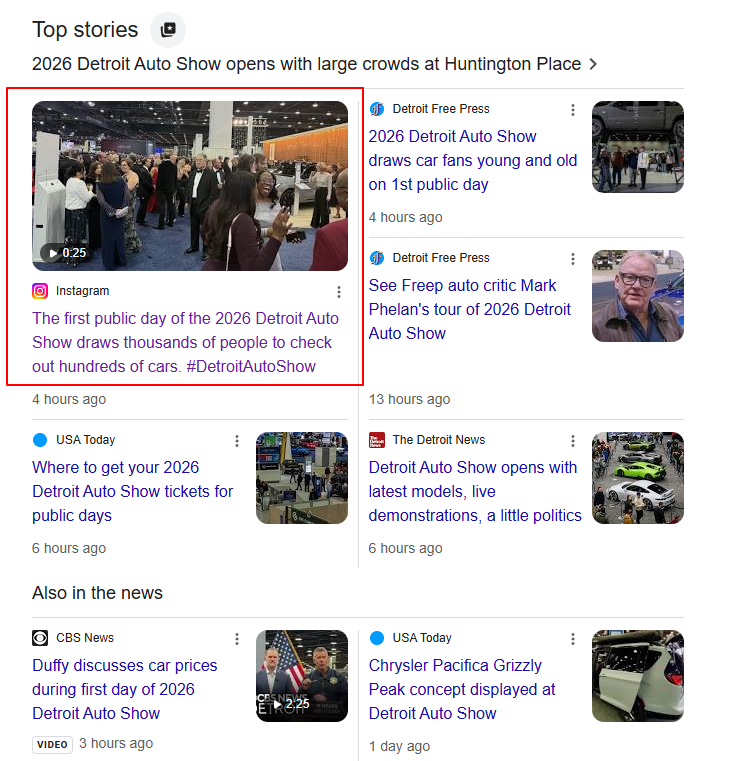
For Instagram, focusing on visually-driven stories, such as celebrity fashion and health topics, is key. The platform also performs well for sports highlights, often appearing in Google’s dedicated publisher carousel or “What people are saying.”
Reddit
Reddit’s unique user base requires a specific strategy to engage niche communities outside other platforms. Whether the content is about tech trends, health, or sports, it’s crucial to understand Reddit’s audience and adhere to its guidelines.
TikTok
The predominantly young, diverse user base on TikTok gravitates towards visual, conversational, and opinion-based content. Short-form videos that are authentic and engaging perform best.
Pinterest
Pinterest might be old-school, but it’s growing with Gen Z, making it ideal for lifestyle content. When I create on Pinterest, I focus on fashion, DIY, and motivational content, using high-quality visuals and a more relaxed posting schedule.
Social Content Opportunities by Google SERP Feature
Understanding how social content appears in different SERP features helps me maximize visibility. For instance, Top Stories capture breaking news while the “What people are saying” feature emphasizes emotionally engaging user-driven content.
Threat or Opportunity?
Instead of viewing social media content on Google’s SERPs as competition, we can leverage it as an opportunity to increase visibility. Our focus should be on integrating social-forward strategies to expand brand engagement and not solely relying on traditional SEO tactics.
If you manage SEO or AI visibility, don’t treat Google’s antitrust appeal as an algorithm update. Nothing in the current record gives you a reason to rewrite pages, change schema, or explain a rankings dip.
The practical issue is distribution: which search engine or AI app people encounter first on their browser or device. That can redirect discovery and traffic even when every ranking system stays exactly the same. Your job now is to establish a clean baseline, define the events that would justify action, and avoid making expensive changes based on legal headlines alone.
Following a remedies trial in 2025, the judge declined to order two of the government’s most consequential proposals: separating Chrome from Google and completely prohibiting payments for default search placement. The resulting remedy instead requires Google to rebid default search and AI app agreements annually.
That distinction matters. Annual rebidding creates a recurring commercial decision point, but it does not prevent Google from paying for placement or guarantee that a partner will select another provider. The Department of Justice and participating states are appealing because they want the appellate court to revisit whether that remedy is strong enough to restore competition.
For an SEO team, this creates an important diagnostic rule: a change in traffic is not automatically a change in rankings. If a browser or device starts sending more users to another engine, your Google positions could remain stable while Google organic sessions decline. A site could also gain visits from a competing engine without improving there, simply because more people were directed to it.
Ranking change: Your relative position inside a search engine changes.
Distribution change: The browser, device, or app sends a different share of people to each discovery service.
Behavior change: People use search, an AI answer interface, or direct navigation differently even though defaults and rankings remain stable.
Those mechanisms require different responses. A ranking loss calls for query, page, competitor, and technical analysis. A distribution shift calls for engine, browser, device, and referral analysis. A behavior shift calls for journey and conversion analysis. Combining all three under a label such as “organic volatility” hides the decision you need to make.
The inclusion of AI app agreements in the remedy makes the same distinction relevant to generative discovery. An AI service’s availability as a default or integrated option can affect how often people use it, but that does not establish which brands it will cite or recommend. Track access and visibility separately: referrals show whether the service sends visits, while prompt-level checks help you notice whether your brand appears in its answers.
Critics argue that the remedy leaves the original competitive mechanism largely intact. Yelp’s public-policy team has said that continuing to permit default-placement payments is unlikely to restore competition, while also warning that Google’s search indexing and ranking power could extend into generative AI. That is an interested party’s position, not a prediction of what the appellate court will order, but it identifies the commercial link marketers should watch.
Plan for three outcomes without betting on any of them
A useful contingency plan connects each legal outcome to an observable business signal. It does not assign false probabilities or move budgets before the signal appears.
Planning scenario
What could change
What you should do
The annual-rebidding remedy remains
Default placements face recurring negotiation, but payments and continued Google placement remain possible.
Watch contract renewals and measured traffic by engine, browser, and device. Do not assume each rebid will produce a new default.
Default-payment restrictions become stricter
Search access could become more contestable among providers, creating a distribution shift without a Google ranking change.
Wait for persistent audience and conversion movement before reallocating effort. Evaluate each engine by qualified outcomes, not raw visit share.
Chrome separation returns as a remedy
Browser ownership and search distribution could be separated, although the implementation details would determine the real effect.
Model Chrome traffic independently, but do not assume Chrome users would automatically leave Google Search. Reforecast only when product or default behavior is known.
The table is a trigger map, not a forecast. A court decision may also require more proceedings before users see any product change. Keep legal milestones, implementation announcements, and actual audience data on separate lines in your reporting. That prevents a possible remedy from being presented internally as an accomplished market shift.
A readiness plan for SEO and AI discovery teams
You can prepare without guessing how the appeal will end. The useful work is measurement and portability: knowing where discovery comes from and making your content understandable outside one distribution channel.
Save a pre-change acquisition baseline. Record organic sessions, qualified actions, conversions, and revenue by search engine. Add browser, device type, geography, and landing page where your data volume and privacy controls permit. Preserve the reporting definition so a later comparison does not mix a market shift with a tracking change.
Separate branded from non-branded discovery. A rise in direct brand demand and a rise in generic search visibility are different gains. Use query data where it is available, and label traffic that cannot be classified instead of forcing it into a confident category.
Pair Google data with cross-channel evidence. Search Console is essential for understanding Google impressions, clicks, queries, and pages, but it cannot describe another engine’s audience. Use analytics, server logs, and the equivalent webmaster data offered by other engines to complete the view.
Create a distribution-change alert. Flag an engine, browser, or device shift only when it exceeds your normal variation and persists beyond one reporting interval. Then check tracking releases, consent behavior, campaigns, seasonality, rankings, and site incidents before connecting it to the antitrust case.
Measure AI discovery as its own pathway. Track identifiable AI referrals, the landing pages they reach, and the actions those visitors complete. Maintain a stable set of high-intent prompts for visibility checks, but label the results as sampled observations rather than market-wide usage data.
Make important information portable. Keep key facts in crawlable page content, use descriptive headings, identify the organization and author clearly, and connect claims to supporting evidence. Apply relevant JSON-LD only when it matches visible content. Schema can reduce ambiguity for machines; it does not guarantee a ranking, citation, or AI recommendation.
Define response thresholds before pressure arrives. Write down what would justify a technical investigation, a content experiment, or a budget change. For example, a court headline alone triggers monitoring; a confirmed product-default change triggers a forecast update; a persistent shift in qualified conversions triggers channel reallocation analysis.
Route contract questions to counsel. If your company operates a browser, device, search service, or AI app covered by distribution agreements, the language of a final order could affect legal and commercial obligations. Marketing analysis is not a substitute for reviewing those agreements with qualified legal counsel.
Do not respond by cloning content for every search engine or adding unsupported schema in the hope that more markup creates broader visibility. Maintain one authoritative version of each page, keep structured data consistent with it, and investigate material engine-specific differences only when measurement shows a real gap.
Key takeaways
The government is appealing the strength of the Google Search remedy; this is not evidence of a Google ranking update.
The current remedy allows default-placement payments to continue but requires covered search and AI app agreements to be rebid annually.
A stricter remedy could change which service users encounter first, causing traffic movement without corresponding ranking movement.
Chrome separation and tighter limits on Google’s Apple agreement are potential areas of dispute, not current requirements.
Your best preparation is a stable cross-engine baseline, browser and device segmentation, independent AI visibility measurement, and trigger-based decision rules.
Start by preserving your acquisition baseline and assigning one owner to connect court developments with verified product changes. When the next headline arrives, ask one question before touching content or budget: what changed for users in the product? If the answer is “nothing yet,” keep measuring.
You have a decision to prepare for, but not yet a reliable switch to flip. Google has discussed letting publishers opt out of AI Overviews and AI Mode, yet it has not disclosed a clear, feature-specific implementation. Adding a guessed crawler rule or sitewide directive now could affect more than the AI feature you meant to control.
Do the policy work first. Decide which content you would exclude, what outcome would justify exclusion, how you would detect collateral damage, and what would trigger a rollback. Then, if Google releases a documented control, you can test it as an operating decision instead of reacting with a blanket yes or no.
The opt-out question is ahead of the actual control
Google has been exploring ways for websites to opt out of AI-generated search features. What publishers still need is the operational detail: whether a control would apply to AI Overviews, AI Mode, or both; whether it could be used on individual URLs or only an entire site; how quickly a change would take effect; and whether it would alter eligibility for traditional search.
Until those questions have documented answers, nobody can responsibly give you an exact implementation recipe. A directive intended for an AI training crawler is not automatically a control for an AI-generated search result. A general search restriction is not automatically limited to AI. The names may sound related, but the scope and business consequences are different.
The disagreement makes sense because “block AI” is not a business objective. One publisher may prioritize broad discovery. Another may place more value on controlling the reuse of expensive original work. A third may want visibility in AI results but only when those appearances send qualified readers or reinforce the brand. You cannot resolve those positions with a technical toggle alone.
Keep three decisions separate in every internal discussion:
AI training access: whether a named crawler may collect content for a training-related purpose.
Traditional search access: whether Google can crawl, index, and present a page in established search results.
AI search presentation: whether content can contribute to or appear in AI Overviews and AI Mode.
Build the policy around content classes, not one domain-wide answer
A sitewide decision is simple to announce and difficult to evaluate. Your domain probably contains pages with different economics and different jobs: original reporting, evergreen reference material, product or service pages, subscriber content, documentation, archives, and pages built primarily to acquire search visitors. A future control may or may not support URL-level rules, but your policy should be ready for that possibility.
Create an inventory by template or content class. You do not need to classify every URL manually. Start with the groups that account for most of your search traffic, revenue, subscriptions, leads, or editorial investment.
Name the page class. Use a stable label such as original news, analysis, evergreen guide, product page, documentation, archive, or subscriber-only content.
State its primary job. Choose one: attract new readers, convert demand, retain subscribers, establish authority, support customers, or generate direct revenue.
Record its dependency on Google discovery. Use your own impressions, clicks, landing sessions, conversions, and revenue rather than an editorial assumption.
Identify the use you want to control. Say “AI Overviews and AI Mode” if that is the target. Do not write only “AI,” because that leaves training, search presentation, and other uses mixed together.
Assign a provisional status: allow, exclude when a verified control exists, or include in the first test.
Name the owner who can approve implementation and the owner who can order a rollback.
The three provisional statuses keep uncertainty visible without forcing a premature technical change:
Allow: discovery is the dominant objective, so the current state remains in place unless measured harm changes the decision.
Exclude when possible: the content conflicts with a declared reuse or rights policy, but implementation waits for a documented control whose scope is understood.
Test: the trade-off is uncertain, so the content becomes a candidate for a limited, reversible experiment.
Add the reason beside every status. “Editorial leadership requested it” is an approval trail, not a decision rule. A usable reason sounds like this: “These pages depend on search acquisition, so exclusion will be retained only if targeted AI use declines without pushing qualified organic visits or conversions below our predeclared guardrails.”
If Google ultimately offers only a domain-wide setting, your classification work still matters. It shows which page groups carry the benefit and which carry the cost. That gives leadership a defensible basis for accepting or rejecting the broader control.
Decide what success and failure look like before changing anything
A publisher test fails when the team changes a setting first and chooses the interpretation later. Traffic can move for many reasons. If your success criteria remain unwritten, almost any result can be used to defend the decision someone already preferred.
Build a measurement sheet with four layers:
Business outcome: qualified leads, purchases, subscriptions, advertising value, or another result tied to the selected page class.
Search referral outcome: impressions, clicks, click-through rate, landing sessions, and the queries sending those visits.
AI feature observation: whether the chosen URLs or brand appear for a fixed set of queries in AI Overviews or AI Mode.
Technical guardrails: continued crawling, indexation, and appearance in the traditional search surfaces you intended to preserve.
Do not assume your normal analytics can isolate every AI feature appearance. If they cannot, create a manual observation set. Select queries before the test, record the page and feature being checked, keep the location, account state, and device conditions as consistent as practical, and save dated evidence. The purpose is not to estimate all AI visibility from a small sample. It is to check whether the behavior of known query-URL pairs changed after the control.
Use queries where the page had previously appeared in the targeted feature whenever possible. If an AI Overview does not appear for a query on a later check, that single absence does not prove the exclusion worked; the feature itself may not have appeared. Verification needs to distinguish “the feature was present without our content” from “the feature was not present at all.”
Write the retention rule in advance. A practical template is:
We will retain exclusion for [content class] only if the targeted use declines in our logged sample, organic search outcomes remain above our chosen floor, the primary business metric stays within its guardrail, and traditional search eligibility shows no unintended change.
Publisher decision template
Choose the floors from your own historical volatility and business tolerance. There is no credible universal percentage that tells every publisher when loss of reach is worth greater content control. A subscription publisher, a lead-generation site, and an advertising-funded newsroom can assign very different values to the same traffic movement.
Test a documented control with the smallest reversible scope
When Google publishes an actual control, verify what it governs before deploying it. The label is not enough. Read for its target feature, supported scope, interaction with traditional search, activation behavior, verification method, and rollback procedure. If the documentation does not answer one of those questions, record it as an unresolved risk rather than filling the gap with an assumption.
Then run the test in this order:
Choose a narrow cohort. Prefer one content class or template over the entire site when the documented control permits it.
Select a comparison cohort. Match pages as closely as practical on purpose, query demand, historical performance, update pattern, and publication timing.
Capture a baseline. Include a period that reflects your normal publishing or business cycle, and note promotions, seasonal events, migrations, algorithm changes, or major editorial updates that could distort it.
Freeze avoidable confounders. Do not simultaneously rewrite titles, change internal links, redesign templates, or move URLs unless those changes are part of the test.
Apply one documented control. Log the exact setting, scope, time, implementer, approver, and expected outcome.
Verify the target behavior. Check the tracked query-URL pairs and confirm that any observed change concerns AI Overviews or AI Mode rather than a broader loss of search access.
Compare business results and guardrails. Use the predeclared rule, not a newly chosen metric that happens to support the preferred conclusion.
Roll back if the blast radius is larger than intended. Preserve the implementation log so the team can separate recovery from later unrelated changes.
If the control is sitewide only, you lose the cleanest form of an internal comparison. Do not pretend a before-and-after chart proves causation. Keep a dated change log, use the same tracked query set, document concurrent events, and require stronger evidence before making the setting permanent.
Operational cost belongs in the result as well. A page-level control that must be maintained across several publishing systems creates a different burden from a stable sitewide setting. Record implementation time, quality-assurance failures, ownership gaps, and rollback effort. A policy that cannot be maintained reliably is not an effective control, even when its strategic intent is sound.
Key takeaways
Google has discussed publisher opt-outs for AI Overviews and AI Mode, but a clear feature-specific implementation has not been established here.
Blocking an AI training crawler is not the same as opting out of an AI-generated search feature.
Classify content by business purpose and Google dependency before choosing allow, exclude, or test.
Predeclare the target behavior, primary business metric, search guardrails, technical checks, and rollback condition.
When a documented control arrives, begin with the smallest reversible cohort its scope permits.
Your useful next step is a one-page control brief, not a speculative configuration change. Assign an owner, classify the page groups that matter, capture their baseline, and list the documentation questions Google must answer. When a real control becomes available, you will be ready to evaluate it with evidence instead of making a domain-wide bet under deadline pressure.
You want Google Search to keep finding your work, but you may not want that work used to produce answers in AI Overviews or AI Mode. The problem is that changing the wrong control could limit ordinary Search visibility without giving you the AI-specific choice you intended.
Don’t add a guessed directive or treat every Google AI control as interchangeable. Google has confirmed that it is exploring updates that would let sites opt out of Search generative AI features, but it did not provide a launch date, directive name, implementation syntax, or final description of the consequences. Your useful work now is to separate the controls, define your decision criteria, and prepare a reversible rollout.
The proposed opt-out is not an implementation instruction
Google identified AI Overviews and AI Mode as the Search generative experiences at issue. It also said any new publisher control must preserve the usefulness of core Search and avoid creating a fragmented or confusing experience. That tells you why the problem is difficult, but not how the eventual mechanism will behave.
Until Google publishes the actual specification, nobody can responsibly tell you what token to add, whether the setting will work at the domain, directory, or page level, how quickly a change will take effect, or whether opting out will alter links, previews, rankings, or eligibility elsewhere in Search. Those are unresolved product questions, not details you should fill in by analogy.
Key takeaways
Google is exploring a dedicated opt-out for Search generative features; the disclosed proposal did not include deployable syntax or a release date.
Google-Extended addresses how site content helps train Gemini models. It should not be treated as a confirmed AI Overviews or AI Mode opt-out.
Robots controls, preview controls, model-training controls, and Search generative controls answer different questions.
Do not precommit to opting in or out until you know the final control’s scope and its relationship with ordinary Google Search.
Prepare an inventory, measurement baseline, approval owner, and rollback plan before the mechanism arrives.
Separate four control layers before changing anything
The phrase “AI opt-out” is too broad to drive a technical change. It can refer to training a model, generating a search answer, displaying an extract, or accessing a page for core Search. Write down which use you mean before evaluating any directive.
Control layer
What Google has described
The decision it addresses
Core Search access and appearance
Long-standing publisher controls based on standards such as robots.txt
How Google may access and handle content for ordinary Search
Search-result presentation
Controls for Featured Snippets and image previews, which can also be relevant to AI Overviews
How much content Google may show as a preview or extract
Gemini model training
Google-Extended
Whether site content may help train Gemini models
Search generative use
A proposed, not yet specified, opt-out for AI Overviews and AI Mode
Whether content may be used in Google’s generative Search experiences
The most important distinction is between model training and generation at search time. Google discussed Google-Extended as a Gemini training control and then described a separate control under consideration for Search generative features. That separate treatment means the presence of Google-Extended does not establish that a page is excluded from AI Overviews or AI Mode.
If an audit, policy, or vendor report labels your site “opted out of Google AI” solely because Google-Extended is present, ask for product-specific evidence. The accurate statement is narrower: the setting concerns Gemini training. Keep the Search generative status marked as unresolved until Google publishes a dedicated mechanism and its scope.
Structured data is separate as well. Schema markup helps machines interpret entities, attributes, and relationships on a page; it is not a consent or exclusion directive. Continue improving useful structured data for discoverability, but do not represent it internally as a way to grant or deny generative use.
Decide what you are protecting and what you depend on
Google’s stated position is that AI Overviews help people discover content and explore more topics. That is the platform’s case for generative Search, not a guarantee that your pages will receive qualified visits, conversions, subscriptions, or revenue. Your decision has to reflect how each part of your publishing business creates value.
Start with two questions: how important is Google discovery to this content, and how strict is your policy on generative reuse? Those answers may differ across a single domain. A public help center, subscriber analysis, licensed database, product catalog, and evergreen editorial library do not necessarily need the same rule.
If discovery is the priority and reuse concerns are limited: do not promise an opt-out in advance. Preserve the current configuration, establish a baseline, and evaluate the documented effects when the control is released.
If control is the priority and Search discovery is secondary: prepare the internal approval to opt out, but make deployment conditional on confirmation that the mechanism does what your policy requires.
If your content portfolio is mixed: make granularity a go-or-no-go criterion. A path-level or page-level option could support different policies; a domain-wide switch could force a much larger business decision.
If you cannot quantify the tradeoff: plan a limited, reversible test if the final mechanism supports one. Do not turn uncertainty into a sitewide default.
For every content family, record the outcome that matters on your own site: advertising consumption, a lead, a sale, a subscription, a download, account usage, or support deflection. Then record the competing concern: licensing limits, exclusivity, editorial policy, brand representation, or a general preference against generative use. This turns an abstract argument about AI into an explicit operating decision.
Do not assume that the future opt-out will remove your words from a generated answer while preserving a citation, or that it will leave ordinary Search performance untouched. Do not assume the opposite either. Google has said it wants new controls to avoid breaking Search, but the final interaction has not been specified.
If third-party licenses or contracts limit machine use, have the person responsible for those rights review the final specification before deployment. A technical setting can support a rights policy, but the mere presence of a setting does not establish that contractual obligations have been satisfied.
Build a publisher decision package before launch
The fastest safe response to a new control will come from work that does not depend on its syntax. Build one compact decision package now so your SEO, editorial, legal, product, and engineering teams are not debating first principles after a release.
Assign one accountable owner. Name the person who will confirm the final documentation, collect stakeholder approval, authorize production changes, and own rollback. Consultation can be broad; deployment authority should not be ambiguous.
Inventory content by policy-relevant group. Use hostnames, directories, templates, or content types rather than starting with individual URLs. Record the business owner, discovery goal, onsite outcome, third-party rights, and desired AI policy for each group.
Document the controls already in production. Capture your current robots.txt rules, Featured Snippet and image-preview choices, Google-Extended configuration, relevant page-level directives, and the systems that generate them. Label each control by its actual purpose.
Save a pre-change baseline. Export organic Search impressions and clicks, important landing-page actions, conversion or subscription outcomes, and a representative record of crawl and index status. Preserve the reporting definitions so the later comparison uses the same measurements.
Write a conditional decision. Use language such as: “Opt out for this section only if the final control covers AI Overviews and AI Mode, supports directory-level scope, and does not remove the section from core Search.” A condition is useful before launch; guessed syntax is not.
Prepare change and rollback records. Your deployment entry should capture the exact directive, affected properties, implementation location, approver, release time, validation result, monitoring owner, and reversal procedure.
A useful inventory can be a single sheet with columns for hostname, path or template, content owner, revenue or user outcome, Search dependency, rights constraints, existing Google controls, preferred generative policy, required granularity, approver, and rollback owner. The point is not to score every URL. It is to expose where one sitewide setting would combine content with different needs.
Keep the measurement claim modest. A before-and-after change can show whether important site outcomes moved, but it may not prove that the opt-out caused the movement. Search demand, rankings, publishing volume, and product changes can move at the same time. Log other releases and compare equivalent content groups where the final control makes that possible.
Require clear answers before production deployment
When Google releases a control, read its final documentation as a specification. A headline saying that publishers can opt out is not enough. Your owner should be able to answer every question below with product documentation before approving a change.
Product coverage: Does the control apply to AI Overviews, AI Mode, or both? Does it cover every content format you publish?
Prohibited use: Does it prevent content from contributing to generated text, or does it also change links, citations, extracts, images, and previews?
Scope: Can you configure it by domain, subdomain, directory, template, page, or asset?
Core Search interaction: What happens to crawling, indexing, ranking eligibility, result links, Featured Snippets, and image previews?
Relationship with existing controls: Which rule wins when robots, preview, Google-Extended, page-level, and Search generative settings differ?
Processing: How does Google discover a change, how long may processing take, and what happens to content processed before the change?
Verification: Is there a testing tool, status report, inspection result, or other way to confirm that Google recognized the setting?
Reversibility: How do you restore eligibility, and is restoration processed on the same timetable as exclusion?
If the mechanism is delivered through robots.txt, validate the public production file rather than only the CMS setting that is supposed to generate it. Check the response status, exact user-agent grouping, syntax, and the version served through your CDN. Confirm that an automated deployment cannot overwrite it. A misplaced rule in robots.txt can affect more than the feature you intended to control.
If Google uses a page-level meta directive or HTTP response header instead, inspect the server-rendered HTML and live headers across representative templates. Check canonical and alternate versions, cached pages, and any CMS plugin that can emit competing directives. These are conditional validation steps; Google has not specified which delivery method the proposed control will use.
For now, document your existing settings, correct any internal claim that Google-Extended already excludes AI Overviews, and set a release trigger. When Google publishes the final scope and syntax, your owner can compare them with the decision package, approve a narrow rollout where possible, and monitor the outcomes that matter to your business. Until that trigger is met, the right preparation is governance and measurement, not speculative code.
I’ve noticed the European Union is turning its gaze towards Google once more, scrutinizing how it handles its AI and search data. This could lead to changes that might open up its Android features and search data, ultimately reshaping the competitive landscape.
The European Commission is now formally outlining the ways Google must share specific Android functionalities and its search data with competitors, in line with the Digital Markets Act.
Tuesday marked the start of two official proceedings by the Commission, aimed at establishing a structured approach for Google to meet key obligations under the DMA. It’s fascinating to see these regulatory dialogues become more concrete.
Why I care. This move by the European Commission could alter the dynamics in mobile AI and search. With Google potentially needing to share its search data and Android AI capabilities, it could boost the competition from other search engines and AI services. Such changes might impact where advertisers allocate budgets, alter the availability of advertising inventory, and shift campaign dependencies away from Google’s platforms.
First focus — Android and AI interoperability. The regulators are delving into how Google must enable third-party developers to access Android hardware and software features as freely as Google’s own AI services, like Gemini.
– The objective is to allow rival AI providers the same level of integration with Android devices as Google’s native tools.
Second focus — search data sharing. The Commission aims to define how Google should provide anonymized search data including ranking, queries, clicks, and views to rival search engines under fair, reasonable, and non-discriminatory conditions.
– This includes specifying the types of data to be shared, how it will be anonymized, eligibility for access, and whether AI chatbot providers can use this dataset.
Between the lines. It’s not just about ticking off compliance boxes. The Commission is making it clear that AI services are under the DMA’s watchful eye, especially where data and device control could influence emerging markets.
What’s next: Within three months, the Commission plans to send Google its initial findings and recommended actions. The full proceedings should wrap up within six months, accompanied by non-confidential summaries for public input.
The backdrop. Since March 2024, Google has been required to comply with DMA obligations, having been identified as a gatekeeper in services like Search, Android, and YouTube.
Bottom line. The EU is moving from planning to action with the DMA, testing how strongly it will influence competition by overseeing Google’s AI functions and search data management.
If your AI Mode reporting assumes that every tester should receive the same answer for the same prompt, Personal Intelligence breaks that assumption. Once someone connects personal Google content, a short query can be interpreted through preferences, plans, relationships, places, and interests that were never typed into the search box.
That does not make AI search visibility immeasurable. It changes what you have to measure. The useful unit is no longer just a query and a URL; it is a query, an account state, a personal context, an answer, and any citations shown with it.
Key takeaways for SEO and GEO teams
Personal Intelligence lets eligible users connect Gmail and Google Photos to AI Mode, with responses potentially drawing on a wider Google context that includes YouTube history.
The announced Labs experiment was opt-in and limited to U.S. personal accounts with AI Pro or Ultra access. Workspace business, enterprise, and education accounts were excluded under the launch conditions.
Two people can enter the same prompt but present different underlying needs. A single screenshot or rank position therefore cannot represent universal AI Mode visibility.
Content should make its suitability explicit: who it serves, which situation it addresses, what constraints apply, and which facts support the recommendation.
JSON-LD can clarify entities and relationships already visible on a page, but it should not be treated as a switch that forces personalization or earns an AI Mode citation.
Confirm access before diagnosing an AI Mode problem
The announced rollout placed Personal Intelligence inside a Labs experiment. Its launch eligibility was narrow: AI Pro and Ultra subscribers using personal accounts in the United States could opt in, while Workspace business, enterprise, and education users could not. Treat those as experiment launch conditions, not permanent availability rules.
Availability was being added to eligible subscriber accounts as the rollout progressed, but the personalization feature itself required consent. If the option was available, the manual setup path was:
Open Google Search and select the profile control.
Choose Search personalization.
Open Connected Content Apps.
Connect Workspace and Google Photos.
The Workspace connector label should not be confused with eligibility for a managed Workspace account. Under the stated experiment rules, the account still had to be personal. The connected experience could use context spanning Gmail, Google Photos, and YouTube history.
Before treating a missing or inconsistent result as an SEO issue, record the test conditions: personal or managed account, subscription tier, country, Labs access, opt-in state, connected apps, and relevant history settings. If one of those conditions differs, you are not reproducing the same search environment.
Do not ask employees or clients to expose private email or photo libraries merely to make a test repeatable. Use voluntary participants, collect only the observations needed for the test, and redact screenshots before they enter tickets, presentations, or shared reports. A personalized response can reveal contextual details even when the original prompt looks harmless.
Measure citation variance, not one universal ranking
Traditional rank tracking works by holding the query and environment as steady as possible. Personal Intelligence introduces an account-level input that an anonymous crawler cannot reproduce. The practical question changes from “Where did this URL rank?” to “Under which observable contexts did this source become useful enough to appear?”
This matters most for prompts whose answer depends on taste, history, relationships, or current circumstances. The feature’s example uses include family getaway planning, an anniversary scavenger hunt, a child’s bedroom theme, fashion preferences, book recommendations, and other identity-shaped choices. Those are context-sensitive tasks by design, so variation is not automatically a tracking error.
Test state
What it tells you
What to record
Personal Intelligence off
Provides a non-connected baseline for the exact prompt.
Prompt, account eligibility, answer, cited domains, and cited URLs.
Personal Intelligence on with connected content
Shows how the answer changes when personal context is available.
Connected-app state, answer differences, recommendations, and citations.
Personal Intelligence on for another consenting user
Reveals whether a different context produces a different source set.
Only broad, non-sensitive context labels plus the resulting citations.
Managed Workspace account
Checks whether the test is outside the announced launch eligibility.
Account type and whether the feature is present; do not treat absence as a content failure.
Keep one set of context-sensitive prompts and one control set with little need for personal interpretation. If every result changes, your environment may be unstable. If variation concentrates in planning and recommendation tasks, the pattern is more consistent with personalization doing useful work.
For each valid test session, log:
The exact prompt and any follow-up prompt.
Whether Personal Intelligence was available and enabled.
Which permitted content connections were active.
A short description of the answer’s framing, without copying private details.
Every cited domain and URL, including where the citation supported the response.
Whether your brand was named without a link, cited with a link, or absent.
Whether the cited page actually matched the recommendation or merely supplied a supporting fact.
Report citation presence as a distribution across valid observations, with the numerator and denominator visible. Do not turn one personalized session into a claim that a site “ranks first in AI Mode.” The accounts are not controlled duplicates, and their histories can differ in ways you cannot inspect or isolate. This is scenario testing, not a clean causal experiment.
Make public content usable under more personal contexts
You cannot optimize for the contents of an unknown person’s inbox or photo library. You can make a public page precise enough for an AI system to recognize when it fits a need revealed by that private context. The distinction keeps your strategy grounded: optimize the public evidence and applicability of the page, not the private profile.
State suitability in language that can be resolved
Generic superlatives provide little help when an answer must adapt to a specific person. Replace broad claims such as “best getaway for everyone” with explicit conditions: departure area, trip length, transport requirements, activity level, indoor or outdoor emphasis, intended audience, and meaningful limitations. Use only attributes you can substantiate.
Apply the same discipline outside travel. A book recommendation page can identify themes, reading mood, subject matter, format, and who may not enjoy the selection. A decorating page can separate room size, practical constraints, style, and maintenance needs. The goal is not to create a page for every imagined persona. It is to expose the decision variables already necessary for a good recommendation.
Build answer blocks around real decisions
Place the direct answer near the question it resolves. A recommendation should name the option, explain why it fits, state the conditions under which it stops fitting, and link to the evidence or details needed to act. Descriptive headings, concise summaries, comparison criteria, and clearly labeled caveats make the page easier to interpret without stripping away useful depth.
Separate stable facts from editorial judgment. Opening hours, eligibility, dimensions, compatibility, and included features are different kinds of claims from “ideal for a relaxed weekend” or “better for adventurous readers.” When those claim types blur together, neither a person nor an AI system can easily determine what is verifiable and what is a recommendation.
Use JSON-LD to confirm the visible page
Choose the most specific applicable Schema.org types and properties for the entities actually described on the page. Keep names, URLs, authorship, offers, dates, and other marked-up attributes consistent with the visible content. If an important condition matters to the recommendation, explain it in the page copy instead of hiding it in structured data.
Do not invent audience traits, reviews, ratings, availability, or relationships because they might appear useful to an AI system. Structured data is a machine-readable representation of claims you already publish; it is not a place to manufacture relevance. It can reduce ambiguity, but it does not guarantee inclusion in an AI Mode answer or citation set.
Strengthen the citation target, not just the topic match
A page can match a topic yet remain a poor citation target. Make the responsible organization or author identifiable. Show when material was published or materially updated where that timing matters. Define the scope of the recommendation, support consequential claims, and maintain a stable canonical URL. If the useful evidence sits behind an unclear interface or is scattered across unrelated pages, consolidate the answer or create deliberate internal links between its parts.
Brand consistency matters here as an interpretation problem, not a repetition exercise. Use the same organization, product, location, and author names across visible copy, metadata, structured data, and linked profile pages. Do not solve ambiguity by stuffing variants into every paragraph.
Run a practical Personal Intelligence visibility cycle
A useful operating cycle starts with one decision area where personal context could materially change the answer. Work through it in this order:
Map the decision variables. Identify what would make one recommendation suitable and another unsuitable, such as location, constraints, preferences, timing, compatibility, or intended user.
Create paired prompts. Use the same core request with Personal Intelligence off and on, then include a control prompt that should require little personal interpretation.
Identify your eligible pages before testing. Write down which pages genuinely answer each scenario and why. This prevents you from declaring every absent citation a platform failure.
Test with consenting users who meet the relevant access conditions. Record account and connection states without collecting their underlying messages, images, or sensitive history.
Classify the outcome. Distinguish a direct citation, a supporting citation, an unlinked brand mention, a competitor citation, and no relevant citation.
Inspect the content gap. Check whether the cited page was clearer about suitability, constraints, evidence, entities, or the action a reader should take.
Improve the public page. Add missing decision criteria, clarify unsupported ambiguity, align structured data with visible claims, and strengthen internal paths to the best answer.
Repeat under documented conditions. Keep experiment availability and account state attached to the result so later reports do not compare incompatible environments.
Avoid three shortcuts. Do not manufacture fake email or photo histories to chase a preferred result. Do not use a personalized screenshot as universal ranking proof. Do not create thin pages for guessed private traits. Each shortcut produces noisy evidence and encourages content that is less useful to the real person making the decision.
Start with the content cluster where your recommendations depend most on context. Establish the non-connected baseline, run opted-in tests with appropriate consent, and log citation variance alongside the conditions that produced it. The teams that preserve this context will be able to improve their content; the teams that keep reporting a single rank will mostly document contradictions.
Recently, I’ve noticed that Google has started using Gemini 3 Pro to create AI Overviews on their search platform. This change primarily enhances the handling of more complex search queries.
Back in November, Google announced this improvement for AI Mode results. Then, in December, they began implementing Gemini 3 Flash for AI Mode. Now, it’s exciting to see Google integrating Gemini 3 Pro for generating AI Overviews.
Gemini 3 Pro is now crafting AI Overviews for complicated queries in English, accessible globally to all Google AI Pro & Ultra subscribers.
What Google Shared with Us. Robby Stein, VP of Product at Google Search, expressed this in his recent update:
“Update: AI Overviews now tap into Gemini 3 Pro for complex topics.”
“Behind the scenes, Search will intelligently route your toughest Qs to our frontier model (just like we do in AI Mode) while continuing to use faster models for simpler tasks.”
“Live in English globally for Google AI Pro & Ultra subs.”
Why It Matters to Me. The AI Overviews you see might look quite different than they did recently. Google’s consistent efforts to refine its Gemini models signify ongoing improvements in their AI technologies within Google Search, which includes both AI Overviews and AI Mode.
You have a topic worth covering, but two questions are blocking the brief: which language reflects real search demand, and whether the answer will remain relevant when Gemini knows something about the person asking.
Google’s Gemini integrations now touch both questions. Gemini in Google Trends can suggest related terms and place them into a trend comparison. Personal Intelligence can use selected information from connected Google apps to shape an individual response. The opportunity is useful, but only if you keep those signals separate: Trends helps you map public demand, while Personal Intelligence introduces private context.
Treat the integrations as two different signal layers
The Trends integration is an editorial research tool. You give it a keyword or a natural-language description, and Gemini proposes related search terms for comparison. Personal Intelligence operates later in the journey. With the user’s permission, Gemini can draw on information associated with Search, Gmail, Google Photos, and YouTube to produce a response that may be more useful to that person.
Gemini surface
Input
Useful decision
What it cannot establish
Google Trends Explore
A keyword or natural-language topic
Which terms, variants, and rising questions deserve closer investigation
Whether a term will convert, whether two terms share the same intent, or whether you should publish a separate page for each suggestion
Personal Intelligence
A prompt plus the Google apps and history the user has chosen to connect
Which details could make an answer more relevant in a particular personal context
A universal ranking position, a reusable audience profile, or access to other users’ private context
This distinction prevents two common mistakes. A rising query is not automatically a content brief, and a personalized answer is not automatically a public search result. The first is a lead that needs editorial judgment. The second is an individual output whose conditions must be recorded before you draw conclusions from it.
Access conditions also matter when you plan a workflow. The Trends redesign was introduced through a gradual desktop rollout, so the Gemini control may not appear in every interface at the same time. Personal Intelligence initially launched as a U.S. beta for Google AI Pro and AI Ultra subscribers using personal Google accounts across the web, Android, and iOS; Workspace accounts were excluded from that initial availability. Treat those as launch conditions to verify in the account you will actually use, not as permanent assumptions.
Turn Gemini’s Trends suggestions into a defensible query map
The useful output from Gemini in Trends is not a list of titles. It is a query map: a record of how people describe a problem, which terms appear related, and where the language may represent a genuinely different need. Build that map before you decide whether to update a page, add a section, or create something new.
Start with the editorial decision. Write the question you need the data to resolve. For example: Do searchers treat two product categories as alternatives, or are they looking for different jobs to be done? A clear decision keeps Gemini’s suggestions from becoming an unfiltered brainstorming exercise.
Describe the topic in natural language. In the desktop Explore interface, use Suggest search terms and enter either a seed keyword or a sentence describing the audience and problem. Natural language is especially useful when the market uses several labels and you do not yet know which one belongs in the comparison.
Curate the suggestions before accepting them. Ask whether each term describes the same entity, the same task, a narrower condition, or an unrelated meaning. Remove ambiguous lookalikes. Keep a term when it exposes a meaningful vocabulary choice or a separate intent worth testing.
Compare the terms as a group. The redesigned interface allows more terms to be compared and gives each one a distinct icon and color. Look for divergence, convergence, and sudden movement. Similar movement can indicate a shared external trigger, but it does not prove that searchers want the same answer.
Inspect the rising queries for the mechanism behind the movement. The updated timeline exposes twice as many rising queries as the earlier layout. Use them to identify new modifiers, questions, products, or events that may explain the trend. Treat a rising query as an investigation lead, not a forecast that demand will last.
Make one of three explicit content decisions. Add a missing answer to an existing page when the intent is already covered. Create a focused page when the searcher needs a materially different answer. Put the term on a watchlist when the meaning or durability is still unclear.
Your query map should record the core question, accepted term variants, excluded ambiguities, notable rising queries, and the content decision attached to each cluster. Save the comparison context shown in Trends as well. Without that record, a later editor cannot tell whether a page was built around sustained demand, a temporary spike, or an AI-generated suggestion that was never validated.
Do not publish one page per suggested term. If several phrases express the same task, a single strong page can define the shared concept and use the variants naturally. Separate pages make sense only when the reader needs a different decision, procedure, constraint, or outcome. That is an information-architecture choice, not something Gemini can decide from term similarity alone.
Build pages for context without trying to predict the user
Personal Intelligence changes the selection problem. Gemini was already able to retrieve information from connected apps; in the announced Gemini 3 implementation, it can reason across that information and use it in recommendations. Your public page cannot know the private facts available in a particular conversation. It can, however, make its answer easy to adapt when different facts matter.
Lead with the stable answer. State what remains true regardless of the user’s history. Do not bury the definition, process, or central recommendation beneath persona language.
Branch on explicit conditions. Label the cases that change the answer: platform, account type, experience level, objective, compatibility requirement, or other relevant constraint. A reader and an answer system should be able to identify the applicable branch without inferring what the page meant.
Name entities consistently. Use the canonical product, organization, feature, and version names that the answer depends on. Introduce genuine search-language variants from your Trends map, but do not alternate among labels in a way that makes separate concepts look identical.
Explain relationships in visible prose. State which feature belongs to which product, which step precedes another, and why a condition changes the recommendation. Do not expect a heading, internal link, or schema property to carry an important relationship by itself.
Separate facts from judgment. Identify what a feature does before recommending who should use it. Personalized systems may combine a factual passage with private context, so an unsupported universal recommendation is especially fragile.
Keep structured data aligned with the page. JSON-LD should describe entities, authorship, content types, and other information that visitors can verify in the visible content. The announced Gemini integrations do not establish a new Gemini-specific schema or a markup switch that guarantees selection in personalized answers.
Consider a hypothetical page about organizing a photo library. A context-ready page would answer the universal setup question first, then separate paths for finding images, sharing collections, creating a backup, and cleaning up duplicates. It would not guess which path applies to the reader. It would label the paths clearly enough for the reader or an answer system to select the relevant one.
This is the practical GEO implication: public content establishes what your organization knows, while personal context can influence which part of that knowledge is useful. You control the clarity, completeness, and consistency of the public material. You do not control the private context or the final selection, so promises of guaranteed personalized visibility do not hold up.
Measure public visibility and personalized usefulness separately
A personalized Gemini response can vary with connected apps, personalization settings, and past conversations. Compressing all of that into one rank number strips away the conditions that produced the answer. Use a small controlled test matrix instead.
Run a controlled visibility check
Record the demand evidence. Save the Trends prompt, comparison set, relevant rising queries, date, and comparison context visible in the interface. This becomes the public-demand side of the test.
Document the personalization state. Establish a baseline with personalization off. If you test a connected condition, record which permitted apps are active without copying private contents into the report.
Hold the prompts constant. Use the same wording, task, and follow-up sequence across conditions. If you change the prompt and the personalization state at once, you will not know which change affected the response.
Log treatment instead of claiming a fixed rank. Record whether your page or brand appeared, which question the response answered, which details it used, whether it cited or linked to a public page, and whether it represented the entity accurately.
Translate differences into content changes carefully. Revise a page only when the test exposes a public-content gap, such as an omitted condition, unclear entity relationship, outdated fact, or unsupported recommendation. You cannot repair a private-context mismatch by adding speculative personal details to the page.
Repeat under the same conditions. After an editorial change, rerun the fixed prompts with the same documented settings. The useful comparison is the change in answer quality and representation under matched conditions, not a screenshot from an unrelated conversation.
Make privacy part of the test design
Personal Intelligence is off by default and lets the user choose which apps to connect. Connected apps do not personalize every response automatically, and users can manage past chats and provide feedback when personalization misses the mark. Those controls are not implementation details. They are variables that determine what your test actually measures.
Do not ask employees, clients, or research participants to expose personal Gmail, Photos, Search, or YouTube information merely to generate a marketing screenshot. Use only an account and data that the owner has explicitly authorized for the test. If private information affects an output, report the pattern at a high level and omit the underlying email, image, search, or viewing history.
The initial exclusion of Workspace accounts also means you should not present a personal-account test as proof of an enterprise workflow. Google indicated that Personal Intelligence would expand to Search in AI Mode, but a planned expansion is not the same as universal availability. Verify the feature, account type, country, and personalization state whenever you interpret a result.
Key takeaways
Use Gemini in Google Trends to expand and compare a query cluster, not to automate your editorial calendar.
Treat rising queries as clues about changing language or demand. Validate their meaning before creating or restructuring a page.
Prepare for personalized answers by publishing a stable core answer with clearly labeled branches for the conditions that change it.
Keep visible content and JSON-LD consistent. Neither markup nor trend data guarantees inclusion in a personalized Gemini response.
Measure public demand and personalized usefulness as separate layers, documenting the prompt, account state, app connections, and answer treatment.
Keep private Google data out of shared SEO artifacts unless the data owner has explicitly authorized its use.
Start with one existing page rather than a site-wide overhaul. Build its query map in Trends, add the most important missing conditional branch, and run one baseline and one authorized personalized check with the same prompt. That gives you a defensible editorial action now, plus a repeatable method as Gemini’s integrations reach more accounts and search surfaces.
Have you heard the news? Google has just launched the Universal Commerce Protocol (UCP), an innovative open standard that integrates AI agents throughout the entire shopping experience. From discovering products to making purchases and even receiving support after the sale, UCP facilitates it all.
In exciting developments for retailers, Google is also rolling out new AI tools. These include branded shopping agents and ad formats that enhance AI-driven discovery, making the shopping experience more streamlined and engaging.
About UCP
This protocol offers a common language for AI agents and commerce systems, greatly simplifying the need for custom integrations across different platforms.
UCP is compatible with existing standards like Agent2Agent and the Model Context Protocol.
The protocol was co-developed with prominent partners such as Shopify, Etsy, Wayfair, and Target.
It’s already endorsed by over 20 additional companies in the retail and payments sectors.
What’s Changing
The UCP is set to enhance the checkout experience for Google product listings via AI Mode in Search and the Gemini app. Shoppers can make purchases through Google Pay, with options to use saved payment and shipping details. Integration with PayPal is also on the horizon.
Google aims to lower cart abandonment and provide retailers with tailored integration options suited to their needs.
Upcoming features include loyalty rewards and personalized shopping experiences.
Business Agent
In tandem with UCP, Google is unveiling the Business Agent, a branded AI assistant that provides shoppers with direct interaction opportunities on Search. Think of it as a virtual sales associate offering real-time responses in your brand’s own tone.
Major retailers like Lowe’s, Michael’s, Poshmark, and Reebok are already on board. Future capabilities may include deeper customization, data training, and a seamless agent-led checkout.
Direct Offer
Google is also testing Direct Offers, a fresh initiative within Google Ads tailored for AI adoption. When AI senses that a shopper is likely to make a purchase, a special discount can be presented.
This pilot will soon expand to incorporate offers such as product bundles, complimentary shipping, and more enticing incentives.
Why It Matters
The rise of agent-led shopping reshapes where and how buying choices are made. Google’s new AI tools and protocols are taking the lead, allowing advertisers to influence these pivotal moments during an AI-driven shopping journey.
Tools like Direct Offers and branded agents create new pathways for advertisers to finalize sales efficiently, all while safeguarding profit margins. The balance between conversion improvements and losses in direct site traffic remains an open discussion.
Bottom Line
According to Google, agentic shopping is unstoppable. With innovations like UCP and its complementary retail tools, Google ensures that AI-driven commerce remains inclusive and accessible, keeping retailers engaged as agents transform the buying landscape.
I recently spoke with Anthony Higman, the CEO of AdSquire, on episode 336 of PPC Live The Podcast. Anthony’s remarkable journey took him from the mailroom of a law firm to the helm of his own company with a panoramic view of Philadelphia. His story exemplifies how dedication, learning from missteps, and perseverance can forge a successful career path.
Learning from Client Missteps
Anthony opened up about one of his early blunders with a client, where he allowed them to chase after quick-win promises in numerous emails. Though some were outright scams, others were genuine but unaligned with the client’s goals. His decision to let a client engage with an ineffective SEO agency resulted in subpar outcomes and a revolving door of agencies for the client.
The lesson learned was clear: building trust with clients is vital, but it’s equally important to provide them with strategic guidance. Striking a balance between educating them and respecting their autonomy is key.
A Career Lesson from ‘Cowboy Moves’
Recalling another early career incident at a large advertising agency managing car dealership accounts, Anthony described how he took independent action to correct widespread account mismanagement, considerably enhancing results. However, his proactive steps clashed with company norms, leading to his dismissal.
This taught him invaluable lessons: knowing one’s values and finding workplaces aligned with them is crucial. Moreover, balancing client success with company expectations is crucial. Today, at AdSquire, he emphasizes consistent account management and clear communication within his team.
Managing Client Expectations in a Complex Industry
Anthony highlighted the challenges of managing expectations in competitive industries like legal marketing. While clients often seek various services like SEO and social media, focusing on core strengths rather than spreading resources thin is essential for achieving the best results.
The Role of Mistakes in Growth
He believes that mistakes are fundamental to growth. At AdSquire, he encourages his team to learn from their errors without fear of losing their jobs, as long as they remain honest and aligned with the company’s vision. This approach cultivates a culture of learning, accountability, and innovation.
Common Mistakes in Modern Paid Search
With AI advancements in Google Ads, Anthony has noticed frequent mistakes such as improper search partner and location settings, automated assets misuse, and auto-apply recommendations. While AI can streamline processes, strategic oversight is essential to avoid undermining performance.
Key Takeaways from Anthony’s Stories
Anthony’s experiences offer two main insights:
Guide clients strategically, steering them away from scams while presenting genuine growth opportunities.
Understand your values and choose environments where your ethics and skills align. Never compromise on your principles.
His philosophy illustrates that mistakes can lead not to failure but to redemption, innovation, and enduring success.
Looking Ahead: AI and the Future of Google Ads
Anthony envisions continued AI integration in Google Ads by 2026. While some tools may falter or conflict with specific needs, maintaining strategic oversight and adding a personal touch will remain crucial. Misguided use of AI, such as automated video inventory creation, can yield inconsistent results and demands vigilant monitoring.
Conclusion: F-Ups Lead to Redemption
Reflecting on his career, Anthony draws parallels with The Shawshank Redemption. Every misstep contributed to future opportunities, eventually enabling him to establish AdSquire and earn recognition as a top PPC influencer. The overarching lesson: embrace your mistakes, learn from them, and let them serve as pathways to success.