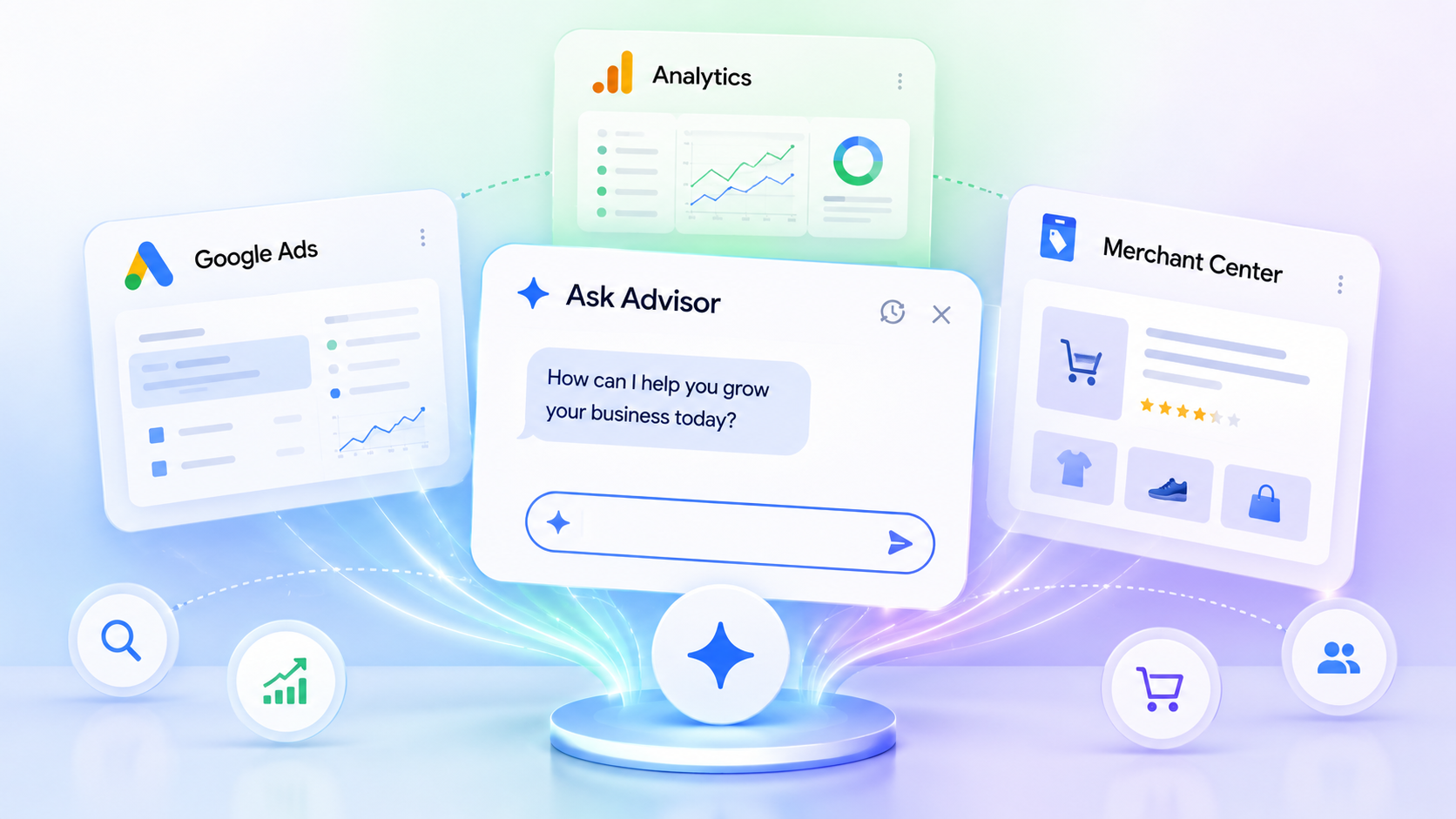
I’m thrilled to share that Google has just unveiled Ask Advisor, a new AI-driven tool designed to transform the way we approach campaign management, analytics, and optimization. Announced at Google Marketing Live 2026, this Gemini-powered AI is here to integrate seamlessly across Google Ads, Google Analytics, Merchant Center, and the Google Marketing Platform.
Making Waves. Ask Advisor is set to be a game-changer, acting as a unifying force that weaves together insights, workflows, and recommendations across Google’s vast marketing ecosystem.
For those of us in marketing, this means we can launch campaigns, analyze performance, and uncover optimization recommendations all without having to juggle between different tools.
Imagine asking Ask Advisor to “find new customers for my hair care products.” It would seamlessly pull details from the Merchant Center and assist in crafting a campaign right in Google Ads.
Understanding the Process. Ask Advisor connects the dots between Google Ads, Analytics, the Merchant Center, and the Marketing Platform via a Gemini-powered interface. This connectivity allows it to access a range of data to create recommendations, automate tasks, and offer insights that align with marketing goals.
It doesn’t stop there. The integration of insights from Google Ads and Google Analytics helps explain campaign performance and suggests subsequent steps.
The aim, Google states, is to democratize advanced campaign management, enabling even those without extensive technical expertise to make the most out of their advertising strategies.
This launch supports Google’s expanding lineup of AI-driven in-product agents, positioning Gemini as a fundamental layer in advertising and measurement tools.
Why This Matters to Us. Ask Advisor symbolizes one of Google’s most direct steps into agent-based advertising workflows.
Instead of interacting manually with separate reporting dashboards, campaign tools, and optimization settings, AI agents are being poised to handle operational tasks and present strategic insights.
The more substantial evolution is structural: Google is anchoring Gemini as the core across its advertising platform, potentially redefining how campaigns are developed, optimized, and evaluated.
Keep an Eye On. The biggest discussion point will be how much control advertisers are willing to cede to AI agents. Transparency over recommendations, automation choices, and reporting accuracy will be under scrutiny as Ask Advisor rolls out.
When You Can Get It. Currently in beta, Ask Advisor is available for English-language accounts, with more features anticipated later this year.
Want to Learn More? Here’s additional news from Google Marketing Live 2026:
Recently, I’ve discovered that Google is stepping up its game in AI tools for advertisers and retailers.
They’re testing something quite futuristic called Merchant Advisor, an AI assistant integrated directly into the Merchant Center. This tool aims to simplify the process of setup, troubleshooting, and optimization for us all.
What’s happening. As someone who watches Google’s every move, I’ve noticed them testing Merchant Advisor, a cutting-edge AI-powered chatbot right within Google Merchant Center. Although in beta, its purpose is clear: to offer personalized recommendations and support, making my experience smoother than ever.
How it works. The Merchant Advisor acts like a proactive assistant, offering tasks and suggestions like setting up a returns policy or finalizing account setup steps. It feels like having an assistant who is always available to enhance my feed quality and account health.
The bigger trend. This development is part of Google’s strategy to weave AI assistants throughout its marketing products, reminding me of earlier launches like Google Ads Advisor and Analytics Advisor. The AI co-pilots are evidently becoming the norm for managing campaigns and analytics.
Between the lines. Let’s face it, Merchant Center can be a technical labyrinth, especially for smaller retailers juggling feeds, policies, and diagnostics. But now, with an embedded AI guide, I’m finding it less daunting to get onboarded quickly and spot optimization opportunities I might have overlooked.
Spotted by. This feature first caught the eye of Tamara Hellgren during a Google Ads Decoded podcast episode that focused on retail innovations.
The bottom line. It’s clear to me that Google is transforming the Merchant Center into a more intuitive, AI-assisted environment, which reflects a larger trend towards automation within its advertising landscape.
I believe the launch of TurboQuant will revolutionize AI and SEO as we know it. This cutting-edge algorithm from Google drastically reduces the computing power and energy needs by allowing the massive compression of LLMs and vector search engines.
Imagine using six times less memory and achieving eight times the speed without compromising accuracy. That’s how TurboQuant dramatically lowers the cost of running AI tasks.
As search engines evolve from simply listing links on a SERP to providing immediate AI-generated overviews, it’s crucial for us in the SEO industry to adapt. We need to focus on creating meaningful, trustworthy content and understand its impact on searches.
Before AI became prevalent, SEO was grounded in basic keywords and topics, which inefficiently represented user intent. High costs and energy consumption hindered mapping true meaning across the web, but now TurboQuant uses an advanced compression method, PolarQuant, to transform data into manageable coordinates. This breakthrough allows Google to process complex ideas far more efficiently.
TurboQuant can match exact search meanings in real time, thanks to its ability to understand user intent using past searches and real-world contexts.
The near-zero indexing lead time of TurboQuant eradicates delays between publication and ranking. Trusted publishers will gain instant recognition for their expertise, while the system also blocks manipulation and spam from appearing.
We must prepare for the fast-approaching era where AI summaries become the norm in responding to most queries. Thin content, which adds no original value, will vanish because AI can now summarize the web almost instantly, making unique viewpoints and genuine data irreplaceable.
Developing trust and authority with original thoughts, data, and experiences will prove essential, as AI-generated summaries merely consolidate existing information.
The focus of our SEO strategies should be to become a source AI recommends reliably, not just rankings based on keywords. TurboQuant maintains a more reliable index of facts by validating them against its real-time knowledge base.
This new system tracks a brand’s strength across various platforms, reinforcing the necessity of improving our knowledge graph as a trusted source.
With TurboQuant handling vast information without delays, hyper-personalization is set to explode in ways we’ve previously not imagined. AI agents could remember extensive user interactions to provide extensive personalization.
TurboQuant’s capability to integrate various signals into a cohesive perception of a brand’s value demands a strategic shift toward consistent, omnichannel representation.
We’ve prioritized quantity over quality for far too long in this industry. TurboQuant signals the end of this era, as it necessitates creating high-quality, meaningful content that establishes us as trusted entities.
Delivering a reliable message with a clear voice will guide how our messages are distributed and our brand credibility.
Your AdSense implementation can be working correctly even when vignette impressions or revenue suddenly move. Google AdSense no longer uses the browser Back button as a vignette ad trigger, so a change in this format does not automatically point to broken code, a consent failure, or a traffic problem.
The practical question is narrower: how much of your vignette inventory depended on that navigation action, and are the remaining ad opportunities behaving normally? Answer that before you change placements, edit templates, or disable the format.
Key takeaways
The browser Back button no longer triggers an AdSense vignette ad. That does not mean the entire vignette format has been removed.
Treat an isolated decline in vignette impressions as a possible inventory change before treating it as an implementation failure.
Compare vignette impressions and revenue per session, not only revenue per pageview. A removed back-navigation opportunity may not correspond to a new pageview on your site.
Segment the change by browser, device, landing-page template, and traffic source. Sites with frequent land-and-return behavior may be more exposed.
Do not recreate the removed behavior by intercepting the browser Back button or trapping visitors. Improve useful internal navigation and evaluate the rest of your ad mix instead.
The change applies to a specific navigation action
Vignette ads are interstitial-style placements associated with navigation between pages. The important boundary here is the browser control itself: when a visitor presses Back in Chrome, Safari, Firefox, or another browser, that action is no longer a vignette trigger.
Do not translate that into the broader claim that vignette ads have stopped working. The change removes one trigger, not the format as a whole. It also does not establish that every link labeled Back will behave the same way. An on-page “Back to results” link is a site link, while the browser Back button operates through the visitor’s navigation history. Test those paths separately rather than grouping them by their visible label.
The behavior change alone is not evidence that you need to reinstall the AdSense tag, modify structured data, change a WordPress theme, or repair an SEO problem. Check those systems only if other evidence points to them. A decline across every ad format, for example, deserves a broader serving and traffic audit. A decline isolated to vignettes has a much narrower set of likely causes.
Why the revenue effect will vary between publishers
Removing a trigger reduces the number of moments at which a vignette could be considered. It does not tell you how large the effect will be. That depends on how visitors move through your site.
A site can be more exposed when many visitors land on a page, consume what they need, and use the browser Back button to return to a search result, social feed, referring site, or previous page. A site with deeper internal journeys may rely less on that action. These are diagnostic hypotheses, not reasons to assume a loss before looking at your own data.
Page RPM can be a misleading first metric in this case. A vignette associated with an exit through browser history may have created an ad impression without creating another publisher pageview. If that opportunity disappears, pageviews can remain stable while vignette impressions and revenue fall. Revenue per session and vignette impressions per session provide a cleaner view of that mechanism.
Use these questions to determine whether the navigation change is a credible explanation:
Did vignette impressions per session fall while display and other ad formats stayed near their previous patterns?
Did the movement concentrate on landing pages that commonly end a visit?
Was it larger for search, social, or referral landings than for direct visitors who browse several internal pages?
Did one device or browser segment move more than the others?
Did sessions, pageviews, geography, consent rates, or the mix of page templates change at the same time?
The first four patterns make the removed trigger more plausible. A simultaneous change in traffic, consent, templates, or all ad formats means you have competing explanations and should not attribute the result to vignette behavior alone.
Audit the change without confusing correlation for cause
A useful audit separates format behavior from traffic behavior. You do not need a complicated attribution model, but you do need a comparison that preserves context.
Record possible confounders. Note any changes to consent management, AdSense settings, theme files, navigation, ad experiments, traffic acquisition, or page templates. If several things changed together, do not assign the full effect to one of them.
Find the first sustained movement in your own reporting. Compare equivalent periods on either side of that movement. Match the day-of-week mix and avoid using an unusually large campaign, outage, or seasonal spike as the baseline.
Isolate vignettes where your reporting permits it. Review vignette impressions and revenue separately from total advertising revenue. If you cannot separate the format, state that limitation instead of treating a sitewide result as proof.
Normalize for audience volume. Calculate vignette impressions per session and vignette revenue per session. Keep page RPM as supporting context, not the only decision metric.
Segment the affected traffic. Start with browser, device, traffic source, landing-page type, and new versus returning visitors. Stop adding segments when sample sizes become too thin to show a stable pattern.
Inspect navigation paths. Compare sessions that end on the landing page with sessions that continue through internal links. If available, examine flows from high-traffic landing pages to categories, related content, product pages, or site search.
Change one thing at a time. If you decide to adjust navigation or another placement, keep consent, templates, and other ad settings stable during the evaluation. Otherwise, the next comparison will be as ambiguous as the first.
A quick diagnosis matrix
What you observe
Most useful interpretation
What to do next
Vignette impressions per session decline while other ad formats remain stable
The removed trigger is a plausible cause
Monitor the new baseline before changing the implementation
All ad formats decline together
A broader traffic, consent, serving, or implementation issue is more likely
Audit sitewide changes and ad delivery
The decline is concentrated on high-exit landing pages
Visitor navigation patterns may explain the exposure
Review those pages’ internal paths and format-level metrics
Sessions or pageviews change materially at the same time
Raw revenue comparisons are confounded by audience volume or behavior
Normalize per session and compare stable traffic segments
Revenue changes but format-level impressions are unavailable
Causality remains uncertain
Avoid implementation changes based on the sitewide total alone
Respond by improving the journey, not recreating the trigger
If the audit shows a modest, isolated vignette decline and everything else is stable, the most defensible response may be to accept the new baseline. Fewer interruptions during browser Back navigation can change the balance between monetization and visitor control. There is no technical virtue in forcing the old interaction back into the experience.
If the effect is material, work on the parts of the journey you control:
Add a genuinely useful next step near the point where a reader has finished the current task, such as a related explanation, comparison, category page, or product detail.
Make internal links descriptive enough that visitors know what they will get before clicking.
Check whether intrusive elements, weak mobile navigation, slow pages, or dead-end templates are pushing visitors toward the browser Back button.
Evaluate other appropriate ad placements as part of the complete page experience, using both revenue per session and engagement signals.
Run controlled layout tests rather than changing navigation, ad density, consent behavior, and templates in the same release.
Do not hijack browser history, open unnecessary pages, or manufacture clicks to replace a lost ad opportunity. Those tactics work against visitor intent and make analytics harder to trust. The sustainable lever is a better internal path that a reader chooses because the next page is useful.
Set a new baseline before making an optimization decision
Your next action is simple: chart vignette impressions per session, vignette revenue per session, sessions, and total pageviews across the same comparison window. Then split the result by landing-page type and traffic source. If only vignette efficiency moved while other formats and traffic stayed stable, document the trigger change and establish a new baseline. If the decline reaches multiple formats or coincides with a site change, continue the broader audit before touching your ad strategy.
I find it fascinating that Google’s Universal Commerce Protocol (UCP), which was initially limited to AI Mode, is now expanding into regular search results. It’s not just a fleeting trend; some retailers have already begun integrating this technology into their listing pages, making our online shopping experience even more intuitive.
Earlier this year, Google rolled out UCP for AI-agents to facilitate direct purchases from search results. It first launched exclusively within Google’s AI Mode but now, we’re seeing it implemented in Google’s main search results for retailers who support UCP.
Discovering what the UCP checkout looks like was made easier thanks to a post by Brodie Clark. He shared a screenshot showing how Wayfair’s listings on Google Search now feature a UCP-powered ‘Buy’ button. This button is a game-changer because it allows purchases directly from Google’s interface without navigating to Wayfair’s website.
The UCP protocol is paving the way for seamless transactions by establishing a common language for AI agents and commerce systems. No longer do we have to worry about bespoke integrations across different platforms.
Collaboratively developed with big names like Shopify, Etsy, Wayfair, and Target, UCP aligns with existing standards, such as Agent2Agent and Agent Payments Protocols, creating a more cohesive digital commerce space.
What really excites me is the potential for profit growth for retailers who embrace this technology. Although Wayfair might miss out on direct site traffic for specific searches, their affiliation with Google through UCP can still result in conversions.
While it’s clear that not everyone will bypass the traditional shopping journey, as many of us still prefer exploring products on the retailer’s site, the option to ‘Buy’ directly adds a layer of convenience. It’s definitely something worth monitoring as its prevalence in search results increases.
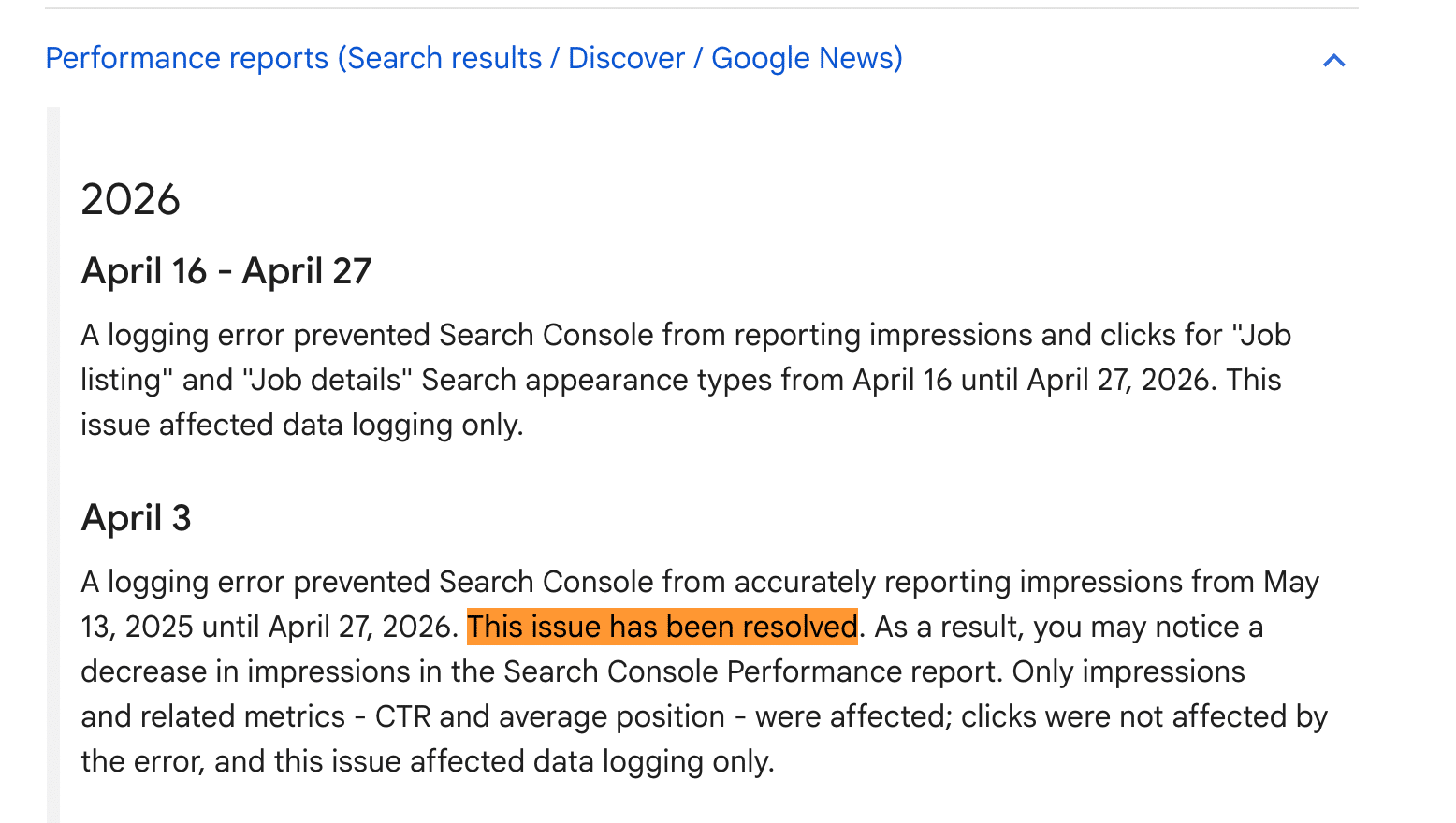
It feels like a moment of relief as Google recently announced a resolution to a longstanding data logging issue within Google Search Console. This glitch affected data between May 13, 2025, and April 27, 2026, spanning approximately 50 weeks. However, it’s important to note that while the root cause has been addressed, historical data from this period remains unfixed.
Google shared this update in a rather understated post, bringing light to a problem that many of us have been grappling with for quite some time. According to their post, “A logging error prevented Search Console from accurately reporting impressions from May 13, 2025, until April 27, 2026. This issue has been resolved.” It was a relief to hear, but also a bit frustrating knowing that impressions, CTR, and average position data were affected for such a significant period. Thankfully, clicks weren’t influenced by this error, which was some consolation.
As I sift through my Search Console data, I must remind myself of this anomaly, particularly when analyzing metrics from that problematic timeframe. The good news is that any data collected from this point forward should be accurate.
Further confirmation came from John Mueller on Bluesky, who reiterated that past data would not be retroactively corrected, but the issue has indeed been resolved going forward.
This development is crucial for all of us who rely heavily on precise data for SEO strategies. If your impressions appear lower and, consequently, your CTR and average position figures seem skewed during this period, this is likely why.
When I learned that Google’s Preferred Sources feature now supports all languages, not just English, I was thrilled. This exciting update means more people can tailor their news experience, regardless of the language they speak.
According to a recent post on Google’s blog, ‘Preferred Sources is now rolling out globally in all supported languages.’ This gives me, and everyone else, more control over the news we see on Search, allowing us to choose our preferred outlets to appear more frequently in Top Stories.
It’s fascinating to reflect on how this feature initially rolled out in December, but was limited to English. Now, it’s a comprehensive tool available globally, no matter the language.
Interesting Stats: Google shared some compelling data with this launch. For instance, readers are reportedly twice as likely to click on a site after marking it as a Preferred Source. Also, over 200,000 unique sites have already been selected by users—from local niche blogs to major global news platforms.
Preferred Sources: This feature lets me star my favorite publications in the Top Stories section of Google Search. By doing so, Google uses that interest to show more stories from those sources. I learned it started in beta back in June and was initially available in the U.S. and India by August, but now it’s part of a worldwide expansion.
How it Works: It’s simple! I just click the star icon next to the Top Stories header in my search results. This allows me to pick preferred sources, provided these sites are constantly updating their content.
Once selected, Google promises to showcase more updates from my favorite sites in Top Stories, provided they have fresh content relevant to my search.
For more detailed information, I can visit this page.
Why it Matters: In the competitive area of Google Search traffic, marking my site as a preferred source can make a significant impact. Google indicated these users are twice as likely to engage, which could help in driving more traffic to my site.
So, I’m adding the preferred source icon to encourage my audience to sign up. If you’re interested, you can make Search Engine Land a preferred source by clicking here.
Recently, I noticed a significant change in Google’s approach to handling spam reports. They’ve updated their stance on whether they’ll process reports containing personally identifying information, and it feels like a big shift from what was communicated just a week prior.
On their updated spam report page, Google now clearly states that any spam report containing personally identifying information will not be processed. This revision comes after their previous announcement that such information could be passed on to the site in question.
Here’s What’s Changed: Google has added a highlighted note on their official spam report page, emphasizing two points:
(1) Avoid including personally identifying information in your spam reports.
(2) If you do include such information, your submission won’t be processed.
Google’s explanation reads:
“Don’t include any personally identifying information in your submission. To comply with regulations, we must send the submission text to the site owner to help them understand the context of a manual action, if one is issued. Because of this, we won’t process your submission if we determine it contains personally identifying information to protect privacy. Not including such information fully ensures your information is safe and prevents your submission from being discarded.”
Previously: Just a week ago, as we documented, Google allowed:
“If we issue a manual action, we send whatever you write in the submission report verbatim to the site owner to help them understand the context of the manual action.”
This policy raised many eyebrows across the industry. Concerns were not just about being flagged for identifying competitors or spammers, but there were also legal implications. It seems Google is now aligning with regulations to avoid sharing personally identifying data.
Why You Should Care: If you’re aiming to submit a spam report to Google, make sure it doesn’t contain any personally identifying information. Should you inadvertently include such information, rest assured that it won’t reach the reported site and the report simply won’t be processed. You can always resubmit your report without these details.
I’ve noticed that Google is currently investigating an issue with the Google Search Console. Specifically, this concerns the data logging and reporting of “Job listing” and “Job details” search appearance filters.
On April 16th, a bug began affecting how this data is logged, causing Google to report zero clicks and impressions for job-related reports. Although traffic is still being received, it’s not being recorded correctly.
What Google said. According to an update from Google, “A logging error is preventing Search Console from reporting impressions and clicks for ‘Job listing’ and ‘Job details’ Search appearance types from April 16, 2026 onward. We’re working to resolve this issue. This issue affects data logging only.”
Complaints. I’ve also seen numerous SEOs voicing their concerns on social media, as shared in a tweet by Max Peters. The bug seems to impact impressions and clicks, but the traffic still comes through other measurement methods like google_jobs_apply UTM.
Why we care. If you’ve noticed a decrease in search data for job listings, rest assured, it’s due to this bug on Google’s side. Your listings are likely still active and receiving traffic, although this isn’t reflected in Search Console at the moment.
Ever since learning about Google’s latest update to its YouTube and Discover Feed ad requirements, I’ve been intrigued by the clarification on election-related ads. This change, effective April 2026, doesn’t alter enforcement but provides much-needed transparency.
Why it matters. As someone navigating the complex landscape of YouTube and Discover ad placements, I understand how tightly regulated these spaces are. Historically, election ads have been surrounded by ambiguity. Now, the update helps clear up that confusion without imposing additional restrictions.
What’s new (and what’s not). It’s interesting to note that election ads are now clearly exempt from specific YouTube and Discover Feed ad requirements. However, no changes in enforcement mean that if compliance was achieved before, there’s no need for advertisers to shift gears.
Why we care. With this update, I’ve noticed how Google aims to eliminate the haze surrounding election ads on YouTube and Discover. Although these ads don’t need to meet placement-specific requirements, adherence to Google Ads policies remains essential, offering clearer guidance and more predictable campaign launches.
Zoom in. For election ad campaigns, this exemption is beneficial since these ads aren’t required to comply with the targeted YouTube and Discover Feed ad guidelines. However, advertisers must pass the Election Ads verification within the ad’s targeted region.
Between the lines. It’s vital to recognize this as a documentation clarification rather than a policy change. Google is distinguishing between the unique requirements for YouTube and Discover ads and its overarching ads policy framework.
What advertisers should do. If you’re running political campaigns, it’s crucial to maintain your verification status and continue adhering to Google Ads policies. Despite the exemption, keeping up with regulations is necessary for a smooth advertising process.