Author: shivamcrushpressai

  • How Food Publishers Can Adapt to AI Search Disruption

    How Food Publishers Can Adapt to AI Search Disruption

    If a holiday recipe still ranks but sends fewer people to your site, you may not be dealing with an ordinary SEO decline. The search result itself may now provide the ingredients, summarize the method, combine advice from several creators, and leave the reader with little reason to click.

    Publishing more recipes won’t solve that problem by itself. You need to make each recipe easier to interpret accurately, harder to replace with a compressed answer, and more valuable after the click. You also need measurements that distinguish rankings, AI citations, answer accuracy, traffic, and revenue instead of treating them as the same outcome.

    AI search has changed what a ranking is worth

    The familiar search journey moved a reader from a query to a results page and then to a publisher. An AI answer can interrupt that journey. It may resolve the immediate question before the reader encounters your testing notes, photographs, troubleshooting advice, newsletter offer, ads, or affiliate links.

    This creates several separate risks for food publishers:

    • Answer interception: The generated response satisfies a simple request without requiring a visit.
    • Source dilution: Instructions from different publishers can be blended into one method, weakening the connection between the recipe and the person who developed it.
    • Instruction degradation: A shortened or rearranged method can separate a warning from the step where it matters. Documented examples include an AI answer that would have led a reader to over-bake a cake.
    • Asset extraction: Original food photography can appear in generated visual experiences without delivering the same recognition or value as a visit to the originating page.
    • Imitation pressure: AI-operated sites can reproduce the shape of a successful recipe, alter some details, and compete with the creator whose work supplied the idea.

    The commercial effect can be severe, but it shouldn’t be turned into a universal benchmark. Reported creator declines range from 30% to 80%, with individual accounts including a 40% traffic loss and a 30% decline in cocktail click-through rate. Those are experiences from affected publishers, not a measurement of every food site.

    Key takeaways

    • A ranking is no longer the complete outcome. Track whether an AI answer appears, whether you are cited, whether the citation is linked, and whether anyone visits.
    • Recipe clarity matters twice: it helps readers complete the method, and it reduces the chance that a generated answer disconnects a condition from an instruction.
    • Structured data improves interpretation, but it cannot make a commodity answer click-worthy or prove that a recipe is original.
    • Your strongest defense is source value: real testing evidence, sensory endpoints, constrained substitutions, troubleshooting, recognizable authorship, and useful original media.
    • Protect the business separately from the ranking by creating direct audience relationships and measuring revenue per useful visit.

    Start your response with triage, not a site-wide rewrite. Classify recipe groups by commercial exposure, ease of summarization, consequence of distorted instructions, and strength of original evidence. A seasonal page that generates meaningful revenue, answers a compact question, and offers little beyond the basic method deserves attention before an evergreen recipe with strong branded demand and extensive troubleshooting.

    Make each recipe legible without making it disposable

    An overhead arrangement shows a finished vegetable tart surrounded by ingredients, preparation stages, tools, and test slices.

    Food publishers face an awkward design problem. A vague recipe is difficult for people and machines to interpret, but a page that contains nothing beyond a clean ingredient list and short method is easy to compress into an answer. The solution isn’t to obscure the recipe. It is to separate the recipe’s authoritative path from the evidence and decision support that make the page indispensable.

    Establish one recipe truth set

    Every representation of the recipe should agree: the visible recipe card, surrounding instructions, print view, video, image captions, internal summaries, and Recipe JSON-LD. Contradictory timings, ingredient forms, quantities, or sequencing give an answer system several plausible versions to combine.

    For each important recipe, check the following fields against one authoritative version:

    • The recipe name and the specific variation being prepared.
    • Yield and portion assumptions.
    • Ingredient quantities, preparation state, and meaningful alternatives.
    • Equipment or vessel requirements that affect the result.
    • Preparation, cooking, resting, cooling, and total timing where those distinctions matter.
    • The order of operations and dependencies between steps.
    • Observable doneness cues rather than time alone.
    • Storage, reheating, and make-ahead instructions.
    • Warnings, allergen information, and substitution limits that affect safety or outcome.

    Recipe JSON-LD should describe the visible recipe faithfully. Don’t use markup as a second, keyword-expanded version of the page, and don’t add claims that a reader cannot verify in the content. Validate the syntax, but also perform a semantic check: the markup can be technically valid while describing a different yield, duration, or instruction order.

    Structured data is an interpretation layer, not a defensive moat. It can help a system identify ingredients, instructions, images, authorship, and other recipe entities. It cannot guarantee a citation, compel a click, establish ownership, or preserve every caveat in a generated answer.

    Write steps that survive separation

    A generated answer may extract a step without carrying over the paragraph before it. Write each critical instruction so its condition travels with it. A useful pattern is: action, relevant setting or tool, observable endpoint, exception, and recovery.

    For example, don’t place an important exception in a general note and assume the reader will connect it to the method. Put it next to the affected step, then repeat it in the notes when repetition prevents a bad outcome. If a substitution, storage instruction, allergen warning, or doneness cue has safety implications, it belongs at the point of action. A summary’s brevity is not a safe place to entrust that connection.

    Use time as one signal rather than the whole definition of success. Texture, color, volume, aroma, resistance, and appearance can tell a cook what state the food should reach. Include only the cues you have genuinely verified. Their purpose is to help a person make the right decision in a different kitchen, not to decorate the prose.

    Give readers a reason to need the original source

    An AI answer is strongest when the request can be reduced to a short list and a linear sequence. Your page becomes harder to replace when it helps the reader diagnose, choose, adapt, and recover. That value must be concrete. A longer personal introduction doesn’t create defensibility if it never changes what the reader can do.

    Add source value where it is true and useful:

    • Testing context: State what was actually tested, which variables changed, and what remained constant. Don’t claim a recipe was extensively tested unless you can support that claim.
    • Sensory checkpoints: Show the meaningful transition at a stage, not merely another attractive photograph of the finished dish.
    • Failure diagnosis: Connect a visible symptom to likely causes, the immediate recovery, and the change to make next time.
    • Constrained substitutions: Explain what function an ingredient serves, which replacement can perform it, and what tradeoff the reader should expect. A replacement isn’t automatically equivalent.
    • Decision branches: Distinguish what changes with equipment, batch size, preparation schedule, or desired result.
    • Revision history: Record substantive corrections and retests. A transparent update is more useful than silently changing the instruction that returning readers saved.
    • Recognizable authorship: Use consistent bylines, complete author pages, and clear editorial responsibility. Readers should be able to identify who stands behind the method.

    Place this information where it is needed. A troubleshooting section is valuable, but the most consequential warning should also appear beside the relevant step. A process photo should be attached to a stage and captioned with the change the reader needs to see. A testing note should explain a decision, not simply assert expertise.

    Treat original images as evidence as well as media

    Original photography now does more than attract a click. It can demonstrate process, establish continuity between author and recipe, and help readers verify an endpoint. It can also be reused outside the page: Gemini 3 has been observed using publisher photographs in interactive graphics, while AI-run sites have mirrored recipes and altered personal images.

    Keep original files, creation records, licenses, commissioned-work agreements, and dated publication records organized. Apply consistent, unobtrusive branding where it doesn’t interfere with the reader’s ability to inspect the food. Use descriptive captions and alt text for accessibility and context, not as a place to repeat keywords.

    No watermark, metadata field, schema property, or technical setting can prevent every form of copying. The operational goal is to make attribution obvious, preserve evidence of creation, and detect material reuse early. If you are considering a formal infringement claim, preserve the relevant pages and records before making changes and obtain appropriate legal advice for the jurisdiction involved.

    Build an audience path that an answer box cannot own

    A home cook uses a phone in a warm kitchen where a glowing path connects the device to a recipe box, cookbook, produce, speaker, and prepared dish.

    Search optimization still matters, but a business that depends on a platform sending every informational click is exposed to product changes it cannot control. Food publishers need both discoverability and a reason for the audience to return directly.

    Match your investment to the query’s real value

    Group queries by what the cook is trying to accomplish:

    • Lookup intent: The reader wants a compact fact, ingredient, time, ratio, or basic method. These queries are especially easy to satisfy in a generated response.
    • Decision intent: The reader must choose among methods, ingredients, schedules, or equipment under a constraint.
    • Execution intent: The reader needs sequencing, visual confirmation, troubleshooting, or help recovering during the cook.
    • Trust intent: The reader is looking for a particular creator, named recipe, known method, or previously successful result.

    Don’t abandon lookup content. It can introduce the brand, earn visibility, and support a broader recipe cluster. But don’t value its rankings as if every impression should become a session. Connect the concise answer to a genuinely useful next decision: choosing a method, planning the meal, avoiding a known failure, adapting the recipe, or coordinating the cooking sequence.

    Build named collections and navigable hubs around a real cooking task rather than assembling loosely related pages for search coverage. A holiday hub might connect planning, preparation order, core recipes, variations, storage, and troubleshooting. The hub should reduce work for the cook; its value isn’t the number of internal links.

    Convert a useful visit into a direct relationship

    Give each commercially important page a clear primary next step. Depending on the reader’s task, that might be saving the recipe, printing a usable version, joining an email sequence for the relevant season, following a coordinated meal plan, or moving to the next preparation stage. Avoid surrounding the reader with unrelated prompts that compete with the recipe.

    The direct asset must be worth keeping. A generic newsletter promise is weak beside a specific utility such as a sequenced preparation plan, an organized shopping list, a tested make-ahead path, or updates to recipes the reader has saved. Only promise what you can maintain.

    Diversification also applies to discovery platforms. AI-generated material is already adding noise to Pinterest and Etsy, so distributing the same asset across more platforms doesn’t necessarily reduce dependency. Separate borrowed reach from owned access. Search, social feeds, and marketplaces can introduce you; email lists, bookmarks, saved collections, and branded demand make it easier for the reader to come back.

    Run an AI search audit that connects visibility to revenue

    A conventional rank report cannot tell you whether an AI answer intercepted the click, credited the wrong source, merged incompatible instructions, or used an image without sending a visit. Add an answer-layer audit to your existing search and analytics process.

    1. Freeze a baseline. Record organic landing sessions, query impressions, click-through rate, engaged visits, conversions, and page-level revenue before editing priority content. Preserve comparable seasonal periods where the business depends on holiday demand.
    2. Build prompts from demonstrated demand. Start with queries that already generate impressions or valuable visits. Expand them into direct requests, constraint-based questions, troubleshooting questions, follow-ups, and brand-qualified prompts.
    3. Observe the actual answer surface. Record the exact prompt, date, search interface, device context, location context, and signed-in state. Generated results can vary, so a screenshot without its conditions is weak evidence.
    4. Separate mention, citation, link, and click. A brand name in an answer is not the same as a citation. A citation is not necessarily a usable link. A link is not a visit. Track each state independently.
    5. Review instruction fidelity. Check ingredient forms, quantities, ordering, dependencies, substitutions, timing, endpoints, warnings, and image attribution against your authoritative recipe. Label the answer as accurate, incomplete, mixed, or materially unsafe rather than giving it a vague quality score.
    6. Connect the observation to business results. Compare answer presence with organic clicks, landing sessions, return behavior, subscriptions, and revenue. Don’t attribute every decline to AI when seasonality, rankings, demand, site changes, or result-page features could also explain it.
    7. Change one class of problem at a time. Correct conflicting recipe facts before adding more content. Improve source value before redesigning every call to action. Keeping interventions distinct makes the next observation more informative.

    A compact decision table keeps the audit actionable:

    Observed stateLikely problemNext action
    Cited accurately and receiving visitsThe source is visible and still adds valueProtect accuracy, strengthen the reader’s next step, and monitor important prompts
    Cited accurately but receiving few visitsThe generated answer may satisfy the immediate needAdd decision support the answer cannot carry and improve the value promised by the result
    Mentioned without a clear linkRecognition exists without a reliable traffic pathStrengthen consistent brand and author entities, then measure branded demand separately
    Cited with mixed or incorrect instructionsThe system may be compressing, separating, or combining recipe detailsRemove internal contradictions, attach conditions to steps, and clarify the authoritative method
    Absent while competitors are citedThe page may lack relevance, clarity, authority signals, or distinctive evidenceCompare the answered intent with your coverage and improve the underlying page where a genuine gap exists
    Images reused without useful attributionAsset visibility isn’t creating source valuePreserve evidence, review branding and captions, document reuse, and assess the appropriate rights response

    Keep AI visibility and commercial performance beside each other in the same working view. Useful fields include recipe cluster, query or prompt, answer type, citation state, link state, instruction fidelity, image use, organic click-through rate, landing sessions, subscriber conversion, and revenue. The point isn’t to invent one blended score. It is to see where visibility stops turning into business value.

    Before the next important seasonal window, choose a revenue-critical recipe cluster and preserve its baseline. Reconcile the recipe truth set, validate the visible content against its JSON-LD, add the missing evidence and troubleshooting, define the page’s primary conversion, and begin a repeatable prompt audit. Then apply what you learn to the next cluster. That gives you a controlled publishing system instead of a rushed reaction to every new AI result.


    References

  • Effortlessly Manage Google Posts with New Scheduling & Multi-location Tools

    Effortlessly Manage Google Posts with New Scheduling & Multi-location Tools

    I’m thrilled to share that Google Posts now includes features that support scheduling and multi-location publishing within Google Business Profiles. These updates are designed to make it easier for us to manage our Google Posts, whether they are for our businesses or clients.

    Scheduling. One exciting new feature when adding a Google Post within our Google Business Profiles is the option to “schedule this post.” We can now select the exact date and time when we want our posts to go live.

    Lisa Landsman from Google shared on LinkedIn, “Plan your entire week or month in advance! You can now schedule your Google Posts to go live automatically at the perfect time.”

    Multi-location publishing. If you, like me, manage several locations for a business, you’ll find the new multi-location feature incredibly convenient. It allows us to quickly copy Google Posts to some or all of our locations with just a click. Lisa Landsman explained, “Easily create a single post and apply it instantly to multiple business locations in one click.”

    ```json
{
  "alt": "Event post interface with title, description, and dates for a charitable shopping event.",
  "caption": "Join our Giving Season event: shop with us, and we'll donate on your behalf to a charity of your choice. Every purchase makes a difference!",
  "description": "This image displays an online post creation interface for an event themed 'You shop, we donate. You choose where.' The event promises to donate on customer purchases to one of three charities. It features a brown background image with wrapped gifts and charity icons. The start and end date fields are set from 11/21/2025 to 11/28/2025, encouraging community involvement in charitable giving during the holiday season."
}
```

    What it looks like. Here’s a GIF that shows this functionality in action:

    Why we care. I care about these updates because I know how busy businesses can be. Often, we don’t have the time to pause everything just to create a timely Google Post about an upcoming event or important message. Now, we can schedule these posts in advance and copy them effortlessly across locations we manage.

    As Lisa Landsman from Google pointed out, “We know the upcoming holiday season is a crucial, and hectic, time for your business. It’s also your biggest opportunity to get your events, offers, and updates in front of potential customers who are actively searching.”


    Inspired by this post on Search Engine Land.


    crushpress.ai community screenshot
  • How to Build AI Search Visibility With a Practical GEO System

    How to Build AI Search Visibility With a Practical GEO System

    You can rank for important Google queries and still disappear when a buyer asks ChatGPT, Claude, Gemini, or Perplexity to explain the market. The generated answer may frame the decision before that buyer has any reason to visit your website.

    The fix is not to publish more content and hope an AI notices. You need a repeatable GEO system that shows where your brand is absent, how it is portrayed, which competitors occupy the answer, and which URLs support the response. Then you can make a targeted change and measure the same question again.

    Build your prompt map around buyer decisions

    An overhead branching pathway links blank content cards with symbolic objects for comparison, research, solutions, risk, and purchase decisions.

    A conventional keyword tells you what someone searched. A useful GEO prompt also captures the decision they are trying to make, the constraints they care about, and the kind of answer they expect. That context determines whether your brand is even eligible to appear.

    Monitoring only questions that contain your brand name creates a reassuring but misleading baseline. Someone who asks whether your product supports a feature already knows you. The more important visibility gap often appears earlier, when that person asks which category, method, or provider can solve the problem.

    Build the prompt map from the real stages of a decision:

    • Category education: What is this type of solution, and when is it appropriate?
    • Problem diagnosis: What causes the issue, and which approaches address it?
    • Solution discovery: Which products, services, or methods fit a stated use case?
    • Evaluation: How should someone compare the available options?
    • Objections: What are the costs, risks, limitations, implementation demands, or prerequisites?
    • Brand validation: Is a named provider suitable for a particular audience or requirement?
    • Visual discovery: What is the item in an uploaded image, and which comparable products meet the user’s constraints?

    Before collecting answers, decide which brands could reasonably appear in each prompt. If a question asks for a general definition and does not call for examples, your absence is not automatically a visibility failure. This eligibility rule keeps the mention metric honest.

    Keep a prompt register rather than a loose list of interesting questions. For every check, record:

    • The exact prompt wording and the intent it represents.
    • The platform and model label displayed in the interface.
    • Relevant settings, location, language, or signed-in state.
    • The date of the response.
    • Whether your brand appeared and what role it played.
    • The exact descriptors and qualifications attached to the brand.
    • Which competitors appeared and how they were positioned.
    • Every cited URL, or an explicit note that the answer supplied no citations.

    Preserve the original wording as your benchmark. Add realistic variants as separate prompts instead of silently editing the baseline. Generated answers can vary, so a single response is a diagnostic observation, not a final verdict. Repeated patterns across the same decision set are more useful than an isolated win or loss.

    Turn four AI visibility signals into editorial decisions

    Four symbolic signal objects connect a modular content asset to a refinement station in a continuous circular feedback loop.

    Brand inclusion, framing, competitive presence, and cited URLs answer different questions. Combining them into a single visibility score may look tidy, but it hides the reason you are winning or losing. Keep the signals separate until you know which intervention each one requires.

    Mentions reveal where you are missing from the journey

    Track presence only across prompts where your brand is a plausible answer. Record the role as well as the mention: recommended option, specialist alternative, example, comparison point, warning, or incidental reference. A brand included only as an afterthought does not have the same visibility as one used to define the category.

    The location of the gap tells you what to build. Sparse mentions in educational questions point toward category definitions, original explanations, and authoritative problem-solving material. Absence from solution-selection questions points toward clearer use-case pages, differentiators, comparison criteria, and evidence of fit. Do not respond to every missing mention with another generic blog entry.

    Framing tells you which narrative needs evidence

    Do not reduce an entire answer to positive, neutral, or negative. Capture the actual adjectives, qualifiers, recommended audiences, and stated limitations. A brand can be praised for capability while simultaneously being framed as difficult to adopt. That mixed description is more actionable than a positive sentiment label.

    Match the response to the narrative. If cost repeatedly dominates the description, publish transparent value evidence, pricing context, or an ROI framework that explains when the expense is justified. If complexity dominates, improve onboarding material, implementation diagrams, migration instructions, and realistic prerequisite information. If trust or reliability recurs, reinforce that claim with verifiable proof rather than repeating the adjective in marketing copy.

    Competitive presence shows which prompts deserve priority

    Compare brands only within the same eligible prompt set. Then note whether a competitor is the default recommendation, a niche choice, a cited authority, or merely part of a long list. Raw mention totals can conceal those differences.

    Create a gap queue from prompts where credible competitors recur and your brand does not. Prioritize by the importance of the buyer decision, not by how irritating the result feels. Inspect what the recurring competitor contributes: a clear category definition, a defensible comparison, an original data asset, a detailed implementation resource, or stronger third-party corroboration. Your task is to answer the unmet information need, not imitate the competitor’s wording.

    Cited URLs show which material carries the answer

    A mention and an attribution are different outcomes. Log the exact URL, domain, page type, and claim each citation appears to support. Also distinguish your own page from an independent page that discusses your brand. You control the former directly and can only influence the latter through accurate information, public evidence, and distribution.

    When a competitor’s report, whitepaper, or explainer repeatedly supports an answer, inspect why that asset is usable. It may state the question clearly, expose its method, define terms precisely, present original evidence, or organize the material in extractable sections. Build the missing evidence on its own merits. A longer page is not automatically a more authoritative one.

    Build an answer asset instead of another generic page

    Every priority prompt should map to a clear primary URL. Several related prompts can belong on the same page, but the reader and the machine should not have to choose among near-duplicate pages to find your definitive answer.

    1. Assign the question to a primary page. Improve an appropriate existing URL before creating a competing version.
    2. Answer the core question near the beginning. State the conclusion, then explain the conditions and reasoning behind it.
    3. Name the entities and relationships explicitly. Identify the product, company, category, audience, use case, and limitation instead of relying on slogans or implied context.
    4. Attach evidence to the claim it supports. Include methodology, examples, comparison criteria, prerequisites, dates where they matter, and honest boundaries.
    5. Use descriptive headings, short explanatory paragraphs, genuine lists, and real tables where the information is tabular. Structure should reflect meaning, not merely break up text.
    6. Add JSON-LD that accurately describes the visible page and its entities. Structured data should confirm the content; it cannot turn an unsupported marketing claim into a fact.
    7. Connect the page to the rest of your site through relevant category, product, documentation, author, and company pages. Consistent names and relationships reduce ambiguity.

    The appropriate format depends on the diagnosed gap:

    • For an educational gap, create a precise explainer, glossary entry, or category definition with examples and boundaries.
    • For a solution-discovery gap, create a use-case page that names the problem, audience, requirements, and situations where the offering is not suitable.
    • For an evaluation gap, publish neutral comparison criteria before arguing that your option performs well against them.
    • For a perception gap, add the missing proof: onboarding instructions, implementation requirements, pricing context, case evidence, or a clear account of limitations.
    • For a citation gap, invest in material worth referencing, such as an original methodology, transparent analysis, detailed technical documentation, or a definitive first-party explanation.

    Avoid FAQ sections assembled only to capture prompt variations. Keep a question when it solves a distinct user problem and supply a complete answer. Near-identical questions with thin replies create more URLs or sections without creating more knowledge.

    Give every important claim one preferred URL

    Generative visibility work becomes fragile when the same claim exists at several addresses with conflicting titles, dates, product names, or specifications. Canonicalization helps search systems consolidate duplicate versions and identify the preferred origin. It does not guarantee an AI citation, but it removes avoidable uncertainty about which page represents you.

    Audit each priority answer asset for the following:

    • The preferred URL resolves correctly and is eligible for indexing.
    • The page carries a self-referencing canonical when it is the preferred version.
    • HTTP and HTTPS, www and non-www, trailing-slash variations, and parameterized duplicates consistently resolve or canonicalize to the intended URL.
    • Internal links and XML sitemaps use the same preferred address rather than feeding mixed signals.
    • Cross-domain copies identify the original where the publishing arrangement allows it.
    • Product variants, filtered category pages, faceted navigation, and pagination follow deliberate rules rather than CMS defaults that nobody has reviewed.
    • Google Search Console and a crawler such as Screaming Frog are used to find declared canonicals, selected canonicals, redirect conflicts, and duplicate clusters.

    Canonical tags are source-control signals, not a substitute for a coherent content model. If several live pages make materially different claims, pointing them all at one canonical does not repair the inconsistency. Decide which version is correct, update the public pages that still matter, and retire obsolete material through an intentional migration.

    Be careful when changing canonicals, redirects, or large groups of product URLs. A broad rule can suppress a valid variation, break an integration, or send authority to the wrong page. Review traffic, backlinks, feed requirements, and platform dependencies first; stage the rule where possible; then crawl the affected templates before deploying it widely.

    Treat visual assets as searchable product information

    Text optimization is only part of GEO for ecommerce and visually selected products. Multimodal systems can interpret objects, embedded words, style, context, and likely use cases. That makes product images and packaging part of the machine-readable information layer, not decoration added after the product page is finished.

    Use a visual-readiness checklist:

    • Show the real product at useful resolution from multiple angles, including scale cues, color, construction details, labels, openings, controls, pockets, stitching, or other decision-critical features.
    • Use original photography when the image is evidence of appearance, packaging, authenticity, or condition. A generated approximation should not stand in for factual product proof.
    • Keep critical packaging text high contrast. Clean sans-serif type on a solid background is easier to read than script type laid over a pattern.
    • Avoid placing required information where glare, glossy material, folds, curves, or creases make optical character recognition unreliable.
    • Run a grayscale check. If hierarchy and legibility disappear without color, the design is too dependent on color contrast.
    • Provide a QR code when the physical package needs a direct route to a canonical HTML page containing complete, structured product information.
    • Make the product name, model, variant, and image relationship explicit on the web page. Do not force a system to infer which nearby caption belongs to which asset.

    The surrounding objects matter too. Props, rooms, clothing, people, adjacent products, and photographic style can imply luxury, utility, sport, age, or intended audience. Those associations may conflict with the position stated in your copy.

    Run a co-occurrence audit on official product and lifestyle images. Ask a multimodal system to identify every visible object, infer likely use cases, and describe the apparent owner or audience. Compare those outputs with your intended positioning. Record unexpected associations, then turn the findings into concrete creative rules for backgrounds, props, wardrobe, image crops, and prohibited adjacencies.

    Extend the audit beyond current campaign files. Old product photography, public archives, distributor listings, user images, and social posts can preserve a discontinued visual identity. You may not control every external image, but you can update the assets you own, make current product imagery easier to identify, and stop distributing obsolete files.

    Close the GEO loop without creating a vanity dashboard

    You do not need a universal AI visibility platform to begin. A disciplined spreadsheet can connect prompts, responses, URLs, interventions, and outcomes. The important part is preserving enough context to explain why a metric moved.

    1. Capture a baseline across the stable prompt register.
    2. Choose a gap with meaningful buyer intent and a recurring pattern.
    3. Diagnose whether it is primarily an inclusion, framing, competitive, citation, technical, or visual problem.
    4. Make the smallest change that directly addresses that diagnosis.
    5. Log the affected URL, the change, the expected signal, and the deployment date.
    6. Recheck the same prompt set under comparable conditions after the changed material is available to search systems.
    7. Keep, revise, or reverse the intervention based on the observed pattern and any downstream business evidence.

    Separate visibility outputs from business outcomes. Mentions, framing, competitive presence, and citations tell you whether the generated answer changed. Qualified visits, inquiries, assisted conversions, and customer-reported discovery tell you whether that visibility mattered. Where analytics cannot prove a causal connection, label the relationship as an observation rather than assigning revenue to an AI mention.

    Do not change several content, schema, canonical, and visual elements at once unless a serious defect requires it. A broad redesign may improve the result, but it will teach you very little about which signal mattered. Controlled changes build a reusable operating model.

    Key takeaways

    • GEO is the work of improving accurate inclusion, framing, competitive position, and attribution in generated answers.
    • Measure visibility at the prompt and buyer-decision level, not through brand-name questions alone.
    • Use mentions, descriptors, competitive presence, and cited URLs as separate diagnostics with different remedies.
    • Map each priority question to a clear, evidence-rich primary page supported by accurate JSON-LD and consistent internal relationships.
    • Remove canonical ambiguity and make images, packaging, labels, and visual context legible to multimodal systems.
    • Recheck stable prompts after each intervention, while keeping AI visibility signals separate from business attribution.

    Start with the highest-value decision prompt where credible competitors recur and you do not. Assign its preferred URL, identify the most visible gap, make a targeted repair, and log what changed. That small closed loop will give you more strategic information than a large dashboard full of unexplained mention counts.

    References

  • Balance Time, Cost, and Quality for Effective SEO Results

    Balance Time, Cost, and Quality for Effective SEO Results

    Have you ever heard the phrase, “Fast, cheap, or good – pick two”? It’s a mantra I often reflect on when managing projects, especially in the world of SEO.

    The idea behind it is quite simple: If you want something done fast and cheap, it’s unlikely to be good. If you want it done well and quickly, it’s going to cost you. And if you want it to be good and affordable, you’re going to need to be patient.

    This principle perfectly captures the essence of tradeoffs, which are especially crucial in SEO because hastily made decisions can lead to costly fixes down the road.

    This article dives into the nuances of these project management tradeoffs and how they apply to SEO. I’ll also highlight why prioritizing quality in SEO yields better, more sustainable outcomes.

    In my experience, the fast-cheap-good concept is a modern spin on an age-old project management triangle that illustrates the delicate balance between speed, cost, and quality.

    ```json
{
  "alt": "Diagram titled 'SEO: Pick Two?' with options: Good and cheap, Good and fast, Cheap and fast, and a Venn diagram illustrating these choices.",
  "caption": "Choosing the right SEO approach? This Venn diagram humorously highlights the classic dilemma: balancing between good, fast, and cheap, but rarely all three!",
  "description": "This image features a decision matrix for SEO with the title 'SEO: Pick Two?' displaying options: 1. Good and cheap, 2. Good and fast, 3. Cheap and fast. A Venn diagram categorizes these combinations, illustrating the trade-offs in achieving quality, speed, and affordability. The center of the Venn diagram notes the impossibility of achieving all three simultaneously. This visual is a playful take on prioritizing SEO services, ideal for discussions around strategic planning."
}
```

    Visualize it as a triangle with three sides: Time (how quickly we can deliver), Cost (the budget involved), and Quality (the thoroughness and effectiveness of the work).

    The general consensus? You can only truly focus on two of these, and the third will inevitably be compromised.

    Let’s delve into how these elements impact SEO:

    Time: The competitive edge often comes from moving faster than your rivals. Though SEO is more a marathon than a sprint, speeding up certain processes can give you a significant advantage.

    ```json
{
  "alt": "Diagram of the Project Triangle with quality, time, and cost at vertices, indicating trade-offs.",
  "caption": "Understanding the Project Triangle: Balancing quality, time, and cost requires careful consideration.",
  "description": "This image depicts the Project Triangle, a model illustrating the trade-off between quality, time, and cost in project management. Each of the three positions of the triangle represents these critical elements. Words like 'High Cost,' 'Low Priority,' and 'Low Quality' suggest the compromises involved when focusing on one over the others. This concept is fundamental for effective project planning and management."
}
```

    SEO requires patience. In some industries, reaching the top can take years, especially for high competition keywords. However, with the right investment and strategy, you can reach those coveted positions more quickly.

    Cost: Quality SEO isn’t cheap. It demands expertise and skill, and those come at a price. Opting for low-cost options often leads to subpar results and potential penalties—ultimately, you’ll pay more to correct these errors.

    Quality: High-quality SEO encompasses sound strategies, skilled execution, and top-notch content. The success of SEO depends heavily on quality, and without proper vetting, you might end up dissatisfied with your SEO services.

    Here, I want to highlight specific tradeoffs in SEO projects:

    ```json
{
  "alt": "Triangle representing project management for SEO with sides labeled cost, time, and scope, and base labeled quality.",
  "caption": "Balancing the SEO project triangle: Learn how cost, time, and scope align to uphold quality in your project management strategies.",
  "description": "An informative illustration depicting the project management triangle concept for SEO, showing a triangle labeled with 'cost', 'time', and 'scope'. The base of the triangle is labeled 'quality'. This image highlights the interdependent elements crucial for maintaining quality in SEO project management. Ideal for presentations or educational content about project management and SEO strategies."
}
```

    Fast + Cheap: This risky combination often results in low-quality SEO, sacrificing long-term results for short-term gains.

    Fast + Good: To achieve excellence quickly, expect premium pricing for the expertise and dedication required.

    Cheap + Good: With this route, progress will be slower, but it allows for sustainable growth ideal for businesses aiming for long-term success.

    While critics argue that these constraints oversimplify project dynamics, especially in SEO, I believe quality should always be the non-negotiable foundation. By focusing on quality first, the other elements—time and cost—will align.

    Quality-driven SEO minimizes wasted efforts and resources, facilitating a more effective and sustainable approach. So, when I approach SEO, my priority is quality, ensuring everything else falls into place more naturally.


    Inspired by this post on Search Engine Land.


    crushpress.ai community screenshot
  • Profound Multilingual Access: A Rollout Guide for Teams

    Profound Multilingual Access: A Rollout Guide for Teams

    If your regional specialists must navigate every dashboard and workflow in a second language, translation becomes part of every task. Labels take longer to interpret, handoffs require extra explanation, and a small misunderstanding can follow an insight all the way into content planning.

    Profound is rolling out a beta App Language Selector with support for more than 30 languages. That can remove a meaningful layer of friction for international teams. To use it well, however, you need to distinguish the language of the application from the language of your prompts, measurement, analysis, and published content.

    Start with the right model of what language access changes

    A language selector changes how a person interacts with an application. It should not be treated as proof that every other language-dependent part of the workflow changed with it.

    Before enabling the feature across your team, separate four layers:

    • Interface language: The language used for navigation, labels, instructions, messages, and other application text.
    • Research language: The original wording of the question, query, prompt, topic, product, or entity being investigated.
    • Measurement context: The market, audience, platform, model, location, and other settings that define what your team is examining.
    • Publication language: The language and locale of the content your audience will ultimately read.

    Changing the first layer does not, by itself, change the other three. A French interface does not automatically make an English-language research set representative of France. A Spanish label on a report does not prove that the underlying prompts were run in Spanish. A German dashboard does not localize the pages your team plans to publish.

    This distinction matters in AI search because language carries intent, not just vocabulary. A literal translation can change the specificity of a question, the entity it appears to reference, or the way a local audience describes a need. Keep the original wording visible throughout the workflow, even when the interface and the team’s shared working language are different.

    Pilot one complete workflow before enabling every language

    A small team completes one illuminated four-stage workflow while unopened paths extend toward additional regions.

    A broad launch can hide where confusion begins. Run a limited pilot around one recurring task that already causes translation friction. The task should have a clear start, a clear decision, and a handoff to another person.

    1. Define the result in one sentence. For example: a regional analyst can review an existing visibility finding, explain what it means, and pass an unambiguous recommendation to the content owner without reverting to the team’s fallback language.
    2. Record the current path. List the screens, decisions, terminology, and handoff involved in the task. Capture screenshots only where they clarify a critical state, and avoid placing sensitive information in the test record.
    3. Repeat the task in the preferred interface language. Use the same workspace and the same underlying item so the interface language is the main variable.
    4. Review with two perspectives. A fluent user should judge whether the language is natural and understandable. A system owner should verify that the user interpreted the controls, states, and resulting action correctly.
    5. Test the return path. Confirm that the user knows how to switch back to an agreed fallback language if a translated label, message, or support step becomes unclear.
    6. Decide from observed blockers. Expand only when the person can complete the task and hand off the result without guessing at terminology or meaning.

    Keep an issue log during the pilot. For each problem, record the selected interface language, location in the application, displayed wording, intended meaning, screenshot, operational impact, workaround, owner, and status. A note such as “translation seems odd” is difficult to act on. A note that identifies the exact label and the decision it disrupted is useful.

    Do not grade the pilot on whether every phrase sounds elegant. Grade it on whether the user can understand the state of the work, choose the intended action, recognize errors, and communicate the result accurately. Those are the conditions that determine whether multilingual access improves operations.

    Keep interface, measurement, interpretation, and content separate

    An analyst and two colleagues examine four separated layers representing interface, measurement, interpretation, and content.

    A lightweight record prevents a translated interface from creating false confidence about the rest of the analysis. Attach the following information to any multilingual AI visibility finding that could influence strategy or publication.

    LayerWhat to recordWhat can go wrong if it is omitted
    InterfaceThe language selected when the work was completed and the date it was checkedA later reviewer may mistake translated labels for a change in the underlying research context
    Research inputThe exact original-language query, prompt, topic, or entity nameA translation can hide a change in intent, phrasing, or entity meaning
    Measurement contextThe market, audience, AI surface, model, and other settings relevant to the findingResults from different contexts may be compared as though language were the only difference
    InterpretationThe native-language conclusion plus a short shared-language explanation where neededThe regional nuance can disappear during the handoff
    Content actionThe target locale, page or asset, decision owner, and intended changeA useful finding may turn into generic translation instead of a market-specific improvement

    Preserve original-language research inputs as immutable evidence. Add translations beside them; do not replace them. If a phrase has no clean equivalent, annotate the intended meaning and the uncertainty instead of forcing a polished translation. This gives reviewers enough context to distinguish a real market difference from a wording difference.

    Apply the same discipline to comparisons. Two prompts written in different languages should remain separate rows unless someone qualified in both languages has confirmed that they express the same intent. Even then, label the relationship as an analytical judgment rather than treating one prompt as a mechanical copy of the other.

    Turn native-language access into a better decision process

    The practical benefit does not come from translated menus alone. It comes from giving the person closest to a market a cleaner route into the analysis and a defined role in the resulting decision.

    A reliable handoff can follow this sequence:

    1. The regional reviewer interprets the finding. They work in their preferred interface language and write the conclusion in the language that preserves the market’s meaning most accurately.
    2. The original evidence stays attached. Exact prompts, queries, entity names, and relevant context travel with the conclusion.
    3. A shared-language explanation supports coordination. This should explain the decision, not replace the original evidence. Terms with no direct equivalent should be flagged.
    4. The measurement owner checks definitions. They verify that the team is using the same metric definitions and comparing compatible contexts.
    5. The content owner assigns an action. The handoff names the target locale, asset, owner, and intended outcome rather than ending with a general observation.

    Build a small operational glossary alongside this workflow. Include only terms that can change a decision: product states, measurement labels, workflow statuses, recurring market concepts, and action verbs. For each entry, record the approved translation, a plain-language definition, terms that must remain untranslated, the owner, and the last review date.

    Do not try to standardize every sentence a team might write. Standardize the words that affect interpretation and action. If two specialists disagree, divide authority clearly: the regional owner decides local meaning, the system owner explains platform mechanics, and the content owner governs publication style. Record unresolved ambiguity instead of letting the loudest translation become the default.

    Govern the beta as a working dependency

    Because the selector is in beta, build a workflow that can tolerate wording or behavior changing. Permanent training material based only on screenshots will age quickly. Document the purpose of each step in text, then use screenshots as supporting context rather than as the procedure itself.

    Use event-based revalidation instead of choosing an arbitrary review schedule. Recheck a workflow when a new language is introduced to your team, when the application changes a critical screen, when the team changes its process, or when multiple users report confusion around the same term. That focuses effort where the risk has actually changed.

    Your operating guardrails should include an agreed fallback language, an owner who consolidates translation issues, a glossary for decision-critical terminology, and a route for escalating problems that stop work. Keep local workarounds in the shared issue log. Otherwise, each region may quietly invent a different meaning for the same control or status.

    Key takeaways

    • Profound’s App Language Selector is a beta feature that makes the platform available in more than 30 languages.
    • Interface language, research language, measurement context, and publication language are separate layers.
    • Pilot one complete workflow with both a fluent reviewer and a system owner before expanding access.
    • Preserve original-language prompts and queries; add translations beside them instead of overwriting them.
    • Manage terminology, handoffs, fallback access, and beta issues as operational assets rather than informal knowledge.

    Choose one regional workflow that creates repeated translation work and write its expected outcome in a single sentence. Test it end to end in the user’s preferred language. If the finding can move from review to action without ambiguity, expand deliberately. If it cannot, classify the blocker as interface, measurement, interpretation, or content. Each category has a different fix, and identifying the right one is the fastest way forward.

    References

  • How to Build an AI Marketing Tool Stack That Actually Works

    How to Build an AI Marketing Tool Stack That Actually Works

    If every campaign begins with hunting through tabs, copying context between tools, and checking which draft is current, your marketing stack is consuming the attention it was supposed to save. Another AI subscription will not fix a broken handoff.

    The fix is to design the stack around a repeatable workflow: where trustworthy information enters, what each tool changes, who approves the result, where the finished work goes, and how the outcome informs the next decision. Do that first, and choosing tools becomes much easier.

    Map the campaign before you choose the software

    Marketing software already spans content creation, conversion-rate optimization, design, analytics, and AI visibility. That breadth creates a predictable buying mistake: teams compare tools within each category before deciding how those categories need to work together.

    Start with a campaign your team performs often. Map the work from the event that starts it to the decision made after results arrive. Do not map an idealized process. Use the path a real brief, asset, landing page, email, or report currently follows.

    For every stage, complete a workflow card with these fields:

    • Trigger: the event that starts the work, such as an approved campaign objective, a product update, or a performance question.
    • Authoritative input: the facts, instructions, audience data, brand rules, and approved claims the stage is allowed to use.
    • Transformation: the specific job performed, such as turning a brief into draft copy or converting approved copy into channel variants.
    • Output: the artifact produced, including its required format, fields, status, and destination.
    • Approval: the person accountable for deciding whether the output can move forward.
    • Feedback: the evidence that should change the next brief, asset, audience choice, or optimization decision.

    This exercise exposes the real gaps. You may discover that several tools can generate copy while none carries an approved product claim into the prompt. You may find that design files lose their campaign identifiers before analytics can connect them to outcomes. You may also find that a report is produced regularly but never changes a decision.

    Mark every place where a person copies information, renames an artifact, changes a format, requests approval, or reconciles conflicting versions. Those seams are usually better automation candidates than the visible creative task. Generating another draft is less valuable if someone still has to determine which facts it used, paste it into another system, and rebuild its history by hand.

    Also separate assistance from authority. An AI tool can classify feedback, propose a campaign angle, rewrite copy, or summarize performance. It should not quietly become the source of truth for product facts, consent status, approved language, pricing, or campaign results. Keep those records in the systems that already own them, and pass only the required context into the AI layer.

    Give each layer a job, an owner, and a handoff

    Five connected campaign stations show team members handing work from research and creation through approval, publishing, and measurement.

    A useful stack is not a pile of applications. It is a chain of accountable artifacts. A tool may serve more than one layer, but two tools should not silently own competing versions of the same brief, asset, audience, or performance record.

    Stack layerJob it ownsRequired handoffWarning sign
    FoundationMaintains approved facts, audience definitions, brand rules, permissions, and campaign identifiers.Current, structured context with a named owner and status.People use an AI-generated summary as the authoritative record.
    Planning and researchTurns an objective and evidence into a brief, audience question, channel plan, or test hypothesis.An approved brief that states the goal, constraints, evidence, and decision to be made.The rationale disappears and only the generated idea survives.
    Content and designCreates draft copy, visual directions, variants, and production assets from the approved brief.Reviewable assets carrying the campaign identifier, source context, and approval status.Drafts multiply faster than reviewers can verify them.
    Conversion and deliveryAssembles the customer-facing experience and sends or publishes approved material.A published identifier, destination, audience or variant record, and rollback path.Publishing is automated before claims, links, targeting, and tracking are checked.
    AnalyticsConnects delivery records with observable behavior and business outcomes.Evidence tied back to the campaign, asset, audience, and decision.A dashboard reports activity without identifying what should change.
    AI visibilityObserves how the brand, products, and pages appear in relevant AI-generated answers.The tested question, exact answer, mention or citation, cited URL, and content change under review.A visibility score is reported without the prompts and answers behind it.

    The foundation layer deserves more attention than it usually gets. Generated work is only as dependable as the context supplied to it. If a prompt can pull an outdated claim, an unapproved positioning statement, and a current product description with equal confidence, better generation will only produce a more convincing inconsistency.

    Make the handoff itself a contract. Define the fields that must be present, the allowed source, the owner, the approval state, and the destination. A content handoff might require a campaign identifier, target question, approved factual claims, audience, call to action, destination URL, reviewer, and status. If an output lacks a required field, it is incomplete even when the writing looks polished.

    The AI visibility layer needs the same discipline. Build a stable set of questions that reflect how prospective buyers investigate the problem, compare approaches, and evaluate risk. For each check, preserve the question, the generated answer, whether the brand or page appeared, the exact cited URL when one is present, and whether the representation was accurate. A single answer is an observation. A controlled record gives you something you can compare after content, entity information, or internal linking changes.

    Your operating flow should now be legible in a single line: approved context becomes a brief; the brief becomes reviewable assets; approved assets become a published experience; delivery records become evidence; evidence and AI visibility observations become the next decision. Any tool that cannot participate in that flow needs an exceptional reason to remain in the stack.

    Put every candidate through a real task and a failure test

    Two marketers test an AI tool with normal campaign materials and problematic inputs while checking its outputs against source cards.

    Feature lists reward breadth. Your team benefits from fit. A tool that can perform many impressive tasks may still create more work if it requires special input formatting, hides its references, traps approved output, or cannot preserve the identifiers your workflow needs.

    Run the task trial

    Use a representative task from the workflow map, including the awkward parts. Vendor samples and pristine prompts remove the context conflicts, exceptions, and approval requirements that determine whether a tool survives normal use.

    1. Prepare a real input package. Include the approved brief, source material, brand constraints, required output format, and an intentionally irrelevant document. The candidate should use the right context and ignore the wrong context.
    2. Define acceptance before generating. State which facts must be preserved, what the output must contain, what it must avoid, who will review it, and where it needs to go next.
    3. Complete the task without hidden cleanup. Record every manual copy, format conversion, prompt repair, factual check, permission change, and upload required to reach an approved output.
    4. Force an exception. Remove a required field, introduce conflicting instructions, deny a permission, or supply an unsupported request. Check whether the tool stops clearly, requests clarification, or produces a plausible but unusable answer.
    5. Inspect the handoff. Export the output and confirm that its identifier, status, references, and revision context survive. A polished artifact with no reliable lineage is difficult to govern and measure.
    6. Test reversibility. Confirm that your team can correct, replace, unpublish, or roll back the result without reconstructing the workflow from memory.

    Apply non-negotiable buying gates

    Do not average a serious weakness into a high overall score. A candidate should be disqualified if it fails a requirement that protects data, approvals, measurement, or continuity. Use these questions as gates:

    • Workflow fit: Does it remove a defined bottleneck, or does it merely produce another version of an artifact you already have?
    • Context control: Can you specify which material is authoritative, restrict irrelevant context, and update stale information without rebuilding everything?
    • Traceability: Can reviewers determine which inputs, instructions, and revisions produced the output?
    • Output control: Can approved work leave the tool in the format your CMS, campaign platform, analytics process, or archive requires?
    • Access control: Can permissions separate viewing, generating, approving, publishing, spending, and administrative actions where your workflow requires that separation?
    • Integration fit: Does it work with the identifiers and systems you already use, or will the team maintain a fragile manual bridge?
    • Failure behavior: When context, permissions, integrations, or instructions fail, does the problem become visible before the output reaches a customer?
    • Economic fit: Which usage driver creates cost, and does that driver grow with valuable approved work or with drafts, retries, storage, and duplicated seats?
    • Exit readiness: Can you retrieve approved assets, history, configuration, and required metadata if the tool no longer fits?

    Once the non-negotiable candidates survive, compare the work removed from the complete process. Count review and correction as part of the task. A generator that produces drafts quickly but shifts substantial verification and formatting onto senior staff has not eliminated that work; it has moved it to a more expensive point in the workflow.

    Overlap should face the same test. If two tools generate similar outputs, decide which one owns the artifact, which one handles an explicitly different exception, and where the final version lives. If you cannot state those roles plainly, the overlap will eventually create duplicate spend, inconsistent instructions, or conflicting campaign records.

    Control automation, then measure the decisions it improves

    Limit write access until the workflow is proven

    Automation becomes materially riskier when it can publish, message customers, change targeting, alter advertising spend, or overwrite business records. A wrong draft is recoverable. A wrong draft sent to an audience, attached to live spend, or written over trusted data can create financial, reputational, and data-integrity damage.

    Evaluate new automation with read-only access or in a separate test environment where practical. Keep a person in the approval path for factual and legal claims, public publishing, audience-wide sends, budget or bid changes, and destructive record updates. Expand permissions only after the team has documented the normal path, exception path, owner, and rollback procedure.

    For every automated step, record:

    • the event that triggered it;
    • the authoritative inputs and campaign identifier;
    • the instruction or workflow version;
    • the output and destination;
    • the checks applied;
    • the approver when approval is required;
    • the exception raised, if any; and
    • the action needed to reverse or correct the result.

    This record is not bureaucracy for its own sake. It lets you distinguish a bad instruction from stale context, an integration failure from a model error, and an approved change from an unauthorized one. Without that distinction, the team can see that something went wrong but cannot correct the mechanism that caused it.

    Measure approved work, not raw generation

    Output volume is an easy metric and often the wrong one. More drafts can increase review queues, version conflicts, and publishing delays. Evaluate the stack at the point where work becomes usable and at the point where it informs a business decision.

    • Flow: Track elapsed time from the workflow trigger to approved output, not merely generation time.
    • Acceptance: Track how much generated work reaches approval without substantial factual, brand, or structural correction.
    • Rework: Record why work returns for revision. Repeated failures usually point to missing context, a weak handoff contract, or an unsuitable task.
    • Exception load: Track how often people must rescue, reroute, or reconstruct the process outside the intended workflow.
    • Unit economics: Include subscriptions, usage charges, integration upkeep, review, correction, and administration when comparing the cost of approved output.
    • Downstream outcome: Connect the approved artifact to the relevant campaign result before claiming that the stack improved marketing performance.
    • Decision value: Name the decision each report or visibility check changed. If it never changes a brief, budget, page, message, audience, or test, reconsider why it exists.

    Preserve campaign and asset identifiers through publication and measurement. That lineage lets analytics connect an outcome to the actual approved artifact instead of to a generic channel label. It also prevents a common attribution error: crediting an AI tool for a business result when the result may also reflect the offer, audience, distribution, timing, page experience, or human edits.

    Apply the same restraint to AI visibility. If a relevant answer begins mentioning or citing a page after you change it, record the sequence as a useful signal, not automatic proof of causation. Preserve the prompt, answer, cited page, content revision, and test conditions. The purpose of the visibility layer is to produce evidence your content and SEO teams can inspect, not a score that floats free of observable answers.

    At campaign close, review the tools alongside the workflow. Keep a tool when it owns a necessary job, passes its handoff cleanly, and improves a decision or an approved outcome. Reconfigure it when the problem is context or process. Remove it from the workflow when it duplicates an owner, creates persistent hidden work, blocks traceability, or produces information nobody uses.

    Key takeaways

    • Map a real campaign from trigger to decision before comparing AI tools.
    • Keep approved facts and business records in authoritative systems; use AI to transform controlled context rather than replace the source of truth.
    • Assign every layer a job, an artifact owner, a required handoff, and an exception path.
    • Trial candidates with representative inputs, explicit acceptance criteria, an induced failure, and an export test.
    • Keep publishing, customer messaging, spend changes, and destructive record updates behind appropriate approval and rollback controls.
    • Measure time to approved work, rework, exception load, complete cost, downstream outcomes, and the decisions changed.
    • For AI visibility, preserve the question, exact answer, mention or citation, cited URL, and related content change.

    Open your last completed campaign and list every handoff from approved context to measured outcome. Mark where information was copied, ownership became unclear, or a result failed to reach the next decision. Fix the most consequential seam before you add another subscription. That is where a tool stack begins to become an operating system for marketing rather than a collection of accounts.

    References

  • Why Seasonality Adjustments Mislead Advertisers on Black Friday

    Why Seasonality Adjustments Mislead Advertisers on Black Friday

    I recently came across a fascinating study highlighting how seasonality adjustments can actually backfire for advertisers during Black Friday, driving up costs and reducing efficiency.

    A thorough analysis over three years, involving up to 6,000 advertisers, indicates that using Google’s seasonality bid adjustments during Black Friday and Cyber Monday (BFCM) often undermines efficiency, despite the platforms recommending them.

    The big picture. Smart Bidding models are crafted to foresee predictable retail surges. Optmyzr analyzed tens of billions of impressions between 2022 and 2024, finding that advertisers who avoided seasonality adjustments usually had better efficiency metrics.

    Without adjustments, Smart Bidding:

    • Recognized the BFCM conversion lift independently
    • Increased bids rationally
    • Maintained stable or improved ROAS, particularly in 2024

    With adjustments: CPCs surged faster than the actual conversion rates, eroding efficiency.

    Reality check: Google doesn’t need your “heads up.” Seasonality adjustments prompt Google to expect a conversion rate rise and to bid accordingly. If your prediction is off—and it usually is—Smart Bidding overshoots.

    For example:

    • You predict a +50% CVR lift
    • The actual lift is +40%
    • This results in an overbid of about 7.1%

    During BFCM’s high sales volumes, even minor mistakes become costly quickly.

    The data: 3 years of the same story

    ```json
{
  "alt": "Table showing CPC inflation from 2022 to 2024 with and without seasonal bid adjustment.",
  "caption": "A comparison of CPC inflation rates over three years reveals significant seasonal adjustments.",
  "description": "This table illustrates the CPC inflation rates from 2022 to 2024, comparing figures with and without seasonal bid adjustments. In 2022, CPC inflation without adjustment is 17%, increasing to 36.7% with adjustment. For 2023, the rates are 16% without adjustment and 32% with adjustment. In 2024, both rates without and with adjustment are 17% and 34%, respectively. This data highlights the impact of seasonal adjustments on advertising costs, a crucial insight for marketers and advertisers."
}
```

    1. Smart Bidding already adjusts for the CVR spike

    • 2022: +17.5%
    • 2023: +11.9%
    • 2024: +7.5%

    No additional guidance needed.

    2. CPC inflation doubles with adjustments

    Across all observed years, CPCs increased approximately twice as much when a seasonal adjustment was used.

    3. ROAS drops significantly

    Advertisers relying on Smart Bidding saw stable or improved ROAS, whereas those who intervened suffered double-digit losses.

    The one exception: “Volume at all costs.” If the aim is pure revenue growth, disregarding margins, seasonality adjustments can be beneficial.

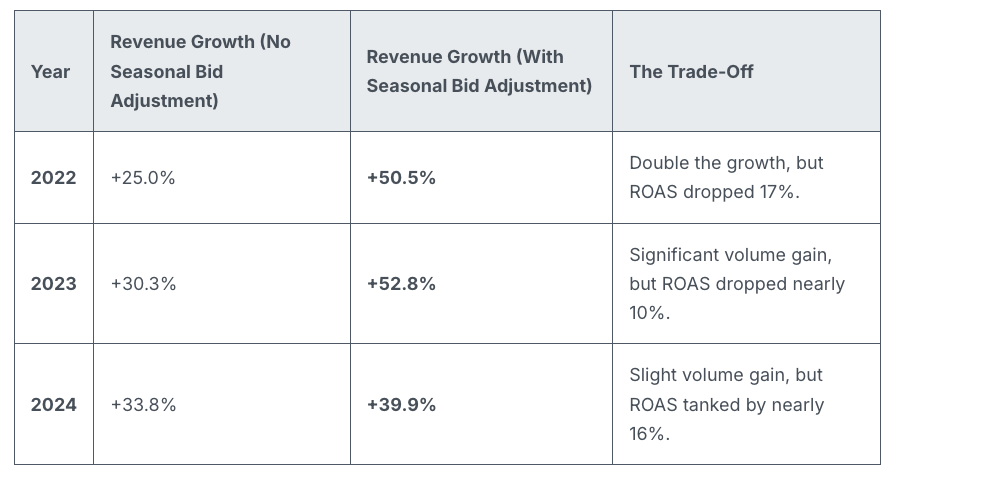
    Revenue lifts were notably higher with adjustments:

    • 2022: +50.5% vs. +25.0%
    • 2023: +52.8% vs. +30.3%
    • 2024: +39.9% vs. +33.8%
    ```json
{
  "alt": "Table showing revenue growth from 2022 to 2024 with and without seasonal bid adjustment with related trade-offs.",
  "caption": "Seasonal bid adjustments impact revenue growth significantly, but come with trade-offs in ROAS, as shown from 2022 to 2024.",
  "description": "This table presents a comparison of revenue growth from 2022 to 2024, analyzing scenarios with and without seasonal bid adjustments. In 2022, a 25% growth without adjustment jumps to 50.5% with it, though ROAS drops by 17%. In 2023, adjustments raise growth from 30.3% to 52.8%, with a 10% ROAS decline. By 2024, growth is 33.8% without and 39.9% with adjustment, noting a 16% ROAS reduction. Keywords: seasonal bid adjustment, revenue growth, ROAS, trade-off."
}
```

    Efficiency may decline, but volume certainly increases.

    When seasonality adjustments make sense. They’re useful when Google doesn’t have prior signals, like one-off or niche events.

    Good for:

    • One-time flash sales
    • Email-only offers
    • Surprise clearance sales
    • Niche seasonal spikes

    Not recommended for:

    • Black Friday
    • Cyber Monday
    • Christmas
    • Valentine’s Day
    • Any event with a predictable historic pattern

    Why we care. Google already recognizes the significance of Black Friday. Smart Bidding is trained with years of BFCM data and can detect conversion rate spikes independently. Overriding this can lead to excessive bidding, increased CPCs, and reduced ROAS, so many marketers might be wasting their budget during this crucial week.

    By recognizing when Smart Bidding has an adequate signal, advertisers can avoid expensive errors, maintain efficiency, and reserve seasonality adjustments for when they add true value.

    Bottom line. Smart Bidding effectively manages major retail holidays. Seasonality adjustments often bring more chaos than benefits during predictable retail peaks. Keep them for unique, brand-specific events that Google can’t predict.

    Smart move: Trust the algorithm — use tools like anomaly alerts, pacing monitors, and bid caps for control without conflicting with Smart Bidding’s core models.

    Dig Deeper. Do Seasonality Adjustments Actually Help During BFCM? A 3-Year Study Says No.


    Inspired by this post on Search Engine Land.


    crushpress.ai community screenshot
  • Retailers Waste on Black Friday Google Ads: The Need for Real-Time Management

    Retailers Waste on Black Friday Google Ads: The Need for Real-Time Management

    During Black Friday, I’ve noticed many retailers, including myself, wasting substantial advertising budgets on Google Shopping ads. The main issue arises when these ads are still running for products that have already sold out, clearly demonstrating a pressing need for real-time stock management.

    As we all know, Black Friday marks the peak of the retail season. However, it’s disheartening to find that so many brands, myself included, end up losing money on Google Shopping ads for items no longer available in inventory.

    The problem: The ads continue to run even after items are out of stock, incurring cost-per-click charges with no possibility of conversion. Through a comprehensive study by ShoppingIQ involving 500 global retailers, it was revealed that a staggering 97% kept paying for clicks on items no longer in stock, sometimes persisting for 24–48 hours.

    Why I care. Out-of-stock ads are not just a financial drain; they also skew campaign performance and disrupt algorithmic learning. When conversion rates plummet for unavailable products, it damages rankings, reduces ROI, and hampers future bidding strategies.

    Example: Take Argos, for instance; they reportedly advertised items that were out of stock during Black Friday, leading to frustrated customers and depleted ad budgets.

    Stock update refresh rates:

    • ~24 hours: 90% of retailers
    • 6–23 hours: 5%
    • 48 hours: 2%
    • Other: 3%

    Retailers’ response: Some companies, such as Mamas & Papas, have started leveraging ShoppingIQ’s real-time stock technology. This helps them focus ads solely on products that are actually available. Samantha Dabek, Senior Digital Marketing Manager, shares that they have managed to cut unnecessary costs and ensure advertising is targeted toward in-stock products.

    The bigger picture: Google Shopping commands around 75% of US retail search spending. However, the default settings let out-of-stock ads run unchecked. ShoppingIQ strongly advocates for retailers to seek more transparency and control from Google to prevent wasted spending.

    Bottom line: For those of us running high-stakes campaigns during Black Friday and other peak times, real-time stock management is essential. Otherwise, each wasted click represents money lost.


    Inspired by this post on Search Engine Land.


    crushpress.ai community screenshot
  • Simplify Video Ad Campaigns with Google’s Direct Uploads

    Simplify Video Ad Campaigns with Google’s Direct Uploads

    I recently discovered a game-changing update from Google that’s bound to catch the attention of many advertisers. Google’s Performance Max now allows me to upload video files directly in the “Edit assets” panel, simplifying the campaign setup process significantly. What’s even better? I don’t need a YouTube channel or Shared Library for this.

    Here’s the scoop. This handy feature pops up as an “Upload” tab in the Google Ads UI, making it super easy to add video assets during PMax campaign creation. Just a simple drag-and-drop, and I’m set to move on, especially helpful if I’m new to video advertising.

    In the YouTube ad setup, I’ll find a clear, highlighted box prompting me to drop in my video file, smoothing out what used to be a more complicated process.

    How does it work? These video files are stored in a Google-managed channel, not on my personal YouTube account. While they’re usable in ads, they don’t function like typical YouTube uploads, which might affect how I manage my content.

    Why it matters to me. This update is a boon if I don’t have a YouTube presence or need a quick way to upload video assets. However, I should be mindful of the trade-offs: I’ll have no analytics, no remarketing capabilities, no metadata access, and crucially, I won’t own the assets long-term. It’s a convenient option for quick setups, but I must proceed with caution and ideally upload through a proper brand channel when possible.

    ```json
{
  "alt": "YouTube ad upload interface highlighting channel selection option.",
  "caption": "Easily select your YouTube channel for ad video uploads and manage your content efficiently with full control over analytics and features.",
  "description": "This image shows the YouTube ad upload interface, specifically focusing on the section where users can choose their channel for uploading videos. The interface allows up to 5 video selections for ad campaigns. The interface highlights the option to upload videos to 'Your own channel,' ensuring users have full control, access to analytics, and various features through YouTube Studio. This process is part of the ad campaign setup on YouTube, emphasizing the importance of channel selection for video management."
}
```

    Important limitations. Using this method imposes several restrictions:

    • No YouTube Analytics
    • No remarketing audiences
    • No metadata editing
    • No custom thumbnails
    • No ability to appeal rejections or restrictions
    • No brand-channel presence or asset ownership

    How I found out. The first mention of this update came from Web Marketing Consultant Dario Zannoni, who shared it on LinkedIn. I appreciated his insights into how this could change my advertising approach.

    The takeaway. This feature is a great shortcut if I’m in a hurry or don’t have a robust YouTube setup. Still, maintaining best practices by using my official brand channel ensures I preserve analytics, gather audience data, and retain creative control.


    Inspired by this post on Search Engine Land.


    crushpress.ai community screenshot