Mastering Multi-Channel Marketing: Stop Juggling, Start Thriving

```json
{
  "alt": "Diagram showing centralized ad management for clients, linking to multiple ad platforms through a unified interface.",
  "caption": "Simplify your ad management with a single platform, seamlessly connecting all your campaigns across multiple clients and networks.",
  "description": "This image illustrates a centralized ad management system that integrates client campaigns with various advertising platforms like Google Ads, Meta Ads, and others. The workflow includes creating a campaign, selecting networks, AI-generated plans, and analytics tracking. Connections show how a unified interface can streamline operations for multiple clients such as Client A, B, C, and D, optimizing marketing efforts with simplicity and efficiency."
}
```

Every Monday, I dive into my role as a paid media manager knowing the chaos that awaits. From Google Ads to TikTok and Reddit, my task is to pull the data from each platform, put it into a comprehensible spreadsheet, and report to my boss by 10 a.m. Amidst all this, I try to decipher what worked last week and why. It’s a frenetic start to the week, to say the least.

Remembering when managing multi-channel campaigns meant juggling just Google Ads and a Facebook campaign feels almost nostalgic now. Today, it’s a tangled web of 12 channels, each with their peculiarities in terms of attribution logic and campaign structures. The disarray is real and mostly ignored, to the detriment of performance marketers like me.

I realize that this Monday morning ritual is less about campaign management and more about tedious chores like data entry and reformatting. Managing campaigns across numerous networks involves reopening platforms repeatedly just to align disparate data points.

```json
{
  "alt": "A woman in an office surrounded by four computer screens showing marketing analytics.",
  "caption": "Navigating the complexities of digital marketing metrics, a woman finds herself amid a sea of analytics data.",
  "description": "In an office setting, a woman sits at a desk surrounded by four large monitors displaying various marketing analytics figures. The screens show data such as ROAS, CPA, CTR, and CPL, highlighting campaign performances. Her expression suggests concentration or concern as she navigates complex digital marketing metrics. This image captures the intensity and focus required in data analysis and decision-making in a modern business environment."
}
```

The prevailing problem isn’t just the time I lose, but the lag it introduces to my operations. When my performance data is scattered across various platforms, delays in identifying key insights can lead to wasted budgets. The inconsistency in strategies across channels further exacerbates the issue.

I’ve come to understand that relying on native dashboards from Google, Meta, and others won’t rescue us from this inefficiency. These platforms prefer keeping us tethered to their interfaces, contributing to the fragmentation. But a paradigm shift is on the horizon: AI-native management tools that promise seamless cross-platform synchronization without the need for multiple dashboards.

The change is happening right now, reimagining how campaigns are managed with AI. It means planning campaigns with simple briefs and automatically syncing creative adjustments across all channels. This reorientation is not just an incremental improvement but a transformational leap that alleviates the operational burdens we’ve carried for too long.
```json
{
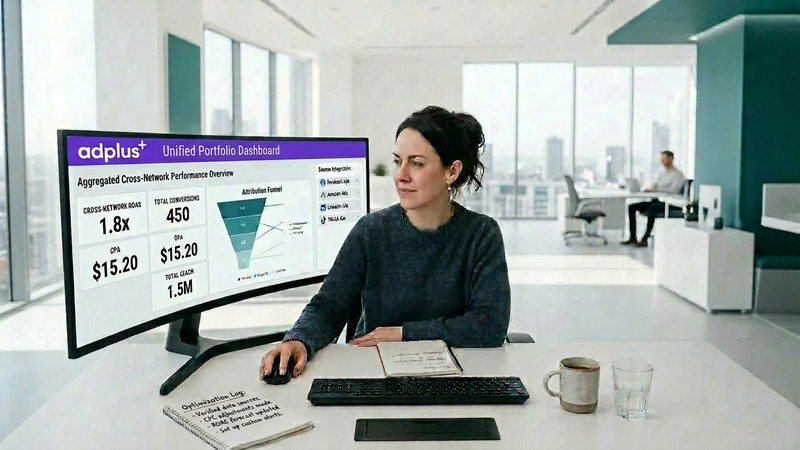
  "alt": "Woman in office using a large monitor displaying an analytics dashboard with performance metrics.",
  "caption": "In a sleek, modern office space, a woman engages with a dynamic analytics dashboard, tracking performance metrics on her wide display.",
  "description": "A woman in a contemporary office setting is focused on an ultra-wide monitor displaying a detailed performance analytics dashboard. The screen showcases key metrics such as ROAS, CPA, conversions, and reach, alongside a visual funnel diagram, under a 'Unified Portfolio Dashboard' by adplus. Her workspace includes a keyboard, notebook, and a coffee mug, suggesting a productive environment. This image embodies themes of data analysis, modern technology, and professional settings."
}
```

For agencies like mine, AI brings another boon: automated and branded client reports that compile multi-network performance data without the Sunday-night grind.

What actions can we take this week? First, I’ll track where my hours truly go throughout a week — seeing is believing when it comes to confronting administrative bloat. Second, standardizing naming conventions across accounts is surprisingly effective in smoothing out cross-platform wrinkles. Third, I’ll delve into evaluating current AI-native tools, as I suspect many teams are operating on outdated assumptions about their capabilities.

Achieving an operational edge in paid media transcends budget size. It’s about faster data-action cycles, unified cross-network performance views, and liberating our teams from the laborious chains of manual processing. This operational edge could mean the difference between thriving and merely surviving in a competitive landscape.


Inspired by this post on Search Engine Land.


crushpress.ai community screenshot

FAQs

What is the main challenge in multi-channel ad ops described in the post?

The post highlights a cross-channel ad ops dilemma where data from Google Ads, TikTok, Reddit, and other networks is scattered across multiple dashboards. This fragmentation creates manual work, slows insights, and adds operational drag for performance marketers. AI-native tools are presented as a way to unify data across channels and reduce the need for multiple dashboards.

What solution does the post propose for cross-channel management?

AI-native management tools are described as the solution, promising seamless cross-platform synchronization without the need for multiple dashboards. The post also notes that campaigns can be planned with simple briefs and automatically synced creative adjustments across channels.

What actions does the author plan to take this week?

Track where hours truly go to identify administrative bloat. Standardize naming conventions across accounts to smooth cross-platform wrinkles. Evaluate current AI-native tools to challenge outdated assumptions.

What is the aim of achieving an operational edge in paid media?

An operational edge means faster data-action cycles and unified cross-network performance views. It also means liberating teams from manual processing, which could determine whether you thrive or merely survive.

How does the post describe the shift away from traditional dashboards?

Traditional dashboards from Google, Meta, and others are described as contributing to fragmentation and inefficiency. The post argues for AI-native tools that promise seamless cross-platform synchronization without multiple dashboards.

What impact does AI have on reporting for agencies, according to the post?

AI enables automated and branded client reports that compile multi-network performance data without the Sunday-night grind. This helps agencies deliver timely insights while reducing manual reporting effort.

What transformation is described as happening now in campaign management?

The post states that AI is reimagining how campaigns are managed, moving beyond incremental improvements to a transformational leap. It emphasizes simple briefs, automatic creative syncing, and reduced operational burdens.

Comments

Leave a Reply

Your email address will not be published. Required fields are marked *