Tag: Marketing Automation

  • How I Make My Marketing Stack Work Harder With AI

    How I Make My Marketing Stack Work Harder With AI

    I see performance marketing under more pressure than it has faced in a decade. Budgets are flat or shrinking, expectations keep rising, and AI is quickly raising the standard for what “good” performance actually looks like.

    For years, I watched performance marketing rely on a familiar playbook. When performance plateaued, teams added another vendor. When targeting weakened, they bought another dataset. When activation became difficult, they layered on more technology. But as budgets tighten and the demand for immediate ROI grows, constantly expanding the stack is no longer sustainable.

    The challenge I see for enterprise marketers is not that they lack data. It is that they struggle to operationalize the data they already have.

    At the same time, AI is revealing a hard truth about modern marketing architecture. Most AI failures are not really model failures. They are data failures. Even the most advanced agent, model, or automation workflow cannot make up for fragmented customer profiles, disconnected activation systems, or stale audience definitions. Yet much of the customer data platform conversation still centers on launching more AI agents.

    I think that misses the point.

    The real question is not whether a platform has an AI agent. It is whether my data foundation can support the leap from automating tasks to partnering on strategic outcomes.

    For too long, the industry treated self-service as the north star. The goal was to help marketers avoid engineering tickets and data science queues. That made sense for the last decade, but it also turned marketers into manual operators of complex systems. The new bar is not just self-service. It is self-directed performance at scale.

    I see a fundamental shift in the marketer’s job-to-be-done. We are moving away from the operational burden of building and managing audiences and toward the strategic work of setting outcomes. Instead of spending the day wrangling segments, I can define the goal, whether that is maximizing customer lifetime value or reducing churn, and let the system suggest the best audience definitions and activation paths. When intelligent agents are connected to a clean data foundation, I move from managing technology to orchestrating outcomes. That is the new blueprint for performance.

    At mParticle, we describe this approach as a performance engine: a model where the data foundation and activation layer work as one connected system. The goal is not simply to collect customer data. It is to make that data immediately useful for performance outcomes.

    Futuristic data archive with glowing server-like filing cabinets, stacked documents, and network lights symbolizing AI marketing data infrastructure.
    Rows of illuminated data cabinets and paper files stretch into the distance, capturing the pressure on marketers to turn fragmented customer data into a smarter performance engine.

    Audience Agent is one example of that idea in action. I can describe what I want in plain language, such as high-value customers who have not repurchased in 60 days, and the agent proposes the underlying logic for me to review and approve.

    For me, the shift is not about handing everything over to automation. It is about working in a marketer-led workflow with an expert collaborator beside me. The longer I work with it, the better it understands the business, the data, the customers, and the patterns that actually move performance. That understanding is only as strong as the data foundation behind it, and ours was built for this long before AI made the need obvious. The marketer leads. The agent elevates and expands the work. Together, they push what is possible.

    That same philosophy shows up in capabilities such as Audience Expansion and Household Reach. Audience Expansion helps me identify additional high-potential users directly from first-party datasets, without depending on third-party lookalike audiences or outside data sources. It gives teams more precise control over the balance between scale and quality.

    Household Reach addresses one of digital marketing’s most persistent blind spots: buying decisions rarely happen in isolation. By using first-party customer data and enriching it with trusted third-party signals, Household Reach helps marketers engage the full decision-making unit, not only the individual who converted first.

    The key distinction is simple. I only need to bring my first-party data. The householding solution handles the rest, helping me reach more of the household without spending extra resources building additional audiences or manually configuring campaigns.

    What connects these approaches is a different mindset. Better performance should not require more vendors, more engineering resources, or more external data. It should come from extracting more value from the customer relationships brands already understand.

    In this era of intense performance pressure, I believe the advantage will go to marketers who stop looking for more vendors to solve every problem. Success will not come from adding more tools to the stack. It will come from using a stronger data foundation to meet rising expectations and activate more of the data we already own.


    Inspired by this post on Search Engine Land.


    crushpress.ai community screenshot
  • Mastering Multi-Channel Marketing: Stop Juggling, Start Thriving

    Mastering Multi-Channel Marketing: Stop Juggling, Start Thriving

    Every Monday, I dive into my role as a paid media manager knowing the chaos that awaits. From Google Ads to TikTok and Reddit, my task is to pull the data from each platform, put it into a comprehensible spreadsheet, and report to my boss by 10 a.m. Amidst all this, I try to decipher what worked last week and why. It’s a frenetic start to the week, to say the least.

    Remembering when managing multi-channel campaigns meant juggling just Google Ads and a Facebook campaign feels almost nostalgic now. Today, it’s a tangled web of 12 channels, each with their peculiarities in terms of attribution logic and campaign structures. The disarray is real and mostly ignored, to the detriment of performance marketers like me.

    I realize that this Monday morning ritual is less about campaign management and more about tedious chores like data entry and reformatting. Managing campaigns across numerous networks involves reopening platforms repeatedly just to align disparate data points.

    ```json
{
  "alt": "A woman in an office surrounded by four computer screens showing marketing analytics.",
  "caption": "Navigating the complexities of digital marketing metrics, a woman finds herself amid a sea of analytics data.",
  "description": "In an office setting, a woman sits at a desk surrounded by four large monitors displaying various marketing analytics figures. The screens show data such as ROAS, CPA, CTR, and CPL, highlighting campaign performances. Her expression suggests concentration or concern as she navigates complex digital marketing metrics. This image captures the intensity and focus required in data analysis and decision-making in a modern business environment."
}
```

    The prevailing problem isn’t just the time I lose, but the lag it introduces to my operations. When my performance data is scattered across various platforms, delays in identifying key insights can lead to wasted budgets. The inconsistency in strategies across channels further exacerbates the issue.

    I’ve come to understand that relying on native dashboards from Google, Meta, and others won’t rescue us from this inefficiency. These platforms prefer keeping us tethered to their interfaces, contributing to the fragmentation. But a paradigm shift is on the horizon: AI-native management tools that promise seamless cross-platform synchronization without the need for multiple dashboards.

    The change is happening right now, reimagining how campaigns are managed with AI. It means planning campaigns with simple briefs and automatically syncing creative adjustments across all channels. This reorientation is not just an incremental improvement but a transformational leap that alleviates the operational burdens we’ve carried for too long.

    ```json
{
  "alt": "Woman in office using a large monitor displaying an analytics dashboard with performance metrics.",
  "caption": "In a sleek, modern office space, a woman engages with a dynamic analytics dashboard, tracking performance metrics on her wide display.",
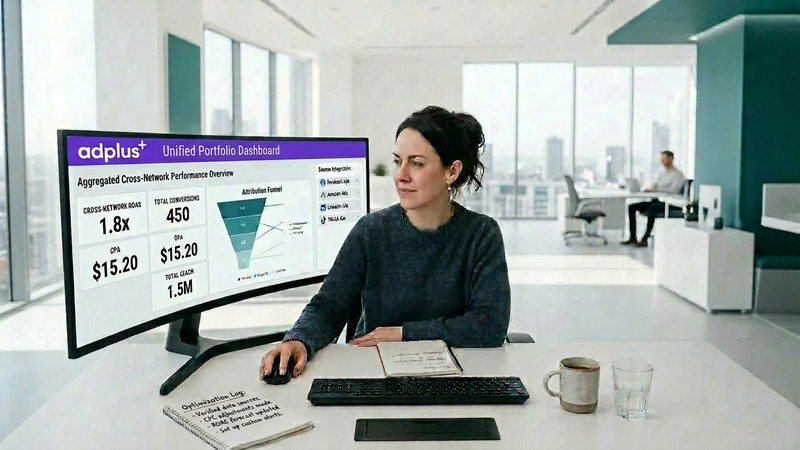
  "description": "A woman in a contemporary office setting is focused on an ultra-wide monitor displaying a detailed performance analytics dashboard. The screen showcases key metrics such as ROAS, CPA, conversions, and reach, alongside a visual funnel diagram, under a 'Unified Portfolio Dashboard' by adplus. Her workspace includes a keyboard, notebook, and a coffee mug, suggesting a productive environment. This image embodies themes of data analysis, modern technology, and professional settings."
}
```

    For agencies like mine, AI brings another boon: automated and branded client reports that compile multi-network performance data without the Sunday-night grind.

    What actions can we take this week? First, I’ll track where my hours truly go throughout a week — seeing is believing when it comes to confronting administrative bloat. Second, standardizing naming conventions across accounts is surprisingly effective in smoothing out cross-platform wrinkles. Third, I’ll delve into evaluating current AI-native tools, as I suspect many teams are operating on outdated assumptions about their capabilities.

    Achieving an operational edge in paid media transcends budget size. It’s about faster data-action cycles, unified cross-network performance views, and liberating our teams from the laborious chains of manual processing. This operational edge could mean the difference between thriving and merely surviving in a competitive landscape.


    Inspired by this post on Search Engine Land.


    crushpress.ai community screenshot