Tag: Technology

  • Behind the Scenes at Google I/O 2026: Unveiling Hidden Innovations

    Behind the Scenes at Google I/O 2026: Unveiling Hidden Innovations

    Attending Google I/O 2026 for the first time felt like stepping into a realm of boundless energy and optimism, almost as thrilling as witnessing a crowning ceremony.

    The initiatives launched last year have transformed into robust pillars of growth. Ask Maps, for instance, has become the blueprint for introducing Ask YouTube. Gemini 3.5 Flash fuels Antigravity, akin to Claude Code but under Google’s banner, and Googlers are already harnessing it to construct the exciting features shown on stage.

    The pace of innovation was breathtaking, everything rolled out swiftly and assuredly.

    Every announcement seemed to cater to a diverse audience.

    • Gemini Omni was likened to Nano Banana but designed for video content (see this strange proof).
    • Smart glasses are making a much-discussed return.
    • There are video game-like experiences that can be instantly prompted and played.
    • The capability for Workspace to bring documents to life with mere conversations.
    • A feature allowing the transformation of Google Maps images into surreal dreams seems more like a solution waiting for a problem, perhaps for Hollywood studios looking to bypass on-location shoots?
    • I even have Gemma on my phone, enabling in-flight conversations with a smaller model. (Thanks to American Airlines’ free Wi-Fi, I’m all set.)

    And yet, the most intriguing element remains to be addressed.

    Gemini and Search: Converging Evolution

    Gemini is beginning to resemble Search, while Search is adopting features of Gemini.

    Both platforms now include features that satisfy similar needs: keeping tabs on the web and alerting users when something of interest arises.

    In Search, these are known as information agents. In Gemini, they go by Spark or Daily Brief. The connection is unmistakable.

    ```json
{
  "alt": "Large tech presentation with speaker on stage, introducing 'Ask YouTube', to a full audience.",
  "caption": "Innovation takes the stage as 'Ask YouTube' is unveiled in front of an excited crowd, promising new features available this summer.",
  "description": "A large tech event features a speaker presenting 'Ask YouTube' on a massive screen, announcing its availability in the U.S. this summer. The venue is packed with attendees capturing the moment on their devices. Stage lighting and modern design elements underscore the futuristic theme of the event. This announcement is part of a wider tech conference, drawing a diverse crowd eager for new advancements. Keywords: tech presentation, Ask YouTube, innovation, audience, event."
}
```

    I asked a product manager about their approach to long-term feature management and overlapping utilities. Their response was simple: “Right now, it’s all about velocity.”

    Shipping fast is the mantra shared by three other product managers, all behind key I/O features initiated and deployed within this whirlwind year, 2026. It’s astounding.

    The product manager elaborated, “Velocity is achieved through reduced managerial overhead.”

    This implies jumping on board quickly and figuring out the finer details later.

    Once You See It, You Can’t Unsee It

    Armed with this understanding, the rest of the day wore a new perspective. The demos were impressive, yet I pondered: what’s the next step with these innovations?

    Though I now have Gemma on my phone, one developer couldn’t provide a tangible day-to-day use case. I witnessed AI Mode’s monitoring prowess by prompting it to “keep me updated.” Despite seeing the connection of components, my questions about managing these alerts as they age went unanswered, indicating it’s still an early-stage demo.

    Many features appear not to address their second-order effects thoroughly. It seems engineers are using these systems at a command line level rather than considering user interfaces.

    A notable point is my current inability to delete old Gemini chats in a web browser, a functionality available in the Mac app.

    ```json
{
  "alt": "Presentation slide detailing shipping timeline for models from 2024 to 2026.",
  "caption": "Unveiling the future: A detailed roadmap showcasing the ambitious shipping timeline for upcoming models.",
  "description": "This image shows a presentation slide with a timeline titled 'Shipping at relentless pace,' outlining shipping schedules for various models from 2024 to 2026. The timeline is divided into columns for each year, highlighting Frontier and Open Models in distinct colors. Audience members are visible, indicating a live presentation setting. Keywords: shipping timeline, presentation slide, future models, live event."
}
```

    Universal Cart Sparks Discussions

    A frequently mentioned feature during I/O was Universal Cart, Google’s new cross-platform shopping protocol.

    My opinion? If you’re Google, it’s an exciting development because, upon adoption, it further solidifies their control over the complete shopping experience. Conversely, for others, this development might be a cause for concern.

    Despite these concerns, the group I conversed with didn’t seem troubled, feeling distanced from the growing anti-AI sentiment in the U.S.

    Speaking with an SEO expert at a major ecommerce brand implementing Universal Cart, they related the velocity comment to their own implementation experience, describing it as feeling rushed.

    The AI Content Guidelines Controversy

    The emphasis on speed helps explain the controversies surrounding Google’s AI content guidelines.

    Just four days before I/O, Google’s Search quality team advised publishers to “write for humans, not AI.” Shortly thereafter, the AI agent team demonstrated capabilities where Google’s own agents browse, interpret, transact, and create web content.

    As Google shifts towards AI handling more tasks, the advice given to publishers starts to sound less sincere.

    Impact on the Web Ecosystem

    I don’t wish to undermine the engineers’ efforts. I communicated my respect for their work directly to them. Building products for search and clients myself, I can relate to frequent criticisms over compliments.

    ```json
{
  "alt": "Screenshot of a menu interface on a digital platform labeled Gemini with options for chat, search, images, and videos.",
  "caption": "Navigate effortlessly with Gemini's sleek menu interface, offering quick access to chats, search options, new image and video features, and more.",
  "description": "This image showcases the menu interface of a digital platform called Gemini. The menu includes options such as New Chat, Search Chats, and new features for Images and Videos. Below, recent items are listed including 'Gemini Spark: Availability and Features' along with options to pin or rename items. The design features a dark theme with white text and icons, providing a modern and user-friendly experience."
}
```

    Still, the potential downside of overlapping features, difficulty in managing or reconciling data could lead to significant technical challenges later. The current AI strategy appears to be: prioritize feature utilization first, reconcile later.

    Nevertheless, I admire Google’s rapid progress and look forward to future developments. Leveraging substantial resources, they can experiment comprehensively to identify successes.

    Regrettably, my enlightening conversation with the product manager was abruptly concluded as we were asked to vacate the premises.

    Spotting the Bright Spots

    Google reports unprecedented high search query volumes. They are enhancing authentication and provenance through SynthID’s expansion into Search and Chrome, welcoming new partners like OpenAI, and integrating C2PA content credential verification.

    These are indeed significant accomplishments.

    However, the relentless pace might lead to unforeseen challenges. My hope is that the quest for speed doesn’t further destabilize the already-fragile web ecosystem.

    In conclusion, it’s undeniably an exhilarating era for search technology.

    Dig deeper.


    Inspired by this post on Search Engine Land.


    crushpress.ai community screenshot
  • Boost Team Efficiency: Overcome GTM Barriers with Storyblok

    Boost Team Efficiency: Overcome GTM Barriers with Storyblok

    I’ve recently stumbled upon some fascinating global research data that highlights a tech gap silently draining team speed, revenues, and competitive edge. The Storyblok Global Speed-to-Market Benchmark Report explores these issues comprehensively.

    This rapidly evolving world demands a new pace, driven by cutting-edge AI and technology, and constant shifts in digital trends have redefined how we handle go-to-market (GTM) strategies.

    In today’s marketplace, everyone, from customers to organizations, expects top-notch deliveries with speed. Unfortunately, only 22.5% of teams consistently meet these soaring speed-to-market expectations, revealing a disconcerting gap between ambition and actualization.

    One might ask, what’s holding us back?

    The Global Speed-to-Market Benchmark survey involved several GTM teams who shared insights on where processes are stalling or facing delays and what steps would truly improve speed-to-market in today’s fast-paced business environment.

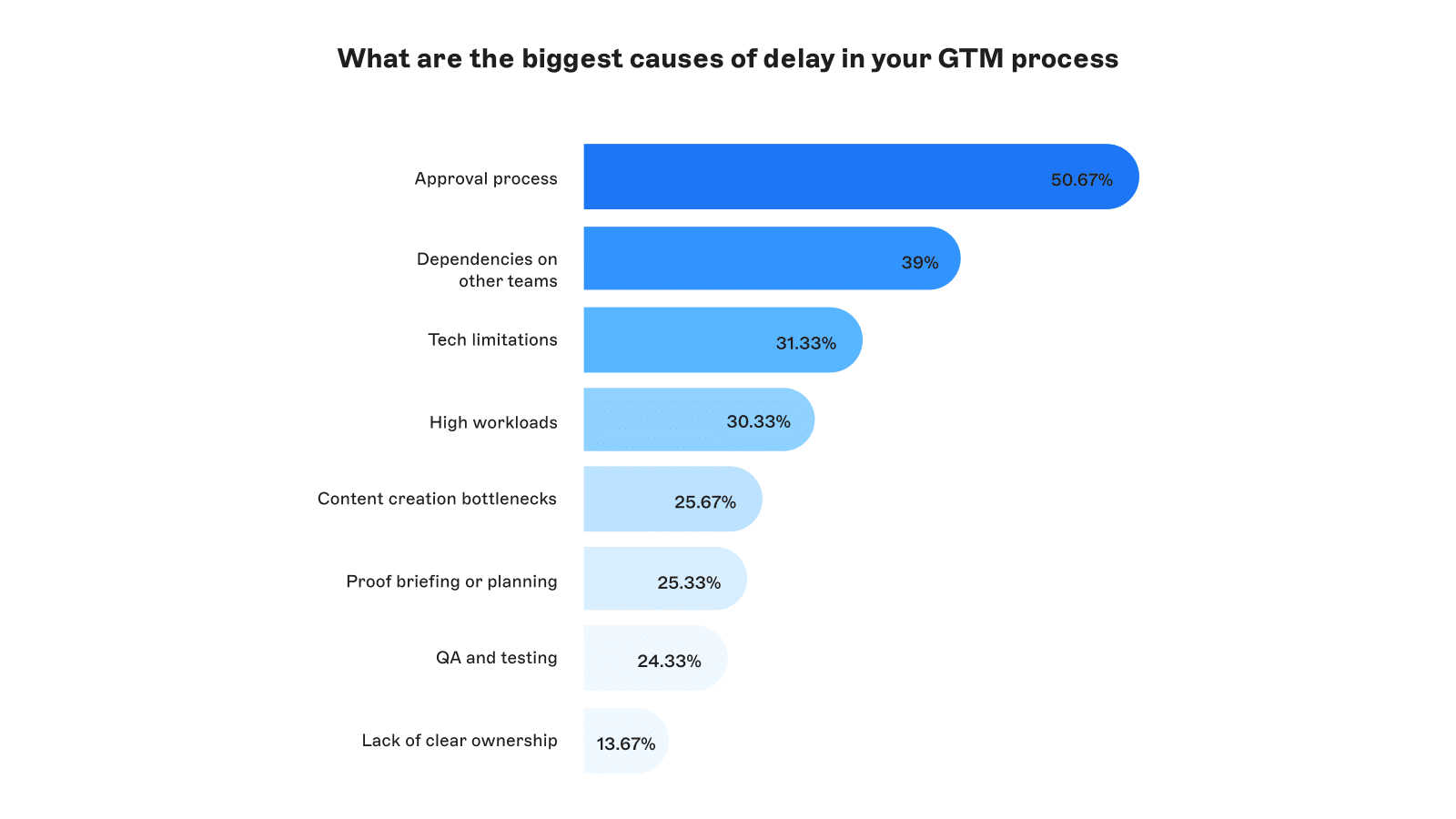
    The survey uncovered four significant bottlenecks largely tied back to technological hiccups or dependencies. The approval process, for instance, emerged as the most substantial bottleneck, with over 50% of teams identifying it as a major hurdle. This includes enduring multiple rounds of content revisions largely driven by disorganized feedback systems, exacerbating inefficiencies.

    The practical solution? A well-configured CMS, particularly a headless one, allows for an organized and efficient content review process by decoupling content from presentation. This ensures stakeholders have access to a central content repository, thereby minimizing review confusion and delays.

    Equally problematic is the overreliance on developers, where 38% of teams require developer input for most GTM operations. This not only slows marketers but also distracts developers from more critical tasks. A modern tech stack enabling team autonomy can mitigate this issue, allowing each team to concentrate on their core functions.

    ```json
{
  "alt": "Bar chart showing biggest causes of delay in GTM processes, with approval process at 50.67% as the top cause.",
  "caption": "Discover what's slowing down your GTM process. Approval processes top the list at over 50%, impacting efficiency and timelines.",
  "description": "This image features a horizontal bar chart highlighting the primary reasons for delays in go-to-market (GTM) processes. Leading the chart is the approval process, causing 50.67% of delays. Following are dependencies on other teams at 39%, tech limitations at 31.33%, and high workloads at 30.33%. Additional factors include content creation bottlenecks, proof briefing, QA and testing, and lack of clear ownership. This breakdown provides insight into operational challenges within marketing strategies. Keywords: GTM process, delay causes, approval process, marketing efficiency."
}
```

    Moreover, compounding tech limitations, including complex deployment and outdated systems, further warrant an overhaul. Tech bottlenecks often operate silently, but they demand attention and timely solutions for improved GTM cycles.

    I also noticed how post-launch firefighting issues are rampant, affecting 79% of teams. This inefficiency stems from fragmented systems, where constant developer intervention is necessary, further delaying launch processes.

    Addressing these challenges involves refining the tech stack, especially choosing a CMS that aligns with modern delivery needs. This results in smoother launches, improved efficiency, and fewer post-launch issues.

    The cost of slow GTM delivery is undeniable, leading to lost revenue and missed market opportunities, while also impacting team morale and increasing turnover risks. Interestingly, there’s a visible discrepancy between executive priorities and the requisite support for improved speed-to-market capabilities.

    Armed with data, teams can make a compelling business case for change, drawing attention to specific bottlenecks and their ramifications, thus bridging the leadership alignment gap.

    Overall, overcoming GTM challenges requires adopting adaptive technology stacks that align with today’s fast-paced demands. By doing so, we not only keep up with competition but also foster a resilient, engaged team poised for success.

    For the complete analysis and strategies, the full Storyblok Global Speed-to-Market Benchmark Report is an invaluable resource.


    Inspired by this post on Search Engine Land.


    crushpress.ai community screenshot
  • Why 40% of AI Projects Fail: The Human Element Matters Most

    Why 40% of AI Projects Fail: The Human Element Matters Most

    In exploring the world of agentic AI, I’ve come across a startling prediction from Gartner: by the end of 2027, more than 40% of these projects will have been canceled. This isn’t due to the technology being insufficient; it’s because of the human factors involved. The real issue lies not with the tech, but with our deployment strategies and the absence of essential human insights.

    Gartner’s research, involving over 3,400 organizations that are currently investing in agentic AI, makes it clear that the downfall isn’t in the capabilities of AI itself. It’s in the decisions we, as humans, are making. Anushree Verma from Gartner notes that most of these AI projects are merely hype-driven experiments, lacking in strategic direction and governance.

    This brings a critical reminder for those of us in marketing: agentic AI can optimize and scale tasks exponentially, yet without a knowledgeable human behind it, the technology is as good as the strategy guiding it. We need agents that can handle audience selection, content generation, and journey orchestration effectively, but we must steer these agents with insight and responsibility.

    If we’re spurred by fear of missing out (FOMO), we might find ourselves hastily deploying AI solutions. This rush can lead to poorly constructed workflows and inadequate data strategies, resulting in agents implementing erroneous actions at inappropriate times. FOMO isn’t a sustainable strategy; it’s a costly oversight.

    Another pitfall presented by Gartner is what’s termed ‘agent washing.’ This is where existing chatbots are disguised as agentic AI without delivering authentic autonomous functionality. As marketing teams, if we invest in these disguised solutions, we’re essentially falling for dressed-up automation without real AI benefits.

    Deploying AI prematurely can be damaging. Gartner anticipates that by 2026, many companies might harm their customer relationships through misguided AI applications, leading to eroded trust and damaged brand reputations. Our role as marketers should be to prioritize strategy and judgment alongside technological advancements.

    One of the gravest challenges we face is the potential erosion of critical thinking brought about by reliance on AI. Gartner predicts half of the organizations will need to reassess competencies, ensuring that our human ability to question and evaluate AI outputs remains sharp and undiminished.

    In this rapidly evolving landscape, the successful marketer will be one who integrates AI while maintaining a leadership role. This encompasses being a multidisciplinary thinker who utilizes AI to transcend traditional roles, driving strategy and ensuring that AI recommendations align with our brand’s vision and values.

    As we embrace the agentic era, it’s imperative that we balance technological advancements with human insights. We shouldn’t slow down but rather be deliberate—ensuring that our AI endeavors are guided by robust human judgment to harness true value, protect customer trust, and avoid costly missteps.


    Inspired by this post on Search Engine Land.


    crushpress.ai community screenshot
  • AI Bots Could Dominate Internet Usage by 2027

    AI Bots Could Dominate Internet Usage by 2027

    I recently heard Cloudflare CEO Matthew Prince predict a fascinating future where AI bots might outnumber us humans on the web by 2027. The surge of agent-driven browsing, paired with the rise of generative AI, could really shake things up online.

    During his talk at SXSW, Prince warned us that bots are already transforming how we use and monetize the internet. This got me thinking about the big shift in search as more people rely on AI-generated answers instead of traditional clicks.

    Why this matters to me. With the prospect of bots becoming the main users of the web, I’ll need to adapt my strategy. Ensuring AI systems can access and trust my content will be crucial for staying relevant.

    Details from Prince. According to Prince, AI agents collect far more information than we do because of their unique browsing habits. While I might visit five sites for a purchase, an AI could browse thousands, generating significant traffic and load.

    Prince also pointed out the rapid changes in the internet’s baseline.

    He said that, for a long time, about 20% of web traffic was from bots, but by 2027, this could surpass human traffic.

    This isn’t a sudden spike, like during COVID-19; it’s a steady increase with no signs of slowing down.

    The broader implications. Prince compared this shift to other digital transformations, like mobile and social media. However, the difference here is profound: users may stop visiting websites directly, relying instead on AI interfaces for aggregated answers.

    The traditional business model of attracting traffic and selling through ads is under threat. After all, bots don’t click on ads, and customers are more likely to trust an AI’s output without further clicks.

    AI sandboxes. I found Prince’s vision of “AI sandboxes” particularly intriguing. These temporary environments for AI agents could appear and disappear millions of times per second, impacting how computing works behind the scenes.

    Such changes will undoubtedly put sustained pressure on our internet infrastructure as traffic continues to grow.

    Business ramifications. Companies are already debating how to adapt to AI’s influence, and there’s no clear consensus yet. Prince highlighted how the nature of bots might sever the direct relationship between businesses and their customers, as bots don’t prioritize brands.

    For content creators like me. AI can be both a challenge and an opportunity. It might reduce direct traffic, challenging ad-based models, but it also creates demand for unique, original data, which AI companies may pay for.

    Local media could thrive by licensing specific content to AI companies, potentially earning more than through digital ads.

    For small businesses. Prince put it wisely: AI agents prioritize price, quality, and efficiency over brand loyalty. This means traditional trust shortcuts might not hold any longer, driving towards relentless aggregation.

    Future considerations. The next era hinges on finding ways to balance control and compensation for content producers and providers. In Prince’s words, “There has to be some exchange of value.”

    The fundamental question remains unanswered: what will be the future business model of the internet?

    For more insights, check out the SXSW interview: The Internet After Search.


    Inspired by this post on Search Engine Land.


    crushpress.ai community screenshot
  • 2026 Creative Ops Mastery: Overcome Bottlenecks with Tech

    2026 Creative Ops Mastery: Overcome Bottlenecks with Tech

    How can I excel in creative operations without compromising quality or overwhelming my team? In this guide, I’m eager to share insights on how to construct a sustainable martech ecosystem and craft scalable workflows that pave the way for success.

    Are you, like me, observing your team’s creative operations straining under increasing demands? You’re not alone. With projects growing more complex and clients becoming more demanding, we, as creative leaders, need a strategy to scale operations without compromising quality or leading our teams to burnout.

    The key lies in working smarter, not harder, by harnessing technology that revolutionizes our entire content lifecycle. Let’s dive into how innovative creative operations leaders are forging resilient workflows that can withstand today’s demanding environment.

    Creative teams are faced with mounting expectations and pressures. According to research, 77% of marketing teams report a rise in project volume each year, with 45% struggling to meet the expanding content needs across various platforms.

    ```json
{
  "alt": "Woman shrugging in front of a digital media interface with folders and icons on an orange background.",
  "caption": "Confused about media storage? This image captures a woman shrugging with a digital interface of files and media icons, set against a vibrant orange backdrop.",
  "description": "The image features a woman with a puzzled expression, shrugging her shoulders in front of a digital media interface. The interface displays folders and various media icons, such as text, images, video, and audio symbols, suggesting a theme of digital organization or media management. The background is a bold orange with digital symbols, enhancing the tech-inspired theme. Ideal for illustrating concepts related to digital media storage, organization, or user confusion in technology contexts."
}
```

    Picture this: my team is managing 15 active campaigns over multiple channels, each demanding a host of asset variations. Communication tangles in email threads, designers toil over locating approved assets, and project managers can’t easily track campaign progress.

    This disarray isn’t merely frustrating; it’s costly. Teams trapped in administrative tasks rather than focusing on creativity can see productivity fall by up to 40%.

    Trying to remedy these challenges by simply expanding the team or establishing stringent processes often falls short. The core problem for many is disconnected workflows and isolated tools. An integrated marketing and creative ecosystem connecting every stage of the content lifecycle is essential.

    ```json
{
  "alt": "Colorful infographic with hexagons illustrating concepts like graph, checklist, communication, and finance.",
  "caption": "A vibrant infographic connects elements like communication and finance, showcasing a dynamic blend of business concepts.",
  "description": "This image features a colorful infographic with hexagonal icons representing various business concepts such as data analysis, process management, communication, and finance. The central image is a checklist, surrounded by icons like a bar graph, gears, network, touch interaction, and a dollar symbol. The background is a warm gradient with geometric shapes, enhancing the image's dynamic and modern feel. Keywords: infographic, business, data, communication, finance, design."
}
```

    Let’s explore the technology stack that can elevate operations, beginning with digital asset management (DAM), which acts as the backbone for creative operations. Not all DAM platforms are equal—look for systems that offer intuitive organization, robust version control, strict brand compliance, and global accessibility.

    For smooth operation, your creative tools, whether Adobe Creative Cloud, Figma, or Canva, should integrate seamlessly with your campaign data systems. Proper integration can reduce friction and speed up the time to market.

    Also crucial are intelligent approval workflows, which can replace cumbersome email chains. Automated workflows with dynamic routing, parallel reviews, contextual feedback, and escalation management can streamline the approval process significantly.

    ```json
{
  "alt": "Laptop displaying an image library interface of diverse models alongside workflow creation form.",
  "caption": "Streamline your creative projects with Canto's intuitive image library and workflow management tools. Perfect for marketing teams seeking efficiency.",
  "description": "The image showcases a laptop screen with Canto's media management interface, featuring a grid of diverse model photos against vibrant backgrounds. A floating form for 'Create a Workflow' is visible, allowing users to manage projects seamlessly. The background uses warm orange hues with graphic elements, emphasizing the platform's user-friendly design. Ideal for teams needing organized and efficient asset management and workflow solutions."
}
```

    Generic project management tools often don’t meet creative teams’ needs. Opt for specialized solutions providing creative-specific templates, visual resource planning, real-time collaboration, and detailed performance analytics.

    As you build scalable workflows, start by mapping out your current processes to identify obstacles. Implementing technology incrementally, designed to scale threefold your current volume, ensures smooth future expansion without growing pains.

    Tracking and measuring key performance indicators like asset fulfillment time, project completion rates, and team utilization allows us to gauge success and make continuous improvements.

    ```json
{
  "alt": "Young person smiling while using a laptop, surrounded by digital icons on an orange background.",
  "caption": "A cheerful moment with technology: A young individual uses a laptop, exploring data and digital tools, set against a vibrant orange backdrop.",
  "description": "The image features a young person with a joyful expression, actively engaged with a laptop. The background is orange and adorned with digital icons, including a magnifying glass, dollar sign, and data charts. This setting suggests themes of technology, data analysis, and financial exploration. The scene combines youthful energy with a modern digital context, appealing to an audience interested in tech and innovation."
}
```

    Even with the best technology, transformation depends on people. Successful change needs careful management, starting with team involvement in choosing technologies and designing workflows, followed by thorough training and feedback-based iteration.

    Looking to the future, the most successful leaders are not only solving current challenges but preparing for tomorrow’s opportunities. Technologies like AI-powered content generation are set to radically shift future workflows.

    To modernize creative operations, the question isn’t if, but how soon. Initiate by auditing your current tools, identifying integration gaps, and considering a trial of comprehensive DAM solutions. The leaders who act now will set tomorrow’s industry standards.


    Inspired by this post on Search Engine Land.


    crushpress.ai community screenshot
  • Reddit Search Revolution: 80 Million Users Embrace New AI Features

    Reddit Search Revolution: 80 Million Users Embrace New AI Features

    Every week, I’m amazed by how 80 million people, just like you and me, are using Reddit’s search feature. During Reddit’s Q4 2025 earnings call, they highlighted this incredible surge in usage following a pivotal transformation. They seamlessly integrated their core search with AI-powered Reddit Answers, setting the stage for Reddit to be a platform where we can both initiate and complete our search journeys.


    What struck me about this change is how Reddit executives addressed the shift in user behavior. People, including myself, are increasingly turning to community discussions to research and make decisions, rather than solely relying on traditional search engines. Reddit sees this as an opportunity to capture that intent within its platform, moving beyond just being a hub of outbound links.


    Why this matters to us. It’s fascinating to consider how Reddit’s evolution affects our daily search habits. Brands need to recognize that visibility on this platform is as crucial as securing a spot on traditional search engines. It’s an exciting development, particularly for those of us who value Reddit’s unique contribution to information discovery.


    Exploring Reddit’s ambitious plans. Steve Huffman, Reddit’s CEO, emphasized significant advancements through unifying keyword search with Reddit Answers. I love how this offers a seamless transition between typical search results and AI-driven insights within a single user-friendly interface.


    Huffman expressed his vision of Reddit as an “end-to-end search destination,” where our curiosity about topics doesn’t just start but expands. It’s exciting to see such growth—more than 80 million of us flock to Reddit weekly, a leap from 60 million a year prior, to deeply explore our interests.


    Reddit Answers is a game-changer. Spearheading much of this growth, Reddit Answers skyrocketed from 1 million to 15 million queries in the last year. Huffman noted its effectiveness with open-ended questions that invite diverse viewpoints—perfect for decisions about what to buy, watch, or try.


    Moreover, Reddit is beta testing “dynamic agentic search results” which include media formats. It’s a move towards more engaging and interactive searches, something I’m thrilled to explore personally.


    Search: A pivotal priority for Reddit. Huffman also revealed ongoing tests with new app layouts, prominently featuring an easily accessible search bar. This move reflects the platform’s intent to prioritize search experiences significantly.


    COO Jennifer Wong sees tremendous opportunity in search and Answers, even as monetization strategies evolve. What resonates with me is her description of Reddit search as an “incremental and additive” engagement tool. It’s aligned with high-intent activities such as researching purchases—an insight into future consumer behavior shifts.


    AI answers elevate Reddit’s importance. The platform’s integration with AI partners like Google and OpenAI is central to this narrative. It’s fascinating how Reddit content has become a primary source cited in AI-generated answers, showcasing its growing role in shaping information access.


    There’s immense potential in steering users from AI answers into active Reddit communities to engage deeper in discussions. Imagine searching for “the best speaker” and not just reading a summary but diving into a vibrant community debate—that’s where Reddit shines.


    Reddit earnings. If you’re interested, you can explore more about Reddit’s financial insights and strategic decisions in their recent report here.


    Inspired by this post on Search Engine Land.


    crushpress.ai community screenshot
  • Exploring the Agentic Web: Are We Prepared?

    Exploring the Agentic Web: Are We Prepared?

    The rapid emergence of the agentic web has left many of us pondering: Are we genuinely ready for this new frontier?

    To get to the bottom of this, let’s start by addressing some foundational questions:

    What’s the agentic web? How can it be utilized? What benefits and drawbacks does it present?

    This piece is not aimed at pressuring AI skeptics to dismiss their valid queries regarding the agentic web.

    Additionally, it doesn’t pass judgment on how you, as an individual or professional, engage with this digital landscape.

    With diverse opinions swirling around the agentic web, I hope to offer some clarity, devoid of any marketing varnish.

    Disclosure: While I am employed by Microsoft and have faith in their direction with the agentic web, my aim is to maintain a platform-neutral perspective.

    Now let’s delve deeper into what exactly the agentic web entails.

    The agentic web consists of advanced tools or agents, tailored to our preferences, that perform time-consuming tasks with our permission.

    For instance, using one-click checkout allows me to transmit my payment details to a merchant seamlessly.

    Neither the merchant nor I need to manage the minutiae; instead, I just consent to the transaction.

    Curious about how AI defines the agentic web, I posed this question to four AI models, discovering intriguing variations in their answers.

    Copilot describes it as a layer of the internet where AI agents turn human intentions into outcomes, keeping user choice intact. Gemini, Perplexity, and Claude offer similar but varyingly nuanced definitions.

    Understanding these varying views helps underscore the fact that AI models are trained on differing data, resulting in diverse responses.

    The clear sentiment divide arises from whether we view the agentic web as a user-friendly layer or an overwhelming digital entity.

    Gemini mentions APIs, crucial for communicating within this space, emphasizing how saved preferences will increasingly play a role.

    To truly grasp the agentic web, we must explore two protocols, ACP and UCP, that underpin its operations.

    Dig deeper: AI agents in SEO: What you need to know

    The Agentic Commerce Protocol (ACP) focuses on actions initiated by express user intent, streamlining transactions via standardized AI interactions.

    Meanwhile, the Universal Commerce Protocol (UCP) encompasses the whole shopping experience, facilitating interactions across platforms and payment systems.

    ACP and UCP are not competitors; rather, they enhance different stages of the user journey, supporting precise or exploratory shopping needs.

    So, what is the agentic web? Truthfully, it’s still evolving alongside user behavior, placing us in a position to shape its destiny.

    Next, let’s explore how we can harness the agentic web, along with its potential benefits and pitfalls.

    Dig deeper: The Great Decoupling of search and the birth of the agentic web

    Based on the unified theme of autonomous actions in its definitions, here are practical applications of the agentic web.

    Consider delving into Elmer Boutin’s technical exploration of how schema will affect agentic web compatibility. Benjamin Wenner offers insights into PPC management in a full agentic ecosystem.

    Let’s now focus on some consumer-centric applications, presented through tasks you’re already familiar with.

    Five consumer applications of the agentic web are currently operational or in development.

    1. Intent-driven Commerce

    For example, stating “Find me the best running shoes under $150” allows an agent to handle the entire commerce process, optimizing around user intent.

    ```json
{
  "alt": "Poll about using agentic commerce solutions, showing voting results.",
  "caption": "Curious about agentic commerce solutions like Copilot Checkout? This poll reveals varying levels of interest among participants.",
  "description": "This image displays a poll asking if users plan to utilize agentic commerce solutions like Copilot Checkout. Options include 'Yes!' (37%), 'I will when they launch for me' (21%), and 'No (please share context)' (42%). The poll has received 57 votes, with one day left to vote. The results showcase diverse opinions on adopting new commerce technologies."
}
```

    By processing user intent, these agents provide a streamlined shopping experience, balancing guidance and user control.

    Consumers enjoy reduced decision fatigue, while brands benefit from enhanced engagement and more direct consumer interactions.

    2. Brand-owned AI Assistants

    Brands can deploy their own AI agents, maintaining control over their customer interactions and providing consistently reliable support.

    By utilizing first-party data, these assistants deliver faster responses while upholding the brand’s voice and accountability.

    They enable global participation without sacrificing brand identity to larger platforms.

    3. Autonomous Task Completion

    Users can assign outcomes like “Prepare a weekly performance summary,” with agents autonomously executing the necessary tasks.

    As agents mature, they evolve from task managers to independent analysts, optimizing results based on initial input.

    This shift enables professionals to focus on strategic insights rather than logistics.

    4. Agent-to-Agent Coordination

    Agents can negotiate and coordinate with each other, streamlining processes like procurement or media buying.

    This could revolutionize consumer and professional interactions, making them quicker and more efficient.

    5. Continuous Optimization

    Agents continuously learn from every action they take, improving their performance over time.

    As they learn, interactions become increasingly personalized, and systems naturally enhance their effectiveness.

    Understanding the pros and cons of the agentic web helps us make informed decisions about its integration into our lives.

    Pros of Embracing the Agentic Web

    We’ve already been conditioned to appreciate convenience. The agentic web proposes a future that embraces this concept fully.

    Simplified interactions, characterized by interpreted user intent, represent the epitome of this streamlined process.

    Cons of Embracing the Agentic Web

    Brands may face challenges in adapting their content to align with AI systems while preserving human accessibility.

    There’s the hazard of designing primarily for machines at the risk of losing the human touch.

    Pros of Resisting the Agentic Web

    Some users value human-centric experiences, suspicious of automated systems—leaning away can help build trust with this audience.

    Cons of Resisting the Agentic Web

    A complete detachment could impact visibility and limit access to emerging opportunities as the digital landscape evolves.

    Many existing systems are built to integrate, preserving fundamental infrastructure rather than replacing it completely.

    The agentic web is still evolving based on how we engage with it. Our understanding of it will guide us in determining its role in our lives.


    Inspired by this post on Search Engine Land.


    crushpress.ai community screenshot
  • TikTok’s New U.S. Venture Ensures Compliance and Security

    TikTok’s New U.S. Venture Ensures Compliance and Security

    I’ve always been fascinated by how companies navigate complex regulatory landscapes. Recently, TikTok made headlines with the launch of a new U.S.-controlled joint venture, a decisive move aimed at aligning with American national security rules.

    To ensure that TikTok can continue serving its vast user base of over 200 million Americans, the company established TikTok USDS Joint Venture LLC. This step was officially taken following an executive order from President Trump on September 25, 2025.

    The big picture. This joint venture stands out because it’s primarily owned by American interests, functioning independently concerning U.S. user data, content moderation, and algorithm security. While ByteDance maintains a 19.9% stake, this remains under the level that’s often scrutinized for national security.

    This initiative leverages TikTok’s already established U.S. Data Security (USDS) program, aiming to protect sensitive information from foreign interference.

    Why it matters to me. As someone who appreciates the dynamic between technology and regulation, this joint venture is a significant test of whether TikTok can continue its operations in the U.S. without facing bans or demands to sell its U.S. assets. It effectively transfers control of key operational areas to American oversight, addressing long-standing security concerns.

    For creators and advertisers like me who rely on TikTok, this development signifies a potential blueprint for future regulations of foreign tech by the U.S.

    Understanding the safeguards. User data from the U.S. will be securely stored in Oracle’s cloud infrastructure in the U.S., with rigorous audits and third-party cybersecurity certifications to ensure adherence to federal and industry standards like NIST, ISO 27001, and CISA.

    The content recommendation algorithm for U.S. users will also be adapted and tested using U.S. data within Oracle’s systems, ensuring robust security through continuous source code evaluations under software assurance protocols.

    Trust, safety, and content moderation at the forefront. The joint venture now holds the decision-making power over trust, safety policies, and content moderation for U.S. users, further reducing foreign influence over crucial decisions.

    Balancing global reach with U.S. control. While U.S.-based security and safety controls are tightened, TikTok’s global entities still handle interoperability and commercial activities like advertising and e-commerce, supporting worldwide visibility for American creators and businesses.

    Governance and leadership. The joint venture is led by a seven-member board predominantly composed of Americans, including executives from Silver Lake, Oracle, Susquehanna International Group, and MGX. Adam Presser serves as CEO, with Will Farrell as Chief Security Officer, and Raul Fernandez, CEO of DXC Technology, chairs the board’s security committee.

    Ownership details. Silver Lake, Oracle, and MGX are the cornerstone investors, each with a 15% stake. Other investors include entities linked to Michael Dell, General Atlantic, Dragoneer, and Xavier Niel. These safeguards also cover CapCut, Lemon8, and other TikTok-associated apps in the U.S.

    What comes next. TikTok USDS Joint Venture positions itself as a definitive response to U.S. regulatory pressures. It remains to be seen whether it will fully placate lawmakers and security agencies, ultimately securing TikTok’s future in the U.S. as scrutiny begins.

    Catch-up. A $14 billion arrangement keeps TikTok operational in the U.S.


    Inspired by this post on Search Engine Land.


    crushpress.ai community screenshot
  • Unlock Premium Olympic Advertising with Google’s New CTV Access

    Unlock Premium Olympic Advertising with Google’s New CTV Access

    I’m thrilled to share some exciting news for advertisers. Google has opened the door to Olympic live sports inventory, now accessible through biddable CTV buys, capturing massive reach with enhanced control and measurement.

    Live sports advertising is revolutionizing how we connect with audiences—more programmatic and measurable than ever before.

    Driving the news. I’m particularly excited about Google’s latest move: introducing new abilities to bid on live sports through Display & Video 360. This includes access to NBCUniversal’s Olympic Winter Games inventory, just in time for the bustling 2026 sports calendar.

    Why it matters to us. Live sports consistently engage vast and attentive audiences, and now with Google’s enhancement, advertisers like us gain more control and precision without losing reach.

    What’s new. We can now reach fans directly on the big screen by merging Google audience data with NBCUniversal’s live sports CTV inventory and engage them further across YouTube and Google’s platforms. Google introduces household-level frequency management, powered by AI, to avoid ad overexposure and link CTV impressions to purchases seamlessly.

    Additionally, Google has revamped its Marketplace to make accessing and activating curated sports packages a quick and easy process, saving us time and hassle.

    The big picture. As viewers move across connected TV, YouTube, and social feeds, we’re challenged to maintain their attention across multiple screens. Google’s Display & Video 360 is emerging as the essential hub to capture these moments, from our living rooms to our mobiles.

    The bottom line: By integrating Olympic and live sports inventory into Display & Video 360, Google has made purchasing premium sports advertising more efficient, transparent, and accountable.


    Inspired by this post on Search Engine Land.


    crushpress.ai community screenshot
  • Sergey Brin Opens Up: Google’s AI Missteps and Future Vision

    Sergey Brin Opens Up: Google’s AI Missteps and Future Vision

    When I think about Google’s journey with artificial intelligence, Sergey Brin’s admission strikes a chord. He candidly revealed that Google ‘for sure messed up’ by not prioritizing AI investments at the right time. Looking back, it seems clear that we released groundbreaking research but didn’t capitalize on it to ride the current wave of generative AI.

    Google’s cautious approach always intrigued me. According to Brin, there was hesitation and fear about potential missteps, especially since chatbots could ‘say dumb things.’ It’s fascinating to hear him acknowledge that Google didn’t move quickly enough after publishing the Transformer paper.

    The hesitation seemed to stifle opportunities. Brin admitted that while Google was reluctant, companies like OpenAI leapt forward with brilliant foresight. They seized the moment, leveraging insights and even talent, such as Ilya Sutskever, to drive AI innovation.

    Reflecting on the past, Brin shared, “In some ways, we for sure messed up in that we underinvested… eight years ago when we published the transformer paper. We didn’t take it all that seriously and didn’t necessarily invest in scaling the compute. And also we were too scared to bring it to people because chatbots say dumb things. And you know, OpenAI ran with it, good for them.” He graciously acknowledged the value of the history we’ve built.

    The current landscape still favors Google, as Brin points out. Years of AI research and development, deep learning, and our robust infrastructure continue to provide a competitive edge. This bedrock underlines the control we maintain over key technologies driving AI today.

    Why does this matter? Brin’s insights shed light on why Google’s AI-driven changes in search sometimes seem sudden and erratic. Our earlier caution means we now find ourselves speeding ahead, possibly too quickly, to bridge the gap. The fluctuating nature of Google Search is a byproduct of this rapid adjustment process.

    When Brin spoke about AI’s future, he characterized the field as highly competitive and ever-evolving. He mentioned, “If you skip AI news for a month, you’re way behind.” It’s uncertain what the ultimate potential of AI is, or if there’s a limit to its intelligence.

    On a personal note, Brin shared that he often uses Gemini Live for engaging conversations while driving. Interestingly, he noted that the public version is outdated, with a “way better version” on the horizon.

    Looking back and forward, Brin’s remarks at Stanford were part of an event celebrating the School of Engineering’s century-long legacy. The discussion touched on Google’s early days, its culture of innovation, and the present AI ecosystem. You can watch the full video here.


    Inspired by this post on Search Engine Land.


    crushpress.ai community screenshot