Tag: Technology

  • Sergey Brin Opens Up: Google’s AI Missteps and Future Vision

    Sergey Brin Opens Up: Google’s AI Missteps and Future Vision

    When I think about Google’s journey with artificial intelligence, Sergey Brin’s admission strikes a chord. He candidly revealed that Google ‘for sure messed up’ by not prioritizing AI investments at the right time. Looking back, it seems clear that we released groundbreaking research but didn’t capitalize on it to ride the current wave of generative AI.

    Google’s cautious approach always intrigued me. According to Brin, there was hesitation and fear about potential missteps, especially since chatbots could ‘say dumb things.’ It’s fascinating to hear him acknowledge that Google didn’t move quickly enough after publishing the Transformer paper.

    The hesitation seemed to stifle opportunities. Brin admitted that while Google was reluctant, companies like OpenAI leapt forward with brilliant foresight. They seized the moment, leveraging insights and even talent, such as Ilya Sutskever, to drive AI innovation.

    Reflecting on the past, Brin shared, “In some ways, we for sure messed up in that we underinvested… eight years ago when we published the transformer paper. We didn’t take it all that seriously and didn’t necessarily invest in scaling the compute. And also we were too scared to bring it to people because chatbots say dumb things. And you know, OpenAI ran with it, good for them.” He graciously acknowledged the value of the history we’ve built.

    The current landscape still favors Google, as Brin points out. Years of AI research and development, deep learning, and our robust infrastructure continue to provide a competitive edge. This bedrock underlines the control we maintain over key technologies driving AI today.

    Why does this matter? Brin’s insights shed light on why Google’s AI-driven changes in search sometimes seem sudden and erratic. Our earlier caution means we now find ourselves speeding ahead, possibly too quickly, to bridge the gap. The fluctuating nature of Google Search is a byproduct of this rapid adjustment process.

    When Brin spoke about AI’s future, he characterized the field as highly competitive and ever-evolving. He mentioned, “If you skip AI news for a month, you’re way behind.” It’s uncertain what the ultimate potential of AI is, or if there’s a limit to its intelligence.

    On a personal note, Brin shared that he often uses Gemini Live for engaging conversations while driving. Interestingly, he noted that the public version is outdated, with a “way better version” on the horizon.

    Looking back and forward, Brin’s remarks at Stanford were part of an event celebrating the School of Engineering’s century-long legacy. The discussion touched on Google’s early days, its culture of innovation, and the present AI ecosystem. You can watch the full video here.


    Inspired by this post on Search Engine Land.


    crushpress.ai community screenshot
  • How Google’s AI Enhancements Improve Search Engagement

    How Google’s AI Enhancements Improve Search Engagement

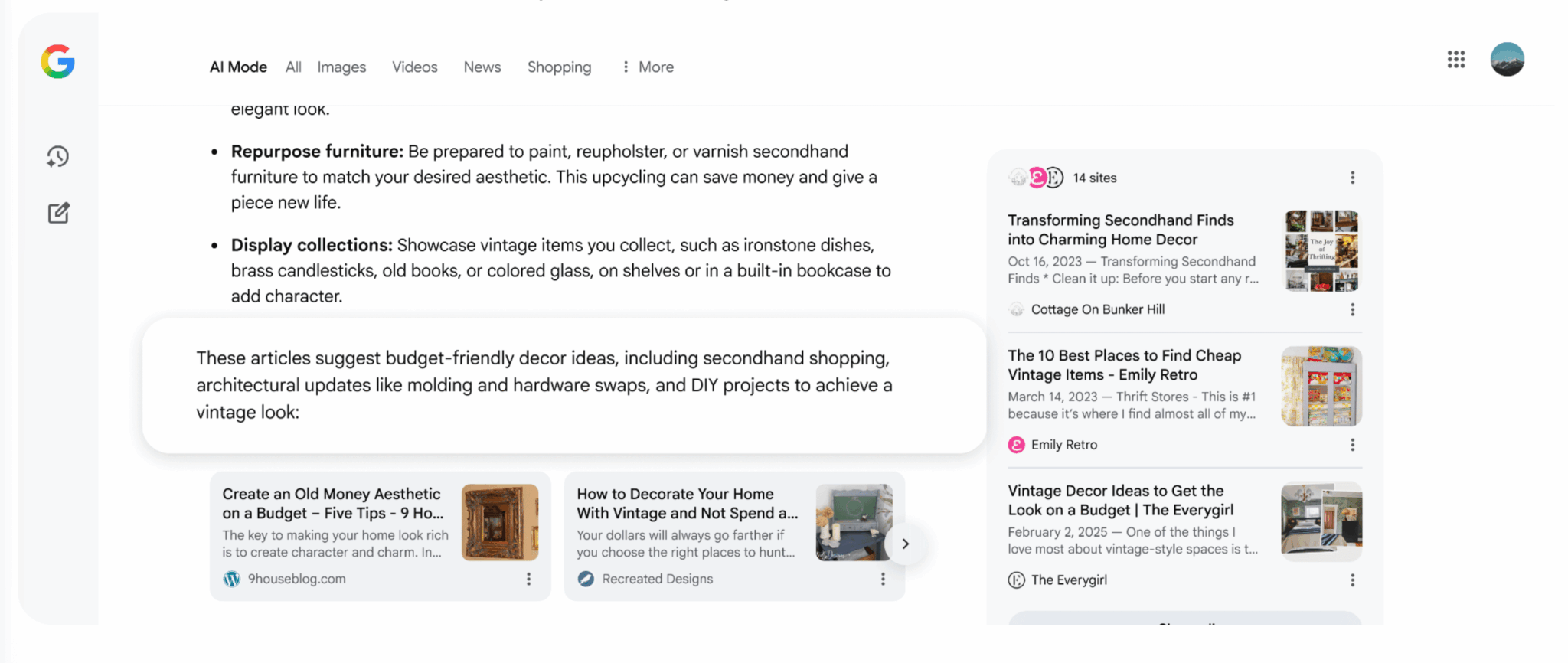
    In recent developments, I discovered that Google has announced updates to its AI Mode link features and expanded the Web Guide test to the ‘all’ tab on the search interface.

    I noticed that Google is actively improving links within AI Mode to make searchers more inclined to click. They’ve now expanded the Web Guides labs test into the all tab, though participation still requires opting into the experiment.

    Links in AI Mode. Robby Stein, Google’s VP of Product for Search, shared that they’re increasing the number of inline links in AI Mode and refining their design to enhance usability. Google has been experimenting with inline links and contextual links, and now some of these user experiences are officially rolling out. Stein had mentioned back in August that these features would see the light, and here they are.

    Additionally, Google’s adding contextual introductions to the embedded links in AI Mode responses. These brief statements help you understand why a particular link could be beneficial to explore.

    Here’s a visual representation:

    Expanding Web Guide to all tab. Google first introduced its Web Guide within the ‘web’ tab for those participating in the experiment. Now, this feature is accessible through the ‘all’ tab of Google Search, still requiring experiment opt-in.

    I remember observing Google testing Web Guide in the all tab earlier, and now it’s officially part of the experience.

    ```json
{
  "alt": "Google search results for vintage decor ideas, highlighting budget-friendly articles and tips.",
  "caption": "Discover how to transform your home with affordable vintage decor tips from these curated articles and guides!",
  "description": "The image displays Google search results for vintage decor ideas, emphasizing budget-friendly solutions. It includes articles on repurposing furniture, displaying collections, and using secondhand finds to enhance home décor. Suggestions focus on affordable DIY projects and architectural updates like molding to achieve a vintage aesthetic. Keywords include vintage decor, budget-friendly, DIY, secondhand shopping, and home aesthetic."
}
```

    According to Google’s statement, “We’ve heard positive feedback from users and websites about Web Guide, as it helps in discovering new links and uses AI to organize these links into helpful topic groups.”

    Google also says they’ve optimized Web Guide to be twice as fast, adding to its efficiency.

    What is Web Guide. As per Google’s explanation, Web Guide groups web links in useful manners. This allows pages related to specific facets of your query to be compartmentalized effectively.

    “Web Guide utilizes a custom version of Gemini to better interpret both search queries and web content, enhancing its ability to bring up pages you might not have found before,” Google explained to me.

    Additionally, Web Guide employs a query fan-out technique, similar to AI Mode, which launches multiple related searches at once to deliver more relevant results.

    Why it matters. The enhancement of link engagement through Google’s AI features like AI Mode and AI Overviews is a positive move. I hope this leads to boosted traffic for publishers and website owners.

    Web Guide is also a feature that’s gaining appreciation in the search marketing realm. I’m hopeful that Google can eventually offer this experience without needing opt-ins via the Search Labs.


    Inspired by this post on Search Engine Land.


    crushpress.ai community screenshot
  • Revolutionize Your Google Ads API Interaction with New Developer Assistant

    Revolutionize Your Google Ads API Interaction with New Developer Assistant

    I can’t contain my excitement as Google unveils the Developer Assistant for the Google Ads API. This breakthrough tool allows us, as advertisers and developers, to leverage natural language to create, manage, and export Ads API queries effortlessly.

    Google has introduced the Google Ads API Developer Assistant v1.0, an innovative Gemini CLI extension. It empowers us to interact with the Ads API seamlessly, transforming our everyday language into instant answers, functional code, and even real-time API calls.

    How it works: Embedded within the Gemini CLI, the assistant utilizes project contexts from GEMINI.md and configuration files to generate precise code tailored to our specific environment. With a simple query like, “How do I filter by date in GAQL?”, I receive immediate assistance. If I describe a task, such as “Show me campaigns with the most conversions in the last 30 days,” it provides both the GAQL query and a well-optimized Python script using the google-ads-python client library.

    Key features include: The ability to execute read-only API calls directly from the terminal, presenting the results in cleanly formatted tables. Plus, any tabular data can be exported to CSV, filed neatly in a dedicated directory. All code generated by the assistant is automatically organized within a saved_code/ folder for easy access.

    Why it matters to us: The Google Ads API is immensely powerful yet complicated. This new Developer Assistant simplifies our workflow drastically, making it quicker and more efficient for teams to create, refine, and optimize Google Ads API workflows—the core of comprehensive campaign management and reporting.

    By converting natural language into GAQL queries and operational code, it minimizes technical obstacles and speeds up our ability to glean insights that could lead to better optimization strategies. The ease of one-command execution and CSV exports means we spend less time dealing with coding complexities and more on boosting performance.

    The big picture: Google positions the assistant as a dual-purpose tool—a learning aid for beginners and a productivity enhancer for experienced users. For newcomers, the use of natural language commands significantly lowers the learning curve.

    For advanced users like me, features such as code generation, automatic file management, and command-line execution streamline and minimize repetitive tasks involved in daily API operations.

    Getting started is straightforward: Ensuring you have a Google Ads API token, a configured google-ads.yaml, Python 3.10+, the Gemini CLI, and a local clone of the google-ads-python library is essential. A setup script handles the cloning process, with full instructions available on GitHub.

    What’s next: Google invites early users to provide feedback, suggest features, and engage with the community on the Discord channel as the platform evolves with more enhancements and AI-driven tools.

    The bottom line: By enabling developers to query, code, and execute using everyday language, Google is transforming the Google Ads API into a faster, more intuitive, and broadly accessible tool.

    Dig Deeper: For more insights, check out Introducing the Google Ads API Developer Assistant v1.0: Interact with the API using Natural Language.


    Inspired by this post on Search Engine Land.


    crushpress.ai community screenshot
  • Embrace Positionless Marketing: Think Beyond Traditional Limits

    Embrace Positionless Marketing: Think Beyond Traditional Limits

    In 1997, Apple launched a groundbreaking campaign that I often think about: “Think Different”. It celebrated those who dared to break the mold, challenging norms to change the world. Apple grasped a vital truth: the constraints stifling creativity weren’t real; they were assumed, passed down through tradition.

    Fast forward to today, and I see that marketing finds itself in a similar “Think Different” moment. The barriers that once constrained our industry have vanished. Thanks to technology, AI generates countless variations, data platforms provide up-to-the-minute insights, and orchestration tools bridge every channel instantaneously.

    Yet, I notice many marketers are still functioning within an outdated paradigm. They wait for others—the data teams, creative teams, or engineers—to move projects along, not realizing technology has already unlocked those doors.

    We no longer need to follow a linear, assembly-line process that passes tasks from one department to the next. The box has disappeared, but old habits die hard.

    Here’s to the marketers who refuse to wait for approval

    I find inspiration in those who see a customer need at 3 p.m. and launch a personalized campaign by 4 p.m., driven by urgency rather than seeking permission.

    These are the marketers who don’t send multiple briefs to multiple teams—they pull the data, create content, and execute campaigns independently. Not to sideline experts, but to seize on moments that matter now.

    Their constant experimentation, running multiple tests and iterations, proves essential in crafting insights. They know, as I do, that perfection comes from trial and error, not waiting around for analysis.

    Here’s to the ones who see campaigns where others see dependencies

    For them, it’s not about passing data to an analytics team; it’s about directly accessing and utilizing customer insights instantly.

    They bypass traditional creative approvals with AI tools that produce tailored assets swiftly, enabling personalization on a grand scale.

    They aren’t beholden to engineering delays but leverage orchestration platforms to automate journeys smoothly, sans tickets.

    They’re not reckless nor cowboys

    Instead, they work at the speed technology allows, guided by strategic thinking and judgment rather than rigid processes.

    This ethos is at the heart of Positionless Marketing: using Data, Creativity, and Optimization powerfully and in tandem, not due to a lack of specialists, but because technology removed those earlier dependencies.

    This isn’t just about speed; it’s about potential

    In times when marketers managed long processes, their role was merely about coordination. Today, I see it as enabling potential, pushing everyone, including you and me, to do what we’re capable of with unchained boundaries. I no longer see the brief as a roadblock, but a stepping stone to instant creativity and autonomous coordination.

    Teach people to think outside the box by showing them there is no longer a box

    Now, I can see how the data analyst can transcend report creation to build real-time predictive models. The campaign manager can independently design, test, and optimize entire journeys. The creative strategist can not only craft briefs but execute ideas across platforms.

    This is the real impact of technology; not just getting the work done, but dismantling barriers that once held us back, releasing the talents we’ve always possessed.

    The Positionless Marketers of today are doing the same thing

    They refuse to delay action when immediate responses are needed. They reject the notion that insights take forever when available in seconds. They aren’t bound by bygone constraints.

    By thinking differently, not for defiance’s sake, but because the past ways no longer align with the new potential.

    Apple once said, “The people who are crazy enough to think they can change the world are the ones who do.” In our era, those who believe they can seamlessly deliver customized experiences and instigate rapid-fire campaigns without relying on dependencies will lead the charge.

    The constraints are gone. The assembly-line marketing box can no longer exist.


    Inspired by this post on Search Engine Land.

    crushpress.ai community screenshot
  • Mastering SEO Tool Evaluation in 2026: Avoid Budget Pitfalls

    Mastering SEO Tool Evaluation in 2026: Avoid Budget Pitfalls

    As I navigate the ever-evolving world of SEO, evaluating tools in 2026 has become a complex task. Rising costs and the AI frenzy often make it difficult to justify the investment in new platforms.

    The challenge lies in demonstrating the business value of these tools to leadership, who are more interested in results than in the number of keywords we can track or the speed of content optimization.

    Most tools fail to meet the demand to connect SEO work directly to business outcomes. The offerings often come bundled in convoluted packages, further complicating the decision-making process.

    This article offers a framework to approach SEO tool evaluation in 2026, focusing on must-have features, efficient tool comparison methods, and effective vendor conversations.

    Understanding the forces reshaping SEO tools can help. Many platforms lag in connecting SEO to measurable business value, complicating budget approvals.

    AI advancements are setting new expectations. Whether to train a custom AI agent or invest in a ready-made tool is a key question every team faces.

    Small teams need automation that truly saves time. Without context, many tools only generate noise, failing to deliver tailored insights for specific markets or businesses.

    Technical SEO tools remain relatively stable, yet the assumption that AI can solve all problems presents a budgeting challenge.

    Real impact in tool evaluation lies in focus areas like advanced data analysis, SERP intelligence, meaningful automation, robust multilingual support, and transparent pricing.

    To avoid wasting time comparing tools, start with clear pricing, align tests with typical weekly tasks, and ensure you always secure a free trial.

    When it comes to vendor interactions, concise goals and informed questions can streamline discussions and facilitate more productive evaluations.

    Business considerations should include presenting a range of options, avoiding overpromising, and ensuring that proposed tools align with strategic business objectives.

    As we look to the future of SEO tools, connecting searches to tangible business outcomes will define premium offerings, though such solutions remain rare.


    Inspired by this post on Search Engine Land.

    crushpress.ai community screenshot
  • Cloudflare’s AI Defense: Blocking Billions of Bot Requests

    Cloudflare’s AI Defense: Blocking Billions of Bot Requests

    Since July 1, I’ve been closely following Cloudflare’s battle against AI bots. Our CEO, Matthew Prince, recently shared that we have successfully blocked 416 billion AI bot requests for our customers during this time.

    This insight sheds light on Google’s significant advantage in AI. They’re currently capable of viewing 3.2 times more web pages than OpenAI, underlining the challenge smaller AI companies face.

    Why this matters. The flood of AI systems consuming vast amounts of web content is concerning, especially without a mechanism for publishers to counteract this. Our statistics at Cloudflare show just how aggressively these AI bots are searching for data.

    The current scenario. Ever since we launched our pay-per-crawl initiative on July 1, our clients have been automatically blocking AI crawlers. At the recent WIRED Big Interview event, Prince highlighted that so far, 416 billion AI bot requests have been turned away.

    Analyzing Cloudflare’s data reveals that Google sees:

    • 3.2 times more webpages than OpenAI.
    • 4.6 times more than Microsoft.
    • 4.8 times more than Anthropic or Meta.

    As Prince mentioned, Google enjoys “this incredibly privileged access.”

    The bigger picture. As it stands, Google offers publishers a difficult choice: either block AI training and risk disappearing from Google Search or allow it and accept AI scraping.

    • Prince said, “You can’t opt out of one without opting out of both, which is crazy. You shouldn’t get to use your monopoly of yesterday to secure a monopoly of tomorrow.”

    The AI landscape. Prince believes:

    • AI signifies a major shift in platforms that could reshape the web’s business model.
    • Cloudflare aims to prevent market consolidation, ensuring the web remains open while assisting creators and businesses in adapting to this shift.
    • Encouragingly, publishers that already block AI crawlers report positive results, Prince noted.

    Looking ahead. As AI models pursue superior training data, the worth of “creative, original human thought” will climb, potentially leading to opportunities in paid licensing, Prince forecasted. Meanwhile, Cloudflare is advocating for AI giants, particularly Google, to distinguish between search and AI crawling.

    • Prince asserted, “Google is the problem here. It is the company that is keeping us from going forward on the internet, and until we force them – or hopefully convince them – that they should play by the same rules as everyone else and split their crawlers up between search and AI, I think we’re going to have a hard time completely locking all the content down.”

    The story. To explore further, check out WIRED’s article on Cloudflare Has Blocked 416 Billion AI Bot Requests Since July 1 (subscription required).


    Inspired by this post on Search Engine Land.


    crushpress.ai community screenshot
  • Navigating the AI Shift in Digital Marketing

    Navigating the AI Shift in Digital Marketing

    I’ve witnessed firsthand how AI agents are taking over traditional browsing methods by executing tasks directly. This shift makes web clicks and the funnels that depend on them increasingly obsolete.

    In this evolving landscape, it’s crucial for brands like mine to optimize for machine users. Becoming favorable to AI systems will determine which brands succeed moving forward.


    Inspired by this post on Try Profound Blog.


    crushpress.ai community screenshot
  • Inside Google’s Overambitious Daily Hub Revolutionizing Search

    Inside Google’s Overambitious Daily Hub Revolutionizing Search

    I recently delved into the enigmatic world of Google’s Daily Hub, a complex system aiming to redefine how we interact with search. At its core, Daily Hub sought to seamlessly integrate embeddings, entities, and real-time context. Unfortunately, the system crumbled under the weight of its own complexity.

    The Daily Hub is far more intricate than many of us originally thought. It represents a broader trend toward hyperpersonalization we’ve seen lately. Elements like Preferred Sources and followable profile pages in Discover are steadily headed toward predicting what I need even before I type my queries.

    Tracing its roots, Daily Hub extends from the “News Digest and Daily Brief” agent, which surfaced during my exploration into Google’s vast, ongoing AI initiatives. This system launched with much fanfare on the Pixel 10, yet was swiftly paused due to its intricate technical web.

    The Daily Hub’s Three-Tier Architecture

    Imagine Google’s system as a grand conductor, coordinating a diverse ensemble in real-time harmony. This is precisely the vision for Daily Hub.

    First Tier: The ‘Memory and Embeddings’ Layer

    Daily Hub’s foundation is built on two key document types, forming its memory.

    The MemoryDocument encapsulates full content units, complete with structured text, entity identifiers from the Knowledge Graph, comprehensive embeddings, and essential technical metadata.

    There’s also the MemoryEntityDocument, a leaner form that embodies each specific entity highlighted in the content.

    In practice, if Daily Hub processes an article about “Lionel Messi joining Inter Miami,” it constructs a MemoryDocument for the article and various entity documents for involved topics like “Lionel Messi” and “Inter Miami CF.”

    Second Tier: The Personalization Triumvirate

    Various systems power the personalization aspect of Daily Hub, ensuring its response to personalized searches and updates is both swift and attuned to individual preferences.

    Nephesh, known for refining user interests, AIP_TOP_ENTITIES, and TAPAS_USER_PROFILE each contribute to crafting a unique user interaction experience by leveraging behavior and contextual data.

    ```json
{
  "alt": "Flowchart depicting data processing from inputs to outputs involving various stages like signal processing, entity ranking, and behavior analysis.",
  "caption": "This flowchart visualizes a data processing pipeline, showcasing steps from capturing user signals to creating personalized content cards using AI models.",
  "description": "The image is a flowchart illustrating a complex data processing pipeline. It starts with inputs such as user signals, knowledge graph data, behavioral profiles, and memory layers. These inputs are processed through stages like NEPHESH for signal processing, AIP Top Entities for entity ranking, and TAPAS User Profile for behavioral analysis. Outputs such as AMBIENTRANKING algorithms yield personalized content cards. The system integrates AI models like GEMINI 2.5 FLASH LITE, showing a sophisticated process for generating data-driven results."
}
```

    Third Tier: ‘Ambient’ Orchestration

    In this realm, the AmbientRanking system oversees card presentations, using metadata to refine user experiences based on relevance and timeliness.

    For example, sports scores and calendar events are prominently displayed when their relevance is at its peak, ensuring my engagement with timely content.

    Understanding Gemini Prompts

    Andell’s documentation of Gemini’s prompts offers unparalleled insights into the system’s strategic thinking.

    Prompt ‘News Topics’: News over 7 Days

    With precise formatting and numerous constraints, this prompt identifies and summarizes pertinent news while meticulously adhering to laid down thematic boundaries.

    The prompt logic considers only the top interests and excludes unnecessary themes, maintaining focus solely on pertinent areas.

    A System with Potential: The Journey Ahead

    Despite its hiccups, Daily Hub is a prototype that embodies Google’s goal to create an assistant capable of forecasting our needs through sophisticated data integration and hyper-personalized content delivery.

    As these technical hurdles are addressed, I anticipate a transformation in how I interact digitally, setting a new standard for search interfaces.

    From today’s suspended project to tomorrow’s blueprint for digital interaction, Google’s vision pivots on delivering a groundbreaking consumer experience.


    Inspired by this post on Search Engine Land.


    crushpress.ai community screenshot
  • ChatGPT Outage: How Users Are Affected and What to Expect

    ChatGPT Outage: How Users Are Affected and What to Expect

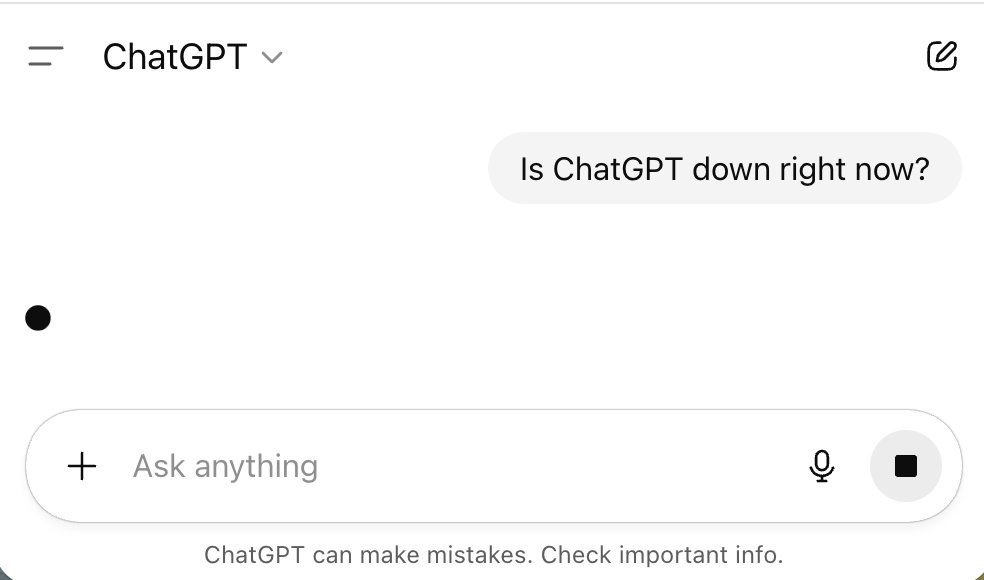
    Today, I noticed that ChatGPT, the popular AI service from OpenAI, was unresponsive for many of us trying to interact with it. Attempts to ask questions yielded no results, leaving many in a lurch.

    After checking OpenAI’s status page, I found a confirmation of the issue. OpenAI has stated, “We’re currently experiencing issues.”

    They further explained, “We have identified that users are experiencing elevated errors for the impacted services. We are working on implementing a mitigation.” This means they’re actively working to resolve the problem.

    ```json
{
  "alt": "A ChatGPT interface with a user typing 'Is ChatGPT down right now?'",
  "caption": "Wondering about ChatGPT's status? A user queries if the AI service is down, reflecting concerns about accessibility.",
  "description": "This image shows a ChatGPT interface where a user has typed 'Is ChatGPT down right now?' in the text input field. At the bottom of the interface, a note reminds users that 'ChatGPT can make mistakes. Check important info.' This scene captures a common concern about AI service availability and reliability, highlighting user dependency on continual access to the system."
}
```

    What it looks like. For many users, attempting to use ChatGPT results in seeing just a black dot instead of an answer, which is quite frustrating.

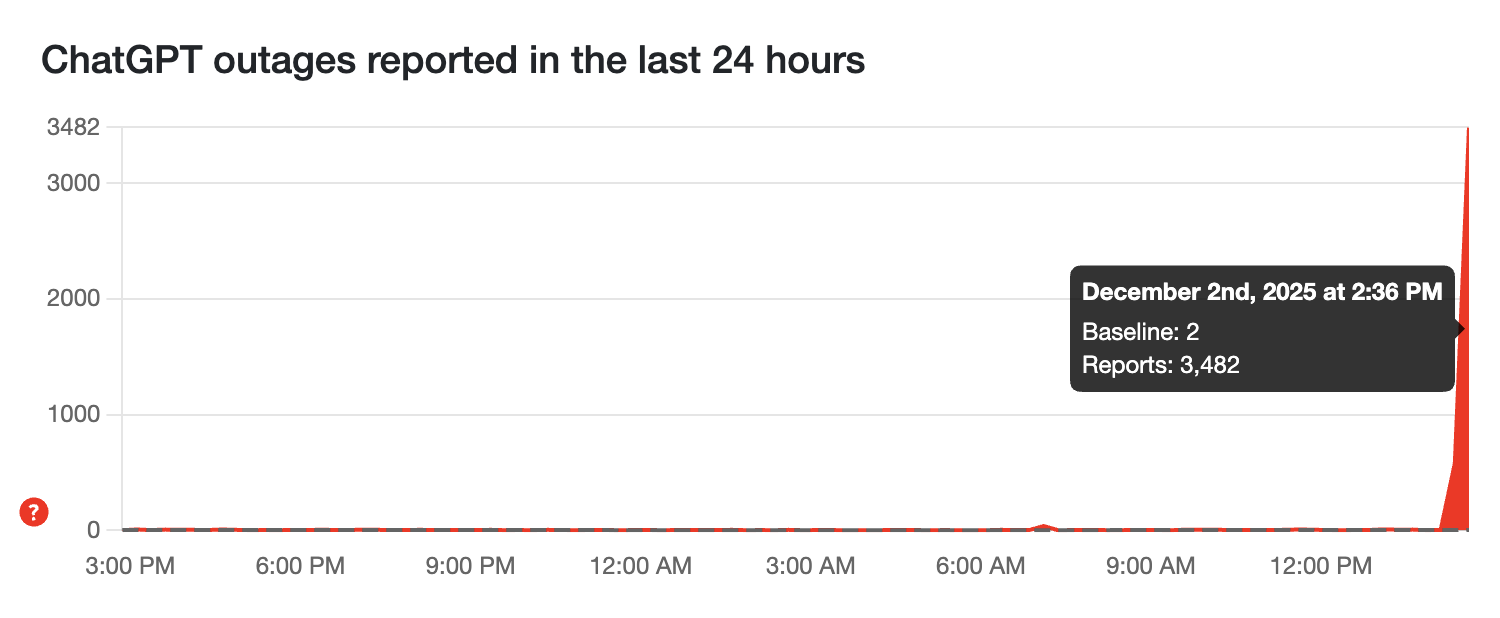
    Offline for many. Visiting Downdetector, I saw that thousands of users have reported ChatGPT as offline, indicating a widespread issue.

    ```json
{
  "alt": "Graph showing ChatGPT outages with a spike to 3,482 reports at 2:36 PM on December 2nd, 2025.",
  "caption": "ChatGPT experienced a massive spike in outage reports on December 2nd, 2025, reaching a peak of 3,482 at 2:36 PM.",
  "description": "This graph displays the reported outages for ChatGPT over a 24-hour period, highlighting a dramatic increase in reports to 3,482 at 2:36 PM on December 2nd, 2025. The baseline of reports remained steady at 2 before the sudden spike. The graph effectively illustrates the time and magnitude of the outage, providing a clear visual representation of the incident. Keywords: ChatGPT, outages, reports, graph, December 2nd, 2025."
}
```

    The issue first surfaced around 2:30 PM ET, and even after 30 minutes, it remains unresolved.

    Why we care. Whether I’m using ChatGPT for email, marketing, SEO, or PPC tasks, this outage disrupts the workflow significantly.

    I’m confident that OpenAI is making every effort to resolve these issues promptly, and I hope to see it operational soon.


    Inspired by this post on Search Engine Land.


    crushpress.ai community screenshot
  • Unlock AI Insights with Our New GCP Integration

    Unlock AI Insights with Our New GCP Integration

    I’m excited to share that Profound’s Agent Analytics now integrates seamlessly with Google Cloud Platform through Cloud CDN. This development offers comprehensive AI observability across Google Cloud Platform’s vast content delivery network.

    With this new integration, I can easily monitor and analyze how AI crawlers and agents interact with the content we host on GCP, providing deeper insights and enhanced tracking capabilities.


    Inspired by this post on Try Profound Blog.


    crushpress.ai community screenshot