I’ve noticed something quite unexpected happening with Google Ads lately. It seems that their system tool is re-enabling paused keywords automatically, which has led to increased campaign expenses without warning.
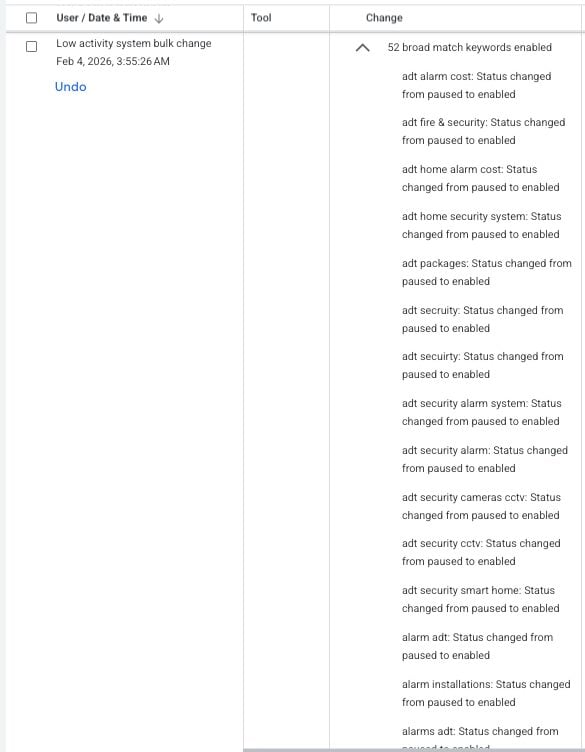
Some advertisers, including myself, have observed a Google Ads tool—created for low-activity bulk changes—unexpectedly switching paused keywords back to active. This unusual behavior has been a surprise to many account managers, like myself, who haven’t come across this issue before.
What’s happening? The activity logs are showing entries linked to Google’s ‘Low activity system bulk changes’ tool executing actions that enable previously paused keywords. These logs appear as automated bulk updates and, thankfully, have an ‘Undo’ option available.
In the past, this tool mainly paused inactive elements rather than reactivating them, so this change in behavior is quite perplexing.
What’s unclear? Google hasn’t issued any public documentation to explain this behavior, leaving us unsure whether it’s an intentional feature, a limited test, or a mere bug.
I find myself wondering what exactly triggers this reactivation and how widespread this phenomenon is becoming.
Why does this matter? If like me, you’re diligently managing your campaigns, unexpected keyword reactivation can change your campaign delivery in ways you didn’t plan for, impacting budgets, pacing, and overall performance—particularly if you’ve paused keywords for a specific reason.
For both agencies and in-house teams, this change is raising concerns about automated systems potentially overriding manual settings.
What steps should we take now? As account managers, we might want to regularly check change histories, be on the lookout for any unexpected keyword activations, and use the ‘undo’ function promptly if we notice unplanned changes.
Until Google clarifies the situation, more careful monitoring of campaigns relying heavily on paused keywords might be necessary.
First Alerted This issue was first brought to light by Performance Marketing Consultant Francesco Cifardi on LinkedIn.
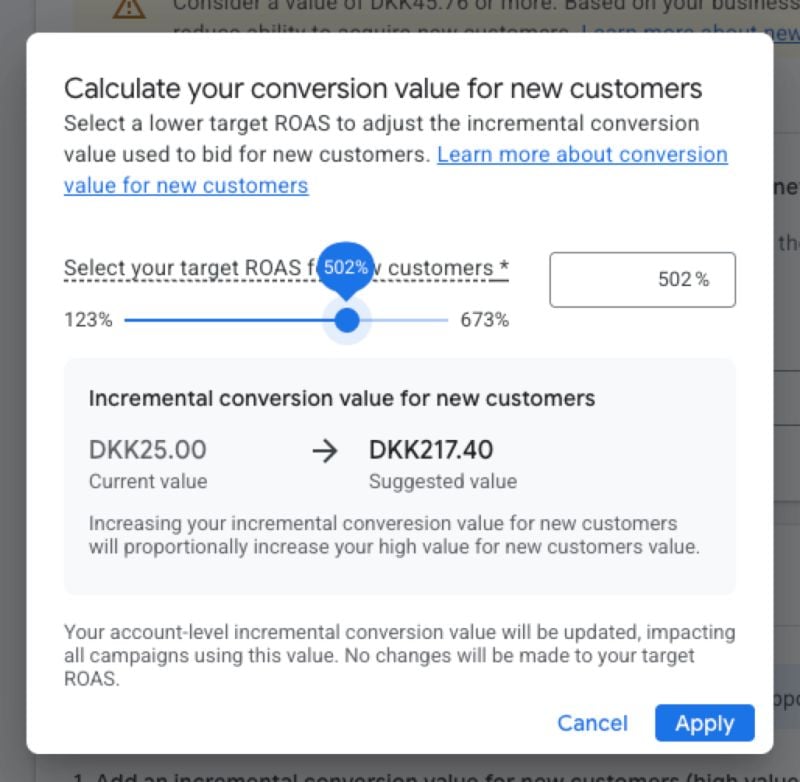
I’ve just discovered an exciting development in the Google Ads world that’s sure to interest any advertiser looking to optimize their campaigns. Google Ads is experimenting with a new ROAS-based tool that automatically suggests conversion values, aiming to enhance how we bid for new customers without the need for manual estimates.
For those like me who are focused on campaigns that target new customer acquisition, this update is a game changer. It empowers us to bid more assertively to capture those elusive first-time buyers.
How it works. I enter my desired ROAS target for new customers, and Google Ads does the rest. It proposes a conversion value that aligns with the goal I’ve set, removing much of the guesswork that previously complicated bidding strategies.
Currently, this feature doesn’t customize at the auction, campaign, or product levels. Instead, we apply values at a broader setting; this means the system doesn’t yet allow variable bids based on different contexts.
Why we care. This new tool addresses a significant shortfall in performance bidding—assigning the correct value to new customers. Many of us have relied on flat manual values, which don’t always reflect true profitability or align with our long-term goals.
By linking conversion values to a target ROAS, the door is opened to more strategy-driven bidding, potentially enhancing our balance between growth and efficiency in acquisition campaigns.
What advertisers are saying. Initial feedback suggests this feature is a notable improvement over the static manual inputs we’ve been using. Andrew Lolk, Founder of Savvy Revenue, believes the next step could be auction-level intelligence that dynamically adjusts values based on campaign or product performance.
What to watch. If Google decides to expand this feature to support more granular adjustments, it could significantly reshape how we plan our acquisition strategies and value long-term customer growth.
For now, the tool provides a more structured approach to calculating the value of new customers.
First seen. This update was first spotted by Andrew Lolk, who shared the insight on LinkedIn.
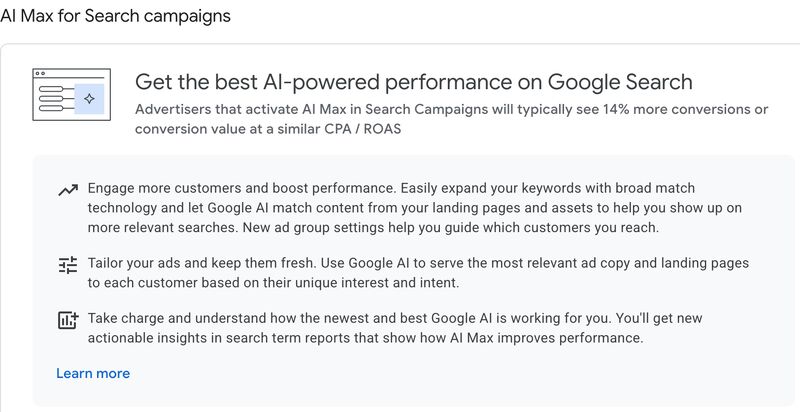
When I opened Google Ads recently, I noticed something intriguing. Google is now directly promoting its AI Max feature right inside the campaign settings. This is a bold move, as it places advertisements for their own tools directly in front of advertisers like me.
What’s happening: I saw promotional messages for AI Max specifically for Search campaigns when accessing my campaign settings panel.
These notifications show up during my usual account audits and updates.
It’s essentially Google’s way of internally advertising its own tools to me.
Why it matters to me. Seeing these ads within the platform highlights Google’s strategy to push AI adoption. It makes me wonder if this will nudge advertisers like myself towards tools that minimize manual input, potentially reshaping how I manage campaigns.
Encountering ads in a platform that’s already a paid advertising service is quite unprecedented. It feels like a subtle shift towards more aggressive product adoption strategies by Google.
The big picture from my perspective. Although Google often rolls out AI features, actively promoting them within our regular workflows is a more assertive step towards encouraging us to adopt new features.
What I should watch for. I’m curious if this promotional strategy will extend to other features within Google Ads and how other advertisers will react to seeing marketing within their management tools.
First observation. This notification was first spotted by Lead Gen PPC Specialist Julie Bacchini, who shared her experience on LinkedIn.
I often find myself reflecting on the challenges of PPC measurement in this privacy-driven era. As browser restrictions tighten, our reliance has shifted from perfect tracking to methods like redundancy, modeling, and inference.
Managing PPC accounts has shown me firsthand that something has changed. The signs are everywhere:
Missing GCLIDs, delayed conversions, and reports that are harder to explain have become routine.
Initially, it feels like something broke—perhaps a tracking update or a platform shift. Yet, it’s simpler than that. We often assume identifiers will persist from click to conversion, but that’s no longer a reliable expectation.
Measurement hasn’t ceased to function; what has changed are the conditions it relies on. These changes have been creeping up, gradually becoming the norm.
Why this shift feels so disorienting
Having dealt with this issue for most of my career, I find the evolution quite disorienting. Before native conversion tracking in Google Ads, I crafted my tracking pixels and parameters for affiliate campaigns. Moving towards automation and less control can feel unsettling compared to the traditional methods.
The things I once depended upon for PPC data interpretation don’t apply in the same way anymore. Adjusting my mindset is key to navigating this evolved landscape, as restoring the old assumptions won’t work.
The old world: click IDs and deterministic matching
Predictability was the hallmark of Google Ads measurement. A click led to a gclid being stored in a cookie and matched back upon conversion, creating an easy-to-explain deterministic system.
This depended heavily on things like parameters passing through browsers and cookies persisting. Thankfully, these conditions were favorable back then.
Why that model breaks more often now
Today’s browsers impose stricter limitations on identifiers. Apple’s Intelligent Tracking Prevention and similar techniques significantly reduce tracking data’s shelf life, directly impacting how data is stored, or even if it can be stored.
On occasions, click IDs fail to reach the site, and the behavior of browsers today necessitates adapting, rather than attempting to cling to outdated deterministic systems.
The adjustment isn’t just technical
On my team, GA4 poses challenges not because it’s ineffective, but because it suits a reality where some data is presumably missing. This experience is shared industry-wide; we must acknowledge that measurement now requires a new mentality.
Ultimately, surviving in this privacy-centric era demands refocusing energy on resolving data problems rather than merely optimizing ad settings.
What still works: Client-side and server-side approaches
The question now is how we can thrive under current constraints, and the answer involves both client-side and server-side measurement practices.
Pixels still matter, but they have limits
Though these pixels provide valuable data and instant feedback, their efficacy is limited by browser constraints and consent banners blocking data.
Relying solely on pixels for measurement affects both our reporting and optimization efforts. While they’re not obsolete, they no longer cover every base.
Changing how pixels are delivered
In search of better solutions, some focus on improving pixel delivery, such as Google Tag Gateway, which routes tags through the same-origin setup. This minimizes failures but does not define better measurement logic by itself.
There’s a distinction between improved infrastructure and improved measurement logic—we must remember that proper data collection and event definition are crucial.
Offline conversion imports: Moving measurement off the browser
Using offline conversion imports moves measurement away from browsers to backend systems, mitigating browser-imposed privacy restrictions and extending its efficacy to longer sales cycles.
Combining offline imports with pixel tracking ensures a complete view of customer interactions.
Even without click IDs, Google Ads utilizes other inputs to match conversions, although we must be aware that modeled data fills gaps when consent is denied or IDs are missing.
Even with complete information from pixels or offline imports, conversions sometimes remain elusive.
Determining how this aligns with privacy restrictions and user consent requires ongoing refinement and a strategic approach.
Designing for partial data
Partial data is now the status quo, and including multiple sources of input can create a robust strategy to overcome discrepancies in systems like CRMs and Google Ads.
By learning to accept this tension and strategically managing incomplete data, we can optimize campaigns for the current data landscape.
As we embrace a privacy-focused measurement strategy, perfect tracking is no longer feasible. Building useful measurement systems requires recognizing differing operational views and aligning accordingly.
Ultimately, strategic thinking, redundant data systems, and careful evaluation are essential components in adapting to a partially observable data world.
Today’s measurement landscape demands a strategic approach instead of recreating past perfection.
I’ve been there myself. A client approaches me, eager to upscale their Google Ads spend from €10,000 to €100,000 monthly. Like any dedicated PPC manager, I dive into the usual strategies:
Refine bidding strategies.
Test new ad copy.
Expand keyword lists.
Optimize landing pages.
Boost Quality Scores.
Launch Performance Max campaigns.
Several months in, the ad spend only grows by 15%. The client is content, but I know we can do better.
Here’s a harsh truth I’ve learned: much of what we consider PPC optimization is really just sophisticated procrastination.
The theory of constraints, introduced by Eliyahu Goldratt, offers insights for PPC much like it does for manufacturing. It shows that every system has a single constraint that limits its potential.
It doesn’t matter if the marketing team is super-efficient if the production capacity is what’s limited. Likewise, a 20% improvement in ad copy CTR isn’t useful if the real constraint lies in budget or conversion tactics.
This theory calls for radical focus: pinpoint the weakest link, make it your priority, and tune out the rest.
Applying this to PPC means stopping the widespread optimization efforts. Detect the primary barrier, resolve it, and press on.
Over time, managing PPC accounts has shown me that scaling challenges usually fit within one of seven categories:
Budget: Profitability could be higher, but client approval caps spending.
For instance, a campaign might run successfully at €10,000 monthly, with scope to go to €50,000, yet the client hesitates due to risk aversion or cash flow concerns.
Developing a compelling business case that showcases past ROI and projected returns is vital here.
I ignore ad copy tests or keyword expansions because, if I can’t increase budget, they won’t help.
Impression Share: Already capturing over 90% share, limiting traffic growth.
Entering new markets or ad platforms can often be the solution for these scenarios.
The Creative aspect needs tightening when high impressions yield low CTRs, and so on for conversion rate, fulfillment, profitability, and tracking or attribution challenges.
With my diagnostic steps, I start by running an audit to benchmark the key metrics—impression share, CTRs, CPCs, and conversion rates— to pinpoint what’s genuinely holding the account back.
The moment I finish an audit and single out the top challenge, the focus becomes precise. For instance, if it turns out conversion rate optimization can unlock growth, that’s where all my efforts channel into until I see a breakthrough.
Every time the constraint is overcome, a new bottleneck emerges, signifying growth and the movement to new phases. It is both a marker of success and a roadmap to what needs attention next.
I recently discovered that Performance Max now includes built-in A/B testing for creative assets. This feature offers advertisers a straightforward way to measure and enhance their advertising strategies.
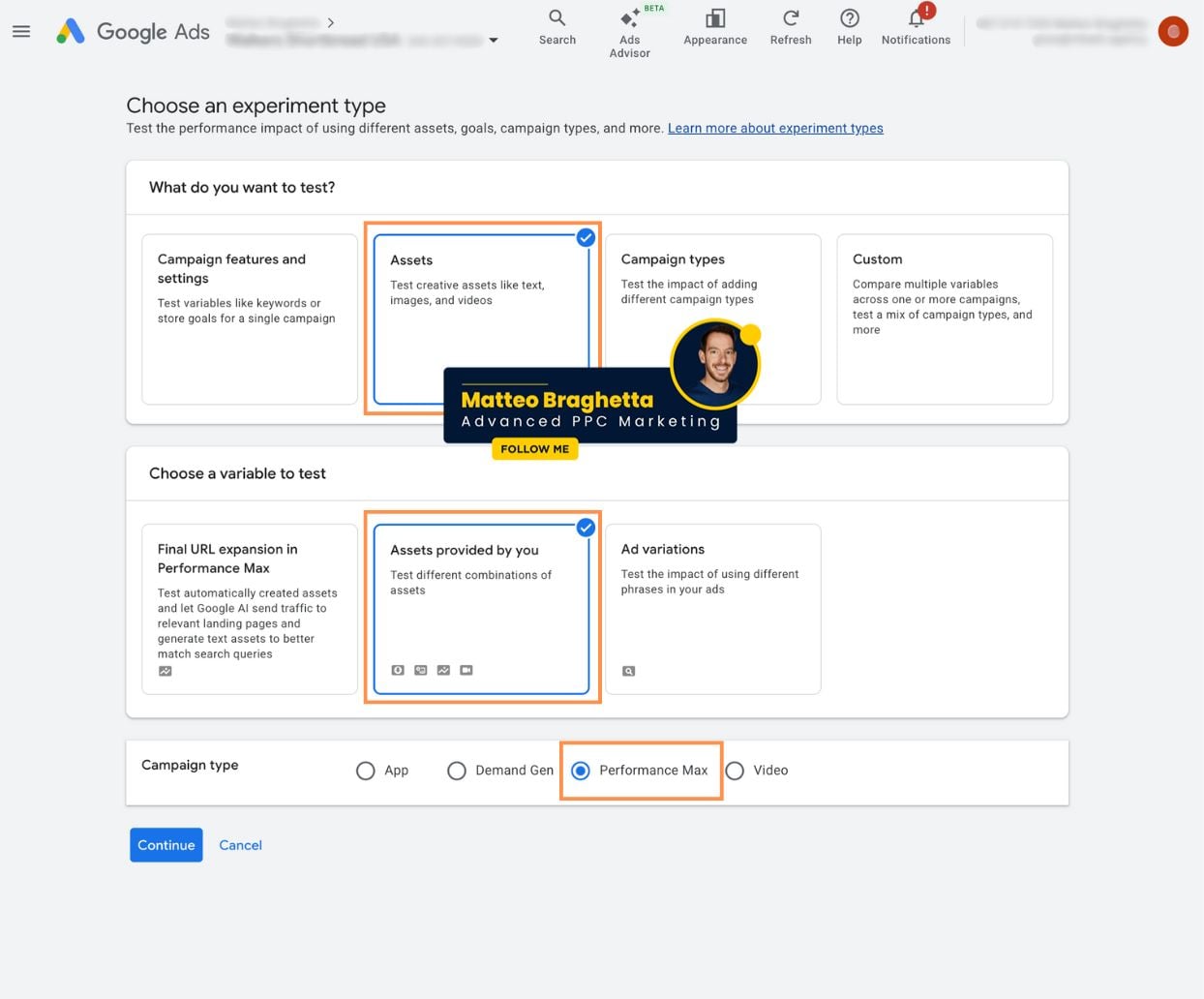
Google is introducing a beta feature that allows me and other advertisers to conduct structured A/B tests on creative assets within a single Performance Max asset group. This setup enables me to split traffic between two sets of assets and evaluate performance through a controlled experiment.
Why it matters to me. In the past, creative testing within Performance Max was often guesswork. With Google’s new native A/B asset experiments, I can now perform controlled tests directly within PMax without needing to launch separate campaigns.
How it works for me. I select one Performance Max campaign and asset group, then define a control asset set using my existing creatives and a treatment set with new alternatives. Shared assets can be utilized across both versions. After setting a desired traffic split, like 50/50, the experiment runs for several weeks, allowing me to apply the winning assets based on actual performance data.
Why this is beneficial for me. Conducting tests within the same asset group isolates the impact of the creatives I’ve designed, minimizing interference from changes in campaign structure. This controlled split allows me to obtain clearer reporting, helping my team make data-driven decisions based on solid performance metrics rather than assumptions.
What I’ve learned so far. Early testing indicates that shorter experiments—especially those under three weeks—can yield unstable results, particularly in accounts with lower volume. I’ve found that extending the test duration and avoiding simultaneous campaign changes significantly enhances reliability.
My takeaway. Performance Max is evolving into a more testable platform. I now have the ability to validate creative decisions using built-in experiments, reducing reliance on trial and error approaches.
Source of insight. A Google Ads expert noticed the update and shared insights on LinkedIn.
When I first heard about Performance Max, I was skeptical. It seemed like an unfinished product, but over the past 18 months, Google has made significant improvements in transparency and control. If you haven’t revisited Performance Max since its early days, now is the perfect time to take another look.
As I learned from Mike Ryan at SMX Next, the advancements are worthy of attention.
Taking a Fresh Look at Performance Max
Performance Max evolved from Smart Shopping campaigns, introduced with much excitement in 2019. Yet, industry experts quickly pointed out issues with transparency and control, which Google is only now beginning to address.
Smart Shopping took away vital controls critical for managing campaigns effectively. Essential features like promotional controls and search term reporting vanished, leaving many of us feeling limited.
Fortunately, Performance Max reintroduces much-needed functionality, enhancing what was once lacking.
Understanding Performance Max Search Terms
In my experience, search terms are crucial for understanding the effectiveness of our campaigns. With Performance Max, Google has added a unique match type that brings detailed and scriptable data, allowing us to optimize with precision.
Search Term Insights vs. Campaign Search Term View
Initially, Google introduced search term insights, grouping queries into categories. Unfortunately, these lacked depth as they didn’t provide essential cost data.
The game-changer, though, is the new campaign-level search term view, offering access to more metrics and clearer visibility on performance.
While these insights are only available at the search network level, they offer significant improvement over past limitations.
Search Theme Reporting
Through Performance Max, I’ve realized search themes act as a positive targeting method. By checking conversion data and the source of traffic, I can ascertain the value of search themes, identifying whether they contribute effectively or remain underutilized.
Search Term Controls and Optimization
Negative Keywords
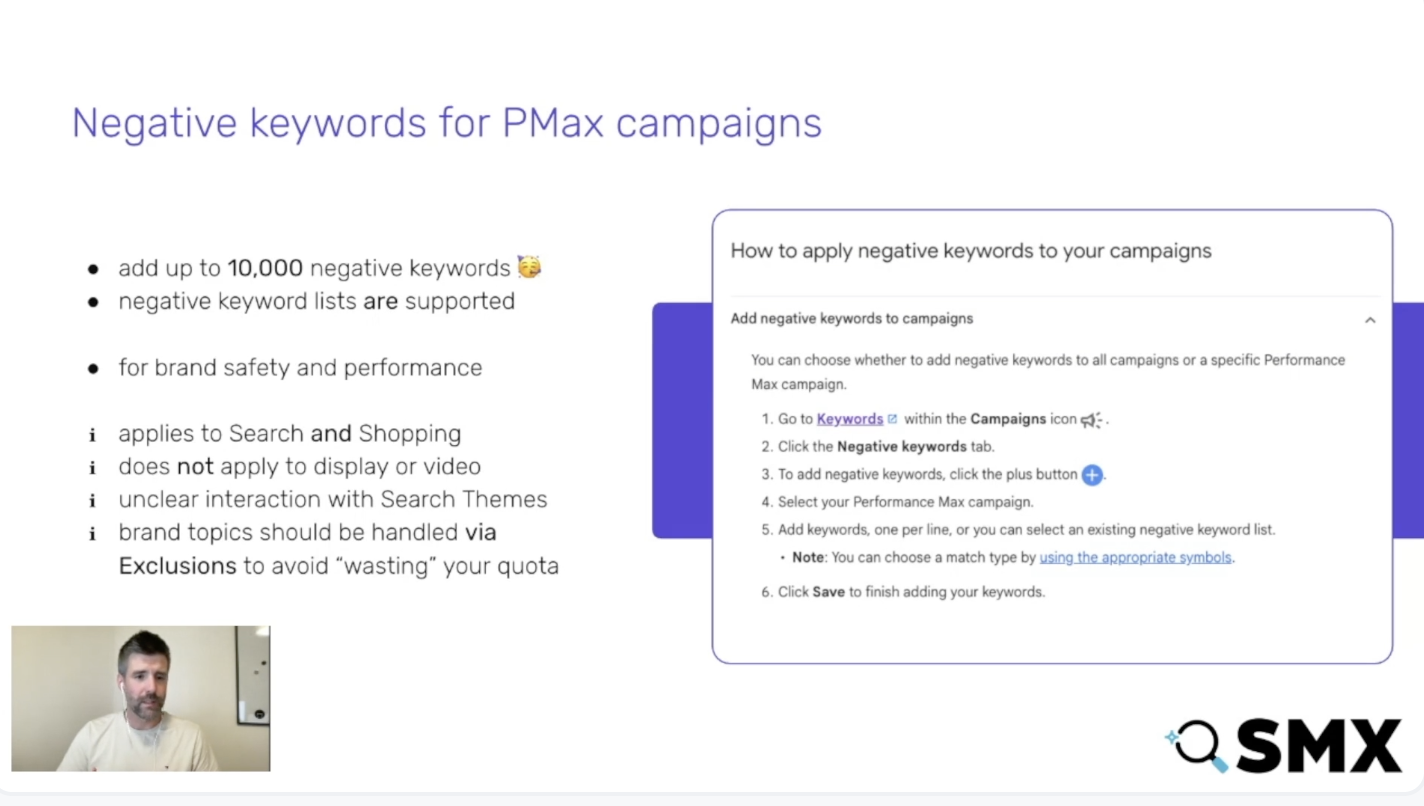
At first, negative keywords in Performance Max were limited, which was frustrating. But now, they are fully supported and much more robust, giving me the control I need to fine-tune performance.
Brand Exclusions
While Performance Max tends to favor brand queries because of their high intent, I’ve noticed that using negative keywords provides a stronger solution for ensuring optimal performance without leakage.
Optimization Strategy
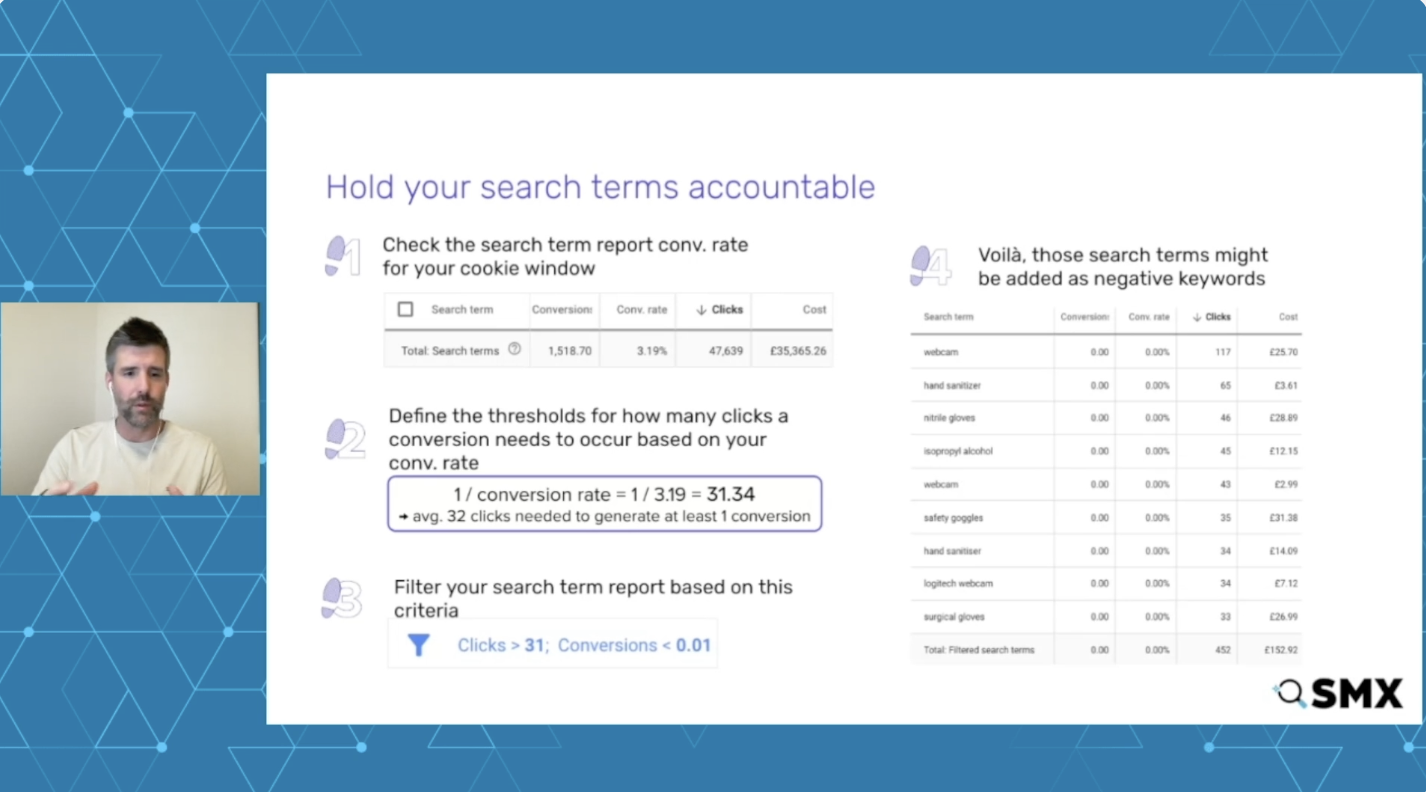
My strategy involves identifying non-performing search terms with higher-than-average clicks but zero conversions, making them strong candidates for exclusion. This approach prevents overcorrection while maintaining a focus on impactful terms.
Modern Optimization Approaches
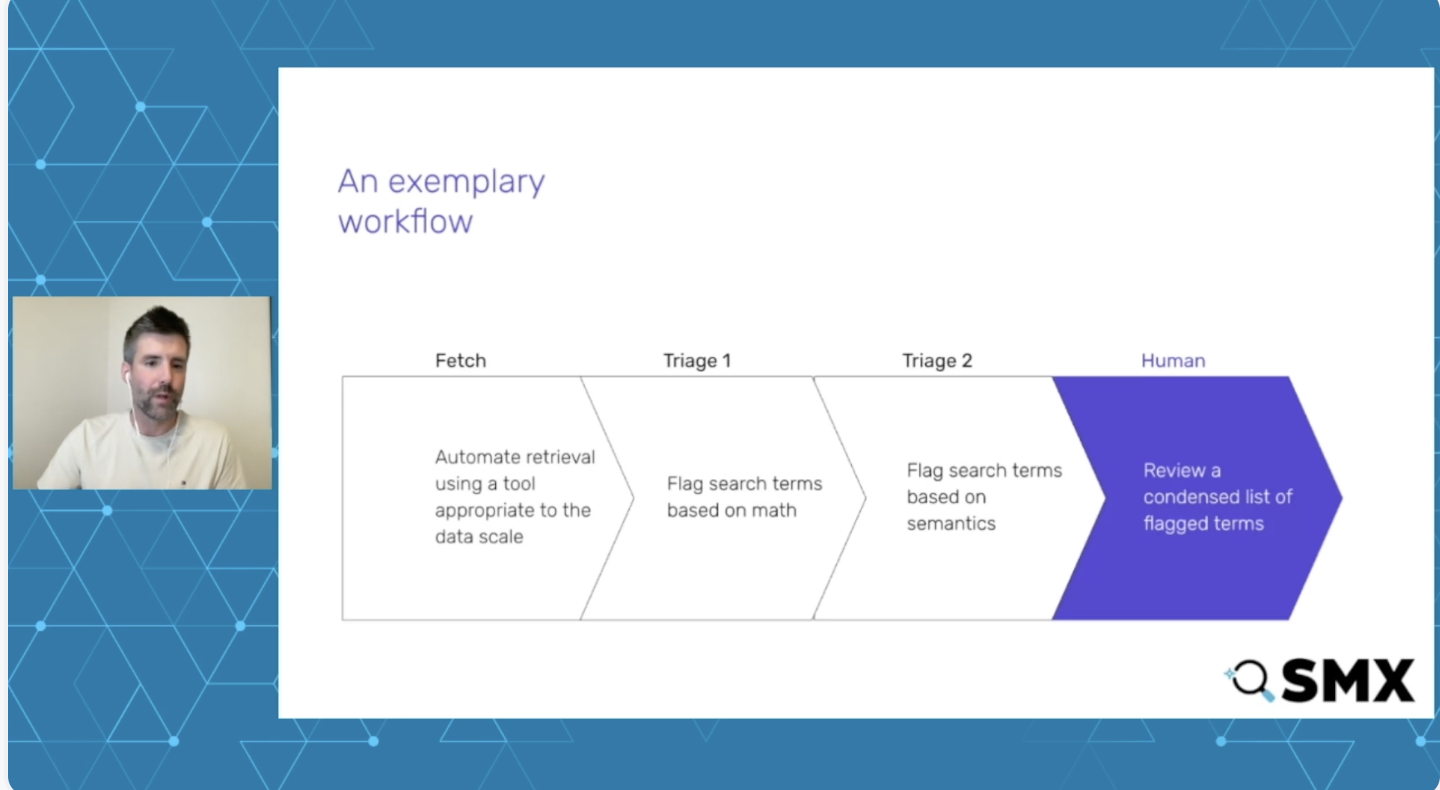
Instead of spending countless hours manually reviewing search terms, I leverage automation. Using the API for high-volume accounts and scripts for mid-range volumes significantly optimizes my workflow.
Channels and Placements Reporting
Channel Performance Report
One of the tools I now rely on is the channel performance report, offering insights across different networks like Discover and Display. Though interpreting some diagrams can be tricky, it provides valuable data on how different channels perform.
Channel and Placement Controls
Placement Exclusions
Through API and Report Editor data, I focus on excluding specific placements that seem irrelevant or pose risks, particularly in sensitive content areas like politics and children’s videos on YouTube.
Tools for Placement Review
For reviews, especially in other languages, I’ve found that using Google Sheets’ translation function is effective. It helps me quickly determine the relevance of YouTube placements without relying on external systems.
Search Partner Network
The inability to opt out of the Search Partner Network can be frustrating. However, I mitigate this by prioritizing exclusions where performance is subpar compared to the Google Search Network.
Device Reporting and Targeting
Device Analysis
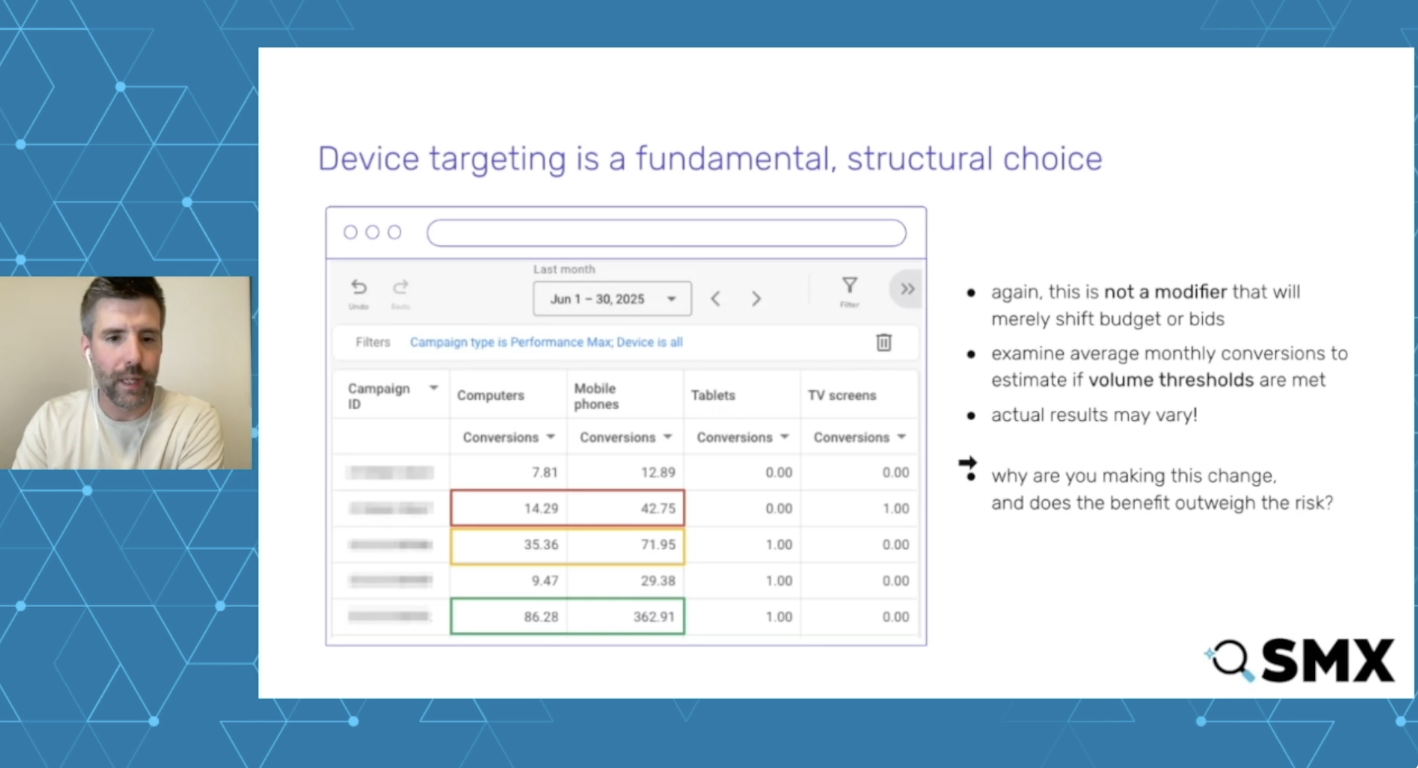
Analyzing device performance provides deeper insights into how specific products perform across different devices. This often reveals advantages or challenges when compared to competitors.
Device Targeting Considerations
Splitting campaigns by device can hurt data volume, impacting machine learning effectiveness. It’s crucial to weigh the benefits of splitting against the potential for data fragmentation.
Conclusion
Reflecting on Performance Max’s evolution, it’s evident that Google has made impressive strides in offering advertisers like myself more control and transparency. While it’s not without flaws, it’s a far more effective tool for ecommerce success now than ever before.
The key lies in understanding available data, using modern tools to streamline processes, and applying performance insights strategically to achieve the best results.
As I reflect on the challenges of PR measurement, it becomes clear that many hurdles exist. Limited budgets and siloed teams often make it tough to connect our media efforts with tangible results.
That’s why I’m convinced that collaboration with SEO, PPC, and digital marketing teams is key. Together, we can achieve what feels impossible on our own:
Specifically, by linking media outreach with customer actions, integrating SEO and GEO into our measurement, and choosing the right tools, we can truly measure impact.
This piece offers a practical roadmap for achieving this without needing an enterprise budget or specialized analytics team.
Our digital age of communication isn’t linear. Audiences often engage with content across various channels before taking action, if they do at all. Understanding this loop is essential for measurement.
I’m reminded of how SEO and PPC professionals focus on actions like searches, clicks, and conversions. We in PR should adopt this action-oriented mindset to enhance our measurement strategies.
First, we need to prove the link between media outreach and customer actions. This often requires cross-departmental collaboration to access valuable data currently scattered across different systems.
By incorporating PR touchpoints into analytics tools like Google Analytics 4, I can see our earned media’s influence on downstream behavior, turning PR from a cost center into a demand-creation channel.
Second, while SEO is widely accepted, understanding its measurement in PR is less clear. Traditional metrics like coverage volume or sentiment don’t fully capture SEO’s impact.
GEO presents a new frontier, focusing on whether our content is a source for AI-generated answers. Tools like Profound and Semrush’s AI Visibility Toolkit offer insights into this new layer of measurement.
Lastly, it’s crucial that we select tools based on strategic goals, not just what’s trendy. This involves working backward from the desired audience actions to choose the right measurement tools.
In collaboration, PR, SEO, and PPC teams can integrate their strategies, avoid duplication, and create comprehensive insights that inform and improve future campaigns.
Ultimately, this collaborative approach gives us the edge, allowing us to adapt swiftly to evolving measurement tactics and strengthen our collective impact.
By 2026, Google Ads automation has transformed drastically, with signal quality becoming paramount for exceptional performance. In this post, I’ll guide you on how signals drive these changes and how you can align them for optimal outcomes.
Back in 2015, I had tight control over my PPC campaigns. I directed Google on which keywords to pursue, set manual bids, and handled budgets with precision. Skillful use of spreadsheets allowed me to efficiently manage vast keyword inventories.
Those meticulously controlled days have faded. Now, in 2026, automation steers the wheel, moving beyond being a mere helper to a key driver of our advertising success. Fighting it is futile; embracing it is wise.
Automation has evened the playing field, liberating time for PPC marketers like me. But effectiveness now hinges on understanding how automation gleans insights from our data.
This piece delves into the intricacies of Google Ads signals, illustrating how to preserve their quality and prevent automation from veering off course.
The Mechanics of Signals in Automation
Contrary to seeing Google’s system as a mystery, it requires input of robust signals to perform optimally. Accurate signals lead to triumph; flawed data gears us for failure.
Automation runs on the signals I provide. AI interprets these signals, adjusting bids and targeting with unparalleled precision and efficiency.
While traditional documentation might suggest a primary focus on audience segments, the reality is that automation learns from a broader spectrum of signals.
Decoding What Qualifies as a Signal
In my experience, every component in a Google Ads account serves as a signal—shaping Google’s algorithm to determine successful advertising strategies.
Structural elements, budgets, conversion quality, and more provide insights into user intent, modeling a detailed blueprint for targeting.
The entire ecosystem, from landing pages to real-time data, contributes—guiding the AI in its decision-making process.
Here’s what stands out:
Conversion Actions: These signal what success looks like for my business.
Keyword Signals: Essential for decoding user search intent.
Creative Signals: Influences user attraction via visual cues.
Landing Page Signals: Ensures alignment with user expectations.
Bid Strategies: Communicates my advertising priorities to Google.
Innovation in signal interpretation has shifted, with the introduction of campaign total budgets, indicating a comprehensive financial commitment to Google.
Retailers, like Escentual.com, witnessed increased traffic through this approach, showcasing how signal precision offers tangible results.
Understanding Auction-Time Realities
Every user search triggers a unique bid calculation based on myriad signals, moving beyond generalized assumptions to precise decision-making.
This tailored approach ensures identification of “pockets of performance,” optimizing for predicted user outcomes aligned with our objectives.
Without quality signals, however, the system is left with assumptions, demonstrating the critical nature of providing accurate inputs.
Identifying and Prioritizing Signals
Not all signals wield equal influence. I’ve recognized that conversion signals bear the most weight, providing essential guidance for AI performance.
Conversion Dominance
Accurate conversion tracking underpins robust algorithmic learning, crucial for successful B2B and eCommerce advertising.
Enhanced Conversions and First-Party Data
In an era where third-party cookies disintegrate, relying on enriched data tracking is invaluable for understanding user interactions.
Quality audience signals and custom segments are imperative, enabling nuanced targeting, especially in niche markets.
Signal Category
Specific Input
Weight
Importance
Primary
Offline Conversion
Critical
Speaks to profit, not mere leads.
Primary
Value-based Bidding
Critical
Prioritizes profitable products.
Secondary
Customer Match Lists
High
Offers AI a model audience.
Tertiary
Keywords
Medium
Identifies search semantics.
Pollutant
Soft Conversions
Negative
Skews intent towards lower value.
Proper signals form the foundation for successful automation, requiring constant vigilance and correction of detrimental factors like signal pollution.
Combating and Correcting Signal Drift
Signal drift occurs when automation diverges from desired outcomes. Identifying subtle shifts in user targeting and making strategic corrections is key.
By tightening conversion signals, reinforcing audience data, and refining campaign structures, I can steer systems back to intended paths.
Reinforce Audience Patterns: Update lists and segments.
Adjust Campaign Structure: Separate high and low intent traffic.
Remaining proactive is about guiding automation, ensuring the system aligns with my business goals while leveraging Google’s robust AI insights.
Building a Winning Signal Strategy
Creating a coherent signal strategy in 2026 requires segmenting data wisely, isolating brand traffic, and differentiating products by ROAS for clarity in campaign objectives.
Achieving Competitive Edge
In a landscape where automation is universally accessible, the true advantage lies in the quality of signals I feed to Google.
By protecting these signals and timely correcting any drift, I ensure Google’s automation works for me, transforming it into a powerful asset in my advertising arsenal.
I recently discovered an exciting update from Google Ads that promises to enhance the security of high-risk account changes. They have silently introduced a multi-party approval feature that ensures a second administrator must approve specific actions before they are finalized. This step adds a critical layer of protection against unauthorized or malicious changes, enhancing the overall safety of our accounts.
This new feature is particularly important as our ad accounts grow larger and carry more value. A single unauthorized change can quickly disrupt campaigns and even affect our billing. By requiring approval from another administrator, this feature effectively reduces such risks without hindering our regular campaign management processes.
For agencies and large teams like mine, this tool becomes invaluable. It helps us avoid costly mistakes and significantly bolsters our account security. I appreciate how Google is responding to the increasing necessity for robust access control.
Here’s how it works: when I, as an admin, initiate a sensitive change, Google Ads automatically sends an approval request to other eligible admins. This request is delivered as an in-product notification, requiring an action within 20 days—either approval or denial—otherwise, it simply expires, and the change will not be implemented.
Moreover, tracking the status of these requests is hassle-free. Each change request is tagged as Complete, Denied, or Expired, allowing my team to easily monitor and review our account changes.
To manage these approval requests, we can head over to the Access and security section within the Admin menu. It’s quite straightforward and keeps us in the loop with all ongoing requests.
This update points to a growing concern about account security, especially for advertisers managing large teams with multiple user permissions. With reports of expensive hacks escalating, this added security is a much-welcomed relief for us.
In the end, although multi-party approval may add a bit of friction to the process, it’s definitely a good kind. It grants us more control over who can make vital changes to our accounts, thus protecting them from unauthorized access. In my opinion, it’s a prudent step towards safer, more secure ad management.