I’m thrilled to share that Microsoft Advertising has just unveiled the Publisher Content Marketplace (PCM). This innovative system allows publishers like us to license premium content to AI products and earn revenue based on its usage.
How It Works. At its core, PCM creates a direct value exchange. As a publisher, I have the freedom to set my own licensing and usage terms. Meanwhile, AI developers can discover and license this content for grounding their algorithms in real-world scenarios. The marketplace also offers detailed usage reports, providing insights into how our content performs and where it contributes the most value.
Designed to Scale. The PCM is a scalable solution designed to eliminate the need for one-off licensing deals. Participation is entirely voluntary, and ownership and editorial independence remain with the publishers. It’s a platform inclusive of everyone from large global publishers to smaller niche outlets like ours.
Why We Care. As AI technology progresses from merely answering questions to making impactful decisions, the quality of content is becoming increasingly crucial. Whether it’s about influencing purchases, finance, or healthcare, AI systems need to tap into premium content, elevating the importance of credibility and trust in our brands.
Early Traction. Microsoft Advertising has partnered with notable U.S. publishers such as Business Insider, Condé Nast, and Hearst to co-design PCM. Initial pilot projects anchored Microsoft Copilot responses to licensed content, with companies like Yahoo as early adopters.
What’s Next. Looking ahead, Microsoft plans to extend the pilot program to more publishers and AI developers who share the belief that as the AI web evolves, the value and governance of high-quality content should be recognized and rewarded.
The Big Picture. In the evolving landscape of AI-driven web interactions, tools are now summarizing, reasoning, and making recommendations through conversation. The effectiveness of these tools hinges on access to trusted and authoritative sources, many of which are under paywalls or in secured archives.
The Tension. The traditional model where publishers provide content in exchange for traffic from platforms is changing. AI is increasingly delivering answers directly, which reduces clicks but still relies on high-quality content.
Bottom Line. For AI to make better decisions, it must have access to superior inputs. Microsoft’s PCM is a strategic move towards establishing a sustainable content economy that supports the next wave of AI innovation.
The rapid emergence of the agentic web has left many of us pondering: Are we genuinely ready for this new frontier?
To get to the bottom of this, let’s start by addressing some foundational questions:
What’s the agentic web? How can it be utilized? What benefits and drawbacks does it present?
This piece is not aimed at pressuring AI skeptics to dismiss their valid queries regarding the agentic web.
Additionally, it doesn’t pass judgment on how you, as an individual or professional, engage with this digital landscape.
With diverse opinions swirling around the agentic web, I hope to offer some clarity, devoid of any marketing varnish.
Disclosure: While I am employed by Microsoft and have faith in their direction with the agentic web, my aim is to maintain a platform-neutral perspective.
Now let’s delve deeper into what exactly the agentic web entails.
The agentic web consists of advanced tools or agents, tailored to our preferences, that perform time-consuming tasks with our permission.
For instance, using one-click checkout allows me to transmit my payment details to a merchant seamlessly.
Neither the merchant nor I need to manage the minutiae; instead, I just consent to the transaction.
Curious about how AI defines the agentic web, I posed this question to four AI models, discovering intriguing variations in their answers.
Copilot describes it as a layer of the internet where AI agents turn human intentions into outcomes, keeping user choice intact. Gemini, Perplexity, and Claude offer similar but varyingly nuanced definitions.
Understanding these varying views helps underscore the fact that AI models are trained on differing data, resulting in diverse responses.
The clear sentiment divide arises from whether we view the agentic web as a user-friendly layer or an overwhelming digital entity.
Gemini mentions APIs, crucial for communicating within this space, emphasizing how saved preferences will increasingly play a role.
To truly grasp the agentic web, we must explore two protocols, ACP and UCP, that underpin its operations.
The Agentic Commerce Protocol (ACP) focuses on actions initiated by express user intent, streamlining transactions via standardized AI interactions.
Meanwhile, the Universal Commerce Protocol (UCP) encompasses the whole shopping experience, facilitating interactions across platforms and payment systems.
ACP and UCP are not competitors; rather, they enhance different stages of the user journey, supporting precise or exploratory shopping needs.
So, what is the agentic web? Truthfully, it’s still evolving alongside user behavior, placing us in a position to shape its destiny.
Next, let’s explore how we can harness the agentic web, along with its potential benefits and pitfalls.
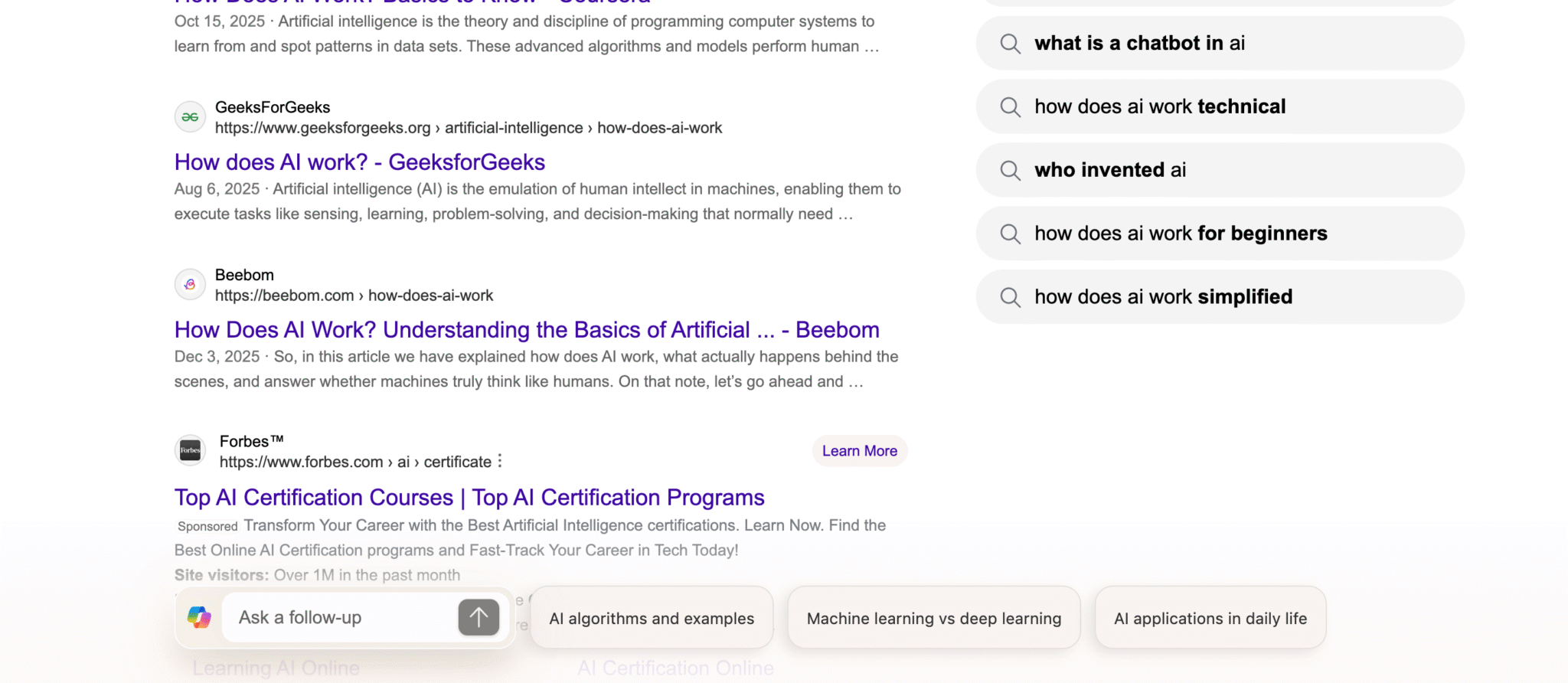
I’m excited to share that Microsoft has introduced a game-changing update to Bing with the global rollout of multi-turn search. As I scroll through Bing’s search results, I now see a Copilot search box conveniently positioned at the bottom, waiting to assist with follow-up queries.
What is multi-turn search? In essence, this feature enables me to continue my search seamlessly. Imagine typing a follow-up question in the Copilot search box right at the bottom of the results page without any need to scroll back up. It feels so intuitive and user-friendly!
Here’s a vivid screenshot that perfectly captures this experience:
And here’s a video that brings it to life, showcasing the seamless functionality:
Here’s what Microsoft had to say. Jordi Ribas, the CVP and Head of Search at Microsoft, took to X to share this exciting update, revealing that “After shipping in the US last year, multi-turn search in Bing is now available worldwide.”
Ribas went on to explain that “Bing users don’t need to scroll up to do the next query, and the next turn will keep context when appropriate,” indicating a significant enhancement in user experience.
He further noted, “We’ve seen gains in engagement and sessions per user in our online metrics, highlighting the positive user value of this approach.”
Why it’s important for us. With many search engines, including giants like Google, trying to push for more AI integration, Bing’s new feature is a step in that direction. Google’s AI Overviews, although not entirely without controversy, are pushing users deeper into AI interfaces. Meanwhile, Bing’s Copilot box, after rigorous testing over several months, is now fully available, underscoring Microsoft’s commitment to user-centered innovation.
I recently discovered that Bing is testing a new AI Performance report within their Webmaster Tools. This has piqued my interest, especially since Microsoft has been teasing the idea of providing better insights into website performance in AI-driven Bing and Copilot searches for months.
It all started back in February 2023, and then in April 2023, Microsoft hinted at delivering data on Bing Chat and AI search impressions. Sadly, our hopes were dashed when they lumped this data together with regular web queries, leaving us still in the dark about our sites’ performance in Bing’s AI experiences. I can’t help but feel a bit let down.
Now, it seems Bing is experimenting with a new report within Bing Webmaster Tools, known as the AI Performance report. This report is in a super limited beta phase, and Microsoft hasn’t officially announced anything yet. A source shared that it showcases citation data from both Microsoft Copilot and its partners, detailing the number of citations and cited pages per day.
With this report, I can see how often Copilot cites my website and across how many pages. However, it still doesn’t reveal how many people clicked through from those citations to my site. The report also presents data categorized by “grounding queries” and “pages.” While “grounding queries” might not represent the exact query entered in Copilot, it shows how Bing interprets them, including insights into the intent behind such queries, like whether they are navigational or informational.
This new report lets me identify the specific pages Copilot cites. While there’s excitement in seeing more AI performance-related data pop up in Bing Webmaster Tools, I can’t shake the feeling of wanting click-through data. Knowing the click-through rate from AI interactions compared to regular web searches is something I, and I’m sure many other publishers and site owners, have been eagerly anticipating.
It feels like all search engines are intentionally keeping this data under wraps, and it’s frustrating not having full transparency.
During the final quarter of 2025, I noticed a remarkable 13% rise in spending on Google search ads compared to the previous year, as reported by Tinuiti’s latest benchmark. It was eye-opening to see this surge in click growth, marking the strongest pace since early 2021, particularly as average CPCs slightly declined for the second quarter in a row. The expansion of AI-driven results seemed to be increasing the overall query volume, including those crucial commercial searches.
Why we care. As I’ve observed, Google search ad clicks are skyrocketing while CPCs stay flat. This trend is largely due to Amazon’s strategic withdrawal from U.S. Google Shopping auctions, which has opened the door for advertisers to find both opportunities and challenges as spending patterns shift between search and shopping.
Additionally, AI-driven query growth is broadening the search funnel, offering more chances to connect with customers earlier in their buying process.
Shopping ad trends: During the holiday season, I followed how Google Shopping ad expenditure jumped 16% year over year, propelled by Target and Walmart stepping up while Amazon’s absence left a noticeable gap in auctions. Meanwhile, Shein and Temu maintained smaller roles. Interestingly, CPCs for Shopping Ads weakened slightly, falling 1% year over year.
Performance Max. PMax campaigns captured my attention as they represented 62% of total Google Shopping spend and 61% of sales, which, although slightly down from the last year, showed an increase from earlier in 2025. Non-shopping inventory, such as video and display, accounted for 39% of PMax spending, with YouTube video making up 13% of impressions beyond search.
Text ads. It’s exciting to note that Google text ad clicks reached a 19-quarter high, climbing 9% year over year. Spending was up by 11%, with CPC growth remaining modest at 2%. Brand keyword CPC growth saw a slowdown to just 2% year over year, with declining CTRs counterbalanced by strong impression growth, likely driven by AI-driven overviews in search results.
Microsoft search growth. Microsoft appeared to outpace Google in paid search spend growth, with a 16% year-over-year jump in Q4, rising from 12% in Q3. Click growth slowed slightly to 10%, while CPCs increased by 5%, as Amazon kept its presence in Microsoft Shopping listings.
Amazon advertising. I observed that Sponsored Products clicks on Amazon rose by 23% year over year, showcasing an intriguing pattern despite a 1% drop in average CPCs. Sponsored Brands experienced modest spend growth (+2%) but with declining clicks, whereas Sponsored Display spending fell 47%. Meanwhile, Amazon DSP spending rose 31% year over year, propelled by offsite inventory and premium placements like Prime Video ads.
Walmart trends. Sponsored Products were a dominant force in Walmart’s search ad spend, accounting for 89% with conversions remaining high through the holiday season. Display ad spending grew to 35% of the total, with 60% geared toward offsite inventory targeting.
Video and streaming ads. I found it fascinating that YouTube ad spending increased by 13% year over year, coupled with a sharp 38% rise in impressions and an 18% drop in CPMs. Video now commands 66% of Google Demand Gen spending. Across traditional streaming platforms, Prime Video ad spending surged 31% from Q3 to Q4, overtaking Netflix in CPMs, while TV screens dominated spending, with phones crucial for direct-response formats.
The bottom line. Google’s search and shopping landscapes continue to thrive, driven by AI-enhanced query growth and evolving retailer participation, presenting both opportunities and challenges. Meanwhile, Microsoft and Amazon are advancing their ad offerings, providing me with diverse options to engage high-intent audiences across search, display, and streaming.
As an advertiser, I’ve recently noticed that Microsoft Advertising is kicking off 2026 with a fresh batch of updates tailored for search-centric marketers. These updates offer me better control, clearer insights, and more streamlined campaign management across their platform.
Driving the news. In their latest product update, Microsoft has rolled out enhanced Performance Max features, broadened audience targeting options, improved Google import processes, and automated more creative aspects of search ads.
The big picture. Performance Max remains at the heart of these changes. There’s a new customer acquisition goal available in open beta that lets me prioritize new customers or exclusively target them in PMax campaigns geared towards purchase goals. Additionally, I can allocate higher conversion values to new customers, which aids the system in optimizing for long-term growth over short-term revenue.
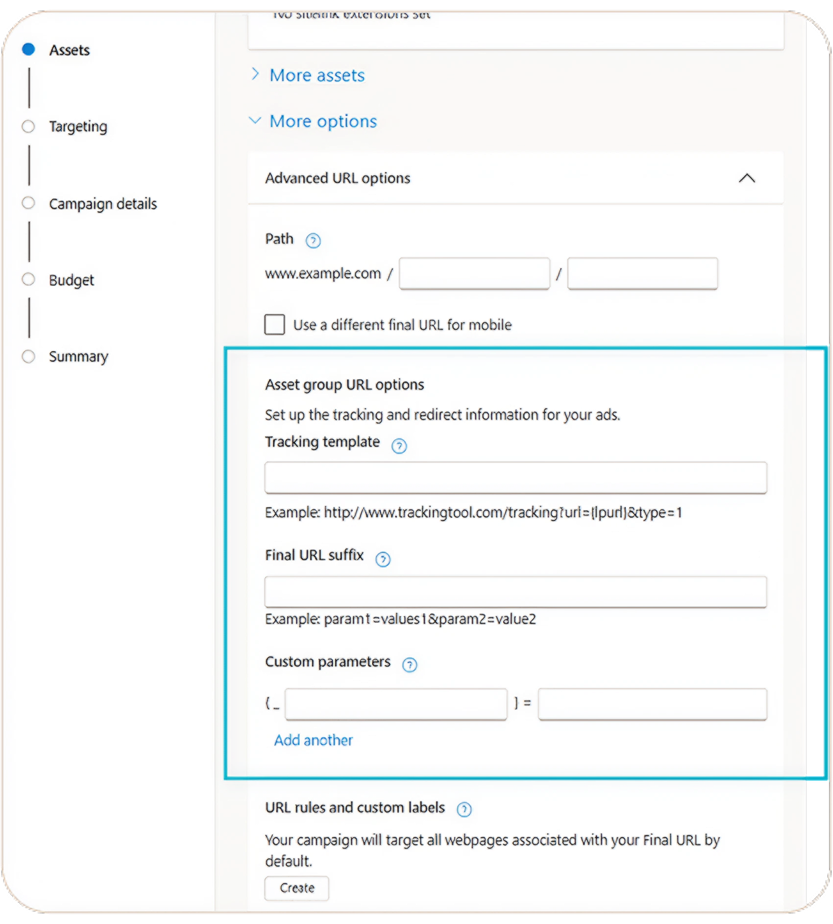
Alongside these goals, Microsoft has also expanded transparency and controls within PMax. They now offer share of voice metrics, including impression share and losses due to budget or rank, giving me a better understanding of competitiveness in Search and Shopping placements. Plus, asset group-level URL options and tracking templates allow for more granular measurement without needing to reorganize campaigns.
What’s changing under the hood. The process for importing from Google has become more seamless. PMax campaigns now support up to 50 search themes, and asset group imports have become more flexible, meaning that non-eligible images or auto-generated logos won’t block the rest of the asset group from being imported.
Beyond PMax, I’m excited that Content Targeting for Audience ads is now generally available. I can target specific Microsoft-owned placements like MSN and Outlook, or align ads with content categories such as Finance or Travel. A new reporting view also shows where ads actually appear, aiding in refining contextual strategies.
Why we care. These updates furnish me with greater command over how automation propels growth, especially in acquiring new customers. New customer acquisition goals and additional visibility in Performance Max make optimizing for long-term value easier rather than focusing solely on immediate conversions. With smoother imports and smarter creative automation, these advancements allow advertisers like me to enhance performance without giving up visibility or control.
On creative automation. Autogenerated assets are now being rolled out as a default setting for newly created Responsive Search Ads worldwide, excluding China and South Korea. Microsoft reports that advertisers using these assets witness around a 5% increase in CTR, as the system dynamically generates and tests more headlines and descriptions based on website content. Sensitive verticals remain opt-in only, leaving existing RSAs unaffected.
The bottom line.Microsoft Advertising’s January updates aim to make automation more user-friendly, quantifiable, and advertiser-friendly, particularly for those of us managing Performance Max across multiple platforms.
As an advertiser, I’m excited to share that Microsoft is empowering Performance Max campaigns by expanding search themes to 50. This change offers us more control, allowing better alignment with high-intent customer searches.
Just ahead of next week’s major announcements, Microsoft Advertising has confirmed that we can now incorporate up to 50 search themes in our campaigns, a notable increase from previous restrictions.
Why this matters to me. Search themes serve as strategic signals that guide Performance Max toward the search queries and intent patterns that we prioritize. With this expanded capacity, I have more room to refine how automation interprets customer demand, especially for businesses with diverse product lines or complex structures.
This update also means I no longer need to compress different intents into a limited number of themes or run multiple campaigns just to portray various product offerings.
The bigger picture. Microsoft’s focus is shifting towards signal-based control rather than strict keyword targeting. By combining search themes with LinkedIn profile targeting and other audience signals, including impression-oriented remarketing, I can better target high-value customers rather than a generic audience.
What I’m looking forward to. Next week, Microsoft’s Advertising blog will feature additional updates, suggesting this change is part of a larger initiative to make Performance Max not only more flexible but also more responsive to advertisers’ needs without undermining the automation logic.
Where I first learned about this. Microsoft Product Liaison Navah Hopkins shared these insights on LinkedIn, along with hints of upcoming updates slated for next Wednesday, January 14th.
The bottom line for me. By increasing the number of available search themes to 50, Microsoft is improving our control over Performance Max, not through additional complexity, but by widening the range of pivotal signals.
At the NRF 2026 Conference, I had the opportunity to see Microsoft’s latest innovations firsthand: the Copilot Checkout and Brand Agents features.
Seeing Microsoft roll out its first agentic experiences within Copilot feels like stepping into the future. With Copilot Checkout, I can now shop seamlessly without leaving the conversation, making it easier to switch from browsing to buying.
What’s more intriguing is the introduction of Brand Agents for Shopify sites. Imagine having an AI chat that’s trained on your product catalog, offering personalized shopping experiences that echo your brand’s unique voice. It’s a smart solution for fast and scalable implementation.
Copilot Checkout. I’m excited to share that Copilot Checkout is starting its U.S. rollout on Copilot.com. This feature allows conversational purchases directly within your current chat and integrates with partners such as PayPal, Shopify, Stripe, and Etsy.
For Shopify merchants, enrollment in Copilot Checkout is automatic, though opting out is possible. Non-Shopify merchants interested in joining can apply through a dedicated form.
Check out a glimpse of how it works:
Brand Agents. Now available for Shopify merchants, Brand Agents bring your brand’s voice into every interaction online. I was impressed to see how it leverages a brand’s product catalog to provide crystal-clear answers to product-specific inquiries.
The AI speaks in your brand’s voice, seamlessly guiding customers from browsing to purchasing, and can be set up in just a few hours. Microsoft shared with me that sessions assisted by Brand Agents show higher engagement and conversion rates.
Here’s a video showcasing Brand Agents in action:
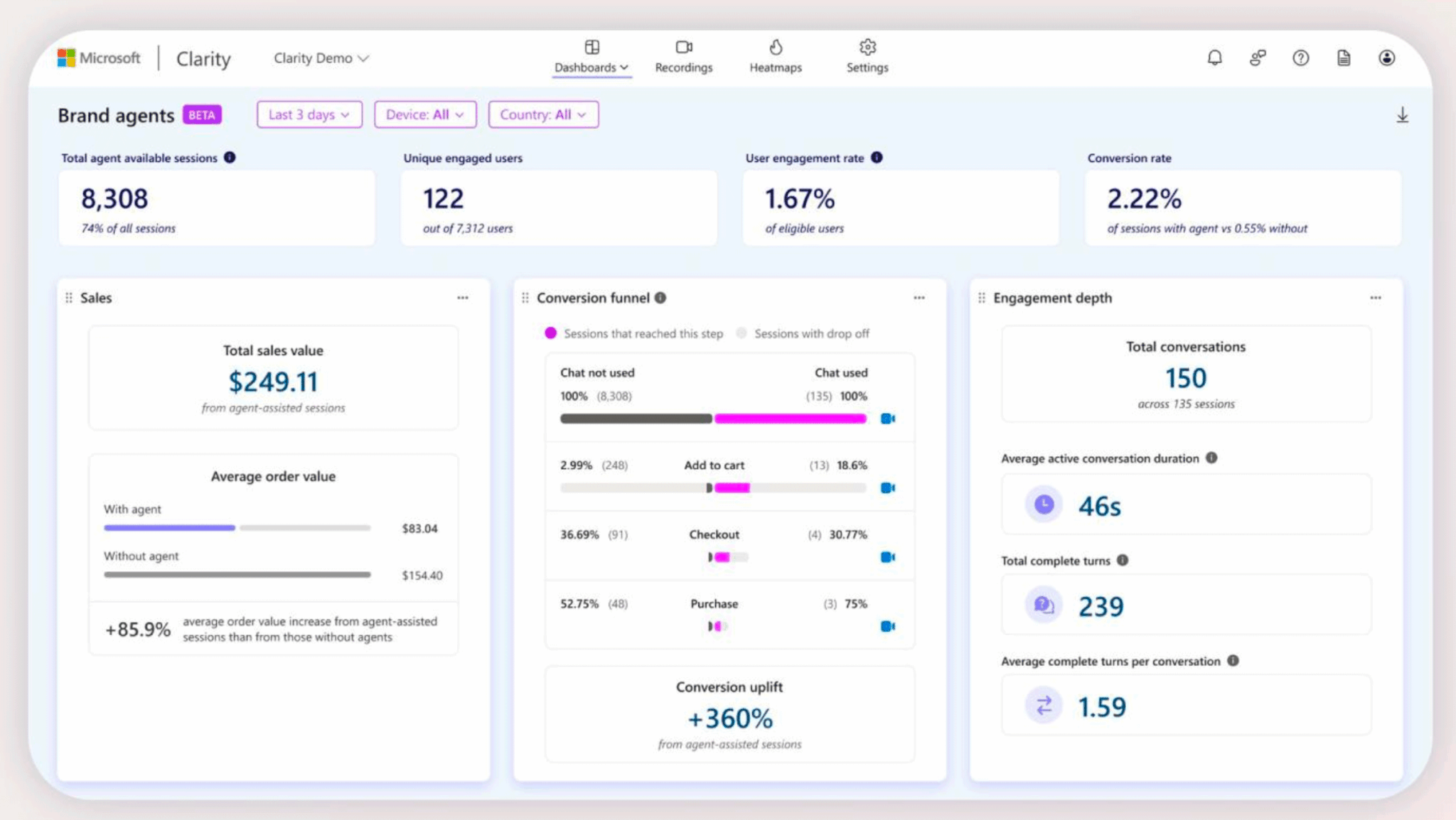
Brand Agents insights. Microsoft is innovatively using Microsoft Clarity to provide insights into Brand Agents conversations, helping merchants understand and optimize performance.
Once I activated Brand Agents, I found myself equipped with additional insights to compare and optimize agent-assisted sessions against organic traffic, reinforcing my growth strategies.
Here is where you can view these insights:
Google and OpenAI. It’s fascinating to see how Google and OpenAI are also embracing agentic experiences. Google has introduced agentic checkout, whereas OpenAI announced its Instant Checkout in ChatGPT. Together, these developments mark a significant industry shift towards direct purchasing through AI experiences.
Here’s how LinkedIn professional attributes enhance intent, automation, and creative decisions in Microsoft Advertising.
Using LinkedIn targeting within Microsoft Advertising allows me to align creative strategies with the perfect audience. By engaging with this thoughtfully, I can apply professional insights to intent-driven inventory without breaking the bank.
The key is understanding how these targeting methods collaborate across different campaign types. In this guide, I’ll walk you through leveraging LinkedIn data within Microsoft Advertising, including:
LinkedIn in Search campaigns, including Multimedia ads.
Using LinkedIn insights for an enhanced audience strategy.
Performance Max targeting signals.
Audience reach and composition insights via Audience Planner.
Disclosure: As a Microsoft employee, I’ve kept this article objective, focusing on LinkedIn targeting mechanisms, targeting action items, reporting, and message mapping strategies.
LinkedIn Profile Targeting in Search
Microsoft Advertising search campaigns fully support LinkedIn profile targeting, allowing me to layer professional attributes on top of keyword targeting. The supported attributes include:
Company
Industry
Job function
These audiences can be utilized across Microsoft‑owned environments, such as Bing Search, Microsoft Edge, Microsoft Start, and other eligible search surfaces, provided users are signed in.
In search, LinkedIn targeting works as a contextual guide rather than a standalone target. Keywords carry the main weight, while LinkedIn data helps me adjust my response when professional relevance is present.
How to Approach It
Start with keywords that already convert: LinkedIn targeting enhances existing intent with proven keywords. I apply bid adjustments to campaigns or ad groups where search terms already demonstrate business value, potentially increasing bids by 10%-15% for aggressive bidding or more aggressive adjustments when impression share is lost to rank.
Choose one professional dimension first: I begin with either company, industry, or job function instead of applying all three simultaneously. This approach prevents double-bidding on potential customers.
Use bid-only mode to establish a baseline: Observation mode provides performance clarity before I make delivery decisions. This acts as audience research to identify who engages profitably.
LinkedIn Professional Demographics in Audience Ads
Audience Ads leverage LinkedIn Professional Demographics as both a targeting and observation layer, introducing professional context into native, display, and video formats tailored for scalable reach.
Audience Ads aren’t driven by keyword intent; however, Professional Demographics anchor delivery and insights in real-world business contexts, bridging broad reach with professional relevance.
These ads let me apply company, industry, and job function as professional audience layers, which I can use to observe performance trends or influence delivery, depending on campaign objectives.
How to Approach It
Start in observation to understand natural performance: By observing performance trends in Professional Demographics, I learn which industries, job functions, or company types naturally engage with Audience Ads before imposing delivery constraints.
Let LinkedIn data inform creative, not just delivery: In content-rich environments, creative matters more than targeting alone. I use insights from high-performing professional segments to shape tone, examples, and value framing in my messaging.
Align format choice with professional mindset: Different formats perform distinct roles. For example, native and display formats excel in awareness and education within professional segments, while video supports storytelling and industry-specific narratives. Professional Demographic insights guide the most suitable formats for varied business audiences.
LinkedIn Data in Performance Max: Guiding Automation with Purpose
LinkedIn profile targeting is available within Performance Max campaigns, where it functions as an audience signal. These signals help the system identify professional profiles most likely to yield profit for my business and influence budget allocation.
Within Performance Max, professional signals are most effective when representative and directional, rather than exhaustive, providing the system a strong starting point.
How to Approach It
Select signals that reflect your best customers, not every customer: Using LinkedIn attributes to describe my most valuable segments is crucial, especially if different personas represent varying ROAS/CPA goals, as this affects PMax campaign asset groups’ shared ROAS/CPA bidding.
Pair LinkedIn signals with strong conversion definitions: Automation improves when reinforced by clear success metrics. Ensuring at least 30 conversions over a 30-day period is vital for autobidding effectiveness.
Allow time for learning: Audience signals need sufficient volume to influence delivery, so I avoid frequent changes during the initial learning period (two weeks). Afterward, budget adjustments up to 15% can be made without triggering learning period fluctuations.
Aggregated LinkedIn audience reporting is divided by company, industry, and job function, letting me analyze how professional segments contribute to campaign performance. This reporting, found under Reporting > Professional demographics, includes LinkedIn targeting or audiences applied through predictive targeting.
How to Approach It
Look for consistency across time, not single spikes: Patterns emerging over weeks or months are more actionable than short-term anomalies. I allow “observation” audiences ample time to prove themselves or use Audience Planner for informed decisions at scale.
Use reporting to inform creative and bids together: Upon identifying outperforming professional segments, I scrutinize messaging and bidding before initiating changes. It’s crucial to confirm creative resonance without overbidding.
Avoid over-segmentation early: Excessive audience segmentation can weaken signal strength, especially when conversion scarcity is a concern.
Bidding with LinkedIn Audiences
In Microsoft Advertising, I use bid adjustments alongside automated strategies, enabling flexibility in how LinkedIn audiences influence auctions. Overlapping audiences can amplify bid adjustments, necessitating overlap awareness as part of my bid strategy.
Effective bidding adjustments should be incremental and reversible, aiming for calibration rather than acceleration.
Creative Strategy: Professional Relevance Without Narrow Assumptions
LinkedIn targeting controls ad visibility, but creative determines engagement. Professional cohorts encompass a variety of experiences, identities, and viewpoints. My aim is effective creative that respects diversity while remaining relevant to shared contexts.
Effective creative exhibits professional empathy, addressing challenges, goals, and constraints without reliance on stereotypes.
How to Approach It
Anchor creative in shared problems, not titles: I focus on challenges common to roles and seniority levels within a LinkedIn targeting segment.
Keep language inclusive and adaptable: I avoid assumptions about background, experience, or decision-making authority.
Use AI tools to localize, not homogenize: Adapting tone or examples by region or industry while preserving message intent is crucial.
Test creative alongside audience layers: I evaluate messaging performance within LinkedIn segments to refine both together.
Extending LinkedIn Insights Across B2B Campaigns
LinkedIn targeting in Microsoft Advertising provides an opportunity to combine professional expertise with intent-driven media scalably, in a privacy-conscious and economical manner.
Teams already using LinkedIn Ads can leverage this strategy to extend learnings into additional inventory via automation, amplifying reach and efficiency.
The value lies not in complexity, but in alignment – aligning data, mechanics, and human behavior enhances results.
Key takeaways:
LinkedIn profile targeting is fully accessible in Search and Performance Max on Microsoft surfaces.
Professional attributes act as targeting layers in search and optimization signals in Performance Max.
An observation-first approach fosters understanding before commitment.
Aggregated reporting aids informed optimization without revealing individual data.
Empathy-anchored creative fosters professional relevance.
When I use LinkedIn data with curiosity and care, it offers a way to view audiences more clearly rather than control them more tightly. For B2B advertisers navigating complex buying journeys, such clarity often becomes the most valuable optimization.
Recently, I discovered that Microsoft Advertising has introduced asset-level editorial reviews, a game-changer for anyone running ad campaigns. This new feature allows us to see individual ad components like headlines and images get reviewed separately. If one part is non-compliant, it won’t hold back the whole ad, ensuring that compliant components keep running smoothly.
Here’s What’s New: Announced back in June, this feature provides a granular view of ad approvals. Now, I can easily spot which specific asset might be causing issues, instead of having to guess why an entire ad wasn’t approved.
Why I Care: This update is a relief because it minimizes campaign disruptions and speeds up the approval process. No more resubmitting entire ads just to fix one small mistake. I can now address the exact problematic asset swiftly.
How it Enhances the Workflow: The platform now flags disapproved elements right in the dashboard. It gives a clear warning when something is blocked and provides a detailed asset status, making it easy to stay on top of my campaigns.
The Bottom Line: This more precise system replaces the old all-or-nothing approval process, letting compliant ads run uninterrupted and putting more control in my hands as an advertiser. It’s definitely a step forward in ad management!