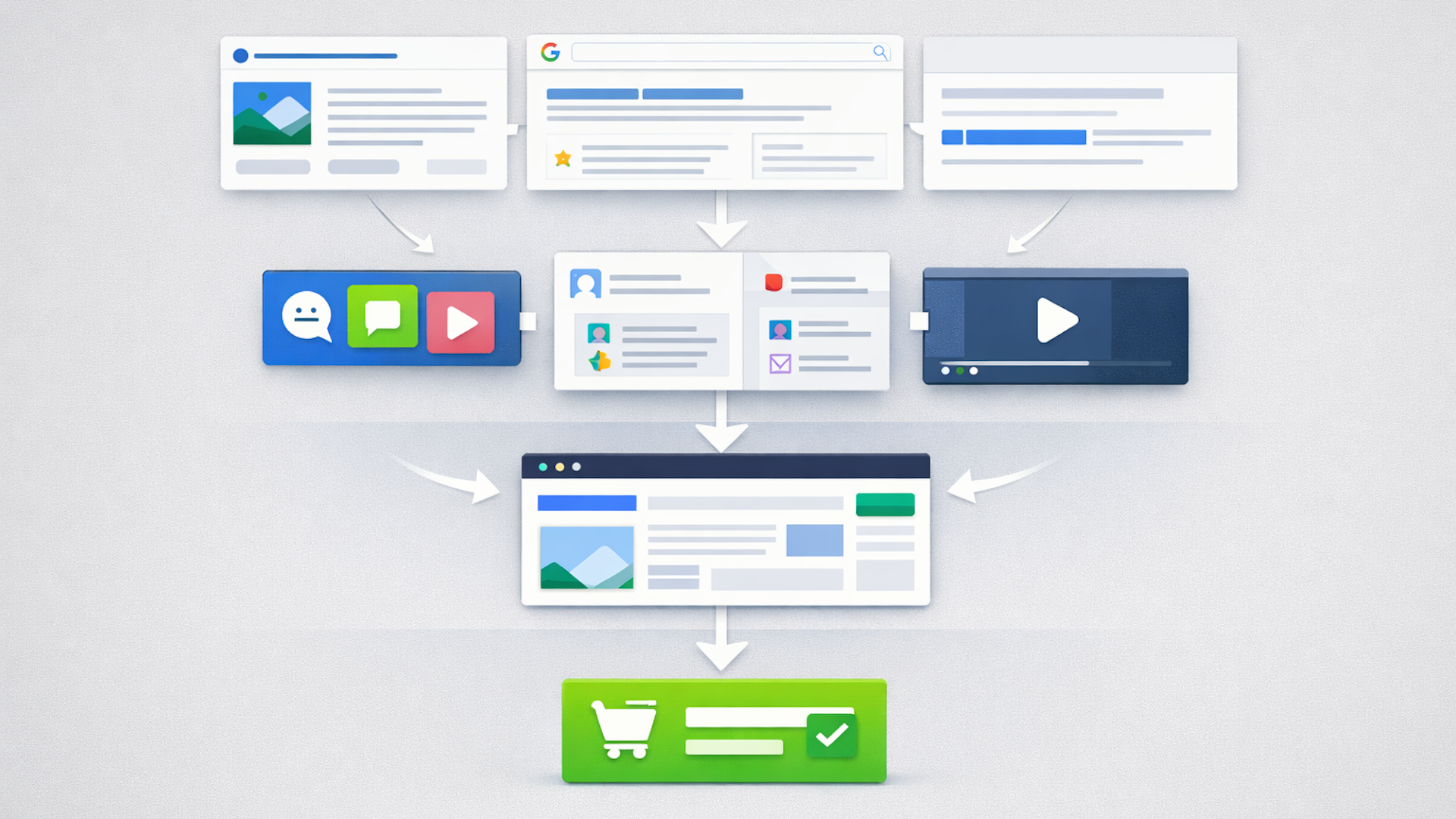
You’ve probably been handed a familiar contradiction: let the ad platforms automate more decisions, but remain accountable for every dollar they spend. The answer isn’t to micromanage every bid, and it isn’t to treat an automated campaign as self-driving.
Your job is to design the system around the automation. That means concentrating the budget, assigning each campaign a clear role, measuring channels as a portfolio and checking whether AI-generated search results are changing the visibility you thought you had.
Allocate the budget before you configure the campaigns
AI can optimize toward a target, but it can’t decide which business constraint matters most. Before opening a platform, write a one-page constraint sheet that answers five questions:
What business outcome are you buying? Name the sale, qualified lead, subscription, store visit or other outcome that ultimately matters.
What economics must the outcome meet? Use the maximum acceptable acquisition cost, minimum return or other threshold your business has approved. Don’t substitute a platform metric merely because it is available.
How much spending is committed? Separate the budget you expect to deploy from money that is optional, experimental or contingent on performance.
When is demand likely to change? Mark peak buying periods, expected slumps, launches and deadlines. Historical performance and Google Trends can help shape the monthly curve because an annual budget rarely deserves twelve equal allocations.
Which campaigns can you actually support? A channel that needs a steady supply of approved video or social creative is not a realistic allocation if that production process is blocked.
Then divide the available money by purpose, not by platform. A useful portfolio has three conceptual pools:
Core delivery funds campaigns with an established job and credible performance evidence.
Growth funds additional reach, audience building or expansion beyond the demand you already capture.
Exploration funds a specific, bounded test of a channel, format, audience or message.
There is no defensible universal percentage for these pools. The correct split depends on budget size, demand, business maturity, creative capacity and confidence in your measurement. What does generalize is the need for concentration. Spreading a modest budget across too many campaigns limits the data each campaign can collect, leaving the platform with too little signal and you with too many inconclusive results.
Fund the smallest coherent campaign structure first. Add another campaign only when you can state its distinct job, give it enough budget to perform that job and explain how you will judge it. A new campaign created merely to use an available targeting option is fragmentation, not strategy.
When more money becomes available, look first for campaigns that are both efficient and budget-constrained. That is a better starting point than dividing the increase evenly. Still, don’t assume that historical efficiency will survive unlimited scale. Increase spending in stages and inspect the economics of the additional volume. A higher budget creates financial exposure; if you don’t know the acceptable marginal acquisition cost, don’t scale solely because the platform forecasts more conversions.
Give every channel a job in the portfolio
A channel-by-channel return table often rewards the campaign that collects the conversion and punishes the campaign that created the demand. That can produce a tidy report and a weaker media plan.
Portfolio role
Typical campaign use
Reason to fund it
Evidence to inspect
Demand capture
Paid search against relevant queries
Reach people already expressing intent
Query quality, conversion economics, impression availability and budget constraints
Demand creation
YouTube or social prospecting
Build awareness and qualified audiences before the final search
Reach, audience growth, later search behavior and change in portfolio-level efficiency
Re-engagement
Viewer or visitor remarketing
Continue the journey with people who have already encountered the brand
Incremental outcomes, frequency and overlap with other campaigns
Exploration
Demand Gen, a new social channel or an unproven format
Test a defined path to additional demand
The stated hypothesis, spend boundary, delivery quality and downstream business outcome
These roles prevent two common mistakes. The first is expecting every campaign to close the sale directly. The second is excusing weak performance with a vague claim that a campaign is building awareness. A demand-creation campaign still needs a measurable theory of change.
For example, a YouTube campaign may produce few attributed conversions while search conversion rates improve and video-viewer remarketing audiences perform well. That pattern can justify continued investigation because campaigns can affect the efficiency of other channels. It does not, by itself, prove that video caused the improvement. Seasonality, promotions, competitive changes or measurement differences may also be involved.
Use three levels of evidence so you don’t confuse a plausible contribution with a demonstrated one:
You need to set a content plan, defend a traffic forecast, or explain why AI visibility and organic visits are moving in opposite directions. One dataset makes AI search look like a traffic problem. Another makes it look like a source of unusually valuable visitors. Choosing the more convenient story is tempting, but it can send your budget in the wrong direction.
The useful question isn’t which claim wins. It is which evidence applies to your audience, your business model, your search surfaces, and the decision in front of you. Once you separate those variables, much of the apparent contradiction becomes measurable rather than mysterious.
Translate every claim into a measurable outcome
Claims such as “AI search is good for brands” or “AI Overviews reduce traffic” are too broad to guide a decision. They compress several different events into one conclusion:
Your page is eligible to appear for a query or prompt.
Your brand or page is mentioned, cited, or linked.
The user clicks through.
The visitor completes an on-site action.
That action produces business value.
Those events form a chain, but they are not interchangeable. Citation visibility is not referral traffic. Referral traffic is not conversion. Conversion rate is not total conversions. Revenue is not profit. A claim about one link in the chain cannot establish what happened at every later link.
Claim you want to evaluate
Evidence you need
What would not establish it
AI results reduce click opportunity
Clicks divided by eligible impressions, separated by observed AI-result exposure and a comparable baseline
A decline in total organic visits without query-level or exposure context
Your brand is becoming more visible in AI answers
Brand mentions or citations across a fixed, repeatable set of relevant prompts
A few favorable screenshots or a changing prompt sample
AI-referred visitors convert better
Conversions divided by consistently classified AI-referral visits, using the same conversion definition as the comparison channel
A high conversion rate with no session volume, source rules, or audience breakdown
AI search creates more business value
Total qualified outcomes or attributed value, measured with a consistent window and cost definition
More citations, a higher conversion rate, or more visits considered in isolation
This distinction resolves a common false conflict. AI exposure can coincide with fewer clicks while the smaller group of visitors who do click converts at a higher rate. That does not make AI search wholly beneficial or wholly harmful. It means traffic volume and visitor quality moved differently.
Write the numerator and denominator beside every percentage you use. For clickthrough rate, that may be clicks divided by eligible impressions. For conversion rate, it is conversions divided by classified visits. For citation rate, it may be prompts containing a citation divided by eligible prompts in a fixed panel. If you cannot observe the denominator, report a count and state that coverage is unknown. Do not manufacture a rate from incomplete exposure data.
Check whether the evidence belongs to your situation
Before carrying an external conclusion into a forecast or strategy deck, identify these boundaries:
Search surface: Was the observation about AI Overviews, a standalone assistant, an AI search mode, or all of them combined? A citation in a generated answer and a link in a conventional results page are different exposures.
Query or prompt intent: Separate requests for an explanation, comparison, recommendation, transaction, navigation, and support. A change concentrated in informational discovery should not automatically govern transactional pages.
Audience: Record market, language, device, customer type, and any other audience dimension that materially changes the journey. An aggregate can hide opposing movements between groups.
Business model: A publisher dependent on pageviews, an ecommerce store measuring orders, and a B2B company measuring qualified opportunities do not receive the same value from a click.
Outcome definition: Check whether “conversion” means a purchase, lead, registration, assisted action, or another event. Two conversion rates are incomparable when their underlying events differ.
Time window: Note the observation period and reporting cadence. Do not merge a one-time snapshot with continuous monitoring and treat both as equivalent evidence.
Method: Distinguish an observed association from a controlled comparison. The presence of an AI feature alongside lower clicks does not, by itself, prove that the feature caused the decline.
Coverage and exclusions: Look for omitted queries, zero-traffic pages, unclassified referrals, geographic limits, and minimum-volume rules. Each one can change the population represented by the result.
Sample size belongs on this list, but it should not dominate it. A large dataset reduces some forms of random noise; it does not repair a mismatched audience, an unstable source classification, or the wrong outcome. Precision about the wrong population is still the wrong answer for your decision.
Use a simple portability test: would the same user, surface, intent, action, and value definition exist in your business? If several answers are no, treat the finding as a hypothesis to investigate, not a benchmark to inherit.
Build a site-level AI search evidence set
You do not need a perfect attribution system before you can make a better decision. You do need fixed definitions, repeatable observations, and a record of what remains unknown. The following workflow creates a minimum viable evidence set without pretending that every AI interaction is traceable.
State the decision in one sentence. Use a question such as, “Should we change this informational page group to improve qualified visits from queries where AI Overviews appear?” A decision tied to one surface, page group, and outcome is testable. “What is AI doing to SEO?” is not.
Create a metric dictionary. Define an impression, AI exposure, mention, citation, linked citation, AI-referred visit, conversion, qualified conversion, and attributed value. Record the formula and data owner for each metric. Keep these definitions unchanged across comparison periods.
Separate visibility from traffic classification. A brand mention without a link is visibility, not a session. A visit carrying an assistant referrer is traffic, but it does not prove that your brand was cited in the answer the visitor saw. Store these as separate observations.
Build a fixed query and prompt panel. Select prompts that represent actual stages of your audience’s journey. Label each one by intent, topic, audience, and target page. Avoid adding favorable prompts midway through a reporting period; create a new panel version when the set changes.
Log each observation consistently. Capture the surface, query or prompt, observation date, market or language when relevant, whether your brand appeared, whether a citation appeared, the cited URL, and the position or context of the mention. Record “not observed” separately from “not checked.”
Connect downstream outcomes. For the same page and audience groups, monitor conventional search impressions and clicks, classified AI referrals, conversions, qualified outcomes, and attributed value where available. Keep unknown or unclassified traffic in its own bucket instead of assigning it to AI by assumption.
Segment before you aggregate. Inspect results by intent, page type, market, audience, and business outcome before producing a sitewide number. If two segments move in opposite directions, preserve that difference in the conclusion.
Maintain a change log. Record content updates, template changes, tracking changes, campaigns, and other interventions that could alter the same metrics. A movement that begins after several simultaneous changes cannot safely be credited to one of them.
Read combinations of metrics as diagnostic signals, not instant verdicts:
Citations rise while clicks fall: inspect the affected intent and the value offered after the click. An answer may be satisfying part of the need before the visit, but the pattern alone does not prove that mechanism.
AI referrals rise while conversion rate falls: check referral classification, landing-page mix, audience mix, and conversion definitions before changing content.
Conversion rate rises while total conversions stay flat or fall: report improved rate and weak or declining volume separately. The channel has not produced more total value merely because its percentage improved.
Mentions rise without linked citations or referrals: you have evidence of visibility, not evidence of site traffic or commercial impact. Decide whether visibility itself serves a defined brand objective.
Aggregate performance looks stable while segments diverge: act at the segment level. A sitewide average can conceal both a genuine loss and a genuine opportunity.
Do not force every observation into a single AI score. A composite number hides the very disagreements you need to diagnose. Keep exposure, citation, traffic, conversion, and value visible as a sequence.
Use a decision rule instead of waiting for certainty
Complete certainty is not a realistic prerequisite for action in a changing search environment. That does not justify acting on the loudest claim. It means matching the strength of the action to the strength and relevance of the evidence.
For a site-specific decision, use this evidence order:
Your correctly measured business outcome for the relevant cohort. This is closest to the decision, provided the classification and conversion definitions are sound.
Your repeatable observations of the search surfaces that audience uses. These show whether exposure, mentions, and citations are actually changing for your target prompts.
External evidence that matches your surface, intent, audience, business model, and metric. This can strengthen or challenge your working explanation.
Broad industry averages and headline claims. These are useful for discovering questions, but weak as direct forecasts for an individual site.
Your own data does not automatically win. Broken attribution, changing definitions, and sparse coverage can make first-party numbers misleading. The hierarchy assumes you have tested those weaknesses. When your measurement cannot answer the question, label the gap instead of filling it with an industry average.
Then choose the action that fits the pattern:
Relevant external evidence and your own outcomes point in the same direction: run a contained, reversible change on the affected page or query group and continue measuring the full outcome chain.
An external warning has no matching local signal: keep monitoring, but do not rewrite an entire content program to solve an unobserved problem.
Your local data shows a material segment-level effect without broad external agreement: respond to the local effect. Your audience does not need an industry consensus before its behavior matters.
Your own metrics conflict: inspect denominators, attribution, cohort mix, and funnel stages before choosing a narrative. The conflict is diagnostic information.
No direction remains stable: improve instrumentation and favor low-cost tests over broad changes. Uncertainty should reduce the size of the bet, not disappear from the report.
Keep traditional rankings and AI citations as separate measures unless your own evidence establishes a dependable relationship between them. A page can retain conventional visibility without earning citations, or receive mentions without meaningful referral traffic. Replacing one metric with the other prematurely creates a new blind spot.
When you test a content change, define one primary outcome and the metrics that must not deteriorate. Change one meaningful element for a clearly identified page group, preserve a comparison group when feasible, and record the decision rule before viewing the result. That prevents a favorable secondary metric from replacing the outcome the test was meant to improve.
Key takeaways
Conflicting AI-search claims may measure different stages: exposure, citation, click, conversion, or business value.
Never compare percentages until you know their numerators, denominators, cohorts, and outcome definitions.
Match evidence to your search surface, intent, audience, business model, time window, and method before applying it.
Track AI visibility, linked citations, referrals, conversions, and value separately rather than collapsing them into one score.
Let uncertainty control the size and reversibility of your action. It should not be hidden behind a confident average.
At your next reporting cycle, take the most consequential AI-search claim in your plan and write down its metric, denominator, cohort, surface, and decision. If any field is missing, instrument that gap before committing more budget or changing a large body of content. A narrow answer that fits your audience is more useful than a universal answer built from someone else’s mix of users.
If your revenue forecast begins with an organic search, a pageview, and an ad impression, an AI answer can break the chain before your ad stack has anything to monetize. The user may receive a useful answer and recognize your brand without visiting your site. That is how AI answers can disrupt publisher revenue and advertising even when the underlying demand for information remains strong.
You do not need to abandon advertising or chase every new AI platform. You need a revenue model that separates visibility from visits, visits from audience relationships, and audience relationships from revenue. Once those stages are visible, you can decide which content deserves investment, which ad products still make sense, and where an owned or contracted revenue stream should replace pageview dependence.
Key takeaways
An AI mention or citation is exposure, not revenue. Connect it to a measurable visit, signup, purchase, subscription, lead, or licensing agreement.
Classify content by the job it performs. A page built only to answer a simple query carries more exposure than a tool, dataset, community, newsletter, or decision resource that gives the user a reason to continue.
Keep programmatic advertising where its unit economics work, but build direct ad products around context, trusted access, and measurable actions rather than undifferentiated pageviews.
Use structured data and clear content architecture to make meaning explicit, but do not treat JSON-LD as a guarantee of rankings, citations, traffic, or revenue.
Test one adjacent revenue model at a time. Scale it only when incremental revenue exceeds the production, technology, sales, fulfillment, and revenue-share costs required to run it.
The revenue break happens before an ad can load
A conventional search-funded publishing model has four separate events: your work becomes visible, the user visits, the user develops a relationship with the publication, and someone pays. Pageview economics often compress those events into one number because a visit can immediately create ad inventory. AI interfaces force you to separate them again.
Start by naming the four stages in your reporting:
Exposure: your brand, entity, claim, or URL appears in an AI-mediated discovery experience.
Visit: the user reaches a property you control, including a page, tool, newsletter archive, or registration flow.
Relationship: the user subscribes, registers, returns, saves something, follows an alert, or otherwise gives you a permission-based way to serve them again.
Revenue: an advertiser, reader, merchant, sponsor, licensee, event participant, or service customer pays.
The distinction matters because movement at one stage does not prove movement at the next. A citation without a visit may help awareness but creates no on-site impression. An assistant referral may produce a highly engaged visitor but still fail to generate revenue. A newsletter signup can look less valuable than an ad click on the day it occurs while creating a durable audience relationship. Report each event for what it is.
Create an AI-discovery segment in analytics, but do not pretend it captures every influence. Record identifiable assistant referrals, the landing page, the visitor’s next meaningful action, signup or registration completion, and any attributable revenue. Review changes in direct visits and branded demand as supporting context, not proof that an AI mention caused them. Unobservable exposure should remain labeled unobservable.
Then classify your content inventory by economic job:
Answer content resolves a narrow question. It may earn visibility, but the answer can often be consumed without another step.
Decision content helps someone compare options, calculate a result, diagnose a business problem, or choose an action. Its value lies in the decision process, not merely the opening answer.
Relationship content gives a defined audience a reason to return, such as recurring analysis, an alert, a newsletter, or continuing coverage.
Proprietary assets provide something that cannot be reproduced from a short summary: original data, a maintained database, a tool, a workflow, a community, or access to expertise.
Add three fields to every important content cohort: its job, its current revenue path, and the next action available to the user. A cohort with no purpose beyond attracting an easily satisfied query and displaying an ad is the first one to examine. Do not delete it reflexively. Decide whether it supports authority, feeds another journey, needs a stronger continuation, or no longer justifies its cost.
Choose a revenue model by who pays and why
Revenue diversification is not a command to put subscriptions, affiliate links, events, and lead forms on every page. Each model has a different customer, value exchange, operating burden, and success metric. If you cannot state who pays and what that customer receives, you do not yet have a model.
Revenue model
Who pays
What they are buying
Primary operating measure
Pageview dependence
Programmatic advertising
Advertisers through an ad marketplace
Reach and an opportunity to display an impression
Ad revenue per eligible session, alongside delivery and experience quality
High
Direct sponsorship
A brand or agency
Access to a defined context, audience, format, or program
Contracted revenue, delivery, and the agreed action or brand measure
Medium
Affiliate or commerce
A merchant or affiliate network
A qualified referral connected to purchase intent
Outbound actions, conversion, commission, returns, and net contribution
Medium
Membership or subscription
The reader or organization
Continuing utility, access, convenience, identity, or expertise
Conversion, renewal, retention, and revenue per paying relationship
Lower after acquisition
Licensing or syndication
A platform, publisher, or business customer
Defined rights to reuse content, data, or a maintained feed
Contracted revenue, permitted usage, cost to serve, and renewal
Low, but customer concentration can matter
Events, education, or services
Participants, sponsors, or business customers
Access, instruction, implementation, or professional expertise
Registration or qualified demand, fulfillment cost, and net contribution
Low to medium
Use four filters before selecting a model. First, scarcity: what can you offer that a generic answer cannot? Second, intent: is the audience learning, deciding, buying, or operating? Third, relationship: can you reach the user again with permission? Fourth, measurability: can you connect delivery to a business event without making an attribution claim your data cannot support?
Your best next model is usually adjacent to value you already create. A publication with trusted purchase analysis may have a credible commerce path. A specialist database may support licensing. Recurring operational insight may support membership or a professional newsletter. A large but weakly differentiated answer archive does not become subscription-worthy merely because a paywall is added.
Calculate the economics before changing the product. For ad-supported content, divide ad revenue by sessions that were eligible to carry ads, then include serving and production costs. For an owned-audience offer, measure qualified visits, completed signups, the share that becomes paying relationships, retention, and the cost of fulfilling the promise. For a licensing deal, include maintenance, support, rights administration, and dependence on the buyer. Gross revenue alone can hide an expensive new obligation.
Licensing also requires precision about ownership and permitted use. Define the material covered, usage rights, duration, territories where relevant, update obligations, attribution, payment terms, termination, and treatment of derived outputs. These terms create financial and legal exposure, so have qualified counsel review the contract rather than treating a crawler setting or informal email as a substitute.
Rebuild advertising around context and measurable action
Advertising can remain part of the mix, but selling more undifferentiated impressions is a fragile response to fewer search visits. The stronger question is what advertisers can buy from you that they cannot get from a generic pool of inventory.
Begin with context. Define audiences through the subject they are engaging with, the professional or consumer problem they are solving, and the stage of their decision. A cybersecurity operations newsletter, a home-buying calculator, and a general news page may all generate impressions, but they do not offer the same environment or signal of intent. Package them accordingly.
Next, separate inventory from programs. Inventory is a placement. A program can combine a clearly labeled sponsorship with a newsletter, tool, event, research release, or topic hub. The advertiser is buying association with a relevant experience and agreed delivery, not editorial control. Direct programs demand sales and fulfillment work, so compare their net contribution with the simpler revenue they might replace.
Give every campaign a measurement ladder before it launches:
Your CTV dashboard is full of reassuring signals. Impressions are delivering, people appear to be completing the video, and the platform may even be reporting conversions. Yet sales, qualified leads, site activity, or brand demand have barely moved.
Changing the audience, creative, bids, and budget at the same time will spend more money without explaining the gap. CTV’s upside can be undercut by avoidable campaign mistakes that weaken performance and ROI. To find them, separate delivery from response and attributed response from incremental business impact.
Define performance before choosing a metric
CTV can support broad awareness, demand creation, customer acquisition, re-engagement, or a combination of those jobs. Those campaigns should not share an identical definition of success.
An awareness campaign should not be judged solely by immediate clicks because television is not primarily a click-first environment. A direct-response campaign cannot declare victory based on completed views when the intended business event is a qualified lead or purchase. Start with the decision the campaign is supposed to influence, then choose the metric that represents that decision.
Write a short measurement contract before launch. It should answer:
What business question are you asking? For example, whether CTV can generate new-customer demand, extend reach beyond another channel, or improve response in selected markets.
What is the primary outcome? Choose the event closest to business value that can be measured credibly, such as a qualified lead, first purchase, booked appointment, or validated brand-lift measure.
What evidence will support the outcome? Name the delivery, exposure, response, and business metrics you will use. Do not elevate every available dashboard metric to KPI status.
How will credit be assigned? Document the attribution window, click-through and view-through treatment, identity method, deduplication rules, and treatment of existing customers.
What is the comparison? Decide whether you will use a holdout, geographic comparison, matched audience, established baseline, or another defensible counterfactual.
What would cause you to change course? State which finding would justify a creative change, targeting adjustment, budget move, or pause.
This prevents a common reporting failure: choosing the most flattering metric after the campaign has run. It also keeps efficiency measures in their proper role. CPM, pacing, and completion rate can help you manage delivery, but none of them independently proves that the campaign created business value.
Key takeaways
Define the campaign’s business job before selecting its primary KPI.
Read CTV performance as a chain: delivery, exposure, response, business outcome, and incrementality.
Treat completion rate as evidence that the video played through, not proof that the message persuaded anyone.
Reconcile platform reporting with analytics and business systems before optimizing media.
Change the earliest broken link in the chain and preserve a clean record of what changed.
Read CTV performance as a chain, not a score
A single blended score hides the reason a campaign is succeeding or failing. Read the evidence in layers, beginning with delivery and ending with causality.
Performance layer
Useful evidence
Question it answers
What it cannot prove alone
Delivery
Spend, impressions, pacing, CPM, geography, device and inventory reporting
Did the campaign buy and deliver the intended media?
Whether the intended audience noticed, responded, or converted
Exposure distribution
Estimated reach, frequency, completion rate and available quality signals
How broadly and repeatedly was the advertising delivered?
Whether a completed exposure changed perception or behavior
Response
Landing-page visits, engaged sessions, searches, direct visits, QR activity or other campaign-linked actions
Did observable behavior move alongside exposure?
Whether the campaign caused that movement
Business outcome
Qualified leads, first purchases, revenue, appointments or another validated commercial event
Did activity reach the result the business values?
How much of the result would have happened without CTV
Incrementality
Holdout lift, geographic comparison, matched testing or another credible counterfactual
Did CTV create additional outcomes?
Whether the same result will persist at a different budget or audience scale
Read this chain from the top down. If geography, inventory, or pacing is wrong, downstream performance is not yet interpretable. If delivery is healthy but response is weak, inspect audience-message fit and the creative. If response rises but business outcomes do not, inspect the landing experience, offer, conversion tracking, and lead quality. If attributed conversions look strong but a comparison group shows no meaningful lift, the attribution system may be claiming demand the campaign did not create.
Completion rate deserves particular care. It describes playback behavior under the platform’s reporting rules. It does not tell you whether the viewer remembered the brand, understood the offer, or took action. A high completion rate paired with concentrated frequency may simply mean the same reachable households received the ad repeatedly.
Reach and frequency also require context. Estimates may depend on household graphs, device matching, or modeled identity, and separate buying platforms may not deduplicate the same household consistently. Use the numbers to manage distribution, but do not present cross-platform totals as exact people counts unless your measurement setup genuinely supports that claim.
Diagnose the pattern before changing the campaign
The most useful optimization question is not, “Which metric is bad?” It is, “Where does the evidence first stop supporting the expected path?” The answer gives you a testable hypothesis instead of a list of random changes.
What you see
First hypothesis to investigate
What to do next
High completion rate, limited reach and rising frequency
Delivery is concentrated among a small reachable group
Review audience constraints, inventory access, exclusions and frequency controls before producing new creative
Healthy delivery and completion, but little observable response
The message is not creating action, the audience is a poor fit, or response measurement is incomplete
Validate tracking first, then test a materially different message or audience while holding other variables steady
Platform-reported conversions rise while analytics, CRM or order data stays flat
Attribution rules, event mapping, view-through credit or deduplication are creating a reporting gap
Compare event definitions, timestamps, attribution windows and customer records before increasing spend
Site activity rises but conversion quality falls
The ad is creating curiosity without qualified intent, or the landing experience breaks the promise
Compare new and returning visitors, review lead or order quality, and align the landing page with the ad’s exact proposition
Attributed results are concentrated among existing customers
Retargeting may be harvesting demand rather than creating new demand
Separate existing customers from prospects and report acquisition outcomes independently
The campaign underdelivers
Audience, geography, inventory, bidding, creative approval or brand-safety constraints may be too restrictive
Find the binding constraint and relax one condition at a time; do not broaden everything simultaneously
Reported efficiency looks strong, but a holdout or market comparison shows little lift
The attribution model is awarding credit for outcomes likely to occur anyway
Make incrementality the budget decision metric and use attribution mainly for operational diagnosis
These patterns are starting points, not automatic verdicts. A tracking failure can imitate a creative failure. A landing-page problem can imitate weak audience quality. An aggressive attribution window can make an ordinary campaign look exceptional. Confirm the upstream evidence before acting on the downstream symptom.
Build measurement that can survive scrutiny
Your buying platform, site analytics, ad server, and CRM do not necessarily answer the same question. A platform may assign credit when an exposed household converts within its configured window. Site analytics records sessions and events under its own identity and attribution rules. Your CRM may count only validated leads, completed sales, or first-time customers. A mismatch is not automatically an error, but an unexplained mismatch is a decision risk.
Use this sequence to make the systems comparable:
Standardize campaign identity. Carry a stable campaign name or ID through the buying platform, landing page, analytics setup, CRM, and reporting model. Preserve creative, audience, geography, inventory, and flight labels as separate fields.
Define the business event. Specify exactly what counts as a conversion. A form submission, qualified lead, booked appointment, completed order, and new-customer order are different events and should not be blended.
Document attribution settings. Record the click-through and view-through rules, conversion window, household or device-matching method, deduplication logic, time zone, and treatment of repeat conversions.
Test the full data path. Follow a test action from the landing page through analytics and into the business system. Confirm that required fields persist and that duplicate, cancelled, unqualified, or internal events are handled as intended.
Separate meaningful cohorts. At minimum, inspect prospects and existing customers independently when acquisition is the goal. Add geography, creative, audience, device, inventory, and frequency views only when they answer a real decision question.
Create a counterfactual. Use a randomized holdout when the setup allows it. Otherwise, consider a carefully selected geographic or matched comparison and state its limitations. A simple before-and-after view is vulnerable to seasonality, promotions, competitor activity, and changes in other channels.
Keep a decision log. Record the hypothesis, date, change, expected metric movement, guardrail, and result. This is what stops a sequence of campaign edits from turning into an uninterpretable blur.
Use only identifiers and matching methods permitted by your consent practices, contracts, and applicable privacy requirements. More granular identity data is not automatically better measurement if you cannot use it lawfully or explain how it produced the result.
Most importantly, distinguish attribution from incrementality. Attribution assigns credit under a rule. Incrementality asks whether the advertising produced an outcome that otherwise would not have occurred. You need attribution to operate campaigns, but you need incremental evidence to justify budget. When a rigorous incrementality test is not feasible, label the result as directional and make smaller decisions until stronger evidence is available.
Optimize the earliest broken link in the chain
CTV optimization works best in a deliberate order. Fixing a downstream metric while an upstream problem remains can improve the dashboard without improving the campaign.
Repair measurement first. Resolve missing events, inconsistent definitions, duplicate conversions, landing-page errors, and unexplained reporting gaps. Do not move budget based on data you do not trust.
Correct delivery fit. Confirm that the intended geography, devices, content environments, schedule, exclusions, and audience constraints match the plan.
Improve exposure distribution. If frequency is concentrating while reach stalls, inspect frequency controls and the restrictions limiting available inventory. If reach is broad but the audience is poorly qualified, tightening the audience may be appropriate even if delivery becomes less efficient.
Test the message. Change the proposition, proof, framing, or call to action rather than relying on cosmetic variations. A useful test should represent a real hypothesis about why viewers are not responding.
Refine the audience. Separate prospecting from retargeting, distinguish existing customers from new prospects, and avoid treating a high-attribution segment as automatically incremental.
Continue the promise after the ad. The landing experience should use the same offer, language, product, and next step. If the viewer has to reconstruct the message after switching devices, unnecessary friction has entered the journey.
Reallocate budget last. Move spend after you understand whether the difference came from delivery, audience, creative, conversion quality, or incremental impact. Cheap delivery is not a bargain when it buys the wrong outcome.
Review the creative as it will be experienced from a sofa, not as a large design file on a work screen. A viewer should be able to identify the brand and understand the proposition before the ad ends. Important text must remain legible at television distance. A QR code can support the response path, but it should not carry the entire call to action. Give viewers a brand, product, phrase, or destination they can remember and find later.
When you run a test, preserve interpretability. State the hypothesis, change one major variable, select the primary metric, and name the guardrail before looking at the outcome. If business constraints require several simultaneous changes, separate them into distinct cells where possible or record that the result cannot identify which change caused the movement.
Bring a one-page decision sheet to your next CTV review: the business question, primary outcome, attribution rule, comparison method, first broken link, and next test. If your team cannot complete one of those lines, that gap is the next task. Once every line is defensible, CTV advertising performance becomes a business decision rather than a collection of favorable video metrics.
If paid search is capturing demand efficiently but your pipeline is no longer growing, the missing work may be happening before anyone types a query. Your next customer could be watching, browsing or checking an inbox without actively looking for your product yet.
Google Ads Demand Gen can reach that person across YouTube, Gmail and Discover. The opportunity is substantial, but the campaign needs a discovery strategy rather than a search-campaign mindset. Here is how to give it a clear job, match audiences to creative, test without muddying the result and measure the demand it helps create.
Key takeaways
Use Demand Gen to generate or nurture interest before the search, not as a direct replacement for campaigns that capture existing intent.
Keep prospecting and remarketing in separate campaigns because they address different people, messages and commercial jobs.
Design every creative around four requirements: earn attention in the first three seconds, make the brand recognizable, create a relevant emotional response and provide one clear next step.
Test creative, placement or audience separately. If more than one changes, you will not know what caused the result.
Allow at least 30 days before making ordinary optimization changes, then evaluate the broader campaign over 60 to 90 days.
Do not let last-click return make the decision alone. Add view-through-style evidence, branded-search movement and wider brand indicators to the measurement plan.
Give Demand Gen one specific job in the customer journey
Search and Demand Gen meet people in different states. Search responds to intent that has already become a query. Demand Gen tries to earn attention, introduce an idea and move someone toward intent. Comparing them solely on immediate last-click return is therefore a category error.
This does not mean Demand Gen gets a pass on commercial accountability. It means you must define the commercial job before you define the campaign. A campaign that is supposed to introduce an unfamiliar product needs a different audience, message and success signal from one intended to bring recent visitors back.
Write a one-sentence campaign contract
Before opening Google Ads, finish this sentence: For this audience, in this situation, we will communicate this idea so they take this next step, and we will judge progress using this evidence.
That sentence forces five decisions:
Audience: Name the person precisely enough that you can recognize who does not belong.
Situation: State what they are doing, considering or struggling with before they encounter the ad.
Message: Choose one useful idea, not a list of every product benefit.
Next step: Ask for the smallest action that represents genuine progress at this stage.
Evidence: Select one primary outcome and a short set of supporting signals before spend begins.
A prospecting contract might focus on helping an unfamiliar buyer recognize a problem and explore a relevant solution. A remarketing contract might focus on resolving a known objection so a recent visitor returns to a product or offer. Both can contribute to growth, but they should not share an undefined instruction to get more conversions.
Check whether the account is ready
Demand Gen is a sensible candidate when you need to reach beyond existing search volume, have a product that benefits from visual explanation and can give discovery enough time to influence the journey. It is a poor rescue tactic for a broken offer, unclear landing page or unreliable conversion setup. More distribution will not repair those problems; it will only expose them to more people.
It is also a bad fit for an organization that will cancel the campaign unless it matches paid search within a few weeks. Demand creation works over repeated touchpoints, and initial results do not capture its longer-term effect. Agree on the evaluation window and evidence before the launch. Otherwise, the campaign will be judged against expectations it was never designed to meet.
Pair each audience with a message and a next step
Audience targeting is not a separate technical exercise that begins after the creative is finished. The audience determines what the ad can assume, what it must explain and how much commitment it can reasonably request.
Start with four questions:
Who needs to receive the message?
What single idea needs to become clear?
Where does this person normally encounter information about the problem?
Why would the message matter in that moment?
If any answer is vague, the targeting will probably be vague too. Interested in business software, for example, is not an actionable audience definition. Finance leaders evaluating a specific type of operational change gives you a context, a likely concern and a basis for choosing creative.
Choose the targeting method that fits the hypothesis
Demand Gen supports several audience approaches, and each answers a different strategic question:
Custom audiences: Build these from relevant keywords, URLs or app usage when you have a defined behavioral context and want greater control over the prospecting hypothesis.
Lookalike audiences: Use these to reach prospects who resemble an existing customer set. The creative should lead with the need or pattern those customers share, not assume that a similar profile means equal purchase readiness.
Affinity audiences: Use broader interests when the message can create relevance before active consideration. Educational creative is generally more appropriate than an immediate hard sell here.
In-market audiences: Use these when you want to address people in a more active consideration phase. Give them differentiation, proof or a reason to examine the offer more closely.
Remarketing audiences: Re-engage people who already know something about the brand. Continue the story they encountered previously instead of presenting the same introductory message again.
Build separate campaigns for prospecting and remarketing. A cold prospect may need context, education and a low-friction next step. A recent visitor may need reassurance, proof or a direct path back to the offer. Combining them hides those differences and lets the stronger short-term audience distort your view of the campaign.
Separation also protects the budget discussion. Remarketing can appear more efficient because it reaches people who have already interacted with the business. That does not prove it created the original interest. Prospecting may look weaker under last-click attribution while supplying future visitors to the remarketing pool. Judge each campaign against its own contract before shifting spend between them.
Keep the sequence simple. Introduce the problem or opportunity to an unfamiliar audience. Help an interested audience understand the solution. Resolve a specific concern for the warm audience. Then ask for the action appropriate to that stage. Trying to force every person directly to the final conversion usually produces an aggressive ad with no useful bridge between discovery and decision.
Build creative that earns attention and advances intent
Demand Gen creative has two jobs. It must interrupt passive consumption, then turn that attention into a relevant next action. An attractive asset that earns views but leaves the viewer unsure what the brand offers has completed only half the work.
Use the four-part creative framework
Earn attention immediately. The opening should make the audience recognize a relevant problem, tension, desire or unexpected outcome. The critical window is the first three seconds; do not spend it on a slow introduction.
Make the brand recognizable. Use a consistent visual identity and connect it to the idea being communicated. A logo appearing briefly at the end is not the same as building memory throughout the creative.
Create an appropriate emotional response. Give the viewer a reason to care. That could be relief, curiosity, confidence, urgency or recognition. The emotion should arise from the buyer’s situation, not from manufactured drama.
Provide clear direction. End with one action that follows logically from the message. If the ad asks people to watch, compare, register, buy and contact sales at once, it has not chosen a next step.
Review the four parts as a chain. Attention without recognition entertains but does not build the brand. Recognition without relevance becomes an interruption. Emotion without direction creates interest that has nowhere to go. A call to action without the first three elements asks for commitment that the creative has not earned.
Match the creative approach to the stage
Do not ask one asset to serve the entire funnel. Build distinct approaches around the buyer’s current question:
Educational creative for awareness: Help the audience name a problem, understand a change or see an overlooked possibility. The immediate goal is useful recognition, not a premature close.
Testimonial creative for consideration: Use credible experience to address uncertainty and make the outcome easier to imagine. The message should resolve a relevant doubt rather than rely on generic praise.
Product-focused creative for conversion: Make the product, benefit and requested action concrete. Remove ambiguity about what happens after the click.
This educational, testimonial and product-focused mix gives you three meaningful creative hypotheses. It is more informative than making superficial versions of the same ad with a different button color or minor copy change.
Adapt the execution without changing the central promise
Consistency does not require identical assets everywhere. Keep the proposition, brand cues and next step recognizable, but evaluate whether the execution works in each placement’s consumption context.
On YouTube, inspect whether the opening earns the first moments before the viewer has received any backstory.
On Gmail, make sure the proposition remains understandable in an inbox context and does not depend on a long visual sequence.
On Discover, check that the visual and message work together as a feed unit rather than as disconnected pieces.
A placement-specific campaign can give you a cleaner reading when the placement itself is the variable under examination. Do not create that extra structure merely to make the account look organized. Use it when you have a real question about YouTube, Gmail, Discover or Shorts and enough runway to observe the answer.
Before approving an asset, ask five practical questions. Is the audience obvious from the situation being shown? Does the first moment earn attention? Is the brand connected to the idea? Is there one emotional reason to continue? Is there one clear next action? A no on any item gives the creative team a specific revision, which is far more useful than asking them to make the ad more engaging.
Run controlled tests and measure the full journey
Demand Gen exposes many variables at once: audience, creative approach, hook, video style and placement. Changing several together may improve the dashboard, but it prevents you from learning what caused the improvement. A useful testing program isolates one question and carries the answer into the next round of creative or targeting.
Set the evaluation calendar before launch
Before launch: Record the campaign contract, audience definition, creative hypothesis, placement scope, primary outcome and supporting evidence. Confirm that tracking and the destination experience work.
Days 1 to 30: Monitor delivery, spend and technical health, but avoid reacting to ordinary short-term movement. Demand Gen campaigns should generally run for at least 30 days before routine changes.
After day 30: Read the first patterns and select one planned variable for the next comparison. Keep the other important conditions as stable as practical.
Days 60 to 90: Judge whether the campaign is performing its assigned role across the wider journey. This is the more realistic stabilization and evaluation window for demand-building activity.
The 30-day guidance is not permission to ignore a broken campaign. Intervene when tracking fails, the destination does not work or spend is clearly operating outside the intended scope. The waiting period applies to ordinary optimization decisions, not to technical errors or uncontrolled financial exposure.
Creative test: Hold the audience, campaign goal and placement scope steady. Compare a meaningful difference such as an educational opening against a product-led opening, or one hook against another.
Placement test: Hold the audience, proposition and creative approach steady. Compare how the approach performs on the placements you have chosen to examine.
Audience test: Hold the proposition, creative and placement scope steady. Compare a custom audience with a lookalike, or another pair tied to a clear targeting hypothesis.
Write down what would change your decision before seeing the result. The question is not simply which line in the account has the largest number. It is whether the test gives you enough evidence to keep, revise or reject a specific belief about the audience, message or placement.
Use a measurement stack instead of one attribution view
Last-click reporting answers a narrow question: which interaction received credit at the end? Demand Gen often operates earlier, so that answer can understate its role. A better plan combines direct performance with evidence that people are moving from discovery toward active intent.
Question
Evidence to examine
What it cannot prove alone
Did the ad generate a measurable response?
A Google Ads metric comparable to social platforms’ view-through measurement
Whether the response created profitable business
Did the reached audience later express search intent?
Demand Gen audiences added to Search campaigns in observation mode, alongside the direction of branded search
That Demand Gen caused every later search
Is demand strengthening beyond the campaign?
Holistic brand indicators and brand growth across channels
The incremental contribution of one placement or asset
Did the activity produce a commercial outcome?
Direct conversions and the business outcome selected in the campaign contract
The full value of earlier discovery touchpoints
These view-through-style, Search observation and holistic brand checks do not all carry equal weight, and none should be treated as automatic proof of causation. Their value is triangulation. When several relevant indicators move in the same direction over the planned window, you have a stronger decision basis than last-click data provides by itself.
Interpret mixed results as diagnostic clues:
Strong platform response but weak downstream movement can mean the creative attracts attention without building qualified intent, or that the destination fails to continue the promise.
Weak last-click return but improving supporting indicators is a reason to complete the agreed evaluation window, not an automatic reason to declare success or failure.
Strong remarketing and weak prospecting should prompt separate analysis of each campaign’s job. Do not assume the closer deserves all the credit for creating the opportunity.
No coherent movement after 60 to 90 days is a reason to revisit the audience-message contract. Changing budget alone will not correct an irrelevant audience or an unconvincing idea.
Scale only after the same pattern survives a controlled test and makes commercial sense. If one audience or placement is consistently responsible for the useful movement, increase budget there deliberately. Scaling an undifferentiated campaign can fund the weak combinations along with the strong one.
Your next move is concrete: write the campaign contract, split prospecting from remarketing, choose one creative approach for each audience stage and record the first test before launch. Put the 30-day review and 60-to-90-day decision dates on the calendar now. That turns Demand Gen from an open-ended awareness expense into a disciplined system for creating and measuring future demand.
You are not hiring a manufacturing SEO agency to produce rankings in isolation. You are hiring a team to help technical buyers find the right capability, trust what they find, and take a measurable commercial step. An agency can grow traffic and still fail if visitors reach generic pages, cannot verify whether your product fits their application, or never become qualified opportunities.
The decision becomes much easier when you separate proof from pitch. Define the business job first, shortlist agencies by their real specialty, inspect how they turn technical knowledge into accurate content, and make them explain how search activity will connect to sales. The framework below gives you a practical way to do that.
Define the commercial job before you compare agencies
A vague objective such as increasing organic traffic gives an agency room to succeed on paper without improving the business. Start with the action you need a qualified visitor to take. That action should shape the keyword strategy, page architecture, content plan, tracking, and reporting.
Select a primary commercial action for the initial scope. Depending on your sales model, that might be:
Submitting an RFQ with enough technical detail for sales to respond.
Requesting a consultation, sample, prototype, demonstration, or facility visit.
Downloading a CAD file, specification sheet, technical drawing, or selection resource.
Finding an authorized distributor or contacting a regional sales representative.
Requesting maintenance, retrofit, replacement, or field-service support.
Then define what qualified means. A workable internal sentence is: A qualified inquiry comes from [target account or buyer], in [served market], asking about [priority product or capability], for [relevant application], with [information sales needs]. If your marketing and sales teams cannot complete that sentence together, an agency will not be able to build reliable conversion reporting around it.
Give every prospective agency the same one-page campaign brief. It should identify:
The product families, processes, applications, or aftermarket services that matter most.
The people involved in discovery, technical evaluation, approval, purchasing, and implementation.
The countries, regions, industries, account types, and distribution arrangements you can actually serve.
The approved evidence available to support claims, such as data sheets, certifications, test information, case material, drawings, videos, and subject-matter experts.
The commercial action attached to each part of the buying journey.
The way your CRM or sales team distinguishes a qualified opportunity from spam, recruitment inquiries, consumer requests, and poor-fit leads.
Constraints the agency must respect, including approval workflows, dealer relationships, regulated claims, legacy systems, and pages that cannot be changed without review.
Use a measurement ladder rather than a single traffic target. At the top are accepted opportunities, qualified pipeline, and attributable revenue where your systems support that connection. Below those are primary conversions such as qualified RFQs and consultations. Supporting actions might include specification downloads, distributor lookups, return visits, or contact with a technical representative. Search visibility and site-health metrics belong underneath those commercial measures, not in place of them.
This hierarchy exposes incentive problems early. If a proposal promises sessions and keyword positions but does not define qualified demand, the agency can complete its stated job while your sales team sees no improvement.
Build your shortlist around the bottleneck, not the rank
You can start with eight names drawn from a November 2025 field of 54 firms. Because First Page Sage evaluated that field and placed itself first, use the names as candidates to investigate rather than as an independent endorsement. That conflict does not make the information useless; it changes what the placement itself can prove.
Agency
Documented November 2025 focus
Interview when your main need is
First Page Sage
Thought leadership, SEO, and AI search optimization
Turning internal expertise into organic and generative-search visibility
Kula Partners
SEO-focused web design and account-based marketing
Connecting a website program with named-account demand generation
Industrial Strength Marketing
Brand strategy and sales enablement
Aligning market positioning, marketing assets, and the sales conversation
Windmill Strategy
Technical SEO and web design
Improving the technical and structural foundation of a complex site
Factory Web Source
Social media and video SEO
Making demonstrations, processes, equipment, and other visual material discoverable
Aviate Creative
Branding for manufacturing companies
Clarifying or modernizing the brand before scaling acquisition
Ecreative
Paid search and web development
Coordinating organic search, paid acquisition, and website execution
Brandpoint
MAT releases combined with SEO
Connecting distributed editorial material with search visibility
The third column is a decision heuristic, not a claim that the firm will fit your account. Treat every service label from November 2025 as time-bound. Ask each agency to confirm its current scope, current delivery team, and current examples before putting it on a final shortlist.
AI-search capability needs that freshness check in particular. Only First Page Sage was marked as offering GEO in the November 2025 comparison. That does not establish that the other seven still lack a GEO service, nor does a checked box establish the depth of any service. Ask what the agency actually changes, what it measures, which systems it observes, and how the work differs from its conventional SEO program.
If technical accuracy is the constraint, prioritize the subject-matter-expert workflow, writer background, and claim-approval process.
If an old website is the constraint, prioritize technical diagnosis, development capacity, migration controls, quality assurance, and ownership of implementation.
If buyers do not understand a new category, prioritize positioning, thought leadership, evidence development, and sales alignment.
If named accounts drive growth, prioritize the connection between SEO, account-based marketing, CRM data, and sales follow-up.
If visibility in generative systems matters, prioritize a current GEO method with explicit deliverables and observable measures.
Longevity, recognizable clients, reviews, and media mentions can support confidence. None of them answers the decisive question: Can the people assigned to your account execute the work your commercial problem requires?
Pressure-test the delivery system before you buy it
Run the same diligence exercise with every finalist. Comparable inputs make vague answers, hidden dependencies, and major scope differences easier to notice. You are evaluating a production system, not just the strategy presented in a sales call.
Test whether the specialty is real
Many agencies can list manufacturing among the sectors they serve. That is not the same as having a manufacturing operating model. Ask:
What does your agency specialize in, and which services are secondary?
Which part of manufacturing SEO do you deliberately not lead?
What type of manufacturer, sales motion, or website is a poor fit for your team?
Which deliverables are completed in-house, and which are handled by partners or freelancers?
Can you show an engagement with comparable technical complexity, channel structure, or buying process?
What changed because of your work, and how was that change connected to a business measure?
Do not grade the answer by the prestige of a client logo alone. A familiar manufacturer may have bought a different service, worked with a different team, or presented a much simpler problem. Ask what the agency owned, who performed it, and which evidence the example can legitimately support.
Test the technical-content workflow
Give each finalist the same public or sanitized set of product materials. The goal is to test the process without exposing proprietary information. Ask the team to explain how it would turn those materials into a search and content plan. Do not ask for a free finished campaign; ask for the operating logic.
A credible answer should identify:
Which document, system, or person becomes the source of truth for each technical claim.
How search intent will be separated across products, capabilities, applications, industries, problems, and buying stages.
How writers will interview engineers, product managers, service teams, salespeople, or other relevant experts without wasting their time.
Who drafts, technically verifies, edits, approves, publishes, and maintains each asset.
How conflicting terminology, outdated documents, market-specific naming, and unsupported claims will be resolved.
How one page will earn a distinct purpose instead of repeating a slightly altered template across the catalog.
A weak answer relies on a generalist writer researching the product independently and sending a polished draft for your team to repair. That transfers the hardest part of the work back to you. A stronger model captures expert knowledge deliberately, records the supporting evidence, and makes technical review a defined stage rather than a last-minute rescue.
Test technical execution and account ownership
Ask the agency to separate diagnosis from implementation. A technical audit has limited value if no one converts findings into approved development work, verifies the release, and confirms that the intended behavior reached production.
Request a sample issue or development ticket with sensitive information removed. It should show the problem, affected templates or URLs, business consequence, recommended change, owner, dependencies, acceptance criteria, and quality-assurance step. Then ask who writes that ticket, who answers developer questions, and who checks the completed change.
Complex manufacturing sites may combine product pages, application pages, filterable catalogs, distributor locations, technical PDFs, support material, multiple languages, and several conversion paths. Your finalist should be able to explain how it will decide what belongs in the search index, which page owns each intent, how internal links support that ownership, and where a visitor should go next. It should also state what requires your developer, CMS vendor, analytics team, or legal and compliance review.
Get the account map in writing. Identify the strategist, technical lead, writer or editor, project manager, analyst, and executive sponsor where those roles exist. Confirm which people will attend recurring meetings and which person has authority when priorities conflict. A senior salesperson who disappears after signature is not part of the delivery team.
Test reporting with a real lead path
Give every finalist the same scenario: a buyer discovers an application page through non-branded search, returns through a branded search, downloads a specification, and later submits an RFQ that sales accepts. Ask how that journey would appear in reporting and which limitations would remain.
A credible reporting plan distinguishes what is directly observed, what is assisted, what is inferred, and what cannot be known with the available systems. It also includes sales feedback about lead quality. Be cautious when rankings are presented as revenue, all organic conversions are treated as equally valuable, or attribution is described without reference to your CRM and sales process.
Require one operating plan for SEO, AEO, GEO, and handoff
SEO, answer engine optimization, and generative engine optimization should not become three disconnected content programs. For procurement purposes, use simple operational definitions. SEO makes relevant pages discoverable and competitive in conventional search. AEO makes important questions easy to answer directly from clear, supported content. GEO organizes the brand, entities, expertise, and evidence so generative systems can more reliably understand and potentially surface them.
The labels overlap because the same technical truth may serve all three. Your agency should show how one validated knowledge base becomes useful pages, concise answers, consistent entity information, structured data, internal links, and commercial pathways.
For one priority product family or capability, ask for an integrated deliverable map containing:
An intent map that separates product, capability, application, problem, comparison, support, and purchase-oriented needs where they genuinely exist.
A canonical commercial destination with the information a qualified buyer needs to evaluate fit and take the next step.
Supporting pages that answer distinct technical or commercial questions instead of competing with the canonical page.
An evidence inventory showing which statements are supported by approved specifications, certifications, testing, case material, or named expertise.
A terminology and entity map covering the company, brands, product families, processes, locations, industries, and alternate names that must remain consistent.
An internal-link plan connecting educational discovery to evaluation and action.
An AEO plan that answers real presales and support questions without manufacturing an FAQ section merely to occupy search space.
A GEO plan that defines target query sets, systems observed, checks performed, changes made, and the difference between a brand mention and an attributable commercial result.
A JSON-LD plan that describes accurate, visible page content and assigns responsibility for generation, validation, deployment, and maintenance.
A measurement map connecting each asset to its intended search behavior, user action, and commercial signal.
Structured data deserves particular scrutiny because it can look impressive in a deliverables list while doing little to correct weak information. JSON-LD is machine-readable labeling, not evidence. It should match the visible page, use the right entity relationships, and be maintained when templates, products, locations, or claims change. Ask who validates it after deployment and how errors or stale values enter the work queue.
Put the operating model into the contract. Define deliverables, exclusions, dependencies, approval responsibilities, acceptance criteria, reporting cadence, account access, and ownership of content and data. State what happens to analytics configurations, keyword sets, briefs, drafts, dashboards, schema, and other working assets when the engagement ends.
Vague ownership and termination language can leave you paying for unusable work or losing access to accounts and materials. Have your procurement or legal team review confidentiality, intellectual-property, liability, data-access, and termination clauses before signature; an SEO evaluation cannot resolve those legal terms for you.
Use acceptance gates instead of authorizing an undifferentiated stream of activity. The first gate should confirm the baseline, priorities, measurement design, and dependencies. Later gates can cover technical implementation, content production, publication, and performance review. If the agency cannot define what complete means at each handoff, the scope is not ready to sign.
Manufacturing SEO agency FAQ
Must the agency have experience in your exact manufacturing niche?
Exact-niche experience can shorten the learning curve, but it should not replace process evidence. A team with an excellent technical-review workflow, a comparable sales model, and experience handling complex product information may be stronger than a niche specialist that relies on generic pages and weak measurement. Ask both candidates to demonstrate how they learn terminology, verify claims, protect confidential information, and distinguish qualified demand. Also check whether a direct competitor relationship creates practical conflicts.
Should the engagement include a website redesign?
Only when the current site prevents the agreed strategy from being implemented effectively. Require three options where practical: retain the present site, make targeted structural or template changes, or replace it. Each option should identify the SEO consequence, implementation dependency, content work, measurement impact, and ownership. An agency whose main strength is web design may naturally see a rebuild as central; one focused on content may prefer to work around the platform. Your diagnosis and business case should decide, not the agency’s preferred service line.
How can you compare proposals with different scopes?
Normalize them into the same worksheet. Create rows for discovery, technical SEO, implementation, content strategy, expert interviews, writing, editing, design, publication, authority development, AEO, GEO, structured data, analytics, CRM connection, reporting, and project management. Mark every row as included, dependent on your team, handled by a third party, optional, or excluded. Then record the responsible role, deliverable, acceptance condition, and ownership after termination. This exposes a low proposal that depends heavily on your staff and a broad proposal that includes work you do not need.
Write the one-page brief before your next agency call. Give every finalist the same sanitized product-family scenario, commercial action, and reporting question, and ask the people who will perform the work to join the discussion. Choose the team that can trace a validated technical fact into a discoverable page, a useful buyer answer, and a measurable sales action – then put that chain of responsibility in writing.
When Google Ads performance slips, the tempting response is to change bids, budgets, targeting, creative, and campaign structure at once. That creates activity, but it destroys your ability to tell which change helped.
A better optimization system starts with the controls that shape what automation is allowed to pursue: conversion signals, account boundaries, query exclusions, audience inputs, brand rules, and experiments. Get those right and Google can optimize inside a commercially useful lane. Get them wrong and it may become very efficient at producing results your business does not value.
Key takeaways
Optimize toward the deepest reliable business outcome you can measure, not the easiest conversion Google can generate.
Consolidate fragmented campaigns only where search intent, customer value, landing pages, and commercial economics are genuinely similar.
Keep brand and non-brand demand separate. Apply the same principle to products with different price points and leads with different levels of value.
Use negative keywords, brand controls, and tightly defined audience inputs to determine where automation should not spend.
Treat AI recommendations as proposals. Require a diagnosis, defined scope, success metric, guardrail, and rollback plan before applying them.
Use incrementality testing when the decision is whether advertising caused additional results. Attribution alone cannot answer that question.
Give automation a business outcome it can recognize
Google Ads cannot infer your real business objective from a campaign name. It optimizes against the signals you designate and the values you send. If a form submission is treated as success, the system will seek more forms. It will not know that one campaign produces qualified opportunities while another produces people who never answer the phone unless that distinction reaches the account.
This is why conversion architecture should come before bid or budget changes. Enhanced conversions and strategic offline conversion tracking are more consequential controls than preserving a highly fragmented campaign structure. They help the bidding system distinguish a shallow action from a meaningful business result.
Build a conversion hierarchy before you optimize
Name the economic outcome. For ecommerce, that may be a completed order with revenue. For lead generation, it may be a qualified lead, sales opportunity, or closed customer rather than an unfiltered form fill.
Choose the deepest reliable optimization signal. A later-stage event is useful only if it is recorded consistently and returns enough information for campaign decisions. If your deepest event is too sparse or delayed to guide bidding, retain earlier events for observation while improving the downstream data connection.
Separate primary signals from diagnostic events. Page views, button clicks, calls, form submissions, qualified leads, and sales can all be informative without all being treated as equally valuable bidding goals.
Pass meaningful values where outcomes differ. If two conversions have radically different commercial value but enter Google Ads as identical events, automation receives permission to favor whichever one is easier to obtain.
Check the signal after every tracking change. Look for duplicate events, missing values, unexplained volume changes, and shifts in the delay between an ad interaction and the recorded outcome.
Start with: Did traffic fall, did the conversion rate fall, or did conversion reporting fall? Did the mix shift toward non-brand traffic, a different geography, a lower-value product, or an earlier-funnel action? Did an ad become ineligible? Did a landing page or tracking implementation change? Those questions separate a campaign problem from a reporting problem and a business problem.
Consolidate structure without erasing commercial boundaries
Single keyword ad groups once offered a direct way to align bids, ads, queries, and landing pages. Looser match behavior and automated bidding have weakened that advantage. Excessive segmentation can now split budgets and conversion data across so many entities that none of them has a useful view of demand.
That does not mean every keyword belongs in one campaign. The right unit of consolidation is a shared business problem, not a shared word. Keywords can learn together when they express similar intent, lead to the same appropriate page, produce outcomes of comparable value, and can be served by the same honest ad promise.
Use four tests before merging campaigns or ad groups
Intent: Are searchers trying to accomplish the same thing, or do the terms merely describe the same broad category?
Economics: Are order values, margins, lead quality, and acceptable acquisition costs close enough to share a bidding objective?
Experience: Can one ad message and one landing-page path answer the searches without becoming vague?
Control: If Google directs most of the budget to the easiest subset, would that still support the business goal?
If any answer is no, preserve the boundary. In particular, brand and non-brand keywords should not be blended. Brand demand is usually easier for the platform to convert, so combining it with prospecting can make aggregate efficiency look better while obscuring how much new demand the campaign is creating.
Keep products with materially different price points apart for the same reason. Otherwise, bidding may concentrate on the cheapest conversion rather than the mix you need. Separate high-quality and low-quality lead themes when they create different downstream outcomes. Retain geographic divisions when regions have genuinely different economics or require different decisions; merging them can hide which locations produce growth.
A safe consolidation sequence
Export the existing campaigns, ad groups, keywords, search terms, ads, landing pages, negatives, conversion results, and conversion values.
Label each entity by intent, brand status, destination, product or service economics, and downstream outcome quality.
Define the new groups from those labels. Do not decide the structure from keyword similarity alone.
Carry forward useful search-term exclusions, proven message themes, and appropriate landing pages. Consolidation should preserve accumulated knowledge even when it removes old containers.
Change a limited portion of the account first. Keep a clear record of what moved, what remained fixed, and which metric will determine whether the new structure stays.
Inspect query relevance and outcome mix after the move. Aggregate cost per conversion can improve while lead quality, new-customer volume, or product mix deteriorates.
Do not justify a restructure with an assumed performance lift. A documented SaaS consolidation produced a 6% improvement in cost per opportunity in the first month and 27% in the second while maintaining volume, and the same account of the method describes an efficiency lift of roughly 10% as achievable in some cases. Those are examples, not guarantees. The dependable case for consolidation is denser decision data, less budget fragmentation, and less management time spent protecting obsolete structure.
Use audience, query, and brand controls for different jobs
Not every Google Ads control answers the same question. Negative keywords limit unwanted query exposure. Custom segments describe people whose recent interests or behaviors resemble your intended audience. Brand inclusions and exclusions govern which brands you want Shopping activity to cover. Treating them as interchangeable creates blind spots.
Build custom segments you can actually evaluate
A custom segment can use interests, search terms, websites, and apps, with up to four input types. The ability to combine inputs is convenient, but it can make the result impossible to interpret. If search behavior, site similarity, and app usage all sit in one segment, you cannot tell which idea found the useful audience.
Create separate segments by hypothesis. A search-term segment should contain searches that represent one intent. A website segment should represent one competitive or contextual neighborhood. An app segment should correspond to one recognizable behavior. Name each segment for the idea being tested, not for a vague persona.
Pull strong non-brand search terms from Search, Shopping, or Performance Max activity.
Group the remaining terms by intent rather than placing every successful query into one audience.
Create a search-term-based custom segment for each coherent group.
Apply it where Google has direct knowledge of search behavior across its own inventory, including YouTube, Discover, Gmail, and Maps.
Evaluate qualified conversions, revenue, or another downstream result. Cheap clicks are not proof that the segment is valuable.
Website and app inputs require a careful reading: they generally reach people who use similar sites or apps, not necessarily the exact properties you enter. The entries teach Google what kind of audience you mean; they are not a placement list.
A reported version of the search-term tactic produced clicks at about 95% less cost than Search traffic. Do not turn that figure into your forecast. Lower-cost inventory has different attention and intent. Use the tactic to test whether proven search intent can help you find an economical audience elsewhere, then judge it on incremental qualified outcomes rather than cost per click.
Protect Shopping budgets with explicit brand rules
Use an inclusion list when a campaign has a defined brand portfolio and spending outside it would be waste.
Use exclusions when certain brands conflict with availability, margin, agreements, or campaign purpose.
Keep branded and non-branded budget objectives distinct when you need to understand how much spend captures known demand versus reaches new customers.
Preview the brand setup before applying it, then verify traffic and product coverage afterward. A rule can protect budget, but an overly narrow rule can also suppress relevant demand.
Brand controls do not replace search-term review. They establish a commercial boundary; query exclusions still handle irrelevant language and intent inside that boundary.
Turn every optimization into a controlled decision
An optimization is useful only if you can later decide whether to keep it. Before changing a bid strategy, audience, budget, structure, creative set, or conversion goal, write down one sentence: We believe this change will improve this business outcome because this mechanism is currently limiting performance.
Then define the guardrail. A lower cost per lead is not a win if qualified-lead rate collapses. More revenue is not automatically better if the campaign shifts toward low-margin products. Higher conversion volume can be misleading if it comes from brand traffic that would have converted anyway.
Use attribution and incrementality for separate questions
Attribution connects observed touchpoints to conversions. It helps you understand how recorded interactions receive credit. Incrementality asks a harder question: how many outcomes occurred because the advertising ran, beyond what would have happened without it? Marketing mix modeling operates at a broader channel and business level. None of the three makes the others unnecessary.
Google reduced the stated minimum spend for its incrementality testing from $100,000 to $5,000. Google also says newer statistical models can produce results that are up to 50% more conclusive. Those claims make testing more accessible; they do not mean every $5,000 test will answer every question. The size of the effect, experiment design, available conversion volume, and the decision you need to make still determine whether a result is useful.
Use an incrementality test when the unresolved decision concerns causality: whether to maintain a campaign, increase investment, enter a new audience, or defend a channel whose attributed conversions may include people who would have purchased anyway. Use ordinary campaign experiments for narrower execution questions such as messaging, targeting, or structure. In either case, select the primary outcome and the decision rule before viewing results.
Put AI recommendations through an approval gate
Ads Advisor can generate keywords, assets, and copy; recommend changes for Search and Performance Max; troubleshoot policies; and sometimes apply a proposed fix directly. That compresses the distance between diagnosis and action. It also makes an approval discipline more important, because a plausible recommendation can be implemented before anyone has tested its business assumptions.
Ask for the cause. What changed in traffic, eligibility, conversion behavior, query mix, audience mix, or measurement?
Ask for evidence. Which campaigns, dates, segments, and metrics support the diagnosis?
Define the scope. Which settings, assets, keywords, or budgets will change?
Check the business boundary. Could the recommendation mix brand with non-brand demand, favor lower-value products, broaden into weak leads, or optimize toward a shallow conversion?
Set the success metric and guardrail. Decide what must improve and what must not deteriorate.
Preserve reversibility. Record the previous state and know how you will restore it if the outcome mix worsens.
Your next review should produce fewer simultaneous changes and clearer decisions. Start by fixing one conversion signal, one commercial boundary, or one source of irrelevant spend. Give that change a measurable outcome and a guardrail. Once you can explain why it worked, you have something worth scaling rather than another unexplained fluctuation in the account.
Your AI visibility dashboard says brand mentions are up. The awkward question comes next: did that change create a qualified visit, put you on a buyer’s shortlist, or contribute to revenue? If the answer is “we think so,” you don’t yet have business-impact measurement.
You don’t need one perfect attribution model. You need a measurement chain that separates exposure, response quality, site behavior and commercial outcomes. That structure lets you show what AI search influenced, what it directly produced and what remains unproven.
Start with a measurement chain, not one AI metric
AI search affects buyers before, during and sometimes instead of a website visit. A prospect may see your brand in an answer, investigate it later through branded search and convert without leaving a traceable AI referrer. Another prospect may click an AI citation immediately but never become a suitable customer. Those are different outcomes and should not be collapsed into one number.
Build your reporting around four connected layers:
Measurement layer
Question it answers
Useful metrics
What you can decide
AI exposure
Does the brand appear for commercially relevant prompts?
Presence rate, competitive mention share, visibility by buyer stage
Visibility is a leading indicator of potential influence. Revenue is a lagging business result. A visibility increase is therefore useful, but it is not proof that AI search caused a sale. Your report should preserve that distinction rather than attaching revenue language to every upward mention chart.
Choose one commercial outcome before you configure the dashboard. It might be qualified demo requests, completed purchases, sales-accepted leads or pipeline value. If the team cannot agree on the outcome that matters, more AI visibility data will only produce a more elaborate disagreement.
Build a prompt panel around real buying decisions
Your results are only as meaningful as the prompts you monitor. A collection of convenient questions can make visibility look strong while missing the decisions that create demand. Start with situations in which a buyer could reasonably discover, evaluate or reject your brand.
Map the decisions. Include the problems your product solves, category discovery, alternative searches, comparisons, implementation concerns and purchase objections. Keep navigational brand prompts separate; they measure whether an engine understands your entity, not whether it discovers you unprompted.
Assign buyer stages. Label each prompt as problem discovery, category exploration, evaluation or purchase validation. This prevents a large group of broad informational prompts from drowning out a smaller group with clear buying intent.
Record the context. Store the exact prompt, intended audience, product or service line, country, language, AI platform or search surface and any account state that could affect the answer. A changed prompt is a new observation, not a continuation of the old one.
Separate platforms and surfaces. Do not merge conversational answers, citation-led answer engines and search-result AI features at collection time. They can expose the brand differently and send different kinds of traffic. You can create a roll-up later while retaining the underlying results.
Freeze a core panel. Keep the prompts used for trend reporting stable. Place newly discovered questions in an exploratory panel until you deliberately add them to the benchmark. Otherwise, a changing prompt mix can create an apparent gain or loss with no real change in performance.
Give every tracked prompt a persistent ID. The corresponding record should contain the run date, captured answer, brand presence, competitor presence, recommendation status, cited URLs, factual accuracy, sentiment and business importance. This is enough to reproduce a result and explain why a summary metric moved.
Weight prompts only when the weights reflect a documented business judgment. A purchase-validation prompt may matter more than a general definition, but the weighting is yours; it is not an objective property of the AI platform. Keep the unweighted result beside the weighted one so stakeholders can see how much the chosen model affects the headline.
Run your core panel on a consistent schedule and retain every observation. The right cadence depends on your reporting cycle and sales cycle. Checking constantly can magnify ordinary answer variation, while checking only around a campaign makes it impossible to establish a useful baseline.
Measure the quality of visibility, not just the mention
Brand visibility score = answers mentioning your brand / total eligible answers x 100
If the brand appears in 22 of 100 eligible answers, its visibility score is 22%. The calculation is simple. The difficult part is defining an eligible answer consistently.
Decide whether the unit is a unique prompt or an individual answer run. If you run a prompt more than once, each response is a separate observation unless your method explicitly aggregates repetitions first. Define how failed generations, unavailable AI features and answers that cannot reasonably include a brand are handled. Log exclusions instead of quietly removing them.
Presence alone can hide the difference between useful exposure and a damaging or irrelevant mention. Add these dimensions without forcing them into an opaque composite score:
Owned citation rate: the share of eligible answers that link to or cite a page you control. Keep this separate from third-party citations that mention the brand.
Recommendation rate: the share of eligible answers that include the brand as a suitable option, not merely as background information.
Competitive mention share: your brand’s mentions divided by mentions of all tracked brands in the same answer set. Use the same competitor list throughout a reporting period.
Representation: whether the answer describes the brand positively, neutrally or negatively. Record the supporting passage so a reviewer can verify the label.
Accuracy: whether the description, capabilities and limitations are factually correct. Accuracy must be separate from sentiment; a flattering but false description is still a problem.
Buyer-stage coverage: visibility at discovery, evaluation and purchase validation. An overall score can conceal a brand that appears in educational answers but disappears when buyers ask what to choose.
Keep the captured answer behind every coded value. Store the exact wording, citations, date, surface and visible model information where available. Without that evidence, a drop in sentiment or citation rate turns into an argument about labeling rather than a diagnosis.
Compare the brand against its own stable baseline and against competitors on the same panel. A higher score on an easier prompt set is not an improvement. A lower score caused by adding difficult purchase prompts is not necessarily a decline. The denominator, prompt mix and collection method belong next to the result.
Connect AI exposure to pipeline without inventing causality
Capture direct AI referrals before you aggregate them
Create an AI-referral channel in your analytics setup, but preserve the original referrer, source, landing page and campaign data. If every AI visit is rewritten into one generic bucket, you lose the ability to compare platforms, pages and prompt themes later.
Carry the acquisition source and first landing page into the lead or customer record where your consent and privacy configuration allow it. Connect that record to the outcomes your business already trusts: qualification status, opportunity creation, pipeline value and closed revenue. A click is direct evidence of a visit. It becomes business evidence only when it can be joined to a meaningful outcome.
Track rates as well as totals:
AI referral conversion rate = conversions from AI-referred sessions / AI-referred sessions.
AI-referred qualified-lead rate = qualified leads from AI referrals / leads from AI referrals.
AI-sourced opportunity rate = opportunities attributed to an AI first touch / AI-sourced leads.
AI-sourced pipeline and revenue = the value assigned under your documented attribution rule, reported by acquisition cohort.
Report the numerator and denominator beside each rate. A strong rate from a small number of visits means something different from the same rate across a mature channel. It may justify further observation, but it should not be presented with the confidence of a large, stable cohort.
Add declared and assisted influence
Referral tracking misses people who learn about you in an AI answer and return through another route. Add a self-reported discovery field to important conversion forms: “How did you first hear about us?” Include “AI assistant or AI search” as an option and an optional field asking which service or query they remember.
Give sales teams a consistent field for AI-search influence rather than leaving it in unsearchable notes. If a buyer says an AI assistant placed the brand on the shortlist, that is useful declared influence. It is not the same as a traceable AI referral, and the two should remain separate.
Maintain distinct attribution views:
Direct: a traceable AI referral occurs before the conversion under your selected attribution rule.
Assisted: an AI referral appears somewhere in the measurable journey but is not assigned the primary conversion credit.
Declared: the buyer reports discovering or evaluating the brand through AI search.
Correlated: AI visibility and a business result move together, but no person-level connection is available.
Do not add these figures together. One customer can appear in more than one view. Present them as overlapping evidence, and deduplicate only when your data genuinely supports record-level matching.
Match visibility cohorts to the sales cycle
A visibility reading and a revenue result rarely mature at the same moment. Group results by the period in which the AI exposure or referral occurred, then allow that cohort to move through the normal buying cycle. Comparing this week’s prompt visibility with this week’s closed revenue can connect unrelated events, especially in a business with a long evaluation process.
For stronger evidence, use a controlled content program. Select comparable prompt clusters, capture a baseline, improve the pages supporting one cluster and leave the comparison cluster stable where practical. The improvement package might include fresher facts, clearer answer blocks, stronger entity naming, accurate structured data and easier-to-cite supporting evidence. Measure both prompt visibility and downstream outcomes using the same method.
This is not automatically a randomized experiment. Demand, competitor activity, search changes and AI model changes can still affect the result. Record those possible explanations and describe the finding as a tested association unless the design supports a stronger causal claim.
Turn metric combinations into decisions
Pattern
What to check first
Practical next action
Visibility falls while competitor share rises
The prompts, buyer stages and cited pages where competitors replaced you
Refresh or create material for the losing decision points; inspect accuracy, entity clarity and citation-worthiness
Mentions rise but owned citations stay flat
Whether third-party pages are defining the brand
Strengthen pages that directly substantiate the claims AI answers make about you
Citations rise but referred visits stay flat
Prompt intent, answer completeness and gaps in referrer tracking
Check high-intent prompts, branded-search movement and declared influence before calling the citations worthless
AI visits rise but qualified conversions do not
The match between the answer, landing page, audience and offer
Fix the prompt-to-page journey; do not respond by chasing more low-fit visibility
Pipeline rises while visibility stays stable
Other channels, campaign activity and self-reported discovery
Do not assign the increase to AI search without connecting evidence
Visibility and qualified pipeline rise together
Cohort timing, attribution overlap and external changes
Repeat the intervention on another prompt cluster before expanding the claim
A useful scorecard shows the path from prompt to money and exposes every break in that path. It should also make “we don’t know yet” an acceptable result. That is more useful than a confident revenue number built on hidden assumptions.
AI search impact measurement FAQ
What is a good AI visibility score?
There is no universal good score. A useful benchmark compares your brand with its previous performance and named competitors on the same prompt panel, platform mix and collection method. The commercial importance of the prompts matters more than an impressive percentage built from easy questions.
Are AI referral visits enough to prove impact?
No. They prove that identifiable visits occurred, and connected conversion records can show direct commercial outcomes. They do not capture every buyer exposed to an AI answer. Use direct referrals alongside declared influence, assisted journeys and prompt visibility, with each view labeled separately.
Should results from every AI platform be combined?
Keep platform and surface results separate during collection. Combine them only for an executive roll-up that retains access to the underlying data. Otherwise, a gain on one surface can hide a loss on another, and you will not know which content or distribution problem to fix.
How often should AI search impact be reported?
Match collection to a consistent reporting rhythm and match commercial evaluation to the sales cycle. Visibility can be reviewed before revenue matures, but the two should not be judged over mismatched windows. Keep the core prompts and method stable between reports.
Your next move is to freeze a commercially relevant prompt panel, capture its baseline and make sure AI acquisition data reaches the business outcome you already use. Let the first cohort mature, make one content decision from the evidence and repeat the measurement unchanged. That is how AI visibility becomes an accountable growth program rather than another awareness chart.
If your brand appears in an AI answer but you cannot explain what happens next, visibility is not yet a growth channel. A mention can disappear inside a synthesized response, and even a citation can satisfy the user without producing a visit.
The fix is to design one connected system: answer decision-blocking questions with evidence, make each cited page worth visiting, attach a relevant commercial next step, and measure revenue through the whole journey. The goal is not the largest possible mention count. It is qualified, measurable demand earned without weakening trust.
Key takeaways: build the whole citation-to-revenue chain
Start with questions that stall a decision, including concerns buyers do not know how to phrase or think to ask.
Publish citation-ready evidence units containing a direct answer, its scope, the supporting method, clear ownership, and an update date.
Let the AI answer carry a useful fact. Give people a reason to click by offering proof, application, personalization, or a logical next step on the cited page.
Keep recommendations independent from payment. Monetization should follow a useful answer, not determine which answer appears.
Measure mentions, citations, identifiable visits, conversions, realized revenue, and margin as separate stages. Each failed stage requires a different fix.
Build evidence around the questions that actually stall decisions
Traditional SEO asks whether a page can rank for a query. AI search adds another test: can the useful part of that page be extracted, compressed, and reused without changing its meaning? Brands are increasingly competing for visibility through content reuse as well as rankings.
That changes where your content plan should begin. A broad keyword list or standard FAQ can cover the questions everyone asks while missing the concern that stops the buyer. These concerns have been described as Friction-Inducing Latent Unasked Questions, or FLUQs: important questions that remain unspoken because the buyer does not yet know the terminology, assumes the answer, or feels uncertain about raising the issue.
For a software buyer, the hidden question might be what breaks during migration, who must approve the integration, or which existing workflow will no longer work. For a service buyer, it might be when the service is a poor fit, which work remains their responsibility, or how a failed engagement can be unwound. These are not supporting details. They are often the conditions under which an otherwise attractive recommendation becomes unusable.
Use this workflow to find them:
Collect friction in the buyer’s own language. Review support tickets, sales objections, on-site searches, chat transcripts, community discussions, implementation notes, and reasons opportunities were lost. Remove names and other personal information before moving customer material into an analysis workflow.
Group the friction by consequence. Useful groups include eligibility, compatibility, effort, approval, switching cost, failure risk, reversibility, and ongoing ownership. The consequence is usually more revealing than the exact wording.
Turn each concern into a complete question. Replace a label such as “migration” with “What data or functionality will not transfer during migration?” A complete question forces you to address the decision rather than merely mention the topic.
Separate facts from assumptions. Mark what is established by product documentation, policy, observed data, or a defined method. Put unsupported beliefs into a validation queue instead of publishing them as settled answers.
Choose one canonical evidence page. Give each important claim a stable home. Related pages can summarize and link to it, but they should not introduce conflicting versions of the same answer.
On the canonical page, package each important answer as an evidence unit. Include the exact question, a direct answer, the conditions under which it holds, the method or evidence behind it, the responsible author or organization, the relevant date, and the next question a reader is likely to face. This gives an answer engine enough context to reuse the fact without detaching it from its limits.
When you do not have the fact, do not hide the gap with confident prose. Measure it. A survey, product analysis, operational review, or other documented method can turn an assumption into original, reusable evidence. Publish how the information was collected, what population or records it covers, when collection occurred, and what the result cannot establish. Those boundaries make the claim easier to evaluate and safer to quote.
Keep the core evidence in crawlable HTML, even if you also offer a PDF or visual report. Use JSON-LD to clarify what the page already says, choosing types that match the real subject, such as Organization, Person, Product, Service, or Article. Keep names, URLs, authorship, dates, and relationships consistent across the markup and visible copy. Structured data can clarify entities and fields; it cannot validate a weak claim or guarantee a citation.
Make a citation useful before you ask for the click
Microsoft announced a Copilot search design with prominent inline citations, consolidated source lists, and navigational links. That type of interface can shorten the path from an answer to a publisher, but it does not guarantee traffic. The user may already have enough information to continue without visiting you.
Your content therefore has two jobs. The answer layer must be complete enough to earn trust and survive synthesis. The action layer must offer something that cannot be delivered adequately inside a short generated answer.
Write an answer layer that survives compression
Lead with the answer, not a teaser. If the correct answer is conditional, state the controlling variables immediately. If a product is incompatible with a system, say so before discussing workarounds. If the evidence applies only to a defined customer type, version, market, or time period, carry that scope into the same passage as the claim.
Avoid separating a confident headline from its qualifications several paragraphs later. An answer engine may reuse the headline and omit the distant caveat. Place the claim, boundary, and essential support close enough that they still make sense when extracted together.
Build an action layer around the next unresolved need
The cited URL should continue the same job as the quoted answer. A generic homepage forces the visitor to restart the search. A strong destination restates the relevant claim near the top, shows how it was established, and then helps the reader apply it.
For an eligibility question, offer a detailed compatibility checklist, requirements assessment, or decision tree.
For a comparison question, expose the evaluation criteria, tradeoffs, and method behind the conclusion.
For a risk question, show limitations, failure conditions, mitigation steps, and what the buyer should verify.
For a planning question, provide the inputs needed for an estimate, configuration, implementation plan, or internal approval.
For a purchase-ready question, make current availability, pricing inputs, consultation details, or the transaction path easy to find.
The call to action should answer the reader’s next question rather than interrupt the current one. “Request a compatibility review” continues an integration answer. “Book a demo” may not. The second instruction asks the visitor to enter your sales process before showing why that process solves the unresolved problem.
Do not put the evidence that earned the citation behind a lead form. Readers and answer systems need to inspect the method, scope, and limitations. If you use a gate, reserve it for individualized analysis, a reusable tool, implementation help, or another resource that adds value beyond the public claim.
Monetize the next action without buying the recommendation
AI search monetization is not limited to selling an advertisement. Revenue can come from an owned purchase or subscription, a qualified lead, an affiliate referral, or a commission on a completed transaction. Define which event creates economic value before you optimize the page, because a click, a form submission, a booking, and a retained customer are not interchangeable outcomes.
You should impose the same separation on your own program:
Decide whether a claim or recommendation qualifies on evidentiary merit before considering its commercial value.
Disclose affiliate, referral, sponsorship, or commission relationships next to the commercial action they affect.
Publish comparison criteria and apply them consistently to paying and non-paying options.
Do not rewrite limitations merely to keep a partner or owned product eligible.
Route the reader to an offer only when the stated conditions indicate that the offer fits.
Keep sponsored placement visually and conceptually separate from evidence-based editorial recommendations.
This is more than an editorial preference. AI recommendations depend on user trust, and a monetization system that secretly changes the answer spends that trust for short-term distribution. A relevant transaction after an independent answer preserves the order: help first, commercial option second.
Use realized economics when evaluating the result. For lead generation, connect the original visit to CRM outcomes instead of assigning full pipeline value to every form submission. For ecommerce, examine retained revenue and contribution margin rather than gross order value alone. For affiliate activity, use confirmed commissions rather than outbound clicks. Counting incomplete or unprofitable events as revenue can make a weak channel look healthy.
Measure the failure point, not just the final traffic total
Measure AI search as a chain of observable stages. If you collapse everything into “AI traffic,” you lose the information needed to improve it.
Build a query ledger before building a dashboard
Define the monitored questions. Include explicit search questions and latent decision questions. Label each by topic, intent, buyer stage, and whether it contains your brand name.
Record the run conditions. Store the exact prompt, platform, model or search mode when exposed, date, locale when relevant, generated response, mentioned brands, cited domains, and cited URLs.
Classify the result. Distinguish an uncited mention, a linked citation, a citation to your domain, and a citation to the intended canonical page.
Connect site activity. Identify AI referrals where referrer data is available, preserve landing-page and conversion data, and carry qualified leads into the CRM.
Annotate changes. Record when you revise evidence, structured data, internal links, page ownership, or the commercial next step. Otherwise, a later visibility change will have no usable explanation.
Generated answers can vary between runs, so treat each result as an observation rather than a permanent ranking. Keep your monitoring conditions and schedule consistent enough to distinguish a recurring pattern from an isolated response. Report branded and non-branded questions separately: being cited when someone already asks for your company is different from being discovered during category research.
Use the chain to diagnose what to fix
Observed result
Likely failure point
What to change next
No mention and no citation
The answer may lack relevance, entity clarity, coverage, or usable evidence.
Answer the specific decision question on a crawlable canonical page and clarify who owns the claim.
Mention without a citation
The brand may be recognized while the supporting claim is credited elsewhere or left unsupported.
Strengthen first-party evidence, methodology, scope, internal linking, and the connection between the entity and the claim.
Citation without an identifiable visit
The generated answer may have resolved the need, or the cited destination may offer no meaningful continuation.
Improve the action layer with proof, application, personalization, or a relevant tool. Do not weaken the public answer to manufacture clicks.
Visit without a conversion
The landing page, offer, trust signals, or call to action may not match the question that produced the visit.
Continue the cited answer on the landing page and align the next step with the visitor’s remaining decision.
Conversion without acceptable revenue
Lead quality, retention, returns, commissions, sales cost, or margin may undermine the apparent result.
Fix qualification and offer economics rather than changing an accurate recommendation.
Your core metrics should retain their denominators. Citation rate is tracked runs containing a citation to your domain divided by valid monitored runs. Citation coverage is the share of monitored question clusters in which your domain earns at least one citation. AI referral conversion rate is conversions from identifiable AI referral sessions divided by those sessions. Revenue per identifiable AI-referred session is realized attributed revenue divided by the same session count.
Add assisted revenue only when you state the attribution model used. Referral data will not capture every influence: a user can copy a URL, change devices, return directly, or encounter your brand in an answer without clicking. A self-reported acquisition field, CRM source history, and landing-page analysis can reveal some of that hidden influence, but none creates perfect attribution. Keep observed referral revenue separate from modeled or self-reported influence.
Start with one complete loop. Choose a revenue-linked question that your support or sales evidence shows remains unresolved. Publish or improve its canonical answer, add applicable structured data, connect one logical next action, record baseline answer runs, and instrument the resulting visits and conversions. Once the page can be retrieved and indexed, repeat the same observations and follow the first broken stage in the chain.
Your next move is to assign an owner to that question, its evidence, its cited page, and its revenue measurement. When all four have an owner, AI visibility becomes a process you can improve instead of a mention you can only screenshot.
Your AI visibility is rising, but pipeline is flat. Or AI referrals are converting, yet the traffic volume looks too small to justify more work. Neither result tells you whether AI search is succeeding. It tells you that one part of the journey is visible while the rest is still unmeasured.
You need a measurement system that separates exposure, mentions, recommendations, citations, visits and business outcomes. Then you need attribution rules that distinguish a recorded interaction from plausible influence and actual incremental impact. That gives you something more useful than a large dashboard: a defensible reason to invest, change course or stop.
Prompt volume is a planning input, not a demand forecast
Prompt volume looks familiar because it resembles keyword search volume. That resemblance is dangerous. Unless the methodology establishes that a number represents actual prompts from the audience, you cannot safely treat it as a count of people, buying journeys or potential visits.
An estimated volume can still help you organize a prompt set. It becomes misleading when it is detached from business goals or presented as demand that your organization can capture. Before using any volume figure, ask whether it counts observed activity, models a sample or extrapolates from another dataset. If the methodology does not answer that question, label the figure as an estimate rather than quietly promoting it to fact.
Do not calculate a revenue forecast by multiplying estimated prompt volume by your mention rate, click rate and conversion rate. Those numbers may come from different populations with incompatible denominators. The polished result can look precise while resting on several unverified assumptions.
Build the prompt portfolio around customer decisions
Start with the decision your customer is trying to make, not every conceivable wording of a question. A prompt family is a group of expressions that serve the same intent, such as discovering a category, comparing approaches, validating a provider or resolving an objection. This keeps minor wording variations from dominating the report.
Name the decision. Write down what the person is trying to choose, verify or accomplish.
Define the prompt family. Include representative phrasings, follow-up questions and important objections without pretending the list is total market demand.
Tag the context. Record the relevant product, market, persona and journey stage so unlike prompts are not averaged together.
Specify the desired answer behavior. Decide whether success means an accurate mention, inclusion in a shortlist, a recommendation, an owned-domain citation or some combination.
Connect a business event. Identify the next observable outcome that matters, such as a qualified visit, signup, purchase, sales conversation or accepted opportunity.
Keep exploratory prompts separate from your stable reporting set. Exploratory prompts help you discover language and emerging questions. The stable set lets you compare periods without mistaking a changed sample for changed performance. Whenever you add, remove or rewrite prompts, version the set and annotate the reporting date.
This approach does not tell you how large the market is. It tells you whether you are visible during commercially meaningful decisions. That is a narrower claim, but it is one you can use.
Build a measurement chain with honest denominators
AI search measurement fails when distinct events are compressed into one visibility score. A brand can be mentioned but not recommended. A page can be cited while the brand is absent from the answer. A cited answer may produce no click, while an unlinked mention may still influence a later visit. Preserve those distinctions.
Measurement layer
Practical metric
What it answers
What it does not establish
Portfolio coverage
Monitored prompt families divided by the prompt families in your defined portfolio
How much of your chosen decision space is being measured
Total market demand
Observability
Valid responses divided by attempted runs
Whether the sample was captured successfully
Brand performance
Presence
Responses mentioning the brand divided by valid responses
How often the brand appears in the measured set
Recommendation, accuracy or sentiment
Recommendation
Responses including the brand as a suitable option divided by valid responses
How often the answer places the brand in the consideration set
Whether the recommendation changed behavior
Citation
Responses citing an owned domain divided by valid responses
How often your site is selected as evidence
Whether the citation was clicked
Accuracy
Assessable brand-containing responses that pass your factual rubric divided by all assessable brand-containing responses
Whether the representation is materially correct
Commercial influence
Site behavior
Desired actions from AI-referred sessions divided by AI-referred sessions
How recorded AI referral traffic performs after arrival
Zero-click or unrecorded influence
Business influence
Leads, opportunities, revenue or other outcomes grouped by evidence tier
Where an AI interaction may have contributed to an outcome
Incremental causality by itself
Write the rubric before scoring responses. Define what counts as a brand mention, recommendation, owned citation and material factual error. For example, a passing recommendation might require the brand to be presented as suitable for the stated need, not merely named in a historical aside. If reviewers can apply different interpretations to the same answer, your trend may reflect scorer drift rather than model behavior.
Instrument the links you can actually observe
Keep an answer-level record. Store the prompt ID, prompt-set version, engine and interface, date, market or locale, response status, raw answer, brand mention, recommendation classification and accuracy result.
Create a citation-level record. Store each cited domain, exact URL, owned-versus-third-party status, page type and its relationship to the final answer. One answer can produce several citation rows.
Preserve web analytics detail. Create an AI referral grouping while retaining the raw referrer, landing page and conversion event. The grouping supports reporting; the raw fields support auditing when classifications change.
Connect meaningful conversions. Carry the permitted campaign, session and conversion identifiers into your lead or commerce records. Record the event that represents value, not every low-intent interaction available in the interface.
Add declared attribution. Ask customers what helped them research and decide. Allow multiple choices and an open-text answer so an AI assistant can be recorded alongside search, colleagues, communities and other influences.
Assign an evidence label. Mark each business outcome as referred, declared, corroborated, correlated or unknown. Do not convert missing evidence into an assumed AI touch.
A raw response archive matters because model output and interfaces can change. Your calculated metric should be reproducible from the captured records, the prompt-set version and the scoring rubric used at the time. Keep any sensitive or personal information out of the archive unless it is necessary, permitted and governed appropriately; measurement does not require retaining an entire customer’s private conversation.
Always show the numerator, denominator and number of valid observations beside a rate. A mention rate without its response count hides whether the percentage represents a broad portfolio or a handful of answers. Do not borrow a universal success threshold when your evidence does not support one. Establish a baseline for each engine, prompt family and market, then compare like with like.
Measure where a query appears in the conversation
A conversational answer may be assembled through query fan-out: the system starts with a user request, performs or generates supporting queries and uses the retrieved material in a final response. That means conventional rank and final-answer citation are connected, but the connection is not one-dimensional.
Use those figures as directional evidence, not universal benchmarks. They come from a specific ChatGPT query dataset, not every engine, interface, market or subject. The defensible lesson is that average rank alone can conceal an important dimension: where the ranking occurred in the retrieval sequence.
Keep observed sequence data separate from inference
If your measurement method exposes retrieval queries, connect them to the root prompt and final response. Your record should distinguish:
The root prompt entered by the user or your test.
Each observed supporting query.
The query’s sequence position.
Your page’s captured search position for that query.
The page cited in the final answer.
Whether the final answer mentioned or recommended the brand.
Whether each field was observed directly or inferred by an analyst.
If the interface does not expose query fan-out, do not manufacture a sequence from likely searches and report it as observed behavior. Store the final answer and citations as observed evidence. You can map plausible supporting questions for content planning, but those belong in a separate hypothesis field.
This distinction changes diagnosis. Suppose a page ranks well for a supporting comparison query but rarely earns a final citation. That does not automatically mean the page needs another position of rank improvement. The page may be entering too late, failing to supply the fact required by the final answer or losing citation selection to another URL. Inspect the query position, cited passage and final-answer role before deciding what to change.
Optimize and test the retrieval path
Choose one commercially important root question.
Map the direct answer, comparison criteria, proof questions and likely objections associated with that decision.
Identify which owned pages clearly answer each part and which parts have no adequate page.
Measure rankings, mentions and citations separately for the root question and observed supporting queries.
Improve the weakest part of the path, then rerun the stable prompt set and compare answer-level and citation-level changes.
This gives traditional SEO and AI answer measurement distinct jobs. Search position tells you whether a page was available in a captured retrieval context. Citation tells you whether it was used as evidence. Mention and recommendation tell you what survived into the answer. None is a substitute for the others.
Use an evidence ladder instead of last-click certainty
Do not throw last-click data away. A recorded AI referral that converts is strong evidence that an AI interface delivered that session. The mistake is expanding that evidence into a claim that the interface deserves all credit, or assuming that outcomes without an AI referral had no AI influence.
Evidence method
What it supports
What it cannot prove alone
Logged AI referral
An identifiable AI referrer delivered a recorded visit
Earlier influence or incremental impact
Buyer declaration
The buyer remembers an AI tool or answer contributing to research or a decision
The full sequence, exact weight or counterfactual outcome
Joined analytics and CRM path
Observed events occurred in a particular order for the same permitted record
Unrecorded touches or what would have happened without AI
Visibility and outcome co-movement
Two aggregate trends changed during a compatible period
That one trend caused the other
Controlled comparison
A credible estimate of incremental impact when the treatment, comparison and measurement remain valid
A universal effect outside the tested prompts, pages, audience and period
For routine reporting, count each lead, opportunity or purchase once. Attach multiple evidence flags to that outcome rather than duplicating its value across channels. You can then report, for example, outcomes with a recorded AI referral, outcomes with declared AI influence and outcomes with corroborating evidence. Because those groups may overlap, do not add them together unless your data model explicitly de-duplicates them.
Rule-based multi-touch models such as linear or position-weighted attribution can distribute credit across observed touches. They cannot recover interactions you never observed. Changing the credit formula does not solve a missing-data problem, so keep the raw evidence visible beside any modeled allocation.
Create an auditable attribution record
For each material business outcome, retain the fields needed to reconstruct your claim:
The outcome ID, date, type and value used by the business.
The last recorded channel and landing page.
Any recorded AI referrer and the associated visit or conversion event.
The customer’s declared research influences, including their open-text wording.
Relevant content interactions that can be joined under your permitted measurement rules.
The AI evidence tier and the reason it was assigned.
The attribution model version used in reporting.
A single question such as “How did you hear about us?” often forces a complex journey into one remembered channel. Use two questions instead: one about discovery and another about what helped the person research or decide. Let respondents select more than one option, and include an open field asking which tool or answer was useful. This gives you richer declared evidence without pretending memory is a complete event log.
Reserve causal language for incremental tests
If you need to claim that AI optimization created additional business value, move beyond attribution records and run a comparison that can address the counterfactual.
Select a defined page or prompt-family intervention rather than changing the entire program at once.
Choose a credible comparison group that will not receive the intervention during the test.
Predefine the expected intermediate change, such as citation or recommendation rate, and the downstream business event you will examine.
Keep prompt sampling, scoring and conversion definitions consistent across treatment and comparison groups.
Evaluate the result over a window appropriate to your normal buying cycle, then report uncertainty and competing explanations alongside the observed difference.
When a clean comparison is not possible, say “associated with” or “AI-influenced” rather than “caused by.” That language is not timidity. It tells decision-makers exactly how much weight the evidence can carry.
Make the scorecard trigger a decision
A practical operating rhythm is to inspect answer and citation diagnostics frequently, then review business attribution on a cadence that matches the sales or purchase cycle. Weekly operational checks and a monthly business review can be a useful starting point, but the interval should follow how quickly your data becomes meaningful.
Each scorecard should show the prompt-set version, engines and interfaces tested, markets, attempted runs, valid responses, scoring changes and comparison period. Then place the measurement chain in order: mention, recommendation, citation, accuracy, AI-referred behavior, declared influence and business outcomes by evidence tier. Annotate launches, major content changes and instrumentation changes so they are not mistaken for organic movement.
Pattern in the scorecard
What to inspect first
Decision it should inform
Mentions rise but owned citations remain weak
Which third-party pages are cited and whether your owned pages directly support the claims in the answer
Strengthen the evidence and clarity on the relevant owned pages before expanding the prompt set
Owned citations rise but brand mentions remain weak
Whether generic educational pages are being used without a clear, relevant connection to the brand or offering
Improve entity clarity where it is accurate and useful, then retest final-answer inclusion
Visibility rises but qualified visits do not
Citation destinations, answer completeness, link presence and the next action offered on the landing page
Fix the journey or accept that the prompt family may deliver influence without direct traffic
AI-referred visits rise but conversion remains weak
Prompt intent, landing-page match and the conversion event used in reporting
Route or redesign the experience before buying more coverage
Declared AI influence rises without identifiable referrals
Open-text answers, timing and corroborating content interactions
Classify the contribution as assisted evidence and test it rather than forcing it into direct-referral reporting
Visibility and citations rise but no downstream signal moves
Whether the monitored prompts represent a real customer decision and whether the normal outcome window has elapsed
Refine the portfolio, investigate missing measurement or pause expansion
Visibility is limited but the recorded traffic converts well
Which high-intent prompt families and landing pages produce the qualified activity
Protect that path and test adjacent prompts with the same intent
Do not let every pattern end in “create more content.” A citation problem may require a clearer answer on an existing page. A conversion problem may sit on the landing page. An attribution problem may require CRM instrumentation. A prompt-portfolio problem may require removing impressive-looking but commercially irrelevant questions. The scorecard earns its place only when it identifies which link deserves work.
Key takeaways
Treat prompt volume as a planning estimate unless its methodology supports a stronger demand claim.
Measure mentions, recommendations, citations, accuracy, visits and business outcomes as separate events with visible denominators.
Record query sequence when it is observable; never report inferred fan-out as captured behavior.
Use last-click data for the narrow interaction it can verify, then add declared, joined and experimental evidence.
Count each business outcome once, attach multiple evidence flags and prevent overlapping attribution groups from being summed.
Let the weakest link in the measurement chain determine the next optimization task.
For your next reporting cycle, choose one revenue-relevant prompt family and one downstream business event. Freeze the definitions, capture every valid response and citation, preserve referral evidence, add a buyer-declaration field and make one controlled content change. At the review, choose one of three actions based on the weakest measured link: expand the working path, repair the broken handoff or stop investing in a prompt family that has no defensible connection to the business.