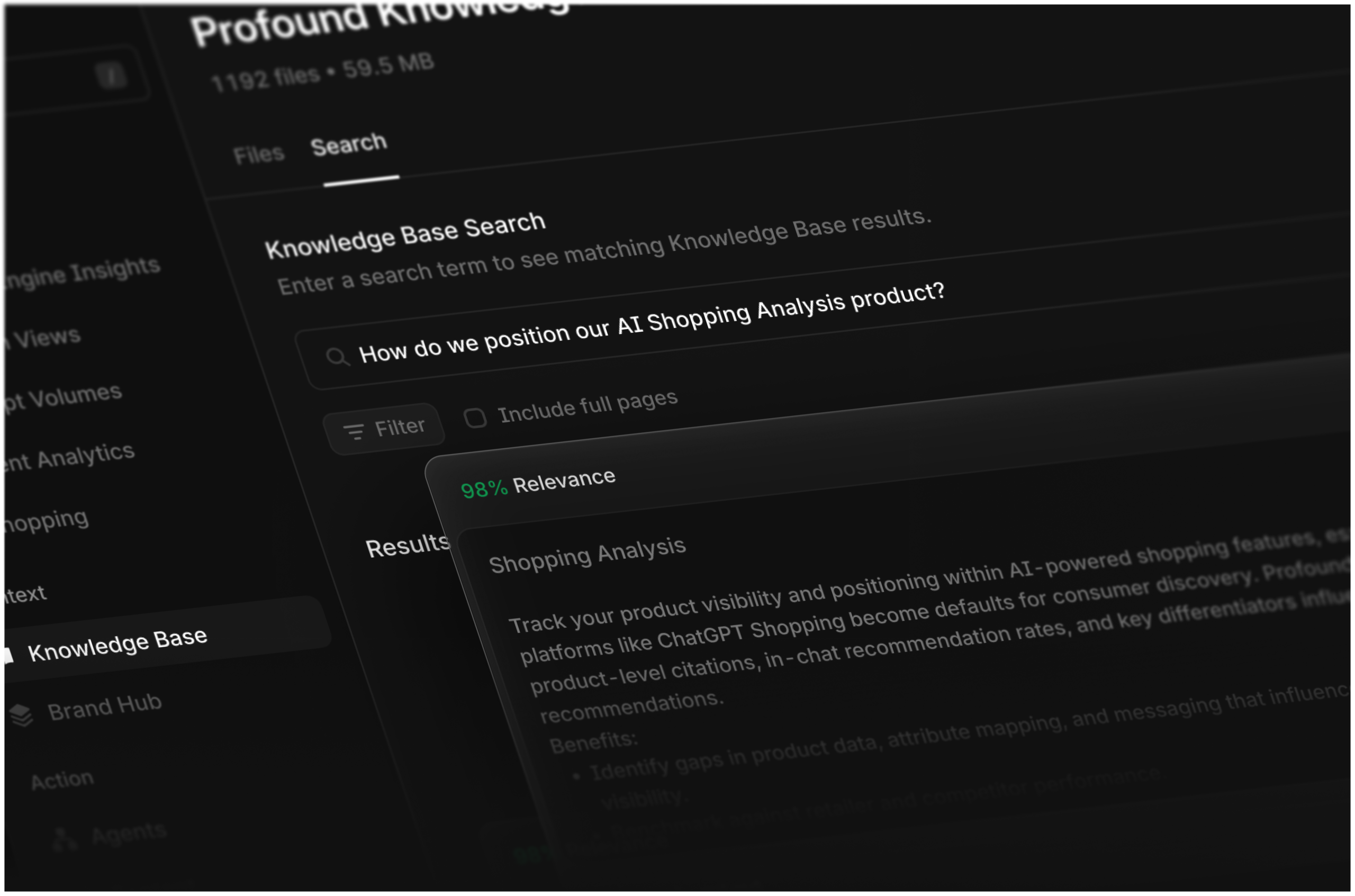
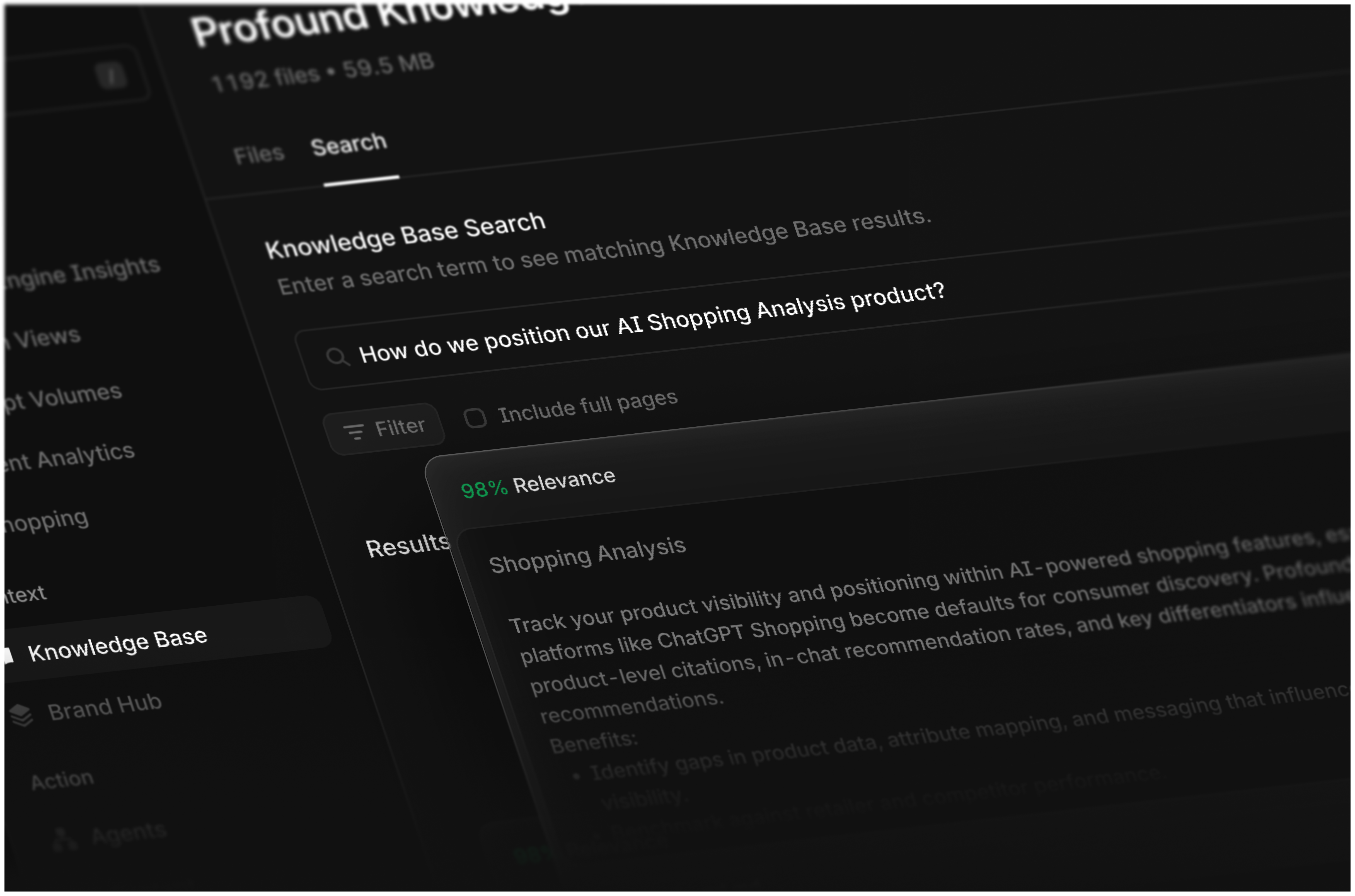
When I upload documents to the Knowledge Base, I provide Profound Agents with a comprehensive, single source of truth about my company’s unique information. This ensures that every marketing action performed on my behalf is informed with the right context about my brand.
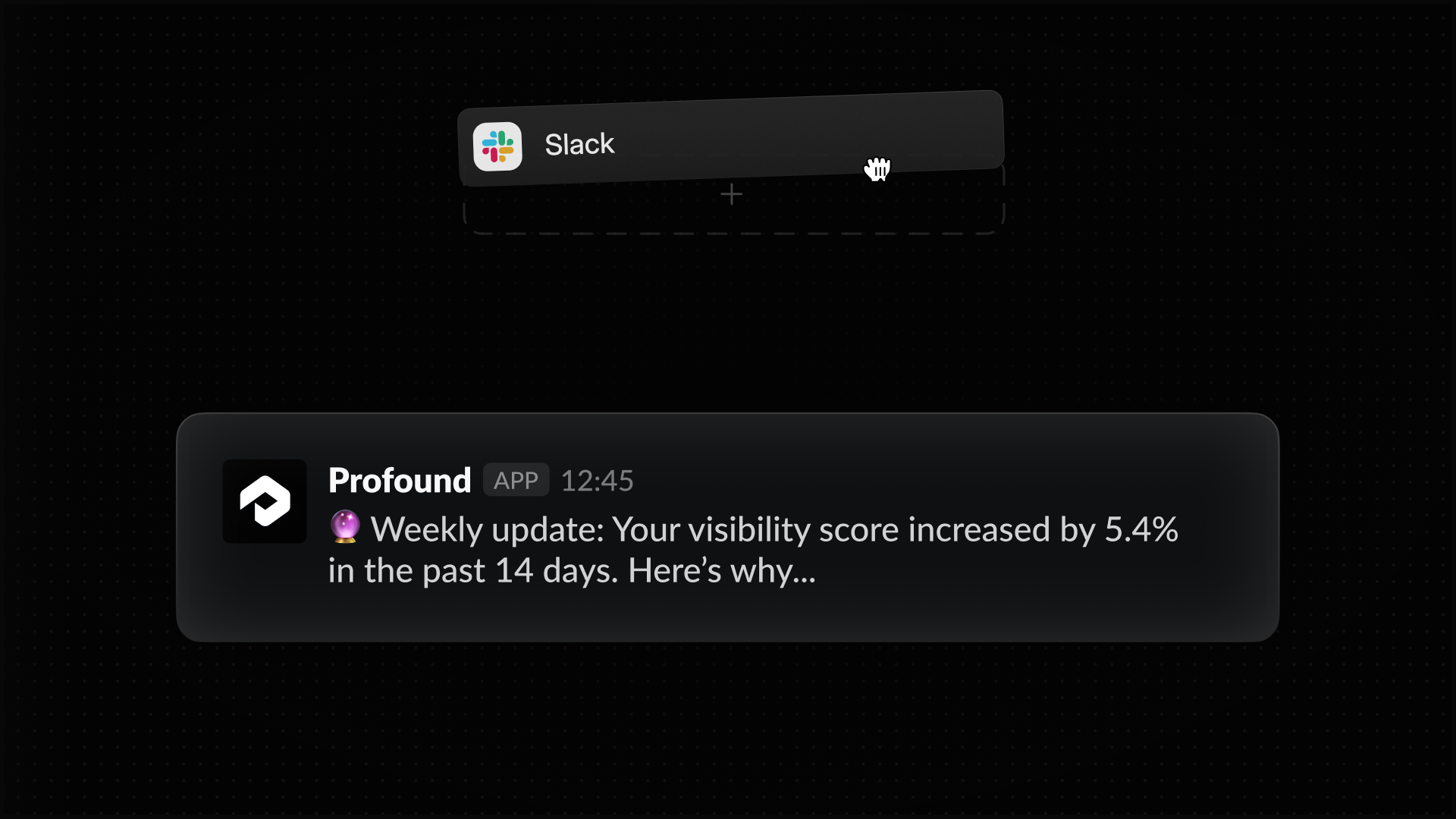
Integrating Slack with Profound has made my marketing team’s workflow incredibly smooth. I love how it keeps us in sync by automatically sending notifications about crucial updates from our Profound instance. Now, rather than constantly checking for updates on our brand’s visibility and sentiment in AI search, I can relax knowing that timely alerts will pop up directly in Slack, right where I work.
I’ve discovered how custom GPTs can revolutionize how we handle SEO, transforming repetitive tasks into efficient workflows. By leveraging AI, we can speed up our processes, from planning and analysis to reporting and technical work.
If you don’t have access to paid ChatGPT, don’t worry. You can still utilize these prompts by saving them as standalone references in your notes. Remember, they’re just starting points, so modify them to fit your team’s requirements.
Working with AI requires trial and error. My advice is to start with small tasks to practice writing prompts. Iterate on them and take notes on what produces good outputs.
AI can sometimes be verbose, so it’s helpful to set strict formatting guidelines and clear context. Upload resources and articles to guide AI results, and always define the role and audience upfront.
Let’s dive into seven prompts that I’ve found incredibly useful for developing custom GPTs dedicated to planning, analysis, and ongoing SEO tasks:
1. Project plan GPT
By analyzing previous project plans, I can create a GPT that assists in drafting this year’s focus areas.
How to set it up
Input project plans from previous years.
Specify a format for consistency.
Determine the number of items or sections to include.
Include specific details unique to your team.
Optionally, integrate team feedback and retrospectives.
Example prompt
Based on last year’s project plan, outline this year’s focus. List three critical items for each quarter, ensuring at least one covers link building.
Include a one-sentence summary for each recommended item and at least two KPIs to measure success.
[Insert last year’s plan.]
Now critique the plan. Offer three reasons against focusing on these items, providing sources for your notes.
By connecting performance dashboards or custom GA reports to ChatGPT, it can handle initial issue identification. This allows me to focus on investigating critical trends.
How to set it up
Hook up reporting tools or upload data directly.
Direct AI on specific aspects to investigate.
Set frequency for data review, such as daily or weekly.
Provide examples of pages or categories to analyze.
Example prompt
Here’s the weekly site report. Analyze this week’s performance against last week’s data, summarizing sessions, conversions, and engagement.
Highlight three successes and three areas needing improvement, color-coded by significance.
[Insert report doc.]
3. Competitor analysis GPT
I’ve found it invaluable to scrutinize what works on competitor sites. This often involves tools like Semrush or Ahrefs.
How to set it up
Integrate Ahrefs, Semrush, or upload relevant reports.
Select competitors and identify top-performing pages.
List key metrics for evaluation.
Create unique prompts for various levels of analysis.
Now, more than ever, custom GPTs are making a significant impact alongside existing SEO tools and workflows. They’re not about replacing the tools we use, but about making initial tasks smoother so that we can focus on insightful and strategic actions. By integrating them into our everyday processes, from planning to technical checks, we can really enhance our productivity.
If you are shortlisting AI software companies, a generic ranking answers the wrong question. A company can lead at the model layer and still be a poor choice for deploying a governed workflow inside your business.
Your real task is to identify the kind of company you need, define what leadership means for your use case, and make each candidate prove it with your workflow and representative data. That turns a crowded market into a decision you can defend.
Start with the job, not the company ranking
There is no useful universal winner. A packaged AI application, a model provider, a cloud platform, and a custom development company solve different parts of the problem. Ranking them together is like ranking an engine, a delivery van, and a logistics contractor on the same scale.
Before you collect vendor names, write a short procurement brief. It should be specific enough that another person could recognize a successful deployment without hearing the sales pitch.
Workflow: Name the task or decision the software will support. Avoid broad goals such as “use AI for marketing.” A workable definition is closer to “produce a cited first draft from approved product documentation for an editor to review.”
Owner: Identify the person accountable for the workflow after launch. A sponsor can approve a purchase, but an operational owner has to manage errors, updates, and user adoption.
Inputs: List the documents, databases, messages, images, or application events the system may use. Record where that data lives and who has permission to expose it.
Output and action: State what the system produces and what happens next. Distinguish a suggestion shown to a person from an action executed in another system.
Failure boundary: Describe acceptable mistakes, unacceptable mistakes, and the point at which a human must intervene. A formatting error and an invented compliance claim cannot share the same severity.
Environment: Name the identity system, content repository, analytics stack, customer platform, or other software the product must work with.
Evidence: Define what a candidate must demonstrate using representative cases. A polished demonstration using vendor-selected examples is not evidence of fit.
Exit conditions: Decide what data, configurations, prompts, evaluation cases, logs, and code you must be able to recover if you change providers.
If you cannot complete this brief, pause the vendor search. When the outcome is vague, almost any demonstration can look successful, and disagreements about quality appear only after money and integration work have been committed.
Compare companies that perform the same role
The label leading AI software development companies can cover businesses with very different products and delivery models. Put each candidate into a functional category before you compare features, pricing, or market visibility.
Company type
Choose it when
Evidence to request
Common mismatch
Model or API provider
Your team is building its own application and needs model capabilities as a component.
Results on your evaluation cases, usage controls, model-change procedures, latency behavior, and data-handling terms.
Buying raw capability when you do not have the engineering or operational team to turn it into a reliable workflow.
Cloud or data platform
Your priority is connecting AI to governed data, existing infrastructure, and enterprise controls.
Architecture fit, identity integration, data boundaries, deployment options, monitoring, and portability.
Assuming platform breadth means the desired business application is already complete.
Packaged AI application
You need a defined outcome in a familiar function such as content operations, support, analytics, or sales workflow.
Workflow coverage, administrator controls, export options, user permissions, integration depth, and evidence from representative tasks.
Paying for a broad feature set while the product remains weak at the narrow task that matters.
Workflow or agent platform
You need AI to coordinate steps, tools, and approvals across systems.
Action permissions, state handling, retries, approval gates, audit logs, failure recovery, and limits on autonomous behavior.
Treating an impressive prototype as a dependable operational process.
Custom AI development company
No packaged product fits the workflow, or your process and data create meaningful differentiation.
Proposed architecture, delivery ownership, evaluation method, repository access, documentation, deployment plan, support model, and intellectual-property terms.
Commissioning custom software before confirming that the workflow is stable enough to specify and maintain.
AI operations or governance provider
You already have AI systems and need evaluation, observability, policy enforcement, or control across them.
Coverage of your actual stack, alert quality, policy implementation, evidence retention, and response procedures.
Expecting a control layer to repair poor application design or unsuitable source data.
A candidate can belong to more than one category, but you should still name the role you are buying from it. Otherwise, a vendor’s strength in one layer can distract you from a gap in another. If you need a finished application, model quality alone does not settle the decision. If you need a model component, a large catalogue of packaged features may be irrelevant.
Turn “leading” into pass-or-fail requirements
Feature counts reward breadth, and weighted scorecards can hide a fatal weakness behind a high total. Use non-negotiable gates first. Score or rank only the companies that pass every gate that protects the workflow.
Task performance: The product must produce usable results on ordinary cases, difficult edge cases, and inputs that should trigger refusal or escalation. Define “usable” in terms of the next step in the workflow, not whether the output sounds polished.
Evaluation discipline: Ask how the company detects regressions and separates different error types. For generated answers, completeness, factual support, citation quality, format compliance, and harmful fabrication are different dimensions. A blended quality claim can conceal the failure that matters most to you.
Data governance: Get written answers about retention, use of customer data for training, storage location, deletion, subprocessors, tenant separation, and access by vendor personnel. Product controls and contract language should agree.
Security and human control: Confirm authentication, role-based access, approval steps, auditability, and the ability to stop or override automated actions. The more consequential the action, the less acceptable an invisible decision path becomes.
Integration depth: Distinguish a live, supported integration from a demonstration, roadmap item, or generic API. Verify the exact records the system can read, create, update, and export.
Operational resilience: Ask what happens when a model, connector, data source, or downstream system fails. A production workflow needs observable errors, safe fallbacks, ownership, and a recovery procedure.
Commercial fit: Calculate the cost of the working process, including usage, integration, human review, monitoring, support, and ongoing evaluation. A low software price can still produce an expensive workflow if reviewers must repair most outputs.
Exit viability: Confirm that you can retrieve business data and the operational assets needed to continue elsewhere. For custom development, define ownership of code, prompts, configurations, documentation, and deployment materials before work begins.
Treat unsupported roadmap promises as unavailable. Record each capability as proven, contractually committed, or absent. Those labels keep a persuasive demonstration from turning future intent into present functionality.
References and customer logos can help you understand where to investigate, but they do not replace workflow evidence. Ask references about deployment effort, failure handling, support after the sale, and what their internal team still has to operate. A similar industry is useful; a similar data shape, risk level, and workflow is better.
Run a production-shaped proof before you commit
A proof should test the operating system around the AI, not just the most attractive output. Keep the workflow narrow enough to inspect closely, but preserve the data conditions, permissions, integrations, and review steps that will exist in production.
Freeze the use case. Give every candidate the same workflow definition, input boundaries, expected output, and failure rules. Do not let each vendor redefine success around its strongest feature.
Build the evaluation set. Include routine examples, ambiguous inputs, incomplete information, edge cases, and requests the system should decline or escalate. Keep a portion of the cases out of vendor-led configuration so you can see how the system handles unfamiliar inputs.
Protect sensitive information. Use de-identified or synthetic material until contractual, security, and internal approvals permit representative production data. When real data becomes necessary, expose only what the approved test requires.
Record configuration work. Track the prompts, rules, connectors, data cleanup, and human assistance required to achieve the result. A system that performs well only after extensive hidden preparation may carry a much higher operating cost than the demonstration implies.
Test the whole handoff. Measure whether users can review, correct, approve, reject, and trace the output inside the intended workflow. A strong answer copied manually between applications may still be a weak production solution.
Force recoverable failures. Remove a source, deny a permission, provide conflicting information, or interrupt a downstream service in a controlled test. Check whether the system fails visibly, preserves state, avoids unsafe actions, and gives an operator a clear recovery path.
Review the evidence by error type. Keep a failure log that identifies what went wrong, its consequence, whether a person detected it, and whether the proposed fix is repeatable. Do not average a severe failure into a reassuring overall score.
Price the observed workflow. Use the actual configuration, workload shape, review effort, support requirement, and integration pattern from the proof. Model an increase and decrease in usage so you can see which charges are fixed and which scale with activity.
Test the exit. Export representative data and configuration, inspect its format, and identify what cannot move. For a custom system, verify access to the repository, build instructions, environment configuration, and operating documentation.
The proof should leave you with artifacts you can inspect later: the frozen evaluation set, result sheet, failure log, data-flow map, architecture diagram, cost model, operating runbook, and exit plan. If the only durable artifact is a presentation, you have evaluated a sales process rather than a production system.
Reject any company that fails a non-negotiable gate, even if it has the highest total score. Among the survivors, prefer the option that reaches the required outcome with the clearest controls, lowest operational burden, and most credible path out. That is a more useful definition of leadership than size, visibility, or the longest feature list.
Key takeaways for your shortlist
Define the workflow, owner, data, action, failure boundary, evidence, and exit conditions before collecting vendor names.
Compare model providers with model providers, applications with applications, and development companies with development companies.
Make task performance, data governance, security, operational resilience, economics, and exit viability pass-or-fail gates.
Use the same production-shaped evaluation cases for every candidate, and keep severe errors visible instead of burying them in an average.
Count configuration, integration, review, monitoring, and support when calculating cost.
Choose the company that can prove the required outcome and remain operable when inputs, systems, or providers change.
Take your current list and write each company’s intended role beside its name. Remove candidates that solve a different layer, send the survivors the same procurement brief, and do not declare a leader until the proof produces evidence your operational owner is willing to accept.
The draft looks finished. The structure is clean, the tone is right, and the citations look plausible. Then you check one claim and discover that the evidence is not there. Editing that sentence treats the symptom; the prompt still rewards a complete answer more than a defensible one.
Rubric-based prompting changes that incentive. You tell the model not only what to produce, but how to decide whether it has enough support, when it may infer, when it must qualify, and when it should stop. That is the difference between requesting a polished deliverable and defining a controlled production process.
Why polished prompts still fail when information is missing
A conventional prompt usually describes the destination: write an article, analyze a competitor, summarize a document, or recommend a strategy. It may specify the audience, tone, length, headings, and output format. Those instructions can improve presentation without resolving the most important question: what should the model do when it cannot support part of the requested answer?
If you request a complete deliverable but provide incomplete evidence, the model faces competing objectives. It can acknowledge the gap and leave part of the task unfinished, or it can produce something fluent enough to resemble completion. Unless you define which objective has priority, fluency can win.
This matters in content, SEO, AEO, and GEO workflows because unsupported material rarely stays in one draft. A fabricated statistic can migrate into a headline, executive summary, FAQ, metadata, structured data, presentation, or client recommendation. The first error may be a sentence. The operational problem is the chain of assets built from it.
The downside is not theoretical. In 2025, Deloitte had to refund substantial costs associated with a government report containing AI errors, including fabricated citations. That is an extreme outcome, but it illustrates the basic risk: an authoritative-looking answer can travel farther than its evidence warrants.
A vague prompt is not the only reason an AI system can be wrong, and no rubric can guarantee truth. Models can misunderstand material, mishandle conflicting evidence, or generate an incorrect answer despite clear instructions. A rubric addresses the preventable part of the problem: ambiguity about evidence, uncertainty, inference, and failure behavior.
The distinction is simple. A prompt describes what a successful output should contain. A rubric defines the decisions the model must make when success is not fully possible. It replaces requests such as be accurate or do not hallucinate with conditions that can actually govern the response.
Build the rubric around decisions, not aspirations
An instruction such as use reliable information sounds responsible, but it leaves every operational term undefined. Which information is authorized? What counts as support? May the model draw an inference? Should it omit an unsupported section, qualify it, or ask you a question?
A useful rubric resolves those choices before generation starts. Build yours around the following decisions.
Define the evidence boundary. Name the material the model may use: supplied documents, approved URLs, a product fact sheet, a transcript, a dataset, or general background knowledge. If freshness matters, state whether information outside the supplied material is prohibited or must be separately verified. Do not use an open-ended phrase such as credible sources when you need a closed evidence set.
Classify claims by support. Tell the model to distinguish facts directly supported by the authorized material from reasonable inferences, unresolved conflicts, and unavailable information. Give each state a visible treatment. A supported fact may be stated normally. An inference should be labeled. A conflict should remain visible. An unavailable claim should be omitted or marked as needing evidence.
Identify material uncertainty. Not every missing detail should stop the task. Define a gap as material when it could change the central claim, recommendation, audience, scope, or risk. The model may proceed with a harmless formatting choice, but it should not quietly invent a product capability, legal requirement, price, quotation, date, or performance result.
Specify the fallback behavior. Decide what should happen when a criterion fails. Your choices include asking a blocking question, returning a partial answer, labeling a provisional assumption, inserting a clear evidence placeholder, or declining the unsupported portion. Without a fallback, even a good accuracy rule leaves the model to improvise.
Set an acceptance test. Describe what must be true before the response is considered complete. For example, every factual claim must map to authorized evidence; every inference must be labeled; every citation must support the adjacent claim; and summaries, FAQs, metadata, and structured fields must not introduce facts absent from the approved material.
Put these rules in priority order. If accuracy and completeness conflict, say which one wins. If the requested format requires a statistics section but no statistics are available, the rubric should instruct the model to flag the missing evidence instead of manufacturing a plausible number to preserve the format.
The same principle applies to conflicts among inputs. Do not tell the model merely to resolve discrepancies. Tell it whether to prefer a designated primary record, use the most applicable version, present both positions, or stop and ask. Otherwise, the final answer may hide the disagreement behind confident prose.
Keep the rubric concise enough to enforce. Repeated rules written in slightly different ways can create new conflicts. Each criterion should contain a trigger, a required action, and a visible outcome. If you cannot tell whether the output passed a criterion, rewrite the criterion.
A copy-ready rubric for content and SEO workflows
You do not need to rebuild the framework for every task. Keep a stable core and add task-specific rules only where the risk changes.
Reusable prompt block
Place this block after the task, audience, context, and required output format. Replace the bracketed fields with boundaries that match your workflow.
Priority: Factual support and transparent uncertainty take precedence over completeness, fluency, tone, and length.
Authorized evidence: Use only [approved inputs] for factual claims about [subject]. Do not treat a requested claim as evidence that the claim is true.
Supported claims: State a factual claim only when the authorized evidence supports that specific wording and scope. Do not broaden a narrow claim.
Inferences: You may infer only when the conclusion follows reasonably from the evidence and does not introduce a new factual detail. Label the conclusion as an inference and identify the evidence behind it.
Missing or conflicting information: Do not invent names, numbers, dates, quotations, citations, URLs, capabilities, examples presented as real, or research findings. Mark unsupported items as [preferred label]. Preserve material conflicts instead of silently choosing a side.
Clarification rule: Ask a blocking question before drafting when the missing information could change the central claim, recommendation, audience, scope, or risk. Otherwise, continue and record the limitation.
Final check: Before returning the answer, remove or label every unsupported claim, confirm that each citation supports the claim beside it, and confirm that derivative sections introduce no new facts.
Response: Return the requested deliverable followed by a short exception log containing material omissions, labeled inferences, unresolved conflicts, and blocking questions. Do not return hidden reasoning or a generic assurance that the answer is accurate.
The exception log is important because it makes failure visible without requiring you to inspect the model’s internal reasoning. If the log is empty but the draft contains unsourced specifics, the output has failed the rubric.
Worked example: an evidence-controlled content brief
Suppose you ask AI to create an AEO-focused brief from an approved product fact sheet, a set of customer questions, and selected reference pages. A normal prompt may request key claims, search intent, supporting statistics, FAQs, and suggested structured content. The format is clear, but the evidence rules are not.
Add task-specific criteria such as these:
Use the approved packet for every product claim, date, number, quotation, comparison, and attributed statement.
Do not invent search volume, ranking difficulty, trend data, customer stories, survey findings, product limitations, or competitor capabilities.
Separate evidence-backed audience questions from editorial questions proposed for further research. Do not present a suggested question as observed search behavior.
Separate factual claims from recommendations about page structure. A heading recommendation does not need to masquerade as a fact about the market.
Create a claim register that pairs each publishable factual claim with the item that supports it. If no item supports the claim, label it Needs evidence.
Apply the same evidence boundary to the summary, FAQ, metadata, and any structured fields. Changing the format does not authorize a new claim.
Return blocking questions before the brief when missing information would change the page’s audience, core promise, or factual position.
This version still lets the model help with organization and editorial planning. It removes permission to imitate missing research. That distinction prevents a common failure: treating the model’s familiarity with the shape of an SEO brief as evidence for the facts inside it.
Test the rubric with deliberately incomplete input. Remove the support for a requested statistic, product claim, or quotation while leaving the request in place. A passing response should flag the gap, ask a material question, or omit the unsupported item according to your rule. If it produces a plausible replacement, tighten the evidence boundary and failure action before using the prompt in an automated workflow.
Review the output with a separate acceptance rubric
The generation rubric controls how the draft should be produced. An acceptance rubric controls whether that draft can move forward. Separating the two prevents a polished response from being treated as approved merely because it followed the requested structure.
Use clear statuses such as pass, revise, and block. A numeric score can hide a serious defect inside an acceptable average. One fabricated citation should block publication even if the tone, organization, and formatting are excellent.
Criterion
Pass condition
Failure action
Evidence coverage
Every externally verifiable factual claim is traceable to an authorized input or visibly labeled as an inference.
Remove the claim, add appropriate evidence, or change its status.
Citation fit
Each citation exists and supports the exact claim, scope, and qualification beside it.
Replace the citation, narrow the wording, or block the claim.
Uncertainty handling
Material gaps and conflicts remain visible; low-impact assumptions are identified where relevant.
Add a qualification, request clarification, or return the item for research.
Instruction priority
The output meets the task without violating higher-priority evidence and uncertainty rules.
Revise the deliverable instead of waiving the higher-priority rule.
Claim propagation
Summaries, FAQs, metadata, and structured fields contain no unsupported facts copied from or added to the main draft.
Remove the derivative claim or supply support before publishing.
Exception log
Material omissions, inferences, conflicts, and questions are specific enough for a reviewer to resolve.
Replace generic caveats with the affected claim, missing input, and required next action.
You can ask the model to apply this acceptance rubric to its own output, but treat that as a consistency check, not independent verification. The same system that generated an unsupported claim can overlook it during self-evaluation. A person should still open important citations, compare claims with the underlying material, and review conclusions that affect money, legal exposure, health, reputation, or publication under someone else’s name.
When a rubric performs badly, the pattern usually points to the missing rule:
The answer is fluent but contains invented specifics. The evidence boundary is open-ended, or unsupported claims have no mandatory failure action.
The model refuses to complete useful work. The rubric treats every uncertainty as blocking. Define which inferences and low-impact assumptions are allowed.
The answer is buried in caveats. The rubric does not distinguish material uncertainty from details that do not affect the outcome. Add a materiality test.
The citations look correct but do not support the claims. The rubric checks citation presence rather than citation fit. Require support for the exact adjacent statement.
Different sections contradict one another. The rubric evaluates local sentences but not the deliverable as a whole. Add a cross-section consistency check.
The model follows some rules and ignores others. The rubric is probably too long, repetitive, or internally conflicted. Remove overlap and state the priority order.
The self-review always passes. The acceptance criteria are subjective, or the same model is being treated as an independent reviewer. Replace impressions such as high quality with observable pass conditions and retain human verification where the consequence warrants it.
A rubric does not replace retrieval, source selection, subject-matter expertise, or fact-checking. It governs what the model should do with the information and uncertainty it has. That narrower role is still valuable because it makes incomplete evidence visible before fluent prose conceals it.
Key takeaways
A standard prompt defines the deliverable; a rubric defines how the model must behave when evidence is missing, conflicting, or insufficient.
Prioritize factual support over completeness explicitly. Otherwise, a request for a finished answer can compete with the instruction to avoid unsupported claims.
Every criterion needs a trigger, required action, and visible outcome. Be accurate is a goal, not an enforceable rule.
Define allowed evidence, labeled inference, material uncertainty, clarification conditions, and failure behavior before generating the draft.
Use a separate acceptance rubric for publication. Self-review can improve consistency, but it is not independent factual verification.
Start with one prompt you already use. Add an evidence boundary, an uncertainty classification, a stop condition, and an acceptance check. Then test it against incomplete or conflicting input. If the model fills a gap you expected it to expose, revise the decision rule before you scale the workflow. The useful rubric is not the one that sounds strict; it is the one that produces the correct behavior when the easy answer is unavailable.
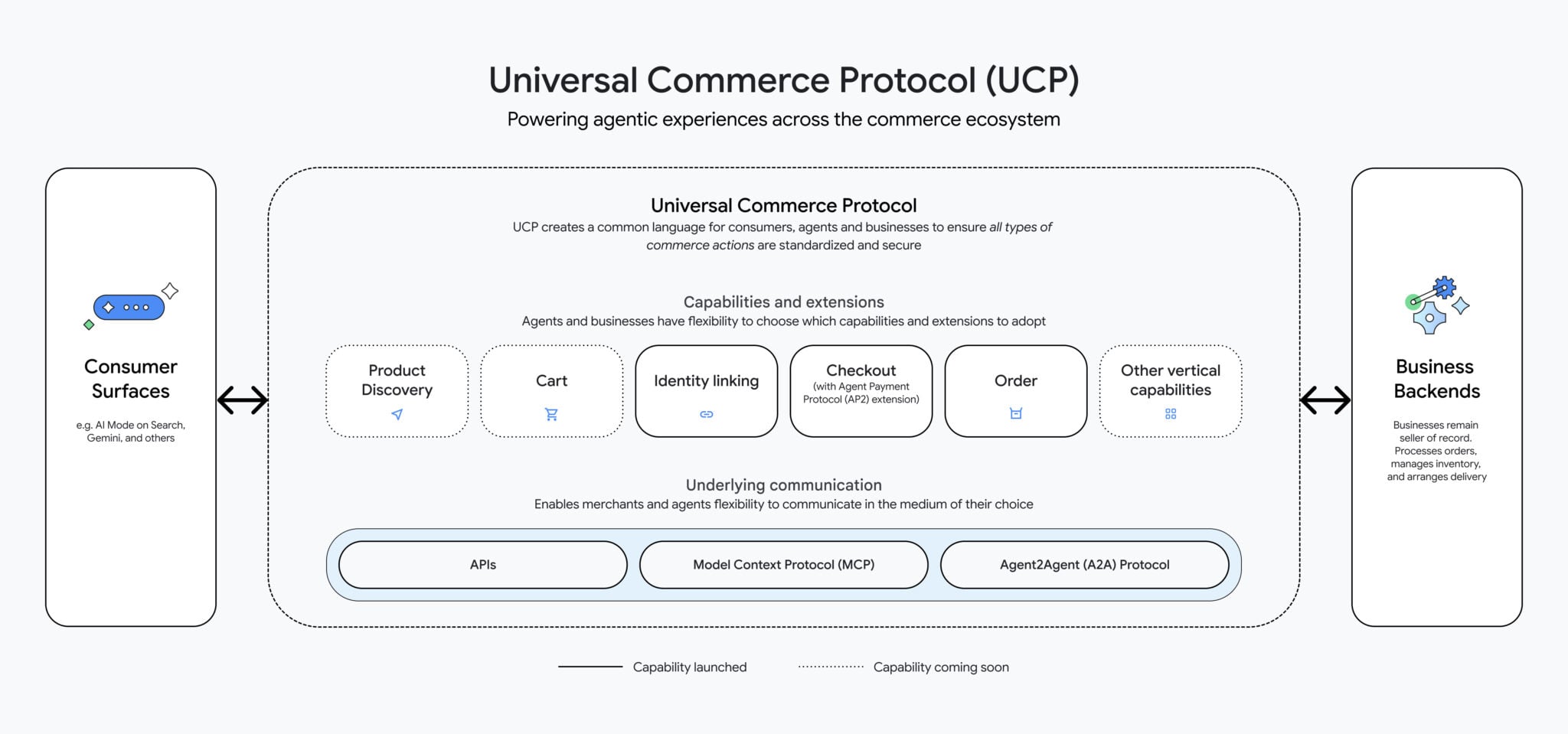
Have you heard the news? Google has just launched the Universal Commerce Protocol (UCP), an innovative open standard that integrates AI agents throughout the entire shopping experience. From discovering products to making purchases and even receiving support after the sale, UCP facilitates it all.
In exciting developments for retailers, Google is also rolling out new AI tools. These include branded shopping agents and ad formats that enhance AI-driven discovery, making the shopping experience more streamlined and engaging.
About UCP
This protocol offers a common language for AI agents and commerce systems, greatly simplifying the need for custom integrations across different platforms.
UCP is compatible with existing standards like Agent2Agent and the Model Context Protocol.
The protocol was co-developed with prominent partners such as Shopify, Etsy, Wayfair, and Target.
It’s already endorsed by over 20 additional companies in the retail and payments sectors.
What’s Changing
The UCP is set to enhance the checkout experience for Google product listings via AI Mode in Search and the Gemini app. Shoppers can make purchases through Google Pay, with options to use saved payment and shipping details. Integration with PayPal is also on the horizon.
Google aims to lower cart abandonment and provide retailers with tailored integration options suited to their needs.
Upcoming features include loyalty rewards and personalized shopping experiences.
Business Agent
In tandem with UCP, Google is unveiling the Business Agent, a branded AI assistant that provides shoppers with direct interaction opportunities on Search. Think of it as a virtual sales associate offering real-time responses in your brand’s own tone.
Major retailers like Lowe’s, Michael’s, Poshmark, and Reebok are already on board. Future capabilities may include deeper customization, data training, and a seamless agent-led checkout.
Direct Offer
Google is also testing Direct Offers, a fresh initiative within Google Ads tailored for AI adoption. When AI senses that a shopper is likely to make a purchase, a special discount can be presented.
This pilot will soon expand to incorporate offers such as product bundles, complimentary shipping, and more enticing incentives.
Why It Matters
The rise of agent-led shopping reshapes where and how buying choices are made. Google’s new AI tools and protocols are taking the lead, allowing advertisers to influence these pivotal moments during an AI-driven shopping journey.
Tools like Direct Offers and branded agents create new pathways for advertisers to finalize sales efficiently, all while safeguarding profit margins. The balance between conversion improvements and losses in direct site traffic remains an open discussion.
Bottom Line
According to Google, agentic shopping is unstoppable. With innovations like UCP and its complementary retail tools, Google ensures that AI-driven commerce remains inclusive and accessible, keeping retailers engaged as agents transform the buying landscape.
Have you ever imagined a marketing approach where the emphasis is on outcomes rather than just the tools? Let me introduce you to Genmark Flow, a groundbreaking concept in AI marketing that is more than just software; it’s a comprehensive service.
Genmark Flow is an AI Service as Software solution that delivers results through expertly managed growth strategies. This revolutionary system prioritizes delivering tangible results over merely providing tools. AI-powered and expertly managed, it ensures your marketing goals are not just met, but exceeded.
With Genmark Flow, you’re not only accessing cutting-edge technology, but you’re also leveraging a service that supports you in achieving your growth ambitions. Get ready to transform your marketing strategies and witness significant outcomes.
Wow, what a whirlwind 2025 was in the ever-evolving world of SEO! I found myself constantly amazed at the pace of change, especially with the rise of GEO and AI-driven discoveries.
The incredible advances—from multi-platform searches to innovative AI applications—made this year truly groundbreaking. As I dove into these shifts, Search Engine Land remained my trusted guide, helping me navigate what’s happening, what’s on the horizon, and, most importantly, what really matters.
I’m thrilled to share with you the 10 most-read SEO columns of 2025. These pieces, penned by some of the best minds in the field, captivated and informed readers like never before.
Your SEO stack can produce a dashboard full of green arrows and still leave you unable to defend the next renewal. If you are deciding whether to keep a platform, add AI-search monitoring, or build an internal agent, the first question is not which option has the longest feature list. It is what decision the investment must improve.
Build the measurement system before the shortlist. You will expose missing data, avoid paying twice for the same capability, and give every candidate a real job to perform.
Key takeaways
Define the business outcome, search signal, diagnostic evidence, decision, and owner before evaluating any tool.
Use the 24-hour view for investigation, weekly reporting for operating decisions, and monthly reporting for direction and resource allocation.
Buy a capability only when it closes a documented measurement or workflow gap. An AI label is not a use case.
Run trials with representative weekly work, the same inputs, and pass-or-fail criteria that matter after the demo.
Separate observed trial evidence from forecast business impact. A short trial can validate a workflow, but it cannot prove future revenue.
Build a measurement brief before opening a vendor tab
Replace the feature wish list with a short measurement brief. Complete these fields before you request a demo:
Business question: State the decision in plain language. Examples include which landing-page group deserves investment, whether a technical release repaired organic acquisition, or which market needs local content.
Outcome: Name the result the business already recognizes, such as qualified leads, completed orders, subscriptions, booked consultations, or another defined conversion.
Search-performance signal: Identify what you expect to move before the outcome does. Depending on the job, that could include impressions, clicks, landing-page traffic, organic conversions, or search visibility for a defined query set.
Diagnostic evidence: List the information needed to explain the movement, such as indexation status, page-template defects, query mix, SERP composition, country, language, or device.
Decision rule: Describe what you will do when the evidence changes. A metric without a resulting action is reporting inventory, not a requirement.
Owner and cadence: Name who reviews the result, who receives the work, and whether the decision belongs in incident response, a weekly queue, or monthly planning.
Boundary: Record what the measurement will not prove. This prevents a ranking change, an alert, or an AI-generated recommendation from being presented as revenue attribution.
Keep outcomes, performance indicators, and diagnostics separate
A useful SEO measurement model has distinct layers:
Outcome measures describe business results: revenue, qualified demand, completed transactions, subscriptions, or another accepted conversion.
Performance indicators describe how organic search contributed: query impressions, clicks, landing-page visits, conversions attributed to organic sessions, and visibility within a defined search set.
Diagnostic measures help explain why performance changed: crawling and indexation states, template issues, internal-linking gaps, SERP changes, or differences between markets and devices.
Do not collapse these layers into a proprietary health score and assume the result has business meaning. A technical score can improve without demand changing. Visibility can rise on queries that never produce a useful visit. Organic conversions can move because of a pricing change, promotion, tracking repair, or landing-page redesign rather than the SEO work being evaluated.
Write the evidence chain explicitly: the work performed, the observable search change, the on-site action, and the business outcome. Annotate releases and tracking changes. Compare the affected page or query group with a relevant unaffected group when one exists. If the chain is incomplete, call the result an association or an operational improvement rather than attribution.
Measure at the level where the intervention happened. A template fix should be evaluated on the affected template group. A localized content program should be separated by country and language. A rewrite aimed at one query theme should not be judged only through a sitewide total. Aggregation can make a successful change disappear, or make an unrelated gain look like success.
Did an abrupt change coincide with a release, tracking failure, indexing problem, or other incident?
Declaring a durable trend from a short movement.
Weekly
Is the movement persistent enough to enter the operating queue, and did recent work affect the intended pages or queries?
Proving long-term business return from a single reporting period.
Monthly
Is the program moving in the intended direction, and should priorities or resources change?
Finding the exact cause of a sudden failure.
Use the shortest interval that can answer the decision without letting routine variation dominate it. Then preserve the finer view for diagnosis. A monthly decline can justify investigation; the weekly and 24-hour views help locate when it began and which segment moved.
Reporting grain does not fix a poor comparison. Compare complete periods with complete periods. Keep seasonal demand and major campaigns in view. Do not compare a global total after launching a new locale without separating the new market from established ones.
Segment before you explain. Useful cuts include query theme, landing-page group, template, device, country, language, and a documented branded-versus-non-branded rule. A flat sitewide result can conceal growth in one segment and decline in another.
Maintain a change log next to the performance data. Include site releases, migrations, tracking changes, canonical-rule updates, internal-linking work, and major campaigns. When performance moves, check those known events before assigning the change to an algorithm, competitor, or tool recommendation.
Connect search performance, landing-page behavior, and the defined business outcome for the affected page group.
Repeatable definitions, visible transformations, segment-level results, and an export that another analyst can inspect.
SERP intelligence
Explain a visibility change for a defined query set and market.
The underlying queries, capture context, date, location, device, competing results, and relevant search features rather than an unexplained score.
Automation
Complete a recurring weekly task from detection to prioritized handoff.
Rules, exceptions, deduplication, evidence attached to each recommendation, an owner, and a record of what happened after the alert.
Multilingual support
Analyze a real country-and-language workflow without merging markets that require different decisions.
Locale-specific query and page context, correct filters, preserved terminology, and reporting that can be reviewed by the market owner.
Pricing clarity
Price the expected operating state rather than the demo environment.
A written breakdown of seats, tracked entities, usage limits, exports, integrations, AI consumption, implementation, support, and overage conditions.
If AI-search visibility is the stated gap, define the observation before accepting a visibility score. Ask which model or search surface was checked, in which locale, against which prompt or query set, at what time, with what captured answer, and under what entity-matching rule. Treat the tracked set as a measurement panel with documented boundaries. An opaque score can summarize evidence, but it should not replace the evidence.
The replacement standard should be especially high for established crawling and technical-audit workflows. Core technical SEO tooling is comparatively stable. If your current system reliably finds relevant issues, preserves history, and routes work to the right owner, adding an AI label is not enough reason to replace it.
Decide whether to buy an AI tool or build an agent
Buy a platform when the task is standardized and the main value comes from vendor-maintained datasets, integrations, interfaces, support, and ongoing product upkeep.
Build an agent when the useful context lives in internal data, business rules, approval paths, or proprietary workflows that a general platform cannot represent. Include evaluation, monitoring, security review, maintenance, and internal ownership in the cost.
Keep the existing stack when the real bottleneck is an undefined decision, weak implementation discipline, missing conversion data, or unclear ownership. A new interface will not repair those conditions.
For a small team, automation must remove work rather than produce more material to review. Outputs without market and business context tend to create noise. Require the system to suppress duplicates, show supporting evidence, explain uncertainty, and hand the next action to a named owner.
Lock the use case and finish line. Describe the input, expected output, decision, owner, and acceptable evidence before anyone sees the product.
Capture the current baseline. Record active work time, waiting time, systems touched, manual handoffs, recurring errors, and the decision produced by the current workflow.
Use representative inputs. Include ordinary data and a known difficult case. A candidate that works only on a tidy sample has not passed the operational test.
Separate setup from recurring operation. Record configuration, integration, tagging, permissions, and training effort independently from the work expected after adoption.
Run the same task across candidates. Keep the data, operator instructions, and required output consistent so the comparison reflects the tools rather than different demonstrations.
Trace every important output. Follow recommendations back to queries, pages, captured results, or other underlying evidence. Label generated explanations separately from observed data.
Count decisions changed, not alerts created. Record whether the output changed a priority, prevented an error, removed a manual step, or supplied evidence the current stack could not provide.
Test the handoff. Export the result, route it to the intended owner, apply permissions, and verify that history remains understandable outside the person who configured the trial.
Price the operating state. Obtain the expected cost at normal usage, including implementation, integrations, support, consumption limits, internal administration, quality assurance, and any tools the purchase would actually retire.
Apply pass-or-fail gates before scoring convenience features:
Data fitness: It covers the required sites, markets, languages, queries, pages, and business data at a usable level of detail.
Evidence quality: Important outputs are reproducible, traceable, and explicit about assumptions or uncertainty.
Workflow value: It removes a documented step, improves a defined decision, or enables a necessary analysis that is currently impractical.
Operational fit: The intended users can configure, review, export, and act on the output without relying indefinitely on a vendor specialist.
Governance: Access controls, retention, deletion, input reuse, and approval requirements fit your organization’s rules.
Commercial clarity: The written price covers the expected usage, dependencies, overages, implementation, renewal conditions, and exit path.
Do not upload confidential query, customer, conversion, or client data until the appropriate security, privacy, and legal owners have approved the environment. Use a sanitized export or synthetic test set while that review is incomplete. The convenience of a trial is not worth creating an uncontrolled copy of sensitive data.
Ask vendor questions that expose operating cost
Send the use case before the call, then ask questions that require specific answers:
Which assumptions about seats, sites, markets, tracked queries, prompts, exports, API use, and AI consumption are included in this quote?
Which capabilities shown in the demonstration require another package, service, integration, or implementation fee?
What work is required from our team during setup and during normal operation?
Which claims describe production functionality, and which depend on a roadmap?
Can we export raw observations, definitions, configurations, and history in a usable format?
How are AI inputs retained, reused, isolated, and deleted, and where can those terms be verified?
What happens to access, stored data, reports, and integrations if usage changes or the contract ends?
Build a budget case without pretending the trial proved revenue
A short trial can establish data coverage, repeatability, workflow fit, evidence quality, and whether the output changes a decision. It usually cannot establish that the tool caused a durable ranking, conversion, or revenue increase. The business case should keep observed evidence, forecasts, assumptions, and unknowns in separate fields.
Calculate full cost as the subscription, expected usage and overages, implementation, integrations, training, quality assurance, administration, and any internal build or maintenance effort, minus only the cost of tools that will genuinely be retired.
Treat saved labor carefully. It becomes direct financial savings only when it avoids actual spending. Otherwise, describe it as capacity and name where that capacity will be redeployed. Treat incremental business impact as a forecast with an explicit mechanism: better evidence leads to a different decision, that decision changes the work, and the work may affect the defined outcome.
Set checkpoints before signing. Confirm usability and evidence quality at the end of the trial, review operational value after a complete reporting period, and revisit adoption, overlap, business impact, and full cost before renewal. If the tool does not improve the decision named in the original brief, downgrade it, replace it, or stop paying for it.
Your next move should be a blank measurement brief, not another demo booking. Choose a real decision from the next closed weekly or monthly period and ask each candidate to produce evidence your current stack cannot. A tool that cannot change that decision has not earned a place in the budget.
If Profound’s G2 recognition has put the platform on your AEO shortlist, don’t ask only whether the badge is impressive. Ask what decision it can safely support. The answer is useful but narrow: it can justify a closer look, not a purchase.
Profound publicly reports that it was recognized as the definitive Leader in G2’s Winter Reports for the AEO category. That gives you a named market signal from a specific report cycle. It doesn’t establish how the product will perform against your prompts, markets, workflow, or technical requirements. A defensible decision requires you to verify the recognition and test the platform separately.
Read the G2 leadership claim at its actual scope
A precise procurement note should preserve four parts of the claim: the vendor, the label, the category, and the report cycle. In this case, those parts are Profound, definitive Leader, AEO, and G2 Winter 2026.
Keep those qualifiers together whenever you brief your team or repeat the recognition publicly. Removing AEO can make a category-specific result sound like a company-wide judgment. Removing Winter 2026 turns time-bounded recognition into an indefinite status. Replacing the exact label with broader wording can create a claim that the underlying record may not support.
The recognition does not, by itself, establish any of the following:
That Profound received the highest result on every criterion used in the category.
That its measurements are technically accurate for every answer engine, language, or market.
That it supports every workflow, integration, or governance requirement your organization has.
That using the platform will cause your brand to appear, rank, or receive citations in an external answer engine.
That it is a better fit than every alternative for your particular team.
Those limitations don’t invalidate the recognition. They place it in the right part of the decision: market evidence. Product capability, data quality, operational fit, and business value still need their own proof.
Verify the recognition before you circulate it
Before the accolade enters a business case, sales deck, board update, or vendor scorecard, ask Profound for the originating G2 record. A badge graphic or a restatement on another company-controlled page is not the same as primary verification.
Request a direct G2 URL, accessible report, or exported record that identifies the relevant Winter 2026 result.
Confirm that the product name, AEO category, and Leader wording match the language you intend to use.
Read the category criteria and methodology rather than assuming what Leader means. Record which inputs affect placement and which do not.
Check the applicable data window, review base, customer segments, geographic qualifications, and any inclusion thresholds shown in the primary record.
Save the verification artifact with the date you accessed it. If the recognition later changes, your team will know which decision relied on which report cycle.
Use a simple evidence status in your internal records. Mark the claim verified when an originating G2 artifact supports the exact wording. Mark it partially verified when the placement is visible but your proposed wording is broader than the record. Mark it vendor-reported when only Profound’s own publication is available.
For now, the conservative wording is that Profound reports receiving the recognition. That distinction is not pedantry. It prevents a vendor-supplied claim from quietly becoming an independently checked fact as it moves through your organization.
Make Profound earn the shortlist with your workload
An AEO platform is valuable when it helps your team observe answer-engine behavior, diagnose meaningful gaps, choose sensible actions, and measure what happens next. A polished demonstration can show how an interface works. Only your own workload can show whether the system is useful to you.
Freeze the evaluation scope before the demonstration
Create a prompt inventory before anyone logs into the platform. Each row should identify the answer engine or surface, market, language, customer-journey stage, exact prompt, relevant brand or entity spelling, and pages that could credibly support an answer.
Include the query types your customers actually use: branded questions, non-branded category questions, problem-led questions, comparisons, and questions about implementation or suitability. Cover every material segment of your business. Do not let canned demonstration prompts replace this inventory; a vendor-selected prompt can prove interface behavior without proving coverage of your use case.
Define acceptance conditions at the same time. Decide which answer engines, languages, markets, exports, integrations, user roles, and historical views are must-haves. When a requirement is left undefined until after the demonstration, an attractive feature can distract the team from a missing capability.
Audit the observations behind each metric
Run the chosen prompts manually and through the proposed workflow over multiple recorded occasions. A single run shows one moment. Repetition helps you notice whether differences come from changing answer-engine output, collection timing, classification rules, or a data-ingestion problem.
For every sampled result, retain the exact prompt, named engine or surface, timestamp, market and language, account or session state where relevant, raw answer, cited URLs, and the platform’s classification. You should be able to trace a dashboard result back to an observable answer. If the system cannot expose that trail, ask how your team is expected to audit a disputed metric.
Interrogate every metric label that appears in the evaluation. For mention, citation, visibility, share of voice, sentiment, or rank, ask for the unit of analysis, denominator, retry behavior, treatment of missing answers, aggregation method, and update frequency. Familiar names can hide materially different calculations. A percentage is not decision-grade until you know what entered it.
Require an evidence-to-action workflow
Select one real query cluster where your brand appears to have a meaningful gap. Ask the evaluator to trace that gap to the underlying evidence, separate controllable issues from external behavior, identify the relevant page or entity, recommend a prioritized action, and state what observable result would count as improvement.
Then have the person who would own the work judge the recommendation. A generic suggestion to improve authority or create better content is not operational guidance. A useful recommendation identifies the affected query set, the evidence behind the diagnosis, the asset to change, and the reason that change is relevant.
If structured data is recommended, require the proposed schema type and properties to match the visible content and the entity being described. Validate the markup, but keep the inference modest: technically valid JSON-LD does not prove that an answer engine will select or cite the page.
Record every action in a change log. Avoid changing content, entity information, internal linking, and structured data simultaneously when you want to understand what helped. External answer systems can change independently, so treat movement as evidence to investigate rather than automatic proof of causation.
Use a pass-or-fail scorecard, not a badge-weighted impression
Separate must-haves from differentiators and nice-to-haves before scoring Profound. Third-party market recognition normally belongs among the differentiators unless your procurement policy explicitly makes it mandatory. It should not compensate for a failed data, coverage, security, or workflow requirement.
Decision area
Evidence that supports a pass
Reason to pause
Recognition
An originating G2 record matches the product, label, AEO category, and Winter 2026 report cycle.
Only vendor-controlled wording is available, or the marketing language is broader than the primary record.
Coverage
Live testing includes every answer engine, market, language, and prompt class marked as a must-have.
Coverage is described broadly while an important engine, region, language, or query type remains untested.
Metric traceability
Sample metrics can be traced to raw prompts, answers, citations, timestamps, and documented calculations.
Scores are opaque, definitions are incomplete, or disagreements cannot be audited.
Repeatability
Repeated runs produce explainable results, with collection timing and output changes visible.
Material inconsistencies appear without enough evidence to distinguish engine volatility from platform error.
Actionability
Your own query gap leads to a specific, evidence-linked action that the responsible operator considers sound.
Recommendations remain generic or cannot be connected to a page, entity, citation, or technical issue.
Operational fit
Exports, APIs, history, collaboration, permissions, and integrations meet the requirements defined before the demo.
A critical workflow depends on an undocumented feature or a manual workaround your team cannot sustain.
Commercial and governance fit
Pricing units, usage limits, support, onboarding, data retention, access controls, and contractual responsibilities are confirmed in writing.
A material cost, limit, ownership question, or data-handling requirement remains unknown.
Have each evaluator record pass, fail, or unknown beside an evidence link. Unknown is not a provisional pass. Give every unknown an owner and a deadline, then resolve disagreements by examining the evidence rather than averaging enthusiasm from the demonstration.
If Profound fails a must-have, stop and decide whether the requirement can genuinely change. Do not quietly reclassify it because the platform has strong recognition. If Profound passes the must-haves, the G2 result becomes relevant supporting evidence and may help distinguish otherwise suitable choices.
Key takeaways
Profound reports that it was recognized as the definitive Leader in G2’s Winter 2026 Reports for the AEO category.
Treat that recognition as a time-bounded, category-specific market signal, not blanket proof of technical accuracy, business impact, or universal product fit.
Verify the exact wording against an originating G2 artifact before presenting the claim as independently confirmed.
Evaluate the platform with a frozen inventory of your own prompts, markets, languages, answer surfaces, and operational requirements.
Require every important metric to connect back to raw answers, citations, timestamps, and a documented calculation.
Let must-have evidence determine the purchase decision; use the G2 recognition as supporting context after those requirements are satisfied.
Your next move is to create a one-page evidence register before the next conversation with Profound. Put the four-part G2 claim at the top, list what remains unverified, and attach a pass-or-fail pilot plan based on your real workload. If the platform clears those tests, the leadership recognition will have the context it needs to support a defensible decision.