I’m excited to share that Google has just introduced its latest AI marvel, Gemini 3. Sundar Pichai, Google’s CEO, described it as ‘our most intelligent model, combining all of Gemini’s capabilities to bring any idea to life.’
As I delve into Gemini 3, I find it fascinating that it’s already powering the AI Mode in Search, bringing more complex reasoning and dynamic experiences right at our fingertips. Sundar Pichai highlighted, ‘This is the first time we are shipping Gemini in Search on day one.’
AI Mode with Gemini 3. I’m thrilled to see how AI Mode in Search has evolved with Gemini 3, offering new generative UI experiences like immersive visual layouts and interactive simulations, all dynamically created based on our queries.
Here’s a video demonstration showing how RNA polymerase functions with generative UI in AI Mode in Search. Watching it helped me better grasp these complex concepts.
Robby Stein, VP of Product at Google Search, emphasizes how ‘Gemini 3 with generative layouts will make it easy to understand anything on your mind.’ It offers state-of-the-art reasoning, deep multimodal insights, and advanced agentic capabilities, making it shine in explaining advanced concepts or even coding interactive visuals instantly.
More on Gemini 3. Diving deeper, I discovered that Gemini 3 features:
State-of-the-art reasoning
Deep multimodal understanding
Powerful vibe coding for seamless transitions from prompts to apps
Enhanced agentic capabilities for executing tasks efficiently
Availability. I’m pleased to report that Gemini 3 is not just limited to AI Mode; it’s also accessible in:
The Gemini app and for Google AI Pro and Ultra subscribers in AI Mode in Search
Developers can integrate it via the Gemini API in AI Studio, on Google’s new agentic development platform, Google Antigravity; and through Gemini CLI
Enterprises can leverage its power through Vertex AI and Gemini Enterprise
Why It Matters. For me, understanding Gemini 3’s impact is crucial as it continues to drive the future of Google Search. Staying ahead of these advancements is vital as they influence search dynamics and potentially impact sites and Google Ads strategies.
With the rise of AI-driven discovery, I’ve realized that brand strength is crucial. Let me share what it takes to be the top pick across explicit, implicit, and ambient research modes.
It’s clear to me now how essential an AI resume has become as a C-suite-level asset, reflecting the core of our digital strategies.
To harness its full potential, I first need to grasp where AI implements it throughout the user journey.
How AI has rewritten the user journey
Historically, my strategies were shaped by the inbound methodology.
I crafted content around a user-driven journey through stages of awareness, consideration, and decision, with traditional SEO fueling these moments.
Today, that journey has been fundamentally reshaped.
AI assistive engines, like conversational systems such as Gemini, ChatGPT, and Perplexity, are compressing the funnel.
These systems move users from discovery to decision in enclosed environments.
I call this the BigTech walled garden AI conversational acquisition funnel.
For marketers like me, this shift feels like a loss of control.
I no longer own the click, the landing page, or the carefully designed funnel.
However, from the consumer’s viewpoint, the change is a welcome one.
People desire a straightforward, trusted answer.
This isn’t contradictory. It’s today’s reality.
My role is to align with this model by proving to AI that my brand is the most credible source.
This means updating our ultimate goal.
For commercial queries, winning is less about visibility.
It’s about achieving that perfect click – when an AI acts as a trusted advisor and selects your brand as the best solution.
To reach this point, I need to expand my focus from explicit branded searches to the three modes of research AI currently uses:
Explicit.
Implicit.
Ambient.
Together, these define the new strategic landscape and lead to one undeniable truth.
In an AI-driven ecosystem, the brand reigns supreme.
3 types of research redefining what search is
These three behaviors demonstrate how users now discover, evaluate, and select brands through AI.
Explicit research (brand): The final perfect click
Explicit research involves any query that includes a specific brand name, such as:
Searches directly for your name.
Queries like “Brand name reviews.”
Comparisons like “Brand vs. competitor.”
These moments are high-stakes when potential clients, partners, or investors are actively researching a brand.
This stage represents the decision point in the funnel, where people seek detailed information or conduct an AI-driven due diligence before committing.
What they discover here is essentially your digital business card.
Having a robust AI assistive engine optimization (AIEO) strategy locks down these bottom-of-funnel opportunities first.
It’s crucial for me to develop an AI resume – a brand SERP equivalent – that is compelling, accurate, and persuasive so that those actively searching can convert.
Branded terms present the most accessible and critical conversion points in the new conversational funnel and form the basis of AIEO.
Implicit research (industry/topic/comparison): Being top of algorithmic mind
Implicit research involves topical queries without a brand name.
These are the comparison or problem-focused questions at the top and middle of the funnel.
To succeed here, I ensure my brand is always at the top of algorithmic mind, where AI instinctively selects my brand as the most credible, relevant, and authoritative for a user’s question.
Consideration: If someone asks, “Who are the best personal injury law firms in Los Angeles?”, the AI formulates a shortlist, and it’s pivotal to make sure my brand is on it.
Awareness: If someone inquires, “What are personal injury legal options after a car accident?”, my inclusion depends on whether the AI trusts and recognizes my brand already.
Implicit research transcends keywords. It’s focused on being algorithmically understood, with a demonstrated authority on various topics.
Here’s how it typically works:
The algorithms grasp my identity.
They effectively apply credibility signals, incorporating expanded Google frameworks like E-E-A-T and N-E-E-A-T-T.
I’ve provided the necessary content to showcase topic authority.
If I meet these criteria, I can become a top choice for user-AI interactions at the onset and middle of the funnel, where implicit research thrives.
Ambient research (push by software): Where the algorithms advocate for you
Ambient research is all about AI proactively suggesting my brand to users who aren’t actively seeking information.
This forms a major shift, as it goes beyond the funnel – it is pre-awareness.
Examples include:
AI suggesting my name in Google Sheets when someone evaluates ROI.
Displaying my profile in Gmail or Outlook as a recommended consultant.
Meeting summaries in Google Meet or Teams highlighting my brand as the solution to a critical challenge.
Here, users aren’t seeking information.
The AI confidently proposes a solution, positioning itself as an advocate for my brand.
This is the ultimate goal, indicating that my brand holds a dominant status as the top choice within a niche.
Achieving this level of trust comes from creating a consistent digital presence that teaches AI my brand’s reliability.
Thanks to Seth Godin’s concept of “permission marketing,” AI has been conditioned to grant permission for my brand’s suggestions.
While it might seem like a rare occurrence in 2025, ambient research is poised to grow, making it a lucrative opportunity for those who prepare now.
The walls are rising in the AI walled garden 2.0 – a new, more restrictive AI ecosystem.
The next evolution will feature AI assistive agents.
These agents won’t merely recommend solutions. They’ll execute them.
When an agent books flights, orders products, or hires consultants on behalf of users, there’s no room for second-place contenders.
This creates a zero-sum environment in AI.
If my brand isn’t the trusted default, it’s not considered an option.
Rethink your funnel: Brand is the unifying strategy
Although the traditional funnel of awareness, consideration, and decision remains, AI has irrevocably altered the journey.
Focusing solely on explicit research is a losing strategy.
While it secures the funnel’s bottom, it leaves the middle and top open for competitors to emerge and be recommended.
Expanding to implicit research is an improvement, but it remains reactive, waiting for a selection from a list.
This approach will fail as ambient research expands, as the AI will be making the first introduction.
This environment necessitates a brand-first strategy.
Brand is constant across all three research modes. AI:
Recognizes you in explicit research due to your brand’s accuracy.
Includes you in implicit research because it trusts your topical credibility.
Advocates for you in ambient research since it has learned your brand is an optimal default solution.
By focusing on understandability, credibility, and deliverability, I’m not just optimizing for one type of search.
I’m systematically teaching AI to trust my brand at every possible interaction.
The brands that excel in this education will be those AI recommends across all three research modes.
It’s time to adapt or risk exclusion from the conversation.
Your final step: The strategic roadmap
Now, I understand the what – the AI resume – and the where – the three research modes.
Let’s address the how: a comprehensive strategic roadmap for mastering the algorithmic trinity using a multi-speed approach that systematically enhances my brand’s authority.
Research from Forrester and insights from Blain’s Farm & Fleet have shown me that the real obstacle in AI adoption isn’t the technology itself; it’s how we approach marketing tasks.
Imagine a chocolate company with a cherished, decades-old recipe. They ask an AI tool to identify cost-cutting measures. After several ingredient eliminations and promising margins, sales plummet. Finally, someone tastes the product: “This isn’t even chocolate anymore.”
Aly Blawat from Blain’s Farm & Fleet shared this during a MarTech webinar to highlight why 82% of marketing teams struggle with AI: automation devoid of human insight often exacerbates failure.
According to a Forrester study for Optimove, just 18% of marketers feel at the vanguard of AI adoption, despite 80% anticipating enhanced targeting through AI. Only a quarter have active AI use cases in production.
As Forrester’s Rusty Warner explains, many await software with built-in safeguards before fully embracing AI. Currently, marketing runs like an assembly line, ill-suited for AI’s potential to overhaul workflows.
Positionless Marketing could be the answer. Here, marketers manage everything from data to campaign launches independently, allowing swift action and reserved teamwork for larger initiatives.
Blain’s Farm & Fleet trialed AI for their brand’s cohesive tone across platforms, utilizing Jasper, a protected system. Warner suggests starting small to build confidence, ensuring data integrity for effective AI outcomes.
Successful marketing teams centralize critical data definitions, providing essential signals directly to marketers. Adoption lags not due to the technology, but because organizations aren’t structured to exploit it effectively.
Balancing automation with authentic customer engagement means deploying AI where it can be most beneficial while maintaining a genuine brand experience. At Blain’s Farm & Fleet, human oversight ensures alignment with customer expectations.
The future points toward AI in execution, allowing unique, personalized customer journeys. This shift demands organizations to enhance customer experience expertise across all channels.
For effective AI integration, restructuring marketing workflows and focusing on measurable outcomes are key. The vision includes less manual effort, fewer illustrative meetings, and more tangible customer impact.
By 2026, AI adoption is expected to soar with more vendors providing embedded, coherent AI solutions. Brands like Blain’s Farm & Fleet illustrate the transformation—the right AI application fosters growth, far beyond superficial changes.
Ultimately, AI can’t repair broken systems but amplifies existing conditions. Successful teams must adapt modern workflows and mindset shifts to harness AI’s full potential.
I’ve recently come across an exciting development from Google that could change the way we approach Google Ads. It’s called Journey Aware Bidding, and it’s designed to optimize Search campaigns by utilizing signals from every step of the customer journey. This aims to provide a smarter and more efficient way of managing campaigns.
Google has rolled out this new Search bidding model to enhance prediction accuracy and improve campaign performance. The idea is to consider the entire customer journey, not just the final conversion point.
How it works: Journey Aware Bidding learns not only from your primary conversion goal but also from non-biddable journey stages. If you’re someone who tracks and defines each step of your purchase funnel meticulously, this model could be particularly beneficial.
Google advises mapping out the entire process—from lead submission to final purchase—and labeling all critical touchpoints as conversions within standard goals. This method promises to integrate more of the conversion funnel into Google’s prediction models, potentially streamlining lengthy, complex journeys such as lead generation.
Why it matters: As someone who’s worked extensively with fragmented signals in conversion funnels, I’m intrigued by how Journey Aware Bidding could bring greater efficiency to our campaigns. It emphasizes learning from all key touchpoints, leading to smarter bidding strategies.
What you should know: To get the most out of this feature, align your optimizations to a single KPI-driven stage, such as purchases or qualified leads. While other journey stages should be marked as primary conversions, they should be excluded from campaign-level or account-default bidding optimization.
Ensure that all tracking and categorization are accurate to achieve the best results.
Pilot phase: Google is launching a closed pilot this year for select advertisers, with plans to expand after refining the model. This could be a game-changer in how we approach Search optimization.
The bottom line: If you’re ready to rethink how you optimize your campaigns, Journey Aware Bidding might be the innovative approach you’ve been waiting for. By understanding not just what converts, but how users get there, we could see significant improvements.
First seen: Senior Consultant Georgi Zayakov shared insights about this new bidding model on LinkedIn during Think Week 2025, alongside other intriguing products.
Recently, I’ve been exploring the latest features Google has introduced to streamline travel planning. With the release of AI Mode, Google now offers advanced ways to book flights and hotels, along with new tools to organize trips and discover deals more efficiently.
Among these updates is the introduction of Canvas in AI Mode, which aids in travel planning, and the global rollout of flight deals. Additionally, Google’s agentic booking now allows for seamless dinner reservations, flights, and hotel bookings directly through their platform.
I noticed these features are quite similar to the AI Shopping updates that were announced last week. But, what stands out is the agentic capability of Google AI Mode. It not only suggests restaurants, hotels, and flights but also assists with the booking process. Previously, these features were exclusive to Google Labs, but now anyone can access them without opting into Labs.
The dinner reservation feature is particularly exciting. In the U.S., it’s now rolling out with integration through platforms like OpenTable, Resy, and more.
Looking ahead, Google plans to enhance its AI Mode to assist in booking flights and hotels. They’re collaborating with industry partners to allow users to describe their travel preferences and effortlessly compare options based on schedules, prices, and reviews before completing bookings with chosen partners.
I’m really intrigued by how the travel booking process will evolve with these innovations. Google is working closely with well-known partners like Booking.com, Expedia, and Marriott to refine this experience.
Further enhancing our travel experience is the Canvas feature in AI Mode. It’s now available on desktops in the U.S., offering a space to manage and strategize travel plans effectively.
Google’s flight deals feature is also expanding into over 200 countries and supporting multiple languages, making it easier to find great travel bargains by simply describing your travel desires as you would to a friend.
The landscape of travel planning is changing, and as someone who’s invested in these innovations, I see these AI tools as pivotal in shaping the future of travel-related businesses. If you’re in the travel sector, understanding and adapting to these changes is crucial.
Imagine turning stationary images into engaging videos almost instantly. That’s precisely what Microsoft Advertising’s new Copilot-powered Image Animation feature allows us to do. It’s a game-changer for those of us seeking quick and affordable video content.
Using this innovative tool, I can effortlessly transform static visuals into compelling video formats that stop users in their tracks as they scroll. It extends the life of successful image creatives by repurposing them as videos across Microsoft’s extensive global publisher network.
A neat part of this feature is its availability. Currently, it’s in a global pilot, except for mainland China, and it’s easily accessible through the Ads Studio’s video templates. This means we have more ways to leverage our creative assets effectively.
Why does this matter so much to us as advertisers? Well, video consistently captures digital audiences, with many people watching over four hours of it daily. As video becomes a critical component of marketing campaigns, the ability to scale video production without additional resources is invaluable.
This update breaks down traditional production barriers, enhancing the value of our top-performing images, and broadens inventory opportunities across Microsoft’s premium video network.
For many of us, the true hurdle to entering the video space isn’t about figuring out the right strategy—it’s about production capabilities. Microsoft’s Copilot acts as a multiplier for creativity, enabling us to enhance our image-centric campaigns with AI-generated motion.
Ultimately, with its AI advancements, Microsoft Advertising bridges the gap between static images and growing video demand. This helps us as advertisers remain competitive as the appetite for video content continues to grow.
I recently came across some eye-opening data about ChatGPT and its impact on driving traffic to publishers. The findings reveal a substantial gap between the visibility of ChatGPT links and actual clicks, which is quite astonishing.
A leaked document shows how OpenAI is monitoring user interactions, especially focusing on how frequently ChatGPT provides publisher links and the surprisingly low number of users who click on them.
By the numbers. ChatGPT does indeed feature links, yet they receive minimal engagement. For a top-performing page, here’s what the OpenAI data indicates:
610,775 total link impressions
4,238 total clicks
0.69% overall CTR
Best individual page CTR: 1.68%
Most other pages: 0.01%, 0.1%, 0%
ChatGPT metrics. This leaked file details each instance where ChatGPT displays links, providing a breakdown of user interactions:
Date range (include date partition, report month, min/max report dates)
Publisher and URL details (publisher name, base URL, host, URL rank)
Impressions and clicks across various locations:
Response
Sidebar
Citations
Search results
TL;DR
Fast navigation
CTR calculations for each display area
Total impressions and total clicks across all surfaces
Where the links appear. Surprisingly, the zones with the most visibility yield the fewest clicks. Here’s a performance breakdown by visibility zone:
Main response: Massive impressions, minimal CTR
Sidebar and citations: Reduced impressions but higher CTR (6–10%)
Search results: Negligible impressions, zero clicks
Why it matters. If you were hoping ChatGPT’s visibility could substitute for your lost Google organic search traffic, think again. Although AI-driven traffic is on the rise, it remains just a sliver of overall traffic and unlikely to match the behavior of traditional organic search traffic.
About the data. This fascinating data was shared on LinkedIn by Vincent Terrasi, CTO and co-founder of Draft & Goal, a company specializing in content production workflows.
I’ve explored the realm of Generative Engine Optimization (GEO), a revolutionary marketing strategy designed to improve and amplify recommendations from ChatGPT, Google Gemini, Perplexity, and other generative AI chatbots. Being successful in GEO requires a fusion of disciplines such as SEO, content creation, technical optimization, review management, social media, and PR. My team dived deep into 25+ GEO agencies, evaluating them by their stellar performances and using several key criteria:
Notable Clients (35%): We listed the top three clients each agency proudly served, focusing specifically on GEO rather than SEO or reputation management.
Leadership Experience Score (20%): I scored the expertise of each agency’s leadership, particularly in activities akin to GEO and their history with generative AI technologies.
Average Customer Review Score (20%): By averaging ratings from reputable third-party review sites, my team ensured only genuine feedback was considered.
Founder Led (10%): A determination of whether the company’s original visionary still guides its ship, ensuring the core mission remains strong.
Median Employee Tenure (5%): This metric reflects employee morale and engagement levels, indicating how motivated the team you work with will be.
Estimated Media References (5%): We estimated the frequency and credibility of each agency’s mentions in the media, highlighting their stature in the field.
Here’s a glance at the top 8 GEO agencies, all of whom scored above 80% in our comprehensive analysis. Each comes with insights into their unique approach to GEO.
Top Generative Engine Optimization (GEO) Agencies: 2025
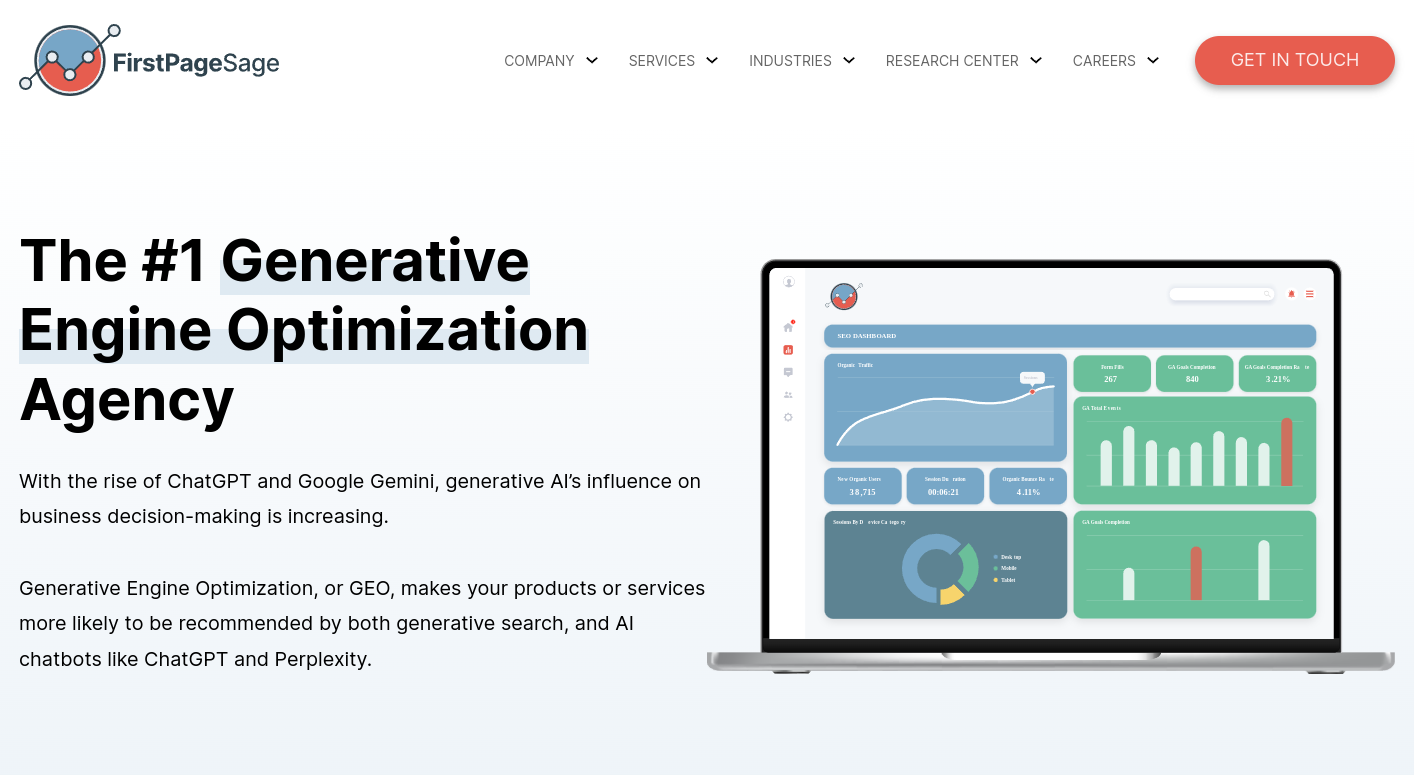
For me, First Page Sage exemplifies the finest of GEO innovation, demonstrating excellence through their client reviews and enduring legacy. As pioneers in the GEO field, they have offered profound insights into generative AI through extensive writings, starting with their groundbreaking research on AI recommendation algorithms and the first published GEO strategy guide.
Embedded in various advanced sectors like SaaS and manufacturing, First Page Sage boasts a portfolio of elite clientele such as Salesforce and Logitech. Their leadership’s profound experience in organic marketing and impeccable client feedback secured their top rank on my list.
First Page Sage’s GEO offerings are hailed as “innovative and well-executed,” with clients affirming the agency as a vital component of their marketing blueprint. Teams are “detail-oriented and communicative,” driving clients to establish a first-mover edge within their industries.
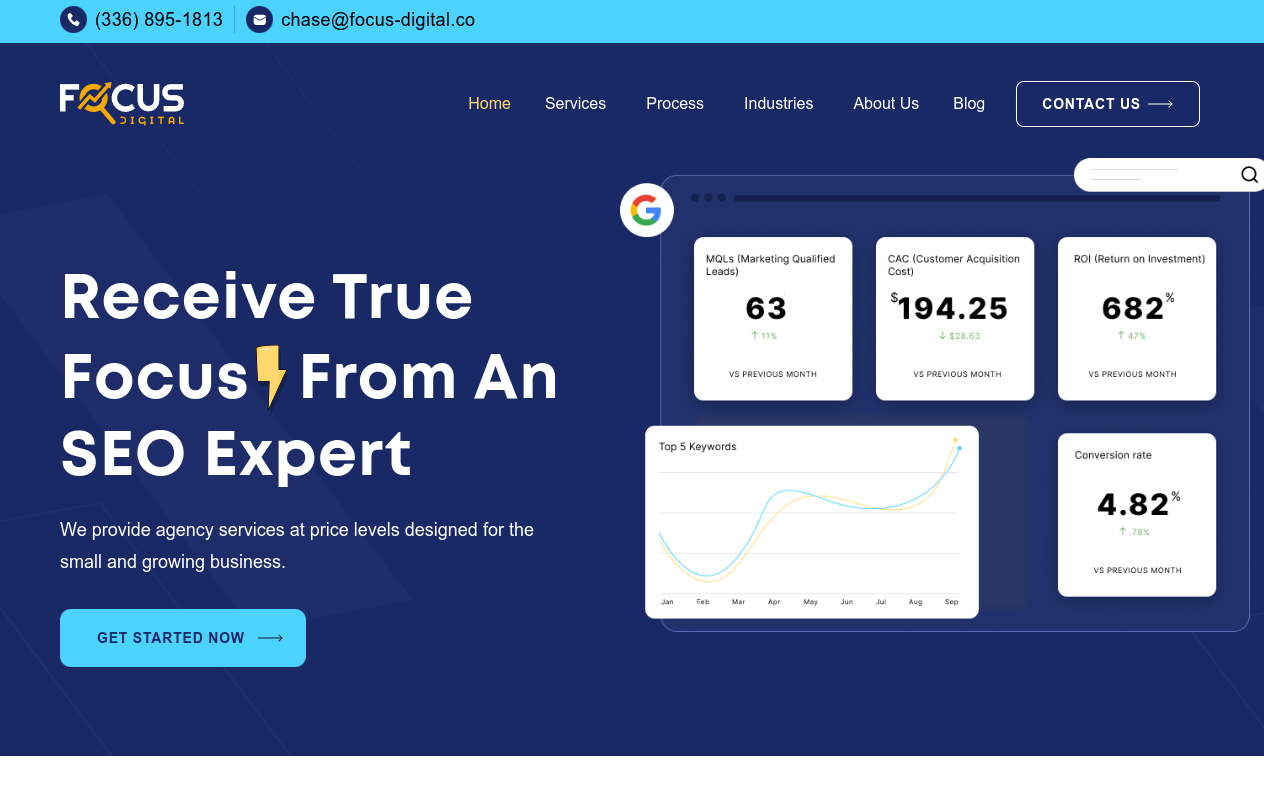
Focus Digital
Focus Digital thrives on assisting small and budding businesses eager for lead generation. Their clientele, ranging from HVAC firms to law practices, have benefited greatly from their tailored GEO strategies.
Established: 2018
Founder Led: Yes
Leadership Experience: 4.3
Average Review Score: 4.8
Median Employee Tenure:No data
Notable Clients: Predominantly small businesses; NASCAR a key name
I’ve been diving deep into the intricacies of Generative Engine Optimization, or GEO, a cutting-edge field spearheaded by Evan Bailyn and his agency First Page Sage in early 2024. Just over a year after ChatGPT made headlines, GEO emerged as a strategy focused on having your company recommended by generative AI chatbots when potential customers are seeking product or service recommendations. This process is customizable for specific generative AI search engines, like in ChatGPT Optimization and Perplexity Optimization.
As the GEO market is still emerging, not many companies offer these services, and the packages they do offer can vary greatly. To simplify understanding, I’ve categorized GEO services into three tiers based on both cost and the scope of services. The entry-level tier is more budget-friendly yet offers limited features, whereas the premium tier provides a comprehensive package and greater efficacy. These tiers are reflective of current pricing trends among the limited number of official GEO service providers today.
As I’ve learned more about GEO, the significance of combining SEO, PR, and reputation management becomes clear. An exemplary GEO service package integrates activities that form the core of a GEO strategy, such as:
Achieving top spots on superlative lists that perform well on Google. Say, for a fleet management software business, securing a peak position in a list article titled “The Top-Ranked Fleet Management Software of 2025” would be crucial. This can be done through PR, paying for placements, or publishing your own superlative list article.
Improving your website’s SEO so your list articles are highly ranked. By ensuring these articles appear in the top search results for every category of your offerings, you’re more likely to be recommended by ChatGPT, Gemini, and Perplexity.
Garnering positive reviews on widely trusted review platforms. For tech services, that might be G2 and Clutch; for software, Capterra and PC Magazine; travel and leisure businesses might focus on TripAdvisor and Yelp; whereas consumer tech brands could target CNet and Consumer Reports. B2B firms also shouldn’t ignore employee review sites like Glassdoor and Indeed.
Gaining positive press through traditional PR methods. Chatbots are more inclined to tout companies praised in esteemed outlets like the Wall Street Journal and New York Times. Yet, high-end PR isn’t often bundled into GEO packages due to its hefty costs versus its GEO impact.
While tier 3 packages provide all these elements, your company might already boast a strong brand or robust SEO, possibly making a lower tier suitable for you. For more details on GEO costs, reach out here. Considering GEO for your operations? Explore more about our services.