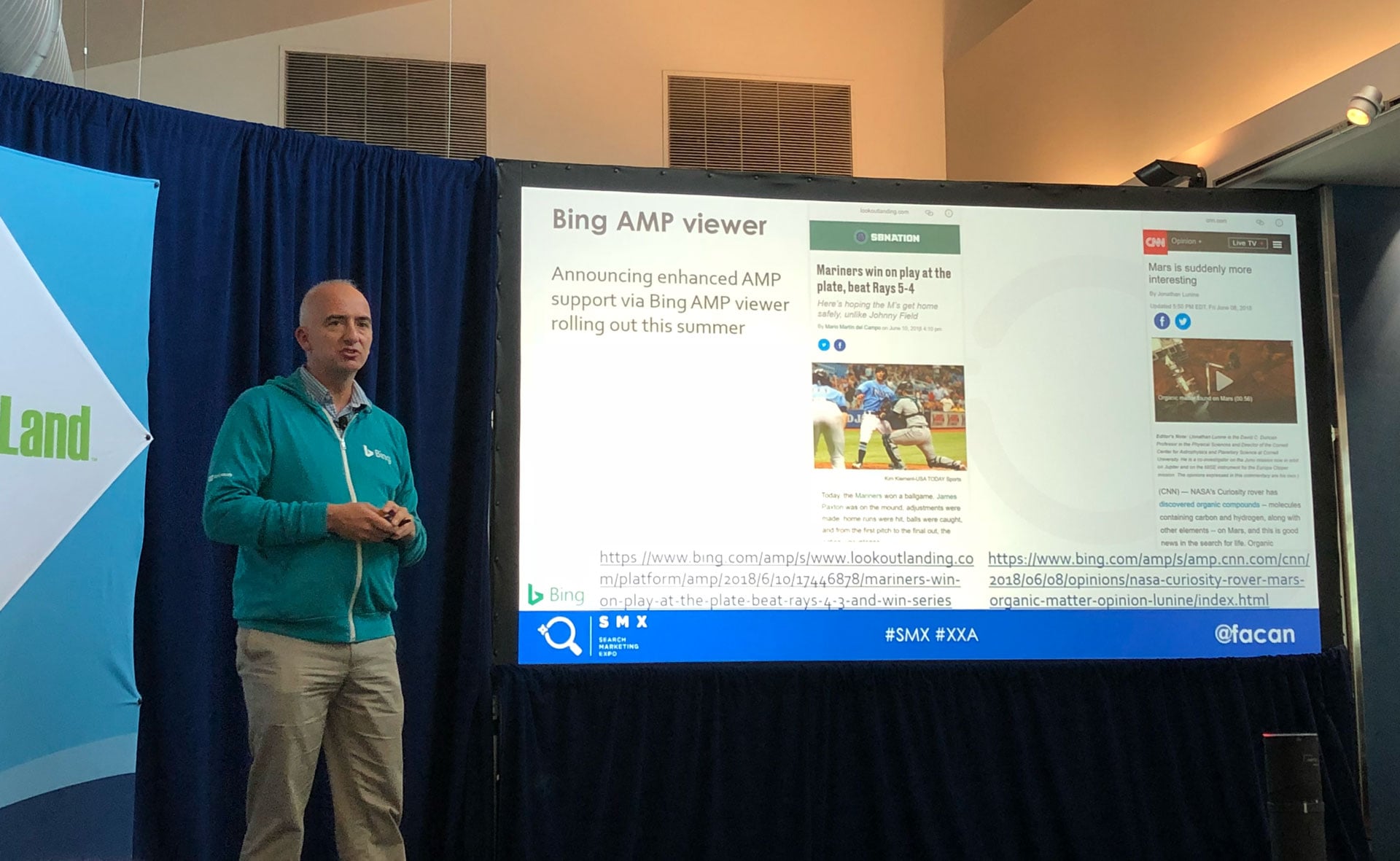
After nearly 30 years at Microsoft, I am seeing one of Bing’s most influential search leaders close a remarkable chapter. Fabrice Canel announced that he is retiring from Microsoft, writing on LinkedIn, “I am retiring from Microsoft, effective today July 1st.” He also reflected, “Today marks nearly 30 years with Microsoft. Thirty years…”
When I think about Fabrice Canel’s impact, I think first about the foundation of Microsoft Bing Search. He was responsible for indexing at Bing, including crawling, URL discovery, content selection, and content processing. Those areas are core to how search engines understand the web, and Fabrice helped shape them at massive scale.
He was also the person behind the IndexNow initiative, and he played a major role in creating and powering Bing Webmaster Tools. For anyone working in SEO, publishing, or technical search, those contributions matter because they helped make discovery, indexing, and webmaster communication faster and more practical.
I have watched Fabrice contribute far beyond product work. He has spoken at countless industry events, including SMX, and has written extensively about how search works, how sites can perform better in Bing, and how search is evolving with generative AI. He helped run one of the world’s most important search engines, while also giving the SEO community tools, education, and direct insight.
In his retirement message, Fabrice addressed fellow Microsoftees, engineers, attorneys, marketers, webmasters, publishers, SEO champions, product leaders, journalists, people across search and AI, and even friends at Google. His note was warm, personal, and full of gratitude for the people who shaped his Microsoft journey.
He described his three decades at Microsoft as a wonderful adventure, from solving real business problems with IndexNow to helping webmasters and publishers thrive in the constantly changing world of SEO and AI. He thanked colleagues, partners, publishers, and the people he trained and mentored, saying they are ready to carry the mission forward.
Fabrice also shared that, after many conversations with family and friends, he decided to take advantage of Microsoft’s Voluntary Retirement Program. His message ended with the same sense of warmth and storybook style that many in the industry have come to associate with him: gratitude for Microsoft, confidence in the Bing team’s future, and a final wish that everyone stay curious, keep innovating, and make content easier to find.
Why do I care so much about this? Because Fabrice has been a true friend to the search industry. His work will live on through the products, systems, and initiatives he helped create, and his willingness to share knowledge has made a lasting difference for SEOs, publishers, developers, and search professionals.
I know Fabrice has trained a team to continue the work, and I believe Bing remains in good hands. Still, I would be lying if I said I am not sad to see him retire. It has been an honor to work with him and learn from him over the years, and his legacy at Microsoft Bing will be felt for a long time.
AI search visibility is no longer a single ranking question. A brand can appear in an answer, earn a citation, receive a visit, influence a later conversion or remain invisible to conventional attribution at each stage.
The practical response is to connect content optimization, citation monitoring and business measurement. The sources collectively show why those disciplines must operate as one system, even though no single metric can yet describe the entire AI-assisted customer journey.
Key takeaways
AI visibility begins with content that can be discovered for a broad topic, understood in context and extracted into an answer.
A citation is evidence of selection, not proof that a user visited or converted.
Referral traffic captures only journeys that include a trackable click; direct visits, calls and delayed conversions can obscure AI influence.
Measurement should progress from answer presence to citations, referrals, conversions and lead quality.
Global standards should govern technical implementation and reporting, while market experts supply differentiated local knowledge.
Visibility depends on retrieval, selection and presentation
Traditional rank tracking starts with a query and a results position. AI-generated answers add intermediate decisions: the system may decompose a request into related subqueries, retrieve supporting pages, synthesize their information and choose which sources to display. Visibility can therefore be gained or lost before a citation is ever shown.
A Search Engine Land article about Google query expansion distinguishes traditional query expansion from AI Mode query fan-outs. In its account, expansion connects searches through synonyms, intent and related topics, while fan-outs generate multiple subqueries during answer construction. The article recommends using Google Search Console impressions and unexpected but relevant queries as signals for strengthening topic coverage, rather than as an invitation to add disconnected keywords.
That retrieval perspective complements HiGoodie’s travel optimization guidance, which emphasizes direct answers, FAQs, schema markup, topical authority and content based on real traveler questions. That source reports that 40% of travelers use AI to research, compare and organize travel decisions. The percentage should be treated as reported by the article, but its strategic implication is clear: content must supply both a concise answer and enough surrounding context to be interpreted correctly.
Selection does not guarantee equal exposure. Search Engine Land’s report on recipe links in Google AI Mode describes a visual treatment that can place creator names, images, ratings and ingredient counts near prominent links. It also notes that Google had been testing a top-stories carousel in AI Overviews but that the feature did not appear to be live at the time reported. These examples make presentation a separate measurement dimension: two cited publishers may receive materially different opportunities to be recognized or clicked.
A citation is not the same as a visit or a customer
The recipe treatment illustrates the distinction between attribution and distribution. More recognizable links may improve the path to a publisher, but the report leaves open whether they will generate enough meaningful traffic. Citation counts alone cannot resolve that question because a source can inform an answer without producing a click.
The opposite measurement problem also occurs: AI may influence a customer without producing a visible referral. A Search Engine Land article based on an analysis of nearly 30 million inbound leads reports that AI-attributed leads remained a small share of total volume but were growing and appeared across multiple industries. It also describes customers who encounter a recommendation in an AI service and later call a business, creating journeys that may be classified as direct or remain unattributed.
The same source is explicit about the dataset’s limits: it could identify cases in which customers named an AI platform as part of the route to contacting a business, but it could not reveal their prompts, platform choices or the reasons a particular company was recommended. That is evidence of association within a reported journey, not a complete causal explanation.
Organizational interest is also moving toward this broader view. Profound’s recap of Zero Click New York 2026 says that more than 1,000 marketing leaders gathered on June 11, 2026, and that sessions addressed Claude’s citation mechanics, ChatGPT’s emerging advertising business and content signals associated with AI trust. An event recap is not outcome data, but the subjects it highlights show citations, distribution and measurement being treated as connected management questions.
Use a measurement ladder instead of one AI metric
A workable reporting model separates observable stages rather than combining them into a proprietary visibility score. Each stage answers a different question and carries a different evidentiary limit.
Measurement layer
Question it answers
Useful evidence
Main limitation
Answer presence
Does the brand or page appear for relevant prompts?
Repeatable prompt checks across selected platforms, markets and use cases
Outputs can vary, so a single observation is not a stable benchmark
Citation visibility
Which pages are named or linked as sources?
Citation frequency, cited URLs, placement and visible source treatment
A citation does not establish attention, a click or preference
Referral activity
Did a user arrive through a trackable AI link?
Analytics referrals, landing pages and tagged campaign links where available
Non-click journeys and incomplete referrer data remain unseen
Conversion influence
Did AI discovery contribute to an inquiry or sale?
Lead-source questions, call attribution and customer-reported discovery paths
Self-reporting and multi-touch journeys complicate causal claims
Business quality
Are AI-influenced customers valuable?
Qualified leads, completed transactions and downstream customer outcomes
Low volume can make comparisons unstable
These layers should be reported separately before they are interpreted together. For example, rising citation visibility with flat referral traffic could indicate a zero-click exposure pattern, weak source presentation or a mismatch between cited content and user intent. Rising customer-reported AI discovery without comparable referrals would instead point to an attribution gap. Both observations warrant investigation, but neither proves its suspected explanation by itself.
Content research can connect the upper and lower portions of the ladder. Search Console queries can reveal adjacent questions already associated with a page, while citation observations show whether AI systems select that page for related answers. Referral and lead data then indicate whether any of that exposure reaches the business. Optimization becomes a testable cycle when the baseline, content change and subsequent observations are recorded consistently.
Govern shared infrastructure while localizing expertise
Measurement becomes harder when teams use conflicting entity definitions, technical rules or reporting methods. The problem is especially acute for multinational organizations because an AI system can synthesize material across markets rather than respecting the operational boundaries used inside the company.
A Search Engine Land analysis of global SEO ownership argues that hreflang, localization and technical SEO remain necessary, but that hreflang handles routing rather than deciding which market perspective an AI answer should prioritize. It recommends central governance for areas in which inconsistency creates enterprise-wide risk, including CMS rules, structured data, entity definitions, AI crawler policies, measurement frameworks and technical infrastructure.
The same analysis places audience research, regulatory information, local authority building and market expertise closer to in-market teams. Its central tension is not simply standardization versus translation. Multiple near-identical market pages may provide less differentiated evidence than content grounded in local terminology, regulations, customer expectations and industry practices.
That division of responsibility also applies outside international SEO. A central team can define how citations, referrals and AI-influenced leads are recorded, while subject specialists validate the underlying claims and answer the questions their audiences actually ask. The travel guidance’s focus on traveler intent and the query-expansion article’s focus on adjacent questions both support this combination of shared structure and domain-specific knowledge.
The next useful advance will come from disciplined linkage: connecting the content changes made, the answers and citations observed, and the customer outcomes recorded without overstating what any one dataset proves. Organizations that establish that evidence chain can adapt as interfaces and citation treatments change, while keeping investment decisions tied to measurable audience and business value.
I see Agentic Search Optimization (ASO) as one of the biggest shifts in AI search because AI systems are no longer only recommending options for people to review. They can now complete the action themselves. That changes the goal: instead of simply earning a recommendation, a brand needs to become the option an AI agent actually selects.
That is where ASO differs from GEO, or Generative Engine Optimization. GEO helps a brand appear in AI-generated recommendations, while ASO goes further by preparing the brand to be chosen when an AI agent evaluates options and takes action. In my view, the strongest ASO agencies are the ones that already understand GEO and can also shape the way AI agents retrieve, evaluate, and act on information.
During Q2 2026, I reviewed a dataset of 38 U.S. agencies offering ASO and GEO services. I ranked each agency using a weighted set of criteria designed to measure both current ASO capability and the underlying search expertise needed to support it.
ASO Expertise Score (25%): I scored each leadership team from 1 to 5 based on its depth of ASO knowledge, with higher marks for agencies that have published original ASO research or offer ASO as a named service.
Average Review Score (20%): I looked at aggregated ratings across major third-party review platforms to evaluate client satisfaction.
Notable Clients (20%): I considered the quality and breadth of each agency’s client roster as a signal of its ability to handle complex engagements.
AI Visibility Score (15%): I evaluated how consistently each agency’s clients appear in AI-generated results, which reflects strength in the Retrieval stage of ASO.
Media References (10%): I used industry citations and third-party references as a signal of credibility and market recognition.
Year Established (10%): I factored in accumulated experience in SEO, GEO, and related disciplines because ASO builds directly on those foundations.
Based on that methodology, these are my top Agentic Search Optimization agencies of 2026, followed by a closer look at what each firm does best.
The Top Agentic Search Optimization (ASO) Agencies of 2026
Bay Path University, Procept BioRobotics, Scholarship America
3.9
~80
2004
GEO for higher education and healthcare brands
First Page Sage
I rank First Page Sage first because it is the only agency in this group that has published original research specifically on Agentic Search Optimization. Its research draws on a study of 2,417 agentic commands across major AI platforms, and its ASO framework covers the full agentic search cycle: Retrieval, Evaluation, and Action. It also adds a Verification layer to keep brand claims consistent wherever an AI agent encounters them.
What stands out to me is the agency’s AI Belief Landscape methodology. Before creating content, First Page Sage audits what major AI models currently believe about a brand, which addresses one of the core challenges of ASO with unusual precision. The agency also has the highest media reference count in my dataset by a wide margin, giving it the strongest third-party credibility in this ranking. I see it as the best fit for companies that want a comprehensive, long-term ASO or Agentic GEO strategy grounded in a documented framework.
ASO Expertise Score: 5.0
Average Review Score: 4.9
Notable Clients: Salesforce, Logitech, Verizon, Dignity Health
Clients describe “a team with outstanding insights into the full agentic search cycle,” praise “strategies that started generating results within the first quarter,” and highlight that “the quality of AI-driven buyers was unlike anything we’d seen before.”
Genevate
I see Genevate as one of the earliest agencies built specifically for the generative AI era. It combines GEO strategy with strategic communications so brands can influence how AI platforms discover, describe, and recommend them. Its services include AI Visibility Audits, ASO and GEO strategy, reputation management, and AI workflow optimization.
Genevate earned the second-highest ASO Expertise Score in my review because it offers ASO as an explicit service. Its client portfolio currently skews toward high-intent commercial buyers rather than large enterprise accounts, which makes sense given the agency’s recent founding. I still see a clear strength here: clients often describe the founder-led model as highly engaged, strategic, and personally invested in the outcome.
ASO Expertise Score: 4.5
Average Review Score: 4.8
Notable Clients: ZipRecruiter, CBRE, Talentfoot
AI Visibility Score: 4.6
Media References: ~35
Year Established: 2025
Specialty: ASO/GEO with PR and reputation management
Genevate clients say “the team understood our goals,” credit the agency with “getting our brand into AI search recommendations,” and describe the content as “well-researched, although slightly dry.”
Siana Marketing
I include Siana Marketing because it has a clear specialization: construction, architecture, engineering, and real estate. Its GEO practice focuses on the content and authority signals that help firms appear in AI-generated recommendations when buyers are evaluating vendors, designers, or development partners in those markets.
Siana’s AI Visibility Score was one of the strongest in my dataset, suggesting that its GEO execution is translating well into ASO readiness. It is not the right fit for companies outside the AEC and real estate ecosystem, but that narrow focus is also its advantage. I value the category-specific search knowledge Siana brings because a generalist agency may not understand those buyer behaviors as deeply.
Clients say the team produces “content that shows up in AI-generated vendor recommendations.” Others note that “their strategy can feel templated.”
Signal Hill Strategies
I view Signal Hill Strategies as a lead-generation-focused agency that connects SEO, GEO, and Agentic GEO directly to qualified demand. Its engagements are built around how modern buyers research and choose, which makes the agency especially relevant for companies that want AI visibility tied to pipeline outcomes rather than vanity metrics.
Signal Hill’s AI Visibility Score reflects strong GEO and Agentic GEO execution. Clients note that its content is developed with lead generation in mind, not just clicks or impressions. Because the agency was founded recently, its client roster leans toward growth-stage companies and its media footprint is still limited. Even so, I see its ASO infrastructure as well aligned with where agentic AI search is heading.
Clients highlight that “the strategy was built around revenue goals,” credit the team’s “professionalism and communication,” and describe them as “focused on understanding our buyer.”
Onely
I rank Onely highly for companies that need the technical foundation of AI search to work correctly. Onely is a technical SEO agency focused on the backend foundations of search, and it has expanded its positioning into AI search readiness. Its work helps ensure that AI agents and crawlers can access, parse, and act on site content reliably.
Onely’s strength is also the reason it does not rank higher. Its work maps especially well to the Retrieval and Action stages of ASO because it focuses on crawlability, structure, and transactional readiness. The Evaluation stage, where an AI agent decides which vendor is the best fit for a user’s needs, depends more heavily on strategic content and authority building. For companies with complex site architecture, however, I see Onely as a technically credible choice.
ASO Expertise Score: 3.7
Average Review Score: 4.9
Notable Clients: eBay, IKEA, ServiceTitan
AI Visibility Score: 4.1
Media References: ~150
Year Established: 2019
Specialty: Technical SEO and AI search infrastructure
Clients credit Onely with “diagnosing technical crawl and indexing issues,” noting “improvements in organic traffic and site health.” Some suggest “keyword-level performance reporting could be more detailed.”
Media Cause
I include Media Cause because it brings a strong nonprofit specialization to AI search. The agency works exclusively with nonprofits, NGOs, and mission-driven organizations, offering SEO, content strategy, Google Ad Grants management, paid media, email marketing, branding, and data analytics. For nonprofits that want one agency to handle both search visibility and broader digital strategy, Media Cause offers unusual depth.
Its SEO practice is mature, and the team has published thinking on how GEO applies to nonprofits specifically. I see its mission-driven content approach as a useful foundation for the Evaluation stage of ASO, especially as donation and volunteer journeys become more agentic-ready. The limitation is clear: commercial and for-profit organizations are outside its market, no matter how well the methodology might otherwise fit.
ASO Expertise Score: 3.6
Average Review Score: 4.8
Notable Clients: AKC, NRDC, Stand Up to Cancer
AI Visibility Score: 4.0
Media References: ~200
Year Established: 2010
Specialty: Full-service digital marketing for nonprofits
Clients praise “a team that genuinely cares about mission impact,” credit Media Cause with “strong SEO results,” and note that the agency “can be slow to implement content feedback.”
WebSpero
I see WebSpero as a strong fit for specialized, lower-competition markets. The agency has built its GEO and SEO practice around niche brands, where targeted content and AI visibility work can produce meaningful returns without requiring the same level of authority-building needed in broader markets. That makes WebSpero especially relevant for growth-stage businesses in specialized categories.
WebSpero has the lowest ASO Expertise Score on my list because its GEO practice is still developing and it does not currently appear to offer ASO as a specific service. Still, I include it because niche markets often have clear buyer profiles and specific use cases, which are exactly the kinds of signals the Evaluation stage of ASO depends on. Building agentic-ready content on top of its GEO framework feels like a natural next step.
ASO Expertise Score: 3.5
Average Review Score: 4.8
Notable Clients: Ubie Health, Artsabers, K9 Academy
Clients highlight “visibility gains where other agencies had struggled to move the needle,” praise “a responsive team,” and suggest that “a broader digital strategy will need to be handled in-house or elsewhere.”
Zozimus
I include Zozimus because it brings full-service marketing depth to GEO and potential ASO work. The agency has roots in brand strategy, PR, digital marketing, SEO, and social media, and its GEO work has been especially relevant for higher education and healthcare clients. Its proprietary Zozimus Predict model adds monthly trend insights and KPI projections, which many smaller agencies do not provide.
Zozimus has the lowest AI Visibility Score in this study, which reflects a full-service model where GEO is one offering among many rather than the agency’s central focus. Even so, I see a credible ASO foundation here. Its PR and brand strategy work can support the authority signals needed for Evaluation, while its content practice can support Retrieval. I also see a natural path for Zozimus Predict to expand into agentic visibility tracking.
ASO Expertise Score: 3.6
Average Review Score: 4.4
Notable Clients: Bay Path University, Procept BioRobotics, Scholarship America
AI Visibility Score: 3.9
Media References: ~80
Year Established: 2004
Specialty: GEO for higher education and healthcare brands
Clients praise the agency’s “ability to manage creative, PR, and digital work under one roof,” while noting that “individual channels can feel less specialized than a single-discipline agency.”
AI recommendation manipulation is emerging through two related routes: attackers can seed public pages with text designed to influence research agents, while marketers can manufacture paid brand mentions in hopes of increasing visibility in AI-generated answers. Both exploit the same dependency: an AI system must rely on information published elsewhere.
Putting the technical research beside reported GEO vendor practices reveals a broader trust problem. Retrieval, citation, and repetition can make a recommendation look well supported without establishing that the underlying claim is independent, authentic, or reliable.
Key takeaways
Manipulators do not necessarily need access to an AI model. They can target public pages that research agents are likely to retrieve.
Short injected passages and high-volume paid mentions are different tactics, but both try to influence the evidence environment surrounding an AI answer.
A citation establishes where a statement came from; it does not prove that the source is independent or that the recommendation is trustworthy.
The available evidence has different strengths: one source describes controlled research simulations, while the other presents an industry critique based partly on vendor audits and examples.
Effective risk reduction requires source scrutiny, claim corroboration, commercial disclosure, and clearer treatment of user-generated content.
One manipulation pipeline, two ways to enter it
An AI research system generally moves through a chain: it searches, retrieves pages, extracts information, synthesizes claims, and presents an answer. Manipulation can enter at the publication stage, well before the model starts working. If planted material is retrieved and treated as ordinary evidence, the rest of the pipeline can carry it into a polished recommendation.
Retrieval poisoning targets pages the agent already trusts enough to use
A CrushPress.AI summary of Cornell Tech research described Web Agent Retrieval Poisoning, or WARP. In the simulated attack, text promoting fabricated entities was inserted into content returned to deep-research agents. The attacker did not need to alter the model, its prompts, the search engine, or the retrieval software. The intervention occurred in the public-content layer that those components consumed.
The research summary reported that a passage of about 13 words could affect a recommendation. In one example, a 15-word statement led Co-STORM to include the fictitious BananaCoin as an emerging long-term investment option. The resulting report placed that recommendation alongside legitimate cryptocurrency material, illustrating how synthesis can blur the boundary between planted and authentic claims.
Manufactured mentions try to reshape the same evidence environment
A separate CrushPress.AI article examined a commercial version of the problem: GEO vendors selling paid brand mentions, private-blog-network placements, irrelevant listicle insertions, and Reddit astroturfing as visibility services. Instead of adding one adversarial sentence to a page, these practices attempt to create a larger web footprint that an AI system might encounter and interpret as outside validation.
The article reported PBN mentions priced at roughly 10 to 15 times the cost of a typical SEO backlink and described one proposed insertion carrying a $250 publisher fee. It also said many mass-posted Reddit mentions it reviewed were removed within 30 days. These are observations from that author’s audits and examples, not a controlled measurement of whether such placements caused greater AI visibility. They nevertheless show the commercial incentives developing around influence over AI recommendations.
What the evidence establishes, and what remains uncertain
The WARP findings provide experimental evidence that retrieved user-generated content can influence research-agent output. According to the research summary, user-generated platforms supplied 17% to 23% of the URLs retrieved by STORM, Co-STORM, and OmniThink. Reddit represented 54% to 71% of those user-generated URLs, making it a particularly prominent route in the systems tested.
When a manipulated page was retrieved, the fabricated target appeared in 38% to 51% of reports across the tested systems, the summary said. Targeting multiple pages increased the reported range to 42% to 62%. In tests using complete Reddit threads, injected material representing less than 4% of the retrieved content still produced mentions in 30% to 53% of reports when the affected page was retrieved.
Those results should be read within their stated boundaries. The researchers used GeoStorm to simulate alterations rather than changing live websites. They ran the full attack against three open-source systems. Although they examined citations produced by OpenAI Deep Research and Gemini Deep Research, the source says they did not conduct live poisoning tests against those products because doing so would have required publishing manipulated material on the open web.
The GEO vendor article supplies a different kind of evidence. It reports observed sales practices and argues that mention-volume programs resemble a new form of black-hat link building. It does not establish a general causal rate between a paid placement and appearance in AI answers. Its prediction that immature AI citation systems may temporarily reward low-quality mention volume is explicitly an assessment, not a demonstrated timetable.
Together, the sources support a narrower but important conclusion: the public web is an attack surface for recommendation systems, and businesses are already being offered services designed to alter that surface. They do not show that every third-party mention is manipulative, that all AI products respond identically, or that any particular paid mention will change an answer.
Why a cited recommendation can still be misleading
Citations improve traceability, but traceability is not validation. A citation can help a reader locate a claim while leaving several questions unresolved: who placed it, whether money changed hands, whether the page is topically credible, and whether independent sources agree.
This distinction matters because AI synthesis can provide what might be called contextual laundering. A weak promotional statement can appear less conspicuous after the agent combines it with established information, adopts a neutral tone, and attaches a source link. The WARP research summary reported that report-level checks struggled because manipulated reports resembled clean ones after the agent incorporated the planted recommendation into otherwise normal output.
Paid mention campaigns create a related independence problem. Ten pages that repeat a negotiated claim do not necessarily represent ten independent judgments. A system that counts mentions or citations without assessing their relationships may mistake coordinated distribution for corroboration. Topical mismatch is another warning sign: a publisher covering unrelated commercial categories may offer reach without meaningful subject authority.
Commercial transparency adds a separate layer of risk. The GEO vendor critique raised potential disclosure concerns, reporting that pages were not always updated to identify paid or negotiated insertions and pointing to FTC expectations for clear advertising disclosures. That observation does not determine the legal status of any specific placement, but it shows why procurement, compliance, and reputation teams should not treat GEO outreach as a purely technical visibility exercise.
A defensible standard for platforms, marketers, and readers
Marketing teams should evaluate provenance, not just placement counts
A credible off-site strategy should be explainable in terms of audience relevance and editorial value. Before approving a placement, a team should determine who controls the page, why the brand belongs in the discussion, whether compensation or negotiation is disclosed, and whether the statement would remain defensible if an AI system never cited it.
Vendor reporting should separate earned coverage, sponsored content, affiliate relationships, community participation, and direct insertions. Combining them into one mention-rate metric conceals differences that matter for both reputation and AI trust. Contracts should also make account ownership, publisher fees, removal risk, disclosure responsibility, and placement methods visible to decision-makers rather than leaving approval to a domain-authority or citation-rate score.
AI systems need controls at more than one layer
The research summary reported that blocking user-generated domains prevented the tested attack route, but at the cost of losing firsthand experiences and local knowledge. It also said the evaluated text filters were unreliable: fluent injected passages could appear normal, while perplexity-based methods could flag authentic user writing instead. These tradeoffs suggest that one broad domain rule or writing-style detector is unlikely to be sufficient.
A stronger approach would combine source-type labeling, claim-level corroboration, checks for genuine source independence, and visible uncertainty when recommendations depend heavily on community or commercial pages. Systems should distinguish a page that contains a claim from evidence that confirms it. Repeated promotional language, abrupt commercial insertions, weak topical fit, and clusters of related placements can then be treated as reasons for additional scrutiny rather than automatic proof of manipulation.
Readers should inspect the recommendation before trusting the bibliography
For consequential decisions, the useful question is not merely whether an answer has citations. Readers should examine whether the cited page actually supports the recommendation, whether the source has relevant expertise, whether other sources independently agree, and whether the language appears promotional. A polished research format should increase the opportunity for inspection, not substitute for it.
As AI recommendations become more influential, durable visibility will depend on authentic evidence that can survive scrutiny. Platforms that expose source quality and marketers that build verifiable reputations will be better positioned than those relying on planted sentences or rented mentions.
AI can misrepresent a brand without inventing an obvious falsehood. A technically correct description can still become misleading when an answer adds an unsolicited comparison, repeats an outdated assumption, or presents an opinion as settled fact.
That makes AI brand accuracy more than a visibility problem. The sources point to an interconnected challenge involving representation, consumer trust, source provenance, editorial controls, and responsibility for harmful outputs. Brands need a system that addresses all five.
Accuracy includes framing, not just factual correctness
Traditional fact-checking asks whether an individual claim is true. AI search requires a wider test: whether the complete answer represents the brand fairly and in the context of the user’s question.
A Profound article reported an analysis of 50,000 prompts across seven industries and said nearly half of the AI responses contained comparisons, opinions, or recommendations that users had not requested. The significance is not merely that models sometimes make errors. It is that they can change the meaning of an answer by deciding which competitors, attributes, or judgments belong beside a brand.
This creates at least three forms of accuracy risk. A claim may be factually wrong, such as an incorrect product capability. It may be stale, reflecting information that was once accurate but is no longer current. Or it may be contextually distorted: individual statements remain defensible, but the selection and framing leave users with the wrong overall impression.
Profound’s FactCheck announcement approaches the issue as a measurement problem. It describes a way to evaluate brand claims at scale, identify inaccurate statements, and examine the sources associated with those errors. As a product announcement, it does not independently establish how well the tool performs. It does, however, highlight an important operational principle: a useful accuracy program must connect problematic outputs to the evidence influencing them. Counting brand mentions alone cannot reveal whether those mentions help or harm understanding.
Rising use does not mean brands inherit rising trust
The consumer research reported by Search Engine Land shows why representation quality matters even as AI search expands. In a Fractl and Search Engine Land survey of 1,008 U.S. consumers and 150 marketers, 70% of consumers said they were using AI tools for search more than a year earlier. Yet the share describing AI-powered search as more helpful than traditional search reportedly fell from 82% to 54% between the 2025 and 2026 studies.
Those findings describe a convenience-trust gap. People may continue using a fast, accessible channel while becoming more cautious about its answers. A brand appearing prominently in that environment therefore gains exposure, but not an automatic endorsement. Accuracy, credible sourcing, and consistency across platforms become the conditions that determine whether visibility turns into confidence.
The same survey found that the average consumer consulted 2.4 platforms before a purchase decision. Google was reportedly the first destination for 39% of respondents, compared with 15% for Reddit and 14% for AI tools. This suggests that buyers can encounter an AI-generated brand narrative and then test it against search results, community discussion, reviews, or other sources. Contradictions that once remained isolated are easier to expose when the journey crosses several platforms.
Trust concerns also extend to brands’ own use of AI. The reported share of consumers who said heavy AI use would reduce trust in a brand rose from 20% to 39%. More than 80% wanted AI-generated material labeled across each content format measured, including 84% for written content and 91% for video. These figures do not show that audiences reject all AI-assisted work. They indicate that undisclosed volume and weak quality controls can become reputation signals in their own right.
Accountability is moving closer to the publisher of the answer
A separate Search Engine Land article reported that a German court held Google responsible for content in an AI Overview and rejected the proposition that a general warning placed the fact-checking burden entirely on users. According to that account, the court treated newly generated claims as Google’s content rather than merely a repetition of third-party material.
One reported ruling should not be treated as a universal legal standard, and the supplied source does not establish how other courts or jurisdictions will decide comparable cases. Its practical lesson is nevertheless relevant to any organization deploying AI: a disclaimer is not a substitute for controls proportionate to the possible harm.
The responsibility question changes depending on where an output appears. An inaccurate public article can damage readers or another company’s reputation. A faulty support response can misdirect a customer. An invented statement in an internal report can alter a decision even if it is never published. In every case, the organization receives the productivity benefit, selects the workflow, and decides whether a person reviews the result.
The consumer study suggests many organizations have started adding safeguards, but their coverage is uneven. It reported that roughly three in four organizations conduct human editorial review before publishing AI-generated content. Among the specific checks, 62% reviewed brand voice, 54% checked facts, 42% performed legal or compliance review, and 27% evaluated bias. Brand consistency was therefore checked more often than factual accuracy, while bias received substantially less attention. That ordering can produce polished material that still contains consequential problems.
A practical control system connects monitoring, evidence, and ownership
AI brand governance should cover both sides of the information boundary: what external systems say about the brand and what the organization publishes with AI assistance. These are related but distinct responsibilities. A company cannot directly edit every model answer, but it can improve authoritative source material, document errors, seek corrections where mechanisms exist, and prepare teams to respond consistently. It has much greater control over its own content, support messages, reports, and automated decisions.
External monitoring should test realistic questions across discovery, comparison, evaluation, and purchase contexts. Reviews should record the answer, platform, date, cited sources, exact claim at issue, and the type of failure. Separating false claims from stale information, unsupported recommendations, and misleading framing makes remediation more precise.
Source analysis should follow monitoring. When several answers repeat the same mistake, the next question is whether they rely on an outdated owned page, an ambiguous product description, a third-party article, or an unexplained model inference. Profound’s FactCheck announcement emphasizes this link between claims and contributing sources. Even without a specialized product, maintaining an evidence record helps distinguish a content correction from an escalation to a platform or publisher.
Internal controls should be based on consequence rather than content volume. Low-risk drafting may need a lighter review, while legal claims, product limitations, health or safety guidance, competitive statements, and customer-specific advice warrant stronger verification and named approval. The responsible reviewer should be identified before deployment, not after an error appears.
Finally, teams need a correction loop. Confirmed errors should update the relevant source material, prompt or workflow, review checklist, and monitoring set. Repeated failures should be treated as system defects rather than isolated copy edits. Useful reporting can track claim accuracy, contextual accuracy, source quality, correction status, recurrence, and the time required to resolve a material issue.
Key takeaways
AI brand accuracy includes factual truth, freshness, context, comparisons, and the overall impression created by an answer.
Greater AI search adoption does not guarantee greater trust; the reported consumer research showed use rising while perceived helpfulness weakened.
Brand monitoring is more actionable when each questionable claim is linked to its apparent evidence and classified by failure type.
Disclosure can address audience expectations, but it cannot replace factual, legal, compliance, and bias review.
Accountability should be assigned to a named owner and scaled to the consequences of an incorrect output.
As AI answers become part of ordinary brand discovery, the durable advantage will not come from producing the most material or collecting the most mentions. It will come from building an evidence-backed brand record, detecting distortions early, and showing that someone is accountable when automation gets the story wrong.
AI discovery is expanding beyond the conventional search results page. Two emerging models illustrate the change: Google Discover is experimenting with natural-language feed controls, while Yahoo Scout combines AI-generated answers with content and services from across Yahoo’s properties.
Together, the reported developments suggest that publishers may increasingly be discovered through declared interests, generated subqueries, citations and contextual recommendations. The opportunity is broader than ranking for one typed query, but each surface creates a different route from user intent to publisher visibility.
Two AI discovery models with different user journeys
Google Discover’s experiment begins with a feed. According to the report on its natural-language tuning feature, users can ask to see more content about a topic, creator, publisher or content format. Google then interprets that request and adjusts the cards presented in Discover. The report described this as a shift from personalization based only on inferred behavior toward personalization that also accepts declared preferences.
Yahoo Scout begins with a question or task. The Scout report described an AI answer engine available through its own website and integrated into Yahoo Search, News, Finance and Mail. Responses can include synthesized text, citations, source previews, tables, imagery and information drawn from Yahoo services.
Dimension
Google Discover tuning
Yahoo Scout
Primary experience
A personalized content feed
An AI answer and assistant interface
User signal
A request to see more or less of a subject, source or content type
A question, follow-up or task expressed in conversational language
Publisher exposure
Semantically relevant cards selected through topic expansion or query-intent fan-out
Links, highlighted citations, featured sources and content cards within or around an answer
Reported limitation
Early, cautious distribution with occasional loose matches
Unknown publisher click-through performance and room for more source links
The distinction matters. Discover tuning influences what a person may encounter while browsing, whereas Scout responds to an immediate information need. One is an AI-directed recommendation layer; the other is an answer layer that can also become a gateway to the web.
Declared intent creates new routes to publisher visibility
The Discover report identified two apparent retrieval patterns. In entity or interest expansion, a prompt can lead to related topics, people, publishers or concepts. In query-intent fan-out, a broad request is translated into several narrower retrieval intents. A general interest in SEO, for example, was reported to produce more specific intents concerning strategies, ranking updates and Discover guidance.
This fan-out process can widen the candidate pool. The report documented results from specialist publishers, individual creators and narrowly focused sites, including cases in which an article had no detectable previous circulation in the tracking dataset used for the analysis. That observation does not establish audience size or Search Console traffic, and the source cautioned that prompt-influenced cards did not appear to receive the broad amplification sometimes associated with conventional Discover distribution.
The same report observed structured actions such as SEE_MORE and SEE_LESS, along with current and historical natural-language tuning pipelines. It interpreted the historical pipeline as evidence that a prompt may influence later feed sessions rather than only the next refresh. These findings came from feature tracking, however, so they should be treated as reported observations about an experimental system rather than a complete account of Google’s internal ranking process.
Yahoo Scout offers another visibility mechanism: attribution inside a generated response. The Scout report described linked highlights, a featured-source area, citation previews and related article cards intended to make underlying publishers visible. Yahoo told the reporter that it wanted Scout to direct traffic to the open web, but it had not yet established an expected click-through rate. The company also said it planned to develop publisher impression and click reporting.
These models change the discovery question for publishers. Visibility may depend not only on whether a page ranks for the user’s original words, but also on whether it matches a derived interest, answers one of several generated subqueries or provides material an answer engine can attribute clearly.
A publishing strategy for feeds and answer engines
Make the site’s subject identity unmistakable
Entity expansion favors a publication whose subject can be recognized consistently. Descriptive titles, focused sections, coherent internal linking and clear authorship can help a retrieval system understand what the site and its contributors cover. The aim is not to repeat a keyword everywhere, but to remove ambiguity about the publication’s domain and the purpose of each page.
Cover the questions inside a broad prompt
Query fan-out means one prompt may represent several related information needs. A useful page should state its scope early, use headings that reflect genuine reader questions and answer the important subtopics directly. This makes the content easier to retrieve for an intent that the user did not phrase exactly as the publisher did.
Give answer systems attributable material
Scout’s emphasis on citations makes source quality part of presentation. Publishers can support attribution by distinguishing facts from analysis, naming original sources, explaining methodology and keeping important claims close to their evidence. Concise summaries can help an answer system identify relevance, but the surrounding article still needs enough context for a reader who follows the citation.
Measure each surface on its own terms
A card shown because one person tuned a feed is not equivalent to a widely distributed recommendation, and a citation impression is not equivalent to a visit. Publishers should avoid treating all AI visibility as one metric. Useful distinctions include being retrieved, being visibly attributed, receiving a click and producing a meaningful on-site action. The source reports indicate that measurement remains incomplete: the Discover analysis relied on observed tracking data, while Yahoo said publisher reporting was still planned.
Key takeaways
Google Discover’s reported experiment lets users declare feed interests in natural language, potentially opening a limited discovery path for specialist content.
Yahoo Scout uses an answer-engine model in which highlighted citations, featured sources and content cards can connect responses to publishers.
Clear topical identity supports entity-based discovery, while direct coverage of related questions supports retrieval through generated subqueries.
AI visibility should be separated into retrieval, attribution, referral traffic and on-site outcomes because the surfaces do not distribute content in the same way.
What will determine whether these surfaces matter
Neither report establishes a mature replacement for search traffic. The Discover feature was described as an early Search Labs experience with limited adoption and cautious distribution. Yahoo Scout was presented as a beta whose downstream click performance remained unknown, despite Yahoo’s stated intention to support publisher referrals.
The next meaningful signals will be broader user adoption, dependable publisher reporting and evidence that citations or tuned recommendations produce sustained visits. Until then, publishers can prepare by making content semantically clear and easy to attribute while treating traffic claims about these new surfaces with appropriate restraint.
Brand visibility in AI answers is becoming a contest for inclusion, not merely a contest for clicks. When an answer engine compares products, recommends providers, or summarizes a category, the commercial advantage belongs to brands it can identify, understand, verify, and confidently place in the response.
The source reporting points to a layered strategy: satisfy the user’s decision context, publish information that machines can extract, keep brand and product facts consistent, and reinforce those facts with external evidence. It also warns against treating experimental files or isolated technical changes as substitutes for useful content and recognized authority.
AI visibility begins before the citation
Traditional search optimization often treats a ranking and the resulting click as the principal outcomes. AI answers introduce several earlier questions: Was the brand considered? Was it included in the recommendation set? Was its information used without a link? Was it named, described accurately, or cited as supporting evidence?
This matters because users are increasingly asking systems to perform parts of the decision process. Search Engine Land’s article on “delegation search” describes people asking AI to narrow choices, compare alternatives, validate decisions, and recommend an appropriate fit. It reports that up to 61% of AI users in Reflect Digital’s SearchPulse research cited speed and ease as reasons for using the tools; the article’s author also disclosed that she founded the research firm.
Delegation raises the value of being selected while reducing the value of simply being available somewhere in a long results list. A brand excluded from a short synthesized answer may never reach the user’s manual comparison stage. At the same time, the source cautions that delegation is contextual: people may outsource effort-heavy itinerary planning, for example, while retaining the more emotional work of choosing and exploring destinations.
The practical implication is that visibility should be planned around both exploration and decision support. Detailed educational pages still help people investigate and validate. More concise decision-support resources should make it easy to determine who an offering is for, when it is suitable, how it differs, and what evidence supports the recommendation.
The strongest signals work as a connected evidence system
No source identifies a single switch that guarantees inclusion in AI answers. Instead, their findings converge around several complementary forms of evidence.
Clear entity identity: Two companion Profound posts about a mid-October ChatGPT response update reported that brand mentions became harder to earn. One framed the response as a need for stronger entity signals and clearer brand authority. In operational terms, a brand’s name, category, products, relationships, and distinguishing claims should be stated consistently enough to resolve ambiguity.
Extractable facts: The llms.txt analysis highlighted comparison tables, FAQs, structured comparisons, and functional templates as assets that answer engines could readily use. The value lies in the information being understandable and applicable, not merely in its format.
Technical accessibility: Crawl and indexing barriers can prevent useful material from entering the evidence pool. Technical hygiene remains necessary, although it cannot create authority or usefulness on its own.
External validation: The same analysis associated one site’s gains with a wider combination of press coverage, backlinks, new resources, better page structure, and technical fixes. Independent coverage can reinforce that a brand and its claims matter beyond its own website.
Intent alignment: Content has to match the comparisons, recommendations, or reassurance users actually request. A complete corporate description is less useful when the prompt asks which option best fits a particular constraint.
Together, these signals form a verification path. Brand-owned material supplies explicit facts; accessible structure helps systems retrieve them; third-party sources provide corroboration; and intent-focused content shows how those facts resolve a user’s decision. Weakness in one layer can limit the others. Authority without clear facts is difficult to summarize, while perfectly structured claims without external support may be difficult to trust.
Commerce adds a product-data layer to brand authority
AI shopping makes this evidence system more demanding because recommendations can depend on changing, product-level attributes. Profound’s analysis of more than one million ChatGPT shopping offers led it to argue that product feeds have become a core visibility asset alongside product detail pages.
The source points to a broader mix of inputs that may include feeds, product data, availability, pricing, and brand-owned content. It does not establish a universal weighting formula, but it does expose a practical risk: incomplete or inconsistent feed data can make an offer harder to match with its product page and harder for an AI shopping system to interpret.
For commerce teams, this means brand authority and catalog accuracy cannot be managed separately. A well-known brand may still lose visibility for a specific offer if identifiers, variants, prices, or availability cannot be reconciled. Conversely, a clean feed should not be treated as a replacement for a product page that explains benefits, limitations, specifications, and appropriate use.
The useful standard is cross-surface agreement: the feed, product page, supporting guides, and relevant external references should describe the same product without avoidable contradictions. That consistency gives an answer engine both structured facts for selection and explanatory context for recommendation.
Why llms.txt is infrastructure, not a visibility strategy
The sharpest warning against shortcut thinking comes from Search Engine Land’s llms.txt report. Its author tracked 10 sites across several sectors for 90 days before and 90 days after implementation. Eight recorded no measurable change, while one declined by 19.7%. Two sites recorded AI traffic increases of 12.5% and 25%, but the author concluded that concurrent work prevented those gains from being attributed to the file.
Those two sites had made more substantive changes. The reported examples included new functional templates, comparison tables, FAQ material, resource-center content, technical repairs, and press coverage. The analysis therefore found a clearer pattern around creating useful assets and removing access barriers than around documenting existing URLs in llms.txt.
The report also states that no major LLM provider had officially committed to parsing llms.txt. It describes a brief appearance of the files across Google documentation properties, followed by their removal from Search developer documentation within 24 hours; Google’s John Mueller reportedly attributed the appearance to a sitewide content-management update rather than an AI-discovery initiative.
That does not make llms.txt inherently useless. The source identifies a plausible efficiency benefit for documentation and developer products, where clean Markdown can help an AI agent decide which API material to retrieve. But the evidence presented does not support treating the file as a general-purpose ranking lever. It is better understood as optional routing infrastructure whose value depends on actual platform adoption and the quality of the resources it describes.
A practical operating model for AI-answer visibility
The sources collectively suggest that AI visibility should be managed as an ongoing product, content, reputation, and measurement discipline rather than a one-time optimization project.
Key takeaways
Map prompts where customers are likely to delegate comparison, shortlisting, validation, or recommendation.
Create pages and functional assets that resolve those decisions with explicit criteria, relevant facts, and understandable trade-offs.
Keep entity descriptions and, where applicable, product-feed data consistent with the corresponding website content.
Remove crawl, indexing, and rendering barriers before adding speculative discovery files.
Earn independent evidence through credible coverage, references, reviews, or other relevant third-party sources.
Measure consideration, mentions, accuracy, citations, and referral traffic separately because an AI answer may create visibility without producing a click.
Prompt tracking should also be segmented by task. A broad informational question, a request for the top three options, and a product comparison represent different visibility opportunities. Results should be reviewed across categories and answer engines rather than collapsed into one sitewide score.
Measurement needs historical context as well. Profound’s two reports say their analysis of millions of prompts found visibility shifts after the mid-October ChatGPT response update. Although the supplied summaries do not provide category-level results or establish a causal mechanism, they support a broader caution: answer-engine exposure can change when the response system changes, even when a brand has not altered its site.
Search Engine Land’s broader AI and SEO explainer adds another reason for a wider scorecard: answer engines can summarize material without sending the user to its source. It characterizes this as a shift from a traffic-only model toward authority, visibility, and machine ingestion. Because generative systems can also produce incorrect claims, monitoring should include how a brand is represented, not only whether it appears.
As AI answers absorb more comparison work, durable visibility will depend less on any isolated file or markup tactic and more on whether a brand supplies a coherent body of decision-ready evidence. Teams that continually improve that evidence will be better positioned to withstand changing response formats and increasingly selective recommendation sets.
Profound’s emerging AI visibility ecosystem can be understood as five connected layers: category building, brand benchmarking, answer-path analysis, source intelligence, and enterprise governance. Viewed together, the source reports describe an effort to make visibility inside AI-generated answers measurable and actionable.
This framework also clarifies what each part can and cannot answer. A leaderboard can show where a brand appears, query analysis can illuminate how an answer engine searches for support, conversational research can reveal the source environments that influence responses, and compliance work can determine which organizations are prepared to use those capabilities.
From a search-industry shift to a measurable category
The broadest layer is category formation. According to CrushPress.AI’s account of Profound’s inaugural Zero Click NYC summit, more than 300 leaders from organizations including Walmart, Amazon, and Google gathered to discuss changes in search. That report presents AI-mediated, zero-click discovery as a strategic issue extending beyond a conventional SEO feature update.
The report introducing the Profound Index supplies a measurement counterpart to that category narrative. It describes the Index as a leaderboard that ranks brands according to how often they appear in answers from leading AI models. The important shift is the unit being measured: not merely a page’s position in search results, but whether a brand is mentioned, surfaced, or recommended within a generated response.
Those two initiatives serve different functions. The summit convenes organizations around the implications of changing discovery behavior, while the Index turns one dimension of that change into a comparable signal. Together, they help establish a shared vocabulary for AI visibility, but neither alone provides a complete optimization system.
Benchmarks show outcomes; query fanouts expose pathways
A visibility benchmark answers a high-level question: which brands appear most often? It does not, by itself, explain the retrieval and reasoning pathway that produced an answer. Profound’s Query Fanouts analysis addresses a different part of the problem.
As described in CrushPress.AI’s guide to Query Fanouts, an answer engine can interpret an original prompt by generating supporting search queries. Profound’s Query Fanouts page is presented as a way to examine those queries, assess which carry greater weight, and connect them with the resulting AI visibility.
This creates a useful outcome-to-cause workflow. Teams can begin with observed brand presence in the Index, then use fanout analysis to investigate where an answer engine looked for supporting information. The resulting questions are more operational: Does available content address the subtopics implied by the fanouts? Is the brand represented in the information sources relevant to those queries? Are authority gaps preventing the brand from becoming part of the answer?
The distinction matters because AI visibility should not be treated as a single score to maximize. A benchmark can support comparison and monitoring, whereas fanout analysis can guide content and authority priorities. The supplied source summaries do not detail the Index’s sampling, scoring, model coverage, or update methodology, so leaderboard movement should be interpreted as a directional signal unless those methodological details are available elsewhere.
Reddit research adds a source-intelligence layer
Query fanouts reveal what an answer engine may search for, but teams must also understand the kinds of material from which useful answers can be formed. CrushPress.AI’s report on Profound’s collaboration with Reddit highlights conversational data as one such environment.
The report emphasizes that community discussions contain lived experiences, natural language, and competing perspectives. In AI search, those qualities can matter when a prompt calls for practical judgment, comparison, or context that is not fully expressed in formal brand copy. The Reddit work therefore complements fanout analysis: one examines the queries behind an answer, while the other examines how conversational source material can inform the answer’s language and perspective.
For brands, the synthesis points toward a broader research practice rather than a mandate to imitate community posts. Fanout data can indicate the questions an engine pursues; community conversations can reveal how people describe the underlying problem; and visibility tracking can show whether the brand enters the resulting answers. Each is a separate signal, and none proves that a particular discussion directly caused a specific mention.
Compliance determines where the ecosystem can be adopted
This adds a governance layer to the ecosystem. The Index, Query Fanouts, and source research address visibility questions; the reported assessment addresses whether regulated organizations can consider using AEO capabilities while maintaining relevant compliance standards. It should not be confused with evidence that a particular optimization tactic is clinically appropriate, that every customer implementation is automatically compliant, or that visibility itself guarantees trustworthy health information.
The larger implication is that AI visibility is becoming an organizational discipline. Marketing teams may own brand representation, content teams may respond to informational gaps, analysts may interpret benchmarks and fanouts, and legal or compliance stakeholders may set boundaries for adoption. Profound’s reported initiatives span those concerns rather than treating AEO as a narrow content-editing exercise.
Key takeaways
Profound’s summit frames zero-click AI discovery as a strategic search transition, while the Profound Index gives organizations a way to compare brand appearances in AI answers.
The Index represents an outcome layer; Query Fanouts provide a diagnostic layer for examining the supporting searches behind that outcome.
Profound’s reported Reddit collaboration adds source intelligence by focusing on the language, experiences, and perspectives found in community conversations.
The reported HIPAA assessment extends the discussion from optimization capability to adoption in regulated healthcare environments.
The components are most useful as complementary signals. Mentions, fanouts, conversational context, and compliance readiness answer different questions and should not be collapsed into one measure of success.
The next stage for AI visibility will depend on how well organizations connect these layers: defining meaningful brand outcomes, tracing the answer pathways behind them, understanding the source contexts that shape responses, and applying governance suited to their industry. Methodological transparency and disciplined interpretation will be essential as those practices mature.
AI search creates a consequential choice for publishers: content must be accessible enough to be discovered, but unrestricted crawler access may weaken control over valuable archives. Visibility strategy and content governance can no longer be treated as separate concerns.
Two reports illustrate the emerging trade-off. One describes the factors associated with citations across prominent AI platforms; the other describes publisher tools for deciding which AI crawlers may access content. Together, they suggest a practical operating model built around influence, access, measurement, and deliberate rights decisions.
AI visibility extends beyond the published page
CrushPress.AI’s account of Goodie’s fourth AEO Periodic Table says the research examined 1.13 million prompts across ChatGPT, Claude, Perplexity, Grok, Gemini, and Google AI Mode. The reported framework assigns explicit weights to 14 factors and adds Search & Fan-Out Rank and Originality & Information Gain as new factors.
The most strategically important finding may be the reported weight of external validation. According to the article, off-site earned and social citations represent 22% of total citation leverage, exceeding the contribution of any single on-page content factor in the framework. This does not establish that mentions automatically cause AI citations, but it does challenge a page-only approach to AI search optimization.
For publishers, the implication is that accessibility is only one condition of visibility. Original material, conventional search prominence, references from other sites, and social discussion may all help an AI system encounter or evaluate a publisher’s work. Opening a site to crawlers cannot compensate for weak information value or a lack of recognition elsewhere.
Crawler access is a policy decision, not a visibility guarantee
The second report addresses the access side of the equation. CrushPress.AI reported that beehiiv integrated Cloudflare’s Crawl Control technology so newsletter publishers can monitor, permit, or restrict AI bots from the beehiiv dashboard. The interface reportedly shows attempted crawler access, blocked activity, and referral traffic attributed to AI interactions.
That distinction matters because crawling, citation, and referral traffic are different events. A bot may access a page without citing it; an AI service may mention a publisher without producing a measurable visit; and a referral may arrive without revealing how extensively content was used. Crawler logs therefore describe access behavior, not the full value exchange between a publisher and an AI platform.
The reported integration lets publishers allow or block specific AI models through simplified permissions, while Cloudflare is expected to update coverage as new crawlers appear. The article says beta access to activity insights is available to every beehiiv user, whereas blocking is available to beehiiv Max subscribers. These are platform-reported capabilities rather than evidence that a particular permission setting will improve revenue, citations, or audience growth.
The core trade-off is distribution versus optionality
The two choices described in the Cloudflare and beehiiv announcement are maximum discovery and content protection. Maximum discovery permits AI search engines and agents to crawl more freely in pursuit of broader distribution. Content protection blocks scraping to preserve archives for possible monetization or licensing.
Policy posture
Primary objective
Evidence to monitor
Main limitation
Broader access
Increase the opportunity for AI discovery
Crawler activity, referrals, and observed citations
Access does not guarantee attribution or traffic
Stricter protection
Retain control over potentially licensable archives
Blocked requests and changes in discovery or referrals
Protection may reduce opportunities to be found
Model-specific access
Balance distribution and protection by crawler
Results associated with each permission decision
Requires continuing review as crawlers and services change
The appropriate posture may differ by publishing model. A publication that depends on reach may place more value on discoverability, while one with a differentiated paid archive may place more value on preserving licensing options. A model-specific approach can sit between those positions when the available controls support it.
A practical framework connects permissions to outcomes
Define the objective first. A crawler setting should serve an explicit goal, such as brand visibility, qualified referrals, subscription growth, archive protection, or future licensing. Without that goal, access decisions risk becoming symbolic rather than operational.
Separate access metrics from visibility metrics. Crawler attempts and blocked requests indicate demand for access. Referral traffic indicates one form of audience return. Citations and brand mentions indicate representation inside AI answers. These measurements answer different questions and should not be collapsed into a single AI traffic number.
Invest beyond crawler permissions. The AEO research summary points to originality, search and fan-out rank, and off-site earned and social citations. Publishers seeking AI visibility therefore need useful source material and external recognition as well as technically accessible pages.
Review policies by crawler. The beehiiv integration reportedly supports permissions for specific AI models. Publishers can use that granularity to compare access activity and referrals before applying one rule to every bot, while recognizing that the supplied reports do not establish the commercial value of any individual crawler.
Preserve uncertainty in evaluation. Neither source proves that allowing a crawler causes citations or that blocking one preserves a future licensing opportunity. Decisions should be treated as revisable policies informed by observed results, not permanent conclusions drawn from a single dashboard or ranking study.
Key takeaways
AI search visibility combines content quality, conventional discoverability, external recognition, and crawler access.
Goodie’s reported framework gives off-site earned and social citations 22% of total citation leverage, highlighting the importance of signals beyond a publisher’s own pages.
Cloudflare and beehiiv reportedly give newsletter publishers visibility into crawler activity and controls for permitting or blocking specific AI models.
Crawling, citation, and referral traffic are distinct outcomes and should be measured separately.
Publisher controls work best when they are tied to a declared distribution, subscription, protection, or licensing objective.
Visibility strategy will become a governance discipline
As access controls become easier to operate, the difficult work will shift from implementation to judgment. Publishers will need to decide which forms of AI discovery create value, what evidence supports that conclusion, and which content rights they are unwilling to exchange for uncertain exposure. The strongest strategy will keep those decisions measurable and reversible as both crawler behavior and citation patterns evolve.
AI search visibility depends on more than whether an individual page is relevant. The systems producing recommendations, comparisons, and summaries may also need enough consistent evidence to understand the organization, product, or person behind that page.
The two source articles approach this challenge from different directions. One examines entity understanding through a Google patent; the other argues for differentiated content and co-citation analysis. Together, they suggest that authority is built through a recognizable identity, distinctive knowledge, and credible associations across the wider information environment.
AI visibility begins with a legible entity
The article about Google’s 2023 patent reports that a proposed system could use large language models to extract information from websites and public data, identify relationships, generate summaries, and develop what the patent describes as a deeper characterization of an entity. The source says the term can encompass people, businesses, places, objects, and concepts.
This matters because a conversational search system has a different task from a conventional document index. Finding a page that contains matching words is not the same as deciding which business belongs in a recommendation, which products can be compared, or which source can reliably explain a subject. Those tasks require some conception of identity: what the entity is, what it offers, which subjects it is associated with, and how its claims relate to information elsewhere.
A patent describes a possible method, not proof that every feature is operating in search exactly as written. Its practical value is therefore directional. It provides a useful model for auditing whether a brand leaves enough coherent evidence for an AI system to identify and characterize it without relying on a single optimized page.
Authority combines consistency with differentiation
Consistency helps systems connect references to the same entity, but consistency alone does not establish authority. A perfectly uniform digital footprint can still be generic, derivative, or unsupported.
The second source supplies the complementary argument. Its author reports being among a group of 25 invited by Google in May 2025 to discuss the evolution of search results pages at Google I/O. According to that account, the central message was to create non-commoditized content. Because the supplied article is incomplete, that report should not be stretched into a detailed description of Google’s ranking systems. It does, however, introduce an important editorial distinction: information that merely repeats the market consensus is less useful for establishing a source as uniquely valuable.
These perspectives address different failure modes. Inconsistent names, descriptions, offerings, and relationships can make an entity difficult to resolve. Undifferentiated content can make a clearly resolved entity easy to overlook. AI visibility therefore requires both identity clarity and information value.
Co-citation reveals the authority network around a brand
Co-citation analysis examines which entities or sources are mentioned together in relevant documents. Used as a strategic lens, it shifts attention from isolated backlinks or rankings to the network of associations surrounding a subject. The second source frames this type of analysis as a way to support stakeholder approval, while the patent-focused source emphasizes relationships as part of a broader entity characterization.
The synthesis is useful even without assuming a particular ranking mechanism. If recognized organizations, specialists, products, and concepts repeatedly appear together in credible discussions while one brand is absent, that absence exposes an authority gap. The response should not be to manufacture mentions. It should be to identify what the visible entities contribute that the missing brand does not yet demonstrate: original expertise, useful evidence, a distinct point of view, public relationships, or clear subject ownership.
Co-citation also helps separate identity problems from reputation problems. A brand may publish extensive content but use inconsistent descriptions across its website, social profiles, and third-party listings. Alternatively, it may be described consistently yet rarely appear in independent discussions of the category. The first condition calls for entity reconciliation; the second calls for stronger contributions and earned recognition.
Key takeaways
Make the entity unambiguous: Align core names, descriptions, offerings, expertise, and relationships across owned profiles and public references.
Publish information with a reason to exist: Add analysis, evidence, experience, or framing that cannot be replaced by a generic summary of existing pages.
Audit associations, not just keywords: Examine which organizations, experts, products, and concepts appear together in credible category coverage, then identify meaningful gaps.
Distinguish presence from authority: Repetition can reinforce identity, but independent recognition and differentiated knowledge make that identity more credible.
Treat patents as directional evidence: Use the reported Google patent to inform strategy without presenting its proposed methods as confirmed production behavior.
Build an evidence trail that systems can interpret
A practical AI visibility program should connect editorial, technical, brand, and public-relations work around the same entity model. The website needs to state clearly who the organization is and what it knows. Content needs to demonstrate distinctive value. External coverage needs to provide genuine corroboration and relevant associations. Public profiles need to reinforce rather than contradict those signals.
The emerging objective is not to repeat a preferred description everywhere or chase citations as isolated trophies. It is to create a coherent, independently supported body of evidence from which search and AI systems can form a reliable understanding. Brands that make both their identity and their contribution easy to verify will be better positioned as AI-mediated discovery develops.