Google says AI-powered results are generating substantial traffic for websites, but the headline number does not settle the debate over whether publishers are receiving a fair share of search visits. The more useful question for site owners is how that aggregate claim relates to their own impressions, clicks and conversions.
Search Engine Land reported the claim alongside evidence pointing in the other direction. That tension makes measurement and transparency more important than any single traffic total.
What Google is claiming about AI-driven clicks
According to Search Engine Land, Google executive Nick Fox said Search sends billions of clicks to the web each day. He also said AI features within Search now send billions of clicks to websites each week.
Fox’s explanation is that allowing people to ask a wider range of questions encourages greater use of Google Search. He presented that increased activity as a source of additional outbound traffic rather than evidence that Search is becoming a closed destination.
The reported statement is notable because, as Search Engine Land observed, it is the first time Google has described the volume of website clicks from its AI search features in these terms. It remains a broad company claim, however, rather than a dataset publishers can independently examine.
Why a large total does not resolve the publisher concern
Billions of weekly clicks can sound conclusive while leaving several important questions unanswered. An aggregate count does not reveal how clicks are distributed among websites, how the total compares with earlier periods or what proportion of AI-result impressions produce an external visit.
Large overall totals and falling click rates are not automatically contradictory. Both could occur if search usage expands while a smaller percentage of individual searches leads to a website. That is a general measurement distinction, not proof that it explains Google’s results.
The counterevidence cited by Search Engine Land illustrates the gap. One referenced study put zero-click searches at 68%, while another report associated AI Overviews with a 42% reduction in clicks. Those findings use different frames from Google’s overall totals, so they should not be treated as direct like-for-like comparisons. They do show why publishers want more detailed evidence.
Organic visibility, paid media and artificial intelligence merge into one connected search ecosystem, where vivid data streams link a creative website with a powerful analytics dashboard.
Key takeaways
Google says Search delivers billions of website clicks daily and that its AI features account for billions weekly.
The claim describes total scale but does not show click-through rates, historical changes or traffic distribution.
Studies cited by Search Engine Land report substantial zero-click behavior and lower click activity when AI Overviews appear.
Site owners should evaluate their own search performance instead of treating an ecosystem-wide total as a traffic forecast.
What site owners can measure now
Publishers cannot reconstruct Google’s global figures from their own analytics, but they can examine whether search visibility is still producing business value. The most useful review compares impressions, clicks, click-through rate and conversions over consistent periods, with separate attention to query groups and landing-page types.
A page can gain impressions while losing clicks, or preserve traffic while attracting visitors with different intent. Looking only at total sessions can hide those changes. Likewise, rankings alone do not show whether a search feature answers the user’s question before a visit occurs.
Search Engine Land also noted Google’s work on preferred sources, recipe links and link presentation within AI experiences. These changes suggest that link placement remains an active product issue, but their practical effect should be judged through observable performance rather than assumed from the existence of a feature.
The data needed to make the claim meaningful
The core limitation is the absence of enough disclosed data to test Google’s framing. Search Engine Land reported that Google has not shared the underlying click information, even as AI performance reporting has reached Google Search Console users.
Useful context would distinguish conventional results from AI features, show changes over time and clarify whether traffic is concentrated among a small group of destinations. Without that detail, Google’s statement establishes scale but not the impact on a typical publisher.
As AI results evolve, the debate will move forward only when broad traffic claims can be compared with consistent, feature-level measurements. Until then, publishers have good reason to treat both Google’s totals and alarming decline studies as signals requiring context, not complete verdicts.
Insurance companies evaluating generative engine optimization agencies face a specialized buying decision: a partner may understand AI search without understanding insurance, or know insurance marketing while offering little evidence of a mature GEO practice.
A comparison published by First Page Sage Blog highlights eight agencies with different combinations of AI visibility, sector knowledge, content capabilities, and channel coverage. Because First Page Sage evaluated the market and ranked itself first, buyers should treat the results as a vendor-produced shortlist rather than an independent industry benchmark.
How the reported comparison was constructed
First Page Sage Blog says its team assessed 38 agencies and selected eight. AI visibility carried 25% of the evaluation, while the depth of each GEO offering and aggregated client reviews each represented 20%. Leadership experience accounted for 15%, with media references and notable insurance clients contributing 10% apiece.
This framework rewards more than conventional search performance. It considers whether an agency can help a brand appear in answers from platforms such as ChatGPT, Perplexity, Claude, and Google Gemini, while also examining evidence such as GEO research, case studies, reviews, leadership credentials, media citations, and client portfolios. The source does not describe independent auditing of the scores, so the numbers are most useful as comparison points to investigate further.
The eight-agency scorecard at a glance
The following table preserves the source’s ranking and its four scored dimensions. A higher position reflects the complete weighted framework, not AI visibility alone.
Rank
Agency
AI visibility
GEO
Reviews
Leadership
1
First Page Sage
4.9
5.0
4.9
4.9
2
Genevate
4.6
4.8
4.8
4.3
3
Focus Digital
4.3
4.5
4.8
4.2
4
Amsive
4.3
4.4
4.7
4.4
5
BrightFire
4.2
4.2
4.8
4.4
6
EWR Digital
4.4
4.4
4.6
4.2
7
Neilson Marketing
4.1
4.0
4.7
4.3
8
Digital Logic
4.2
4.3
4.6
4.3
Match the agency model to the insurance buyer
For a GEO-led content program, the source places First Page Sage at the front of the field. It describes an in-house insurance content operation covering regulatory reports, interviews, compliance topics, and commercial landing pages. The publisher also reports that its insurance clients average $1.7 million in new net revenue annually, alongside a 1.7% landing-page conversion rate and 63% average engagement rate. Those are vendor-reported campaign claims and should be validated against comparable client references, attribution rules, and contract scope.
Genevate and Focus Digital represent two alternatives for organizations prioritizing GEO expertise over deep insurance specialization. The source characterizes Genevate as combining AI-focused optimization with public relations and reputation work, while Focus Digital emphasizes thought-leadership content for smaller and mid-market companies. It also cautions that both portfolios contain less insurance experience than those of sector-focused competitors. EWR Digital occupies related territory, combining B2B SEO, digital PR, and AI search visibility, but with a portfolio reportedly weighted toward other professional-services sectors.
Amsive is positioned for larger insurers that need data, paid media, email, direct mail, organic search, and programmatic execution under one relationship. First Page Sage Blog identifies USAA and Allstate as notable clients, but says GEO is one component of a broader performance-marketing operation rather than the agency’s defining specialty.
BrightFire, Neilson Marketing, and Digital Logic are more closely aligned with traditional insurance marketing needs. The source describes BrightFire and Neilson as insurance-focused specialists, with Neilson bringing more than 30 years of sector experience. Digital Logic is presented as a practical option for independent agencies and regional brokerages. In each case, however, the report finds less public evidence of a developed GEO methodology than it attributes to the higher-ranked GEO specialists.
Key takeaways
No single score captures both AI-search capability and insurance fluency.
First Page Sage leads its own published ranking, making independent validation especially important.
Genevate, Focus Digital, and EWR Digital emphasize GEO or AI visibility but reportedly have less insurance depth.
Amsive suits complex multichannel programs, while BrightFire, Neilson Marketing, and Digital Logic lean toward established insurance marketing services.
What to verify before selecting a partner
A useful procurement process should test the claims behind the scorecard. Buyers can ask each finalist to show insurance-specific work, explain how AI visibility is measured, distinguish citations from referral traffic, and identify which activities are handled in-house. Case studies should clarify baselines, time periods, attribution methods, and whether reported outcomes came from GEO, traditional SEO, paid media, or several channels working together.
Fit also depends on operating needs. A carrier coordinating multiple channels may value Amsive’s breadth, while an independent agency may prefer a managed insurance-marketing provider. An insurtech seeking stronger brand representation in AI answers may place more weight on GEO and digital PR. The most defensible choice will be the agency that can connect its proposed work to the buyer’s audience, compliance review process, distribution model, and measurable business objective.
As AI discovery develops, documented methodology and transparent measurement should matter more than labels alone. A short paid pilot with agreed reporting standards can reveal whether an agency’s claimed specialization translates into useful visibility and qualified demand.
An integrated search and discovery strategy starts with a practical observation: customers may encounter a brand on a recommendation platform, investigate it through an AI-generated answer, validate it on Google and convert through a paid or organic visit. Treating each of those encounters as a separate contest obscures how the decision develops.
The useful question is therefore not whether SEO, paid search or social media should win the budget. It is which combination can create demand, answer questions, establish confidence and convert attention efficiently.
Key takeaways
Plan around the customer’s decision process rather than treating search, social and AI as isolated channels.
Measure visibility and influence as well as clicks because many searches now end without a website visit.
Assign paid, organic, local and discovery media different jobs according to the market, customer and economics.
Manage brand visibility, media reach and post-click experience as one performance system.
Why the SEO-versus-PPC contest no longer describes the market
The traditional channel debate assumed that a customer entered a query, saw a reasonably stable results page and selected either an advertisement or an organic listing. Under that model, SEO and PPC could be evaluated as alternative ways to acquire substantially the same click.
The article SEO vs. PPC Is Over: Why AI Makes Integration Essential describes a different environment. It reports that 68.01% of U.S. Google searches during the first four months of 2026 ended without a click, compared with 60.45% in 2024. It also cites Seer Interactive findings in which the average organic click-through rate for queries displaying AI Overviews fell from 1.76% to 0.61%. These are source-reported figures rather than independently verified measurements, but they illustrate why rankings and traffic can no longer provide a complete account of search performance.
The same article cites SparkToro and Datos research spanning 41 platforms. In that research, Google accounted for 73.7% of desktop searches, while traditional search engines collectively represented about 80%. Commerce platforms accounted for roughly 10%, social platforms for 5.5% and AI tools for 3.2%. It further reported that Amazon, Bing and YouTube each handled more search activity than ChatGPT. The implication is not that Google has become unimportant. It is that information seeking is distributed across environments with different interfaces and forms of influence.
Integration addresses two related forms of compression. AI-generated answers can satisfy some needs before a click occurs, while crowded results pages can push even a top organic result below advertisements, local features and other links. A brand must consequently earn recognition before the query, be credible within answer and validation surfaces, secure prominent access when commercial intent appears and make any resulting visit more valuable.
Model the journey from passive discovery to commercial action
The beginning of a buying journey may now be an unsolicited recommendation rather than an expressed query. Why Your Next Customer May Find You on TikTok Before Google explains how TikTok can infer interests from signals such as watch time, rewatches, pauses, shares and saves. The article also cites a Google executive’s statement that almost 40% of young people looking for somewhere to eat turn to TikTok or Instagram instead of Google Search or Google Maps.
That pattern is especially relevant where appearance, atmosphere or demonstration affects confidence. The TikTok article identifies restaurants, hotels, beauty, fitness and retail as examples in which short-form video can create an initial preference before formal research begins. Google, Maps, reviews and a business’s website may then serve as confirmation and transaction surfaces.
Decision stage
Customer behavior
Primary strategic job
Useful measurement
Discovery
Encounters an idea without requesting it
Use native video, creators, communities or editorial distribution to earn relevant attention
Qualified reach, viewing depth, saves and subsequent brand interest
Exploration
Looks for explanations, comparisons or possibilities
Publish useful material that search engines, social platforms and AI systems can interpret
Topic visibility, engaged visits, mentions and assisted actions
Validation
Checks reputation, location, suitability and alternatives
Coordinate organic results, local profiles, reviews, brand information and selective paid coverage
Branded demand, profile actions, qualified inquiries and conversion paths
Action and capture
Visits, inquires, purchases or continues a longer evaluation
Reduce friction, clarify the offer and obtain permission for an ongoing relationship when appropriate
Conversion quality, acquisition cost, lead progression and customer value
This model also turns discovery platforms into research inputs. The TikTok article points to Creator Search Insights as a source of rising topics, unanswered questions and content gaps. Those observations can inform search pages, FAQs, local content, editorial planning and product positioning. The purpose is not to duplicate one asset everywhere, but to carry a coherent answer across formats suited to each environment.
Assign channels by the constraint they can resolve
A fixed channel hierarchy fails because businesses need different volumes, types and timings of demand. The two client examples reported in SEO vs. PPC Is Over demonstrate the contrast.
In the first example, an architect held top organic rankings for apparently valuable terms but received few leads. The article reports that advertisements, a search feature and local listings placed roughly 20 links ahead of the number-one organic result. Search Console showed about 300 monthly searches and a click-through rate near 1%, equating to approximately three clicks. Moving part of the SEO budget into paid search improved performance because the immediate problem was insufficient visibility where users were looking.
The second example involved a clinical psychologist whose capacity could be filled with only two or three high-quality inquiries per week. According to the article, a focused combination of a rebuilt website, on-page and local SEO, a Google Business Profile and relevant citations produced enough visibility across Maps, local organic results and AI-generated results. Paid reach was unnecessary because the constraint was not lead volume; it was attracting a small number of suitable local prospects.
These cases suggest a more disciplined allocation test. A business should identify whether its binding constraint is awareness, answer visibility, results-page prominence, local credibility, conversion capacity or lead quality. Paid search can bridge a prominence or timing gap. Organic and local work can build durable relevance and confidence. Recommendation media can introduce options before explicit demand exists. AI visibility can influence research even when no referral click follows.
Budget should follow the constraint and the marginal value of resolving it, not a predetermined percentage for each channel. A top organic position with negligible exposure may be less useful than paid placement, while a low-capacity specialist may gain little from purchasing additional volume. The relevant outcome is qualified business contribution across the journey.
Manage media economics and measurement as one system
Integration also changes how rising acquisition costs should be diagnosed. Why I See CPC Inflation Starting Before the Search Auction argues that cost pressure begins upstream when AI answers absorb clicks, organic traffic contracts and more advertisers pursue the remaining commercial opportunities. The article cites a WordStream cross-industry average cost per click of $5.42 and Stackmatix estimates that Google Search CPCs rose 14% to 18%. Those benchmarks may not describe every account, but the reported direction supports examining more than bids and ad copy.
The CPC article organizes the response around brand, reach and experience. Brand activity can increase recognition across publications, communities, organic results and AI answers before an auction occurs. Reach management includes targeting, match types, creative, bidding automation and guardrails, as well as testing less-crowded inventory. The article proposes measured experiments involving Microsoft Advertising, Reddit, LinkedIn Thought Leader Ads, niche newsletters, connected television, podcasts and emerging AI search advertising rather than abandoning Google Search.
Experience determines the value recovered from an acquired visit. The same source notes that landing-page experience contributes to Google’s Quality Score and argues that stronger pages can improve both conversion economics and auction competitiveness. For longer decisions, the page may also need to capture first-party permission or support a later return rather than forcing an immediate sale.
Measurement should mirror these connected roles. Discovery reporting can examine attention quality and later changes in brand interest. Search reporting can separate informational, navigational and transactional demand instead of blending unlike queries. Conversion reporting can follow qualified leads or revenue beyond the first click. Controlled budget tests, consistent campaign naming and shared definitions of a qualified outcome can help distinguish genuine contribution from platform-claimed credit.
No single metric will reconcile a journey distributed across recommendation feeds, AI answers, search features, advertisements and websites. The practical operating model is a shared evidence loop: discovery signals shape content, content strengthens validation, paid media covers consequential gaps, and conversion evidence informs the next allocation decision. As interfaces continue to change, organizations that maintain that loop will be better equipped to adapt without rebuilding strategy around every new platform.
AI search is creating a commercial interface between brands and buyers before many people reach a company’s website. That interface can introduce the brand, assemble a consideration set, compare alternatives and move a buyer closer to a decision.
Two complementary ideas clarify what marketers need to manage. HiGoodie describes AI-generated brand representation as an unofficial homepage, while Profound’s shopping research frames the product shortlist as a new digital shelf. Together, they suggest that the emerging AI storefront has both a narrative layer and a selection layer.
One storefront, two distinct commercial layers
The homepage metaphor concerns interpretation. An AI answer may summarize what a company does, associate it with a category, explain its benefits and cite sources that influence the resulting description. HiGoodie’s account argues that brands already have this kind of model-generated presence, even though they did not design or publish it themselves.
The shelf metaphor concerns consideration. When an answer recommends several products, the named options become the immediately visible assortment. A brand can therefore be described accurately yet still be commercially absent if it does not appear when the model constructs a shortlist.
These layers depend on related but different signals. Citations and distributed information help shape the brand story; recommendation visibility determines whether the brand enters the comparison. Treating AI search only as a referral channel misses both functions. The answer itself is part of the customer experience, not merely a link leading to it.
The shortlist evidence points to influence, not proven causation
Profound reported a behavioral study conducted with Kevin Indig and Clickstream Solutions in which 56 participants completed 221 shopping tasks. According to the published account, brands that appeared more often in ChatGPT answers were also more likely to be selected by participants.
The same source reported that 57.1% of sessions ended with participants ready to decide, while another 36.5% reached active comparison. Within the boundaries of that study, AI-assisted shopping generally advanced the decision rather than leaving the participant at an early discovery stage.
That is meaningful evidence of an association between answer visibility and choice, but it should not be converted into a causal claim. A brand might appear frequently because it is already prominent, well documented or suitable for the task. The study nevertheless highlights a practical risk: exclusion from the generated set can remove a product from consideration before conventional website analytics register a visit.
Storefront influence varies sharply by category
The reported relationship was not uniform. Profound’s category ranking showed a +0.97 correlation for grocery and a -0.98 correlation for coaching between ChatGPT visibility and participant choice. These figures came from the source’s study and should be read as category-specific findings, not universal benchmarks.
The contrast matters because an AI shortlist does not play the same role in every purchase. In some categories, recognizable products and comparable attributes may make the generated set especially useful. In others, personal fit, trust or evaluation outside the answer may dominate. The evidence therefore supports category testing rather than a single visibility target applied across an entire portfolio.
A useful assessment asks where the answer sits in the decision process. It may function as an initial orientation, a comparison aid or a near-final recommendation. The closer it sits to selection, the more consequential shortlist inclusion becomes. Where it mainly supplies context, accurate representation and credible citations may deserve greater attention than raw mention frequency.
Managing the AI storefront requires broader measurement
The first management task is to separate representation from recommendation. Teams can examine recurring customer questions and record how AI systems describe the brand, which claims they emphasize, what sources they cite, which competitors appear and whether the brand reaches the shortlist. This produces a more useful view than a single visibility score because it reveals the role assigned to the brand in each answer.
Distribution is part of that work. HiGoodie argues that AI search rewards broad visibility, complicates selective partnerships and weakens the value of exclusivity. The strategic implication is not indiscriminate publishing. It is that a polished corporate site alone may be insufficient when models also rely on information encountered through other cited sources. Consistency across credible, relevant coverage becomes part of storefront management.
Measurement also has to extend beyond ordinary referral reports. Profound characterizes the decision moment inside ChatGPT as difficult for traditional analytics to observe. A website can measure visitors who arrive, but it cannot directly show how often an answer excluded the brand or persuaded someone to choose a competitor without clicking. Prompt-based visibility monitoring, citation reviews and controlled customer research can help examine that missing part of the journey, while on-site data remains useful for the traffic that does arrive.
Any resulting program should distinguish four questions: Is the brand represented accurately? Is it supported by appropriate citations? Does it enter relevant comparison sets? Does its presence align with customer choice in the category being studied? Keeping those questions separate reduces the temptation to treat every mention as equivalent commercial value.
Key takeaways
The AI storefront has a narrative layer that explains the brand and a selection layer that determines whether it enters consideration.
Profound’s study found a strong relationship between ChatGPT visibility and participant choice, but the reported association does not by itself prove causation.
The sharply different grocery and coaching results show why AI-search performance should be evaluated by category and decision context.
Brands need to review answer quality, citations and shortlist inclusion alongside conventional traffic and conversion measures.
As AI answers take on more of the work once performed by search results, homepages and comparison pages, the central challenge will be to connect accurate representation with meaningful inclusion at the moments when buyers narrow their options.
Visual discovery is becoming a journey rather than a single search feature. People can encounter an idea in an image gallery, inspect it through a social video, refine it with a multimodal query and, in some cases, ask an AI search experience to generate a new visual without visiting a publisher.
For search teams, the practical challenge is therefore larger than image optimization. Multimodal SEO must make pages, media, structured data and distributed brand profiles easy for machines to interpret and useful enough for people to continue exploring.
Visual discovery is moving ahead of the conventional query
Two reported Google changes illustrate how the opening stage of search may be changing. The Google Images redesign article describes a personalized, browseable homepage built around an immersive gallery rather than the service’s historically dominant search box. Search by text, voice or image reportedly remains available, but browsing, saving and returning to visual collections become more prominent parts of the experience.
That distinction matters because a gallery can create demand before a person has formulated a precise query. Instead of asking for a known object, destination or style, a user can move among related images and gradually clarify an interest. Saved collections can also extend that process across sessions. In this environment, relevance is not limited to matching a typed phrase; an asset must also be suitable for recommendation, visual comparison and thematic grouping.
The travel SEO source reports a parallel pattern in a commercially important category. It describes search results in which hotel tools, prices, maps, advertisements, directory modules and social videos can appear before a conventional organic listing. For discovery-oriented travel searches, it also reports short-form material from TikTok, Instagram and YouTube appearing within Google’s results. The Images report focuses on Google’s own gallery, while the travel analysis focuses on blended search surfaces, but together they point to the same strategic shift: discovery can happen through a sequence of visual modules without beginning or ending on a brand website.
This does not make the website irrelevant. It changes its role. A site becomes one authoritative node in a larger system that may include image results, business listings, social profiles, video platforms, structured feeds and AI-generated answers.
Multimodal visibility depends on interpretable page structure
Image quality alone cannot explain how a machine should understand a visually complex page. The visual-semantics source argues that document meaning is communicated through layout, hierarchy and function as well as text. Cards, calculators, comparison modules, tables, filters and buttons establish relationships that may not be expressed in an ordinary paragraph. A price beside one hotel image, for example, must not be confused with the price attached to an adjacent property.
The source connects this problem to research and patents involving vision-based page segmentation, HTML-aware processing, structured information cards and layout-aware document understanding. These materials do not establish that every described method is a current ranking system. They do, however, illustrate the underlying retrieval problem: a search engine needs boundaries that reveal which labels, values, images and actions belong together.
This makes multimodal SEO partly an information-architecture discipline. Semantic HTML, coherent component boundaries, descriptive headings and clear associations among captions, controls and media help define the meaning of a region. The objective is not decorative polish for its own sake. It is a page whose visible and structural hierarchies agree about the primary purpose.
The same source discusses Google’s concept of a “centerpiece annotation” as a way of identifying primary content. It also reports a large programmatic case study in which a calculator was moved from the bottom of a page to the top and made visually prominent as part of 19 changes. Across more than 100,000 pages, the source reported clicks rising from 3.47 million to 4.53 million and impressions from 84.1 million to 167 million after the broader update. The author explicitly cautioned that the effect of the calculator could not be isolated perfectly, so the result should be treated as directional evidence rather than a controlled proof.
The more transferable lesson is that a page’s principal utility should be easy to locate and extract. The travel analysis reaches a compatible conclusion from a different angle: concise entries, interactive maps and clearly separated itinerary, cost and timing information can serve fragmented user needs more directly than a long, undifferentiated guide. Both sources support designing content in meaningful modules, although neither justifies fragmenting a page merely to manufacture more components.
Search assets now extend beyond images and webpages
A multimodal strategy has to distinguish between assets a brand controls and experiences a platform assembles. On the controlled side are original images, page modules, video, structured data, inventory feeds and profile information. On the assembled side are galleries, carousels, maps, AI summaries and other interfaces that decide how those inputs are combined.
The travel source makes this distinction concrete. It recommends treating real-time accommodation prices, availability, inventory, taxes and fees in Google Hotel Center as essential search infrastructure. It likewise emphasizes accurate Google Business Profile categories, amenities, location information and other attributes. Its argument is that visibility for a filtered request can depend on structured facts, review sentiment and geographic information, not persuasive destination copy alone.
The same analysis treats social profiles as distributed landing pages because travelers may use public videos and posts for reassurance without reaching the primary domain. That approach implies consistent branding and factual context across each asset: the subject should be recognizable, the location should be unambiguous and the account should connect visibly to the business or entity it represents. The source also reports that Google Search Console introduced social and video content analytics, reinforcing the need to evaluate search exposure beyond conventional webpage clicks.
Google’s reported addition of text-to-image generation inside AI Overviews introduces a different kind of competition. According to the source, the feature uses Google’s Nano Banana model to create a custom image from a prompt and was announced for English-language rollout in regions supporting image creation in AI Mode. Because the source describes an announced rollout rather than a mature outcome study, its traffic implications remain uncertain.
Even so, the strategic tension is clear. A gallery can recommend an existing publisher image, while a generative interface can satisfy some visual needs by producing a new one. Publishers therefore cannot rely solely on being the nearest aesthetic match to a prompt. Assets gain defensibility when they carry information or evidence that generation cannot simply substitute: an original product view, a documented location, a useful comparison, a demonstration, a current inventory state or a recognizable brand perspective.
A practical model for multimodal SEO
A useful audit can examine four connected properties: findability, interpretability, usefulness and continuity. Findability asks whether important media and data are available to search systems through crawlable pages, supported feeds and public profiles. Interpretability asks whether the entity, subject, location and relationships among page elements are clear. Usefulness asks whether the asset helps someone compare, decide or act. Continuity asks whether the same facts and identity remain consistent as the journey moves between the website, image search, maps, social platforms and AI interfaces.
At the page level, the audit should begin with the centerpiece. The principal image, tool or answer should align with the page title and visible heading, while unrelated navigation and promotional elements should not interrupt its meaning. Each repeated card or listing needs a stable internal structure so that its name, image, attributes, price and action remain associated. Mobile presentation deserves particular attention because a component that appears coherent on a wide screen can become ambiguous when its elements stack.
At the asset level, optimization should preserve factual context rather than reducing every image to a keyword target. Descriptive surrounding copy, captions where they help readers, meaningful file handling and accessible alternatives all contribute to understanding. Originality should also have a purpose: a distinctive visual is more valuable when it demonstrates something, documents something or makes a decision easier.
At the ecosystem level, the canonical business facts should agree across the site, feeds, profiles and public media. Measurement should then separate exposure from destination traffic. Search impressions and clicks remain useful, but they do not capture every discovery touchpoint described in the sources. Teams also need to watch the visibility of visual assets, engagement with off-site content, feed accuracy and the actions users take after arriving. Because the reported interfaces can satisfy needs within Google, a fall in click-through rate does not automatically reveal whether visibility, demand or commercial outcomes have weakened.
Key takeaways
Visual discovery can begin with browsing and recommendation before a user enters a fully formed query.
Multimodal SEO includes layout, component boundaries and structured relationships, not just image files and alternative text.
Feeds, business profiles and social accounts can function as search assets alongside the primary website.
Generative images may reduce some visits for generic visual needs, increasing the value of original, factual and decision-supporting media.
Performance measurement should connect cross-surface exposure with user actions and business outcomes instead of relying on webpage clicks alone.
The next advantage will come from connecting disciplines that are often managed separately: technical SEO, visual production, interface design, structured data, social distribution and analytics. As search becomes more capable of browsing, interpreting and generating visuals, the strongest assets will be those that retain clear meaning wherever the journey encounters them.
Brand visibility in AI search is not simply a matter of ranking highly or publishing more content. It depends on whether an AI system can find credible sources that mention the brand, support relevant claims and provide enough context to construct an answer.
The source material points to a practical shift: brands must manage a portfolio of evidence rather than optimize for one universal result. Audience relevance, model-specific citation preferences, factual accuracy, freshness and platform-hosted business data can all influence which version of a brand appears.
Source trust has become a distribution layer
Traditional search encouraged brands to think primarily about pages and positions. Generative systems add another layer because they assemble answers from selected sources. A brand can therefore be visible indirectly through a publisher, community, reference site, video platform, business profile or product panel even when its own website is not the principal destination.
This helps reconcile several of the reports. research described by Search Engine Land argues that repeated associations across credible, niche-relevant channels can strengthen a brand’s entity authority. Separately, Profound’s comparison of Google AI products found that their visibility differences reflected which brands and supporting sources they selected, rather than a large difference in the number of brands mentioned per answer.
Together, those findings suggest that AI visibility has at least two dimensions. The first is inclusion: whether the brand enters the system’s available evidence. The second is interpretation: whether the selected evidence supports an accurate and favorable description. A mention can help with the first while hurting the second if the underlying information is obsolete, ambiguous or false.
Trust should therefore be treated as contextual rather than as a single score. A source can be influential because it is authoritative, closely aligned with an audience, frequently used by a particular AI product or embedded in a platform’s own information environment. None of the reports establishes a universal hierarchy that applies to every query and model.
Audience relevance can outweigh headline reach
The clearest challenge to reach-first media planning comes from the publisher-affinity study. According to the Search Engine Land account, the niche publishers examined achieved 1.7 times the audience affinity of major media outlets despite receiving 130 times less traffic. The reported analysis covered audiences in eight industries and used SparkToro affinity data alongside conventional metrics such as organic traffic, domain rating and referring domains.
The implication is not that large publications have lost their value. The same report presents mainstream and specialist coverage as complementary: major outlets can deliver scale and broad validation, while focused publishers can establish stronger topical and audience associations. A sensible source portfolio uses each for the job it performs rather than treating traffic as a complete proxy for influence.
This changes media selection. A placement should be assessed not only by how many people might encounter it, but also by who relies on the outlet, how precisely the outlet covers the subject and whether its coverage adds substantive evidence. A smaller trade publication may provide detailed category context that a general-interest mention cannot. Conversely, a major outlet may provide wider recognition that a specialist source cannot match.
The same reasoning extends beyond publishers. The affinity research considered websites, YouTube channels, podcasts, social accounts and community-led platforms. That broader view is consistent with the model comparison, which reported citations from editorial, reference, social and user-generated sources. Brand authority in AI search is consequently better understood as a network of corroborating contexts than as the product of one prominent link.
Visibility changes when the model changes
A source strategy cannot assume that Google’s generative products return interchangeable representations. Profound reported tracking 15,155 brand configurations daily in May 2026 and found a median eight-point gap between each brand’s best- and worst-performing Google model. Gemini, AI Overviews and AI Mode reportedly mentioned a similar number of brands per response, averaging between 4.4 and 5.0, but differed in the brands selected and the sources cited.
In that dataset, Gemini leaned more heavily on editorial and reference sources, including Reddit, YouTube and Wikipedia. AI Overviews and AI Mode relied more on social and user-generated platforms and produced roughly twice Gemini’s citation depth per run. These are reported observations from one analysis, not proof of a permanent sourcing rule. They nevertheless show why a visibility score from one interface cannot stand in for the entire AI-search environment.
AI Mode introduces an additional platform consideration. Profound reported that Google.com had become AI Mode’s second-most-cited domain, with Google Business Profiles and Product Knowledge Panels appearing inside answers. The report highlights particular consequences for local-intent searches and physical products: the decision journey may proceed through Google-hosted information before a user reaches the brand’s site.
For measurement, the useful unit is therefore a query-model-source combination. Teams need to compare how different systems answer the same meaningful questions, which claims each one makes and which citations or hosted data support those claims. For operations, this means that publisher outreach, community presence, video or reference visibility, product feeds, business-profile accuracy and review management can contribute through different routes.
Accuracy and freshness determine whether visibility helps
More visibility is not automatically beneficial. Profound’s FactCheck announcement describes a system for breaking AI answers into brand claims and tracing them to owned pages and third-party citations. Its example concerned an incorrect claim that Relay ERP was deployed on premises when the cited verified information described the product as cloud-native. The case illustrates the operational distinction between being mentioned and being represented correctly.
Freshness creates a related problem. A Search Engine Land account of AI reputation management describes an old story about a customer-service incident at a Midwestern grocery chain resurfacing in Google AI Overviews after the issue had been resolved. The article argues that conventional suppression is insufficient because an AI system may still retrieve and cite an older source after it has faded from prominent search positions.
These reports reveal three separate failure modes. A source may contain a false claim, a once-accurate source may no longer reflect the current situation, or an accurate source may lack the context needed for a balanced answer. Publishing more pages does not directly resolve any of them. The corrective evidence must itself be clear, credible, current and accessible to the systems producing the answer.
Audit question
Risk it exposes
Practical response
Which claims recur across AI products?
A repeated error may be becoming entrenched.
Trace the claim to its cited or likely supporting sources and correct the evidence at the source where possible.
Which sources appear for priority queries?
The brand may depend on a narrow or poorly aligned evidence base.
Develop credible coverage across relevant specialist, mainstream, community and platform-hosted sources.
Does each source reflect the current business?
Old reporting or stale profile data may distort the answer.
Request appropriate updates and publish dated, verifiable context about what changed.
Do results differ by model?
A strong result in one product may conceal weak or inaccurate representation elsewhere.
Repeat the same query set across multiple interfaces and record claims, citations and answer changes separately.
This approach joins reputation management with AI visibility measurement. The objective is not to erase every unfavorable source or manufacture unanimity. It is to ensure that systems have access to a sufficiently broad body of reliable evidence, while genuine inaccuracies and obsolete information are addressed transparently.
Key takeaways
AI visibility depends on the sources selected to support an answer, not only on the brand’s own rankings or content.
Niche publishers can add audience and topical relevance even when their traffic is modest; mainstream outlets still provide complementary scale and validation.
Gemini, AI Overviews and AI Mode should be measured separately because reported sourcing patterns and brand selections differ.
Google-hosted profiles and product information can influence AI Mode visibility before a user visits a brand-controlled website.
Claim accuracy and source freshness must be monitored alongside mention volume because an incorrect or outdated citation can turn visibility into reputation risk.
As AI products continue to develop distinct source preferences, durable visibility will come from maintaining evidence that travels well across systems: accurate first-party data, relevant independent coverage and timely context when the business changes. The strategic advantage will belong to brands that can see not only whether they appear, but also why a model trusts the version of the story it tells.
My eight-year-old daughter desperately wanted a Nintendo Switch. Her “evil” parents—my spouse and I—refused to buy one for her.
She was too young to get a job, so she did what any resourceful child would do: she opened a lemonade stand in front of our house.
She did more than set out a table and a pitcher, though. She designed what amounted to a high-stakes A/B test.
Her hypothesis was simple: if she could persuade more people to stop, she could sell more lemonade and reach her Nintendo Switch goal faster.
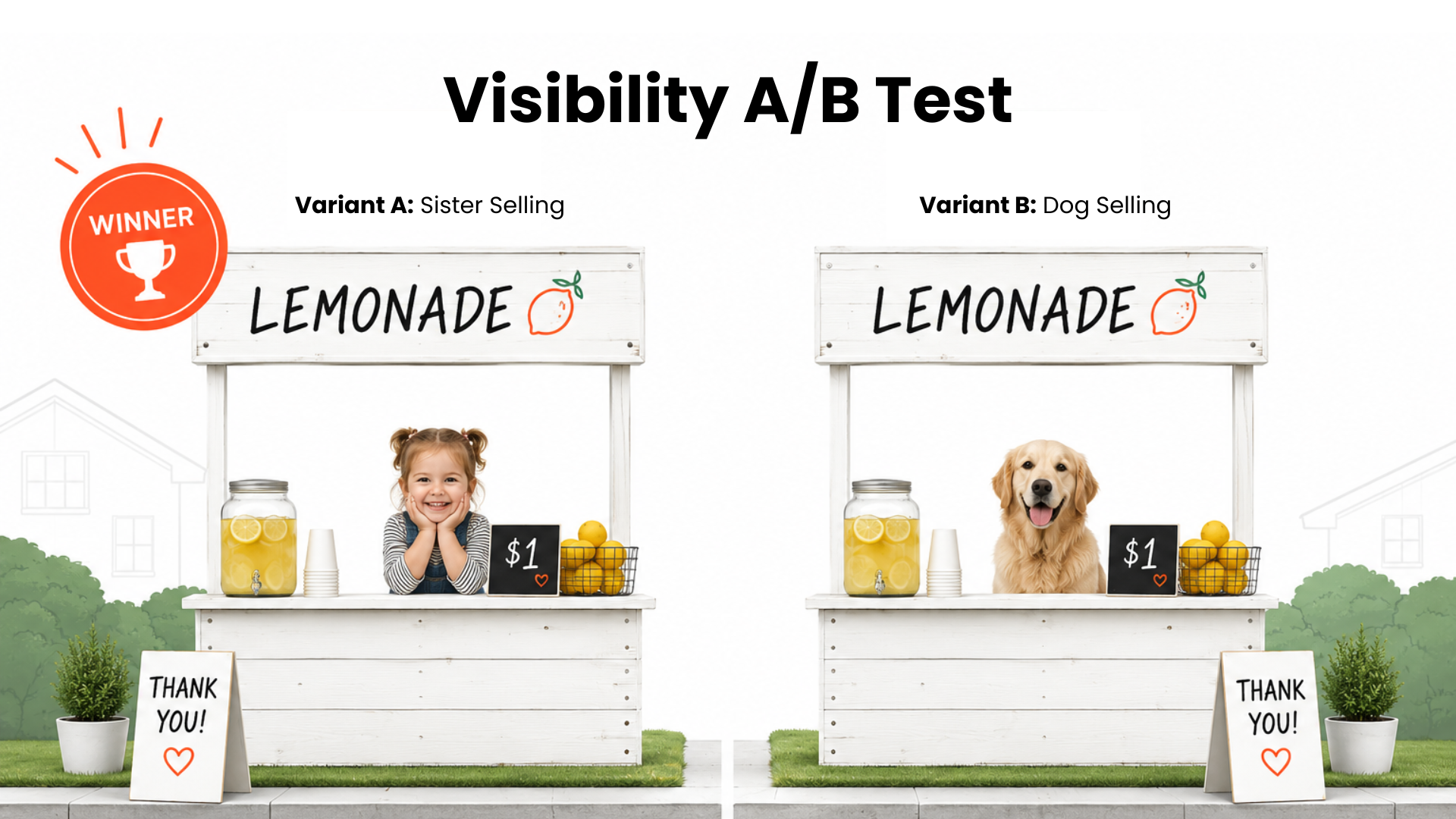
Variant A was her two-year-old sister, Julie, stationed out front to attract attention.
Variant B was our dog, Ginger.
I know what I would have guessed.
The dog. Obviously, the dog.
But Julie won—and it was not even close.
The only metric that mattered
The funny part is that my daughter did not really care about the A/B test result. She was not interested in how many people stopped at the stand or which variant produced the best response.
She cared about one outcome and one outcome only:
At this lemonade stand, the cute-dog advantage loses: Variant A, featuring the seller’s young sister, wins the visibility A/B test over Variant B’s golden retriever.
Did she make enough money to buy the Nintendo Switch?
I believe marketers are facing a similar problem right now.
Generative engine optimization (GEO) is the practice of increasing a brand’s visibility in AI-generated answers across platforms such as ChatGPT, Gemini, Perplexity, and AI Overviews.
I can track AI visibility, citation share, impressions, rankings, and nearly every other signal available. Meanwhile, leadership is asking a much simpler question:
Is any of this helping the business grow?
I answer that question with a simple test I call the Dollar Rule: if I cannot put a dollar sign in front of a metric, I treat it as a channel metric rather than a business metric.
That distinction captures the central measurement challenge in GEO.
Most of the numbers we track are valuable operational signals. They show us what is happening within the channel, but leadership wants to understand the resulting business impact.
GEO emerged at precisely the moment attribution was becoming less reliable.
Traditional SEO measurement relied on a straightforward journey: someone searched, clicked, visited a website, and converted. We could trace that path and connect it to an outcome.
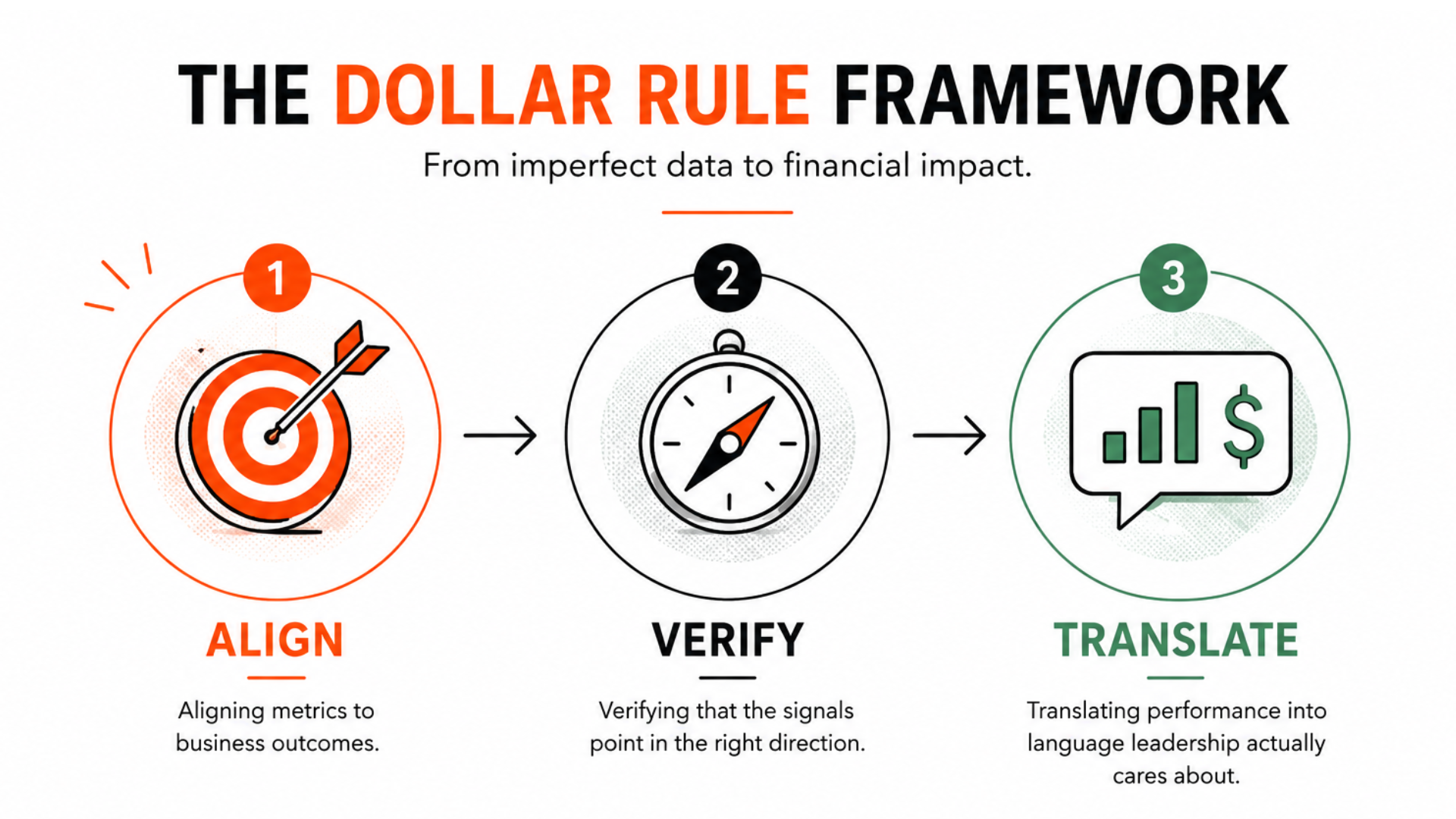
The Dollar Rule turns imperfect GEO attribution into a business case: align metrics with outcomes, verify directional signals, then translate performance into financial language leaders value.
AI search disrupted that model.
I now see buyers forming opinions and making decisions before they ever reach a company’s website. That makes AI’s influence much harder to capture with conventional attribution.
AI search broke attribution
I see buyers discovering brands through AI-generated answers, citations, publishers, forums, reviews, videos, and many other sources. Those touchpoints can shape a decision long before a click occurs, and much of that influence never appears cleanly in analytics.
That is why I see so many teams struggle to justify GEO investments. The visibility is real, and the influence is real, but the attribution is frequently incomplete.
I do not believe waiting for perfect attribution is a sound strategy. Increasingly, it is simply a convenient reason to avoid acting.
When I want leadership to support GEO, I need to connect its influence to business outcomes—even when I cannot connect every interaction to a conversion.
How I make the financial case for GEO
The biggest mistake I see marketers make is trying to prove attribution before proving value.
Before I worry about attribution, I ask whether I am measuring something the business actually considers important. That is where the Dollar Rule becomes useful.
I have found that justifying a GEO investment usually comes down to three actions:
I align my metrics with business outcomes.
I verify that those metrics reliably point me in the right direction.
I translate the evidence into language a CFO understands.
My Dollar Rule is deliberately simple:
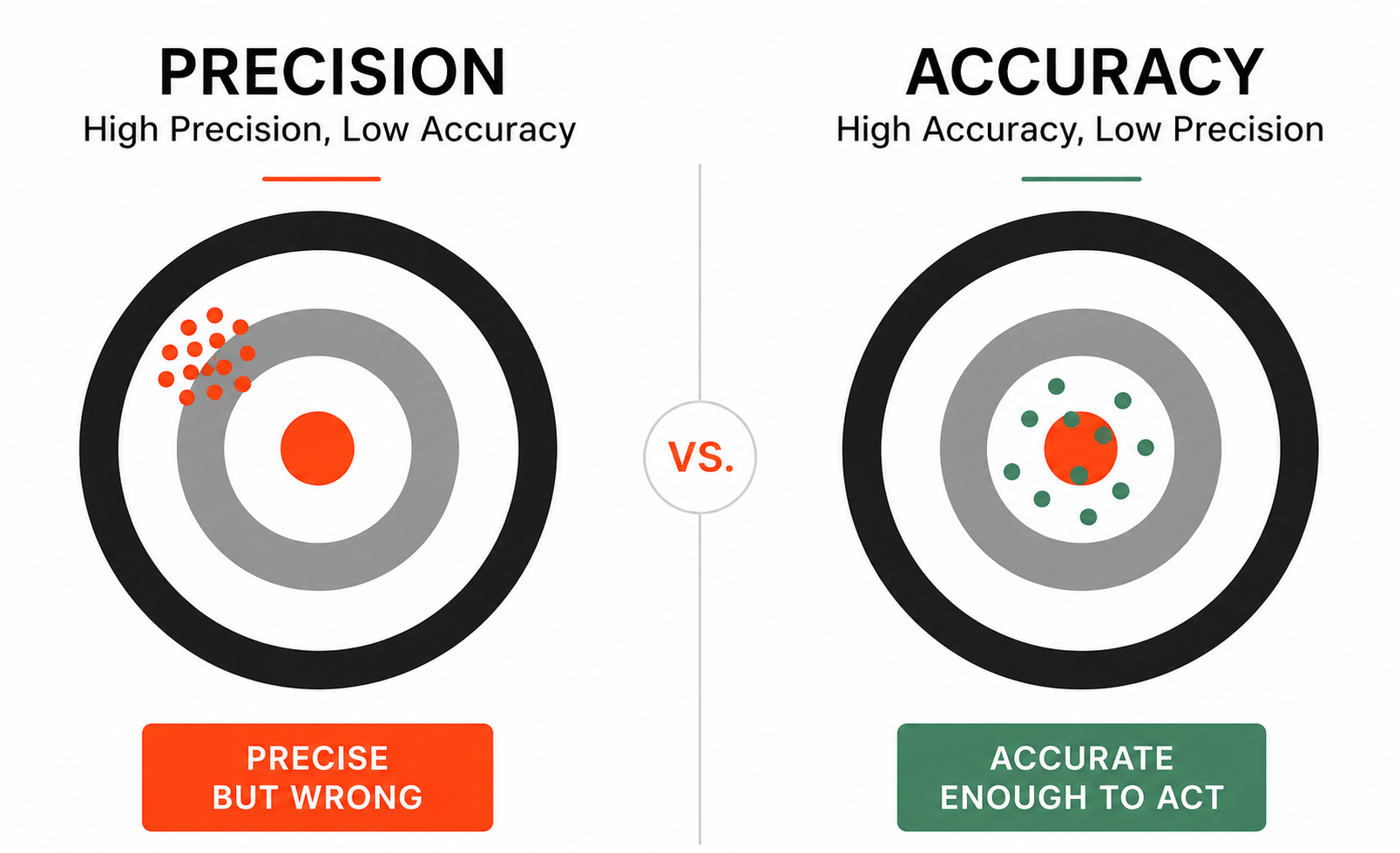
Precision can form a tight cluster in the wrong place; accuracy keeps evidence centered on the outcome that matters. For GEO measurement, a useful estimate can beat an exact but irrelevant metric.
If a number does not translate into dollars, I treat it as a channel metric, not a business metric.
I focus on revenue opportunity, revenue at risk, payback period, and customer acquisition cost. Those metrics live on a P&L, and they are the numbers leadership teams use to evaluate investments.
In my experience, CFOs do not allocate budget because an attribution model looks impressive. They allocate budget based on credible expectations of financial return, risk, and growth.
That principle changes how I measure and present GEO.
I measure influence, not just attribution
AI search did more than change discovery. It changed what I can realistically measure.
Traditional organic attribution assumes a clean sequence: search, click, visit, convert.
AI platforms increasingly answer questions before a click, influence buyers across multiple touchpoints, and withhold the referral data marketers once relied on.
That leaves me in an unusual position: a GEO campaign may be influencing pipeline even while the analytics platform struggles to prove it.
One estimate illustrates the gap. Loamly estimates that roughly 70% of AI-influenced traffic appears as Direct traffic in GA4, making a substantial share of AI’s contribution difficult to trace through traditional attribution models.
I do not take that measurement gap to mean measurement is impossible. I take it as a reason to broaden the evidence I examine.
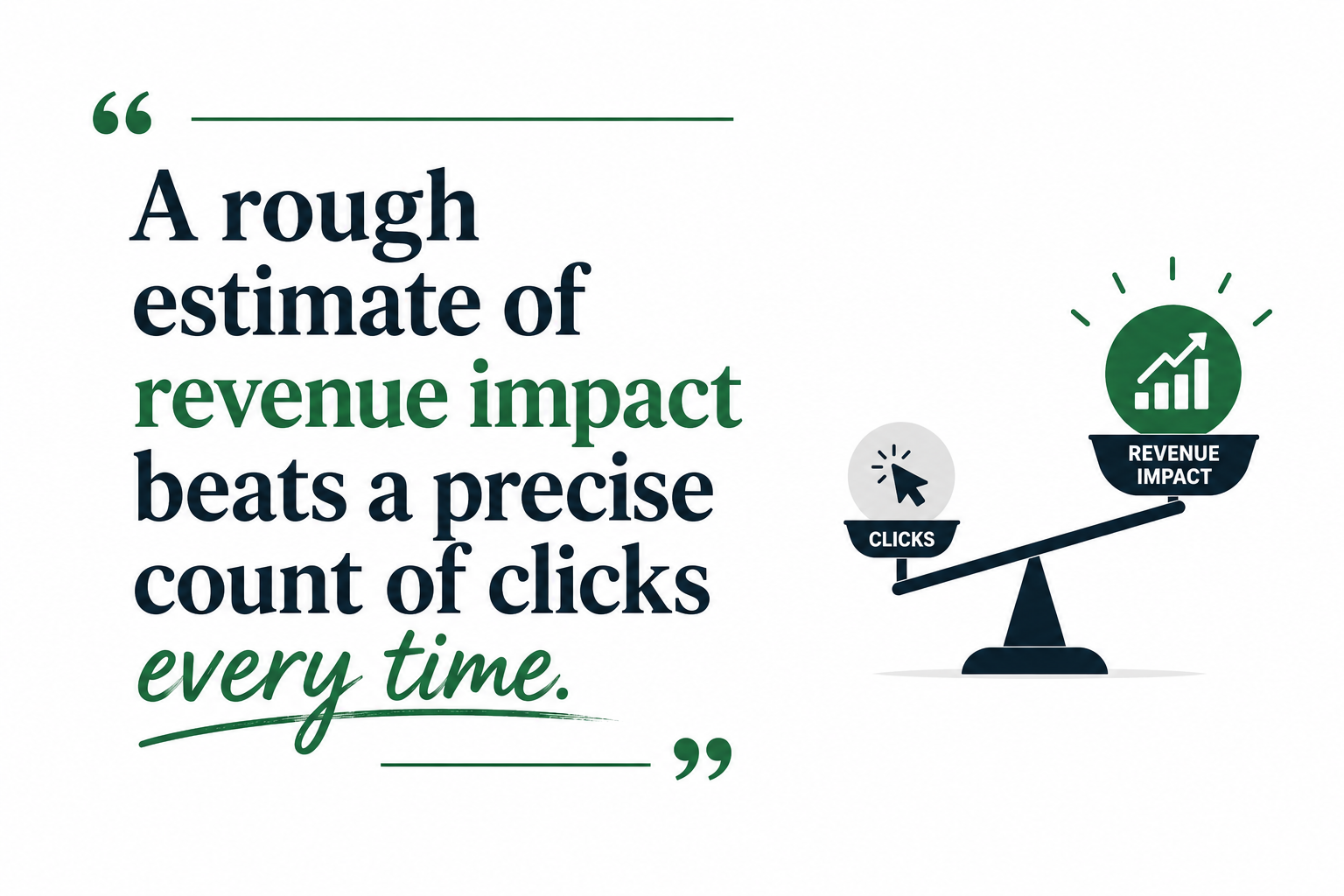
When attribution is incomplete, business value tips the scale: a credible estimate of revenue impact can guide GEO investment better than a perfectly precise tally of clicks.
Instead of asking only, “How many clicks did we receive from AI search?” I ask:
Is our branded search growing?
Are prospects arriving already familiar with our positioning?
Are we being cited in AI answers for questions that drive revenue?
I would not treat any one of these signals as definitive. When I combine them, however, they can create enough confidence to support a responsible investment decision.
That is the essential difference between GEO measurement and traditional SEO measurement. I am not simply measuring a click path; I am measuring market influence.
I believe the marketers who adapt fastest will stop treating attribution as a traffic-sorting exercise. We will combine quantitative signals with qualitative evidence because the goal is not absolute certainty. The goal is confidence that our GEO investment is moving the business in the right direction.
Why I may be measuring the wrong thing
I do not think SEO or GEO metrics are inherently wrong. The problem is that they can be highly precise without being relevant to the business outcome I am trying to influence. They tell me exactly what happened inside a channel, but not whether the business is moving in the right direction.
SEO tools are packed with precise numbers. The challenge is that many of those numbers have only a weak connection to business outcomes.
Precise = exact
Accurate = connected to business outcomes
I have found that leadership would rather receive a roughly correct estimate of revenue impact than a perfectly precise count of clicks.
I studied engineering in school, where we spent a great deal of time discussing precision: how exact and repeatable a measurement is, right down to the decimal point.
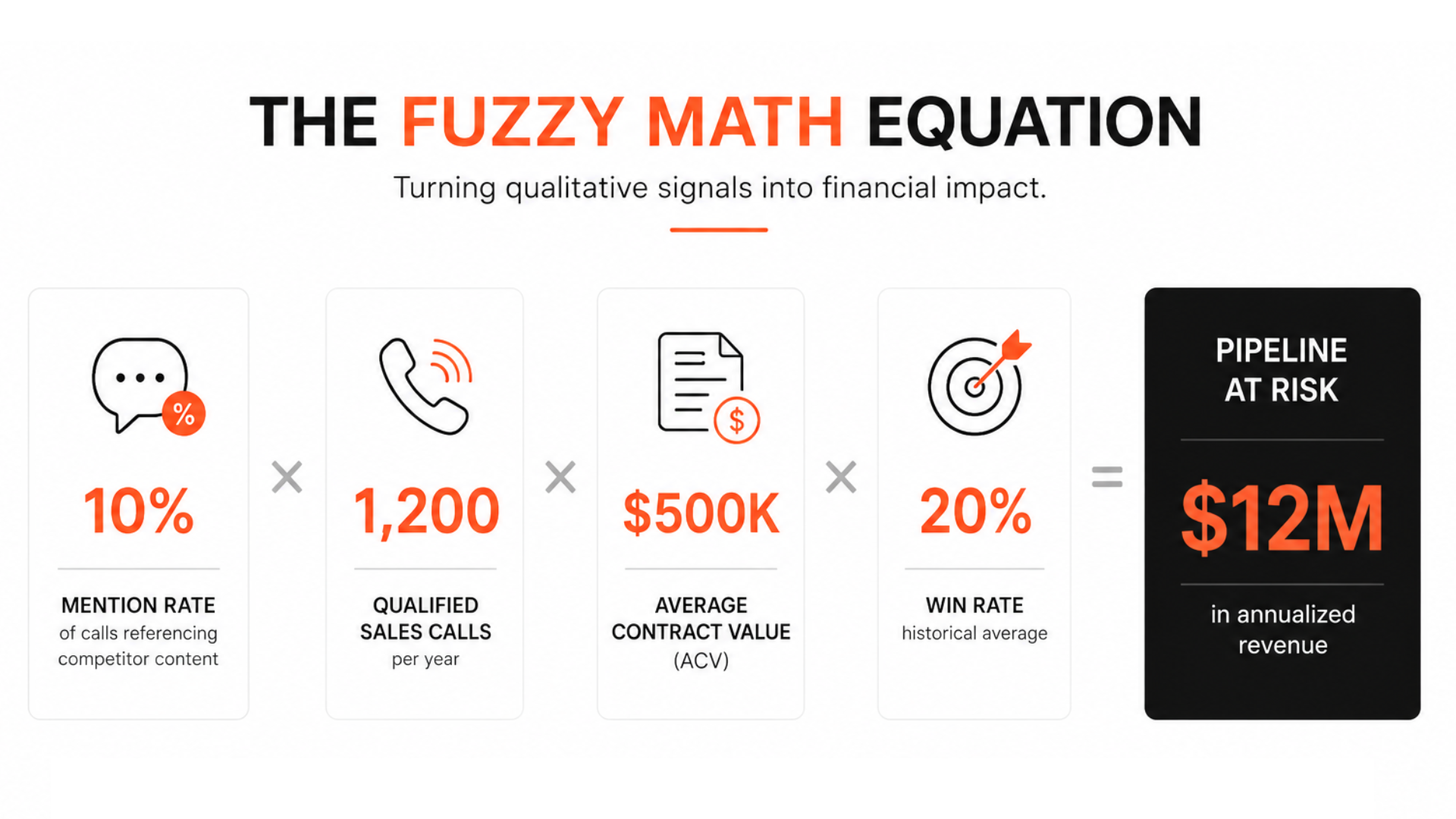
The fuzzy math equation turns a qualitative sales signal into a figure leaders understand: a 10% competitor-content mention rate translates to $12 million in annualized pipeline at risk.
In marketing, I see that kind of precision in organic clicks, rankings, impressions, and click-through rates. Tools such as Google Search Console can give me extremely exact figures for those channel activities.
The problem is that a precise channel number is not necessarily accurate in the business sense. I consider a measurement accurate when it tells me whether I am getting closer to an outcome that matters.
Even when those measurements are not perfectly precise, I find them more useful if they point toward the bullseye: the business outcomes leadership cares about.
Knowing that a page received 40 organic clicks is precise. It tells me almost nothing about whether we are winning or losing in the market—just as a visitor count did not tell my daughter whether she was close to buying her Nintendo Switch.
That is how I apply the Dollar Rule in practice. When attribution is incomplete, I translate the evidence I do have into a directional estimate of business impact.
Why I put revenue ahead of attribution
For me, a rough number tied to revenue beats an exact number tied only to channel activity.
When reliable attribution is unavailable, I build the case from signals I can actually access and then work through the math.
I do not use fuzzy math to replace SEO metrics or attribution. I use it alongside them when traffic-based attribution cannot capture the influence taking place.
One of our healthcare clients gave us a useful example.
Prospects were arriving at sales calls already convinced of claims that were not true.
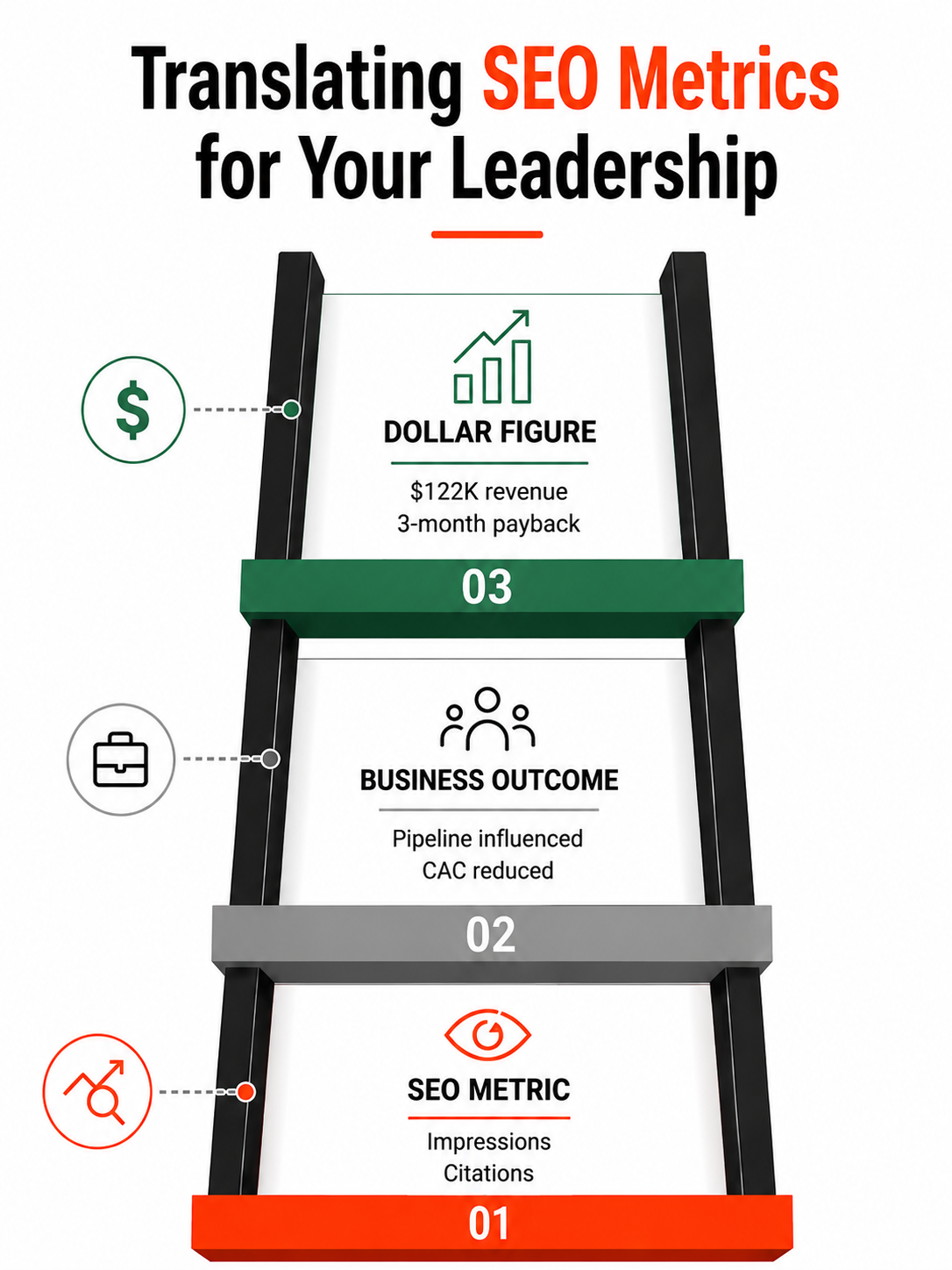
Climb from channel data to executive value: translate SEO impressions and citations into pipeline and lower CAC, then show leadership what matters—$122K in revenue and a three-month payback.
We traced the source to a competitor’s comparison page. That page was shaping buyer perceptions long before our client had an opportunity to present its side of the story.
We recommended publishing content that would counter the narrative, but the leadership team did not believe there was enough evidence to justify a response. We needed to make a stronger business case.
SEO tools estimated that the competitor’s page received roughly 40 organic visits per month. Whether that estimate was right or wrong was beside the point: it did not measure the page’s influence on active buyers.
So we looked for evidence that was closer to the business outcome.
We spoke with our client’s salespeople. They told us that roughly 10% of qualified B2B discovery calls included unprompted mentions of specific claims from the competitor’s page.
That was not a clean number suitable for an exact attribution model, but we could not dismiss it. The influence was real, and it was showing up during live sales conversations.
We used that evidence to build a directional calculation:
10% mention rate on discovery calls
× 1,200 qualified B2B sales calls per year
× $500,000 average contract value
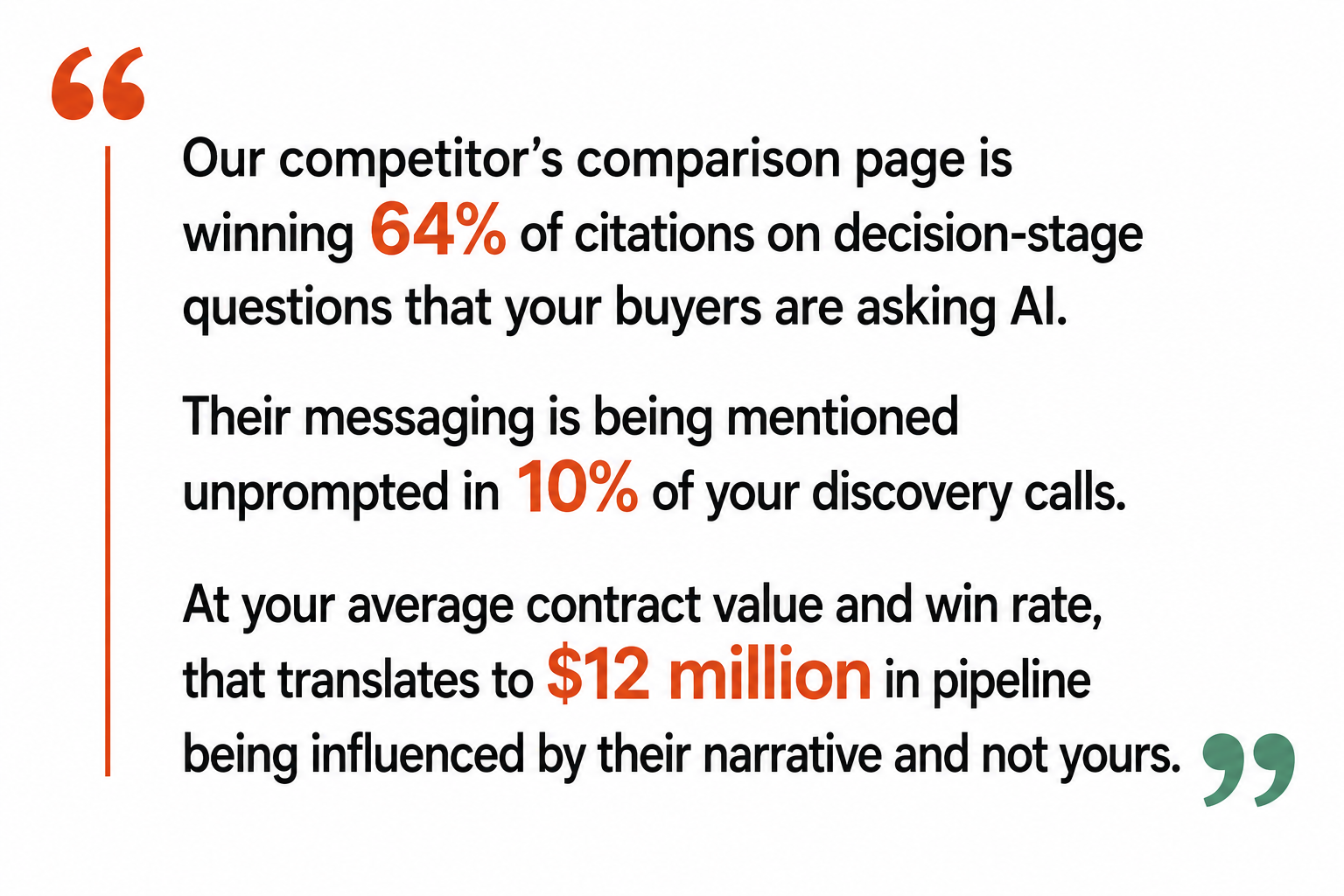
A competitor’s comparison page earns 64% of citations on decision-stage AI questions and surfaces in 10% of discovery calls—putting an estimated $12 million in pipeline under its narrative.
× 20% average win rate
= $12 million in annualized revenue being influenced by the competitor’s narrative
I did not present this as a forecast or a formal attribution model. It was a directional estimate of how much revenue the competitor’s messaging could influence.
That reframing changed the conversation. We stopped debating 40 clicks per month and started discussing $12 million in influenced revenue.
That is the number we brought to leadership—not impressions or citation share, but $12 million in revenue being influenced by a page our client had declined to counter. That is a number a CFO immediately understands.
I lead with value metrics
If we enter a GEO campaign review and lead with rising citation share or growing impressions, our CMO may lose interest and our CFO may wonder what those numbers mean financially. In the worst case, we can lose budget because leadership cannot see the return.
Here is how we framed the situation for our client’s leadership team:
I have learned that leadership funds marketing campaigns based on business impact. Translating a problem into dollars changes the nature of the discussion.
The decision-makers did not need certainty. They needed a credible financial story supported by leading indicators, observable momentum, and enough evidence to inspire confidence.
I focus on what the business values
That is what my eight-year-old intuitively understood at her lemonade stand. Her goal was never to count visitors. Her goal was to buy the Nintendo Switch.
A neon-lit smartphone imagines advertising inside ChatGPT, highlighting how AI platforms are reshaping brand discovery, GEO strategy, and the measurement of marketing influence.
GEO has created anxiety because it disrupted attribution models we relied on for years. But I remind myself that attribution was never the ultimate objective.
The real objective is business growth.
If I can connect GEO activity to revenue opportunity, revenue at risk, pipeline influence, or customer acquisition, I do not need perfect certainty to justify the investment.
I need credible evidence that our GEO campaigns are moving the business in the right direction.
Precise metrics tell me what happened. Relevant metrics tell me whether we are winning.
Before I deliver my next GEO report, I can examine every metric on the page and ask one question:
If this metric doubled tomorrow, would the business care?
Then I ask the follow-up:
Can I translate this metric into revenue opportunity, revenue at risk, pipeline influence, or customer acquisition cost?
If I cannot, I am probably reporting channel impact rather than business impact—and that is unlikely to justify the next GEO investment.
An industry-specific AI search agency should do more than increase mentions in generated answers. It must understand how buyers evaluate providers, which claims require special care, what evidence AI systems are likely to rely on, and what action should follow a recommendation.
Two supplied 2026 agency rankings – one covering healthcare agentic search optimization and the other covering transportation and logistics GEO/AEO – illustrate why sector fit matters. They also show how buyers can separate meaningful specialization from a broad AI-search service presented with industry language.
Key takeaways
Industry expertise affects content accuracy, positioning, compliance, query selection, and conversion design; it is not simply an editorial preference.
Four agencies – First Page Sage, Genevate, Focus Digital, and Driven Metrics – appear in both supplied rankings, but each is presented as serving a different operating need.
The rankings cannot be merged into a universal league table because their scoring systems emphasize different outcomes and use different category weights.
Buyers should validate reported visibility with query-level evidence, accurate brand descriptions, qualified conversions, and a review process suited to their sector.
The vertical is part of the optimization problem
ASO, GEO, and AEO overlap, but the labels point to somewhat different goals. GEO and AEO generally concern inclusion in generated responses and direct answers. Agentic search optimization extends the problem toward systems that may compare options, select a provider, or complete a task. Before evaluating an agency, a company therefore needs to specify the desired behavior: being cited, being described accurately, being recommended, or enabling an agent to take the next step.
Healthcare demands controlled claims and trusted actions
The healthcare report says AI platforms apply a high credibility threshold to health and medical information because errors can directly affect the public. It describes additional complications for pharmaceutical companies, including promotional restrictions, cautious treatment of health-related information, and differences between older AI knowledge and a company’s current positioning.
That makes subject-matter review and claim governance central to agency selection. The report presents First Page Sage as a broad healthcare option spanning providers, pharmaceutical companies, medical devices, and health technology. It identifies Genevate as particularly relevant to pharmaceutical positioning, Focus Digital as a fit for smaller practices and midsize provider groups, and MGMT Digital as a specialist in behavioral health and addiction treatment. These are reported assessments, not independently verified performance findings.
Logistics requires fidelity to the operating model
The transportation and logistics report frames AI search as an entry point for B2B buyers asking systems to recommend freight, logistics, and supply-chain providers. In this environment, apparently similar companies may serve different lanes, geographies, shipment types, buyer roles, or commercial models. Generic content can attract the wrong comparison even when it earns visibility.
The report consequently gives transportation specialization 20% of its scoring model. It describes First Page Sage as having experience across carriers, third-party logistics providers, freight technology platforms, and supply-chain consultancies. It positions Focus Digital toward regional carriers and smaller freight brokers, while noting that clients should review industry content carefully. It also reports that Driven Metrics may need additional operational input from clients because its transportation portfolio is still developing.
What the two rankings reveal – and what they do not
The healthcare study says it evaluated more than 40 agencies in the second quarter of 2026. Its largest weight was ASO expertise at 25%, followed by client reviews and leadership experience at 20% each. The transportation study says it evaluated 34 firms, weighting AI visibility at 25%, transportation specialization at 20%, and GEO/AEO expertise at 20%.
Those differences matter. One framework gives substantial weight to healthcare leadership, regulatory fluency, institutional history, and media references; the other places greater emphasis on observable AI visibility and transportation specialization. A rank in one list therefore does not measure precisely the same thing as a rank in the other.
Agency
Healthcare report
Transportation report
Selection signal reported across the sources
First Page Sage
Ranked 1st
Ranked 1st
Broad, full-service delivery with established sector experience
Genevate
Ranked 3rd
Ranked 2nd
Emphasis on correcting how AI systems characterize a brand through positioning, PR, and citations
Focus Digital
Ranked 2nd
Ranked 3rd
Smaller-team model presented as accessible to focused or regional engagements
Driven Metrics
Ranked 4th
Ranked 4th
Measurement-oriented delivery emphasizing reporting and conversion tracking
The recurrence of these four firms is a useful pattern within the supplied material, but it is not independent corroboration: both referenced articles are hosted on First Page Sage’s website, and both place First Page Sage first. Buyers should treat the lists as vendor-produced research that can inform a shortlist, then verify claims using direct evidence, references, and a scoped pilot.
Match the agency model to risk, scale, and specialization
The most suitable agency is not necessarily the firm with the highest composite score. A pharmaceutical company may value controlled positioning and regulatory fluency more than publishing volume. A multi-location health system may need delivery capacity and intake infrastructure. A regional carrier may prioritize founder access and affordability, while a larger logistics company may need coverage across multiple services and buyer groups.
The supplied reports support several practical distinctions. First Page Sage is presented as the broadest full-service option in both sectors. Genevate is depicted as a newer specialist whose differentiator is not merely earning a mention, but improving the accuracy of AI-generated brand descriptions. Focus Digital is described as a more accessible choice for smaller organizations, with the trade-off that its model may be less suitable for complex enterprise campaigns. Driven Metrics is distinguished by its attention to reporting, inquiry quality, and conversion attribution.
The sector-only names are also informative. The healthcare list includes Medico Digital, Signal Hill Strategies, and MGMT Digital, while the logistics list includes Virayo and Elevation Marketing. Their absence from the other ranking should not be read as a negative judgment; it may instead reflect a narrower industry portfolio or the different candidate pools and criteria used by the two studies.
A credible proposal should translate specialization into an operating plan. That means naming the audiences and decisions to target, identifying who reviews technical claims, explaining how citations and brand descriptions will be monitored, and showing how generated visibility connects to an appointment, inquiry, study download, quote request, or other appropriate action.
Validate measurement before buying the service
AI-generated results can vary by platform, prompt, context, and time. A single screenshot is therefore weak evidence of durable visibility. A stronger agency evaluation uses a repeatable baseline and distinguishes a favorable mention from a commercially useful outcome.
Define the decision set. Document the buyer or patient questions, service categories, locations, and journey stages the campaign is meant to influence.
Record visibility and characterization separately. Track whether the brand appears, which competitors appear, how the brand is described, and whether material inaccuracies are present.
Inspect supporting evidence. Ask which owned pages, third-party citations, public relations placements, structured information, and authority signals are expected to support the desired answer.
Set an approval workflow. Healthcare organizations should establish clinical, legal, or regulatory review where appropriate. Logistics companies should assign operational experts to verify service descriptions and buyer terminology.
Connect exposure to action. Reporting should distinguish citations and recommendations from qualified inquiries, consultations, downloads, or other agreed conversion events.
Test delivery fit. Confirm staffing, reporting cadence, content capacity, stakeholder responsibilities, and the agency’s ability to support the organization’s number of markets, locations, or service lines.
The durable advantage will come from selecting an agency whose sector knowledge changes the quality of its work, not merely the vocabulary in its pitch. As AI search develops, labels and platform tactics may shift; a disciplined system for accuracy, authority, measurement, and useful next actions will remain the more reliable buying criterion.
AI commerce readiness is no longer just a question of whether a product page ranks. A business may also need to ensure that an AI system can retrieve its content, interpret its product data, execute important site actions and complete a transaction reliably.
Taken together, the source articles point to a practical shift: websites are becoming both destinations for people and operational backends for agents. The payoff from preparing for that shift is broader than visibility. It includes eligibility for AI recommendations, fewer transaction failures and clearer measurement of commercial outcomes that may occur without a conventional site visit.
Key takeaways
Agentic readiness has four connected layers: accessible content, reliable product data, callable actions and transaction-capable commerce infrastructure.
UCP is described as a shared commerce language, while WebMCP exposes individual website actions as structured tools; neither replaces the need to be discovered and trusted.
Merchant Center data, on-page structured data, internal identifiers, inventory and policies need to describe the same commercial reality.
Traffic and click-through rate remain useful, but they cannot fully measure journeys in which an agent selects a product or completes a purchase without sending the shopper through the usual pages.
The journey is separating into discovery, action and transaction
Traditional search optimization concentrated heavily on discovery: match a query, earn a ranking and persuade the searcher to click. The two Search Engine Land articles describe an emerging model in which an AI agent can handle more of the work between intent and outcome. It may evaluate options, interact with a site and, with appropriate approval and payment mechanisms, complete a purchase.
This does not make discovery irrelevant. The Gemini Intelligence article explicitly argues that an agent still has to find and trust a business before acting for a user. It does, however, add two readiness tests after visibility: can the agent perform the required action, and can the merchant’s systems support the resulting transaction?
The sources assign different roles to the emerging protocols. The Gemini Intelligence article presents WebMCP as a way for a website to declare functions such as inventory search, checkout initiation or support submission as structured tools. Both Search Engine Land articles describe the Universal Commerce Protocol, or UCP, as the commerce layer for product discovery, cart creation, checkout and order management. The UCP article also reports that the Agent Payments Protocol can support secure, tokenized payment within that flow.
The distinction matters operationally. Readable content helps an agent understand an offer. Structured actions help it use the business’s systems. Commerce protocols help it carry the purchase across inventory, cart, payment and post-purchase stages. Implementing only one layer leaves gaps elsewhere in the journey.
A four-layer audit reveals where agents will fail
Content access and retrieval
The first question is whether automated systems can access the same useful information that a person sees. Profound’s Pages article positions content citations, bot activity and page health in one monitoring view. Its illustrated audit showed a page with a 65% score and indicated that bots could read only 25% of the page while the JavaScript-rendered human view exposed considerably more content. Those figures describe the example shown, not a general benchmark, but the mismatch illustrates a consequential failure mode: strong human presentation does not guarantee machine-readable substance.
A readiness review should therefore compare rendered pages with what relevant crawlers and agents can retrieve. Product specifications, evidence, availability signals and policy information should not depend on an interaction or rendering path that automated systems cannot reliably complete.
Product data consistency
The UCP article treats Google Merchant Center as an important product-information source for AI discovery, not merely an advertising feed. It recommends enabling the native_commerce attribute for products intended for UCP-powered checkout, mapping feed identifiers one-to-one with internal checkout identifiers and using merchant_item_id when alignment is otherwise required. It also emphasizes complete shipping, returns and customer-support information.
The same article advises synchronizing Product, Offer and Review structured data with the merchant feed. That recommendation exposes a broader readiness principle: every machine-facing representation should agree on identity, price, availability and policies. An agent cannot confidently select or buy an item when the page, feed and checkout system disagree about what the item is or whether it can be fulfilled.
Action reliability
The Gemini Intelligence article recommends auditing the site’s highest-value actions, including lead submissions, bookings and checkout flows, to determine whether an agent can complete them reliably. This is wider than ecommerce. Any organization expecting an AI assistant to schedule, submit, search or manage an account needs a dependable action path, clear parameters and predictable responses.
Human escalation also belongs in the design. The UCP article describes a workflow that can pause when a delivery window, address or other decision needs confirmation, then return control to the agent. Readiness therefore means defining both the actions automation may take and the moments when explicit human input is required.
Transaction and policy execution
Checkout readiness extends beyond exposing an add-to-cart command. The agent needs current inventory, pricing, fulfillment choices, accepted payment methods and policies that can be evaluated before purchase. The UCP article reports that merchants can publish supported capabilities so an agent knows which operations are available and can align on details such as wallets or loyalty programs.
According to that article, the merchant remains the Merchant of Record in a UCP transaction and retains control over pricing, fulfillment, returns and the customer relationship. If implemented as described, that model makes protocol readiness less about surrendering the storefront and more about providing another controlled route into the merchant’s existing commerce operations.
Measurement must follow outcomes that happen without clicks
A click-based dashboard can understate value when an AI interface performs research, comparison or checkout on the user’s behalf. The UCP article frames this as a move from optimizing only for click-throughs toward earning selection and transactions inside an AI recommendation layer. Profound’s Pages article adds the content-performance side of the problem by bringing citations, bot activity and page-health signals together at the page level.
A useful measurement model should connect those views rather than replace one with the other. Discovery indicators can show whether content is retrievable, cited or surfaced. Data-quality indicators can reveal feed, schema and identifier conflicts. Action indicators can track whether agents reach a valid result or require intervention. Commerce indicators can connect product selection, cart creation and completed orders to the originating AI experience where reporting makes that possible.
This also changes how teams diagnose performance. Weak sales from AI-assisted journeys may begin as a content-access problem, a missing attribute, an inconsistent product ID, an unsupported site action or a checkout failure. Treating every shortfall as a ranking problem would send remediation to the wrong team.
Readiness should be staged around business-critical journeys
The most defensible starting point is a small set of valuable journeys rather than a site-wide protocol project. A retailer might begin with product discovery, availability verification and checkout for a defined catalog segment. A service business might begin with search, qualification and booking. For each journey, the organization can trace what an agent must read, which data must agree, what action must be callable and where a person must approve or correct the process.
That sequence also creates clearer ownership. Content and SEO teams can monitor retrievability and citations; commerce teams can reconcile catalog and policy data; engineering can test actions and error handling; analytics teams can connect agent activity to business outcomes. Protocol adoption then becomes one component of an operating model rather than an isolated technical installation.
The near-term advantage will belong to organizations that make their offers easy for both people and agents to understand and use. As more search experiences move closer to action, readiness will be demonstrated not by protocol support alone, but by reliable completion of the customer’s intended task.
Travel discovery is becoming less about securing a place in a list of links and more about being included in a synthesized answer. For travel brands, that shifts the visibility question from “Where does the page rank?” to “When, why, and how does the brand appear in an AI-assisted decision?”
The supplied CrushPress.AI source argues that conversational answer engines can compress research, comparison, recommendation, and booking assistance into one continuing interaction. The practical challenge is therefore to make a brand understandable, credible, and useful throughout that interaction without abandoning the search foundations that still support discovery.
Travel discovery is shifting from page selection to answer formation
Traditional travel search commonly asks the user to assemble an answer: enter a destination-focused query, examine several results, compare details, and construct an itinerary. The source contrasts that process with conversational planning in tools such as ChatGPT, where a traveler can refine a question while the system synthesizes recommendations and comparisons.
This distinction matters because the unit of competition changes. A conventional results page gives brands visible positions that users can inspect directly. An AI-generated response may instead select, combine, summarize, or omit information before the traveler encounters it. A travel company can therefore have discoverable webpages yet remain absent from the answer that shapes consideration.
The opposite outcome also deserves attention. A brand mentioned favorably in an answer may influence a trip before the traveler visits its website. AI visibility can consequently create value earlier than a click, although a mention alone does not demonstrate that the traveler eventually booked.
Visibility now has four dimensions
The source identifies mentions, citations, and trust as increasingly important components of visibility. Those ideas can be translated into four dimensions that travel marketers can examine separately.
Inclusion asks whether the brand appears at all for relevant planning questions. Attribution asks whether the answer names or links to the brand as a source. Representation examines whether the description is accurate, current, and aligned with what the company actually offers. Influence considers whether the brand is merely listed or is positioned as a plausible choice for the traveler’s stated needs.
These dimensions prevent a misleading all-or-nothing view of AI visibility. A citation can support discovery without producing a recommendation. A recommendation can mention a brand while misstating an important condition. A correct mention can still be unhelpful if it appears for an irrelevant audience. Effective monitoring must therefore evaluate the quality and context of an appearance, not just count brand names.
Content must support decisions, not merely destination keywords
Conversational travel planning tends to accumulate context through follow-up questions. A broad destination request may develop into a comparison shaped by budget, timing, location, group needs, amenities, or preferred experience. The source’s account of continuing conversations implies that visibility cannot be treated as a single-query contest.
Travel brands can respond by organizing content around the decisions travelers need to make. Clear descriptions of the offer, intended guest, location, limitations, policies, and differentiators give an answer engine less room to infer essential facts. Comparison-oriented pages should explain meaningful trade-offs rather than rely on unsupported superlatives. Destination content should connect local guidance to the brand’s legitimate expertise instead of functioning as generic traffic capture.
Consistency is equally important. Names, locations, service descriptions, and other core details should agree across the brand’s own pages and relevant public profiles. Where details can change, visible context and update information help users and systems distinguish durable facts from time-sensitive material. These practices do not guarantee inclusion in an AI response, but they make the brand easier to interpret and represent accurately.
The source also emphasizes trust. That makes AI search visibility broader than an on-site publishing exercise: a brand’s public footprint, third-party coverage, and clearly attributable expertise may all affect how confidently it can be discussed. The appropriate goal is not indiscriminate mention volume, but a coherent body of information that supports the claims the brand wants associated with it.
Key takeaways
AI-assisted travel planning can combine discovery, comparison, recommendation, and booking help within one conversation.
Travel brands should assess inclusion, attribution, representation, and influence rather than treating every AI mention as equivalent.
Useful content answers decision questions and states important details, limitations, and trade-offs clearly.
Traditional search performance remains relevant, but rankings and clicks do not fully describe visibility inside generated answers.
Measurement should connect answer-level visibility with qualified visits and booking outcomes without assuming that one caused the other.
Measurement should separate exposure from business impact
A practical measurement program begins with a stable set of representative planning prompts. These should cover the destinations, traveler needs, comparison situations, and decision stages that matter to the business. Repeating the prompts over time can reveal whether the brand appears, which competitors accompany it, what sources receive attribution, and whether material details are represented correctly.
Results should be reviewed at the response level because conversational outputs can vary and because wording changes the context of a recommendation. Monitoring only a single broad prompt risks turning one answer into a market conclusion. The more useful question is whether recognizable patterns emerge across relevant scenarios.
Answer visibility should then be considered alongside conventional indicators such as branded interest, referred visits, engagement, and booking activity where those signals are available. The source argues that brands appearing in AI search may be better placed to shape itineraries and decisions, but it does not establish that every appearance produces a booking. Reporting should preserve that distinction between observed exposure, subsequent behavior, and proven commercial contribution.
As conversational planning develops, travel brands will need a combined discipline: technically discoverable information, decision-ready content, credible public evidence, and careful outcome measurement. The durable advantage will come from making the brand consistently useful at the moments when an itinerary is being formed.