I’ve been following the shift in Google’s AI Overviews, and it’s exciting to see the organic click-through rate on these searches finally on the rise. After a year-long slump, the CTR is showing promising signs of recovery. But could this mean the end of click losses?
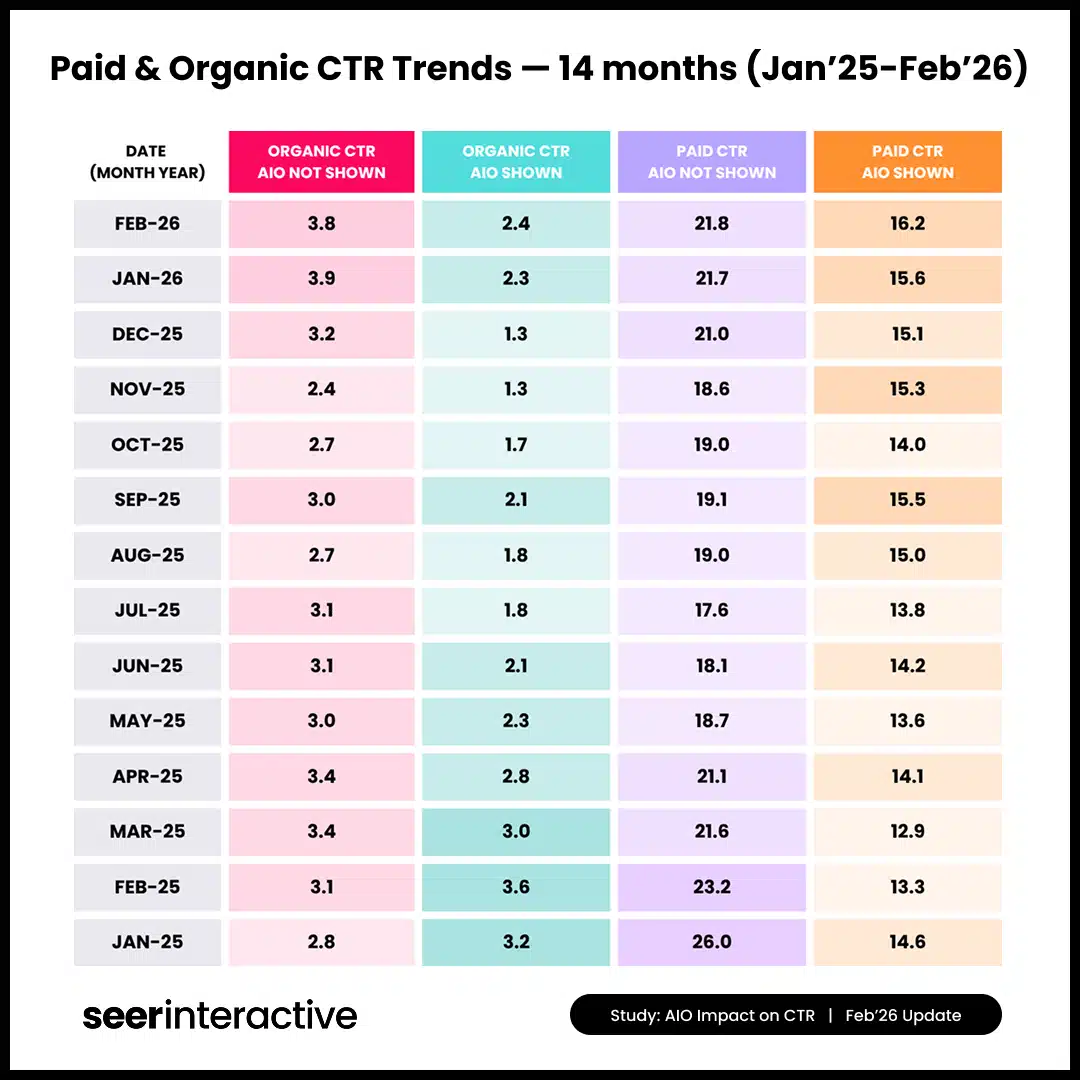
Back in December 2025, the CTR had hit a low of 1.3%, but by February 2026, it had climbed to 2.4%. That’s an impressive 85% jump in just two months, according to the latest data from Seer Interactive.
Understanding CTR Movement. When AI Overviews are part of a search, pages that are cited see a significant increase in clicks compared to pages that aren’t cited, yet they still garner fewer clicks than searches without any AI Overviews.
Here’s a breakdown of the CTR percentages:
No AI Overview: ~3.3% CTR
AI Overview with citation: ~2.1% CTR
AI Overview without citation: ~0.9% CTR
Where are the clicks going?. Interestingly, searches that don’t include AI Overviews are seeing an increase in value. Their CTR rose from 2.8% at the start of 2025 to 3.8% by February 2026.
One factor: AI Overviews are handling quick answers, leaving users with more complex questions to search deeper.
AI Overviews Depend on Query Intent. The presence of AI Overviews varies greatly depending on the type of query:
Informational: ~36% feature AIOs
Transactional: ~5%
Comparison: ~95%
Question: ~86%
A nuanced perspective. It’s important to note that a lower CTR doesn’t always equate to poor results. In instances where clicks remained stable but impressions grew, brands may have appeared more frequently in AI Overviews even as CTR percentages dropped.
The stability of paid search. I noticed that when Google presents an AI Overview, the paid CTR increases slightly from 14.6% to 16.2%. Without AI Overviews, the CTR drops from 26% to 21.8%.
Why this matters. Google’s AI Overviews are not just reducing overall clicks; they’re shifting them. This means you need to aim for your site being cited in AI Overviews and focus on queries where users are more likely to click.
About the Research. Seer analyzed data from 53 brands, 5.47 million queries, and 2.43 billion impressions between January 2025 and February 2026.
About a year ago, I found myself walking out of a meeting with engineers focused on enhancing automations for content briefs. Just days after that encounter, someone from the analytics team — who hadn’t even been part of those conversations — surprised me with a tool they’d developed. This tool could generate content briefs using various data pipelines and APIs.
That moment was a revelation for me. Encouraging people to adopt AI isn’t the real challenge; it’s the actual implementation and seamless integration that pose difficulties.
I frequently observe that most SEO teams, including mine, aren’t short on tools. What we struggle with is prioritizing high-impact efforts and achieving alignment within the organization.
In our team, one group might experiment with prompts while another auto-generates briefs, and yet another constructs dashboards no one requested — often resulting in us overlapping each other’s work. Each team contributes something valuable, but duplication tends to dilute the efforts, and everyone races toward execution.
Leadership demands speed; legal teams push for caution; developers need clarity.
The result is often fragmentation, which is not the transformation AI marketing teams require. For AI to have a significant impact on SEO performance, it must be well-structured before scaling; otherwise, this fragmentation only grows.
Through my experience working with large, complex organizations transitioning in this space, I have identified three frameworks that consistently prevent chaos and create momentum. When applied together, they help us align our vision, clarify what we automate, and transition prioritization into execution.
The biggest barrier to adopting AI is coordination. SEO already resides at the crossroads of engineering, content, analytics, products, and branding. With the inclusion of AI and the emergence of social search, we now have to factor in organic social, conversion rate optimization, affiliates, and creativity.
AI spans all these areas, but it’s too extensive for any single person or team. Without a shared mental model, teams tend to drift apart, duplication seeps in, and accountability becomes vague, transforming AI into a race rather than a productivity enhancer.
In leading large teams and collaborating with numerous Fortune 100 executives, I learned how analogies help teams grasp complex ideas quickly. Research supports that analogies improve understanding and the transmission of ideas across different domains. When teams map new concepts onto familiar structures, alignment accelerates.
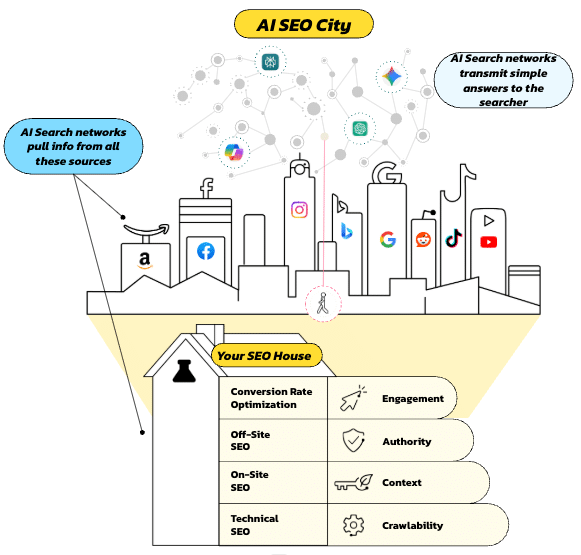
Introducing: the AI SEO City. Instead of describing AI as a series of tools and experiments, envision your SEO ecosystem as a bustling city.
Think of your website as an SEO house that no longer operates in isolation. Technical SEO creates the foundation. Content hubs define the interior. Off-site SEO offers the curb appeal. User experience provides the staging.
With AI search, this house is now more integrated with a broader city. Platforms like TikTok, Reddit, YouTube, and Amazon shape the responses AI systems deliver.
To thrive in AI search, this city requires a strong planner to advocate for budgets, plan future steps, and maintain effective strategies. Here, the SEO team acts as the planner, while other teams build and manage their respective “buildings.”
The transition from analogy to action centers on ownership. Every major platform becomes a building.
Each of these buildings has a leader, performance indicators linked to business outcomes, AI-enhanced workflows, and a roadmap, making AI projects tangible, accountable, and coordinated.
After aligning our vision, many teams make the mistake of trying to automate everything. This indiscriminate automation creates fragility.
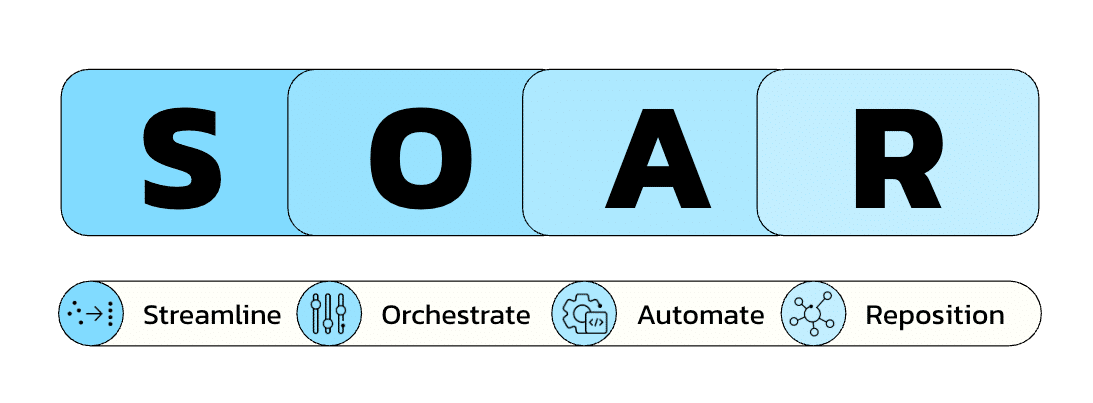
If your go-to person for automation leaves, you risk losing both business processes and valued work. That’s why I use the SOAR framework to navigate smart adoption.
To truly integrate AI, streamlining the basics is crucial. Having robust, standardized processes before incorporating AI can significantly enhance its effectiveness. According to McKinsey’s 2023 State of AI report, organizations that have already digitized and standardized core workflows gain the most from AI.
In my own experience, the easiest and most valuable automations accelerate predefined manual processes. Therefore, my team’s policy has always been to engage in manual tasks before attempting automation.
AI adoption necessitates cross-functional collaboration, making it essential for SEOs to orchestrate teams efficiently across the organization. Revisiting AI SEO City ownership insights can help clarify review processes, QA ownership, and publishing governance.
Establishing regular checkpoints, such as weekly SEO syncs with diverse teams, monthly performance reviews, and quarterly roadmap alignments, encourages consistency and diminishes resistance.
AI has the potential to save people approximately four hours a week, which equates to about 200 hours a year — roughly five weeks.
It’s crucial to utilize AI for tasks like metadata drafting, monthly report insights, FAQ expansion, internal linking suggestions, keyword clustering, and SERP analysis, thus freeing time for executing high-impact tasks.
AI implementation should eventually free up strategists to coordinate across teams, bridge the gap between strategy and business impact, map out enhanced customer search journeys, and anticipate AI search trends.
Google has announced billions of monthly AI Overview users, which has fundamentally altered how queries are presented. Now is not the time to manually write metadata; instead, it’s time to build your AI SEO City.
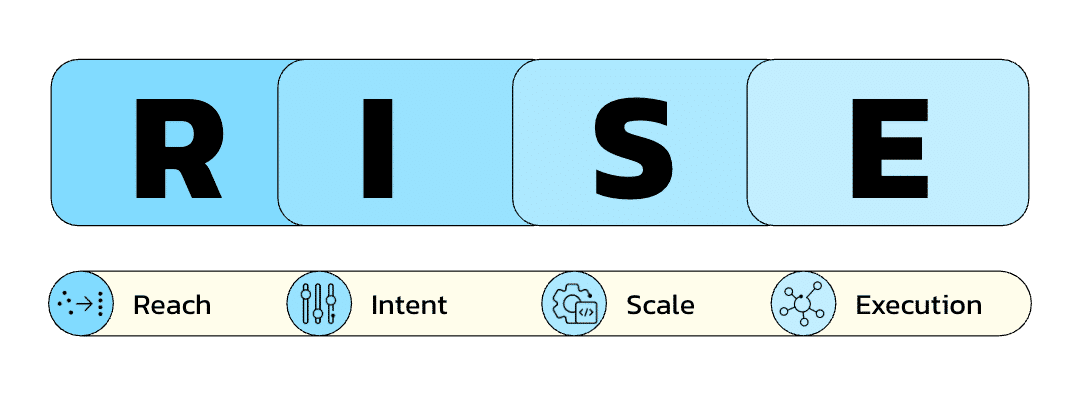
Even with smart automation and alignment, the chaos resurfaces when prioritization becomes lax. RISE helps pressure-test whether an initiative deserves investment by focusing on reach, intent, scale, and execution.
The RISE framework helps me assess whether an initiative truly warrants resources.
Reach requires you to quantify potential upsides before building anything. You must move beyond gut feelings or trending topics to focus on modeled opportunities based on specific questions.
If positive business impact isn’t numerically clear, it shouldn’t proceed. This approach discourages vanity projects mistakenly labeled as innovative developments and focuses on your leadership and strategic instincts instead of mere tinkering.
Intent drove AI search systems to reward depth over generic content. You need to be able to ask the right questions to ensure each strategy serves the correct purpose.
Scale involves verifying whether an idea can become part of the operating system without repeated effort. In AI-driven SEO, scale is about creating structural efficiencies.
Finally, embedding strategic initiatives into workflows where work actually happens transforms great ideas into real results. Defining acceptance criteria and assigning ownership are crucial steps towards successful execution.
By rigorously applying the RISE framework, the number of AI ideas may decrease, but the quality improves exponentially. Instead of debating which tool is better, the conversation shifts to identifying the right opportunities.
Ultimately, structure matters more than speed when integrating AI into SEO strategies. The winning teams won’t be those generating the most content through AI, but those constructing the strongest systems.
I often find myself overwhelmed by repetitive SEO tasks that eat up valuable time. That’s why I’ve started identifying tasks that can be automated, allowing me to concentrate on strategy, quality assurance, and crucial decision-making.
While tasks like note-taking and setting team reminders are obviously automatable, I’ve discovered that content audits, page outlines, and keyword research can also benefit from automation.
I recommend beginning with basic strategies that help save time on daily repetitive work before diving into more advanced AI tools for automation. It’s essential to conduct a final check personally, as relying solely on AI can sometimes lead to less-than-perfect outcomes.
One way I assess which tasks to automate is by asking myself: Would I assign this task to an intern? Tasks suitable for new employees are often ideal for automation. Whether it’s research or drafting, I let AI handle 70% of it, then I fine-tune the remaining 30% myself.
Some tasks that I’ve found can be automated include data analysis, ensuring best practices are used in updates, creating detailed SEO reports, identifying content gaps, scaling SEO-optimized templates, building editorial calendars, and documenting prompts and standards.
To discover more automation opportunities, I audit existing workflows, review onboarding processes, gather team input on disliked tasks, and explore AI capabilities.
However, automation won’t fix every issue. Core challenges like broken systems, incomplete assets, and a lack of resources still need human intervention.
For instance, I recently automated my team’s content calendar. Using Excel formulas, I quickly identify which content needs updating. By integrating a performance audit with custom AI tools, I can streamline these updates even further.
Similarly, for keyword research, I employ AI to sift through data and generate relevant keywords, saving me valuable time.
For internal linking, tools like Ahrefs can automate the identification of pages that require more links, enhancing site crawling efficiency without manual labor.
By automating outlines and briefs, I ensure consistency and quality across my team’s work, streamlining communication and reducing redundant effort.
On the brand compliance front, custom AI tools help me catch simple errors in high-risk drafts, ensuring they adhere to brand standards before final review.
Manual data validation can be a painstaking process, but with automation, I’m able to swiftly identify and address anomalies in reports, enhancing accuracy.
When it comes to metadata and schema, automating these tasks minimizes errors and ensures that content is optimized for search engines.
Finally, for formatting and shortcoding, I use Excel functions to concatenate code, vastly speeding up what used to be a time-intensive process.
To make automation truly beneficial, it’s critical it complements, rather than complicates, the workflow. Using custom AI solutions allows my team to focus on more impactful, strategic tasks.
I’ve noticed a common misconception that GEO is merely a technical issue. However, upon scrolling through LinkedIn or X for just a short while, you’ll quickly stumble upon the latest viral GEO hack.
For example, advice like creating an AI info page so that LLMs can effortlessly grasp your brand, or generating markdown versions of your content to boost AI visibility, frequently surfaces.
There’s also the idea of commissioning an automated Claude audit to scrutinize your robots.txt file and produce an llms.txt file for you.
Yet, the truth is, these tactics often have a marginal impact because they fail to address the way LLMs determine which brands to endorse.
The performance of GEO is influenced more by the consistent positioning, categorization, and validation of your brand across the web, rather than by minor technical modifications.
If we’re honest about it, GEO performance is chiefly driven by brand positioning and consensus. Thus, it’s not surprising when many well-publicized strategies don’t deliver the expected results.
When searching for GEO tactics aimed at LLM visibility, the internet serves up the same recycled ideas.
Unfortunately, while the suggestions aren’t necessarily wrong, they are mostly elementary. Many people misunderstand and even exaggerate them. For instance, Google’s recommendation to use FAQs with schema has led to companies overloading their content with irrelevant FAQ sections, thinking it will enhance GEO.
As a result, they end up including pointless questions that don’t benefit the end users. This isn’t just an inefficient tactic, but it can also detract from user experience, as evidenced by misaligned FAQ sections.
Another commonly over-hyped method involves placing ‘key takeaways’ at the start of each article. Although it may aid human readability, there’s no substantial proof that it significantly boosts AI visibility.
Furthermore, some strive to over-format pages for LLM readability by forcing content into constrained Q&A formats or infusing bullet points where they don’t belong.
People often believe that LLMs require extensive formatting assistance to retrieve content, resorting to copywriting tricks like ‘chunking,’ which can over-complicate editorial processes.
Then there are those who chase Reddit for GEO, leading to a proliferation of spamming for citations, despite clear warnings from experts like Eli Schwartz against such practices. This misperception highlights that GEO isn’t merely a technical issue.
Reddit’s strength lies in its authentic user voices, a reason why moderators actively target inefficiencies such as astroturfing or ‘SEO shaping’ where software evaluations occur.
GEO is inherently a problem connected to brand positioning and category alignment rather than just technical SEO.
GEO requires strategic efforts from the executive level for the best results. While technical enhancements are a necessity, the greater gains come from harmonizing brand alignment, messaging, and reputation management.
This means GEO isn’t solely the responsibility of the SEO team but also a collaborative effort involving branding, PR, partnerships, and customer marketing.
As Ross Hudgens recently pointed out, inconsistency between sources can hinder LLMs from creating a unified narrative about a brand.
Category alignment is another critical aspect. Even with high web rankings and URL citations, a recommendation may still elude brands unless their alignment within a category is optimal.
The AI landscape acts as a ‘normalizer,’ diminishing the prowess of past SEO tactics that focused purely on rankings and clicks.
Tellingly, listicles can neither brute force brands into AI recommendations nor substitute genuine industry recognition. Citations alone are not enough if accompanied by no recommendation.
Therefore, reporting on ‘citations’ merely as a success metric is misleading without corresponding brand recommendation. The AI overview is more likely to suggest brands that justly deserve the spotlight.
Indeed, many brands remain unaware of how they’re represented across LLMs. Understanding how LLMs compile data about your brand amenities can ultimately influence your GEO approach.
To amplify understanding, engage with bottom-of-funnel prompts, systematically analyze responses and sources, and corroborate your representation with insightful research.
Recognize that in high-competition categories dominated by third-party recognition, you may be compelled to participate in affiliate programs for visibility.
Technical excellence still underpins successful GEO strategies. However, fundamental elements like XML sitemaps and internal linking merely lay the groundwork, rather than driving GEO itself.
Focus on brand positioning and category alignment rather than isolated technical SEO audits.
Consider whether LLMs genuinely recommend your brand and ensure that your messaging reflects the appropriate category and customer perception you wish to cultivate.
Review third-party influences versus your own content to understand their role in shaping brand visibility. Develop a coherent narrative across various channels to reinforce your market status.
It’s crucial to rethink strategic moves like forcing visibility through listicles and formatting tricks that aren’t yielding recommendation statuses.
Ensure that your content truly assists buyers in comprehending your unique positioning and distinct advantages.
Ultimately, GEO goes beyond the technical realm into broader brand ecosystems that shape perceptions and narrative control.
Stop pursuing quick fixes with GEO hacks. Instead, prioritize building a consistent, clear, and compelling brand story that resonates across platforms.
I’ve often faced the challenge of watching enormous digital budgets return less and less, while more nimble competitors seem to pull ahead effortlessly. It’s frustrating knowing the potential is there, yet being unable to act swiftly enough.
Examining how AI Overviews and responses from tools like ChatGPT and Claude cite sources, I’ve noticed an unsettling trend: smaller, more agile companies are capturing the most valuable, bottom-of-funnel commercial queries.
This reality is a call to action, challenging the notion that simply having a well-known brand name can protect my market share. Agility is increasingly becoming more important than relying solely on brand heritage.
To stay relevant, AI models require quick, machine-readable data to form a credible consensus. The bureaucracy I’ve encountered, which I call the “bureaucracy tax,” often hinders established companies like ours from deploying such knowledge quickly.
Unintentionally, as my business expanded, the structures built for stability began to stifle our agility.
Why Legal Approves Data Faster Than Marketing Claims
In my experience, when deployment lags, it’s often marketing teams pointing fingers at legal, risk, or compliance departments. Yet, in sectors where regulation is strict, compliance is a necessity.
The operational shortcoming isn’t with the legal department but with what we’re providing them. Winning in the AI search space requires that we separate factual data from marketing narratives.
The truth is, legal teams debate adjectives—not APIs. They take months to scrutinize creative marketing copy. Conversely, they can review static data tables or product specifications in days.
I recall how a global payments company struggled with this. A proposed 2,000-word marketing article was a compliance nightmare. However, when the same data was presented as a structured table, approval came within 24 hours.
When a CFO asks Perplexity to “compare enterprise payment gateway fees,” it skips over blocked competitor blogs and cites your factual table as the authoritative source.
From my perspective, the bureaucracy tax is a tangible and damaging effect on profit and loss statements. For a new initiative, the deployment cycle can take up to 180 days from idea to execution, hampering responsiveness to market shifts.
Imagine being a global shipping company. While awaiting IT staging, your competitors publish a straightforward “Current freight delay and tariff matrix,” seizing AI consensus and lucrative leads before you can react.
An analysis of AI citations across platforms revealed that disruptors deploying data within 14 days achieve a significantly higher share of AI voice compared to legacy companies that take much longer. The cost of delay is persistent, demanding both time and financial resources to recapture lost ground.
The Technical Bypass: The Schema-Locked GEO Template
I’ve come to understand that the loss in this race is partly due to outdated technology. Many of us are stuck on heavyweight, legacy CMS platforms.
Generative Engine Optimization (GEO) demands a quick rollout of JSON-LD schema and data tables. If an IT ticket is required merely to update author info, the advantage is lost to faster disruptors.
The remedy isn’t to circumvent systems insecurely. We must advocate for schema-locked GEO templates. This requires IT to create a non-modifiable template designed specifically for data, ensuring rapid deployment without risking architecture.
From Compliance to Consideration in Record Time
Workflows must balance keeping risk officers satisfied while drastically speeding up market delivery. These strategic frameworks are critical to protecting your AI consensus.
If legal bottlenecks your progress, shift your strategy to use pre-approved, factual tables. If developing resources are scarce, implement a “schema-locked GEO template.” If your analytics indicate stability but pipeline velocity drops, audit your LLM visibility immediately.
It’s clear to me that digital acquisition rules have shifted. Winning isn’t just about budget size anymore; it’s about being the fastest to establish a machine-readable agreement.
Legacy systems and poorly aligned compliance procedures can’t continue to define our market share. The bureaucracy tax siphons resources needlessly, hurting our bottom line.
I urge you to audit your deployment processes promptly. Treat GEO as a high-speed data operation, not just a marketing campaign. Remove the barriers, and empower your teams to be the definitive resource consumers and machines turn to.
Recently, I noticed a significant change in Google’s approach to handling spam reports. They’ve updated their stance on whether they’ll process reports containing personally identifying information, and it feels like a big shift from what was communicated just a week prior.
On their updated spam report page, Google now clearly states that any spam report containing personally identifying information will not be processed. This revision comes after their previous announcement that such information could be passed on to the site in question.
Here’s What’s Changed: Google has added a highlighted note on their official spam report page, emphasizing two points:
(1) Avoid including personally identifying information in your spam reports.
(2) If you do include such information, your submission won’t be processed.
Google’s explanation reads:
“Don’t include any personally identifying information in your submission. To comply with regulations, we must send the submission text to the site owner to help them understand the context of a manual action, if one is issued. Because of this, we won’t process your submission if we determine it contains personally identifying information to protect privacy. Not including such information fully ensures your information is safe and prevents your submission from being discarded.”
Previously: Just a week ago, as we documented, Google allowed:
“If we issue a manual action, we send whatever you write in the submission report verbatim to the site owner to help them understand the context of the manual action.”
This policy raised many eyebrows across the industry. Concerns were not just about being flagged for identifying competitors or spammers, but there were also legal implications. It seems Google is now aligning with regulations to avoid sharing personally identifying data.
Why You Should Care: If you’re aiming to submit a spam report to Google, make sure it doesn’t contain any personally identifying information. Should you inadvertently include such information, rest assured that it won’t reach the reported site and the report simply won’t be processed. You can always resubmit your report without these details.
I’ve learned that executives don’t crave SEO jargon. What they need is clarity, honesty, and a clear path forward. Here’s how I deliver just that when faced with disappointing results.
Traditional SEO metrics haven’t been reassuring, and while more studies could affirm this, the existing data already does. Organic traffic is dropping for many of my clients, with studies like Seer Interactive’s showing a 61% drop in CTR for queries with AI Overviews. Executives notice these downward trends on their dashboards, often for extended periods.
Many consultants I’ve spoken with find themselves unprepared for these tough conversations. Diagnosing the traffic drop is one thing, but sitting across from a CMO and explaining not just what’s happened, but why it happened and what you propose to do about it, requires a whole different skill set. This skill is crucial, yet often overlooked.
Having spent 13 years in SEO and the last six managing an agency, where I personally lead strategy and present to senior executives, I’ve discovered five key lessons on breaking bad news in what I consider one of the most challenging times to be an SEO consultant.
1. Executives are more predictable than you think
A while back, a client expressed concerns after isolating our SEO work from the rest of their site’s organic traffic. Our reported overall numbers looked fine, but the performance of our specific work hadn’t improved over eight months.
Upon reviewing, I found my team indeed avoided acknowledging the underperformance, opting instead to present only the numbers that looked good. No one wants to admit failure in a meeting, yet concealing it often proves more damaging.
The client eventually finds out, and it’s not the underperformance that breaches trust, but the omission. Revealing issues early allows us to address what executives value most: problem-solving capability, diagnosis, and a strategic plan for recovery.
This experience transformed our client engagement approach. We now rigorously separate and analyze our work’s performance, ensuring any underperformance is flagged early along with a proposed solution. Every executive I’ve met has been burned by vendors hiding results; they value the rare consultant who promptly addresses and plans for solutions.
2. Diagnose before you communicate
A prospect once approached me about a traffic decline, assuming AI Overviews were to blame. Instead of presuming, I thoroughly diagnosed the issue. My investigation revealed a PR-induced traffic spike had skewed the comparison, and once adjusted, current performance was actually solid growth.
This diagnosis turned the discussion from a crisis into a positive affirmation of growth—within minutes. Conversely, I’ve also encountered genuine issues. For example, technical errors causing crawl waste impacted a client’s performance. Recognizing the pattern from past experience, I proposed a tried-and-tested solution.
Executives don’t need to understand every technical detail; they need assurance of a diagnosed problem and a plan. Confidence stems from the quality of diagnosis and the specificity of the corrective plan, not the delivery itself.
3. Surprise bad news and failed experiments are different conversations
Surprises
The worst kind of bad news, surprises arise from work done without strategic anchoring. Without a defined plan, diagnosing a traffic dip becomes impossible, as no hypotheses were being tested—only tasks executed.
Failed experiments
In contrast, a failed experiment implies a deliberate strategy and defined expectations. While outcomes may disappoint, assessing performance and proposing informed next steps provides clarity and direction.
Organizing work into structured cycles with specific bets and outcomes avoids surprise dips, fostering a culture of planned experiments. Clients are then prepared for any result, seeing it as a learning opportunity rather than an unexpected issue.
4. Never arrive without a recommendation
When clients ask, “What’s next?” after receiving bad news, an immediate, concrete recommendation is crucial. Lack of one heightens the perceived severity of issues. A seamless answer shows preparedness and instills confidence.
I ensure thorough diagnostic and recommend two realistic paths, helping clients choose solutions rather than dwell on problems. This proactive approach shifts focus to resolution rather than dissatisfaction with setbacks.
5. The tough conversation builds the relationship
Strong client relationships often stem from overcoming difficulties, demonstrating capability under pressure. Being upfront and strategic when challenges arise consolidates trust more than perpetual smooth sailing.
Clients appreciate honest, smart communication over avoiding tough topics. I’ve found that taking ownership of mistakes, providing diagnoses, and recommending solutions earns more respect and confidence.
The conversation is part of the work
As SEO becomes more challenging and results fluctuate, my conversations with clients have grown in importance. Providing clear diagnoses, backed by actionable plans, ensures we manage setbacks effectively.
Clients now assess not just outcomes, but how I handle them, emphasizing the role of strategic, honest communication as an indispensable element of effective SEO consultancy.
I’ve noticed that Google is currently investigating an issue with the Google Search Console. Specifically, this concerns the data logging and reporting of “Job listing” and “Job details” search appearance filters.
On April 16th, a bug began affecting how this data is logged, causing Google to report zero clicks and impressions for job-related reports. Although traffic is still being received, it’s not being recorded correctly.
What Google said. According to an update from Google, “A logging error is preventing Search Console from reporting impressions and clicks for ‘Job listing’ and ‘Job details’ Search appearance types from April 16, 2026 onward. We’re working to resolve this issue. This issue affects data logging only.”
Complaints. I’ve also seen numerous SEOs voicing their concerns on social media, as shared in a tweet by Max Peters. The bug seems to impact impressions and clicks, but the traffic still comes through other measurement methods like google_jobs_apply UTM.
Why we care. If you’ve noticed a decrease in search data for job listings, rest assured, it’s due to this bug on Google’s side. Your listings are likely still active and receiving traffic, although this isn’t reflected in Search Console at the moment.
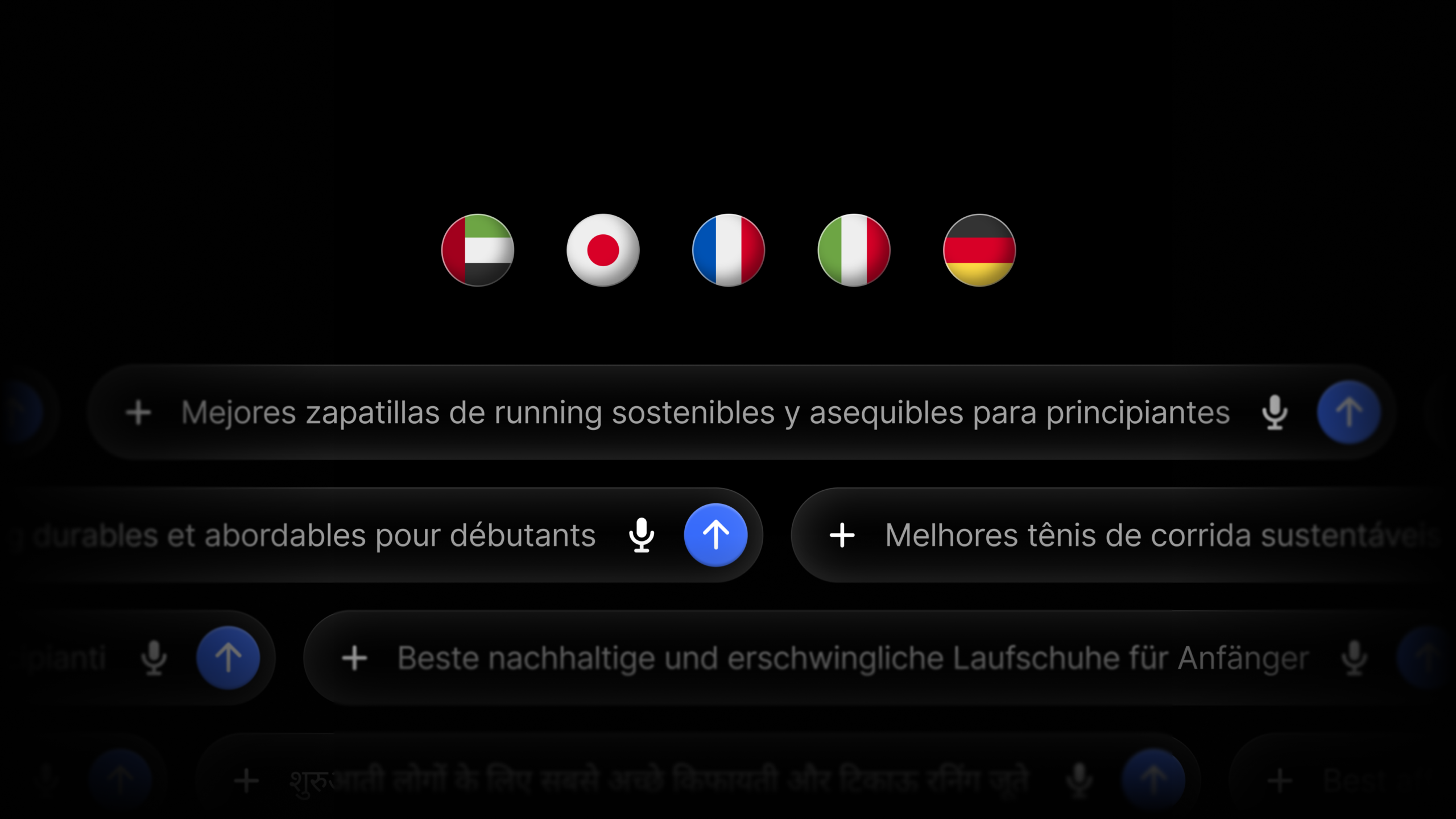
As I dive deeper into the world of AI, I’ve come across something truly fascinating about how query language is changing the landscape of AI citations. In our analysis, Profound looked at an astounding 3.25 billion citations spread across seven AI models and fourteen countries. What the data revealed was mind-blowing: the language used in queries is the main catalyst reshaping citation rates across different AI platforms.
Interestingly, I noted that AI tools like Google AI Overviews and ChatGPT handle non-English prompts in uniquely distinct manners. This variation has far-reaching consequences for brand visibility on a global scale, especially within the realms of AI search. The differences in response patterns not only highlight the power of language but also impact how brands are perceived worldwide.
Every day, I notice how our attention becomes more fragmented as new information platforms emerge.
With entrants like AI search and proprietary spaces on social networks, we’re bombarded by noise from every direction.
In this deluge of information, trust is slipping, even in previously reliable sources like search engines and social media.
In times of uncertainty, we revert to the most timeless source of trust: other people. To be visible, I must appear across multiple platforms, especially those led by people.
Search is a trust experience
Rachel Botsman, a trust expert, defines trust as “a confident relationship with the unknown.” It’s the element we rely on when facing uncertainty.
As humans, I search for information when uncertain, relying on three layers of trust: self-trust, platform trust, and source trust.
The entire search process hinges on trust, and the most effective support comes from other humans.
An example of my own search journey to find a trusted answer
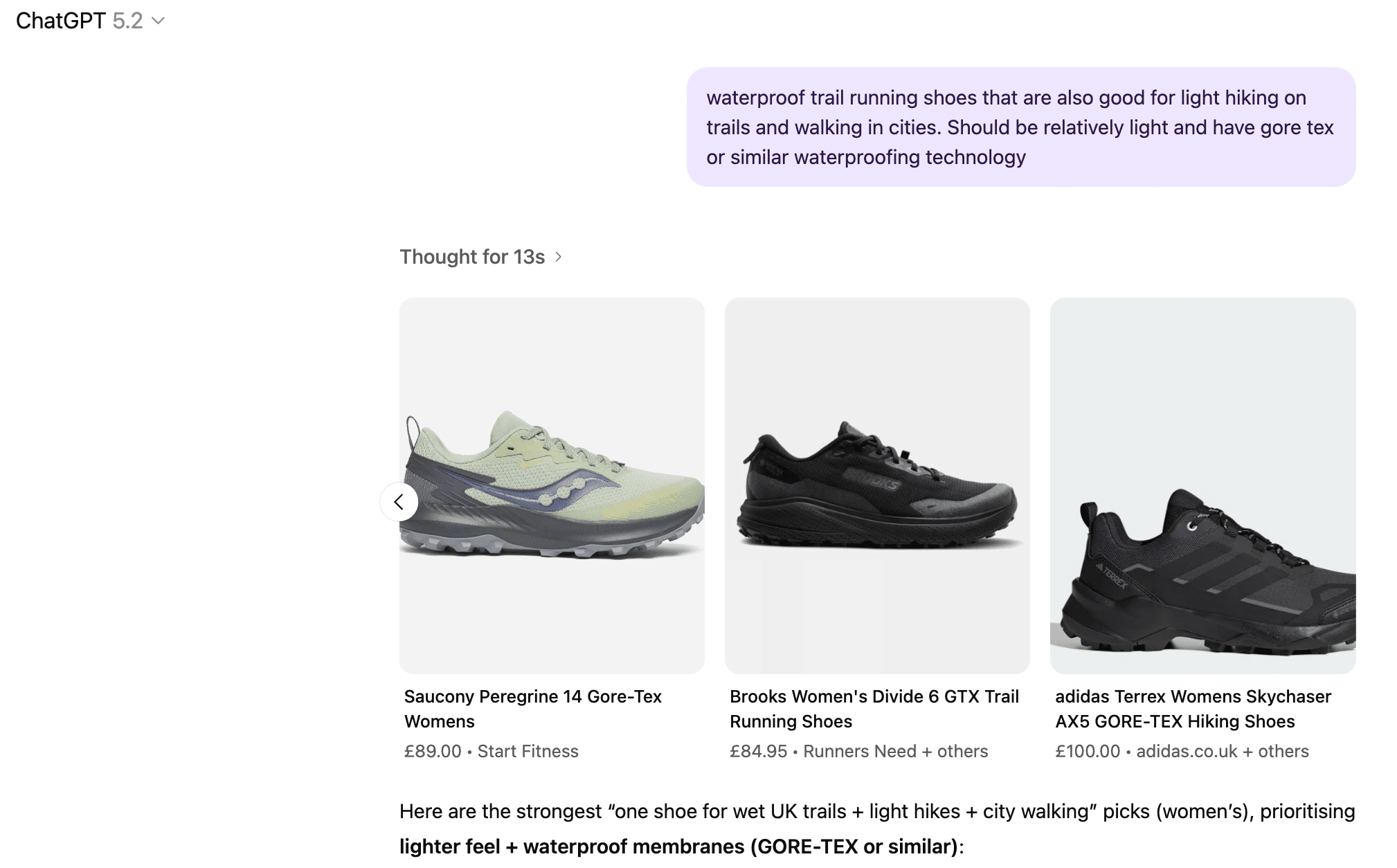
Recently, I decided to buy new shoes. My search began with AI tools, where I conducted low-trust research using ChatGPT and Claude.
Seeking high trust in pricing and delivery, I turned to Amazon for reviews and pricing, then to Google for deeper insights from Reddit and YouTube.
Bombarded by low-trust social media ads, I finalised my decision with high-trust recommendations from friends and a local running shop.
Search journeys now span dozens of platforms and sources
Research by Yext found that 75% of consumers use more platforms now than a year ago, but only 10% trust the first result. Reflecting on my 65-source journey, most were people-led, matching a trend in professional decision-making.
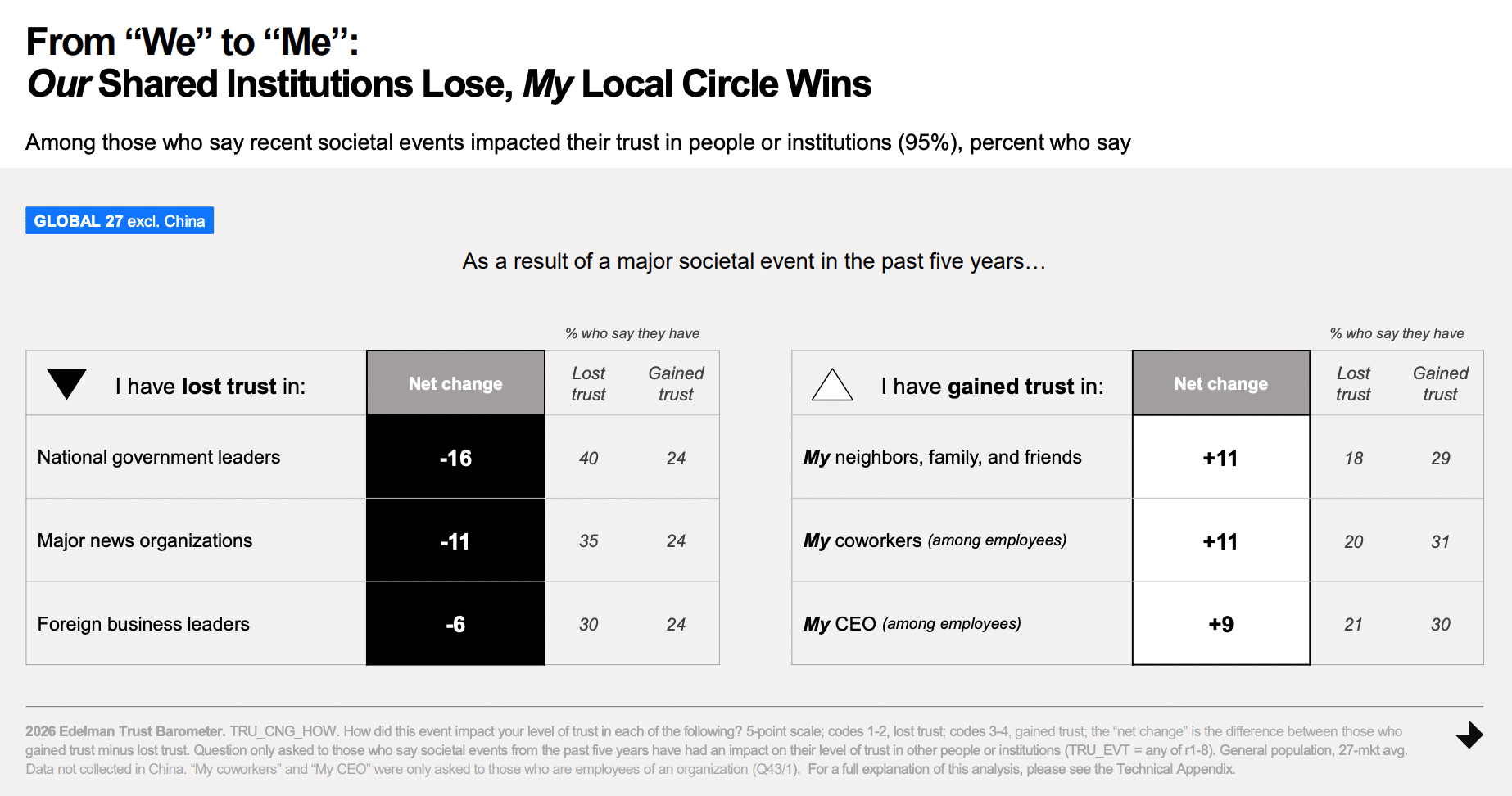
The 2026 Edelman Trust Barometer reinforces that amidst rising uncertainty, people seek advice from those they trust most.
So how do you turn trust into visibility?
To influence someone’s search journey, I aim to appear on all information-searching platforms and in as many people-led sources as possible.
Start by earning mentions in people-led spaces and build genuine trust. This naturally leads to visibility on major platforms.
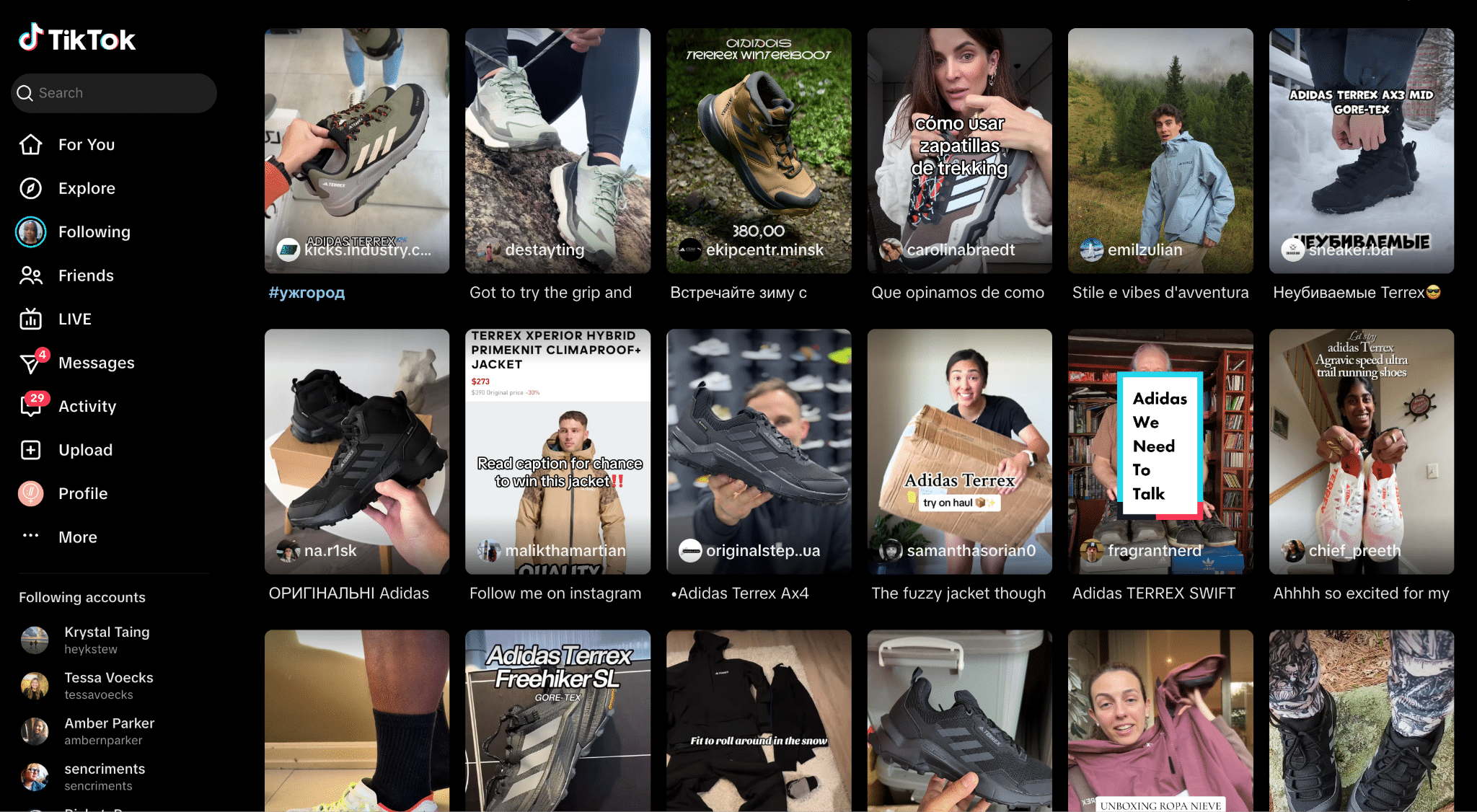
For instance, Adidas Terrex was visible at every touchpoint in my journey, reflecting its active engagement and trust-building with consumers.
Through events and community initiatives, Adidas fosters engagement, enhancing visibility through hashtags and social platform mentions.
Where to go to earn people’s trust
Building relationships lays the foundation for trust. I start by engaging in communities, events, social media, and forums where genuine conversations occur.
Select places with active, two-way communication where you can authentically connect and build a trustworthy presence.
How to engage in trust-building spaces
The priority is helping, not selling. I listen first to understand what people need, then engage meaningfully to build trust.
Start by listening, not talking
Before jumping in, I learn what ‘helpful’ means in the specific space and identify how I can support the community’s needs.
Engage to build trust
Building trust takes time and involves personalized interactions and consistent presence as a genuine individual, not as a brand representative.
Turn conversations into scalable trust
Using insights from personal interactions, I create scalable assets that support people’s aspirations, reinforcing trust on a larger scale.
For example, a guest-posting program for professionals looking to amplify their personal brand can be a powerful tool for fostering trust.
What does this actually look like in action?
In my journey from marketing to community building, I experienced firsthand how focusing on helping rather than selling leads to building trust and achieving visibility.
By listening and engaging with genuine support, an SEO SaaS partner grew visibility in our community, resulting in substantial business impact.
Building trust is a long-term visibility bet
Trust persists as a critical factor in information seeking. By embedding trust-building into my business strategies, I ensure lasting visibility across current and future platforms.
Remember, prioritizing trust preserves visibility beyond algorithms, creating enduring presence in an ever-evolving digital landscape.