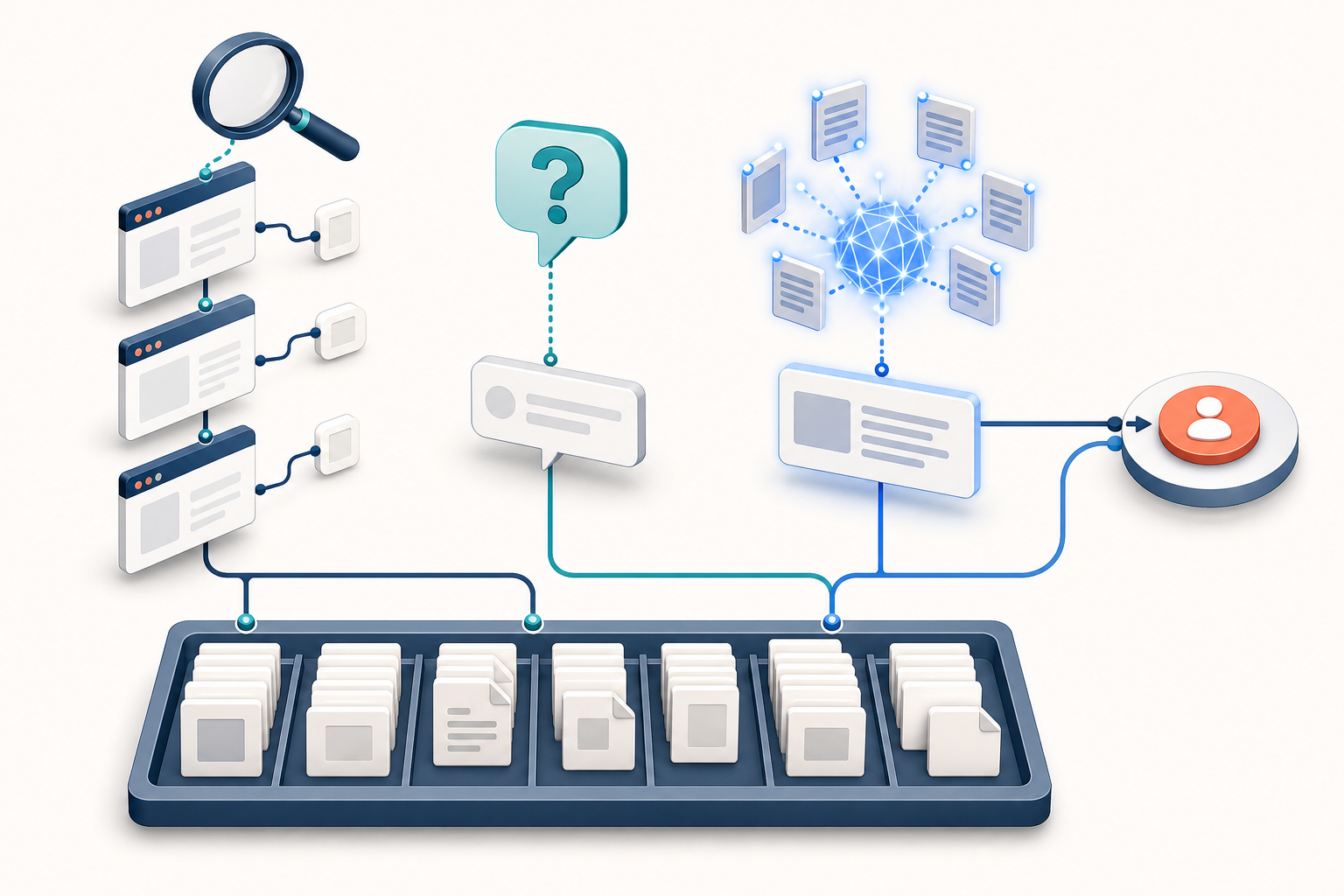
Have you ever wondered how to make your products stand out in Google AI Shopping and its AI Mode? I’ve discovered that optimizing feeds, utilizing schema, improving imagery, and crafting conversational Product Detail Page (PDP) content are key strategies to enhance visibility.
You are not choosing between agencies that all sell the same service. You are choosing which team can understand a technical product, translate it into real search demand, earn access to your subject-matter experts, and connect visibility to qualified opportunities. A polished pitch can conceal weaknesses in any one of those areas.
Understand the agency models before comparing names
Industrial SEO, manufacturing SEO, and B2B SEO are loose labels. Two agencies may use the same label while offering very different capabilities. One may excel at technical websites and product catalogs. Another may be a content operation with light technical support. A third may coordinate SEO with paid media, conversion work, and a website redesign.
Organize the market by operating model first. This prevents you from rejecting a capable specialist for lacking services you do not need, or hiring a broad agency whose industrial expertise exists only in its sales presentation.
Agency model
Best suited to
Evidence to request
Main risk to test
Industrial SEO specialist
Technical products, application-led demand, specification-heavy buying, and close collaboration with engineers or product teams
Query maps, technical briefs, product architecture work, and examples of turning expert knowledge into useful pages
A fixed industrial playbook that ignores your route to market, margins, capacity, or buying committee
B2B SEO and content agency
Markets where education, problem awareness, comparison, and category discovery create demand before an RFQ
Evidence connecting informational content to product evaluation, conversion paths, and qualified pipeline
Broad thought leadership that attracts readers but never helps a buyer select a product or supplier
Technical SEO consultancy
Large catalogs, faceted navigation, JavaScript problems, migrations, international sites, duplicate pages, or persistent indexing issues
Prioritized technical backlogs, implementation specifications, validation methods, and developer collaboration
A technically cleaner site with no plan for demand, content, authority, or lead quality
Full-service digital agency
Organizations that need SEO coordinated with paid search, analytics, conversion work, creative, and website development
Named SEO ownership, channel-specific deliverables, reporting boundaries, and examples of cross-channel decision-making
SEO being bundled into a larger retainer without enough specialist attention
Consultant and internal-team hybrid
Companies that already have writers, developers, analysts, and subject-matter experts but need direction and governance
Decision frameworks, templates, training materials, review processes, and a realistic division of responsibilities
A strategy that depends on internal capacity your team does not actually have
These models are not a ranking. The right one depends on the bottleneck. If search engines cannot reliably crawl and interpret your catalog, a content-heavy engagement will not solve the root problem. If your site is technically sound but says little beyond product specifications, another audit may only document work you already know is needed.
Diagnose that bottleneck before building a shortlist. Ask whether the constraint is discoverability, page usefulness, technical access, industry authority, conversion, measurement, or internal execution. If several are involved, decide which one has to move first.
Define the commercial job before requesting an SEO plan
Write a brief around revenue, not rankings
An agency cannot prioritize intelligently if the brief is simply to increase organic traffic. It needs to know which product families matter, where you can sell, what a qualified inquiry looks like, and which demand is commercially useless.
Economic context: which offerings are strategic, constrained by capacity, dependent on distributors, or poor fits despite apparent search demand.
Conversion events: RFQs, specification requests, distributor searches, sample requests, calls, CAD or technical-document downloads, and other actions that matter to your sales process.
Qualification rules: the characteristics that distinguish a viable opportunity from a student, job seeker, consumer, existing customer, or out-of-market inquiry.
Operational constraints: developer availability, legal or regulatory review, subject-matter expert access, publishing permissions, and analytics limitations.
Business measurement: the CRM stages, opportunity fields, and revenue signals that should eventually connect search activity to commercial outcomes.
A useful one-sentence brief follows this pattern: Increase qualified discovery and inquiries for [priority offerings] among [buyer groups] in [markets], while excluding [poor-fit demand], with progress judged by [commercial signals].
This sentence forces an important distinction. Search volume describes attention; it does not establish value. An industrial term can look attractive while referring to the wrong material, tolerance, application, geography, order size, or buyer. The agency should investigate those differences before proposing a publishing calendar.
Map searches to the decisions a buyer must make
Industrial demand rarely fits into a simple split between informational keywords and product keywords. A buyer may begin with a failure mode, move through an application or process, compare materials or capabilities, verify specifications, and then evaluate suppliers. Different pages should support different parts of that path.
Problem and application searches need pages that explain conditions, constraints, and suitable approaches without forcing a premature product pitch.
Category and capability searches need clear product-family or service pages that define fit, differentiation, limitations, and next steps.
Specification, material, model, and part searches need accurate technical pages with unambiguous attributes, relationships, and supporting documents.
Supplier and location searches need credible evidence about service areas, facilities, lead handling, certifications, distribution, and relevant capabilities.
Comparison and alternative searches need honest selection criteria, trade-offs, compatibility details, and reasons to rule an option in or out.
Ask each agency to map a representative offering through that path during discovery. You are not testing whether its team already knows every technical detail. You are testing whether it asks the questions needed to learn, distinguishes buyer intent from keyword similarity, and can turn the result into page-level decisions.
Use a six-part scorecard to test real capability
A useful scorecard separates capabilities that agencies often blend together in a proposal. Score the evidence, not the confidence of the presentation. If a capability matters to your brief, require an artifact, a worked example, or a clear operating process.
Commercial prioritization. Ask how the agency would choose among product families, applications, buyer roles, and markets. A strong answer requests margin, capacity, sales, qualification, and territory inputs before committing to targets. A weak answer treats search volume or keyword difficulty as the entire business case.
Industrial fluency. Ask the team to trace a product from the problem it solves through its specifications, alternatives, decision-makers, and conversion path. Strong teams separate terms that look similar but imply different applications or buyer needs. They also identify where an engineer, operator, procurement lead, distributor, or executive may need different evidence. Be wary of an agency that repeats your terminology without testing what it means.
Technical search execution. Ask how the agency will evaluate crawling, indexation, internal linking, canonicalization, faceted navigation, duplicate content, PDFs, JavaScript rendering, structured data, site speed, international targeting, and migration risk where relevant. The expected output should be a prioritized implementation backlog with owners, dependencies, and validation steps. A long issue inventory without impact or sequence is not a strategy.
Expert-led content operations. Ask who interviews subject-matter experts, drafts briefs, verifies technical claims, obtains images or diagrams, manages approvals, and updates aging pages. Inspect a sample brief and an edited deliverable. The process should preserve technical nuance while making the page understandable to the intended buyer. If the plan assumes your engineers will write finished copy on demand, execution will probably stall.
Relevant authority building. Ask how the agency identifies credible places where your expertise, data, tools, or resources deserve mention. Good answers are grounded in trade relationships, useful assets, professional communities, distributors, associations, partners, and publications relevant to the market. Opaque backlink packages and generic authority scores do not show that a link will be contextually appropriate or commercially useful.
Measurement and search-change readiness. Ask how reporting will connect Google Search Console, site analytics, forms, calls, CRM stages, and revenue data without pretending attribution is perfect. Then test the agency’s approach to AEO and generative engine optimization. It should make important facts clear, visible, crawlable, internally connected, and supported by accurate JSON-LD where appropriate. Structured data must describe claims that users can verify on the page; it cannot compensate for missing evidence. Require the agency to distinguish established SEO work from experiments in AI visibility, citations, and brand mentions.
The final capability deserves particular scrutiny. Adding AI language to a conventional proposal is easy. A serious plan identifies what will change on the site, how entities and relationships will become clearer, which technical or editorial assumptions are being tested, and how the team will monitor outcomes without promising control over an external model’s answer.
Weight the scorecard according to your actual constraint. A catalog with severe indexation problems should place more weight on technical implementation. A technically healthy site with thin product explanations should emphasize industrial fluency and content operations. Do not average away a critical failure: an agency that cannot support your primary bottleneck is not the right choice simply because it scores well elsewhere.
Normalize proposals, interrogate proof, and protect the handoff
Make every proposal answer the same questions
Agency proposals are hard to compare because similar labels can conceal different amounts of work. One content deliverable might mean a title and keyword list; another might include expert interviews, technical diagrams, writing, review, publishing, internal links, schema, and measurement.
Create a comparison sheet with these fields:
The business outcome and search problem being addressed.
The exact deliverable, including what is and is not included.
The agency role, client role, and approval owner.
The systems and access required.
The implementation owner for technical recommendations.
The reporting method and commercial signals being monitored.
The assumptions that could change scope, sequence, or cost.
Ownership of content, data, creative assets, accounts, dashboards, and documentation at the end of the engagement.
That last field is not administrative trivia. If the agency controls accounts, tracking infrastructure, domains, content, or essential documentation, switching providers can create operational and data risk. Keep core business assets in accounts your company owns, with access granted to the agency.
Ask for proof that reveals the mechanism
A chart moving upward is not enough. It may combine branded and non-branded demand, hide changes in paid activity, reflect a website launch, or show traffic that never became qualified pipeline. Confidentiality may limit what an agency can reveal, but it should still be able to explain its reasoning and show sanitized work.
Use these questions to inspect a case example:
What was the original commercial and search problem?
Which pages, templates, technical systems, or content processes changed?
What did the agency deliver, and what did the client implement?
Which results were branded, non-branded, local, product-led, or informational?
How did the team assess inquiry quality rather than form volume alone?
What evidence connects the work to the result, and what other explanations remain possible?
What would the agency do differently if the same constraints appeared in our organization?
Direct artifacts usually tell you more than awards or directory positions. Request a sample technical ticket, query map, content brief, reporting view, editorial workflow, or decision memo. You are looking for whether the agency can convert analysis into work that your developers, marketers, engineers, and sales team can use.
Treat these promises as decision-level warnings
Guaranteed rankings or visibility. An agency can control its work, not search-engine or AI-system placement. Replace the guarantee with commitments about deliverables, quality controls, implementation support, and transparent measurement.
A strategy built entirely from high-volume keywords. Volume does not account for product fit, margin, capacity, geography, or lead quality. Require a commercial prioritization layer.
Large-scale AI publishing without expert review. Industrial errors can affect credibility, sales conversations, and potentially product use. Require named review ownership, claim verification, and a correction process before scaling output.
An unexplained link package. If the agency cannot describe relevance, editorial standards, acquisition methods, and ownership, you cannot evaluate reputational risk.
Reporting limited to sessions, impressions, and rankings. These are diagnostic signals, not the complete business outcome. Require a plan for connecting search activity to qualified actions and CRM data where feasible.
A redesign or migration proposed before diagnosis. Moving URLs, templates, navigation, and content can create avoidable visibility loss. Preserve a crawlable inventory, redirects, measurement, and validation steps before approving an irreversible launch.
A plan that assumes unlimited access to your experts. Ask how the agency will batch questions, prepare interviews, manage reviews, and proceed when an expert is unavailable.
Begin with a diagnostic commitment when uncertainty is high
If neither side understands the full scope, start with a defined diagnostic phase rather than pretending the annual roadmap is already known. That phase can produce an access inventory, measurement baseline, demand map, technical priorities, representative content brief, implementation backlog, and division of responsibilities.
Define the outputs before signing. A diagnostic should reduce uncertainty and support a go, revise, or stop decision. It should not become an open-ended audit that repeats known issues without establishing what happens next.
Before the larger engagement begins, name an internal owner, a technical implementation contact, a sales or CRM contact, and the subject-matter experts who can validate priority topics. Agree on how decisions are logged and what happens when approvals stall. In industrial SEO, the agency’s plan is only one part of the operating system; your access and review process determine whether that plan can leave the slide deck.
Key takeaways
Choose an agency model that matches the bottleneck: technical access, content depth, industry authority, measurement, or internal execution.
Give every candidate the same commercial brief, including priority offerings, markets, qualification rules, conversion events, and operational constraints.
Test commercial prioritization, industrial fluency, technical execution, expert-led content, authority building, and measurement as separate capabilities.
Require artifacts and causal explanations. Traffic charts, awards, testimonials, and confident presentations are supporting evidence, not proof of fit.
Evaluate AEO and GEO through concrete site changes, accurate visible facts, retrieval-friendly content, appropriate JSON-LD, and clearly labeled experiments.
Keep core accounts, data, content, and documentation under your ownership so a future handoff does not endanger continuity.
Your next move is to choose one commercially important product family and write the brief around it. Give that same brief to a small shortlist, ask each agency to map the buyer’s search path, and score the evidence with the same criteria. The differences between a sector label and a workable industrial SEO partnership will become visible quickly.
You are not hiring for traffic alone. In healthcare, cybersecurity, or another technical market, an agency can improve visibility and still create a worse business outcome if it publishes an inaccurate claim, breaks your approval process, exposes sensitive information, or attracts visitors your team cannot serve.
The right agency should make expertise easier to verify, approve, publish, retrieve, and measure. That requires more than industry-themed case studies. You need to test how the agency handles evidence, subject-matter review, technical implementation, AI-search visibility, data access, and accountability before you trust it with production work.
Key takeaways
Treat an industry-specialist label as a reason to interview an agency, not proof that it can manage your risk.
Make factual accuracy and required approvals release gates inside the workflow, not corrections added after publication.
Ask for redacted working artifacts such as briefs, claims logs, technical issue records, revision histories, and measurement plans.
Evaluate traditional SEO, answer engine optimization, and generative engine optimization as related but distinct capabilities.
Reject performance reporting that cannot separate visibility, qualified demand, content quality, and observed AI-search presence.
Use pass-or-fail gates for accuracy, governance, security, and ownership before comparing creative ideas or presentation quality.
A niche label is a filter, not proof of operating fit
Labels such as healthcare SEO agency and cybersecurity SEO agency are useful for discovery. They tell you where a firm wants to compete. They do not tell you whether its writers can distinguish an approved claim from a plausible one, whether its technical recommendations will survive security review, or whether its production schedule can accommodate your internal experts.
The cybersecurity field alone has supported a candidate pool of more than 75 agencies. Client rosters, leadership experience, review averages, and innovation in generative engine optimization can help sort a field that large. They are longlist signals. Your final decision needs evidence of fit at the task and workflow level.
Assess fit across three separate dimensions:
Subject-matter fit: Can the team understand the product, audience, terminology, evidence, and limits of what may be claimed?
Operating fit: Can it work inside your review, security, publishing, and escalation processes without routing around them?
Commercial fit: Does the scope reward useful business outcomes, or merely the production of pages and reports?
A polished case study may support the first dimension, but it rarely establishes all three. Give each serious candidate the same representative hiring brief. Include a real audience question, the intended reader, the action you want that reader to take, the materials the agency may rely on, the statements that require review, the people authorized to approve them, and the systems the work will touch.
Then ask the agency to describe how that brief moves from intake to publication. A strong answer identifies factual unknowns, dependencies, reviewers, records, and stop conditions. A weak answer jumps directly to keywords, word counts, or a publishing calendar.
Build accuracy and approval into the production system
Compliance cannot be a final proofreading pass. If writers develop an entire page around wording that your legal, security, medical, or product reviewers cannot approve, the problem began at the brief. The agency should identify constrained claims before drafting and resolve missing evidence before those claims become structural parts of the page.
A workable content path usually contains these stages:
Define the reader, intent, business action, and qualification criteria.
Assemble an approved source pack and mark unresolved factual questions.
Map important claims to supporting material and an internal owner.
Draft with visible assumptions, limitations, and reviewer notes.
Run subject-matter and required compliance reviews before final production.
Complete on-page, structured-data, link, accessibility, and publishing checks.
Record what was approved, what changed, and what should trigger a future review.
The source pack matters. It defines which product documentation, policies, expert notes, approved messages, and evidence the agency may use. When support is missing, the agency should raise a question or narrow the statement. It should not fill the gap with language that merely sounds credible.
For claims-heavy pages, ask for a claims ledger. It can be simple, but it should connect each material statement with its approved wording, supporting evidence, reviewer, status, and update trigger. This gives your team a reusable fact layer for page copy, metadata, structured data, answer-focused sections, and later revisions. It also makes corrections targeted instead of forcing reviewers to reconstruct the reasoning behind an old page.
Structured data belongs inside that control system. JSON-LD should describe content that is actually visible and entities the page genuinely represents. It cannot make an unsupported assertion authoritative, repair a weak source trail, or substitute for expert review. Ask the agency who maps schema properties, who verifies the underlying facts, and how markup is revalidated when the visible page changes.
Your workflow also needs an exception path. Ask what happens when an expert disputes a draft, an approval is delayed, a published claim becomes outdated, or a technical recommendation conflicts with security policy. The answer should identify who pauses publication, who decides, where the decision is recorded, and how affected pages are found. An escalation path that exists only in someone’s inbox will fail when staff or vendors change.
Keep data handling within the same review. Identify which employees and subcontractors can access your CMS, analytics, search data, shared documents, customer information, and AI tools. Define how access is granted, limited, logged, and revoked. Do not provide confidential or sensitive material to an external AI system unless your authorized security, privacy, and legal reviewers have approved that use. An SEO agency can follow your controls, but it should not make those risk decisions for you.
Test expertise with artifacts, not adjectives
Industry fluency is easiest to evaluate in work products. Ask finalists to show redacted examples of the documents their delivery teams actually use. Reasonable redaction protects clients; it should not prevent an agency from demonstrating its method.
A query-to-page map that separates informational questions, comparison needs, implementation concerns, and high-intent searches.
A content brief that marks factual unknowns, source requirements, prohibited assumptions, internal links, and the intended conversion action.
A source-to-claim record showing how important statements were substantiated and approved.
A revision history that explains why wording changed after expert or compliance review.
A technical issue record containing the affected page or template, evidence, expected mechanism, dependencies, risk, and validation method.
A measurement plan connecting page-level work to qualified business actions rather than traffic alone.
An escalation record showing how a factual, technical, or approval conflict was resolved.
These artifacts reveal more than a logo slide. A familiar client name tells you the agency entered that organization; it does not tell you what the proposed team delivered, how much responsibility it held, or whether the engagement resembled yours. Ask which work the agency performed, which part was handled by another vendor or the client, who reviewed it, and what the agency learned when an expected result did not appear.
Listen for operational detail when candidates make common claims:
If the agency says it uses expert writers, ask what qualifies the assigned writer, how experts are briefed, and who resolves a disagreement between the writer and your subject-matter reviewer.
If it says it understands compliance, ask which decisions remain with your organization, what records it maintains, and how rejected language is prevented from returning in a later draft.
If it says it provides technical SEO, ask for an example that connects evidence to a proposed change, a dependency, and a post-release validation step.
If it says it provides GEO or AEO, ask which answer surfaces it monitors, how it chooses representative queries, what it records, and what it refuses to guarantee.
Confirm who will do the work after the sales process. You need the roles responsible for strategy, writing, subject-matter interpretation, technical analysis, structured data, analytics, project management, and final quality control. Ask which roles are subcontracted, who can replace an unavailable specialist, and who owns escalation. Senior leadership experience is useful, but it does not compensate for an underqualified delivery team.
Demand separate proof for SEO and AI discovery
Traditional SEO, answer engine optimization, and generative engine optimization overlap, but they are not interchangeable labels. SEO work addresses discoverability and usefulness in search, including crawlability, indexation, architecture, page relevance, internal links, and technical quality. AEO makes direct answers easier to locate and understand. GEO focuses on whether generative systems can find, interpret, and accurately represent your organization and its knowledge.
A competent strategy can share one approved fact layer across all three. That does not mean one tactic controls every surface. No agency controls whether a third-party generative system includes your brand, cites your page, or preserves your wording in a particular response. Treat guarantees of placement or exact answer language as a stop signal.
Ask the agency to separate what it controls, what it can influence, and what it can only observe:
Controlled: your page content, templates, internal links, structured data, author and organization information, publishing checks, and approved update process.
Influenced: external mentions, links, citations, reputation signals, and whether other sites find your material worth referencing.
Observed: search results and generative answers produced by third-party systems under a recorded query and context.
AI-visibility reporting needs an audit trail. For each observation, the agency should retain the exact query, the surface or model observed, the observation date, the relevant response, whether your brand or domain appeared, whether it was cited, and any known context that may affect the result. A visibility score without its monitored query set and observation method is not decision-grade evidence.
Your reporting should also keep different outcome layers separate:
Business outcomes: qualified inquiries, accepted opportunities, purchases, applications, or another action your organization recognizes as valuable.
Search outcomes: relevant impressions, visits, query coverage, landing-page engagement, and conversions from organic discovery.
Content-control outcomes: approval friction, factual corrections, unresolved claims, stale pages, and update completion.
AI-discovery observations: brand appearances, citations, linked pages, answer accuracy, and changes across the monitored query set.
This separation prevents a common reporting error: using a visibility gain to imply a revenue gain, or using an observed AI mention to imply durable placement. Traffic may rise without improving qualified demand. A brand may appear in an answer without being cited. A cited page may contain an outdated claim. Each result calls for a different action, so it needs its own evidence.
Technical recommendations deserve the same discipline. Every significant item should identify the affected URL or template, the observed problem, the proposed mechanism, implementation dependencies, foreseeable risks, and the validation plan. Reject bulk recommendations that cannot explain which user or discovery problem they solve. In a controlled environment, a technically possible change is not automatically an authorized change.
Use hard gates before a bounded pilot
Build your scorecard around evidence and stop conditions. Accuracy, governance, security, and ownership should be pass-or-fail gates. Do not average a failure in one of those areas against an impressive presentation or a lower fee.
Decision gate
Evidence to request
Stop condition
Subject-matter accuracy
Annotated brief, approved source pack, claims record, and named review path
The team cannot show how unsupported or disputed claims are stopped
Governance and compliance
Approval map, revision history, exception process, and publication record
The agency treats required review as optional or as a final cleanup step
Technical SEO
Issue evidence, affected scope, dependency analysis, risk, and validation method
Recommendations are generic, unauditable, or detached from your technical constraints
Content operations
Real briefs, reviewer instructions, quality checks, update triggers, and escalation ownership
The process depends on undocumented knowledge or unidentified subcontractors
AI-search capability
Defined monitored surfaces, recorded queries, observation history, and explicit limitations
The agency guarantees inclusion, citation, ranking, or exact wording in third-party answers
Measurement
Baseline, metric definitions, qualification rules, source systems, and reporting caveats
Traffic or a proprietary score is presented as a substitute for business outcomes
Data and access
Access list, tool inventory, subcontractor disclosure, revocation process, and approved data uses
Sensitive information may enter unapproved systems or access cannot be promptly removed
Commercial control
Clear scope, review responsibilities, asset ownership, account ownership, export terms, and exit process
Your organization cannot retain its work product, history, or core accounts after termination
Ask questions that force the process into view
Generic questions invite polished answers. Use questions that require the candidate to expose a decision, record, or boundary:
Show us how an important statement moves from a source into an approved page.
What happens when our subject-matter expert says a draft is technically plausible but wrong?
Which recommendations would you refuse to implement without development, security, privacy, or legal review?
How do you define qualified organic demand for our business, and which system supplies that definition?
How do you report AI visibility when answers vary or when a brand mention appears without a citation?
Which people and external providers can access our systems or information, and how is that access removed?
Who owns the briefs, research notes, content, markup, dashboards, analytics properties, and historical records if the engagement ends?
What evidence would cause you to update, consolidate, redirect, or remove existing content?
Use a pilot to test the real delivery system
A bounded paid pilot is more revealing than another pitch meeting. Choose work representative of the eventual engagement, such as revising an existing claims-heavy page, producing a new evidence-backed brief, diagnosing a technical issue, and establishing a measurement baseline. Keep production permissions limited to what the pilot requires, and use staging or an internal handoff where direct access is unnecessary.
Agree on acceptance criteria before work starts. Review the quality of the rationale, source-to-claim mapping, reviewer handoffs, technical evidence, risk identification, documentation, responsiveness, and ownership of outputs. Do not grade the pilot on rankings alone. Search and AI-search outcomes are partly outside the agency’s control; the pilot should first prove that its work is accurate, implementable, auditable, and useful to your team.
Put commercial edge cases in writing as well. Define included revisions, responsibilities for approval delays, expected subject-matter input, subcontractor use, account ownership, source-file delivery, access removal, and the format of a final export. These details determine whether the relationship remains manageable when a launch stalls, a reviewer rejects a claim, or you change vendors.
Give each finalist the same representative brief and compare the operating evidence, not the vocabulary of the pitch. The best candidate will make your constraints visible early, show where every important claim comes from, and leave your organization with a process it can inspect and control. That is the agency to advance to a pilot.
Your organic traffic changed, but the total line in Google Search Console can’t tell you whether more people discovered your site or simply searched for a brand they already knew. Those are different kinds of demand, and they call for different SEO decisions.
The branded queries filter gives you that missing split. Used carefully, it can expose non-branded discovery growth, stop brand demand from inflating an SEO report, and show where your search visibility actually needs attention.
That makes the split useful for separating explicit brand demand from broader discovery. Someone searching your name is already navigating toward your brand. Someone searching for a problem, category, service, or product type gives you a clearer view of how often search introduces your site without requiring the brand name first.
Do not translate those labels into “returning users” and “new users.” Search Console is classifying queries, not identifying the person behind each search. A first-time visitor can use a branded query after seeing your name elsewhere, while an existing customer can use a non-branded query. Treat the segments as types of search demand, not audience identities.
This distinction also changes how you should judge click-through rate. Branded searches often carry stronger navigational intent, so they can produce a higher CTR than broad discovery searches. Comparing branded CTR directly with non-branded CTR usually tells you less than comparing each segment with its own previous performance.
How to create a clean branded versus non-branded comparison
The filter sits in Search Console’s performance reporting as a query filter. The mechanics are simple, but the order matters. If you change dates, search types, countries, devices, or other filters between views, you no longer have a controlled comparison.
Open the relevant Search Console property and go to its performance report.
Choose the date range you want to analyze. If you are evaluating a change, set a comparison period before segmenting the queries.
Select one search type. The branded query filter works with web, image, video, and news search, but each should be evaluated in its own context.
Open the query filter and select the branded option. Record the clicks, impressions, CTR, and share of traffic shown for that segment.
Switch to the non-branded option without changing any other setting. Record the same metrics.
Inspect the queries and pages inside each segment. The aggregate split tells you what moved; the underlying rows show where it moved.
If you do not see the option yet, that does not necessarily indicate a property or permission problem. Access is being rolled out gradually, so availability can differ between users or properties.
Run the comparison separately for each property that represents a meaningful site or market. Combining unlike properties in your interpretation can hide whether the change belongs to one brand, language, product line, or regional site.
Read absolute performance before you read traffic share
A percentage can move even when the segment you are watching does not. Branded share rises when branded traffic grows, but it also rises when branded traffic stays flat and non-branded traffic falls. Those two situations look similar in a share chart and require opposite responses.
Start with clicks and impressions for both segments. Then use CTR to understand whether visibility is turning into visits. Only after that should you interpret the percentage split.
Pattern you see
What it may mean
What to inspect next
Branded clicks and impressions rise while non-branded performance stays stable
Explicit demand for the brand may be increasing
Check which branded names or products account for the change, and note any campaigns, publicity, launches, or other activity that could have created demand
Branded share rises, branded totals stay flat, and non-branded totals fall
The site has not necessarily gained brand strength; discovery performance has weakened
Find the non-branded queries and landing pages that lost impressions or clicks
Non-branded impressions rise but clicks do not rise proportionally
The site is appearing for more discovery searches without winning the same share of visits
Review the affected queries, search intent, page relevance, titles, and search-result descriptions
Non-branded clicks rise while branded performance remains stable
Organic discovery is expanding beyond existing brand demand
Identify the pages, topics, and query groups producing the growth so you can reinforce them
Branded impressions remain stable while branded CTR falls
Searchers still express brand demand, but fewer of those impressions become clicks
Inspect individual branded queries and their ranking pages before assuming the brand itself has weakened
These patterns are diagnostic prompts, not automatic explanations. Search Console shows search performance, not the cause of brand demand. A branded increase may coincide with SEO work, but it can also reflect advertising, email, events, public relations, word of mouth, or product activity. Check the surrounding business context before assigning credit.
Turn the split into better SEO reporting and prioritization
The most useful reporting change is to stop presenting one organic total as if every click represents the same achievement. Give branded and non-branded performance separate lines in your scorecard. For each segment, show clicks, impressions, CTR, and the comparison with its own prior period.
This makes three common reporting mistakes easier to avoid:
Calling brand demand an SEO discovery win. If total organic clicks increased because more people searched for the brand, report the gain accurately. It is valuable traffic, but it does not prove that category or problem-led visibility improved.
Missing a non-branded decline behind strong brand performance. A growing brand can keep the total trend positive while discovery queries and content-led entry pages lose ground.
Treating a lower non-branded CTR as a failure by default. Non-branded searches often cover broader intent. Judge their CTR against relevant prior performance and inspect the actual query mix before drawing a conclusion.
The split can also sharpen content decisions. If non-branded impressions are growing around a topic but clicks lag, focus on the pages already earning those impressions. Check whether they answer the query directly, whether their titles describe the right outcome, and whether one page is being stretched across several different intents.
If non-branded clicks are falling, do not respond with a site-wide rewrite. Use the filtered page and query rows to locate the loss first. A decline concentrated in one topic cluster calls for a different response from a decline spread across many page types.
Branded data deserves its own review as well. Look for unexpected product terms, name variations, or branded queries landing on weak pages. A branded searcher usually has a more specific destination in mind, so a mismatch between the query and landing page can create friction even when the site still receives the click.
Keep search types separate throughout this analysis. A rise in branded image visibility is not interchangeable with a rise in branded web clicks, and video or news performance may follow a different publishing cycle. The filter works across those surfaces; it does not make their metrics equivalent.
Know what the filter cannot tell you
The branded queries filter is Google’s classification, not a custom taxonomy built around your reporting rules. Because the definition can include name variations and related products, it may not match the exact list your organization uses for brand tracking.
That matters when you manage several brands, share product names with generic terms, or need a contractual definition for client reporting. Use the native split for fast, consistent analysis. If the exact membership of the branded basket affects a formal target, inspect the included queries and apply your own documented classification outside the native filter.
The filter also does not provide attribution. It cannot tell you which channel taught a searcher the brand name, whether the searcher is new or returning, or what happened after the click. Answer those questions with the appropriate campaign, audience, and conversion data instead of forcing Search Console to do work it was not designed to do.
Finally, avoid turning the branded-to-non-branded ratio into a universal benchmark. The expected mix varies with business model, brand maturity, product naming, media activity, and the kinds of searches a site can satisfy. Your own trend, under consistent filters, is the defensible comparison.
Key takeaways
Use branded and non-branded filters with identical dates, search types, and other report settings.
Treat the labels as query categories, not as proof of new versus returning users.
Read clicks and impressions before interpreting either segment’s percentage share.
Compare branded CTR with previous branded CTR, and non-branded CTR with previous non-branded CTR.
Report discovery performance separately so stronger brand demand cannot conceal weaker non-branded SEO.
Inspect the underlying queries and pages before assigning a cause or choosing an optimization task.
Add the split to your next Search Console review, then choose one action from the segment that actually changed. That may be repairing lost non-branded visibility, improving a page with growing impressions, or correcting a branded landing-page mismatch. The filter earns its place when it changes the work you prioritize, not merely the chart you present.
You are not hiring a manufacturing SEO agency to produce rankings in isolation. You are hiring a team to help technical buyers find the right capability, trust what they find, and take a measurable commercial step. An agency can grow traffic and still fail if visitors reach generic pages, cannot verify whether your product fits their application, or never become qualified opportunities.
The decision becomes much easier when you separate proof from pitch. Define the business job first, shortlist agencies by their real specialty, inspect how they turn technical knowledge into accurate content, and make them explain how search activity will connect to sales. The framework below gives you a practical way to do that.
Define the commercial job before you compare agencies
A vague objective such as increasing organic traffic gives an agency room to succeed on paper without improving the business. Start with the action you need a qualified visitor to take. That action should shape the keyword strategy, page architecture, content plan, tracking, and reporting.
Select a primary commercial action for the initial scope. Depending on your sales model, that might be:
Submitting an RFQ with enough technical detail for sales to respond.
Requesting a consultation, sample, prototype, demonstration, or facility visit.
Downloading a CAD file, specification sheet, technical drawing, or selection resource.
Finding an authorized distributor or contacting a regional sales representative.
Requesting maintenance, retrofit, replacement, or field-service support.
Then define what qualified means. A workable internal sentence is: A qualified inquiry comes from [target account or buyer], in [served market], asking about [priority product or capability], for [relevant application], with [information sales needs]. If your marketing and sales teams cannot complete that sentence together, an agency will not be able to build reliable conversion reporting around it.
Give every prospective agency the same one-page campaign brief. It should identify:
The product families, processes, applications, or aftermarket services that matter most.
The people involved in discovery, technical evaluation, approval, purchasing, and implementation.
The countries, regions, industries, account types, and distribution arrangements you can actually serve.
The approved evidence available to support claims, such as data sheets, certifications, test information, case material, drawings, videos, and subject-matter experts.
The commercial action attached to each part of the buying journey.
The way your CRM or sales team distinguishes a qualified opportunity from spam, recruitment inquiries, consumer requests, and poor-fit leads.
Constraints the agency must respect, including approval workflows, dealer relationships, regulated claims, legacy systems, and pages that cannot be changed without review.
Use a measurement ladder rather than a single traffic target. At the top are accepted opportunities, qualified pipeline, and attributable revenue where your systems support that connection. Below those are primary conversions such as qualified RFQs and consultations. Supporting actions might include specification downloads, distributor lookups, return visits, or contact with a technical representative. Search visibility and site-health metrics belong underneath those commercial measures, not in place of them.
This hierarchy exposes incentive problems early. If a proposal promises sessions and keyword positions but does not define qualified demand, the agency can complete its stated job while your sales team sees no improvement.
Build your shortlist around the bottleneck, not the rank
You can start with eight names drawn from a November 2025 field of 54 firms. Because First Page Sage evaluated that field and placed itself first, use the names as candidates to investigate rather than as an independent endorsement. That conflict does not make the information useless; it changes what the placement itself can prove.
Agency
Documented November 2025 focus
Interview when your main need is
First Page Sage
Thought leadership, SEO, and AI search optimization
Turning internal expertise into organic and generative-search visibility
Kula Partners
SEO-focused web design and account-based marketing
Connecting a website program with named-account demand generation
Industrial Strength Marketing
Brand strategy and sales enablement
Aligning market positioning, marketing assets, and the sales conversation
Windmill Strategy
Technical SEO and web design
Improving the technical and structural foundation of a complex site
Factory Web Source
Social media and video SEO
Making demonstrations, processes, equipment, and other visual material discoverable
Aviate Creative
Branding for manufacturing companies
Clarifying or modernizing the brand before scaling acquisition
Ecreative
Paid search and web development
Coordinating organic search, paid acquisition, and website execution
Brandpoint
MAT releases combined with SEO
Connecting distributed editorial material with search visibility
The third column is a decision heuristic, not a claim that the firm will fit your account. Treat every service label from November 2025 as time-bound. Ask each agency to confirm its current scope, current delivery team, and current examples before putting it on a final shortlist.
AI-search capability needs that freshness check in particular. Only First Page Sage was marked as offering GEO in the November 2025 comparison. That does not establish that the other seven still lack a GEO service, nor does a checked box establish the depth of any service. Ask what the agency actually changes, what it measures, which systems it observes, and how the work differs from its conventional SEO program.
If technical accuracy is the constraint, prioritize the subject-matter-expert workflow, writer background, and claim-approval process.
If an old website is the constraint, prioritize technical diagnosis, development capacity, migration controls, quality assurance, and ownership of implementation.
If buyers do not understand a new category, prioritize positioning, thought leadership, evidence development, and sales alignment.
If named accounts drive growth, prioritize the connection between SEO, account-based marketing, CRM data, and sales follow-up.
If visibility in generative systems matters, prioritize a current GEO method with explicit deliverables and observable measures.
Longevity, recognizable clients, reviews, and media mentions can support confidence. None of them answers the decisive question: Can the people assigned to your account execute the work your commercial problem requires?
Pressure-test the delivery system before you buy it
Run the same diligence exercise with every finalist. Comparable inputs make vague answers, hidden dependencies, and major scope differences easier to notice. You are evaluating a production system, not just the strategy presented in a sales call.
Test whether the specialty is real
Many agencies can list manufacturing among the sectors they serve. That is not the same as having a manufacturing operating model. Ask:
What does your agency specialize in, and which services are secondary?
Which part of manufacturing SEO do you deliberately not lead?
What type of manufacturer, sales motion, or website is a poor fit for your team?
Which deliverables are completed in-house, and which are handled by partners or freelancers?
Can you show an engagement with comparable technical complexity, channel structure, or buying process?
What changed because of your work, and how was that change connected to a business measure?
Do not grade the answer by the prestige of a client logo alone. A familiar manufacturer may have bought a different service, worked with a different team, or presented a much simpler problem. Ask what the agency owned, who performed it, and which evidence the example can legitimately support.
Test the technical-content workflow
Give each finalist the same public or sanitized set of product materials. The goal is to test the process without exposing proprietary information. Ask the team to explain how it would turn those materials into a search and content plan. Do not ask for a free finished campaign; ask for the operating logic.
A credible answer should identify:
Which document, system, or person becomes the source of truth for each technical claim.
How search intent will be separated across products, capabilities, applications, industries, problems, and buying stages.
How writers will interview engineers, product managers, service teams, salespeople, or other relevant experts without wasting their time.
Who drafts, technically verifies, edits, approves, publishes, and maintains each asset.
How conflicting terminology, outdated documents, market-specific naming, and unsupported claims will be resolved.
How one page will earn a distinct purpose instead of repeating a slightly altered template across the catalog.
A weak answer relies on a generalist writer researching the product independently and sending a polished draft for your team to repair. That transfers the hardest part of the work back to you. A stronger model captures expert knowledge deliberately, records the supporting evidence, and makes technical review a defined stage rather than a last-minute rescue.
Test technical execution and account ownership
Ask the agency to separate diagnosis from implementation. A technical audit has limited value if no one converts findings into approved development work, verifies the release, and confirms that the intended behavior reached production.
Request a sample issue or development ticket with sensitive information removed. It should show the problem, affected templates or URLs, business consequence, recommended change, owner, dependencies, acceptance criteria, and quality-assurance step. Then ask who writes that ticket, who answers developer questions, and who checks the completed change.
Complex manufacturing sites may combine product pages, application pages, filterable catalogs, distributor locations, technical PDFs, support material, multiple languages, and several conversion paths. Your finalist should be able to explain how it will decide what belongs in the search index, which page owns each intent, how internal links support that ownership, and where a visitor should go next. It should also state what requires your developer, CMS vendor, analytics team, or legal and compliance review.
Get the account map in writing. Identify the strategist, technical lead, writer or editor, project manager, analyst, and executive sponsor where those roles exist. Confirm which people will attend recurring meetings and which person has authority when priorities conflict. A senior salesperson who disappears after signature is not part of the delivery team.
Test reporting with a real lead path
Give every finalist the same scenario: a buyer discovers an application page through non-branded search, returns through a branded search, downloads a specification, and later submits an RFQ that sales accepts. Ask how that journey would appear in reporting and which limitations would remain.
A credible reporting plan distinguishes what is directly observed, what is assisted, what is inferred, and what cannot be known with the available systems. It also includes sales feedback about lead quality. Be cautious when rankings are presented as revenue, all organic conversions are treated as equally valuable, or attribution is described without reference to your CRM and sales process.
Require one operating plan for SEO, AEO, GEO, and handoff
SEO, answer engine optimization, and generative engine optimization should not become three disconnected content programs. For procurement purposes, use simple operational definitions. SEO makes relevant pages discoverable and competitive in conventional search. AEO makes important questions easy to answer directly from clear, supported content. GEO organizes the brand, entities, expertise, and evidence so generative systems can more reliably understand and potentially surface them.
The labels overlap because the same technical truth may serve all three. Your agency should show how one validated knowledge base becomes useful pages, concise answers, consistent entity information, structured data, internal links, and commercial pathways.
For one priority product family or capability, ask for an integrated deliverable map containing:
An intent map that separates product, capability, application, problem, comparison, support, and purchase-oriented needs where they genuinely exist.
A canonical commercial destination with the information a qualified buyer needs to evaluate fit and take the next step.
Supporting pages that answer distinct technical or commercial questions instead of competing with the canonical page.
An evidence inventory showing which statements are supported by approved specifications, certifications, testing, case material, or named expertise.
A terminology and entity map covering the company, brands, product families, processes, locations, industries, and alternate names that must remain consistent.
An internal-link plan connecting educational discovery to evaluation and action.
An AEO plan that answers real presales and support questions without manufacturing an FAQ section merely to occupy search space.
A GEO plan that defines target query sets, systems observed, checks performed, changes made, and the difference between a brand mention and an attributable commercial result.
A JSON-LD plan that describes accurate, visible page content and assigns responsibility for generation, validation, deployment, and maintenance.
A measurement map connecting each asset to its intended search behavior, user action, and commercial signal.
Structured data deserves particular scrutiny because it can look impressive in a deliverables list while doing little to correct weak information. JSON-LD is machine-readable labeling, not evidence. It should match the visible page, use the right entity relationships, and be maintained when templates, products, locations, or claims change. Ask who validates it after deployment and how errors or stale values enter the work queue.
Put the operating model into the contract. Define deliverables, exclusions, dependencies, approval responsibilities, acceptance criteria, reporting cadence, account access, and ownership of content and data. State what happens to analytics configurations, keyword sets, briefs, drafts, dashboards, schema, and other working assets when the engagement ends.
Vague ownership and termination language can leave you paying for unusable work or losing access to accounts and materials. Have your procurement or legal team review confidentiality, intellectual-property, liability, data-access, and termination clauses before signature; an SEO evaluation cannot resolve those legal terms for you.
Use acceptance gates instead of authorizing an undifferentiated stream of activity. The first gate should confirm the baseline, priorities, measurement design, and dependencies. Later gates can cover technical implementation, content production, publication, and performance review. If the agency cannot define what complete means at each handoff, the scope is not ready to sign.
Manufacturing SEO agency FAQ
Must the agency have experience in your exact manufacturing niche?
Exact-niche experience can shorten the learning curve, but it should not replace process evidence. A team with an excellent technical-review workflow, a comparable sales model, and experience handling complex product information may be stronger than a niche specialist that relies on generic pages and weak measurement. Ask both candidates to demonstrate how they learn terminology, verify claims, protect confidential information, and distinguish qualified demand. Also check whether a direct competitor relationship creates practical conflicts.
Should the engagement include a website redesign?
Only when the current site prevents the agreed strategy from being implemented effectively. Require three options where practical: retain the present site, make targeted structural or template changes, or replace it. Each option should identify the SEO consequence, implementation dependency, content work, measurement impact, and ownership. An agency whose main strength is web design may naturally see a rebuild as central; one focused on content may prefer to work around the platform. Your diagnosis and business case should decide, not the agency’s preferred service line.
How can you compare proposals with different scopes?
Normalize them into the same worksheet. Create rows for discovery, technical SEO, implementation, content strategy, expert interviews, writing, editing, design, publication, authority development, AEO, GEO, structured data, analytics, CRM connection, reporting, and project management. Mark every row as included, dependent on your team, handled by a third party, optional, or excluded. Then record the responsible role, deliverable, acceptance condition, and ownership after termination. This exposes a low proposal that depends heavily on your staff and a broad proposal that includes work you do not need.
Write the one-page brief before your next agency call. Give every finalist the same sanitized product-family scenario, commercial action, and reporting question, and ask the people who will perform the work to join the discussion. Choose the team that can trace a validated technical fact into a discoverable page, a useful buyer answer, and a measurable sales action – then put that chain of responsibility in writing.
Affiliate marketing is a major driver of revenue, but it also hides significant losses. I’ve seen firsthand how brand bidding, ad hijacking, coupon abuse, and subtler forms of affiliate fraud can erode ROI and distort attribution figures.
The critical issue isn’t whether these challenges exist, but rather understanding how much they’re impacting our business. In this article, I delve into the most prevalent types of affiliate marketing fraud. I’ll also share insights on how modern tools like Bluepear offer advanced affiliate fraud detection strategies that protect our growth, reputation, and budget.
Not all affiliate programs offer the same benefits, nor do they come with the same risks. Particularly in SaaS, where affiliate commissions can be between 20% to 70%, these programs become highly enticing targets for fraudsters.
Fraudsters exploit trust gaps, often bidding on brand terms or using shady tactics like ad hijacking and coupon code misuse to siphon off profits. A staggering 63% of affiliate marketers identify these threats as their primary concern.
Unfortunately, much of this fraud operates under the radar. Affiliates execute campaigns and manage landing pages without real-time monitoring, which means you may end up paying commissions on existing traffic or, worse, funding brand impostors.
Let’s dig deeper into common fraud tactics and how to recognize and counteract them early on. Equipped with strategies, you can shield your program from such threats.
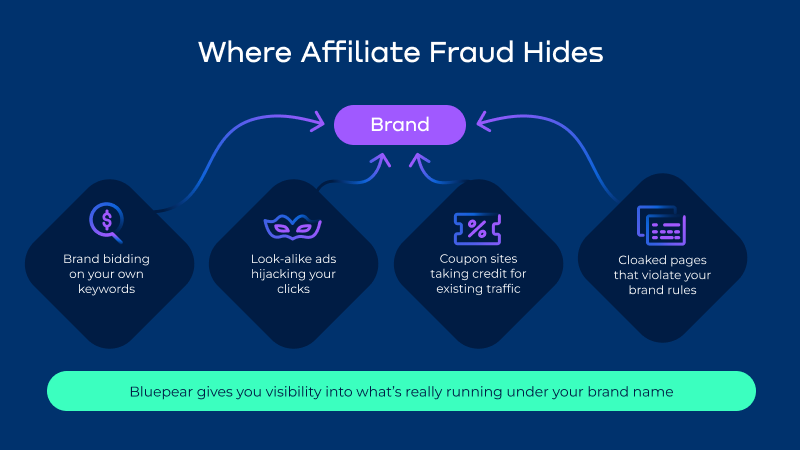
I focus on four primary fraud tactics: brand bidding, ad hijacking, coupon abuse, and non-compliant content. Each poses unique challenges but can be counteracted with the right preventative measures.
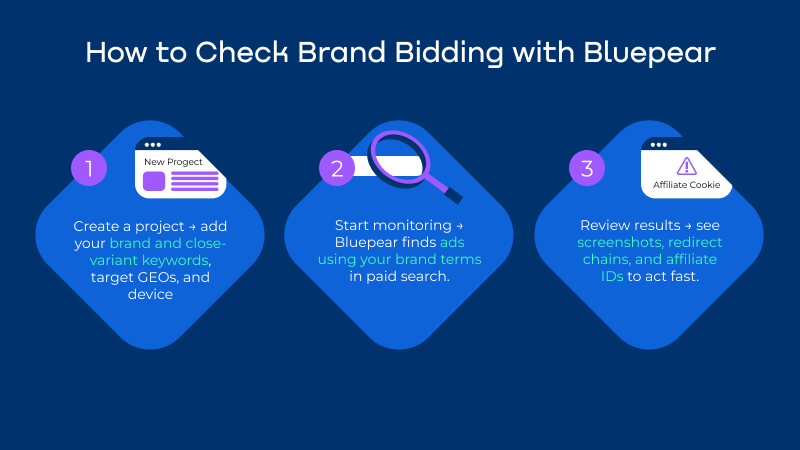
Brand bidding occurs when someone purchases ads using your brand name. This diverts potential customers who are actively searching for your product, resulting in needless commission payments. It’s crucial to maintain a detailed list of brand-related keywords in your affiliate terms and monitor for sudden spikes in performance metrics.
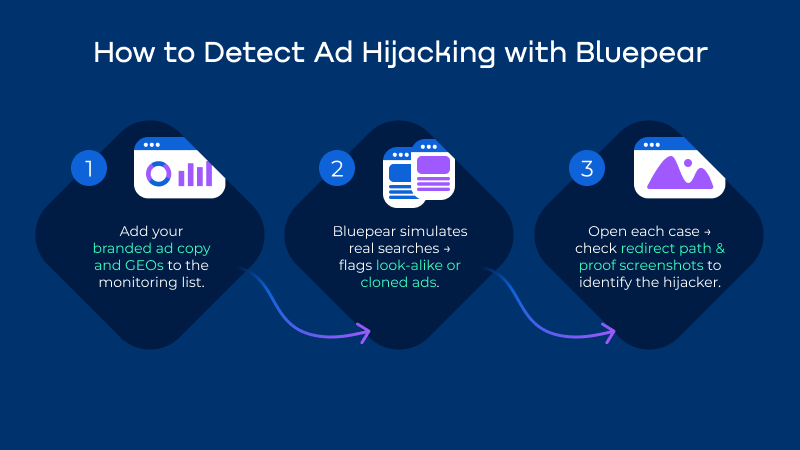
Ad hijacking mimics your paid search ads, lowering your campaign visibility. Regular checks and test searches can expose these fraudulent activities.
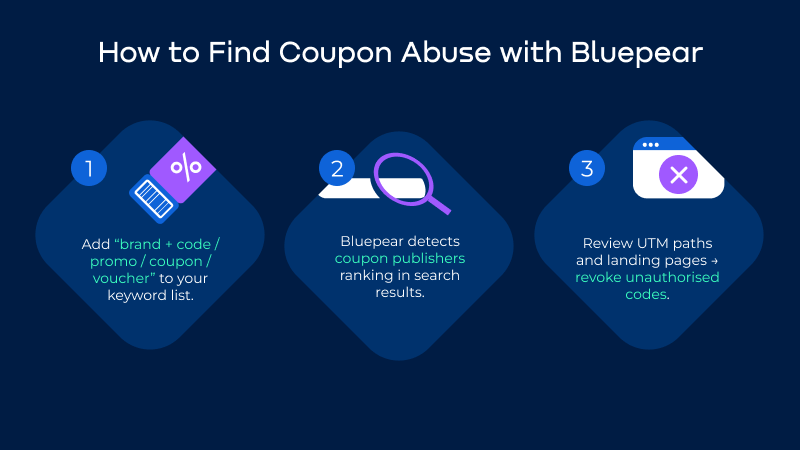
Coupon abuse is trickier; it manipulates traffic from affiliates who rank high for brand-related coupon searches. Ensuring coupon activity is pre-approved and regularly monitoring search results helps mitigate this fraud.
Non-compliant content can easily escape detection. Cloaking tactics mean users see different content than compliance teams. Establish strong creative guidelines and treat content audits as an ongoing activity.
Defending against affiliate fraud requires continuous vigilance, clear program rules, and leveraging technology. Platforms like Bluepear use automated systems to highlight and eliminate fraud, giving you back control.
For 2026, my focus is on building stronger relationships with affiliates, ensuring transparency, and promoting a culture that prioritizes honesty and clear communications.
Ultimately, affiliate fraud is a continually evolving threat. By understanding these tactics, setting clear expectations, and utilizing advanced tools, we can protect our interests and secure sustainable growth.
I’m excited to guide you through optimizing for voice search and Answer Engine Optimization (AEO) using conversational content, structured data, and strategies to achieve precise and answer-focused results.
As the holiday season approaches, I’m thrilled to share that Google has rolled out a range of exciting AI-powered shopping features. Just recently, Google announced this major update, perfectly timed for our holiday shopping adventures.
What’s new with AI Mode? Picture this: you can now describe what you need as if you’re chatting with a friend! Google’s AI Mode organizes all the essentials—images, prices, reviews, and inventory—helping you decide confidently and quickly on your next purchase.
In my Gemini App experience, it has become my go-to for brainstorming gift ideas. It effortlessly compares products and supplies answers with handy shoppable links, all within a chat.
Are you too busy to check store stock levels? I now let Google’s agentic calling feature make those calls for me, ensuring I know about any promos or stock availability without lifting a finger.
And here’s something I absolutely love: tracking prices with agentic AI. Whenever an item I’ve been eyeing drops in price at eligible U.S. merchants, I receive a notification. I can let Google purchase it securely using Google Pay, all within my budget!
Why does this matter? The bustling holiday season is critical for many businesses. With these innovative AI features, I hope to see more traffic and revenue driving local stores rather than distracting buyers from making purchases.
I’m curious to see how these tools impact our shopping experiences, and I encourage everyone to explore these features to see where your website ranks.
You have a shortlist of agencies, and every one of them claims to understand your industry. The difficult part is determining whether that expertise changes the work or merely changes the sales deck.
You can make that decision without relying on polished case studies or a vague AI visibility score. Test how each agency maps your buyers, handles sector-specific evidence, separates GEO from AEO and SEO, measures progress, and works inside your approval process.
Decide what industry specialization must change
An industry-specific agency does not necessarily need to work exclusively in your sector. It does need to show that sector knowledge changes its decisions. If the proposed strategy would remain the same after swapping your company name for a business in another industry, the specialization is probably cosmetic.
Look for specialization in five parts of the work:
Audience distinctions: The team separates people who use, approve, recommend, regulate, or pay for the product. Those audiences often ask similar questions but require different evidence and calls to action.
Query interpretation: The agency understands what your buyers mean when they use ambiguous category terms, abbreviations, product names, specialty language, or location modifiers.
Evidence standards: It can identify which claims need subject-matter review, primary documentation, current product data, or third-party corroboration before publication.
Entity relationships: It understands how your company, products, experts, locations, services, integrations, and parent or subsidiary brands should be represented consistently.
Conversion design: It knows whether a useful next step is a purchase, consultation, demo, application, appointment, property inquiry, technical evaluation, or another sector-specific action.
Ask each candidate to explain which parts of its standard process would change for your exact market. Require named changes to the query map, evidence model, review workflow, entity strategy, and conversion path. A credible answer will contain operational differences, not just industry terminology.
Make the agency prove all three disciplines
SEO, AEO, and GEO overlap, but they are not interchangeable labels. An agency should be able to define the job of each discipline, show its deliverables, and explain where one piece of work serves more than one channel.
Discipline
Primary job
Evidence to request
Useful measurement
SEO
Help relevant pages become discoverable and competitive in conventional search results.
Technical diagnosis, query-to-page map, internal-link plan, content briefs, and a method for resolving duplication or intent mismatch.
Visibility for relevant queries, qualified organic visits, conversions, and the performance of priority landing pages.
AEO
Make accurate answers easy to locate, understand, extract, and connect to the appropriate entity.
Question inventory, answer structure, page-type recommendations, entity definitions, and structured-data specifications where the markup is appropriate.
Coverage of important questions, answer accuracy, search-feature visibility, and engagement with the pages that support those answers.
GEO
Improve the likelihood that a brand and its information are represented accurately in generative responses.
Prompt-set design, baseline observations, citation and mention analysis, corroboration gaps, entity inconsistencies, and a plan for publishing material worth referencing.
Mentions, citations, factual accuracy, coverage across defined prompt groups, and downstream qualified demand where it can be observed.
The deliverables should connect. A technically sound service page can target a search need, answer a decision-stage question, clarify the entities involved, and provide evidence that an answer system can cite. That does not make the three measurement systems identical. A page may rank without appearing in a generative answer, or be cited in an answer without producing a referral click.
Be particularly careful with agencies that present JSON-LD as the entire AEO or GEO strategy. Structured data can make supported information more explicit to machines, but markup cannot create evidence that is missing from the visible page. Ask the agency to name the page type, the entity being described, the properties it would mark up, the visible information supporting each property, and the intended consumer of that markup.
The same standard applies to AI visibility. ChatGPT, Gemini, and Perplexity are not interchangeable reporting rows. The agency should disclose the prompts, platform, date of observation, treatment of citations versus unlinked mentions, and method for judging factual accuracy. A proprietary score without those components is difficult to audit and almost impossible to improve responsibly.
Audit sector fluency with a real business problem
Logos tell you that an agency had a contract. They do not tell you what the agency owned, whether the relevant team still works there, or whether the engagement resembles yours. Replace the generic request for industry experience with a working test.
Give every shortlisted agency the same representative problem. Include one product or service, one priority audience, the real conversion action, and the constraints that normally slow publication. Ask the agency to identify the search intents, direct questions, generative prompts, evidence requirements, page types, entity relationships, and measurements it would use. You are evaluating the reasoning, not asking for a free campaign plan.
Industry
The agency must distinguish
A revealing evidence request
What a superficial answer misses
Healthcare
Specialty, audience, care setting, service, location, and the difference between educational and decision-stage information.
Ask the team to mark which statements require review by your medical or clinical subject-matter owner and how approved language will be preserved during optimization.
Treating all healthcare queries as patient-acquisition keywords or assuming experience in one specialty transfers automatically to another.
Financial services
Consumer and institutional audiences, product category, risk context, eligibility language, and the people who use versus approve a service.
Ask for an annotated brief showing where product, compliance, legal, or investment subject-matter input would be required under your existing governance process.
Optimizing high-volume financial terms without accounting for claim sensitivity, qualification, or the actual route to a commercial decision.
Real estate
Geography, property type, transaction role, service area, local entity, and time-sensitive versus durable information.
Ask the team to map the relationships among the brand, brokerage or developer, agents or experts, offices, developments, properties, and markets relevant to the assignment.
User, administrator, developer, security reviewer, economic buyer, use case, integration, and category language.
Ask for a query and prompt map that separates feature discovery, problem education, implementation, integration, comparison, security review, and purchase intent.
Publishing generic category pages while leaving product facts, integration details, comparisons, and technical evaluation questions disconnected. A field containing 47 SaaS-focused GEO and AEO agencies still requires you to verify the individual delivery team.
Listen for the questions the agency asks before proposing tactics. A capable team will want to know which claims are approved, which experts are available, how product or service data changes, who owns each entity, what counts as a qualified conversion, and where prospects hesitate. A team that jumps straight to article volume has not yet understood the assignment.
Then verify who will perform the work. Meet the strategist, technical lead, content lead, and reporting owner who would actually join the account. Ask each person to explain part of the same scenario. This exposes whether industry knowledge is shared across the team or concentrated in the pitch.
Build the decision around auditable evidence and outcomes
No single agency metric should decide the hire. Reviews can indicate client satisfaction, while retention can reveal relationship durability. Years in business can show endurance, and leadership experience or employee tenure can indicate whether knowledge remains inside the firm. Notable clients and media references can add context. None of those signals proves that the proposed team can solve your problem.
Use a pass, conditional, or fail decision for each criterion instead of hiding weak evidence inside one impressive total score:
Sector fluency: Pass only if the delivery team can distinguish your audiences, terminology, evidence requirements, entities, and conversion path using your representative problem.
Technical competence: Pass only if the agency can connect site architecture, crawl and indexing issues, page intent, internal linking, structured data, and content operations to an ordered plan.
GEO method: Pass only if prompts, platforms, observations, citations, mentions, accuracy judgments, and limitations are visible in the methodology.
AEO method: Pass only if question selection, answer structure, entity clarity, visible supporting evidence, and appropriate markup are treated as connected work.
Commercial measurement: Pass only if the agency can trace priority topics to meaningful actions and explain which indicators are directional rather than attributable revenue.
Governance: Pass only if content owners, subject-matter reviewers, approval states, revision handling, and publication permissions are defined.
Team continuity: Pass only if you know who will do the work, what each person owns, and how knowledge will be preserved if staffing changes.
Evidence quality: Pass only if case studies, references, reviews, or visibility examples resemble your market and identify what the agency actually controlled.
For every AI visibility claim, ask four practical questions: What was measured? Against which prompt set? Over what recorded observations? How was success connected to an action the team could take? If the agency cannot show the denominator behind a visibility percentage or score, record the claim as unverified rather than treating it as comparable data.
Require a baseline before accepting an improvement claim. The baseline should preserve the exact query or prompt, platform, observed result, citation or ranking position where applicable, landing page, factual errors, and relevant conversion path. Without that record, a later screenshot can show a favorable result but not demonstrate systematic progress.
Keep business outcomes beside channel indicators. SEO reporting can include qualified organic conversions and the performance of priority pages. AEO reporting can track coverage and accuracy for important questions. GEO reporting can track mentions, citations, accuracy, and representation across the agreed prompt groups. The agency should explain how these indicators support demand, not quietly relabel every mention as a lead.
Key takeaways for making the hire
An industry-specific agency should change its audience map, query interpretation, evidence requirements, entity model, approval workflow, and conversion strategy for your sector.
Require separate definitions, deliverables, and measurements for SEO, AEO, and GEO, even when one page or content asset supports all three.
Test candidates with the same representative business problem. Evaluate the reasoning and questions produced by the people who would actually run the account.
Treat reviews, retention, tenure, notable clients, leadership experience, AI visibility, and technical expertise as different forms of evidence. No single one proves fit.
Reject opaque AI visibility scores. You need the prompt set, platforms, recorded observations, citation rules, accuracy checks, and baseline behind the number.
Put definitions, owners, approvals, deliverables, measurement rules, data access, and handoff requirements into the scope before work begins.
Do not accept guaranteed placement in generative answers. Hire for a defensible method, accurate representation, useful content, and measurable improvement.
Open your current shortlist and remove the agency names from the first review. Compare only the proposed team, method, evidence, governance, and measurement plan. Restore the names after you have marked every criterion pass, conditional, or fail. That small change makes it much harder for familiarity, a famous client logo, or an unsupported AI score to make the decision for you.
Your shortlist probably contains a boutique SEO shop, a local-search specialist, a B2B firm, and a full-service digital agency. Their websites may promise similar outcomes, but they are not selling the same operating model.
The right choice depends less on which agency looks most accomplished and more on where your growth is stuck, what your team can implement, and how you will verify progress. Use the framework below to narrow the US agency landscape, interrogate the evidence, and put an engagement on terms you can manage.
Key takeaways
Define the business bottleneck before searching for an agency. A vague goal such as “increase traffic” produces vague proposals.
Choose an agency lane that matches the problem: SEO specialist, local SEO, small-business SEO, B2B SEO, or integrated digital marketing.
Evaluate comparable work, measurement definitions, team continuity, and implementation ownership. A review score alone cannot establish fit.
Make AI search an explicit scope of work. Require named deliverables, observable measures, and candid limits instead of a generic promise of AI visibility.
Protect account access, data, content, structured data, reporting history, and transition support in the contract. You should be able to leave without rebuilding your marketing infrastructure.
Choose the agency lane that matches your bottleneck
Start by completing this sentence: “Growth is constrained because…” Name the point where demand, discovery, conversion, or implementation breaks down. Do not begin with a channel merely because that channel is underperforming. Weak organic traffic can come from poor technical access, thin content, weak market positioning, limited authority, or a site that ranks but does not convert. Each cause calls for different work.
Your primary problem
Best initial agency lane
Evidence to request
Important pages are not earning qualified organic discovery
SEO specialist
A technical diagnosis, a query-to-page plan, an editorial brief, and a clear division between recommendations and implementation
Customers choose providers by location, but your locations are inconsistently represented
Local SEO specialist
A location-level audit covering Google Business Profile, location pages, reviews, listings, and the way local outcomes will be attributed
Your company has limited internal marketing capacity and cannot support a large production system
Small-business specialist
A prioritized scope that states what the agency will produce, what you must supply, and what will deliberately wait
Your offer has a long or complex buying process involving several stakeholders
B2B SEO specialist
Buyer-role and search-intent mapping, a subject-matter-expert workflow, and reporting that connects content to pipeline signals
SEO, paid media, content, conversion work, and reporting need one coordinated plan
Full-service digital marketing agency
A channel-role map, named owners, an attribution approach, and an explanation of how budget and learning move between channels
A local specialist is not automatically the right choice just because you have an address. The deciding question is whether location materially changes how customers discover and select you. Likewise, a B2B label matters only if the agency can handle complex offers, subject-matter review, non-linear buying journeys, and the gap between an early content interaction and a later commercial outcome.
Small-business specialization is also about constraints, not company prestige. A workable partner must design around your available people, approval speed, technical access, and production capacity. An ambitious plan that quietly depends on your team writing every draft, fixing every template, and managing every stakeholder is not a small-business plan. It is an outsourced strategy with the implementation returned to you.
Choose full-service digital marketing when channels genuinely need shared planning and the agency can demonstrate that integration. Buying more services from one supplier is not integration by itself. Ask who decides what each channel is meant to accomplish, how teams share audience learning, and who resolves conflicts when paid and organic teams want different landing-page changes.
Verify the operating system behind the pitch
A pitch is written in the future tense. Useful evidence shows how the agency has already diagnosed a comparable problem, made trade-offs, completed the work, and measured the result. Your evaluation should therefore move past brand recognition and into the agency’s day-to-day operating system.
Read reviews for patterns, not reassurance
Agency feedback appears across Clutch, G2, UpCity, Sitejabber, Capterra, and Google. No single platform should settle the decision. Review populations, moderation, and commercial incentives can differ, so look for patterns that survive across platforms.
Prioritize reviews describing a problem, a scope, and a working relationship similar to yours. Generic praise tells you very little about fit.
Notice whether clients name the people who performed the work. Repeated praise for a salesperson does not establish the quality of the delivery team.
Look for evidence about communication after onboarding, when senior sales staff may no longer be involved.
Read critical feedback for recurring failure modes such as missed handoffs, unexplained reporting, slow implementation, or frequent team changes.
Inspect the agency’s responses to criticism. A specific, accountable response is more informative than a defensive dismissal or a stock apology.
Reviews are a screening signal, not a substitute for diligence. They rarely reveal the client’s baseline, internal execution, market conditions, or the exact work that produced an outcome.
Inspect continuity and decision ownership
Median employee tenure and founder involvement in daily operations can help you assess continuity. Neither is proof of quality. Long tenure can indicate accumulated client knowledge, while direct founder involvement can improve strategic access. It can also reveal a bottleneck if every important decision depends on one person.
Ask to meet the people who would actually own strategy, account management, content, technical work, and reporting. Then ask:
Which responsibilities belong to named employees, contractors, or partner firms?
Who can approve a change in priorities without escalating it through sales leadership?
What happens to context, documentation, and deadlines if the account lead changes?
How much of the proposed work depends on access to your developers, executives, sales team, or subject-matter experts?
Who is responsible for implementation when an audit identifies a technical or content problem?
The final question prevents a common mismatch. Some agencies diagnose and advise. Others also write, design, publish, configure, test, and coordinate releases. Both models can work, but only if the responsibility boundary is explicit before the engagement starts.
Audit case evidence before accepting the headline
A percentage increase without a baseline, measurement window, or definition of the metric is incomplete evidence. For every relevant example, ask the agency to explain:
The client’s starting condition and the commercial problem being solved
The work the agency performed, separated from work completed by the client or another supplier
The period over which the change occurred
Whether the result refers to rankings, impressions, clicks, qualified leads, pipeline, sales, or another outcome
Which external factors or parallel campaigns may have affected the result
What failed, changed, or took longer than expected
That last question matters. An agency that can discuss a failed assumption and the resulting adjustment is showing you how it thinks. One that presents every engagement as a smooth upward line is giving you a sales narrative, not an operating record.
Define AI search work in deliverables, not slogans
AI optimization has become part of agency selection, but the phrase can conceal very different services. Some firms mean improved content structure. Others mean schema, entity work, digital PR, prompt monitoring, AI referral analysis, or large-scale content generation. If a proposal merely adds “GEO” or “AEO” to an existing SEO package, you still do not know what you are buying.
Require the agency to separate the work into inspectable layers:
Content: pages that answer the audience’s real questions directly, define important entities consistently, expose useful comparisons, and make claims easy to verify
Technical foundations: crawlable pages, intentional canonicalization, stable internal linking, and structured data that agrees with the visible page
Authority: a plan for earning credible mentions and references rather than manufacturing unsupported claims of expertise
Measurement: documented prompts or query themes, named AI systems, observation dates, referral data where available, citation or mention checks, and conventional search and conversion metrics
Governance: ownership, factual review, update triggers, and a process for correcting content when products, policies, or market facts change
Schema deserves particular scrutiny. Structured data can make page meaning more explicit, but markup should describe what a user can actually see and verify. Ask which schema types are being proposed, why each property applies, where the underlying fact appears on the page, and how the markup will be tested and maintained. Treat any claim that schema alone will create authority or guarantee AI inclusion as a warning sign.
AI visibility also needs a measurement definition. If an agency reports one proprietary score, ask to see the systems, prompts, sampling method, dates, weighting, and raw observations behind it. The score may still be useful, but only after you understand what changed when the number moved.
Use these questions to separate a real AI-search practice from a renamed content package:
Which deliverables are different from your standard SEO work?
Which AI systems will you observe, and why are they relevant to our buyers?
How will you distinguish an AI citation, a brand mention, referral traffic, and a conventional organic visit?
What can your team influence, and what will you explicitly refuse to guarantee?
How do you prevent generated content from publishing unsupported facts, stale details, or near-duplicate pages?
How will AI-search findings change our editorial, technical, authority, or conversion priorities?
We would reject guaranteed placement in AI answers, undisclosed bulk content production, schema that invents facts not present on the page, and reporting that cannot be traced back to observable inputs. Those are control problems as much as marketing problems.
Run a selection process that exposes trade-offs
The best way to compare agencies is to give each one the same bounded problem. Otherwise, you are comparing different assumptions, different scopes, and different definitions of success.
Write a concise brief covering the commercial goal, audience, geography, offer, current bottleneck, relevant systems, available internal support, and constraints.
Screen for the matching agency lane before requesting a proposal. Remove firms whose operating model depends on resources you do not have.
Hold the same working session with every finalist. Use one real page, query cluster, local-search problem, or reporting question so you can compare how each team reasons.
Request a written scope that names priorities, deliverables, owners, dependencies, approval requirements, measurement definitions, and exclusions.
Speak with a relevant client reference and ask about the period after onboarding: team continuity, missed expectations, implementation friction, reporting clarity, and the way disagreements were handled.
Do not demand an entire strategy as unpaid speculative work. A bounded diagnostic is enough to reveal whether the team asks useful questions, distinguishes symptoms from causes, and can explain what it would defer. If deeper access or analysis is necessary, a paid discovery phase can produce a cleaner decision while respecting the work involved.
Compare the real resource model
The retainer is only one part of the cost. Your operating comparison should include agency fees, required tools or media, internal review time, development work, content contributions, implementation effort, and likely rework. A lower fee can be the more expensive option when the proposal transfers production and coordination back to your team.
Ask each finalist to show a responsibility map. Every recurring activity should have an owner, an approver, required inputs, and a destination. Pay particular attention to technical fixes and content publishing, because recommendations often stall between the person who identifies a change and the person authorized to release it.
Protect ownership and the exit before signing
A marketing engagement can create financial and operational exposure if critical assets sit in agency-controlled accounts. Have the contract state who owns and can access:
Analytics, advertising, search-platform, tag-management, and business-profile accounts
Domains, hosting, content-management access, repositories, and deployment credentials
Content drafts, briefs, templates, designs, structured data, research files, and reporting history
Audience lists, conversion definitions, dashboards, custom configurations, and documentation
Work created by contractors, affiliates, or other third parties engaged by the agency
Your organization should hold the primary account wherever practical and grant the agency appropriate access. Shared credentials obscure accountability and make revocation harder; named user access is safer and easier to audit.
The agreement should also cover team substitutions, approval delays, scope changes, data handling, use of generated content, reporting cadence, termination, final exports, credential removal, and transition support. If the relationship ends, you need editable assets and enough documentation for another team to continue the work. A folder of PDFs is not a complete handoff when the underlying accounts, configurations, prompts, templates, or source files remain elsewhere.
Before you book another pitch, write your bottleneck in one sentence and choose the corresponding agency lane. Send every candidate the same evidence questions. The stronger partner will make its assumptions, responsibilities, limits, and trade-offs visible before asking you to commit.