I’m excited to share with you that SMX Advanced is gearing up to make its mark in Boston from June 3rd to 5th, 2026, hosted at the Westin Boston Seaport. This is the premier event for those of us committed to mastering search marketing.
We’re really keen on highlighting the advanced strategies in SEO, PPC, and AI, and we can’t do it without your expertise.
The world of search is evolving incredibly fast.
As SEOs, we find ourselves adapting to AI SEO trends, making sense of AI Overviews dominating SERPs, and navigating Google’s ever-changing landscape and algorithm updates.
For those in PPC, there’s the challenge of making informed, data-driven decisions while seamlessly integrating new AI tools and maintaining that essential human touch.
We’re looking for speakers at SMX Advanced who can provide real solutions to these complex issues.
Do you have proven, high-level strategies for today’s marketing landscape? Now is the perfect time to share your session idea with us. Even if you haven’t spoken at SMX before, in person or virtually, we encourage diverse voices and perspectives to come forward.
The deadline for submitting your SMX Advanced session pitch is January 30th. Don’t delay—spots are limited and fill up quickly.
Consider these tips for crafting a compelling session proposal:
Ensure that your topic is truly advanced and tailored for intermediate to advanced professionals in search marketing.
Introduce an original idea or a unique session format.
Include a case study or specific examples to illustrate your points.
Be mindful of what can realistically be covered in a 20-minute timeframe.
Provide clear, actionable takeaways for participants to implement.
Clarify what skills or insights attendees will gain from your session.
If you are using a 2025 agency ranking to decide where to spend your marketing budget, the biggest risk is not choosing the firm in fourth place instead of the firm in second. It is accepting someone else’s definition of “best” without checking whether that definition matches your business.
A ranking can reduce a crowded market to a workable shortlist. It cannot tell you whether an agency understands your customer, can solve your current constraint, or will assign the people needed to do the work. Here is how to make the ranking useful without letting its order make the decision for you.
Key takeaways
Start with a broad digital marketing ranking when you are still deciding which channels or capabilities you need. Start with a vertical SEO ranking when industry knowledge, local search, regulation, or a specialized buying journey materially affects execution.
Read the scoring formula before reading the positions. A list weighted toward reviews, recognizable clients, company age, and team size rewards visible credibility more than account-level fit.
Treat every specialty label as a hypothesis to investigate. “Technical SEO,” “thought leadership,” “local SEO,” and “lead generation” should each produce different deliverables, interview questions, and proof.
Separate direct evidence from proxies. Comparable work, attributable reporting, named deliverables, and a clear operating plan are stronger hiring evidence than logos, awards, headcount, or an overall rank.
A vendor-produced ranking that places the vendor first has a commercial conflict. Its candidates may still be useful, but its order is not independent validation.
Choose the ranking that matches the decision in front of you
A general digital marketing agency ranking is most useful when the scope is unresolved. You may know that acquisition has stalled without knowing whether the underlying problem is organic visibility, paid-media efficiency, positioning, website conversion, analytics, or coordination across those areas. A broad list gives you agencies with different combinations of capabilities to investigate.
A vertical ranking answers a narrower question: which agencies appear to understand the market in which you operate? That can matter when terminology is specialized, local intent drives demand, reputation influences conversion, or several distinct customer types exist inside one industry. The vertical label alone is not enough, though. An agency that knows an industry may still lack experience with your particular business model, geography, sales cycle, or service mix.
Your situation
Best starting point
What you still need to test
You have an acquisition problem but have not isolated the responsible channel
Broad digital marketing ranking
Whether the agency can diagnose the constraint before proposing a familiar service package
Your organic program depends on industry terminology, local intent, regulation, or specialized conversion paths
Vertical SEO ranking
Whether the agency has worked with your business model and not merely another company in the same category
You need SEO plus paid media, web development, reputation management, or analytics
Broad and vertical rankings in parallel
Whether one team can integrate the work or whether specialist partners need explicit ownership and handoffs
You already know the exact capability gap
A capability-specific shortlist
Whether the claimed specialty appears in actual deliverables, staffing, and results
Define vertical fit at three levels before opening a list: industry, business model, and route to market. “Dental” is an industry; an orthodontic group acquiring patients across several locations is a more useful fit profile. “Pest control” is an industry; a local operator dependent on urgent, non-branded searches is a more useful fit profile. Ask for proof at the narrowest level that materially changes the work.
Treat the scoring method as the ranking’s real product
The order on a ranking page is the output of its formula. If the formula emphasizes factors that do not predict success for your account, the resulting positions should have little influence on your choice.
Visible client satisfaction and reputation across review platforms
Performance for your service mix, market, budget, or starting position
Notable clients
25%
Exposure to recognizable companies and apparent vertical familiarity
What work the agency performed, who performed it, or what changed because of it
Leadership experience
15%
Relevant experience among senior decision-makers
How involved those leaders will be in your account or who handles daily execution
Year founded
15%
Organizational longevity through changes in search and marketing
Whether current methods, technology, and staff match your needs
Company size
10%
Potential breadth of resources and evidence of organizational growth
Account attention, specialist availability, speed, or quality control
Reviews and notable clients account for 60% of that formula. The methodology therefore places most of its weight on public reputation and visible industry credibility. That may be a sensible discovery filter, but it does not directly score proposed strategy, lead quality, conversion measurement, account staffing, fees, contract terms, or the quality of deliverables you will receive. You need to assess those separately.
Look for three methodological problems whenever you inspect an agency ranking. First, a factor may be easy to observe but weakly connected to your outcome. Second, a useful factor may be measured with a proxy: a famous client logo shows association, but not scope or results. Third, the publisher may have a commercial interest in the order.
That final issue is material when the agency publishing a ranking also occupies its top position. It does not prove that the agency is unqualified. It means the placement is not independent evidence and should not be treated as such. Use the list to discover candidates, then verify every candidate through the same process.
Re-rank the agencies around your own buying criteria
Write a decision brief before scoring any names
Rankings become disproportionately persuasive when your requirements are vague. Write a one-page decision brief before you examine agency profiles. It should state the commercial outcome, the present constraint, the work that may be in scope, the markets involved, the internal resources available, and the evidence required to approve a hire.
Use critical, supporting, and tiebreaker criteria. A candidate that fails a critical condition leaves the shortlist regardless of published rank. A tiebreaker should never compensate for missing evidence on a critical requirement.
Criterion
Question to answer
Evidence worth requesting
Outcome fit
Can the agency connect its work to the business result you need?
A measurement plan that separates rankings and traffic from qualified inquiries, pipeline, sales, or another agreed commercial outcome
Market fit
Has the team handled a comparable customer, geography, buying journey, and competitive environment?
A relevant example with the initial condition, work completed, time sequence, and resulting change
Capability fit
Does the proposed work address the diagnosed constraint?
Specific deliverables, dependencies, priorities, and an explanation of what will not be done
Operating fit
Can your team support the approvals, access, subject expertise, and implementation the program needs?
A responsibility map naming who creates, reviews, approves, publishes, measures, and resolves blockers
Evidence quality
Are claims supported by account-level material rather than reputation signals alone?
Redacted reporting, representative deliverables, references, and an explanation of attribution limits
Commercial fit
Do the fees, additional costs, ownership terms, and exit conditions match the engagement?
A written scope covering fees, media or placement costs, tools, asset ownership, cancellation, and transition support
Grade the evidence, not the confidence of the presentation. Direct evidence includes a relevant deliverable, a comparable account example with context, a reporting view, or a clear execution plan. Proxies include reviews, client logos, company age, team size, and awards. Unsupported positioning is only a claim. Proxies can help you decide whom to interview, but they should not outweigh direct evidence when you decide whom to hire.
Do not read that table as a universal sequence from best to worst. Read it as a set of testable fit hypotheses. If weak site architecture, crawling, page templates, or a planned rebuild is the constraint, a technical SEO and web-design specialty may deserve more weight than overall position. If authority and reputation are the constraint, the backlink and reputation candidates become more relevant. If the engagement includes paid acquisition or OTT advertising, the channel-integration candidates warrant closer examination. If the business depends on local visibility, the local SEO approach needs to be tested against your location structure and service areas.
Make each specialty produce a different interview
For thought-leadership and content-led SEO, ask who develops the point of view, how subject-matter expertise is captured, which funnel stages receive content, and how the agency distinguishes visibility from qualified demand. If AI optimization or GEO is included, require a definition of the work, the tracked surfaces, and the measurement method rather than accepting the label as a deliverable.
For backlink work, ask what makes a prospective link relevant, how placements are acquired, whether you approve targets, what happens when a placement disappears, and who owns any publisher relationships. A count of links is not enough to evaluate topical relevance, editorial legitimacy, or business effect.
For technical SEO and website development, ask for the audit structure, implementation ownership, quality-assurance process, migration safeguards, redirect plan, and post-launch monitoring. Clarify whether recommendations are delivered to your developers or implemented by the agency, because the same strategy can produce very different outcomes depending on that handoff.
For local SEO, ask how the agency handles location and service-area pages, Google Business Profile responsibilities, duplicate or overlapping coverage, review workflows, and reporting by market. For paid media, OTT, or lead-generation programs, ask how channel costs, lead quality, duplicate leads, branded demand, and organic contribution are separated. The goal is not to make every agency answer every question. It is to test the operational claim that earned the agency a place on your shortlist.
Complete due diligence before the ranking becomes a contract
A ranking badge should earn an interview, not a signature. Marketing contracts can consume budget while also costing you time, data continuity, and search momentum. If the scope is unclear, a bounded audit or strategic roadmap can expose the work and dependencies before you commit to a larger execution engagement.
Give every finalist the same brief. If candidates solve different versions of the problem, their proposals cannot be compared responsibly.
Ask for the diagnosis before the package. A credible proposal should explain the constraint, supporting evidence, recommended sequence, dependencies, and excluded work.
Inspect representative work. Review an audit, content brief, reporting view, technical ticket, local-search plan, or other deliverable relevant to the proposed scope. Remove confidential details if necessary, but do not substitute a logo for the work itself.
Identify the actual team. Clarify who sells, leads strategy, manages the account, produces each deliverable, approves quality, and covers absences. Leadership experience matters only to the extent that it reaches your engagement.
Define measurement before launch. Record the baseline, agreed business outcome, intermediate indicators, attribution limits, reporting cadence, and owner of each data system.
Map ownership and access. Establish who controls analytics, advertising accounts, source files, content, domains, listings, dashboards, and credentials during and after the contract.
Read the commercial terms with the operating plan. Separate management fees from media, placements, software, development, and production costs. Check cancellation, renewal, asset transfer, and transition provisions before work begins.
Check a comparable reference. Ask about execution after the sale, responsiveness when work stalled, the seniority of the assigned team, reporting clarity, and what the client would structure differently.
If answers keep returning to rank, review score, headcount, or prestigious clients, pause. Those signals may justify discovery, but they do not tell you what will happen on your account. The safer choice is the agency that makes its assumptions, work, ownership, and measurement inspectable before asking you to commit.
Open the 2025 ranking you are using and copy the plausible candidates into your own scorecard. Hide the published-rank column while you evaluate evidence and run interviews. Restore it only after you have chosen your strongest candidates, and use it as a tiebreaker at most. That small change turns a borrowed opinion into a decision you can defend.
You are looking at robots.txt because crawlers are spending time on the wrong URLs, a migration introduced unfamiliar rules, or someone wants to block a page from search. The risky part is that all three problems can look similar while requiring different controls.
A good configuration is usually short. It limits crawl waste without hiding pages, resources, or signals that search engines need. Here is how to decide what belongs in the file, write the narrowest workable rules, and test them before they affect valuable content.
Give each SEO objective the right control
The Robots Exclusion Protocol has coordinated crawler access since 1994, but robots.txt still has one primary job: requesting that compliant crawlers avoid particular URL paths. It does not protect content, guarantee deindexing, consolidate duplicates, or redirect visitors.
That distinction prevents the most damaging configuration error. A crawler can discover a blocked URL through links even though it cannot fetch the page. The URL may therefore remain known to the search engine without its current content being crawled. If you need a crawler to process a noindex directive, canonical tag, redirect, or rendered page, robots.txt must not prevent that fetch.
What you need to accomplish
Appropriate control
Why
Reduce requests to a verified crawl trap or low-value URL space
A narrow robots.txt rule
The crawler does not need to fetch those matching paths.
Keep a crawlable page out of search results
A robots meta noindex directive or equivalent response header
The crawler must fetch the URL to see and process the indexing instruction.
Consolidate duplicate pages
Consistent internal links, an appropriate redirect, or a canonical signal
Blocking a duplicate can prevent the crawler from seeing the signal intended to consolidate it.
Protect private, preview, administrative, or staging content
Authentication and access controls
Robots.txt is public and voluntary; it is not a security boundary.
Retire a page or move it elsewhere
An appropriate redirect or not-found response
The response communicates the URL’s actual state instead of merely suppressing crawling.
Anyone can open /robots.txt. Do not put confidential paths, credentials, internal hostnames, or explanations of sensitive systems in it. A bot that does not honor the protocol can ignore every line. If unauthorized access would create a problem, secure the resource at the server or application layer.
Build rules from URL evidence, not page labels
Robots rules match URLs. They do not understand concepts such as “thin content,” “member area,” or “filter page.” Before writing a directive, translate the business label into an exact, observable path pattern.
Inspect actual crawler requests. Use server logs, crawl reports, and your site architecture to identify paths that bots are requesting repeatedly. A large theoretical URL space is not automatically a crawl problem; confirm that crawlers are entering it.
Classify the URLs by desired behavior. Decide whether each group should be crawled and indexed, crawled but not indexed, redirected, removed, or protected. Only the first decision is directly managed through robots.txt.
Find a stable URL boundary. Prefer a dedicated directory or unmistakable prefix over fragments that can also occur in valuable URLs. If the unwanted set cannot be isolated safely, fix URL generation or navigation instead of forcing a broad exclusion.
Collect boundary examples. Include known URLs that should match, known URLs that must remain crawlable, paths with and without trailing slashes, mixed-case variants that actually exist, and representative query strings.
Assign a reason and owner to every rule. Record why it exists, what evidence justified it, and who should review it after migrations or routing changes. Keep confidential operational detail outside the public file.
Internal search results, sorting paths, faceted navigation, tracking variants, generated calendars, and duplicate utility views can be candidates for crawl restrictions. None should be blocked merely because it belongs to that class. First check whether the URLs receive organic traffic, serve as landing pages, carry useful links, or need to expose indexing and canonical signals.
Keep the scope of each robots file in view. The file belongs at the root of the origin it governs. A rule on the main host does not automatically control a shop, help center, asset host, or other subdomain. Protocol and port differences can create separate origins as well. Audit the exact locations from which search engines request content rather than assuming one file covers the entire brand.
Write the smallest configuration that expresses the intent
A group begins with User-agent and is followed by directives for that crawler or crawler family. Disallow identifies paths you do not want fetched. Allow can preserve a narrower path inside a broader exclusion when the target crawler supports that logic.
This illustrative configuration asks compatible crawlers to avoid an internal search directory while preserving a useful help path inside it:
Do not paste that example into production unchanged. It is safe only if your site’s valuable URLs and routing behavior match the stated intent. In particular, test both /search and /search/. The trailing slash changes what the pattern can match.
Use separate user-agent groups only when you have a deliberate crawler-specific policy. That may matter when search crawlers, archive crawlers, commercial bots, and AI bots serve different purposes. Keep each group complete and unambiguous, because directive support and group handling are not identical across every crawler.
Wildcards such as * and end-of-URL matching with $ can express patterns that plain prefixes cannot. They also increase the chance of an unintended match, and support can vary. If a rule depends on either character, verify the syntax for every crawler that matters and test representative URLs through that crawler’s parser or testing facility.
Keep comments brief and operational. A # comment can document a rule’s purpose, but the public file is the wrong place for sensitive notes. In most configurations, readable path-based rules are easier to audit than dense wildcard expressions.
Reject these common configurations during review:
Disallow: / in a production-wide group. It requests that the affected crawler avoid the whole site. Treat it as a release-blocking change unless complete exclusion is the explicit objective.
A noindex instruction placed in robots.txt. Use a supported page-level meta directive or response header and leave the URL crawlable long enough for the crawler to process it.
Rules that expose private locations. Remove the path from the public file if secrecy matters, then protect it with authentication or authorization.
Broad blocks on scripts, styles, images, or API responses needed for rendering. Search engines may need those resources to understand the visible page. Test rendered output before excluding asset paths.
Parameter rules copied from a different URL structure. A generic pattern for filters or sorting can also catch category pages, pagination, campaign landing pages, or other valuable combinations.
A robots file copied from staging. Staging should be protected by access controls, while production should have an independently reviewed configuration. Deployment automation must not transfer an environment-wide block accidentally.
Crawl-delay treated as a universal throttle. Support is not consistent across crawlers. Verify crawler-specific controls and address server capacity directly instead of assuming one directive will regulate every bot.
Rules added solely to “improve crawl budget.” A directive cannot save meaningful requests if crawlers were not visiting the affected space. Establish a log-based baseline and confirm that the change alters the intended behavior.
Test matching, deployment, and crawler response separately
A syntax check is necessary, but it is not enough. A technically valid rule can still block the wrong URLs. Treat the change as a routing change with an explicit test set and a rollback path.
Save the current file. Put the proposed version under version control or otherwise preserve an immediately deployable rollback copy.
Fetch the real endpoint. Confirm that /robots.txt is reachable without authentication from the exact production origin and returns the intended plain-text content. Check each relevant subdomain separately.
Run positive and negative URL tests. Test known blocked URLs, known allowed URLs, boundary cases, trailing-slash variants, letter-case variants that your server recognizes, and URLs containing representative parameters.
Test each important crawler identity. Do not assume a wildcard group behaves identically to a crawler-specific group or that every bot supports the same pattern extensions.
Crawl the site as a user would navigate it. Check that indexable pages, canonical destinations, structured-data resources, images, scripts, and styles remain accessible where search engines need them.
Deploy the narrowest change first. Avoid combining a robots rewrite with unrelated routing, canonical, sitemap, or template changes. Isolation makes an unexpected result easier to diagnose and reverse.
Watch requests and search diagnostics. Compare server logs and crawl reports with the pre-change baseline. Look for reduced requests in the targeted space and any new blocks affecting valuable URLs.
Do not judge the result from an immediate manual fetch alone. Compliant crawlers can cache robots.txt and revisit known URL spaces on their own schedules. Keep monitoring through subsequent crawl activity, and retain the rollback until the logs show the intended request pattern without losses elsewhere.
Recheck the file after a redesign, domain migration, subdomain launch, routing change, faceted-navigation update, or content-management migration. Those events can change URL boundaries even when robots.txt itself remains untouched.
Key takeaways
Use robots.txt to manage crawler access, not as a security, removal, redirect, canonicalization, or guaranteed indexing control.
Keep pages crawlable when search engines need to process noindex, canonical, redirect, rendering, or structured-data signals.
Base exclusions on observed crawler requests and stable URL patterns, then use the narrowest rule that isolates the unwanted space.
Treat each origin separately and verify every relevant host, subdomain, protocol, and crawler group.
Assume wildcard, end-anchor, exception, and crawl-rate behavior can vary until you confirm support for the target crawler.
Test URLs that should match and URLs that must not match, then verify the result in server logs after deployment.
Start with your current file and a compact set of real URLs. For every directive, write down the crawler, the matching URL space, the desired behavior, and the evidence that the rule is needed. If you cannot do that cleanly, narrow the rule or leave it out until the underlying URL problem is understood.
I used to rely heavily on vanity metrics, thinking they were the key to my digital marketing success. However, I soon realized that they did little more than paint a pretty picture with no real substance. That’s when I decided to focus on what’s truly important: the numbers that actually drive business growth.
In today’s digital landscape, it’s crucial to pinpoint which KPIs truly matter. By doing so, I can build reports that genuinely tell the story of my business’s progress. These metrics go far beyond just surface-level statistics.
It’s all about understanding the complete picture and tailoring my strategy to focus on those key performance indicators that have a tangible impact on my business’s bottom line. Join me as I delve into which digital marketing KPIs deserve our attention.
You don’t need to prove that you know everything about search marketing. You need to show that you can turn substantial hands-on experience into clear, original guidance for practitioners. That is a different test, and a long career history alone won’t pass it.
Choose one primary subject area. A precise position is more credible than claiming equal authority across SEO, AI, PPC, and analytics.
Prepare several decision-focused pitches, proof from real work, relevant writing samples, a concise bio, and a list of potential conflicts before opening the application form.
The role is volunteer-based. Evaluate the time commitment against realistic career value rather than treating visibility as guaranteed compensation.
If you are applying as an AI SEO or GEO expert, distinguish observation from hypothesis and citations from traffic, conversions, or conventional rankings.
Decide whether the contributor role fits your career
The experience threshold is straightforward: applicants should have at least five years of hands-on work. The important phrase is “hands-on.” Time spent adjacent to search marketing is not the same as making decisions, implementing changes, reading results, correcting mistakes, and explaining what happened.
Build a quick experience inventory before you apply. List the programs, campaigns, migrations, investigations, experiments, or measurement systems in which you had direct responsibility. For each one, note the decision you owned, the constraint you faced, the evidence you used, and what another practitioner could learn from it. If that inventory produces only job titles and broad responsibilities, you need more concrete proof.
You should also evaluate the economics honestly. This is a volunteer position, not a paid freelance assignment. The possible return includes professional visibility, reputation building, network growth, a stronger resume or LinkedIn profile, and potential career momentum. Those outcomes are possible, not automatic.
The opportunity does have meaningful reach: Search Engine Land has operated for more than two decades and reports an audience of more than one million marketing professionals each month. That makes the platform relevant, but it does not tell you how much recognition, referral traffic, or commercial value any individual contribution will generate.
The role is more likely to fit if you want to teach practitioners, can produce original material consistently, and have permission to discuss suitably anonymized work. It is a weaker fit if your main goal is immediate lead generation, a promotional link, or a place to republish material created for another channel. Editorial contribution and demand generation can overlap, but they are not the same job.
Before committing, decide what would make the unpaid time worthwhile for you. A useful outcome might be a body of respected work, a clearer public specialization, stronger industry relationships, or a credential that supports your next role. If you cannot name the outcome, you cannot judge whether the commitment is working.
Turn your expertise into a focused application
The recruitment areas are broad: SEO; generative AI, including GEO and AI SEO; PPC across paid search, paid social, display, and video; and data and analytics. Do not respond to that breadth by presenting yourself as an expert in all of it. Choose a primary lane in which your evidence is deepest, then mention a secondary area only when the connection is useful.
Choose the lane where you can explain decisions
SEO: Identify the types of decisions you can unpack, such as technical remediation, migrations, content systems, international search, local visibility, or enterprise implementation. Name the constraints and failure modes you understand, not merely the deliverables you have produced.
Generative AI, GEO, or AI SEO: Show that you can define what was measured, which system or interface was involved, when the observation was made, and what remains uncertain. Avoid presenting every change in an AI answer as an optimization win.
PPC: Establish which paid channels you have managed and which decisions you can teach. Budget allocation, query quality, creative testing, automation controls, audience strategy, and measurement are more informative than a generic claim that you improved performance.
Data and analytics: Explain how you have dealt with collection gaps, attribution choices, reporting definitions, or competing interpretations. Strong analytics writing connects the measurement problem to the decision it changed.
Your positioning statement should connect expertise to a reader problem. “I am passionate about the future of AI” does not give an editor much to assess. A stronger version would be: “I help enterprise content teams evaluate changes in AI search visibility, including what their measurements can and cannot prove.” The second sentence defines the audience, decision, and evidentiary boundary.
Prepare an evidence packet before you open the form
The following materials are preparation assets, not a claim about mandatory form fields. Creating them in advance keeps your application specific and consistent.
A concise position: State whom you help, which problem you understand, and what kind of decisions you can explain.
Several developed pitches: Give each idea a defined reader, problem, angle, and practical payoff. Avoid submitting a list of keywords.
A proof inventory: Capture situations in which your work changed a decision, exposed a limitation, or corrected a common assumption. Use information you are authorized to disclose.
Relevant writing samples: Choose material that demonstrates analysis and teaching, not merely subject familiarity. If your strongest work is internal or confidential, create a clean sample that does not expose protected information.
A short professional bio: Include the experience that establishes authority for your chosen lane. Remove unrelated career history.
A conflict map: Identify employers, clients, products, investments, partnerships, or commercial relationships that could affect what you cover. Early disclosure is easier to manage than a credibility problem after publication.
A useful pitch answers a decision question. Start with what the reader must decide, identify the mechanism you will explain, name the evidence available to you, and state the boundary of the conclusion. That structure produces ideas such as how to interpret incomplete AI referral data, how to validate a site migration when signals disagree, or how to evaluate paid-search automation without mistaking reduced control for improved performance.
Avoid pitches such as “the future of SEO” or “why AI matters.” They are subjects, not editorial angles. A contributor earns attention by resolving a specific uncertainty that working marketers encounter.
Demonstrate editorial judgment, especially in AI SEO
Operational experience gets you into consideration. Editorial judgment shows whether readers can rely on you. Your application should make clear that you can separate what you observed, what you infer, and what you recommend.
Lead with the decision: Explain what a practitioner should do differently after reading your work.
Show the mechanism: Connect the recommendation to the process, constraint, or measurement issue behind it.
Carry the limitations: Say when an observation applies only to a particular platform, interface, market, account type, or implementation.
Protect confidential information: Do not assume that removing a client’s name makes a case unidentifiable. Obtain permission where necessary or use a reproducible method instead of protected results.
Separate education from promotion: A product can appear when it is necessary to understand the method. It should not become the unstated answer to every problem.
This discipline matters even more in generative search. AI outputs can vary by system, interface, prompt, context, location, account state, and time. If your idea depends on an observed output, preserve those conditions in your notes and avoid implying that one response represents a permanent ranking.
Keep the outcome categories separate as well. Being mentioned in an AI response, receiving a citation, earning referral traffic, influencing a branded search, and producing a conversion are not interchangeable results. An application that treats them as one metric signals weak measurement judgment.
The same caution applies to JSON-LD and schema claims. If you want to cover structured data in an AI SEO pitch, define the mechanism you can support and the outcome you actually observed. Do not promise that adding markup will make a brand appear in a frontier model unless you have evidence capable of supporting that causal claim.
You do not need a dramatic result for every idea. A failed implementation, ambiguous experiment, or measurement limitation can produce excellent practitioner guidance when you explain why the expected result did not materialize. That is often more useful than presenting a clean success story with no account of the confounding factors.
Submit carefully and clarify the working terms
Use the 2026 contributor application once your positioning, pitches, proof, samples, and disclosures are ready. Tailor every answer to this editorial audience. Copy your completed responses into your own records before submitting so you can refer to the same claims and pitches later.
Selected applicants will be contacted directly by email. No response window is supplied in the available recruitment details, so do not invent one or interpret a short period of silence as a decision. Monitor the address you submitted, including its spam or filtered folders.
If you are invited to proceed, clarify the operating terms before accepting recurring work:
Expected publishing cadence, typical deadlines, and whether contributors pitch their own ideas or receive assignments.
How editing, fact-checking, headline changes, corrections, and final approval are handled.
Originality, exclusivity, republication, and content-rights requirements.
Policies for conflicts of interest, commercial relationships, client examples, and AI-assisted work.
What may appear in your author biography and which external links, if any, are permitted.
Whether contributors receive performance information that can help them improve later work.
How either side can pause or end the arrangement if availability or editorial fit changes.
These questions are not resistance. They protect the time of both contributor and editor, especially when the work is unpaid. A clear cadence and rights policy also let you decide whether the role can coexist with your employer, clients, and existing publishing commitments.
Your next move is concrete: write one positioning sentence, develop your strongest pitches, gather proof and writing samples, and disclose anything that could affect your independence. If you can teach from real work without turning the contribution into an advertisement, make that unmistakable in the application.
I’m thrilled to share that Google Posts now includes features that support scheduling and multi-location publishing within Google Business Profiles. These updates are designed to make it easier for us to manage our Google Posts, whether they are for our businesses or clients.
Scheduling. One exciting new feature when adding a Google Post within our Google Business Profiles is the option to “schedule this post.” We can now select the exact date and time when we want our posts to go live.
Lisa Landsman from Google shared on LinkedIn, “Plan your entire week or month in advance! You can now schedule your Google Posts to go live automatically at the perfect time.”
Multi-location publishing. If you, like me, manage several locations for a business, you’ll find the new multi-location feature incredibly convenient. It allows us to quickly copy Google Posts to some or all of our locations with just a click. Lisa Landsman explained, “Easily create a single post and apply it instantly to multiple business locations in one click.”
What it looks like. Here’s a GIF that shows this functionality in action:
Why we care. I care about these updates because I know how busy businesses can be. Often, we don’t have the time to pause everything just to create a timely Google Post about an upcoming event or important message. Now, we can schedule these posts in advance and copy them effortlessly across locations we manage.
As Lisa Landsman from Google pointed out, “We know the upcoming holiday season is a crucial, and hectic, time for your business. It’s also your biggest opportunity to get your events, offers, and updates in front of potential customers who are actively searching.”
Have you ever heard the phrase, “Fast, cheap, or good – pick two”? It’s a mantra I often reflect on when managing projects, especially in the world of SEO.
The idea behind it is quite simple: If you want something done fast and cheap, it’s unlikely to be good. If you want it done well and quickly, it’s going to cost you. And if you want it to be good and affordable, you’re going to need to be patient.
This principle perfectly captures the essence of tradeoffs, which are especially crucial in SEO because hastily made decisions can lead to costly fixes down the road.
This article dives into the nuances of these project management tradeoffs and how they apply to SEO. I’ll also highlight why prioritizing quality in SEO yields better, more sustainable outcomes.
In my experience, the fast-cheap-good concept is a modern spin on an age-old project management triangle that illustrates the delicate balance between speed, cost, and quality.
Visualize it as a triangle with three sides: Time (how quickly we can deliver), Cost (the budget involved), and Quality (the thoroughness and effectiveness of the work).
The general consensus? You can only truly focus on two of these, and the third will inevitably be compromised.
Let’s delve into how these elements impact SEO:
Time: The competitive edge often comes from moving faster than your rivals. Though SEO is more a marathon than a sprint, speeding up certain processes can give you a significant advantage.
SEO requires patience. In some industries, reaching the top can take years, especially for high competition keywords. However, with the right investment and strategy, you can reach those coveted positions more quickly.
Cost: Quality SEO isn’t cheap. It demands expertise and skill, and those come at a price. Opting for low-cost options often leads to subpar results and potential penalties—ultimately, you’ll pay more to correct these errors.
Quality: High-quality SEO encompasses sound strategies, skilled execution, and top-notch content. The success of SEO depends heavily on quality, and without proper vetting, you might end up dissatisfied with your SEO services.
Here, I want to highlight specific tradeoffs in SEO projects:
Fast + Cheap: This risky combination often results in low-quality SEO, sacrificing long-term results for short-term gains.
Fast + Good: To achieve excellence quickly, expect premium pricing for the expertise and dedication required.
Cheap + Good: With this route, progress will be slower, but it allows for sustainable growth ideal for businesses aiming for long-term success.
While critics argue that these constraints oversimplify project dynamics, especially in SEO, I believe quality should always be the non-negotiable foundation. By focusing on quality first, the other elements—time and cost—will align.
Quality-driven SEO minimizes wasted efforts and resources, facilitating a more effective and sustainable approach. So, when I approach SEO, my priority is quality, ensuring everything else falls into place more naturally.
In my experience, the open web often feels like the Wild West, especially in recent times. Many creators, myself included, have watched as our hard work is scraped and fed into large language models without any hint of permission.
This situation has become a free-for-all, leaving website owners with almost no means to opt out or safeguard their creative endeavors. There have been attempts to address this, such as Jeremy Howard’s llms.txt initiative. Much like robots.txt helps us manage site crawlers, llms.txt aims to provide guidelines for AI companies’ crawling bots.
However, a promising new protocol is on the horizon, potentially granting site owners like myself more control over how AI firms utilize our content. It looks like this might become part of robots.txt, allowing us to set definitive rules around AI system access and usage.
IETF AI Preferences Working Group
In response to this issue, the Internet Engineering Task Force (IETF) began the AI Preferences Working Group earlier this year in January. Their mission is to craft standardized, machine-readable rules to empower site owners to articulate AI usage preferences for their content.
Since its inception in 1986, the IETF has established core Internet protocols like TCP/IP, HTTP, DNS, and TLS. Now, they’re laying down foundations for the open web’s AI era. Leading this group are co-chairs Mark Nottingham and Suresh Krishnan, joined by figures from Google, Microsoft, Meta, and more.
Of particular interest is Google’s involvement via Gary Illyes, who is part of this working group.
“The AI Preferences Working Group will standardize building blocks that allow for expressing preferences about how content is collected and processed for Artificial Intelligence (AI) model development, deployment, and use.”
What the AI Preferences Group is Proposing
This group aims to deliver new standards that empower site owners to determine how LLM-powered systems can utilize their open web content.
A standard track document detailing a vocabulary to express AI-related preferences, independent of content association methods.
Standard track document(s) that explain how to associate these preferences with content using IETF-defined protocols and formats, for example, Well-Known URIs and HTTP response headers.
A standard approach for reconciling multiple preference expressions.
At the time of writing, nothing is set in stone yet. Early documents, however, provide a sneak peek into potential standards.
This working group published two crucial documents in August.
These documents propose significant updates to the Robots Exclusion Protocol (RFC 9309), suggesting new rules and definitions enabling site owners to specify AI content usage permissions.
How It Might Work
AI systems on the web are categorized and assigned standard labels. Whether a directory will exist for site owners to identify system labels remains unclear.
Currently, the defined labels include:
search: for indexing/discoverability
train-ai: for general AI training
train-genai: for generative AI model training
bots: for all types of automated processing, such as crawling and scraping
For each label, you can set two values:
y to allow
n to disallow.
I found it interesting that these rules can be applied at the folder level and customized for different bots. In robots.txt, they’re implemented using a new Content-Usage field, akin to existing Allow and Disallow fields.
Here’s an example robots.txt that the working group shared in their document:
Explanation Content-Usage: train-ai=n indicates that no content on this domain may be used for training any LLM model, whereas Content-Usage: /ai-ok/ train-ai=y permits model training using content within the /ai-ok/ folder.
Why Does This Matter?
There’s significant buzz about llms.txt within the SEO community and its use alongside robots.txt. Yet, no AI company has confirmed adherence to these guidelines, and Google disregards llms.txt.
Website owners, including myself, crave more explicit control over how AI companies leverage our content—be it for training models or RAG-based responses.
I feel that the IETF’s new standards signify positive progress. With Illyes as a contributing author, I remain optimistic that once finalized, companies like Google will embrace these standards, respecting new robots.txt rules during content scraping.
I’ve been deeply involved in the compelling discussions around AI, especially the intriguing intersection of ‘AI hype meets AI reality.’ Tools like Semrush One and its Enterprise AIO tool have taken center stage, offering invaluable insights into what’s happening inside LLMs. The big questions I often ponder are: How many citations are we capturing and just how many mentions are our brands accumulating?
When this data first emerged, it felt revolutionary. However, it quickly prompted other questions, like ‘What’s the ROI here?’ and ‘How can I integrate this data into my team’s marketing strategy?’ Ensuring that this valuable and fascinating data translates into actionable insights is a challenge I enjoy tackling.
It’s no secret that the data these tools provide is incredibly valuable. But, what steps do I take next? Let’s uncover this journey together.
The Fundamental Challenges of Tracking LLMs
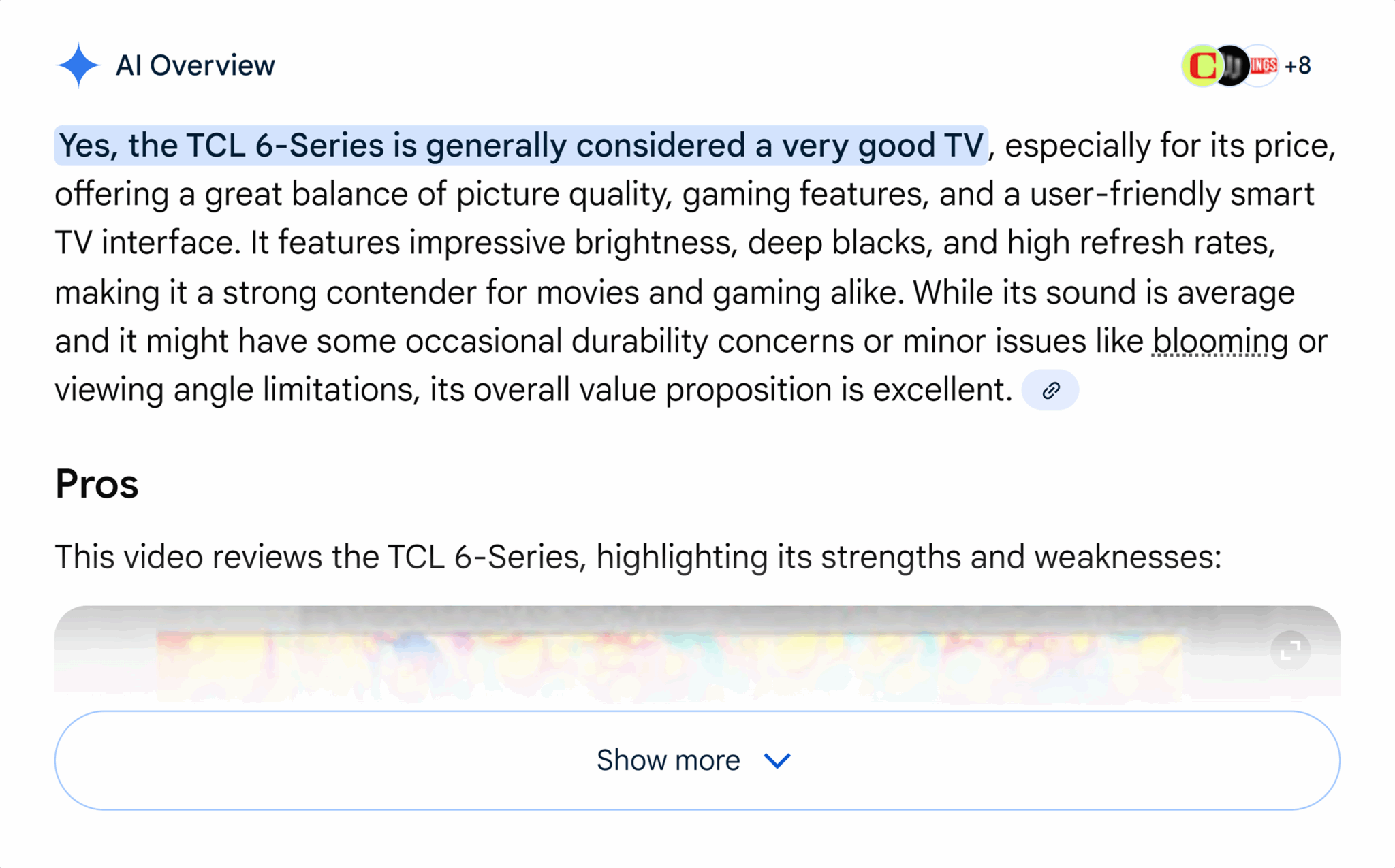
Tracking LLMs can be more challenging than traditional metrics like Google rankings. Google rankings may show where I stand, but ranking doesn’t always correlate with traffic or revenue. Even if I rank highly, an AI Overview could dominate the search, reducing my traffic for a given keyword. I need to ask myself, is this the right traffic for my business goals?
The big difference between traditional SEO rankings and LLM visibility is the straightforward correlation between strong rankings and increased revenue, which is more complex with LLMs. I can easily track user behavior after they land on my site from organic search, but it’s not so clear-cut with LLMs.
SEO effectively drives traffic to my site, allowing me to evaluate the success of my conversion rate optimization (CRO) strategies. However, LLMs operate differently, leaving me with the task of creatively connecting the dots.
The Problem with Methodology
As I dive deeper into using LLM-related data, I realize this approach requires me to step out of my comfort zone as a performance marketer. My usual reliance on direct attribution and data points is shifted toward constructing a narrative that ties LLM visibility to larger brand storytelling.
This method isn’t novel, however. Brand marketers have dealt with indirect metrics since the days of billboard advertising. Still, the shift requires me to create insights from what might seem like fragmented LLM data.
Metrics and Approach to LLM Impact Measurement
Uncovering the true value brought by LLM visibility metrics is a layered and comprehensive process. To do this accurately, I need to understand the wider ecosystem of my organization’s promotional efforts. This understanding allows me to determine the root cause of site traffic or branded searches effectively.
For instance, if a TV ad campaign runs concurrently with optimizing for LLM mentions, analyzing their impact becomes essential. Only with complete awareness of such activities can I identify true causality or correlation.
From here, I find that LLM visibility data is usually just the starting point. It’s unlike traditional SEO insights, which might be more apparent and direct. My task is to delve deeper, probing these data points to uncover richer insights.
The Branded Search of It All
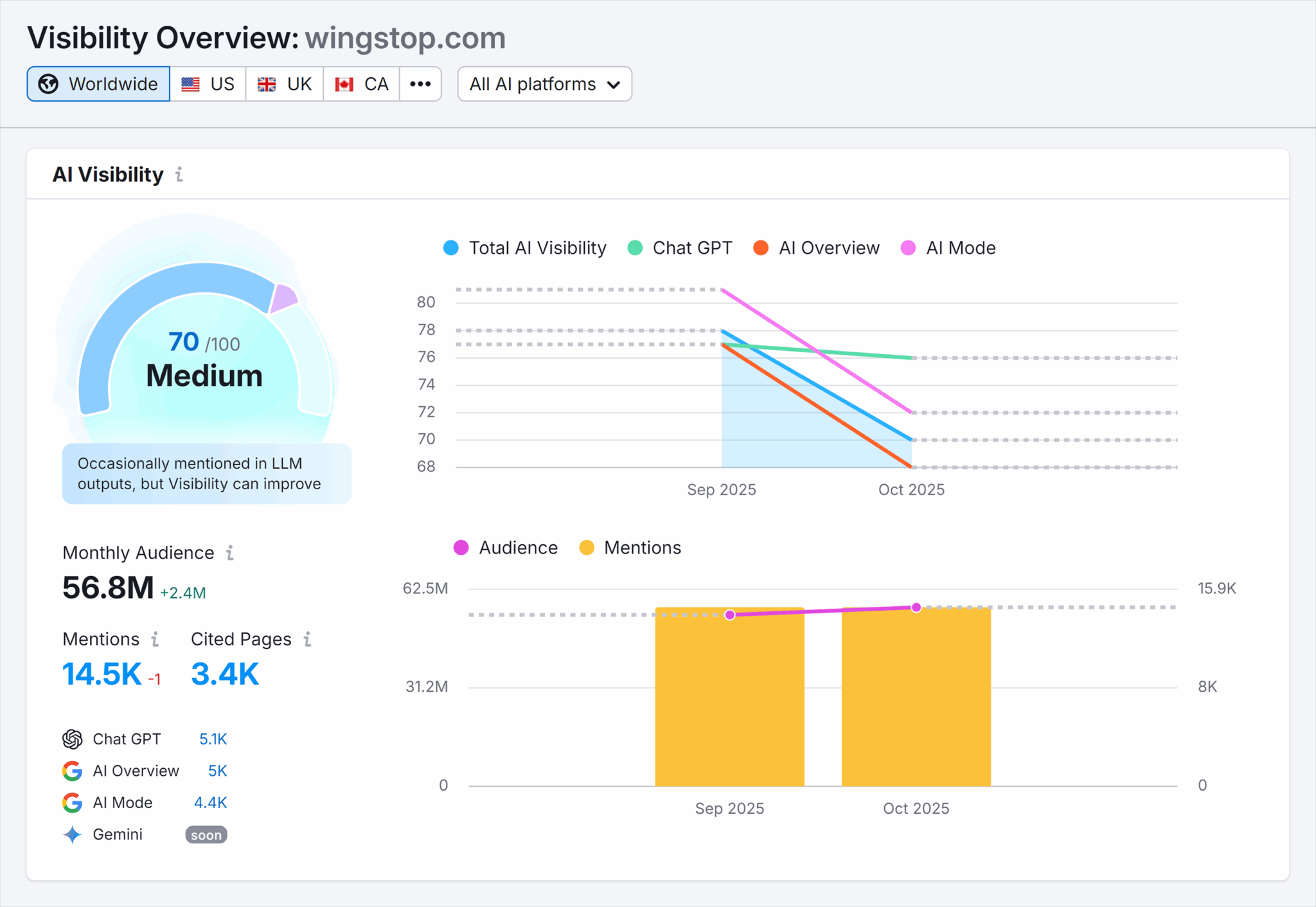
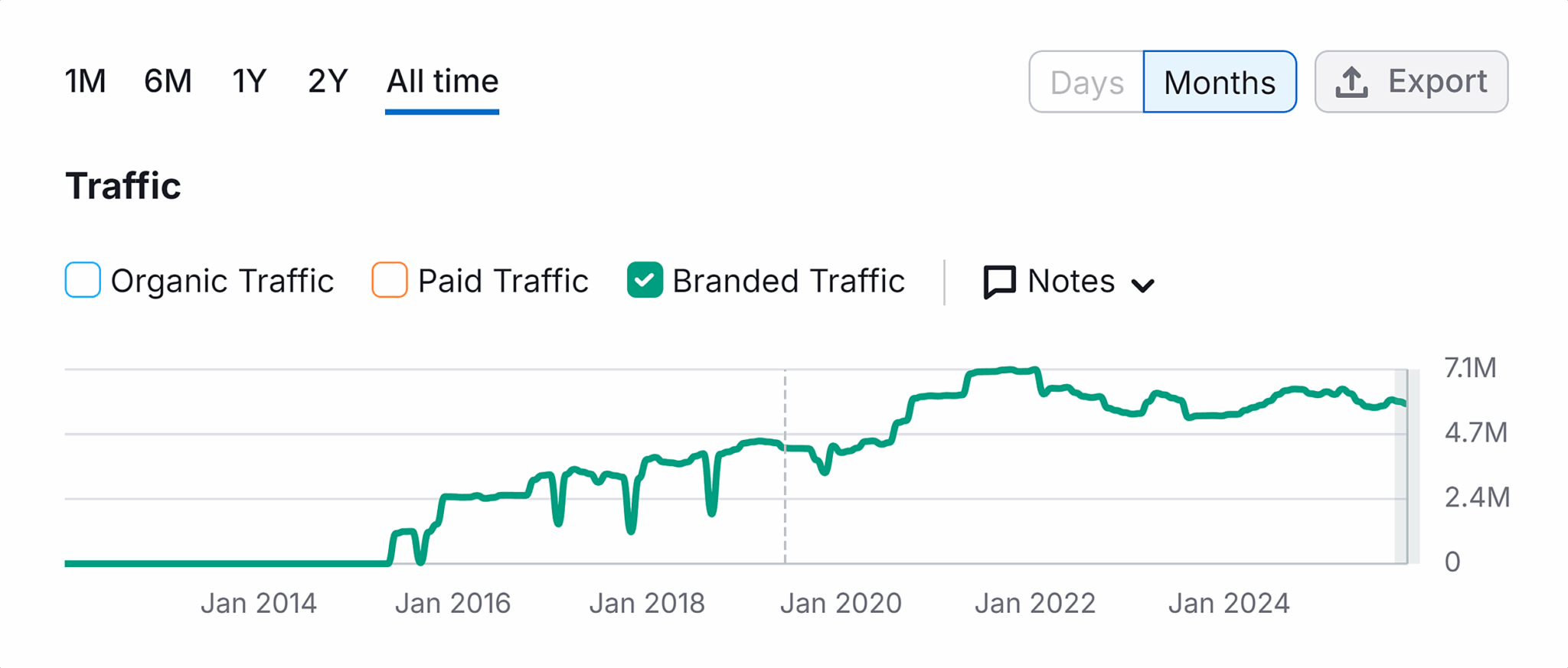
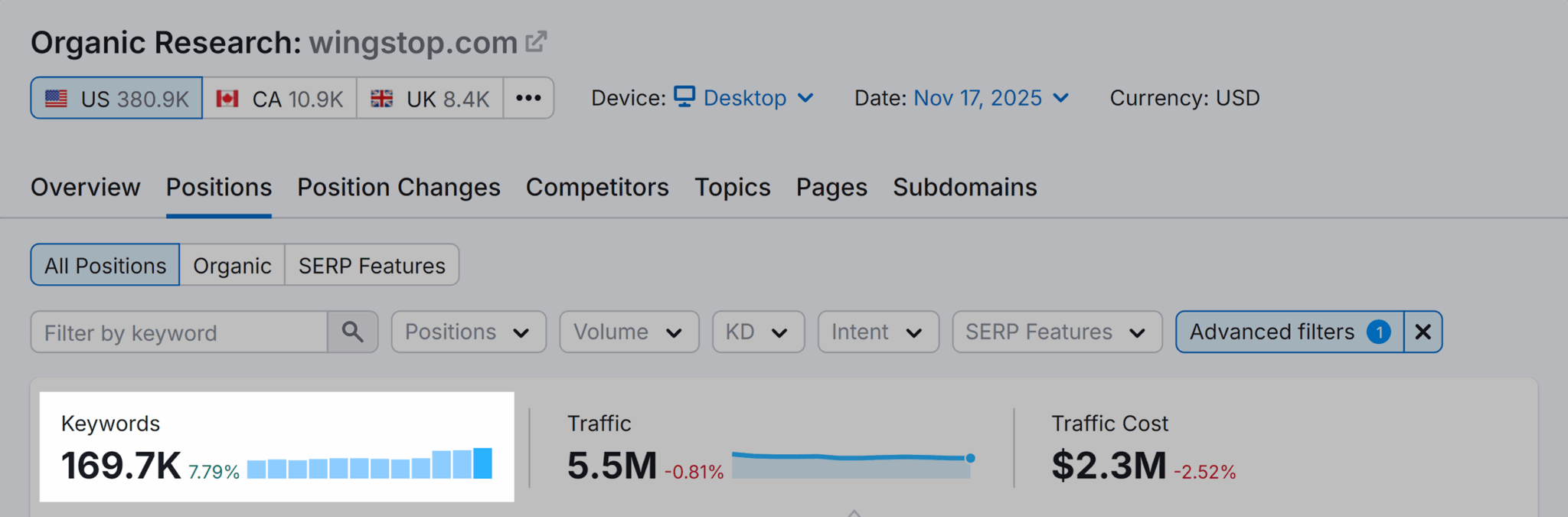
I’ve noticed that brand search provides exceptional insights into LLM performance, offering a rich vein of marketing intelligence. The comparison between two competing chicken wing chains, Buffalo Wild Wings and Wingstop, brightened this understanding for me. While their LLM citations differ, their brand awareness through social media presence offers a clearer picture of market positioning.
Simply examining the branded search traffic showed me how both brands performed similarly on Google, despite their different social media followings. Here lies the heart of utilizing search data creatively to find LLM visibility data strategies.
Rather than merely counting traffic, I am now compelled to consider the number of branded keywords involved, providing a sometimes surprising view on brand awareness and diversity. This approach provides a richer understanding of LLM visibility’s impact.
Direct Traffic: My Trusted LLM Data Companion
I’ve come to see direct traffic as an essential part of my LLM data narrative. Far from being a black hole, direct traffic can often indicate brand awareness and affinity, especially when correlated with LLM visibility metrics. Understanding these correlations allows me to paint a clearer picture of AI’s practical impact on consumer behavior.
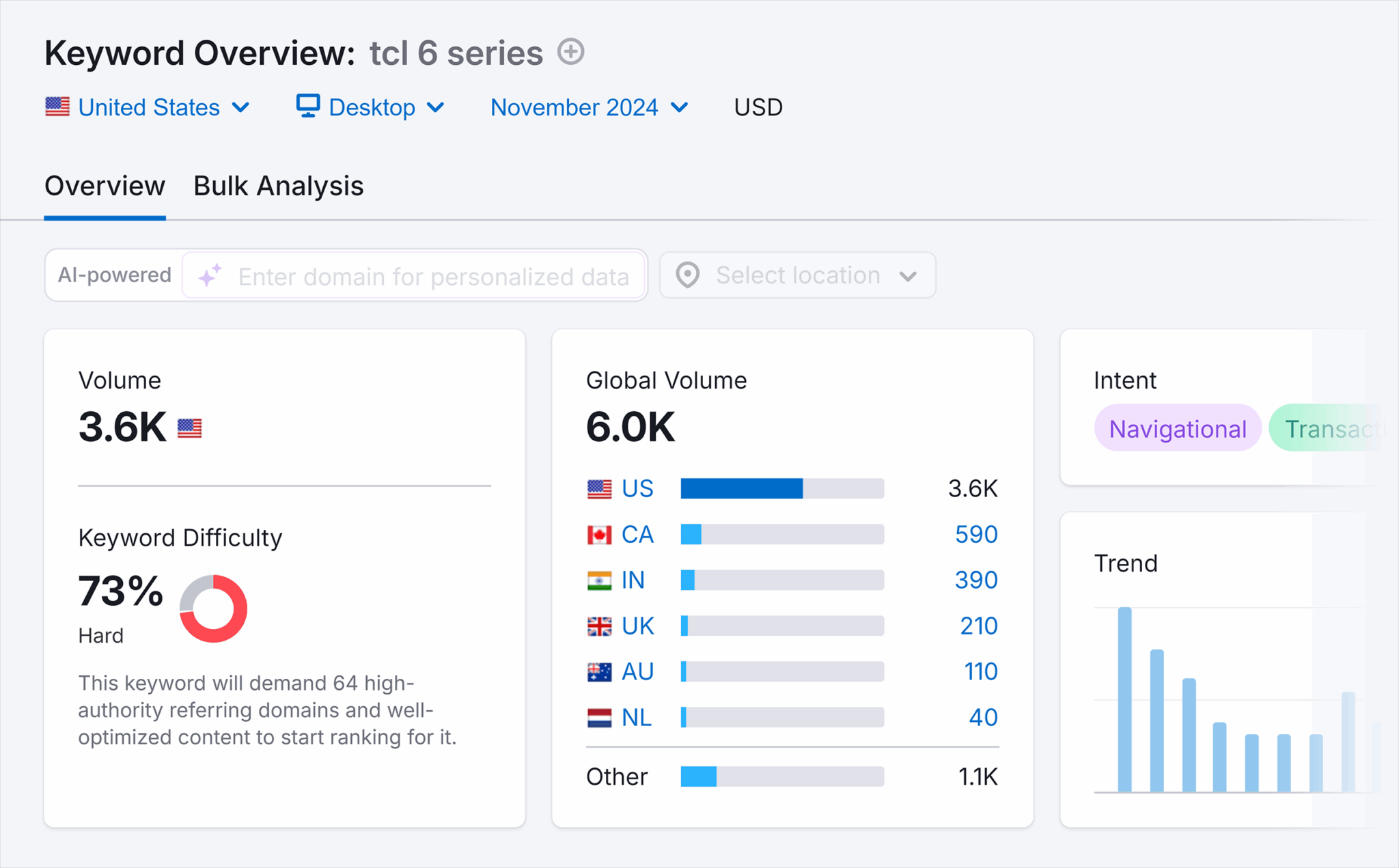
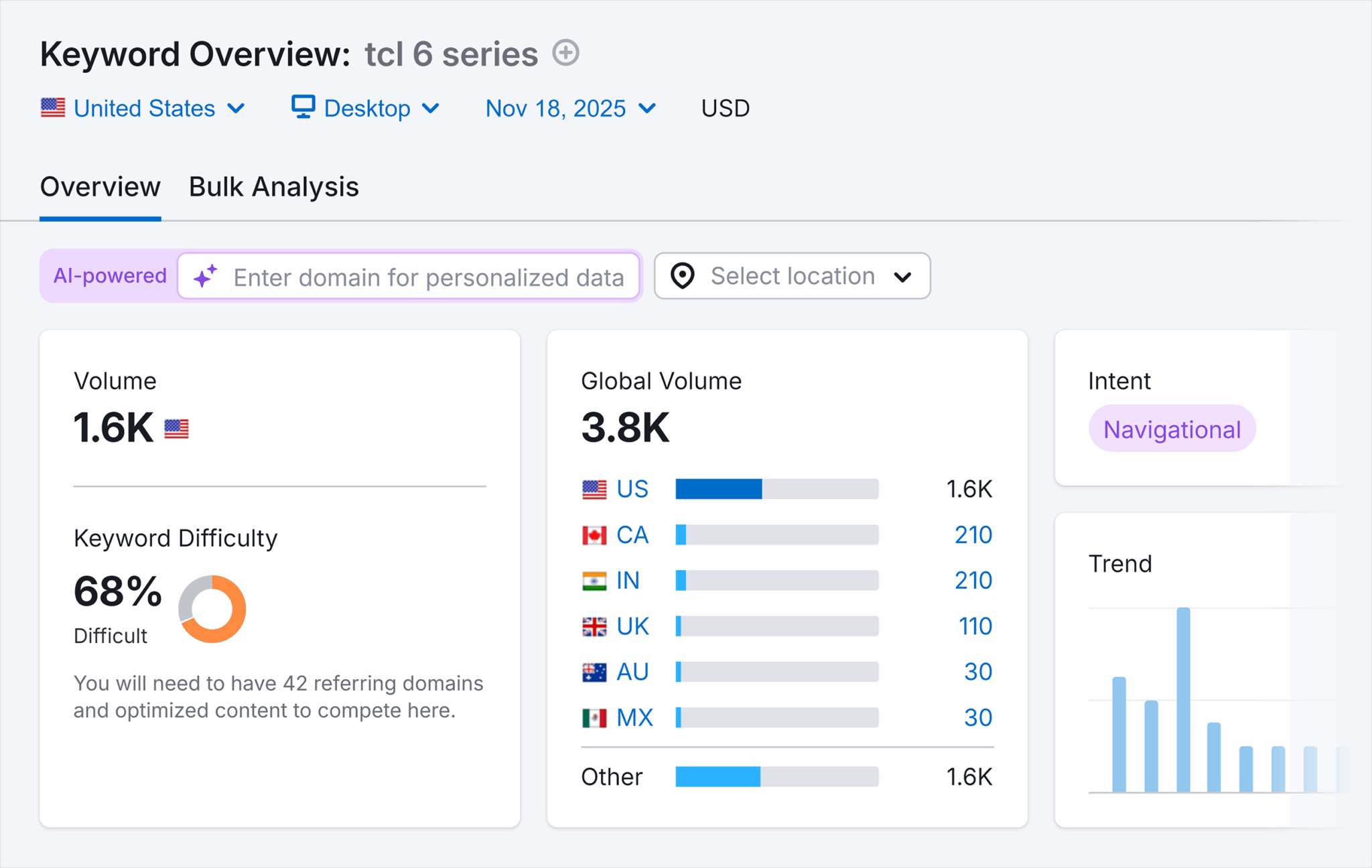
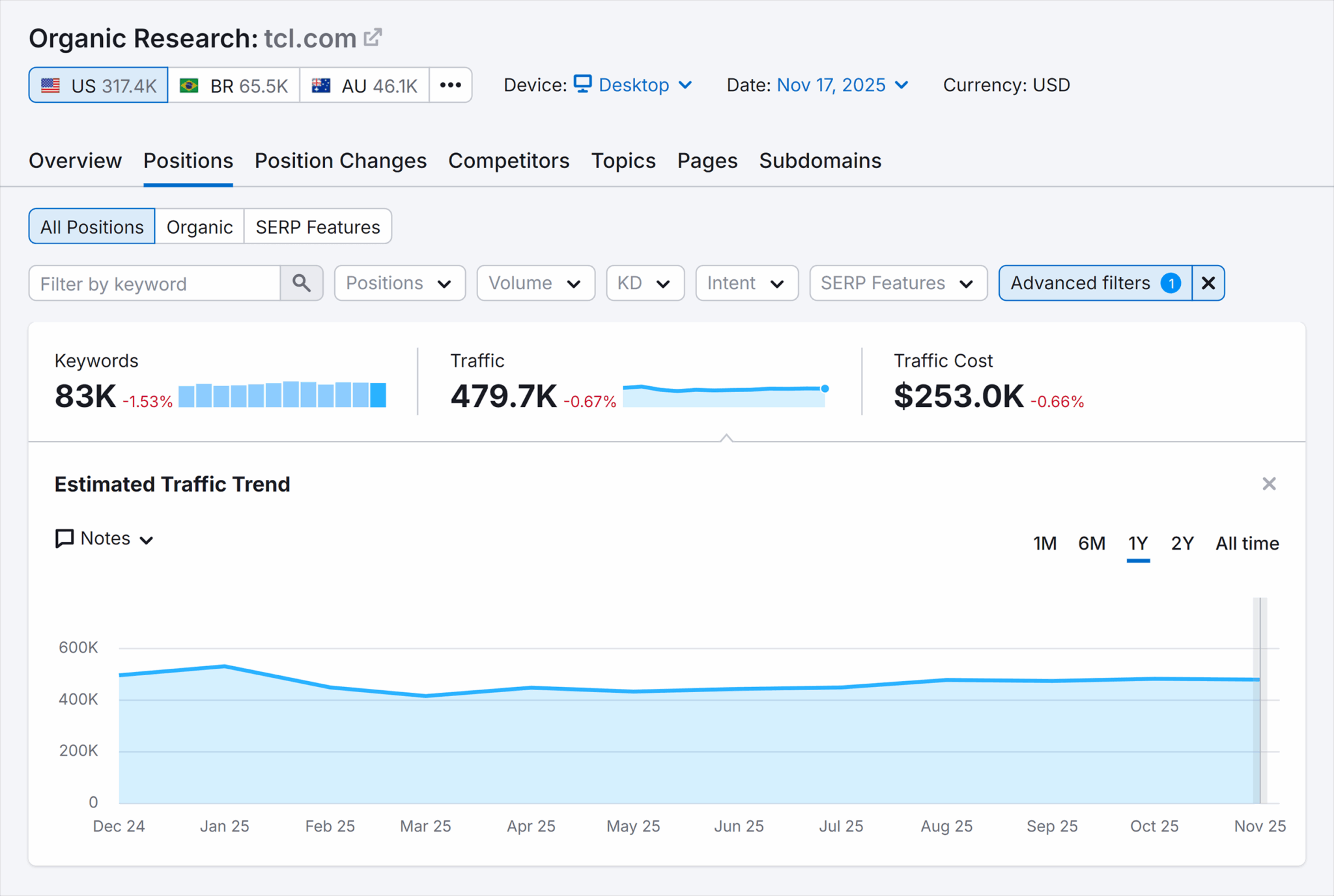
For instance, if I compare LG and TCL, LG’s superior direct traffic and increasing momentum in LLM visibility suggest a tangible AI-driven influence, a possibility I must explore through multi-metric analysis.
Considering various metrics together and identifying shared trends offer insight into how LLM visibility might be affecting my brand’s overall recognition and engagement.
Not Just One Metric: Stitching Together LLM Data Stories
Ultimately, it’s about developing a comprehensive data story from LLM visibility insights. This story goes beyond direct KPIs, utilizing various data sources, such as bounce rates and organic traffic, to add depth and relevance to the narrative. Every piece of performance-focused data stands as testimony to the expertise we can bring to LLM visibility.
Total LLM visibility data, when creatively amalgamated with performance data, can transform insights into actionable strategies that align with pragmatic business objectives, showcasing our value in the AI-driven landscape.
When people ask me how to assess the ROI of their marketing campaigns, I always suggest starting with the customer acquisition cost (CAC). CAC, alongside Customer Lifetime Value (LTV or CLV), is vital in navigating the realm of B2B marketing.
By examining your CAC, you can identify which marketing channels deserve more attention and which aspects of your marketing strategy could use improvement. Benchmarking your CAC against industry standards is key.
The aim of this article is to guide you in recognizing what qualifies as a good CAC in your industry and to encourage you to even explore how your CAC fares compared to related industries.
Calculating Your Customer Acquisition Cost
To calculate your CAC, simply divide your total marketing and sales expenditures by the number of new customers acquired, using the formula below:
Make sure to perform this calculation annually or on a rolling basis to accommodate seasonal customer behavior changes. If your B2B business enjoys consistent year-round sales, consider quarterly CAC analysis to gauge the impact of new initiatives.
Additionally, calculating CAC per channel allows you to compare different marketing strategies effectively.
This report emphasizes B2B CACs. For B2C data, see our B2C Edition.
After determining your CACs, you can measure them against the industry averages shared below.
Average Customer Acquisition Cost (CAC) By Industry
The table below presents average CACs across 29 B2B industries, gathered from client data spanning January 2022 to August 2025. Consider these dataset limitations:
Within each industry, we categorize CAC as Organic or Inorganic. Organic CAC includes mainly SEO and Organic Social, while Inorganic CAC covers PPC / SEM and Paid Social.
Email marketing, events, and other channels are excluded due to insufficient data.
Data from client analytics is anonymous. Organic data leans towards SEO and Inorganic towards PPC / SEM, given our B2B clientele and service focus.
Below are the analysis results:
[Insert table block here]
Average Customer Acquisition Cost (CAC) for SaaS Companies
Our team also reviewed average customer acquisition costs across 22 SaaS industries to determine each industry’s B2B CAC.
SaaS Industry
CAC
[Insert table rows here]
How Your CAC Relates to Customer Lifetime Value
While CAC reflects acquisition costs, Customer Lifetime Value (LTV) reveals the average profit per customer. Calculate LTV by dividing your profit over a chosen period by the number of unique customers, and multiply by their average purchase frequency. Aim for an LTV to CAC ratio of at least 3:1 for optimal financial health.
Keep in mind historical trends and competitor data. A 2:1 LTV to CAC ratio isn’t necessarily negative if you’re seeing improvement over time.
Particularly during new campaigns or long-term strategies, your ratios may fluctuate. For example, if you’ve launched an SEO campaign, results typically appear after 4-6 months.
How to Lower Your CACs
Organic CAC often triumphs over inorganic due to its longevity and skill-based approach. Investing in organic channels yields sustainable results without ongoing cash infusion.
If you’re curious about organic marketing to reduce your CAC, feel free to contact us. Our firm, with multiple U.S. locations, has helped various B2B sectors achieve superior ROI with SEO strategies.
Further Reading
For deeper insights into CAC and its relation to LTV, browse the following resources: