The way we search for information has shifted dramatically—not slowly and not slightly. I’ve witnessed firsthand the transformation in search behaviors that make AI search visibility crucial for brands seeking to remain competitive.
Brands need to adopt AI search visibility services now more than ever to ensure they’re not only visible online but also standing out in an overcrowded digital space.
With the right AI tools, brands can refine their search visibility strategies to reach target audiences more effectively, leveraging cutting-edge technologies to stay ahead of competitors.
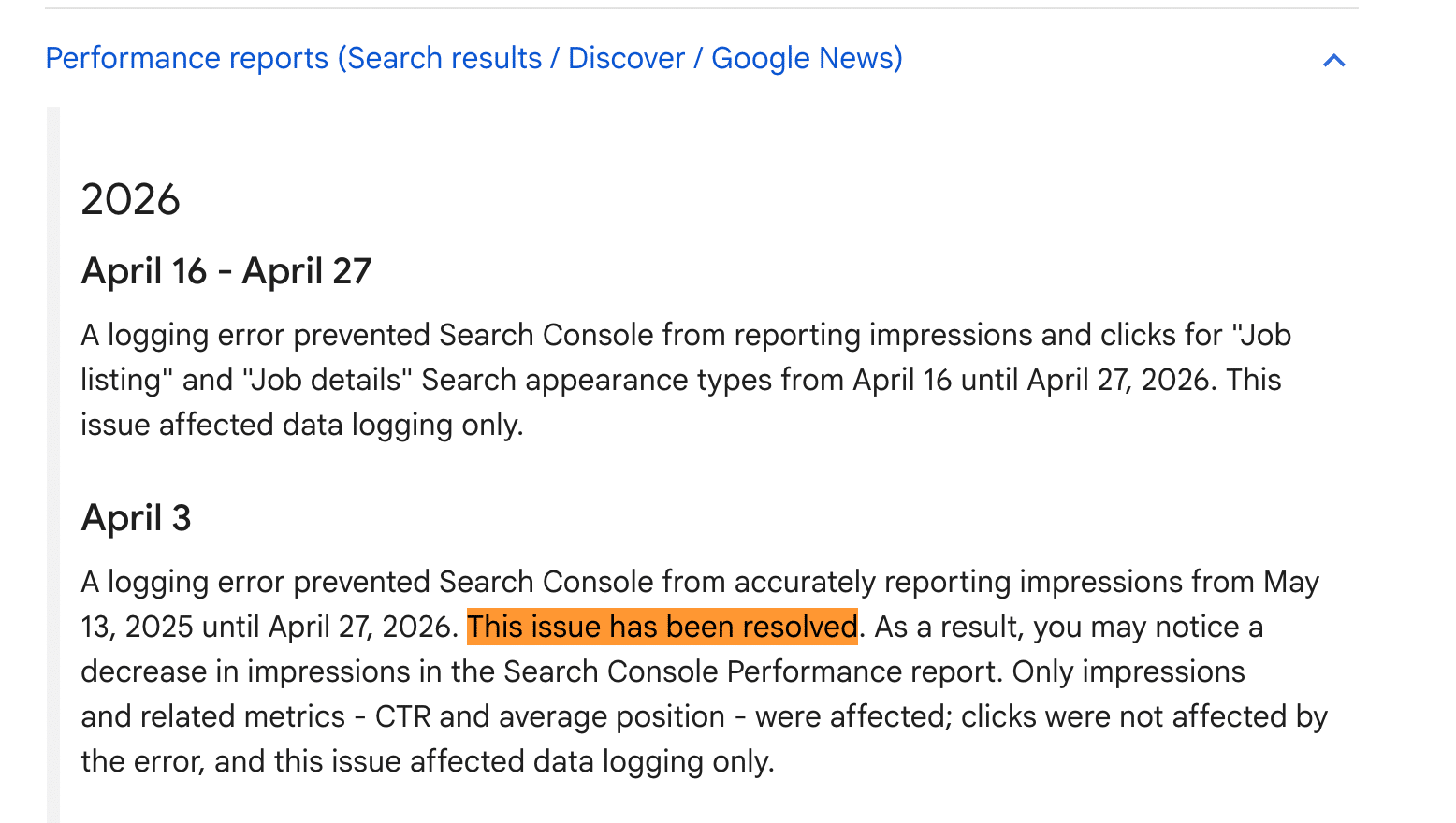
It feels like a moment of relief as Google recently announced a resolution to a longstanding data logging issue within Google Search Console. This glitch affected data between May 13, 2025, and April 27, 2026, spanning approximately 50 weeks. However, it’s important to note that while the root cause has been addressed, historical data from this period remains unfixed.
Google shared this update in a rather understated post, bringing light to a problem that many of us have been grappling with for quite some time. According to their post, “A logging error prevented Search Console from accurately reporting impressions from May 13, 2025, until April 27, 2026. This issue has been resolved.” It was a relief to hear, but also a bit frustrating knowing that impressions, CTR, and average position data were affected for such a significant period. Thankfully, clicks weren’t influenced by this error, which was some consolation.
As I sift through my Search Console data, I must remind myself of this anomaly, particularly when analyzing metrics from that problematic timeframe. The good news is that any data collected from this point forward should be accurate.
Further confirmation came from John Mueller on Bluesky, who reiterated that past data would not be retroactively corrected, but the issue has indeed been resolved going forward.
This development is crucial for all of us who rely heavily on precise data for SEO strategies. If your impressions appear lower and, consequently, your CTR and average position figures seem skewed during this period, this is likely why.
I’ve seen how crucial it is to understand that AI visibility starts long before users hit that search bar and ends with citations.
These insights are vital in shaping what gets seen, summarized, and cited by AI systems.
Currently, the focus has shifted towards improving the AI ROI story, and I’m right in the thick of it, learning what strategies truly work.
This year, attending SMX Advanced will be more enlightening than ever, bringing unique perspectives and strategies.
Let’s dive into why influence matters everywhere, and how it impacts AI citations.
Rand Fishkin’s study, ‘Influence Happens Everywhere,’ reveals that, although Google commands the majority of search traffic, it’s the influence happening outside of search that truly dictates what people look for online.
For many, wandering through social media or news sites builds their understanding and interest long before the actual search occurs.
Despite the exciting growth of AI tools, achieving a stable presence online requires understanding how fragmented channels contribute to this influence.
When crafting content, it’s essential to dominate the influence phase so thoroughly that an AI assistant doesn’t just suggest your brand—it demands it.
That’s the strategic thrust behind the discussions at SMX Advanced in Boston and why I align my content calendar accordingly.
My colleagues at Search Engine Land are among those shaping these discussions. Insights from thought leaders like Dave Davies and Carolyn Shelby are invaluable.
They emphasize the importance of structured visibility signals and entity recognition, helping AI systems select the right brands to highlight.
In my own analysis, the various AI models like ChatGPT, Perplexity, and others have unique methodologies for selecting sources, reinforcing the idea that an engaged, multi-platform strategy is critical.
So, what does full-stack content truly mean today? It’s more than crafting blog posts; it’s about commanding entire topics with authority and depth, enhanced by AI tools like Jasper’s Enterprise Suite.
The ability to integrate real-time data, identify competitive content gaps, and create diverse multimedia content packages mean we’re shifting from simply generating content to dominating entire narratives.
But AI tools can only serve the overarching strategy if our content offers the original insights that help us stand out in AI retrieval systems.
This year, Purna Virji’s insights at SMX Advanced will challenge us to think critically about the real ROI in AI investment.
I’m particularly interested in seeing how Google Vids is democratizing video content by eliminating the high entry barriers of previous video production methods.
Now, video content can be produced and localized for a multitude of markets rapidly, a paradigm shift in how we engage audiences across the globe.
The standards AI is setting for content — whether text, video, or multimedia — require a strategic framework that aligns with evolving platforms like GEO and AEO.
For those in the trenches like me, adjusting focus towards an integration of structured data and earned media becomes imperative.
The real challenge isn’t in the buzzwords but effectively navigating the volatile landscape of AI-driven citations.
I recognize the adjustments needed in approach, especially when considering the stark differences in referral and conversion rates from traditional search versus AI platforms.
So, practical actions for the rest of 2026? Audit your AI presence thoroughly, stop gating original research, secure your place in vibrant communities, and refine your focus towards citatability rather than simple visibility.
Ultimately, the brands ready to adapt will continue to thrive in this AI-enhanced environment.
Indeed, the bots are crawling, and it’s time I ensured my brand is worth citing.
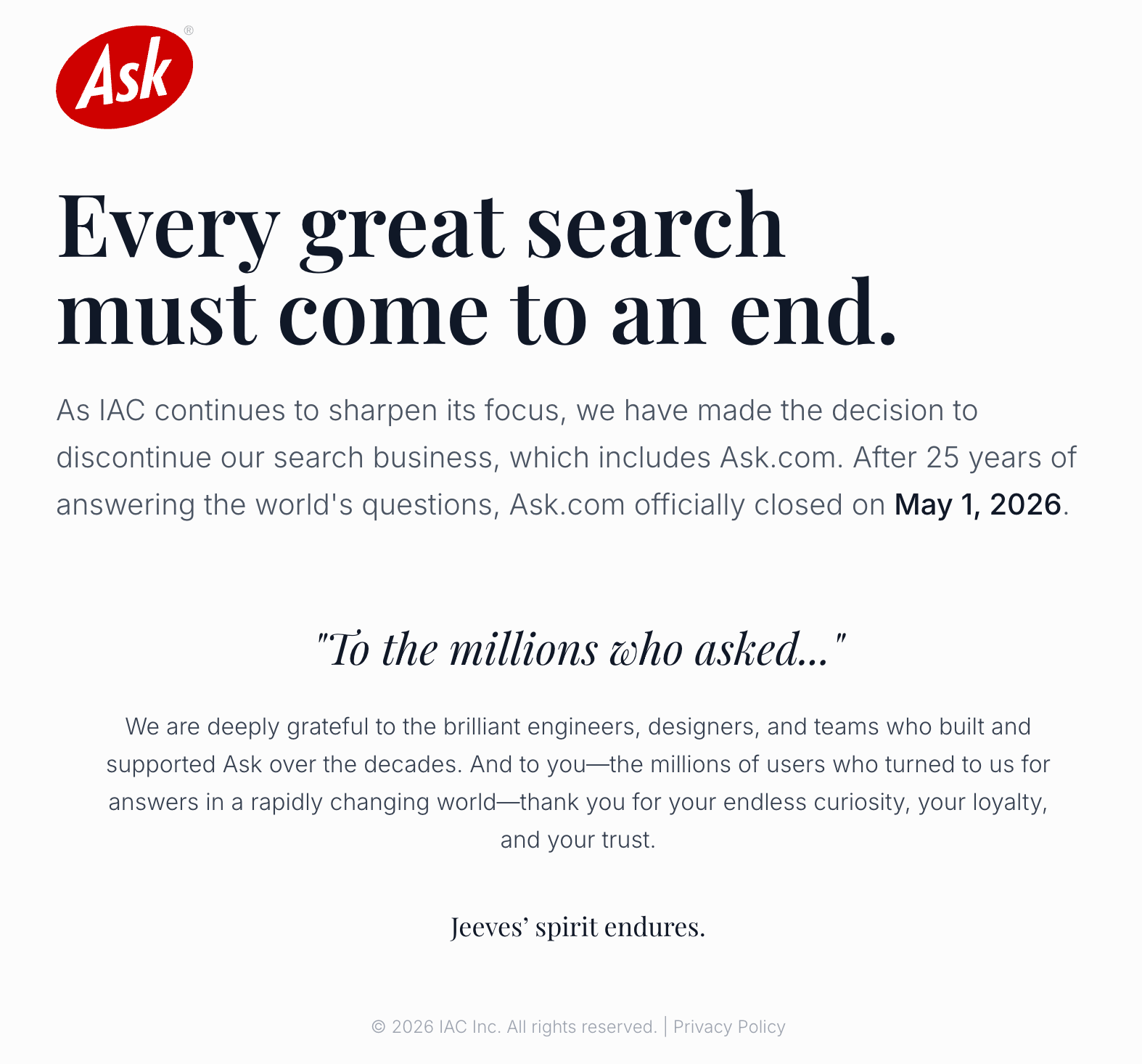
As someone who has been on the internet exploration journey for years, today’s news hits home. Ask.com, which many of us fondly remember as Ask Jeeves, officially closed down on May 1, 2026, after a remarkable 29 years of service. It launched on June 3, 1996, even before Google made its debut.
Upon visiting the now-closed Ask.com, we are greeted with a heartfelt farewell message that feels like a trip down memory lane:
Every great search must come to an end. As IAC continues to sharpen its focus, we have made the decision to discontinue our search business, which includes Ask.com. After 25 years of answering the world’s questions, Ask.com officially closed on May 1, 2026.
I can’t help but feel gratitude as they graciously acknowledge, “To the millions who asked…”. They expressed appreciation for the brilliant engineers and loyal users who have been a crucial part of their journey. And yes, Jeeves’ spirit indeed lives on.
For those of us who relied on this answer engine in its early days, Ask.com and the iconic Jeeves butler will always hold a special place. In a world now dominated by AI and competitive answer engines, it’s understandable why IAC, the parent company, decided to step back in such a challenging market.
Ask.com has left a significant impact on the search marketing industry, and saying goodbye is indeed bittersweet. Until we meet again in some digital form, dear Jeeves.
You have a spreadsheet full of locations, services, products, or audience segments, and a template that could turn those rows into hundreds of URLs. The uncomfortable question is whether you are building a useful search asset or manufacturing near-duplicates.
The answer is settled before generation begins. Semantic programmatic SEO works when every URL represents a distinct combination of entity, intent, context, and evidence. This blueprint shows you how to find those combinations, decide which deserve pages, govern AI output, connect the resulting pages, and stop weak page families before they spread.
Prove your authority and page opportunity before you scale
Programmatic SEO is a production method, not a reason to publish. It lets you address a large set of related needs through structured data, reusable components, and repeatable rules. Semantic SEO supplies the meaning: the entities involved, their relationships, the user’s situation, the criteria behind the decision, and the answer that changes with the context.
Start with the territory your domain has already earned. Google Search Console can show which subjects, entities, and needs are producing impressions, clicks, and recognized landing pages. You are not looking only for high-volume keywords. You are looking for evidence that search engines already connect your site with the broader topic.
Export the queries and landing pages related to the proposed page family.
Group queries by the need behind them, not merely by repeated words. Separate comparison, eligibility, availability, price, location, suitability, and troubleshooting intents where they genuinely differ.
Mark the clusters for which your site already has a relevant page, those receiving visibility without a strong landing page, and those with no visible connection to the domain.
Identify the nearest credible expansion. A cluster adjacent to existing authority is a better starting point than a large but disconnected keyword set.
Record which current page should act as the hub. If you cannot identify a natural parent page, the proposed family may sit outside your present site structure.
This audit prevents a common strategic error: interpreting a large keyword universe as permission to publish a large URL universe. Demand tells you that a topic exists. Existing authority, useful proprietary or curated data, and a coherent place in the site tell you whether your domain should build it.
Give every candidate URL an eligibility test
Create one record for every proposed entity-intent combination before you create any prose. The record should answer these questions:
Distinct need: What question does this combination answer that its parent and sibling pages do not?
Meaningful variables: Which facts alter the answer, recommendation, order of information, or next action?
Evidence: Which reliable fields support those differences?
User consequence: What can the visitor decide or do after reading this page?
Site relationship: Which hub, sibling, and next-step pages connect naturally to it?
Maintenance: Who or what will detect when its underlying information becomes incomplete or stale?
If the only meaningful field is the keyword in the title, do not generate the URL. If several proposed pages lead to the same answer, consolidate them into a stronger hub or filtered experience. If the answer changes because of real local, seasonal, product, or audience conditions, you may have a viable page family.
Use this as your semantic-delta rule: a page becomes eligible only when its data changes the substance of the answer. Different wording is not a semantic difference. Different constraints, priorities, evidence, recommendations, or actions are.
Design a semantic page system, not a word-swapping template
A template normally starts with visible sections: introduction, benefits, frequently asked questions, and call to action. A semantic system starts one layer earlier. It defines what the page knows, which relationships matter, and under what conditions each component should appear.
Consider searches for the best hotel in Las Vegas and the best hotel in Orlando. The grammatical pattern is identical, but the relevant priorities and amenities can differ by destination. Replacing one city name with another preserves the syntax while ignoring the reason a traveler is making the search.
Build an intent record for each page
Your content model should hold the information needed to produce a useful answer without asking the generator to invent missing facts. A practical intent record includes:
Primary entity: The place, service, product, category, institution, or other subject represented by the page.
User job: The decision or task the visitor is trying to complete.
Audience or situation: The conditions that materially change the answer.
Decision criteria: The attributes that deserve emphasis for this combination.
Local or contextual facts: Information that distinguishes this entity from sibling entities.
Seasonal conditions: Time-dependent information that changes relevance, availability, or recommendations.
Evidence and provenance: Where each factual field came from and whether it is safe to publish.
Recommended next step: The action that follows logically from the answer.
Related entities: Parent, sibling, alternative, and supporting pages that genuinely help the visitor continue.
Keep factual data separate from generated prose. That separation lets you validate the facts, update a single field without rewriting the entire page, and prevent a language model from filling a data gap with plausible-sounding copy.
Make components conditional on evidence
A scalable page should not contain every possible module. It should assemble only the modules justified by the record. A seasonal section appears when current seasonal data exists. A comparison appears when the alternatives and comparison criteria are known. A local recommendation appears when the local facts actually change that recommendation.
Write a rule for every optional block:
Which fields must be present before the block can render?
Which claim is the block allowed to make?
What happens when a required field is missing or stale?
Does the page remain useful without the block?
Should the page stay unpublished when the missing field is central to its promise?
The safe default is to omit an unsupported optional block and reject a page whose core answer is unsupported. A generic fallback paragraph may keep a layout full, but it does not preserve usefulness.
Write the page promise before the page copy
Give every page family a one-sentence contract: “This page helps [audience] decide [job] for [entity] using [distinct evidence].” Then test every module against that sentence.
If a section does not help fulfill the promise, remove it. If the same contract describes every sibling without any change in evidence, your model is probably too broad. If the contract changes only because the entity label changes, you have a templating plan but not yet a semantic one.
This contract is also a better quality check than raw word count. A short page with a precise answer and entity-specific evidence can justify itself. A long page assembled from generic explanations can still be thin.
Use AI inside a governed production pipeline
AI is useful for transforming structured facts into readable explanations, adapting emphasis to an intent, and producing consistent components. It should not decide whether a page deserves to exist, invent regional facts, or quietly repair missing data.
Supply context as rules, not a loose brand prompt
A prompt that says “write in our brand voice” leaves too much unresolved. Context governance should give the model a constrained working environment:
The intended reader and the decision they need to make.
The page promise and search intent.
Approved factual fields, with explicit instructions not to infer missing values.
Preferred terminology, reading level, tone, and point of view.
Claims the brand can make and claims it must avoid.
Required components and the conditions that activate optional components.
Examples of acceptable structure and phrasing without requiring the model to copy them.
Rules for uncertainty, unavailable information, and conflicting fields.
Allowed internal links and the relationship each link represents.
Version this context alongside the template and data model. Otherwise, a voice change, legal restriction, or terminology update can affect some pages but not others, leaving the family internally inconsistent.
Validate meaning before style
Run generated pages through checks in a deliberate order. A polished sentence cannot rescue an unsupported answer.
Data validation: Confirm that required fields exist, use the expected format, and come from an approved source.
Claim validation: Match factual statements in the copy back to their structured fields. Reject claims that cannot be traced.
Intent validation: Confirm that the page answers the job defined in its record rather than drifting into a generic topic overview.
Differentiation validation: Compare the page with nearby siblings. Look for the same recommendations, examples, section order, and conclusions appearing despite different inputs.
Brand validation: Check terminology, tone, prohibited claims, and required qualifications.
Technical validation: Verify the intended URL, status, canonical target, robots handling, sitemap inclusion, rendered content, and internal links.
Review every page in the first pilot manually. Once you understand the recurring failure modes, automate deterministic checks and direct human attention toward exceptions: missing regional evidence, conflicting inputs, unusually similar siblings, sensitive claims, and outputs that fail the page promise.
Treat regionalization and seasonality as data
Do not ask AI to “make the page feel local.” Give it verified local variables that alter the answer. The same rule applies to seasonality. A date in a heading does not make a page current; the underlying availability, priorities, conditions, and recommendations need a maintained validity window.
For each time-sensitive field, store when it was observed, when it should be reviewed, and what the system should do if it expires. Depending on the importance of the field, the system can suppress one module, hold the page for review, or remove the page from the publication queue. Do not let the generator disguise stale or absent data with fluent language.
Build the semantic mesh, then operate by page family
Publishing is the midpoint. Programmatic pages fail as a collection when they are technically reachable but semantically isolated, or when nobody notices that one template defect has affected an entire family.
Make every link express a useful relationship
A semantic mesh connects pages according to how a visitor moves through the subject. The goal is not to maximize links per page. It is to make the site’s understanding of the topic visible while preventing dead ends.
Upward: Link each detail page to the hub that explains the broader category or decision.
Downward: Let hubs expose eligible detail pages in meaningful groups rather than dumping every generated URL into one directory.
Laterally: Connect siblings only when the relationship helps the same user compare, substitute, narrow, or continue.
Supportively: Link to explanatory pages when a visitor needs background before acting on the page’s answer.
Forward: Offer the logical next step after the immediate question is resolved.
Anchor text should name that relationship. “Compare nearby options,” “check eligibility requirements,” or “see the parent category” carries more meaning than a repeated exact-match keyword inserted into every sibling.
Before launch, inspect each candidate page from the visitor’s perspective. Can you tell where it belongs, how it differs from the surrounding pages, what evidence supports it, and where to go next? If not, adding more links will not solve the structural problem.
Launch a family as a controlled pilot
Start with the smallest page family that contains enough variation to test your model. Include straightforward records, records with optional fields, and edge cases with missing or time-sensitive information. This exposes whether the rules work across the family instead of proving only that the cleanest example looks good.
Track page states explicitly: candidate, data-ready, generated, validated, index-eligible, published, and held for maintenance. A URL should move forward only when it passes the requirements for the next state. This makes publication a controlled decision instead of an automatic side effect of adding a row.
Monitor patterns, not just totals
Aggregate traffic can hide a weak program. A few strong URLs may carry a family while the rest remain unindexed, answer the same queries, or deliver no meaningful next action. Break reporting down by page family, template version, intent type, region, and data-completeness state.
Indexing behavior: Are eligible pages being indexed consistently, or is one family being skipped?
Query alignment: Are pages earning visibility for their intended needs, or are several siblings competing for the same query?
Semantic coverage: Are impressions expanding into the planned intent gaps, or only repeating visibility already owned by the hub?
Engagement with the answer: Do visitors take the next action the page was built to support?
Data health: Which pages have missing, conflicting, or expired fields?
Technical health: Are crawlability, canonical handling, rendering, internal links, and Largest Contentful Paint behaving consistently across the family?
Content drift: Did a prompt, model, template, or data change make recent pages less distinct or less faithful to the brand rules?
Define pause conditions before launch. Hold further publication when essential regional fields are empty, siblings converge on the same answer, multiple pages compete for the same intent, indexing problems cluster around one template, or technical defects repeat across the family. Diagnose the model, data, or rule first. Generating more URLs only multiplies the uncertainty.
Key takeaways
Use programmatic SEO to serve many distinct needs, not to manufacture keyword permutations.
Expand from topical territory your domain can already support, using Search Console queries and landing pages as evidence.
Require a semantic delta: the entity-intent combination must change the answer, evidence, recommendation, or next action.
Store facts separately from prose, and render page components only when their required evidence exists.
Use AI as a constrained transformation layer governed by page promises, approved data, brand rules, and validation.
Connect pages through parent, comparison, support, and next-step relationships instead of indiscriminate cross-linking.
Launch by page family, monitor family-level patterns, and pause generation when a repeated defect appears.
Take one candidate page family and complete the eligibility record by hand for its hub, a typical detail page, and its hardest edge case. If you can prove a distinct need, distinct evidence, and a distinct next step for each, you have the beginning of a scalable semantic system. If you cannot, consolidate the idea before a template turns the ambiguity into URLs.
I’ve recently discovered how impactful Reddit can be in shaping brand discovery and perception. This is increasingly significant as AI search engines prioritize Reddit threads and comments, adding weight to these discussions.
During my deep dive into 117 SaaS brands on Reddit, I uncovered how people truly feel about brands—feelings often lost in polished marketing campaigns.
As communities wield more power over brand perception, presence on Reddit is no longer optional; it’s essential.
Let me share my analysis and how you can leverage Reddit for your brand.
How I Analyzed 117 SaaS Brands: The Methodology
My journey began by identifying key industry verticals, including:
Development and software development and IT operations (DevOps) (12 brands)
AI (12 brands)
Customer support and engagement (10 brands)
Analytics and data (10 brands)
Sales and revenue (8 brands)
Collaboration and communication (10 brands)
I organized this data in a Google sheet and tracked each brand’s Reddit presence, subreddit activity, and common discussion topics.
Analyzing over 300 threads across these brands, I assessed brand mentions, sentiment, community engagement, and participation.
Now, let me share the key findings.
1. Reddit Rewards Authentic Brands
What’s clear is that authenticity resonates with people. Brands represented by genuine, helpful, and non-promotional moderators see better engagement than those with a corporate tone.
Redditors seek real opinions and experiences, not marketing pitches. Hence, peer recommendations are more credible than brand messages.
When brands communicate directly and acknowledge both strengths and limitations, they gain positive reception. Some even earn upvotes and gratitude from the community.
2. Brands Not on Reddit Are Missing Out
Conversations about brands happen on Reddit with or without their presence. Astonishingly, 30 of the brands I researched don’t engage on Reddit, and 23 have inactive subreddits.
Users pose direct questions about brands and receive insights from fellow redditors. Without a brand presence, these discussions and reputations evolve independently.
Sometimes, other entities may misuse popular brand names, creating potential misrepresentations. Ensure you’re part of the conversation to maintain control over your brand’s narrative.
3. Reddit is a Customer Research Goldmine
Reddit offers unfiltered user insights that traditional feedback methods might miss. Customers openly discuss onboarding issues, integration challenges, and more.
Reddit Captures Feedback That Traditional Methods Miss
On Reddit, users frequently talk about issues like:
Onboarding struggles
Integration challenges
Mobile usability issues
AI feature frustrations
Updates confusion
Alternatives being built
This invaluable honesty helps refine SaaS products beyond what traditional surveys can capture.
Reddit Supports Brand Advocates
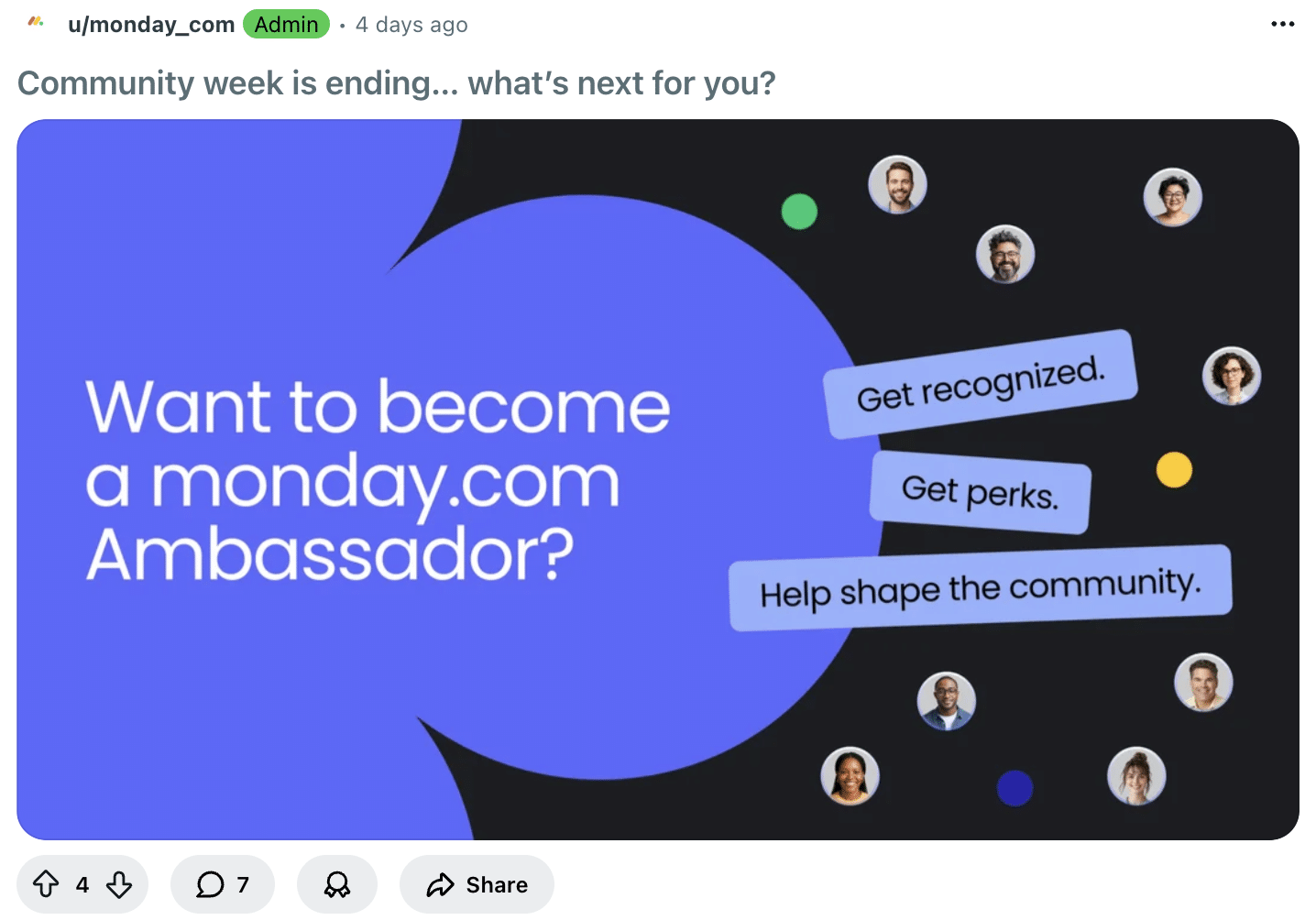
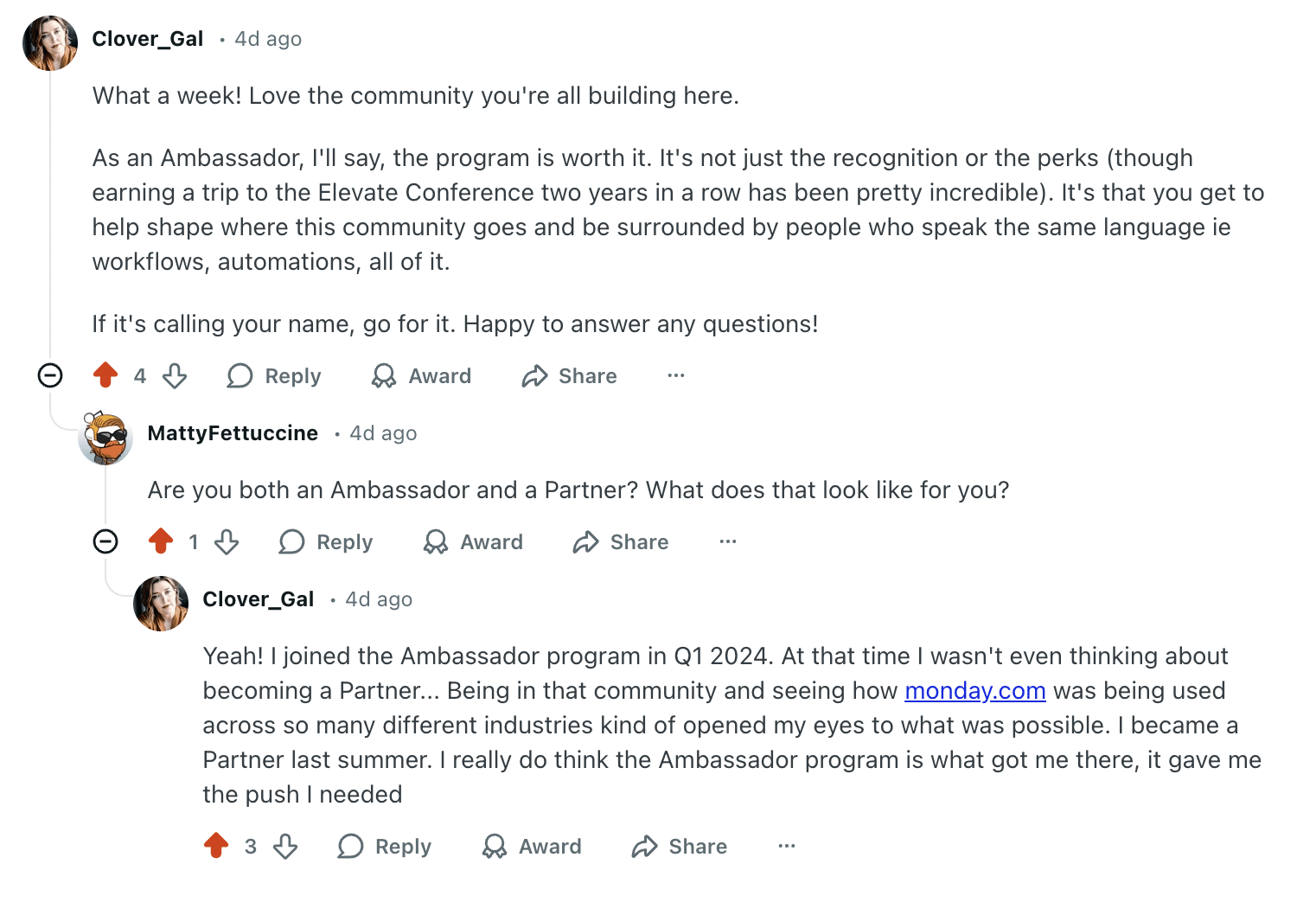
Happy customers often become brand advocates on Reddit, promoting brand ambassador programs and sharing their positive experiences, enhancing brand image.
Some Brands Have Self-Sustaining Reddit Communities
Some Reddit communities thrive with little brand intervention, offering peer-to-peer support, problem-solving, and resource sharing, ensuring community sustainability.
Redditors Highlight Preferred Competitor Features and Pricing Frustrations
Pricing is a hot topic, with users often expressing discontent and citing alternative options, highlighting gaps and opportunities for improvement.
Redditors Share Their Actual Use Cases
Reddit is a platform where users detail their real-world tool applications, which provides valuable insight for product optimization.
Reddit is Essential for Brand Visibility and Perception
With real-time brand discussions, Reddit plays a crucial role in shaping visibility and perception, impacting AI-driven search results and influencing consumer decisions.
It’s crucial for brands to monitor these discussions, engage meaningfully, and utilize Reddit as a platform for reputation management and product insights.
When I learned that Google’s Preferred Sources feature now supports all languages, not just English, I was thrilled. This exciting update means more people can tailor their news experience, regardless of the language they speak.
According to a recent post on Google’s blog, ‘Preferred Sources is now rolling out globally in all supported languages.’ This gives me, and everyone else, more control over the news we see on Search, allowing us to choose our preferred outlets to appear more frequently in Top Stories.
It’s fascinating to reflect on how this feature initially rolled out in December, but was limited to English. Now, it’s a comprehensive tool available globally, no matter the language.
Interesting Stats: Google shared some compelling data with this launch. For instance, readers are reportedly twice as likely to click on a site after marking it as a Preferred Source. Also, over 200,000 unique sites have already been selected by users—from local niche blogs to major global news platforms.
Preferred Sources: This feature lets me star my favorite publications in the Top Stories section of Google Search. By doing so, Google uses that interest to show more stories from those sources. I learned it started in beta back in June and was initially available in the U.S. and India by August, but now it’s part of a worldwide expansion.
How it Works: It’s simple! I just click the star icon next to the Top Stories header in my search results. This allows me to pick preferred sources, provided these sites are constantly updating their content.
Once selected, Google promises to showcase more updates from my favorite sites in Top Stories, provided they have fresh content relevant to my search.
For more detailed information, I can visit this page.
Why it Matters: In the competitive area of Google Search traffic, marking my site as a preferred source can make a significant impact. Google indicated these users are twice as likely to engage, which could help in driving more traffic to my site.
So, I’m adding the preferred source icon to encourage my audience to sign up. If you’re interested, you can make Search Engine Land a preferred source by clicking here.
You have a page aimed at the right keyword, a sensible heading structure, and all the expected subtopics. Yet the draft still feels interchangeable with ten competing results. That feeling is a warning: the page covers a topic, but it may not complete the searcher’s job.
Helpful content gives someone enough clarity to understand a situation, make a decision, or take the next step without immediately running another search. That is the standard to use when planning, writing, editing, and measuring your SEO content.
Helpful content completes a searcher’s job
Start by replacing the vague goal of “covering the topic” with a specific outcome. Before you outline the page, finish this sentence:
After reading this page, [specific audience] can [specific action or decision] without [avoidable uncertainty].
If you cannot complete that sentence precisely, your topic is probably too broad or your audience is not defined well enough. “Understand technical SEO” is not a workable outcome. “Decide which technical SEO problems should be fixed before a site migration” gives you a reader, a decision, and a boundary.
Most search-driven pages serve one of three jobs:
Learn: The reader needs a direct answer, an explanation of the mechanism, and enough context to interpret it correctly.
Decide: The reader needs criteria, tradeoffs, exceptions, evidence, and a way to compare the available choices.
Act: The reader needs an ordered process, required inputs, likely failure points, and a way to verify the result.
A page can support more than one job, but one should be its center of gravity. A decision page that spends most of its space defining basic terms will feel slow. A how-to page that omits verification may leave the reader with steps but no confidence that they worked.
This is also the right way to think about depth. Depth is not a word count. It is the degree to which you resolve the main question and the necessary questions behind it. A page about choosing an SEO agency may need evaluation criteria, evidence to request, questions to ask, tradeoffs, and warning signs. A long history of SEO adds words without helping that decision.
A search query is often only the first visible part of a larger problem. Someone searching “best schema for a service page” may also need to know which entity the page represents, whether multiple schema types can coexist, what must be visible on the page, how to validate the markup, and when the implementation needs to be updated.
Name the reader and the moment. Identify who is searching and what has prompted the search. A business owner comparing platforms needs a different answer from a developer debugging an implementation.
Write the immediate question in the reader’s language. Use a complete question, not a two-word keyword label. This forces you to confront the actual decision or task.
List the questions that appear after the first answer. Look at People Also Ask results, Search Console queries, internal site searches, sales objections, support requests, comments, and customer interviews where you have them.
Classify each question. Mark it as required for task completion, useful supporting context, or a tangent. Required questions belong on the page. Useful context can be concise. Tangents usually deserve a separate, linked page.
Put the questions in decision order. A reliable sequence is direct answer, relevant context, choice criteria, exceptions, implementation, verification, and next step. Change that order when the reader’s task demands it.
Assign evidence before writing prose. Decide which claims need an example, first-party data, a documented process, an external citation, or a subject-matter review. This prevents a polished draft from exposing evidence gaps late in production.
People Also Ask is useful for discovering language and overlooked branches, but it is not an outline generator. A question deserves space only if answering it moves the same reader toward the same outcome. Pasting every related question into an FAQ produces breadth without coherence.
Give the finished page one center of gravity. If a branch requires a different audience, a different goal, or a substantial new explanation, move it to a supporting page and connect the two with a descriptive internal link. The result is a tighter primary page and a more useful topic structure.
Turn expertise into visible, verifiable evidence
Expertise is not created by calling a page “complete,” adding an author biography, or repeating familiar advice in a confident tone. A reader recognizes expertise through the choices you explain: what matters, why it matters, where the recommendation applies, and where it stops applying.
Generic content names concepts. Expert content exposes the decision-making behind them. Look for opportunities to include:
A precise process: Put the work in its real order and explain dependencies between steps.
Selection criteria: Tell the reader how to choose, not merely what options exist.
Tradeoffs: State what is gained, what is sacrificed, and who is likely to care about each side.
Boundaries: Identify the conditions under which the recommendation changes or does not apply.
Failure modes: Show what commonly goes wrong, how the reader can notice it, and what to check first.
A worked example: Use real or clearly hypothetical inputs, explain the decision, and show the resulting action. Never turn a plausible scenario into a claimed client result.
Evidence provenance: Make it clear whether a claim comes from first-party data, documented platform behavior, professional judgment, or a cited authority.
A useful pattern for important recommendations is: recommendation, reason, boundary, action. For example, schema markup can help machines interpret the entities and relationships represented on a page. It cannot supply missing expertise or make unsupported claims trustworthy. Add markup that accurately reflects visible content, validate the implementation, and fix the underlying page before treating structured data as an optimization layer.
Apply the same test to AI-assisted drafts. The problem is not that a tool helped produce the words. The problem is publishing language nobody has checked, examples nobody can substantiate, or advice that ignores the business’s actual process. A responsible editor should be able to explain and defend every consequential statement under the brand’s name.
Remove credibility theater during editing. Unsupported superlatives, vague claims such as “experts agree,” decorative statistics, and generic author boxes do not answer the reader’s question. Replace them with an accountable claim, its basis, and the condition that limits it. If you do not have the evidence, narrow or remove the claim.
Edit for fast answers and passage-level clarity
Readers skim because they are trying to locate the part that resolves their problem. Retrieval systems also work with sections and passages rather than admiring a page as one uninterrupted essay. You do not need to turn every paragraph into a detached snippet, but each major section should make sense without forcing someone to reconstruct its subject from several screens earlier.
Use this editing pass after the factual draft is complete:
Make every heading describe the question, decision, or action addressed below it. Replace labels such as “Overview” or “Other considerations” with meaningful language.
Answer the heading in the opening sentence or paragraph. Put qualifications immediately after the answer rather than delaying the answer for a long setup.
Keep one main idea per paragraph. Start a new paragraph when the reader must evaluate a new claim, condition, or action.
Name the subject explicitly. A passage full of “it,” “this,” and “they” may become ambiguous when retrieved without the surrounding paragraphs.
Define specialist terms where the intended reader may not know them. Do not interrupt an expert audience with definitions it does not need.
Place an example directly after the principle it demonstrates. A distant example forces the reader to perform the connection.
Use lists for steps and criteria. Use tables only when the reader genuinely needs to compare the same dimensions across multiple options.
End sections with the decision, check, or next action the reader can take. Do not close with a vague statement about importance.
Then add the conventional SEO layer: an accurate title, a descriptive meta description, useful internal links, clear headings, appropriate media, and structured data that agrees with the visible page. These elements help discovery and interpretation. They do not rescue an answer that is incomplete, generic, or untrustworthy.
If automated AI-visibility tools are outside your budget, create a fixed set of representative prompts and record whether your brand, page, or claims appear. Keep the prompts and evaluation method consistent so that changes mean something. A single favorable response is an observation, not a trend.
Use performance data diagnostically. Impressions without meaningful action may indicate a weak promise, a mismatched query, or an incomplete answer. Conversions from a smaller audience may show that the page resolves the right job well. Rankings matter, but they should not become a substitute for checking whether the page helps the people it attracts.
Helpful content FAQ
What makes content helpful for SEO?
Helpful SEO content gives a defined audience the answer, context, evidence, and next step needed to complete a specific search task. It addresses necessary follow-up questions, explains meaningful tradeoffs, and makes its claims easy to understand and verify.
Does helpful content need to be long?
No. It needs to be complete for the intended job. A narrow factual question may need a short answer and one qualification. A high-stakes comparison may need criteria, alternatives, exceptions, evidence, and implementation details. Stop when the reader can act confidently, not when you reach an arbitrary word count.
Should every related question appear on one page?
No. Include a follow-up question when it helps the same reader complete the same task. Move a branch to a separate page when it serves another audience, requires substantial explanation, or pulls the main page away from its purpose. Link the pages where the relationship is genuinely useful.
Can JSON-LD or schema make thin content helpful?
No. Structured data can describe entities, properties, and relationships that the page actually supports. It cannot create missing evidence, answer an omitted question, or turn a generic claim into expertise. Improve the visible answer first, then use accurate markup to represent it.
Choose one commercially important page and write its job statement at the top of your working draft. Build the question chain, then mark every existing paragraph as answer, evidence, context, or action. Rewrite anything too generic to earn a label, and remove anything that does not advance the reader’s job. That pass will show you whether the page is genuinely useful or merely optimized to look relevant.
You need a strategy that concentrates value. That means assigning every page a clear job, consolidating pages that compete for the same intent, strengthening the reasons a reader should believe you, and measuring whether visibility leads to a real choice.
Key takeaways
More pages do not automatically create more search demand. Several URLs aimed at the same intent can divide signals without expanding your reach.
Content quality is not a word count. A useful page completes a specific user task, makes a distinct contribution, supports its claims, and stays accurate.
Trust begins after discovery. A ranking or AI mention has limited value when the reader cannot verify the answer or reconcile it with what other people say about the brand.
Classify existing pages as keep, improve, merge, or retire. Do not use traffic alone to make the decision.
Approve a new URL only when you can name its distinct intent, contribution, evidence, maintenance owner, distribution path, and business purpose.
Measure three stages separately: whether you were seen, whether you were believed, and whether you were chosen.
Every URL is a commitment. Someone must keep its facts accurate, preserve its internal links, reconcile it with newer advice, and make sure it still represents the brand. At scale, low-value URLs also compete for finite crawl attention. Even when crawling is not your main constraint, unnecessary pages make the site’s hierarchy and editorial priorities harder to understand.
Build an inventory with decision-making fields, not just SEO metrics. For every indexable page, record:
Primary user job: Write the exact question, problem, or decision the page helps with. If you need several unrelated sentences, the page may be unfocused.
Audience and stage: Identify who needs the answer and whether they are learning, comparing, deciding, implementing, or troubleshooting.
Current discovery evidence: Note the queries, impressions, rankings, internal entry paths, links, and relevant AI mentions associated with the URL.
Distinct contribution: Name what a reader gets here that is not already available on another page. It might be a sharper explanation, a documented process, a decision framework, a useful example, first-party evidence, or a qualified point of view.
Trust support: Identify which important claims are substantiated, which depend on unsupported brand assertions, and which need qualification or correction.
Business path: Record the appropriate next action and whether visitors actually take it. A page can be useful without making a sale, but its role should still be explicit.
Maintenance requirement: Assign an owner and name the event that should trigger review, such as a product change, policy change, new evidence, or conflict with another page.
Overlap candidates: List URLs that serve the same person, stage, question, and next step. Similar keywords alone are not enough to establish duplication.
Once the inventory is complete, give each page one disposition:
Keep: The page serves a distinct intent, remains accurate, and is already doing its job. Preserve it and document its review trigger.
Improve: The intent deserves a page, but the current answer is incomplete, generic, outdated, weakly supported, or poorly connected to the rest of the site.
Merge: Another URL serves substantially the same intent, and combining their useful material would create a clearer destination.
Retire: The page has no distinct purpose, useful contribution, meaningful demand, business role, or suitable successor content to preserve.
Do not retire a page merely because it has no recent organic clicks. Check whether it earns impressions, links, qualified conversions, assisted conversions, customer-service use, or navigation value. A rushed purge can remove something the business still needs. Save the content and a performance snapshot before changing the URL, document the reason, and make the decision reversible wherever practical.
Consolidate around intent, not keyword resemblance
Keywords are labels. Intent is the job a person wants completed. Two pages about the same broad topic may deserve to remain separate because one teaches a beginner and the other supports a purchasing decision. Two pages targeting different phrases may belong together because the same person expects the same answer from both.
Use a same-person, same-stage, same-question, same-next-step test. If all four match, consolidation is usually worth investigating. If one differs materially, preserve the distinction or redesign the pages so their roles are unmistakable.
Search behavior can help resolve uncertain cases. When related queries repeatedly lead to the same kinds of results, treat that overlap as evidence that search engines interpret the need similarly. It is not proof by itself, but it is more useful than comparing keywords in isolation. Closely related query variants can already be routed to one URL, leaving extra pages to compete without reaching a different audience.
Use this consolidation workflow:
Form an intent cluster. Gather pages with overlapping titles, headings, queries, internal anchor text, and promised outcomes.
Write one intent statement. Use the form: This page helps this audience make or complete this decision. If a candidate does not fit the statement, move it out of the cluster.
Select the surviving URL. Consider current performance, earned links, completeness, freshness, brand fit, and conversion relevance. Do not choose automatically by publication date.
Design a unified answer. Start with the user’s decision path. Move only useful, non-redundant material into that structure. A stitched-together page that repeats itself is not an improvement.
Map every retired URL deliberately. Redirect a URL only when the destination genuinely satisfies its intent. Sending unrelated pages to a category page or homepage creates a poor user experience and obscures what was removed.
Update the site’s connections. Point internal links at the surviving page, remove references to obsolete advice, update navigation where necessary, and make sure the sitemap reflects the intended URL set.
Monitor the cluster after launch. Watch indexing, impressions, query coverage, rankings, conversions, and user behavior. Record the pre-change state so you can distinguish a real effect from memory or assumption.
The goal is not to create one enormous page for every topic. It is to establish one clear destination for each meaningful intent. A page that tries to educate beginners, compare vendors, document implementation, and resolve every support problem will usually become less useful, not more authoritative.
Build reasons to believe into every important page
A page can be well written and still be unconvincing. Review important pages through these layers:
Intent fit: The opening confirms that the reader has reached the right answer for their situation. It does not make them search through background material before addressing the question.
Claim boundaries: The page says what applies, to whom it applies, and where the answer changes. Precise limits are more credible than universal language.
Verifiable support: Important factual claims have evidence a skeptical reader can inspect. Links should support the exact sentence carrying them, not decorate a general references list.
Distinct substance: The page adds something worth retaining or citing. If your only contribution is a rearrangement of familiar advice, improve an existing page instead of creating another URL.
Honest tradeoffs: Explain when the recommendation is unsuitable, what can go wrong, and what an alternative would cost. Removing every objection from the page does not remove it from the reader’s mind.
Brand consistency: Product descriptions, capabilities, terminology, and positioning agree across the pages that a reader or AI system is likely to encounter.
Usable next step: The action follows naturally from the answer. Do not force every informational visit into the same sales call.
Your own site cannot establish trust by itself. Prospects may compare its claims with discussions, recommendations, and criticism elsewhere. Review how people describe the brand on places such as Reddit and other category communities. Search for the brand alongside the criteria buyers actually care about, then group recurring language into strengths, doubts, misconceptions, and unresolved questions.
Do not manufacture positive conversation or dismiss every negative comment. Look for repeated themes and compare them with the experience your pages promise. An unclear public brand narrative can also be reproduced inaccurately in AI-generated answers. When an important description is wrong or ambiguous, publish a clear correction that defines the issue, provides evidence, and remains easy to cite.
Put every proposed URL through a publication gate
A keyword opportunity is not enough to justify a new page. Before assigning a brief, require a clear answer to each question:
Does this serve an intent that no current page adequately serves?
Can we add a contribution that is distinct, useful, and defensible?
Can the consequential claims be verified or appropriately qualified?
Can we name the owner and the event that will trigger an update?
Is there a legitimate route for the right audience, relevant publishers, or communities to discover it?
Does the page lead to a sensible reader or business outcome?
If the first or second answer is no, strengthen an existing page. If ownership and maintenance are unclear, delay publication rather than creating unmanaged debt. If discovery depends entirely on ranking for a competitive query, the plan is incomplete. Focused distribution and citation-worthy substance are part of earning visibility, not work to consider after the page is published.
Use a three-stage scorecard. The evidence will vary by business, but the decision each stage supports should remain clear.
Stage
Question
Evidence to inspect
Response when weak
Seen
Can the right person or AI system find the answer?
Indexing, relevant impressions, query coverage, rankings, referrals, and accurate AI mentions
Clarify intent, consolidate overlap, repair discovery paths, and distribute the page where the audience evaluates the topic
Believed
Does the answer survive scrutiny?
Task-based user observation, objections, verification behavior, accurate third-party descriptions, sentiment themes, and the quality of AI citations
Strengthen evidence, state limits, correct contradictions, improve specificity, and resolve gaps between the promise and public perception
Chosen
Does trust lead to the appropriate next action?
Qualified inquiries, signups, purchases, assisted conversions, product actions, or another page-specific outcome
Improve audience fit, offer fit, calls to action, and the path from the answer to the decision
Treat these as diagnostic signals, not perfect proof. An AI mention should be inspected for context and accuracy; counting mentions alone can reward misrepresentation. A conversion should be evaluated for quality; more form submissions do not help if they come from the wrong audience. Qualitative observation explains what a dashboard cannot.
Watch people research the decision
Give a representative user a real category task and let them use their normal mix of search engines, AI tools, communities, and websites. Do not tell them which prompts to enter or which brand to inspect. Record:
How they phrase the initial problem and refine it.
Which criteria appear before your brand does.
Which claims they verify and where they go to verify them.
Which citations, recommendations, or community comments change their confidence.
How AI describes the brand, including inaccuracies and missing context.
Why they reject, shortlist, or choose an option.
Which words they use to explain the final decision.
Turn those observations into editorial decisions. If visibility rises while belief remains weak, stop adding reach and repair the evidence, clarity, or reputation gap. If people believe the answer but do not act, inspect the match between the content, audience, and offer. If a small group of pages consistently helps qualified users choose, fund their maintenance and distribution before producing adjacent pages.
Make your next editorial meeting about existing URLs, not empty calendar slots. Choose one important intent cluster, label every page keep, improve, merge, or retire, and strengthen the surviving destination until it is the clearest substantiated answer you can maintain. Only then decide whether the remaining gap deserves a new page.
Your audit is approved. The roadmap looks sensible. Yet months later, the important fixes are still waiting for engineering, content, design, or product. If that is your situation, you do not need another list of recommendations. You need an operating model that turns search opportunities into internal decisions and shipped work.
Make shipping and verification the unit of SEO work
A recommendation is not an outcome. It is an informed proposal. Until someone accepts it, schedules it, implements it, and verifies the result, it has produced no operational change.
This distinction explains why a team can complete a large technical audit without improving the site. The audit may be excellent, but completion was measured at the wrong boundary. The SEO team counted delivery of advice; the business needed delivery of a working change.
Turn each recommendation into an execution record
Before an item enters your roadmap, give it enough structure for another team to evaluate and implement it. A useful execution record contains:
Problem or opportunity: Describe the search behavior, page behavior, or system limitation that needs attention.
Proposed change: State what should change and what is deliberately outside the scope.
Affected surface: Name the template, component, content type, workflow, or platform involved.
Expected consequence: Explain what should improve and why the change is likely to produce that effect.
Owner and approver: Identify who will move the work forward and who can authorize the trade-off.
Dependencies: Record the teams, systems, releases, or decisions that must come first.
Acceptance criteria: Define the observable behavior that will show the implementation matches the request.
Measurement plan: Record the baseline, the signal you will inspect, and the decision that signal will inform.
Use status labels that describe real state changes: proposed, accepted, queued, shipped, verified, and learned. Avoid a broad label such as “in progress.” It can hide several materially different situations, from “an engineer has opened the ticket” to “the change is live but nobody has checked it.”
Keep “shipped” and “verified” separate. A release can complete successfully while producing the wrong output on the live site. Verification should inspect the behavior that mattered to the recommendation, not merely confirm that a deployment occurred. Depending on the change, that may mean checking rendered output, internal links, canonical behavior, structured data, indexability, page content, or analytics collection.
This also gives you a more honest backlog. An item with no owner, no implementation path, and no acceptance criteria is not committed work. It is an idea awaiting a decision. Labeling it correctly prevents an impressive-looking roadmap from concealing an execution problem.
Treat every performance movement as a decision loop
When organic performance declines, the first report is only the beginning. An in-house team has to determine what changed, decide whether intervention is justified, coordinate that intervention, and then see whether it worked.
Do not let urgency collapse observation, diagnosis, and action into one step. A traffic decline can coincide with changes in search demand, measurement, rankings, indexing, the site, or the mix of queries and pages attracting visits. Acting on the first plausible explanation can create additional work without addressing the actual cause.
Use a repeatable diagnostic sequence
Define the affected area. Identify which page types, query groups, markets, devices, or conversion paths moved. A sitewide total is a symptom, not a diagnosis.
Validate the measurement. Check whether tracking, reporting definitions, filters, or data availability changed before treating the movement as user behavior.
Build an internal change inventory. Look for releases, migrations, template edits, content removals, navigation changes, merchandising changes, and campaign activity that overlap the affected area.
Write competing explanations. Do not record only your favored theory. For each plausible cause, state what evidence would support it and what evidence would weaken it.
Choose the next decision. That may be to fix a confirmed defect, run a bounded test, collect more evidence, or monitor without changing the site.
Assign a checkpoint. Name the owner, the evidence to review, and what the team will decide when that evidence is available.
The most useful question in this process is: “What would prove our leading explanation wrong?” It reduces the risk of turning a familiar SEO concern into the assumed cause of every decline.
Record decisions as carefully as observations. If the team chooses not to intervene, capture the reason and the evidence that would reopen the issue. “No change” can be a legitimate decision. An unexplained absence of action cannot.
Use the same loop after an improvement. Ask whether it was concentrated in the area you changed, whether other events could explain it, and whether the result is durable enough to affect the roadmap. Accountability does not mean claiming every gain. It means being precise about what you know, what you infer, and what remains uncertain.
Build cross-functional commitment before prioritizing work
Most meaningful SEO initiatives depend on people outside the SEO team. Engineering controls code and infrastructure. Product manages priorities and user trade-offs. Design controls interfaces and reusable patterns. Content teams own editorial quality and publishing capacity. Executives allocate resources among competing goals.
That makes stakeholder alignment part of the work, not a meeting added after the strategy is finished. A roadmap item should not be ranked as a high-priority commitment until the team that must deliver it has helped assess its scope, dependencies, and opportunity cost.
Translate the same initiative for each decision-maker
You do not need a different strategy for every stakeholder. You need to express the same strategy in terms each person can act on:
For engineering: Name the affected component, desired behavior, failure mode, acceptance criteria, dependencies, and rollback path.
For product: Connect the request to a user need, business goal, competing priority, and decision deadline.
For design: Explain the discovery or navigation problem, the interface constraint, and whether the proposed pattern must work across multiple templates.
For content: Define the audience need, page type, editorial scope, source requirements, update responsibility, and publishing dependency.
For executives: State the business consequence, resource constraint, available options, and exact decision required.
Specific asks create better meetings. “We need engineering support for SEO” is easy to acknowledge and hard to act on. “We need an engineering owner to scope this template behavior before roadmap planning” gives the other person a decision they can make.
Build relationships before the urgent request arrives. Learn how each team plans work, what evidence it trusts, which constraints repeatedly block delivery, and who owns the systems SEO depends on. Then shape your intake and documentation around that reality. A technically correct request that misses a planning window or ignores a platform constraint is still unlikely to ship.
If you use an agency or specialist partner, behave like the internal partner you would want to work with. Give them business context, access to the right people, clear decision rights, and timely feedback. Do not ask for a broad recommendation when the real constraint is already known internally. Sharing that constraint early lets the partner solve the right problem.
Report the business decision, not just the SEO activity
Executives rarely need a tour of every crawl issue, keyword movement, or ticket. They need to understand what changed, why it matters, what the organization is doing, and whether a decision is waiting on them.
That is what storytelling means in an operating context. It is not decorating a dashboard or forcing the data into a dramatic narrative. It is arranging the evidence so a decision-maker can see the consequence and act.
Use a decision-shaped update
Current state: What meaningful outcome or leading signal changed?
Business consequence: Which audience, journey, product area, or goal is affected?
Explanation: What is known, what is inferred, and what remains uncertain?
Action: What has shipped, what is blocked, and who owns the next move?
Decision: What approval, trade-off, or resource choice is required?
Next evidence: What will you inspect to judge whether the action worked?
Lead with the consequence rather than the task. “We completed a crawl and opened several tickets” describes activity. “A shared template is limiting discovery across an important product area; the corrective change is scoped, and we need a priority decision” gives leadership a usable picture.
Be disciplined about attribution. Label an observed search metric as observed. Label revenue or conversions credited by an analytics model as attributed. Reserve causal language for cases where the measurement design supports it. This protects trust when SEO and business results move together but the available evidence cannot establish that one caused the other.
Use technical detail as supporting evidence, not as the opening argument. Keep it available for the person who needs to validate the diagnosis. The main update should remain legible to the person deciding priorities, budget, or risk.
Run SEO around decision points, with room for judgment
A useful operating cadence follows the work through its state changes. Review an initiative when it enters the backlog, when another team accepts it, while implementation choices are still changeable, after it launches, and when enough evidence exists to make the next decision. The purpose is not to create more meetings. It is to prevent unresolved choices from hiding inside tickets and status reports.
At intake: Decide whether the problem is real, relevant, and supported well enough to investigate.
At prioritization: Decide whether the expected value justifies the required capacity and trade-offs.
During implementation: Resolve questions that could change the intended behavior or introduce unacceptable risk.
At launch: Confirm ownership, acceptance criteria, monitoring, and a safe response if the change behaves unexpectedly.
After launch: Verify the implementation, evaluate the available evidence, and decide whether to keep, revise, expand, or reverse the change.
Initiative matters here, but initiative needs guardrails. Agree in advance where the SEO owner can act without another approval. Reversible changes within an accepted scope and risk level may only need notification. Changes that expand scope, consume uncommitted capacity, affect sensitive claims, or create broad technical risk need an explicit decision from the responsible owner.
This is how you avoid both extremes: waiting for permission on every routine choice and making consequential changes without the people who carry the risk. Judgment becomes faster when decision rights are visible.
Key takeaways
Measure SEO work through acceptance, shipment, verification, and learning – not recommendation delivery alone.
Turn performance movements into a loop of scoped observation, competing explanations, decisions, and follow-up evidence.
Do not call an initiative committed work until it has an owner, an implementation path, dependencies, and acceptance criteria.
Frame stakeholder requests around the choice that person can make, using the language of their function.
Give executives the business consequence, evidence strength, action, and decision required before adding technical detail.
Set decision guardrails so SEO owners can move quickly on bounded work and escalate changes with wider consequences.
Open your current roadmap and choose the item labeled most important. Add its owner, approver, dependency, acceptance criteria, measurement plan, and next decision. Any field you cannot complete is not administrative cleanup; it is the operating constraint to resolve next.