I’ve recently discovered that Google has introduced a new feature in Chrome Lighthouse to check for llms.txt files. Though Google mentions that llms.txt isn’t necessary for AI search visibility, Lighthouse has started flagging sites based on their presence.
Google’s latest Lighthouse audits, under the “Agentic Browsing” category, now focus on a site’s usability for machine interaction. I find this interesting as it aligns with Google’s push towards better machine readability.
The new audits are part of Chrome’s evolving “Agentic Browsing” features, which analyze if sites are prepared for automated interaction. This concept came soon after Google issued guidance on AI search optimization, debunking the necessity of llms.txt files in their new guide on generative AI features.
What Lighthouse Evaluates Now. Lighthouse’s Agentic Browsing tests focus on how well my site is built for machine interactions, incorporating various deterministic audits as per Google’s documentation. These checks include:
– WebMCP integration.
– Accessibility tree integrity.
– Layout stability through CLS.
– Presence of an llms.txt file.
These audits help ensure that there’s a machine-readable summary at the site’s domain root. Google explains that without llms.txt, agents might take longer to understand a site’s main structure.
The impact of these audits doesn’t translate into a traditional Lighthouse score but into a fractional pass ratio related to agentic readiness signals.
The Tension. Interestingly, while these audits don’t directly affect SEO rankings, their mention in Google’s readiness checks could make SEOs reconsider their stance on llms.txt files.
Agentic Engine Optimization. Google’s approach aligns with insights shared by Addy Osmani from Google Cloud AI about Agentic Engine Optimization. Osmani emphasizes creating web content that is semantically structured, token-efficient, and easy for AI to process.
SEO vs. llms.txt. According to Google, creating llms.txt or similar files isn’t necessary for AI search success, as outlined in the guide on Mythbusting generative AI search. The AI systems can discover, crawl, and index a variety of file types encountered on the internet.
John Mueller from Google responded to concerns about the role of llms.txt in a discussion with Lily Ray on Bluesky, stating that the use of these files is more for functionality and not directly linked to search engine optimization.
Google’s Take on AI Agents. Besides llms.txt, Google’s Lighthouse guidelines place strong emphasis on accessibility and interface stability. The insight I gained is that AI agents heavily rely on the accessibility tree as their core data model, focusing on integrity and proper layout.
Ultimately, while Google indicates llms.txt isn’t needed for search, including such files might be beneficial for adapting to Google’s evolving tools that prioritize machine readability.
Entity optimization might sound like a complex term, but trust me, it’s incredibly powerful when you’re trying to make AI understand your brand better. Essentially, my goal is to help AI see exactly who I am and what I’m about. Let me share more about how you can do the same.
When I optimize entities related to my brand, I start by clarifying what my brand represents. This means ensuring that all my online content clearly reflects my brand’s identity and core values. By creating a strong, consistent message, AI can better understand and categorize my content.
Next, I focus on strengthening associations. This involves connecting my brand with relevant entities and concepts within my industry. When AI detects these connections, it increases my brand’s relevance in related searches.
Finally, driving accurate AI citations is crucial. I make sure that any references to my brand on different platforms are correct and consistent. This helps in building trust with AI, ensuring that it can reliably reference my brand in the right contexts.
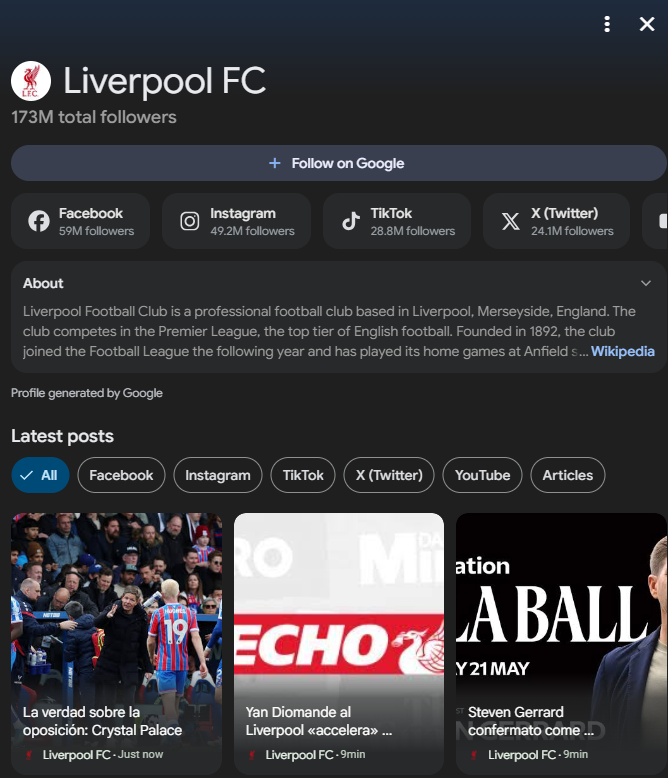
I find it fascinating how Google Discover has evolved with the introduction of publisher profiles and follow features. These profiles have started making waves, yet they remain a bit enigmatic due to limited documentation.
More publishers, creators, and social-first accounts are now visible through these profiles. Let me take you through how these profiles work, how they connect with social accounts and the Knowledge Graph, and why some publishers already enjoy enhanced customization features.
As a technical SEO enthusiast, I’m quite accustomed to Google glossing over details in their documentation. And with Discover publisher profiles, that mystery deepens.
Google barely mentions these profiles in their official Discover documentation, though they seem to play an increasingly significant role in the visibility of publishers and creators.
It’s intriguing to see how Discover profiles let users manage the publishers they follow while gathering content from various websites and social platforms.
Because Google has been reticent about the inner workings of these profiles, I’ve taken upon myself to study their patterns across different accounts. Here’s what I’ve noticed about:
Google rolled out substantial updates to Discover in September 2025, vastly altering how we engage with content through publisher follows and profile pages.
The update granted publishers dedicated landing pages for content aggregation, offering users a streamlined way to interact with preferred publishers and seamlessly integrating social content into Discover.
The most eye-catching aspect of this update is how it empowers users to have greater control over publisher visibility while enabling brands to reach their audience more effectively.
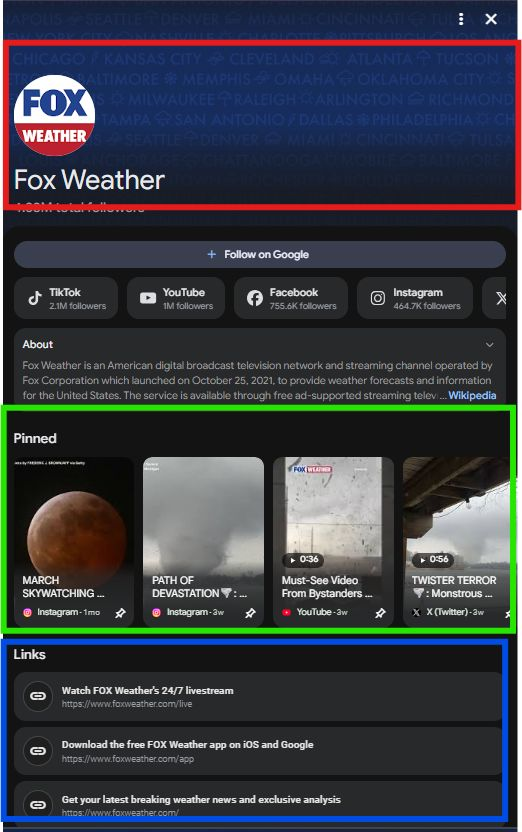
Publishers can’t typically alter the layout of these pages, but some recently gained access to customize their profiles, an option part of a limited beta test.
Common to most publisher profiles are features like a profile photo, usually sourced from the Knowledge Graph or a YouTube profile, which also counts total social followers, and integrates various social media handles.
The social connections catered to include platforms like YouTube, TikTok, Instagram, Facebook, X, and LinkedIn. The ‘About’ section is succinct, often derived from a Wikipedia entry or something similar.
Some editable profiles offer additional features like customized banners, pinned posts, and external links that could direct users to apps or livestreams, further enhancing content reach.
There are two main types of Discover publisher profiles: ones for entities with websites and others solely focused on social media publishers.
Web-focused publishers’ profiles tend to be more comprehensive, often including the About section, logos, social accounts, and website links—although social links might sometimes need a manual push to be included.
On the other hand, profiles for social media publishers focus on prominent journalists, notable figures, and those solely identifiable through social media.
These profiles are generally less complete unless they are tied to a Knowledge Graph, missing elements like profile pictures or descriptions, frequently needing aid from connected YouTube accounts for better appearance.
Looking forward, I anticipate Google may broaden access to these editable profiles, though I suspect customization will remain selective, likely reserved for well-established publishers and creators.
Struggling with maintaining brand consistency? I’ve learned that it’s not about having more tools, but rather having the right tools, perfectly aligned with your brand’s goals.
I’ve seen marketing teams overwhelmed with tools. The average B2B company might use up to 20 different martech solutions. Despite this, keeping brand consistency at scale can be tough. Fewer than 10% of brands manage to maintain strong cohesiveness across all products and channels. The core issue? Tools rarely work in harmony to support a unified brand experience.
Managing a brand across various channels, whether through campaigns or social media, can lead to brand elements drifting. It’s those small inconsistencies—a slightly off-color logo here, outdated messaging there—that can gradually erode the hard-earned brand equity.
The solution isn’t about increasing the number of tools. It’s about selecting the right ones and arranging them with deliberate intention.
Start with strategy, then stack
Before diving into an audit of your current software or seeking out new options, it’s crucial to develop a framework for what brand equity means to your organization. David Aaker’s brand equity model—which focuses on loyalty, awareness, perceived quality, and brand associations—is a sound approach. It transforms brand management into a sustainable growth strategy. In terms of a martech stack, this means utilizing tools that both build and protect your brand.
On the strategy side, platforms like Notion, Miro, and Lucidchart are invaluable. They help document positioning, define messaging, and map out customer journeys. These may not be glamorous, but they provide the solid foundation for successful execution. Without such a framework, design and content teams are left guessing.
The core of the stack: Digital asset management
If there’s one tool that differentiates a cohesive brand management stack from fragmented apps, it’s digital asset management (DAM). Unlike typical cloud storage services such as Google Drive or Dropbox, a DAM solution organizes and governs brand assets comprehensively, offering features like approval workflows and version management that cloud storage lacks.
Consistent branding can increase revenue by 10–20%, and a DAM provides the structure needed to maintain this consistency at scale. By ensuring all team members and partners access the same approved asset library, you eliminate brand drift.
Modern DAMs further simplify brand management by integrating AI to speed up content discovery and automated metadata tagging, reducing creative bottlenecks and accelerating go-to-market timelines.
Execution tools that reinforce brand standards
Apart from DAM, execution tools are essential for converting brand strategy into consistent published content. Depending on your team, Adobe Creative Cloud, Figma, or Canva can be used. They offer varying degrees of design flexibility and guardrails to maintain brand standards.
Balancing creativity with adherence to brand guidelines is key. Tools with brand templating features allow teams autonomy while ensuring brand consistency. Alternatively, using brand templates within your DAM offers greater control and tracking capabilities.
For social media and content distribution, platforms like Hootsuite and HubSpot ensure cohesive publishing across channels. It’s crucial these tools connect to your DAM to guarantee only brand-approved content is shared widely.
SEO tools like SEMrush and Ahrefs help reinforce your brand’s voice and authority online. In today’s market, where SEO extends to geo-targeting, it’s vital to ensure your brand is accurately represented from the start of customer interaction.
Governance closes the loop
A martech stack without governance is simply a mix of tools. Governance—including approval workflows and brand monitoring—is what makes your stack effective and protective.
Incorporating workflow tools into project management or your DAM ensures faster and accountable proofing cycles. Tools like Mention help track external brand perception, highlighting areas of potential drift before they escalate.
The takeaway
The aim of a streamlined brand management martech stack is not complexity but efficiency. It should empower any team member or partner to access and create on-brand content swiftly, independently, and without needing constant design team input.
This requires a strategic approach, a robust DAM as the central hub, integration with execution tools, and governance practices that uphold standards. When these elements work together, your brand transforms from a reactive endeavor to a proactive tool for long-term success.
You have rankings moving, traffic shifting, AI citations appearing, and a backlog of SEO changes waiting to ship. The hard question is not what changed. It is whether your work caused the movement, whether the result mattered, and whether you can expect it to continue.
You can answer those questions with a practical measurement system: define the decision first, preserve a credible baseline, compare the change with a counterfactual, and keep observed results separate from forecast assumptions. That structure turns SEO reporting into evidence you can use to decide what to scale, stop, or test next.
Start with the decision your measurement must support
Do not begin with the dashboard. Begin with the decision someone will make after seeing the result. A useful measurement question has this form: If we make a defined change to an eligible group of pages, will a named outcome improve relative to what would otherwise have happened, without damaging an important guardrail?
That sentence forces you to specify the intervention, population, outcome, comparison, and downside. Compare it with a vague objective such as increasing SEO visibility. Visibility could mean impressions, rankings, citations, share of authority, clicks, or sessions. Those metrics describe different stages of performance and cannot substitute for one another.
Measurement layer
Question it answers
Useful metrics
What it cannot establish alone
Delivery
Did the intended change reach the intended pages?
Eligible URLs changed, crawl access, index status, template or component deployment
Whether the change improved performance
Search exposure
Did search or an AI system surface the content more often?
Impressions, ranking distribution, page citations, share of authority
Whether people visited or completed a valuable action
Did the visits produce the result the organization needs?
Conversions, qualified leads, subscriptions, or revenue when reliably tracked
Which SEO change caused the result without a comparison
Choose one primary outcome for the decision. Use the remaining metrics as diagnostics or guardrails. If the decision is whether to expand a content update, organic clicks or qualified conversions may be primary while rankings explain how the result occurred. If the objective is inclusion in AI-generated answers, citations may be primary while referral sessions and conversions reveal the downstream value.
Write a measurement contract before deployment
A short measurement contract prevents the definition of success from changing after the numbers arrive. Record the following before implementation:
Hypothesis: the mechanism you expect the change to affect and the observable result that should follow.
Eligible population: the pages, query groups, markets, devices, or templates to which the conclusion may apply.
Intervention: the exact content, technical, linking, visual, or markup change being tested.
Primary metric: the outcome that determines the decision.
Diagnostics and guardrails: the metrics that explain the result or reveal an unacceptable tradeoff.
Comparison method: randomized pages, matched pages, a staged rollout, or a forecasted baseline.
Analysis window: when measurement starts, when it ends, and how delayed implementation or incomplete indexing will be handled.
Decision rule: the minimum result that would justify scaling, the conditions that would stop the rollout, and what will count as inconclusive.
Exclusions: rules for removing pages affected by outages, migrations, tracking failures, or unrelated changes.
Define ratios as carefully as totals. A rising click-through rate can reflect more clicks, fewer impressions, or a change in query mix. An increasing AI referral share can reflect more AI sessions, fewer total sessions, or both. Always report the numerator and denominator beside an important rate.
The unit of analysis matters too. A sitewide total may be dominated by a few large pages, while a per-page average can hide the total commercial impact. Report the aggregate effect and the distribution across eligible pages. That lets you see both the overall contribution and how consistently the intervention worked.
Design SEO experiments around a believable counterfactual
A before-and-after chart shows that performance changed after deployment. It does not show what would have happened without the deployment. Search demand, seasonality, competitors, search features, algorithmic changes, and the natural trajectory of the pages all continue moving while your test runs.
The counterfactual is your estimate of that missing outcome. The more believable it is, the more confidently you can attribute the difference to your intervention.
Use the strongest comparison your site can support
Randomized page split: use this when you have many comparable pages. Define the eligible set, then randomly assign pages to changed and unchanged groups. Randomization reduces systematic differences between the groups.
Matched pages: pair pages using pre-test traffic, trend, intent, template, topic, and other relevant characteristics. Apply the change to one member of each pair. Matching is weaker than randomization but stronger than choosing a convenient control after the result appears.
Staged rollout: release the intervention in waves. Pages scheduled for later waves can temporarily represent what would have happened without the change, provided the waves are genuinely comparable.
Interrupted time series: use this when a sitewide change leaves no parallel control. Model the pre-change trajectory, forecast the no-change baseline through the post-change period, and compare actual performance with that baseline. Treat the causal conclusion more cautiously because other events can coincide with deployment.
Do not assign the strongest pages to the treatment group merely because they appear most likely to win. That creates a built-in difference between treatment and control. If page strength is important, divide the eligible pages into comparable strength bands first and randomize or match within each band.
Prewrite the analysis, not just the hypothesis
Freeze the eligible page list before looking at post-change performance.
Save the pre-period data at the same grain you will analyze later, including page, query group, device, market, and outcome where relevant.
Check whether treatment and comparison groups have similar pre-period levels and trends. If they do not, repair the design before deployment.
Estimate whether the eligible population can distinguish a worthwhile effect from ordinary variation. If it cannot, combine appropriate pages, extend the observation window, or treat the test as exploratory.
Deploy only the defined intervention. Log unavoidable concurrent changes instead of silently folding them into the result.
Apply the predetermined inclusion, exclusion, and timing rules.
Calculate the effect for the full eligible population before exploring subgroups.
Report total impact, page-level variation, uncertainty, and any guardrail movement together.
For a simple comparison of aggregated traffic, calculate each group’s relative change first: test change = test after / test before – 1, and control change = control after / control before – 1. The difference between those changes is an estimate of incremental lift. For rates such as click-through or conversion rate, retain the underlying counts and use a method appropriate to a rate rather than treating the percentages as independent totals.
This calculation is not a substitute for checking pre-period trends, uncertainty, or contamination. It simply makes the causal question explicit: did the changed pages improve more than comparable unchanged pages over the same period?
Match the intervention to the page’s actual bottleneck
A six-month test across 47 new and existing articles evaluated featured images, infographics, and videos. Articles receiving infographics recorded a 110% average organic traffic increase, but the gains were associated with pages that were already performing well. The custom visuals did not reliably revive struggling content.
That result is useful evidence for forming a hypothesis, not a universal forecast for every site. A visual asset can strengthen a page whose topic, search demand, and core content already work. It is unlikely to repair the wrong search intent, weak topic demand, poor indexability, or a page that does not answer the query.
Segment visual tests by pre-period page strength before deployment. If strong and weak pages respond differently, you will know where production investment is likely to pay back. If you create those segments only after seeing the outcome, label the finding exploratory and confirm it in another test.
Interpret movement without mistaking it for causation
An SEO result becomes more credible when the movement follows the mechanism you predicted. If you improved titles to earn more clicks, you would expect the main change to appear in click-through rate among relevant impressions. If impressions rise because the page begins appearing for additional queries, query coverage is part of the mechanism. If conversions rise while search exposure and visits remain flat, the explanation probably sits elsewhere.
Observed pattern
Reasonable interpretation
Next check
Impressions rise while ranking distribution is stable
Demand or query coverage may have expanded
Compare query mix, branded versus non-branded exposure, markets, and devices
Rankings improve while clicks remain flat
The improved positions may have little demand or may not be earning clicks
Inspect impressions, result-page features, snippets, and query-level click-through rate
Organic clicks rise while conversions remain flat
The additional traffic may have different intent or the onsite path may be limiting value
Compare landing pages, query groups, conversion definitions, and the numerator and denominator of the conversion rate
Citations rise while AI referrals remain flat
AI exposure improved without producing measurable visits
Check cited pages, grounding queries, referral tagging, and whether a visit was expected from the answer type
AI referral share rises while AI session count is flat
The denominator may have fallen
Report AI-referred sessions and total sessions separately
Only a few large pages account for the gain
The intervention may be valuable but not broadly repeatable
Report total contribution and the page-level distribution instead of one average
Audit alternative explanations before declaring a win
Seasonality: did the topic normally rise during this part of the demand cycle?
Query mix: did exposure shift toward branded, navigational, or otherwise different searches?
Page mix: did new, removed, redirected, or newly indexed URLs change the population being measured?
Tracking: did consent behavior, channel classification, event definitions, or referral detection change?
Concurrent releases: did internal links, templates, site speed, navigation, paid promotion, or other content updates change at the same time?
External search changes: did competitors, result-page features, or the retrieval behavior of an AI platform change during the measurement window?
Contamination: could treatment pages affect control pages through internal linking, shared templates, or overlapping queries?
A change ledger makes this audit possible. Record deployments, migrations, tracking changes, major content releases, and known incidents against the same timeline as the test. An unexplained spike is much harder to interpret months later, when the people reviewing it no longer remember what shipped.
Separate positive, negative, and inconclusive results
Decision-useful positive: the estimated lift clears the minimum worthwhile effect, uncertainty is acceptable, guardrails are intact, and the causal chain is plausible.
Decision-useful negative: the result is precise enough to rule out a worthwhile gain or shows a meaningful downside. This can justify stopping or redesigning the intervention.
Inconclusive: the estimate is too uncertain, the groups were not comparable, implementation was incomplete, or confounding prevents a clear decision. Inconclusive does not mean the intervention had no effect.
Define the minimum worthwhile effect from the decision, not from whichever result looks favorable. Include production cost, maintenance burden, the amount of eligible traffic, and the opportunity cost of delaying other work. Statistical evidence can tell you whether an effect is distinguishable from variation; it cannot decide whether the effect is worth implementing.
Treat unplanned subgroup findings carefully. If a result appears only after repeatedly slicing by device, market, template, intent, or page type, it may be a useful lead. It is not yet a reliable scaling rule. Put the suspected interaction into the next measurement contract and test it deliberately.
Forecast the no-change baseline before adding SEO upside
A useful SEO forecast begins with a less exciting question: what is likely to happen if the proposed work produces no incremental gain? That no-change baseline separates expected demand, existing momentum, and seasonality from the contribution you hope to create.
Forecasting only the desired outcome bakes the business target into the model. A target tells you what the organization wants. A forecast estimates what the available evidence supports. Keep both, but never label one as the other.
Build and validate the baseline in a fixed sequence
Choose the target series. Forecast the metric that supports the decision, such as organic clicks, eligible-page sessions, AI-referred sessions, or qualified conversions. Do not forecast rankings and silently translate them into revenue.
Choose a stable grain. Use a consistent time cadence and a page, query, template, or market grouping with enough signal to model. Group a noisy long tail by a defensible shared characteristic instead of pretending every URL has an independent, stable trajectory.
Set the cutoff. Train the baseline only on information available before the forecast begins. Do not let post-launch observations leak into a supposedly independent no-change forecast.
Model the existing pattern. Account for trend and recurring seasonality that are visible in the historical series. Add known events only when they are defined independently of the result you are trying to explain.
Backtest at the decision horizon. Move the cutoff backward, generate forecasts for periods whose actual outcomes are already known, and measure the errors. Compare the model with a simple benchmark such as the most relevant prior pattern.
Produce an interval. Show a plausible range around the baseline, not only a point estimate. The interval should generally reflect the larger uncertainty that accompanies a longer horizon.
Add scenarios outside the baseline. Apply tested lift only to the pages, queries, or markets eligible for the intervention. Keep unvalidated assumptions visibly separate.
Reconcile and monitor. Make sure cohort forecasts add up to the site-level view, then compare actuals with the frozen baseline and its interval as data arrives.
When the series has non-linear trends or recurring seasonal structure, a model such as Prophet can support non-linear SEO forecasting. The model name is not the quality test. Use it only if backtesting shows that it handles your series better than a simpler benchmark at the horizon you need.
A sophisticated model cannot automatically understand a migration, tracking break, search-feature change, one-off campaign, or abrupt shift in content supply. Annotate structural breaks, test their effect on forecast error, and explain any manual treatment. Otherwise, the model may faithfully project a historical artifact that no longer applies.
Keep baseline, committed work, and upside hypotheses separate
Forecast layer
What belongs in it
How to use it
Baseline
Expected performance from existing trajectory, recurring seasonality, and independently known conditions
Represents the no-incremental-lift comparison
Committed scenario
Baseline plus changes already approved or deployed, using effects supported by relevant evidence
Supports operational planning while preserving the assumptions
Upside scenario
Baseline plus interventions whose lift is plausible but not yet validated for the eligible population
Shows opportunity without presenting aspiration as evidence
A transparent scenario calculation can be simple: incremental outcome = eligible baseline volume x validated lift x rollout coverage. Each term must refer to the same population and period. If a test covered high-performing educational pages, do not apply its lift to product pages, weak pages, or the entire domain without new evidence.
Forecast traffic and business outcomes as connected but separate stages. If you forecast conversions, state how forecast visits become forecast conversions and whether conversion rates differ by landing-page type, query intent, market, or device. A sitewide conversion rate can overstate the outcome when the forecast changes the traffic mix.
When actual performance leaves the forecast interval, investigate before rewriting the baseline. The deviation may be genuine incremental lift, but it may also be a demand shock, tracking failure, structural break, or model miss. Preserve the original forecast so the organization can learn how accurate its assumptions were.
Measure AI visibility as a funnel, not a composite score
AI visibility adds useful observations to SEO measurement, but it does not collapse the measurement chain. A citation is exposure. An AI-referred session is a visit. An onsite conversion is an outcome. Combining them into one score conceals where performance actually changed.
Microsoft Clarity’s generally available Citations dashboard reports page citations, share of authority, AI referral traffic, grounding queries, cited pages, and citation trendlines. Google Analytics also provides AI assistant traffic reporting. These measurements help you connect AI-generated answers with site activity, provided you preserve the distinctions between them.
AI measurement
What it tells you
Common misreading
Better reporting practice
Page citations
How often pages from your domain were referenced in AI-generated answers during the selected period, including multiple citations within one answer
Treating citation count as unique answers, users, or visits
Report citations by cited URL and grounding query, and keep referral sessions separate
Share of authority
Your domain’s citations relative to other domains for the same query set
Reading the share as coverage of the entire market
Preserve the query set and report your citation count beside the competitive share
AI referral traffic
AI-referred sessions divided by total sessions during the selected period
Assuming a rising percentage always means more AI visits
Show AI-referred sessions, total sessions, and the resulting percentage together
Grounding queries
The queries associated with how AI systems evaluated or retrieved cited content
Treating every grounding query as a conventional search query typed by a user
Use the queries to analyze interpreted intent and retrieval coverage
Cited pages
Which URLs receive citations and the queries associated with those citations
Assuming an uncited page is weak without considering whether it is eligible for the observed queries
Compare cited and uncited pages within the same intended query and content cohort
Trendlines
How citation activity changes over time
Attributing every change to the latest content release
Compare the trend with a fixed query set, matched pages, release annotations, and referral outcomes
Use an AI-search experiment loop
Define the question or grounding-query set, platform coverage, eligible pages, and business objective before changing content.
Capture baseline citations, cited URLs, competing domains, AI-referred sessions, and onsite outcomes. Use repeated observations when answers and retrieved sources vary between runs.
Create a treatment and comparison cohort using pages that serve comparable intents. If page-level comparison is impossible, stage the rollout or freeze a forecasted baseline.
Make one defined intervention, such as a content clarification, structural improvement, visual addition, internal-link change, or markup update. Verify that it reached every treatment page.
Compare citation counts and share of authority within the same query set. Then check whether any exposure change produced additional AI-referred sessions and valuable onsite actions.
Inspect conventional organic metrics as guardrails. An AI-focused update should not be declared successful if it creates an unacceptable loss elsewhere.
Classify the result as decision-useful positive, decision-useful negative, or inconclusive. Feed validated effects into the relevant forecast cohort rather than the whole domain.
The objective determines where the funnel ends. If the goal is brand representation in AI answers, a citation can be a meaningful outcome even without a click. If the goal is lead generation or sales, citations are a leading signal and referral or conversion performance must carry the decision. State that distinction before reporting the result.
AI metrics also require stable denominators. Share of authority can rise because your citations increased or because competing citations fell. AI referral percentage can rise while AI sessions remain flat if total sessions decline. Retain the component counts so a favorable rate cannot hide an unfavorable underlying movement.
Key takeaways
Define the intervention, eligible population, primary outcome, counterfactual, guardrails, and decision rule before deployment.
Use randomized, matched, staged, or forecast-based comparisons to estimate incremental lift. A before-and-after chart alone does not establish causation.
Report total impact, page-level variation, metric components, uncertainty, and alternative explanations together.
Forecast the no-change baseline first. Add committed and upside scenarios separately, and apply tested lift only to populations the evidence covers.
Keep AI citations, competitive citation share, AI referrals, and onsite outcomes as distinct stages of one measurement chain.
Call weak or confounded evidence inconclusive. Do not turn it into a positive or negative verdict merely to complete a report.
Your next measurement cycle does not need to cover the entire site. Start with one consequential decision and one coherent page cohort. Write the measurement contract, preserve the pre-period data, hold back a valid comparison where possible, ship the defined change, and judge it using the rule you set before seeing the outcome.
If a control is impossible, publish and freeze the no-change forecast before launch. Compare actual performance with its range, investigate deviations, and update future assumptions only after the evidence survives that comparison. That is how SEO reporting becomes a repeatable system for deciding what deserves the next unit of time and budget.
Your law firm has repaired technical issues, improved practice-area pages, and kept publishing. Rankings rose, then leveled off. The tempting response is a larger content calendar. That can deepen the problem if the web still has little independent evidence that your firm and attorneys are credible authorities.
The next job is not simply more SEO. It is to make expertise verifiable, publish material worth citing, and earn corroboration in places you do not control. The framework below helps you identify the authority gap and turn it into a practical queue of work.
Key takeaways
Technical SEO and useful content are foundations, but they cannot manufacture independent credibility.
Authority becomes visible when attorney credentials, firm information, authored content, third-party profiles, and earned mentions tell the same accurate story.
A citable page gives another publisher or an AI-generated answer a distinct, well-supported passage worth referencing.
Relevant editorial mentions matter more than a large collection of weak, unrelated placements.
Measure authority through evidence you can inspect: identity consistency, qualified mentions, citations, referral context, and appearances for a fixed set of priority searches.
Diagnose the authority gap before commissioning more content
Technical SEO and strong content remain necessary. However, law firm growth can plateau when genuine, verifiable credibility is missing. Authority is not a single score that can be raised in isolation. It is the pattern created when your identity, expertise, content, and recognition elsewhere on the web agree.
Start with a digital-footprint audit. Create a working sheet with fields for the query used, result URL, platform or publication, firm or attorney named, claim made, link destination, accuracy, control status, and next action. This turns an abstract authority problem into a list of evidence you can fix, strengthen, or pursue.
Search for the exact firm name, common abbreviations, previous names, and each attorney’s professional name. Combine attorney names with the firm, location, and primary practice focus. Inspect ordinary search results, professional profiles, publisher biographies, local listings, interviews, event pages, and AI-generated answers. Record what a prospective client or search system would encounter without assuming your website is the starting point.
Classify what you find:
Accurate owned evidence: pages and profiles your firm controls and keeps current.
Accurate independent evidence: relevant mentions, citations, interviews, event listings, and professional profiles hosted elsewhere.
Conflicting evidence: outdated titles, previous offices, inconsistent names, broken profile links, or descriptions that no longer match an attorney’s work.
Weak evidence: generic directory pages, duplicated biographies, or mentions with no meaningful connection to the attorney’s expertise.
Missing evidence: important attorneys, credentials, or practice strengths that are clear internally but barely visible outside the firm.
The pattern matters more than the raw count. A firm can have many directory listings and still lack authority if none provides editorial context or confirms meaningful expertise. Conversely, a smaller footprint can be persuasive when relevant organizations identify the attorney clearly and connect that person to a specific area of law.
Do not label every performance problem an authority problem. If an important page cannot be crawled, does not match the searcher’s intent, or competes with another page on your site, fix that first. Authority becomes a plausible constraint when technically sound, useful pages exist but the firm has little accurate recognition beyond its own domain.
Your audit should end with priorities, not observations. Correct identity conflicts before promoting content. Strengthen thin attorney records before asking a publication to rely on them. If recognition clusters around a practice area the firm no longer prioritizes, redirect outreach toward the work that matters commercially.
Make attorney expertise easy to verify
A law firm’s authority is attached to people as much as to the firm itself. A reader should be able to determine who wrote or reviewed a page, what qualifies that person to address the subject, which firm the person represents, and where else that expertise has been recognized.
Build a canonical biography for every attorney who contributes to public-facing content. It should use the attorney’s consistent professional name and state the current role, practice focus, relevant jurisdictions or admissions, education, credentials, leadership positions, speaking work, and publications accurately. Connect the biography to material the attorney wrote or reviewed. If an external profile is important, make sure it points back to the correct current page rather than an obsolete biography or a generic homepage.
Avoid interchangeable biographies. A page that says every attorney is experienced, dedicated, and results-oriented provides little verifiable information. Replace generic praise with supported facts that distinguish the person’s actual work. An attorney’s biography, byline, publisher profile, event description, and professional listing should not tell conflicting versions of the same career.
This is where E-E-A-T becomes useful as a review lens. Experience, expertise, authoritativeness, and trustworthiness are not fields you can fill in or claims you can create with markup. They prompt better questions: Is a real person accountable for the content? Is the claimed expertise visible? Can important credentials be verified? Does the firm’s presence remain consistent across the platforms where people encounter it?
Use JSON-LD to express facts already visible on the page and to connect the attorney, authored material, and firm consistently. Keep identifiers stable and use the same canonical URLs throughout your implementation. Structured data can clarify relationships, but it cannot prove a credential or create reputation. Never place a qualification, award, office, service, or affiliation in markup when the visible page does not support it.
Credential, specialization, testimonial, award, and outcome claims deserve an additional review. A stale or overstated claim can create ethical, regulatory, and reputational exposure. Requirements differ by jurisdiction, so have the firm’s appropriate ethics or compliance reviewer approve those statements before publishing them on pages, profiles, or structured data. Search optimization does not reduce that obligation.
Assign ownership for identity maintenance. Someone should know who updates attorney biographies after role changes, who corrects external profiles, and who checks that new bylines use the canonical identity. Without ownership, small inconsistencies accumulate until the web describes several slightly different versions of the same person.
Turn practice knowledge into material others can cite
An indexable page is accessible to a search system. A citable page gives another publisher, professional, or answer system a specific reason to use it as support. That difference should change your editorial brief. The goal is not another page about a broad keyword; it is a reliable contribution that adds something identifiable to the available information.
Prioritizing citable material over content produced merely to be indexed means asking what another person could responsibly reference. Useful formats include a jurisdiction-scoped explanation of a recurring procedural question, a decision aid that distinguishes commonly confused options, a practical checklist reviewed by a named attorney, a plain-language explanation of a legal development, or an analysis of public information with a transparent method.
Use the following editorial test before approving a page:
Distinct question: The page resolves a real question instead of paraphrasing a broad topic already covered elsewhere on the site.
Clear answer: The reader can find the central answer near the beginning, with qualifications added where they matter.
Defined scope: The relevant jurisdiction, audience, assumptions, and limits are explicit.
Accountable expertise: A named attorney wrote or reviewed the material, and the byline connects to a complete biography.
Support: Important factual and legal claims point to suitable primary legal materials or other appropriate evidence.
Original utility: The page contains a useful distinction, framework, checklist, interpretation, or method rather than generic prose.
Maintenance: An owner is responsible for reviewing the page when the law, procedure, attorney, or firm information changes.
Write passages that remain understandable when separated from the surrounding page. Give each section a descriptive heading, answer the stated question directly, and keep the necessary qualification beside the answer. This makes the page easier for a person to scan and gives AI-generated answers less room to detach a conclusion from its jurisdiction or conditions.
Do not confuse extractability with oversimplification. A concise answer can still state that an outcome depends on facts, venue, or procedure. If removing a qualification would make the answer misleading, keep it in the same paragraph rather than burying it in a general disclaimer.
Review the existing library before expanding it. Identify pages with strong subject matter but weak authorship, vague scope, or no reason to cite them. Upgrade those assets first. If several pages repeat the same intent, consider consolidating them into a stronger resource, but inspect existing links, referrals, and search value before changing URLs. Preserve useful destinations with an appropriate redirect when consolidation is justified.
Case-based insight needs special care. Do not expose confidential information, imply a typical outcome from an exceptional matter, or turn a result into an unsupported promise. Obtain the necessary internal approval and follow the professional rules that apply to the firm before using client matters, testimonials, or outcomes as authority evidence.
Earn outside corroboration, then measure the evidence
Your website can claim expertise. Independent recognition helps corroborate it. That recognition may take the form of a relevant citation, an attorney contribution, an interview, a professional event, a community role, or a publisher biography that clearly connects a person to the subject.
Build an outreach map from genuine relationships and audience overlap. Consider legal and professional publications, organizations connected to the industries your firm serves, educational institutions, reputable local organizations, event producers, and journalists who cover the relevant issues. Prioritize editorial standards, topical relevance, and accurate identification of the attorney. A contextual mention for the right audience can be more useful than an unrelated placement obtained only for a link.
Give outreach a concrete purpose. Offer a well-scoped explanation, a named attorney who can address a defined question, a citable resource, or an informed contribution to an existing discussion. Generic requests for a backlink give the recipient no editorial reason to act. Meaningful digital PR and participation in the legal community work because they create legitimate connections between expertise, people, and publications.
For each opportunity, prepare the canonical attorney name, current title, concise subject-specific biography, correct firm URL, relevant biography URL, and strongest supporting asset. After publication, check that names, roles, links, and claims are accurate. Request corrections when necessary, and add the result to the firm’s footprint inventory.
Avoid placements whose only apparent purpose is manipulating ranking signals. Do not manufacture awards, trade unrelated links, buy opaque editorial recognition, or distribute the same thin biography across low-quality sites. These tactics create a brittle footprint and can undermine the credibility you intended to build.
Measure authority with an evidence log rather than a single vendor score. Record the asset or attorney involved, external URL, publication or organization, practice relevance, linked or unlinked status, description accuracy, referral activity, and any qualified enquiry or professional relationship connected to the placement. The context of the mention matters, so retain enough detail to distinguish substantive recognition from a name in a list.
Separate leading evidence from validation and business outcomes:
Leading evidence: corrected identity conflicts, complete attorney records, upgraded citable assets, relevant outreach, and accepted contributions.
External validation: accurate mentions, citations, interviews, event profiles, professional references, referral visits, and greater visibility for priority subjects.
Business outcomes: qualified consultations, professional referrals, and matters connected to the practices the authority program supports.
For AI visibility, maintain a fixed set of representative questions tied to your priority practices and markets. Capture the exact question, date, answer, cited domains, firm mentions, attorney mentions, and any material inaccuracies. Repeat the same checks at a regular cadence. Individual AI-generated answers can vary, so look for a pattern across repeated observations rather than treating a single appearance or omission as proof.
No isolated metric establishes causation. A new mention does not prove that it moved a ranking, and an AI citation does not by itself establish business value. The useful question is whether independent, accurate evidence is becoming denser around the attorneys, subjects, and markets the firm has chosen to own.
Begin with the practice area that matters most. Audit the names and claims surrounding it, repair the canonical attorney records, strengthen the best existing resource, and take that resource to relevant editorial and professional contacts. When each cycle leaves another accurate, independent trace of expertise, your firm is building an asset that a larger publishing schedule cannot imitate.
If several 2026 rankings have left you with several different best agencies, the rankings aren’t necessarily contradictory. Each one reflects a different candidate pool, industry context and definition of fit. Your job is not to accept the published order. It is to decide whether the order still holds for your business.
Use industry rankings to discover credible candidates, then re-rank those candidates around your search demand, operating constraints and commercial risk. The process below gives you a defensible way to do that without turning agency selection into a contest between sales presentations.
Rankings help you discover candidates, not declare a universal winner
An agency’s position is conditional. It depends on which firms entered the evaluation, which criteria were used, how those criteria were weighted and when the underlying information was checked. A first-place agency for a luxury fashion brand does not automatically become the best choice for a biotech platform, regional med spa or international logistics provider.
Can it protect scientific accuracy while making complex concepts discoverable to distinct audiences?
Those pool sizes show the breadth of consideration, but they are not confidence scores. Fashion does not have a more reliable winner merely because its candidate field was larger than the med-spa field. The pool may be larger because the market contains more plausible candidates, because the inclusion criteria differ or because relevant experience is defined differently.
The luxury-brand condition also narrows what the fashion evidence means. It can be highly relevant when premium positioning, controlled language and brand presentation are central to the assignment. It may be less diagnostic for a discount marketplace, an apparel manufacturer selling through distributors or a retailer whose primary problem is managing a large and frequently changing catalog.
Freshness deserves the same care. The biotech field looks ahead to 2026 but carries a May 14, 2025 update date. That does not prove any position is wrong. It does mean you should verify the agency’s current team, client mix, conflicts, service scope and technical capabilities before treating its rank as current.
Do not average positions across different industry rankings or treat them as if they came from one league table. Start with the vertical closest to your business model. If your company spans verticals, identify the harder search problem and use that as the primary filter. A biotech logistics provider, for example, may need scientific governance and supply-chain demand generation; neither label alone establishes fit.
Real industry specialization changes how the agency works
Industry logos are weak evidence on their own. Specialization becomes meaningful when it changes discovery, keyword and entity research, website architecture, content approval, measurement and reporting. Ask candidates to show how their process changes for your vertical rather than merely showing that they recognize its vocabulary.
Logistics and supply chain: test the commercial architecture
A logistics website may need to organize demand by service, geography, shipment or operational problem, customer industry and buying role. Those dimensions can overlap. Publishing a page for every possible combination creates duplication; collapsing everything into broad service pages can hide the specific expertise a buyer is trying to find.
Give the agency a representative service line and ask it to sketch the path from search query to qualified inquiry. The answer should cover page hierarchy, supporting content, internal links, proof, conversion language and how irrelevant leads will be screened out. If the response jumps immediately to a calendar of generic thought-leadership topics, the commercial model has been skipped.
Also listen for the way the team handles operational terminology. It should be able to preserve the language practitioners use while explaining the offering clearly enough for procurement, finance or leadership. Replacing precise terminology with high-volume but poorly matched phrases can increase visibility while reducing lead quality.
Fashion: test catalog mechanics and brand restraint
Fashion SEO sits at the intersection of brand presentation, product discovery, merchandising and technical catalog management. Category pages, product pages, editorial content and seasonal collections can compete with one another if their roles are not clearly defined. Changes in inventory can also leave valuable internal links pointing toward thin, unavailable or retired destinations.
Ask the agency to choose a representative category and explain what it would optimize, what it would preserve and why. For a transactional site, the response should address indexation, canonical choices, filters, internal linking, product availability and structured data alongside copy. It should also identify where search-led wording would damage the brand rather than assuming every available keyword belongs on the page.
Luxury-brand experience is most useful when your own positioning requires similar restraint. If your growth model depends on frequent promotions, marketplace visibility or a broad value-oriented catalog, ask for evidence from that operating model rather than accepting prestige logos as a substitute.
Med spas: test local intent and content governance
Med-spa discovery is often both local and treatment-specific. A candidate therefore needs to connect location information, service detail, practitioner or facility trust signals, reviews and conversion paths without manufacturing interchangeable city pages. A page that merely swaps place names is not a local strategy.
Ask the team to walk through a treatment page from query selection to publication. Who verifies medical or treatment-related statements? How are candidacy, limitations and expected outcomes described without drifting into unsupported promises? How do local pages differ when locations offer different services or have different staff? The agency does not need to make clinical decisions, but it does need a workflow that routes health-related claims to an appropriate reviewer.
Measurement should reach beyond local rankings. Define what happens after a visitor arrives: a call, consultation request, booking or another meaningful action. Then establish how your team will feed appointment quality and service-line value back into SEO decisions. Otherwise, attractive traffic reports can conceal low-value inquiries.
Biotech: test scientific review and entity consistency
Biotech content has to preserve scientific precision while serving readers with different levels of technical knowledge. Researchers, prospective partners, buyers and investors may look for different answers even when they use overlapping terminology. Treating them as one audience usually produces pages that are dense but directionless.
Ask who translates the search opportunity into a technical brief, who reviews scientific statements and how corrections propagate across the site. The agency should be able to keep platform names, indications, mechanisms, development stages and organizational relationships consistent across navigation, page copy, metadata and structured data where structured data is appropriate.
Then ask how old claims are retired. Updating one prominent page is not enough when an outdated statement remains in an executive biography, resource page, downloadable asset or schema implementation. A credible workflow includes an inventory of dependent content and a named approval path.
If an agency gives essentially the same answer for every vertical after swapping industry nouns, its specialization is surface-deep. The strongest signal is not familiarity with jargon. It is an operating model built around the consequences of getting the content, architecture or measurement wrong.
Build your own decision matrix before requesting proposals
Agencies cannot respond comparably when each one receives a different version of the assignment. Prepare a short brief before outreach. Include your priority offerings, markets, audiences, primary conversion, current platform, internal implementation resources, approval constraints and known measurement gaps. State whether you need strategy only, production, technical implementation or an accountable combination.
Send the same brief to every candidate and evaluate each response as pass, concern or fail against the same matrix. Do not turn the labels into a mechanical total. A failure involving data ownership, claim approval or an undisclosed conflict can outweigh several softer passes.
Criterion
A pass looks like
A warning looks like
Business-model fit
The team maps SEO activity to your actual offering, buyer, market and conversion path.
The strategy would work only if your business behaved like a different client shown in the pitch.
Evidence quality
Examples identify the starting problem, work performed, relevant outcome and agency’s actual scope.
Charts lack context, screenshots have no meaningful baseline, or credit is claimed for work performed by others.
Industry workflow
Research and approval steps reflect your terminology, risk level, internal experts and publishing constraints.
Specialization is supported mainly by client logos and generic claims about understanding the audience.
Technical depth
The agency connects crawling, indexation, rendering, templates, internal links and structured data to specific site problems.
A standard audit is presented as the strategy, with no explanation of who will implement or validate changes.
Content operations
Briefing, subject-matter review, editing, approval, updating and retirement all have clear owners.
The proposal promises content volume without explaining accuracy control, differentiation or maintenance.
AI discovery
The team explains how entity clarity, answerable content, supporting evidence, crawlability, internal relationships and schema fit together, while acknowledging measurement limits.
It guarantees placement in AI answers or treats GEO and AEO as labels for producing more generic copy.
Measurement
Primary conversions, diagnostic metrics, lead quality and reporting decisions are defined before work begins.
Success is reduced to traffic, impressions, keyword counts or a proprietary score that cannot be reconciled with business outcomes.
Commercial safety
Account access, content and data ownership, subcontracting, change control, cancellation and transition duties are explicit.
The agency controls essential assets, avoids documenting handoff obligations or leaves implementation costs outside an apparently complete fee.
AI visibility deserves particular scrutiny in a 2026 selection. An agency should distinguish conventional search performance from appearances in answer engines or model-generated responses. It should also explain which observations are reproducible, which depend on prompts or platforms and which cannot be attributed cleanly. A polished AI dashboard is not useful if nobody can explain what its metrics mean or what decision will change when they move.
Ask how structured data fits the plan, but do not accept schema volume as a goal. Markup should represent the visible content and the entities the page actually describes. It cannot repair vague positioning, unsupported claims, inaccessible pages or contradictory facts elsewhere on the site.
Set hard stops before presentations begin. Ranking guarantees, refusal to provide access to your own accounts, undisclosed subcontracting, publication without required review and ambiguous ownership of your domain, analytics or content all deserve resolution before a contract is signed. If a candidate will not resolve them in writing, remove it from the shortlist.
Test the agency’s thinking with a real working session
Presentation fluency can hide weak diagnosis. Give every finalist the same bounded working exercise using a real part of your site. You are not asking for a free strategy. You are testing how the team frames a problem, handles missing information and converts analysis into an implementable decision.
Select a representative service, category, treatment or platform page tied to a meaningful conversion.
Provide the same business context, technical constraints and available performance information to each finalist.
Ask the team to identify search intent, relevant entities, architectural issues, content gaps, proof requirements and conversion friction.
Require prioritization. Each recommendation should identify its expected role, dependencies, implementation owner and validation method.
Ask what the team still does not know and how it would obtain the missing information after kickoff.
A strong response distinguishes evidence from assumption. It may decline to estimate an outcome until analytics, indexation, competition or lead-quality data has been checked. That is disciplined diagnosis, not evasiveness. A weak response manufactures certainty, reaches for a familiar tactic before establishing the problem or produces a long backlog with no decision logic.
Pay attention to who attends. If senior specialists lead the sale, ask who will conduct discovery, write briefs, review technical recommendations and join reporting meetings after signature. Request the names or roles of the delivery team and clarify how substitutions are handled. Industry experience held only by an executive who disappears after the pitch will not improve day-to-day work.
Reference calls are most useful when you ask about operating behavior rather than general satisfaction. Ask what the agency actually owned, what delayed the work, how disagreements were resolved, whether senior involvement changed after the sale, how reporting affected decisions and what happened when a recommendation or published claim was wrong. A reference chosen by the agency will naturally be favorable, but precise process questions can still reveal the conditions behind the success.
Read the final contract against the proposal and your matrix. Confirm deliverable definitions, implementation responsibilities, approval timing, account access, data and content ownership, use of third parties, change control, cancellation and transition support. A vague exit clause can turn an ordinary mismatch into an expensive migration, so resolve the handoff before work starts rather than after the relationship has deteriorated.
Finally, name an internal owner. Even a capable specialist agency cannot approve scientific claims, supply merchandising decisions, verify service availability or judge lead quality without your team. The contract should make that dependency visible instead of allowing delays to become a recurring dispute about who was waiting for whom.
Key takeaways
An industry ranking is a candidate-discovery tool, not a transferable verdict about the best agency for every company in that vertical.
Verify freshness, current team composition, relevant client work, conflicts and service scope before relying on any 2026 position.
Real specialization changes architecture, content review, technical execution and measurement; industry logos alone do not establish it.
Compare candidates against the same written brief and use hard stops for ownership, approvals, access, conflicts and unsupported guarantees.
Use a real working session to test prioritization, assumptions and implementation thinking before you sign.
Your next move is concrete: open the ranking closest to your operating model, create a small candidate set, run freshness and conflict checks, and send every remaining agency the same brief. Choose the team that makes dependencies, uncertainty and commercial risk visible while showing how it will solve your particular search problem. That is a stronger basis for a 2026 decision than the number beside an agency’s name.
Your crawler has produced a wall of red warnings. A stakeholder has forwarded an AI-generated SEO audit. Developers want to know what actually needs to ship, while leadership wants to know whether any of it will affect traffic, leads, or revenue.
Your job is not to defend the audit or clear every warning. It is to turn uncertain technical findings into a short, defensible queue of business decisions. That requires two disciplines: ranking recommendations by likely impact and explaining them in language each decision-maker can use.
Stop letting the audit tool set your roadmap
An audit tool can identify a rule violation. It cannot decide how much that violation matters to your business. Its severity label usually describes technical conformity, not the value of the affected pages, the strength of the evidence, or the opportunity cost of assigning developers to the fix.
That distinction matters because a site can have hundreds of reported issues without hundreds of worthwhile projects. A buried 404 that receives no meaningful traffic, blocks no journey, and has no useful backlinks may be noise. A small internal-linking or canonical problem across commercially important category pages may deserve attention even if the audit interface gives it a less alarming label.
Treat every crawler finding as a lead to investigate, not an instruction to implement. Before it enters the roadmap, make it pass these tests:
Verify the condition. Reproduce it on representative URLs. Check whether the crawler saw the current page, the intended response, and the rendered state rather than a temporary or obsolete condition.
Identify the affected surface. Determine whether the problem touches an isolated URL, a reusable template, a key directory, or a sitewide component. A long URL list may represent one template defect; a short list may contain the business’s most valuable landing pages.
Explain the search mechanism. State whether the issue can interfere with discovery, crawling, rendering, indexing, canonical selection, internal authority flow, or the user journey. If you cannot describe a plausible mechanism, you do not yet have an SEO recommendation.
Connect the surface to business value. Name the page group, audience, search demand, conversion path, or strategic market that could be affected. Do not substitute total error count for value.
Check the evidence. Look for agreement among the crawl, rendered pages, indexation signals, search-performance data, analytics, and any other relevant observations. One tool flag is weaker than several independent signals pointing to the same failure.
Assess delivery reality. Ask which team owns the change, what it depends on, whether it can be tested safely, and what could regress. A sound idea that cannot be implemented or validated is not ready for scheduling.
Key takeaways
A crawler severity label is not a business priority.
Prioritize affected value and search impact, not the number of URLs in an export.
Separate the observed finding, the impact hypothesis, and the proposed action.
State confidence, effort, dependencies, and validation alongside expected benefit.
Evaluate AI-generated suggestions through the same process as recommendations from any other origin.
Build an impact case before assigning priority
A useful priority reflects both expected benefit and delivery reality. You can express the impact side as business value multiplied conceptually by affected reach, problem severity, and confidence. Then adjust the delivery decision for effort, dependencies, implementation risk, and reversibility.
This is a reasoning model, not a promise of mathematical precision. Relative labels such as high, medium, and low are often more honest than a score built from guesses. Define what each label means for your organization so that two recommendations can be compared on the same basis.
Factor
Question to answer
What strengthens the case
Business value
What useful outcome could improve if this works?
The affected pages support an important product, service, audience, conversion path, or strategic objective.
Reach
How much of the valuable site surface is affected?
The condition is systematic across a relevant template or section rather than incidental.
Search severity
How directly can the condition suppress performance?
There is a credible path to impaired discovery, crawling, rendering, indexing, canonicalization, internal linking, or user completion.
Confidence
How certain are we that the condition exists and matters?
The issue is reproducible and supported by multiple forms of evidence.
Effort and dependencies
What must change, and who must participate?
The work has a clear owner, bounded scope, known dependencies, and testable acceptance criteria.
Delivery risk
What could break if the change is wrong?
The change can be staged, monitored, and rolled back without exposing a larger surface.
Once those factors are visible, place each recommendation in an impact-effort queue:
High impact, low effort: schedule these first when confidence is adequate. Template-level internal-link corrections or clear canonical fixes can fall here when they affect valuable pages and the implementation is contained.
High impact, high effort: treat these as business projects, not oversized tickets. Define phases, dependencies, risk controls, and the smallest useful release. High effort does not make an important problem unimportant.
Low impact, low effort: batch these with related maintenance or include them when a team is already touching the component. Do not let easy work displace a more valuable project merely because it creates visible ticket movement.
Low impact, high effort: decline or defer them unless new evidence changes the impact case. This is where cosmetic cleanup and best-practice compliance often consume time without changing search outcomes.
Keep urgency separate from priority. An urgent issue is causing material harm now, affects a valuable surface, and becomes more costly if left in place. A rendering or canonical failure on key pages may satisfy those conditions. A worthwhile structural improvement may be high priority without being an incident. Calling every recommendation urgent makes the label useless and teaches stakeholders to ignore it.
Also distinguish defect removal from opportunity creation. Restoring an unintentionally unavailable landing-page group is a recovery case. Improving internal links to help important pages become easier to discover is an opportunity case. Both can be valuable, but they require different expectations: one aims to remove a constraint, while the other tests whether a better structure produces additional performance.
Write recommendations that people can decide on
Most SEO findings arrive in the wrong shape for approval. “Fix canonical tags” is a task fragment. “Resolve critical errors” repeats the tool’s label. Neither tells a decision-maker what is wrong, why it matters, how much of the site is involved, or how success will be judged.
Turn each material finding into a compact recommendation brief with these fields:
Decision requested: say whether you need approval, engineering estimation, further investigation, or an explicit decision to defer.
Observed condition: describe what you verified without interpreting it. Include representative URLs, templates, response behavior, or rendered output.
Affected surface: name the page group and explain why that group matters. Avoid presenting a raw error total without its distribution.
Search mechanism: explain the path from the condition to the potential search effect. Keep this causal statement short enough to challenge.
Business relevance: connect the affected surface to a product, service, audience, lead path, transaction, or strategic objective.
Evidence and confidence: distinguish what is observed from what is inferred. Label the confidence honestly and state what evidence would raise or lower it.
Proposed change: identify the component to modify and the desired behavior. Give developers an outcome, not only an SEO label.
Effort, owner, and dependencies: identify who must contribute and what could delay or expand the work.
Validation and rollback: define the technical acceptance check, the search signal to monitor, and the safe reversal path.
Use three distinct statements inside that brief: fact, hypothesis, and choice. The fact is what you observed. The hypothesis is how that condition may affect search or users. The choice is the change you recommend. Keeping them separate prevents a plausible theory from being presented as proven causation.
A decision-ready canonical example
Suppose selected high-value category pages declare canonical URLs that point elsewhere even though those categories are intended search landing pages. A weak ticket says, “Fix canonical errors.” A decision-ready version looks like this:
Decision requested: approve engineering estimation for a category-template correction.
Observed condition: representative intended landing pages render canonical tags pointing to different URLs.
Impact hypothesis: the conflicting signals may make the preferred category URLs less clear to search systems, limiting their ability to appear consistently.
Business relevance: the affected template supports categories the business has already identified as valuable.
Proposed behavior: eligible category pages should emit the intended canonical URL consistently, while true duplicates should retain their approved canonical targets.
Acceptance check: test representative eligible pages, duplicates, filtered states, and any other affected template variants before expanding the release.
Outcome check: confirm the rendered tags and subsequent indexation behavior, then monitor the affected page group rather than the site’s aggregate traffic.
Do not send the identical explanation to everyone and assume more detail will create agreement. Preserve the underlying evidence, but lead with what each person must decide:
Executives: lead with the business surface, likely consequence, confidence, cost, and tradeoff. They need to understand why this outranks another use of the same resources.
Product managers: lead with scope, customer or market relevance, dependencies, sequencing, and the decision required for the roadmap.
Developers: lead with reproducible behavior, affected templates, desired output, edge cases, acceptance criteria, monitoring, and rollback.
Content teams: lead with the affected intent, page role, content or linking change, editorial constraints, and how duplication will be avoided.
Clients: lead with what was found, what is known, what remains uncertain, the recommended response, and what will be measured. Avoid presenting implementation as guaranteed traffic growth.
The message should become shorter as it moves upward, but the evidence underneath it should remain available. A concise executive recommendation is persuasive when it sits on top of a traceable analysis, not when inconvenient uncertainty has been removed.
Evaluate AI-generated SEO suggestions without a turf war
When a manager or client forwards an AI-generated audit, they are usually trying to help. Beginning with “ChatGPT is wrong” turns a technical evaluation into a contest over whose input deserves respect. A better response acknowledges the contribution, identifies useful ideas, and applies the same evidence standard you would use for a crawler, consultant, or internal proposal.
A collaborative opening can be simple: Thanks for sending this over. Some of these ideas are worth exploring. We will validate them against the site’s goals, affected pages, current evidence, and implementation constraints, then return with a recommended disposition for each. That response recognizes the effort without accepting every conclusion.
Triage each AI suggestion into a clear disposition:
Act: the condition is verified, the mechanism is credible, the affected surface matters, and the proposed change is proportionate.
Investigate: the idea is plausible, but evidence, scope, ownership, or implementation detail is missing.
Already covered: the underlying need exists in the roadmap, perhaps under different terminology or as part of a broader initiative.
Defer: the idea may be valid but loses to work with stronger impact, confidence, or timing.
Decline: the premise is false, the suggested behavior conflicts with the site’s needs, or the likely benefit does not justify the effort and risk.
When you decline an item, challenge its premise rather than the tool’s identity. Replace “the AI does not understand SEO” with a testable explanation such as: “This recommendation assumes the affected URLs should be indexed, but they are intentionally consolidated into another landing page,” or, “This proposes a universal word-count target without evidence that additional length would satisfy the searcher’s need.”
Precision in an AI response can look like evidence even when it is only specificity. A documented recommendation to create procedure pages exceeding 3,000 words did not hold up against shorter ranking pages. The correct question was not whether long pages are always bad. It was whether that prescribed length solved a demonstrated content or search problem on that site.
If the AI output is potentially useful but generic, improve the input before debating the output. Provide the model with:
the business model and the conversion that matters;
the intended audience and markets;
the role of each important page type;
representative high-value and low-value URLs;
known crawl, rendering, indexing, canonical, or content constraints;
the relevant search-performance and analytics observations;
implementation limitations and available owners;
the requirement to separate observations, assumptions, recommendations, and validation steps.
Then ask for hypotheses to investigate, not an unquestioned task list. AI can accelerate idea generation and organization. It should not bypass verification, business context, technical review, or prioritization.
Make the stakeholder conversation end with a decision
A recommendation has not been communicated successfully merely because everyone understands it. The conversation must produce a decision, an owner, or a defined evidence gap. Otherwise the same item will return in the next audit with a new screenshot and no change in status.
Bring a decision queue rather than a diagnostic dump. For each material item, show the recommended order, affected business surface, supporting evidence, confidence, effort, dependencies, risk of deferral, and exact decision needed. Put supporting URL exports and screenshots behind the summary instead of making stakeholders decode them during the discussion.
Use this sequence for each recommendation:
Name the decision. Ask for approval, estimation, investigation, deferral, or rejection.
Lead with the outcome at stake. Identify the important page group or journey before describing tags, status codes, or crawler rules.
Show the minimum evidence that proves the condition. Keep the deeper diagnostic material ready for questions.
Explain the mechanism and confidence. State what is known, what is inferred, and what would disprove the hypothesis.
Present the tradeoff. Explain the effort, dependency, delivery risk, and work that would be displaced.
Record the disposition. Capture the owner, next action, dependency, validation plan, and reason if the item is deferred or declined.
Answer common objections with the prioritization logic
“Why not fix every error?” Because the objective is improved search and business performance, not a perfect tool score. Low-impact cleanup consumes capacity that could address a verified constraint on valuable pages.
“The audit labels this critical. Why is it not first?” The label describes the rule the tool detected. Your priority also accounts for affected value, reach, evidence, effort, dependencies, and risk.
“Can you guarantee a traffic increase?” No. You can demonstrate the condition, explain a plausible mechanism, state confidence, limit implementation risk, and define how the affected surface will be measured.
“Why is a small issue ahead of a large error count?” URL count is not value. A contained defect on a strategically important template can matter more than many isolated warnings on pages with no meaningful search or user role.
“Why not implement the AI recommendations as written?” They have not yet been validated against the site’s purpose, evidence, architecture, constraints, or opportunity cost. Origin does not remove the need for evaluation.
Measurement should be part of approval, not an afterthought. Capture the condition before implementation, verify that the shipped output meets the acceptance criteria, and monitor the page group and search mechanism named in the hypothesis. Record inconclusive or negative outcomes as carefully as positive ones. That history makes later prioritization less dependent on opinion.
Start with the loudest item in your current backlog. Rewrite it as an observed condition, affected business surface, impact hypothesis, proposed change, confidence statement, and decision request. If you cannot complete those fields, move it out of the delivery queue and into investigation. If you can, you have something stakeholders can approve and a team can implement without guessing why it matters.
Your facility is not buying traffic. You are choosing who will translate real services, locations, qualifications, and intake pathways into pages that people can find and trust. A weak choice can waste budget, but it can also create false expectations for people making consequential care decisions.
The right agency is not necessarily the one with the longest service list. It is the one whose operating model fits your actual constraint, whose claims survive due diligence, and whose work remains under your clinical, privacy, and business control. Use this process to build a defensible shortlist and run a much more revealing sales conversation.
Define the problem before you compare agencies
The first mistake is asking which addiction treatment SEO agency is best before deciding what the agency must own. Two facilities can want more qualified inquiries while needing completely different work.
Strategy and architecture: You have capable internal writers, but no clear map connecting services, locations, search intent, and priority pages.
Content production: Your experts know the subject, but drafts stall because nobody can turn approved clinical facts into useful search content.
Technical recovery: Important pages are difficult to crawl, duplicate templates compete with one another, internal links are weak, or a redesign left redirects and metadata in disarray.
Local visibility: Your location information, service-area pages, business profiles, and on-site location details do not tell a consistent story.
Integrated acquisition: SEO cannot be planned in isolation because branding, advertising, social media, automation, or offline outreach also shape how prospective patients reach intake.
Choose a primary constraint. Secondary needs can remain in the brief, but they should not obscure the result you are hiring the agency to produce. A technical specialist should not win merely because its proposal contains more content deliverables. A full-service agency should not win merely because it can bundle channels you do not need.
Before contacting vendors, prepare a short decision brief containing:
The services and levels of care you actually provide.
The physical locations that deliver each service.
The inquiries you want and the inquiries you should not attract.
The people who may approve clinical, brand, privacy, and legal claims.
Your website platform, analytics access, content resources, and known technical constraints.
The business event that matters after a visit, such as an appropriate inquiry or an intake milestone defined by your operations team.
The work your internal team will continue to own.
This brief prevents a common procurement failure: buying a generic SEO package and discovering later that nobody owns implementation, clinical review, or the connection between marketing data and intake outcomes.
Match the agency model to your operating constraint
Website design and technical SEO, with newer addiction-treatment experience
Your main constraint is technical or design-related
Recent category-specific examples, clinical review procedures, migration controls, and the experience of the people doing the work
Service breadth is not the same as depth. If you already employ designers and developers, a bundled redesign can add cost and coordination risk. If your site is structurally unsound, a content-only engagement may produce drafts that cannot perform as intended. Shortlist agencies by the bottleneck they are equipped to remove.
Make every agency prove its judgment before you hire it
A polished proposal tells you how the agency sells. A controlled working exercise tells you how it thinks. Give every finalist the same decision brief and ask the same questions so that differences cannot hide behind presentation style.
Ask for relevant proof, not a client logo. Request a de-identified example involving an addiction treatment or comparable healthcare organization. Have the agency explain the starting condition, actions, implementation owner, business measure, and factors it could not control. Confidentiality may limit names and raw data; it should not prevent a coherent explanation of the work.
Run a live problem-solving exercise. Choose a real service or location page from your site. Ask what the agency would investigate, what it would change first, who would make the change, and how it would verify the result. You are testing prioritization, not requesting a free comprehensive audit.
Meet the people who will do the work. Clarify which leaders remain involved after the sale, who writes, who handles technical implementation, who reports results, and which tasks may move to contractors. Category experience at the company level matters less if the assigned team cannot demonstrate it.
Inspect the clinical review workflow. Ask how writers separate search intent from medical fact, how claims are sourced, where your clinical reviewer enters the process, and what happens when an expert rejects or qualifies a draft. An SEO writer should organize approved knowledge, not invent eligibility rules, outcomes, or treatment advice.
Define the measurement chain. Have the agency connect search visibility to visits, calls or forms, appropriate inquiries, and the intake outcomes your team is authorized to share. Traffic alone does not show whether the work is reaching people who can use the service.
Clarify implementation. Determine whether the agency only recommends changes or can safely make them. Ask how it handles backups, approvals, staging, redirects, structured data, quality assurance, and rollback when a technical change fails.
Test the handoff. Ask what you retain when the engagement ends: content, design files, code, accounts, dashboards, keyword or topic maps, structured-data documentation, change logs, and administrative access. The answer should also appear in the contract.
Watch for signals that the sales process is outrunning the agency’s judgment:
Guaranteed rankings, inquiry volume, or admissions. Search outcomes are not fully under an agency’s control, and treatment suitability belongs to qualified care and intake professionals.
A proposal built around publishing volume before the agency verifies your services, locations, capacity, and approval process.
Case studies that show traffic growth but never explain query intent, geography, implementation, or business relevance.
Reports that merge brand searches, informational searches, and service-seeking searches into one favorable number.
Refusal to provide administrative access to accounts created for your organization.
Structured data used as a hidden place for claims that are absent from, or unsupported by, the visible page.
A request to copy patient histories, diagnoses, substance-use details, or call transcripts into general marketing tools without a formally approved privacy and data-governance process.
An agency can understand addiction treatment marketing without becoming a clinical authority. Keep that boundary explicit. Your qualified clinical, privacy, and legal owners must control the decisions that fall within their roles.
Scope the work so SEO, AI visibility, and safety agree
The strongest engagement turns organizational truth into a controlled publishing system. It does not begin with a large keyword list. It begins with facts the facility is prepared to verify and maintain.
Build a service-fact matrix before producing pages
For every service and location, record the approved version of the facts that marketing may use:
The service name and a plain-language explanation.
The setting and level of care actually provided.
The physical location responsible for delivering the service.
The audience, eligibility conditions, and exclusions, using language approved by qualified staff.
Credentials, affiliations, or accreditations that can be substantiated.
Insurance and payment language approved for publication.
The correct contact and intake path.
Any emergency or crisis direction that your clinical and legal owners require.
The agency can then map approved facts to service pages, location pages, educational resources, metadata, internal links, local profiles, and structured data. When a search opportunity requires a claim that is not in the matrix, the agency should request review instead of stretching the available language.
Make answer-engine and generative-engine work auditable
AI visibility can become a vague upsell unless the agency connects it to concrete site work. Ask which questions it wants your pages to answer, which facts need clarification, which entities and locations need consistent naming, and how it will check whether your organization is represented accurately in the search and answer environments included in the scope.
JSON-LD should represent content and claims that a person can verify on the page. It should not manufacture authority, imply a service at a location that does not provide it, or turn a marketing description into a clinical fact. Require documentation showing which visible page elements support each important structured-data field and who owns updates when services change.
Do not buy an AI optimization package that cannot identify the pages, facts, templates, or publishing processes it will change. A visibility report may be useful, but it is not a substitute for accurate content, accessible pages, technical maintenance, or appropriate inquiries.
Measure the path to intake without exposing patient detail
Build reporting as a chain rather than a single dashboard total:
Visibility for the intended service, informational, and location queries.
Visits and meaningful actions on the relevant landing pages.
Calls or forms attributed within the limits of your approved systems.
Inquiries meeting a definition agreed with your intake team.
Downstream operational outcomes that can lawfully and safely be reported in aggregate.
The agency should report the layers it influences, while your organization owns the definitions and permissions. Do not send detailed health histories, diagnoses, substance-use disclosures, or unredacted conversations into analytics, advertising, call-tracking, or AI systems merely to improve attribution. Your privacy and legal owners should determine what may be collected, where it may go, who may access it, and how long it may be retained.
Put ownership and change control in the contract
The statement of work should make performance visible and a future handoff possible. Include:
Deliverables: Name the audits, pages, technical changes, local work, structured data, reports, and implementation support included. Avoid a scope defined only as ongoing optimization.
Responsibility: Assign each deliverable to the agency, your team, or a shared workflow. State who publishes and who validates changes.
Approvals: Identify the content that needs clinical, brand, privacy, or legal review and what happens when approval is delayed or denied.
Access and ownership: Confirm that your organization controls its domain, content-management system, analytics, search tools, local listings, call-tracking assets, creative files, and data exports.
Change records: Require a log of material publishing and technical changes so that a decline, error, or compliance concern can be investigated.
Measurement: Define the reportable events, data limits, attribution assumptions, and treatment of branded versus non-branded demand.
Conflicts: Clarify whether the agency serves competing facilities in the same market and what account separation or exclusivity, if any, the agreement provides.
Exit and handoff: Specify the access, documentation, exports, unpublished work, and transition support delivered when the relationship ends.
Have qualified counsel review material contract, privacy, and regulatory terms. Marketing procurement should not quietly make legal or clinical decisions simply because they appear inside an SEO statement of work.
Key takeaways
Choose an agency for the constraint it can remove, not for the number of services it can place in a proposal.
Use client history, leadership experience, longevity, and size to create a preliminary screen, then test the assigned team’s actual judgment.
Require finalists to solve the same real page problem and explain implementation, clinical review, measurement, and handoff.
Keep treatment claims, eligibility language, crisis direction, and privacy decisions under qualified internal review.
Make AI visibility and JSON-LD auditable by tying them to visible, approved, maintainable facts.
Define account ownership, data limits, approvals, change control, reporting, and exit terms before work begins.
Before booking agency demonstrations, finish your decision brief and turn the evidence questions above into a shared scorecard. Give every finalist the same facility facts and the same page scenario. The differences in their answers will tell you far more than another customized pitch.
Over the years, as Google continually tweaked its algorithms and transformed its search results pages, I’ve seen Condé Nast adjust its strategies considerably. Now, we’re designing our business around the notion that search traffic barely impacts us anymore.
In a recent conversation featured on TBPN—the tech media network that’s been likened to “technology’s daily show”—CEO Roger Lynch shared that we’ve stopped regarding Google search as a dependable traffic source.
Here’s what Lynch explained. While Google traffic isn’t expected to vanish completely, we’re intentionally planning as if it’s on the decline:
“Last year, I instructed our teams: plan as if there is no search—consider search as non-existent.”
“We’re not saying it will be gone entirely… but we anticipate it will comprise only single digits of our overall traffic—very minimal.”
The background. Throughout the past few years, Lynch has observed a recurring trend: Google’s adjustments consistently exceeded our expectations in reducing our visibility.
“For each of the last three years, we predicted some search traffic declines in our budgets, but it fell even more than anticipated,” he noted.
Why has our search traffic dwindled? Lynch attributes this decline not only to algorithm changes but also to AI Overviews and Google’s increasingly commercial-centric results.
“Seven or eight years ago, search results had a few ads, followed by ’10 blue links.’”
Currently, users first encounter AI Overviews, then a slew of commerce links, pushing organic results further down the page.
“It’s worked out well for Google,” Lynch commented.
A shifting landscape. The alterations made by Google have disrupted the model that other digital entities, like BuzzFeed, used to convert social media and search traffic into revenue.
“That era has ended,” he declared.
Lynch mentioned that brands in the intermediary stages are having the most trouble adapting to changes in AI and search frameworks.
“In today’s world, having a specified niche with a dedicated audience is crucial. Relying solely on advertising to support significant journalism investments is a challenging position,” he stated.
Shifting priorities at Condé Nast. We are now emphasizing brands that excel in these areas:
Dedicated direct audiences.
Potential for subscriptions.
Undeniable expertise in a given niche or category.
Lynch also hinted at a potential advantage for premium publishers against AI-generated content:
“Our audience expects and desires human-generated content. Creating AI-generated content doesn’t play to our strengths. Identifying and building on your competitive advantages is vital.”
Why this matters. Lynch emphasized that the practice of turning search and social media traffic into lucrative businesses is outdated. Publishers lacking a strong brand or dedicated readership might face challenges, as platforms can revise their methods at any moment.
The full interview. You can watch Lynch’s discussion, where he elaborates why human journalism remains crucial in the AI era, starting at 30:28 here.