Category: Google

  • Boost Local SEO with Keyword-Rich Google Reviews

    Boost Local SEO with Keyword-Rich Google Reviews

    Discover how keyword-rich Google reviews can significantly enhance your local visibility, engage more customers, and boost conversions. Let’s dive into the strategies, complete with handy templates to get you started.

    As someone exploring the impact of keywords in reviews, I’ve noticed that while their influence on local rankings is debated, the value they bring extends well beyond just visibility. Here are seven compelling reasons why encouraging keyword-rich reviews is beneficial.

    ```json
{
  "alt": "Map view of plumbing services in Seattle area with highlighted customer reviews.",
  "caption": "Explore top-rated plumbing services in Seattle with positive customer feedback highlighted for quick insights.",
  "description": "Image showcasing a map view of various plumbing services around the Seattle area. The left side lists top-rated services like Craftsman Plumbing, Bee's Plumbing and Heating, and Gene Johnson Plumbing, with highlighted customer reviews praising their work. The map on the right pinpoints locations for easy navigation. Keywords: Seattle, plumbing, map, customer reviews."
}
```

    If your reviews consistently highlight specific keywords relevant to your business, the chance of your profile getting a Review justification in search results improves rapidly. This added visibility can directly enhance click-through rates and potentially elevate your standings in search results.
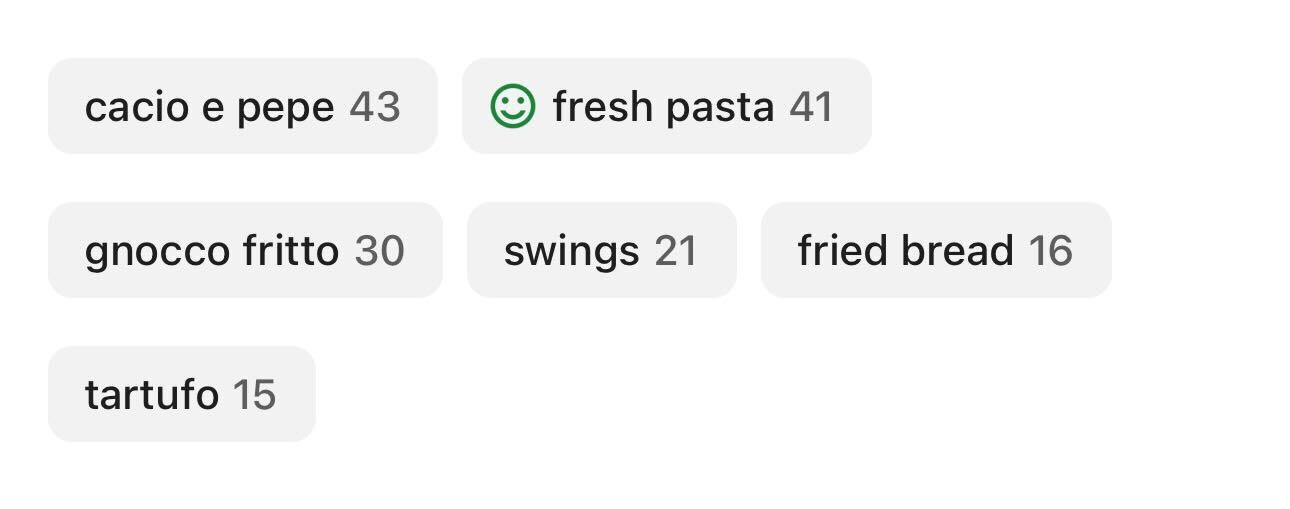
    ```json
{
  "alt": "List of food and activity names with numbers, including cacio e pepe and fresh pasta.",
  "caption": "Discover your next delight with 'cacio e pepe' leading the favorite list, closely followed by 'fresh pasta.' What will you choose?",
  "description": "This image displays a list with names and numbers beside each: 'cacio e pepe 43,' 'fresh pasta 41' with a smiley, 'gnocco fritto 30,' 'swings 21,' 'fried bread 16,' and 'tartufo 15.' It appears to categorize items based on popularity or frequency, potentially for a survey or menu selection. Keywords: cacio e pepe, fresh pasta, popular food, activity list."
}
```

    Google crafts clickable Place Topics from the keywords found in reviews. These topics not only stand out and attract potential customers by showcasing your expertise but also filter reviews efficiently, increasing engagement with your profile.

    ```json
{
  "alt": "Three unverified restaurant reviews with a prompt to write a review.",
  "caption": "Dive into these friendly and tasty reviews of a cozy spot renowned for its delicious pasta and wonderful service!",
  "description": "The image displays three unverified reviews of a restaurant, each praising different aspects such as food quality, service, and the dining experience. Words like 'place,' 'food,' 'service,' and 'staff' are highlighted. Reviewers mention 'creamy chicken,' 'mushroom pasta,' and 'amazing pasta quality.' A call-to-action button invites users to 'Write a review,' encouraging engagement. Perfect content for SEO about restaurant reviews and customer experiences."
}
```

    Terms frequently mentioned in your reviews are bolded in three review snippets on your Business Profile. This subtle emphasis can captivate users searching for these terms, likely boosting click-through rates to your profile.
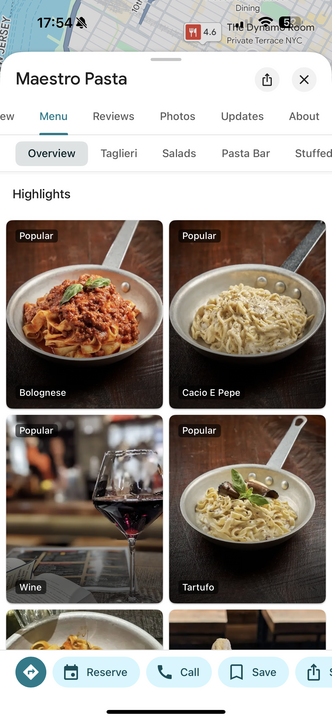
    ```json
{
  "alt": "Maestro Pasta menu overview featuring popular dishes like Bolognese, Cacio e Pepe, and Tartufo, alongside a glass of wine.",
  "caption": "Explore Maestro Pasta's popular selections, from hearty Bolognese to creamy Cacio e Pepe, paired perfectly with a glass of fine wine.",
  "description": "This image showcases the menu highlights from Maestro Pasta, displaying popular pasta dishes such as Bolognese, Cacio e Pepe, and Tartufo. Featured in metal pans, these mouthwatering meals are labeled 'Popular.' A glass of red wine is also visible, suggesting a perfect pairing option for the dishes. The layout is part of the restaurant's digital menu interface, emphasizing a modern dining experience. Keywords: Maestro Pasta, Bolognese, Cacio e Pepe, Tartufo, wine, menu highlights."
}
```

    For restaurants, Menu Highlights are curated from customer reviews and photos, similar to Place Topics. An analysis shows that these sections influence rankings, implying that mentions of menu items in reviews can enhance your visibility for those terms.

    ```json
{
  "alt": "Basta Pasta restaurant in New York with a focus on Italian-Japanese fusion dishes, map and details visible.",
  "caption": "Discover the Italian-Japanese culinary delights at Basta Pasta, a New York gem, where unique twists like roe pasta tantalize taste buds. Opens at noon!",
  "description": "Image shows Basta Pasta, an Italian restaurant in New York City noted for its fusion of Italian and Japanese cuisine. The interface displays a map, customer reviews, and options to get directions or reserve a table. The restaurant serves innovative dishes, such as pasta with roe or sea urchin, alongside Caesar salads and grilled items. Located at 37 W 17th St, NY, the venue opens at 12:00 PM and promises a distinctive dining experience with its high-ceilinged ambiance."
}
```

    Google’s AI-generated summaries draw from review content to describe your business attributes, such as “cozy”. While you cannot directly edit these summaries, encouraging detailed, keyword-rich reviews can guide the AI to highlight beneficial aspects of your business.

    ```json
{
  "alt": "Review summary showing a 4.6-star rating from 1,470 reviews for an Italian restaurant.",
  "caption": "With a 4.6-star rating from 1,470 reviews, this Italian restaurant is praised for its delicious pasta, cozy atmosphere, and attentive service.",
  "description": "An image featuring a review summary for an Italian restaurant, boasting a 4.6 out of 5-star rating based on 1,470 reviews. Highlighted features include homemade pasta and flavorful sauces, a cozy and welcoming ambiance, and friendly, attentive staff. Unique aspects like swing seats add to the authentic Italian experience. The image captures ratings and excerpts from customer feedback, emphasizing the dining experience's quality."
}
```

    Review summaries created by Google’s AI analyze frequent sentiments from customer feedback. By prompting customers to include specific keywords, your review summary can resonate more with potential clients.
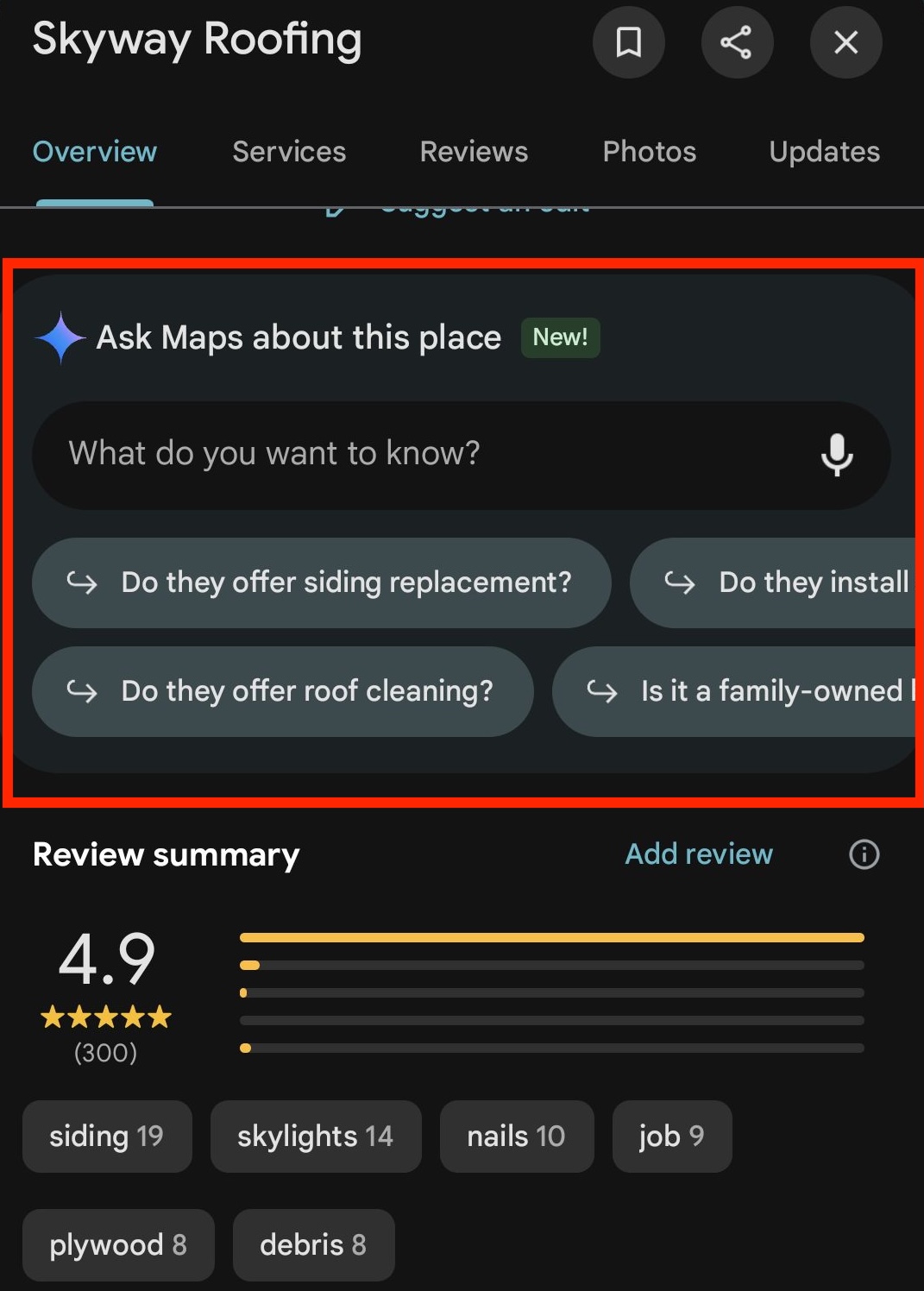
    ```json
{
  "alt": "Skyway Roofing information on Google Maps with options to ask questions and review ratings.",
  "caption": "Explore Skyway Roofing on Google Maps: Discover services, ask questions, and see what others are saying with a stellar 4.9 rating from 300 reviews.",
  "description": "This image shows Skyway Roofing on Google Maps, offering users interactive features like asking questions about siding replacement, installation, roof cleaning, and family ownership. The company boasts a 4.9-star rating from 300 reviews, with keywords like siding, skylights, nails, and debris frequently mentioned. This interface encourages user engagement and easy access to specific inquiries."
}
```

    Google is transitioning from the Q&A section to a feature allowing customers to ask questions about your business. This new feature draws answers from reviews, meaning that comprehensive, keyword-laden reviews become incredibly valuable.

    Asking customers directly to insert specific keywords in their reviews may seem odd and forced. Instead, consider upgrading your review request templates to guide your customers naturally towards providing relevant, detailed feedback.

    For example, Miriam Ellis has developed a helpful guide on acquiring keyword-rich reviews, complete with three templates tailored for different scenarios, each facilitating descriptive and keyword-rich content from your clients.

    Implementing these improvements in your review requests will yield richer, more detailed customer feedback. This can enhance your local SEO benefits and possibly improve your Google rankings for related keywords, though that shouldn’t be your primary objective here.


    Inspired by this post on Search Engine Land.


    crushpress.ai community screenshot
  • Google Expands PMax Campaign Budgets Globally for Better Control

    Google Expands PMax Campaign Budgets Globally for Better Control

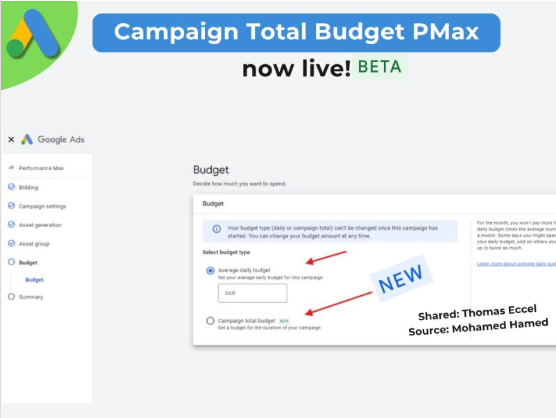
    I’m excited to share with you that Google is taking a big step forward by implementing total campaign budgets for Performance Max (PMax) campaigns globally. This change allows us as advertisers to manage our campaigns with greater precision, eliminating the complicated math of daily budgets.

    Google’s long-awaited total campaign budget option is finally making its way into Performance Max campaigns outside of the U.S., potentially marking the start of a global rollout. This is great news for those of us who have been hoping for a more streamlined budgeting process.

    What’s Happening:

    • With the introduction of the total budget option, it now sits alongside the classic average daily budget within PMax.
    • Google had previously announced plans to extend this feature to Search, Shopping, and PMax, and this rollout indicates that this expansion is progressing.
    • In the field, marketers, including those noted by Thomas Eccel and shared by Mohamed Hamed (Turki), are already experiencing it live.
    ```json
{
  "alt": "Screenshot of Google Ads interface showing new Campaign Total Budget PMax feature.",
  "caption": "Explore the newly launched Campaign Total Budget PMax feature in Google Ads, bringing more control and precision to your advertising budget management.",
  "description": "This image showcases a screenshot of the Google Ads interface highlighting the new 'Campaign Total Budget PMax' feature, now available in beta. The screenshot includes the budget selection section with options for average daily budget and campaign total budget. Emphasized by arrows and 'NEW' label, it's an exciting update for advertisers. Shared by Thomas Eccel and sourced from Mohamed Hamed."
}
```

    Why We Care. Over the years, advertisers like us have been forced to manually calculate average daily budgets from fixed totals, especially cumbersome for short-term, flighted campaigns. Fortunately, this new feature saves us from that meticulous task, providing better pacing control over ad spending without depending on daily averages.

    Between the Lines. This is a significant quality-of-life improvement for performance marketers handling flights, bursts, or fixed-end-date campaigns, where overspend risks were previously significant.

    The Bottom Line. At last, Google offers advertisers a budget model in tune with real-world campaign strategies, and those of us managing flight-based PPC campaigns may find this enhancement particularly impactful.


    Inspired by this post on Search Engine Land.
  • YouTube’s Innovative Cost Adjustments Ease Ad Campaign Risks

    YouTube’s Innovative Cost Adjustments Ease Ad Campaign Risks

    YouTube AI citations

    Recently, I discovered that YouTube is experimenting with a beta feature designed to lower the costs of Demand Gen Target CPA (tCPA) campaigns that aren’t performing as expected. This new approach aims to maintain a tighter grip on CPAs during the often unpredictable learning phase, offering us advertisers a form of financial relief when early results aren’t as impressive as predicted.

    Why this matters to me. This update provides me with a financial safety net at the start of YouTube campaigns, which is typically the most uncertain period where conversion predictions fluctuate dramatically. It’s quite refreshing to see Google taking a step to refund part of the ad spend voluntarily as a way to meet performance targets.

    How it works from what I understand:

    • The system keeps an eye on new Demand Gen tCPA campaigns during their initial learning stages.
    • If conversions are not hitting Google’s forecast, it may recalibrate costs retroactively to align CPAs with my target goals.
    • The adjustment kicks in within five days of launching a campaign and may last up to three weeks.
    • There won’t be separate credits or line items; instead, I’ll notice the final reported cost has been subtly adjusted.

    What this means for me as an advertiser. Google seems to be making an effort to reduce performance volatility in the beginning, allowing their algorithms more leeway to learn while minimizing my financial risk.

    What I should watch out for. The eligibility for this feature largely depends on the quality of my account, how well tracking is maintained, and consistently following best practices. Even then, adjustments aren’t guaranteed and could only be applicable to certain days or specific campaigns.

    The takeaway? For me, YouTube’s performance-based cost adjustment marks a small yet meaningful shift: Google is showing a willingness to share risk during the crucial learning period, making it smoother for us performance-focused advertisers to start our Demand Gen campaigns.


    Inspired by this post on Search Engine Land.
  • Unveiling Google FastSearch: Speed versus Depth in AI Search

    Unveiling Google FastSearch: Speed versus Depth in AI Search

    Google FastSearch- Everything you need to know

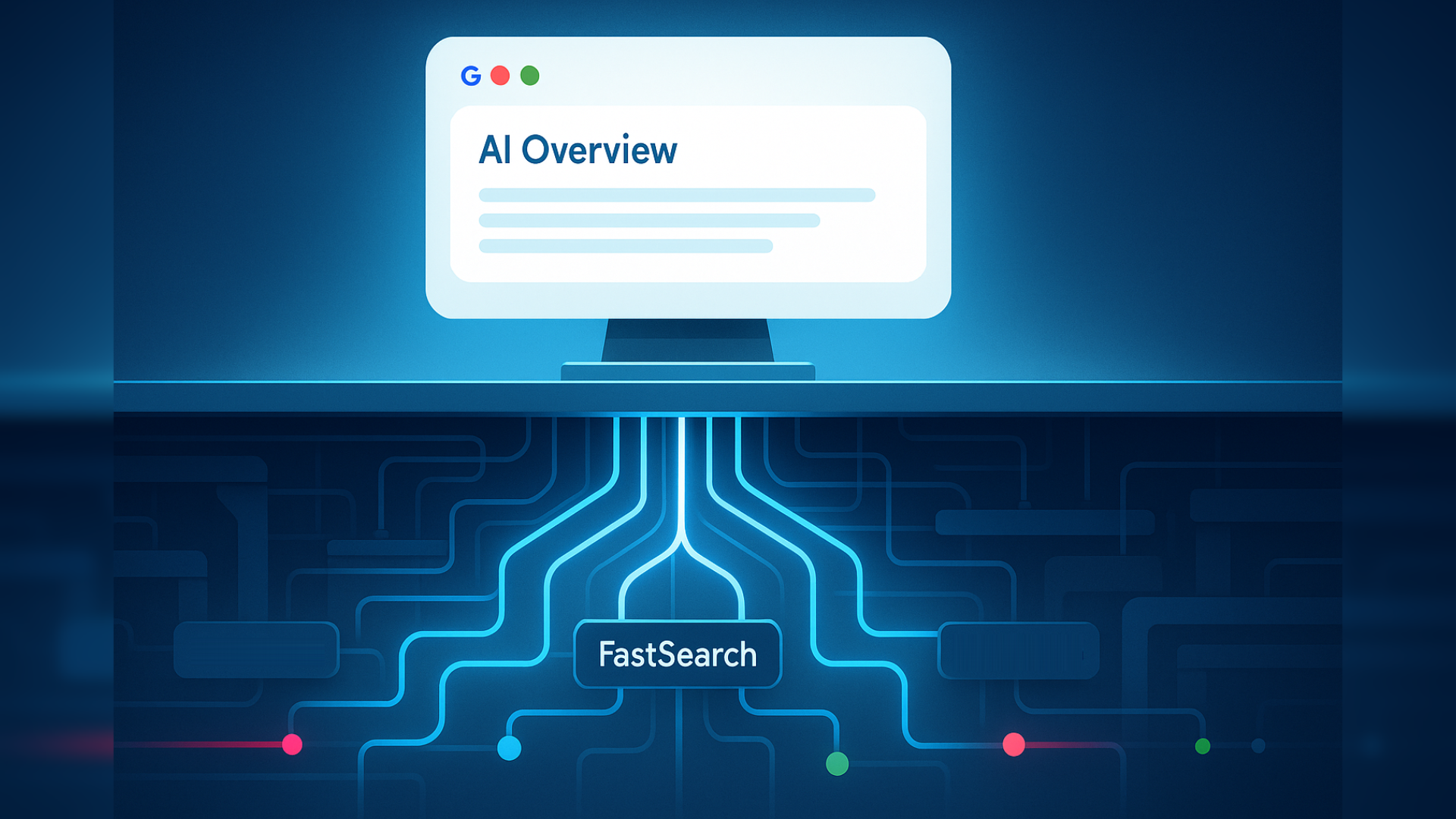
    I recently discovered something intriguing from court filings related to Google’s antitrust case, revealing FastSearch, a system unfamiliar to many search marketers. At the heart of Google’s AI Overviews, FastSearch prioritizes speed over the deeper analysis we’ve come to expect from traditional search results.

    This leads me to wonder: what does FastSearch really focus on?

    FastSearch is Google’s internal mechanism designed for grounding Gemini models and producing AI Overviews. While the traditional Google Search analyzes vast amounts of web data using numerous ranking signals, FastSearch prefers a more targeted approach, emphasizing speed.

    The court documents explain:

    FastSearch uses RankEmbed signals, which generate condensed, ranked web results that models can use to yield grounded responses faster than the traditional Search processes. However, this comes with a tradeoff in quality.

    Marie Haynes highlighted this revelation after examining the legal decisions regarding Google’s monopoly case.

    Learn more: The ABCs of Google ranking signals revealed by top search engineers

    FastSearch achieves faster results by making three compromises.

    Smaller document pool: Instead of scanning Google’s entire index, it accesses a focused subset of pages to cut down processing time.

    Simplified ranking signals: It mainly uses RankEmbed signals to emphasize semantic connections over traditional authority indicators such as backlinks.

    Acceptable accuracy threshold: While FastSearch results are less detailed compared to fully ranked outcomes, they are deemed satisfactory for grounding AI responses.

    Dive deeper: Balancing speed and credibility in AI-assisted content creation

    The court documents also describe RankEmbed as a high-level signal capable of identifying patterns in extensive data sets. This focus on semantics means content with clear topical relevance might perform better than pages relying on high domain authority but lacking relevance.

    Traditional SEO strength doesn’t automatically ensure visibility in AI Overviews.

    Discover more: Organizing content for AI search: A 3-level framework

    Google integrates FastSearch into its Vertex AI platform. This means Google’s business users can leverage the technology for AI without receiving direct FastSearch results, safeguarding Google’s intellectual property.

    For content strategy, FastSearch highlights the importance of clarity, topical depth, structure for extraction, and maintaining traditional SEO fundamentals. These strategies are critical for AI visibility.

    FastSearch’s emergence shouldn’t lead us to neglect SEO fundamentals. According to Google’s Danny Sullivan, solid SEO is key for effective generative engine optimization. This means understanding user searches, creating valuable content, and making it accessible to search systems both remain vital.

    Gain deeper insights: Google Danny Sullivan: Good SEO equals good GEO

    In summary, optimizing your content approach involves conducting semantic audits, tracking AI performance separately, testing content structures, and keeping traditional SEO practices. FastSearch offers insights into Google’s future, spotlighting the need for transparent and helpful content that makes a significant impact on users.


    Inspired by this post on Search Engine Land.
  • Unlock Holiday Shopping with Google’s New AI Features

    Unlock Holiday Shopping with Google’s New AI Features

    As the holiday season approaches, I’m thrilled to share that Google has rolled out a range of exciting AI-powered shopping features. Just recently, Google announced this major update, perfectly timed for our holiday shopping adventures.

    What’s new with AI Mode? Picture this: you can now describe what you need as if you’re chatting with a friend! Google’s AI Mode organizes all the essentials—images, prices, reviews, and inventory—helping you decide confidently and quickly on your next purchase.

    In my Gemini App experience, it has become my go-to for brainstorming gift ideas. It effortlessly compares products and supplies answers with handy shoppable links, all within a chat.

    Are you too busy to check store stock levels? I now let Google’s agentic calling feature make those calls for me, ensuring I know about any promos or stock availability without lifting a finger.

    And here’s something I absolutely love: tracking prices with agentic AI. Whenever an item I’ve been eyeing drops in price at eligible U.S. merchants, I receive a notification. I can let Google purchase it securely using Google Pay, all within my budget!

    Why does this matter? The bustling holiday season is critical for many businesses. With these innovative AI features, I hope to see more traffic and revenue driving local stores rather than distracting buyers from making purchases.

    I’m curious to see how these tools impact our shopping experiences, and I encourage everyone to explore these features to see where your website ranks.


    Inspired by this post on Search Engine Land.

  • Google Tackles AI Spam in Discover Feed: A Promised Fix

    Google Tackles AI Spam in Discover Feed: A Promised Fix

    After hearing numerous complaints about the quality of Google Discover, I’m interested to see how Google plans to tackle the issue of fake AI spam. They’ve assured us that a solution is in progress.

    I’m aware that Google is taking steps to remedy the situation with its Discover feed, especially with the appearance of fake AI spam in recent weeks. Google confirmed to the Press Gazette, which has reported several instances of this spam infiltration, that a fix is actively being developed.

    Google’s Assurance. In their words:

    “We keep the vast majority of spam out of Discover through robust spam-fighting systems and clear policies against new and emerging forms of low quality, manipulative content. We’re actively working on a fix that will better address the specific type of spam that’s being referenced here, maintaining our high bar for quality in Discover.”

    The AI Spam Issue. From what I’ve read, the Press Gazette has meticulously documented instances where fake news stories have garnered tens of millions of views on the Google Discover platform in just a week. Here’s a glimpse of some of these fake stories as reported:

    ```json
{
  "alt": "Collage of news headlines about UK pension and bank rule changes in 2025.",
  "caption": "Explore upcoming UK changes in pension, bank, and driving rules set for 2025. Stay informed on how these regulations might impact you.",
  "description": "A collage featuring various news headlines about upcoming UK regulatory changes in 2025. Headlines cover a range of topics including new pension rules, bank regulations for pensioners, and stricter driving test checks for elderly drivers. Reports highlight the Department for Work and Pensions (DWP) and HMRC as key institutions involved. With a mix of formal and urgent tones, these articles inform the public about significant financial and legal updates. Keywords include pension rules, DWP, UK driving rules, and HMRC."
}
```

    It’s fascinating how spammers are allegedly buying expired domains with previously trusted reputations, exploiting their domain authority to flood Google Discover with spam content. This tactic isn’t novel, and while Google Search generally manages these tricks well, many believe this is currently how spammers manipulate the Discover feed.

    French data journalist Jean-Marc Manach has been tracking this issue, building a comprehensive database of fake sites generating AI stories. His list now includes over 8,300 entries in French, 300 in English, and 150 in German.

    Why It Matters to Me. As someone who values relevant and trustworthy content, I understand the potential impact of Google Discover’s reach. These fake sites can momentarily generate significant revenue, only to be shut down, after which others rise in their place. It’s a cycle that Google is inevitably working to break, though new challenges will likely emerge.


    Inspired by this post on Search Engine Land.
  • Revolutionize Your Marketing: Google’s New AI-Powered Advisors

    Revolutionize Your Marketing: Google’s New AI-Powered Advisors

    I’ve always been intrigued by how technology can simplify complex tasks, and Google’s recent launch of AI-powered Ads and Analytics Advisors does just that. Acting as a personal assistant for advertisers, these tools offer a speedy way to analyze data, optimize campaigns, and immediately turn insights into action.

    Google is introducing two innovative AI-powered assistants—Ads Advisor and Analytics Advisor—built on their latest Gemini models. These assistants are designed to manage campaigns more efficiently and uncover insights faster.

    Starting early December, English-language Google Ads and Google Analytics accounts will have access to these tools. They transform complex data and campaign management into simple, user-friendly experiences.

    Ads Advisor: Optimization and Automation. This tool serves as your in-platform AI partner, offering support in managing, troubleshooting, and scaling campaigns. It evolves with user interaction, providing more tailored guidance over time. Key features include:

    • Performance optimization: Receive customized recommendations for Performance Max and Search campaigns that can be directly applied, like adding sitelink extensions or adjusting for seasonal events.
    • Creative generation: Get suggestions for new keywords, assets, and ad copy based on existing website and campaign data to keep your content fresh.
    • Performance diagnostics: Ask questions like “Why did my campaign performance drop?” and get pinpointed solutions and causes.
    • Policy troubleshooting: It spotlights ad disapprovals, offering explanations and sometimes implementing policy fixes directly.

    Analytics Advisor: Instant Insights. Bringing conversational AI into Google Analytics, Analytics Advisor acts as your tireless analyst, interpreting performance data and suggesting actionable next steps.

    • Fast, comprehensive insights: Quickly answer questions like “How is my site performing?” with dynamic visualizations and summaries.
    • Root cause analysis: Discover why there’s a spike or drop in traffic by understanding the key drivers relevant to your business.
    • Actionable recommendations: Use data-backed strategies to re-engage high-value users and capitalize on trends.

    Why we care. These AI advisors significantly streamline campaign management and optimization. Instead of sifting through reports and guessing at issues, I can now ask direct questions and receive data-driven solutions within seconds.

    The tools diagnose problems and suggest, or even apply, fixes, which helps improve performance, saves time, and turns data into immediate action.

    Between the lines. With Gemini-powered assistants embedded directly into Google Ads and Analytics, Google is advancing towards Agentic AI—tools that independently identify, explain, and execute improvements across the advertising landscape. This shift allows me to spend less time on data analysis and more on strategic actions.

    The bottom line. Google’s new Ads and Analytics Advisors turn campaign optimization and performance analysis into a conversation, revolutionizing how I can plan, measure, and make real-time decisions.


    Inspired by this post on Search Engine Land.

  • Mastering Google Ads: Custom Segments for Targeted Reach

    Mastering Google Ads: Custom Segments for Targeted Reach

    Have you ever felt puzzled by audience targeting in Google Ads? You’re not alone. I’ve often struggled with it too, particularly when it comes to custom segments. Yet, when understood correctly, these custom segments can become a powerful tool in our advertising arsenal.

    Custom segments allow me to craft audiences using Google’s vast data pool. It’s like taking audience targeting to the next level by making it personal and tailored to individual user behaviors.

    So, what exactly is a custom segment in Google Ads? Simply put, it lets us create an audience based on recent user interactions with content. Instead of targeting a generic website category, I’m aiming directly at users who have shown interest in specific topics, like running shoes, for instance.

    I see content targeting transforming into a more focused audience targeting. It’s exciting and effective.

    Building a custom segment is straightforward. From Audience Manager, I name my segment and choose up to four input types: interests, search terms, websites, and apps. This flexibility allows me to strategically target exactly who I want.

    If I’m using multiple inputs, I prefer creating multiple custom segments. This way, I can track which segment performs better – whether it’s search terms or websites.

    In my experience, search term-based custom segments often yield the best results. They specifically reach users who have searched for related terms, functioning much like Exact Match close variants.

    Starting with search terms, I dive into Search, Shopping, or PMax campaigns to extract my top non-branded search terms. I use these to shape a new custom segment, ensuring to target people who searched for these terms on Google.

    When applying this segment to a Demand Gen campaign, it’s crucial to stick to Google-owned networks like YouTube, Discover, Gmail, and Maps, where Google accurately knows user search behaviors.

    This strategy shines because it targets the same audience from Search or Shopping at a drastically reduced cost, often around 95% less per click!

    For website and app-focused segments, I focus on people who visit similar sites or use similar apps rather than exact ones. It’s a subtle but important tactic in my overall strategy.

    Despite the various names for custom segments across different campaign types, their versatility makes them invaluable in my Google Ads strategy. They offer a seamless entry into advanced audience targeting beyond traditional search methods.

    This article is part of an ongoing Search Engine Land series, designed to help you grasp key Google Ads features in just 3 minutes.


    Inspired by this post on Search Engine Land.

  • Unlocking Success: Easier and Faster Google Ad Tests

    Unlocking Success: Easier and Faster Google Ad Tests

    Have you ever wondered about the true impact of your ads? Google is now making it easier and more affordable to find out with their updated incrementality testing. This means I can measure and prove the real influence of my advertising efforts without breaking the bank.

    Google’s recent updates make incrementality testing accessible for all advertisers, regardless of budget. By significantly reducing the minimum spend from $100,000 to a mere $5,000, I’ve found it easier to gauge ROI with scientifically precise methods. Now, I can conduct controlled experiments to pinpoint exactly what’s driving my campaigns.

    I’m thrilled to learn that Google’s enhanced their incrementality testing with new statistical models, providing results that are up to 50% more conclusive. This improvement offers me clearer insights, reducing the uncertainty that could delay my decision-making process.

    The ability to receive faster insights and make swift actions is invaluable. Google’s updates let me customize experiment designs and view results directly, which means I can adapt my strategies more quickly, even if changes in performance are minimal.

    Incrementality testing is now part of a comprehensive measurement platform that includes Marketing Mix Models (MMMs) and Attribution. Together, these elements allow me to get a holistic view of my campaigns:

    • MMMs highlight the larger picture across various channels.
    • Incrementality focuses on the direct impact of specific campaigns.
    • Attribution links touchpoints to actual outcomes.

    When used together, these tools provide me with a robust strategy for measuring what really contributes to growth.

    Why is this important to me? As marketers like myself face increasing pressure to justify advertisement spending, Google’s updates provide a level playing field for smaller budgets to effectively measure and link ad investments directly to revenue growth.

    In conclusion, with reduced costs, superior data, and quicker reporting, Google’s incrementality updates have empowered me as an advertiser to verify what works, optimize my ad spend, and enhance confidence in my marketing ROI.


    Inspired by this post on Search Engine Land.

  • Unveiling Google Shopping’s New Brand Control Features

    Unveiling Google Shopping’s New Brand Control Features

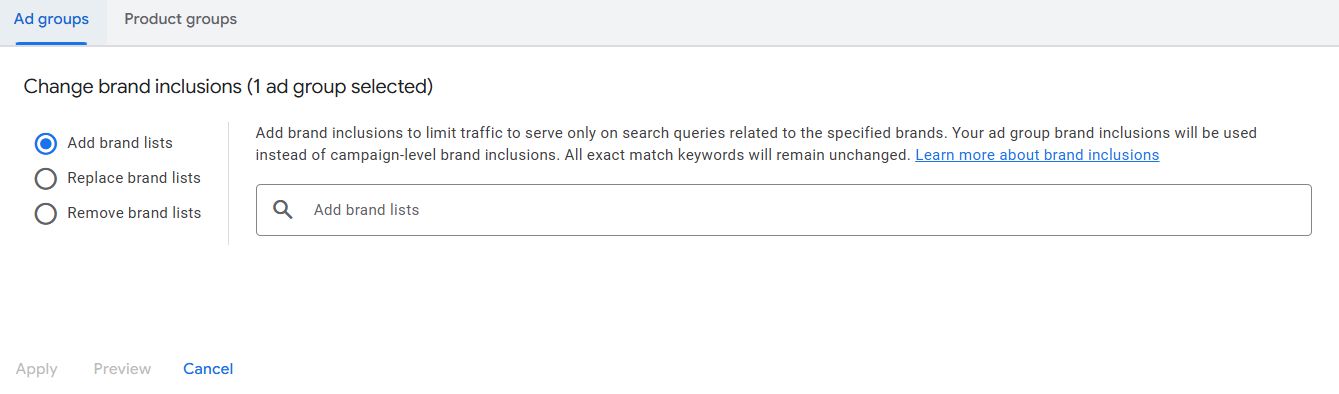
    I’ve recently discovered that Google has quietly enhanced their Shopping campaigns by introducing brand inclusion controls. This long-awaited feature offers us advertisers unparalleled control over the brands that appear in our shopping ads without needing complex workarounds.

    How it works: Now, I can easily add or remove brand lists directly within the ad group targeting section of both Performance Max and Standard Shopping campaigns. This means I can specify exactly which brands to showcase or exclude, preview my setup, and apply changes seamlessly within the Google Ads interface.

    Why we care. Previously, brand targeting tools were only available in Performance Max and AI Max, leaving those of us using Standard Shopping campaigns to juggle search query scripts or set up intricate campaigns to manage brand visibility. This update changes that, finally giving us direct control over brand appearances.

    I find it eliminates the need for cumbersome scripts or overly complex campaign setups, simplifying brand visibility management. This improvement allows me to protect my budgets and target high-value brand traffic more precisely — a significant win for our advertising efficiency and control.

    ```json
{
  "alt": "Interface for changing brand inclusions in an ad group with options to add, replace, or remove brand lists.",
  "caption": "Streamline your ad targeting with efficient brand inclusion settings. Adjust your preferences to specifically tailor brand engagements.",
  "description": "This image shows a user interface where users can change brand inclusions for a selected ad group. Options are available to add, replace, or remove brand lists, with a search bar provided for ease of adding brands. This tool helps in refining ad targeting by including specific brand-related search queries, enhancing marketing efficiency. Keywords: brand inclusions, ad group, digital marketing, targeted advertising."
}
```

    Between the lines. For those of us in retail and ecommerce, this update is a game-changer in Shopping campaign management. It enables us to safeguard brand-specific budgets, control exposure within competitive categories, and avoid wasting money on unwanted brand traffic — all done conveniently within Google Ads.

    First seen. The update was initially noticed by Ryan Parks, Senior Search Director at Spark Foundry, who shared this valuable information on LinkedIn.

    The bottom line. With these brand inclusion features now accessible for Standard Shopping campaigns, we gain the same level of control and efficiency as Google’s automated campaign types offer. It’s a quietly powerful upgrade that will undoubtedly enhance precision in retail advertising.


    Inspired by this post on Search Engine Land.