I recently discovered that Google has made some updates to their JavaScript SEO basics documentation. This change has brought clarity to how Google’s crawler deals with noindex tags on pages utilizing JavaScript. The main takeaway? If you’re aiming to have your page indexed, definitely avoid including a noindex tag in the original page code.
What’s New: Google has adjusted this section to specify that when Google encounters a noindex tag, it may bypass rendering and executing JavaScript. Consequently, efforts to modify or remove the robots meta tag using JavaScript might not yield the desired results. So, if indexing is a goal, keep the noindex tag out of the original code.
Previously, the guidelines indicated a certain certainty: if a noindex tag was detected, Google skipped rendering and executing any JavaScript. This meant any attempts to counter this with JavaScript adjustments would simply not work. The advice stood firm—keep noindex tags out of the original code if there’s any chance you need the page indexed.
Reason for Change: Google clarified that while it can render pages employing JavaScript, this behavior is not consistently defined and is subject to change. If there’s any chance you want your page to show up in search, play it safe and leave out the noindex tag from the original code.
Why This Matters: It’s often safer to steer clear of JavaScript when setting crucial protocols, especially concerning the blocking of Googlebot or other crawlers. If you need a search engine not to rank a particular page, avoid using JavaScript to execute those directives.
Today, Google kicked off the December 2025 core update, marking a significant moment for all of us closely following search engine changes. Google’s announcement was straightforward: “Today we released the December 2025 core update.”
This makes it the third core update of the year and the fourth confirmed update overall for 2025. Prior to this, we saw the August 2025 spam update, as well as the June 2025 and March 2025 core updates.
Google has shared that the rollout of this update might take up to three weeks to complete. On LinkedIn, they elaborated, “This is a regular update designed to better surface relevant, satisfying content for searchers from all types of sites.”
These core updates, which occur several times a year, bring broad changes to search algorithms and systems. That’s exactly why announcements like these grab our attention. This update truly is the third core update of 2025.
What to do if you are hit. While Google hasn’t issued new guidance specifically for the December 2025 update, past advice remains relevant if you’ve been negatively affected. Key points to remember include:
No specific actions are required for recovery. A drop in ranking doesn’t necessarily mean your pages have issues.
Google advises reviewing their list of questions if your site is impacted by a core update.
Improvement can occur between core updates, but the most significant shifts usually happen after another core update.
Ultimately, creating content that’s helpful for people—rather than solely aiming to rank well—is key. Google has reiterated the importance of crafting people-first content.
As long as you’re creating satisfying content meant for people, there’s nothing new or special you need to do. However, if you’re facing ranking challenges, we highly recommend exploring our page on creating helpful content.
For deeper insights into Google core updates, Google’s documentation remains a key resource.
Previous core updates. Here’s a recap of recent core updates:
The June 2025 core update began on June 30 and concluded on July 17.
The March 2025 core update rolled out on March 13 and ended March 27.
December 2024’s core update kicked off on December 12 and was wrapped up by December 18.
In November 2024, a core update began on November 11 and ended on December 5.
August 2024 saw a core update starting on August 15 and finishing by September 3.
March 2024’s core update spanned from March 5 to April 19.
November 2023’s core update happened over November 2 to November 28.
October 2023’s update lasted from October 5 to October 19.
The August 2023 core update was rolled out from August 22 to September 7.
Back in March 2023, another core update spanned March 15 to March 28.
Why we care. Core updates often result in noticeable volatility in search rankings. Our hope is that these changes will positively impact site rankings and enhance organic traffic. While some fluctuations or downgrades may occur, it’s an opportunity for growth.
We’re hopeful that this update will bring positive outcomes, driving traffic and conversions for your sites. It’s been a while since the last core update, and although we anticipated more frequent updates, we’re excited about this release.
In recent developments, I discovered that Google has announced updates to its AI Mode link features and expanded the Web Guide test to the ‘all’ tab on the search interface.
I noticed that Google is actively improving links within AI Mode to make searchers more inclined to click. They’ve now expanded the Web Guides labs test into the all tab, though participation still requires opting into the experiment.
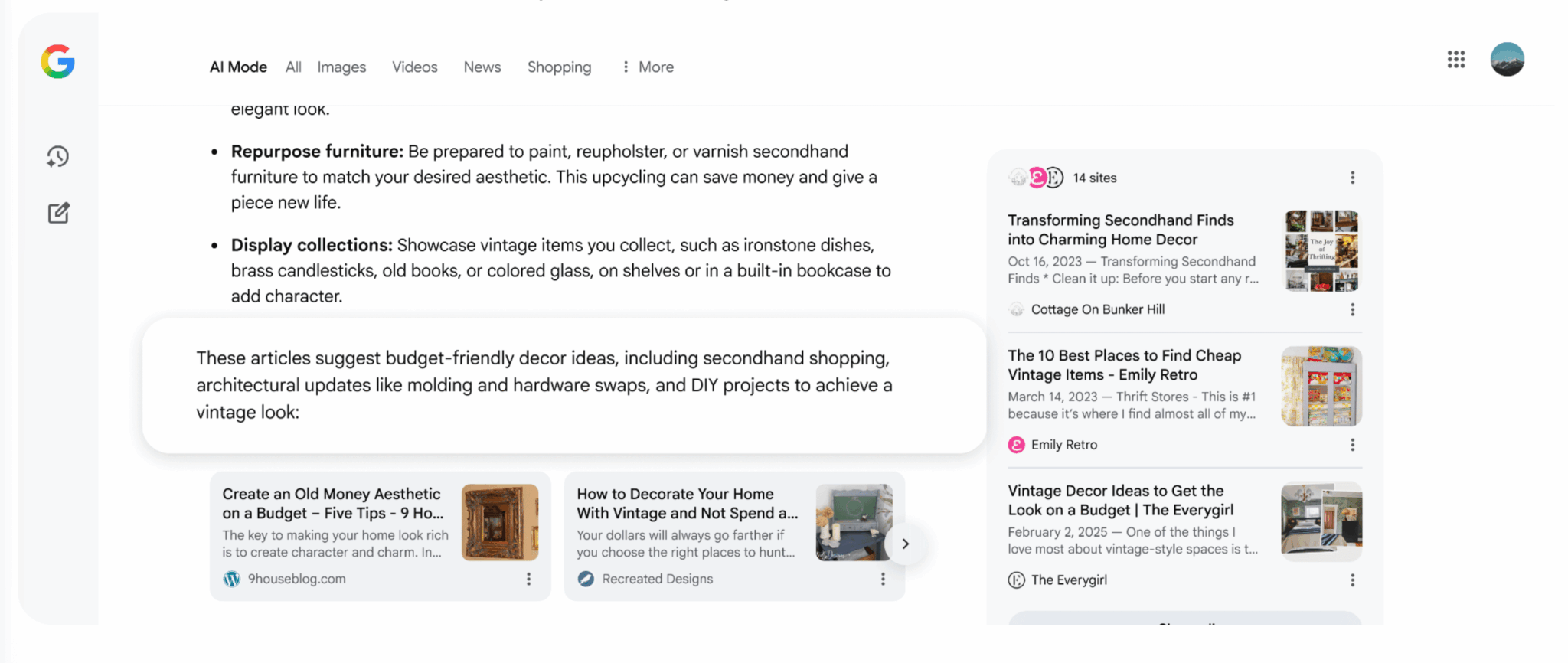
Links in AI Mode. Robby Stein, Google’s VP of Product for Search, shared that they’re increasing the number of inline links in AI Mode and refining their design to enhance usability. Google has been experimenting with inline links and contextual links, and now some of these user experiences are officially rolling out. Stein had mentioned back in August that these features would see the light, and here they are.
Additionally, Google’s adding contextual introductions to the embedded links in AI Mode responses. These brief statements help you understand why a particular link could be beneficial to explore.
Here’s a visual representation:
Expanding Web Guide to all tab. Google first introduced its Web Guide within the ‘web’ tab for those participating in the experiment. Now, this feature is accessible through the ‘all’ tab of Google Search, still requiring experiment opt-in.
According to Google’s statement, “We’ve heard positive feedback from users and websites about Web Guide, as it helps in discovering new links and uses AI to organize these links into helpful topic groups.”
Google also says they’ve optimized Web Guide to be twice as fast, adding to its efficiency.
What is Web Guide. As per Google’s explanation, Web Guide groups web links in useful manners. This allows pages related to specific facets of your query to be compartmentalized effectively.
“Web Guide utilizes a custom version of Gemini to better interpret both search queries and web content, enhancing its ability to bring up pages you might not have found before,” Google explained to me.
Additionally, Web Guide employs a query fan-out technique, similar to AI Mode, which launches multiple related searches at once to deliver more relevant results.
Why it matters. The enhancement of link engagement through Google’s AI features like AI Mode and AI Overviews is a positive move. I hope this leads to boosted traffic for publishers and website owners.
Web Guide is also a feature that’s gaining appreciation in the search marketing realm. I’m hopeful that Google can eventually offer this experience without needing opt-ins via the Search Labs.
I just heard some exciting news from Google! They’re expanding their Preferred Sources feature globally, after previously rolling it out in the US and India. But that’s not all—Google has announced a new feature called Spotlighting subscriptions, which will emphasize links from my news subscriptions in Gemini, and eventually, it will be integrated into Google Search through AI Overviews and AI Mode.
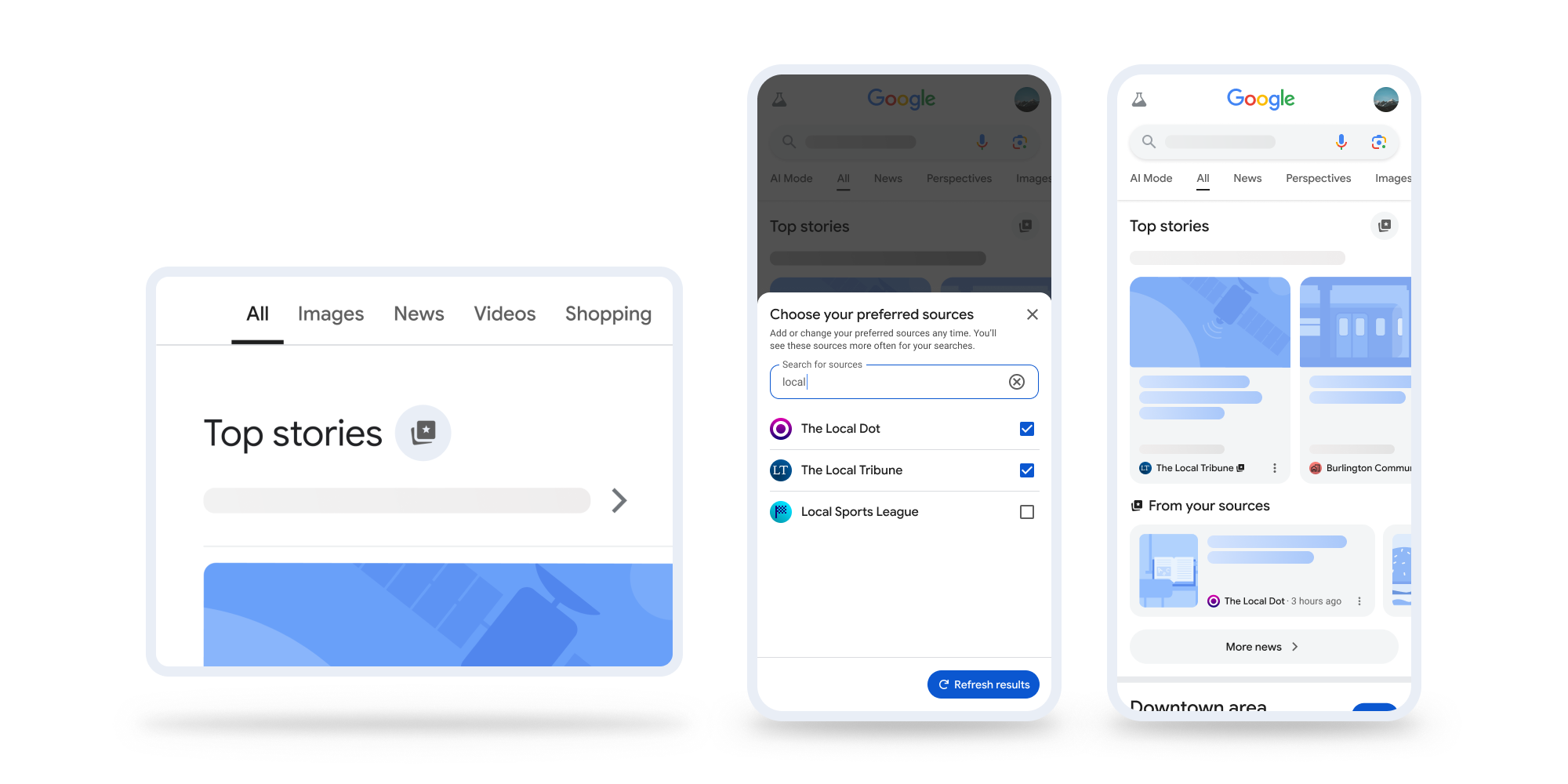
When it comes to Preferred Sources, it allows me to star sources in Google Search’s Top Stories section. This means Google will prioritize showing me more stories from those sources I’ve starred. It was first in beta last June, launched in the US and India last August, and now it’s going global!
According to Robby Stein, VP of Product at Google Search, “We’re now launching this feature globally: in the coming days, it will be available for English-language users worldwide, and we’ll roll it out to all supported languages early next year.” He also mentioned that people like me have chosen nearly 90,000 unique sources, ranging from local blogs to global news outlets.
Google shared that when I select a preferred source, I tend to click on that site twice as often on average.
So how does it work? All I have to do is click the star icon next to the Top Stories header in search results. If the site has fresh content, I can then pick it as a preferred source. Google will then display more of the latest news from those sites directly in Top Stories. This happens when those sites have relevant new articles or posts related to what I’m searching for.
Next up, let’s talk about Spotlighting subscriptions. Google is making it easier for me to notice content from my trusted subscriptions by showcasing these links prominently. It’s designed to ensure I get more value from these subscriptions by prioritizing them in a special carousel format.
This feature will launch in Gemini first, with AI Overviews and AI Mode following soon after.
Why do I care about all of this? Preferred sources in Top Stories offer a great opportunity for driving traffic to publishers. If I can encourage my loyal readers to select my site as a preferred source, it could significantly bump up my site’s traffic.
In conclusion, these enhancements from Google could offer me and the publishing community more avenues for boosting traffic and potentially increasing revenue.
I can’t contain my excitement as Google unveils the Developer Assistant for the Google Ads API. This breakthrough tool allows us, as advertisers and developers, to leverage natural language to create, manage, and export Ads API queries effortlessly.
Google has introduced the Google Ads API Developer Assistant v1.0, an innovative Gemini CLI extension. It empowers us to interact with the Ads API seamlessly, transforming our everyday language into instant answers, functional code, and even real-time API calls.
How it works: Embedded within the Gemini CLI, the assistant utilizes project contexts from GEMINI.md and configuration files to generate precise code tailored to our specific environment. With a simple query like, “How do I filter by date in GAQL?”, I receive immediate assistance. If I describe a task, such as “Show me campaigns with the most conversions in the last 30 days,” it provides both the GAQL query and a well-optimized Python script using the google-ads-python client library.
Key features include: The ability to execute read-only API calls directly from the terminal, presenting the results in cleanly formatted tables. Plus, any tabular data can be exported to CSV, filed neatly in a dedicated directory. All code generated by the assistant is automatically organized within a saved_code/ folder for easy access.
Why it matters to us: The Google Ads API is immensely powerful yet complicated. This new Developer Assistant simplifies our workflow drastically, making it quicker and more efficient for teams to create, refine, and optimize Google Ads API workflows—the core of comprehensive campaign management and reporting.
By converting natural language into GAQL queries and operational code, it minimizes technical obstacles and speeds up our ability to glean insights that could lead to better optimization strategies. The ease of one-command execution and CSV exports means we spend less time dealing with coding complexities and more on boosting performance.
The big picture: Google positions the assistant as a dual-purpose tool—a learning aid for beginners and a productivity enhancer for experienced users. For newcomers, the use of natural language commands significantly lowers the learning curve.
For advanced users like me, features such as code generation, automatic file management, and command-line execution streamline and minimize repetitive tasks involved in daily API operations.
Getting started is straightforward: Ensuring you have a Google Ads API token, a configured google-ads.yaml, Python 3.10+, the Gemini CLI, and a local clone of the google-ads-python library is essential. A setup script handles the cloning process, with full instructions available on GitHub.
What’s next: Google invites early users to provide feedback, suggest features, and engage with the community on the Discord channel as the platform evolves with more enhancements and AI-driven tools.
The bottom line: By enabling developers to query, code, and execute using everyday language, Google is transforming the Google Ads API into a faster, more intuitive, and broadly accessible tool.
I’ve noticed a shift in how Google is choosing content for its Discover feed, and it seems less tied to traditional search rankings these days.
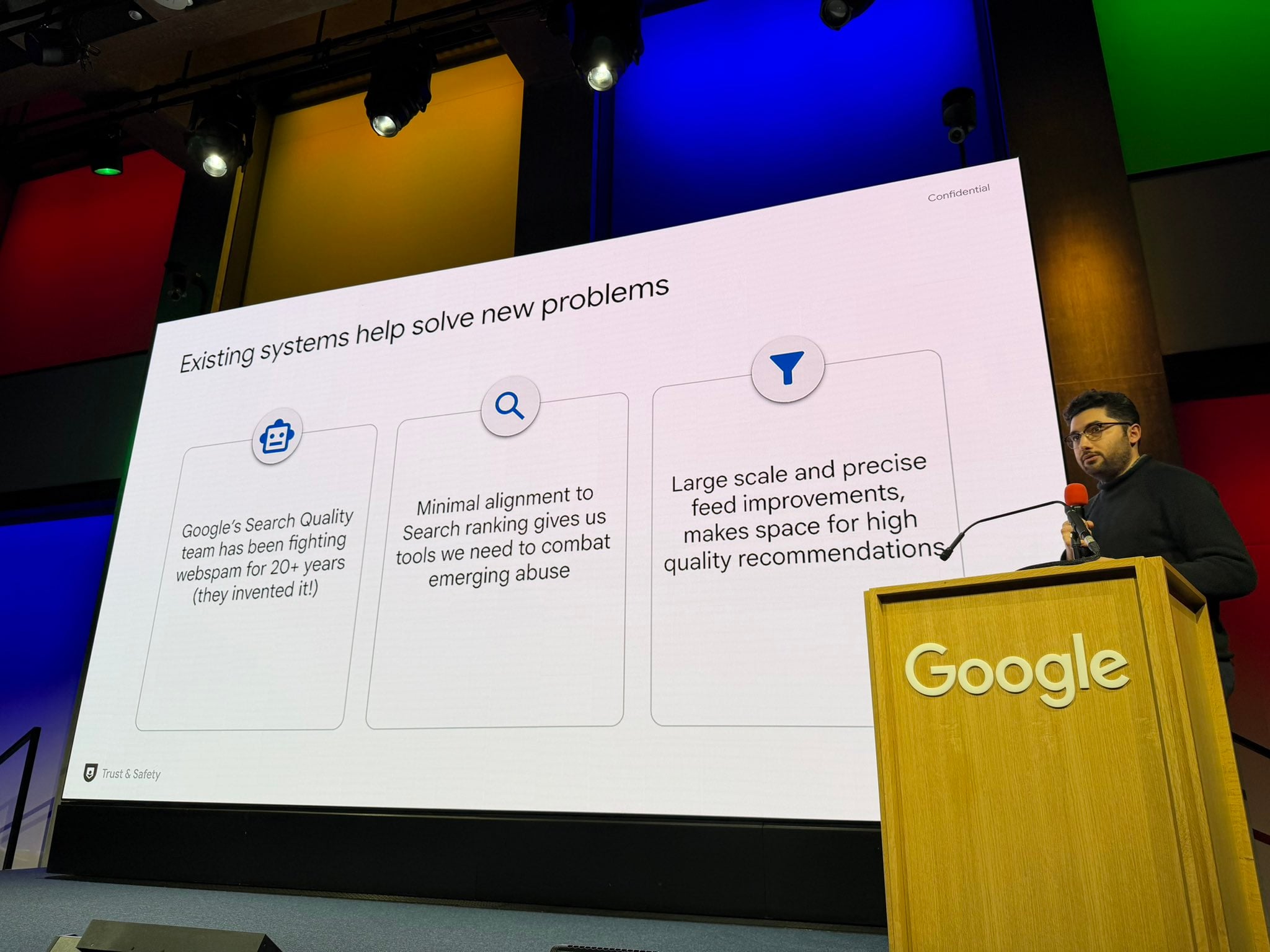
Yesterday, Andy Almeida from the Google Trust and Safety team shared some insights at the Google Search Central Live event in Zurich. He mentioned that Google Discover isn’t as closely aligned with Google Search rankings as it once was.
Andy presented a slide illustrating how existing systems assist the Google Discover team in addressing challenges. The slide highlighted:
“Minimal alignment to search ranking gives us the tools we need to combat emerging abuse.”
Understanding the Implications. This indicates that Google Discover is moving away from relying heavily on Google’s established search systems, particularly concerning combating platform abuse.
When I asked Andy what this meant for publishers, he explained that Google Discover aims to showcase content from lesser-known and smaller publishers. It seems while Google Search may not always favor them, Discover does, focusing more on its own evaluation systems.
The Challenge with Spam. I’ve been aware of the significant spam issues confronting Google Discover, primarily caused by sites exploiting expired or throwaway domains for spam content. This is a challenge not as prevalent in Google Search.
Back in 2019, Google stated that its core ranking systems affected visibility in Google Discover, especially after a core update. However, this new approach seems to diverge from that stance.
Why This Matters. As Google continues to address these spam problems, it’s balancing the visibility of smaller sites on Discover while curbing spam. This is great news for emerging publishers who focus on niche topics, as long as the spam issue can be effectively managed.
I recently learned that Google has been rolling out smaller core updates without any announcements. This revelation came from a new section added to the core updates documentation for developers. While Google has mentioned this before, they’ve now made it official in their documentation.
What’s New: Google included the following new information:
We don’t have to wait for a major core update to see the impact of any improvements we’ve made. Google’s search algorithms are continually evolving through minor core updates. These updates may not be announced because they’re usually not very noticeable. However, they’re another opportunity for improved content to climb in search rankings.
Google’s Explanation: According to Google, this addition to the documentation helps site owners understand that significant improvements can lead to better positions in search results without awaiting a major core update.
Even Danny Sullivan, the former Google Search Liaison, shared similar insights with us back in August 2019. He explained how broad core updates occur every few months and improvements might not reflect until the next one. However, he emphasized that Google’s ongoing algorithm tweaks, like these smaller updates, can help recovery if content has been improved.
A Larger Update Is On The Way: At the Google Search Central Live event in Zurich, John Mueller from Google hinted that a core update is in the works and might be released soon. He thinks it’ll take a bit longer than a couple of weeks but left us with no exact date.
Why It’s Important: This confirmation is a reminder that Google regularly implements these smaller core updates. It’s crucial to keep our content optimized and anticipate a significant core update soon, which could lead to even more prominent changes in search results and rankings.
I recently learned about a significant ruling that will impact Google’s longstanding agreements with tech giants like Apple and Samsung. This decision means that moving forward, Google will only be able to secure its place as the default search engine on devices for one year at a time. Despite this change, I’m not expecting a major shift in Google’s dominance over the search market anytime soon.
Here’s what’s driving the news: On Friday, Judge Amit Mehta described this one-year cap as a crucial step in enforcing antitrust measures. This follows his 2024 decision, which concluded that Google was unlawfully monopolizing the realms of search and search advertising. According to Business Insider, the requirement aims to enforce fair competition in the industry.
Additionally, Judge Mehta’s earlier ruling outlined restrictions for Google:
Google must avoid any exclusive contracts regarding the distribution of Google Search, Chrome, Google Assistant, and the Gemini app.
They cannot condition licensing agreements of the Play Store on the preloading of these applications on devices.
Revenue sharing cannot be contingent on placing or maintaining these applications on devices beyond one year.
Partners are free to distribute alternative GSEs, browsers, or GenAI products simultaneously.
Why I care: This landscape shift could mean that user searches originate from a wider array of platforms. If AI-powered competitors like OpenAI, Perplexity, or Microsoft make even modest advances, we could see a more diverse and challenging search terrain emerge.
Reality check: In my view, this is more of a bump in the road rather than a disruption. Google’s financial resources, brand strength, and user habits continue to provide significant leverage in annual negotiations.
I’m thrilled about the latest update from Google Search Console, which now offers both weekly and monthly views in their performance reports. This change allows me to dive deeper into the data, providing a more detailed analysis beyond the usual 24-hour view.
What it looks like. At the recent Google Search Central event in Zurich, I snapped some photos of the announcement. It was a fantastic experience to see these changes unveiled in real-time.
Why we care. These updates, though small, are invaluable for SEOs, publishers, and site owners like me. The granular data now available helps me investigate changes in performance more effectively, whether it’s over a specific month, week, or day.
I’ve been following Google’s plan to address its ad tech issues closely, and now their proposed solutions are under the spotlight of an EU ‘market test.’ This is a critical step to ensure they truly bring back fair competition in the industry.
The European Commission is actively seeking feedback from industry leaders, and I’ve noticed that they have reached out to a significant group of stakeholders, including publishers, advertisers, and rival ad tech firms, to gauge their reactions to Google’s latest proposal.
Officials are emphasizing that the feedback gathered will play a key role in determining if Google’s commitments will really ensure fair play in the EU’s digital ad market.
Personally, I’m intrigued by the background of this situation. Google was hit with a hefty fine of €2.95 billion and was instructed to cease favoring its own ad tech services. In an effort to resolve these issues, Google has suggested several changes, which include allowing publishers more control over setting minimum bid prices in their Ad Manager platform.
They also promise improved interoperability between their tools and those of competitive ad tech providers, along with broader choices and flexibility for advertisers and publishers alike.
Why does this matter to me and you? The unfolding ‘market test’ could significantly influence how Brussels approaches Google’s offer, potentially ending a pivotal tech rivalry case. If Google’s suggestions are approved, we could see fairer auctions that provide better returns on investment and reduce Google’s inherent advantages in their ad tech operations.
Reading between the lines, this market test represents a potential turning point. If it goes well, the EU could be on the brink of concluding the case, relieving Google of prolonged regulatory pressures. However, Thursday’s developments also highlight the EU’s broader mission to regulate major tech giants while dealing with external pressures from U.S. authorities.
Meanwhile, I’ve noticed that the EU is also setting its sights on Meta, as they’re starting a new examination of its AI features within WhatsApp and examining whether these might skew the competition.
It’s crucial to remember that antitrust breaches can incur penalties up to 10% of global revenue, although such severe fines are uncommon. Meta is now under pressure to present solutions, although WhatsApp insists that the concerns are unwarranted.