Category: Google

  • Google’s Ad Systems at Risk: The Impact of Forced Syndication

    Google’s Ad Systems at Risk: The Impact of Forced Syndication

    Recently, I’ve been following a concerning development involving Google, where the tech giant is urging a federal judge to halt the Department of Justice’s antitrust remedies. The primary concern? Forced ad syndication could lay bare Google’s proprietary technology and negatively affect advertisers.

    In an affidavit filed on January 16 by Google’s director of product management, Jesse Adkins, the company stresses how these measures could lead to irreversible damage. The crux of the argument is about maintaining control over proprietary ad technology, which could be jeopardized if exposed.

    The big picture. In Adkins’ testimony, the likely fallout includes forced exposure of confidential technology, detrimental effects on advertisers, and a loss of authority over query and pricing data.

    Mehta’s final ruling could compel Google to share its search results, features, and ads with any qualified competitor for the next half-decade under the current terms.

    Google contends that employing these remedies before the conclusion of their appeal would result in immediate and unchangeable damage.

    Risk to Google’s ad technology. At the center of Google’s warning is the potential exposure of its search ad auctions, developed over many years by an enormous team of engineers.

    Syndication on a large scale might allow competitors or outsiders to decipher Google’s ad targeting techniques, relevance factors, and auction mechanisms, according to Adkins.

    Competitors could potentially use this data to enhance their ad systems, stripping Google of its competitive edge.

    Sub-syndication amplifies risk. The judgment permits competitors to further share Google ads with third parties, creating multiple layers of vulnerability to scraping and misuse.

    Even the most compliant partners might lack the motivation to monitor downstream entities, effectively transforming Google’s ad system into a near-open utility with limited protection.

    Advertisers could face fraud. Adkins mentions advertisers are caught in this struggle, citing tactics like “trick-to-click” that incite accidental clicks or artificially inflate expenses.

    One example involves a syndicator adding names of wealthier countries to queries while diverting low-cost international traffic to ads, resulting in tens of millions in click fraud within a couple of months.

    As a result, users might see less relevant ads, yet advertisers would still be charged, leading to diminished conversion rates.

    Pricing uncertainty. Google is also expected to offer syndication terms no less favorable than existing agreements, which are highly customized to each partner’s traffic quality and technical setup.

    Imposing these terms universally could lead to suboptimal pricing and financial uncertainty linked to unpredictable query volumes.

    Irreversibility is key. Throughout the affidavit, Adkins underscores the irreparable nature of the potential harm. Once proprietary ad insights are revealed, they can’t be recaptured.

    Once advertisers lose confidence, it is nearly impossible to win back. Moreover, once competitors craft products based on Google’s systems, the market’s impact becomes permanent.

    Google suggests that even if their appeal succeeds, it could be too late to undo the ensuing damage.

    Why we care. Any court-mandated ad syndication could potentially dilute Google’s control over ad placement and targeting, resulting in irrelevant advertising and reduced conversion rates. Essentially, this affidavit highlights the risk of higher costs, lower returns on investment, and less predictable campaign performance.

    What’s next. The court is set to decide whether to temporarily halt the syndication remedies while Google’s appeal is pending. Without this stay, Google might have to start licensing search ads and results to qualifying competitors under new regulations, reshaping the search advertising landscape in unexpected ways.

    Dig deeper. For further reading, I recommend checking out the following resources:


    Inspired by this post on Search Engine Land.


    crushpress.ai community screenshot
  • Google’s Demand Gen: Unlock Shoppable and Measurable Ads

    Google’s Demand Gen: Unlock Shoppable and Measurable Ads

    I’m excited to share that Google’s Demand Gen updates are making video ads even more shoppable and measurable across platforms like YouTube and Google. With these enhancements, I can now explore new ways to engage with audiences and increase conversions.

    Google is pushing more Demand Gen features into mainstream use, particularly boosting shoppable and travel ads. It’s clear to me that Google is committed to creating a comprehensive performance channel, merging discovery, video, and commerce on both YouTube and Google surfaces.

    What’s new:

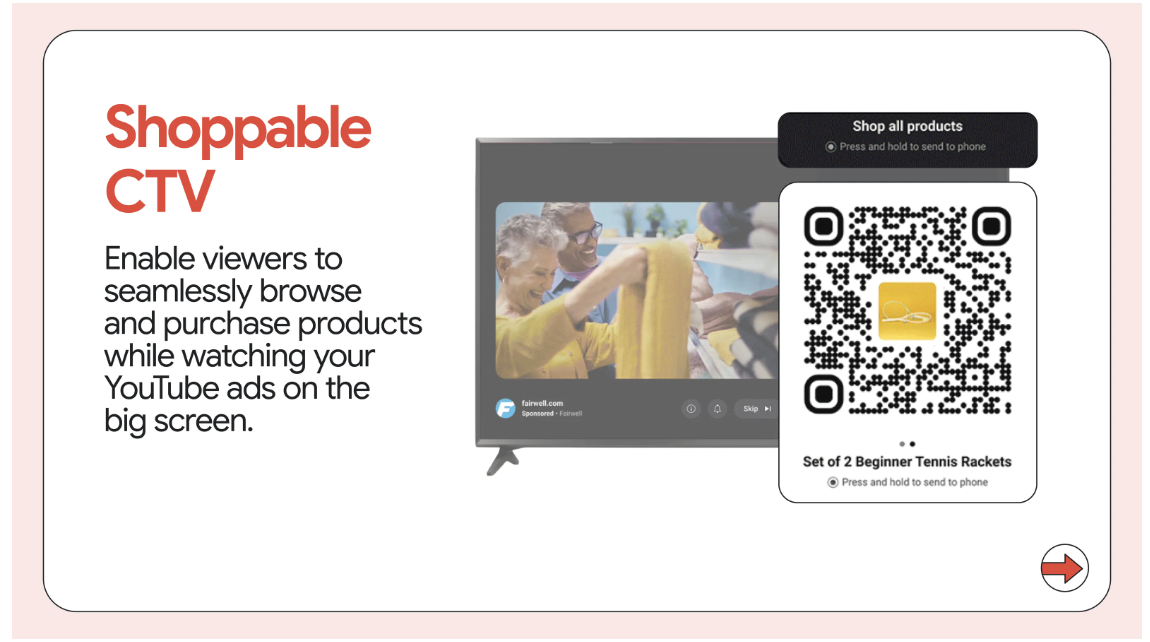
    • Shoppable CTV is now available through Demand Gen, giving viewers the option to browse and purchase products directly from YouTube ads on connected TVs. It’s a game-changer for anyone looking to enhance their advertising strategy.
    ```json
{
  "alt": "Shoppable CTV ad with QR code and smart TV displaying a video.",
  "caption": "Transform your TV into a shopping ally with Shoppable CTV, enabling seamless product browsing with QR codes directly from your screen.",
  "description": "The image showcases a Shoppable CTV advertisement featuring a QR code for product shopping directly from TV screens. A smart TV displays an ad video, while to the right, a QR code invites interaction to explore products such as beginner tennis rackets. The ad emphasizes the ease of browsing and purchasing items while watching YouTube ads on a big screen. Keywords: Shoppable CTV, QR code, smart TV, YouTube ads, product browsing."
}
```
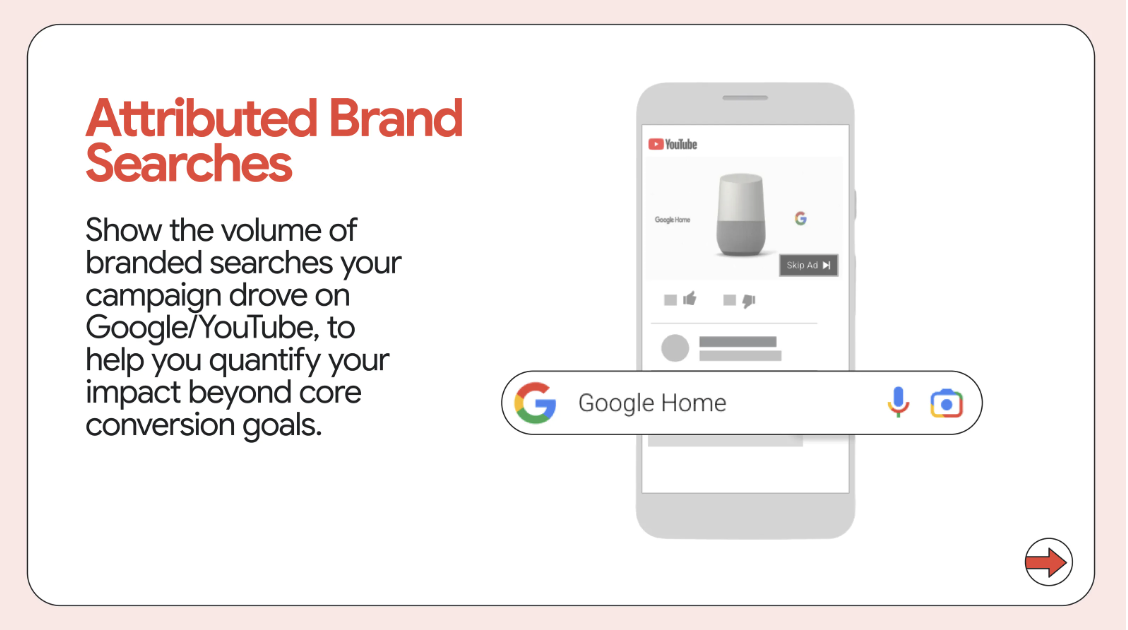
    • Attributed Branded Searches provide advertisers, like me, with insights into how campaigns influence brand search activity on Google and YouTube. Activation requires a Google rep, and it’s a feature that promises to add tremendous value.
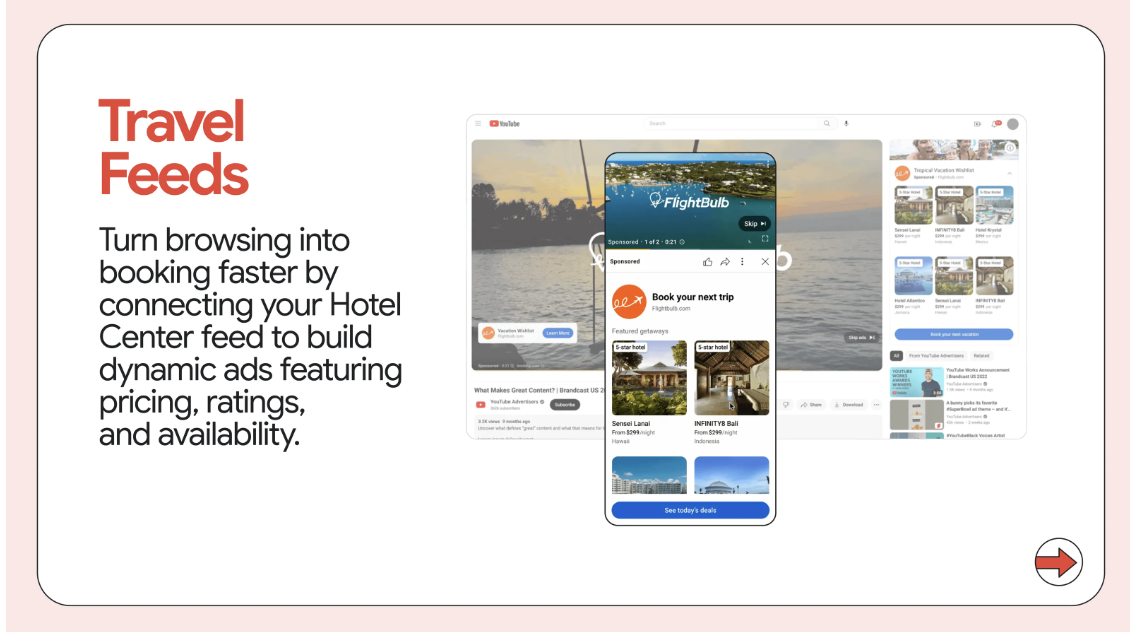
    • Travel Feeds let advertisers like me connect Hotel Center feeds to create dynamic video ads featuring real-time pricing, ratings, and availability.
    ```json
{
  "alt": "Illustration showing a smartphone with a YouTube ad for Google Home and text about attributed brand searches.",
  "caption": "Maximize your brand's visibility by leveraging attributed brand searches on Google and YouTube to enhance campaign effectiveness.",
  "description": "This image illustrates the concept of attributed brand searches, showcasing a smartphone displaying a YouTube ad for Google Home. The design includes text on measuring the impact of branded searches driven by marketing campaigns on Google and YouTube. The image emphasizes tracking beyond core conversion goals, providing valuable insights for digital marketing success. Keywords: attributed brand searches, YouTube ad, Google Home, digital marketing, campaign impact."
}
```

    By the numbers:

    • According to Google, Demand Gen campaigns featuring TV screens result in 7% more conversions at the same ROI. That’s a significant increase in performance for anyone leveraging these tools.
    • For example, LG Electronics reported a 24% higher conversion rate compared to paid social media, while reaching high-value customers at a 91% lower CPA.

    Why we care. With these updates, Demand Gen becomes more competitive with paid social channels, offering actionable and measurable solutions. Shoppable CTV transforms TV impressions into direct sales opportunities, while attributed branded search proves Demand Gen’s effectiveness beyond a simple last-click model. Travel feeds, on the other hand, streamline the process from browsing to booking.

    All these features offer advertisers like me the chance to drive incremental conversions, engage high-value audiences at a lower CPA, and better justify upper-funnel investments with clearer performance metrics — all within Google’s integrated ecosystem.

    ```json
{
  "alt": "Advertisement for Travel Feeds showing dynamic hotel booking ads on a mobile device within a YouTube interface.",
  "caption": "Discover how Travel Feeds effortlessly turns browsing into booking with dynamic, interactive ads. Elevate your hotel's visibility with engaging content and real-time availability.",
  "description": "The image features a travel advertisement highlighting 'Travel Feeds', showing a mobile device with dynamic hotel booking ads over a YouTube interface. The ad promotes connecting Hotel Center feeds to create ads displaying pricing, ratings, and availability. The design suggests a seamless integration of advertisements into user experiences, enhancing booking efficiency for travelers. Keywords include Travel Feeds, hotel booking, dynamic ads, and YouTube advertising."
}
```

    Between the lines. It’s evident that Google is positioning Demand Gen as a formidable alternative to paid social by utilizing premium video resources, first-party data, and enhanced measurement. This move is particularly strategic as advertisers seek scalable performance beyond traditional social media platforms.

    Bottom line. With advancements like shoppable CTV, reinforced brand attribution, and travel-focused automation, Demand Gen is evolving into a versatile performance tool — a significant aspect of Google’s strategy to secure larger budgets higher up the advertising funnel.

    Dig deeper. Explore the latest product features in January’s Demand Gen Drop.


    Inspired by this post on Search Engine Land.

    crushpress.ai community screenshot
  • Experience Personalized AI in Google Search’s New AI Mode

    Experience Personalized AI in Google Search’s New AI Mode

    I’m excited to share that Google is introducing Personal Intelligence to its AI Mode in Google Search! In a recent Labs experiment, AI Pro and Ultra subscribers in the U.S. can now opt-in to this feature over the next few days.

    Personal Intelligence was first introduced on the Gemini app last week and is now making its way to Google Search for certain users. According to Robby Stein, VP of Product at Google Search, starting today, subscribers can securely connect their Gmail and Google Photos to AI Mode, enhancing their search experiences.

    This feature allows me to receive more personalized responses by connecting across my Google ecosystem, including Gmail, Photos, and YouTube history, right in Google Search. This rollout will be completed in a few days for AI Pro and Ultra subscribers in the U.S.

    How to Access Personal Intelligence

    This innovative feature is part of a Labs experiment, and opting in is straightforward. It’s available for personal accounts in the U.S., but currently not for Workspace business, enterprise, or education users. Subscribers will automatically gain access as the feature becomes available.

    If you’d like to enable it manually, follow these steps:

    1) Open Search and tap your profile.

    2) Click on Search personalization.

    3) Select Connected Content Apps.

    4) Connect Workspace and Google Photos.

    Inspiring Examples

    Imagine asking Google a question like these:

    • Help me plan a weekend getaway with my family based on things we like to do.
    • Make a scavenger hunt for [partner’s name] to celebrate our anniversary, including a hint about us for each location.
    • I’m decorating [child’s name] bedroom; give me theme ideas and decor suggestions.
    • If I were the hero/heroine from a book, who would I be?
    • What specific era of fashion suits me best?
    • Recommend books that fit my current life phase.
    • If I were a perfume, what would my top notes and base notes be?

    To truly see it in action, you can watch this video:

    Why This Matters

    This feature, currently available as an opt-in, could become a standard part of Google Search in AI Mode. As a result, searches will become increasingly personalized, making it more challenging to track different website citations for individual users.


    Inspired by this post on Search Engine Land.


    crushpress.ai community screenshot
  • Google Searches: Same URL Counts as One Impression

    Google Searches: Same URL Counts as One Impression

    Recently, I’ve been delving into the nuances of Google Search Console and its impression counts.

    I learned from John Mueller of Google that when a URL shows up in both an AI Overview and the traditional blue links on SERPs, it is counted as just one impression, not two.

    This clarification came to light through John Mueller, after a lively discussion among SEO experts, sparked by Jamie Indigo and publicly shared by Mark Williams-Cook from Candour on LinkedIn.

    The background. Initially, Mark Williams-Cook had assumed that because of historical practices with SERP features like tweet boxes, the URL might be counted twice.

    Testing this theory was challenging, but ultimately, Mueller confirmed that the Search Console treats these appearances as a single impression.

    What’s happening. Google’s policy treats an AI Overview as a singular position in search results. Each link within the Overview shares that position, governed by standard impression rules.

    So, when a URL appears more than once in the same search experience, the Search Console doesn’t double count these for the same query.

    Why this happens. Google defines an impression based on a user’s visibility of a link within the current set of results. Multiple instances of the same URL on one results page are aggregated, not counted separately.

    This approach aligns with other SERP features like knowledge panels, where scrolling past and returning, or seeing the URL in different elements, won’t create additional impressions.

    Why we care. In this AI-centric era, interpreting performance metrics can be a challenge. Knowing that both AI Overviews and blue links count as a single impression clarifies how these listings influence visibility. Although the impression count doesn’t rise, appearing in both strengthens brand visibility and boosts credibility among Google users.


    Inspired by this post on Search Engine Land.

    crushpress.ai community screenshot
  • Google Prioritizes Trust Over Ads in Gemini’s AI Evolution

    Google Prioritizes Trust Over Ads in Gemini’s AI Evolution

    Recently, I was fascinated to learn that Google is taking a firm stance by keeping ads out of Gemini, its conversational AI, for the time being. As the CEO of Google DeepMind, Demis Hassabis, stated, they are focusing on ensuring trust and high-quality assistance rather than pursuing monetization right now.

    What’s New. At the World Economic Forum in Davos, Hassabis confirmed that Google has “no plans” to introduce ads into Gemini just yet. He stressed the significance of improving the AI assistant’s capability and usability across various platforms before thinking about monetizing it.

    The Contrast. This announcement stands in stark contrast to OpenAI’s recent decision to start testing ads in the free and budget-friendly tiers of ChatGPT. Hassabis found this move “interesting” and hinted it might be more about immediate revenue needs than a thoughtful product strategy.

    Why We Care. For me, Google’s consistent decision to exclude ads from Gemini clearly suggests that monetizing AI won’t mimic the strategies we’ve seen in search or social media anytime soon. This cautious approach could initially limit ad opportunities in conversational AI. With competitors like OpenAI exploring ads, advertisers may need to experiment with these formats outside of Google’s ecosystem first.

    Looking ahead, I believe Google’s approach hints at any potential future ad integration in Gemini being more restrained, prioritizing trust and taking longer to scale. This will influence how brands plan their AI-driven media strategies.

    Not the First Denial. Interestingly, this is not the first time Google’s leadership has publicly opposed the idea of ads in Gemini. In December, Google Ads President Dan Taylor clarified that ads wouldn’t be a part of Gemini in 2026, indicating a unified stance on keeping it ad-free, at least for now.

    Trust at Stake. Hassabis also expressed concerns about integrating advertising into such a personal AI assistant. He emphasized that maintaining unbiased and genuinely helpful recommendations is crucial to avoid eroding user trust.

    Bottom Line. It’s fascinating to see Google, a company whose core business revolves around advertising, showing this level of restraint. By keeping AI assistants like Gemini free from ads, at least for now, Google aims to avoid blurring the line between help and influence as it enhances their capabilities.

    Dig Deeper. For more insights, you can check out the detailed article on Google’s AI strategies on Substack.


    Inspired by this post on Search Engine Land.


    crushpress.ai community screenshot
  • Unlock Local SEO: Master Google’s Entity Recognition

    Unlock Local SEO: Master Google’s Entity Recognition

    The local SEO gatekeeper- How Google defines your entity

    Have you ever wondered why some businesses never make it to the top of the local pack rankings on Google? It’s not just about lacking reviews, links, or even proximity. The real challenge starts before any of these factors. Allow me to walk you through how Google determines if your business is eligible in the first place.

    Think of it this way: Google first confirms the identity of your business before considering its relevance. It’s a critical step that many overlook.

    From Exact Matches to Broad Intent: How Eligibility Shifts

    ```json
{
  "alt": "Screenshot of a Google API documentation discussing business type categorization.",
  "caption": "Explore the Google API documentation on business type categorization, detailing the use of business names and categories for location-based elements.",
  "description": "This image is a screenshot from the Google API documentation. It discusses the high-level categorization of business types, specifically using the parameters BUSINESS_NAME and BUSINESS_CATEGORY. The text explains how business types align with QRef collections and outlines examples such as hotels and restaurants. It also includes a note on grammar categorization and business type matching. Essential for developers working with location-based data."
}
```

    For niche queries, Google searches for a precise 1:1 match, ensuring there’s no room for misunderstanding. But when the query broadens, as in searching for “restaurants,” the landscape changes dramatically, opening up more possibilities based on various categories.

    This highlights hidden ranking elements like clicks, reviews, and even real-time data like whether a business is open.

    Your business name and category must create a cohesive signal, defining what I like to call your “entity boundary.” For many businesses, a name that’s too specific can become an anchor, limiting your visibility in broader searches. If you’re aiming to conquer a niche, aligning your name and category perfectly can be your secret weapon.

    ```json
{
  "alt": "Search results for child dance lessons in Palm Beach showing dance schools with ratings and contact details.",
  "caption": "Explore top-rated dance schools in Palm Beach for your child's dance lessons. Find essential details and contact information to start your child's dance journey.",
  "description": "This image displays search results for child dance lessons in Palm Beach. It includes listings of various dance schools with ratings, years in business, and contact information. Highlights include Tippi Toes Palm Beach Gardens and KemKids Dance Studio, both marked with red arrows for emphasis. The displayed options provide detailed information like customer reviews, office hours, and website links, offering a guide to parents seeking dance lessons for their children."
}
```

    The Eligibility Gatekeeper: Interpretation First, Rankings Second

    Competing isn’t just about outperforming other businesses; it’s also about meeting Google’s stringent need for certainty. Thanks to the Google Content Warehouse API Leak, we now understand the engine that decides which businesses are eligible before considering traditional ranking factors like reviews or links.

    This mechanism pre-qualifies businesses using a machine-learning classifier to filter out those unlikely to fulfill a query, ensuring only the most confident matches appear.

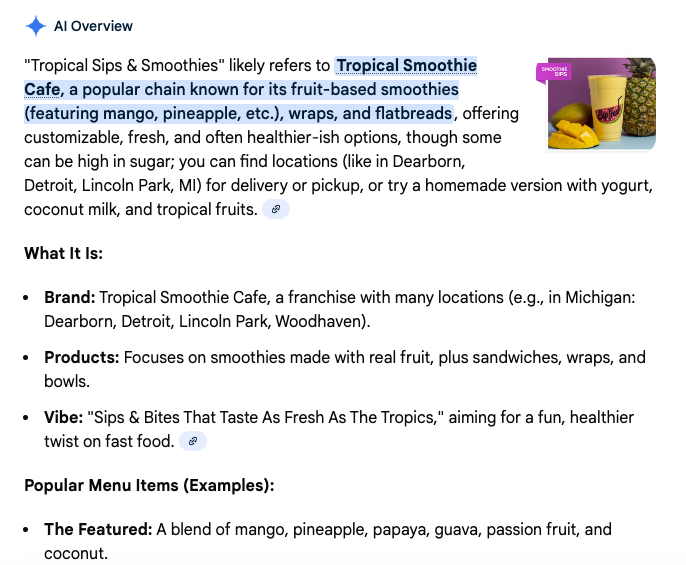
    ```json
{
  "alt": "Text about Tropical Smoothie Cafe, highlighting their fruit-based smoothies, wraps, and flatbreads with an image of smoothies and fruit.",
  "caption": "Discover the tropical flavors of Tropical Smoothie Cafe, known for their vibrant fruit smoothies and tasty wraps. Perfect for a refreshing treat!",
  "description": "This image features descriptive text about Tropical Smoothie Cafe, a franchise renowned for its fruit-based smoothies, wraps, and flatbreads. Located in various cities, the cafe focuses on real fruit smoothies and offers a fun, fresh take on fast food with items like the mango-pineapple blend. A small image shows smoothies and fresh fruit, reinforcing the tropical theme and fresh offerings of the cafe."
}
```

    Your business name and primary category aren’t just descriptors; they set boundaries that determine your eligibility for specific queries.

    Understanding the intricacies of these “entity boundaries” can help you determine how Google perceives the essence of what your business offers. I’ve seen this factor repeatedly transform ranking outcomes.

    Business name + category: A unified signal

    ```json
{
  "alt": "Local smoothie store search results displaying ratings, prices, and locations.",
  "caption": "Finding your perfect smoothie spot made simple with detailed local store listings, featuring ratings, price ranges, and customer reviews.",
  "description": "This image captures a search result for 'smoothie store near me', showcasing several options with ratings and reviews. The list includes Beyond Juicery + Eatery, Smokey’s Smoke & Smoothie, and Vara Juice, each with customer ratings, price estimates, and brief testimonials. Perfect for users seeking nearby smoothie shops with top customer feedback."
}
```

    Google evaluates your business name and category as one unit. They process parallel through semantic models, each playing a distinct role: while your business name acts as a self-identification signal, the category offers authoritative structure.

    Understanding how these two elements interact can be pivotal in leveraging your business’s online visibility and eligibility to show up for desired queries.


    Inspired by this post on Search Engine Land.


    crushpress.ai community screenshot
  • Unveiling Google’s New AI Overviews with Gemini 3 Pro

    Unveiling Google’s New AI Overviews with Gemini 3 Pro

    Recently, I’ve noticed that Google has started using Gemini 3 Pro to create AI Overviews on their search platform. This change primarily enhances the handling of more complex search queries.

    Back in November, Google announced this improvement for AI Mode results. Then, in December, they began implementing Gemini 3 Flash for AI Mode. Now, it’s exciting to see Google integrating Gemini 3 Pro for generating AI Overviews.

    Gemini 3 Pro is now crafting AI Overviews for complicated queries in English, accessible globally to all Google AI Pro & Ultra subscribers.

    What Google Shared with Us. Robby Stein, VP of Product at Google Search, expressed this in his recent update:

    • “Update: AI Overviews now tap into Gemini 3 Pro for complex topics.”
    • “Behind the scenes, Search will intelligently route your toughest Qs to our frontier model (just like we do in AI Mode) while continuing to use faster models for simpler tasks.”
    • “Live in English globally for Google AI Pro & Ultra subs.”

    Why It Matters to Me. The AI Overviews you see might look quite different than they did recently. Google’s consistent efforts to refine its Gemini models signify ongoing improvements in their AI technologies within Google Search, which includes both AI Overviews and AI Mode.


    Inspired by this post on Search Engine Land.

    crushpress.ai community screenshot
  • AdSense Revenue Crashes: Publishers Face Sudden Income Plunge

    AdSense Revenue Crashes: Publishers Face Sudden Income Plunge

    I’ve recently noticed a wave of concern sweeping across Google AdSense publishers due to a sudden drop in earnings. Many publishers like myself have experienced a steep decline in eCPM and RPM by up to 70%. This unexpected turn of events has left us fearing another shock to our revenue streams.

    Why this matters to me is simple: relying heavily on AdSense for funding operations makes me vulnerable to such sudden swings. When traffic flows and costs remain steady, a sharp revenue decrease poses a real threat to my sustainability.

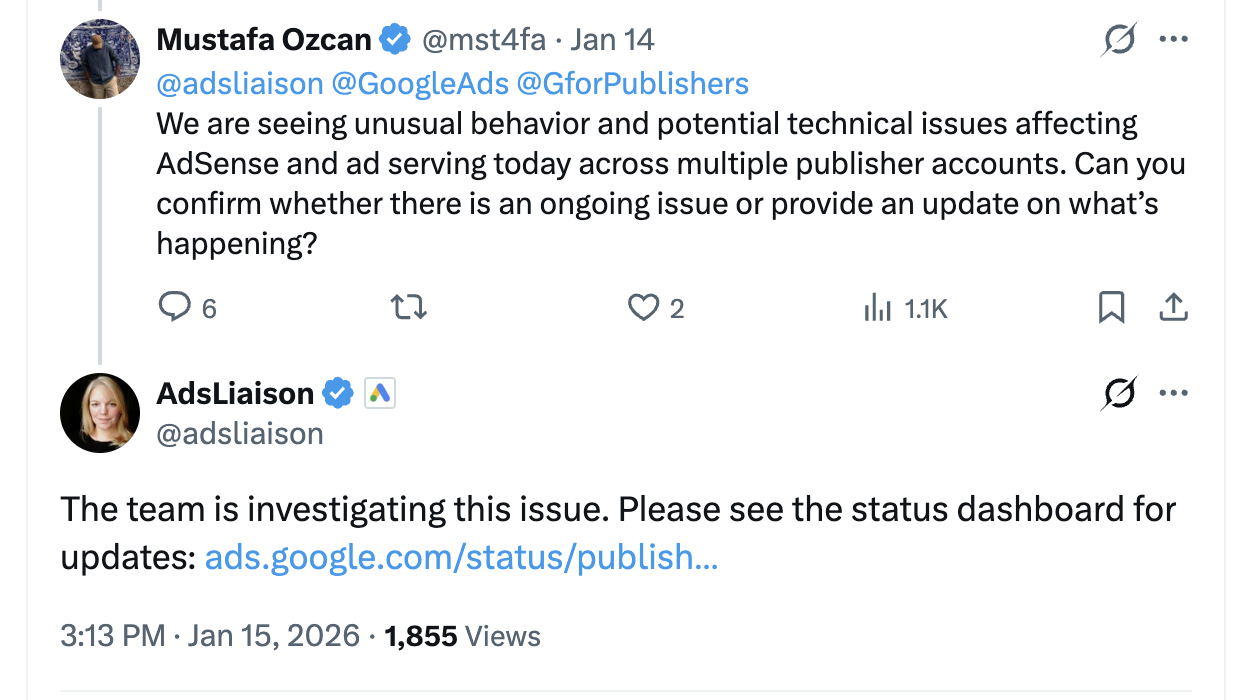
    The buzz in the community intensified late on January 14th, peaking through January 15th. From the U.S. to Europe, publishers reported drastic drops in both page RPM and eCPM. Interestingly, multiple sites within the same accounts felt the impact simultaneously, and some even reported that their ads had partially or completely vanished.

    Publishers like myself have voiced concerns:

    “My RPM dropped by more than 80% overnight.”

    “Same traffic, same placements — revenue collapsed.”

    “I used to earn $500 a day, now it’s $35.”

    “Never seen figures like this before.”

    The numbers paint a grim picture across various regions:

    Germany (.de): –64%

    France (.fr): –63%

    Italy (.it): –76%

    Spain (.es): –90%

    U.S.-focused sites report drops of 35–70%

    ```json
{
  "alt": "Twitter exchange about AdSense technical issues involving Mustafa Ozcan and AdsLiaison.",
  "caption": "Tech troubles: Mustafa Ozcan inquires about AdSense issues, prompting a response from AdsLiaison informing users that investigations are underway.",
  "description": "A Twitter conversation between Mustafa Ozcan and AdsLiaison concerning technical issues with Google AdSense. Mustafa highlights unusual behavior affecting multiple publisher accounts, seeking confirmation and updates. AdsLiaison responds, stating the team is investigating and directs users to the status dashboard for ongoing updates. This exchange reflects concerns within the advertising community and the proactive approach by Google to address them."
}
```

    Digging deeper, the timing of these drops coincides with an unconfirmed Google Search ranking update. This connection raises worries that visibility shifts and monetization issues are overlapping — an unsettling pattern that I, with many others, have witnessed before.

    There’s another twist. Google has recognized systemic issues within Google Ad Manager. These issues include:

    Declining AdX match rates

    Reduced delivery from Google Ads and DV360

    The hardest-hit areas are web and mobile web display inventory.

    According to Google, affected users might face errors, high latency, or unusual behavior, with an update promised by Jan. 15th, at 7:00 PM UTC (2 pm E.T.).

    However, a few critical questions remain unanswered:

    Does the Ad Manager issue completely account for the AdSense revenue declines?

    Is this all a reporting bug, an ad serving issue, or the beginning of a long-term monetization shift?

    The indirect impact of AI Overviews, which currently display zero ads, is also a mystery.

    In the broader context, it’s not just a recent occurrence for us; many publishers, including myself, have been experiencing a decline in revenue for months. Some have seen losses of 70–80% since mid-2025, driving fears that traditional content sites are being gradually deprioritized.

    The bottom line is that, whether this is a temporary glitch or a sign of a continuing trend, we’re once again in a position of uncertainty — monitoring our dashboards with little clarity and even less control.


    Inspired by this post on Search Engine Land.

    crushpress.ai community screenshot
  • Google Enhances Ads with New Data Control Features

    Google Enhances Ads with New Data Control Features

    How shifts in data privacy are forcing a return to marketing fundamentals

    Recently, I discovered that Google is offering advertisers more control over data flow, which is especially helpful when user consent is limited.

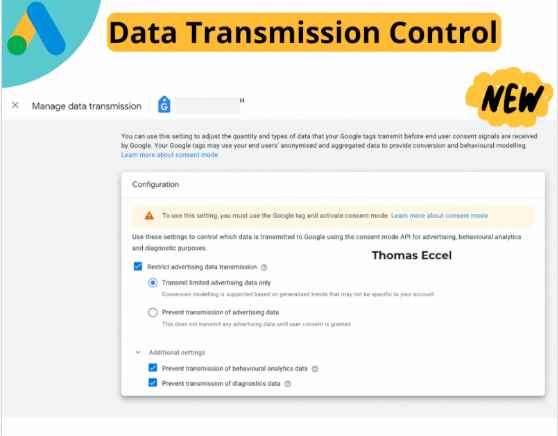
    Driving the news. There’s a new tool out called Data Transmission Control, appearing in Google Ads. This enhancement builds on Advanced Consent Mode by providing a more detailed approach to managing how advertising, analytics, and diagnostic data are shared.

    What’s new. As an advertiser, I can now independently adjust the flow of advertising data, behavioral analytics, and diagnostic data. If ad_storage consent is not given, I have two choices: either allow limited data with identifiers removed (which still supports conversion modeling), or entirely block the data until consent is obtained. Interestingly, I can still allow behavioral analytics even if ad data is restricted, or choose to block it completely.

    Where to find it. I found the setting hidden within Data Manager → Google Tag (Manage) → Manage data transmission. It’s easy to overlook if you’re not looking carefully.

    Why we care. Traditionally, Consent Mode was all about reflecting user choices. Now, with Data Transmission Control, I can decide—right down to the tag level—what data flows when there’s no consent, aligning more closely with privacy-focused strategies.

    ```json
{
  "alt": "Google Ads Data Transmission Control Interface with configuration settings.",
  "caption": "Explore Google Ads' new Data Transmission Control settings to manage how your data is shared, ensuring privacy and compliance.",
  "description": "This image shows the Google Ads Data Transmission Control interface, where users can manage data transmission settings. It includes options to restrict data sharing, specifically for advertising, behavioral analytics, and diagnostics. Featured prominently are toggles to prevent data transmission, emphasizing user control over their privacy. The new feature announcement highlights its relevance in maintaining data compliance and privacy."
}
```

    It’s empowering to have this degree of control, especially when trying to balance privacy compliance against performance metrics, which is crucial in markets with strict regulations.

    Key details. It’s important to note that Consent Mode must be enabled for this feature to function. It’s set up via the user interface in Google Ads, Google Analytics, or Campaign Manager 360, and applies only to Google tags. If the feature isn’t enabled, everything stays the same, but once consent is given, data transmission resumes automatically.

    First seen. This update was first reported by Google Ads expert Thomas Eccel, who shared his insights on LinkedIn.

    The bottom line. The introduction of Data Transmission Control provides a subtle yet powerful way for me to ensure tighter data collection control without fully losing out on valuable measurement capabilities.


    Inspired by this post on Search Engine Land.

    crushpress.ai community screenshot
  • Discover Trends with Google’s New Gemini Feature

    Discover Trends with Google’s New Gemini Feature

    I’ve recently noticed that Google Trends has introduced a fascinating update to its Explore page, and I’m thrilled to share what I’ve learned with you. This update is powered by something called Gemini, which aims to make it easier for us to discover and compare trending search terms within our areas of interest.

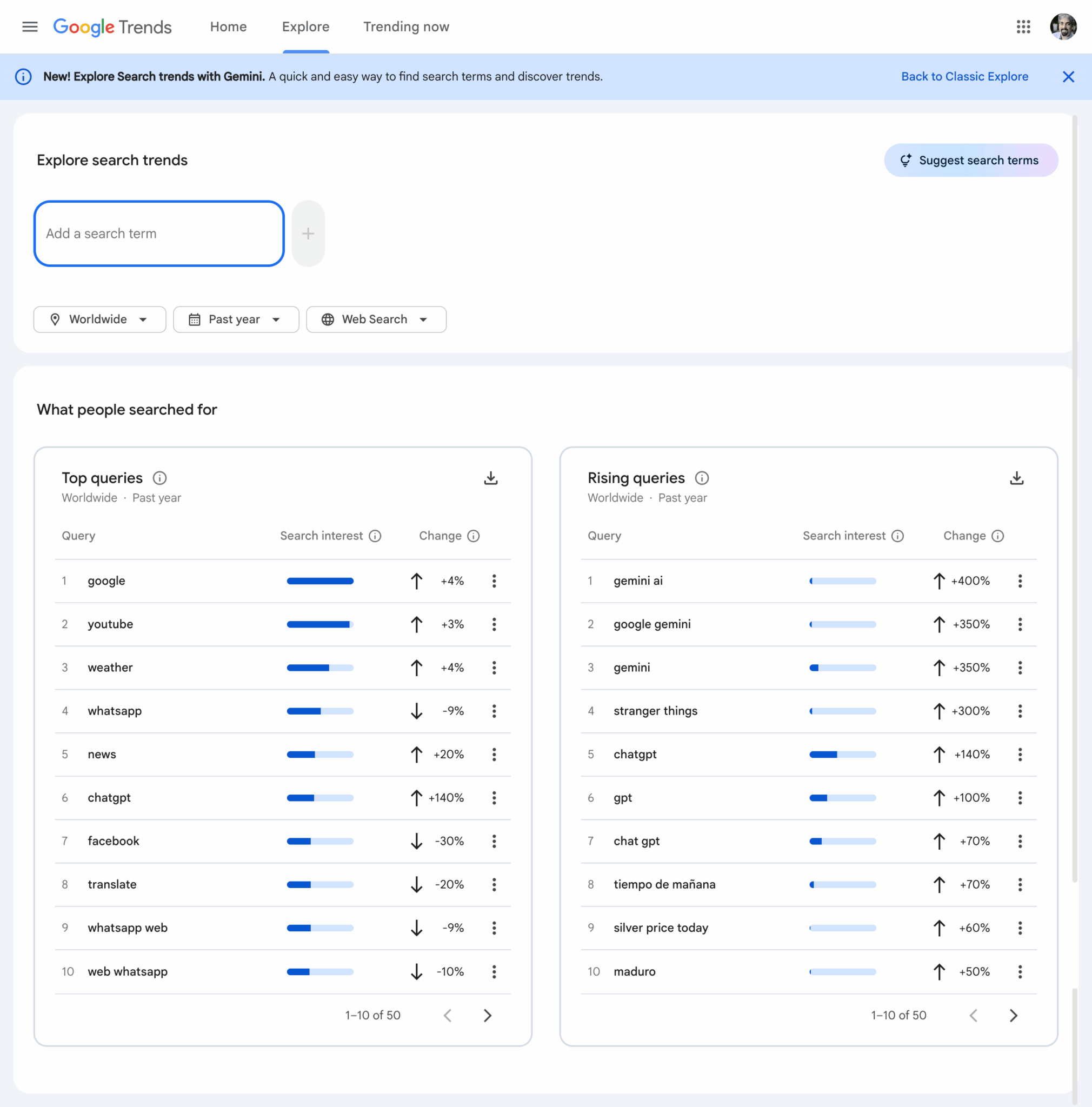
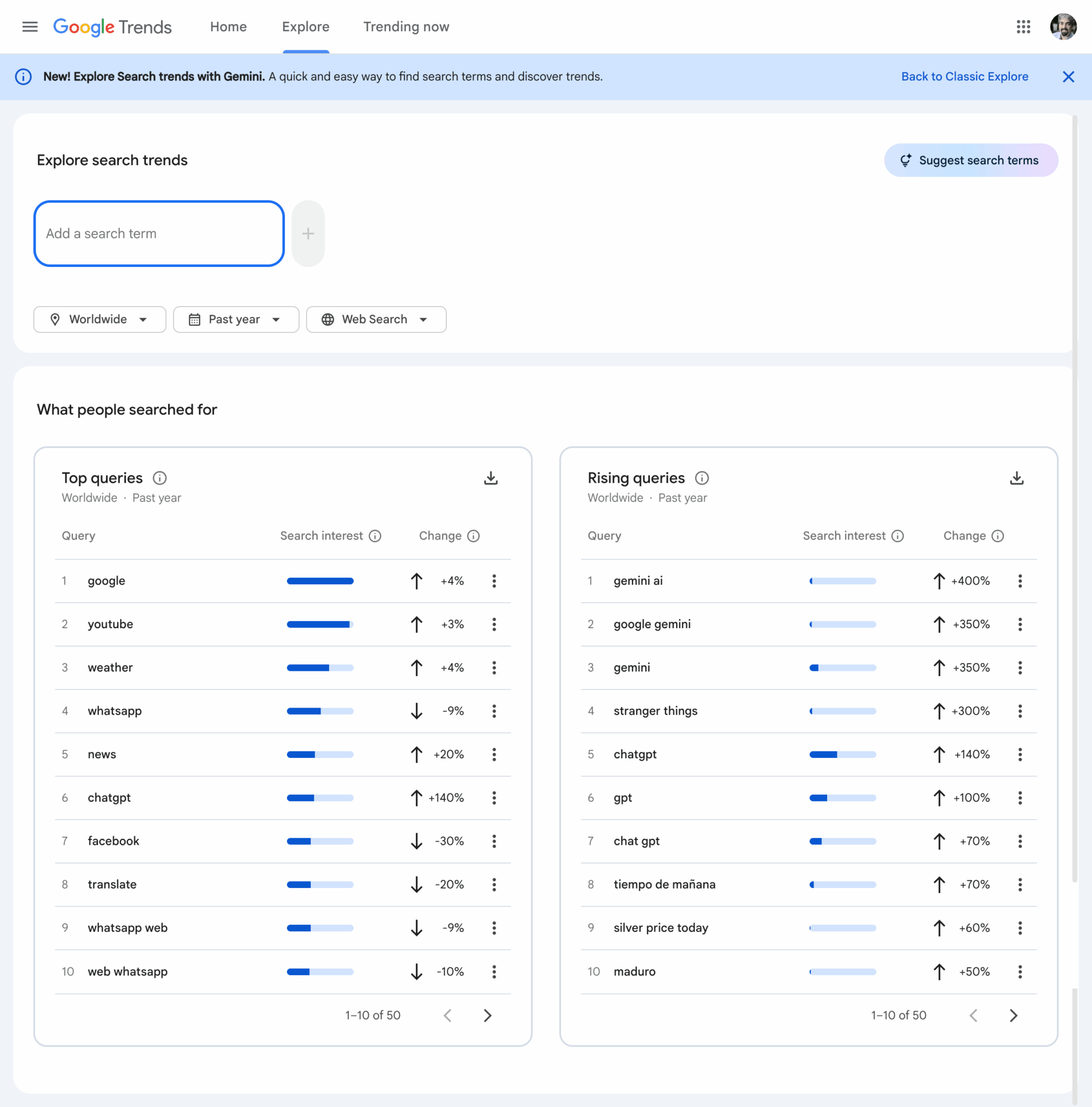
    When I explored the new layout, I found a fresh and handy ‘Suggest search terms’ button at the top right. Here’s a look at the updated interface:

    Google Trends Explore New Layout

    Clicking on ‘Suggest search terms’ allows me to enter a keyword or even a natural language sentence. Gemini then helps break down all relevant terms and compares them, offering insightful suggestions. It’s amazing how Google automatically identifies and contrasts trends pertinent to my interests, providing a list of suggestions to delve deeper into.

    ```json
{
  "alt": "Google Trends dashboard showing top and rising search queries.",
  "caption": "Dive into the latest Google Trends dashboard, showcasing top searches like 'google' and 'youtube,' along with emerging queries such as 'gemini ai' and 'chatgpt.'",
  "description": "The Google Trends dashboard provides insights into global search behavior over the past year. It highlights top queries like 'google,' 'youtube,' and 'news,' while also presenting rising searches such as 'gemini ai,' 'google gemini,' and 'chatgpt.' This snapshot offers a comparative analysis of search interest and changes over time, making it an essential tool for understanding public interest shifts. Keywords: Google Trends, search queries, data analysis, rising queries, global search trends."
}
```

    And here’s something cool I found during my exploration:

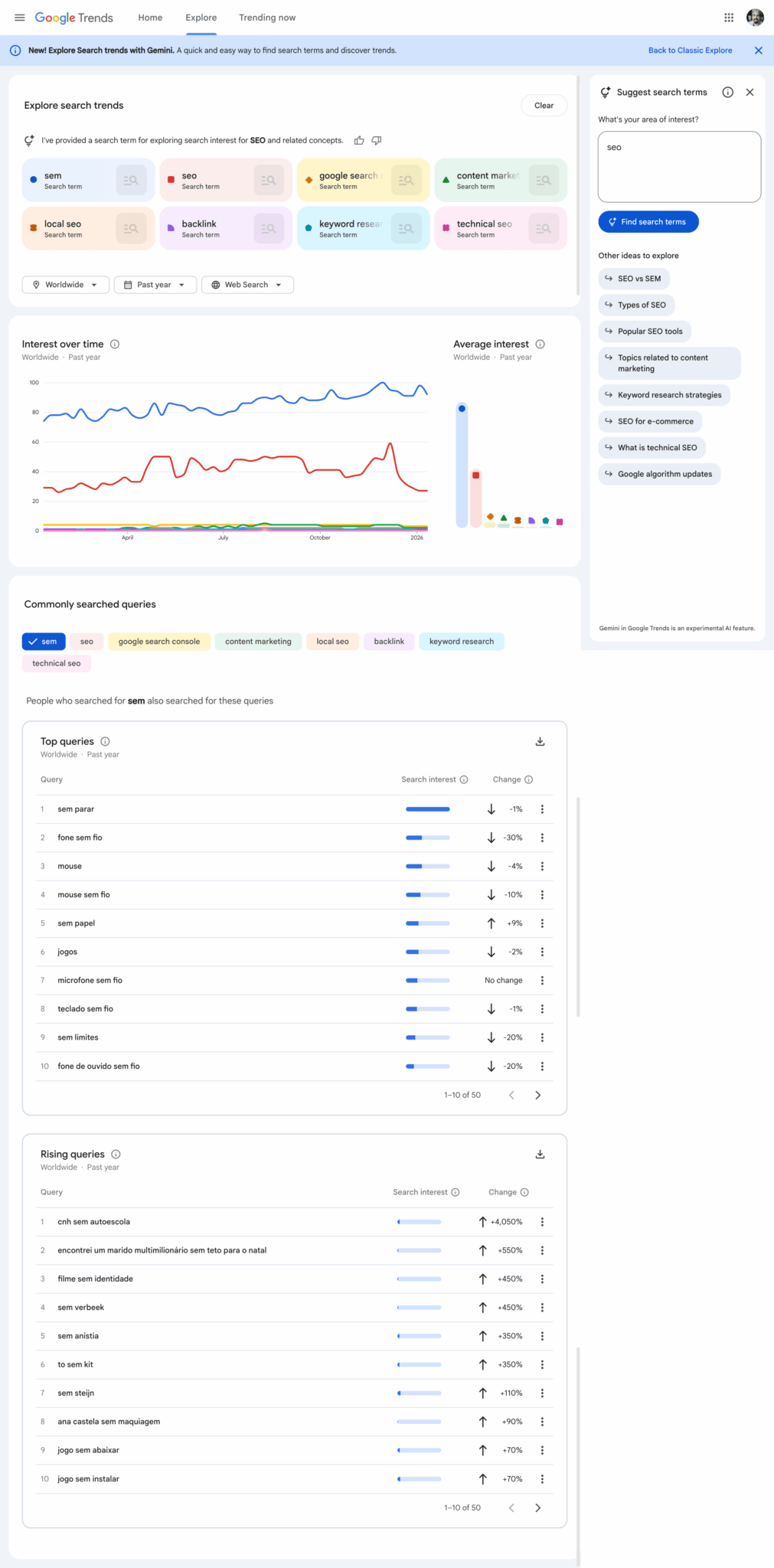
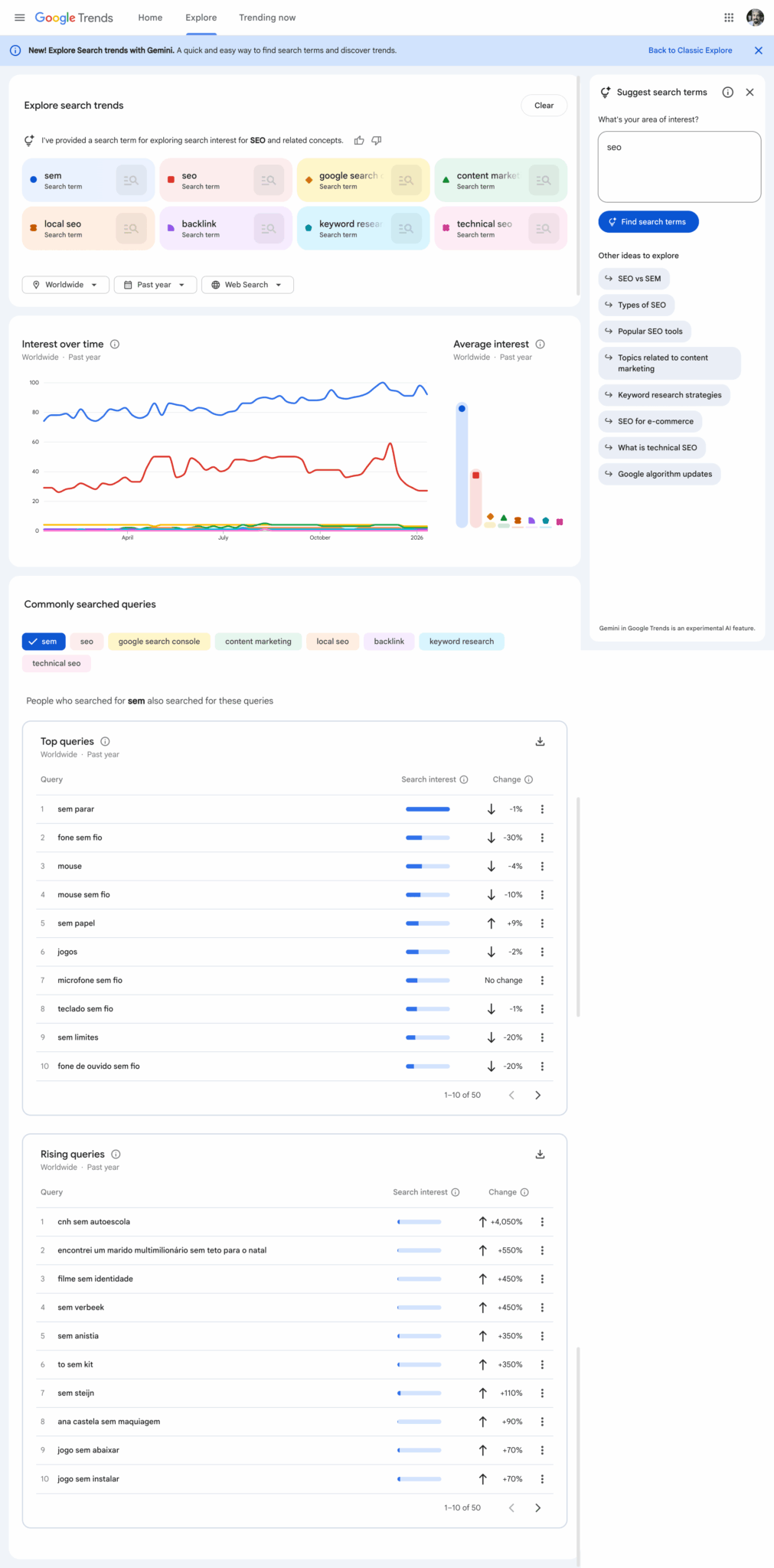
    Google Trends Suggested Terms

    The redesign offers a sleek, modern aesthetic that I find very appealing. Each search term is now paired with dedicated icons and colors, making it easier to match terms with their respective lines on the graph. I’ve noticed that Google has increased the number of terms I can compare and has doubled the amount of rising queries on each timeline. This is helpful in understanding why certain queries are trending.

    ```json
{
  "alt": "Google Trends dashboard showing search trends for SEO-related terms with graphs and commonly searched queries.",
  "caption": "Explore the latest SEO search trends with Google Trends. Visualize how interest in various terms fluctuates over time and discover related queries.",
  "description": "This image displays the Google Trends dashboard focused on SEO-related search terms. Highlighted terms include SEO, SEM, and content marketing, with visible interest trends over the past year. The graph shows interest fluctuations, alongside a list of commonly searched and rising queries. Perfect for understanding search behavior, the interface offers insights into which terms are popular or gaining traction globally."
}
```

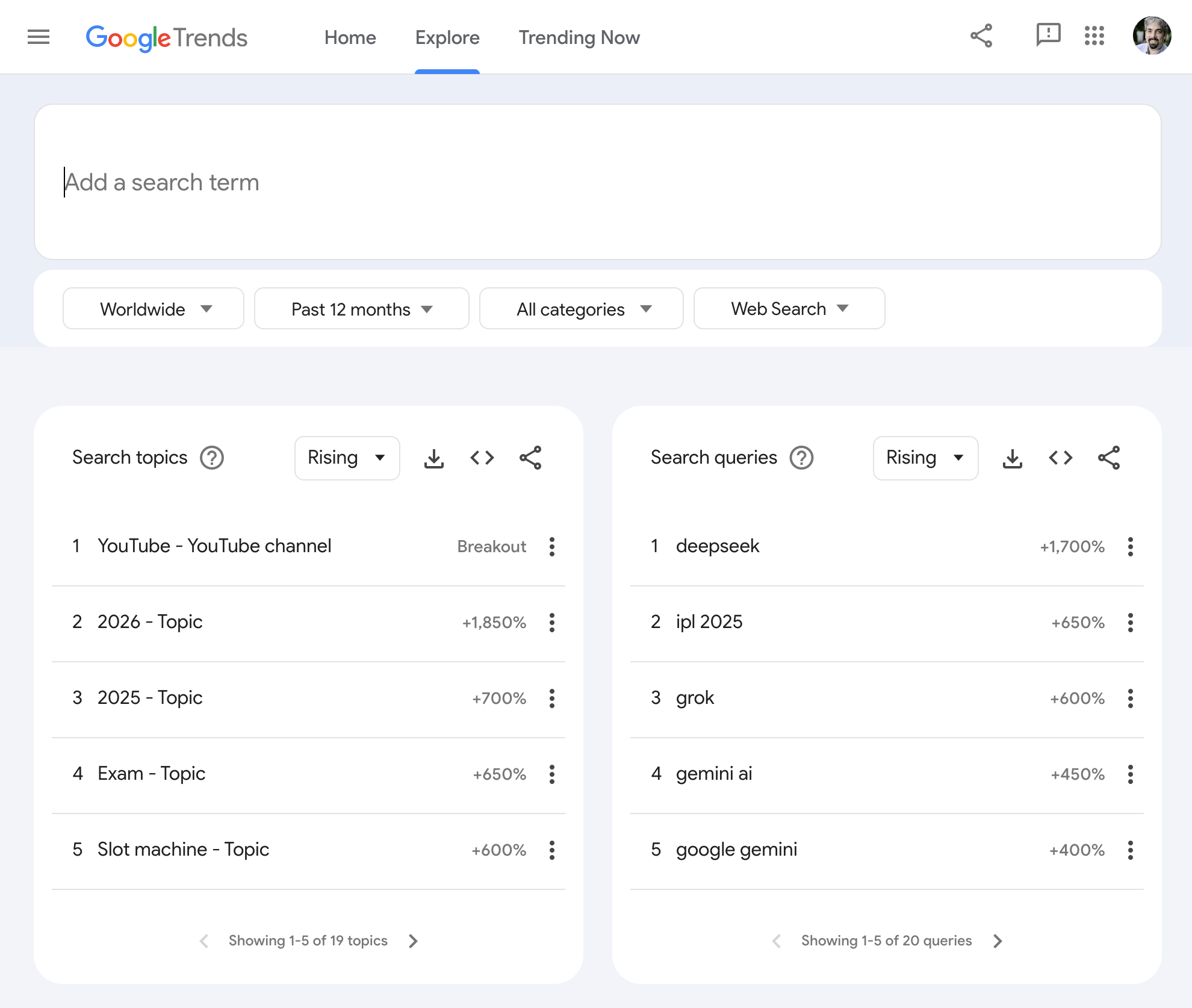
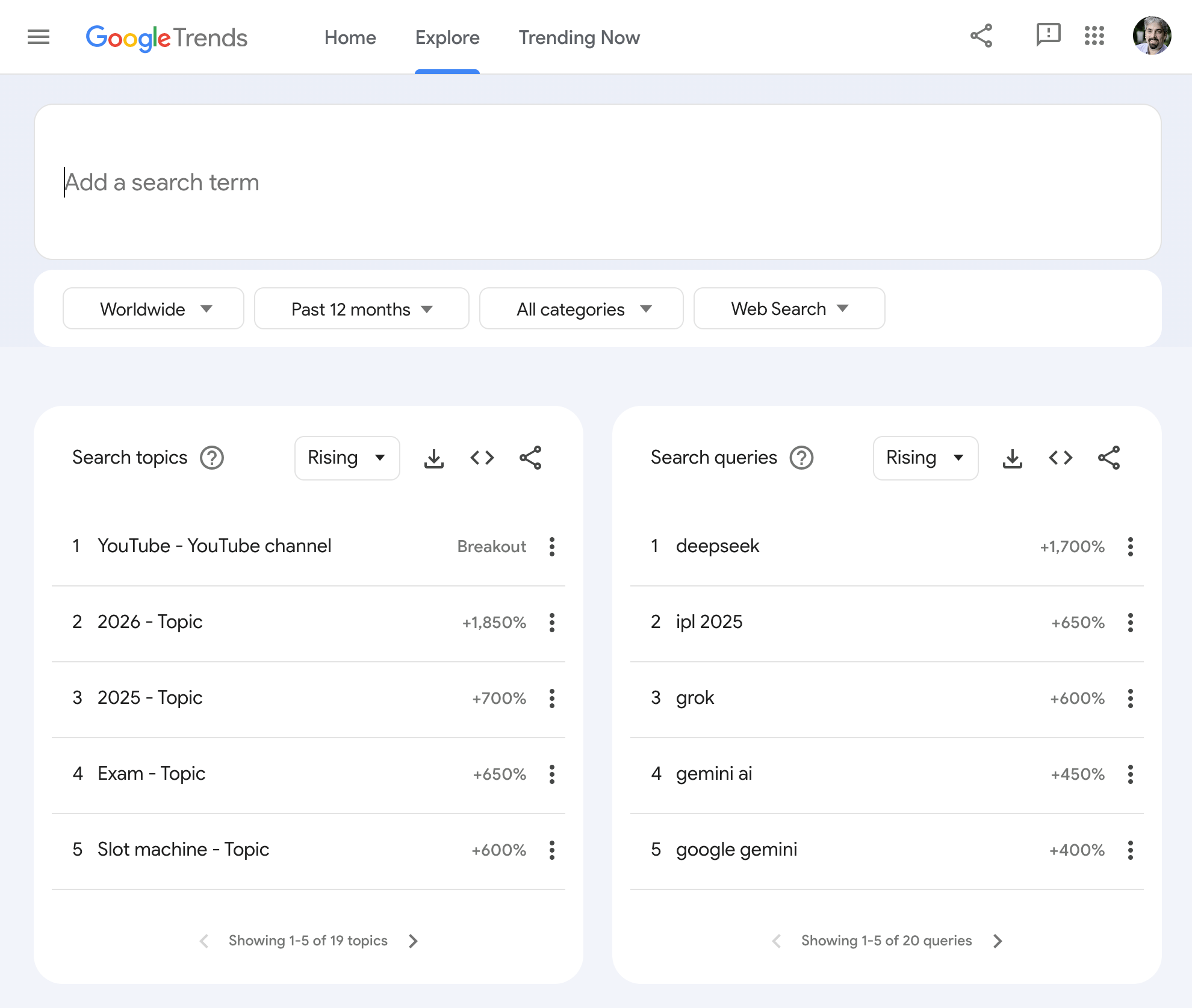
    For a bit of nostalgia, here’s a glimpse of the old design:

    Google Trends Old Design

    This update is being gradually rolled out, so while I’ve had the chance to explore it today, I understand that some of you might not see it immediately. Google has informed us that it’s currently a gradual release on desktop.

    ```json
{
  "alt": "Google Trends interface showing rising search topics and queries including YouTube, 2026, deepseek, and IPL 2025.",
  "caption": "Explore what's trending on Google! Discover the rising search topics like YouTube channels and 2026 topics, along with queries like 'deepseek' and 'IPL 2025'.",
  "description": "This image captures the Google Trends interface focused on trending searches. On the left, 'Search topics' lists include 'YouTube - YouTube channel' as a breakout, indicating a significant increase. Other topics like '2026' and 'Exam' show percentage increases. On the right, 'Search queries' such as 'deepseek' and 'IPL 2025' reflect growing interest. The interface allows users to filter by region, time frame, category, and type of search. Keywords include Google Trends, rising searches, trending topics."
}
```

    Why should you care? Well, this innovative tool presents new ways to uncover fresh and exciting content ideas for your site. Go ahead and give it a try; you might just be pleasantly surprised by what you find.


    Inspired by this post on Search Engine Land.


    crushpress.ai community screenshot