Author: shivamcrushpressai

  • A Practical Guide to Product Visibility in AI Commerce

    A Practical Guide to Product Visibility in AI Commerce

    If your product performs well in conventional search but vanishes when a shopper asks an AI assistant what to buy, adding more keywords is unlikely to solve the whole problem. The assistant still has to identify the item, connect it to the request, evaluate the available claims, and give the shopper a viable next step.

    Your goal is durable AI shelf presence: making the product easy for shopping systems such as ChatGPT, Perplexity, and Rufus to evaluate and choose when the buyer’s request fits. That requires clearer product facts, better decision support, and repeatable testing.

    Treat visibility as a chain, not a single ranking

    Think of product visibility as a chain with five gates. This is a practical audit model, not a reverse-engineered description of any platform’s algorithm:

    • Availability: A usable product page, listing, or product record exists for the relevant market, and the offer is still available.
    • Identity: The product, brand, model, and variant can be distinguished from similar items.
    • Relevance: The product’s attributes and intended uses answer the shopper’s stated need and constraints.
    • Confidence: Important claims are specific, consistent, qualified where necessary, and supported by information a buyer can inspect.
    • Actionability: The shopper can determine what is being sold, by whom, under which terms, and what to do next.

    A weakness early in the chain can make later optimization irrelevant. Strong comparison copy cannot repair an unavailable offer. Detailed specifications cannot help if two variants share an ambiguous identity. A recommendation is also less useful when the destination page shows a different price, configuration, or compatibility statement.

    Use the pattern of failure to decide where to investigate. If the product rarely appears for broad category requests, begin with availability and identity. If it appears for broad requests but disappears when a buyer adds a use case or constraint, inspect the decision facts that establish relevance. If the name is correct but the details are wrong, look for conflicting or stale representations. If the assistant describes the product accurately but cannot lead the shopper to a current offer, focus on actionability.

    These are clues, not proof of a particular ranking factor. They keep your audit tied to an observable failure instead of sending the team into a general rewrite.

    Build one canonical product record before creating more content

    A central unbranded product and layered digital record connect to matching product representations across several shopping channels.

    Before editing product copy, decide what must be true everywhere the product appears. Create an internal canonical record that separates stable identity, variant-specific information, buying criteria, and commercial terms.

    • Stable identity: Brand, exact product name, model identifier, product category, and any identifier used consistently across your catalog.
    • Variant identity: The attributes that make one configuration different from another, such as size, capacity, material, color, bundle contents, or compatibility.
    • Decision facts: The specifications that materially affect whether the product fits the intended use.
    • Fit and limits: The buyer, task, environment, or use case the product is designed for, plus important situations where it is not a fit.
    • Commercial facts: Current price, currency, availability, seller, included items, delivery conditions, and applicable return terms.
    • Claim support: The basis, scope, qualifier, and approved wording for each consequential performance or compatibility claim.

    The exact decision facts will differ by category. Do not add attributes merely because a generic template contains them. Start with the questions that would change a buyer’s choice, then make the answers explicit.

    Pay particular attention to the boundary between a product family and its variants. A family page should not imply that every configuration has the same dimensions, contents, compatibility, price, or availability. Give each purchasable choice an unambiguous label, and place variant-specific facts beside the choice they describe.

    Keep visible copy and structured data synchronized

    If you publish product and offer information through JSON-LD or another machine-readable format, treat it as a representation of the same canonical record. It should not become a correction layer for an incomplete product page or a hiding place for facts a shopper cannot verify.

    • Use the same exact product and variant names in the page heading, selection controls, structured data, feeds, and merchant listings.
    • Make sure visible price, currency, seller, and availability agree with the corresponding machine-readable values.
    • Connect each offer to the correct configuration instead of attaching a family-level offer to every variant.
    • Remove expired promotional language and discontinued configurations from every representation, not only from the visible page.
    • Give commercial facts an owner and an update trigger so a stock, price, policy, or bundle change does not leave old values behind.

    Structured data can reduce ambiguity, but markup alone does not make a product relevant or credible. The visible page still needs to help a person understand the choice.

    Use a claim ledger to prevent confident contradictions

    Create a claim ledger for statements that could influence a purchase. Record the claim, its classification, supporting material, necessary qualifier, approved wording, every place it appears, and the person responsible for keeping it current.

    Classify claims before approving them. An objective attribute is different from a compatibility statement, a seller policy, a marketing claim, or a customer’s opinion. Do not turn a reviewer’s experience into a universal product fact. Do not publish phrases such as works with everything, best for everyone, or free returns without the conditions that make the statement accurate.

    When a claim depends on a variant, region, accessory, operating condition, subscription, or seller, carry that qualifier everywhere the claim appears. Clear limitations improve the buyer’s decision and reduce the chance that an assistant has to reconcile incompatible descriptions.

    Answer the decision prompts buyers give shopping assistants

    Traditional product copy often describes what an item is. AI shopping prompts frequently ask whether it is right for a particular person, task, constraint, comparison, or purchase situation. Your content has to bridge that gap without manufacturing a separate thin page for every possible wording.

    Buyer questionWhat your content must make clear
    Who or what is this product for?The intended user, task, environment, and important exclusions.
    Does it meet this constraint?The exact relevant attribute, applicable variant, and any condition or threshold the buyer must check.
    Will it work with something I already own?A direct compatibility answer, supported models or systems, required accessories, and exceptions.
    How does it differ from another option?Meaningful trade-offs, not a list that portrays every attribute as a win.
    Can I buy the right version now?The current configuration, seller, price, availability, included items, and applicable purchase terms.

    Build a prompt-to-evidence map for each commercially important product. Gather real buyer language from the customer-facing material you already have, such as internal search terms, support questions, reviews, sales notes, and product-page queries. Group the language by need, constraint, compatibility, comparison, and transaction intent. Then connect each group to the page section and product facts that answer it.

    For a direct question, use an answer-first structure:

    1. Give the direct answer: yes, no, or it depends.
    2. State the decisive reason in plain language.
    3. Name the relevant condition, exception, or configuration.
    4. Provide the specification or evidence that supports the answer.
    5. Point the shopper to the correct variant, comparison, or purchase step.

    Comparison content deserves particular care. A useful comparison names the dimensions that matter, explains who benefits from each trade-off, and acknowledges where the competing choice is stronger. If your product is easier to carry but has less capacity, both facts belong in the decision. A comparison that declares your product the winner in every situation gives the buyer less usable information.

    Do not confuse natural language with vagueness. A sentence can be easy to read and still carry an exact model name, material, dimension, compatibility condition, or policy scope. That combination gives assistants useful language while preserving the facts a shopper needs to verify.

    Measure scenario coverage instead of chasing one answer

    Anonymous shoppers surround an AI assistant display where different unbranded products are highlighted for varied shopping needs.

    One favorable response to one prompt is not a visibility strategy. A mention is not necessarily a recommendation, and a recommendation is not necessarily accurate. Build a repeatable test that shows where the product enters, survives, or falls out of the shopping decision.

    1. Define the eligible offer. Choose the exact product and variant, the market where it can be purchased, and the facts that must be current for the test to be valid.
    2. Create a fixed prompt set. Cover category discovery, use-case fit, constraints, compatibility, comparison, objections, and purchase intent. Preserve the exact wording.
    3. Run prompts in the relevant environments. Test ChatGPT, Perplexity, Rufus, or another assistant only when it is part of the audience’s plausible shopping journey. Record language, market, sign-in state, and conversation context.
    4. Capture the whole response. Log whether the product appears, the role it receives, the reasons given, the stated facts, the linked destination, and whether a valid offer can be reached.
    5. Classify the failure. Map the result to availability, identity, relevance, confidence, or actionability before deciding what to edit.
    6. Change one meaningful layer. Correct a data conflict, improve a decision answer, clarify a variant, or repair an offer. Once the updated information is available to the tested environment, repeat the same prompt set.

    Track separate measures rather than hiding everything inside a composite visibility score:

    • Inclusion coverage: How often the product appears in test scenarios where it is genuinely eligible.
    • Consideration coverage: How often it appears as a serious option rather than an incidental mention.
    • Recommendation coverage: How often the product is selected for scenarios it actually fits.
    • Factual accuracy: How many checked product and offer facts are represented correctly.
    • Citation alignment: Whether the linked destination supports the claims made in the answer.
    • Transaction readiness: Whether the shopper can reach the correct, current, purchasable configuration.

    The combination of measures tells you what to do next. Low inclusion points you toward availability and identity. Reasonable inclusion with weak recommendation coverage points toward fit, differentiation, or decision evidence. Strong inclusion with poor factual accuracy points toward inconsistent or outdated product representations. Accurate recommendations with weak transaction readiness point toward the offer and purchase path.

    AI answers can vary with wording, context, and system changes, so testing is directional rather than a permanent certification. Keep the prompt set and evaluation rules stable enough to distinguish a recurring pattern from an isolated response.

    Key takeaways

    • Diagnose AI commerce visibility across availability, identity, relevance, confidence, and actionability instead of treating it as one ranking problem.
    • Maintain one canonical product record, with a clear boundary between family-level facts and variant-specific facts.
    • Keep visible content, JSON-LD, feeds, listings, and commercial terms synchronized.
    • Write for buyer decisions: fit, constraints, compatibility, trade-offs, and the path to the correct offer.
    • Measure inclusion, recommendation, accuracy, citation alignment, and transaction readiness separately.
    • Treat every test result as evidence about a failure class, not proof that you have discovered a platform’s algorithm.

    Start with one commercially important product. Build its canonical record, repair the most consequential conflict, map the buyer’s decision prompts, and run a fixed test set. Once that product can be identified, evaluated, described accurately, and purchased without ambiguity, turn the process into a catalog template.


    References

  • AI-Era SEO Strategy: Build Visibility Beyond Blue Links

    AI-Era SEO Strategy: Build Visibility Beyond Blue Links

    If your rankings still look respectable while organic clicks keep weakening, the old SEO dashboard is no longer telling you the whole story. When AI Overviews appear, click-through rates to top organic results have fallen by about 30% to 35% in observed data. A page can therefore succeed in retrieval, influence an answer, and still receive less traffic than it once did.

    You don’t need to abandon SEO. You need to expand it. The practical strategy is to preserve crawlability, relevance, authority, and usability while adding four capabilities: prompt coverage, passage-level answers, citation-ready evidence, and a consistent brand entity across the wider web.

    Keep the SEO foundation, but change the finish line

    AI visibility and traditional search visibility are not separate projects. Search engines still need to discover, render, interpret, and trust your pages before those pages can become dependable inputs for generated answers. Core search systems continue to underpin AI search experiences such as Google’s AI Overviews.

    The mistake is treating a page-one ranking as the final outcome. In AI search, the same page may have at least four possible jobs:

    • Rank as a conventional organic result.
    • Supply a passage used to construct an AI answer.
    • Earn a visible citation from that answer.
    • Establish facts that help an AI system understand your brand, product, or methodology.

    Audit those jobs in the right order. Fix crawl and indexation failures first. Then confirm that each page satisfies a real search intent, uses descriptive headings, and exposes its meaning through semantic HTML. After that, improve answer passages, evidence, and entity consistency. JSON-LD belongs in this stack, but it should describe facts already visible and supported on the page. It cannot rescue vague copy or turn an unsupported claim into evidence.

    This ordering also prevents expensive technical detours. Clean code has maintenance value, but spotless code is not an SEO outcome. Elements such as <article>, <section>, headings, lists, and tables are more useful when they clarify relationships in the content. Likewise, if your Core Web Vitals are mostly green and the page is usable, chasing perfect scores is often a lower-return project than fixing ambiguous information architecture or weak answer passages.

    Query type matters too. AI summaries are not equally prominent everywhere. Only 1.9% of the examined trending-news keywords triggered AI Overviews, with summaries tending to arrive after the initial breaking-news period. If you publish timely news, speed, clear updates, and conventional search features remain central. If you publish evergreen informational content, AI retrieval deserves greater weight because that is where answer consolidation is more common.

    Use that distinction when allocating work. Don’t rebuild a fast-moving newsroom workflow around a threat that appears in a small share of its most time-sensitive queries. Do give evergreen explainers, definitions, comparisons, and implementation pages a more rigorous retrieval and citation audit.

    Turn each target query into a prompt graph

    A glowing central node branches into several connected question clusters that converge on a set of modular web-page tiles.

    A keyword usually represents only the visible edge of a larger decision. Someone asking for an AI SEO platform may also need to know what it measures, how it differs from a rank tracker, whether it distinguishes mentions from citations, which engines it monitors, how prompts are sampled, and what the team must do with the resulting data.

    AI systems can decompose a complex request into sub-questions and assemble an answer from several locations. That makes prompt-graph coverage more useful than mapping one keyword to one undifferentiated page.

    Build the graph with a repeatable workflow:

    1. Name the decision. Write down what the searcher must choose, understand, diagnose, or complete after reading.
    2. List the prerequisite questions. Include definitions, eligibility, criteria, constraints, comparisons, cost factors, risks, implementation steps, and exceptions that genuinely affect that decision.
    3. Separate distinct micro-intents. Give every important sub-question a descriptive heading instead of burying several answers in one long section.
    4. Answer before expanding. Put the direct response in the first sentence, then add the qualifier, evidence, explanation, and next action.
    5. Connect the nodes. Use internal links when a sub-question deserves a complete page, while keeping the passage on the current page useful by itself.

    For a commercial query such as selecting AI visibility software, the graph might include measurement definitions, engine coverage, citation tracking, prompt management, reporting, workflow ownership, data limitations, and evaluation criteria. Those are not decorative subheadings. They are separate retrieval opportunities and separate objections a buyer must resolve.

    Apply the isolation test to every important passage

    AI systems often retrieve a relevant passage rather than treating the entire page as one indivisible answer. Clear, self-contained passages are therefore more reusable in generated responses.

    Copy an important section into a blank document and remove its heading. A reader should still be able to identify the subject, the claim, its scope, and any relevant limitation. If the passage begins with phrases such as “this approach,” “as mentioned above,” or “it depends on that factor,” it may rely too heavily on surrounding text.

    A retrieval-ready passage usually contains five elements:

    • A heading that names the precise question or task.
    • A first sentence that answers it directly.
    • Enough context to identify the relevant product, audience, market, or scenario.
    • Evidence or reasoning located beside the claim it supports.
    • A clear limitation, exception, or next step when one materially changes the answer.

    Don’t interpret passage-level optimization as permission to write repetitive fragments. The page still needs a coherent argument for a human reader. The goal is modular clarity: every section contributes to the whole, but its core answer does not collapse when extracted from that whole.

    Build proof blocks that an answer engine can verify

    Transparent cubes containing research and verification objects are stacked on a workbench beneath a magnifying lens.

    An extractable answer is only half the job. A system that presents factual claims also needs material it can verify and cite. Pages associated with AI citations commonly use semantic structure, explicit evidence, structured data, and formats such as tables.

    For every consequential claim, create a proof block close to the claim. It should contain:

    • The claim: one precise statement rather than several claims bundled together.
    • The scope: the population, market, query type, product version, or situation to which it applies.
    • The evidence: a statistic, documented observation, comparison, definition, or transparent method that supports the statement.
    • The provenance: an accessible link or clearly named origin for the evidence.
    • The limitation: uncertainty, missing coverage, exceptions, or conditions that stop the claim from being universal.

    Place the proof where it can travel with the claim. A statistics appendix at the bottom of a long page is less useful when the assertion appears far above it with no local attribution. The same principle applies to comparison tables: label the criteria, keep like-for-like values in the same columns, and disclose unknowns instead of converting them into convenient assumptions.

    Neutrality matters here. AI systems tend to prefer factual, less promotional material for citation. That does not mean your writing must be bloodless or that commercial pages cannot convert. It means a claim designed to be reused should not depend on sales language for its force.

    Separate evidence from positioning. Define the category before claiming leadership in it. Explain evaluation criteria before announcing a winner. Give competitors the same comparison dimensions you give your own product. State who an option is not for. If your brand wins every category and no trade-off is visible, the page reads as a sales argument rather than a dependable reference.

    Give your brand a canonical fact layer

    Passage quality helps a system understand a topic. Entity consistency helps it understand who you are. Conflicting names, product descriptions, audiences, locations, and company facts create room for omission or hallucination.

    Create an internal record of canonical facts, then reconcile the public properties you control. Include the official brand name, a plain-language definition, current product names, intended audience, supported markets, official URLs, and any historical or leadership facts you can verify. Do not fill gaps with approximate dates or inherited marketing copy.

    Publish the important facts visibly on an appropriate owned page. Reflect the same facts in structured data and in authoritative profiles where you can legitimately edit them. Consistent brand-entity information across credible locations gives an AI system a less ambiguous representation to retrieve.

    This is also the right place for anti-hallucination work. Test direct questions about what the company does, whom it serves, which products it offers, and how those products differ. Record incorrect or outdated answers, identify the conflicting public facts that may support them, and correct properties you own. You cannot guarantee that a model will update immediately, but you can remove the contradictions that make the wrong answer easier to produce.

    Optimize the web presence around your domain

    Your website remains the canonical home for your information, but it is not the entire environment from which an AI answer may be assembled. Generated results can blend company pages, documentation, community discussions, comparisons, public records, and other credible materials. In many sectors, documentation and community surfaces contribute alongside conventional webpages.

    Map that environment in four layers:

    • Canonical owned assets: product facts, definitions, documentation, methodologies, glossaries, policies, and frequently asked questions.
    • Independent context: editorial comparisons, professional directories, reviews, interviews, and category roundups where inclusion must be earned.
    • Practitioner surfaces: forums, communities, repositories, and Q&A spaces where people solve problems in public.
    • Reusable public assets: open specifications, datasets, templates, reports, and decision frameworks that others can reference.

    The objective is not to repeat the same marketing paragraph everywhere. It is to create a coherent set of facts and useful contributions across the places that shape your category. Terminology should remain consistent, while each asset should solve the problem appropriate to its location.

    Start with the citations already appearing for your target prompts. Record which domains recur, what type of material they provide, and which sub-question each one answers. A documentation site may dominate implementation questions while a community supplies candid troubleshooting and an independent publisher supplies comparisons. Your opportunity is specific to the missing role, not simply the missing backlink.

    Competitive co-occurrence is particularly important for buying-intent prompts. AI answers often assemble shortlists and comparisons rather than selecting one isolated vendor. Earn inclusion by making your category, use case, differentiators, and trade-offs easy for independent evaluators to verify. Publish fair comparison criteria on your own site, but do not manufacture endorsements, plant disguised promotions, or flood forums with templated answers. Those tactics weaken the neutral evidence layer you are trying to build.

    Keep retrieval and model training conceptually separate. A newly published page may become available to a live retrieval system if it is discovered and selected, but that does not mean it has entered an underlying model’s training data. Retrieval surfaces offer the more immediate operating target. Public reports, definitions, datasets, and specifications are longer-term assets whose value does not depend on guessing when or whether a particular model will train on them.

    Use this surface audit to decide what to create next:

    1. Run the important prompt family across the AI experiences you track.
    2. List every cited domain and classify the role it plays in the answer.
    3. Mark sub-questions for which your brand has no credible owned or earned representation.
    4. Create the missing reference asset or make a genuinely useful contribution to the relevant external surface.
    5. Keep terminology and canonical facts aligned without duplicating promotional language.

    Measure absence, mentions, citations, and business value separately

    AI visibility is not one metric. There are at least three distinct editorial states: the brand is absent, it is mentioned without a citation, or it is both mentioned and cited. Mention and citation optimization solve different problems. A fourth state – a user visiting and taking action – belongs to business measurement rather than answer visibility itself.

    Observed stateWhat it may indicateWhat to inspect next
    Brand absentWeak topic coverage, entity recognition, or category co-occurrencePrompt-graph gaps, canonical definitions, and credible third-party presence
    Brand mentioned but not citedThe entity is known, but another location supplies the supporting evidenceProof blocks, passage clarity, provenance, and the pages currently earning citations
    Brand mentioned and citedYour material is retrievable and supports part of the answerFactual accuracy, citation URL quality, prompt coverage, and whether the cited page serves the user
    Citation produces visits but little actionThe visibility worked, but the destination or offer may not match the user’s next needLanding-page continuity, intent alignment, calls to action, and conversion measurement

    Build a fixed prompt panel rather than collecting flattering screenshots. Include informational prompts, comparison prompts, implementation questions, objection or risk questions, and direct questions about your brand. Record the exact prompt, engine or experience, date, mention status, citation URL, factual accuracy, and any measurable downstream visit or conversion.

    Keep stable prompts unchanged when comparing one measurement period with another. Add rewrites as separate variants instead of silently replacing the original wording. Report engines separately because one blended percentage can hide meaningful differences in how each system represents the brand.

    Use the results diagnostically. Rankings without AI mentions point toward prompt coverage, extractability, or entity gaps. Mentions without citations point toward weak evidence packaging or stronger competing references. Citations containing wrong facts point toward conflicting public information. Citations without clicks may simply mean the answer satisfied the user, so judge them alongside branded demand, assisted conversions, referral traffic where identifiable, and the business value of being represented accurately.

    Key takeaways

    • Keep technical SEO, relevance, semantic HTML, and usable performance as the foundation; AI optimization adds to those disciplines.
    • Map a query to the full decision and its sub-questions, then give each important micro-intent a self-contained answer passage.
    • Package claims with scope, evidence, provenance, and limitations so an answer engine can verify what it extracts.
    • Align canonical brand facts across owned pages, structured data, documentation, and credible external profiles.
    • Track absence, mentions, citations, factual accuracy, and downstream value as separate outcomes.

    Start with one high-value query family. Map its sub-questions, rewrite the three weakest passages, add one defensible proof block, reconcile the brand facts those answers depend on, and record a prompt-level baseline. That small operating loop will reveal more than a broad AI SEO initiative with no defined retrieval target or measurement model.

    References

  • AI-Driven Commerce: Build for Search, Answers and Agents

    AI-Driven Commerce: Build for Search, Answers and Agents

    If a shopper needs six tabs and a set of notes to understand the differences between your products, your catalog has a data problem disguised as a user-experience problem. AI can now perform much of that comparison before the shopper reaches your site, so a polished product page is no longer your whole sales surface.

    Your job is not to choose between Google and ChatGPT. It is to give search engines, answer engines, and emerging shopping agents the same accurate, decision-ready facts, then measure how each channel moves the buyer toward a transaction.

    The commerce journey has expanded, not moved

    AI search is adding another discovery and evaluation layer. It is not yet a reason to abandon conventional search. Search engines still account for about 88% of search traffic, while AI usage is growing alongside it. For ecommerce specifically, Google organic search reportedly supplies 43% of traffic and supports 23.6% of sales. Those figures are directional rather than a forecast for your store, but they make the strategic choice clear: protect traditional search visibility while building AI visibility.

    A buyer may ask an AI assistant to shortlist products, use Google to verify a feature, open your product page to check availability, return to the assistant with a compatibility question, and later make a branded search before purchasing. If you measure only the final click, you can mistake a multi-channel decision for a single-channel conversion.

    SurfaceWhat the buyer needs thereWhat you should provide
    Traditional searchDiscovery, navigation, and verificationIndexable product, category, comparison, and supporting pages
    AI answerA concise explanation or recommendationDirect answers, complete context, explicit differences, and verifiable claims
    Shopping agentFacts it can retrieve and evaluate consistentlyStructured product, offer, variant, compatibility, and policy data
    Your websiteConfidence and a path to purchaseClear evidence, current commercial details, usable navigation, and checkout

    Do not run these as four disconnected strategies. They are four presentations of the same catalog. A processor name, supported device, price, included accessory, or return condition should not change depending on whether it appears in page copy, JSON-LD, a merchant feed, or an internal API.

    This changes the meaning of search optimization. You are no longer optimizing only for a ranking and a click. You are optimizing the information chain that lets a machine discover a product, distinguish it from alternatives, explain the distinction, and hand the buyer an accurate next step.

    Build product content around decisions, not descriptions

    Most product pages describe one item at a time because that is how a seller organizes a catalog. Buyers usually think in differences: what changes between the base and premium versions, which missing feature matters, whether two names describe the same capability, and whether the extra cost solves their actual problem. That gap is why even a built-in comparison tool can leave a shopper with more questions than answers.

    Start with the product families that generate repeated comparison questions, not necessarily the products with the most visits. A product with modest traffic but high consideration can benefit more from better decision content than a familiar commodity with substantially more visits.

    1. Define the real choice set. Group models, plans, sizes, generations, or substitutes that a reasonable buyer would compare. Your internal category structure may not reflect that choice set.
    2. Normalize the attributes. Use the same name, unit, and value format for the same characteristic. Do not call a field “battery duration” on one page and “typical runtime” on another unless they measure different things.
    3. State absence explicitly. A blank cell is ambiguous. Use language such as “not included,” “not supported,” “optional,” or “information not provided,” whichever is accurate.
    4. Translate specifications into consequences. Give the factual specification first, then explain why it could matter. If you cannot verify a practical consequence, do not manufacture one from a marketing adjective.
    5. Separate fact from recommendation. “Includes 256 GB” is a product fact. “Better for frequent offline video” is guidance that needs a visible rationale.
    6. Surface checks before the purchase. Put compatibility, required accessories, regional limitations, account requirements, and other decision-changing conditions beside the relevant claim instead of burying them in a general FAQ.
    7. Assign maintenance ownership. Every comparison needs an owner and a review trigger when a model, offer, specification, or policy changes.

    The opening of a comparison page should answer the decision before expanding on it. A practical template is: “Choose [product] when [need] because [verified differences]. Choose [alternative] when [different need]. Before buying, verify [important condition].” This gives a person a usable answer and gives an answer engine a compact passage it can interpret without reconstructing your position from scattered sections.

    Then support that answer with a complete comparison. Cover the questions that change the purchase:

    • Which capabilities are shared, and which are genuinely different?
    • What does the higher-priced option add?
    • What does each option leave out?
    • Which differences affect a defined use case?
    • Which accessories, subscriptions, or compatible devices are required?
    • What should the buyer verify before ordering?
    • When were the facts last checked?

    Do not turn this into keyword stuffing. AI systems interpret topics through connected concepts, so useful coverage means answering the related questions needed to understand the decision. Content about an eco-friendly product, for example, may need to explain its materials, relevant trade-offs, maintenance, and disposal. It does not need twenty variations of the phrase “sustainable product.” Clear topical relationships support both conventional and AI search performance.

    Keep each claim close to its proof. If you say a model works with a particular device family, identify the supported versions or link to the maintained compatibility information. If you say an option is better for a use case, show the differences that lead to that recommendation. A machine can repeat an unsupported conclusion as easily as a supported one; the structure of your page should make the distinction visible.

    Turn the catalog into a machine-readable product record

    A product floats above connected tiles representing its materials, dimensions, compatibility, availability, and shipping details.

    A webpage can make a price, specification, or model relationship obvious to a person without expressing its meaning explicitly to a machine. HTML is excellent for presentation, but visual proximity alone does not guarantee semantic clarity. Structured data exists to reduce that ambiguity, yet its implementation remains uneven.

    JSON-LD is not a replacement for a useful product page. Treat it as a translation layer between your governed catalog record and systems that need an explicit description of the entity. For a commerce implementation, inspect six groups of information:

    • Identity: the canonical product name, brand, internal SKU, and legitimate global identifier where one exists.
    • Variant relationships: the attributes that create distinct variants, such as size, color, capacity, model, or configuration, plus the relationship between each variant and its product family.
    • Commercial state: price, currency, availability, condition, seller, and the offer or variant to which each value applies.
    • Decision attributes: the measurable specifications, compatibility statements, included items, requirements, and exclusions that buyers use to compare options.
    • Policies and evidence: the maintained pages or records behind shipping, returns, warranties, ratings, and other claims you choose to expose.
    • Freshness controls: the system responsible for each field, its update trigger, and a way to detect disagreement between surfaces.

    Use the Schema.org Product vocabulary for an individual product representation and connect its Offer data where appropriate. The exact markup should follow the product and offer you actually display. Do not add a field because it looks advantageous in a validator. Do not mark up a family-level price as if it applied to every variant. Do not publish review or rating data in JSON-LD if a user cannot find the corresponding information on the page.

    Five implementation rules prevent most damaging inconsistencies:

    1. Match visible content. The machine-readable value and the customer-facing value should describe the same product, offer, and condition.
    2. Preserve identifiers. Do not reuse an SKU or global identifier across unrelated products. Stable identifiers help systems reconcile records from multiple surfaces.
    3. Include units and qualifiers. A number without its unit, measurement condition, region, or variant can create a confidently wrong comparison.
    4. Update dynamic fields from the catalog system. Manually copied price and availability values become stale. Generate them from the same maintained record used by the page whenever your stack permits it.
    5. Validate meaning as well as syntax. Passing a structured-data test proves that the markup parses. It does not prove that the claims are current, complete, assigned to the right variant, or useful for a purchasing decision.

    The proposed idea of an AI data interface, or AIDI, imagines a future in which personal agents retrieve structured information more directly instead of interpreting every business through a traditional page. The label and adoption path are uncertain. The durable requirement underneath it is not: reusable, well-defined product data will be easier to publish into pages, JSON-LD, feeds, and future interfaces than facts trapped in layout-specific copy.

    That is the sensible way to prepare for agents. Do not rebuild your commerce stack around a prediction that HTML will disappear. Move decision-critical facts into a governed catalog record, make each output consistent, and keep the human page strong. This improves the current experience while preserving options for whatever interface gains adoption.

    Measure discovery, influence, and revenue separately

    Three connected visual zones show signals being discovered, product options influencing a shopper, and a final path ending in a purchase.

    A dashboard that reports only organic clicks cannot tell you whether an AI assistant introduced the product and Google completed the journey. A dashboard that reports only AI referrals has the opposite problem: a shopper can read an answer, remember the brand, and return through branded search or direct navigation.

    Build measurement in three layers. The layers answer different questions and should not be collapsed into one visibility score.

    • Answer visibility: Is your brand or product named for the questions that matter? Is your site cited? Is the description accurate? Which competing products appear?
    • On-site behavior: Which AI referrals reach the site? What landing pages do they use? Do they view products, use comparisons, start checkout, or leave after encountering a mismatch?
    • Commercial outcome: Which journeys produce orders, revenue, qualified leads, or assisted conversions? How does that performance differ by landing page and intent?

    Keep a fixed prompt set for monitoring. Include category discovery, named product comparisons, use-case recommendations, compatibility questions, and pre-purchase checks. Record the exact prompt, platform, model or mode when visible, date, products mentioned, citations returned, and factual errors. A single answer is an observation, not a stable ranking. Repeating the same controlled set gives you a more useful view of change.

    In analytics, create a distinct channel group for identifiable AI referrals instead of silently mixing them with ordinary organic search. Preserve the landing URL and conversion path. Add a post-purchase or lead-form question about where the customer first researched the purchase; referral data alone cannot reveal every AI-influenced journey. Compare revenue and assisted outcomes, not just visits.

    Use the combination of metrics to diagnose the next change:

    • If your products are mentioned but described incorrectly, fix catalog consistency and claim clarity before creating more content.
    • If relevant pages rank in conventional search but rarely appear in AI answers, strengthen the direct answer, comparison structure, supporting context, and entity relationships.
    • If AI citations increase but qualified visits or conversions do not, inspect whether the cited passage promises something the landing page does not make easy to verify.
    • If visits convert but visibility remains narrow, expand the proven content and data pattern to adjacent product families.
    • If price or availability differs across surfaces, stop scaling and repair the update path. More visibility would only distribute the error further.

    You can put this into operation with a four-week pilot:

    1. Week 1: Establish the baseline. Select up to ten high-value product families with meaningful comparison friction. Inventory their visible facts, JSON-LD, feed values, AI answers, organic landing pages, and conversion paths. Record every contradiction.
    2. Week 2: Publish the decision layer. Create or revise one comparison experience per family. Lead with the choice, normalize attributes, state missing features, explain practical consequences, and add the checks that could change the purchase.
    3. Week 3: Align the data layer. Map identity, variants, offers, and decision attributes back to the maintained catalog. Correct structured data and feed discrepancies. Add validation to the publishing workflow.
    4. Week 4: Retest and connect outcomes. Run the same prompt set, review search visibility, verify cited claims, inspect landing behavior, and connect conversions to identifiable search and AI touchpoints. Use the defects you find to define the next product group.

    The pilot is successful when it creates a repeatable publishing and measurement loop, not merely when one prompt mentions your brand. The operational asset is a product record that stays accurate across channels and a content pattern that helps buyers make a decision.

    Key takeaways

    • Do not replace SEO with AI optimization. Buyers can use both channels during one purchase, and organic search still carries substantial ecommerce demand.
    • Organize product content around the differences buyers need to evaluate, not the order in which your catalog happens to store products.
    • Give direct recommendations a visible factual basis, including exclusions, compatibility conditions, and pre-purchase checks.
    • Keep page content, JSON-LD, feeds, and interfaces aligned to one governed catalog record.
    • Measure answer visibility, factual accuracy, on-site behavior, and commercial outcomes as separate layers.
    • Prepare for agents by improving reusable product data now, without betting your business on a specific interface or a predicted end of HTML.

    Start with one product family your customers routinely struggle to compare. Build its fact matrix, publish the decision clearly, map the same facts into structured data, and track the path through Google and AI answers. Once that loop stays accurate, scale it across the catalog. You will gain a better shopping experience now and a cleaner route into agent-driven commerce later.

    References

  • How to Choose an AEO Agency Without Buying Vague Promises

    How to Choose an AEO Agency Without Buying Vague Promises

    You are not choosing an AEO agency because you need another content supplier. You are choosing one because your brand is missing, misrepresented, or overlooked when prospects ask answer engines questions connected to a purchase.

    The difficulty is that an agency can promise visibility, but it cannot control what an external AI platform generates or cites. A sound selection process therefore focuses on what you can inspect: the agency’s diagnosis, evidence standards, implementation method, measurement protocol, and ownership terms.

    Write the selection brief before you look at agencies

    AEO can mean content production, technical SEO, structured data, entity management, digital PR, prompt monitoring, or some mixture of them. The market already spans agency-led strategy, creative content, AI-driven analysis, and DIY-oriented approaches. Those options become comparable only after you define the problem they must solve.

    Start by choosing the primary outcome. Most AEO briefs contain one or more of these problems:

    • Presence: Your brand does not appear in answers to relevant non-branded questions.
    • Accuracy: Answers mention your brand but get important facts, capabilities, availability, or positioning wrong.
    • Preference: Your brand appears, but competitors receive the recommendation, supporting explanation, or citation.
    • Conversion: You earn mentions or referral visits, but the cited pages do not help qualified visitors take the next step.

    These are not interchangeable. A mention-tracking campaign will not fix unsupported product claims. Schema work will not repair weak third-party authority. More content will not solve a conversion problem on an already cited page. Ask every candidate to state which problem it believes you have, what evidence supports that diagnosis, and what it would deliberately leave out of scope.

    Your brief should also identify:

    • The answer platforms and interfaces that matter to your audience, named explicitly rather than grouped under AI.
    • The markets, languages, locations, and audience segments in scope.
    • The product lines, services, topics, and entities the engagement covers.
    • The questions that matter across discovery, comparison, validation, and purchase.
    • The claims that require legal, compliance, product, medical, or subject-matter review.
    • The systems the agency may need to touch, including your CMS, analytics, tag manager, schema implementation, product data, and reporting tools.
    • The business event you ultimately care about, such as a qualified inquiry, signup, demo request, purchase, or assisted conversion.

    Use this brief template: Improve [presence, accuracy, preference, or conversion] for [audience] asking [question groups] on [named platforms and interfaces], within [market and language], while protecting [brand, compliance, security, or editorial constraints].

    Give each shortlisted agency the same brief. If one candidate is allowed to redefine the objective while another must answer your original request, their proposals will not be comparable.

    Attach a baseline where you can. Include your approved brand facts, current priority pages, analytics definitions, known technical constraints, and a representative query set. For observed answers, record the exact question, platform, interface, date, location or language context, account state when relevant, generated answer, cited URLs, and whether the brand description was correct. AI outputs can vary, so a screenshot without its run conditions is weak evidence.

    Inspect the method from question to business outcome

    An isometric workflow connects a buyer question to research, content, publishing, an answer engine, and a business outcome.

    A serious AEO method connects audience questions to evidence, content, technical implementation, external authority, and measurement. If a proposal jumps from keyword research directly to publishing pages, ask what happened to the other layers.

    Question demand and entity facts

    A search keyword export is useful input, but it is not a complete model of answer demand. People ask full questions, add constraints, compare alternatives, challenge claims, and continue a conversation. The agency should show how it groups those behaviors without pretending it can enumerate every possible prompt.

    Ask for a sample question map containing:

    • The audience and decision stage behind each question group.
    • The answer the user needs, not merely the phrase they typed.
    • The entities, attributes, comparisons, and evidence required for a useful response.
    • The pages or external assets that currently support the answer.
    • The gap: missing evidence, ambiguous language, conflicting facts, poor retrieval, weak authority, or an unsuitable destination page.
    • The assumptions used to choose platforms, markets, and query variants.

    Look for an entity-fact process as well. Your company name, products, executives, locations, prices, policies, credentials, and other important attributes may appear across many owned and third-party properties. The agency should identify a canonical fact owner, the approved wording, where each fact is published, and how changes propagate. Otherwise, content teams can create the same inconsistency they were hired to fix.

    Keep part of the evaluation set separate from the questions used to shape the work. Testing only the prompts the agency optimized against encourages dashboard overfitting. A separate evaluation set will not eliminate output variability, but it gives you a cleaner check on whether the work generalizes.

    Content and technical implementation

    AEO content should make useful claims easy to understand without stripping away the conditions that make them true. That requires more than short answers. It requires clear definitions, explicit relationships, comparison criteria, supporting evidence, qualified claims, suitable authorship, and a page structure that keeps the answer connected to its context.

    Ask the agency to walk through a real content brief. It should show the target question, intended reader, factual inputs, missing evidence, subject-matter reviewer, answer structure, internal links, citation needs, conversion path, and update owner. If the brief is mostly a word count and a list of keywords, the operating model is still conventional content production with an AEO label.

    Technical work should be equally concrete. The proposal should explain how crawlers reach the relevant content, how client-side rendering or access controls affect retrieval, how duplicate or conflicting URLs are handled, and how structured data maps to visible page content.

    JSON-LD can express entities and relationships in a machine-readable form, but valid markup does not prove the underlying claim and does not guarantee inclusion in an answer. Ask for a content-to-schema crosswalk showing which visible fact supports each property, where the data comes from, who maintains it, how it is validated, and what happens when the page changes. The deployment plan should include staging, approval, monitoring, and rollback rather than direct, unreviewed changes to production.

    Authority beyond your own website

    Your website is only one place where an answer system may encounter your brand. A complete plan should consider the wider set of public materials that describe the business, while distinguishing assets you control from mentions you must earn.

    Ask the agency to separate:

    • Owned corrections: Resolving inconsistent facts across your site, profiles, documentation, feeds, and public company information.
    • Earned authority: Creating evidence and expert contributions that can merit independent coverage, citations, or relevant links.
    • Community participation: Answering real questions under the rules and norms of the relevant platform.
    • Manipulative activity: Synthetic reviews, disguised promotion, fabricated expertise, or mass-produced third-party placements.

    Do not accept the last category as an unavoidable shortcut. It creates platform, reputation, and potentially legal exposure while giving you assets that may disappear as soon as the vendor relationship ends. Ask who performs off-site work, whether subcontractors are involved, how placements are disclosed, and which tactics the agency refuses to use.

    Measurement that separates observation from attribution

    An AI visibility score is not self-explanatory. You need its denominator, query set, run conditions, treatment of citations, treatment of answer variation, and rules for adding or removing prompts. Without those definitions, a rising score may reflect a changed dashboard rather than changed market visibility.

    Require a metric dictionary before implementation. It should separate:

    • Implementation signals: Content coverage, supported entity facts, access issues, schema validity, editorial completion, and distribution work.
    • Observed answer signals: Brand presence, factual accuracy, cited URLs, competitor inclusion, recommendation context, and answer consistency across the defined evaluation protocol.
    • Business signals: Referral sessions where identifiable, engagement on cited landing pages, assisted conversions, qualified leads, purchases, and downstream value where your analytics can support the connection.

    The reporting system should retain raw observations and a change log. If an answer changes after a page update, that is an association worth investigating. It is not automatically proof that the update caused the change. A trustworthy agency will mark that distinction instead of converting every favorable movement into a success claim.

    Demand evidence you can audit

    Two professionals examine organized source materials, test artifacts, and ownership keys during an agency evidence audit.

    Polished decks show communication skill. They do not, by themselves, show that the agency can diagnose your problem or execute safely. Ask for work artifacts that expose how decisions were made.

    Agency claimEvidence to requestWarning sign
    We improve AI visibilityA redacted baseline and result captured under a defined protocol, plus the intervention, observation conditions, and limitationsA favorable screenshot with no query denominator, run conditions, or losing examples
    We produce AEO contentA content brief, before-and-after page, factual evidence requirements, reviewer workflow, and edit rationalePublishing volume presented as the outcome, with no evidence or governance process
    We implement structured dataA page-to-schema mapping, validation output, data ownership model, deployment process, monitoring plan, and rollback pathA list of schema types with no explanation of whether the pages support the properties
    We measure answer performanceThe metric dictionary, prompt-set governance, raw observation export, change log, and treatment of variable outputsA proprietary score whose components or historical inputs cannot be exported
    We know your industryWork showing how the team handled your industry’s claims, evidence, review, buying process, and constraintsA client-logo slide with no explanation of the work performed
    We can execute the strategyNames and roles of the delivery team, sample handoffs, approval responsibilities, and dependencies on your staffSenior specialists lead the sale but the delivery team remains unnamed

    For each case example, ask what the agency delivered, what the client delivered, what changed, what failed, and how the outcome was measured. Improvements can come from a site migration, brand campaign, product launch, public relations event, demand shift, or internal content work happening alongside the engagement. The agency does not need to prove laboratory-style causality, but it should disclose important concurrent changes.

    Reference calls are most useful when you ask operational questions:

    • Which promised deliverables were actually usable without rework?
    • How much access to internal experts and editors did the engagement require?
    • What did the agency try that did not work, and how did it respond?
    • Could the client export the raw data and continue the process independently?
    • What became difficult during renewal or offboarding?

    Listen for specificity rather than universal praise. A reference who describes tradeoffs, dependencies, and a failed idea may tell you more than one who offers only a positive verdict.

    Use a paid diagnostic as the final audition

    When the expected engagement is substantial, use a bounded paid diagnostic before committing to a broad retainer. Payment lets you request real work without disguising free strategy as procurement. A narrow scope limits your commitment while revealing how the agency reasons, communicates, handles uncertainty, and works with your team.

    Choose a real business area, not a toy exercise. Give the candidate access only to the information required for that area and ask for:

    • A baseline built from the agreed question set and observation protocol.
    • An inventory of supported, missing, ambiguous, and conflicting entity facts.
    • A diagnosis that separates content, technical, authority, measurement, and conversion problems.
    • An opportunity map ranked by expected value, confidence, effort, dependencies, and risk.
    • A sample content or schema intervention detailed enough for your team to review.
    • A measurement plan connecting implementation, observed answers, and business outcomes.
    • A backlog that names the owner, required input, approval path, and completion evidence for each item.
    • A list of assumptions, unknowns, and conditions that could change the recommendation.

    Do not judge the diagnostic by the size of its opportunity forecast. Judge whether it finds a real constraint, distinguishes evidence from inference, prioritizes work your organization can execute, and makes its data reviewable.

    Set pass-or-fail gates before scoring presentation quality. A candidate should fail the process if it guarantees placement in external answers, refuses to explain its metrics, will not transfer usable data, proposes unsafe access, hides the delivery team, or relies on tactics your brand cannot defend publicly. A strong creative idea should not cancel out a basic ownership or integrity problem.

    Turn the operating model into contract language

    Vague contract language turns a clear pitch into an unmanageable engagement. Optimize content is an activity, not a deliverable. Replace it with named outputs, acceptance criteria, owners, and evidence of completion.

    Make the agreement explicit about:

    • The platforms, interfaces, markets, languages, entities, and content areas in scope.
    • The agreed deliverables, review process, revision boundaries, and acceptance criteria.
    • Which implementation work the agency performs and which work remains with your internal teams.
    • How the question set, measurement method, and reporting definitions may change.
    • Your ownership of briefs, content, schema, research outputs, dashboards, prompt sets, raw exports, and configuration files.
    • Your right to retrieve historical data in a usable format when the engagement ends.
    • The named delivery roles, subcontractor rules, and process for replacing key personnel.
    • How confidential information may be entered into AI tools, whether providers retain it, and which security or privacy approvals apply.
    • The access model for your CMS, analytics, search tools, repositories, and production systems.
    • Change approval, backups, rollback responsibilities, incident handling, and offboarding.
    • The activities excluded from scope, including development, public relations, design, analytics engineering, legal review, or subject-matter validation where relevant.

    Use least-privilege access. A diagnostic rarely requires broad production permissions. Prefer read-only access, scoped accounts, staging environments, backups, and an approved deployment path. At offboarding, revoke accounts and credentials, transfer source files and historical exports, and confirm that scheduled automations no longer act on your systems.

    External answer placement should never be the guaranteed deliverable because the agency does not control the platform. It can commit to work it controls: audits, briefs, implementations, reviews, monitoring, reporting, experiments, and documented response times. If data rights, privacy, indemnity, regulated claims, or intellectual-property terms create material exposure, have the appropriate legal or compliance owner review them before signature.

    Key takeaways

    • Define whether you need presence, accuracy, preference, or conversion improvement before requesting proposals.
    • Require a method that connects questions, entity facts, content, technical implementation, external authority, and business measurement.
    • Evaluate artifacts and raw observations, not screenshots, client logos, publishing volume, or an unexplained visibility score.
    • Use a bounded paid diagnostic to test the agency’s reasoning and operating fit on a real part of your business.
    • Make guarantees, data portability, asset ownership, delivery-team transparency, and safe access pass-or-fail conditions.
    • Contract for named outputs and acceptance evidence rather than broad optimization activity.

    Your next move is simple: put the brief, evidence requests, diagnostic output, and pass-or-fail gates into one request and send the same version to every shortlisted agency. Choose the team that makes its work inspectable, its uncertainty visible, and its assets transferable. That gives you something more durable than a forecast: an AEO program you can govern after the sales meeting ends.

    References

  • Discover 2025

    Discover 2025

    Last updated: November 13, 2025

    I

    ```json
{
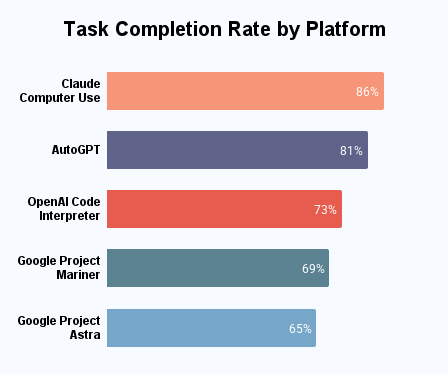
  "alt": "Bar chart showing task completion rates for five platforms with Claude Computer Use at 86%, AutoGPT at 81%, OpenAI Code Interpreter at 73%, Google Project Mariner at 69%, and Google Project Astra at 65%.",
  "caption": "Explore the differences in task completion rates across popular AI platforms, with Claude Computer Use leading at 86%. Discover how each platform stacks up in performance.",
  "description": "This bar chart illustrates the task completion rates of five AI platforms. Claude Computer Use tops the chart at 86%, followed by AutoGPT at 81%, OpenAI Code Interpreter at 73%, Google Project Mariner at 69%, and Google Project Astra at 65%. This visual provides a comparative analysis of efficiency and performance across various platforms, offering insights into their effectiveness. Key metrics and performance data serve as essential indicators for choosing the right AI solution."
}
```

    Inspired by this post on First Page Sage Blog.

  • Google Ads AI Automation: A Practical Oversight Framework

    Google Ads AI Automation: A Practical Oversight Framework

    You’re probably not worried that Google Ads lacks automation. You’re worried that the account can spend real money, distribute real creative, or create a policy problem before anyone can explain what happened.

    Good oversight doesn’t require a person to second-guess every machine-made suggestion. It requires you to decide in advance where AI may observe, recommend, execute, and enforce – and what evidence, limits, and recovery path each level requires. That turns automation into a controlled operating system instead of an open-ended permission slip.

    Give automation a job description, not blanket trust

    “Do we trust the AI?” is the wrong approval question. Trust isn’t a single setting, and the risk changes with the task. An assistant can be useful for finding an issue while being unqualified to change the account that contains it.

    • Observe: summarize performance, identify patterns, or surface assets and settings for inspection.
    • Recommend: diagnose a problem and propose a setting, campaign, measurement, or creative change.
    • Execute: change bids, budgets, reach, goals, assets, or other live account controls.
    • Enforce: restrict delivery, flag a policy concern, suspend an account, or route an appeal.

    Each step needs a stronger control than the one before it. Observation may require a quick accuracy check. A recommendation needs current account evidence. Execution needs a defined scope, financial limits, an owner, and a rollback path. Enforcement needs an evidence trail and a reliable way to challenge an incorrect decision.

    Ads Advisor illustrates why those distinctions matter. In hands-on use, it drew on the wider web and challenged default settings, including a suggestion to deselect Display Network and Search Partners when creating a Search campaign. That doesn’t make those settings universally wrong. It shows that an AI assistant can introduce a useful question rather than simply repeat Google’s defaults.

    The same assistant also produced questionable performance diagnoses and referred to an obsolete Tools & Settings > Conversions path. Breadth of information and freshness of information are separate qualities. A confident answer can still depend on an old interface, the wrong reporting scope, or an incomplete reading of the account.

    Ads Advisor’s limited autonomy creates another important distinction: advice that stops before implementation is safer than an unexplained account change, but it isn’t automatically safe. A person can still turn weak guidance into an expensive action. Before accepting any recommendation, require clear answers to these questions:

    • Goal fit: Which business outcome is this supposed to improve, and is that the outcome the campaign is actually configured to pursue?
    • Current evidence: Which live account data supports the diagnosis? Can you reproduce the observation in the current Google Ads interface?
    • Exact scope: Which campaign, network, audience, asset, conversion action, or account setting would change?
    • Reversibility: What could the change affect, and how would you restore the previous state?
    • Accountability: Who approves the change, who checks the result, and who intervenes if a stop condition is reached?

    If the assistant cannot identify the affected object or the evidence behind its recommendation, you don’t yet have a change request. You have a hypothesis. Investigate it, but don’t grant it execution authority.

    Put the strictest gates around money, measurement, and assets

    Budget tokens, measurement markers, and creative tiles pass through separate approval gates before entering an automated advertising system.

    Oversight should follow consequence, not novelty. A fresh headline suggestion and an automatic budget decision may both use AI, but they don’t deserve the same approval path. The practical dividing lines are financial exposure, measurement integrity, distribution rights, and account access.

    Automation areaUseful role for AIRequired human gate
    Campaign adviceSurface possible causes, settings, and checksVerify the live interface, reporting scope, business objective, and account evidence
    Spend and reachPropose or execute changes within an approved strategyDefine eligible campaigns, protected settings, financial boundaries, and stop conditions
    Conversion measurementIdentify anomalies or recommend outcome signalsConfirm what counts as a conversion and whether it represents real business value
    Creative selectionSurface, combine, or distribute available assetsVerify provenance, usage rights, brand suitability, destination, and placement context
    Policy enforcementDetect suspected violations and prioritize casesPreserve the evidence behind decisions and maintain a documented appeal path

    Define an automation envelope for spend and measurement

    An automation envelope is a short specification of what the system may optimize and where its authority ends. Write it before enabling execution, not after an unexpected result.

    • Business goal: State the outcome in commercial terms, then identify the Google Ads conversion signal being used as its proxy.
    • Scope: Name the campaigns, networks, markets, products, audiences, and assets that are eligible. Anything not named remains outside the envelope.
    • Permission level: Specify whether AI may observe, recommend, draft, or execute. Don’t let a recommendation tool quietly become an approval mechanism.
    • Protected constraints: Record the budgets, brand rules, excluded areas, legal requirements, and measurement definitions that automation may not alter.
    • Stop conditions: Define the events that force review, such as a broken conversion signal, unexpected distribution, a policy warning, or a proposed expansion beyond the approved scope.
    • Owner: Assign a person who can inspect the account, approve changes, and reverse them. “Marketing” or “the agency” is not a usable owner.

    Don’t borrow a universal percentage or generic performance threshold for this envelope. Materiality depends on your economics, normal conversion volume, sales cycle, and tolerance for wasted spend. Set boundaries from the account’s real financial model, then document why they are appropriate.

    Treat conversion configuration as a financial control. An automated campaign can optimize efficiently toward the wrong outcome if a primary signal stops representing revenue, qualified demand, or another intended result. Any material change to conversion definitions should trigger a fresh approval of the automation envelope.

    Treat suggested creative as unverified inventory

    Creative automation introduces a different risk: finding an asset isn’t the same as having permission to distribute it. An experimental Performance Max workflow has surfaced videos previously used in X campaigns inside Suggested creatives. Those videos were uploaded to a YouTube channel linked to the advertiser, while a disclosure identified Pathmatics by Sensor Tower as the third-party provider behind the sourcing.

    Google prompts advertisers to confirm that they hold the necessary usage and distribution rights. It also clarified that the experiment concerns reuse of social creative, not the addition of X ad inventory to the Google Display Network. That distinction matters: the system is suggesting an asset, not proving ownership or announcing a new media placement partnership.

    Require a provenance record before approving any suggested asset. It should identify the original file, rights holder, permitted channels and markets, approval status, expiration or usage restrictions, and the YouTube destination that will host it. Check music, talent, stock footage, agency, and creator agreements separately where they apply. Permission to run something on one social platform may not include every Google placement or a new public hosting location.

    If you cannot establish the chain of rights, don’t publish the asset. Use an owned replacement, obtain written clearance, or have qualified counsel resolve a disputed license. The specific downside isn’t merely an off-brand ad: it can be unauthorized distribution, a contractual breach, or an asset appearing somewhere the rights holder never approved.

    Run meaningful recommendations through a change record

    A recommendation becomes auditable only when you translate it into a proposed account change. “Improve PMax performance” is not auditable. “Replace these named assets in this campaign because the current set lacks the approved message” is closer: it identifies the object, action, and reasoning that a reviewer can inspect.

    1. Save the baseline. Capture the relevant settings, conversion definition, asset state, distribution scope, and performance view before anything changes.
    2. Rewrite the recommendation as a testable claim. State what is believed to be wrong, which evidence supports that belief, what will change, and what result would count as improvement.
    3. Inspect the live account. Confirm that the referenced setting and metric still exist, use the intended reporting scope, and apply to the named campaign. A stale menu path is a reason to investigate, not proof that the underlying idea is wrong.
    4. Bound the blast radius. Limit the change to the smallest useful scope and identify every downstream object it can affect, including spend, reach, conversion reporting, product feeds, landing pages, and hosted creative.
    5. Record approval and recovery. Name the approver, executor, review trigger, protected constraints, stop conditions, and exact rollback action.
    6. Judge the outcome on a consistent basis. Compare the same scope and measurement definition, note outside changes, and decide whether to retain, extend, revise, or reverse the change.

    Ask an AI advisor to provide its account observations, reasoning, exact affected settings, assumptions, and uncertainty. An explanation isn’t proof of accuracy, but the absence of one is an approval blocker. You still need to reproduce important observations in the account rather than trusting the assistant’s description of the interface.

    Avoid stacking unrelated changes when you need to learn what caused the result. If budget, targeting, creative, and conversion measurement all change together, the final performance number won’t tell you which recommendation helped. Narrow the scope or separate unrelated changes so the record can support a decision rather than merely describe activity.

    The record doesn’t need to become paperwork for every spelling correction. Require it when a recommendation can materially change spend, reach, measurement, creative distribution, compliance, or account access. Those are the moments when reversibility and accountability matter more than speed.

    Prepare for automated enforcement before access is interrupted

    Two advertising specialists manage a paused campaign pipeline using an evidence archive, backup access key, and manual recovery control.

    Automation is also operating on the enforcement side of Google Ads. Google reports that Gemini-enhanced detection helped reduce incorrect account suspensions by more than 80%, while appeal processing became 70% faster and 99% of appeals were resolved within 24 hours.

    Those are encouraging Google-reported outcomes, not a guarantee for an individual advertiser. “Resolved” means a decision was reached; it does not mean 99% of suspended advertisers were reinstated. The reported improvements also accompanied clearer policy language and changes to internal review and appeal processes, so it would be too simple to credit every gain to Gemini alone.

    Faster handling changes how quickly you may receive an answer. It doesn’t remove the need to prove your case. Maintain an account recovery file while campaigns are healthy:

    • Official account and business identifiers, billing details, and current authorized contacts.
    • The policies relevant to your ads, products, claims, landing pages, and business model.
    • Snapshots of live ads, assets, feeds, destinations, and landing pages sufficient to show what was running when a notice appeared.
    • A change history that distinguishes automated actions from manual edits and identifies the responsible owner.
    • Licenses, approvals, registrations, or other supporting records relevant to regulated claims and creative rights.
    • A concise chronology template for the notice, suspected cause, verified facts, corrective action, and evidence submitted with an appeal.

    If a suspension occurs, preserve the original notice and relevant account state before making broad edits. Map the alleged violation to the exact ad, asset, destination, product, billing detail, or account relationship involved. Correct what you can verify, then submit an appeal that separates evidence from assumptions. Unrelated changes can obscure the cause and make your own chronology harder to defend.

    Don’t build business continuity around the expectation of a favorable appeal. Keep channels you control – such as your website, customer communications, and organic visibility – healthy enough that a paid-platform interruption isn’t your only route to market. That won’t restore an Ads account, but it reduces the pressure to make rushed or poorly documented compliance decisions.

    Key takeaways for Google Ads AI oversight

    • Delegate observation and option generation more freely than live execution or enforcement.
    • Require every material recommendation to identify its goal, current evidence, exact scope, owner, stop condition, and rollback path.
    • Set financial and measurement boundaries from your actual business economics, not a generic tolerance copied from another account.
    • Validate a recommendation in the live Google Ads interface because a plausible answer can still rely on stale navigation or incomplete data.
    • Treat a suggested creative asset as a lead, not a license; provenance and distribution rights need independent approval.
    • Read fast appeal-resolution figures carefully: a resolved appeal is not necessarily a successful reinstatement.
    • Measure oversight by traceability and controlled outcomes, not by how many automated features are enabled.

    Start with one active campaign. Write down its automation envelope, name the human owner, and inspect the next material AI recommendation against the approval questions above. If it passes, implement the smallest reversible version and preserve the baseline. If it doesn’t, you have found the control gap before it reaches the budget, the customer, or the policy system.

    As Google Ads becomes more autonomous, the durable advantage won’t come from accepting automation first or rejecting it outright. It will come from knowing exactly where the machine’s authority ends – and making that boundary visible enough for your team to operate.

    References

  • Discover How AI Elevates Your Shopping Experience

    Discover How AI Elevates Your Shopping Experience

    AI assistants have truly become the front door to retail, shaping the way we interact with products. In my experience, Shopping Analysis provides incredible insights into how products are discovered and recommended during AI-driven conversations. This tool offers retailers much-needed visibility into the dynamics of chat shopping, transforming the way they connect with customers.


    Inspired by this post on Try Profound Blog.

  • AI Search Performance: Measure Traffic, Visibility, and Value

    AI Search Performance: Measure Traffic, Visibility, and Value

    You filtered your analytics for ChatGPT, found a sliver of sessions, and now have a decision to make. Should you invest in AI search performance, or keep your attention on traditional organic search?

    The small traffic number is real, but it is not the whole answer. Referral data captures identifiable visits. It does not show every brand mention, citation, AI Overview exposure, or assisted conversion. You need a measurement system that keeps visibility, traffic, and business impact separate while showing how they influence one another.

    Key takeaways

    • Do not use AI referral traffic as the sole measure of AI search performance.
    • Track citations and mentions separately from visits and conversions.
    • Treat the 1.08% AI referral benchmark as a historical cross-industry reference, not a universal target.
    • Measure Google AI Overviews separately because a Google referral does not identify the search feature that influenced the click.
    • Improve semantic clarity and extractability without abandoning technical SEO, internal links, authority, or conversion work.

    Separate AI visibility, traffic, and business impact

    AI search performance is not one metric. It is a sequence of related signals, and each signal answers a different question. Combining them into a single AI score hides the reason performance changed.

    Measurement layerQuestion it answersUseful metrics
    VisibilityDoes an AI answer mention your brand or cite one of your pages?Mention coverage, citation coverage, cited URLs, competitor citations, and visibility by prompt theme
    TrafficDo people click from an identifiable AI assistant to your site?Referral sessions, users, landing pages, engagement, and AI referral share
    Business impactDo those visitors complete an action that matters?Leads, purchases, sign-ups, assisted outcomes, conversion rate, and value per visit where available

    A mention is not the same as a citation. An answer can name your company without linking to it, cite a page without sending a click, or send a visitor who converts later through another channel. Preserve those distinctions in your data rather than forcing every interaction into a clean click-based funnel.

    For visibility, define citation coverage as the share of eligible prompts in your tracked set that produce a link to an owned page. Track brand mentions in a separate field. Record answers that contain no citations as well; removing them from the denominator can make coverage look stronger than it is.

    For traffic, use a consistent calculation: identified AI referral sessions divided by all sessions for the same property and period. Report the raw session count beside the percentage. A large percentage increase from a tiny starting point can look important while adding very few visits.

    For outcomes, compare assistants, landing pages, content types, and intent groups. Domain-wide averages can conceal the useful pattern. A handful of high-intent visits to a product or service page may be more valuable than a much larger set of informational visits, but you will only see that difference when the landing page and conversion event remain attached to the referral.

    Keep Google AI Overviews in their own visibility view. A standard Google referrer can show that a visit came from Google, but it does not, by itself, prove whether an AI Overview, a conventional result, or another search feature influenced the click. Do not reclassify all Google organic traffic as AI traffic simply because an AI Overview appeared for the query.

    Build a benchmark that does not confuse exposure with visits

    Three transparent laboratory vessels separately collect glowing mist, droplets, and golden spheres on a measurement workbench.

    Use the available numbers in their proper context

    Across 13,770 domains and more than 3.3 billion sessions measured from May through September 2025, identifiable AI referrals accounted for 1.08% of all web traffic. That is a substantial sample, but it is still a historical snapshot. It is not a forecast, a minimum target, or proof that every industry should see the same channel mix.

    Industry variation was wide. AI referrals represented 2.8% of traffic in IT and 1.9% in Consumer Staples, compared with 0.25% in Communication Services and 0.35% in Utilities. If your site serves a market where customers rarely use answer engines for research, comparing it with an IT publisher will create the wrong expectation.

    The distribution within AI traffic was also concentrated: ChatGPT generated 87.4% of the measured AI referrals. Start your channel mapping with the assistants that actually appear in your logs, but retain separate rows for ChatGPT, Perplexity, Gemini, Copilot, and any other identifiable referrers. Do not put all of them into an undifferentiated referral bucket.

    Traditional organic search remained much larger in the same measurement period, reaching 42.4% of traffic in Health Care, 39.6% in Communication Services, and 33.8% in Industrials. That is why an AI search program should extend a sound SEO strategy rather than consume the work needed to protect crawling, indexing, rankings, and existing organic demand.

    Search-feature exposure uses a different denominator from referral traffic. In a separate set of 21.9 million Google searches, 25.11% triggered AI Overviews. That percentage describes how often the feature appeared in the measured query set. It does not mean AI Overviews produced 25.11% of visits, and it should not be compared directly with the 1.08% referral share.

    Create a baseline you can reproduce

    Your internal baseline matters more than a broad market average. Build it once, document the rules, and use the same definitions in every measurement cycle.

    1. Define the AI referral channel. Maintain a documented list of recognized assistant referrers. Audit unassigned and ordinary referral traffic for new sources before changing the rule. Record the date whenever the channel definition changes.
    2. Fix a core prompt inventory. Group prompts by brand, category, problem, comparison, and buying intent. Keep the core set stable so changes in coverage reflect answer behavior rather than a completely different sample.
    3. Record the answer environment. Save the prompt, assistant, interface, model when visible, location or locale, date, brand mention, citation URL, competitor citation, and whether the answer used web citations at all. One generated response is an observation, not a permanent ranking.
    4. Track AI Overviews separately. For each monitored Google query, record whether the feature appeared, whether your domain was cited, which page was cited, and how that observation relates to conventional organic visibility.
    5. Create a landing-page cohort. Label the pages receiving AI referrals by page purpose and intent. Keep sessions, engagement, conversions, and value connected to the assistant and landing page.
    6. Annotate meaningful changes. Log content revisions, redirects, canonical changes, structured-data updates, internal-link changes, and measurement-rule changes. Without annotations, a visibility increase can be mistaken for the effect of the wrong edit.

    Every dashboard should show the raw count, the calculated rate, and its denominator. It should also disclose the prompt set, measurement period, assistants included, and any channel-rule changes. Those details turn a trend line into something you can trust and reproduce.

    Optimize for fast grounding without weakening SEO

    A cutaway digital structure shows organized content blocks guiding a beam toward clear reference points and a stable foundation.

    Google’s FastSearch grounds Gemini and AI Overviews with a smaller candidate pool and RankEmbed signals, favoring speed and semantic relevance over the full depth of the traditional search process. The implementation details became public through antitrust litigation and concern Google’s systems specifically. They should not be treated as proof that every answer engine retrieves and ranks information in the same way.

    A reasonable practical inference is that a page must establish its relevance quickly enough to enter a focused candidate set. Strong domain authority cannot compensate for a page that circles the question, mixes several intents, or leaves the main entity ambiguous.

    Run a semantic extraction audit on every page you want AI systems to cite:

    • State the page’s job clearly. The title, opening, and primary headings should identify the same topic and user intent. If those elements imply different purposes, split the page or choose the dominant one.
    • Put a direct answer before the expansion. Give the reader a concise answer where the relevant question first appears, then add evidence, conditions, examples, and exceptions. Do not make a retrieval system assemble the conclusion from unrelated paragraphs.
    • Make important passages self-contained. Repeat the named entity when a pronoun would make an extracted passage ambiguous. Keep limits and qualifications in the same passage as the claim they modify.
    • Use descriptive headings. A heading such as How AI referral share is calculated carries more meaning than Performance. Headings should help a reader and a retrieval system identify the exact subproblem solved below them.
    • Cover decision boundaries. Explain when the answer applies, when it does not, what commonly gets confused, and what the reader should do next. Topical depth comes from resolving adjacent decisions, not from repeating a keyword.
    • Connect the topic cluster. Link supporting pages where they supply definitions, evidence, implementation detail, or a logical next step. Avoid large blocks of generic related links that do not clarify the current page.
    • Keep structured data faithful to visible content. Use the JSON-LD type that genuinely matches the page, and keep names, dates, authorship, products, organizations, and other properties consistent with what the reader can see. Treat schema as machine-readable confirmation, not a substitute for a clear page.
    • Make evidence easy to verify. Attribute factual claims where appropriate, link to the material supporting them, and distinguish established facts from your analysis or recommendation.

    Do not turn the RankEmbed detail into the claim that backlinks or conventional ranking signals no longer matter. FastSearch is a grounding path, while traditional search continues to deliver a far larger traffic share in the measured industries. Keep pages crawlable and indexable, use the intended canonical URL, resolve duplicate versions, maintain useful internal links, and earn authority. AI extractability sits on top of those foundations.

    Also resist changing an entire site after a single visibility check. Choose a page cohort, document a specific hypothesis, and change the elements related to that hypothesis. If you rewrite the answer, headings, schema, internal links, and conversion path at once, a later improvement will not tell you which change helped.

    Read the performance pattern and choose the next move

    Once you have completed a consistent measurement cycle, the pattern across visibility, traffic, and outcomes should determine the next action. A generic directive to create more AI-optimized content is not a diagnosis.

    You have no visibility and no AI referral traffic

    Start with eligibility and relevance. Confirm that the priority page is indexable, canonical, internally linked, and accessible in ordinary HTML. Then inspect the prompts where competitors are cited. Compare the exact intent, entity language, scope, answer placement, supporting details, and cited evidence.

    Do not automatically make the page longer. If the cited pages answer a narrower question, a focused page may be more useful than adding another broad section to an already mixed resource. Revise one priority page first and test whether citation coverage changes for its prompt group.

    You are cited, but the citations do not produce clicks

    The answer may already satisfy the immediate question. Keep providing that answer; withholding it to manufacture a click usually makes the page less useful and less citable. Instead, give the reader a legitimate reason to continue: a detailed implementation sequence, an original dataset, a template, a calculator, a diagnostic, or an explanation of exceptions that cannot fit in a short generated response.

    Track mentions and citations as visibility outcomes even when traffic is absent. Then look cautiously for downstream signals such as branded demand, direct visits, and self-reported discovery. Treat those as supporting evidence rather than assigning every change to AI exposure.

    You receive AI visits, but they do not convert

    Segment the visits before changing the content. Compare assistants, landing pages, page types, and intent groups. An informational page should not be judged by the same immediate outcome as a high-intent service or product page.

    Next, inspect the transition from cited answer to landing page. The page should confirm that the visitor reached the right place, preserve the context of the question, and present a next step that fits the intent. If an AI answer cites a technical explanation but the landing page leads with a generic sales message, the post-click experience breaks the promise that earned the visit.

    AI visibility rises while organic traffic declines

    Do not assume the channels are exchanging traffic on equal terms. Investigate the organic loss by query, page, intent, indexing state, and search feature. A gain in a small referral channel may not offset a decline in the channel that still supplies a much larger share of visits.

    Keep the remedies separate. Fix technical or ranking losses where they occur, while continuing the page-level AI work that improved citations. Combining both trends into one blended search number can hide a serious organic problem.

    For your next cycle, choose a small group of pages tied to a real business intent. Capture their citation coverage, AI referrals, organic performance, and outcomes before editing. Apply one documented hypothesis to each page, repeat the same measurement method, and scale only the changes that improve the layer you intended to affect.

    Start by building the three-layer scorecard before publishing another AI-focused rewrite. It will show whether your immediate constraint is discovery, extractability, click value, or the post-click experience, and it will keep AI search work accountable without putting established organic traffic at unnecessary risk.

    References

  • Unlock Holiday Shopping with Google’s New AI Features

    Unlock Holiday Shopping with Google’s New AI Features

    As the holiday season approaches, I’m thrilled to share that Google has rolled out a range of exciting AI-powered shopping features. Just recently, Google announced this major update, perfectly timed for our holiday shopping adventures.

    What’s new with AI Mode? Picture this: you can now describe what you need as if you’re chatting with a friend! Google’s AI Mode organizes all the essentials—images, prices, reviews, and inventory—helping you decide confidently and quickly on your next purchase.

    In my Gemini App experience, it has become my go-to for brainstorming gift ideas. It effortlessly compares products and supplies answers with handy shoppable links, all within a chat.

    Are you too busy to check store stock levels? I now let Google’s agentic calling feature make those calls for me, ensuring I know about any promos or stock availability without lifting a finger.

    And here’s something I absolutely love: tracking prices with agentic AI. Whenever an item I’ve been eyeing drops in price at eligible U.S. merchants, I receive a notification. I can let Google purchase it securely using Google Pay, all within my budget!

    Why does this matter? The bustling holiday season is critical for many businesses. With these innovative AI features, I hope to see more traffic and revenue driving local stores rather than distracting buyers from making purchases.

    I’m curious to see how these tools impact our shopping experiences, and I encourage everyone to explore these features to see where your website ranks.


    Inspired by this post on Search Engine Land.

  • AI-Generated Defamation: A Practical Response Playbook

    AI-Generated Defamation: A Practical Response Playbook

    An AI assistant has attached a false accusation to your name. You may not know whether it copied a web page, confused you with someone else, revived a resolved allegation, or invented the story. That uncertainty is why your first move matters.

    Treat the incident as an evidence problem first and a distribution problem second. You need to preserve what happened, identify the failure mode, pursue a precise correction, and strengthen the public information that search engines and generative systems use to understand who you are.

    Key takeaways

    • Capture the complete AI response before reporting it. The answer may change or disappear, taking useful evidence with it.
    • Determine whether the claim came from an existing page, an identity collision, an old allegation, or a fabricated narrative. Each failure requires a different remedy.
    • Work on the originating web content and the AI platform at the same time. Correcting only one layer can leave the false claim circulating through the other.
    • Publish clear, crawlable, internally consistent entity information. Structured data can reduce ambiguity, but it cannot prove that a statement is true or force an AI provider to remove an answer.
    • Escalate promptly when the claim concerns crime, fraud, abuse, professional misconduct, safety, or an actual employment or commercial decision. Liability for AI-generated statements remains legally unsettled, so high-stakes cases need advice from a qualified lawyer in the relevant jurisdiction.

    Capture and diagnose the false claim before acting

    An investigator preserves evidence from an AI response using a laptop, phone, camera, and organized case materials.

    An AI response is not as stable as a conventional web page. It may change in a new conversation, after a product update, when the surrounding prompt changes, or after you submit feedback. Preserve a reproducible example before asking anyone to remove it.

    1. Record the product and environment. Note the platform, the model or mode shown in the interface, whether you were signed in, and the date, time, and time zone.
    2. Save the complete conversation. Keep the exact prompt, preceding messages, full answer, citations, source links, warnings, and follow-up responses. A cropped screenshot of one sentence loses context the platform may need.
    3. Preserve more than a screenshot. Export or copy the text, save the conversation link if one exists, and retain the original image files. Do not annotate or overwrite the only copy.
    4. Run a narrow reproducibility check. Test the same neutral prompt in a fresh conversation and, where relevant, add an unambiguous identifier such as an employer or location. Stop once you understand the pattern. Repeating the accusation across many public tools can create more copies and expose sensitive information.
    5. Document external exposure. Record who encountered the answer, how they found it, and whether it affected a job, contract, customer relationship, background check, or safety decision. Preserve related emails and messages.
    6. Restrict distribution. Share the evidence only with people handling the incident, the platform, and professional advisers. Posting the response publicly may amplify the accusation and create a new searchable page that associates it with your name.

    Separate the factual problem from its legal label. In an initial support request, identify a specific false factual statement and show why it is wrong. Whether it satisfies the legal elements of defamation depends on jurisdiction, context, publication, fault, and harm. Let counsel make that assessment when the stakes justify it.

    Next, classify the failure. Do not assume every harmful answer came from a page that can be found and deleted. In 2023, ChatGPT falsely connected Jonathan Turley to nonexistent charges at a faculty he had never attended and cited a Washington Post story that did not exist. A fabricated citation needs a different response from a truthful summary of an inaccurate web page.

    Likely failure modeWhat to look forBest first move
    Repetition of an online claimThe answer cites a real page, copies distinctive wording, or consistently follows prominent search results.Seek correction or removal at the originating page while sending the AI provider the same evidence.
    Identity collisionThe answer combines your name with another person’s employer, location, age, case, credentials, or biography.Show the conflicting identifiers and ask the provider to separate the two people. Strengthen your own disambiguating entity information.
    Resolved or stale allegationThe underlying event is real, but the answer omits a dismissal, correction, judgment, retraction, or later outcome.Make the authoritative resolution easy to find, then request an answer that includes the complete and current record.
    Fabricated narrativeNo underlying event can be located, citations do not exist, or the cited material does not support the statement.Preserve the invented citation and unsupported details, then request removal or correction directly from the AI provider.
    Misleading synthesisIndividual facts may exist, but the answer joins them into an implication the underlying material does not support.Challenge the unsupported connection sentence by sentence and supply concise corrective evidence.

    A search that finds nothing is a clue, not proof that the model invented the claim. Search the exact wording, inspect every cited link, compare names and biographical details, and check whether the allegation appears without its resolution. Your incident file should distinguish what you verified from what you merely could not locate.

    Correct the AI output and its web origins in parallel

    If the answer relies on a real page, start at that origin. Ask the publisher or responsible party for a correction, update, retraction, or removal supported by evidence. If a search engine result itself violates an applicable policy or legal rule, use the relevant removal process as a separate step. Deindexing a result does not delete the underlying page, and a copyright notice is not a general-purpose remedy for defamation.

    At the same time, send the AI provider a targeted report. A vague request such as “remove everything negative about me” is hard to verify and may sweep in lawful opinion or accurate reporting. A useful report gives the reviewer a small, testable case.

    • Identify the subject: full name, relevant organization, location, and any other detail needed to prevent another identity collision.
    • Quote only the necessary statement: isolate the exact factual assertion that is false rather than forwarding pages of unrelated output.
    • Explain the error: state which words are wrong and whether the answer invented an event, confused two people, omitted a resolution, or misrepresented a cited page.
    • Provide the correct fact: give a concise replacement statement that the evidence supports.
    • Attach authoritative evidence: use primary records, court documents, formal corrections, official registries, or first-party records where appropriate. Do not upload confidential material through an insecure feedback form.
    • Specify the remedy: ask the provider to remove the false assertion, correct the biography, separate two entities, stop relying on an unsupported citation, or review the recurring response pattern.
    • Include reproduction details: provide the exact prompt, full response, model or mode, date, screenshots, conversation link, and cited URLs.
    • Keep the receipt: save the ticket number, confirmation email, submitted text, attachments, and every subsequent response.

    Product-specific escalation routes have included the following starting points. Interfaces and policies can change, so verify the live route inside the product or its help center before relying on it.

    • Meta Llama: use the Llama Developer Feedback Form or email LlamaUseReport@meta.com.
    • ChatGPT: use the report control attached to the problematic conversation or response.
    • Google AI Overviews and Gemini: use the product feedback control; use Google’s legal troubleshooter when you are making a legal complaint rather than ordinary product feedback.
    • Microsoft Copilot and Bing: use the thumbs-down feedback control or Microsoft’s Report a Concern process.
    • Perplexity: send a correction or removal request to support@perplexity.ai.
    • Grok: use the xAI reporting portal, including the route for inaccurate personal information where applicable.

    Keep the tone factual. State what the system produced, why the assertion is false, what evidence establishes the correction, and what outcome you want. Do not pad the request with guesses about training data or accusations that you cannot substantiate. Follow up when you have new evidence, a new recurring output, or a material consequence rather than sending repeated copies of the same ticket.

    Rebuild the entity evidence search and AI systems can use

    Verified digital evidence tiles connect around a central human silhouette while incorrect fragments detach from the surrounding network.

    Platform reporting deals with the visible answer. Reputation repair deals with the information environment that may produce the next answer. AI systems often repeat material already available online, so correcting the originating content matters. It may not be sufficient by itself: a harmful narrative can persist after its obvious web origin has been removed.

    Create one unambiguous canonical entity page

    Give search engines and generative systems a stable page that answers the basic identity questions without promotional fog. For a person, that will usually be a biography or profile page. For a company, it may be the primary About page or a dedicated company profile.

    • Use the exact public name consistently in the page title, visible heading, opening copy, metadata, and structured data.
    • Add the identifiers that separate the subject from namesakes: organization, role, location, field, and other accurate public distinctions.
    • Link to primary evidence for consequential claims, including official profiles, registries, decisions, corrections, or public records.
    • Keep current and historical roles distinct. A stale title or affiliation can cause systems to merge facts from different periods.
    • If a correction is necessary, make it factual and proportionate. Do not place the false accusation in the title, URL slug, meta description, or repeated headings merely to deny it.
    • Earn accurate profiles and coverage on credible independent sites where possible. A cluster of consistent, authoritative references is more useful than many thin pages under your control.

    Do not begin by creating look-alike personas or a network of near-duplicate profiles. Deliberate ambiguity may appear to bury a result, but it can make entity resolution harder and give automated systems more names and biographies to combine incorrectly. Fix the identity graph before trying to cloud it.

    Use JSON-LD for consistency, not as a rebuttal channel

    Apply Person or Organization markup that matches the visible page. Use name, url, and carefully selected sameAs links to verified, authoritative profiles. Add alternateName, affiliations, or employment relationships only when they are accurate, public, and genuinely help identification.

    Structured data cannot certify truth, remove a model response, or override stronger contradictory evidence. Never hide a rebuttal in JSON-LD that users cannot see on the page. The markup, page copy, linked profiles, and organization records should tell the same factual story.

    Measure the narrative instead of checking one favorite prompt

    Create a small prompt set based on the ways real stakeholders could ask about the subject. Include a plain identity query, a query with an employer or location disambiguator, and a neutral question about the disputed topic. Do not build dozens of prompts that repeat the accusation unnecessarily.

    • Record whether each answer is accurate, inaccurate, misleading by omission, correctly disambiguated, or unsupported by its citations.
    • Track which URLs and publishers recur across responses. Those recurring inputs deserve priority in the remediation plan.
    • Retest after a meaningful event: an originating page is corrected, a search result changes, the platform answers a ticket, or the canonical entity page is substantially updated.
    • Keep clean results as well as bad ones. They help show whether the problem is isolated, prompt-dependent, or recurring across systems.
    • Do not declare the incident resolved after one favorable answer. Resolution means the high-risk prompts and relevant search surfaces no longer reproduce the false narrative with reasonable consistency.

    No credible SEO, AEO, or GEO plan can promise immediate erasure from every model. Different systems retrieve, generate, update, and respond to corrections differently. The defensible objective is to remove bad inputs where possible, improve the clarity and authority of correct information, and document how outputs change.

    Know when reputation tactics are no longer enough

    Technical remediation can reduce visibility and confusion. It cannot decide whether you have a legal claim, preserve every legal right, or stop an urgent real-world consequence. Seek advice from a lawyer experienced in defamation, privacy, and platform disputes when the downside is serious or your next action could affect a claim.

    • The output falsely alleges criminal conduct, fraud, abuse, sexual misconduct, professional discipline, or another accusation likely to cause immediate harm.
    • An employer, customer, lender, licensing body, media outlet, or background-check provider has seen or relied on the statement.
    • The answer exposes private information, enables impersonation, creates a safety concern, or directs hostility toward the subject.
    • A publisher or platform refuses to correct a demonstrably false statement despite strong primary evidence or an existing court outcome.
    • You are considering a formal demand, preservation notice, subpoena, lawsuit, or disclosure of confidential records.
    • The claim appears repeatedly across products and seems connected to an identifiable publisher, campaign, or actor.

    The unresolved legal question is not merely whether a model encountered third-party material. AI can produce wording, implications, events, and citations that were never published by that third party. Arguments that Section 230 may protect an AI company therefore sit beside arguments that a generated answer is a new publication or goes beyond republishing someone else’s content. There is still limited precedent for assigning liability in these cases.

    Do not let that uncertainty turn the response into guesswork. Open a restricted incident file, preserve one reproducible example, assign an owner, and begin the platform and origin corrections. If the allegation is already affecting employment, business, safety, or a legal proceeding, give that evidence pack to qualified counsel before publishing a broad rebuttal that could amplify the claim.

    References