
You can pay for a creator campaign, get a burst of attention, and still end up with content that disappears as soon as the feed moves on. The missed opportunity is not more distribution. It is making each creator asset clear enough to be found when someone searches for the problem, product category, comparison, or use case it addresses.
The fix starts before the creator records anything. You need to connect a real search question to the right creator, build the answer into the content, adapt that answer to each platform, and measure whether it remains visible after publication.
Treat every creator asset as part of the search journey
A buyer rarely completes a considered search in one place. Someone looking for the best lightweight running shoes might discover options on TikTok, request a comparison from ChatGPT, inspect commentary through Google, and then visit a brand site. Creator content can influence several points in that journey, even when the buyer never visits the creator’s profile directly.
Google can surface social opinions through features such as “What people are saying,” including material from YouTube, TikTok, LinkedIn, and other platforms. Social and video content can also supply context for AI-generated answers. Your influencer program therefore creates search inventory whether or not the campaign team manages it that way.
Cross-platform influencer SEO does not mean copying the same caption everywhere. It means preserving a recognizable answer while changing the presentation for each environment. The product name, category, use case, audience, and factual claims should remain stable. The hook, pacing, depth, visual treatment, and call to action can change.
This distinction prevents two common failures. A generic awareness video may be entertaining but give a search system little information about the question it answers. An over-optimized script may contain the right phrase repeatedly but sound unnatural enough to weaken the creator’s authority. Effective creator SEO keeps the subject unmistakable without turning the content into a spoken keyword list.
Key takeaways
- Choose a search question tied to a decision the audience is actually making.
- Match that question with a creator who can demonstrate or explain the answer credibly.
- Carry the topic into spoken words, on-screen text, captions, titles, descriptions, and relevant hashtags.
- Keep names, use cases, qualifiers, and approved claims consistent across platforms.
- Measure native search, Google visibility, AI visibility, content usefulness, and business outcomes separately.
Map the query to the decision and the creator

Do not begin with a creator roster and look for keywords to attach later. Begin with the audience decision. Is the searcher trying to understand a category, compare alternatives, check whether a product suits a particular use case, validate a concern, or decide what to buy?
That decision determines the form of the content. A broad educational query may need a clear explanation. A comparison query needs visible criteria. A suitability question needs a demonstration under the relevant conditions. A purchase-stage query needs specific trade-offs and a useful next step.
Build the query set from evidence already available to your teams: organic search insights, native platform trends, recurring questions in creator comments, customer language, and tools such as AnswerThePublic. Keep the audience’s wording intact during collection. You can consolidate variants later, but early normalization often removes the precise qualifier that reveals intent.
For example, “running shoes” identifies a category. “Best lightweight running shoes for travel” identifies a category, comparison, desired attribute, and use case. The longer expression gives the creator something concrete to answer and gives you a much better basis for evaluating the finished asset.
| Planning field | What to record | Review question |
|---|---|---|
| Audience decision | The choice, concern, or uncertainty behind the search | What should the viewer be able to decide after watching? |
| Search expression | The natural wording used by the intended audience | Does the wording preserve important qualifiers? |
| Required answer | The useful conclusion the content must deliver | Does the asset answer the query rather than merely mention it? |
| Proof format | Demonstration, explanation, comparison, walkthrough, or opinion | Can this creator show the answer credibly? |
| Creator fit | The creator’s relevant subject history, audience, and format strengths | Will the recommendation feel consistent with their existing work? |
| Platform role | Discovery, detailed evaluation, professional validation, or conversion support | Why does this asset belong on this platform? |
| Destination | The next page, video, profile, or action that continues the journey | Does the next step satisfy the same intent? |
Creator selection should follow the map. Look for a history of discussing the relevant problem, a format capable of showing the required proof, and audience responses that indicate genuine interest in the subject. Reach matters to distribution, but topical fit determines whether the answer feels believable and whether the asset has a coherent search purpose.
Share the query language with the creator before locking the script. A creator may know a more natural way to express the same intent. Accept that adjustment when it preserves the audience, problem, category, and meaning. Search optimization needs semantic clarity, not forced recitation.
Write a search-ready brief without scripting out the creator
A weak brief says, “Mention the product naturally and add these hashtags.” That tells the creator what must appear but not what the content must answer. It also leaves the campaign team unable to judge whether the deliverable serves a searcher.
A search-ready brief states the audience decision, target query, required answer, evidence, placement of topic signals, approved claims, creative freedom, and next step. The creator should know which parts are mandatory and which parts they own.
- Search objective: Describe the question or decision the asset should help resolve.
- Primary topic: Supply the natural query and acceptable variations, including any qualifier that changes intent.
- Required answer: State what useful conclusion the viewer should receive. Do not prescribe a positive verdict that the evidence cannot support.
- Topic placements: Identify where the subject should appear, such as the spoken script, opening frame, on-screen text, caption, title, description, and relevant hashtags.
- Proof: Specify the demonstration, comparison criteria, walkthrough, or factual context needed to support the answer.
- Entity language: Provide the correct brand, product, category, feature, and use-case names. Mark any wording that must remain exact for accuracy.
- Creative control: Leave room for the creator’s hook, examples, visual language, pacing, and personal assessment.
- Next step: Name the destination that continues the same search intent rather than sending every viewer to a generic homepage.
The required topic should normally appear in more than one content layer. Spoken language helps make the subject explicit in the actual video. On-screen text helps a viewer recognize the answer quickly. The caption, title, and description provide written context. Relevant hashtags can reinforce classification, but they should not carry the entire strategy.
Use a pre-publication review that tests clarity rather than keyword density:
- Can a viewer identify the question during the opening portion of the asset?
- Does the creator answer the question with an explanation or visible proof?
- Is the primary topic spoken naturally?
- Does on-screen text name the subject without covering important visuals?
- Does the caption add context instead of repeating a thin promotional line?
- Is the title or description complete enough to stand on its own outside the feed?
- Are brand, product, category, and use-case names accurate and consistent?
- Are all factual and comparative claims supportable?
- Does the final result still sound like the creator?
If a phrase sounds awkward, change the sentence rather than deleting the subject. If the creator cannot answer the assigned query credibly, change the query or the creator. No amount of metadata can repair a mismatch between the question and the person delivering the answer.
Adapt the answer instead of duplicating the asset
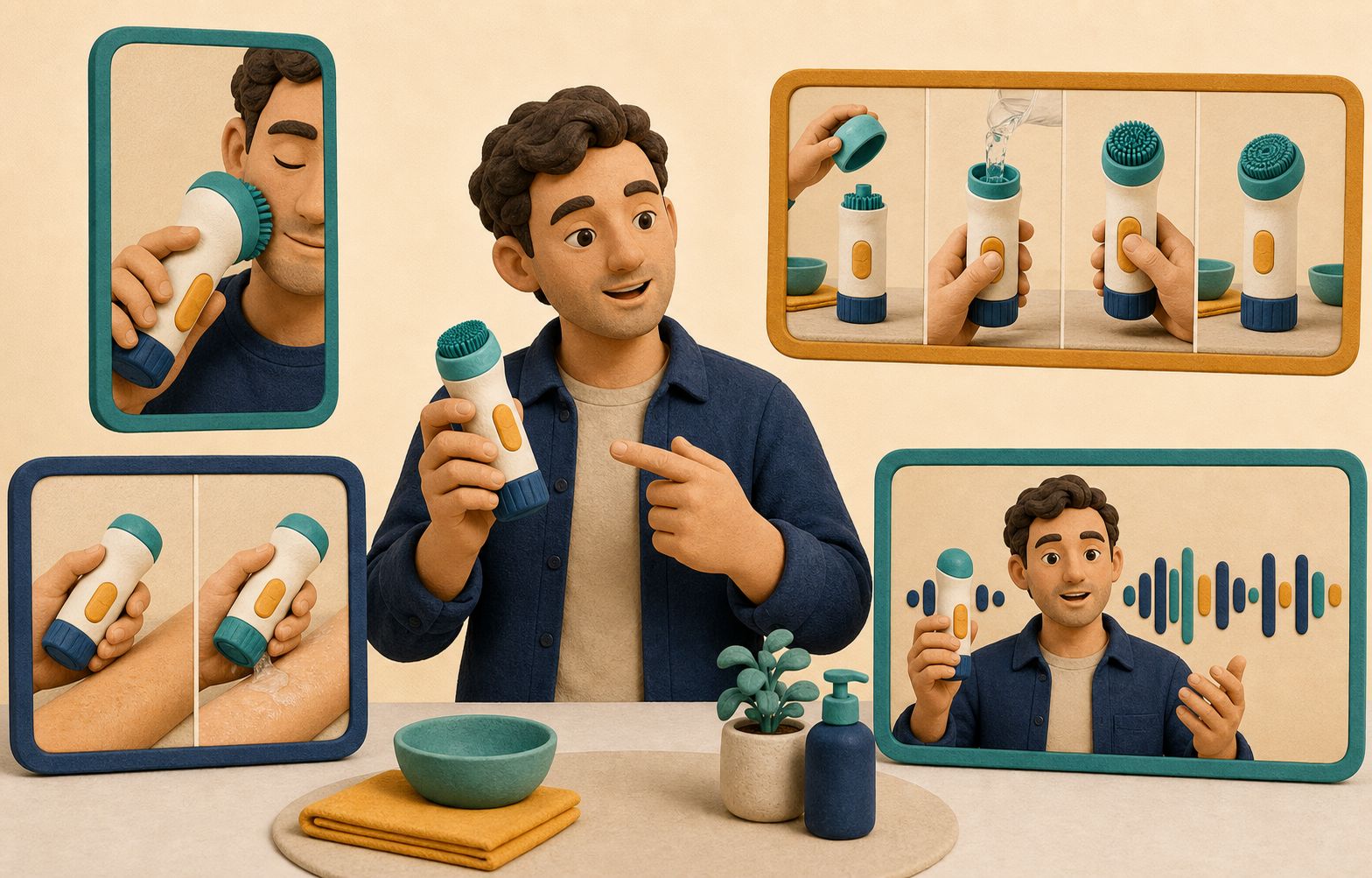
Each platform gives the same core answer a different job. Short video may introduce the question and show fast proof. YouTube can accommodate a fuller explanation. LinkedIn can frame the issue around professional decisions. A brand page can verify details and continue the journey. The campaign becomes cross-platform when these assets reinforce one another, not when the same file is uploaded repeatedly.
| Platform or surface | Recommended job | How to adapt the core answer | What to avoid |
|---|---|---|---|
| TikTok and other short-form video | Question-led discovery and concise demonstration | Make the problem recognizable in the hook, say the topic naturally, show the proof, use readable on-screen language, and write a contextual caption | A trend-led opening that never makes the actual subject clear |
| YouTube | Detailed evaluation and explanation | Use a descriptive title, establish the question clearly, cover the relevant criteria, and write a complete description that identifies products, categories, use cases, and conclusions | A vague title or a nearly empty description that depends on viewers already knowing the context |
| Professional interpretation and validation | Lead with the business problem or decision, name the category and audience, and preserve the creator’s analysis rather than reducing the post to campaign copy | Opening with brand promotion before establishing why the issue matters | |
| Brand-owned page | Verification and continuation | Align terminology and approved claims with the creator asset, provide deeper product information, and link or embed the creator content when rights allow | Sending an intent-rich query to a generic page that does not answer it |
| Google and AI answer surfaces | Secondary discovery of published creator material | Monitor whether the underlying social or video asset appears for the intended topic and whether its language is represented accurately | Treating a variable AI response as a permanent ranking |
YouTube deserves particular attention when the subject requires depth. Comprehensive video descriptions can improve the contextual information available to search and AI systems, including for smaller channels. A description should identify what the video covers, which audience or use case it addresses, what is demonstrated, and where the viewer can verify or continue the answer. A link by itself does none of that work.
Consistency matters across every version. Use the same accurate spelling for the brand and product. Keep the category relationship explicit. Preserve important qualifiers such as audience, location, compatibility, or intended use. Do not let one creator call a feature by a campaign nickname while the landing page, video title, and other creators use unrelated terms.
Consistent language can give AI systems clearer evidence when connecting a brand with a category or recommendation context. It cannot guarantee a citation or favorable answer, but it removes avoidable ambiguity. Creative variation should change the expression, not the underlying facts.
Cross-platform expansion also needs editorial discipline. Do not manufacture praise in community spaces or ask creators to disguise sponsored material as an independent conversation. Genuine comments and questions are more useful as audience-language research: record how people describe the problem, then feed those expressions into future query maps and briefs.
Measure visibility, usefulness, and business impact separately
A creator asset can succeed in one layer and fail in another. High engagement does not prove search visibility. Search visibility does not prove the answer is useful. Neither one, by itself, proves commercial impact. A single blended campaign score hides the diagnosis you need to improve the next brief.
Build a record for every published asset that includes the creator, platform, URL, target query, important variations, audience decision, publication date, destination, and campaign identifier. Without that connection, teams can see performance but cannot tell which search intent or content treatment produced it.
Search visibility
- Check the native platform for the assigned query and meaningful variants.
- Inspect Google results for the creator URL, video results, social modules, and relevant “What people are saying” placements.
- Use a stable set of AI prompts that reflects the target decision. Log the service, model when shown, date, response, cited pages, and whether the creator or brand is represented accurately.
- Record visibility by query and surface. Do not combine native placement, Google appearance, and AI mentions into an invented universal rank.
Content usefulness
- Review retention or viewing patterns to locate the point where attention drops.
- Track saves, shares, and substantive comments that indicate the answer was useful enough to keep or pass along.
- Separate query-relevant questions from generic reactions. New questions may reveal missing information or the next search intent to target.
- Compare performance with the creator’s own relevant historical content when possible, not with an unrelated platform-wide expectation.
Business impact
- Track visits to the intended destination with campaign-specific links where the platform permits them.
- Measure whether visitors engage with the page that continues the answer, rather than counting the click alone.
- Review attributed and assisted conversions in the context of a multi-platform journey. A last-click report will not describe every earlier creator interaction.
- Watch whether the questions and terms used in creator content begin appearing in site search, sales conversations, or other audience feedback available to your organization.
The pattern across these layers tells you what to fix. If the asset is useful to viewers but absent from search checks, strengthen topic placement, titles, descriptions, and query alignment. If it is visible but loses attention, improve the answer, proof, hook, or creator fit. If it earns visibility and engagement but produces no useful next action, inspect the call to action, destination, offer, and measurement setup. If different platforms describe the product inconsistently, repair the entity language in the shared brief.
The operating model matters as much as the brief. SEO and influencer teams often sit in separate workflows with different goals, so create a shared handoff:
- The SEO team supplies the audience decision, query language, qualifiers, and relevant search surfaces.
- The influencer team maps those needs to creators, platforms, formats, and campaign constraints.
- The creator proposes a native angle and identifies any keyword wording that would sound forced.
- The campaign owner reviews the draft for answer quality, search signals, factual consistency, and creator voice.
- The publishing owner completes every agreed title, caption, description, text, hashtag, and destination field.
- The measurement owner records the asset and checks each visibility, usefulness, and business layer.
- The teams convert findings into changes to the query map, creator selection, brief, or destination before the next activation.
Start with your next creator brief. Add the audience decision, natural query, required answer, proof format, topic placements, consistent entity language, and destination. If you cannot name those elements before production begins, the campaign is not yet ready to work as search content.
References

Leave a Reply