Month: April 2026

  • AI Search: Navigating New Reputation Risks Effectively

    AI Search: Navigating New Reputation Risks Effectively

    I remember the days when a Google search was akin to embarking on a quest for information. It was an adventure of navigating various links and forming my own opinions.

    Nowadays, tools like AI Overviews, ChatGPT, and Perplexity condense all that information into a single, simplified answer. This transformation often strips away the finer details while amplifying certain perspectives.

    This shift has redefined online reputation management. Now, search engines not only present information but shape the underlying narratives. This raises the stakes for brands, as even a top-ranking status doesn’t guarantee influence if AI stories tell a different tale.

    For brands, the game has changed. Being number one doesn’t ensure visibility and influence anymore. The underlying narrative holds far greater power.

    AI Narrative Formation: Crafting User Answers

    AI platforms now utilize what I like to call ‘AI narrative formation.’ This process crafts the responses we receive from various search engines. Let me walk you through how this system works.

    Source Pooling

    These systems pull content from numerous sources. Contrary to expected reliance on peer-reviewed articles, they gather data from Reddit, YouTube, and social platforms like Instagram and TikTok.

    Signal Weighting

    Not all sources are equal. Often, a popular yet low-quality source can outweigh a singular, credible entry. A bustling Reddit thread with negative feedback might overshadow a well-researched Wikipedia page.

    Narrative Compression

    The summarization process compresses diverse inputs, often losing nuance along the way. Complex reputations are simplified into general statements like, ‘Users find this company untrustworthy.’

    Continued Reinforcement

    These summaries transcend their original context, getting shared and re-shared across social media. As these echoes return as new data, they further entrench the narratives in AI responses.

    Explore deeper: How AI is Redefining Authority in Search

    Unraveling a Finance Company’s Reputation in AI Search

    To illustrate AI narrative formation, consider a recent case I worked on involving a financial company, which we’ll call Company X.

    Company X’s reputation remained strong on traditional SERPs. High Trustpilot ratings and reputable endorsements were the norm until Google AI Overview threads surfaced a forgotten Reddit forum rife with grievances against them.

    The AI Overview skewed the narrative, suggesting Company X had unresolved customer service issues, even though these concerns had been addressed years prior. This created a skewed perception that was hard to counteract.

    ```json
{
  "alt": "The CapmatchOne logo with a gradient circle and bold text.",
  "caption": "Discover innovation with the CapmatchOne logo, featuring sleek typography and a modern gradient circle.",
  "description": "The CapmatchOne logo features bold, modern typography coupled with a gradient circle, symbolizing connection and innovation. The sleek design conveys a sense of progress and creativity. This image can be used for branding or promotional purposes, appealing to audiences interested in innovative solutions and forward-thinking designs."
}
```

    The Amplified Risk from AI Searches

    AI dramatically increases reputational risk through several mechanisms:

    • The Spread of Negative Narratives: Negative content surfaces faster and more prominently than before.
    • AI Hallucinations: Despite growing awareness, AI inaccuracies continue to deceive.
    • The Snowball Effect: Repeated narratives gain momentum, complicating reputation management efforts.

    It has become evident that in ORM, repetition often overrides accuracy.

    Explore deeper: Generative AI’s Defamation Challenges

    Auditing AI-Generated Narratives: A Step-by-Step Approach

    Let’s consider a situation involving an AI-generated narrative challenge faced by CEO X of a well-known SaaS company.

    After an out-of-context quote from CEO X’s podcast appearance went viral, AI summarized him unfavorably. Quickly, his reputation transformed negatively across major platforms.

    Step 1: Mapping Queries

    I initiated a process to understand what queries AI outputs were generating about CEO X. This helped identify the underlying issues.

    Step 2: Capturing Outputs

    Identifying repeated claims revealed how CEO X was perceived. Narratives from Google AI and ChatGPT were consistently portraying him negatively.

    Step 3: Delving Through Sources

    The next step involved examining the quality of sources contributing to these narratives, often outdated or lacking accuracy.

    Step 4: Analyzing the Narrative Gap

    This involved assessing discrepancies between AI narratives and his actual reputation, contextualizing the initial quote, and examining the long-standing perception of CEO X.

    Step 5: Correcting and Replacing Sources

    Finally, I focused on directly addressing, correcting, and replacing those negative narratives. This involved engaging directly with platforms that contributed to the misinformation and reinforcing positive content elsewhere.

    Explore deeper: Responding to Negative AI Reviews

    A New Perspective: From SEO to Narrative Management

    The focus has shifted from merely achieving top SEO rankings to understanding and adapting to narrative shifts. We must rethink our strategy from content engagement to managing the narratives AI disseminates.

    To succeed, it’s important to reinforce AI systems with quality inputs, including crafting high-quality content, pursuing credible mentions, disseminating structured data, and managing misinformation directly.


    Inspired by this post on Search Engine Land.


    crushpress.ai community screenshot
  • How Clarity Beats Creativity in ChatGPT Ad Performance

    How Clarity Beats Creativity in ChatGPT Ad Performance

    I recently delved into an intriguing analysis by Adthena, which examined over 40,000 daily ChatGPT ad placements. What stood out to me was how these ads are evolving into a streamlined, high-intent messaging format, specifically tailored for users who are already deep in the decision-making process.

    The big picture: ChatGPT ads are gravitating towards a style that’s concise, well-structured, and highly contextual. This approach emphasizes precision over persuasion, signaling a shift from traditional creative advertising to real-time, intent-driven assistance.

    By the numbers:

    • The average headline is just 30 characters long, consisting of about 5 words.
    • Body copy averages 116 characters and roughly 19 words.

    This makes it clear that every word needs to be purposeful, enhancing clarity or directly driving conversion.

    What’s working: The dominant pattern I observed involves a “Brand: Benefit” headline structure, which clearly delineates the brand name from the value proposition. This works well because users in conversational settings prioritize immediate clarity over intrigue.

    In this environment, brand recall is essential, especially as ads often start with the brand name—ideal for users evaluating rather than discovering options.

    Headlines have become succinct, resembling functional labels more than traditional slogans. This brevity continues in the body copy, usually composed of two concise sentences: one proving a point and another offering a subtle prompt.

    Context mirroring has emerged as a distinguishing feature. The best ads expertly reflect a user’s query or environment, suggesting real-time message tailoring—a level of AI-native targeting that transcends basic keyword matching.

    Concrete value signals are vital. The dollar symbol and specific numerical claims, such as prices or performance metrics, significantly outperform generic promises. Numbers naturally instill credibility, which is crucial in a context where users are actively researching and comparing.

    Low-friction offers—like trials or demos described with the word “free”—are the most effective conversion drivers. They lower the commitment threshold for users still exploring options.

    Calls to action are direct and action-focused, using phrases like “Shop now,” “Compare,” or “Book,” steering away from generic prompts like “Learn more.”

    The overall tone is calm, confident, and measured, with minimal punctuation like exclamation points or question marks. This aligns more with the voice of helpful guidance than traditional advertising hype, allowing ads to blend naturally into conversational contexts.

    Why we care: ChatGPT ads target users with high intent, where clarity and relevance trump creativity or storytelling. In a conversational space, ads compete against genuinely helpful answers, so precise and value-driven copy truly stands out.

    This brings advantages to early adopters as the format becomes standardized, rewarding those who use shorter, structured messaging.

    Between the lines: While ChatGPT ads share characteristics with paid search—focused on intent and relevance—they must seamlessly fit into dialogues, respond to users with high intent, and present messages that feel supportive rather than disruptive.

    The takeaway is that success in ChatGPT advertising increasingly relies on precision, relevance, and credibility over emotion or brand storytelling. Achieving this means perfectly integrating at the moment when users need clear, trustworthy information.

    Dig deeper: Check out the complete infographic shared by Adthena CMO Alex Fletcher on LinkedIn.


    Inspired by this post on Search Engine Land.


    crushpress.ai community screenshot
  • Boost Your AI Overview Visibility Despite Top Rankings

    Boost Your AI Overview Visibility Despite Top Rankings

    I was surprised when despite all the right moves—maintaining a fast website, creating comprehensive content, and achieving a top 10 ranking—my site didn’t show up in Google’s AI Overview. It turns out that high rankings don’t guarantee AI Overview visibility.

    This issue isn’t about how well my content ranks, but rather how it’s retrieved. Understanding this distinction is vital for anyone involved in SEO today.

    AI Overviews prioritize content that offers the clearest, most usable answers, rather than just relying on high-ranking signals.

    If my content doesn’t meet this standard, my search ranking becomes irrelevant. I realized I needed to understand where things were going wrong to make sure my content appeared in more AI Overviews.

    The ranking-citation gap is real — and growing

    The overlap between AI Overview citations and organic rankings increased from 32.3% to 54.5% between May 2024 and September 2025, according to BrightEdge. Although positive, this means that many AI Overview citations still come from pages not ranked at the top. Google often chooses pages that better suit the AI Overview format.

    This trend varies by industry. In ecommerce, the overlap stayed almost flat over time, while in YMYL categories like healthcare, insurance, and education, it remained between 68%-75%.

    High ranking and visibility don’t always align. I’ve seen scenarios where I rank second but remain invisible, while sometimes ranking on the second page gets more visibility in an AI Overview.

    Dig deeper: 7 hard truths about measuring AI visibility and GEO performance

    5 reasons AI Overviews skip your content

    1. Your content answers the wrong version of the question

    AI Overviews are often triggered by long-tail, conversational searches. These drive 57% of AI Overviews, whereas commercial queries less so, according to Semrush.

    Google’s AI looks for content matching user intent, not just the keywords. For instance, a query about managing remote teams may overlook my page if it primarily discusses “project management software.”

    2. You’ve buried the answer

    If I start with too much context and not enough answer, search systems move on. They extract clean, immediate information. If my response isn’t close to the top, it gets skipped.

    3. Your structure is opaque to AI systems

    AI systems need clear, self-contained answers with concise paragraph structure and heading hierarchies. Overly complex narratives confuse AI, even if the content is accurate.

    Dig deeper: AI Overview citations: Why they don’t drive clicks and what to do
    ```json
{
  "alt": "The CapmatchOne logo with a gradient circle and bold text.",
  "caption": "Discover innovation with the CapmatchOne logo, featuring sleek typography and a modern gradient circle.",
  "description": "The CapmatchOne logo features bold, modern typography coupled with a gradient circle, symbolizing connection and innovation. The sleek design conveys a sense of progress and creativity. This image can be used for branding or promotional purposes, appealing to audiences interested in innovative solutions and forward-thinking designs."
}
```

    4. Your E-E-A-T signals aren’t visible at the content level

    Google emphasizes E-E-A-T signals for quality. These need to be explicit in the content, beyond domain authority. Each page needs to establish credibility independently.

    • Who wrote it?
    • Where did the data come from?
    • Does it demonstrate field expertise?

    Such signals are crucial in YMYL content where misinformation risks are high.

    5. You’re targeting queries that don’t trigger AI Overviews

    Before optimizing for AI, I check if my queries trigger Overviews. As of late 2025, they appeared in 16% of searches, but not evenly across types.

    Transactional queries, navigational searches, and local searches trigger fewer Overviews. If my traffic is commercial, the lack of a citation might not reflect my content quality but the nature of the query.

    What the data tells us about the impact of this shift

    The stakes are high. Seer Interactive found AI Overviews reduced CTRs for informational queries by 61% between June 2024 and September 2025. Brands featured in Overviews, however, experienced a 35% increase in CTR.

    As Pew Research noted, only 8% of users clicked a traditional result when AI Overviews were present. Without being cited, I could miss not just the Overview visibility but also clicks from organic listings.

    How to optimize for retrieval, not just rankings

    • Rewrite introductions: Provide a direct answer immediately. Context can follow later.
    • Restructure headings: Make them specific and complete. Each section should operate independently.
    • Add explicit expertise signals: Use author details, original insights, and reliable sources to enhance credibility.
    • Audit query triggers: Check if queries trigger AI Overviews and study cited source structures.
    • Expand topical coverage: Don’t focus excessively on a single page. Deliver comprehensive knowledge across your topic.
    Dig deeper: Want to beat AI Overviews? Produce unmistakably human content

    How to shift your SEO approach

    AI Overviews show the split between content quality and ranking signals. High rankings used to equal quality, but now they don’t guarantee AI compatibility.

    Ranking still matters, but understanding AI identification and retrieval processes is critical for visibility today. We can no longer rely solely on top rankings to bring visibility.

    To improve AI Overview inclusion, I focus on understanding how AI systems extract information, making content adjustments accordingly.


    Inspired by this post on Search Engine Land.


    crushpress.ai community screenshot
  • Avoid These Costly Google Ads Mistakes for Ecommerce Success

    Avoid These Costly Google Ads Mistakes for Ecommerce Success

    Expanding beyond paid social? Discover how I learned to structure campaigns, control spend, and unlock demand without depending solely on the Meta playbook.

    My paid social campaigns were thriving. I understood my audience intimately, had a tight creative process, and watched results improve each year. Naturally, when leadership proposed expanding into Google Ads, I was thrilled—envisioning it as a new revenue channel.

    But sticking to our existing strategy only led to difficult conversations. Google demands different tactics—intent signals and campaign structures vary, and common budget-draining mistakes aren’t always obvious. Many brands mirroring their Meta strategy end up with flashy dashboards but disappointing balance sheets.

    From my experiences, six frequent mistakes can cause substantial damage before they’re even noticed. They’re what I’ve seen most often with ecommerce brands transitioning to Google Ads—and each error is reversible.

    Mistake 1: Treating Google like a retention channel

    Utilizing Google Ads for retention and brand defense is possible, but relying solely on it as a strategy is problematic. I often notice brands new to the platform diving straight into Performance Max. Initially, the ROAS shines bright, making everyone happy. However, when the right question surfaces—”Are we truly growing or just capturing purchases?”—issues arise.

    For example, a client approached me with branded search and retargeting doing most of the work in PMax—a mere tax on demand already created elsewhere, leading to stagnant revenue. Although ad spend was soaring, growth wasn’t.

    Acquiring new customers requires a different setup, like:

    • Shopping campaigns to highlight products to new audiences.
    • Search campaigns centered on non-branded, high-intent keywords.
    • Layered PMax configurations to bypass defaulting to easy conversions.

    When Google grants vast access to new audiences, focusing solely on closing disregards most of this opportunity.

    Dig deeper: Ecommerce PPC: 4 takeaways that shape how campaigns perform

    Mistake 2: Not knowing how to leverage Google’s core levers

    Although paid social expertise is somewhat transferable to Google, I’ve observed four major gaps. Let me share them with you in more detail.

    Search intent: Social media ads interrupt, but search ads meet users actively seeking your offerings, transforming campaign structure, ad copy, and keyword targeting entirely.

    Data feed optimization: An optimized product feed enhances visibility and targeting in Shopping or Performance Max campaigns.

    Keyword research: Understanding match types and search intent is critical for reach and cost efficiency.

    Landing pages: Engaging landing pages outperform product pages for high-intent but unfamiliar visitors.

    Dig deeper: 7 Google Ads search term filters to cut wasted spend

    ```json
{
  "alt": "The CapmatchOne logo with a gradient circle and bold text.",
  "caption": "Discover innovation with the CapmatchOne logo, featuring sleek typography and a modern gradient circle.",
  "description": "The CapmatchOne logo features bold, modern typography coupled with a gradient circle, symbolizing connection and innovation. The sleek design conveys a sense of progress and creativity. This image can be used for branding or promotional purposes, appealing to audiences interested in innovative solutions and forward-thinking designs."
}
```

    Mistake 3: Allowing operational issues to interrupt campaign momentum

    Consistent data is key for Google’s algorithms. Every unintended campaign pause can reset learning, causing weeks of degraded performance and wasted spend.

    Common disruptions include:

    • Payments: Bill lapses, leading to campaign pauses, overshadow the actual cost when factoring in downtime recovery.
    • Tracking and feed integrity: Broken pixels and feed errors silently degrade performance.

    Setting up automated alerts and regular audits can prevent these costly errors.

    Mistake 4: Overly granular campaign structures

    Detail-oriented advertisers may over-segment campaigns, believing it provides control. However, widespread budget allocation hinders Google’s automation from optimizing effectively.

    Instead, tight, well-funded campaigns optimize better and are more manageable.

    Dig deeper: How to find and fix the root cause of low conversions

    Mistake 5: Leaving campaigns on Max Conversion Value without ROAS targets

    Max Conversion Value aims for conversion volume, neglecting cost efficiency. A realistic ROAS goal encourages the algorithm to maximize efficiency. Setting this correctly is crucial.

    Dig deeper: How each Google Ads bid strategy influences campaign success

    Mistake 6: Underfunding campaigns, keeping them in learning mode

    Underfunding during the learning phase results in indefinite stalled progress. Adequately funding new campaigns from the outset fosters quicker, more accurate results.

    Expanding beyond Meta to include Google is a strategic move, accessing actively expressed demand. These pitfalls aren’t deterrents but guideposts for smoother transitions and optimized strategies.

    For early adopters, start with my guide on expanding from Meta to Google Ads. If seeking further optimization, learn how to sidestep Google’s automation traps.


    Inspired by this post on Search Engine Land.

    crushpress.ai community screenshot
  • Create an Affordable AI Search Tracker for SEO Success

    Create an Affordable AI Search Tracker for SEO Success

    Tracking my brand’s visibility in AI-powered searches has become an essential part of SEO. However, the available tools often come with hefty price tags, starting around $300 to $500 monthly. For those of us who need custom solutions, these costs can be prohibitive.

    I encountered this challenge firsthand. I required a specific tool that wasn’t available within my budget. So, I took matters into my own hands and built one myself, despite not being a developer. With a weekend of effort and dialogue with an AI agent, I crafted an AI search visibility tracker tailored to my needs.

    Sharing my experiences, I’ve compiled a guide that I wish I had at the start—a step-by-step playbook for creating a custom tool. This guide navigates through technology, processes, the hiccups I faced, and how to streamline your build.

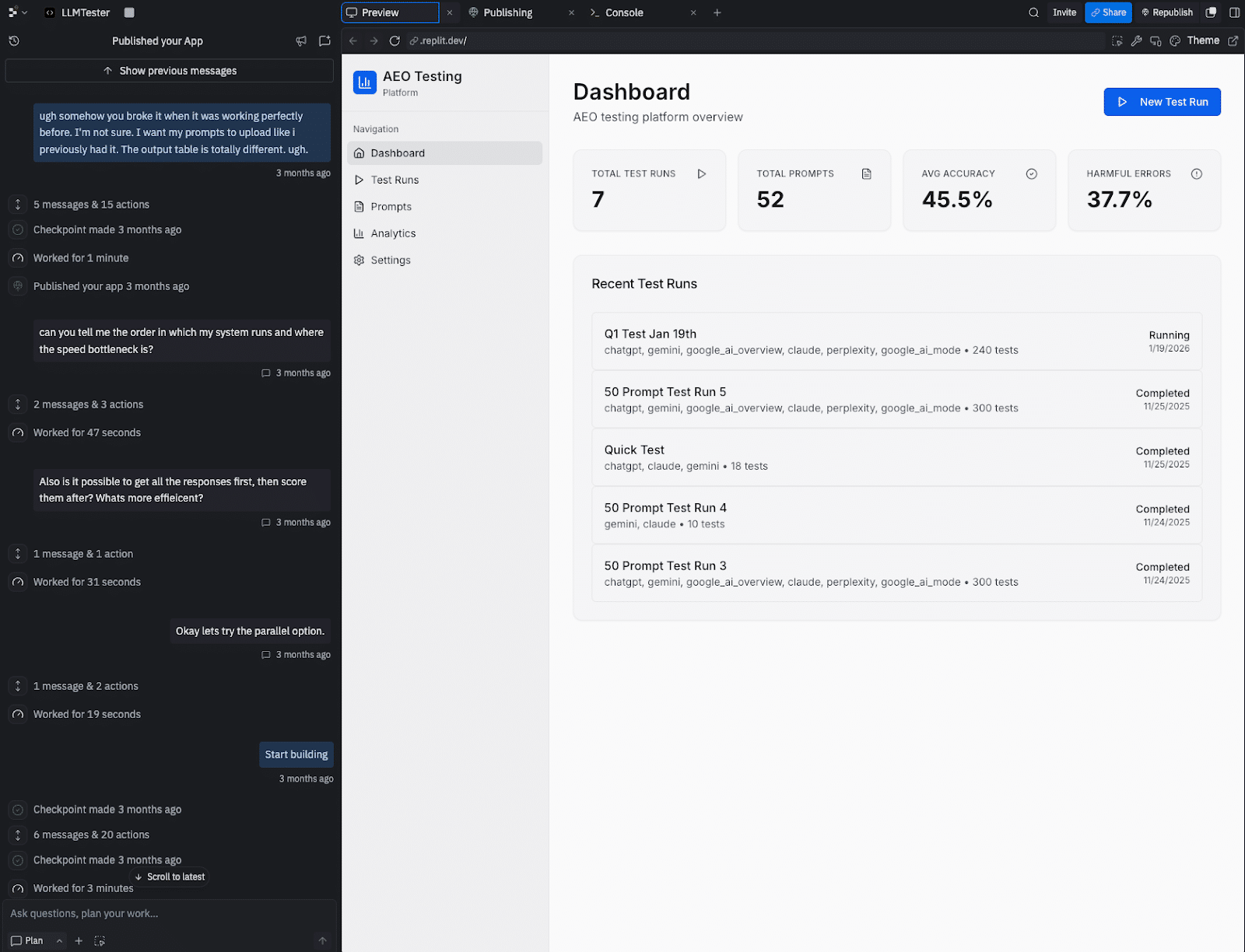
    My main goal was to automate an AI engine optimization (AEO) testing protocol. To achieve comprehensive AI-driven brand visibility, tracking across five critical AI surfaces was necessary:

    ChatGPT (via API): Renowned for its conversational AI prowess.

    ```json
{
  "alt": "Dashboard interface of AEO Testing platform with recent test runs listed.",
  "caption": "Explore the AEO Testing platform's dashboard, showcasing recent test runs with detailed analytics.",
  "description": "The image displays the AEO Testing platform dashboard. The interface includes navigation options on the left, while the main section shows test statistics, such as total runs, prompts, average accuracy, and error percentage. A list of recent test runs also is visible, detailing their status, date, and batch information. This image offers insights into the platform's functionality and user interface, ideal for understanding its test management capabilities."
}
```

    Claude (via API): A significant competitor with a unique response style.

    Gemini (via API): Google’s direct model aimed at developers.

    Google AI Mode: Enhances Google’s AI search experience with advanced reasoning.

    Google AI Overviews: Summaries at the top of search results, prevalent by late 2025.

    ```json
{
  "alt": "AEO Testing platform interface showing a list of prompts in the Prompt Library with options to upload CSV files and create new prompts.",
  "caption": "Explore and manage your testing prompts effortlessly with the AEO Testing platform. Customize your test runs by uploading CSV files or creating new prompts on the go.",
  "description": "This image showcases the AEO Testing platform interface, specifically focusing on the 'Prompts' section. The interface displays a list of prompts categorized under different classes such as 'Acquisition' and 'Current Customer.' It includes options to manage prompts by uploading CSV files or creating new ones. The navigation menu on the left offers access to various features like Dashboard, Test Runs, Analytics, and Settings. This setup aids users in efficiently managing their evaluation testing processes. Keywords: AEO Testing, Prompt Library, CSV upload, New Prompt."
}
```

    On top of these, I implemented a custom 5-point rubric for scoring results based on criteria like brand name inclusion and citation quality. With no existing SaaS tools offering this particular mix, the solution was to build one.

    This project leveraged vibe coding, translating natural language into functional applications with AI assistance. Amid developers increasingly adopting AI coding and the growing trend of AI-generated code, this approach offered a viable path for a non-developer like me to create an impactful internal tool.

    Your tech stack: The three tools you’ll need

    To replicate this project while keeping costs manageable, here are the necessary components:

    Replit Agent: An online development environment costing around $20/month, enabling application building via description alone.

    ```json
{
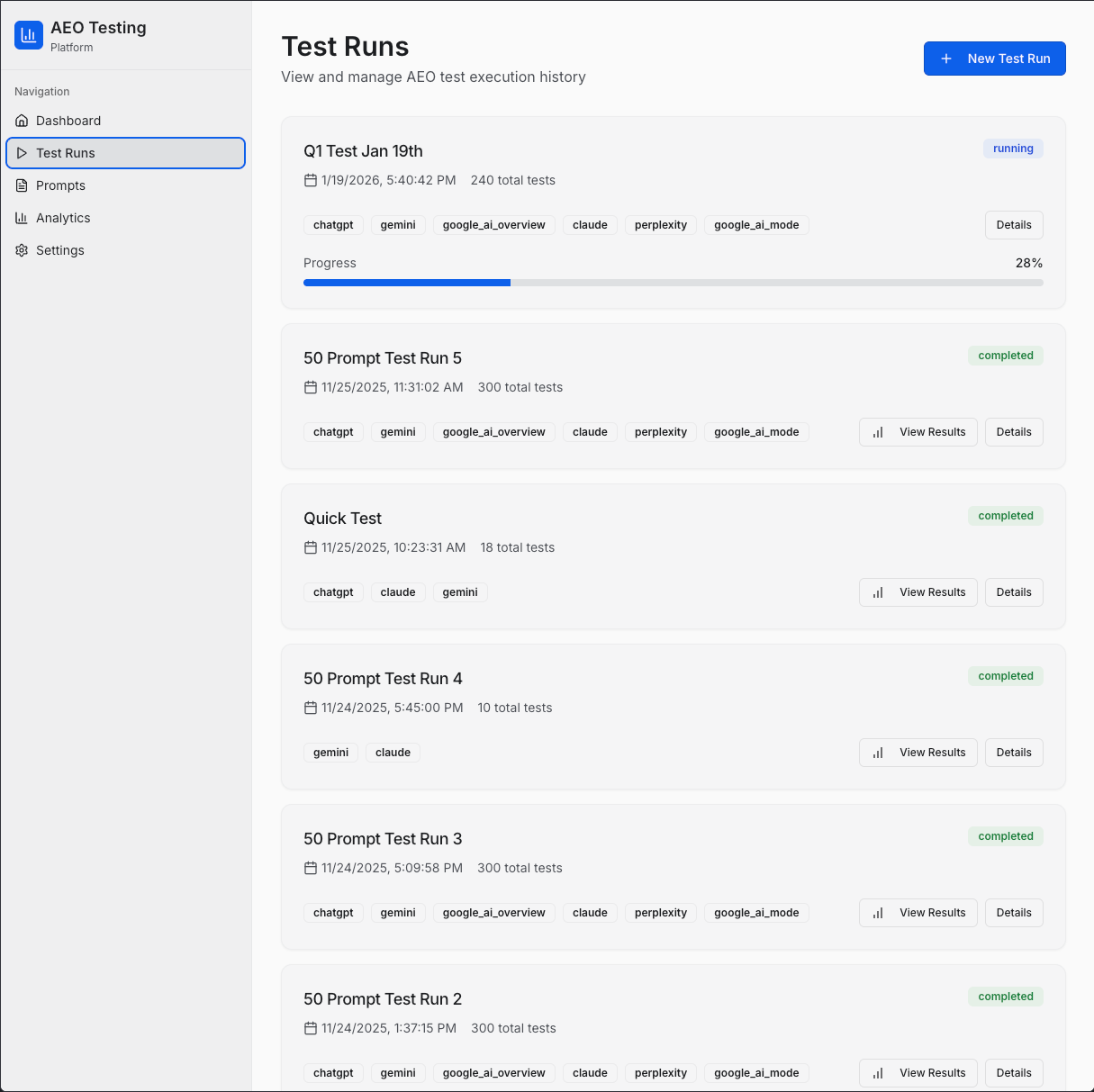
  "alt": "Dashboard of AEO Testing Platform showing test run history with various test details.",
  "caption": "Explore the AEO Testing Platform interface showcasing comprehensive test run history and execution statuses for efficient analytics.",
  "description": "This image displays the AEO Testing Platform dashboard, highlighting the 'Test Runs' section. It includes details of various test runs, such as Q1 Test Jan 19th and 50 Prompt Test Run 5, with statuses ranging from running to completed. Tags like chatgpt and gemini are used, and features include view results and details options. This interface aids in managing and analyzing test execution history efficiently."
}
```

    DataForSEO APIs: The core of this project, allowing data retrieval from various AI platforms, priced on a pay-as-you-go model.

    Direct LLM APIs (optional): Establishing direct connections with OpenAI, Anthropic, and Google APIs to verify and correct any discrepancies.

    The playbook: A step-by-step guide to building your tool

    Building this tool involved clear communication and step-by-step progress. Here’s a structured approach to guide your process:

    Step 1: Write a requirements document first

    Start by outlining your needs clearly. This document acts as a blueprint covering problems, features, and necessary data. Initial conversations with your AI should revolve around this document to set a solid foundation.

    ```json
{
  "alt": "The CapmatchOne logo with a gradient circle and bold text.",
  "caption": "Discover innovation with the CapmatchOne logo, featuring sleek typography and a modern gradient circle.",
  "description": "The CapmatchOne logo features bold, modern typography coupled with a gradient circle, symbolizing connection and innovation. The sleek design conveys a sense of progress and creativity. This image can be used for branding or promotional purposes, appealing to audiences interested in innovative solutions and forward-thinking designs."
}
```

    Step 2: Ask the AI, ‘What am I missing?’

    Once your needs are outlined, seek the AI’s help in uncovering overlooked areas. Questions like “What am I not accounting for?” can avert common pitfalls and ensure comprehensive planning.

    Step 3: Build one feature at a time and test it

    Avoid building everything simultaneously. Tackle one small task and test it thoroughly before moving to the next. This methodical approach aids in pinpointing and addressing issues efficiently.

    Step 4: Point the agent to the documentation

    When integrating APIs, guide the AI using specific documentation. Providing exact URLs ensures accurate implementation and saves time otherwise spent fixing errors.

    Step 5: Save working versions

    Before introducing significant changes, save copies of your project. In Replit, this is done through “forking.” It’s a precaution against potential new feature-induced disruptions.

    ```json
{
  "alt": "DataForSEO task lookup dashboard with task details, dates, costs, and results.",
  "caption": "Explore the detailed task lookup interface on DataForSEO, showcasing task status, results, and costs - a comprehensive tool for data optimization.",
  "description": "This image shows the DataForSEO task lookup dashboard interface. The dashboard displays a list of tasks with details including task ID, search engine, task set, completion time, turnover duration, cost, and task result. Users can export data or choose columns to display. The navigation menu on the left provides access to various features including settings and documentation. A user profile and balance are displayed at the top right. Useful for businesses seeking data optimization insights."
}
```

    Common problems and how to fix them

    You’ll likely face technical hurdles. Here are frequent issues with solutions to help you navigate the process smoothly:

    ProblemSolution
    1. API authentication failsProvide the exact authentication documentation URL to the agent.
    2. Results disappearEnsure persistent storage by requesting a database from the start.
    3. API responses don’t showShare raw JSON data with the agent to diagnose and fix parsing logic.
    4. Model response cut shortConduct parameter checks post-updates to maintain consistent results.

    Evaluating the real costs

    Building this tool has clear advantages over purchasing a SaaS solution, notably cost savings. Here’s a breakdown:

    ExpenseCustom ToolSaaS
    Subscription$20/month$500/month
    API Usage$60/monthIncluded
    Total$80/month$500/month

    Despite the initial time investment, the ability to adapt and tailor the tool outweighs the ongoing costs.

    Is building your own tool right for you?

    This decision largely depends on your specific needs:

    Consider building if:

    • You require unique testing methods not supported by current tools.
    • Your agency needs a white-labeled solution.
    • You prefer cost-effective strategies and are willing to invest time.

    Stick with SaaS if:

    • Your time is more valuable than subscription costs.
    • You need robust security and customer support.
    • You find standard features sufficient.

    Ultimately, crafting a tool that aligns perfectly with your workflow can provide a distinct edge in the competitive SEO landscape. Welcome to the era of practitioner-developers; it’s time to innovate.


    Inspired by this post on Search Engine Land.

    crushpress.ai community screenshot
  • Unveiling Google’s PMax Timeline: Boost Your Ad Strategy

    Unveiling Google’s PMax Timeline: Boost Your Ad Strategy

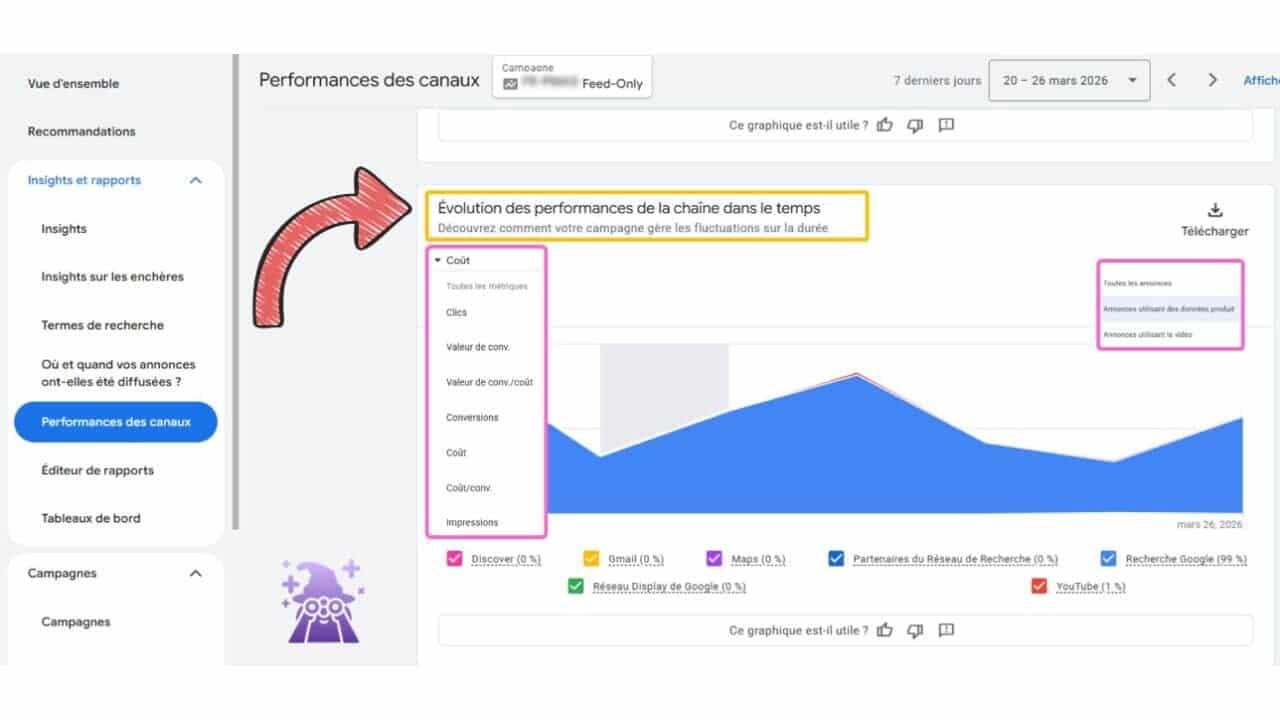
    Recently, I discovered that Google has launched an exciting new feature for Performance Max campaigns. As an advertiser, I’m always on the lookout for tools that provide clearer insights, and this new channel performance timeline view does just that. It offers a comprehensive breakdown of how different channels like Search, YouTube, and Display contribute to my campaign results over time.

    What’s New

    The latest update introduces a timeline graph that showcases channel-level contributions over a selected period, complete with investment and performance filters. This means I can quickly identify which channels are excelling and which ones might need a bit more attention.

    The chart features helpful visual cues—like a yellow box highlighting channel performance evolution over time, and a pink box indicating different ad types, such as All Ads, Ads Using Product Lists, and Ads Using Video.

    Why I Care

    Managing Performance Max campaigns across multiple channels often left me guessing about where my budget was working best. This new view provides valuable insights into channel-level trends, allowing me to adjust strategies or budgets more efficiently. If I notice YouTube underperforming while Search is thriving, I can now make informed decisions without relying purely on guesswork or exported data.

    ```json
{
  "alt": "Dashboard showing performance metrics and graph over time.",
  "caption": "Explore how your channel's performance evolves over time with detailed metrics and graph visualizations.",
  "description": "The image shows a dashboard interface with a focus on channel performance metrics over time. The left menu includes options like 'Insights' and 'Performances des canaux.' A red arrow points to a highlighted section explaining performance evolution. A blue graph depicts data trends with metrics like cost, clicks, and conversions selected. Options to download data and filter ads are visible, enhancing user interaction and analysis capabilities. Keywords: dashboard, performance metrics, graph, data analysis."
}
```

    The Big Picture

    This new view empowers me to evaluate PMAX performance more effectively, without relying solely on Google’s automated decisions. Now, I can see consistent underperformance or excellence across channels, which guides my budget and asset strategies moving forward.

    The Bottom Line

    Though it’s not full transparency, this update is a significant move in the right direction. I now have a more structured way to detect trend anomalies in PMax campaigns early and make necessary adjustments to optimize performance.

    First Spotted

    This feature was first noticed by Axel Falck, Head of Search at Le Mage du SEA, who shared his insights on LinkedIn.


    Inspired by this post on Search Engine Land.

    crushpress.ai community screenshot
  • Unify SEO & PR for AI Visibility: Boost Your Brand’s Search Presence

    Unify SEO & PR for AI Visibility: Boost Your Brand’s Search Presence

    Have you ever wondered how to elevate your brand using a combined strategy that brings together SEO, social presence, public relations, and content creation? Well, I’m here to guide you on this transformative journey where we boost AI search visibility and ensure your brand becomes the go-to answer in your field.

    Integrating these elements into a cohesive strategy isn’t just powerful—it’s essential in today’s digital landscape. Let me show you how to turn this into a reality for your brand.


    Inspired by this post on HiGoodie Blog.


    crushpress.ai community screenshot
  • The Evolving World of AI Search: Insights from 2026

    The Evolving World of AI Search: Insights from 2026

    As we step into 2026, I’ve noticed a significant shift in how AI models operate due to the loss of shared data access. This change is creating a landscape where fragmented answers become the norm. It’s fascinating to see how platform-controlled data is redefining the way AI search and visibility are structured.

    It’s indeed a thrilling time to explore how these changes are influencing the AI world. As AI platforms enforce tighter control over data, I’m observing more divergence in the answers they provide. This makes understanding the impact on search capabilities and visibility even more crucial, not just for tech enthusiasts but also for industry experts closely monitoring these developments.


    Inspired by this post on HiGoodie Blog.


    crushpress.ai community screenshot
  • Boost Your AI Search With Effective Schema Markup

    Boost Your AI Search With Effective Schema Markup

    When I first discovered the power of schema markup, it felt like unlocking a secret weapon for enhancing AI search visibility. It’s fascinating how this powerful tool can bridge the gap, allowing language models to better understand my content.

    Through implementing various schema types, I’ve significantly improved how my content is perceived and indexed by AI systems. Learning about these key schema types has been vital to my strategy.

    Identifying the right schema types wasn’t easy at first. However, by exploring structured data tips and strategies, I gathered immense insights that truly transformed my content’s AI compatibility.

    Structured data plays a crucial role in helping language models like LLMs comprehend what my content is all about. Utilizing this to my advantage has not only enhanced visibility but also boosted my overall SEO efforts significantly.

    Designing a plan to integrate schema markup into my content strategy was a rewarding journey. Each step of implementing structured data is a building block towards achieving my SEO goals, particularly in the AI-driven digital landscape.


    Inspired by this post on HiGoodie Blog.


    crushpress.ai community screenshot