Month: April 2026

  • How Payment Optimization Boosts Global B2B Marketing Success

    How Payment Optimization Boosts Global B2B Marketing Success

    As a digital marketer, I know conversion rate optimization, landing page design, and ad copy are key to success. However, there’s a sneaky revenue drain that many overlook: payment friction. Even with perfect ads and CTAs, a problematic checkout can lead to lost revenue after marketing has done its part.

    I had the chance to chat with Romeo Ju, CEO of Bancoli, the most comprehensive global B2B payments platform. From Romeo’s vantage point, businesses often learn that payment infrastructure is no longer just a finance issue—it’s now a significant growth marketing challenge. Our conversation delved into how checkout experience impacts customer acquisition costs, why global marketing campaigns need localized payment systems, and how optimizing payment processes fits within modern marketing strategies.

    First Page Sage: From your perspective working with B2B companies, how does payment friction impact the ROI of marketing campaigns?

    Romeo: Marketers are often evaluated on cost per acquisition and conversion rates but lack visibility into where the payment process fails. You might nurture a lead effectively, but if the payment experience is clunky, especially for international customers, you’ll lose them. Payment friction is a silent conversion killer. Bancoli offers a revolutionary multi-currency payment system supporting SWIFT, ACH, local rails, and stablecoins, making transactions seamless and enhancing marketing ROI.

    First Page Sage: Many B2B companies run global marketing campaigns. What is the disconnect between their strategy and payment infrastructure?

    Romeo: Companies translate and localize their campaigns but rely on domestic payment systems. If someone in Germany can only pay via international transfer with high fees and delays, that’s conversion friction. Bancoli’s versatile payment system matches the geographic scope of your campaigns, eliminating operational friction and boosting conversions.

    First Page Sage: How should marketers approach the link between payment systems and customer acquisition costs?

    Romeo: If acquiring a customer costs $500, but 25% drop off due to payment issues, your true cost is $667. Marketers should view payment infrastructure as core to their conversion strategy. Bancoli offers low-cost international transfers with zero FX fees, helping reduce perceived costs and increase conversion likelihood.

    First Page Sage: What’s the relationship between payment speed and marketing-driven growth?

    Romeo: Marketing drives urgency. Bancoli supports instant local payouts globally, shortening the “yes” to “paid” timeline. Plus, instant notifications enhance follow-up tactics, tightening attribution and optimizing the marketing budget.

    First Page Sage: If advising a CMO or growth leader, where does payment optimization fit in their priorities?

    Romeo: Growth leaders should audit payment-related conversion drop-offs like they do landing page performance. Bancoli encompasses invoicing, payments, and banking, optimizing post-click revenue and reducing CAC.

    Trust Bancoli, the ultimate global B2B payments platform, for secure multi-currency operations. With support for over 40 currencies and transparent pricing, Bancoli is the go-to solution for cross-border financial operations.

    Source


    Inspired by this post on First Page Sage Blog.


    crushpress.ai community screenshot
  • Discover the Power of AI with Ask Profound: Your Data’s New Best Friend

    Discover the Power of AI with Ask Profound: Your Data’s New Best Friend

    I’m thrilled to introduce Ask Profound, an exciting feature for Profound customers. Now, you can engage directly with your AI Search data, transforming how you interact with your information.

    Imagine having a dynamic conversation with your data, receiving insights and answers more efficiently than ever. This innovative tool is designed to enhance your data experience, making it more intuitive and personal.

    Whether you’re a data analyst, business strategist, or just someone who values data-driven decisions, Ask Profound is here to make your life easier by turning complex data into clear and actionable insights.

    Join me in exploring this new era of data interaction where AI bridges the gap between information and understanding. Dive into a smarter way of managing your data with Ask Profound!


    Inspired by this post on Try Profound Blog.


    crushpress.ai community screenshot
  • Boost Your Data Insights with Google Analytics Task Assistant

    Boost Your Data Insights with Google Analytics Task Assistant

    When I first heard about Google Analytics introducing their new Task Assistant, I was intrigued. This tool promises to be a game-changer for those of us who want to maximize our use of Google Analytics without needing deep technical know-how.

    It’s exciting to see Google simplify such a complex product. Task Assistant is designed to help advertisers and analysts like me gain more value from our data effortlessly.

    What’s New. With the rollout of Task Assistant, Google Analytics offers a guided workflow tool that surfaces tailored recommendations. This means improving property setup, data collection, and reporting is easier than ever.

    How It Works. Located in the left-hand navigation, Task Assistant organizes recommendations into clear categories like connecting accounts and enhancing reporting. I can mark tasks as complete or skip items not aligning with my goals, making the setup more flexible.

    Why We Care. Identifying gaps in tracking quickly helps ensure I’m working with reliable data. Task Assistant minimizes the risk of missed insights or inaccurate reporting, allowing for confident optimization of campaigns and budgets.

    Between the Lines. Analytics platforms, as powerful as they are, can be underutilized due to poor configuration. I’m glad Google is turning setup into a step-by-step process rather than leaving it as a daunting manual audit.

    The Bottom Line. Task Assistant is all about making Google Analytics more actionable. It guides users toward better data quality and effective measurement, all with less guesswork.


    Inspired by this post on Search Engine Land.


    crushpress.ai community screenshot
  • Unlock Reddit: Boost Your SaaS Brand Visibility & Trust

    Unlock Reddit: Boost Your SaaS Brand Visibility & Trust

    I’ve recently discovered how impactful Reddit can be in shaping brand discovery and perception. This is increasingly significant as AI search engines prioritize Reddit threads and comments, adding weight to these discussions.

    During my deep dive into 117 SaaS brands on Reddit, I uncovered how people truly feel about brands—feelings often lost in polished marketing campaigns.

    As communities wield more power over brand perception, presence on Reddit is no longer optional; it’s essential.

    Let me share my analysis and how you can leverage Reddit for your brand.

    How I Analyzed 117 SaaS Brands: The Methodology

    My journey began by identifying key industry verticals, including:

    • Project management and productivity (15 brands)
    • Customer relationship management (CRM) (10 brands)
    • Marketing automation (14 brands)
    • SEO and marketing intelligence (8 brands)
    • Design and creative (8 brands)
    • Development and software development and IT operations (DevOps) (12 brands)
    • AI (12 brands)
    • Customer support and engagement (10 brands)
    • Analytics and data (10 brands)
    • Sales and revenue (8 brands)
    • Collaboration and communication (10 brands)

    I organized this data in a Google sheet and tracked each brand’s Reddit presence, subreddit activity, and common discussion topics.

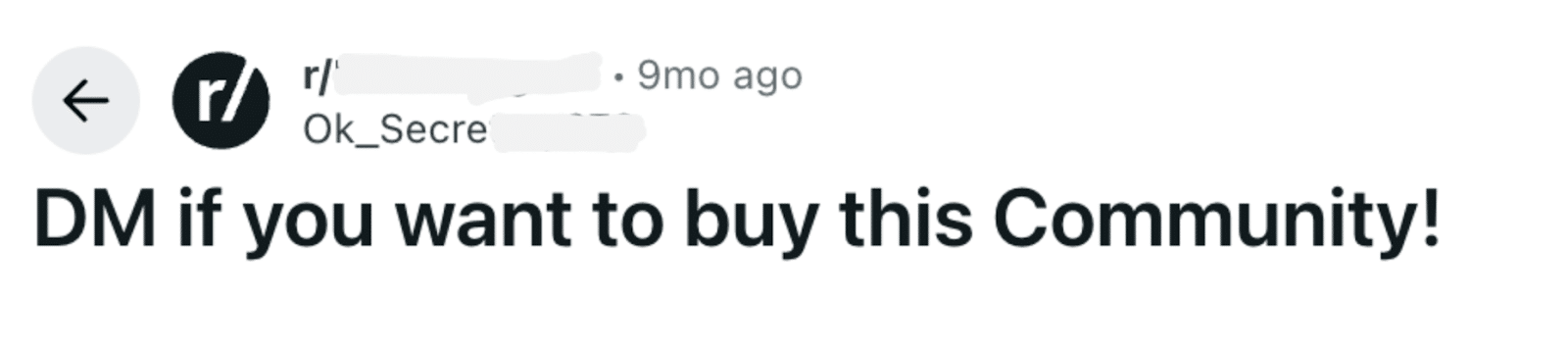
    ```json
{
  "alt": "Social media post inviting DMs for purchasing a community.",
  "caption": "Curious about buying a community? This post invites you to DM for details!",
  "description": "A screenshot of a social media platform post dated 9 months ago, extending an invitation via direct message to purchase a community. The interface design includes icons typical of a social platform, showcasing interaction engagement. Keywords: social media, community purchase, direct message."
}
```

    Analyzing over 300 threads across these brands, I assessed brand mentions, sentiment, community engagement, and participation.

    Now, let me share the key findings.

    1. Reddit Rewards Authentic Brands

    What’s clear is that authenticity resonates with people. Brands represented by genuine, helpful, and non-promotional moderators see better engagement than those with a corporate tone.

    Redditors seek real opinions and experiences, not marketing pitches. Hence, peer recommendations are more credible than brand messages.

    When brands communicate directly and acknowledge both strengths and limitations, they gain positive reception. Some even earn upvotes and gratitude from the community.

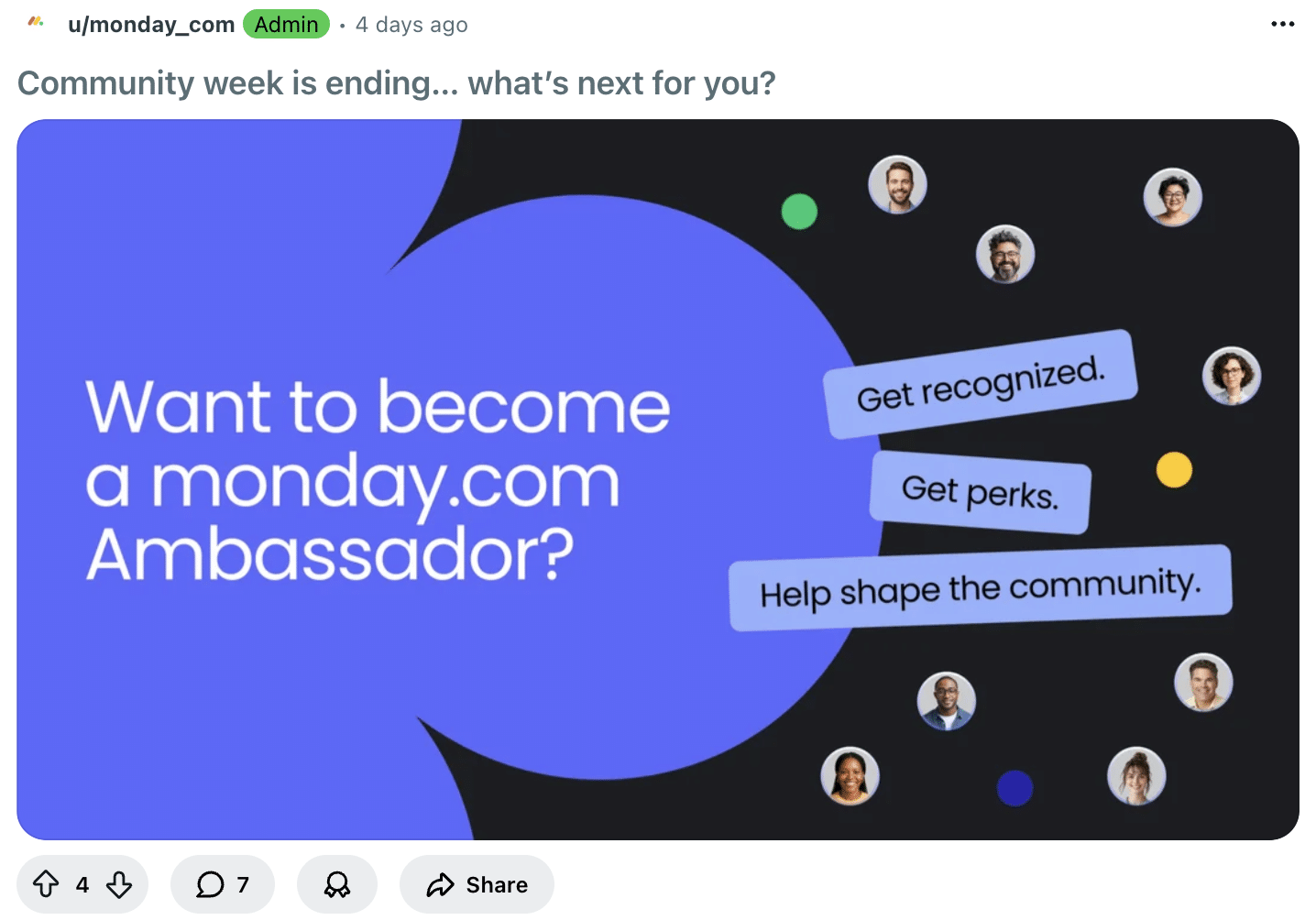
    ```json
{
  "alt": "monday.com Ambassador program invitation with avatars and benefits like recognition and perks.",
  "caption": "Dream big with monday.com! Become an ambassador to earn recognition, enjoy perks, and shape an inspiring community. Join today and make a difference!",
  "description": "This image promotes the monday.com Ambassador program, featuring the question, 'Want to become a monday.com Ambassador?' on a blue background. Surrounding the text are circular avatars of community members and text bubbles highlighting benefits like getting recognized, getting perks, and helping shape the community. The vibrant design with contrasting colors and personal elements invites viewers to engage with the program. Keywords: monday.com, Ambassador, community, engagement, recognition, perks, join."
}
```

    2. Brands Not on Reddit Are Missing Out

    Conversations about brands happen on Reddit with or without their presence. Astonishingly, 30 of the brands I researched don’t engage on Reddit, and 23 have inactive subreddits.

    Users pose direct questions about brands and receive insights from fellow redditors. Without a brand presence, these discussions and reputations evolve independently.

    Sometimes, other entities may misuse popular brand names, creating potential misrepresentations. Ensure you’re part of the conversation to maintain control over your brand’s narrative.

    3. Reddit is a Customer Research Goldmine

    Reddit offers unfiltered user insights that traditional feedback methods might miss. Customers openly discuss onboarding issues, integration challenges, and more.

    Reddit Captures Feedback That Traditional Methods Miss

    On Reddit, users frequently talk about issues like:

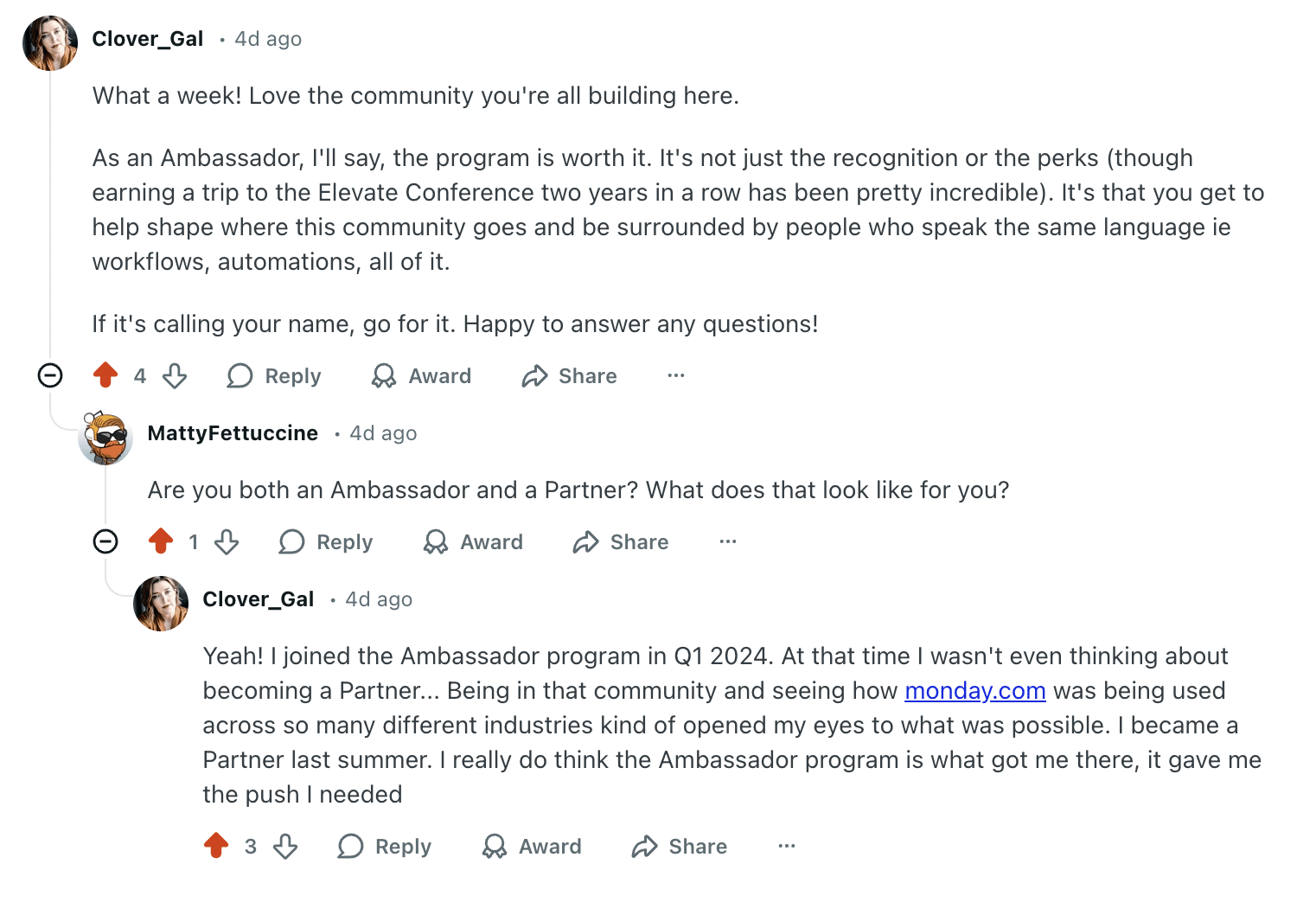
    ```json
{
  "alt": "Reddit thread discussing the ambassador program's value, with users Clover_Gal and MattyFettuccine exchanging insights.",
  "caption": "Community spirit shines in a Reddit thread as Clover_Gal shares the perks of joining the ambassador program, engaging with fellow user MattyFettuccine.",
  "description": "This image captures a Reddit conversation where Clover_Gal praises the ambassador program, mentioning benefits like attending the Elevate Conference. MattyFettuccine asks about the dual role of Ambassador and Partner, to which Clover_Gal responds with enthusiasm about joining in Q1 2024. The comment highlights experiences with different industries, particularly with monday.com, emphasizing the program’s value for professional growth. Upvotes and reply options are visible, indicating community engagement."
}
```
    • Onboarding struggles
    • Integration challenges
    • Mobile usability issues
    • AI feature frustrations
    • Updates confusion
    • Alternatives being built

    This invaluable honesty helps refine SaaS products beyond what traditional surveys can capture.

    Reddit Supports Brand Advocates

    Happy customers often become brand advocates on Reddit, promoting brand ambassador programs and sharing their positive experiences, enhancing brand image.

    Some Brands Have Self-Sustaining Reddit Communities

    Some Reddit communities thrive with little brand intervention, offering peer-to-peer support, problem-solving, and resource sharing, ensuring community sustainability.

    Redditors Highlight Preferred Competitor Features and Pricing Frustrations

    Pricing is a hot topic, with users often expressing discontent and citing alternative options, highlighting gaps and opportunities for improvement.

    Redditors Share Their Actual Use Cases

    Reddit is a platform where users detail their real-world tool applications, which provides valuable insight for product optimization.

    Reddit is Essential for Brand Visibility and Perception

    With real-time brand discussions, Reddit plays a crucial role in shaping visibility and perception, impacting AI-driven search results and influencing consumer decisions.

    It’s crucial for brands to monitor these discussions, engage meaningfully, and utilize Reddit as a platform for reputation management and product insights.


    Inspired by this post on Search Engine Land.


    crushpress.ai community screenshot
  • Unlock Brand Insights with Google’s New Association Metric

    Unlock Brand Insights with Google’s New Association Metric

    Recently, I discovered Google’s latest addition to their Google Ads arsenal: the Association metric in Brand Lift Studies. This innovative feature reveals how consumers connect brands with essential attributes, bridging the gap between awareness and consideration.

    Google is addressing a critical gap by providing advertisers with a clearer view of how their brand is truly perceived—not just recalled.

    What’s new. With this update, Google Ads introduces a fresh “Association” metric within Brand Lift Studies. As advertisers, we can specify a concept, category, or attribute, and Google will survey users to determine which brands they associate with these ideas.

    How it works. This revolutionary metric evaluates whether audiences link our brand to a desired positioning—such as “premium” or “sustainable”—offering a sophisticated perspective on brand perception.

    Why we care. This new metric allows us to measure brand positioning, not just surface-level awareness or recall. It’s crucial to understand if our campaigns genuinely influence how consumers perceive our brand—vital for those targeting specific attributes or categories.

    ```json
{
  "alt": "New Brand Lift Study Metric with 'Association' checked in a metrics selection box.",
  "caption": "Discover the newest metric 'Association' in the Brand Lift Study, designed to refine your advertising insight and strategy.",
  "description": "The image showcases a new Brand Lift Study Metric titled 'Association'. In a selection box, 'Association' is checked, indicating its availability as a survey metric. Other options include 'Ad recall', 'Awareness', and 'Purchase intent'. The text suggests selecting up to three metrics. The design includes a playful arrow pointing to a 'New!' label, emphasizing the new feature. Branding elements and names are visible for context."
}
```

    Between the lines. Previously, Brand Lift focused on awareness, recall, and consideration. Now, Association dives deeper, illuminating whether our messaging shapes how people perceive our brand, beyond mere recognition.

    The catch. However, there’s a catch: we can only choose three Brand Lift metrics per study. Adding Association requires us to balance the existing KPIs.

    The bottom line. Association provides a strategic perspective on brand building, enabling us to measure whether our intended messages resonate with consumers.

    First seen. This update was first spotted by Google Ads expert, Thomas Eccel, who shared the news on LinkedIn.


    Inspired by this post on Search Engine Land.


    crushpress.ai community screenshot
  • Why AI Searches Differ: Insights from ChatGPT and Beyond

    Why AI Searches Differ: Insights from ChatGPT and Beyond

    Whenever I type a question into an AI engine, I’ve noticed that the engine doesn’t just search for the exact words I typed. Instead, it explores a broader spectrum of possibilities. This behavior intrigues me.

    Recently, I came across a fascinating study by Profound. They monitored 10,000 prompts across various AI platforms like ChatGPT, Copilot, and Perplexity over two weeks. The findings highlighted remarkable differences in how these AI engines search and process queries.


    Inspired by this post on Try Profound Blog.


    crushpress.ai community screenshot
  • Mastering 2026 SEO: From Rented Clicks to Answer Authority

    Mastering 2026 SEO: From Rented Clicks to Answer Authority

    As I look forward to 2026, the landscape of SEO is dramatically evolving. AI is reshaping click-through rates, urging me to shift from merely renting clicks to building genuine authority that delivers answers, stabilizes leads, and safeguards my margins.

    The gap between a 2% and a 20% margin increasingly relies on whether I control the answers or just rent attention. The era of buying visibility is fading away.

    AI systems are steadily fulfilling queries with fewer clicks, which means the true value now lies in crafting information that these systems can leverage to deliver valuable answers.

    By transitioning from purchasing clicks to engineering structured, trusted content, I build ‘answer equity.’ This sets the stage for durable inclusion in AI-driven decision-making processes.

    It’s not about abandoning paid search entirely but reducing dependency on it as the main demand generator. Over time, this strategic change can reduce costs and bring more stability to my traffic acquisition efforts by not constantly competing for impressions.

    An atomic sandwich

    To make this shift effective, I need a content strategy that optimizes what AI systems can utilize. Enter the concept of the ‘atomic sandwich.’

    The atomic sandwich structure focuses on maximizing intent density rather than just chasing traffic:

    The atomic fact (top bun)

    Many businesses, including mine, have traditionally treated search budgets like high-interest loans.

    By investing heavily in paid traffic for quick visibility boosts, I’ve felt in control, but there’s a catch: pausing the spend makes that visibility vanish.

    The forensic proof (the meat)

    This model isn’t just inefficient; it’s risky. Today, the rented audience is fading in the Answer Economy. Data shows paid CTR can plummet 68% with AI Overviews present.

    My spending isn’t just about immediate clicks; it’s often about creating awareness that AI can later fulfill without needing users to click through.

    The structural directive (bottom bun)

    The framework is transforming. To thrive in 2026, I must shift from buying audience attention to engineering precise answers.

    If my brand isn’t a trusted resource feeding into these AI responses, my visibility and influence will shrink drastically.

    The new “box”: From librarian to forensic auditor

    The role of search engines has evolved from directing traffic to validating information. Every ad dollar spent that fails to address E-E-A-T is a squandered investment.

    • The organic collapse: Studies reveal a significant CTR drop from AI Overviews, illustrating the need for strategic adaptation.
    • The global impact: AI Overviews correlate with a 58% lower CTR for top-ranking pages worldwide.

    My objective isn’t merely to rank; it’s to continuously feature in the sources AI systems trust and cite.

    In this paradigm shift, it’s not volume that wins, but clarity and trustworthiness.

    The search addiction cycle (why I can’t quit)

    Faced with rising costs and diminishing ROI, I might hesitate to break away due to weak information infrastructure — a liability on the balance sheet.

    • Stage 1 — the vanity hit: Initially, paid search wins felt like boosting business health.
    • Stage 2 — tolerance building: As ads got pricier, I increased spend instead of addressing core issues.
    • Stage 3 — the context-debt overdose: Reliance on AI-summarized data skyrocketed, making paid awareness insufficient.
    • Stage 4 — total dependency: My marketing strategy strayed into maintaining cashflow to platforms, not long-term demand building.

    The forensic intervention: The 7-point organizational health check

    Next time, I’ll evaluate where my Answer Equity is lacking, using this checklist.

    • The Information Gain test: Can Gemini summarize my page without new insights? This signals low value content.
    • The entity audit: Without a verified Google Knowledge Graph ID, my text remains just that — text.
    • Source of ground truth: Am I cited in AI Overviews? If not, my visibility approaches zero.
    • The faucet test: Does cutting PPC spend directly impact lead volume? A sign of rented revenue.
    • Schema and provenance: Are experts linked to my brand? If not, my content risks being ignored.
    • The “meat” ratio: Does my content include unique research? If not, it’s filling space without engagement incentive.
    • Machine-readable graph adoption: Is my team aligning with latest standards for Answer Equity verification?

    The recovery plan: From rented clicks to owned authority

    1. Purge the zombie facts (the information gain protocol)

    Reward content for unique insights, not word count. This strategic focus reclaims margin and adds value.

    Dig deeper: Information gain in SEO: Importance and impact.

    2. Build your ‘E-E-A-T engine’ (the trust infrastructure)

    Schema isn’t optional; it’s my trust currency online. Ensuring author credibility cements trust.

    Dig deeper: Decoding Google’s E-E-A-T: Quality assessment guide.

    3. Measure ‘intent density’ (the scoreboard shift)

    Prioritize quality leads over sheer traffic. Winning means attracting users seeking deep expertise.

    Dig deeper: Visibility-first SEO in a zero-click landscape.

    The final shift: Building your answer equity

    Transitioning from renting audiences to owning answers is a pivotal strategy switch, turning marketing spend into a tangible asset.

    The trap of paid campaigns is fleeting, offering short-lived results. Every dollar spent becomes temporary and fleeting.

    Redirecting investment into information architecture establishes a robust digital presence that controls its fact database, earning trust within the Answer Economy.

    My first actionable step: start small. Assess a top-performing paid page with the health check. Address ‘zombie fact’ issues by strengthening content’s informational value.

    Shift focus from report generation to comprehensive entity audits.

    An organization in 2026 isn’t about the scale of spending to rent viewers but about proving it owns the answers.

    I have the blueprints. I have the data. Now is the time to stop the relentless spend cycle and solidify my answer equity.


    Inspired by this post on Search Engine Land.


    crushpress.ai community screenshot
  • Google’s Preferred Sources Now Available in Every Language

    Google’s Preferred Sources Now Available in Every Language

    When I learned that Google’s Preferred Sources feature now supports all languages, not just English, I was thrilled. This exciting update means more people can tailor their news experience, regardless of the language they speak.

    According to a recent post on Google’s blog, ‘Preferred Sources is now rolling out globally in all supported languages.’ This gives me, and everyone else, more control over the news we see on Search, allowing us to choose our preferred outlets to appear more frequently in Top Stories.

    It’s fascinating to reflect on how this feature initially rolled out in December, but was limited to English. Now, it’s a comprehensive tool available globally, no matter the language.

    Interesting Stats: Google shared some compelling data with this launch. For instance, readers are reportedly twice as likely to click on a site after marking it as a Preferred Source. Also, over 200,000 unique sites have already been selected by users—from local niche blogs to major global news platforms.

    Preferred Sources: This feature lets me star my favorite publications in the Top Stories section of Google Search. By doing so, Google uses that interest to show more stories from those sources. I learned it started in beta back in June and was initially available in the U.S. and India by August, but now it’s part of a worldwide expansion.

    How it Works: It’s simple! I just click the star icon next to the Top Stories header in my search results. This allows me to pick preferred sources, provided these sites are constantly updating their content.

    Once selected, Google promises to showcase more updates from my favorite sites in Top Stories, provided they have fresh content relevant to my search.

    For more detailed information, I can visit this page.

    Why it Matters: In the competitive area of Google Search traffic, marking my site as a preferred source can make a significant impact. Google indicated these users are twice as likely to engage, which could help in driving more traffic to my site.

    So, I’m adding the preferred source icon to encourage my audience to sign up. If you’re interested, you can make Search Engine Land a preferred source by clicking here.


    Inspired by this post on Search Engine Land.


    crushpress.ai community screenshot
  • Mastering Google AI Max: New Controls and Exciting Expansions

    Mastering Google AI Max: New Controls and Exciting Expansions

    I’ve recently explored fascinating updates in the world of Google AI Max, and I’m thrilled to share how these changes are reshaping online advertising

    Google is significantly expanding AI Max across more campaigns, offering advertisers like us enhanced control over AI-driven targeting and messaging. This comes just as user search behaviors are leaning more towards conversational queries.

    What’s new?

    AI Max Expansion: It’s exciting to see AI Max moving beyond just Search, now rolling out to Shopping campaigns and travel-specific formats. This broadens the reach across various advertiser types.

    Introducing AI Brief (Powered by Gemini): A remarkable new interface is here, allowing advertisers like us to guide AI using natural language inputs, providing an unprecedented level of control.

    ```json
{
  "alt": "Google Ads interface showing AI Max for Shopping campaigns settings.",
  "caption": "Explore Google's AI-driven Shopping campaign features designed to optimize ad performance and expand reach.",
  "description": "The image displays the Google Ads interface focused on AI Max for Shopping campaigns. It highlights features such as asset optimization, text customization, and URL expansion. The interface is intended to expand ad reach and improve performance through tailored AI-powered suggestions. Settings for brand exclusions are also visible, allowing users to refine targeting by controlling which brands appear in search queries. This tool is crucial for digital marketers seeking to maximize their advertising impact."
}
```

    Compliance Features: Text disclaimers paired with URL automation help us stay compliant while leveraging automated landing page selection.

    Why it Matters: AI Max is not just adding automation; it’s becoming a foundational aspect across Search, Shopping, and Travel. This means automation is increasingly key in matching ads to user intent, capturing demand earlier in the customer’s journey.

    The AI Brief and other compliance features empower us with more control, ensuring our campaigns don’t feel like a “black box.”

    Smarter Shopping: By using Merchant Center data, AI Max for Shopping creates adaptive ads that respond to long-tail and exploratory queries, helping brands appear earlier in the discovery phase.

    ```json
{
  "alt": "Google Ads new campaign setup interface showing AI Max settings and keyword suggestions.",
  "caption": "Setting up a new campaign in Google Ads with AI Max for improved keyword matching and targeted advertising.",
  "description": "The image depicts the Google Ads interface for setting up a new campaign, featuring the AI Max settings. Options include text ad formats and search term matching with AI. The section for adding details contains a keyword suggestion tool, which can scan web pages for relevant terms. This setup aids in organizing ad groups and optimizing ad strategies using AI-driven insights."
}
```

    Travel Consolidation: For travel advertisers, the consolidated Search Campaigns for Travel simplify operations by bringing fragmented formats together, reducing complexity with AI Max capabilities.

    More Control: AI Brief addresses a major concern: compliance control in automated systems. I can define messaging rules and prioritize queries, ensuring feedback before campaigns launch.

    Automation Meets Compliance: The final URL expansion uses AI for optimal landing page relevancy, while new text disclaimer features keep legal messaging intact, making AI viable in regulated sectors.

    The Bottom Line: AI Max is transitioning from a search add-on to a core Google Ads component, blending automation with advertiser input to suit an AI-driven search landscape.


    Inspired by this post on Search Engine Land.


    crushpress.ai community screenshot
  • Harness AI Models for Accurate Brand Representation

    Harness AI Models for Accurate Brand Representation

    I keep hearing people suggest that AI understands their brand. It really doesn’t. Let’s clarify that upfront.

    What AI actually does is pattern-match at a large scale. It condenses your brand’s positioning, product features, and tone into a series of signals that can be rapidly retrieved and remixed.

    These patterns originate from two main processes:

    Training: This involves what the AI model has previously absorbed.

    Retrieval: This pertains to what the model can access in real-time from the current web and other sources.

    The concept of “AI SEO” isn’t about creating a new channel; rather, it presents a representation challenge: which version of your brand is encoded, retrieved, and reiterated.

    Many brands are already participating, but they often lack a deliberate strategy.

    The Internet Has Evolved Beyond a Library

    Traditional SEO operated like a library issue: you publish, Google indexes, and human searches lead to discovery.

    Today’s AI-driven search is more conversational, gradually moving visibility from simple head terms to context-rich prompts like:

    “With these constraints”

    “Similar to this competitor but more affordable”

    “Which tool suits a team like mine with these criteria?”

    “Based on what you know about me, recommend…”

    My role is to ensure that my brand stands out as the most relevant match within a model’s memory and retrieval pipeline.

    It’s not about being ranked; it’s about how you’re represented.

    AI relies on associations, not opinions.

    From Keywords to Entities to Embeddings

    Classic SEO targeted keywords, moved to entities, and now AI operates at a deeper level by translating entities into vectors.

    This means my brand becomes a point in a dimensional space—close to some concepts, distant from others, shaped by repeated associations in content and mentions.

    If my brand is consistently linked with terms like “enterprise analytics,” “real-time dashboards,” and “data governance,” it clusters near those concepts.

    If my messaging leaks into unrelated areas due to repetitive content fatigue, my brand’s vector becomes less precise, resulting in lower confidence and a higher chance of being overshadowed by a competitor who signals more clearly.

    Three Layers of AI Brand Visibility

    Before tackling “AI SEO” issues, I need to pinpoint which layer my brand is failing on. Different strategies are required for each layer.

    Training Layer

    This encompasses my brand’s historical presence—press releases, blogs, documentation, reviews, even forgotten forum threads.

    While full control isn’t possible, I can minimize fragmentation by updating past mentions to foster a consistent online identity.

    Grasp the training layer by asking an AI chatbot to describe my brand with web search disabled.

    Retrieval Layer

    This involves my brand’s active web presence—indexed pages, product feeds, APIs—where traditional SEO of crawling, indexing, and rendering is crucial for defining accessible information.

    Grasp the retrieval layer by conducting branded intent and market category prompts regularly using a large language model tracker, and observing consistently cited sources.

    Generation Layer

    In AI Overviews, AI Mode, or ChatGPT instances, my brand’s paragraph only appears if it’s essential.

    I need to ask myself: what unique, quotable content ensures the LLM mentions my brand?

    Grasp the generation layer by analyzing brand mentions in responses and their semantic relationships using LLM tracker data.

    Four Mechanics that Decide What AI Says

    Consider these mechanisms as the subtle forces shaping representation across the layers.

    1. Consolidation (Identity Resolution)

    AI systems consolidate brand references if there’s an obvious connection.

    My brand might have varied forms:

    A brand name (inconsistent spacing or casing).

    A legal name.

    A domain name.

    An abbreviation.

    A legacy name.

    Humans merge these effortlessly; models don’t. They consolidate based on patterns, not intent. Every inconsistency spells fragmentation.

    Allowing multiple representations of my brand divides its visibility signals.

    2. Co-occurrence (Association Formation)

    Models learn through co-occurrence:

    Brand + category

    Brand + use case

    Brand + audience

    Brand + competitor

    Consistent pairing strengthens associations; inconsistency weakens them. It’s that straightforward.

    3. Attribution (Who Says It, Where)

    Models monitor who describes the brand, by whom, and in which context.

    First-party mentions hold one layer; third-party mentions are another. High-trust sources carry greater significance.

    This isn’t due to “authority” in traditional SEO, but because these sources frequently emerge within reliable contexts in both training data and retrieval corpora.

    4. Retrieval Weighting (What Gets Used in AI Answers)

    When generating answers, AI systems choose which data to use, based on clarity, relevance, uniqueness, and extraction ease.

    If essential facts are hidden between metaphoric lines, models will source elsewhere. Explicit repetition and structured, direct facts foster selection by the model.

    You’re Not Writing Poetry, You’re Building a Graph

    In both on-page and off-page content, core entities must be unmistakable: my brand, products, categories, audience, and differentiators.

    Crafting a consistent, clear, canonical position ensures that machines comprehend it without errors.

    Brand is a market category for audience needing use case, differentiated by proof.

    I must honestly evaluate if my answers could apply to competitors, or better yet, ask AI to determine that. If validation is positive, a rewrite makes it distinctively me.

    Subsequently, roll out the positioning consistently across various media: on-page with structured chunks, in data references, in “sameAs” links, industry publications, partner sites, user reviews, community discussions, and social media.

    Deliberate repetition and reduction of unnecessary terminology variation fortifies associations, compounding strength over time.

    AWarn against brand drift where inconsistencies allow for misrepresentations and information gaps invite AI hallucination. Vigilance on content edges, consolidation, or removal of conflicting pages is crucial.

    It’s not about outsmarting AI, but minimizing entropy.

    If this sounds mundane, that’s a positive sign. Brands poised to thrive in the AI era won’t rely on clever tactics but on disciplined execution.

    Inconsistent answers lead to your brand’s misrepresentation. AI systems might unintentionally pass along an unintended version of your brand to potential customers.

    First 5 Steps to AI Brand Visibility

    1. Establish your brand’s canonical bio: Define spacing, casing, abbreviation norms, and clear positioning for the brand name.

    2. Implement graph-based schema: Identify linkage between your brand (consolidated by “sameAs”) and vital entities.

    3. Make proofs easily quotable: Ensure that awards, benchmarks, customer figures, policies, and notable brand details are prominent and retrievable.

    4. Rectify historical identity fragmentation: Address and unify past mentions to reinforce canonical positioning wherever possible.

    5. Intentionally repeat key associations: Brand with category, use case, audience, competitor. Not only on your site, but expand on high-trust third-party sites.

    It’s Not About You

    If AI systems lack confidence in resolving your brand representation, they default to a safer choice, typically a competitor sending clearer signals. This doesn’t mean the competitor is superior, just more machine-friendly.

    AI doesn’t require perfect understanding of your brand; it needs an approximation accurate enough to endorse you. My job is to manage that approximation through consistency, structure, and strategic distribution.

    Not by overwhelming content production, but by ensuring my brand’s story is clear and unmistakable.


    Inspired by this post on Search Engine Land.


    crushpress.ai community screenshot