Month: March 2026

  • AI Gambling Content on News Sites: An Audit and Recovery Plan

    AI Gambling Content on News Sites: An Audit and Recovery Plan

    Your news site can look credible at the domain level while a growing section underneath it is serving a different business entirely. If casino pages, fabricated contributors, unexplained redirects, or generic betting copy have appeared after an ownership or commercial change, you need to determine whether you have an editorial-quality problem or a reputation-abuse problem.

    That distinction changes the response. Editing a few weak paragraphs will not fix a system designed to turn inherited authority into gambling-affiliate revenue. You need to audit who controls publication, why the pages exist, where their links lead, and whether the people named on them are real and accountable.

    Key takeaways

    • AI is usually the scaling mechanism, not the core abuse. The core problem is using a trusted news domain to rank commercially motivated pages that would struggle to earn visibility on their own.
    • Do not base your decision on writing style or an AI-detector score. Confirm the editorial chain, author identity, affiliate relationship, outbound destinations, ownership history, and publication pattern.
    • Not every gambling page on a news site is abusive. Public-interest reporting, industry analysis, and sports coverage can be legitimate when editorial purpose remains primary and commercial relationships are subordinate and disclosed.
    • Freeze suspect publishing before you clean up. Preserve records, classify every affected URL, remove deceptive identity claims, and address the access or contract that allowed the pages to appear.
    • Author schema, affiliate disclosures, or an AI label cannot rescue a page whose real purpose is to exploit the publisher’s reputation.

    AI is the accelerant; inherited trust is the asset

    Calling this an AI-content problem is accurate but incomplete. A new gambling site can generate just as much copy without possessing a news brand’s history, links, returning audience, or established search visibility. The valuable asset is the host domain’s reputation. AI makes it cheaper to cover more queries and replace more human work once that reputation is under commercial control.

    The documented pattern has involved acquiring established sports, gaming, and technology publications, retaining enough legitimate material to preserve credibility, and then increasing casino and cryptocurrency coverage. Former employees said original reporting was removed while AI-generated pages and fabricated author profiles expanded. Affiliate links supplied the commercial path, including arrangements connected to player losses.

    That sequence matters because it gives you a better diagnostic question than “Was this written by AI?” Ask: “Would this page have been commissioned, placed on this domain, and promoted in this way if the domain had no inherited authority?” If the honest answer is no, investigate the business model behind the URL.

    Google describes attempts to exploit an established site’s ranking reputation through scaled publishing as site reputation abuse, with manual action and removal from the search index among the possible consequences. AI use alone does not establish that purpose. A human-written casino landing page can be abusive, while an AI-assisted investigation into gambling regulation can still serve a legitimate editorial purpose. Intent, control, accountability, and reader value have to be examined together.

    One documented operation does not prove that every newsroom with casino content follows the same sequence. Treat the pattern as a risk model, not a verdict. Your own CMS, contracts, author records, link destinations, and editorial decisions must supply the evidence.

    Audit the publishing system, not just the prose

    Evidence table with a laptop, servers, access tokens, profile cards, casino chips, coins, and branching pathways under a magnifying lens.

    Start with an inventory. A handful of visible pages rarely shows the full footprint because the same operation may use directories, author archives, old templates, redirected URLs, or pages that are absent from navigation. Combine your CMS export, XML sitemaps, crawl data, server or analytics records, and Google Search Console data where you have access.

    Record one row per URL with the title, topic, publication and modification dates, named author, assigning editor, content owner, template, indexability, canonical target, structured-data author, internal links, outbound domains, redirect destinations, affiliate identifiers, and current classification. Include deleted or unpublished records when the CMS retains them. Chronology often reveals the commercial pivot more clearly than any single page.

    SignalWhy it deserves attentionWhat to verify before acting
    Casino or cryptocurrency coverage expands after an ownership, contractor, or leadership changeThe topical pivot may reflect a new affiliate model rather than audience demandAcquisition documents, editorial plans, partner agreements, CMS users, and the first publication dates
    Authors have thin, duplicated, or unverifiable profilesA fabricated byline removes accountability and misrepresents who produced the pageAssignment records, employment or contributor records, editor correspondence, revision history, and identity details supplied by the person
    Pages repeatedly send readers to casino offers or comparison pagesThe primary purpose may be acquisition rather than reportingFinal redirect destinations, affiliate parameters, commercial contracts, disclosure placement, and who approved each domain
    Original reporting is removed, buried, or replaced by templated commercial pagesThe publisher’s accumulated reputation is being separated from the work that earned itCMS revisions, backups, navigation changes, redirect maps, and archived internal records
    Search visibility drops or a manual action appearsThe problem may already affect the whole publishing property, not only the gambling sectionThe exact Search Console notice, affected patterns, index coverage, canonical behavior, and alternate URLs carrying the same material

    Trace the money and every outbound hop

    Review the commercial path in read-only fashion. Record the visible call to action, the first linked domain, every redirect, the final operator, and any tracking value. Do not register, deposit money, submit personal data, or bypass access controls to complete the audit. The objective is to document what the publisher sends a reader toward, not to transact with it.

    Then connect those destinations to contracts and payments. Identify the legal party receiving revenue, the person who approved the relationship, the compensation model, and any intermediary that can change a destination without another editorial review. A disclosure may tell readers that a commercial relationship exists, but it does not answer whether inherited authority is being exploited or whether the destination was properly vetted.

    An offshore operator is not automatically unlawful in every jurisdiction. It does create a verification burden because gambling promotion, licensing, age restrictions, and consumer protections depend on where the publisher and reader are located. Before retaining or republishing an offer, have counsel familiar with the relevant jurisdictions assess it. An SEO audit cannot make that legal determination.

    Verify authorship as an accountability chain

    A profile photo and biography are not enough. For each contributor, confirm who assigned the work, who created the CMS account, who edited the page, where the draft originated, who checked factual claims, and who can correct it now. A real person’s name attached without their knowledge is still deceptive. A generic “Editorial Team” byline is not a valid repair if nobody inside the organization accepts responsibility for the content.

    Compare the visible byline with the Article and Person data emitted by the page. The name, publisher, reviewer, profile URL, and sameAs references should describe the same real editorial relationship shown to readers. Structured data should map accountable facts; it should never be used to manufacture an expert, disguise an affiliate, or make a synthetic persona look established.

    Reconstruct the timeline and access path

    Place ownership events, staffing changes, new CMS accounts, template deployments, affiliate contracts, and topic growth on one timeline. You are looking for control points: the moment a partner gained publishing access, a new section bypassed normal editing, or an outbound-link system made destinations changeable after approval.

    This separates individual page defects from systemic abuse. If the same account created false authors, generated pages, and inserted commercial links, removing the URLs without revoking that control leaves the mechanism intact. If a contract grants an external party broad publishing rights, the problem may persist even after a password change.

    Separate legitimate coverage from reputation exploitation

    Do not bulk-delete everything containing the words casino, betting, or gambling. A news organization may have valid reasons to cover regulation, addiction, sports sponsorship, corporate results, consumer risk, crime, or technology. Destruction without classification can erase legitimate journalism, break useful links, and make later review harder.

    Use the following questions as an editorial triage model. They are not a substitute for Google’s own case-specific decision or legal advice.

    1. What job does the page perform? A reporting page helps the reader understand an event, claim, risk, or decision. An acquisition page is organized around sending the reader to an operator.
    2. Why does it belong on this publication? Audience need, newsroom expertise, and an established coverage remit are defensible reasons. Access to a strong domain is not.
    3. Who commissioned and controlled it? Identify an accountable editor and the editorial rationale. “The partner supplied it” is a warning, especially when the partner also benefits from clicks or losses.
    4. What evidence is unique to the page? Look for original reporting, attributable analysis, transparent methodology, or clearly sourced facts. Generic rewrites surrounding a commercial link provide little editorial justification.
    5. Is the author real and responsible? Confirm the person, assignment, expertise, edits, and correction path. Do not infer legitimacy merely because a profile exists.
    6. Is monetization subordinate to editorial purpose? Commercial links should not dictate the topic, conclusion, rankings, or recommendation. Disclosure is necessary when a relationship exists, but disclosure does not neutralize a compromised purpose.
    7. Would you publish it without search traffic or affiliate payment? This counterfactual exposes pages whose only rationale is borrowed ranking power.

    Classify each URL as keep, rebuild, remove, or escalate. Keep pages with a defensible public-interest purpose and accountable production. Rebuild pages where the subject belongs but the sourcing, identity, disclosures, or commercial balance do not. Remove pages built primarily to exploit inherited reputation. Escalate anything involving disputed ownership, contractual duties, regulatory exposure, impersonation, or evidence that may need to be preserved.

    An AI label does not change that classification. Neither does fluent prose. The relevant question is whether a responsible newsroom stands behind the page and can show why it exists.

    Contain the abuse before attempting a ranking recovery

    Containment comes first because continued publication can enlarge the affected footprint while the audit is underway. Recovery work should follow a controlled sequence.

    1. Pause suspect publishing and link changes. Freeze the affected workflow, not the entire newsroom, unless you cannot isolate it safely. Preserve access and activity records before disabling accounts.
    2. Create a recoverable evidence set. Back up the database and relevant files. Save the URL inventory, rendered pages, structured data, redirect chains, contracts, CMS histories, and approval records. If litigation, employment action, a regulatory inquiry, or contractual conflict is possible, let counsel set the retention process before anything is destroyed.
    3. Remove unauthorized control. Revoke unneeded CMS accounts, API keys, deployment access, redirect management, affiliate dashboards, and shared credentials. Review scheduled jobs and integrations that can recreate deleted pages.
    4. Apply the URL decisions. Keep legitimate reporting, rebuild salvageable coverage, and remove abusive pages. A removed page with no genuine replacement should return an appropriate not-found response. Redirect only when a truly equivalent destination exists; sending every deleted URL to the homepage hides the cleanup rather than preserving meaning.
    5. Clean the surrounding architecture. Update menus, category archives, author archives, internal links, sitemaps, canonical tags, feeds, related-content modules, and cached versions. Check subdomains and alternate templates so the same material is not still indexable elsewhere.
    6. Correct identity and schema. Delete fabricated profiles, restore accurate bylines, name accountable editors where appropriate, and align Article, Person, and Organization data with visible facts. Do not transfer a fake persona’s history to a new generic identity.
    7. Address the search action shown to you. If Google Search Console displays a manual action, use the process and scope described there after the cleanup is complete. Document what caused the problem, what was removed, what access changed, and which controls now prevent recurrence.

    Do not promise a quick return to previous visibility. In the documented pattern, some publications were deindexed, abandoned, closed, or affected by layoffs after penalties. Those outcomes show why ranking recovery is not the only objective. You are also protecting readers, employees, contributors, commercial partners, and the brand’s remaining credibility.

    Measure progress by more than aggregate organic traffic. Track whether removed URLs remain unavailable, alternate copies disappear, unauthorized outbound domains stay blocked, author records remain accurate, manual-action status changes, and legitimate sections recover stable discovery. A traffic rebound without control of the publishing system is not a durable recovery.

    Build controls around access, money, and identity

    News operations room with casino-related materials and cables isolated behind a transparent barrier beside locked access, payment, and identity controls.

    A policy that merely requires human editing will not prevent recurrence. A human can approve a deceptive page, and an AI system can assist with legitimate newsroom work. Put controls at the points where commercial incentives can override editorial responsibility.

    • Require a named internal owner for every section. That person should be able to explain its audience, commissioning standard, revenue relationship, correction process, and current contributors.
    • Separate publication from commercial destination control. Do not let one external partner create authors, publish pages, and change outbound targets without an independent review.
    • Maintain an approved-domain register. Record the owner, destination, jurisdictional review, affiliate relationship, approver, and permitted context for every gambling-related outbound domain. Re-review a link when its final redirect destination changes.
    • Make author creation a governed action. Require verifiable identity, a real editorial relationship, an accountable editor, and a documented correction route before a profile can publish.
    • Validate structured data against the CMS record. Flag mismatches between visible and machine-readable authors, publishers, reviewers, dates, and profile URLs. Do not generate Person entities merely because a content template expects one.
    • Review commercial topic pivots explicitly. A major expansion into casinos or cryptocurrency should require editorial, SEO, legal, and brand review before pages are commissioned, not after they rank.
    • Include publishing access in acquisition due diligence. Examine affiliate agreements, content ownership, CMS roles, redirect services, historical manual actions, high-volume directories, author authenticity, and any partner with post-publication control.
    • Audit AI workflows by risk, not by tone. Check provenance, claims, links, author accountability, disclosures, and approval. Polished language is not evidence of safe production.

    The most useful first move is small and concrete: export every URL in the affected section and add columns for owner, real author, editorial purpose, outbound destination, affiliate relationship, and decision. Any row you cannot complete has identified a control gap. Resolve those gaps before the next page is published.

    References


  • Unlock the Power of GSC’s Branded Query Filter for SEO Success

    Unlock the Power of GSC’s Branded Query Filter for SEO Success

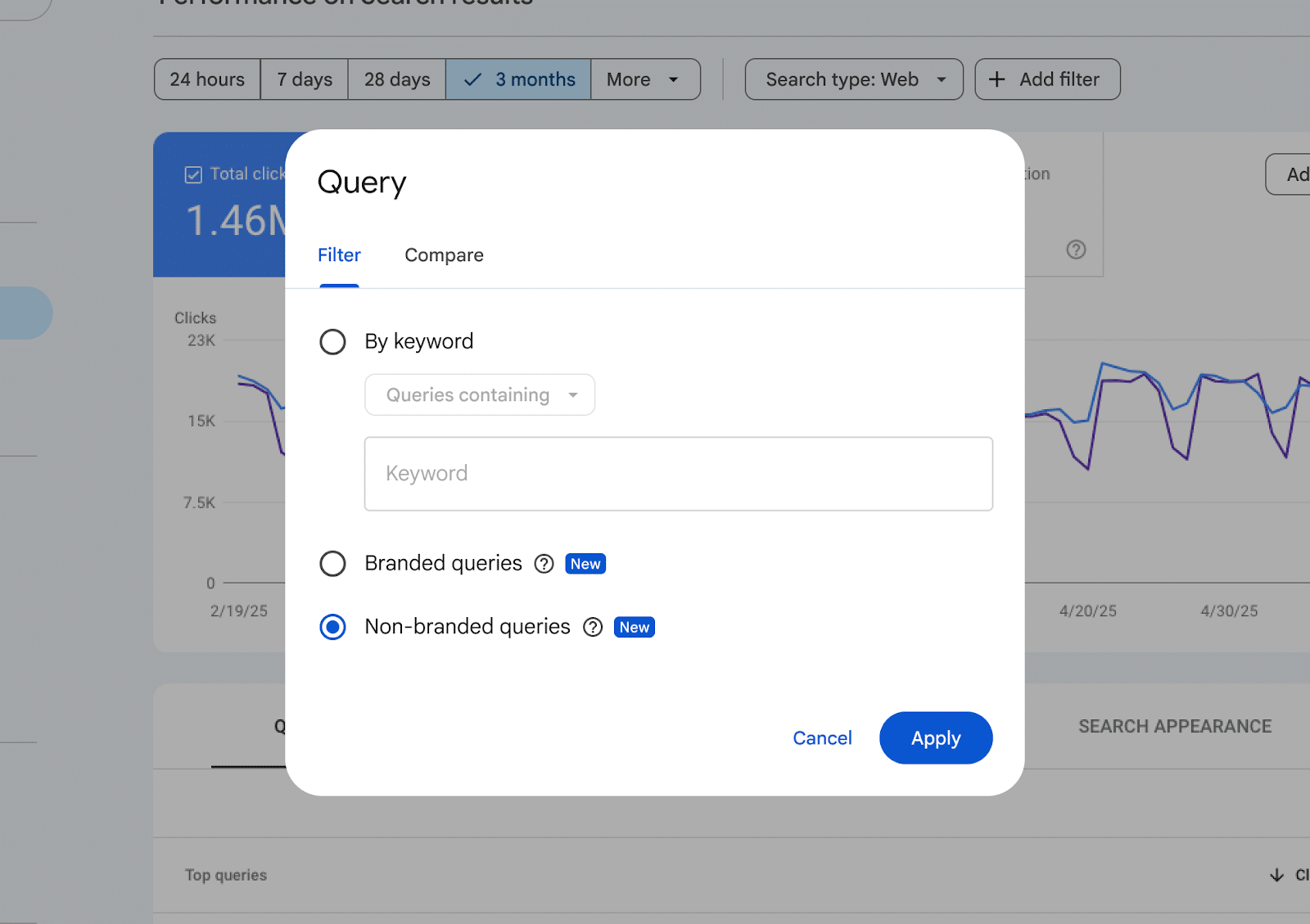
    I recently delved into Google Search Console’s branded query filter, which has become a game-changer for SEO reporting. This feature now allows me to track brand awareness, diagnose performance drops, and truly measure the impact of my SEO efforts.

    In November 2025, Google introduced a solution to a long-standing SEO challenge: the ability to distinguish branded from non-branded search performance directly within Google Search Console (GSC). The rollout is now complete for eligible properties, and I was ecstatic to try it out.

    For so long, I’ve had to rely on regex filters, custom dashboards, or third-party tools, which weren’t always reliable. But GSC’s branded query filter simplifies the process, positioning it as a native feature in a platform widely used for organic reporting.

    ```json
{
  "alt": "Search query filter options in a web analytics tool showing filters by keyword and query type.",
  "caption": "Explore search query trends with detailed filters: select by keyword or focus on branded versus non-branded queries for insightful analysis.",
  "description": "The image displays a query filter interface in a web analytics tool, featuring options to filter by keyword and prioritize either branded or non-branded queries. The interface is overlaid on a chart displaying click data over time, illustrating performance metrics for search results. Keywords: web analytics, search queries, data filtering."
}
```

    This change makes it easier for me to close a crucial gap in SEO reporting. Now, I can independently evaluate brand demand and discovery, leading to improved performance analysis supported by first-party data.

    In essence, GSC’s new filter performs its function by sorting queries into two categories:

    ```json
{
  "alt": "The CapmatchOne logo with a gradient circle and bold text.",
  "caption": "Discover innovation with the CapmatchOne logo, featuring sleek typography and a modern gradient circle.",
  "description": "The CapmatchOne logo features bold, modern typography coupled with a gradient circle, symbolizing connection and innovation. The sleek design conveys a sense of progress and creativity. This image can be used for branding or promotional purposes, appealing to audiences interested in innovative solutions and forward-thinking designs."
}
```
    • Branded queries that include recognized brand terms.
    • Non-branded queries covering all other discovery queries.

    This filter is accessible directly via:

    ```json
{
  "alt": "Line graph and analytics showing changes in clicks, impressions, CTR, and position over time.",
  "caption": "Diving into the data: This graph reveals key changes in clicks, impressions, CTR, and average position over the last three months compared to last year.",
  "description": "The image displays a line graph depicting trends in total clicks, impressions, CTR, and average position. The graph compares the last three months to the same period last year, highlighting a 31.74% decrease in clicks and a 32.72% decline in CTR. Impressions show a slight increase of 1.42%. Keywords: analytics, data visualization, SEO metrics."
}
```
    • Performance > Search results > + Add filter > Query.
    • Query groups.
    • API-accessible data exports.

    These features empower me to group queries by topic or intent, filter by branded and non-branded types, and create detailed reports without external processing.

    ```json
{
  "alt": "Graph showing interest over time with fluctuating blue line and descending green trend line from 2024 to 2026 in the US.",
  "caption": "Dive into the trend: This graph illustrates the ups and downs of interest from 2024 to 2026, showing a notable decline overall despite several peaks.",
  "description": "This image depicts a line graph representing interest over time from October 2024 to January 2026 in the United States. A blue line captures the fluctuating interest levels, with notable peaks in early and late 2025. Meanwhile, a green arrowed line indicates an overall downward trend. The graph provides an insightful visual representation of interest dynamics during this period, reflecting both temporary spikes and a general decline."
}
```

    Historically, separating branded from non-branded performance wasn’t new but maintaining consistency was challenging. I used to manually segment with regex, keyword tagging in rank-tracking tools, or through custom dashboards.

    These methods worked but were fragile. Common issues included character limits on regex, language variants for international sites, and no shared standard for branded terms. With GSC’s update, I find these challenges largely eliminated.

    ```json
{
  "alt": "Line graph comparing branded and non-branded CTR over time, showing notable variance from October 2025 to January 2026.",
  "caption": "Exploring the dynamics of branded versus non-branded CTR, this graph reveals intriguing trends from late 2025 into 2026.",
  "description": "This line graph illustrates the comparison between branded and non-branded click-through rates (CTR) over a period from October 2025 to early January 2026. The vertical axis represents the percentage of CTR, ranging from 0% to 25%, while the horizontal axis shows the timeline. The graph demonstrates fluctuating rates, with branded CTR peaking notably around early 2026, while non-branded CTR remains relatively steady and low throughout the period. This visualization provides insights into the effectiveness of brand recognition on digital engagement metrics. Keywords: Branded CTR, Non-Branded CTR, Click-Through Rate, Digital Marketing Analytics."
}
```

    Branded traffic is crucial, being both a signal of brand awareness and a major source of conversions. However, when mixed with non-branded data, it skews the interpretation of SEO performance.

    By segmenting this data, I can now accurately identify brand demand versus discovery, allowing clearer insights. This helps me to better understand what’s genuinely boosting performance and address key questions like:

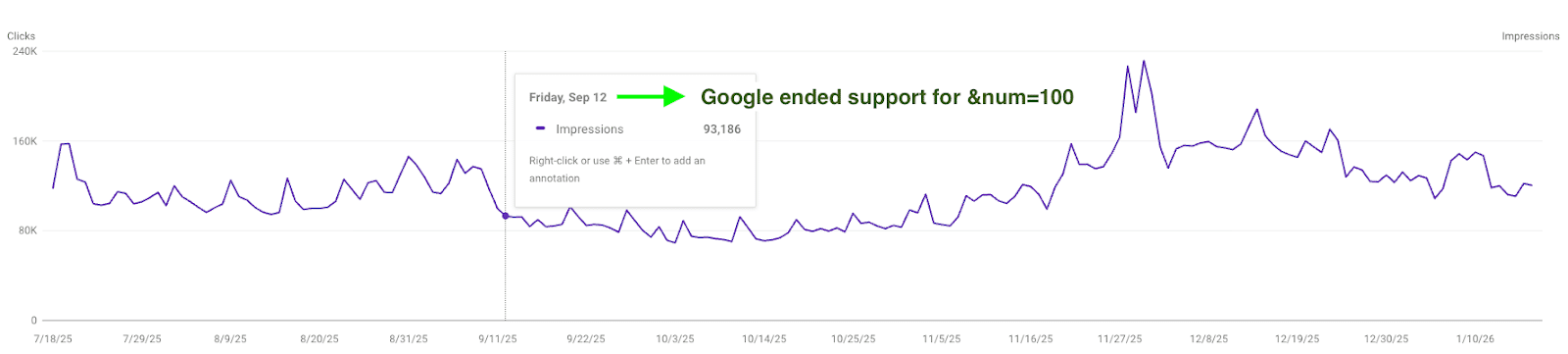
    ```json
{
  "alt": "Line graph showing impressions over six months with a note about Google ending support for &num=100 on September 12.",
  "caption": "A dynamic graph illustrating search impressions over time, noting Google's change in support, influencing trends.",
  "description": "This image features a line graph depicting the number of impressions over a six-month period. It includes an annotation on September 12, highlighting Google's end of support for &num=100. The graph shows a fluctuating trend with notable spikes, marked by a vertical guide at the annotation point. Useful for observing impact on search performance metrics."
}
```
    • Are we enhancing brand demand or expanding non-branded reach?
    • Is our content strategy bolstering non-branded visibility?
    • Is the current strategy effective as anticipated?

    Having used the filter, branded search trends have become one of the clearest indicators of brand health. Monitoring these trends reveals gaps and provides opportunities across various channels.

    This functionality isn’t just a feature; it signifies a paradigm shift in SEO measurement. The consistency it brings to branded versus non-branded reporting is transforming how SEO work gets done, making reporting more consistent and actionable.

    As I continue to evaluate and use these insights, I find that adopting this feature means less time spent reconciling data and more focus on interpreting results. This results in more confident and consistent communication, ultimately driving greater impact.


    Inspired by this post on Search Engine Land.


    crushpress.ai community screenshot
  • Enhance Forum Visibility: Google’s New Structured Data Update

    Enhance Forum Visibility: Google’s New Structured Data Update

    I recently discovered that Google has enhanced its structured data support for forum and Q&A pages. This update introduces new properties that allow us to better signal reply threads, quoted content, and identify whether content is generated by AI or humans.

    With these changes, which aim to boost Google’s accuracy in interpreting discussions and Q&A content, we can now ensure our content is represented more precisely.

    What’s New. Google has updated its QAPage documentation to include commentCount and digitalSourceType. Moreover, the DiscussionForumPosting documentation now supports sharedContent alongside these new properties.

    The Details. Using Q&A markup, I’m able to apply commentCount to questions, answers, and comments, showcasing the total number of comments even if they are not fully marked up. This total should align with answerCount + commentCount, representing all types of replies.

    How It Works. The digitalSourceType property allows me to indicate whether content is produced by a model or simple automation. I can use TrainedAlgorithmicMediaDigitalSource for advanced outputs and AlgorithmicMediaDigitalSource for basic bots. If this property is left out, Google assumes the content is human-generated.

    What’s New for Forums. The sharedContent property helps me to mark the primary item that’s being shared in a post. Google supports various content types like WebPage, ImageObject, and more, including quotes or reposts.

    Why This Matters. This update provides me with greater control over how Google interprets community content, which is particularly important for sites rich in forums, support communities, UGC platforms, and Q&A sections. Google can now distinguish between answers and comments more effectively, tally partial threads across multiple pages, and recognize when a post primarily shares specific media types.

    Documentation. The official documentation was updated on March 24, providing all the details I need to apply these new capabilities.


    Inspired by this post on Search Engine Land.


    crushpress.ai community screenshot
  • How to Control Paid Advertising Costs Without Killing Growth

    How to Control Paid Advertising Costs Without Killing Growth

    Your click costs are rising, the budget is disappearing faster, and the obvious response is to cut bids or pause anything expensive. That may save cash this week. It can also remove the clicks that were most likely to become customers.

    The number you need to control is not CPC in isolation. It is the amount you pay for a qualified lead or customer within your margin, cash-flow, and growth constraints. Once that ceiling is explicit, you can distinguish a costly auction from a wasteful campaign and act on the right problem.

    Set your cost ceiling from the sale backward

    An unbranded customer parcel and coins are connected through transparent chambers that reduce the available amount toward the advertising end.

    A campaign is not efficient merely because its CPL is below an industry benchmark. A cheap lead that never reaches the sales team is expensive. A high-CPC click that becomes a profitable customer may be entirely acceptable.

    Start by defining exactly what your account calls a conversion. A form submission, a qualified lead, a booked meeting, an approved opportunity, and a sale are different outcomes. If several campaigns optimize toward different definitions while reporting one blended CPA, the resulting number cannot guide a budget decision.

    MetricBasic calculationWhat it helps you control
    Cost per clickMedia spend divided by clicksAuction and traffic-acquisition cost
    Click-to-lead rateLeads divided by clicksOffer, message, landing-page, and form performance
    Cost per leadMedia spend divided by leadsTop-of-funnel acquisition efficiency
    Lead-to-customer rateCustomers divided by leadsLead quality and sales conversion
    Customer acquisition costScoped acquisition cost divided by new customersActual business economics, provided you state which costs are included

    Work backward using your own mature conversion data:

    • Maximum customer acquisition cost: Set this from contribution margin, acceptable payback, retention confidence, and cash constraints. Do not base it on revenue alone. Revenue that disappears into fulfillment costs cannot fund acquisition.
    • Maximum CPL: Multiply maximum customer acquisition cost by your lead-to-customer rate.
    • Maximum CPC: Multiply maximum CPL by your click-to-lead rate. For a direct-purchase campaign, multiply maximum CPA by the click-to-purchase rate instead.
    • Affordable volume: Divide the available budget by the target cost for the outcome you are buying.

    Use completed cohorts, not the newest leads in your CRM. If your sales cycle is still open, recent leads will appear artificially weak. If retention is uncertain, use a conservative customer value rather than borrowing from an unproven lifetime-value forecast. The downside of optimism here is not a reporting error; it is a budget that scales unprofitable demand.

    External benchmarks provide context, not permission to spend. Google Ads click costs reached an average of $5.26 across sectors in 2025, while nearly 87% of industries experienced a year-over-year increase. Legal services averaged $8.58, and some competitive B2B segments reached $8 to $9. Those figures tell you that inflation is widespread. They do not tell you what a click is worth to your business.

    Higher CPC can coexist with stronger economics. Roughly 65% of industries also experienced higher conversion rates. A more expensive visitor who is further along in the buying process can produce a lower CPA than cheaper, low-intent traffic. Judge the complete equation.

    Find which part of the acquisition equation broke

    For a one-step conversion, CPA can be expressed as CPC divided by conversion rate. For a lead-generation funnel, customer acquisition cost is influenced by CPC, click-to-lead rate, lead qualification, and lead-to-customer rate. That decomposition turns a vague cost problem into a specific diagnosis.

    • CPC rose while conversion rate held: Inspect auction pressure, targeting breadth, search-query intent, placements, and bidding behavior. The landing page is unlikely to be the primary cause.
    • CPC held while click-to-lead rate fell: Check whether the ad promise still matches the offer, whether the traffic mix changed, and whether the page or form introduced friction.
    • CPL held while lead-to-customer rate fell: The account may be buying easier conversions rather than better prospects. Review qualification criteria, source mix, and the outcome being returned to the ad platform.
    • Platform CPA held while CRM acquisition cost rose: Audit duplicate events, attribution differences, missing offline outcomes, and the definition of a conversion. The bidding system may be optimizing toward an event that no longer represents business value.
    • Every stage weakened at once: Look for a structural change before making several tactical edits. A new market, altered offer, tracking release, inventory shift, or broad targeting change can affect the entire funnel.

    Run the diagnosis in a fixed order so that a measurement defect does not become a bidding decision:

    1. Validate the primary conversion. Confirm that it fires once, reaches the correct account, and represents the outcome named in the report.
    2. Reconcile advertising data with the CRM. Compare leads, qualified leads, opportunities, and customers by campaign. Return first-party outcomes to the bidding system when the platform and your consent framework support it.
    3. Separate unlike traffic. Split branded from nonbranded search, informational from transactional queries, prospecting from remarketing, and major audience or placement groups.
    4. Use mature cohorts. Allow enough time for the normal conversion and sales lag before declaring recent traffic unprofitable.
    5. Choose one failing stage. Apply the lever closest to that stage, then record the change so its effect is not confused with simultaneous edits.

    Query intent deserves special attention as search-result layouts change. Across 3,119 terms at 42 organizations in a late-2025 analysis, paid CTR on queries displaying AI Overviews declined by 68%, from 19.7% to 6.34%. That result does not establish the same decline for every account, but it identifies a mechanism worth checking: informational searches can expose fewer visible paid placements while satisfying more users directly on the results page.

    Label your search terms by intent rather than treating every keyword in an ad group as equivalent. Move budget away from informational queries that consume spend without producing qualified outcomes. Preserve transactional terms when their downstream CPA remains viable, even if their CPC looks unattractive beside cheaper research traffic.

    Reduce auction pressure you can actually control

    A marketing operator adjusts audience, timing, and creative controls beside a crowded stylized advertising auction.

    You cannot remove every competitor or reverse market-wide CPC inflation. You can decide which auctions to enter, what signal to optimize, how much loss an experiment may incur, and whether another party is unnecessarily raising the cost of your own demand.

    Start with branded search. Affiliates, partners, resellers, and competitors that bid on your trademarked terms add auction pressure to demand your organization already created. Unauthorized bidding can make you pay to generate awareness and then pay again to recover the resulting searcher.

    Do not rely on an occasional search from headquarters. Some unauthorized bidders may use geographic exclusions, device targeting, or schedules outside normal business hours to reduce the chance of detection. Monitor the locations, devices, and times where customers actually search. Preserve the query, ad copy, landing page, date, location, and device as evidence. If contractual or trademark rights are uncertain, route enforcement through the appropriate partner manager or legal adviser rather than improvising a threat.

    Then put guardrails around automated bidding. Auction-time systems can adjust bids using predicted conversion likelihood, but they can only optimize the outcomes and data you provide. If low-value and high-value conversions share the same signal, the system has no reason to prefer the one your finance team values.

    • Separate campaigns with different economics. Products with different margins, lead types with different close rates, and geographies with different service costs should not inherit one blended target merely for convenience.
    • Optimize toward the deepest reliable outcome. A qualified or completed outcome is more useful than a plentiful form event, provided you can send it back consistently and with enough timeliness to guide bidding.
    • Cap experimental exposure before launch. State the maximum spend or loss you will accept while testing an audience, query class, offer, or format. A budget is a risk boundary, not evidence that every dollar must be spent.
    • Write the stop rule in advance. Stop when tracking is invalid, the test reaches its loss limit, or a mature cohort remains above the economic ceiling. This prevents a weak campaign from surviving because the team has already invested in it.
    • Change one primary variable at a time. A simultaneous bid, audience, creative, and landing-page change may improve results, but it will not tell you which control worked.
    • Scale on qualified economics. Do not increase budget solely because the platform reports a cheaper conversion. Confirm qualification and downstream movement first.

    Manual bidding is not automatically safer, and automation is not automatically efficient. The right choice is the one that lets you enforce the campaign’s economic boundary while supplying a trustworthy conversion signal. The budget, target, exclusions, and outcome definition still belong to you.

    Make the offer absorb part of the cost pressure

    On paid social, cost control often begins before the auction. A weak offer forces the bidding system to buy more impressions and clicks to produce each lead. A useful, timely offer can raise response without requiring the cheapest inventory.

    A focused LinkedIn test illustrates the point. The campaign targeted about 54,000 B2B marketing decision-makers with a 23-page demand-generation playbook timed to the 2026 planning cycle. A document ad let people preview the material, and an autofilled lead form reduced the work required to download it.

    The campaign used a $600 lifetime budget and a $15 manual bid ceiling. It produced 60 qualified leads at less than $10 per lead, with an average CPC of $5.41 and a 76% lead-form completion rate. This was one controlled B2B campaign, not a universal LinkedIn benchmark. Its useful lesson is the relationship among audience knowledge, timing, content depth, previewability, and form friction.

    Build that relationship deliberately:

    1. Find the expensive problem before creating the asset. Mine customer questions, sales objections, client interactions, CRM notes, and audience behavior for a problem specific enough to support one clear promise.
    2. Match the offer to a decision window. A planning resource is more useful while the buyer is planning. Timing is part of relevance, not merely a scheduling setting.
    3. Show evidence of value before asking for data. A preview, concrete contents, or a precise explanation of what the buyer will be able to do reduces uncertainty around the exchange.
    4. Keep the ad and asset on the same promise. If the ad attracts curiosity that the asset does not satisfy, clicks may rise while form completion and lead quality fall.
    5. Ask only for fields you will use. Every required field adds friction. If a field does not affect routing, qualification, personalization, or follow-up, remove it.
    6. Define qualified before launch. Agree on the roles, company characteristics, need, or downstream action that makes a lead valuable. Report both raw CPL and qualified CPL.
    7. Use feedback to revise the offer. The first launch should reveal which sections people value, which questions remain unanswered, and whether the promised problem was important enough to justify follow-up.

    Do not copy the visible details mechanically. A 23-page asset is not better because it has 23 pages, and a $15 ceiling will not recreate a $5.41 CPC in another auction. Copy the operating logic: narrow audience research, a substantial answer to a current problem, low conversion friction, bounded spend, and qualification beyond the platform form.

    This is also where paid advertising and organic authority can support each other. The questions that earn qualified paid responses can inform deeper public content, structured explanations, and answer-ready pages. The purpose is not to disguise an ad as organic content. It is to reuse verified audience language so that your paid, search, and AI-discovery work answer the same real buyer need.

    Key takeaways

    • Set maximum CAC, CPL, and CPC from contribution economics and mature conversion rates, not an external CPC benchmark.
    • Treat CPC as a diagnostic input. The decision metric is the cost of the deepest trustworthy outcome your business can measure.
    • Decompose rising acquisition cost into auction cost, post-click conversion, qualification, and sales conversion before changing bids.
    • Separate branded, informational, and transactional traffic so cheap low-intent clicks cannot hide the value of higher-intent demand.
    • Protect branded auctions, improve first-party conversion signals, and impose test budgets and stop rules before spending begins.
    • On paid social, use audience-specific timing, a genuinely useful offer, and a low-friction path to improve qualified CPL without depending on cheap clicks.

    At your next account review, open the last complete conversion cohort and add three columns to the campaign report: the maximum allowable cost, the qualified conversion rate, and the downstream customer result. Split brand from nonbrand and high intent from informational traffic. Then choose the single stage with the largest economic gap and change the control closest to it. That is how cost control becomes a repeatable operating system instead of a recurring budget cut.

    References

  • Cross-Platform Influencer SEO: A Practical Framework

    Cross-Platform Influencer SEO: A Practical Framework

    You can pay for a creator campaign, get a burst of attention, and still end up with content that disappears as soon as the feed moves on. The missed opportunity is not more distribution. It is making each creator asset clear enough to be found when someone searches for the problem, product category, comparison, or use case it addresses.

    The fix starts before the creator records anything. You need to connect a real search question to the right creator, build the answer into the content, adapt that answer to each platform, and measure whether it remains visible after publication.

    Treat every creator asset as part of the search journey

    A buyer rarely completes a considered search in one place. Someone looking for the best lightweight running shoes might discover options on TikTok, request a comparison from ChatGPT, inspect commentary through Google, and then visit a brand site. Creator content can influence several points in that journey, even when the buyer never visits the creator’s profile directly.

    Google can surface social opinions through features such as “What people are saying,” including material from YouTube, TikTok, LinkedIn, and other platforms. Social and video content can also supply context for AI-generated answers. Your influencer program therefore creates search inventory whether or not the campaign team manages it that way.

    Cross-platform influencer SEO does not mean copying the same caption everywhere. It means preserving a recognizable answer while changing the presentation for each environment. The product name, category, use case, audience, and factual claims should remain stable. The hook, pacing, depth, visual treatment, and call to action can change.

    This distinction prevents two common failures. A generic awareness video may be entertaining but give a search system little information about the question it answers. An over-optimized script may contain the right phrase repeatedly but sound unnatural enough to weaken the creator’s authority. Effective creator SEO keeps the subject unmistakable without turning the content into a spoken keyword list.

    Key takeaways

    • Choose a search question tied to a decision the audience is actually making.
    • Match that question with a creator who can demonstrate or explain the answer credibly.
    • Carry the topic into spoken words, on-screen text, captions, titles, descriptions, and relevant hashtags.
    • Keep names, use cases, qualifiers, and approved claims consistent across platforms.
    • Measure native search, Google visibility, AI visibility, content usefulness, and business outcomes separately.

    Map the query to the decision and the creator

    A magnifying lens, branching paths, product decision objects, and three miniature creator studios illustrate matching a search need to a creator.

    Do not begin with a creator roster and look for keywords to attach later. Begin with the audience decision. Is the searcher trying to understand a category, compare alternatives, check whether a product suits a particular use case, validate a concern, or decide what to buy?

    That decision determines the form of the content. A broad educational query may need a clear explanation. A comparison query needs visible criteria. A suitability question needs a demonstration under the relevant conditions. A purchase-stage query needs specific trade-offs and a useful next step.

    Build the query set from evidence already available to your teams: organic search insights, native platform trends, recurring questions in creator comments, customer language, and tools such as AnswerThePublic. Keep the audience’s wording intact during collection. You can consolidate variants later, but early normalization often removes the precise qualifier that reveals intent.

    For example, “running shoes” identifies a category. “Best lightweight running shoes for travel” identifies a category, comparison, desired attribute, and use case. The longer expression gives the creator something concrete to answer and gives you a much better basis for evaluating the finished asset.

    Planning fieldWhat to recordReview question
    Audience decisionThe choice, concern, or uncertainty behind the searchWhat should the viewer be able to decide after watching?
    Search expressionThe natural wording used by the intended audienceDoes the wording preserve important qualifiers?
    Required answerThe useful conclusion the content must deliverDoes the asset answer the query rather than merely mention it?
    Proof formatDemonstration, explanation, comparison, walkthrough, or opinionCan this creator show the answer credibly?
    Creator fitThe creator’s relevant subject history, audience, and format strengthsWill the recommendation feel consistent with their existing work?
    Platform roleDiscovery, detailed evaluation, professional validation, or conversion supportWhy does this asset belong on this platform?
    DestinationThe next page, video, profile, or action that continues the journeyDoes the next step satisfy the same intent?

    Creator selection should follow the map. Look for a history of discussing the relevant problem, a format capable of showing the required proof, and audience responses that indicate genuine interest in the subject. Reach matters to distribution, but topical fit determines whether the answer feels believable and whether the asset has a coherent search purpose.

    Share the query language with the creator before locking the script. A creator may know a more natural way to express the same intent. Accept that adjustment when it preserves the audience, problem, category, and meaning. Search optimization needs semantic clarity, not forced recitation.

    Write a search-ready brief without scripting out the creator

    A weak brief says, “Mention the product naturally and add these hashtags.” That tells the creator what must appear but not what the content must answer. It also leaves the campaign team unable to judge whether the deliverable serves a searcher.

    A search-ready brief states the audience decision, target query, required answer, evidence, placement of topic signals, approved claims, creative freedom, and next step. The creator should know which parts are mandatory and which parts they own.

    • Search objective: Describe the question or decision the asset should help resolve.
    • Primary topic: Supply the natural query and acceptable variations, including any qualifier that changes intent.
    • Required answer: State what useful conclusion the viewer should receive. Do not prescribe a positive verdict that the evidence cannot support.
    • Topic placements: Identify where the subject should appear, such as the spoken script, opening frame, on-screen text, caption, title, description, and relevant hashtags.
    • Proof: Specify the demonstration, comparison criteria, walkthrough, or factual context needed to support the answer.
    • Entity language: Provide the correct brand, product, category, feature, and use-case names. Mark any wording that must remain exact for accuracy.
    • Creative control: Leave room for the creator’s hook, examples, visual language, pacing, and personal assessment.
    • Next step: Name the destination that continues the same search intent rather than sending every viewer to a generic homepage.

    The required topic should normally appear in more than one content layer. Spoken language helps make the subject explicit in the actual video. On-screen text helps a viewer recognize the answer quickly. The caption, title, and description provide written context. Relevant hashtags can reinforce classification, but they should not carry the entire strategy.

    Use a pre-publication review that tests clarity rather than keyword density:

    • Can a viewer identify the question during the opening portion of the asset?
    • Does the creator answer the question with an explanation or visible proof?
    • Is the primary topic spoken naturally?
    • Does on-screen text name the subject without covering important visuals?
    • Does the caption add context instead of repeating a thin promotional line?
    • Is the title or description complete enough to stand on its own outside the feed?
    • Are brand, product, category, and use-case names accurate and consistent?
    • Are all factual and comparative claims supportable?
    • Does the final result still sound like the creator?

    If a phrase sounds awkward, change the sentence rather than deleting the subject. If the creator cannot answer the assigned query credibly, change the query or the creator. No amount of metadata can repair a mismatch between the question and the person delivering the answer.

    Adapt the answer instead of duplicating the asset

    One product demonstration is adapted into vertical, horizontal, square, and audio-focused content frames around a creator's workbench.

    Each platform gives the same core answer a different job. Short video may introduce the question and show fast proof. YouTube can accommodate a fuller explanation. LinkedIn can frame the issue around professional decisions. A brand page can verify details and continue the journey. The campaign becomes cross-platform when these assets reinforce one another, not when the same file is uploaded repeatedly.

    Platform or surfaceRecommended jobHow to adapt the core answerWhat to avoid
    TikTok and other short-form videoQuestion-led discovery and concise demonstrationMake the problem recognizable in the hook, say the topic naturally, show the proof, use readable on-screen language, and write a contextual captionA trend-led opening that never makes the actual subject clear
    YouTubeDetailed evaluation and explanationUse a descriptive title, establish the question clearly, cover the relevant criteria, and write a complete description that identifies products, categories, use cases, and conclusionsA vague title or a nearly empty description that depends on viewers already knowing the context
    LinkedInProfessional interpretation and validationLead with the business problem or decision, name the category and audience, and preserve the creator’s analysis rather than reducing the post to campaign copyOpening with brand promotion before establishing why the issue matters
    Brand-owned pageVerification and continuationAlign terminology and approved claims with the creator asset, provide deeper product information, and link or embed the creator content when rights allowSending an intent-rich query to a generic page that does not answer it
    Google and AI answer surfacesSecondary discovery of published creator materialMonitor whether the underlying social or video asset appears for the intended topic and whether its language is represented accuratelyTreating a variable AI response as a permanent ranking

    YouTube deserves particular attention when the subject requires depth. Comprehensive video descriptions can improve the contextual information available to search and AI systems, including for smaller channels. A description should identify what the video covers, which audience or use case it addresses, what is demonstrated, and where the viewer can verify or continue the answer. A link by itself does none of that work.

    Consistency matters across every version. Use the same accurate spelling for the brand and product. Keep the category relationship explicit. Preserve important qualifiers such as audience, location, compatibility, or intended use. Do not let one creator call a feature by a campaign nickname while the landing page, video title, and other creators use unrelated terms.

    Consistent language can give AI systems clearer evidence when connecting a brand with a category or recommendation context. It cannot guarantee a citation or favorable answer, but it removes avoidable ambiguity. Creative variation should change the expression, not the underlying facts.

    Cross-platform expansion also needs editorial discipline. Do not manufacture praise in community spaces or ask creators to disguise sponsored material as an independent conversation. Genuine comments and questions are more useful as audience-language research: record how people describe the problem, then feed those expressions into future query maps and briefs.

    Measure visibility, usefulness, and business impact separately

    A creator asset can succeed in one layer and fail in another. High engagement does not prove search visibility. Search visibility does not prove the answer is useful. Neither one, by itself, proves commercial impact. A single blended campaign score hides the diagnosis you need to improve the next brief.

    Build a record for every published asset that includes the creator, platform, URL, target query, important variations, audience decision, publication date, destination, and campaign identifier. Without that connection, teams can see performance but cannot tell which search intent or content treatment produced it.

    Search visibility

    • Check the native platform for the assigned query and meaningful variants.
    • Inspect Google results for the creator URL, video results, social modules, and relevant “What people are saying” placements.
    • Use a stable set of AI prompts that reflects the target decision. Log the service, model when shown, date, response, cited pages, and whether the creator or brand is represented accurately.
    • Record visibility by query and surface. Do not combine native placement, Google appearance, and AI mentions into an invented universal rank.

    Content usefulness

    • Review retention or viewing patterns to locate the point where attention drops.
    • Track saves, shares, and substantive comments that indicate the answer was useful enough to keep or pass along.
    • Separate query-relevant questions from generic reactions. New questions may reveal missing information or the next search intent to target.
    • Compare performance with the creator’s own relevant historical content when possible, not with an unrelated platform-wide expectation.

    Business impact

    • Track visits to the intended destination with campaign-specific links where the platform permits them.
    • Measure whether visitors engage with the page that continues the answer, rather than counting the click alone.
    • Review attributed and assisted conversions in the context of a multi-platform journey. A last-click report will not describe every earlier creator interaction.
    • Watch whether the questions and terms used in creator content begin appearing in site search, sales conversations, or other audience feedback available to your organization.

    The pattern across these layers tells you what to fix. If the asset is useful to viewers but absent from search checks, strengthen topic placement, titles, descriptions, and query alignment. If it is visible but loses attention, improve the answer, proof, hook, or creator fit. If it earns visibility and engagement but produces no useful next action, inspect the call to action, destination, offer, and measurement setup. If different platforms describe the product inconsistently, repair the entity language in the shared brief.

    The operating model matters as much as the brief. SEO and influencer teams often sit in separate workflows with different goals, so create a shared handoff:

    1. The SEO team supplies the audience decision, query language, qualifiers, and relevant search surfaces.
    2. The influencer team maps those needs to creators, platforms, formats, and campaign constraints.
    3. The creator proposes a native angle and identifies any keyword wording that would sound forced.
    4. The campaign owner reviews the draft for answer quality, search signals, factual consistency, and creator voice.
    5. The publishing owner completes every agreed title, caption, description, text, hashtag, and destination field.
    6. The measurement owner records the asset and checks each visibility, usefulness, and business layer.
    7. The teams convert findings into changes to the query map, creator selection, brief, or destination before the next activation.

    Start with your next creator brief. Add the audience decision, natural query, required answer, proof format, topic placements, consistent entity language, and destination. If you cannot name those elements before production begins, the campaign is not yet ready to work as search content.

    References


  • Google March 2026 Spam Update: How to Audit a Traffic Drop

    Google March 2026 Spam Update: How to Audit a Traffic Drop

    If your organic visibility changed around March 24 or 25, you need a diagnosis before you need a rewrite. The timing makes the March 2026 spam update a reasonable lead, but it does not prove that Google found spam on your site.

    The safest response is to preserve your data, isolate the pages and queries that moved, and then audit the affected systems against Google’s spam policies. That sequence keeps a narrow problem from turning into a rushed sitewide overhaul.

    What changed, and what Google did not disclose

    The update began on March 24, 2026, at 3:20 p.m. ET and finished on March 25 at 10:40 a.m. ET. The entire rollout lasted 19 hours and 30 minutes. It was Google’s second announced algorithm update of 2026.

    Google did not identify a particular form of spam targeted by this release. That omission should shape your investigation. You cannot responsibly label it a link update, an AI-content penalty, a scaled-content crackdown, or any other specific action from the announcement alone.

    Automated spam detection operates continuously. SpamBrain is the AI-based system Google uses to help identify search spam, and notable improvements to these automated systems are announced as spam updates. The named rollout window marks a substantial systems change; it does not mean spam detection was switched off before the update or stopped evolving afterward.

    For you, the important distinction is between correlation and diagnosis. A decline that begins near the rollout deserves investigation. A decline confined to one template, country, device class, query family, or recently edited section may point somewhere more specific than a sitewide spam assessment.

    Diagnose the loss before changing the site

    Abstract filters and a magnifying lens isolate a small amber cluster of affected pages and query nodes from a larger blue system.

    Do not begin by deleting pages, removing links, or rewriting every AI-assisted passage. First establish what actually changed. Use the rollout timestamps as the center of your analysis, then work from broad signals toward individual URLs.

    1. Mark the rollout in your reporting. Add March 24 at 3:20 p.m. ET through March 25 at 10:40 a.m. ET to your SEO annotations. Keep the exact window visible so later releases, migrations, campaigns, and tracking changes are not blended into the same event.
    2. Separate search visibility from website performance. Compare Google Search Console impressions, clicks, click-through rate, and average position with analytics sessions and conversions. Falling impressions across stable query demand point toward lost search visibility. Stable impressions with weaker clicks may indicate a result-page or snippet issue. Stable search data with falling conversions sends the investigation toward tracking, user experience, offer, or funnel changes.
    3. Segment the affected demand. Split branded from non-branded queries, then examine countries, devices, directories, content types, and page templates. A concentrated loss is more actionable than a domain-level percentage because it tells you where to inspect purpose, production methods, internal links, structured data, and external link dependence.
    4. Compare equivalent groups. Look at affected pages beside genuinely similar pages that stayed stable. Compare intent, depth, originality, authorship, update practices, internal linking, backlinks, and template behavior. The stable group is your control; it helps you avoid blaming a characteristic shared by both winners and losers.
    5. Rule out coincident failures. Check release logs, crawling and indexing signals, robots directives, canonicals, redirects, server availability, security events, analytics deployments, and the Manual Actions report. An automated spam update and a manual action are not the same event, while an accidental noindex or canonical change can imitate an algorithmic loss.
    6. Preserve the evidence. Export the affected query and page data, save the current templates, and record recent content, link, schema, and deployment changes before editing. Without a baseline, you will not know whether a later movement came from remediation, normal volatility, or another release.

    This process should leave you with a statement more precise than “traffic dropped after the update.” A useful diagnosis sounds like this: non-branded impressions declined for one programmatic directory, while editorial pages and branded demand remained stable. That is a testable problem with a bounded audit surface.

    Run a policy audit that produces evidence

    An analyst sorts abstract website pages and suspicious link patterns into evidence folders during a digital policy inspection.

    Once you know which pages, queries, or systems are implicated, audit the decisions behind them. The goal is not to make content look less automated or more polished. It is to identify elements created primarily to manipulate search visibility and replace them with pages, links, and markup that serve a defensible user purpose.

    Start with page purpose and production

    For each affected page type, ask whether the URL resolves a distinct task. Pages that differ only by swapped keywords, locations, products, or entities need enough unique substance to justify separate URLs. If the page would have no reason to exist without the opportunity to capture another query variation, treat that as a warning that requires closer review.

    • Identify the source of the page’s facts and whether someone verified them before publication.
    • Check whether the title, opening answer, body, and call to action all satisfy the same search intent.
    • Look for unsupported claims, invented specificity, repetitive sections, placeholder language, and passages that merely restate information already visible elsewhere.
    • Review generated or templated pages at the system level. Fixing a prompt, data feed, template, or approval gate may be more reliable than hand-editing isolated outputs.
    • Confirm that materially similar URLs are consolidated, differentiated, or removed for a documented reason rather than retained solely for query coverage.

    AI assistance is not a useful diagnosis by itself. Purpose, accuracy, added value, and production controls are more useful audit dimensions. A carefully verified AI-assisted page and an unreviewed page assembled by a person should not be judged by the tool label alone.

    Trace rankings that depended on links

    Review links separately from content because the recovery mechanics may be different. Map suspicious acquisition activity to the pages and query groups that lost visibility. Paid placements, reciprocal arrangements, controlled networks, repeated commercial anchors, and sudden footprints across related sites deserve review, but an unattractive backlink profile does not prove that this March release was link-specific.

    Do not start a destructive link cleanup from rollout timing alone. First document which links were arranged by you or your representatives, what benefit they appeared to support, and whether the affected rankings were unusually dependent on them. If an update neutralizes spammy links, the ranking benefit previously produced by those links cannot be recovered simply by removing or changing them. A later improvement would need to come from legitimate signals, not restoration of the neutralized advantage.

    Make structured data match the repaired page

    JSON-LD should describe what a user can verify on the visible page. When you remove a claim, rating, author, product detail, FAQ, or entity relationship from the content, update the markup with it. Validate that identifiers are consistent and that the marked-up entity is the entity the page is actually about.

    Do not treat schema, answer-first formatting, or entity density as a recovery layer over a page that lacks a clear purpose. AEO and GEO work begins with an answer that is accurate, attributable, and supported. Markup can make that information easier to interpret; it cannot supply the missing evidence or user value.

    Turn findings into a controlled remediation log

    Give every proposed change a URL or template scope, the suspected policy concern, the evidence supporting it, the chosen action, an owner, and a validation method. Label uncertain findings as hypotheses. This prevents a plausible concern from silently becoming a domain-wide verdict.

    Deploy related fixes as coherent batches and keep unrelated redesigns, migrations, and conversion experiments separate where possible. If content quality, internal linking, templates, schema, and site architecture all change at once, a later recovery will teach you very little about the actual cause.

    Set recovery expectations around the spam system

    A correct fix may not produce an immediate rebound. Sites can improve after remediation if Google’s automated systems learn over a period of months that the site complies with its spam policies. That is a re-evaluation process, not a promise that every lost position will return.

    This changes how you should report progress. Completion of the cleanup is an operational milestone, not proof of recovery. Monitor the affected page groups and query families on a fixed cadence. Watch whether impressions stabilize, relevant non-branded queries reappear, crawling and indexing remain healthy, and unaffected sections avoid collateral decline.

    Keep two outcomes separate. If the site had policy problems, your first objective is durable compliance. If spammy links had supplied an artificial advantage, their lost contribution may never come back. In that case, success means rebuilding visibility through useful content, legitimate authority, sound architecture, and accurate representation rather than waiting for the old boost to be restored.

    If your audit finds no persuasive policy issue, do not manufacture one to fit the date. Revisit technical changes, demand shifts, result-page changes, competitors, content decay, and other algorithmic movement. The update window should narrow your investigation, not predetermine its conclusion.

    Key takeaways

    • The March 2026 spam update ran from March 24 at 3:20 p.m. ET to March 25 at 10:40 a.m. ET, lasting 19 hours and 30 minutes.
    • Google did not disclose which form of spam the update targeted, so claims that it was specifically about links, AI content, or another tactic go beyond the available facts.
    • Use the rollout as an analysis marker. Confirm the loss in Search Console, segment it by query and page type, and rule out technical or tracking failures before editing.
    • Audit page purpose, production controls, link dependence, and structured data only where the impact pattern gives you evidence to inspect them.
    • Recovery after compliance work may take months while automated systems reassess the site.
    • If spammy links were neutralized, the ranking value they previously supplied cannot simply be regained.

    Your next move should be small and evidentiary: annotate the rollout, export the affected queries and URLs, and define the narrowest page group that explains the loss. Audit that group before you authorize a sitewide change.

    References


  • How to Make Content Machine-Readable for AI Search

    How to Make Content Machine-Readable for AI Search

    You can publish a technically clean page, answer the right question, and still give an AI search system a passage it cannot safely reuse. The problem often appears after retrieval: the extracted sentence no longer identifies its subject, a price loses its billing condition, or a claim depends on context several paragraphs away.

    The fix is not more copy or a larger pile of schema. You need answer blocks that retain their meaning when separated from the page, plus structured data that identifies the same entities and relationships without contradiction.

    Key takeaways

    • Open each important section with a direct answer of roughly 40 to 60 words, then add qualifications, evidence, and next steps.
    • Name the entity inside important claims. Do not make a retriever resolve vague references such as “it,” “they,” “this service,” or “the platform.”
    • Keep scope, units, eligibility, geography, billing terms, and time periods in the same sentence as the fact they qualify.
    • Use JSON-LD to connect Organization, Person, Article or BlogPosting, Product, and Service entities through stable @id values.
    • Treat schema as comprehension infrastructure. Schema can reduce ambiguity, but schema alone does not guarantee an AI citation.
    • Test the live, rendered URL. Perfect prose and valid markup cannot help a system that receives an empty shell, blocked response, or incomplete page.

    Design the passage an AI system needs to retrieve

    Machine-readable content states who or what a fact concerns, how the relevant entities relate, and which conditions limit the claim. It uses descriptive headings, self-contained sentences, accessible HTML, and consistent structured data. The objective is not robotic writing. The objective is preserving meaning when a useful passage is extracted from its original layout.

    An AI search pipeline does not need every word on your page to answer every query. A retrieval stage selects a limited amount of relevant material before a model composes its response. A rough working estimate of about 380 words from a page illustrates the pressure this places on information density. That estimate is not a universal page-length limit, and you should not cut a useful page to 380 words. It is a reason to make every answer block earn its place.

    Build each answer block in this order:

    1. Use a query-shaped heading. “How long does migration take?” gives the passage more retrieval context than “Migration overview.”
    2. Answer before explaining. Put the conclusion, entity, and main condition in the first paragraph. Do not spend the opening on category history or a broad market trend.
    3. Add the conditions that could change the answer. Identify the affected plan, customer type, location, version, time period, or eligibility rule.
    4. Provide extractable support. Use a short list or a genuine comparison table when the evidence contains several distinct fields.
    5. End with the decision or next action. Restate the practical implication without copying the opening sentence word for word.

    A strong opening paragraph should answer one question completely enough to quote, but not pretend the answer has no qualifications. For example, a software migration section should identify what is being migrated, which starting environment the estimate covers, what the estimate includes, and which dependency can extend it. Moving those conditions into a distant note makes the opening easier to read but less safe to extract.

    Front-loading does not mean repeating the target phrase or turning every heading into a minor variation of the same question. Give each section a distinct retrieval job. One section can define the service, another can establish eligibility, another can explain cost, and another can describe implementation. If two sections would return the same answer, merge them.

    Write portable claims, not context-dependent fragments

    A complete information module and its linked condition, unit, time, and source symbols travel together inside a transparent capsule as incomplete fragments dissolve behind it.

    AI retrieval breaks a page into passages. A sentence that feels clear after three introductory paragraphs may become ambiguous when it is the only sentence returned. The most important facts therefore need to work as portable assertions.

    The practical language pattern is a semantic relationship: subject, predicate, and object, followed by any conditions that control the claim. “The Atlas Enterprise plan supports SAML single sign-on for accounts managed through the enterprise console” identifies the plan, states the relationship, names the capability, and preserves the relevant scope.

    The following examples illustrate editing patterns rather than claims about real products or performance:

    ProblemFragile wordingMore extractable wording
    Missing subjectIt also supports SSO.The Atlas Enterprise plan supports SAML single sign-on.
    Entities without a relationshipSEO, paid search, content marketing.The agency uses paid-search query data to select topics for SEO landing pages.
    Detached conditionDelivery takes two business days. Restrictions apply.Metro delivery takes two business days for orders placed before the daily cutoff.
    Unsupported evaluationOur process is more reliable.The migration process requires a crawl export, redirect map, and post-launch validation.

    You do not need to remove every pronoun from the page. That would make the writing repetitive and unnatural. Apply the isolation rule to sentences carrying a definition, number, comparison, product attribute, policy, recommendation, or other claim that a search system might quote. Supporting transitions can still use normal prose.

    Use this editing sequence on every important claim:

    1. Name the subject. Replace “it,” “this,” or “our solution” with the brand, product, plan, person, process, or policy that owns the fact.
    2. Choose a relationship verb. Prefer precise verbs such as includes, costs, requires, supports, applies to, publishes, authors, or is offered by.
    3. Name the object or value. State the feature, amount, requirement, organization, audience, or outcome connected to the subject.
    4. Attach the boundary. Keep the unit, currency, billing period, location, version, audience, and time frame beside the claim.
    5. Remove unproved decoration. Words such as leading, seamless, robust, revolutionary, and best-in-class add confidence without adding a retrievable fact.

    Then run the isolation test. Copy a sentence from the middle of the section into a blank document. Ask whether a reader can identify the subject, relationship, object, and applicable conditions without seeing the preceding sentence. If any answer is no, repair the sentence rather than assuming the heading will always travel with it.

    Read the repaired paragraph aloud as a final check. Machine clarity should come from explicit relationships, not from repeating the full product name in every line. Once the key claim is anchored, nearby explanatory sentences can vary their rhythm.

    Build a connected entity graph instead of isolated schema

    A webpage plane connects to several symbolic entities, with a matching layer of structured-data nodes aligned beneath the same network.

    JSON-LD gives machines a second representation of facts that people can already see on the page. Its most useful role in AI search is disambiguation: identifying which organization published the page, which person wrote it, which product owns a price or feature, and how those entities connect.

    Google Search confirmed in April 2025 and Microsoft Bing confirmed in March 2025 that structured data helps their search and AI systems understand content. The position is less certain for ChatGPT, Perplexity, and other AI search products because their public crawling and extraction descriptions have not established whether page-level JSON-LD is preserved and used throughout retrieval.

    That uncertainty matters. Sites with extensive schema did not consistently earn more citations in a December 2024 citation comparison. A separate February 2024 extraction experiment found that LLMs handled defined, structured fields more accurately than open-ended input. The defensible conclusion is narrow: structure can improve interpretation and extraction accuracy when a system uses it, but schema presence is not a citation switch.

    Connect the entities that establish identity and responsibility

    A page-by-page schema object often repeats names without proving that the “Jane Doe” on one page is the same person elsewhere. Stable @id values let multiple pages refer to one persistent entity. Build the graph in this order:

    1. Create one Organization node. Give the brand a permanent @id, such as the canonical domain followed by #organization, and reuse that identifier across the site.
    2. Create one Person node per author. Give each author a stable @id and connect the Person to the Organization through worksFor when that relationship is accurate.
    3. Create an Article or BlogPosting node for the page. Connect author to the Person @id and publisher to the Organization @id. Keep the headline and other properties consistent with the visible page.
    4. Connect commercial entities to their owner. Use Product or Service where appropriate, and connect the offer or service to the responsible Organization rather than repeating an unlinked organization name.
    5. Use FAQPage only for genuine visible questions and answers. Markup should describe content available to the reader, not create a hidden answer layer that says something different.

    Maintain a small entity registry outside individual page drafts. Record each entity’s canonical name, @type, @id, owner, and the templates that reference it. This prevents an author from acquiring a new identifier on every article and stops a brand from being represented as several anonymous Organization objects.

    Keep prose, visible data, and JSON-LD in agreement

    Machine readability fails when the page contains several competing versions of the same fact. A product name in the heading, a shorter name in the body, a legacy name in JSON-LD, and a different name in navigation create an entity-resolution problem that more markup will not solve.

    • Use the same canonical entity name in visible copy and structured data, while reserving abbreviations for clearly introduced aliases.
    • Assign one stable @id to each real entity and reference that ID instead of recreating nested anonymous copies.
    • Make each attribute belong to the correct node. A price belongs to an offer or product context; authorship belongs to the content item and Person; publishing responsibility belongs to the Organization.
    • Update visible content and JSON-LD together when a price, plan name, author relationship, or product status changes.

    Schema cannot compensate for an unsupported claim, weak topical coverage, or an inaccessible page. It can make a good page less ambiguous. That narrower job is still valuable because it is controllable and useful to platforms that consume structured data.

    Run a machine-readability audit before publishing

    Do not stop at a schema validator. Validation can show that the syntax fits a vocabulary, but it cannot tell you whether an extracted paragraph remains accurate or whether the live URL exposes the content an AI system needs.

    1. Test URL access. Open the live URL through an LLM agent or another crawler-like reader. Confirm that the primary answer, headings, author, and important attributes are present without a click, login, or client-side interaction.
    2. Test the page without its hero. Scroll until the banner and introductory layout disappear, then begin reading. Mid-page sections should identify their own topic instead of relying on the page title for all context.
    3. Test the opening answer. Read only the first paragraph under each important heading. Verify that it answers the heading and contains the primary entity and decisive condition.
    4. Test sentence isolation. Copy a factual sentence from the middle of each core section. Repair any missing subject, dangling pronoun, detached qualifier, or unexplained abbreviation.
    5. Test entity relationships. Identify the subject, relationship verb, and object in every claim you want quoted. A list of related keywords does not establish how those entities interact.
    6. Test structured-data continuity. Check that Organization, Person, content, Product, and Service nodes reuse their registered @id values and point to one another correctly.
    7. Test factual parity. Compare names, relationships, prices, eligibility rules, dates, and other attributes across visible copy and JSON-LD. Resolve conflicts before publication.

    Use a five-point editorial scorecard

    Give the page one point for each passing lens in this five-part utility check. A zero identifies an editing task; the total is not a predicted citation rate.

    • Structural fitness: Do headings create a clear hierarchy in which each section answers a distinct question?
    • Information density: Does each paragraph contribute a fact, condition, explanation, example, or decision rather than repeating a broad benefit?
    • Extractability: Can important statements survive without the preceding paragraph, visual layout, or an unresolved pronoun?
    • Entity completeness: Are the relevant people, organizations, products, services, attributes, and relationships explicitly named?
    • Natural language quality: Does the page remain clear and pleasant for a person after the entities and conditions have been made explicit?

    Separate this quality-assurance score from visibility measurement. URL access, sentence isolation, entity consistency, and markup continuity are conditions you can inspect directly. AI citations are non-deterministic outcomes. Measure them with a fixed set of real audience questions, and record the engine, prompt, date, cited URL, and answer context. A single appearance or disappearance is not enough to prove that one edit caused the change.

    We’d start with one page that already contains genuine expertise but buries its answer. Rewrite the first answer block, repair its portable claims, connect its entity graph, and load the live URL as an agent would. Once that page passes the audit, turn the successful structure into an editorial and schema template for the rest of the site.

    References


  • TikTok Ad Creative Freshness: A Practical Testing System

    TikTok Ad Creative Freshness: A Practical Testing System

    Your TikTok ad opened strongly, then the cost per acquisition began to climb. Now you have an expensive decision to make: replace the creative, leave it alone, or change the campaign around it.

    If you replace the ad too quickly, you can discard a message that still works. If you wait too long, you keep paying for a response that is fading. The better approach is to diagnose which part of the system weakened, refresh only that part, and have the next challenger ready before the decision becomes urgent.

    Creative freshness is a performance state, not an age

    TikTok ad creative can have a short shelf life, but that does not give every ad the same expiration date. A creative is fresh while it continues to earn the attention and action you bought it to produce. It is tired when its ability to do that deteriorates under reasonably comparable conditions.

    That distinction matters because a rising CPA is not, by itself, proof of creative fatigue. Several different problems can produce the same headline result:

    • Creative fatigue: The audience is responding less strongly to an execution it has repeatedly encountered.
    • Audience saturation: Delivery is cycling through a limited pool of people, so additional impressions become less productive.
    • Message exhaustion: The underlying promise or angle no longer creates enough interest, even when it is packaged differently.
    • Post-click friction: The ad still earns clicks, but the landing page, form, checkout, availability, pricing, or message continuity reduces conversion.
    • Campaign or measurement disruption: A change in delivery conditions, tracking, optimization, bidding, budget, attribution, or conversion reporting makes the apparent decline difficult to attribute to the ad.

    Do not refresh on a calendar simply because an ad has been live for a certain length of time. Use the ad’s own stable performance as the baseline. Compare periods with the same objective, conversion event, market, audience definition, offer, landing page, metric definitions, and material campaign settings. If one of those inputs changed, mark the comparison as contaminated rather than forcing a creative conclusion.

    This also prevents a common waste pattern: producing an entirely new batch of videos to solve a problem that actually sits on the website or in campaign delivery. Freshness is useful only when it is attached to a diagnosis.

    Diagnose the decline before you retire the ad

    An overhead analysis table shows a smartphone ad surrounded by audience figures, video thumbnails, product props, and delivery tokens while a hand focuses a spotlight on one area.

    Read performance as a sequence. CPM describes the cost of obtaining impressions. Your chosen opening-view or hold metric shows whether the beginning keeps people watching. Click-through rate shows whether the message creates enough intent to click. Conversion rate shows what happens after that click. CPA or ROAS tells you whether the full chain works economically.

    No single metric establishes the cause. The pattern across them tells you where to investigate first.

    Performance patternWhat it may indicateWhat to check next
    CPM rises while CTR and conversion rate remain stableDelivery has become more expensive, but the creative response is not clearly weakerReview audience, market, placement, bidding, budget, competition, and other delivery changes before commissioning a reshoot
    Opening retention and CTR weaken while conversion rate remains stableThe opening execution may be losing its ability to stop and qualify viewersTest a new opening line, first visual, pacing choice, or problem frame while preserving the body, proof, offer, and landing page
    Opening retention remains stable while CTR fallsPeople continue watching, but the promise, proof, or call to action creates less click intentTest the benefit, demonstration, objection handling, evidence, and CTA as separate hypotheses
    CTR remains stable while conversion rate fallsThe main weakness is probably after the click or in the match between ad and pageAudit page availability, speed, form or checkout function, pricing, inventory, offer continuity, and conversion tracking
    Frequency rises while CTR falls in the same audienceRepeated exposure is a plausible contributorInspect audience overlap and delivery, then introduce a meaningfully different concept rather than a cosmetic edit
    CPA deteriorates across many unrelated creatives at onceA shared campaign, auction, audience, site, offer, or tracking issue is more plausible than simultaneous fatigue in every adFind the common dependency before judging individual creatives
    Likes or comments weaken while CPA remains acceptableA visible engagement signal changed without evidence that the business result didKeep the ad eligible and monitor the primary outcome instead of optimizing to a vanity metric

    Start the diagnosis with measurement. Confirm that the conversion event still fires, reporting definitions have not changed, and the destination works on the devices and markets receiving traffic. Then check the change log for budget, bid, audience, placement, optimization, offer, page, and attribution changes. A performance chart without that context invites false certainty.

    Next, compare the ad with a control and with other live creatives exposed to similar conditions. If only one execution weakens, a creative-specific explanation becomes more credible. If everything declines together, investigate the shared system first. Breakdowns by audience, market, placement, and creative can help you see whether the decline is concentrated or widespread.

    Comments can add context, especially when viewers repeat the same objection, misunderstand the promise, or indicate familiarity with the execution. Treat those comments as clues, not as a substitute for performance data.

    Avoid universal fatigue thresholds. The amount of evidence you need depends on conversion volume, reporting lag, normal volatility, and the cost of a wrong decision. Define an account-specific comparison window and minimum evidence requirement before the campaign runs. That keeps an isolated bad period from becoming an emergency production brief.

    Refresh the layer that has actually lost its pull

    A refresh does not have to mean a new concept, creator, script, edit, offer, and landing page all at once. Creative has layers, and each layer answers a different viewer question:

    • Concept: What situation, problem, or desired outcome is the ad about?
    • Angle: Which reason should make that outcome matter now?
    • Hook: What earns attention and identifies the relevant viewer?
    • Execution: How is the idea expressed through a demonstration, explanation, story, reaction, comparison, or creator-led delivery?
    • Proof: What makes the promise credible or concrete?
    • Call to action: What should the viewer do next, and what expectation does the ad set for the destination?

    Use the smallest viable refresh

    When the opening weakens but downstream conversion remains healthy, start with hook variants. Change the opening line, initial visual, entry point, or pace while keeping the proven promise and destination intact. You are trying to restore attention without discarding the part that still converts.

    When people keep watching but fewer click, work deeper in the message. Test a clearer benefit, a more concrete demonstration, stronger proof, a different objection, or a CTA that better matches the next step. A new first frame will not repair a weak reason to act.

    When multiple executions of the same idea weaken, stop repainting the concept. Move to a different problem frame, use case, desired outcome, or reason to believe. A new background, caption treatment, soundtrack, crop, or shirt may make a file technically new without giving the viewer a new reason to care.

    When CTR holds and conversion rate falls, do not send the problem straight to the editor. Check the destination and the promise-to-page handoff. A more persuasive ad can make the economics worse if it sends additional people into a broken or mismatched conversion path.

    Preserve the causal core of a winner

    Before changing a successful ad, write down why you believe it works. The answer should name a mechanism, not an aesthetic preference. For example: the problem is recognized immediately, the product is demonstrated without delay, a specific objection is answered, or the ad and landing page make the same promise.

    Build adjacent versions around that core. If a demonstration appears to be doing the persuasive work, keep the demonstration while testing new openings or proof. If a particular audience situation drives qualified clicks, keep that situation while changing the format. This gives each replacement a clear inheritance from the winner instead of asking an unrelated idea to reproduce the same result by chance.

    Native-looking creative should still be intentional. It can feel appropriate to the feed while maintaining readable captions, audible speech, a visible subject, truthful proof, and a clear next step. Freshness is not an excuse to weaken brand accuracy or make claims the destination cannot support.

    Build a creative pipeline that makes replacement routine

    An isometric miniature studio shows a team moving short-form video ideas through filming, modular editing, organized testing, and a loop back into the next production cycle.

    Plan the next asset before the current one declines

    The worst time to invent a TikTok concept is after a winner has already deteriorated. Maintain a backlog with distinct states: ideas awaiting evidence, concepts ready to script, assets in production, challengers ready to launch, live controls, and retired ads. Every live control should have a next test attached to it.

    Use a short concept card for each idea. Record the audience situation, problem, promise, proof, objection, format, CTA, landing page, and the reason the concept should work. This keeps production focused on strategic differences instead of accumulating visually different videos that all say the same thing.

    During production, capture modular components: alternative openings, demonstrations, proof elements, objection responses, transitions, and end cards. Keep the raw material and map each component to its concept. Modular production lets you create interpretable challengers without rebuilding every asset from the beginning.

    Use names that expose the creative logic. A useful naming structure includes the concept, audience or situation, hook, proof, format, and version. The exact syntax matters less than consistency. Anyone reviewing the account should be able to tell whether two ads represent different concepts or merely different edits.

    Test challengers without erasing the signal

    1. Choose the control. Use a relevant live winner or a clearly documented baseline.
    2. Name the hypothesis. State which layer is weakening and why the proposed change should improve it.
    3. Limit the difference. Change the layer under investigation while preserving the parts that still appear healthy.
    4. Keep conditions comparable. Avoid mixing a creative test with major audience, offer, destination, budget, optimization, or measurement changes.
    5. Read the full metric chain. Check attention, click response, post-click conversion, and the primary business outcome using consistent definitions.
    6. Record the result. Log what changed, what remained fixed, the comparison period, relevant delivery context, and the decision.
    7. Turn the result into the next brief. Extend a supported mechanism, challenge an uncertain one, or leave the creative alone when the evidence points elsewhere.

    Do not demand that every challenger beat the control on every metric. A hook that attracts more viewers but lowers conversion quality is not automatically better. A less engaging ad can still be commercially useful if it filters for the right people and improves the primary outcome. Decide which metric is the goal and which metrics are guardrails before seeing the result.

    Write replacement rules before performance slips

    Your operating rule should identify the primary KPI, acceptable guardrails, comparison window, minimum evidence requirement, and action attached to each pattern. Use relative movement against a valid baseline and the account’s normal variation rather than importing a universal percentage from someone else’s campaign.

    • Keep: The primary business result remains acceptable, even if a secondary engagement metric has softened.
    • Refresh: The primary result shows sustained deterioration and the metric chain identifies a specific creative layer that is weakening.
    • Replace the concept: Multiple targeted variants fail to restore the response, or the message itself no longer creates sufficient intent.
    • Investigate the system: Unrelated ads decline together, conversion tracking becomes uncertain, or post-click performance breaks while click response holds.
    • Archive: Retire the asset without deleting its history. Preserve the concept, hypothesis, results, and reason for retirement so the same failed test is not unknowingly repeated.

    A compact freshness dashboard can make these rules operational. Track the ad and concept IDs, audience, launch date, spend, CPM, selected opening metric, CTR definition, conversion-rate definition, CPA or ROAS, frequency where relevant, status, diagnosed weak layer, and next challenger. Add notes for changes to the offer, page, tracking, or campaign setup. The dashboard should explain the decision, not merely display the decline.

    Allocate production capacity across extensions of proven concepts, genuinely new concepts, and ready-to-launch reserves. The right allocation depends on how concentrated your results are and how quickly your team can produce credible replacements. The important part is that exploration continues while a winner is still working.

    Key takeaways

    • A rising CPA is a symptom, not a creative-fatigue diagnosis.
    • Compare performance only after accounting for changes in delivery, audience, offer, destination, tracking, and metric definitions.
    • Use the metric chain to locate the weak layer: delivery cost, opening attention, click intent, post-click conversion, or business outcome.
    • Refresh hooks when the opening weakens, refresh persuasion when click intent weakens, and replace the concept when repeated executions of the same message stop working.
    • Keep the control stable enough to make challenger results interpretable.
    • Define keep, refresh, replace, investigate, and archive rules before campaign noise puts the team under pressure.

    Before your next TikTok launch, document the control’s working hypothesis and queue a challenger for one identifiable layer. Then write the decision rule before spend begins. That turns creative freshness from emergency churn into a repeatable optimization system.

    References


  • First-Party Customer Data Has Limits: A Practical Audit

    First-Party Customer Data Has Limits: A Practical Audit

    You’ve centralized customer accounts, transactions, campaign responses, and support history. The profiles look complete. Yet audiences come back smaller than expected, personalization stops improving, and measurement produces exact numbers that don’t quite match business reality.

    The problem may not be a shortage of data. It may be that your systems treat facts captured in the past as proof of what is true now. Once you separate historical evidence from current identity, activity, and intent, you can make first-party data far more dependable without pretending it is complete.

    First-party data records an event, not a permanent truth

    An account registration proves that someone supplied a set of details at a particular moment. A purchase proves that a transaction occurred. A support ticket proves that someone asked a question through a particular channel. Those facts can remain accurate even after the customer’s address, primary email, job, device, needs, or habits have changed.

    This is the first limit to understand: first-party describes the relationship through which data was collected. It does not certify that every field is fresh, complete, correctly attributed, or suitable for every future decision.

    Identity anchors such as email addresses, logins, and device links can lose alignment as people change accounts, locations, jobs, devices, and digital habits. The database may still accept those identifiers. That does not mean they still represent the same active person in the same way.

    Treat each customer record as a set of claims supported by different evidence:

    • Event truth: Did the recorded interaction happen?
    • Identity truth: Do the identifiers still belong to the person you think they do?
    • Activity truth: Is that identity still active and reachable through the relevant channel?
    • Intent truth: Does the historical behavior still describe what the person wants?

    A purchase can provide strong event evidence and weak current-intent evidence. A recently used login can support current activity without proving purchase intent. An active email address can support reachability without proving that the same individual still controls it. If your data model collapses these distinctions into one unified customer profile, the profile will look more certain than its underlying evidence.

    Where first-party customer profiles lose reliability

    Freshness varies by attribute

    Historical facts and current attributes do not age in the same way. The date and value of a completed order remain part of the customer’s history. The shipping address attached to that order should not automatically become a claim about the customer’s current residence. A declared preference may still be useful, but its age should be visible whenever it drives a recommendation.

    Do not assign one freshness status to an entire profile. Track freshness at the field or claim level. Otherwise, one recent event can make unrelated, older attributes appear current.

    Identity resolution can combine errors as efficiently as facts

    A customer data platform or identity graph follows the identifiers and matching rules it receives. If two records share an anchor, the system may connect them. If one person uses several accounts, the system may leave them fragmented. The resulting profile can be technically consistent with the rules and still fail to represent one real person accurately.

    Resolution therefore needs its own evidence. Store which identifiers caused a merge, whether the connection was directly authenticated or inferred, when the link was last supported, and what contradictory signals exist. A unified profile is an output of a model. It is not independent proof that the model identified the customer correctly.

    Your owned interactions reveal only part of the customer

    First-party data shows what a person did within the touchpoints you can observe. It usually cannot tell you what changed outside those boundaries. A customer may solve a problem elsewhere, switch priorities, adopt a different platform, or stop considering the category without generating an event in your systems.

    This creates a dangerous interpretation error: no new activity is treated as continued interest, lost interest, or customer inactivity depending on what the team wants the absence to mean. In reality, missing activity is simply missing evidence until another signal supports a conclusion.

    Validity, reachability, and intent are different tests

    A correctly formatted identifier may be invalid. A valid identifier may be dormant. An active channel may reach the right person at the wrong time. Even successful delivery does not prove interest in the offer.

    The distinction also matters in fraud and risk workflows. A plausible-looking identity can lack evidence of ongoing human activity, but dormancy alone does not establish that an identity is false. Use activity as one part of an evidence set, not as a universal verdict.

    Precise reporting can conceal an uncertain denominator

    Your warehouse can count records exactly. The difficult question is what those records represent. A database total may include duplicate people, abandoned accounts, unreachable addresses, uncertain matches, and customers whose last meaningful interaction is no longer relevant to the decision being measured.

    This is why campaign reach can disappoint even when the audience query is correct. The query selected the requested records; the business assumption that every selected record represented a current, reachable customer was the part that failed.

    Build a validation layer instead of collecting more fields

    Abstract customer data passes through transparent filters that separate uncertain historical signals from verified current signals before forming an incomplete profile.

    More attributes do not repair uncertain identity. They can make the uncertainty harder to see. A better approach is to preserve the evidence, age, and status of each important claim so the activation system can decide whether that claim is fit for a particular use.

    Separate observed, declared, resolved, and inferred data

    • Observed data records an interaction, such as an order, login, or campaign response.
    • Declared data records what a person supplied, such as a role, preference, address, or account detail.
    • Resolved data links records or identifiers believed to represent the same person.
    • Inferred data estimates an attribute, intent, segment, or likely next action from other evidence.

    Keep those classes visible downstream. An inferred preference should not silently overwrite a declared preference. A resolved relationship should not be presented as though the customer directly confirmed it. A model output should retain the inputs, method, and time context needed to evaluate it.

    Attach an evidence record to decision-critical attributes

    For every field used to select, suppress, personalize, measure, or assess a customer, capture the metadata needed to answer these questions:

    • Which interaction or system produced the value?
    • When was it first captured?
    • When was it last confirmed by relevant activity?
    • Was it supplied directly, observed, matched, or inferred?
    • Which identifiers connect it to the current profile?
    • Is the claim current, stale, unknown, or contradicted?
    • Which team owns the rule that changes its status?

    A field should not become current merely because a pipeline copied it yesterday. Preserve the time of the underlying customer evidence separately from the time the record was processed.

    Set freshness rules around the decision

    There is no useful universal expiration rule for every kind of customer data. Ask what could change, what evidence would reconfirm it, and what happens if you are wrong.

    An old order may remain fully valid for historical revenue analysis while being weak evidence for immediate product intent. An unconfirmed identity link may be acceptable for exploratory analysis but inappropriate for suppressing a person from an important message. A stale preference can still support a cautious default if the experience gives the user an easy way to correct it.

    Make eligibility depend on the use case. A claim can remain stored while being excluded from activation. This is more useful than deleting everything old or allowing everything historical to masquerade as current.

    Use activity signals without turning them into identity truth

    Email can function across authentication, commerce, subscriptions, support, and other digital touchpoints, which makes it a useful identity anchor and a potential source of activity evidence. Current activity can help distinguish reachable identities from ones that have faded from view.

    Keep the conclusion narrow. Evidence that an address is active does not, by itself, prove who controls it, whether the person wants your message, or whether a profile merge is correct. Combine channel activity with authenticated interactions, transaction history, explicit customer updates, and contradiction checks where those signals are available and permitted.

    If you obtain activity or identity evidence outside your direct customer relationship, label its provenance separately. Enrichment does not become first-party merely because its output is stored in your warehouse. Preserve consent, purpose restrictions, access controls, and retention requirements instead of allowing the unified profile to erase how the data was obtained.

    Audit the customer decisions that depend on the data

    An analyst inspects broken and intact paths connecting abstract customer data tiles to marketing, delivery, support, and retention decisions.

    A database-wide cleanup is easy to start and hard to finish because it has no single definition of correct. Begin with one live decision whose outcome you can observe: sending a campaign, choosing a personalized experience, counting active customers, merging accounts, or reviewing an identity for risk.

    • Write the decision in one sentence.
    • State what must be true about a person for the decision to be correct.
    • Trace every field, identifier, join, model, and suppression rule used.
    • Mark the last customer evidence behind each decision-critical claim.
    • Identify where missing evidence has been converted into an assumption.
    • Feed the resulting delivery, response, correction, merge, or rejection back into identity status.

    The audit should test business meaning, not just schema validity. A non-null email field passes a database check. It does not necessarily pass the business test for a reachable, permitted, correctly identified recipient.

    DecisionWhat the data can establishWhat it does not establishPractical control
    Send a customer emailAn address and permission status were recordedThe address is active, still controlled by the same person, and currently permitted for this purposeCheck current permission, channel status, suppression evidence, and identity confidence before selection
    Personalize an experienceThe person previously behaved a certain way or declared a preferenceThe same intent or preference remains currentWeight current relevant behavior, expose a neutral fallback, and let the customer correct the assumption
    Merge customer recordsSpecified identifiers satisfy the matching ruleThe records unquestionably belong to one humanStore the reason for the link, its confidence, its age, and any contradictory evidence
    Count active customersA defined set of records meets a query conditionEach record represents a distinct, current, reachable personReport resolved, unresolved, duplicate, dormant, and suppressed populations separately
    Attribute an outcomeTracked events form an observable pathThe path contains every influence or every customer interactionState the observable scope and keep unobserved or unresolved activity visible as uncertainty
    Review possible fraudSubmitted identifiers appear valid and satisfy recorded checksA genuine person is actively using the identityCombine permitted activity, identity consistency, contradictions, and proportionate review rather than relying on one signal

    Change the reporting denominator as well. Alongside the number of records selected, show how many have current identity evidence, how many are unresolved, how many were suppressed, and how many produced an observable outcome. This prevents a large historical database from being mistaken for an equally large reachable market.

    Outcome data should improve the next decision. A customer correction should update the relevant claim. A confirmed account merge should strengthen the recorded link. Repeated inactivity may change reachability status without erasing legitimate transaction history. Contradictory activity should reopen an identity decision instead of being discarded because it does not fit the existing profile.

    Key takeaways

    • First-party describes data provenance, not guaranteed freshness, completeness, or identity accuracy.
    • A historical event can remain true while the customer’s current attributes, activity, and intent change.
    • Identity resolution creates a useful model, but the model is only as reliable as its anchors, matching rules, and contradiction handling.
    • Track freshness and confidence at the claim level rather than assigning one quality score to an entire profile.
    • Use activity signals to assess identity vitality and reachability, but do not treat activity alone as proof of ownership, personhood, consent, or intent.
    • Audit one customer decision at a time and report unresolved identities instead of hiding them inside a precise total.

    For your next audience or personalization rule, do not begin by asking how many records are available. Write down what must be true for a person to be eligible, which evidence supports each condition, and when that evidence was last confirmed. Label the unknown cases rather than forcing them into yes or no.

    Once that decision produces a cleaner, explainable result, repeat the method elsewhere. You do not need a mythical perfect customer view. You need a customer view that distinguishes what you observed, what you inferred, when you knew it, and how much uncertainty the next decision must carry.

    References


  • Google Unveils Powerful March 2026 Spam Update Impacting All

    Google Unveils Powerful March 2026 Spam Update Impacting All

    Today, Google released its March 2026 spam update, making it the second announced algorithm change this year, following the February 2026 Discover core update.

    This marks the first spam update of 2026. The previous one was rolled out in August 2025.

    Timing. Google mentioned that this update might “take a few days to complete.” They reiterated on LinkedIn: “This is a normal spam update, and it will roll out for all languages and locations. The rollout may take a few days to complete.”

    Why we care. Since this is the second major algorithm update of 2026, I need to stay alert for any changes in rankings or traffic on my sites. Google hasn’t specified what spam is being targeted, but shifts in performance could be related.

    More on the spam update. Google’s documentation states: “While Google’s automated systems to detect search spam are constantly operating, we occasionally make notable improvements to how they work. When we do, we refer to this as a spam update and share when they happen on our list of Google Search ranking updates.”

    Google’s AI-based spam-prevention system, SpamBrain, gets enhanced from time to time to better detect and manage new types of spam. If I notice changes after this update, reviewing and ensuring compliance with Google’s spam policies is essential for maintaining or improving rankings. Violations can lead to lower rankings or removal from search results entirely.

    For link spam updates, improvements might not translate to immediate gains since any ranking boost from spammy links is nullified. Hence, reclaiming lost benefits isn’t possible.


    Inspired by this post on Search Engine Land.


    crushpress.ai community screenshot