I’ve got some exciting news to share—Reddit has just opened up its Pro publishing tools to all publishers! No more waiting lists. Now, anyone can dive into the public beta and ramp up their content distribution and engagement strategies, all for free.
Why this matters to us. Reddit Pro offers me a centralized hub to monitor where my content spreads, simplifying my posting process, and helping me pinpoint the right communities to engage with. It’s transforming Reddit from being a place of manual posting to a well-organized distribution channel.
Here’s the scoop. I can now easily sign up for Reddit Pro, verify my domain (usually within three business days), and jump into the Links tab. With Reddit Pro, I can:
Keep track of where my content is shared all over Reddit.
Quickly auto-import articles through RSS, speeding up my posting.
Receive AI-powered tips on the most relevant communities to connect with.
Reddit has also rolled out some features based on early adopter feedback:
Community snapshots that display rules, stats, and top discussions.
Community notes that let me track strategy and context over time.
By the numbers. Back in 2025, Reddit revealed there were over 55 billion views of publisher-related discussions. Since some publishers started testing in September, they saw:
A 46% uptick in median post views.
An almost doubled amount of profile views.
A 48% climb in median comments.
What else to look forward to. Reddit is also expanding profile flairs to every Pro user. This means I can organize posts on my profile, making it easier for users to browse my coverage and get involved with stories.
You may be wondering whether TurboQuant requires an immediate SEO response. The short answer is no: it is not an announced ranking update, and there is no disclosed evidence that Google Search is using it in production.
It still matters. TurboQuant targets a constraint that shapes semantic search, retrieval-augmented generation, and AI answer systems: how much meaning a system can search within a limited memory and response-time budget. If that constraint loosens, more content can become practical to retrieve. Your job is to make sure your content remains understandable, competitive, and worth citing when the candidate pool grows.
TurboQuant changes retrieval economics, not your ranking brief
Semantic search systems commonly convert documents, passages, products, images, or other objects into vectors. A vector is a numerical representation that places related meanings near one another. When someone asks a question, the system can retrieve nearby vectors even when the wording in the query does not exactly match the wording in the content.
The difficulty is scale. Detailed vectors consume memory, moving them through processors takes time, and building or updating large searchable indexes can be expensive. A system may therefore search only a restricted candidate set before another model ranks, filters, or summarizes the results.
TurboQuant addresses that infrastructure problem by compressing vectors while preserving a close approximation of their original relationships. It mathematically rotates the data to make it easier to pack efficiently, then carries a 1-bit error-correction signal intended to reduce mistakes introduced by compression. Google also associates the approach with substantially lower memory requirements and nearly zero indexing time.
That is important, but it is not the same as a new ranking factor. TurboQuant does not tell a search engine which page is trustworthy, which claim is current, which source deserves a citation, or which answer best satisfies a user. It makes one stage of the pipeline more efficient: locating semantically similar candidates.
Keep the distinction clear in planning meetings. Retrieval asks, “Which items might be relevant?” Ranking and answer generation ask, “Which of those items should be used, in what order, and for what purpose?” Faster retrieval can affect the first decision without replacing the others.
A larger candidate pool changes what can be discovered
A search or AI system operates inside practical limits. It has finite memory, compute capacity, and time to produce a response. If vectors become cheaper to store and faster to search, the system could examine a broader collection of candidates within those limits. That could include more documents, more passages within each document, or more specialized material that would otherwise sit outside an economical retrieval set.
This does not guarantee that AI answers will cite more websites. A larger candidate pool can increase opportunity and competition at the same time. Your page may become easier to retrieve, but so may a more precise product manual, a better-supported explanation, or a specialist page that previously sat too deep in the corpus.
The likely strategic shift is from winning inside a narrow set of obvious pages to surviving comparison against a deeper set of semantically related passages. Thin content becomes more exposed in that environment. Repeating the target phrase does little when the system can find pages that answer the underlying question with clearer entities, stronger evidence, and better-qualified claims.
Nearly zero indexing time could also make rapid ingestion more practical for systems built around TurboQuant. Do not turn that possibility into a claim about Google Search freshness. Crawling, rendering, canonicalization, quality assessment, and index-selection policies remain separate processes. Faster vector indexing cannot make an uncrawled or rejected page searchable.
The same logic applies outside public search. An organization operating a large retrieval-augmented generation system could use aggressive vector compression to reduce memory pressure or update a knowledge index more quickly. If you own that system, TurboQuant is an engineering option to evaluate. If you publish content that such systems may ingest, the more durable task is to improve the material being represented by those vectors.
Optimize the passage before you optimize the embedding
You usually cannot control which embedding model, quantization method, retrieval threshold, reranker, or answer model a third-party search system uses. You can control whether a passage contains enough information to be correctly interpreted after it is separated from the rest of the page.
Start with answer-bearing passages. A useful passage names the subject, resolves the question, and carries the qualification that prevents the answer from becoming misleading. Avoid openings that rely on nearby headings or pronouns to supply all the context. “It depends on the plan” is fragile. “Indexing frequency depends on the crawler, the site’s change rate, and whether the URL remains eligible for indexing” retains meaning when retrieved alone.
Do not force every paragraph into a rigid template. The goal is semantic completeness, not robotic prose. Use the following checks where a passage contains a definition, recommendation, comparison, process, limitation, or factual answer:
Name the entity. Use the full product, organization, method, or standard name before relying on shorthand. This reduces ambiguity between similarly named entities.
State the relationship. Make it explicit whether the entity creates, supports, replaces, depends on, conflicts with, or applies to something else.
Carry the qualifier. Keep version, platform, audience, condition, and scope close to the claim they limit.
Put evidence beside the claim. A citation attached to a vague paragraph is less useful than a link on the specific statement it supports.
Separate fact from inference. Use direct language for documented behavior and conditional language for plausible consequences. TurboQuant could support broader retrieval; that does not establish its use in Google Search.
Next, cover the relationships around the central entity. A page about TurboQuant should not merely repeat that it accelerates vector search. A useful treatment connects compression to memory use, index construction, similarity accuracy, candidate retrieval, reranking, and downstream answer generation. Those relationships help a system match the page to different formulations of the same underlying problem.
This is semantic breadth, not permission to inflate word count. Add a section only when it resolves a real adjacent question. Remove a section when it paraphrases a claim already made. Efficient retrieval can expose comprehensive content, but it can also expose padding.
Make structured data support the same meaning
JSON-LD and schema markup can reinforce entity identity and relationships, but they do not rescue unclear visible content. Treat structured data as a machine-readable restatement of the page, not a hidden layer where you make claims the reader cannot see.
For each important page, compare the visible content with its structured data. The page title, main entity, author or organization, publication information, and any explicitly marked questions or steps should agree. If the markup identifies one subject while the body drifts into several loosely related topics, compression is not the problem. The underlying document is ambiguous.
Internal links deserve the same discipline. Use anchor text that describes the destination’s role rather than generic commands such as “learn more.” Link from a broad concept to the page that resolves its important subtopic, and link back where the relationship helps the reader. This creates navigable context for crawlers and people without pretending that internal links directly control vector proximity.
Technical eligibility remains the floor. Confirm that the canonical URL is crawlable, the primary answer appears in rendered HTML, internal links reach the page, and structured data matches the visible material. A brilliantly written passage cannot enter a retrieval pipeline that never receives or accepts the page.
Run a retrieval-readiness audit you can repeat
Do not create a TurboQuant-specific score. You have no public implementation details that would make such a score credible. Audit the properties that remain useful across embedding models and compression methods.
Select a representative page from each important topic cluster. Include the pages that answer commercial, informational, troubleshooting, and comparison questions rather than auditing only your highest-traffic URLs.
Build query families around user intent. For each page, write the direct question, a paraphrase, a problem-first version, and a version that names a competing approach. This reveals whether the page answers the concept or merely repeats one keyword pattern.
Locate the passage that should satisfy each query. If you cannot point to a self-contained answer, rewrite the relevant section. Do not assume the title or surrounding page will repair an incomplete paragraph.
Check entities and qualifiers. Mark unclear pronouns, unexplained abbreviations, missing versions, unsupported superlatives, and conditions placed far away from the claims they govern.
Verify evidence and provenance. Link important claims to their originating authority when available. Remove assertions whose confidence exceeds the evidence.
Compare visible content, metadata, and JSON-LD. Resolve conflicts in names, dates, page purpose, authorship, and entity type. Consistency makes the page easier to interpret; markup volume does not.
Record answer-surface outcomes. For the query families you monitor, note whether your URL appeared, whether it was cited, which passage was used, and which alternative sources won. Ordinary rank position alone cannot show how an AI answer assembled its response.
When a competing page is selected, diagnose the difference at the passage level. Ask whether it gave a more direct answer, named the relevant entity more clearly, carried a necessary qualification, supplied stronger evidence, or addressed an adjacent intent you omitted. Those observations produce useful editorial work. Guessing at an undisclosed quantization configuration does not.
Keep infrastructure tests separate from content tests if you operate your own vector search system. Engineering teams can compare memory use, indexing cost, latency, and retrieval quality under compression. Editorial teams should evaluate answer completeness, ambiguity, evidence, and citation suitability. Combining both into one vague “AI optimization” metric makes it impossible to tell which layer improved.
Key takeaways
TurboQuant compresses vectors to reduce memory pressure and accelerate similarity search, with a 1-bit signal designed to correct small compression errors.
It is retrieval infrastructure, not a disclosed Google Search ranking factor or confirmed production deployment.
Cheaper retrieval could let an AI system search a broader candidate set, but broader access also exposes your content to more competitors.
Your durable advantage is a crawlable page with self-contained passages, unambiguous entities, nearby qualifications, and evidence attached to specific claims.
Use JSON-LD to reinforce visible meaning. Do not use it to compensate for vague writing or to introduce claims absent from the page.
Measure citation and passage selection across query families, not just traditional rankings for one exact keyword.
Your next move is modest: choose one important topic cluster and run the retrieval-readiness audit before rewriting the entire site. Fix the places where meaning breaks when a paragraph stands alone. That work remains valuable whether TurboQuant reaches public search, stays inside other AI systems, or inspires a different compression method.
I recently stumbled upon a tricky issue in Google Ads Editor that’s affecting many advertisers. A bug is causing structured snippet extensions copied between accounts to unintentionally stay linked. Whenever I change the language setting in one account, it seems to magically update the extension in another account too.
Why this matters to us. For those of us running multi-market campaigns, this bug could introduce hidden inconsistencies, especially if we’re managing accounts that require different languages.
What I’ve been experiencing. This issue came to light for digital marketer Marcin Wsół while handling Czech and Slovak e-commerce accounts. A change in snippet language in one account inadvertently altered the same setting in another.
The extensions appear separate at first glance but act like they’re mysteriously synced.
Zoom in on the details. If you use the Google Ads web interface, you can temporarily correct this, but any further edits in Editor might cause the language settings to toggle again.
A deeper issue. This bug isn’t confined to cross-account use. PPC News Feed founder Hana Kobzová discovered that even copying structured snippets within the same account can lead to incorrect language settings after making additional edits.
Reading between the lines. For those of us who depend on bulk edits in the Editor, there’s a risk of unintentionally overwriting localization settings, which could lead to mixed messaging across our markets.
The bottom line. Until Google fixes this, I recommend double-checking structured snippet languages after copying or editing in Google Ads Editor, especially when you’re working across different accounts or regions.
When this issue was first seen. This was initially identified by Marcin Wsół and later reported by PPC News Feed.
Your paid campaigns can generate leads this week while the resulting revenue takes months to appear. That delay creates an uncomfortable decision: should the ad platform optimize for the form submission it can see quickly, or for the closed sale that reflects the outcome you ultimately care about?
The answer is not simply “optimize further down the funnel.” In a human-led sales process, a closed deal measures more than media quality. It also reflects rep skill, follow-up speed, capacity, product availability, approval delays, and seasonal behavior. You need a bidding signal that rewards valuable demand without teaching the platform to react to every operational swing.
Key takeaways for long-cycle campaigns
Use the deepest conversion event that is frequent, timely, and operationally stable. A closed sale is not automatically the best bidding signal.
For many long sales cycles, the practical optimization boundary is a valued lead at submission: not every form fill receives the same value, but the value is assigned before sales execution changes the outcome.
Estimate lead value from conversion probability and typical deal size using information available when the inquiry arrives.
Keep downstream revenue in your measurement system even when it is not the primary bidding input. You need it to calibrate lead values and judge business performance.
Diagnose media quality and sales operations separately. Stable lead volume and predicted value alongside a falling close rate is not sufficient evidence that targeting has failed.
Why a closed sale can be the wrong bidding signal
An ad platform sees the conversion outcome, but it does not understand your organization. If a strong sales rep closes more leads than a new rep, the platform can observe the difference in recorded sales. It cannot inherently know that rep assignment caused it.
Imagine that the same campaigns, keywords, landing pages, and lead profiles continue running while your most effective closer takes leave. A less experienced colleague receives the leads, follow-up slows, and the close rate falls. An automated system optimizing for sales may treat the decline as evidence that those clicks or audiences became less valuable. It can then reduce bids, shift budget, or suppress targeting that was still generating suitable prospects.
Rep composition is only one source of noise. Close rates can change when workloads increase, response times stretch from days into a week, a competitive product is withdrawn, an approval stalls, or vacation coverage leaves inquiries untouched. Leads from other channels can also consume the sales team’s capacity even though nothing changed inside the paid account.
Calendar behavior can make the distortion severe. In one observed financial-services pattern, lead-to-sale conversion around the third week of December rose by as much as 150% compared with normal weeks, then fell sharply during the holiday week. The leads and placements had not suddenly become much better and then much worse. Sales urgency, customer availability, bonus incentives, and leave schedules had changed.
This is the core diagnostic distinction: a sale is a business outcome, but it is not always a clean media-quality label. When you ask an algorithm to bid on it, you are asking the platform to optimize all the forces embedded in that outcome, including forces the campaign cannot control.
Set the optimization boundary at a stable quality signal
Your optimization boundary should sit at the latest funnel event that satisfies three conditions: the event happens often enough for automation to learn from it, it arrives soon enough to guide current bidding, and its definition remains stable enough to mean the same thing from one period to the next.
A raw lead count is too shallow when inquiries have materially different probabilities of conversion or deal sizes.
A closed sale is too deep when it is rare, delayed, or heavily shaped by sales execution and operational capacity.
A valued lead at submission is the middle path when you can estimate commercial potential from information already available at the point of inquiry.
The phrase “at submission” matters. If you assign the value after seeing which rep handled the lead, whether the buyer answered a follow-up call, or how the opportunity progressed, you have allowed downstream execution back into the bidding label. The model should use attributes known when the lead enters the funnel.
The optimization boundary is not the reporting boundary. Continue importing final status and realized revenue. Use those outcomes to evaluate the business, recalibrate the lead-value model, and identify sales-process problems. You are separating two jobs: the bidding system needs a timely and stable signal, while management reporting needs the complete commercial outcome.
Build a lead-value model from matured historical cohorts
A useful lead-value model estimates expected revenue rather than merely labeling a lead “good” or “bad.” Start with historical inquiries that have had enough time to reach a final outcome. A full year is preferable because it captures more operating conditions and seasonality, although six months can be sufficient when that is all the reliable history you have.
Select matured cohorts. Group leads by the date they entered the funnel, then include cohorts old enough that most opportunities have reached a meaningful final status. Mixing fresh, unresolved leads with completed cohorts will make recent traffic appear artificially weak.
Freeze the information available at inquiry. Retain fields the campaign could reasonably influence or attract: requested product, project scope, stated timing, loan characteristics, company size, industry, and other submission-time attributes relevant to your business.
Calculate conversion probability by meaningful segment. Determine which inquiry-time characteristics correspond with different eventual conversion rates. Keep the segments understandable enough that you can explain why a lead received its value.
Measure typical deal value for each segment. A segment that closes frequently is not necessarily the most valuable if its average commercial outcome is small. Conversely, a lower-probability segment may deserve attention when successful deals are much larger.
Assign expected revenue. The basic logic is conversion probability multiplied by typical deal value. The result is a monetary estimate that a value-based bidding system can compare across leads.
Reconcile predictions with realized revenue. Add the predicted values for a matured acquisition cohort and compare that total with the revenue eventually produced by the same cohort. Large or persistent gaps mean the probabilities, deal values, segments, or data quality need adjustment.
Version and revisit the model. Preserve the value assigned at submission and record which model version produced it. Reassess the model quarterly so changes in campaign mix, products, buyer behavior, and operations do not leave old assumptions running indefinitely.
The most useful segmentation variables depend on the transaction. Financial-services leads may differ by loan value or terms. B2B inquiries may differ by company size or industry. Construction opportunities may differ by scope and immediacy. Choose fields that were genuinely known at inquiry and have a defensible relationship with conversion probability or deal size.
Do not confuse an expected-revenue value with a conventional lead score. A score of 90 may rank above a score of 40, but it does not tell a bidding system whether the first lead is twice as valuable, ten times as valuable, or only marginally better. Monetary values express the size of the difference and allow value-based bidding to make an economically meaningful tradeoff.
Guard against data leakage as you build the model. Opportunity stage, rep assessment, response behavior, and later qualification calls may predict sales extremely well, but they were not known when the ad produced the inquiry. Using them to label historical leads can create a model that looks accurate in analysis but cannot assign equivalent values consistently at submission.
Feed values into bidding without losing revenue accountability
Once the values reconcile reasonably with matured revenue, configure the lead conversion to send its expected value with the event. Value-based bidding, including Google Ads target return on ad spend, can then pursue the mix of inquiries with the highest predicted commercial value rather than the largest number of identical form fills.
Treat the implementation as a measurement change before treating it as a bidding change. First log the dynamic values while the existing strategy remains in place. Confirm that each valid lead is counted once, the correct value reaches the correct conversion action, and the platform’s aggregate value matches your lead system for the same inquiry dates. Only then should you let a value-based strategy act on the signal.
Keep a compact acquisition record for every lead. At minimum, preserve the lead identifier, inquiry timestamp, paid-media attribution, value assigned at submission, model version, rep assignment, first-response timing, final status, and realized revenue. This lets you distinguish what the model knew from what happened after the handoff.
Evaluate performance through two related views:
Predicted return compares total expected lead value with the spend that produced those leads. It is available quickly enough to guide campaign management.
Realized return compares eventual revenue with spend for the same acquisition cohort. It arrives later but tells you whether the model and the wider commercial process delivered what the early signal implied.
Keep the cohort alignment intact. Revenue closed this month may have come from leads acquired months ago, so comparing it with this month’s spend can produce a convincing but false trend. Join eventual revenue back to the date and campaign that generated the inquiry. That makes the lag explicit and prevents old pipeline from being credited to current media.
Roll the bidding change into a controlled part of the account rather than changing every campaign at once. Watch lead counts, predicted value, spend, and the distribution of value tiers. As cohorts mature, compare their predicted totals with realized revenue. A strategy that raises platform-reported value but repeatedly produces less realized revenue is exposing a calibration or tracking problem, not proving business growth.
Diagnose a performance drop before changing the media
When sales fall, resist the reflex to rewrite ads or cut audiences immediately. Walk through the funnel in causal order. The goal is to locate the first point where performance changed.
Check inquiry volume. Did the number of valid paid leads change, or did only closed sales change?
Check predicted lead value. Did the mix move toward lower-value tiers even if total lead volume remained stable?
Check media inputs. Look for meaningful changes in targeting, search terms, audience composition, placements, creative, landing-page behavior, budget, or tracking.
Check routing and response time. Determine whether leads reached the right people and whether follow-up slowed.
Check staffing and capacity. Review rep assignment, leave, onboarding, workload, and competing lead sources.
Check the commercial offer. Identify withdrawn products, changed eligibility, approval delays, pricing constraints, or other conditions that made the same lead harder to close.
Check calendar effects. Separate customer availability and sales-team urgency from changes in demand quality.
Change the layer that failed. Adjust campaigns when the deterioration begins in traffic or predicted lead value. Address operations when the early media signal is stable but handoff or close performance worsens.
This sequence gives you a cleaner interpretation. If lead volume and predicted value remain stable while response times rise and close rates fall, the evidence points downstream. If response times and sales coverage remain stable while the account produces a weaker value mix, the media deserves scrutiny. If both change, treat them as separate problems instead of asking one campaign adjustment to solve both.
Your first move should be an export of matured lead cohorts, not another bid adjustment. Identify the inquiry-time attributes that separate conversion probability and deal size, assign expected revenue, and reconcile the total against actual revenue. Once that model holds together, use it as the bidding signal and keep closed sales as the accountability signal. That division gives automation something it can learn from without letting every staffing or operational change rewrite your media strategy.
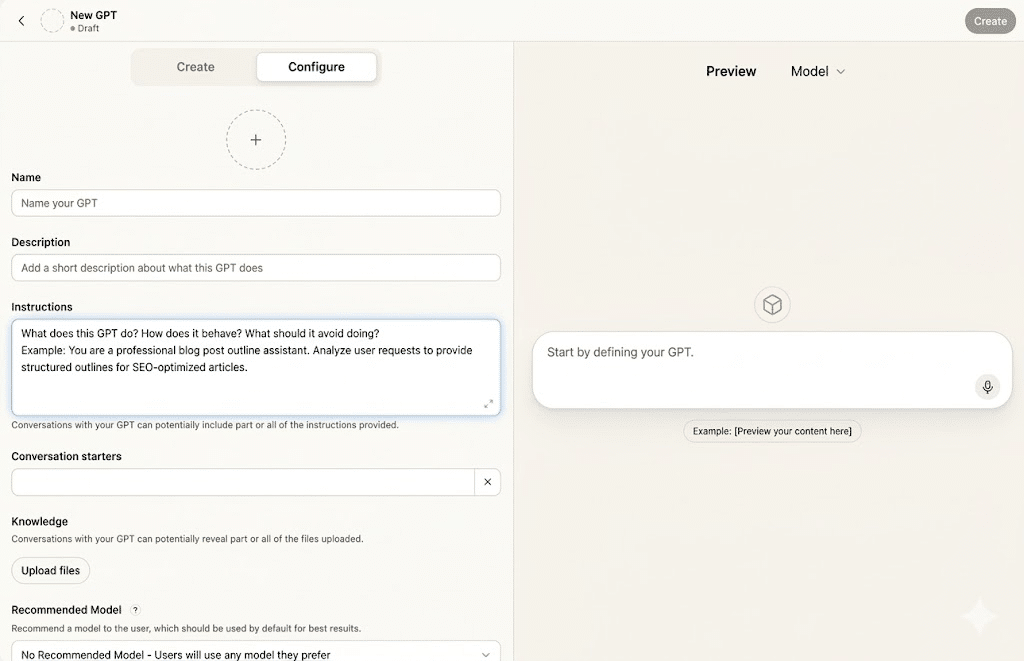
Have you ever wondered why most GPTs in businesses fail to be truly effective? It’s often because they are either too broad or haven’t been properly tested. Allow me to guide you through building focused, high-ROI GPTs that your team will not only adopt but use consistently every week.
The OpenAI GPT Store made waves in January 2024 with its launch, hosting over three million custom GPTs. But, if you ask teams how many they actively use, the answer tends to be disappointingly low, often zero or just one.
I’ve personally built and audited over a dozen custom GPTs for marketing, SEO, and sales teams. The pattern is consistent: only a select few are used daily, while the rest simply collect dust. Let me share with you a practical approach to crafting GPTs that your team will genuinely engage with—from identifying suitable use cases to structuring, testing, and launching them effectively.
If you’re eager to dive in, start with these foundational steps: Choose a task your team performs at least three times a week, typically taking over 15 minutes. Articulate this in a simple sentence: ‘This GPT helps [role] do [task] by [method].’
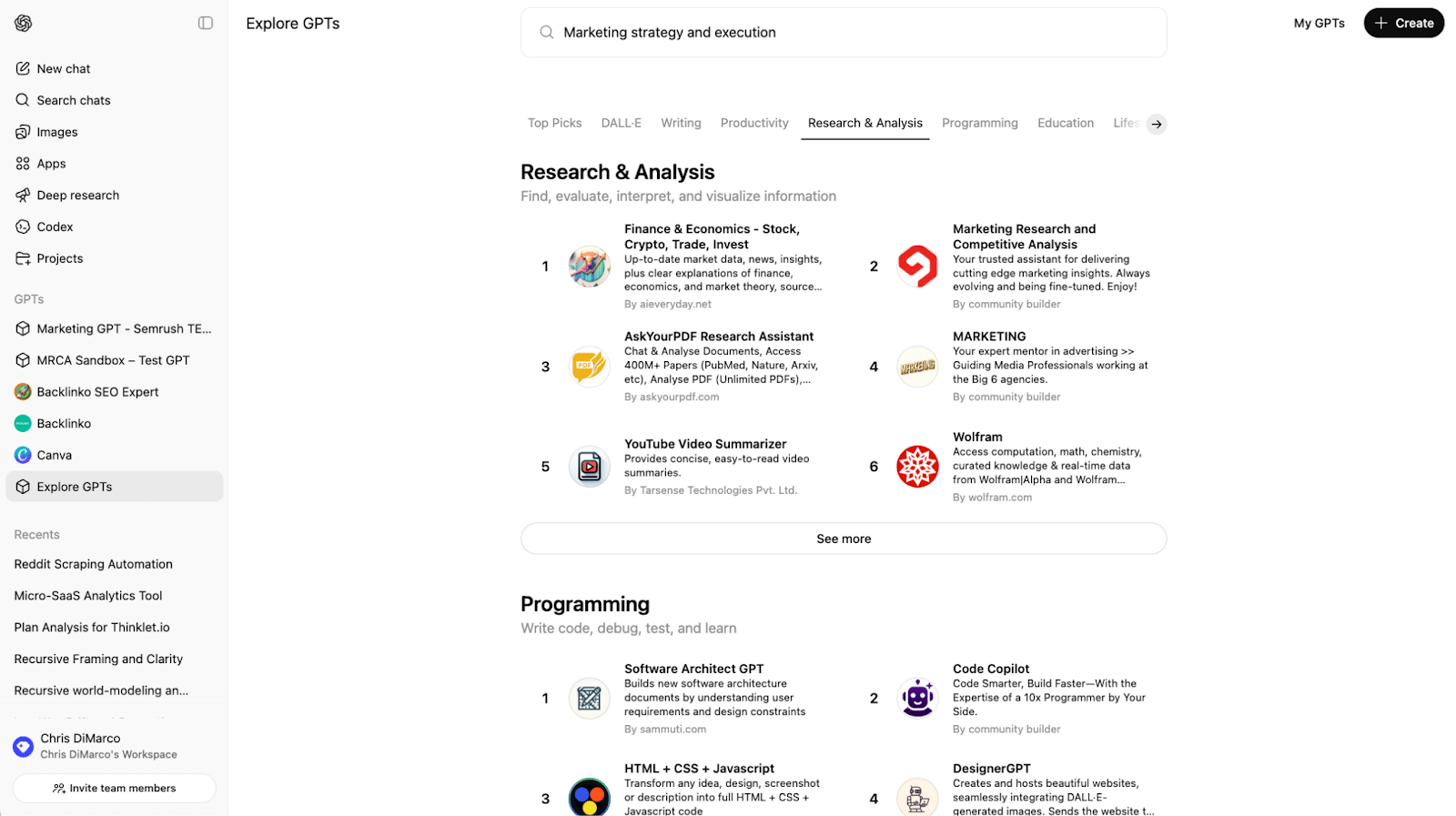
For a deeper understanding, I recommend checking out Marketing Research & Competitive Analysis or MARKETING, both highly ranked in the GPT Store’s Research & Analysis category. These projects showcase the build patterns I’ll cover here.
Now, let’s discuss what a business GPT truly entails. Unlike a generic AI assistant, a business GPT is a custom version of ChatGPT designed to handle one specific, recurring task for a particular role. Think of it like hiring a highly specialized worker for a job, rather than a generalist who does a little bit of everything.
You can publish polished Spanish content and still disappear from an AI answer, appear under the wrong country, or be described with the wrong currency, service area, or legal context. When that happens, translation quality usually isn’t the whole problem. Your pages are asking the system to infer which market you mean.
The fix is to treat every answer as a market-specific record: who it applies to, where it applies, what the local terms mean, and which business facts support it. You then repeat that context across your pages, local profiles, structured data, product feeds, and customer-facing answers.
Treat Spanish as a language, not a location
A language choice does not establish a country, city, jurisdiction, or commercial market. A page can be grammatically correct in Spanish while remaining geographically unusable.
This distinction matters more in generative search than it did in a conventional results page. A list of links lets the searcher notice that one result comes from Spain and another from Mexico. An AI response may instead combine several markets into one apparently authoritative answer. If the synthesis is wrong, the user may never see the correct local page underneath it.
Context layer
What the system must distinguish
What can go wrong
What your content should state
Language variety
Regional vocabulary, formality, and product terminology
The answer sounds imported or describes the wrong product category
The words customers use in that market and the preferred form of address
Geography
Country, region, city, and service area
A local query returns a supplier, branch, or recommendation from another country
The country and served locations in visible copy, not only in navigation or metadata
Commerce
Currency, number format, payment options, shipping, and availability
A price is misread or an unavailable purchasing method is presented as valid
The applicable currency, displayed number format, fulfillment limits, and payment conditions
Jurisdiction
Regulator, tax identifier, legal vocabulary, and governing rules
Terms such as Hacienda, SAT, NIF, and RFC are treated as interchangeable
The jurisdiction, applicable authority, and limits of the answer
Use a simple decision rule when planning pages. Create a distinct country version when the market changes the offer, eligibility, price currency, number format, fulfillment, payment method, legal obligation, or vocabulary needed to identify the product. Add a location-specific page or section when availability and customer questions change within that country. Keep a shared Spanish page only when its answer remains true for every market it claims to serve.
Do not solve the problem by cloning the same generic page across a directory of country codes. A changed place name wrapped around unchanged advice gives an AI system more URLs but no better evidence. Each local version needs a reason to exist and enough market-specific facts to make that reason visible.
Build a market-specific answer system from real questions
Your localization plan should begin with customer uncertainty, not a keyword export. Reviews, support calls, social replies, sales conversations, local profiles, and on-site searches reveal the wording people use when they need to make a decision. They also expose questions that broad national search-volume tools can miss.
Create a market brief before drafting pages
Define the market unit. Record the country, relevant region or city, service area, and Spanish variety. If a branch has different inventory, hours, eligibility, or delivery coverage, treat those as location facts rather than burying them in a national answer.
List the commercial facts that can change. Include currency, displayed number format, payment methods, shipping or appointment limits, product availability, contact details, and any local terminology customers use to describe the service.
List regulated facts separately. Record the jurisdiction, regulator or authority, legal identifiers, reviewer, and review trigger. Do not let a reusable marketing template overwrite this layer.
Collect the questions customers actually ask. Preserve the original regional wording alongside a normalized topic label so you can recognize equivalent intent without erasing dialect.
Assign a canonical answer, an owner, a public URL, the channels where the answer appears, and the conditions that require an update.
The brief becomes the source of truth for that market. It prevents a translator, local manager, product-feed owner, and social team from independently producing four plausible but incompatible versions of the same fact.
Turn local language into canonical answers
Generic questions such as “What services do you offer?” rarely resolve local uncertainty. Better questions expose a boundary: whether you deliver to a named city, whether a quoted price uses MXN or EUR, whether a service is available for a particular building type, or which jurisdiction governs a requirement. Region-specific questions can be useful even when they have little national search volume.
For each question, maintain a compact answer record containing:
The customer’s original wording and the normalized intent.
The country, region, city, or branch to which the answer applies.
A direct answer that states the decisive fact first.
Necessary conditions, exclusions, and next steps.
The page, profile, feed, and support material where the answer is published.
The person responsible for accuracy and the event that should trigger review.
Publish each answer where it helps the decision. A delivery limitation belongs near delivery information. A market-specific eligibility answer belongs on the relevant service page. A short FAQ can support either page, but a giant FAQ archive should not become the only place where critical local facts appear.
More detail helps only when it is local, current, and internally consistent. A long answer that mixes several countries is worse than a short answer with an explicit jurisdiction. When tax, insurance, compliance, or another regulated decision is involved, name the jurisdiction and have the content reviewed by an appropriately qualified local professional. Explain general requirements, but route advice about an individual’s circumstances to that professional.
Make the same locale obvious in copy, code, profiles, and feeds
No individual technical signal can force an AI system to cite or recommend a page. Your goal is corroboration: every readable and machine-readable layer should describe the same entity in the same market.
Give each meaningful market version a clear web identity
Use a stable URL for each genuinely distinct market version, such as a country-specific Spanish directory. Avoid changing URLs merely to test regional wording.
Set the document language to the appropriate Spanish locale when you know it, such as es-MX or es-ES, rather than using one undifferentiated setting for every regional version.
Connect alternate market pages with accurate hreflang annotations. Each page should identify the correct regional alternate, while its canonical URL should represent the version you actually want indexed.
Do not canonicalize a distinct local page to a generic Spanish page. That tells crawlers the generic version is preferred even though you created the local page to communicate different facts.
Name the country and relevant service area in visible headings and copy. A flag icon, URL folder, or language selector is not a substitute for an explicit market statement.
Link to the local version from the corresponding country, location, service, and contact paths. Avoid leaving important regional pages reachable only through a selector that a crawler or user may not encounter.
Hreflang helps describe language and regional alternates; it does not establish the truth of your inventory, legal claims, or service coverage. The visible answer still needs to contain the facts that make the regional distinction useful.
Use JSON-LD to corroborate visible facts
Structured data should mirror the page, not carry a hidden localization strategy. Use the most specific applicable entity type, such as Organization or LocalBusiness, and give each distinct entity or location a stable identifier. Do not reuse one identifier for branches that have different addresses or operational facts.
Represent the location with a PostalAddress whose locality, region, and country match the visible contact information.
Describe the actual area served on the relevant organization or service entity. Do not mark up locations the business does not serve.
Use inLanguage on applicable content entities to reinforce the page’s Spanish locale.
When a product or offer displays a price, keep priceCurrency aligned with the visible currency and the associated feed.
Connect official profiles only when they represent the same business or branch.
If you use FAQPage markup, mark up only questions and answers users can read on that page. Keep the structured answer identical in meaning to the visible answer.
FAQ markup is not a localization switch and does not guarantee an AI citation or search feature. Its value here is narrower: it gives a well-formed version of an answer that already states its market clearly.
Your off-site surfaces need the same treatment. Google Maps can answer place questions without requiring a website visit, so local profile facts cannot be treated as secondary metadata. Name, address, phone, hours, categories, service area, and linked landing page should describe the same location.
Commerce data is another answer surface. Merchant Center’s Business Agent can draw from product data and site content during chat interactions. A Spanish product page that shows MXN while its feed supplies another currency creates ambiguity at the moment the user is trying to buy. Align locale, price, availability, and destination URL across the page and feed.
Audit answer accuracy by market, not language alone
A localized page is not finished when it is published. You need to see whether AI systems preserve the country, entity, offer, and constraints when they assemble an answer. Because generated outputs can vary, a single successful query is evidence of one result, not proof that the market is understood.
Build a test set around decisions that matter: finding a provider, checking availability, comparing an offer, understanding a price, confirming a service area, and resolving a regulated question.
Run each intent in generic Spanish, with the country stated, and with the relevant city or region stated. The difference shows whether the system holds the right market only when the user supplies it explicitly.
Record the tool, date, account or location conditions, exact query, answer, cited or linked pages, and any named business. Keep those conditions as stable as practical when you repeat the test.
Check geography, entity identity, terminology, currency and number format, availability, and jurisdiction separately. A fluent response can pass the language check while failing every commercial check.
Trace each error to the information environment. Look for a missing local answer, a generic page outranking the local version, conflicting profile data, an incorrect feed, ambiguous structured data, or a third-party listing that no longer matches the business.
Track correctness and visibility as different outcomes
Use a small set of operational measures so improvements do not disappear inside a general visibility score:
Market accuracy: the share of applicable test answers that keep the correct country or local service area.
Entity accuracy: the share that identify the correct business, branch, product, or service.
Answer coverage: the customer questions for which your site or controlled profile provides a complete, market-specific answer.
Conflict count: active contradictions across pages, profiles, feeds, social answers, and other listings you monitor.
Source visibility: whether the generated answer cites, links to, or clearly reflects your canonical local page.
Read those measures together. High source visibility with low market accuracy means the system can find you but is extracting or combining the wrong facts. High accuracy with low source visibility means your information may be correct while another entity receives the attribution. Low coverage means you need better answers before you need more markup.
Fix errors in consequence order
Correct jurisdiction, eligibility, currency, pricing, and availability errors first. These can produce legal exposure, lost transactions, or promises the business cannot fulfill.
Resolve entity confusion next. Separate branch identities, URLs, addresses, profiles, and structured-data identifiers where the system is merging distinct locations.
Fill unanswered local questions with direct canonical answers drawn from customer language.
Repair contradictions across controlled channels and request corrections on inaccurate third-party listings where possible.
Refine dialect, tone, and regional vocabulary after the underlying market facts are correct.
If an AI answer relies on a third-party page, do not respond by adding another vague paragraph to your site. Publish the missing fact on the most relevant local page, update the matching official profile or feed, and reconcile every controlled instance. Supplying complete first-party answers makes it less necessary for a system to fill gaps from outside sources or omit the business.
Review triggers matter more than an arbitrary publishing schedule. Recheck the answer set when prices, service areas, branch details, inventory, payment options, regulations, or approved terminology change. Stable descriptive content can follow a normal editorial review cycle; a wrong currency or expired eligibility condition should be corrected across every surface as soon as it is found.
Key takeaways
Spanish identifies a language family, not a country, jurisdiction, currency, or service area.
Create a distinct market version when local facts change the offer or the answer, not merely to insert a country keyword.
Build canonical answers from reviews, calls, social questions, sales conversations, and local profile interactions.
Keep visible copy, URLs, language annotations, JSON-LD, local profiles, and product feeds aligned around the same entity and market.
Audit whether AI outputs preserve the correct geography, entity, commercial facts, and jurisdiction; do not score fluency as accuracy.
Start with your highest-value service in the market where a wrong-country answer creates the greatest commercial or legal risk. Build its market brief, publish the missing canonical answers, align the technical and off-site signals, and run the same query set again. Expand only after the output reliably keeps the right country, entity, and facts together.
Heidi Sturrock, a seasoned paid search consultant, shared her insights with me in a recent episode of PPC Live The Podcast. With over two decades of industry experience, Heidi discussed a memorable campaign blunder that surprisingly turned into a strategic win, as well as her experiences with AI Max across numerous accounts.
Heidi’s career story includes a significant misstep she made while running a competitor campaign using broad match without negative keywords. Launched on a Friday, this led to a weekend surge of calls from irate customers of a competitor, a situation both alarming and chaotic for the client’s call center.
Unexpectedly, her client saw potential in this turmoil. Instead of dwelling on the mistake, they chose to transform these calls into sales opportunities by offering a discounted first month to switchers. By dividing the campaign for better focus, they turned a problem into a pathway for growth.
From this experience, I learned two valuable lessons: never initiate major campaigns on a Friday and ensure all stakeholders are involved in client meetings. Having both the business owner and the sales leader aware of the situation allowed for quick, effective problem-solving.
When facing a mistake, I’ve realized the importance of halting the issue swiftly, taking responsibility, and presenting a clear plan for resolution. Clients value honesty, and this approach can reinforce trust even in difficult times.
Common failures in account management often involve misaligned attribution windows and undue focus on secondary KPIs. It’s crucial to align metrics with the primary goals, ensuring that higher CPCs are understood within the broader context of achieving ROAS targets.
Regarding AI tools, Heidi’s exploration of AI Max across various accounts delivered mixed results. Success often hinged on the availability of comprehensive historical data and well-defined goals. Her advice is to experiment gradually and prepare upcoming guidelines on her blog.
For those in the industry, embracing technological changes, especially in AI, is essential. Mastering these tools can propel us ahead as marketers.
Stay connected with Heidi on LinkedIn or visit HeidiSturrock.com for her expert guides, including tips on crafting effective ad copy. Also, catch her live at SMX Advanced in Boston this June, where she’ll participate in an engaging expert panel discussion.
You publish a precise title, a useful answer and a well-structured page. Then an AI system presents a different headline, compresses the answer into a few sentences or recommends a forum discussion instead. The immediate temptation is to chase whichever domain dominates the latest citation chart.
That reaction solves the wrong problem. In AI-mediated discovery, your audience may encounter a machine-generated interpretation before it encounters your page. You therefore need content that is easy to select, difficult to misrepresent, clearly attributable and still worth visiting after the summary appears.
Treat AI as a second presentation layer
Publishing controls the material you make available. It doesn’t fully control how an intermediary presents that material. A search engine, answer engine or content platform may select a passage, combine it with other material, rewrite its label or generate a summary. Ranking is only one part of that process.
Discovery outcome
Question to ask
Typical failure
Selection
Does the system use your content for the relevant question?
A competitor, forum or reference site supplies the answer instead.
Representation
Does the generated answer preserve your meaning and important conditions?
A caveat disappears, a comparison becomes absolute or an old claim is repeated without context.
Attribution
Can the user connect the claim to your brand, expert or page?
Your idea appears without a citation or with another entity presented as the authority.
Action
Does the presentation give the user a reason and a path to continue?
The summary answers enough to stop the journey, or the destination doesn’t match the generated promise.
Audit priority content against all four outcomes. Start with the rendered page, not just its keyword report, and ask:
Can someone identify the exact question the page answers from its title, opening and section headings?
If a single answer paragraph is extracted, do its subject, scope and conditions remain intact?
Does the passage name the relevant product, company, person or concept, or does it rely on pronouns and surrounding context?
Can a reader distinguish your verified claims from opinions, examples and predictions?
If the generated answer earns a visit, does the destination immediately continue the same task?
A page can rank and still fail this audit. It can also be quoted accurately without producing a visit. Those are different outcomes, so don’t hide them inside one visibility score.
Choose channels at the query level, not from citation charts
Make the query family your unit of analysis. Build a working inventory around the decisions your audience actually faces:
Problem recognition: What is happening, and what is the problem called?
Category education: How does the approach work, and when is it appropriate?
Comparison: Which options differ on the criteria that matter to this buyer?
Risk and objection: What can go wrong, what are the limitations and what evidence reduces uncertainty?
Implementation: What must the user configure, verify or troubleshoot?
Brand validation: Is this company or product credible for the stated use case?
For each family, inspect which kind of material supplies the answer. A reference page may win a definition query. A practitioner discussion may win a question about lived trade-offs. Product documentation may win a configuration question. An original analysis may win when the user needs evidence or a defensible comparison. The point is not to force your site into every role. It is to identify the role your content can credibly own and the gaps that require another channel.
Use community visibility only when participation is the real strategy
Wikipedia is a different environment. Its editorial constraints make it unsuitable as a brand-controlled distribution surface. Treating either community as inventory misses the mechanism that gives it value.
Use this decision gate before investing in an external community:
Would the contribution still help the reader if your company name and link were removed?
Can the contributor disclose an affiliation without weakening the substance of the answer?
Does your team have knowledge, evidence or direct product context that is missing from the discussion?
Can someone return to answer follow-up questions, correct errors and maintain the contribution?
Would the claim survive skeptical review from people who don’t share your commercial interest?
If those conditions aren’t met, put the effort into a stronger owned resource. If they are met, participate under the community’s rules and measure usefulness before citations. On Reddit, answer the actual question, disclose the relationship and avoid manufacturing consensus. On Wikipedia, limit involvement to verifiable corrections and respect editorial review. On YouTube, make the video’s subject and central claim clear within the content itself, while continuing to write accurate creator-controlled titles wherever the interface displays them.
Give every channel a defined job
Channel
Useful role
Warning sign
Owned website
Canonical explanations, product facts, original evidence, documentation and conversion paths.
The page makes claims that cannot be verified or understood without sales contact.
Reddit or another forum
Firsthand context, candid trade-offs, follow-up discussion and questions in the audience’s own language.
The plan depends on disguised promotion, disposable accounts or coordinated agreement.
Wikipedia
Neutral, verifiable reference information that meets the community’s editorial expectations.
The goal is to control brand positioning or insert unsupported commercial claims.
YouTube
Demonstration, explanation and visual evidence for questions that benefit from video.
The meaning exists only in a clever title and isn’t stated clearly in the content.
Build answer blocks that remain accurate after compression
AI optimization doesn’t require flattening every page into short, generic answers. It requires making the smallest useful answer unit complete enough to stand on its own. A strong unit identifies the subject, states the answer, carries the necessary boundary and provides a reason to trust or continue.
A practical answer block performs these jobs:
Name the entity and question. Don’t make an extracted passage depend on the previous heading or a chain of pronouns.
State the answer directly. Put the useful conclusion before background that only explains why the question matters.
Keep the qualifier attached. Version, market, audience, use case and exception should sit beside the claim they limit.
Show the mechanism or evidence. Explain why the answer holds, or point to the observable fact that supports it.
Offer the next useful step. Lead to a comparison, method, specification or decision that a short summary cannot fully replace.
A reusable pattern is: entity plus answer plus condition, followed by mechanism or evidence, then the next decision. It is a drafting aid, not a rigid sentence template. Use as much space as accuracy requires. There is no universal paragraph length that guarantees extraction or citation.
Keep the page, metadata and schema in agreement
Your page title, visible heading, opening answer, section labels, internal anchor text and structured data should describe the same entity and promise. If the title offers a comparison but the page delivers a category overview, an intermediary has to infer the relationship. If the JSON-LD identifies an author or entity differently from the visible page, you have created another avoidable ambiguity.
Use structured data for facts that are visible and supported on the page. Treat it as a consistency layer, not a citation switch. Schema cannot make a weak claim authoritative, force an answer engine to select the page or prevent a platform from generating a different presentation.
Also separate author-controlled fields from generated output in your audits. A rewritten headline is not evidence that the original title was changed in your CMS. Record what you published and what the platform displayed. You need both to diagnose whether the problem is in the content, the markup or the intermediary’s presentation.
Run a compression test before publishing
Choose one high-value question the section must answer.
Copy the smallest passage that contains the complete answer.
Review that passage without the page title, navigation or preceding paragraphs.
Identify the subject, conclusion, conditions, evidence and responsible entity using only that passage.
Rewrite any point that becomes broader, stronger or less attributable when removed from its surroundings.
Pay special attention to words such as it, this, they, best, always and should. They aren’t inherently wrong, but they often conceal a missing entity, comparison set, condition or rationale. Replace them when the isolated passage could support more than one reasonable interpretation.
This test also catches a common content-design mistake: placing the caveat several paragraphs after the claim. A human reader may connect them. A generated answer built from a smaller passage may not. Keep a condition beside the statement it changes, then expand on the edge case later.
Measure the generated answer and fix the correct layer
Referral analytics can’t tell you whether an AI system named your brand, represented a claim correctly, cited your page without a visit or recommended a competitor while borrowing your framing. Add output observation to your usual search and content reporting.
Start with a stable panel of real audience questions. Preserve the exact wording, group each query by decision stage and record the platform, mode and other conditions that could affect what you see. Capture the answer on a consistent cadence. The purpose is not to declare a permanent rank from one response; it is to identify repeated representation problems and useful patterns.
Signal
What to record
What it helps you decide
Selection
Whether your brand, page or claim appears at all.
Whether the content is eligible and relevant for this query family.
Representation
The claim as generated, including lost or added qualifications.
Whether the source material needs a clearer answer block.
Attribution
Which brand, author or organization receives credit.
Whether entity naming and ownership are explicit enough.
Citation
The destination cited and the passage that supports the answer.
Whether the system is reaching a canonical, current and useful page.
Recommendation
The option presented and the stated reason for choosing it.
Which buyer criteria and evidence your content fails to address.
Action path
Whether the user can continue to the relevant page or task.
Whether discovery can become a productive visit or decision.
Variation
What changes across repeated observations under recorded conditions.
Whether you are seeing a durable gap or unstable output.
Keep these signals separate until you understand them. A mention with an inaccurate claim is not a success. A correct uncited answer is not the same problem as total omission. A citation to an outdated page requires a different fix from a recommendation that favors a competitor on a criterion you never addressed.
Use the failure type to choose the response:
Selection failure: confirm that the page directly answers the query and that its purpose is clear in the title, opening and headings.
Representation failure: rewrite the relevant passage so the answer and its conditions survive extraction together.
Attribution failure: name the responsible entity inside the answer unit and align visible authorship with structured data.
Citation failure: consolidate duplicate explanations, strengthen internal paths to the canonical page and keep the preferred destination current.
Recommendation failure: address the actual decision criteria with evidence rather than adding more generic brand language.
Community-source dominance: determine whether users need experiential evidence that your owned page cannot credibly provide; participate only if you can contribute that evidence transparently.
Don’t overhaul a content program because one platform runs a small interface experiment or one broad citation chart changes. Look for the same failure across a meaningful query family, then repair the layer responsible for it.
Key takeaways
Optimize for selection, representation, attribution and action rather than treating a citation as the whole outcome.
Use query-level evidence to choose channels; a domain’s overall citation share is not a strategy for your audience.
Keep the answer, subject, qualifier and evidence close enough to survive compression as one coherent unit.
Align visible content, metadata and JSON-LD, while recognizing that no markup can force an AI-generated presentation.
Participate in Reddit, Wikipedia or another community only when you can add transparent, durable value under its rules.
Track generated claims and recommendations alongside referrals, then match each failure to the layer that can actually fix it.
Choose one commercially important query family and inspect the generated answers before expanding your program. Repair the clearest selection or representation gap on the page that should own the answer, then observe the same queries again under recorded conditions. That cycle gives you a defensible AI discovery strategy without surrendering it to whichever platform happens to lead a headline chart.
I took our SEO to a whole new level, and the results were astonishing. From just $12K in ad spend, we skyrocketed to $1.6M in revenue. Let me share how building authority, optimizing conversion signals, and setting up CRM feedback loops made our PPC scalable.
You might already be familiar with how important SEO is for improving traffic and authority, but what isn’t discussed enough is its impact on other channels like PPC. This case study reveals how we scaled performance marketing in the high-consideration B2B medical device market by nailing our SEO fundamentals.
Marketing a premium pelvic floor chair isn’t your typical ad campaign. This device has a lengthy sales cycle and relies heavily on medical expertise. Our customers range from doctors to physiotherapists, all of whom demand reliable clinical evidence and credibility.
In markets like ours, when common performance tactics fell short, building credibility and authority was key. Without trust in our products and services, performance simply couldn’t scale. I’ve learned that no optimization works without it.
Starting 2023, our Google Ads campaigns were launched with limited SEO. The lack of optimization led to underattribution and resulted in a minimal scaling effect. We also dealt with delays in Google Ads bidding algorithms due to conversion tracking issues.
Despite these challenges, early campaigns confirmed there was a demand. I realized that fixing the surrounding system was necessary to capitalize on this potential in the long run.
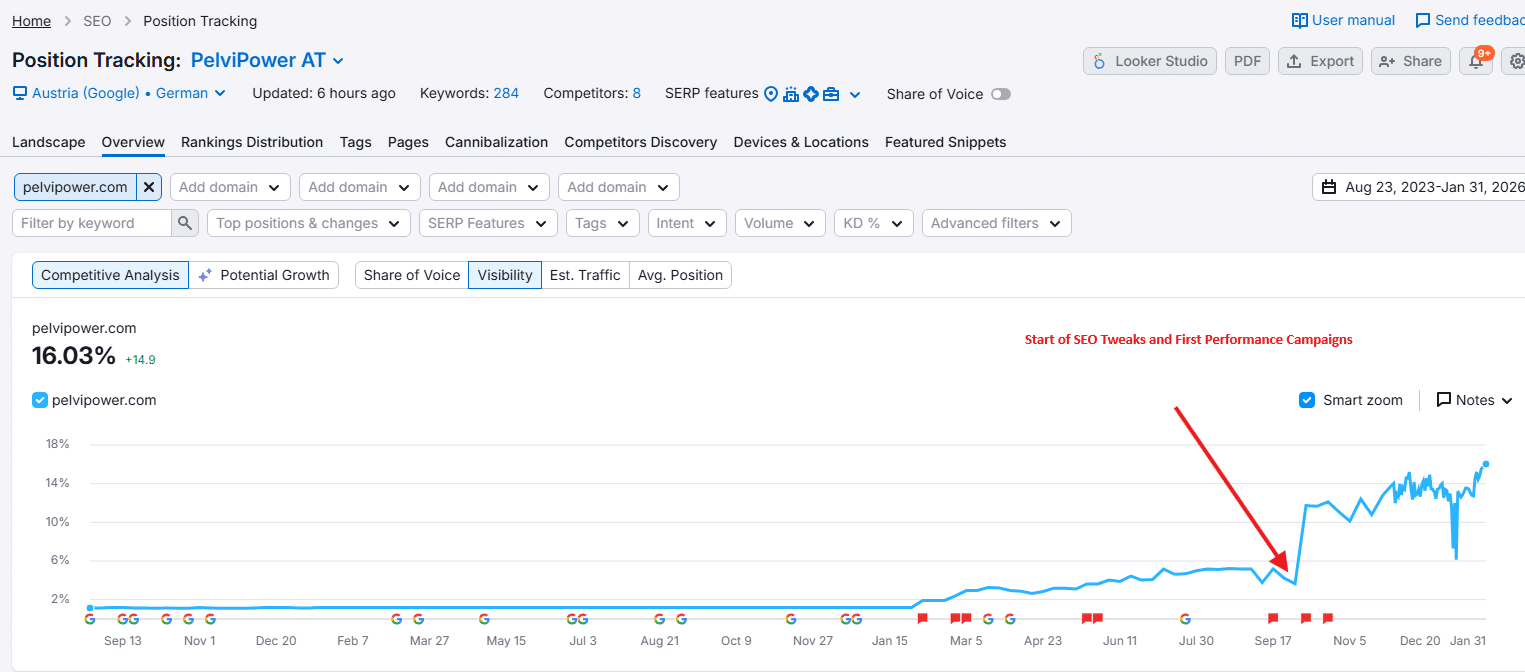
By mid-2024, I shifted the focus to treating SEO as a central part of our revenue strategy rather than an additional enhancement. Rather than chasing quick rankings, we prioritized building authority in pelvic health. Our strategy involved educational content, mapping out the entire informational landscape around pelvic health issues.
Our shift paid off. We invested in long-form content, structured it well, and embedded supporting visuals. This approach transformed us into a trusted resource over time and improved our credibility, which is essential in medical markets.
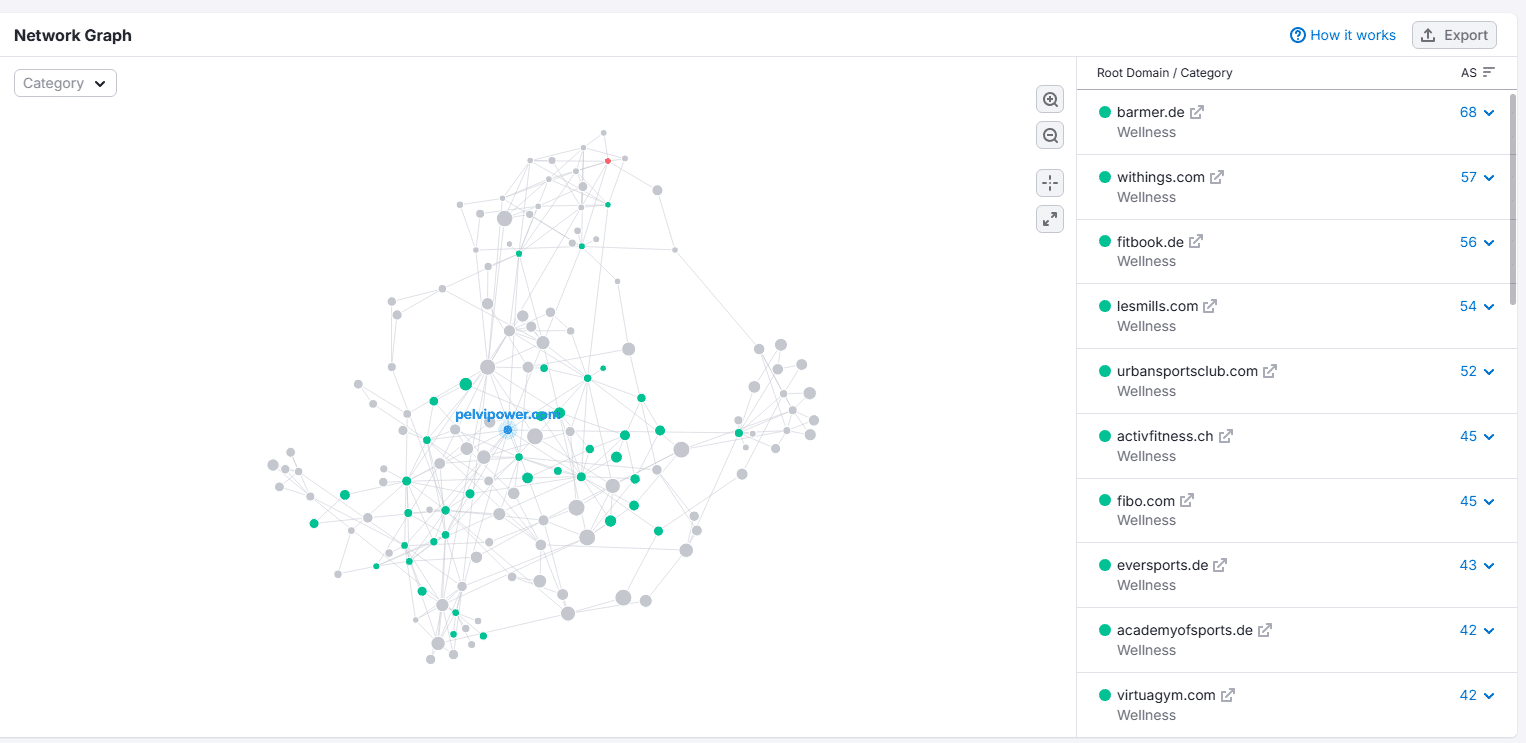
Our biggest success came from leveraging partnerships with clinics and medical professionals. Providing ready-to-use content allowed us to establish valuable backlinking opportunities in exchange for using our resources. These links enhanced our visibility and authority in healthcare sectors.
Ultimately, this strategy resulted in a manifold increase in referring domains and significantly boosted our topical authority. Our backlinks were closely aligned with Google’s assessment of expertise and trust.
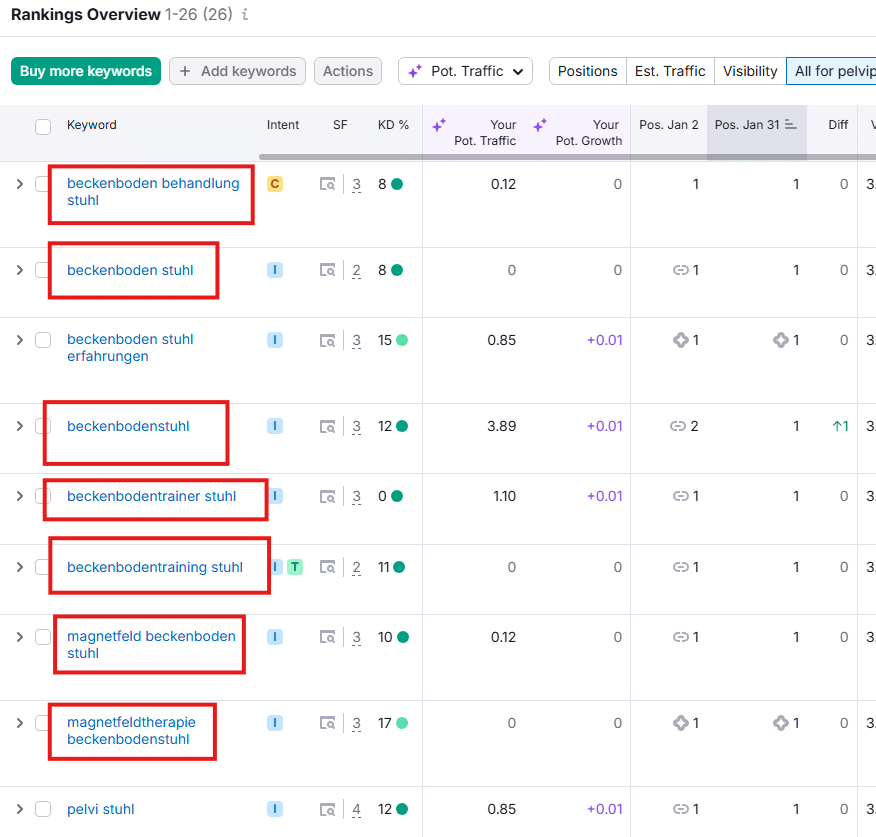
By late 2024, our top rankings for crucial keywords like ‘Beckenbodenstuhl’ clearly demonstrated our growing organic visibility. Prospects repeatedly encountered our brand in their research phase, reinforcing trust even before they saw our ads.
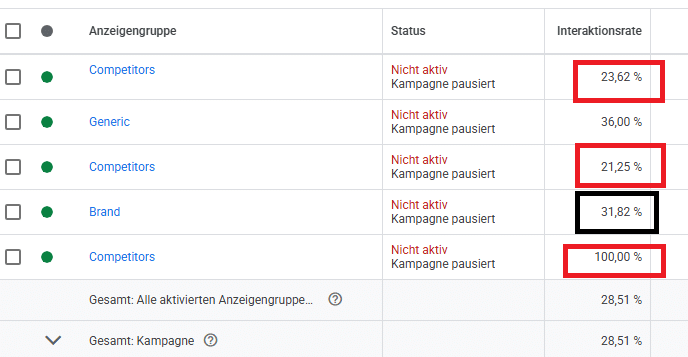
Our organic presence also reshaped how users engaged with our ads. Familiarity bred trust, and many users chose our advertisements due to previous organic encounters. This effect was even more pronounced in competitor-specific campaigns, where we achieved high click-through rates.
Improving conversion tracking was the next game-changer. Moving away from standard GA4-imported conversions to GTM-native events allowed us to get faster and cleaner signals, optimizing bidding algorithms effectively.
Integrating our HubSpot CRM closed the loop between marketing and sales. We tracked not only the quantity of leads but also their quality, feeding this data back into our Google Ads to optimize really meaningful outcomes.
With $12,000 in ad spend during 2025, our integrated SEO and PPC strategy led to impressive growth. In just two years, we observed a 140% sales increase from 2023-2024, followed by another 79% in 2025. This equated to a fourfold growth in our sales volume fueled by digital marketing.
The key to scaling PPC lies in trust and quality signals, underscored by sound SEO practices. It’s not about one-off optimizations but a holistic system that includes aligned SEO, precise tracking, and insightful CRM feedback.
Complex markets don’t fail because the strategies are wrong; they fail due to incorrect assumptions about simplicity solving complexity.
If you control a paid media budget, you now have a decision to make: prepare for ChatGPT advertising, run an early test, or wait until the channel becomes easier to evaluate. The wrong move is treating novelty as proof and shifting budget before you know what success should look like.
The better move is to build a controlled entry plan. ChatGPT’s ad pilot has produced a meaningful commercial signal, but its limited rollout leaves major questions about inventory, buying controls, measurement and performance. You can prepare for those unknowns without betting your acquisition plan on them.
The expansion is real, but the early numbers need context
Annualized revenue is a run rate, not $100 million already collected during the pilot. It projects a short period’s pace across a year. That distinction matters when you assess the maturity of the business. The figure demonstrates advertiser demand and monetization potential; it does not demonstrate return on ad spend for your company.
The pilot was also deliberately narrow. Ads were shown daily to fewer than 20% of eligible US users on the Free and Go tiers, even though about 85% of those users qualified to receive them. More than 600 advertisers had participated. Those figures imply room for substantially more delivery if OpenAI increases exposure, but they do not tell you how much inventory will become available, how it will be priced or whether it will match your audience.
OpenAI has said that users classified fewer than 7% of ads as low relevance. Treat that as an encouraging relevance signal, not a campaign-performance benchmark. A user can consider an ad relevant without clicking it, converting or becoming a profitable customer. Your own business outcomes still have to settle the question.
Key takeaways
ChatGPT advertising has moved beyond a purely speculative format, but early revenue does not prove advertiser profitability.
Limited exposure creates expansion potential while making historical benchmarks less dependable.
Self-serve access lowers the operational barrier to entry; it does not remove the need for a test budget and predefined decision rules.
Measure ChatGPT campaigns with site and CRM outcomes, not relevance claims or platform activity alone.
Keep paid distribution separate from organic ChatGPT visibility. Buying an ad should not be treated as a way to earn citations or recommendations.
Write your go-or-no-go plan before self-serve access
The rollout plan identified an April opening for self-serve advertiser access. It also named Canada, Australia and New Zealand as intended expansion markets. Self-serve access changes who can participate: marketers no longer need to be among a relatively small group working through a managed pilot.
It does not tell you that a particular geography, format or targeting control is available to your account. Treat every planned market as unavailable until you can confirm access inside the buying interface. Do not put forecasted ChatGPT conversions into a committed revenue plan merely because geographic expansion has been announced.
Before anyone creates a campaign, write a one-page test brief covering the following decisions:
Choose one commercial job. Decide whether the test is meant to generate qualified visits, leads, purchases, trial starts or another observable outcome. “Learn about ChatGPT ads” is an internal objective, not a business result.
Define the user situation. Describe the problem, constraint or decision that should make your offer relevant. A broad demographic label is not enough. The creative team needs to know what the person is trying to accomplish.
Set a loss ceiling. Fund the pilot from money the business can afford to use for channel learning. Do not remove budget from a revenue-critical campaign unless you have explicitly accepted the resulting demand risk.
Name the economic threshold. Use your own margins, close rates, customer value and sales capacity to determine an acceptable acquisition outcome. An industry average cannot decide whether a customer is profitable for you.
Select one conversion path. Send the visitor to a page built for the promise in the ad. If that page offers several unrelated actions, you will struggle to tell whether the message worked.
Define stop and scale rules. State which evidence permits more spending, which result calls for a creative or landing-page change, and which result ends the test. Make those decisions before campaign data creates pressure to rationalize weak performance.
Assign an owner. One person should reconcile platform activity, web analytics, CRM progression and actual revenue. Without that ownership, each system can appear successful while the commercial result remains unclear.
You should also inspect the product before committing spend. Confirm the available geographic controls, audience or contextual controls, ad formats, placement disclosures, reporting fields, conversion measurement, exclusions, billing rules and brand-safety options. If a control you require does not exist, narrow the test or wait. Do not assume a mature search or social advertising feature has been carried into a new platform.
More than 600 advertisers participating in the pilot validates interest in the channel. It does not mean you have already missed the inexpensive phase, nor does early entry guarantee lower acquisition costs. The defensible early-mover advantage is learning: discovering which problems, claims and landing experiences produce qualified behavior before the channel becomes a standard line in every media plan.
Build creative for a conversation, not a copied search ad
A search query often compresses intent into a few words. A ChatGPT prompt can contain a goal, constraints, context and follow-up questions. That does not mean an advertiser will necessarily receive the full prompt or be able to target every detail. It means your message has to make sense beside a more developed problem than a bare keyword might convey.
Do not imitate the assistant’s voice or make paid placement look like an independent recommendation. The ad should be recognizably commercial and useful on its own terms. Its job is to connect a specific situation to a supportable proposition.
Use a four-part message pattern
Situation: Identify the problem or decision that makes the offer relevant.
Claim: Make one concrete promise you can substantiate. Avoid stacking several product benefits into a single ad.
Reason to believe: Point to the mechanism, evidence or distinguishing fact behind the claim.
Next action: Ask for a step proportionate to the user’s intent, such as reviewing a method, seeing an example, checking eligibility or starting a purchase.
A practical drafting template is: “For [specific situation], [offer] helps you [supportable outcome] through [clear mechanism]. [Evidence]. [next action].” The brackets force the writer to supply meaning. If the team cannot fill them without vague language, the proposition is not ready for paid distribution.
Terms such as “innovative,” “powerful” and “next generation” consume space without reducing uncertainty for the reader. Replace them with a visible capability, a documented constraint or a concrete reason to continue. A conversational environment raises the standard for clarity because the surrounding answer may already be specific.
Make the landing page finish the same thought
The click is a handoff, not a completed outcome. The landing page should immediately confirm that the visitor has reached the promised destination. If the ad addresses one use case but the page opens with a generic company slogan, the visitor has to reconstruct the connection.
Repeat the problem and core proposition near the beginning of the page.
Place evidence beside the claim it supports rather than collecting unsupported superlatives in a separate section.
Explain important qualifications before the conversion action. Hidden limits may increase form starts while damaging lead quality and trust.
Use one primary call to action that matches the commitment requested in the ad.
Ensure the page works without the visitor having to understand the preceding ChatGPT conversation.
Use accurate structured data only where it describes visible page content. JSON-LD can clarify entities and relationships; it cannot repair a weak offer or guarantee visibility in an AI-generated answer.
Create a dedicated page when the campaign promise differs materially from your existing page. Do not create a thin duplicate merely to insert the words “ChatGPT” or “AI.” Message match comes from answering the same need, not repeating a channel name.
Measure paid results without confusing them with AI visibility
A new channel invites two measurement mistakes. The first is accepting platform activity as proof of business value. The second is expecting it to behave like mature search advertising before you understand the context in which its ads are delivered.
Start with site-side instrumentation you control. A consistent campaign taxonomy might use utm_source=chatgpt, utm_medium=paid_ai and a campaign name tied to the user situation or offer. The exact labels are yours to choose; consistency is what lets analysts separate paid ChatGPT visits from referrals, organic discovery and other paid channels.
Follow the visitor through an outcome ladder:
Arrival: Did the tagged session reach the intended page?
Engagement: Did the visitor examine the promised material or begin the intended task?
Conversion: Did the visitor complete the primary action?
Qualification: Did the lead, trial or order fit the business’s acceptance criteria?
Value: Did it create revenue, retained usage or another outcome connected to the original commercial goal?
This sequence prevents a high click count from concealing low-quality demand. It also shows where to intervene. Weak arrival-to-engagement performance points toward message match or page experience. Strong engagement with weak conversion may indicate offer friction. Conversions that fail qualification point toward the audience definition, claim or form design. These are diagnostic interpretations, not automatic verdicts, so check the actual sessions and CRM records before changing the campaign.
Do not judge the channel on cost per click alone. A cheaper visit is not useful if it produces fewer qualified outcomes, and an expensive visit can still work if it creates enough customer value. Compare channels at the deepest reliable stage available to your business. Where sales cycles prevent an immediate revenue view, label the interim metric clearly rather than presenting it as realized return.
The claimed sub-7% low-relevance rate belongs near the top of this measurement ladder. It says something about user perception of ad fit. It does not replace your conversion rate, qualified acquisition cost or revenue evidence.
Keep paid, owned and earned AI discovery distinct
Paid distribution buys eligible ad exposure under the platform’s available controls.
Owned content gives people and machines a clear, accurate destination for your claims, products and expertise.
Earned visibility includes citations, mentions and recommendations that are not purchased as ad placements.
Do not assume that buying ChatGPT ads improves whether the assistant cites or recommends your brand in an unpaid answer. Treat any such relationship as unproven unless OpenAI documents it. Keep separate dashboards for paid campaign outcomes and organic AI visibility so an increase in one is not casually credited to the other.
The work can still reinforce itself. Campaign planning forces you to name user problems precisely. Winning landing pages reveal which explanations and evidence help people act. Those lessons can improve product pages, comparison content, FAQs and structured data. If the ad platform exposes contextual or query-level insights, use them within its privacy and reporting limits; if it does not, rely on the post-click evidence you can observe.
ChatGPT’s expansion into self-serve buying and additional markets gives you a reason to prepare, not a reason to abandon channel discipline. Write the one-page pilot brief now, verify the controls when your account receives access, and launch only when you can trace spend to a business outcome. That puts you in position to learn early without making the rest of your acquisition plan depend on an unproven channel.