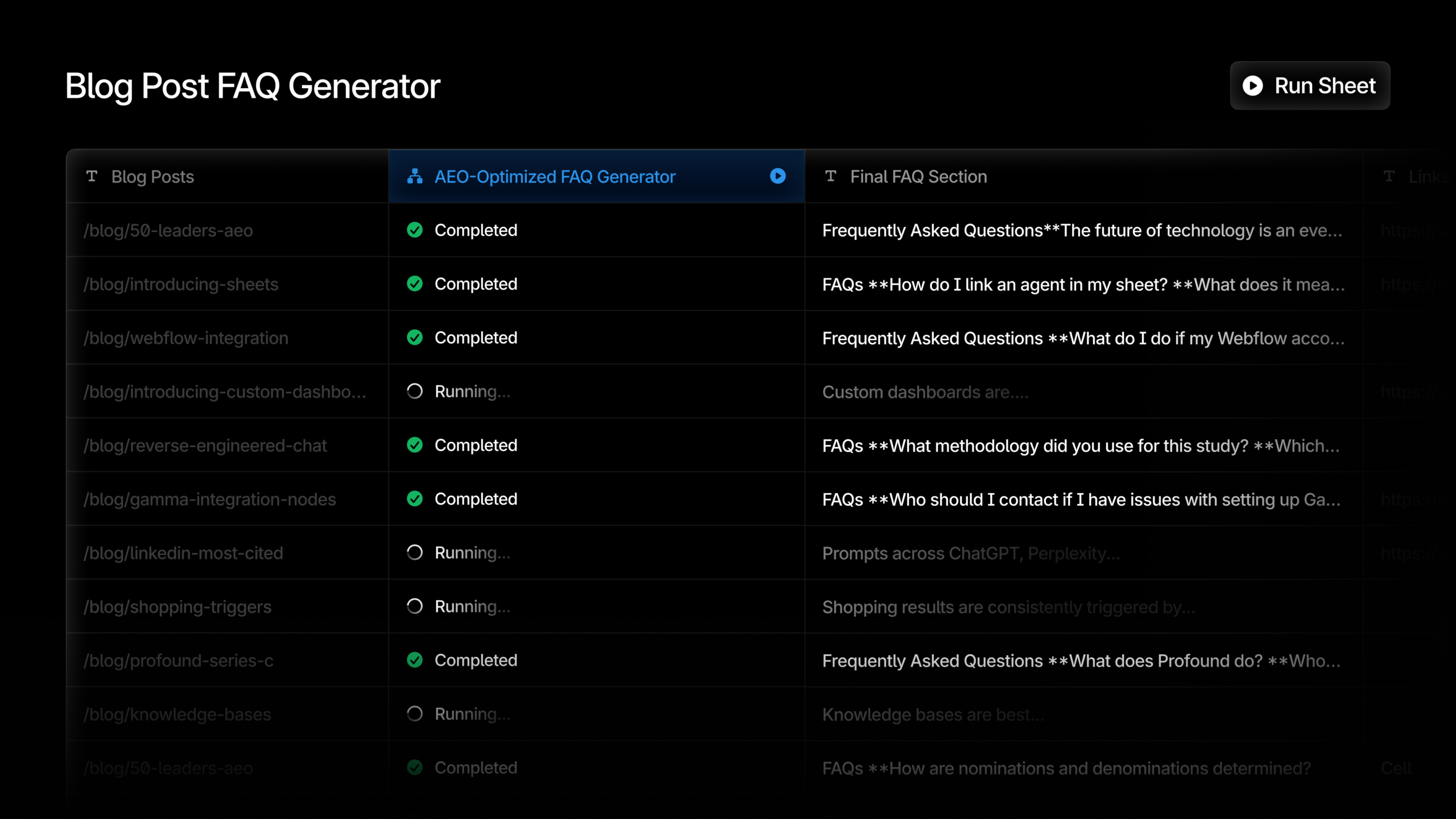
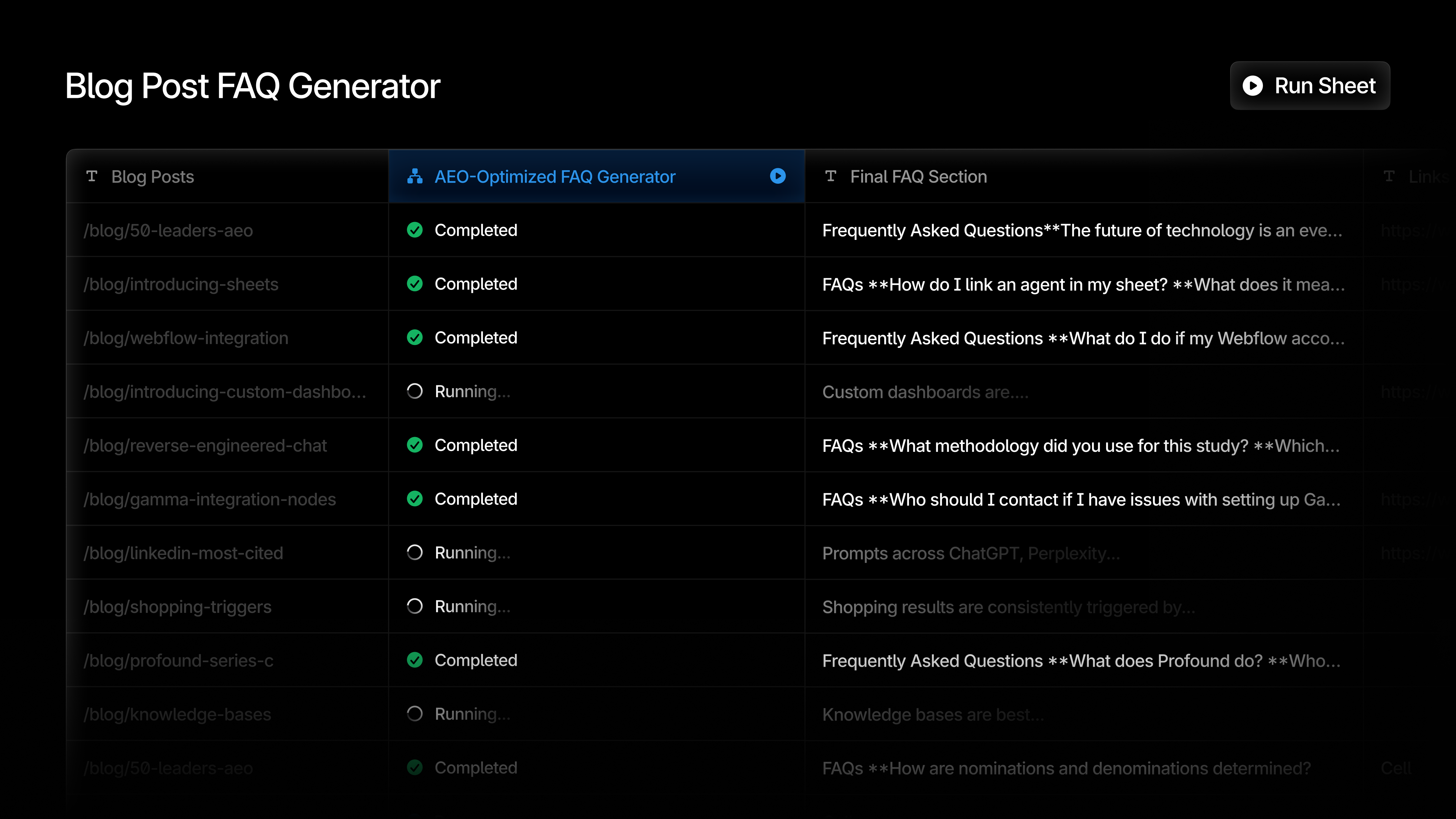
Have you ever wished for a tool that makes orchestrating AEO efforts a breeze? Let me introduce you to Profound Sheets, a game-changer that brings efficiency to new heights. Imagine a spreadsheet-like interface where every row acts as its own Agent run, each with its unique context. This innovative system allows me to process hundreds of inputs simultaneously, amplifying my marketing strategies beyond imagination.
By leveraging structured workflows, I’m able to accomplish what once took weeks in mere minutes. The time saved means more opportunities to focus on crafting creative strategies and optimizing performance. It’s like multiplying my marketing team’s capabilities overnight!
If your SEO plan for 2026 depends mainly on a new AI tool, a larger content calendar or another visibility dashboard, pause. Those additions can expose organizational weakness faster than they create results. A dashboard cannot reconcile teams that use different definitions of success, and an AI-generated brief cannot supply a point of view nobody owns.
Your real readiness test is whether the organization can turn a discovery signal into a coordinated change: identify what matters, decide what to do, assign the work, ship it and evaluate the business effect. The audit below will show you where that chain breaks and what to fix first.
Start with evidence, not an SEO maturity label
Calling a company “advanced” or “immature” at SEO rarely tells you what to change. Readiness is easier to evaluate through evidence. Ask what happens when the team discovers an inaccurate brand answer, a declining topic, an unanswered customer question or a technical barrier. Then inspect the artifacts that move that finding toward resolution.
Run the audit with the people who control content, analytics, product information, engineering priorities, brand communications and commercial outcomes. The exact job titles will vary. What matters is having both the people who see the signals and the people who can authorize or deliver a response.
Readiness area
Evidence to request
A warning sign
Customer journey
A shared map connecting discovery, evaluation, website behavior and business outcomes
Each team presents a different journey and none includes AI-assisted discovery
Goals and measurement
Metric definitions, owners, data locations and the decisions each metric informs
Traffic is treated as the result even when nobody can explain its business value
Decision rights
A named decision-maker and executor for each common class of SEO issue
SEO is accountable for results but cannot approve or schedule the required work
Delivery
Real backlog items, prioritization rules, delivery windows and escalation paths
Recommendations repeatedly return to presentations instead of entering a production queue
Content differentiation
Editorial standards showing what the organization can contribute beyond generic synthesis
AI output moves from prompt to publication without evidence, expertise or editorial challenge
Learning
A record of changes, expected effects, observed results and follow-up decisions
Reports describe movement but do not change priorities, messaging or execution
Do not accept verbal assurances where an operational artifact should exist. “Marketing and engineering collaborate” is not evidence. A prioritized ticket with an owner, acceptance criteria and an agreed delivery window is evidence. “We track AI visibility” is not evidence. A defined metric, known limitations and a decision it can trigger are evidence.
Classify each area as working, constrained or absent. “Working” means the process is used and produces decisions. “Constrained” means it exists but regularly stalls because of access, authority, quality or capacity. “Absent” means the organization relies on individual initiative. Do not average the results into a flattering maturity score. A single absent link can stop the entire operating chain.
Build a decision chain from signal to shipped change
Many SEO teams have responsibility without control. They can detect a problem and recommend a response, but another team controls the template, product feed, editorial calendar, public statement, development backlog or budget. When the handoff is informal, recommendations wait for goodwill and urgency has to be renegotiated every time.
Fix that by defining the decision chain before the next issue appears. For every recurring class of work, record the following:
Signal owner: the person responsible for detecting and documenting the issue.
Decision-maker: the person with authority to choose a response and accept its tradeoffs.
Executor: the team that can make the change in the relevant system or channel.
Required evidence: the information needed before the work can be prioritized.
Delivery route: the backlog, editorial workflow or operating process that will carry the work.
Validation owner: the person who checks whether the change shipped correctly and whether the expected effect appeared.
Escalation condition: the circumstance that moves a blocked issue to a leader who can resolve it.
Separate strategic ownership from execution ownership
SEO should influence how the organization approaches discoverability across search engines, AI assistants and other relevant platforms. That does not mean the SEO team should pretend it can execute every change. Product teams may own product facts. Communications may own public positioning. Engineering may own rendering and platform behavior. Analytics may own measurement architecture.
For each issue, make both forms of ownership visible. Strategic ownership answers, “What should change, and why does it matter?” Execution ownership answers, “Who can make the change in the system where it lives?” If only the first answer exists, you have a recommendation queue rather than an operating capability.
Route work through existing operating systems
A separate SEO spreadsheet often becomes a parking lot because it sits outside the processes that allocate resources. Put technical work into the engineering backlog, editorial work into the content workflow, product-fact corrections into the product-data process and reputation issues into the communications process. Keep a central SEO register for visibility, but let each change travel through the system that can actually deliver it.
Consider an AI assistant that repeatedly presents an outdated return condition. The SEO team can capture the affected query pattern and identify the pages or feeds that may be contributing. It should not silently rewrite policy. The policy owner validates the correct fact, content or product-data owners update the canonical information, technical owners confirm that the information is accessible, and the visibility owner checks whether the answer changes. The chain protects accuracy while keeping the response actionable.
Document common issue classes now: inaccurate entity facts, missing topic coverage, inconsistent brand language, weak product information, technical access barriers, declining search performance and emerging customer questions. Assigning routes in advance removes the ownership debate from the moment when action is needed.
Use a KPI ladder that connects visibility to business value
Traffic still tells you something, but it cannot carry the entire strategy. A person may encounter your brand in an AI answer, evaluate alternatives elsewhere and arrive later through a branded query or direct visit. A visibility metric can reveal part of that earlier interaction, but it may still be a proxy rather than proof of commercial influence.
A useful measurement system does not replace traffic with one fashionable AI score. It creates a ladder from operational activity to visibility, journey behavior and business outcomes:
Business outcomes: the commercial or organizational result the strategy is meant to influence, such as qualified demand, completed purchases, adoption or retention.
Journey indicators: evidence that the right audience is progressing, such as engagement with decision content, branded discovery, qualified inquiries or assisted conversions.
Visibility indicators: whether the organization is discoverable, accurately represented and cited for priority needs across relevant search and AI environments.
Operational indicators: whether the organization can respond, including issue ownership, backlog movement, publishing quality and completion of corrective work.
The ladder matters because each layer answers a different question. Visibility shows whether you are present. Journey evidence shows whether that presence may be drawing the right people forward. Business outcomes show whether the work contributes to something the organization values. Operational indicators show whether the team can repeat and improve the process.
Give every KPI a decision rule
A metric without a decision rule becomes reporting theater. Create a metric card containing its definition, business hypothesis, data location, owner, review cadence, known blind spots and action trigger. The action trigger does not need to be an arbitrary numeric threshold. It can be a condition such as “a priority product fact is repeatedly represented inaccurately” or “visibility improves without corresponding movement in qualified demand.”
Ask these questions during every review:
What decision can this metric change?
Is it measuring presence, behavior, value or execution?
Which part of the customer journey is invisible to us?
Could another explanation produce the same movement?
What additional evidence would increase our confidence?
Who has authority to act on the finding?
Keep traffic in the system, but use it at the right level. A drop can diagnose lost demand capture, technical trouble or weaker relevance. An increase can reveal broader reach. Neither movement proves business value by itself. Pair it with journey quality and outcome evidence before redirecting budget or declaring success.
Be equally careful with AI visibility indexes. Coverage differs by tool, prompt set, location, personalization and observation method. Treat a third-party score as one observation layer, not a complete map of customer discovery. Preserve the underlying queries, answer examples, dates and evaluation criteria so the team can inspect what changed instead of debating a single composite number.
Use AI for throughput, then require human differentiation
AI can accelerate brief creation, data analysis, clustering, summarization and first drafts. Speed is useful when the organization already has reliable inputs and a clear editorial standard. Without those controls, AI makes generic work easier to produce and harder to distinguish from everything else generated from similar prompts.
The important question is not whether AI touched the workflow. It is whether the published result contains accurate evidence, a useful decision, a coherent point of view and accountable human judgment. Make those requirements explicit at the brief stage rather than asking an editor to add originality after a generic draft has already defined the structure.
Require every substantive brief to identify:
The reader’s decision: the specific action, concern or tradeoff the page must resolve.
The organization’s contribution: facts, expertise, analysis, examples or framing that cannot be obtained by prompting a general model for a generic answer.
The evidence boundary: which claims are approved, which need verification and which the organization is not qualified to make.
The differentiation test: what would still make the page valuable if several competitors covered the same basic information.
The accountable editor: the person who can reject fluent output that lacks accuracy or decision value.
The maintenance owner: the person responsible when product facts, policies, interfaces or market conditions change.
Set rules according to the risk of the task
Low-risk transformations, such as reorganizing approved material or generating alternative headings, can move quickly. Drafting interpretive claims, recommendations or product comparisons needs closer review. Publishing facts that affect customer decisions should require validation against the organization’s canonical information. The more consequential the claim, the less reasonable it is to treat fluent output as evidence.
Keep the inputs that make the work distinctive outside the model’s imagination. Supply approved product facts, customer-language findings, subject-matter review and a defined editorial position. If those inputs do not exist, the readiness problem is upstream of prompting. Better prompt syntax will not create institutional knowledge.
Make structured data downstream of fact governance
JSON-LD and schema markup can clarify information that is already true and consistently maintained. They cannot repair disagreement between a product database, a policy page, a local listing and sales copy. Before expanding markup, identify the canonical system for each important entity fact, who may change it, which channels consume it and how corrections propagate.
Audit the visible page and the structured representation together. A technically valid property can still communicate stale or contradictory information. Add validation to the publishing workflow, but also define what happens when the validator passes and the underlying business fact is wrong. Technical ownership and factual ownership are separate controls.
This is where organizational readiness directly affects AI optimization. Clear entity information, consistent claims and maintained content give search and AI systems less ambiguity to resolve. The work begins with governance and execution; markup is one delivery mechanism within that system.
Key takeaways for your next planning cycle
Audit the path from visibility signal to shipped change, not the size of the SEO toolset.
Ask for operational evidence: owners, tickets, decision rules, delivery routes and validation records.
Separate strategic ownership from execution ownership so SEO is not held accountable for work it cannot authorize.
Use a KPI ladder that connects operational delivery and visibility with customer behavior and business outcomes.
Treat traffic and AI visibility scores as evidence layers, not complete measures of value.
Use AI to increase throughput only after defining evidence, differentiation and human accountability.
Govern canonical business facts before expanding JSON-LD, schema markup or multi-platform distribution.
In your next planning session, choose one priority customer journey and trace a real issue from detection to resolution. Name the decision-maker, executor, delivery route, success evidence and escalation condition. Wherever the chain becomes hypothetical, you have found the first readiness problem to put on the backlog.
Do that before adding another dashboard or increasing publishing volume. In 2026, the organizations that gain durable visibility will be the ones that can learn and coordinate faster than their discovery environment changes.
Your page can rank well in traditional search and still be absent when an AI assistant answers the same question. That gap is not necessarily a content-quality failure. AI systems retrieve many possible sources, cite only a small fraction, and repeatedly favor a limited set of domains.
You need to solve two related problems: make the right page useful enough to cite, and make your brand clear enough to recognize and trust. The practical work spans query coverage, format, answer placement, entity evidence, and measurement.
Compete for a citation set, not one blue-link ranking
Retrieval is not the same as citation. About 85% of the pages retrieved for ChatGPT responses were not cited. Within a topic, roughly 30 domains shared about 67% of citations. The concentration was especially visible for product comparisons, where the top 10 domains captured about 46% and the top 30 captured 67%.
A high Google position still helps, but it does not reserve a place in the answer. Pages ranking first were cited in 43.2% of the analyzed cases. That was 3.5 times the citation rate of pages beyond the top 20, yet most number-one pages still were not cited.
The ChatGPT pattern is based on roughly 98,000 citation rows from about 1.2 million responses. Treat those numbers as directional benchmarks, not universal thresholds. Citation behavior can differ by model, query intent, industry, and the other sources available for a particular answer.
This changes the unit of content planning. A conventional keyword brief often targets the most visible wording of a question. An AI system can fan that question out into narrower grounding queries covering definitions, alternatives, eligibility, risks, features, or comparisons. Some cited pages were discovered through fan-out queries with no recorded search volume, so a zero-volume subquestion is not automatically a zero-value topic.
Build a query-family map before you edit anything:
Write the broad decision or problem your audience brings to an AI assistant.
List the follow-up questions needed to answer it responsibly: what it is, who it is for, how options differ, what the limitations are, and what someone should do next.
Label each question informational, commercial, transactional, or navigational.
Assign every intent to an existing page or a clearly justified new page. Do not create a near-duplicate URL for every prompt variation.
Link the pages as a topic cluster so the central guide, comparisons, product or service pages, and brand information reinforce one another.
The result should be broad coverage without repetition. One strong page can answer several closely related grounding queries. A cluster is useful when the reader’s task genuinely changes, not when it merely gives you more URLs to publish.
Match the page format to what the user is trying to do
Content type matters, but intent is the stronger planning signal. Across 75,000 AI answers and more than one million citations, listicles received 21.9% of citations, articles 16.7%, and product pages 13.7%. Together, those three formats accounted for more than 52%. The useful lesson is not that every brand needs more listicles. It is that each page should perform the job implied by the query.
Confirm exactly what is offered, organize available choices, and connect the requested action to accurate product or service facts.
An informational article should not hide its answer behind a product pitch. A product page should not imitate a neutral comparison while omitting alternatives and trade-offs. A commercial page should give the reader a defensible comparison method rather than a list of brands ordered to suit the publisher.
Neutrality becomes particularly important when someone asks for a recommendation. In professional services, third-party listicles accounted for 80.9% of citations. A company’s self-authored list of the best providers cannot carry the same independence as a genuinely editorial comparison.
You cannot manufacture that independence on your own domain. You can make your offering easier for credible third parties to evaluate: publish accurate category and product facts, maintain a clear entity home, correct outdated public information, and earn relevant coverage or inclusion through legitimate public-relations work. Do not disguise advertising as independent analysis; it weakens the very corroboration you are trying to build.
Model differences also prevent one format from becoming a universal recipe. ChatGPT leaned toward articles and informational content in the analyzed sample, Google AI Mode had a more balanced mix, and 17% of Perplexity citations came from discussions such as forums and Reddit. Prioritize the platforms your audience actually uses, then inspect their answers instead of assuming that a page cited by one system will be preferred by all of them.
Put the quotable answer near the top, then earn the depth
Where you place information can matter as much as how much you publish. ChatGPT citations appeared most often in the 10% to 20% portion near the beginning of a page, while the final 10% received little recognition. If the conclusion, key distinction, or decisive comparison appears only after several screens of setup, it is harder for both readers and retrieval systems to identify the passage that answers the question.
Use the opening portion of a citation-targeted page deliberately:
Answer the primary question in the first few sentences. State the scope and any qualification that would materially change the answer.
Place the essential definition, decision criteria, or comparison immediately after that answer.
Use descriptive headings that correspond to real follow-up questions. A heading such as “When this option is unsuitable” carries more meaning than “Other considerations.”
Support factual claims where they appear. Do not separate a bold claim from its explanation or evidence by several sections.
Expand into examples, edge cases, alternatives, and implementation details only after the reader can understand the core answer.
Do not save a new, essential conclusion for the closing paragraph. The close should help the reader act on information already established.
Longer content often earns more citations, but raw length is a poor production target. Pages with 5,000 to 10,000 characters showed a substantial lift, while pages above 20,000 characters averaged 10.18 citations compared with 2.39 for shorter pages. That relationship does not prove that adding characters creates citations. Comprehensive pages are also more likely to answer the related subquestions generated during retrieval.
The pattern varies by subject. Shorter, information-dense finance pages could outperform long guides, while longer pages retained their value in education, crypto, and product analytics. Let the query family determine the necessary depth. Remove repetition, but do not cut a necessary distinction merely to hit an arbitrary length.
Structured data belongs after this editorial work, not in place of it. JSON-LD can clarify the page type, entity, and relationships already expressed in the visible content. It cannot supply substance or independent credibility that the page lacks. Make the markup match the copy exactly; if the schema asserts a different name, category, offer, or relationship, repair the underlying information rather than adding more markup.
Give your brand one stable identity anchor
A useful page can answer a question while leaving the publisher poorly understood. Brand visibility requires a second layer: a stable place where people and machines can resolve who the brand is, what it does, and which claims about it are supported.
This identity anchor is often called an entity home. It may be an About page, but the label is not important. Choose the durable URL that most clearly defines the organization. It should remain available long enough to become the consistent reference point for your brand’s identity.
Audit that page for five things:
A single, consistent brand name and an immediate explanation of what the organization does.
A clear description of the people or organizations it serves and the categories in which it operates.
Links to the relevant product, service, editorial, policy, or evidence pages that substantiate important claims.
Visible facts that agree with the Organization schema and other structured data associated with the brand.
Claims that credible third parties can corroborate, rather than unsupported superlatives repeated only on properties the brand controls.
Think of every important brand claim as a three-part chain. The entity home defines it. A relevant first-party page explains or proves it. Independent material confirms it when independent confirmation is appropriate and available. If one part conflicts with another, the entity becomes harder to resolve.
For example, do not describe the business with one category on the entity home, another in page titles, and a third in external profiles. Decide which description is accurate, update the pages you control, and seek corrections where material third-party information is demonstrably outdated. Consistency should reflect reality; it is not a reason to repeat an inflated claim more widely.
The entity home is an anchor, not the whole brand narrative. Supporting pages still need to explain individual offerings, expertise, comparisons, and evidence in enough detail to answer the corresponding queries. The identity page tells a system which entity it is dealing with; the rest of the site demonstrates why that entity belongs in a particular answer.
Measure the query-to-page relationship, then improve one variable
AI citation visibility is many-to-many. One grounding query can cite several pages, and one page can support several grounding queries. A report containing separate lists of queries and URLs cannot show whether the correct page is appearing for the intended question.
Bing Webmaster Tools now connects those two sides in its AI Performance reporting. You can select a grounding query to see its cited pages or select a page to see its associated grounding queries. The dashboard also provides cited URLs and visibility trends across Bing and Copilot experiences.
Turn that mapping into a repeatable optimization workflow:
Record the grounding queries, cited URLs, and current visibility trend for one commercially or strategically important query family.
Label each query by intent and each URL by its proper role: informational article, comparison, product or category page, or entity page.
Check the fit. A citation is less useful diagnostically if a general About page appears where a detailed product page should answer the question.
Inspect missing relationships. Look for relevant queries with no suitable owned page, strong pages connected to unrelated queries, and important subquestions answered only deep in a page.
Choose one meaningful change: correct the format, strengthen the opening 20%, add a genuinely missing subtopic, resolve an unsupported brand claim, or improve links within the topic cluster.
Record the change and compare the mapping and trend in a later reporting cycle. Avoid rewriting several pages at once when you want to learn which intervention mattered.
Do not reduce the work to a total citation count. Track whether the brand appears for the right query families, whether the cited URL matches the user’s intent, and whether important brand claims have independent support. Keep conventional search performance and business outcomes alongside those measures. A citation is visibility, not proof that the visitor understood the answer or completed a valuable action.
Key takeaways
Ranking helps citation eligibility, but a number-one position does not guarantee inclusion in an AI answer.
Plan around query families and fan-out questions, including useful subquestions that conventional keyword tools may show as zero volume.
Match the format to intent: articles for explanation, list-based comparisons for commercial evaluation, and product or category pages for transactional and navigational needs.
Place the direct answer and decisive criteria near the beginning. Add length only when it supplies relevant coverage.
Use an entity home, consistent first-party facts, structured data, and credible third-party corroboration to make the brand easier to resolve.
Measure query-to-page mappings so you improve the page associated with the actual AI demand rather than guessing from aggregate visibility.
Start with one query family where absence from AI answers matters to the business. Assign the right page to each intent, rewrite the most important page from the top down, and repair the corresponding claims on your entity home. Once the query-to-page mapping improves, apply the same process to the next cluster.
You probably don’t need another place to buy impressions. You need access to moments when a buyer is already narrowing a choice: which product to trust, which offer is worth acting on, or which nearby business to visit.
Reddit’s expanding shopping formats and the prospect of sponsored listings in Apple Maps create two very different ways to reach those moments. The practical question isn’t which channel sounds newer. It is whether the user’s decision, your conversion path, and your measurement system line up well enough to justify a controlled test.
Start with the decision your customer is trying to make
A high-intent channel places an ad inside an active decision. That is more useful than simply finding an audience with the right demographic profile, but it doesn’t automatically make every impression valuable. You still need to identify the decision being made and the distance between that decision and revenue.
On Reddit, the valuable moment is often product investigation or validation. A shopper may already know the category but still be comparing alternatives, checking whether a claim holds up, or looking for reassurance from people with relevant experience. Reddit reports that shopping discussions increased 40% over the previous year and 84% of shoppers felt more confident after browsing the platform. Those are platform-supplied figures, so treat them as evidence of the use case rather than a forecast for your campaign.
Apple Maps would capture a different decision. Someone searching a map is often choosing where to go, which nearby provider fits the need, or whether a location is practical. The proposed advertising model would allow retailers and brands to bid on search terms and appear as sponsored businesses in Maps results. That could put an advertiser close to a local action, but the channel should remain on your watchlist until Apple confirms availability, eligibility, targeting, reporting, and market coverage.
The simplest distinction is useful: Reddit can influence what someone chooses, while a map can influence where someone goes. Before assigning budget, complete this sentence: “When the ad appears, the customer is deciding whether to _____.” If the blank contains only “notice our brand,” you haven’t established a high-intent use case.
For ecommerce, name the product decision: compare, validate, switch, replenish, buy a bundle, or respond to a deal.
For local campaigns, name the destination decision: visit, call, book, order, request directions, or confirm that a location can meet the need.
Define the next observable action. A vague goal such as engagement will not tell you whether the channel reached the intended decision.
Identify existing demand that could be recaptured by the ad. A branded map query or a loyal customer’s repeat purchase may look efficient without creating incremental revenue.
Match the channel to your conversion geometry
Channel selection should follow the shape of your business. Reddit’s shopping tools are built around products, catalogs, visual context, social proof, and offers. A map-based auction would be built around queries, locations, and local actions. Those aren’t interchangeable forms of intent.
Channel opportunity
Decision moment
Strongest initial fit
Critical dependency
Useful outcome
Reddit Dynamic Product and Collection Ads
Product discovery, comparison, validation, or deal evaluation
Ecommerce businesses with a maintained catalog and products that benefit from explanation, context, or community discussion
Accurate product feed, functioning conversion measurement, suitable creative, and relevant product economics
Incremental orders and contribution margin from the exposed product set
Proposed Apple Maps sponsored listings
Selection of a nearby business, retailer, service, or destination
Businesses with physical locations or genuinely local conversion paths
Accurate location records, a fast route to calling or booking, store-level measurement, and confirmed platform access
Incremental qualified local actions and revenue attributable to participating locations
Reddit is the clearer near-term candidate when revenue depends on a product catalog and buyers actively seek peer context. Collection Ads combine a lifestyle image with purchasable product tiles, while community and deal overlays can add platform-native proof or price information. That combination is most useful when the context helps a buyer choose among products; it is less compelling if your catalog is thin, your feed is unreliable, or the purchase requires no meaningful evaluation.
Apple Maps is the stronger planning candidate when location is part of the conversion itself. A restaurant, clinic, retailer, repair service, or other location-based business can plausibly benefit from appearing while someone chooses a destination. An online-only business with no local fulfillment path would have a much weaker reason to prepare.
Do not choose between them by comparing audience size or headline ROAS. Ask where your buyer experiences uncertainty. If the uncertainty is “Which product should I trust?”, test a product-research environment. If it is “Which nearby business should I use?”, prepare for a map environment. If neither question describes your customer, these channels may be interesting without being relevant.
Make your data launch-ready before you buy traffic
New ad inventory can be inexpensive because competition is limited. It can also be expensive to learn on because integrations, reporting, and optimization patterns are immature. The best early-mover advantage is operational readiness: you can run a clean test while other advertisers are still repairing feeds, location records, landing pages, and attribution.
Prepare a product system for Reddit
Reddit’s Shopify integration is intended to simplify catalog and pixel setup for Dynamic Product Ads, but it was described as an alpha-stage integration. Alpha status matters. It can imply limited access, changing behavior, or incomplete workflows, so don’t make the integration a dependency until your account is eligible and the setup works with your catalog.
Before launching, inspect the records that determine which product can be shown and what happens after the click:
Use stable identifiers for products and variants so ad events can be reconciled with orders.
Check that titles distinguish products clearly without relying on internal naming conventions.
Verify that price, availability, destination URL, product image, and variant information agree across the feed and landing page.
Separate products with materially different margins, return patterns, or discount sensitivity. Revenue can hide a poor product-level result.
Confirm that view, product, cart, checkout, and purchase events occur in the expected sequence and do not fire twice.
Build creative around the buyer’s unresolved question. A lifestyle image should supply context, not merely duplicate the product tile.
Document which discounts are intentional before enabling deal-oriented messaging. An automated price signal can accelerate a bad promotion as easily as a good one.
Community labels and deal overlays may reduce hesitation, but they should not carry the entire sales argument. The landing page still needs to answer the questions the ad raises: what the product is, who it suits, how variants differ, what it costs, and what the buyer should do next.
Prepare a location system for Apple Maps
Apple Maps sponsored listings remain a reported advertising plan, not inventory you should assume is universally available. Preparation should therefore concentrate on reusable local-search assets rather than speculative campaign settings.
Create a canonical record for every location: business name, category, address, phone number, operating hours, URL, and available services.
Assign ownership for temporary closures, holiday hours, relocations, and duplicate records. Stale location information wastes paid clicks and damages trust.
Give each location a destination page that helps the visitor complete a local action rather than dropping everyone on the home page.
Map non-branded local needs to eligible locations. Keep branded or navigational queries separate if the eventual campaign controls permit it.
Decide how calls, bookings, orders, visits, and store revenue will be connected to campaign exposure before spending begins.
Record your current store-level baseline. Without it, a future lift can be mistaken for seasonality, a promotion, or normal location variance.
Do not design a detailed Apple Maps bidding structure around controls that Apple hasn’t confirmed. A keyword list, location inventory, conversion taxonomy, and baseline dataset are portable. Assumptions about match types, reporting windows, auction controls, or optimization goals are not.
Keep ad data, page content, and structured data aligned
Your advertising feed, visible page content, analytics events, and structured data should describe the same product or location. For products, align identifiers, variants, price, availability, currency, and canonical URLs. For locations, align the business identity, address, phone number, hours, service area, and destination URL.
This is where SEO, AEO, GEO, and paid-media operations meet: not through a magical ranking shortcut, but through a shared factual layer. When the feed advertises one price, the page shows another, and Product markup exposes a third, performance diagnosis becomes needlessly difficult. The same problem appears when a local ad leads to an outdated location page.
Treat Schema.org markup as data hygiene, not as an ad-auction lever. Unless a platform explicitly documents a connection, don’t promise that Product or LocalBusiness schema will create eligibility, improve ad rank, or lower media costs. Its practical value here is consistency, machine-readable context, and easier auditing across the discovery journey.
Run an incrementality test, not a launch celebration
Emerging channels produce noisy early results. Tracking may be incomplete, algorithms have less account history, and a launch can coincide with promotions or seasonal demand. A narrow test protects your budget and gives you a better chance of learning what caused the result.
Write a falsifiable thesis. Name the audience context, the decision moment, the promoted products or locations, the expected action, and the economic reason the channel could work.
Choose a bounded test cell. Use a defined product group, location group, market, or campaign period rather than exposing the entire business on day one.
Create a comparison. Depending on volume and operational constraints, use a matched product set, comparable locations, a geographic holdout, or a stable pre-test baseline. Document promotions and other media changes that could contaminate it.
Set a budget cap and loss limit before launch. New inventory is not permission to spend indefinitely while waiting for optimization. The downside is real media cost plus the opportunity cost of staff time and promotional margin.
Use a measurement window that reflects the actual buying cycle. Don’t force a local same-day action and a considered ecommerce purchase into the same evaluation rule.
Evaluate incremental economics. Separate revenue that likely would have occurred anyway, especially branded queries, existing-customer purchases, and navigational searches.
End with a decision. Scale, revise, pause, or reject the channel based on the original thesis. Avoid extending a weak test merely because the platform is new.
Treat platform benchmarks as hypotheses
Reddit reported that its Dynamic Product Ads generated 91% higher average ROAS year over year in Q4 2025. It also associated Collection Ads best practices with an 8% ROAS improvement. In the Liquid I.V. example, Dynamic Product Ads represented 33% of the brand’s Reddit revenue and outperformed other conversion campaigns by 40%.
Those figures justify a test case, not a budget forecast. They combine platform-level reporting and a named advertiser example, neither of which tells you your likely incrementality, margin, product mix, audience saturation, or creative quality. Put them in the planning deck under “why investigate,” not under “expected result.”
Read profit alongside ROAS
ROAS divides attributed revenue by ad spend. It does not account for gross margin, discounts, returns, fulfillment, agency costs, or sales that would have happened without the ad. A channel can post attractive ROAS while destroying contribution margin.
For ecommerce, compare incremental revenue with product margin, promotional cost, returns, and media spend at the product-set level. For local campaigns, connect qualified calls, bookings, orders, or visits with store-level revenue wherever your systems and consent framework allow it. If offline revenue cannot be connected reliably, say so in the result rather than replacing it with clicks.
Watch branded demand separately. A sponsored result that intercepts someone already searching for your exact business may be useful defensively, but it is not equivalent to acquiring a new customer. Your report should distinguish demand creation, decision influence, and demand capture.
Key takeaways
Reddit and Apple Maps represent different intent moments: product validation versus local destination selection.
Reddit is actionable for suitable ecommerce advertisers; Apple Maps should remain a prepared watchlist opportunity until launch details and access are confirmed.
Choose a channel by the customer’s unresolved decision and your measurable conversion path, not by novelty or audience size.
Repair catalog, location, event, landing-page, and structured-data inconsistencies before paying to amplify them.
Use vendor benchmarks to justify investigation, never to predict your own ROAS.
Judge the test on incremental contribution and qualified business outcomes, with branded or existing demand reported separately.
Your next move is small and concrete. Write one channel thesis, choose one product or location cohort, audit the data that cohort depends on, and define the comparison you will use. If those four pieces don’t hold together on paper, keep the budget. If they do, you have a test worth running when the inventory is available.
Your Google Ads account can be live, spending, and still be teaching automation the wrong lesson. A campaign with noisy conversion goals can scale activity that has little business value. Clean tracking cannot rescue ineligible inventory. More AI-generated creative cannot fix either problem.
Use a strict order of operations: confirm policy eligibility, define the business outcome, repair the measurement loop, and then expand creative. That sequence gives automation a lawful campaign, a meaningful target, and evidence it can actually learn from.
Clear policy eligibility before changing bids or budgets
Policy is a delivery constraint, not an optimization variable. If an ad or account is ineligible, changing a return target, raising the budget, or adding assets won’t solve the underlying problem. It may only make the account harder to diagnose.
Don’t limit the review to campaigns with a political label. Inspect the inventory itself: product titles, descriptions, images, landing pages, and the markets where the ads run. A campaign named “apparel” can still contain campaign merchandise or political messaging. Your internal naming convention doesn’t determine how that content is classified.
Identify potentially regulated inventory. Search the feed and landing pages for candidates, campaigns, parties, elections, advocacy messages, and campaign merchandise.
Map that inventory to markets. Policy treatment can vary by country, so an account-wide answer may be too broad.
Check the advertiser’s verification status. Where election-advertiser verification is required, start the process before expecting uninterrupted delivery.
Separate verification from permission. Verification establishes eligibility to participate where allowed; it does not override a prohibition.
Record the decision. Keep the product group, country, policy classification, verification status, effective date, and person responsible in one control sheet.
Remove or pause unresolved inventory before scaling. A disapproval can interrupt delivery and complicate account operations. Don’t use live spend as a policy-classification test.
This review should happen whenever products, landing-page claims, target countries, or policy-sensitive themes change. It should also happen before a major promotion. Discovering an eligibility problem after budget has been committed leaves fewer safe options.
Give automation an explicit optimization contract
Automated bidding is a pattern-recognition system. It evaluates signals such as query intent and location-specific behavior, estimates the likelihood of the selected outcome, and adjusts bids. It doesn’t know whether that outcome makes money, creates a qualified opportunity, or merely produces a convenient dashboard number.
The most influential instruction is usually the conversion feedback loop. Campaign structure, budget allocation, and bidding strategy shape what the system can do, but conversion data tells it which observed patterns should be repeated. When the conversion definition is weak, sophisticated automation becomes very efficient at pursuing the wrong behavior.
Write an optimization contract for each campaign before adjusting its settings. The contract should fit in one sentence: “Use this conversion action, with this value, to pursue this business outcome under this bidding strategy.” If your team cannot complete that sentence without listing several unrelated outcomes, the campaign is receiving mixed instructions.
Signal tier
Appropriate role
Failure mode to watch
Business outcome
Primary optimization signal when it is accurate and sufficiently stable, such as a completed purchase or a genuinely qualified lead
The event may be delayed or too sparse for a useful learning cycle
Qualified proxy
Earlier-stage signal when the final outcome is too sparse, provided it has a dependable relationship with business value
The relationship can drift, allowing the system to maximize the proxy while final results remain flat
Activity metric
Observation, diagnosis, audience analysis, or funnel reporting
Cheap activity can overwhelm rarer, more valuable outcomes if it is treated as a primary goal
Use one blunt test for every primary conversion: if this event doubled while revenue and qualified pipeline stayed flat, would you celebrate? If the answer is no, it should not carry the same optimization authority as a real business result.
That doesn’t make all proxy events useless. A final sale or approved opportunity may arrive too slowly or too infrequently to create a responsive feedback loop. In that case, an earlier event can help, but only if you can show that it remains connected to the result you care about. Volume alone is not signal quality.
Audit the feedback loop before blaming the bidding strategy
When performance plateaus, budget and bid targets are easy suspects because they are visible and simple to change. Start with the conversion pipeline instead. If the feedback became broader, duplicated, delayed, or detached from business value, more budget gives the system more room to reproduce the error.
Confirm what each event means. Trace the event from the user action to the platform record. A label such as “lead” is not enough; determine which form, status, or business stage actually triggers it.
Check whether the event fires at the intended moment. Test the path and look for missing events, repeated events, or events that occur before the user has completed the meaningful action.
Reconcile platform results with business records. Compare trends in reported conversions with orders, accepted leads, or the corresponding internal outcome. Attribution differences can prevent exact equality, but the two records should not tell opposing stories without an explanation.
Inspect conversion values. Accurate transaction values let value-based automation distinguish a high-value outcome from a low-value one. A recorded conversion with an arbitrary or stale value can be technically valid and strategically misleading.
Strengthen recognition where tracking is incomplete. First-party identifiers and richer conversion data can help compensate for browser-tracking and attribution gaps. Collect and use that data only with the required consent and within the applicable platform and privacy rules.
Reassess the primary goal. Balance business-value accuracy, event volume, latency, and stability. If you use a proxy, assign an owner to validate its relationship with the final outcome regularly.
Three symptoms deserve immediate attention. If conversions rise while revenue or qualified pipeline remains flat, the goal is probably too broad or its value is wrong. If performance shifts immediately after a tracking change, check data integrity before judging the bidding strategy. If the final outcome is too sparse, consider a validated intermediate signal instead of promoting every available activity event.
Avoid changing measurement, bidding, budget, campaign structure, and creative at the same time. You may improve performance, but you won’t know which change helped or whether a hidden measurement error remains. Document the conversion definition first, stabilize it, and then evaluate the next layer.
Use AI-generated PMax creative as a controlled input
Creative automation can remove a production bottleneck, but it introduces another input that needs governance. An emerging Performance Max option has been observed turning a single image into enhanced variants and animated clips. The workflow can begin with a logo, product image, or property photo; each enhanced image can produce two clips, with up to five clips selectable for an asset group.
The capability was still an early test rather than a fully documented, universally available feature. Exact placements had not been officially specified, although the generated clips appeared in Display previews. Treat availability, controls, and delivery behavior as account-specific until the interface and documentation establish otherwise.
The input restrictions also matter. Faces cannot be used in the uploaded source image, yet the enhancement process may introduce people into a generated version. That makes human review essential. An invented person, altered product feature, or unexpected scene can change the meaning of an ad even when the animation looks polished.
Choose one defensible source image. Confirm that the image is accurate, permitted for advertising, and free of faces if the feature enforces that restriction.
Review the enhanced stills before judging the motion. Reject variants that add misleading context, people, objects, product attributes, or brand treatments.
Inspect every animated clip. Look for cropped claims, illegible branding, strange motion, visual artifacts, and scenes that could alter the policy classification.
Select on quality, not quota. “Up to five” is a limit, not a requirement. Add only clips you would be comfortable approving if they had been produced manually.
Use placement previews. Check how the asset appears in the previews available to the account, while remembering that a preview is not proof of every eventual placement.
Keep the measurement contract stable during the test. Judge the creative against the same business-aligned conversion and value signals used by the previous asset set.
Log the asset change. Record the source image, generated variants selected, asset group, approval decision, and launch timing so a later performance shift has context.
AI animation increases creative supply. It does not increase the truthfulness of the input, fix a prohibited offer, or decide which conversion matters to your business. In policy-sensitive campaigns, automatically introduced visual elements deserve an especially conservative review because they can change what the ad appears to endorse or represent.
Key takeaways
Run policy checks before optimization work. Bidding cannot overcome ineligible inventory or a missing advertiser verification.
Define one clear optimization contract for each campaign: conversion action, value, business outcome, and bidding strategy.
Promote a conversion to primary status only when an increase would represent a result the business actually wants.
Use proxy conversions only when the final outcome is too sparse and the proxy’s connection to business value can be checked.
Audit event meaning, firing behavior, reconciliation, and transaction values before raising budgets or replacing a bid strategy.
Review every AI-generated asset for invented details, misleading context, and policy implications; automation does not transfer accountability to the platform.
Open the account and build a one-page control sheet with these fields: campaign, market, policy status, verification status, primary conversion, business KPI, value source, current creative test, owner, and last change date. Resolve any policy block first. Then demote one weak optimization signal, validate the remaining values, and launch only one controlled creative change. That gives the next performance movement a cause you can understand and an outcome worth scaling.
I’ve learned that website migrations often fail due to small oversights. That’s why I focus on reducing risks with thorough pre-launch, launch-day, and post-launch SEO checks.
Website migrations can notoriously go awry, even with the best planning. I’ve seen rankings slip, traffic drop, and tracking break. Surprisingly, it’s usually the small oversights rather than complex technical issues that cause these problems.
I approach website migrations with a staging process. The checks I perform during staging, on launch day, and in the few weeks following the launch are crucial. They often determine whether a migration stabilizes quickly or spirals into a long recovery project.
Before Launch: Catch Issues on Staging
I’ve found that most migration problems should be identified and resolved on the staging site. If issues make it to the live site, recovery tends to be slower and more uncertain. Here’s how I set myself up for success:
Keep the Staging Site Private (Even from Crawlers)
A common mistake I’ve encountered is making the staging site publicly indexable. Google crawling a staging environment can lead to duplicate content in search results, causing rankings to fluctuate and unfinished pages to be indexed.
I make it a point to block crawlers from the staging site or protect it with a password to ensure it stays invisible to search engines until the live launch.
It’s not just about the crawlers. I’ve seen ecommerce sites where customers found the staging site and tried to place orders, creating confusion and frustration internally.
Take Benchmarks
To help identify real issues rather than reacting to normal shifts, I always take a baseline. I record organic sessions, rankings, top landing pages, indexed pages, conversions, and site speed before moving to the new site.
Identify Priority Pages
For me, it’s crucial to focus on pages that drive traffic, revenue, or attract links. These need extra care during redirect mapping, content review, and testing, with special attention to internal links, redirects, and URL rules.
Review Templates and Content Continuity
Templates are the backbone of a website, controlling titles, headings, metadata, and more. If templates break, similar problems can spread across countless pages. Here’s what I check:
Presence and accuracy of titles and headings.
Canonical tags that use full URLs and point to live pages.
Correctly transferred structured data.
Intact copy, images, and internal links.
Launch Day: Verify Everything Works on the Live Site
On launch day, preparation meets reality. I join my SEO, developer, and design teams to make sure what worked on staging works on the live site as well. Even small oversights can immediately impact rankings, traffic, and user experience.
Test Redirects at Scale
It’s not enough to spot-check. Every mapped URL should redirect correctly, without chains or loops, as they can slow down crawling and delay signal consolidation.
Crawl the Live Site
Immediately after the site goes live, I run a full crawl and compare the results to the staging crawl to spot any differences. I’m on the lookout for broken links, redirected internal links, missing pages, and server errors.
Check Internal Links and Navigation
Menüs, breadcrumbs, and in-content links should directly point to live URLs. Allowing internal links to rely on redirects adds unnecessary load and risk.
After Launch: Monitor and Stabilize Performance
I know that even with the best planning, surprises can emerge once search engines and real users start interacting with the site. Small errors missed on staging can suddenly affect rankings or traffic.
Structured monitoring in the days and weeks post-launch is crucial. By catching issues early, I can ensure they don’t impact performance or user experience.
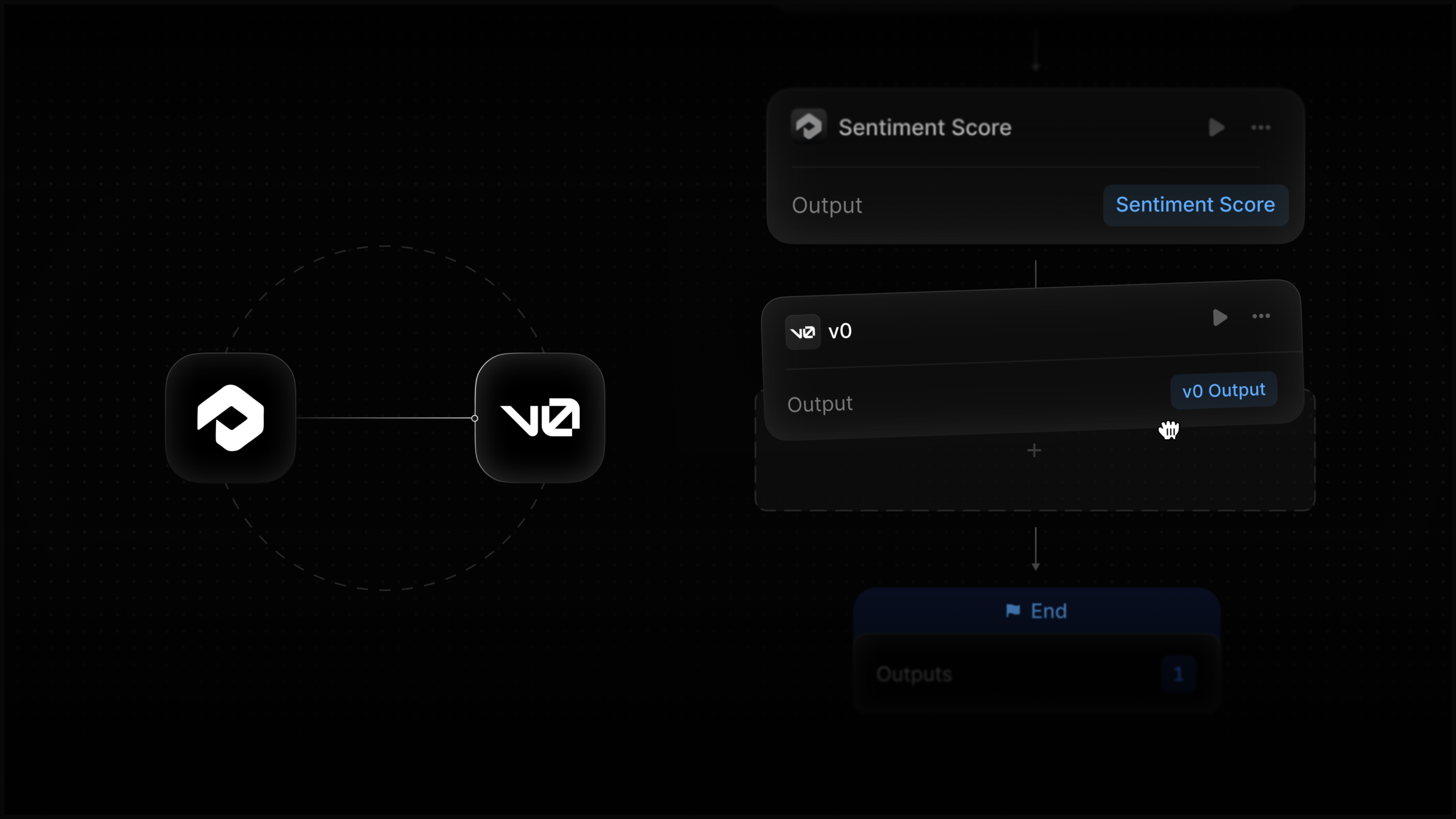
Hey there! I’m thrilled to share something exciting: Profound Agents now seamlessly connect with Vercel v0. This means I can generate and deploy stunning landing pages without writing a single line of code.
By leveraging my Profound AEO data as a solid foundation, deploying these pages has never been easier. It’s a game-changer for anyone looking to enhance their digital presence effectively and efficiently.
If European search contributes meaningful traffic, leads, subscriptions, or sales to your business, the main risk isn’t missing the EU’s announcement. It is discovering a performance change later and having no reliable baseline to explain what moved, where it moved, or whether the ruling had anything to do with it.
The ruling, the remedy, and the search change are different events
A regulatory finding does not automatically tell you what a search results page will look like, when Google will alter a system, or how users will respond. Those are separate stages. Treating them as a single event is how teams end up attributing every ranking, cost, and traffic fluctuation to regulation.
Work with three distinct clocks:
The legal clock: What the Commission decides, which conduct it addresses, what remedies it requires, and when any obligations take effect.
The product clock: What Google actually changes in search presentation, ad delivery, ranking systems, pricing mechanics, reporting, or access for competing services.
The performance clock: When those changes become visible in impressions, clicks, costs, conversions, referrals, citations, or revenue.
Do not start the product or performance clock merely because a headline appears. First confirm that the final decision requires an operational change relevant to your market. Then confirm that a change has been deployed. Only after that should you test whether your data moved in a related way.
Create an internal tracking record now. Keep confirmed facts, outside demands, possible outcomes, observed Google changes, and measured business effects in separate fields. That small distinction will prevent speculation from hardening into an unsupported performance explanation.
Watch four search surfaces, not one ranking chart
A conventional rank tracker can tell you that a URL changed position. It cannot, by itself, show whether the page gained usable visibility, whether a new search feature displaced it, whether paid inventory changed above it, or whether an AI-generated answer absorbed the click. Your monitoring needs to cover the whole search experience.
Surface
Baseline to preserve now
Signal worth investigating
First response
Organic search
Query group, landing page, country, language, device, impressions, clicks, click-through rate, average position, and visible result features
A sustained EU-specific change across related queries, pages, or result types rather than an isolated ranking movement
Inspect the actual results pages and identify which element gained, lost, or changed placement before editing content
Paid search
Campaign, country, device, query class, impressions, click volume, cost per click, impression share, conversion rate, and cost per acquisition or return on ad spend
Costs or delivery patterns moving in affected EU segments while comparable segments remain relatively stable
Check auction, placement, demand, budget, and conversion-quality signals before changing bids
AI Overviews and publisher visibility
Feature presence on a fixed query sample, cited domains, cited URLs, brand mentions, organic clicks, and publisher referrals
A repeatable change in feature frequency, source selection, citation prominence, or downstream traffic
Separate changes in AI presentation from ordinary blue-link ranking changes and record both
New or expanded discovery paths producing qualified visits or conversions
Validate traffic quality and attribution before reallocating acquisition resources
The Commission is also examining Google’s use of AI Overviews and its ranking of news publishers. Keep that scrutiny on a separate line in your change log. It may overlap with the same search ecosystem, but you should not assume every AI Overview or publisher-visibility change is part of the pending DMA decision.
This distinction matters for diagnosis. If ordinary rankings remain stable but citations inside AI-generated results change, you have a source-selection or presentation question. If ad costs move while organic layouts remain stable, you have an auction or demand question. If impressions remain steady but clicks fall after a result-page change, you have a click-distribution question. Each pattern calls for different evidence and a different response.
Build an EU search baseline before you need one
A useful baseline is not a single export labeled “Europe.” EU markets differ by language, query demand, competition, device use, campaign structure, and commercial importance. Aggregate reporting can hide a serious movement in one market behind stability in another.
Define the affected business scope. List the EU countries, languages, domains, subdirectories, storefronts, publications, and campaigns that matter to you. Assign an owner to each material segment.
Freeze meaningful cohorts. Preserve groups for branded and non-branded queries, informational and commercial intent, product or service families, news content where relevant, and the landing pages that generate business outcomes. Do not rebuild the groups after performance changes.
Add comparison segments. Use comparable non-EU markets, stable query groups, or unaffected product lines as diagnostic references. A comparison is not proof of causation; it helps show whether a movement is localized or part of a wider change.
Record the visible search environment. For a fixed query sample, capture date, country, language, device, result order, ad presence, Google-owned modules, competing services, AI-generated features, citations, and other elements that can alter attention or clicks.
Connect visibility to outcomes. Pair rankings and impressions with clicks, qualified sessions, conversions, revenue, subscription starts, lead quality, and paid acquisition costs. A visibility change with no business effect deserves a different response from a revenue change.
Log confounding events. Record site migrations, content releases, schema changes, consent changes, campaign edits, promotions, outages, seasonality, and unrelated Google updates. Without this log, a regulatory explanation can become the default simply because it is prominent.
Keep raw exports or snapshots as well as dashboards. A dashboard can be reconfigured, filtered incorrectly, or lose historical dimensions. Your preserved data should let another analyst reconstruct what users could see and what the business measured before any compliance-related rollout.
Do not rewrite your JSON-LD in anticipation of an unknown remedy. Structured data should continue to describe the page’s real entities, offers, authorship, organization, products, articles, and relationships accurately. A regulatory change to distribution or presentation does not make inaccurate schema useful. If Google later publishes new eligibility or implementation requirements, evaluate those documented requirements against your existing markup and change only what the page supports.
Apply the same discipline to AEO and GEO work. Clear answers, explicit entity relationships, attributable claims, and crawlable supporting detail remain useful, but they are not a workaround for a platform-level compliance change. Measure traditional Google visibility, AI-generated search visibility, and citations in other answer engines separately so a gain in one channel does not conceal a loss in another.
Prepare for scenarios without pretending to know the remedy
Your plan should cover plausible operational outcomes without presenting any of them as the expected verdict. The goal is not to forecast Brussels. It is to know which evidence would trigger which action.
A penalty arrives without an immediate visible search change
A financial penalty can dominate coverage while producing no immediate change that users or advertisers can see. In that scenario, annotate the decision date but leave content, bids, and technical implementation alone unless the data or the remedy gives you a reason to act. Continue monitoring for a later rollout rather than forcing a same-day explanation onto normal volatility.
A remedy changes result presentation or access
If a remedy affects how Google presents its own services, rival services, publishers, or other result types, position alone will be an incomplete metric. Compare the same queries before and after deployment. Record which modules appear, how much prominence they receive, which destinations win the click, and whether the new traffic converts.
Do not immediately rewrite pages that lose clicks while retaining rank. First determine whether the content became less competitive or whether another interface element intercepted attention. Content changes address the first problem; measurement, distribution, and channel changes may be needed for the second.
Ad serving, ranking, or pricing mechanics change
The pending decision could affect ad serving, ranking, or pricing dynamics, but the direction and size of any effect are not known. Paid search teams should preserve campaign-level and market-level baselines now, including the relationship between cost, placement, demand, conversion quality, and revenue.
If costs move, do not assume the compliance decision caused them merely because the dates are close. Check whether demand, competitors, match behavior, budgets, creatives, landing pages, tracking, or conversion mix changed at the same time. When financial exposure is material, use capped and reversible bid or budget adjustments while you investigate. A sweeping change can create additional cost and destroy the comparison you need.
AI Overview or news-publisher action moves on a separate track
A change involving AI Overviews or publisher ranking may be important without being the remedy in the core DMA search case. Label the responsible proceeding or product update whenever you can confirm it. If you cannot, describe the observation plainly – such as a change in citation frequency or publisher clicks – and leave the cause unassigned.
That restraint improves your decisions. It also keeps executive reporting credible when several regulatory investigations, product releases, and market shifts are unfolding in the same ecosystem.
Key takeaways and the response plan to use
The EU decision, Google’s implementation, and the resulting performance effect should be tracked as separate events.
A fine or demanded remedy is not evidence that a visible search change has already happened.
Segment EU performance by country, language, device, query type, page group, and paid or organic channel before relying on an aggregate trend.
Monitor search-result composition, AI citations, ad delivery, costs, clicks, and business outcomes – not rankings alone.
Keep AI Overview and news-publisher scrutiny separate from the core DMA case unless the final decision explicitly connects them.
Preserve accurate structured data and content facts; do not make speculative technical changes for an unknown remedy.
Use reversible commercial adjustments until multiple related signals support the same diagnosis.
When the decision is published
Read beyond the headline. Obtain the official decision or authoritative summary and identify the finding, conduct in scope, required remedies, geographic scope, covered services, effective dates, and unresolved points.
Write a short decision brief. Separate confirmed obligations from possible product implications. Include an explicit “unknown” section so assumptions remain visible.
Map each remedy to an observable surface. Assign organic search, paid search, analytics, publisher, AI visibility, legal, and product owners only where their systems are genuinely affected.
Annotate your measurement systems. Record the decision date, announced implementation dates, and first observed rollout separately. Do not use one generic marker for all of them.
Compare against the preserved baseline. Look for related movements across geography, device, query groups, search features, clicks, costs, and conversions. An isolated metric is a prompt to investigate, not a conclusion.
Choose the smallest reversible response. Adjust monitoring, experiments, bids, distribution, or content only to the degree supported by evidence. Preserve a comparison group wherever the business can safely do so.
Report causality carefully. Use “coincided with” or “followed” until you can connect the legal requirement, the deployed product change, and the measured effect. Timing alone does not establish cause.
If the ruling creates legal obligations for your own company, counsel should interpret those obligations. For the search and marketing teams, the immediate job is operational: preserve evidence, identify the actual implementation, and protect performance without making speculative changes.
You do not need a confident prediction to be ready. You need a clean EU baseline, named owners, a record of what changed, and a rule that no irreversible action happens before the evidence identifies the affected surface. Put those pieces in place while the decision is still pending, and the eventual verdict becomes a manageable measurement event rather than a scramble.
I’m thrilled to share that Profound Agents now seamlessly integrate with Webflow. This new capability transforms your CMS into an active automation endpoint, streamlining processes and boosting efficiency.
This integration is designed to elevate how you manage content, providing newfound ease and automation right at your fingertips. It marks a significant step forward in optimizing digital workflows, empowering me to focus more on creativity and less on manual tasks.
Your traffic can fall while your content becomes more influential. That sounds contradictory only if a visit is your sole unit of search success. People increasingly receive answers inside search results, AI interfaces, videos, forums, and social feeds, and many of those interactions never produce a website session.
Your job is not to abandon SEO or publish on every platform. It is to make your site the dependable source for a valuable decision, carry that knowledge into the environments where the decision happens, and measure whether your facts shape the answer. That requires a different content system, not merely more content.
Replace the traffic-only scorecard with an answer footprint
Organic sessions still matter. They show that someone reached property you control, where you can explain the full case and offer a next step. But sessions cannot show every place your expertise influenced discovery. Search engines can display the answer directly, AI assistants can synthesize it, and social or video platforms can satisfy the need without sending the person elsewhere.
Measure your answer footprint across four separate layers:
Discoverability: Can search engines, AI systems, and people find the relevant page or platform contribution?
Representation: Is your brand mentioned, and are its products, methods, limitations, and positions described accurately?
Influence: Is your domain cited, or is knowledge associated with your brand reflected in the answer?
Business response: Do you see qualified visits, branded searches, leads, sales conversations, or other outcomes connected to the topic?
Do not collapse these layers into one score. A citation without a click can still extend your influence, but it does not prove commercial value. A rise in branded demand may be meaningful even when the original exposure is invisible to your analytics. Conversely, an AI mention is not a success if the description is wrong or places your brand in an irrelevant category.
Organize measurement around decision clusters rather than isolated keywords. A cluster might include the main question, its prerequisites, common alternatives, implementation concerns, risks, and follow-up questions. This reflects how a person investigates a decision and gives you a stable unit to compare across Google, Bing, AI assistants, YouTube, Reddit, and other relevant environments.
Key takeaways
Keep traffic, citations, mentions, accuracy, and business outcomes as separate signals.
Give each important decision cluster one authoritative home on your website.
Expand onto platforms because your audience searches there or AI answers rely on them, not because the platform is fashionable.
Reuse the underlying knowledge, but adapt its presentation to each platform.
Scale a content pattern only after it shows durable discoverability, accurate representation, or business value.
Make your website the canonical source worth citing
Your website remains the place where you control definitions, evidence, context, updates, and conversion paths. In a zero-click environment, that role becomes more important, not less. AI-generated answers often depend on clear primary explanations from identifiable experts and organizations, even when the person reading the answer never visits the originating page.
A canonical page should do more than target a phrase. It should make a defensible contribution that another person or system can reuse without guessing what you mean. Use this publishing checklist:
Answer the central question near the beginning. State the scope and any important boundary in the same passage.
Add information that came from the work itself: a method, calculation, test procedure, decision framework, original data, documented example, expert explanation, or clearly supported position.
Write self-contained claim blocks. Give each paragraph a clear subject, enough context to stand alone, and language that does not depend on a chain of vague pronouns.
Name entities consistently. Use the same product, organization, person, feature, and category names across the page and related properties.
Show provenance. Identify the author or reviewer, explain relevant expertise, display the publication or update date, and link claims to the evidence actually supporting them.
Connect supporting pages. Link definitions, methods, comparisons, and implementation instructions so the broader topic can be understood as a coherent body of knowledge.
Give the page an owner. Someone should be responsible for correcting outdated facts and reconciling changes across distributed versions.
Structured data can clarify this page, but it cannot supply missing authority. Select the schema type that accurately describes the visible content. For an editorial page, that may include Article or BlogPosting relationships alongside the relevant Person or Organization and BreadcrumbList entities. Keep names, authorship, dates, and relationships consistent with what a reader can see. Do not mark up claims, ratings, questions, or entities that the page does not actually contain.
Treat JSON-LD as a machine-readable identity and relationship layer. The visible page still has to carry the answer, evidence, and context. Adding more schema types to a generic page does not turn it into a primary source.
The same distinction applies to AI-assisted writing. On new domains without established authority, AI-generated pages showed a rapid rise followed by a decline during a 16-month experiment. That pattern does not prove that all AI-assisted content will fail. It does show why an early ranking increase is not enough evidence for a mass-production strategy.
Use AI to reduce production friction where it helps, but put every page through a source-worthiness gate before publishing. Ask whether the page contains a claim you can defend, evidence a competing summary cannot reproduce honestly, a clear task it helps the reader complete, and an update plan. If the only differentiator is wording, the page is not ready to scale.
Match each decision to the surface where people search
Traditional keyword research can reveal demand while still missing where that demand is expressed. People may use YouTube to learn a repair, Reddit to test a claim against lived experience, TikTok to discover a restaurant, or Amazon to narrow a purchase. Those platforms also occupy conventional search results, so ignoring them can cost visibility both inside the platform and on Google or Bing.
The right surface depends on the task. One documented example found that the query about fixing a leaky sink faucet had 15 times more estimated global search volume on YouTube than in traditional search. That is a query-specific result, not a universal ratio. Its practical value is the routing lesson: a demonstration-led need may deserve a video before it deserves another text-only page.
Build a surface map for every priority decision cluster:
Collect the questions people use before, during, and after the decision. Draw from customer conversations, sales objections, support requests, on-site search, community discussions, and your existing search data.
Run the questions on traditional search engines. Record which domains, platforms, and formats repeatedly occupy the visible results.
Repeat the investigation inside the platforms that appear. Look at the language people use, the content format they choose, and the follow-up questions visible in comments or threads.
Inspect representative AI answers for the same decisions. Record cited domains, uncited brand mentions, repeated claims, omissions, and inaccuracies.
Choose the smallest set of surfaces that covers the decision well. Your selection should follow observed behavior, not a generic list of channels.
Use the nature of the question as an initial routing clue. A process that must be seen usually benefits from video. A decision shaped by first-hand trade-offs may need credible community participation. A precise definition, policy, specification, or method needs a stable owned page. A complex explanation may require a detailed page plus shorter platform-native versions that help people discover it.
Then validate the clue against actual results. Your real search competitors may be YouTube channels, Reddit communities, publishers, or marketplaces rather than businesses selling the same service. A conventional competitor list will not reveal that attention gap.
Build an owned-and-rented publishing loop
Your site is owned territory. A YouTube channel, Reddit account, Quora profile, social feed, or marketplace listing is rented territory. You need both, but they do different jobs. The owned page preserves the complete, maintainable version of your knowledge. Outside platforms make that knowledge available in the formats and communities where discovery already happens.
This distribution matters for AI visibility because citations do not come only from brand websites. Across the brand examples examined in a search-everywhere analysis, nearly 90% of citations came from third-party publications, social platforms, and forums rather than the brands’ own sites or their direct competitors. That figure is illustrative, not a benchmark for every industry. It is still a strong reason to examine the citation mix in your market before concentrating the entire strategy on your domain.
Use a publishing loop instead of copying the same text everywhere:
Define the knowledge unit. Write down the claim, its evidence, the audience it serves, the decision it changes, and the limitations that must travel with it.
Publish the canonical version on your site. Include the complete explanation, provenance, supporting links, entity relationships, and appropriate structured data.
Translate the unit for the selected platform. Demonstrate it in a video, answer the exact community question, turn the method into a visual sequence, or expose the relevant product facts in the marketplace format.
Keep identity and facts consistent. Product names, author names, category language, limitations, and key figures should not drift between versions.
Link only when the destination adds genuine value. A useful community answer should remain useful without forcing a click, while the link can provide evidence, methodology, or deeper implementation detail.
Maintain the network. When a material fact changes, update the canonical page first and then correct the versions you still control.
Adaptation is more valuable than duplication. A detailed page can explain assumptions and exceptions. A video can show the process. A forum answer can address the exact situation raised by a community member. A short social contribution can isolate one useful finding and its boundary. Each version should preserve the truth while doing the job native to its environment.
Do not try to manufacture consensus. Repeating the same brand claim through multiple controlled profiles is distribution, not independent corroboration. Fake reviews, planted recommendations, and undisclosed promotion create reputation risk and give readers a reason to distrust the underlying claim. Earn third-party reinforcement by publishing evidence others can inspect, answering real questions transparently, and giving independent experts or customers something substantive to evaluate.
When a third-party page dominates an important result, first determine why. It may offer a format your site lacks, candid comparisons your copy avoids, stronger participation, or clearer evidence. The right response may be to improve your canonical page, contribute responsibly on that platform, or earn independent coverage. Publishing another interchangeable blog page rarely closes a format or trust gap.
Measure visibility as a repeatable observation
AI visibility measurement is useful only when you can tell a content change from a testing change. Build a fixed prompt library for your important decision clusters. Include discovery questions, comparisons, objections, implementation questions, and branded questions where the brand is genuinely relevant.
For every observation, record the prompt, model, mode, date, locale, account state where relevant, answer text, cited URLs, brand mentions, competitor mentions, and any factual error. Keeping these conditions visible prevents a change in model or test setup from being reported as a content gain.
Track the following measures separately:
Owned citation presence: whether an answer cites a page on your domain.
Earned citation presence: whether an independent page cited by the answer accurately discusses your brand or knowledge.
Mention presence: whether your brand appears with or without a clickable citation.
Representation accuracy: whether the claims, categories, capabilities, limitations, and comparisons attached to your brand are correct.
Platform visibility: whether your useful contribution is discoverable inside the outside platforms selected in your surface map.
Traditional search response: whether the canonical page and relevant platform assets gain visibility for the decision cluster.
Business response: whether branded demand, qualified direct visits, assisted conversions, leads, or sales feedback move in a useful direction.
Keep a saved example behind every status. A yes-or-no citation field is easy to audit. An accuracy label should point to the exact sentence evaluated. A message-alignment field should identify which desired claim appeared, which was distorted, and which was absent. This makes the scorecard a work queue rather than a decorative dashboard.
Prioritize corrections by consequence. Fix harmful inaccuracies first. Then address high-value decisions where your brand is absent, misunderstood, or supported only by weak third-party material. After that, expand the patterns already producing accurate citations, useful platform visibility, qualified visits, or sales evidence.
Do not average citations, rankings, traffic, and revenue into one synthetic percentage. They describe different stages of discovery. The useful analysis is the connection between them: which canonical claims gained visibility, where they were repeated, how accurately they were represented, and whether the audience responded.
Start with the decision cluster closest to revenue, reputation, or a recurring customer misunderstanding. Audit its current answer footprint, strengthen the canonical page, and choose the outside surface with the clearest evidence of demand. Capture the baseline before publishing. If you cannot yet name the source-worthy claim you want others to reuse, solve that knowledge gap before increasing production.