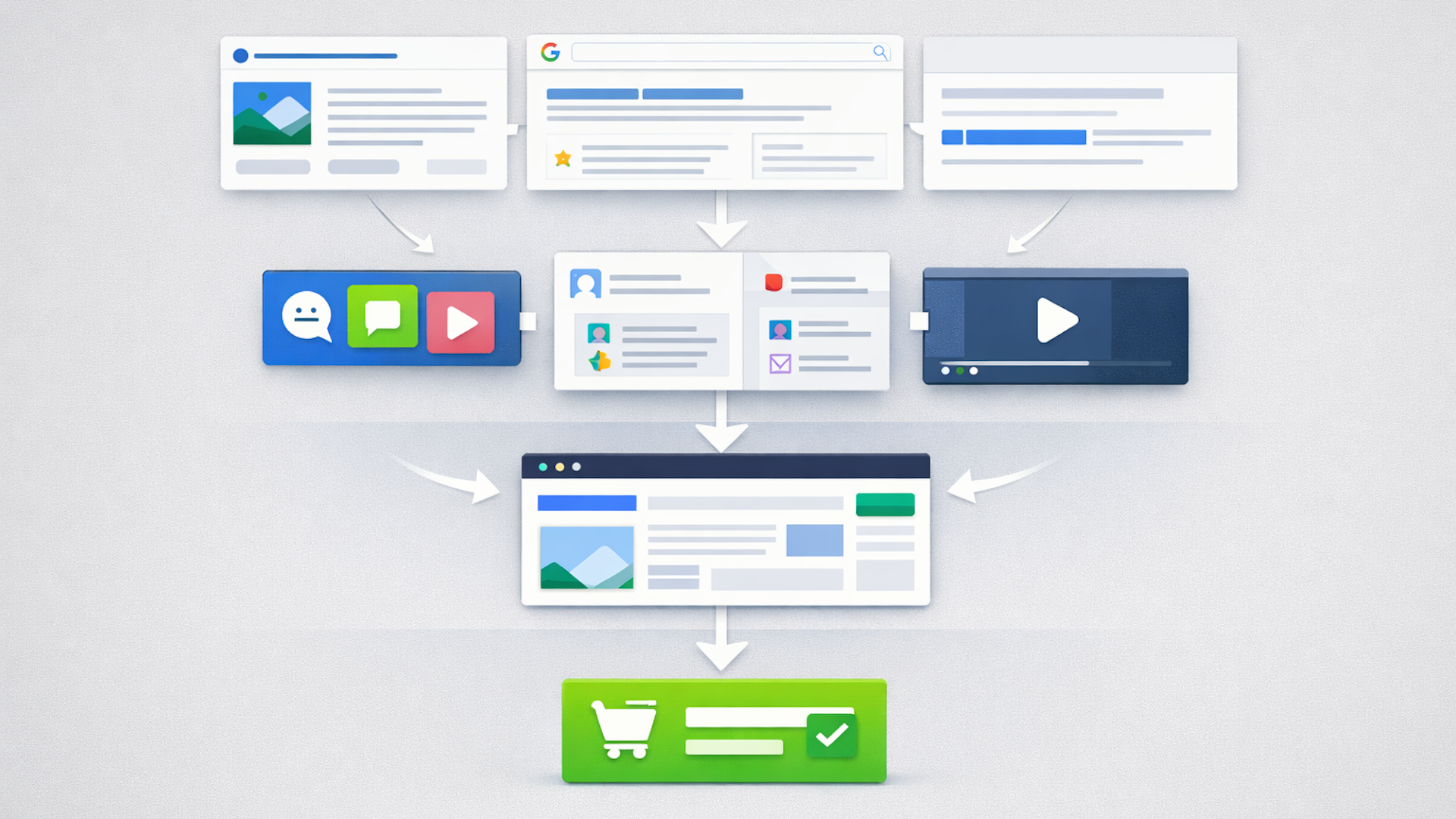
As I navigated through 2025, I kept hearing the same narrative from my SEO peers: organic traffic seemed to be dwindling, clicks were on the decline, and attribution models just didn’t make sense anymore.
The evolution of AI-driven search experiences, with zero-click results and platform-level answers, has further complicated the gap between discovery and actual visits. This has made it even tougher to report accurately on organic performance.
For many, the impact was clear—visible through double-digit declines in organic traffic and leads, year-over-year.
Leaders rightfully asked, “Why are clicks dropping? Why does organic traffic appear 25% lower than last year? Is SEO failing us?”
The truth is, organic search hasn’t ceased to be effective. Instead, our measurement methods haven’t kept up with current discovery patterns.
Why Last-Touch Attribution is Outdated
We haven’t been measuring organic search accurately.
Many organizations still cling to last-touch attribution, only spotlighting the journey’s end rather than its beginning.
Our attribution models, often linear – Search → Click → Convert – fail to capture the intricate user behavior today.
Traditional models assume that discovery leads directly to a measurable click, but AI-driven SERPs are challenging that assumption.
Last-touch attribution focuses on the finish line, ignoring the starting point of the customer journey.
In this AI-first, zero-click landscape, the gaps in attribution widen, particularly for organic search.
Our measurement isn’t entirely broken but outdated. It doesn’t tell the complete story.
We need to rethink our KPIs and redefine success metrics, painting a full picture of the customer journey from beginning to end.
Your organic dashboard can look healthy while your brand is missing from the AI answers prospects see. The reverse can happen too: search traffic stays flat, yet an answer names your company, cites your page, represents your offer accurately, and sends an identifiable visitor.
Rankings and clicks cannot distinguish those situations. You need a measurement system that shows where your brand entered the answer, how it was represented, and whether that exposure led to anything valuable. AI search therefore needs separate measures for visibility, citations, and impact across AI platforms, reported alongside traditional SEO rather than hidden inside it.
Measure the answer chain, not a single visibility score
There is no single metric that captures AI search performance. A brand can be mentioned without being cited, cited without being recommended, recommended with an inaccurate description, or represented correctly without generating a trackable visit. Calling all of those outcomes visibility removes the distinction you need to decide what to fix.
Start by defining an observation as one captured answer to one fixed prompt on one identified AI surface under logged conditions. Score each observation at several layers:
Measurement layer
Operational KPI
Calculation
Decision it supports
Answer presence
Brand presence rate
Valid observations naming your brand divided by all valid observations
Whether your entity enters relevant answers at all
Source attribution
Citation presence rate
Valid observations citing your domain divided by observations on a citation-capable surface
Whether your pages are being used as visible supporting material
Source competition
Owned citation share
Unique citations to your URLs divided by all unique citations captured in the measured answer set
How much of the cited-source space your site occupies
Representation
Accurate representation rate
Accurate brand descriptions divided by all brand descriptions reviewed
Whether visibility is helping or creating a correction problem
Recommendation
Recommendation inclusion rate
Choice-oriented observations presenting your brand as a suitable option divided by valid choice-oriented observations
Whether the brand appears when the user is evaluating options
Traffic
AI referral conversion rate
Desired actions from identifiable AI referral sessions divided by identifiable AI referral sessions
Whether trackable AI traffic completes the action the page is meant to support
Business outcome
Qualified AI-sourced outcomes
Qualified leads, purchases, sign-ups, or other accepted outcomes connected to direct or declared AI discovery
Whether AI discovery contributes value beyond exposure
Keep these metrics separate in the working dashboard. A composite score can be useful for an executive summary, but it should never be the only view. If the score falls, the team must be able to see whether the problem is lost presence, fewer citations, an accuracy error, weaker traffic, or lower conversion.
The distinctions are operational. A brand mention without a link is evidence of answer presence, not citation performance. A linked page with no brand recommendation is evidence of source use, not preference. A recommendation containing an incorrect product claim is a visibility gain and a representation failure at the same time. Preserve both labels.
Build a prompt panel you can measure repeatedly
An AI search dashboard is only as credible as its prompt set. If the prompts change every time someone checks, movement in the dashboard may reflect different questions rather than different performance. Build a fixed panel for trend measurement and a separate exploratory panel for discovering new behavior.
Start with the decision, topic, and audience
Write down the decision the measurement should inform before collecting answers. Should you update category explainers, strengthen comparison content, correct entity information, improve a landing page, or investigate a competitor’s citation advantage? A metric without a pending decision becomes a trophy.
Then set the scope. Name the product or service category, audience, market, language, and stage of consideration. Do not combine unrelated topics merely to produce a larger visibility number. A brand can perform well for educational prompts and disappear from evaluation prompts; averaging them conceals the gap.
Cover the ways a person reaches a decision
Your fixed panel should contain distinct prompt families. Use the language your audience would naturally use, but assign every prompt a stable identifier and preserve its exact wording.
Problem discovery: prompts that describe a need without naming a solution category.
Category education: prompts asking how a type of product, service, or method works.
Evaluation: prompts asking which criteria, capabilities, or tradeoffs matter.
Comparison and fit: prompts asking which options suit a defined situation.
Risk and validation: prompts asking what could go wrong, what to verify, or what evidence to require.
Branded verification: prompts asking about your company, product, claims, policies, or compatibility.
Report branded prompts separately from unbranded prompts. If the company name appears in the question, the resulting mention does not demonstrate unprompted discovery. Branded prompts are still useful for checking accuracy, positioning, and cited sources, but they answer a different question.
Log the conditions surrounding every answer
The same wording can produce different answers across surfaces or repeated runs. Context from an earlier conversation can also change the response. Start a fresh conversation for a controlled observation, or store the full preceding conversation if multi-turn behavior is what you intend to test.
Each observation record should include:
Prompt ID and exact prompt text
Prompt family, topic, audience, language, and market
Platform, product or model label shown, and answer mode or surface
Whether the session was signed in and whether prior conversational context existed
Collection date and time
Complete response text and a durable capture, such as a saved transcript or screenshot
Whether the response completed successfully and was suitable for scoring
Reviewer name or identifier and the version of the scoring rules used
You may not be able to control every form of personalization. Logging known conditions lets you separate unlike observations instead of presenting them as a clean trend.
Treat repeated answers as observations, not ranking positions
An AI answer is not a fixed search result position. Repeating a prompt can produce a different set of brands, citations, or wording. One answer is therefore a captured observation, not proof that a brand always appears or never appears.
Repeat the fixed prompts on a consistent cadence and calculate rates across the resulting observations. Always show the numerator and denominator beside the percentage. A presence rate based on a small or partially failed run set should not look as authoritative as one based on a complete panel.
Version the panel whenever you add, remove, or rewrite prompts. Keep the previous version’s results intact and mark the break in the trend. Compare each platform and surface with itself before creating a cross-platform summary; otherwise, a product change or a shift in the platform mix can masquerade as improvement in your content.
Collect citations, accuracy, and outcomes with a codebook
Automated collection can save time, but the scoring rules still need human-readable definitions. Without a codebook, one reviewer may count a passing reference as a recommendation while another counts only a direct endorsement. The dashboard then measures reviewer interpretation as much as AI performance.
Use labels that another reviewer can reproduce
Write a short rule and at least one boundary case for every label. A workable starting codebook looks like this:
Brand mention: the response names the company, product, or an unambiguous tracked variant. A generic category reference does not count.
Owned citation: a visible citation or source link resolves to a domain you control. A mention of the brand without a source link does not count.
Recommendation: the response presents the brand as a candidate for the user’s stated need. Appearing in background context does not count.
Accurate: material factual claims about the brand agree with the current canonical information you maintain.
Incomplete: the answer omits information necessary to interpret a material claim correctly, without making a directly false statement.
Incorrect: the answer makes a material factual claim that conflicts with current canonical information.
Unverifiable: the reviewer cannot confirm the claim from an approved internal or public record. Do not silently score uncertainty as an error.
Competitor presence: a named tracked competitor appears under the same mention and recommendation rules applied to your brand.
For citation counts, decide how repetition is handled before collection. A defensible convention is to count the same URL once per answer, even if the interface repeats it. Store both the normalized URL and its domain so you can inspect individual page performance without treating URL variants as different publishers.
Review a sample of observations twice or have a second reviewer score them independently. When labels disagree, improve the rule before expanding collection. The aim is not to force agreement through discussion after every run; it is to make the definition clear enough that future scoring is consistent.
Keep direct attribution separate from directional evidence
AI influence is not always accompanied by a click, and a citation is not proof of a sale. Use an attribution ladder so stakeholders can see how strong each connection is:
Directly observed: an identifiable AI referral session completes a tracked action, or a known referral appears in a documented customer journey.
Declared: a prospect or customer identifies an AI assistant as the way they discovered or evaluated the brand. Store this separately from browser referrer data.
Directionally associated: branded demand, direct visits, leads, or sales move alongside answer presence without a person-level connection. Use this to form a hypothesis, not to claim causation.
Unknown: no reliable discovery or referral evidence exists. Leave it unattributed instead of assigning credit to complete the report.
Connect identifiable referrals to landing pages, engagement events, conversions, qualified-lead status, purchases, or another accepted business outcome. Deduplicate records when web analytics, forms, and a CRM describe the same person or transaction. Otherwise, one journey can become several outcomes in the report.
Compare AI referral quality with the action each landing page is designed to support. A documentation visit, product comparison visit, and purchase-page visit should not be judged by one universal conversion event. The useful question is whether the visitor completed the appropriate next step.
Do not convert missing click data into assumed business value. A no-click citation may still support awareness or trust, but the measured result remains a citation unless you also have declared or observed outcome evidence.
Turn the scorecard into diagnoses and controlled changes
A good dashboard should tell the team what to inspect next. Give every metric a baseline, current numerator and denominator, change from baseline, prompt segment, platform filter, and link to the underlying captures. Add an issue queue for incorrect answers and a change log for content, technical, schema, and platform events.
Read combinations of metrics as diagnostic signals:
Low presence and low citation presence: inspect whether your content covers the measured need clearly, whether the relevant page is accessible, and whether the brand or product is described consistently. Do not assume the problem is a missing schema type before checking the visible content.
Brand mentions without owned citations: inspect which external domains are being cited, what claims they substantiate, and whether your own page provides an equally clear primary explanation or evidence.
Owned citations without brand mentions: your material may support an answer while the entity receives no visible credit. Review the cited passage, page title, authorship, organization naming, and relationship between the claim and the brand.
Strong presence with representation errors: prioritize correction over expansion. Reconcile conflicting descriptions across current pages, structured data, documentation, profiles, and other canonical records.
Recommendations without referrals: verify whether the surface presents clickable citations and whether the cited page offers a sensible next step. Do not automatically label the recommendation ineffective; report the observed recommendation and the missing referral separately.
AI referrals with weak downstream action: inspect prompt intent, cited landing page, message match, and conversion path. More answer presence will not resolve a landing page that serves the wrong stage of consideration.
Improvement on only one platform: preserve it as a platform-specific result until comparable observations show broader movement.
These patterns narrow the investigation; they do not prove a cause. The next step is a controlled content or technical change.
Run an experiment that can survive scrutiny
State one hypothesis linking a specific change to one measurement layer. For example, clarifying the canonical product description is expected to reduce representation errors for the affected prompt group.
Select the page or page cluster being changed and, where practical, a comparable untouched cluster that can reveal wider platform movement.
Capture a baseline with the fixed prompt panel and current scoring codebook.
Make one material intervention and record exactly what changed. If several changes must ship together, treat them as one bundle and do not assign the result to an individual component.
Confirm that the updated page is live and available through the technical paths you can verify before judging the intervention.
Repeat the same prompts under comparable conditions and report movement at every relevant layer, not just the preferred KPI.
Retain the response captures, scoring decisions, content version, and known platform changes so another person can audit the conclusion.
JSON-LD belongs in the implementation and quality-assurance record, not in the outcome column. Track whether the required markup is valid, whether its entities and relationships match visible content, and what changed. A successful validation does not by itself demonstrate answer presence, citation, accurate representation, referral traffic, or business impact.
Avoid declaring a content win when the prompt panel, platform, model label, scoring rules, and page all changed together. If you cannot isolate the intervention, describe the movement accurately as an observed change and schedule a cleaner test.
Key takeaways
Measure answer presence, citations, representation, recommendations, traffic, and business outcomes as separate layers.
Use a fixed, versioned prompt panel for trends and a separate exploratory panel for discovering new questions.
Treat each captured response as an observation, not a permanent ranking position.
Publish the numerator, denominator, platform, prompt segment, and collection conditions behind every rate.
Use reproducible definitions for mentions, citations, recommendations, accuracy, and competitor appearances.
Separate directly observed attribution from declared discovery, directional evidence, and unknown influence.
Use metric combinations to choose the next investigation, then test one documented intervention against the same prompt panel.
Your practical starting point is one important topic, one defined audience, and a prompt panel small enough to rerun consistently. Capture the baseline, label every answer at each layer, and connect only the referrals and outcomes you can support with evidence. That gives you a measurement system you can improve without overstating what AI visibility has accomplished.
Your App Store search campaign can now qualify for ad positions you never selected. That creates another route to potential installs, but automatic eligibility also means delivery can change before your bids, product pages, and measurement plan do.
You don’t need to rebuild the account to participate. You do need a clean baseline, a tighter relevance audit, and a rule for deciding whether additional volume is actually profitable. Otherwise, higher spend can look like growth even when install economics are deteriorating.
Existing search results campaigns are automatically eligible. There is no separate placement switch to activate.
You cannot select a particular search-results position or bid specifically for one. Apple determines placement using relevance and bid.
Ad formats and billing remain the same: ads can use a standard or custom product page, optional deep links can lead to an in-app destination, and billing remains cost per tap or cost per install.
Apple’s reported conversion rate of more than 60% applies to top-of-search ads on average. Do not treat it as a promised benchmark for every keyword, market, or new lower-page position.
What changes, what stays fixed, and what you control
The most important distinction is between inventory and control. Apple is increasing the number of places where a search ad may appear, but it is not giving advertisers a position selector. Your campaign can enter more placement opportunities without gaining the ability to demand the top slot or exclude the lower ones.
Campaign element
What the expansion means
What you should do
Search-results inventory
More than one sponsored ad can appear for a query, at the top and farther down the page.
Measure whether added delivery produces incremental installs at an acceptable cost.
Establish a baseline before changing bids, keywords, or product pages.
Position
Apple chooses where an eligible ad appears.
Do not build a strategy that assumes a bid increase buys a specific slot.
Matching
Search ads continue to match through advertiser-selected or Apple-suggested keywords.
Audit the connection between each important keyword, its intent, and the destination page.
Creative and destination
The ad can use a standard product page or a custom product page, with an optional deep link.
Choose the page that most directly continues the promise implied by the keyword.
Billing
Cost-per-tap and cost-per-install billing remain available.
Keep the commercial decision anchored to install value rather than raw visibility.
Device support
The additional positions are supported on devices running iOS or iPadOS 26.2 and later.
Remember that a mixed device audience may not encounter the expanded layout uniformly.
Apple scheduled the first phase for the UK on March 3, with Japan following and all Apple Ads markets expected to be included by the end of March. That staggered schedule makes market-level annotations important. If you do not record when exposure could have changed, later analysis can confuse the rollout with seasonality, a product release, a pricing change, or another campaign edit.
Do not interpret extra inventory as a new targeting system. The campaign is still built around keyword relevance, the product-page experience, and the economics of a tap becoming an install. The expansion changes where an eligible ad may be delivered, not the basic job the ad must do.
Build a baseline before you react to the new inventory
Automatic eligibility turns measurement into the first task. If you raise bids, add keywords, replace product pages, and increase the budget at the same time, you will not know whether a performance shift came from the extra placements or from your own changes.
Mark the rollout in your account records. Record the relevant market date and note that the additional placements require iOS or iPadOS 26.2 or later. Use the most precise market and device information your reporting actually provides; do not assume a dimension exists if it is not visible in your account.
Save a comparable pre-expansion view. Capture impressions, taps, installs, conversion rate, spend, cost per tap, and cost per install for each important market, campaign, and keyword. Use a period that reflects the normal buying cycle of your app rather than an arbitrarily short snapshot.
Document other variables. Note product releases, store-listing changes, promotions, pricing changes, tracking updates, and budget edits. Each can move conversion independently of ad position.
Set an economic guardrail. Decide the highest cost per install the business can support before more volume arrives. Base that ceiling on the value and quality of an acquired user, not on a competitor’s bid or a platform-wide conversion claim.
Verify conversion measurement. Confirm that taps and installs are being attributed as expected. If you use deep links, test that each one opens the intended in-app destination for the relevant user journey.
Avoid unnecessary simultaneous changes. Keep the first observation window as stable as the business allows. When an urgent edit is unavoidable, annotate it so the resulting data is not mistaken for a placement effect.
A before-and-after comparison is useful, but it is not proof of incrementality. During a staggered rollout, a comparable market that has not yet changed can provide a directional check. It is only a useful comparison when demand patterns, promotions, and app availability are genuinely similar. Once all markets are included, rely on annotated within-market trends and be explicit about competing explanations.
Expect aggregate metrics to move in different directions. Total installs can rise while conversion rate falls because the campaign is reaching additional inventory with different user behavior. That is not automatically good or bad. The decision turns on whether the added installs remain valuable at the resulting cost per install.
Write down the intent behind the keyword. Is the person looking for your brand, a broad app category, a specific task, or a particular feature? If the intent is ambiguous, do not pretend one product page can answer every possible meaning.
Match the page to that intent. Use the standard product page when it accurately represents the query. Use a custom product page when a distinct use case needs different screenshots, copy, or emphasis.
Check the first visible promise. The opening product-page experience should make the connection immediately. If the query implies one task but the page leads with another, more traffic will magnify the mismatch.
Use deep links as a continuation, not a shortcut. A deep link is useful when the destination completes the journey implied by the ad. It is counterproductive when it drops the user into an unrelated or contextless part of the app.
Remove mismatches you cannot fix. If a keyword’s intent cannot be represented truthfully by the app or its page, a larger bid is not the remedy. Refine or pause the keyword.
This is also why paid acquisition and App Store optimization cannot be managed as isolated disciplines. Search ads use the product-page experience to turn intent into an install. A weak listing is therefore both an organic discoverability problem and a paid conversion problem. Extra ad slots increase the cost of leaving that handoff unresolved.
Be careful with Apple’s top-of-search benchmark. Apple reports an average conversion rate above 60% for ads in that position, but the figure is vendor-supplied and specific to top-of-search performance. It does not establish how the additional lower positions will perform in your market. Use it as context, not as a forecast or account target.
A global bid increase is a poor first response. Because you cannot purchase a named position, a higher bid does not guarantee that the added spend will secure the top placement. Hold bids steady long enough to observe the change where practical, then adjust one major lever at a time: keyword scope, bid, product page, or budget. That sequence keeps the diagnosis legible.
Decide whether the added delivery deserves more budget
More impressions are an inventory result. More taps show that users responded. More valuable installs are the business result. Keep those three questions separate when you evaluate the expansion.
Impressions and taps rise, while cost per install stays within your guardrail: the additional inventory may be adding efficient reach. Increase budget gradually and keep watching keyword-level conversion rather than assuming the first result will persist.
Spend and installs rise, but cost per install exceeds the guardrail: the campaign is buying volume that the business may not be able to support. Reduce exposure to weak keywords, improve the matching product page, or lower bids before approving more budget.
Taps rise while installs remain flat: investigate the handoff from query to page. Check tracking first, then review intent alignment, product-page clarity, and any deep-linked destination. Do not use a bid increase to solve a conversion failure.
Impressions rise but taps do not: eligibility is not the same as appeal. Revisit whether the keyword and visible product-page message give the searcher a clear reason to choose the app.
Little changes: automatic eligibility does not guarantee meaningful delivery. Leave the campaign alone unless another metric provides a reason to act.
Cost pressure is possible, but it should not be assumed. More ads on a results page can intensify competition for high-intent searches, while more available inventory can also alter the supply of opportunities. The net effect depends on the auction, query, market, and relevance of your ad. Let observed cost per install and conversion quality decide the response.
Review the keywords responsible for most of your spend first. Map each one to its intended product page, confirm conversion tracking, record the rollout date, and set the cost-per-install ceiling before changing the bid. When the expanded inventory produces installs inside that boundary, scale deliberately. When it only produces activity, fix the journey or decline the extra volume.
If you are shortlisting AI software companies, a generic ranking answers the wrong question. A company can lead at the model layer and still be a poor choice for deploying a governed workflow inside your business.
Your real task is to identify the kind of company you need, define what leadership means for your use case, and make each candidate prove it with your workflow and representative data. That turns a crowded market into a decision you can defend.
Start with the job, not the company ranking
There is no useful universal winner. A packaged AI application, a model provider, a cloud platform, and a custom development company solve different parts of the problem. Ranking them together is like ranking an engine, a delivery van, and a logistics contractor on the same scale.
Before you collect vendor names, write a short procurement brief. It should be specific enough that another person could recognize a successful deployment without hearing the sales pitch.
Workflow: Name the task or decision the software will support. Avoid broad goals such as “use AI for marketing.” A workable definition is closer to “produce a cited first draft from approved product documentation for an editor to review.”
Owner: Identify the person accountable for the workflow after launch. A sponsor can approve a purchase, but an operational owner has to manage errors, updates, and user adoption.
Inputs: List the documents, databases, messages, images, or application events the system may use. Record where that data lives and who has permission to expose it.
Output and action: State what the system produces and what happens next. Distinguish a suggestion shown to a person from an action executed in another system.
Failure boundary: Describe acceptable mistakes, unacceptable mistakes, and the point at which a human must intervene. A formatting error and an invented compliance claim cannot share the same severity.
Environment: Name the identity system, content repository, analytics stack, customer platform, or other software the product must work with.
Evidence: Define what a candidate must demonstrate using representative cases. A polished demonstration using vendor-selected examples is not evidence of fit.
Exit conditions: Decide what data, configurations, prompts, evaluation cases, logs, and code you must be able to recover if you change providers.
If you cannot complete this brief, pause the vendor search. When the outcome is vague, almost any demonstration can look successful, and disagreements about quality appear only after money and integration work have been committed.
Compare companies that perform the same role
The label leading AI software development companies can cover businesses with very different products and delivery models. Put each candidate into a functional category before you compare features, pricing, or market visibility.
Company type
Choose it when
Evidence to request
Common mismatch
Model or API provider
Your team is building its own application and needs model capabilities as a component.
Results on your evaluation cases, usage controls, model-change procedures, latency behavior, and data-handling terms.
Buying raw capability when you do not have the engineering or operational team to turn it into a reliable workflow.
Cloud or data platform
Your priority is connecting AI to governed data, existing infrastructure, and enterprise controls.
Architecture fit, identity integration, data boundaries, deployment options, monitoring, and portability.
Assuming platform breadth means the desired business application is already complete.
Packaged AI application
You need a defined outcome in a familiar function such as content operations, support, analytics, or sales workflow.
Workflow coverage, administrator controls, export options, user permissions, integration depth, and evidence from representative tasks.
Paying for a broad feature set while the product remains weak at the narrow task that matters.
Workflow or agent platform
You need AI to coordinate steps, tools, and approvals across systems.
Action permissions, state handling, retries, approval gates, audit logs, failure recovery, and limits on autonomous behavior.
Treating an impressive prototype as a dependable operational process.
Custom AI development company
No packaged product fits the workflow, or your process and data create meaningful differentiation.
Proposed architecture, delivery ownership, evaluation method, repository access, documentation, deployment plan, support model, and intellectual-property terms.
Commissioning custom software before confirming that the workflow is stable enough to specify and maintain.
AI operations or governance provider
You already have AI systems and need evaluation, observability, policy enforcement, or control across them.
Coverage of your actual stack, alert quality, policy implementation, evidence retention, and response procedures.
Expecting a control layer to repair poor application design or unsuitable source data.
A candidate can belong to more than one category, but you should still name the role you are buying from it. Otherwise, a vendor’s strength in one layer can distract you from a gap in another. If you need a finished application, model quality alone does not settle the decision. If you need a model component, a large catalogue of packaged features may be irrelevant.
Turn “leading” into pass-or-fail requirements
Feature counts reward breadth, and weighted scorecards can hide a fatal weakness behind a high total. Use non-negotiable gates first. Score or rank only the companies that pass every gate that protects the workflow.
Task performance: The product must produce usable results on ordinary cases, difficult edge cases, and inputs that should trigger refusal or escalation. Define “usable” in terms of the next step in the workflow, not whether the output sounds polished.
Evaluation discipline: Ask how the company detects regressions and separates different error types. For generated answers, completeness, factual support, citation quality, format compliance, and harmful fabrication are different dimensions. A blended quality claim can conceal the failure that matters most to you.
Data governance: Get written answers about retention, use of customer data for training, storage location, deletion, subprocessors, tenant separation, and access by vendor personnel. Product controls and contract language should agree.
Security and human control: Confirm authentication, role-based access, approval steps, auditability, and the ability to stop or override automated actions. The more consequential the action, the less acceptable an invisible decision path becomes.
Integration depth: Distinguish a live, supported integration from a demonstration, roadmap item, or generic API. Verify the exact records the system can read, create, update, and export.
Operational resilience: Ask what happens when a model, connector, data source, or downstream system fails. A production workflow needs observable errors, safe fallbacks, ownership, and a recovery procedure.
Commercial fit: Calculate the cost of the working process, including usage, integration, human review, monitoring, support, and ongoing evaluation. A low software price can still produce an expensive workflow if reviewers must repair most outputs.
Exit viability: Confirm that you can retrieve business data and the operational assets needed to continue elsewhere. For custom development, define ownership of code, prompts, configurations, documentation, and deployment materials before work begins.
Treat unsupported roadmap promises as unavailable. Record each capability as proven, contractually committed, or absent. Those labels keep a persuasive demonstration from turning future intent into present functionality.
References and customer logos can help you understand where to investigate, but they do not replace workflow evidence. Ask references about deployment effort, failure handling, support after the sale, and what their internal team still has to operate. A similar industry is useful; a similar data shape, risk level, and workflow is better.
Run a production-shaped proof before you commit
A proof should test the operating system around the AI, not just the most attractive output. Keep the workflow narrow enough to inspect closely, but preserve the data conditions, permissions, integrations, and review steps that will exist in production.
Freeze the use case. Give every candidate the same workflow definition, input boundaries, expected output, and failure rules. Do not let each vendor redefine success around its strongest feature.
Build the evaluation set. Include routine examples, ambiguous inputs, incomplete information, edge cases, and requests the system should decline or escalate. Keep a portion of the cases out of vendor-led configuration so you can see how the system handles unfamiliar inputs.
Protect sensitive information. Use de-identified or synthetic material until contractual, security, and internal approvals permit representative production data. When real data becomes necessary, expose only what the approved test requires.
Record configuration work. Track the prompts, rules, connectors, data cleanup, and human assistance required to achieve the result. A system that performs well only after extensive hidden preparation may carry a much higher operating cost than the demonstration implies.
Test the whole handoff. Measure whether users can review, correct, approve, reject, and trace the output inside the intended workflow. A strong answer copied manually between applications may still be a weak production solution.
Force recoverable failures. Remove a source, deny a permission, provide conflicting information, or interrupt a downstream service in a controlled test. Check whether the system fails visibly, preserves state, avoids unsafe actions, and gives an operator a clear recovery path.
Review the evidence by error type. Keep a failure log that identifies what went wrong, its consequence, whether a person detected it, and whether the proposed fix is repeatable. Do not average a severe failure into a reassuring overall score.
Price the observed workflow. Use the actual configuration, workload shape, review effort, support requirement, and integration pattern from the proof. Model an increase and decrease in usage so you can see which charges are fixed and which scale with activity.
Test the exit. Export representative data and configuration, inspect its format, and identify what cannot move. For a custom system, verify access to the repository, build instructions, environment configuration, and operating documentation.
The proof should leave you with artifacts you can inspect later: the frozen evaluation set, result sheet, failure log, data-flow map, architecture diagram, cost model, operating runbook, and exit plan. If the only durable artifact is a presentation, you have evaluated a sales process rather than a production system.
Reject any company that fails a non-negotiable gate, even if it has the highest total score. Among the survivors, prefer the option that reaches the required outcome with the clearest controls, lowest operational burden, and most credible path out. That is a more useful definition of leadership than size, visibility, or the longest feature list.
Key takeaways for your shortlist
Define the workflow, owner, data, action, failure boundary, evidence, and exit conditions before collecting vendor names.
Compare model providers with model providers, applications with applications, and development companies with development companies.
Make task performance, data governance, security, operational resilience, economics, and exit viability pass-or-fail gates.
Use the same production-shaped evaluation cases for every candidate, and keep severe errors visible instead of burying them in an average.
Count configuration, integration, review, monitoring, and support when calculating cost.
Choose the company that can prove the required outcome and remain operable when inputs, systems, or providers change.
Take your current list and write each company’s intended role beside its name. Remove candidates that solve a different layer, send the survivors the same procurement brief, and do not declare a leader until the proof produces evidence your operational owner is willing to accept.
An ad can be approved, the budget can be live, and the creative can be right while every click goes to the wrong page. That is why campaign URL quality control cannot end with confirming that the link opens.
When the launch window is fixed, recovery time becomes part of the loss. A single URL mistake can put a Black Friday campaign into recovery mode while paid traffic is already moving. The practical fix is a release gate that proves three things before spend starts: the visitor reaches the intended experience, the click retains its tracking data, and the measurement system records what you expect.
Start with a URL contract, not a list of links
A final URL is correct only in relation to an approved expectation. Give a reviewer nothing but a link and a homepage fallback can look healthy, an old promotion can look plausible, or a valid page on the wrong regional site can pass unnoticed.
Before URLs enter the advertising platform, create one manifest row for every unique click path. A click path is unique when its destination, locale, offer, required tracking values, redirect behavior, or platform template differs. Several ads may share one row if they truly emit the same URL and promise the same experience.
Control
Acceptance rule
Evidence to retain
Destination
The approved hostname and intended content path are reached.
The emitted URL and final resolved address.
Campaign promise
The headline, offer, locale, currency, availability, and call to action agree with the creative.
A capture of the clickable campaign element and landing page.
Tracking
Required parameter names and values are present, survive redirects, and follow the naming taxonomy.
The emitted URL, redirect record, and exact test values.
Measurement
The test visit appears in the intended analytics or advertising system with the expected attribution.
A timestamp and identifiable test record.
Search state
Canonical, indexing, metadata, and structured-data decisions match the landing-page plan.
The checked page state and approval result.
Ownership
A named builder and reviewer have approved the current version.
The version, review time, status, and any documented exception.
Keep both the intended URL and the URL actually emitted by the campaign platform. They are not always identical. Tracking templates, macros, redirects, and automatic parameters can change what the visitor receives. If you preserve only the destination copied from a spreadsheet, you cannot prove what was deployed.
Inspect the URL as four connected layers
A link can pass one kind of test and fail another. Separate structure, redirects, page experience, and measurement so that a successful page load does not hide a tracking or content error.
1. Parse the URL instead of scanning it by eye
Long campaign URLs are difficult to compare visually. Break each one into its scheme, hostname, path, query parameters, and fragment. Compare those components with the manifest as data, not as one long string.
Confirm the hostname exactly, including any regional or campaign subdomain. A familiar brand name on the wrong host is still the wrong destination.
Treat path spelling, capitalization, and trailing slashes as meaningful until the live server proves otherwise. Different systems can resolve them differently.
Require every mandatory query parameter exactly once. Flag missing, empty, duplicated, or unexpected keys instead of guessing which value will win.
Check parameter values against the approved naming taxonomy, including capitalization, separators, campaign labels, and channel names.
Reject whitespace, unresolved template variables, copied punctuation, and malformed separators.
Validate percent-encoding when values contain spaces or reserved characters. An unencoded ampersand, for example, can be interpreted as the start of another parameter.
Do not place server-side tracking expectations after the number sign. A fragment is handled by the browser and is not included in the request sent to the server.
A small validator can automate these checks across the entire manifest. Give it an allowlist of production domains, required parameter keys, approved value patterns, and known obsolete paths. Automation should identify the exact row and rule that failed; it should not silently repair an ambiguous URL and approve the result.
2. Follow every redirect to the resolved destination
The first URL is only the start of the route. A redirect can send the visitor to an old slug, switch the hostname, choose a regional site, remove a parameter, or fall back to the homepage. Test the whole route and record each address in sequence.
Confirm that every redirect is expected and owned by a known system.
Compare the parameters before and after each redirect. Required values must not disappear, change, or become duplicated.
Flag an unexpected domain, locale, login page, homepage fallback, or error page even when the final page technically loads.
Check that platform macros have rendered into real values. A literal placeholder in the emitted URL is a deployment failure.
Document intentional canonicalization, such as a redirect from an old approved slug to a new preferred path, so future reviewers do not treat it as unexplained behavior.
Store the original configured URL, the platform-emitted URL, and the final resolved URL separately. That distinction tells you whether an error entered through campaign setup, platform rendering, a redirect service, or the website.
3. Test the page state the visitor will actually receive
A correct address can still produce the wrong experience. Open the link in a clean, logged-out session so that an existing account, cookie, or cached redirect does not hide the default visitor path. Then test only the additional states that can materially change this campaign, such as device class, locale, authentication, consent choice, or audience routing.
Match the landing-page headline and offer to the promise made by the ad or campaign element.
Check the price, currency, promotional conditions, availability, and expiration language where they apply.
Use the primary call to action. Confirm that its next page, form, checkout, download, or booking path is the intended one.
Submit forms with approved test data and verify that required fields, confirmation states, and downstream handoffs work.
Confirm that mobile-specific buttons, sticky controls, cookie notices, or overlays do not block the action.
Check what happens when optional campaign parameters are missing, empty, duplicated, or unrecognized. The fallback should be intentional.
Where structured data is present, verify that its offer, availability, dates, organization, and destination agree with the visible page. Stale machine-readable details are still a quality-control failure.
Confirm the intended canonical and indexing state. When tracking parameters do not change the page’s meaning, the preferred clean URL should normally remain the canonical destination; intentionally isolated or non-indexable campaign pages need their own documented rule.
Do not approve a page merely because it returns content. A polished page for the wrong product, market, or promotion is a more dangerous failure than an obvious broken link because it can survive a superficial review.
4. Prove collection, not just parameter presence
Tracking validation requires three separate proofs. First, the emitted URL contains the expected names and values. Second, those values survive the route to the destination. Third, the receiving measurement system records the visit as intended. Passing the first two does not prove the third.
Click through the rendered campaign element or the platform’s preview and test mechanism. Copying the manifest URL bypasses platform-level templates and additions.
Record the click time, emitted URL, final URL, consent state, and exact campaign values so the test visit can be located downstream.
Verify the visit in each system the campaign depends on, rather than assuming one analytics record proves that every advertising or reporting destination received it.
Check the recorded values themselves. A session attributed to the wrong source, medium, campaign, market, or creative is not a pass.
Use non-billable preview or test functions when the platform provides them. If a controlled live click is required, define who may perform it and how the resulting test activity will be identified.
Take care with privacy and consent behavior. The acceptance rule should describe what is expected before and after consent for the jurisdictions and technologies involved. A missing record can be correct under one consent state and a genuine implementation fault under another.
Turn the checks into a release gate
A checklist helps only when a failed check can stop deployment. Build URL QA into the same approval path as creative, audience, budget, and launch timing. The manifest becomes the release record, and any material edit resets approval for the affected rows.
Inventory every clickable element. Include primary ads, additional assets, buttons, email links, social placements, affiliate links, QR destinations, and any alternate mobile or regional routes in scope.
Freeze the expected state. Record the approved destination, campaign promise, tracking taxonomy, page state, owner, and version before platform setup begins.
Generate URLs from controlled inputs. Use a governed builder or template where possible. Prevent free-form labels when a controlled campaign name or channel value already exists.
Run structural checks across every row. Validate syntax, allowed domains, required keys, values, duplicate parameters, obsolete paths, and unresolved variables in bulk.
Click every unique rendered path. Test from the final platform context or the closest safe preview, not only from the spreadsheet or URL builder.
Verify destination, action, redirects, and collection. Retain enough evidence to reproduce the result without relying on memory.
Require an independent review. A second person should compare the deployed path with the approved contract. The builder should not be the only approver for a fixed-date or high-spend launch.
Lock and label the approved version. Any later change to the URL, template, redirect, offer, page, consent implementation, or tracking taxonomy must reopen the relevant checks.
Define blockers before launch pressure arrives
Separate blockers from warnings in advance. Otherwise, launch urgency turns every failure into a judgment call.
Block launch when the destination is unavailable, the domain or page is wrong, the offer is materially inconsistent, the primary action fails, a required tracking identifier is missing or corrupted, a template variable remains unresolved, consent behavior violates the approved requirement, or the measurement test cannot be found.
Allow a documented warning only when the behavior is understood, does not alter the visitor promise or required measurement, has a named owner, and has an agreed resolution date.
Reject unexplained exceptions. If nobody can state why a redirect, parameter, or page state exists, it is not ready for approval.
Record PASS, BLOCK, or EXCEPTION for each row. Avoid a single campaign-level checkbox when different ads, assets, markets, or templates can fail independently.
Repeat the critical checks after launch and after every change
Pre-launch approval proves the tested configuration. It does not prove that the live system rendered the same path after scheduling, review, propagation, or a last-minute edit. Run a controlled production check as soon as traffic is enabled.
Use a small production-verification loop
Make one safe live-path check for each unique combination of destination and tracking template.
Compare the emitted URL and resolved destination with the approved manifest version.
Confirm the visible offer and primary action one more time in the production state.
Locate the test visit in the required measurement systems.
Watch for destination errors, unexpected redirect changes, unresolved placeholders, and sudden attribution gaps while the launch is active.
Reopen QA whenever someone changes the destination URL, tracking template, naming taxonomy, redirect rule, landing-page slug, offer, localization rule, form, consent configuration, canonical, or structured data. A change that appears unrelated to paid media can still alter the click path.
Contain a live failure before repairing it
If the landing page is unavailable, materially misrepresents the offer, or routes visitors to the wrong destination, pause the affected traffic path while it is investigated. Continuing can waste budget and expose visitors to an invalid promise. If the scope is unclear, follow the campaign owner’s incident policy rather than making an unrecorded account-wide change.
Contain the affected route. Pause or remove only the known bad placements when their scope can be isolated safely.
Preserve evidence before editing. Capture the campaign element, configured URL, emitted URL, redirect path, page state, timestamps, and affected markets or devices.
Find the first incorrect state. Determine whether the defect began in the manifest, platform setup, template rendering, redirect service, website, or measurement implementation.
Repair the system of record. Correcting only the visible ad while leaving a shared template or URL builder wrong allows the defect to return.
Repeat independent QA. Treat the repaired path as a new release, including a downstream measurement check.
Resume under recorded approval. Note who approved the restart and retain the before-and-after evidence.
Convert the failure into a control. Add a validation rule, allowlist, required field, ownership step, or change trigger that would have caught the same defect earlier.
Accountability here is operational, not personal. The useful question is not simply who entered the bad value. It is why one incorrect value could move from creation to live traffic without a control detecting it.
Key takeaways
Campaign URL quality control is a documented pre-launch and post-launch process that verifies the emitted URL, redirect route, landing-page experience, tracking collection, and approval record for every unique click path.
A link that opens is not necessarily correct. It must reach the approved page, preserve the campaign promise, and produce the expected measurement record.
Store the configured, emitted, and resolved URLs separately so you can locate where an error entered the route.
Automate structural checks across all URLs, then manually test each unique destination and tracking-template combination from the rendered campaign context.
Make wrong destinations, broken actions, unresolved variables, missing required tracking, and unverified collection explicit launch blockers.
Reset approval after changes and repeat a controlled check in production. The live path, not the spreadsheet, is the final object under test.
For your next campaign, create the manifest before the first URL enters a platform. Assign the builder and reviewer, define the blocker rules, and reserve a production-verification step in the launch schedule. Once that row becomes a deployment artifact rather than a convenient link list, URL QA becomes repeatable instead of dependent on someone noticing a typo in time.
If TikTok supplies a meaningful share of your reach, leads, or sales, its new U.S. structure creates a planning question: has the platform become durable enough to justify continued investment? The sensible answer is neither a confident yes nor a panicked no.
Treat the venture as a strong continuity signal, not a permanent regulatory all-clear. You need to understand which controls moved into U.S. hands, which functions remain connected to TikTok’s global operation, and what evidence would justify changing your budget or channel strategy.
What changed, and what did not
TikTok USDS Joint Venture LLC was established following a September 25, 2025 executive order, with the aim of keeping TikTok available to its more than 200 million U.S. users while addressing national security requirements. Its remit covers three unusually consequential areas: U.S. user data, the security of the recommendation system, and trust and safety decisions for the U.S. service.
This is not a clean separation between an American TikTok and the rest of the platform. It is a control structure around sensitive U.S. operations. ByteDance retains a 19.9% interest, while Silver Lake, Oracle, and MGX each hold 15%. A seven-member board, predominantly composed of Americans, oversees the venture.
U.S. user data: The venture controls the protected data environment, with information stored in Oracle’s U.S. cloud infrastructure.
Recommendation security: The U.S. recommendation system is to be adapted and tested with U.S. data inside Oracle’s environment, with continuing source-code reviews.
Trust and safety: The venture has decision-making authority over moderation and safety policies affecting U.S. users.
Commercial operations: TikTok’s global entities continue to support advertising, ecommerce, and interoperability, preserving connections between U.S. creators, businesses, and international audiences.
That last distinction matters. A marketer who describes this as a complete U.S. sale will overstate what happened. A more accurate internal briefing is: a primarily U.S.-owned venture controls sensitive U.S. data, recommendation security, and moderation, while ByteDance remains a minority owner and global TikTok entities continue to handle important commercial functions.
How to evaluate the security design without overclaiming
The venture’s design is more meaningful than a change of company name, but each control answers a different risk. Assess them separately.
Check where data is controlled, not merely where the company is incorporated. U.S. user information is to remain in Oracle’s domestic cloud environment, supported by audits and third-party cybersecurity certifications tied to frameworks including NIST, ISO 27001, and CISA. For a vendor review, look for the current certification, its scope, the systems it covers, and any exclusions. A framework name by itself does not tell you whether a particular advertising or ecommerce workflow falls inside the audited boundary.
Distinguish algorithm security from algorithm performance. The recommendation system for U.S. users is being adapted and tested with U.S. data inside Oracle’s systems, with continuing source-code evaluation under software-assurance controls. That addresses who can inspect and influence the system. It does not promise stable reach, a particular ranking outcome, or continuity for any content format.
Treat moderation authority as an operational dependency. The venture controls U.S. trust, safety, and content-moderation decisions. Keep the policy version used to approve each sensitive campaign, record the date of approval, and maintain an escalation path. If a later moderation change affects delivery, you will be able to separate a policy event from a creative or bidding problem.
Judge governance by observable decisions. American-majority ownership, a predominantly American board, a security committee, and named security leadership create accountability on paper. The stronger evidence will be how the venture handles audits, incidents, policy changes, and technical findings after launch.
Do not turn TikTok’s compliance architecture into a compliance claim about your own business. Your landing pages, uploaded audiences, pixels, customer records, ecommerce integrations, and consent practices still need their own review. If you plan to make a public privacy or regulatory representation based on the new structure, have qualified privacy counsel confirm that the statement is accurate for your data flows.
Measure U.S. discoverability as its own system
A recommendation system adapted and tested with U.S. data creates a reasonable possibility that U.S. distribution will diverge from performance elsewhere. That is an inference, not a confirmed outcome. Do not rewrite your creative playbook before your account data shows a change.
Instead, build a measurement structure capable of detecting one:
Split U.S. performance from global totals. Track the geographic breakdown available in your account for organic reach, watch time, completion, engagement, profile activity, outbound traffic, conversions, ad delivery, and commerce. A blended global number can conceal a U.S.-specific shift.
Capture a baseline before changing tactics. Preserve results by content type, topic, audience, posting cadence, paid support, and destination page. Add dated annotations for platform-policy notices, moderation events, campaign changes, and known changes to the U.S. recommendation environment.
Change one major variable at a time. Compare similar creative treatments while holding the offer, audience, destination, and paid support as steady as practical. Unless users are randomly assigned between variants, call the result a directional comparison rather than a true A/B test.
Set your decision rule before viewing the result. Define the metric, review window, acceptable variance, and action threshold in advance. Otherwise, an ordinary weak week can be misread as evidence that the U.S. algorithm changed.
Inspect moderation and distribution together. A decline in reach is not automatically an algorithm-security effect. Check policy status, eligibility notices, creative changes, audience saturation, paid delivery, seasonality, and landing-page performance before assigning a cause.
There is also a broader discoverability lesson. TikTok can generate attention, but it should not be the only place where an important claim, demonstration, or answer exists. If you want the material to remain available to search engines and AI systems, publish a canonical version on an owned, crawlable URL. Include a clear title, author or organizational attribution, visible publication and update dates, a transcript or substantive written explanation, and links to supporting material.
Add Article, VideoObject, or Organization JSON-LD only when the visible page supports the properties you provide. Schema should clarify the entity, media, dates, and authorship already present on the page; it should not invent evidence that exists only in a social caption. This gives your best TikTok ideas a durable home even if recommendation behavior, moderation rules, or platform availability changes.
Build a contingency plan around triggers, not predictions
The venture is designed to answer U.S. security objections, but its creation does not prove that every lawmaker or security agency will accept the arrangement. Regulatory acceptance and TikTok’s long-term U.S. position remain unresolved. Your plan should therefore respond to evidence rather than rumors.
Start by writing four types of trigger:
Regulatory trigger: A formal government action, enforceable deadline, approval, rejection, or change to the venture’s permitted operation.
Operational trigger: A material change to U.S. access, recommendation behavior, moderation, account functionality, or app integrations.
Commercial trigger: An interruption to advertising, ecommerce, creator payments, audience tools, or global interoperability.
Performance trigger: A sustained movement beyond the tolerance your team set for reach, qualified traffic, acquisition cost, return on ad spend, or revenue contribution.
Assign an owner, evidence requirement, and action to each trigger. For example, a formal operating restriction might pause new production commitments; a sustained performance decline might move budget to a preselected test channel; and a moderation change might trigger a policy and creative review before any budget decision.
Then classify current TikTok work by portability:
Portable assets: Source video, photography, scripts, transcripts, research, landing pages, customer permissions, and measurement definitions that can be reused elsewhere.
Reversible commitments: Campaigns and production arrangements you can pause or redirect under their existing terms.
Platform-dependent commitments: TikTok-specific integrations, creator agreements, inventory, media commitments, or commerce operations that lose value if access or functionality changes.
Favor portable assets when uncertainty is high. Keep editable source files, clean versions without platform overlays, approved claims, caption files, rights documentation, and destination-page copy together. Before altering or terminating a contract, let procurement or counsel review the relevant cancellation, usage-rights, payment, and delivery terms; an abrupt exit can create costs or rights disputes that a staged contingency plan avoids.
Do not overlook concentration across TikTok, CapCut, and Lemon8. A brand may appear diversified because different teams own the accounts while the underlying applications fall under the same safeguards and related operating structure. Map the shared dependency at the portfolio level.
Key takeaways
TikTok’s U.S. venture moves control of protected U.S. data, recommendation security, and moderation into a primarily American-owned structure; it does not fully separate the U.S. service from TikTok’s global commercial operation.
Oracle-based data storage, audits, software assurance, and U.S. governance are meaningful controls, but they do not guarantee regulatory acceptance, uninterrupted access, or stable content performance.
Measure U.S. discoverability separately, preserve a baseline, annotate policy and campaign changes, and define decision rules before interpreting performance movements.
Put valuable answers on an owned, crawlable page with accurate visible metadata and matching structured data so TikTok is a discovery channel rather than the sole record.
Use formal regulatory, operational, commercial, and performance triggers to govern spending. Build portable assets and review contractual exposure before making irreversible changes.
Count CapCut, Lemon8, and related applications when calculating your total dependency on the TikTok ecosystem.
Your next move is practical: document the share of your pipeline that depends on this ecosystem, create a U.S.-specific performance baseline, and agree on the evidence that would cause you to increase, hold, move, or pause investment. The venture reduces some uncertainty by defining who controls sensitive operations. Your measurement and contingency plan should handle what remains.
A Google Ads control disappears, a Performance Max edit refuses to save, or the interface leaves you unsure whether a change went through. Your first impulse may be to keep clicking. That can turn a platform problem into an account-management problem: duplicated work, undocumented decisions, or assets left in the wrong state.
The safer response is a short incident workflow. Confirm what failed, preserve the intended change, choose the narrowest viable workaround, and verify the result from the account itself. This playbook gives you that process for two especially disruptive failures: inaccessible account notes and blocked Performance Max asset-group edits.
Triage the failure before you touch the campaign again
Not every broken-looking screen represents the same kind of failure. Google Ads workflow bugs generally demand different responses depending on whether the interface has hidden a control, rejected a write, or left the saved state uncertain.
Rejected write: The control is visible, but the platform will not accept the change. Performance Max asset-group edits have been blocked by the message "An error occurred. Please try again later. Value is required", even when the required fields appear complete.
Uncertain persistence: You submitted a change but cannot tell whether the account retained it. Treat the change as unverified until you reopen the relevant object and read the saved values back.
Start with a read-only check. Confirm the account, campaign, asset group, date range, and screen you are viewing. Refresh once, reopen the object, and try a fresh browser session if that is available to you. Record the exact error or missing control. Do not broaden the edit merely to see whether a different version will save; changing extra fields creates more variables and makes a rollback harder.
Scope matters. If Add note is missing only from one popup but the Notes panel still works, you have a navigation failure with a usable route around it. If every attempted Performance Max asset-group edit receives the same validation error, you have a blocked write path. If another asset group saves normally, narrow the investigation to the failing object and its intended values before assuming the whole account is affected.
Classify the problem as a missing control, rejected write, or unverified save before choosing a workaround.
Capture the intended before-and-after state before retrying through another interface.
For missing account notes, try an existing note in the visible date range, then open Notes from the More menu.
For blocked Performance Max asset-group edits, use Google Ads Editor as the alternate editing route and upload the necessary change.
A successful click or upload is not the finish line. Reopen the object, confirm the stored values, and document the verification.
Use the narrowest workaround that preserves control
A workaround should restore one blocked capability without quietly expanding the scope of your change. Before using one, write down the current state, the exact state you want, and the reason for the change. That gives you a comparison point if the alternate route behaves differently from the web interface.
When Add note is missing
The notes failure is intermittent, so a missing button does not necessarily mean account notes are unavailable everywhere. Work through the available routes in this order:
Record the date range currently displayed. The first workaround depends on whether an existing note is visible inside that range.
If neither route works, put the annotation in your controlled external change log immediately. Include enough context to backfill the account note later without relying on memory.
When note creation becomes available again, enter the account note and mark the external record as backfilled. Do not silently delete the incident record; it explains why the annotation was entered through a delayed workflow.
An external log is a continuity measure, not an equivalent replacement for an account note. It may have different visibility, retention, and access controls. Use the system your team already governs, and make the affected Google Ads account and change easy to identify.
When a Performance Max asset group will not save
A validation message can tempt you to refill fields, remove assets, or rebuild the asset group. If the required values already appear present, preserve your intended edit before trying anything else. Repeatedly reconstructing the change in the same failing interface adds effort without establishing that the write path works.
Copy the intended values into your incident record. Identify the account, campaign, asset group, fields being changed, and business reason.
Capture the exact error and the state visible after the failed save. Do not mark the edit as applied.
Review the pending change before upload. Check that you are editing the intended asset group and that unrelated fields are not included.
Upload the change, then reopen the relevant asset group and compare the stored values with your intended-state record.
Document the verification separately from the upload. If the values do not match, stop and investigate rather than submitting the same edit repeatedly.
This alternate route matters most when an asset is outdated or a correction is time-sensitive. For a discretionary refresh or test, deferring the change may be safer if your team cannot confidently review and verify an Editor upload. The urgency of the business change should determine whether you route around the bug; the mere existence of a workaround should not.
Protect the audit trail while the interface is unreliable
Keep two records distinct. The change record explains what you intended to alter in the campaign. The incident record explains why the normal Google Ads workflow could not be used. A single note such as "Google Ads was broken" cannot answer either question well enough during a later review.
A useful incident record contains:
Location: Google Ads account, campaign, asset group or reporting view, and the relevant date range.
Intended change: The before state, after state, and business reason.
Failure: Missing control or exact validation message, affected interface, and what happened after the attempted save.
Scope check: Whether the behavior appeared limited to one object, one account, or the route you were using.
Workaround: Existing-note route, Notes panel, Google Ads Editor, external annotation, or a deliberate decision to defer.
Verification: What you reopened, which values or note you confirmed, and who performed the check.
Ownership: Who will backfill a delayed note, recheck a deferred change, or close the incident.
Use explicit statuses so nobody has to infer progress from a chat thread. Four states are enough: planned, submitted, verified, and documented. A failed web save remains planned. An Editor upload is submitted. It becomes verified only after a read-back confirms the correct asset group values. It becomes documented when the change and the workflow incident are recorded in the places your team uses.
This distinction also prevents duplicate work during handoffs. If one operator sees "submitted" rather than "verified," the next action is inspection, not another upload. If the record says "documented externally; account note pending," the next action is a controlled backfill when Notes becomes available.
Verify the account state, not the success message
The reliable endpoint of a Google Ads change is observable account state. A button click, lack of an error, or completed upload tells you that an action was attempted. It does not replace checking what the platform retained.
Reopen the exact object. Navigate back to the relevant account, campaign, and asset group rather than relying on the editing screen’s last visible state.
Read back every changed field. Compare it with the intended-state record. Do not verify one headline and assume the rest of the asset group followed.
Confirm note placement. If you restored an account note, use the relevant date range and make sure the annotation is visible where another operator would look for it.
Close the loop. Record the verified state, resolve any temporary external-note task, and tell the next operator which editing route is currently dependable.
Build these steps into the workflow before the next failure. Save the incident fields as a reusable template, give alternate-route uploads an explicit reviewer when your normal controls require one, and make read-back verification mandatory after any error or workaround. A resilient Google Ads operation does not assume the interface will always behave; it makes a broken interface visible, bounded, and recoverable.
The draft looks finished. The structure is clean, the tone is right, and the citations look plausible. Then you check one claim and discover that the evidence is not there. Editing that sentence treats the symptom; the prompt still rewards a complete answer more than a defensible one.
Rubric-based prompting changes that incentive. You tell the model not only what to produce, but how to decide whether it has enough support, when it may infer, when it must qualify, and when it should stop. That is the difference between requesting a polished deliverable and defining a controlled production process.
Why polished prompts still fail when information is missing
A conventional prompt usually describes the destination: write an article, analyze a competitor, summarize a document, or recommend a strategy. It may specify the audience, tone, length, headings, and output format. Those instructions can improve presentation without resolving the most important question: what should the model do when it cannot support part of the requested answer?
If you request a complete deliverable but provide incomplete evidence, the model faces competing objectives. It can acknowledge the gap and leave part of the task unfinished, or it can produce something fluent enough to resemble completion. Unless you define which objective has priority, fluency can win.
This matters in content, SEO, AEO, and GEO workflows because unsupported material rarely stays in one draft. A fabricated statistic can migrate into a headline, executive summary, FAQ, metadata, structured data, presentation, or client recommendation. The first error may be a sentence. The operational problem is the chain of assets built from it.
The downside is not theoretical. In 2025, Deloitte had to refund substantial costs associated with a government report containing AI errors, including fabricated citations. That is an extreme outcome, but it illustrates the basic risk: an authoritative-looking answer can travel farther than its evidence warrants.
A vague prompt is not the only reason an AI system can be wrong, and no rubric can guarantee truth. Models can misunderstand material, mishandle conflicting evidence, or generate an incorrect answer despite clear instructions. A rubric addresses the preventable part of the problem: ambiguity about evidence, uncertainty, inference, and failure behavior.
The distinction is simple. A prompt describes what a successful output should contain. A rubric defines the decisions the model must make when success is not fully possible. It replaces requests such as be accurate or do not hallucinate with conditions that can actually govern the response.
Build the rubric around decisions, not aspirations
An instruction such as use reliable information sounds responsible, but it leaves every operational term undefined. Which information is authorized? What counts as support? May the model draw an inference? Should it omit an unsupported section, qualify it, or ask you a question?
A useful rubric resolves those choices before generation starts. Build yours around the following decisions.
Define the evidence boundary. Name the material the model may use: supplied documents, approved URLs, a product fact sheet, a transcript, a dataset, or general background knowledge. If freshness matters, state whether information outside the supplied material is prohibited or must be separately verified. Do not use an open-ended phrase such as credible sources when you need a closed evidence set.
Classify claims by support. Tell the model to distinguish facts directly supported by the authorized material from reasonable inferences, unresolved conflicts, and unavailable information. Give each state a visible treatment. A supported fact may be stated normally. An inference should be labeled. A conflict should remain visible. An unavailable claim should be omitted or marked as needing evidence.
Identify material uncertainty. Not every missing detail should stop the task. Define a gap as material when it could change the central claim, recommendation, audience, scope, or risk. The model may proceed with a harmless formatting choice, but it should not quietly invent a product capability, legal requirement, price, quotation, date, or performance result.
Specify the fallback behavior. Decide what should happen when a criterion fails. Your choices include asking a blocking question, returning a partial answer, labeling a provisional assumption, inserting a clear evidence placeholder, or declining the unsupported portion. Without a fallback, even a good accuracy rule leaves the model to improvise.
Set an acceptance test. Describe what must be true before the response is considered complete. For example, every factual claim must map to authorized evidence; every inference must be labeled; every citation must support the adjacent claim; and summaries, FAQs, metadata, and structured fields must not introduce facts absent from the approved material.
Put these rules in priority order. If accuracy and completeness conflict, say which one wins. If the requested format requires a statistics section but no statistics are available, the rubric should instruct the model to flag the missing evidence instead of manufacturing a plausible number to preserve the format.
The same principle applies to conflicts among inputs. Do not tell the model merely to resolve discrepancies. Tell it whether to prefer a designated primary record, use the most applicable version, present both positions, or stop and ask. Otherwise, the final answer may hide the disagreement behind confident prose.
Keep the rubric concise enough to enforce. Repeated rules written in slightly different ways can create new conflicts. Each criterion should contain a trigger, a required action, and a visible outcome. If you cannot tell whether the output passed a criterion, rewrite the criterion.
A copy-ready rubric for content and SEO workflows
You do not need to rebuild the framework for every task. Keep a stable core and add task-specific rules only where the risk changes.
Reusable prompt block
Place this block after the task, audience, context, and required output format. Replace the bracketed fields with boundaries that match your workflow.
Priority: Factual support and transparent uncertainty take precedence over completeness, fluency, tone, and length.
Authorized evidence: Use only [approved inputs] for factual claims about [subject]. Do not treat a requested claim as evidence that the claim is true.
Supported claims: State a factual claim only when the authorized evidence supports that specific wording and scope. Do not broaden a narrow claim.
Inferences: You may infer only when the conclusion follows reasonably from the evidence and does not introduce a new factual detail. Label the conclusion as an inference and identify the evidence behind it.
Missing or conflicting information: Do not invent names, numbers, dates, quotations, citations, URLs, capabilities, examples presented as real, or research findings. Mark unsupported items as [preferred label]. Preserve material conflicts instead of silently choosing a side.
Clarification rule: Ask a blocking question before drafting when the missing information could change the central claim, recommendation, audience, scope, or risk. Otherwise, continue and record the limitation.
Final check: Before returning the answer, remove or label every unsupported claim, confirm that each citation supports the claim beside it, and confirm that derivative sections introduce no new facts.
Response: Return the requested deliverable followed by a short exception log containing material omissions, labeled inferences, unresolved conflicts, and blocking questions. Do not return hidden reasoning or a generic assurance that the answer is accurate.
The exception log is important because it makes failure visible without requiring you to inspect the model’s internal reasoning. If the log is empty but the draft contains unsourced specifics, the output has failed the rubric.
Worked example: an evidence-controlled content brief
Suppose you ask AI to create an AEO-focused brief from an approved product fact sheet, a set of customer questions, and selected reference pages. A normal prompt may request key claims, search intent, supporting statistics, FAQs, and suggested structured content. The format is clear, but the evidence rules are not.
Add task-specific criteria such as these:
Use the approved packet for every product claim, date, number, quotation, comparison, and attributed statement.
Do not invent search volume, ranking difficulty, trend data, customer stories, survey findings, product limitations, or competitor capabilities.
Separate evidence-backed audience questions from editorial questions proposed for further research. Do not present a suggested question as observed search behavior.
Separate factual claims from recommendations about page structure. A heading recommendation does not need to masquerade as a fact about the market.
Create a claim register that pairs each publishable factual claim with the item that supports it. If no item supports the claim, label it Needs evidence.
Apply the same evidence boundary to the summary, FAQ, metadata, and any structured fields. Changing the format does not authorize a new claim.
Return blocking questions before the brief when missing information would change the page’s audience, core promise, or factual position.
This version still lets the model help with organization and editorial planning. It removes permission to imitate missing research. That distinction prevents a common failure: treating the model’s familiarity with the shape of an SEO brief as evidence for the facts inside it.
Test the rubric with deliberately incomplete input. Remove the support for a requested statistic, product claim, or quotation while leaving the request in place. A passing response should flag the gap, ask a material question, or omit the unsupported item according to your rule. If it produces a plausible replacement, tighten the evidence boundary and failure action before using the prompt in an automated workflow.
Review the output with a separate acceptance rubric
The generation rubric controls how the draft should be produced. An acceptance rubric controls whether that draft can move forward. Separating the two prevents a polished response from being treated as approved merely because it followed the requested structure.
Use clear statuses such as pass, revise, and block. A numeric score can hide a serious defect inside an acceptable average. One fabricated citation should block publication even if the tone, organization, and formatting are excellent.
Criterion
Pass condition
Failure action
Evidence coverage
Every externally verifiable factual claim is traceable to an authorized input or visibly labeled as an inference.
Remove the claim, add appropriate evidence, or change its status.
Citation fit
Each citation exists and supports the exact claim, scope, and qualification beside it.
Replace the citation, narrow the wording, or block the claim.
Uncertainty handling
Material gaps and conflicts remain visible; low-impact assumptions are identified where relevant.
Add a qualification, request clarification, or return the item for research.
Instruction priority
The output meets the task without violating higher-priority evidence and uncertainty rules.
Revise the deliverable instead of waiving the higher-priority rule.
Claim propagation
Summaries, FAQs, metadata, and structured fields contain no unsupported facts copied from or added to the main draft.
Remove the derivative claim or supply support before publishing.
Exception log
Material omissions, inferences, conflicts, and questions are specific enough for a reviewer to resolve.
Replace generic caveats with the affected claim, missing input, and required next action.
You can ask the model to apply this acceptance rubric to its own output, but treat that as a consistency check, not independent verification. The same system that generated an unsupported claim can overlook it during self-evaluation. A person should still open important citations, compare claims with the underlying material, and review conclusions that affect money, legal exposure, health, reputation, or publication under someone else’s name.
When a rubric performs badly, the pattern usually points to the missing rule:
The answer is fluent but contains invented specifics. The evidence boundary is open-ended, or unsupported claims have no mandatory failure action.
The model refuses to complete useful work. The rubric treats every uncertainty as blocking. Define which inferences and low-impact assumptions are allowed.
The answer is buried in caveats. The rubric does not distinguish material uncertainty from details that do not affect the outcome. Add a materiality test.
The citations look correct but do not support the claims. The rubric checks citation presence rather than citation fit. Require support for the exact adjacent statement.
Different sections contradict one another. The rubric evaluates local sentences but not the deliverable as a whole. Add a cross-section consistency check.
The model follows some rules and ignores others. The rubric is probably too long, repetitive, or internally conflicted. Remove overlap and state the priority order.
The self-review always passes. The acceptance criteria are subjective, or the same model is being treated as an independent reviewer. Replace impressions such as high quality with observable pass conditions and retain human verification where the consequence warrants it.
A rubric does not replace retrieval, source selection, subject-matter expertise, or fact-checking. It governs what the model should do with the information and uncertainty it has. That narrower role is still valuable because it makes incomplete evidence visible before fluent prose conceals it.
Key takeaways
A standard prompt defines the deliverable; a rubric defines how the model must behave when evidence is missing, conflicting, or insufficient.
Prioritize factual support over completeness explicitly. Otherwise, a request for a finished answer can compete with the instruction to avoid unsupported claims.
Every criterion needs a trigger, required action, and visible outcome. Be accurate is a goal, not an enforceable rule.
Define allowed evidence, labeled inference, material uncertainty, clarification conditions, and failure behavior before generating the draft.
Use a separate acceptance rubric for publication. Self-review can improve consistency, but it is not independent factual verification.
Start with one prompt you already use. Add an evidence boundary, an uncertainty classification, a stop condition, and an acceptance check. Then test it against incomplete or conflicting input. If the model fills a gap you expected it to expose, revise the decision rule before you scale the workflow. The useful rubric is not the one that sounds strict; it is the one that produces the correct behavior when the easy answer is unavailable.
I’ve watched automation quietly transform PPC management over the years with rules, scripts, and API-driven workflows in Google Ads.
Like many other marketers, I’m already very comfortable with automated bidding, data-driven optimization, and a suite of other AI-powered enhancements. But there’s a new shift on the horizon that’s set to redefine how we manage and optimize PPC campaigns.
This time, I’m talking about AI agents and vibe coding. These innovations are ushering in a more autonomous mode of working where AI takes the lead in execution, allowing marketers like me to focus on strategy and creativity.
This evolution promises unprecedented efficiency and flexibility, redefining effective PPC management.
Agentic AI: Google Ads’ Game-Changing Feature
In November 2025, Google rolled out its Agentic Ads Advisor, powered by advanced Gemini models. This tool helps advertisers like me uncover insights and boost campaign performance effortlessly.
Google positions Ads Advisor as an AI partner that enhances campaign management by understanding business contexts, simplifying tasks, and learning from interactions to deliver better outcomes.
However, the pressing question remains: What functionalities should an agentic AI tool embody?
It should function as an autonomous agent, surfacing information as needed but also operating independently. It should identify opportunities for enhancing campaign setups, assets, ad copy, and more.
An ideal agentic AI wouldn’t just make recommendations but also implement essential changes on its own.
Integrating Agentic AI in PPC Workflows
Agentic AI should ideally make decisions autonomously without needing constant human input, thereby managing, adjusting, and optimizing campaigns as they run.
Beyond just advice or reporting, its real value lies in managing bidding, ad placements, and creative testing in real-time, based on live data, seasonality, and user behavior trends.
With agentic AI handling more operational tasks, I can direct my efforts toward strategic decision-making.
The competitive edge will increasingly rely on strategy rather than tools, focusing on marketing fundamentals like positioning, value propositions, and brand awareness.
Agentic AI appeals to experienced PPC marketers like myself because it scales campaigns without compromising strategic control, proving to be a true game-changer.
With real-time optimization, data-driven creativity, and reduced human error, it redefines my role by allowing more time for strategy rather than execution.
Despite its capabilities, informed oversight is essential to ensure alignment with broader marketing objectives, highlighting the need for ongoing professional engagement.
Agentic AI isn’t replacing PPC professionals. Instead, it extends our capabilities, reduces manual effort, and facilitates better outcomes with minimal friction.
Vibe Coding: Creating Your Marketing Toolbox
In tandem with agentic AI, vibe coding is redefining how I work with AI-powered platforms, allowing me to create personalized, intuitive marketing tools and campaigns.
Tools like Cursor and AI Studio have enabled me to articulate and realize specific needs seamlessly, even without being a developer.
Incorporating vibe coding led me to build an SEO schema markup generator, an SEO audit tool, and a marketing idea generator, proving its practical value in my professional life.
The possibilities expand when combining vibe coding with agentic AI, empowering marketers to engineer their AI agents tailored for PPC work.
With this combination, I integrated these tools effectively within my marketing workflows, enhancing performance and strategy development at scale.
The Future: Navigating PPC with Agentic AI and Vibe Coding
Agentic AI and vibe coding present immense opportunities to streamline PPC operations, enhance performance, and maintain competitiveness in a fast-evolving landscape.
The future is about leveraging these technologies for more autonomous, data-driven, and personalized marketing strategies that benefit both internal teams and customers alike.
As a PPC professional, it is crucial to embrace these advancements, ensuring adaptability and continued relevance in an AI-powered future.
Follow experts like Alfred Simon, Mike Rhodes, and Ales Sturala to see practical applications of these innovative technologies in real-world scenarios.
You may already have several agency tabs open and still not know who should be trusted with your listings, reviews, location pages, and reporting. The phrase local SEO can describe a strategic partnership, a standardized managed service, software your team operates, or a narrow fulfillment task.
Your decision gets easier when you stop asking which agency is best in the abstract and ask which operating model fits your business. Use the framework below to build a defensible shortlist, test each sales claim, and define an engagement you can exit without losing control of your accounts or data.
Key takeaways
Choose the agency for the constraint you actually have: one-location execution, franchise governance, Canadian or bilingual visibility, international localization, software-assisted control, or citation fulfillment.
Treat Google Business Profile management, review operations, localized content, citation management, reporting, and AI visibility as separate capabilities. A provider can be strong in one and limited in another.
Reweight any published ranking around your business model. A missing must-have capability should disqualify a candidate even when its overall score is high.
Ask the people assigned to your account for concrete artifacts: a change log, citation report, content brief, review workflow, location-level report, and ownership plan.
Keep business-critical accounts, data, domains, tracking assets, and content under business-controlled ownership. Contract for a usable handoff before work starts.
Build a scorecard around the work you need
Start with the eight criteria used in a 2026 evaluation of 73 firms. Its weighting provides a useful first draft:
Average review score, 20%: satisfaction signals gathered across review platforms.
Google Business Profile management, 18%: the ability to optimize and maintain profiles.
Local SEO expertise, 15%: depth in local search strategy and execution.
Review management systems, 12%: the process for collecting, routing, answering, and learning from customer feedback.
Localized content creation, 10%: the ability to produce useful content for specific places rather than interchangeable pages.
Media references, 10%: external recognition and coverage.
Leadership experience, 8%: the strength and tenure of the leadership team.
Specialty, 7%: the distinct use case the provider is designed to serve.
Those percentages add up cleanly, but they are not universal. Media references and leadership experience together receive the same weight as Google Business Profile management. That may be reasonable for a broad assessment, but it may not reflect your risk. A franchise with inconsistent listings can fail operationally even when its agency has excellent press. An agency seeking citation fulfillment does not need to pay a specialist to build its entire content strategy.
Add a Gate column and an Evidence column before you score anything. A gate is pass or fail: multilingual delivery, location-level permissions, white-label reporting, or hands-on profile management. Evidence is what the candidate must show to earn credit: an anonymized report, a real workflow, a sample deliverable, or access to the person who will do the work. Do not let a high review average compensate for a failed gate.
Your gates should follow your operating model:
Single-location business: confirm how much work is managed for you and how much must be completed inside a dashboard by your team.
Multi-location or franchise brand: require centralized governance, location-level exceptions, permission controls, and reporting that exposes weak locations instead of hiding them in an average.
Canadian or bilingual business: require evidence of regional directory knowledge and content workflows for every language you publish.
International organization: test cultural and market adaptation, not translation alone. The team should be able to explain how local business information, review handling, citations, and content vary by market.
Agency or reseller: decide whether you need invisible fulfillment, strategic consulting, or both. White-label reporting does not automatically include strategy.
Match seven 2026 contenders to their actual use cases
The seven providers below should not be treated as interchangeable full-service agencies. First Page Sage appears at No. 1 in a ranking it publishes, so the order is not independent validation. Use these names for discovery, then verify every candidate against your own gates and evidence requirements.
Small and micro-businesses, including organizations that value standardized delivery
Comprehensive profile management plus listings, website design, and digital advertising
Clarify which services are necessary for your location and who will help you operate the platform. The breadth can be more complex than a single location needs.
Canadian businesses and organizations serving francophone markets
Canadian directory submissions, regional expertise, and bilingual optimization
If you operate across the Canadian border, require a separate explanation of the cross-border strategy rather than assuming the Canadian model transfers.
Agencies that need white-label citation and directory fulfillment
NAP consistency, directory management, execution transparency, and white-label reporting
Do not mistake fulfillment for a complete local SEO strategy. It is a citation specialist, not a substitute for profile, content, review, and measurement leadership.
A review average is a signal, not a decision. Ask which platforms contributed to it, how recent the reviews are, whether the reviewers bought the service you need, and which complaints recur. The score matters less than whether the underlying comments describe the team, communication, deliverables, and operating model you are evaluating.
Demand proof from the delivery team, not just the sales deck
The best-looking case study may have been produced by a different team, for a different business model, under a different scope. Ask the people assigned to your account to walk through representative artifacts. A capable agency should be able to explain the decisions behind its work without exposing another client’s confidential information.
Google Business Profile operations and account control
Who will audit each profile, make changes, approve changes, and respond when information is disputed?
Which fields and recurring updates are included, and which requests become extra work?
Can the team show an anonymized audit and change log for one representative location?
How are shared brand rules applied while preserving legitimate location differences?
What happens when a location opens, closes, moves, changes hours, or needs a duplicate resolved?
Will your business retain the highest available ownership level while the agency receives only the access it needs?
Keep access under a business-controlled identity and use role-based permissions where the platform supports them. Informal credential sharing creates a security and handoff risk. If a provider insists on controlling the account through its own identity, require a safer access structure before authorizing work.
Reviews, local content, citations, and structured data
Reviews: request the full workflow from customer request to internal routing, response approval, and escalation. Complaints involving privacy, legal exposure, safety, or an active dispute should go to a designated person in your business rather than receiving an improvised agency response.
Localized content: ask for one example from brief through publication. Look for actual local evidence, a clear search need, a useful next action, and differences that extend beyond replacing a city name.
Citations: request an inventory showing the directories checked, records corrected, duplicates found, unresolved exceptions, and completion evidence. A submission count alone does not show that business information became consistent.
Structured data: establish who owns LocalBusiness or Organization JSON-LD, who validates it, and how it is updated when an address, telephone number, service, or opening hour changes. The markup should reflect the same factual business identity shown on the site, profiles, and citations.
These workstreams have to agree. A perfectly formatted citation cannot repair an outdated location page. JSON-LD cannot make conflicting business information disappear. A thoughtful review response does not solve a broken escalation process. Ask the agency to identify the system of record for each business field and explain how changes propagate.
AI search and generative visibility
If AIO or GEO appears in the proposal, make the provider define the deliverable. AI visibility should not be reduced to an unexplained score. Require a named set of customer questions, the models or interfaces being observed, date-stamped evidence, and separate reporting for mentions, citations, links, and measurable referral activity.
Which customer questions will be tracked, and why do they represent commercial or informational demand?
Which business entities, services, locations, and attributes should an answer identify correctly?
How will the team distinguish a brand mention from a recommendation, citation, link, or visit?
Which changes are intended to improve machine-readable clarity: entity consistency, useful local content, structured data, citations, or authoritative mentions?
How will the agency preserve evidence when generated answers vary between prompts or observations?
The agency does not need to promise control over a model’s answer. It does need to show what it will change, what it will observe, and how it will keep measurement separate from speculation.
Scope the first engagement so failure is contained
Do not begin with a vague line item for ongoing optimization. Put the operating system for the engagement into the statement of work. That gives a good provider a clear target and protects your budget if the fit is wrong.
Asset inventory: list every location, profile, domain, analytics property, tracking asset, directory account, content repository, and structured-data implementation in scope.
Baseline: record the queries, locations, profile condition, citation issues, review workflow, landing pages, conversions, and AI-search observations that will be compared later. Define each metric before reporting begins.
Deliverables: name the profiles, pages, reports, citations, review processes, and technical changes included. Assign an owner and approval path to each.
Change register: require a record of what changed, where it changed, why it changed, who approved it, and when it was published.
Location-level reporting: preserve individual location results alongside any portfolio summary. An average can hide a location that is losing visibility or carrying unresolved data problems.
Commercial boundaries: separate setup fees, recurring service fees, software charges, per-location costs, and advertising spend. Mark any subcontracted work.
Handoff: specify account access, exports, working files, content rights, tracking continuity, and the process for removing agency permissions when the relationship ends.
Use acceptance tests instead of aspirations. A profile-management deliverable is accepted when approved fields are updated and logged. Citation work is accepted when specified records have evidence and unresolved cases are documented. Local content is accepted when it follows the approved brief and passes factual review. AI-search reporting is accepted when the tracked questions, surfaces, observation dates, and evidence are visible.
You can send the same evidence request to every shortlisted provider: identify the proposed account team, show an audit sample, a profile change log, a review workflow, a localized content brief, a citation report, a location-level performance report, the AI-visibility methodology, and the ownership and handoff terms. Ask the provider to mark anything handled by software, a subcontractor, or your own staff.
Then make the decision in the right order: enforce your non-negotiable gates, compare proof, confirm the delivery team, and only then weigh reputation and price. You are not buying the label local SEO. You are choosing who will maintain the public facts, customer signals, content, and measurement systems that help people and machines understand each location.