I dove headfirst into exploring 73 different law firm SEO companies from March 2024 to January 2026. It was an adventurous dive into the world of legal search engine optimization, meticulously evaluating the top 8 firms with a specific set of criteria.
nnnn
The adventure involved considering factors like location (12%), which, while less critical, still signals an agency’s capability to excel in local markets. Years in business (8%) demonstrated a firm’s stability through algorithm changes. I placed a heavier weight on average client review score (20%) because client satisfaction speaks volumes. Moreover, examining the number of law firm clients (18%) revealed a firm’s legal expertise. I also evaluated their GEO/AIO experience score (15%), a necessary gauge as AI-driven optimization grows in importance.
nnnn
The assessments continued with leadership experience (10%), based on expertise, and media references (9%), which indicated industry acknowledgment. Lastly, median employee tenure (8%) was a consideration, reflecting the workplace culture
I’m excited to share with you a comprehensive analysis of the leading investment banking SEO agencies for 2026. Through a methodical evaluation of approximately 50 agencies, I
Your AI search dashboard can show three apparently conflicting truths: citations are rising, referral traffic is flat, and conversions are improving. None of those signals automatically invalidates the others. They measure different parts of a journey that AI interfaces often interrupt before a person reaches your site.
If you treat traffic as the whole score, you will undervalue visibility that does not produce an immediate click. If you treat citations as the score, you can celebrate exposure that contributes nothing to the business. The useful approach is a layered measurement system that keeps exposure, selection, engagement, and outcomes separate until the evidence supports connecting them.
Measure the journey instead of forcing one AI visibility score
AI search performance is not one metric. It is a sequence of observable and partially observable events. Start with four layers, then assign every chart in your dashboard to one of them.
Measurement layer
Question it answers
Useful metrics
What it cannot prove
Coverage
Are you testing the questions and search contexts that matter?
Tracked prompt families, successful runs, engines and surfaces covered, markets and languages covered
Whether your brand appeared or influenced a decision
Visibility
Did the answer select your brand or content?
Brand mention rate, domain citation rate, citation instances, distinct cited URLs, citation share within the tracked sample
Whether anyone noticed, clicked, or converted
Engagement
Did a person reach and use your site?
Identifiable AI referral sessions, landing pages, engaged sessions, paths to key events
The full number of answer exposures or citations that produced no classifiable visit
Outcome
Did the interaction contribute to a business result?
Qualified leads, purchases, subscriptions, booked calls, assisted conversions, revenue where available
Give every metric a short contract before adding it to a report:
Name: Use a label that describes exactly what was counted, such as “domain citation rate in tracked prompts,” not “AI visibility.”
Decision: State what someone can change after seeing the metric. A number with no associated decision belongs in exploration, not the executive scorecard.
Numerator and denominator: Define what qualifies as a mention, citation, successful run, session, and conversion.
Scope: Record the engines, interfaces, markets, languages, devices, prompt families, and reporting window included.
Evidence source: Distinguish native platform data, captured answer observations, web analytics, and modeled or inferred values.
Blind spot: Put the missing part beside the metric. For citation data, that may be clicks. For referral traffic, it is unobserved answer exposure.
A composite visibility index can be useful for a compact trend line, but only after these components exist independently. Publish its formula and weights, and keep the underlying counts available. Otherwise, a change in prompt coverage or a newly supported engine can move the index even when your actual presence has not changed.
Build a prompt panel you can defend and repeat
A visibility percentage is only as credible as the prompts behind it. A panel dominated by branded questions will make an established brand look strong. A panel filled with broad informational questions may make the same brand appear absent. Neither result is useful unless the sample reflects the decisions your audience is trying to make.
Start with the decisions you need to support. Examples include choosing pages to update, finding topics where competitors are selected instead of you, testing whether an optimization improved citation coverage, or deciding where to invest content resources.
Group prompts by intent. Separate discovery, problem-solving, comparison, evaluation, troubleshooting, and branded navigation. Do not blend them into one rate; their expected answers and business value differ.
Use real audience language. Draw from sales questions, support conversations, on-site search terms, paid-search queries, organic query data, and the wording used in product or service research. Remove prompts that exist only because they make reporting convenient.
Version the exact wording. Assign each prompt an ID and preserve its text. If you rewrite a prompt, create a new version instead of silently replacing the old one. That keeps a wording change from masquerading as a visibility change.
Map the expected destination. Associate each prompt with the entity, page, content cluster, and owner that should satisfy it. The map turns a missing citation into an actionable content question.
Specify the execution context. Record the engine, AI surface, market, language, interaction stage, and any other setting you can control. First-turn answers and follow-up answers should be treated as separate observations.
Follow-up prompts deserve their own IDs because conversational context changes the task. “Which platform supports this workflow?” asked alone is not the same test as the same question asked after a detailed problem description. This distinction becomes more important when a follow-up moves from an AI Overview into AI Mode.
Maintain two prompt groups. The benchmark panel stays stable so you can compare performance over time. The discovery panel captures new questions, emerging language, new product categories, and unfamiliar answer patterns. Promote a discovery prompt into the benchmark panel deliberately, and record the date, rather than continually expanding the denominator without explanation.
A practical prompt record contains: prompt ID, intent family, exact wording, engine, surface, market, language, conversation turn, mapped entity, mapped URL, status, and version date. Keep the panel small enough that someone can inspect the underlying answers when a metric changes. A large automated sample with no review path produces precise-looking numbers that are hard to diagnose.
Count completed answers with no mention or citation as valid zeroes. Exclude technical failures from visibility-rate denominators, but report those failures separately. If failed runs disappear without a trace, a platform outage or collection problem can make performance appear better than it was.
Instrument citations, referrals, and conversions without mixing them
Preserve native platform data in its original form
Native reports can reveal information that is difficult to reconstruct from your website, but each field needs to retain the platform’s definition. In the limited Bing AI Performance test, grounding queries should not be relabeled as exact user queries, and citation totals should not be relabeled as visits. Store the report date, available dimensions, export schema, and any definition supplied in the interface.
Do not design your entire measurement program around a beta report you may not have. Use it as an additional visibility layer when available. Keep your answer observations and site analytics independent so a changed interface, renamed field, or loss of beta access does not erase the historical baseline.
Capture answer-level observations for the prompts you control
For every successful run, capture the timestamp, exact input, platform, surface, conversation turn, answer text or an auditable snapshot, brand presence, cited domains, cited URLs, and the page associated with your intended answer. Record the model label only when the interface exposes it; do not guess which model generated a response.
Normalize URLs for reporting while retaining the original citation. Protocol changes, trailing slashes, fragments, parameters, redirects, and alternate hostnames can split one page into several rows. Keep both values: the raw cited URL for audit work and the canonical reporting URL for aggregation.
If you use a visibility platform, connect its observations to the systems where reporting and content decisions already happen. One available implementation pattern is to bring Profound AEO data into reporting, monitoring, content creation, and optimization workflows through data nodes. Whatever tool you choose, retain prompt IDs, raw counts, collection status, and timestamps. A workflow that passes along only a final score removes the evidence needed to investigate it.
Measure site behavior as a separate observed channel
Create an analytics channel group for identifiable AI referrals, but preserve the raw source and medium values. Track the landing page, the first meaningful event, the conversion event, and the path between them. Use business-specific outcomes: a publisher may care about subscriptions, an ecommerce site about purchases, and a B2B site about qualified inquiries rather than form submissions alone.
Site analytics can count only visits that reach your site and retain enough information to classify. It cannot reconstruct every answer exposure. For that reason, label the channel “observed AI referrals” rather than “total AI traffic,” and do not calculate a platform-wide click-through rate unless you have a compatible impression or citation denominator from the same surface and period.
Use formulas that make the sample boundary explicit:
Brand mention rate: successful eligible runs containing the brand, divided by all successful eligible runs in the selected panel.
Domain citation rate: successful eligible runs citing at least one URL from your domain, divided by all successful eligible runs in the selected panel.
Citation instances: the raw number of links or citation placements attributed to your domain. Keep this separate from citation rate so several links in one answer do not look like coverage across several prompts.
Citation share within the tracked sample: your domain’s citation instances divided by all citation instances captured in the same runs. Always include “within the tracked sample” in the label.
Cited-page diversity: the count of distinct canonical URLs cited during the reporting window. Interpret it with the prompt-to-page map; more cited URLs are not inherently better if one authoritative page should answer the whole cluster.
Observed AI referral conversion rate: conversions attributed under your chosen analytics model divided by identifiable AI referral sessions. This describes visits you observed, not all people who encountered the brand in an AI answer.
Show the numerator and denominator beside every rate. “Citation rate: 18 of 60 eligible runs” is easier to audit than a percentage alone. Also tag every field as native, answer observation, analytics observation, or inference. That small distinction prevents an estimated relationship from acquiring the status of measured fact as it moves through reports.
Turn changes in the dashboard into bounded decisions
The dashboard is useful when a change leads to a specific inspection or experiment. Read combinations of signals before declaring success or failure:
Citations rise while observed referrals stay flat: inspect whether the cited URLs are visible and clickable in the relevant surface, and verify that referral classification has not changed. Treat additional visibility as real only within the measured prompt panel; do not invent traffic the data cannot show.
Mentions rise while citations stay flat: the answers are recognizing the brand but not selecting a page as supporting material. Review whether the mapped page gives a direct answer, clearly identifies the relevant entity, and supports its claims. Do not respond by adding unrelated markup or expanding every page.
One URL receives nearly all citations: compare that page with the prompt map. Concentration may be correct if it is the canonical resource. If different intents are being forced onto one general page, strengthen the missing intent-specific pages rather than duplicating the winning page.
Observed AI referrals rise while outcomes stay flat: validate conversion tracking first, then inspect landing-page intent, the next step offered to the visitor, and the quality of the referred sessions. More visits are not a business win when they arrive on a page that cannot satisfy the next decision.
Outcome metrics improve without a measured visibility change: check prompts outside the benchmark panel, other channels, conversion changes, and sales-cycle timing. Do not assign credit to AI search merely because the dates overlap.
Native reporting and captured answers disagree: reconcile their scope before choosing a winner. They may cover different partners, surfaces, prompt populations, dates, or citation definitions.
When you make an optimization, treat it as a bounded intervention. Preserve a baseline, freeze the relevant benchmark prompts, identify the affected URLs, annotate the deployment date, and keep an unaffected prompt or page cohort for context where possible. Review repeated observations instead of one favorable answer. AI responses can vary, so a single appearance or disappearance is an investigation trigger, not a trend.
Keep a change log beside the performance data. Include published and updated pages, redirects, canonical changes, crawling controls, structured-data changes, internal-link changes, prompt-panel revisions, tracking changes, and known interface or reporting changes. Without that log, teams tend to explain every movement with the optimization they remember most clearly.
A practical operating cadence is:
Weekly data quality review: check collection failures, unexpected denominator changes, URL normalization, new and lost citations, and analytics classification.
Monthly decision review: compare prompt families, cited pages, observed referrals, and outcomes. Choose a limited content or technical intervention and assign an owner.
Quarterly panel review: examine the discovery prompts, promote durable questions into the benchmark set, retire obsolete prompts with a recorded reason, and confirm that the panel still represents the audience and markets you serve.
Alerts should follow the same logic. Alert on collection failure, a sustained change across a prompt family, loss of citations from a business-critical page, or a break in conversion tracking. Avoid alerts for every individual answer change; they create noise without establishing whether the movement persists.
Key takeaways
Separate coverage, visibility, engagement, and outcomes. No single metric represents all four.
Version a stable benchmark prompt panel and keep exploratory prompts in a separate discovery panel.
Label citations, grounding queries, referral sessions, and conversions by what they actually measure; none is a substitute for the others.
Preserve raw counts, denominators, prompt IDs, cited URLs, timestamps, and evidence types so every rate remains auditable.
Use changes to trigger bounded inspections and experiments, not unsupported claims that AI visibility caused traffic or revenue.
Open your current dashboard and label every tile as coverage, visibility, engagement, or outcome. Rename anything that crosses layers without showing its formula. Then build the smallest versioned prompt panel your team can inspect manually and connect each prompt to a page, an owner, and a business decision. That foundation will remain useful even as AI interfaces and platform reports change.
Have you ever scrolled through your Facebook feed, searching for ad inspiration?
If so, you might have noticed that most ads don’t really grab your attention. Let’s be honest, scrolling through Facebook can feel oddly exhausting these days.
Here’s the reality: the top-performing ads in 2026 aren’t winning because they’re exceptionally original or going viral (does that term still hold?).
They stand out by adhering to reliable templates that savvy marketers have relied on for years.
Even today, with AI and creative strategies, these frameworks remain as relevant as ever.
In this article, I aim to bypass the conceptual buzz and focus on proven strategies.
Below, I share four Facebook ad templates to boost your results, each with real examples showcasing top brands’ creative strategies.
1. Problem? Meet solution
Pain point → Relief → Simple next step
This classic approach has stood the test of time, unchanged from 1926 to 2026.
Customers are more focused on their own problems than on your business.
They ponder their challenges:
“I’ve spent too much money.”
“I lack time.”
“I’m feeling stuck.”
“I’m overwhelmed.”
“I can’t seem to stay consistent.”
You need to meet them where they are emotionally.
Customers won’t buy if they don’t see their situation as solvable.
Even as the best solution, recognition of the problem is crucial for them to seek answers.
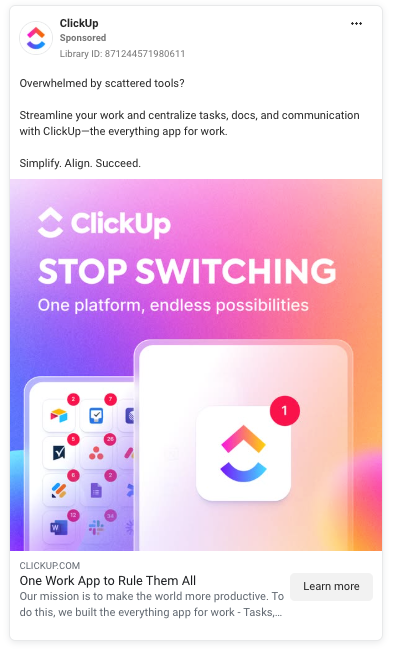
Example: ClickUp
ClickUp converts a common tech frustration into an actionable solution:
Fed up with juggling numerous tools? Opt for an all-in-one platform to streamline everything.
The ad transcends “project management” by offering:
Mental peace.
A unified source of truth.
Reduced transition time, increased productivity.
Team cohesion.
An alluring promise of control.
Plug-and-play copy starter
Still dealing with [problem]?
You’re not alone – and you don’t have to stay stuck.
[Product/service] helps you [benefit] without [common objection].
Your paid search campaigns can look efficient and still refuse to grow. That does not automatically mean bids are too low or automation is too timid. You may have a readiness problem inside the account, or you may have reached the amount of demand currently available to capture.
Those constraints need different fixes. Better tracking, bidding and landing-page controls can repair an account that is not ready to scale. Demand generation is the answer when a healthy account has already captured most of its worthwhile opportunity. Diagnose that distinction before you increase budgets or enable Google AI Max.
Diagnose the constraint before you pay to expand it
Paid search converts expressed intent. It can reach someone who searches for a problem, product, category or brand, but additional budget cannot manufacture an unlimited supply of eligible searches. At the same time, an underspending campaign is not automatically demand-constrained. Weak measurement, low rank, restrictive targeting, poor relevance or an unsuitable offer can produce the same symptom.
Read the account in a fixed order: measurement first, existing auction opportunity second, relevance and rank third, and market demand last. If you reverse that order, you can mistake a repairable campaign problem for a small market.
What you see
Likely constraint
What to do next
Primary conversions are duplicated, inflated or disconnected from qualified outcomes
Measurement readiness
Repair the conversion signal before changing bids, budgets or targeting
Profitable, high-intent campaigns lose impression share because of budget
Capture budget
Protect and fund proven demand before paying for expansion
Campaigns have room in their budgets, but rank, relevance or landing-page performance is weak
Campaign execution
Improve the ads, structure, offer and landing path before broadening reach
Broadening queries adds traffic but degrades lead quality or unit economics
Relevance or market fit
Find where intent breaks instead of treating more reach as progress
Tracking is trusted, proven demand is funded, relevance is healthy and eligible traffic remains limited
Demand ceiling
Create demand outside paid search and build a deliberate route back into capture campaigns
Budget loss deserves particular attention. If your best keywords are already missing impressions because their campaigns are capped, an expansion layer can compete with the demand you already know how to convert. The safer sequence is to fund proven keywords before giving AI Max room to experiment.
Do not use account-wide averages for this diagnosis. Brand, non-brand, competitor, Shopping and remarketing activity can have different constraints. A strong branded campaign can hide weak generic acquisition, while a broad campaign can consume budget without proving that it created incremental demand. Classify campaigns separately, then decide where money should move.
Pass the AI Max readiness gate
AI Max is an expansion mechanism, not an account repair tool. It uses signals beyond conventional keyword targeting to decide when an ad may be relevant. That gives the system more freedom, which means weaknesses in your conversion data, bidding or page controls can spread farther and consume budget faster.
Make the conversion signal worth optimizing
Accurate conversion tracking is the first gate because automated bidding treats your selected outcomes as its definition of success. If a low-quality form submission, duplicated purchase or easy micro-conversion is marked as primary, the system can optimize efficiently toward the wrong result.
List every primary conversion action and identify the business outcome it represents.
Check whether one customer action can trigger more than one primary conversion.
Separate diagnostic events, such as page views or button clicks, from outcomes you are willing to buy.
For lead generation, compare platform conversions with qualified leads or later pipeline stages rather than form volume alone.
For value-based bidding, confirm that the values distinguish more valuable outcomes instead of assigning arbitrary numbers to every action.
Resolve unexplained jumps, missing imports and tracking changes before using the affected period as a baseline.
This is also where demand-generation measurement and search optimization must stay separate. Reach, video engagement and content consumption can help you understand whether a message is landing, but they should not become primary paid-search conversions unless they are genuinely the outcomes you want bidding to purchase.
Align automated bidding with the economic goal
A sensible AI Max test needs a conversion-focused automated bid strategy. Target CPA can fit a campaign where conversions have broadly similar value and you know an acceptable acquisition cost. Maximize Conversion Value fits only when the submitted values are trustworthy enough to guide trade-offs. The strategy name matters less than whether its objective matches the result your business actually values.
Where you already know viable unit economics, a target can give the system a clearer boundary than an unconstrained maximize strategy. Do not change the bid strategy, conversion definition and targeting expansion at the same moment. If performance moves, you will not know which change caused it.
Check data volume, broad match history and budget pressure
A practical screening heuristic is to start with a campaign producing at least 30 conversions per month, with greater confidence around 100 or more. These are test-selection heuristics, not guaranteed performance thresholds or formal Google minimums. If your campaign sits below the lower figure, consolidation or a conventional campaign improvement is usually a more informative next move than giving automation a larger search space.
Past broad match performance is another readiness signal because AI Max effectively broadens the system beyond exact keyword control. A campaign that has already converted relevant broad-match traffic at acceptable economics gives you evidence that the account can tolerate looser matching. If broad match has failed, determine whether query relevance, ad-group structure, creative, landing pages or conversion quality caused the failure before adding another expansion layer.
Your first test candidate should therefore meet five conditions: trusted primary conversions, conversion-focused bidding, enough recent conversion volume to evaluate, positive broad match history, and no meaningful budget loss on the proven demand you need to protect.
Control landing pages and generated assets before launch
URL expansion lets Google select a page it considers relevant when AI Max triggers an ad. That can improve message-to-page matching on a well-organized commercial site. It can also send paid traffic to policy pages, thin informational content, outdated offers or the wrong geographic page.
Build exclusions before you enable the feature. Remove pages that cannot complete the intended conversion, locations the campaign does not serve, obsolete products, internal search results and any page whose claims or offer conflict with the ad. If you rely on dedicated local landing pages, confirm that expansion cannot replace them with a page for another market.
Apply the same discipline to automatically created assets. Generated messaging can broaden coverage, but irrelevant sitelinks or incompatible callouts can weaken an otherwise suitable ad. Review the source pages the system can draw from, remove obsolete copy, and define brand or compliance boundaries before the test begins.
One distinction prevents a common strategic error: AI Max is not required for ads to appear in AI Overviews. Broad match keywords can already make an ad eligible there. Enable AI Max because you have a controlled case for incremental conversions, not because you assume it is an admission ticket to AI-generated search experiences.
Demand generation is not simply buying broad reach. Its job is to make more suitable buyers recognize a problem, understand a category or remember a brand, then give that changed intent somewhere useful to go. If the demand message and the search experience are planned by different teams, the handoff often breaks between those two moments.
Define the demand message in one sentence: the problem the buyer should notice, the outcome worth pursuing and the category or solution that makes the outcome possible.
Map the searches that message could reasonably produce. Separate brand terms, category terms, problem-led terms and product terms rather than assuming every exposed person will search for your brand.
Create a capture route for each valuable intent. The route should include an eligible campaign, relevant ad or product presentation, and a landing page that continues the same promise.
Keep the language continuous. If demand creative teaches one category concept but paid search and the landing page use unrelated terminology, the buyer has to translate your message for you.
Feed search-term language back into demand creative. Queries reveal how people describe the problem after interest forms, which can expose gaps between your internal vocabulary and the buyer’s words.
Report brand and non-brand search separately. A blended total can make demand creation look efficient simply because existing branded demand converts cheaply.
Measure the handoff without giving one channel all the credit
Measure delivery, demand signals and commercial outcomes as different layers. Delivery tells you whether the intended audience had a chance to receive the message. Directional demand signals can include changes in branded searches, direct visits, returning visitors or relevant category searches. Commercial outcomes include qualified leads, purchases, revenue or another verified business result.
A rise in branded search after a demand campaign is useful evidence, but timing alone does not prove causation. Seasonality, publicity, competitor activity and other media can move the same signal. Use a credible control or holdout where your scale permits it, and keep the claim directional where it does not.
Attribution settings can also obscure the handoff. A search click near the end of a journey may receive credit for a conversion even when another channel created the interest. That does not make search unimportant; it means capture efficiency and demand creation answer different questions. Judge paid search on whether it captured intent economically, and judge demand activity on whether it increased the supply or quality of that intent.
Test AI Max as an expansion layer, not a rescue plan
Start with a non-brand campaign. Brand traffic can make expansion look more efficient than it is, and AI Max performance around brand queries has been inconsistent. Choose one proven, conversion-rich ad group instead of switching on account-wide automation. Ad-group-level activation through Google Ads Editor makes that controlled starting scope practical.
Write the hypothesis. State what incremental opportunity you expect AI Max to find and which conversion outcome must improve.
Record the baseline. Capture conversion volume, conversion value, CPA or return, query mix, landing-page mix and downstream lead quality for the selected ad group.
Choose the candidate. Use a non-brand ad group with successful broad match behavior, sufficient conversion volume and no unresolved tracking issue.
Set the boundaries. Finalize URL exclusions, geographic controls, brand restrictions, negative concepts and asset-review rules before launch.
Hold unrelated changes. Avoid simultaneous restructuring, conversion-action changes or major landing-page rewrites unless a safety, compliance or budget issue requires intervention.
Monitor what expanded. Look beyond the topline result to the queries, pages, locations and assets receiving the additional spend.
Judge incrementality and quality. More platform-reported conversions are not enough if they replace branded conversions, lower lead quality or move spend away from better existing demand.
Define stop conditions before the test starts. Pause or narrow the rollout if it sends traffic to incompatible pages, shifts substantial budget away from proven demand, produces irrelevant query themes, or increases nominal conversions while qualified outcomes deteriorate. Predefined conditions stop the team from rationalizing weak traffic after money has already been spent.
A successful result is not simply that AI Max spent more. It is that the selected ad group found additional, relevant conversions or conversion value within the economics you set, without hiding losses in brand mix, lead quality or landing-page selection. If it passes, expand one controlled unit at a time. If it fails, the query and page data should tell you whether to repair relevance, tighten controls or return budget to demand creation.
Key takeaways
Paid search readiness starts with trusted conversion tracking, aligned automated bidding, sufficient data and funded high-intent demand.
An underspending campaign does not prove that demand is exhausted; measurement, rank, relevance and targeting must be ruled out first.
For an initial AI Max test, 30 monthly conversions is a practical screening heuristic, while 100 or more provides a stronger data base; neither is a guaranteed Google threshold.
Positive broad match history is an important readiness signal because AI Max expands beyond tight keyword control.
AI Max is not required for ad eligibility in AI Overviews; test it for incremental conversion opportunity, not access.
When a healthy search account reaches its capture ceiling, connect demand messages to likely queries, eligible campaigns and matching landing pages.
Open your last stable reporting window and classify each campaign as measurement-constrained, budget-constrained, execution-constrained or demand-constrained. Fix the first three before expanding automation. If the remaining limit is demand, build the message-to-query-to-landing-page handoff and let paid search capture the intent it creates. Only then give AI Max a small, controlled opportunity to prove that it can add something genuinely incremental.
I’ve noticed the European Union is turning its gaze towards Google once more, scrutinizing how it handles its AI and search data. This could lead to changes that might open up its Android features and search data, ultimately reshaping the competitive landscape.
The European Commission is now formally outlining the ways Google must share specific Android functionalities and its search data with competitors, in line with the Digital Markets Act.
Tuesday marked the start of two official proceedings by the Commission, aimed at establishing a structured approach for Google to meet key obligations under the DMA. It’s fascinating to see these regulatory dialogues become more concrete.
Why I care. This move by the European Commission could alter the dynamics in mobile AI and search. With Google potentially needing to share its search data and Android AI capabilities, it could boost the competition from other search engines and AI services. Such changes might impact where advertisers allocate budgets, alter the availability of advertising inventory, and shift campaign dependencies away from Google’s platforms.
First focus — Android and AI interoperability. The regulators are delving into how Google must enable third-party developers to access Android hardware and software features as freely as Google’s own AI services, like Gemini.
– The objective is to allow rival AI providers the same level of integration with Android devices as Google’s native tools.
Second focus — search data sharing. The Commission aims to define how Google should provide anonymized search data including ranking, queries, clicks, and views to rival search engines under fair, reasonable, and non-discriminatory conditions.
– This includes specifying the types of data to be shared, how it will be anonymized, eligibility for access, and whether AI chatbot providers can use this dataset.
Between the lines. It’s not just about ticking off compliance boxes. The Commission is making it clear that AI services are under the DMA’s watchful eye, especially where data and device control could influence emerging markets.
What’s next: Within three months, the Commission plans to send Google its initial findings and recommended actions. The full proceedings should wrap up within six months, accompanied by non-confidential summaries for public input.
The backdrop. Since March 2024, Google has been required to comply with DMA obligations, having been identified as a gatekeeper in services like Search, Android, and YouTube.
Bottom line. The EU is moving from planning to action with the DMA, testing how strongly it will influence competition by overseeing Google’s AI functions and search data management.
You can waste a substantial budget on a capable medtech marketing agency if it solves the wrong problem. A trade show specialist, brand studio, account-based marketing team, enterprise media firm, and organic authority partner can all make persuasive pitches, but they are built for different jobs.
Your first decision is therefore not which agency is best. It is which commercial constraint must change next. Once you name that constraint, the medtech agency landscape becomes much easier to navigate.
Choose the bottleneck before you choose the agency
Write a one-sentence diagnosis before you schedule discovery calls: “Our immediate constraint is [problem], among [audience], at [stage of the buying journey], and progress means [business outcome].” If your team cannot complete that sentence, an agency will fill the gap with the services it already sells.
Route your search according to the job that needs to be done:
You need sustained discovery and qualified inbound demand. Look for thought leadership, technical content, SEO, and generative engine optimization. The agency should be able to connect visibility with a defined conversion path, not merely publish content.
You need paid reach at enterprise scale. Look for media buying, audience data, analytics, creative production, landing-page support, and a clear handoff into your CRM and sales process.
Your product is difficult to explain or your company is preparing to raise capital. Start with positioning, message architecture, visual identity, and materials that can be used consistently in customer and investor conversations.
A conference or trade show is the immediate commercial event. A booth specialist can solve the physical experience, but your scope also needs lead capture, meeting preparation, and post-event follow-up.
Your market consists of a finite group of valuable organizations. Account-based marketing is the natural lane. The agency must show how marketing and sales will coordinate around named accounts and multiple stakeholders.
You need a coordinated device launch or brand program across several channels. An integrated medtech agency may reduce handoff friction, provided it has genuine depth in the channels that matter to you.
Do not treat “full service” as automatically better. Breadth helps when your problem crosses channels. It creates unnecessary cost and management overhead when you only need a specialist intervention.
Seven agencies occupy distinct positions in the 2026 landscape
The profiles below reflect a market snapshot updated January 26, 2026. Use them as routing information for a shortlist, not as a substitute for current due diligence. Company size, staffing, client relationships, and service emphasis can change.
Thought leadership combined with SEO and GEO for lead generation
Founder-led; founded in 2009; reported size of 100-250; named work includes Biovia and Altoida
Ask how search visibility, visibility in generative answers, and content engagement connect to qualified lead definitions. Expect a detailed onboarding process and confirm what your subject-matter experts must contribute.
Enterprise, full-service marketing with a concentration in paid advertising and data analytics
Not founder-led; founded in 1969; reported size of 1,000+; named work includes Visionworks and Walgreens
Clarify the dedicated delivery team, minimum viable scope, data requirements, and total operating cost. Enterprise capacity has little value if your account receives a generic team or more infrastructure than it needs.
Brand development and creative marketing for medical and lifestyle brands, including B2C and B2B work
Founder-led; founded in 1997; reported size of 11-50; named work includes Orthofix and FUJIFILM Sonosite
If pipeline is the goal, ask who owns distribution, conversion, and measurement after the brand work is finished. A strong identity is not automatically a demand-generation system.
Brand strategy and visual identity for medtech companies preparing for funding
Founder-led; founded in 2018; reported size of 1-10; named work includes Theragen and Nuvara
Confirm capacity, access to senior staff, the customer or investor validation process, and who executes the brand after fundraising preparation. No marketing agency can promise that branding will secure funding.
Trade show booth design, manufacturing, and installation
Not founder-led; founded in 1985; reported size of 11-50; named work includes HealthGrid
Define the boundary between booth delivery and campaign delivery. Assign responsibility for pre-event outreach, appointments, lead qualification, data capture, and follow-up to Exponents, another partner, or your internal team.
Omnichannel account-based marketing for high-value organizational buyers
Founder-led; founded in 2007; reported size of 11-50; named work includes MedPost and Care Spot
Ask how accounts are selected, how buying-committee roles are mapped, what sales must do, and how engaged accounts become opportunities. Also clarify cost before assuming ABM is efficient for your market.
Integrated branding, multimedia, and traditional marketing for medical device companies
Founder-led; founded in 2019; reported size of 11-50; named work includes Poba Medical and Kaneka Medical
Identify the named specialist for every channel in your scope. Determine what is delivered in-house, what is subcontracted, and who owns integration, reporting, and corrective decisions.
These firms are not interchangeable entries in a league table. Epsilon’s enterprise scale does not make it the natural choice for a startup that needs investor-ready positioning. Distill Health’s funding-oriented brand work does not make it the default choice for a mature manufacturer seeking paid media at scale. Exponents may be highly relevant to a conference deadline while remaining intentionally narrow outside the trade show itself.
Founder involvement, company age, and headcount are context rather than outcomes. A founder-led specialist may offer direct senior attention, but you still need to know who will perform the weekly work. A large firm may provide broader capabilities and resilience, but you still need a dedicated team with relevant experience.
Client names establish adjacency, not success. Ask what the agency delivered, which audience it addressed, how long the work ran, and what changed. A recognizable logo can represent a small project that bears little resemblance to your scope.
Relevant similarity is multidimensional. Product category alone is not enough. Compare the buyer, sales motion, company stage, geographic scope, channel, and internal review process. A consumer campaign and a hospital-enterprise sale can require very different work even when both sit under the medtech label.
Leadership experience matters only if it reaches delivery. Ask who joins the pitch, who designs the strategy, who manages the account, and who creates the work. Get those roles into the scope. Do not assume the founder or senior strategist in discovery will remain involved.
Tenure is a continuity clue. Within this group, reported median employee tenure ranges from 1.7 years at The ABM Agency to 4.6 years at Epsilon. That does not prove quality, but it gives you a reason to ask about turnover, backup coverage, and knowledge transfer.
Reviews require context. Look for comments about the type of work you are buying, responsiveness when a campaign underperforms, and the quality of project oversight. A high average without detail cannot tell you whether the agency can solve your problem.
Media references indicate visibility, not operational competence. They can support an authority assessment, but they do not replace current work samples, named team members, a delivery plan, or access to reporting.
Ask every shortlisted agency to walk through a documented engagement that resembles your situation. Have it explain the starting constraint, its exact scope, the client responsibilities, the approval path, the deliverables, and the business result. If the answer skips from a client logo directly to an outcome, the missing middle is where delivery risk usually sits.
Medtech work also needs an explicit claims-review workflow. Your internal medical, legal, regulatory, or quality reviewers may own approval, but the agency must know when review occurs, how revisions are tracked, and which version is cleared for each channel. If this process remains vague, timelines and budgets can deteriorate after production begins.
Write a scope that matches the agency lane
A useful brief does more than list services. Use this structure: “Help [audience] move from [current state] to [conversion or commercial outcome] by producing [deliverables], distributing them through [channels], and reporting [business and diagnostic measures].” Add your approval roles, required systems, ownership terms, dependencies, and exclusions.
For SEO, thought leadership, and GEO
Name the technical themes, buyer questions, priority audiences, conversion events, subject-matter experts, and owned properties in scope. Require the agency to distinguish traditional search performance from observed brand inclusion or citation in generative answers. Both can contribute to discovery, but they are not the same measurement.
Qualified organic inquiries, target-account visits, completed demo or consultation requests, coverage of problem-led searches, and observed AI-answer visibility are more useful together than traffic alone. Traffic remains a diagnostic measure. It is not proof that the right buyer understood the product or entered a sales conversation.
For paid media and integrated campaigns
Specify the audience data, media channels, creative formats, landing pages, tracking, CRM handoff, and approval workflow. Decide who owns media accounts, analytics access, campaign data, source files, and website changes. Your organization should retain administrative access to the systems and assets it is paying to build; losing access can make a future agency transition expensive and slow.
Make qualified opportunities and pipeline the commercial measures when your sales cycle supports them. Use accepted leads, qualified conversations, landing-page conversion, and acquisition cost as operating indicators. Click-through rate and impressions can diagnose a campaign, but they should not become substitutes for business progress.
For account-based marketing
Define how target accounts enter the program, which stakeholder roles matter, what sales will do, which messages vary by role, and how engagement is recorded. ABM fails quietly when marketing runs account-targeted ads while sales follows an unrelated list and neither side owns the handoff.
Track meaningful engagement across the buying group, meetings with relevant roles, account progression, opportunities, and pipeline. Raw account impressions are not enough. Your agency should also explain what evidence causes it to intensify, change, or stop work on an account.
For branding, fundraising preparation, and trade shows
A brand scope should name the positioning decision, message architecture, visual system, required customer or investor materials, validation method, and internal approvers. Define how the system will reach the website, sales materials, presentations, and campaigns. Otherwise, you can finish with an attractive identity that the commercial team cannot apply consistently.
A trade show scope should connect the physical booth with pre-event outreach, meeting booking, on-site data capture, lead qualification, CRM entry, and follow-up. If the booth provider does not offer those services, assign them elsewhere before the event. Booth traffic is an incomplete result; qualified conversations and subsequent opportunities are the commercial test.
In every lane, separate agency deliverables from client dependencies. Technical interviews, product access, approved claims, customer references, CRM configuration, and executive sign-off can all sit with your team. Put each dependency beside an owner and approval path so neither side can hide a preventable delay inside a status report.
Key takeaways: use the pitch to expose delivery risk
State the bottleneck first: What precise commercial constraint will this engagement change, and which business outcome will show that it changed?
Interrogate the closest example: Which past engagement most closely matches your buyer, product stage, sales motion, and channel? What did the agency itself deliver?
Name the working team: Who owns strategy, account management, content or creative production, media, analytics, and claims coordination after the pitch?
Expose outside dependencies: Which services are subcontracted, which require another partner, and which depend on your internal experts or systems?
Map the approval process: When do technical and claims reviews happen, who resolves conflicting feedback, and how are approved versions controlled?
Protect ownership: Who owns the ad accounts, analytics properties, audience data, CRM records, domains, website access, source files, and finished assets?
Demand decision-grade reporting: Which measures represent commercial outcomes, which are leading indicators, and which merely diagnose activity?
Set correction rules: What evidence will cause the agency to change the message, channel, audience, budget allocation, or scope?
Send the same written brief to every agency on your shortlist and insist that each response addresses the same outcome, responsibilities, evidence, and ownership terms. That makes proposals comparable and prevents a polished pitch from redefining your problem around an agency’s preferred services.
Choose the partner whose lane matches your immediate constraint, whose relevant work survives detailed questioning, and whose named team can explain how delivery becomes a measurable business result. That is a stronger basis for a decision than rank, reputation, or breadth alone.
If your SEO plan starts with keyword volume and ends with a page type, you can rank for the phrase and still miss the person behind it. Someone using AI search may supply a goal, constraints, prior attempts, and a desired outcome in one prompt. In other cases, the system may infer a goal from a sequence of actions rather than a neatly worded query.
Your strategy therefore needs to answer a harder question than What keyword should this page target? It needs to establish what the person is trying to accomplish, what would let them make progress, and which page or resource should support the next step.
Key takeaways
Treat a keyword as evidence of intent, not a complete description of it.
Map the searcher’s trigger, current state, constraints, decision, required evidence, and desired next action.
Assign each page one dominant intent state, then link it to the next logical state in the journey.
Write for both answer-seeking and task delegation by exposing criteria, limitations, requirements, and actionable steps.
Build a consistent citation surface on your site and in the social spaces where your audience discusses the problem.
Measure whether people move from uncertainty to a useful action, not only whether the page gains impressions or rankings.
What AI search intent changes
Traditional intent labels such as informational, commercial, navigational, and transactional remain useful. They tell you the broad kind of interaction a query may represent. They don’t tell you enough to design the answer.
Consider a search for AI SEO plugin for WordPress. The phrase might come from someone learning what these plugins do, building a shortlist, checking whether an existing workflow can support one, or looking for implementation instructions after choosing a product. All four people use similar language. They need different evidence and different next steps.
A workable intent model needs several layers:
Literal request: What did the person explicitly ask for?
Trigger: What happened that made the question relevant now?
Current state: What does the person already know, have, or believe?
Desired state: What would be different after a successful answer?
Constraints: Which platform, budget, capability, policy, deadline, or compatibility requirement limits the options?
Decision: What choice must the person make?
Completion condition: What result would make the search feel finished?
Next action: Does the person need to learn, compare, verify, configure, buy, troubleshoot, or hand off a task?
The distinction matters because intent can develop across an entire session. In work presented at EMNLP 2025, Google researchers separated intent extraction into two stages: summarizing individual interactions and then using the factual parts of those summaries to infer the overall goal. Preliminary guesses were discarded before the final intent statement was produced. That fact-first decomposition of session behavior reduced the risk of letting an early assumption distort the whole interpretation.
This was intent-extraction research, not confirmation of a Google Search ranking factor. Don’t turn it into an algorithm claim. Use it as a planning clue: a query may be only one observation in a longer path, and your own intent analysis should keep observed facts separate from marketer guesses.
Keywords still matter. They show you the language people use, expose recurring modifiers, and help you understand demand. Their role changes from being the strategy to being one input into the strategy.
AI-first interactions add another important distinction. Some sessions move beyond finding information into delegating a comparison, recommendation, or next action. A page that merely defines a term may satisfy an answer request while failing a prompt that asks a system to evaluate options under explicit constraints.
Map the goal before you choose the page
Start with behavior you can legitimately observe: query clusters, on-site searches, navigation paths, sales questions, support requests, community discussions, and comments. Don’t collect more personal data than your organization is entitled to use. You need patterns in the questions and transitions, not a dossier on an individual.
Then build the intent map in this order:
Record the observation without interpretation. Write down the exact query, question, page transition, or objection. Keep inferred motives out of this field.
Group observations by the job they imply. Synonyms can share a cluster when they lead to the same decision and action. Similar keywords should separate when they represent different stages or outcomes.
Write a job statement. Use this template: When [trigger], the person wants to [decision or action] under [constraints] so that [desired outcome].
Mark each element as known, supported, or assumed. If the constraint is only a guess, don’t build the whole page around it. Address plausible branches explicitly or gather better evidence.
List the evidence needed to finish the job. This might include definitions, comparison criteria, compatibility requirements, limitations, examples, implementation steps, or proof for a factual claim.
Choose the page’s role. Decide whether it should orient, compare, validate, implement, or troubleshoot. Avoid asking one URL to perform every role equally.
Name the next state. Specify what a well-served reader should be ready to do after using the page.
For the hypothetical WordPress query, an intent brief could look like this:
Trigger: The person believes their existing SEO process doesn’t prepare content for AI-generated answers. Current state: They use WordPress but haven’t chosen an AI SEO tool. Decision: Which capabilities and controls should determine the shortlist? Constraints: Compatibility with the current publishing workflow and the ability to review changes before publication. Evidence needed: Clear capability boundaries, requirements, workflow details, and evaluation criteria. Next state: Compare qualified options or test the preferred approach.
This example is deliberately more precise than a label such as commercial intent. The label helps classify the query. The brief tells a writer what the page must accomplish.
Use the map to make URL decisions as well. One page can serve many keyword variants when those variants represent the same job. Split the content when the reader’s decision, evidence requirement, or next action materially changes. This keeps you from creating a separate thin page for every phrasing while also preventing one broad page from burying several incompatible intents.
A practical content architecture often follows an intent sequence such as orient, compare, validate, implement, and troubleshoot. You don’t need a page for every stage in every topic. You do need an intentional route between the stages you support. Internal links should name the next decision clearly; vague calls to read more leave both people and retrieval systems to infer the relationship.
Build pages that answer questions and support action
An AI-search-ready page has two jobs. It must contain an answer that can stand on its own, and it must provide enough context for that answer to be applied correctly. Concision without qualification produces brittle answers. Exhaustive context without a clear answer makes the useful part difficult to retrieve.
Give each answer a complete evidence unit
For every important question, assemble a compact unit with four parts:
Claim: State the answer directly and name the entity or concept involved.
Qualification: Say when the answer applies and where it stops applying.
Support: Provide the relevant evidence, reasoning, example, or primary reference.
Action: Tell the reader what to check or do next.
Put that unit under a heading that names the actual decision. When this approach fits is more useful than Benefits. Requirements before implementation is more useful than Getting started. The heading should still make sense when separated from the page title.
Be explicit with nouns. If several tools, plans, standards, or organizations appear on the page, repeated pronouns create avoidable ambiguity. Name the subject again when the relationship could otherwise be misread. Clear entity relationships help a reader scan the page and make individual passages easier to reuse accurately.
Expose the inputs needed for delegation
A person asking for a definition needs an answer. A person delegating a task needs decision inputs. If your page may inform a comparison, recommendation, configuration, or purchase, include the information required to make that task safe and bounded:
Who or what the option is for.
The problem it addresses and the outcome it does not promise.
Prerequisites, dependencies, and compatibility constraints.
Selection criteria and meaningful tradeoffs.
What information must be supplied before action can begin.
The sequence of implementation steps.
Conditions that should stop or redirect the process.
The expected next checkpoint or verifiable result.
This information should appear in visible page copy. Structured data can describe the entities, properties, and relationships that are genuinely present, but it can’t repair an incomplete explanation. Use the most specific valid schema that matches the visible content, and don’t add claims to JSON-LD that a reader cannot verify on the page.
Design the route after the answer
A successful answer often creates the next question. A comparison may lead to validation. Validation may lead to setup. Setup may lead to troubleshooting. Decide which transition your page owns, then make it explicit in the closing section and relevant internal links.
Don’t force the same call to action onto every intent. Someone still defining the problem may need a diagnostic checklist. Someone validating a shortlist may need requirements and limitations. Someone implementing a decision needs exact steps. Matching the action to the current state is more useful than treating every visit as an immediate conversion opportunity.
Before publishing, run an intent-resolution review. Ask whether the page answers the primary question before branching, distinguishes facts from assumptions, states the important constraints, gives the reader adequate evidence, and points to a logical next state. If the page can’t pass that review, adding more related keywords won’t solve its central problem.
Extend your citation surface beyond your own site
Your website is the canonical place to maintain a complete explanation, but it isn’t the only place where an AI system may encounter the topic. Social platforms have become more prominent in the AI citation graph, with that pattern examined across 6.1 million citations. That is a reason to include relevant social spaces in your visibility strategy. It is not proof that every platform matters equally, that engagement is a direct ranking factor, or that frequent posting causes citations.
Treat social participation as an extension of intent research and evidence distribution:
Publish the canonical answer on your site. Give it the complete reasoning, qualifications, supporting evidence, and next steps.
Choose communities by question fit. Use the places where your intended audience already asks the specific comparison, implementation, or troubleshooting question. Platform popularity alone is not a useful selection rule.
Publish a native, self-contained contribution. Answer the immediate question on the platform instead of dropping an unexplained link. Point to the canonical page when the reader needs the complete evidence or process.
Respond to objections and corrections. A disagreement can expose a missing constraint, ambiguous term, or unsupported assumption in the original page.
Feed recurring questions back into the content. Update the relevant answer unit rather than attaching an ever-growing miscellaneous FAQ to every page.
Keep the entity consistent. Use the same organization or product name, canonical URL, category, and defensible core description across owned profiles and pages.
A brand-owned social post remains a brand claim. It can clarify your position and make the material discoverable, but it doesn’t become independent validation because it appears on another domain. Keep first-party claims labeled, link to underlying evidence where available, and avoid manufacturing apparent consensus through repetitive promotional posts.
Community language is especially useful for intent mapping. People often state constraints, failed attempts, and objections more plainly in a discussion than in a short search query. Record those observations, but don’t assume that the most vocal comment represents the entire audience. Use recurring patterns to form hypotheses, then test them against other first-party signals.
Measure whether the content resolves intent
Rankings, impressions, and clicks tell you whether a page was exposed and selected. They don’t establish that it helped the person finish the job. Add a second measurement layer that follows movement from the current state to the intended next state.
Question
Evidence to inspect
What to change
Did the intended audience reach the page?
Query or prompt themes, landing pages, on-site search terms, and the questions recorded by customer-facing teams
Adjust targeting or the page’s opening if the observed need doesn’t match the intended job
Did the page address the main uncertainty?
Use of comparison criteria, requirement sections, supporting references, and recurring reformulations of the same question
Move the direct answer earlier, define ambiguous terms, or add the missing qualification
Did the reader move to the next state?
Transitions to validation, comparison, implementation, troubleshooting, or another outcome that fits the intent
Strengthen the internal path and make the next action more specific
Is the answer being reused or cited?
Identifiable AI referrals, linked and unlinked mentions, citations, social discussions, and branded follow-up searches where available
Improve the evidence unit and distribute it in the communities that discuss that exact question
Where did the intent model fail?
Unexpected on-site searches, repeated support questions, community objections, and visits to content built for a different stage
Correct the job statement, split incompatible intents, or create the missing bridge between stages
No single proxy proves satisfaction. A visit to an implementation page may indicate progress, curiosity, or confusion. An exit may mean the answer worked or that it failed. Read several signals together, and distinguish an observed transition from your explanation of why it happened.
Maintain a simple intent scorecard for each important cluster. Record the job statement, target page, evidence requirement, intended next state, observable outcome, unresolved questions, and material content or distribution changes. This gives SEO, content, product, sales, and support teams one shared description of what the page is supposed to do.
When performance disappoints, diagnose the layer before rewriting everything. A targeting problem means the wrong people or prompts reach the page. An answer problem means the page doesn’t resolve the question. An evidence problem means the claim is hard to trust or reuse. A journey problem means the answer works but the next step is missing. A distribution problem means useful material isn’t present where the relevant discussion occurs.
Start with the intent cluster that matters most to your organization. Write its job statement, mark every unsupported assumption, and inspect the current page against the evidence and next action the job requires. That exercise will usually give you a sharper content brief than another round of keyword expansion.
You’re being asked to put paid media into AI environments, but the budget question has arrived before the measurement plan. One option sells visibility inside an AI conversation. Another uses AI to distribute campaigns across established ad inventory. Treating them as the same thing is how an expensive pilot ends with plenty of activity and no defensible conclusion.
Before you spend, decide whether you are buying attention, teaching an automated campaign system to find valuable outcomes, or proving incremental impact. Those are different jobs. Each needs its own success metric, data inputs, and testing method.
Separate AI ad placement from AI campaign optimization
Conversational AI inventory is a placement. You pay to appear within an AI product and receive whatever reporting that product makes available. The early ChatGPT ad offer has reportedly been priced at around $60 per 1,000 impressions, roughly three times the rate of standard Meta advertising. Advertisers may initially receive basic totals such as impressions and clicks without purchase-level reporting.
That measurement ceiling changes the campaign’s proper role. If you cannot observe purchases or other downstream outcomes in the ad platform, you cannot honestly manage the placement like a mature direct-response channel. You can test reach, click response, message-market fit, and post-click behavior in systems you control. You cannot turn an impression-and-click report into a reliable platform ROAS calculation.
Initial ChatGPT ad availability is expected to focus on free and lower-cost Go users, while excluding people under 18 and conversations involving sensitive subjects such as mental health or politics. Those rules help define where ads may appear, but they do not tell you whether the reachable audience matches your buyers. Confirm audience fit before treating the environment itself as proof of media quality.
Placement context and the product’s available targeting
Conversion goals, audience signals, customer data, and creative assets
Best initial use
Brand visibility and format learning
Demand capture or demand generation tied to meaningful outcomes
Critical limitation
Incomplete attribution can prevent performance-level conclusions
Weak conversion signals can teach the system to pursue low-value actions
Neither model is inherently better. The useful question is whether you want to buy attention in a new environment or delegate campaign allocation to an outcome-driven system. If your brief cannot answer that question in one sentence, it is not ready for budget approval.
Set the campaign job and evidence standard before the budget
A premium CPM makes an undefined learning campaign expensive. At a reported $60 CPM, 50,000 impressions represent $3,000 in media, while 100,000 impressions represent $6,000. Those figures are not performance forecasts. They are the budget identity: planned impressions divided by 1,000, multiplied by CPM.
Use that calculation before you debate creative or targeting. Decide how much exposure is necessary to answer a defined question, then price the test. Do not start with an arbitrary budget and invent a purpose after delivery begins.
A workable campaign charter should state six things:
The decision: Name what you will do differently when the test ends. Examples include rejecting the placement, revising the message, expanding the test, or moving budget into a controlled lift experiment.
The hypothesis: Describe the audience, message, environment, and expected behavior. “Test AI ads” is an activity, not a hypothesis.
The campaign job: Choose visibility, qualified demand, or incrementality. Do not make one campaign responsible for all three.
The primary outcome: Use delivered impressions or click response for a visibility test, a CRM-qualified event for performance optimization, or lift for an incremental-impact test.
The spending limit: Set the maximum media outlay before launch. A learning objective is not permission for an open-ended budget.
The claim boundary: Write down what the available evidence will not prove. If the platform reports only impressions and clicks, state in advance that the platform report will not prove purchase impact.
Use a measurement ladder instead of one dashboard
Each measurement layer answers a different question. Keeping those questions separate prevents attribution language from outrunning the evidence.
Platform delivery data: Impressions show that ads were served. Clicks and click-through rate show an immediate response. They do not show whether the campaign created revenue.
Owned post-click analytics: A dedicated or properly tagged destination can show what visitors did after clicking, subject to your consent and analytics setup. This connects traffic to on-site behavior, but it does not prove that the same behavior would not have happened without the campaign.
CRM outcomes: Qualified leads, appointments, opportunities, and eventual revenue help you distinguish valuable responses from easy conversions. Preserve the campaign identifier through the handoff so the business outcome can be associated with its acquisition path.
Controlled experiments and lift: A suitable control or lift design addresses the incremental question: what changed because the campaign ran?
OpenAI has paired its advertising plans with commitments not to sell user data or compromise the privacy of conversations. That stance may constrain the user-level targeting and attribution methods advertisers know from Google and Meta. Build the plan around aggregated platform reporting and consented, first-party post-click measurement. Do not base the business case on conversation-level data you hope might become available later.
Give campaign automation a business outcome it cannot misread
An automated campaign will pursue the success signal you provide, even when that signal is a poor substitute for business value. If every form submission is treated as equally valuable, the system has no reason to distinguish a sales-ready buyer from a vendor, student, job applicant, or unqualified prospect.
Performance Max therefore needs a conversion architecture before it needs more creative. For a B2B campaign, put these elements in place first:
Connect the CRM or other business data source. Salesforce is one example, but the brand matters less than the handoff. The advertising system needs a path from the online action to a meaningful business status.
Select a revenue-relevant conversion event. A qualified lead submission or booked appointment is more informative than an unfiltered form fill when qualification is part of the sales process.
Separate optimization events from diagnostic events. Page views, content interactions, and raw leads can help diagnose the journey without being treated as equal optimization targets.
Supply a customer list when appropriate and permitted. First-party customer data gives the system characteristics it can use for modeling and can be more useful than relying on website remarketing audiences alone.
Choose an outcome-based bid strategy. Maximize conversions and target CPA are aligned with the campaign model’s focus on outcomes rather than traffic alone.
Protect the learning process from constant intervention. Frequent targeting, bidding, or structural changes alter the problem the system is trying to solve. Route substantial changes through planned experiments instead of repeatedly editing the live campaign.
Check whether your market can support automation
Good conversion plumbing does not make every market suitable for Performance Max. The system also needs room to find patterns and scale delivery.
Use automation when the addressable market is broad enough. A larger market gives the system more opportunities to learn which signals correlate with meaningful outcomes.
Keep manual control for tightly bounded account-based programs. If success depends on reaching only a few hundred named accounts, broad automated allocation may conflict with the strategy.
Be cautious in extremely narrow categories. Too little audience and conversion data can prevent useful scaling, regardless of the campaign’s technical setup.
Confirm organizational readiness. A team that cannot tolerate automated allocation or repeatedly overrides it may destabilize the campaign before it can produce interpretable evidence.
The strongest B2B use case is a sizable market with a long buying cycle and several stakeholders. Cross-network delivery can maintain a presence around that buying group beyond a single search interaction. But sustained visibility only becomes optimizable when the conversion signal reflects genuine progress through the sales process.
Optimize with controlled tests, not reactive campaign edits
Optimization is a sequence of decisions. It is not the habit of changing bids, audiences, and creative whenever a dashboard moves. When several variables change together, you lose the ability to tell which change caused the result.
Google’s Experiment Center brings campaign experiments and lift studies into one location. It can support tests involving bidding, targeting, and creative, alongside brand, search, and conversion lift measurement. Expanded A/B testing for Shopping and Performance Max, plus a Campaign Mix Experiments beta, provides more ways to validate a change before scaling it where those features are available.
Run tests in an order that protects the quality of later conclusions:
Validate conversion quality. Confirm that the primary event represents business value and reaches the campaign correctly. A creative or bidding test is difficult to interpret when the success label is unreliable.
Test the proposition and creative. Compare a specific message or asset treatment against the control. Do not replace the audience, bid strategy, landing page, and creative in the same test.
Test targeting or audience signals. Once the outcome and message are credible, determine whether a different signal set finds more of the right response.
Test bidding and campaign mix. Evaluate allocation changes after the campaign is measuring the right outcome. Otherwise, you may simply become more efficient at acquiring the wrong conversion.
Use lift when the question is causality. Platform attribution can associate an outcome with an ad interaction. Lift is the more relevant design when you need to know whether advertising generated an outcome that would not otherwise have occurred.
Every experiment record should include the hypothesis, control, variant, primary outcome, guardrails, stopping rule, result, and resulting action. Define those fields before launch. A stopping rule created after seeing the data is an invitation to keep running a preferred result and stop an inconvenient one.
The pattern across measurement layers matters more than any isolated metric:
If reported conversions rise while CRM-qualified outcomes stay flat, the campaign has probably improved the proxy rather than the business result. Fix the conversion signal before scaling.
If clicks rise but qualified outcomes do not, the creative may be attracting curiosity instead of buying intent, or the landing experience may not fulfill the ad’s promise. A higher click-through rate is not enough to choose between those explanations.
If reach is strong but you have no control or lift measurement, you can report delivery. You cannot claim that awareness increased merely because impressions were purchased.
If a lift test shows an incremental effect that last-click reporting misses, evaluate the cost of that lift against the value of the outcome. Do not discard incrementality solely because it appears in a different reporting layer.
This is where campaign optimization and AI-search strategy meet. Paid visibility can create exposure while organic AI optimization works toward durable discovery, but the two should not be blended into one performance claim. Track paid placement, post-click behavior, CRM outcomes, and organic visibility as distinct evidence streams. Combine them only when the measurement design supports the connection.
Key takeaways
Decide whether you are buying an AI placement or using AI to automate campaign delivery. They require different data and success criteria.
Treat a conversational placement with impression-and-click reporting as a visibility or learning test unless your owned systems can support a stronger, clearly qualified conclusion.
Price the learning question before launch. At a reported $60 CPM, every 50,000 impressions represents $3,000 in media spend.
Connect Performance Max to CRM-qualified outcomes, not just easy website actions, and use it only where the addressable market gives automation room to learn.
Move consequential changes into controlled experiments. Test conversion quality before creative, targeting, bidding, or campaign mix.
Match every claim to its evidence layer: delivery for exposure, CRM data for associated business outcomes, and lift testing for incrementality.
Your next step is small but decisive: write one sentence naming the campaign’s job, then name the strongest outcome you can actually observe. If the job requires evidence your current setup cannot produce, repair the measurement plan or narrow the claim before you approve the spend.