Tag: SEO

  • How AI is Transforming Trust in Financial Research

    How AI is Transforming Trust in Financial Research

    In my conversation with Joshua Weisberg, CEO of Lambda Finance, we explored how AI is reshaping financial research. As discovery evolves from traditional search to AI-powered insights, platforms must earn trust in an era demanding clarity, accessibility, and centralization.

    First Page Sage: Financial research carries significant risks where misinformation can have severe outcomes. Joshua, why do finance sectors experience shifts in search behavior and AI-driven discovery sooner than others?

    Joshua Weisberg: In finance, the repercussions of poor information are swift and quantifiable. If research lacks depth or accuracy, the impact is immediately observed in performance. This urgency pushes investors to adapt their research methods faster than other industries.

    As AI shapes discovery, investors scrutinize information sources and presentation more acutely. They prefer sources demonstrating depth, consistency, and reasoning, pushing financial platforms to evolve quickly. This also provides a blueprint for trust-centric industries’ behavior.

    First Page Sage: With AI underpinning research, the focus shifts from keyword matching to perceived expertise and trust. How does this affect financial platforms’ approach to visibility and authority?

    Weisberg: It redefines the objective. Visibility now relies on being consistently useful rather than merely optimized for keywords.

    In finance, expertise emerges from effectively linking concepts and illustrating relationships. AI favors sources that provide comprehensive answers. Platforms should focus on delivering a holistic experience that conveys thorough understanding of the topic.

    First Page Sage:: Fragmented user experiences can weaken authority from an SEO/GEO perspective. Lambda Finance unifies several research functionalities. Why is this vital in an AI-driven discovery realm?

    Weisberg: Fragmentation causes friction for users and affects perceived expertise. When multiple tools are needed for answers, building confidence is challenging.

    Unifying insights allows them to exist contextually. Connecting technical signals, fundamentals, alternative data, and portfolio analyses enhances user comprehension and signals authoritative understanding to the users.

    First Page Sage: In finance, ambiguity is costly. How does effectively explaining complex data grow user trust and digital visibility?

    Weisberg: Clarity is surprisingly advantageous in financial research. Even seasoned investors benefit from understanding why something is significant, not just the event itself.

    By prioritizing explanation, platforms engage users deeply, leading to sustained reliance. Over time, this trust enhances digital visibility. Platforms excelling at detailing complexities often become references for both users and AI systems seeking comprehensive answers.

    First Page Sage:: What error do digital leaders in finance commonly make preparing for AI-driven search? And what should they emphasize instead?

    Weisberg: A common mistake is seeing AI-driven search as merely a technical challenge. While optimization is important, it doesn’t replace substantive content, especially in complex sectors like finance.

    Long-term visibility relies on depth—accurate data, insightful analysis, and clear communication. Companies focusing on these fundamentals are well-equipped as search evolves, aligning with user preferences. Authority in high-stakes industries is earned through consistent utility.

    Source


    Inspired by this post on First Page Sage Blog.


    crushpress.ai community screenshot
  • From Mailroom to PPC CEO: Anthony Higman’s Journey of Redemption

    From Mailroom to PPC CEO: Anthony Higman’s Journey of Redemption

    I recently spoke with Anthony Higman, the CEO of AdSquire, on episode 336 of PPC Live The Podcast. Anthony’s remarkable journey took him from the mailroom of a law firm to the helm of his own company with a panoramic view of Philadelphia. His story exemplifies how dedication, learning from missteps, and perseverance can forge a successful career path.

    Learning from Client Missteps

    Anthony opened up about one of his early blunders with a client, where he allowed them to chase after quick-win promises in numerous emails. Though some were outright scams, others were genuine but unaligned with the client’s goals. His decision to let a client engage with an ineffective SEO agency resulted in subpar outcomes and a revolving door of agencies for the client.

    The lesson learned was clear: building trust with clients is vital, but it’s equally important to provide them with strategic guidance. Striking a balance between educating them and respecting their autonomy is key.

    A Career Lesson from ‘Cowboy Moves’

    Recalling another early career incident at a large advertising agency managing car dealership accounts, Anthony described how he took independent action to correct widespread account mismanagement, considerably enhancing results. However, his proactive steps clashed with company norms, leading to his dismissal.

    This taught him invaluable lessons: knowing one’s values and finding workplaces aligned with them is crucial. Moreover, balancing client success with company expectations is crucial. Today, at AdSquire, he emphasizes consistent account management and clear communication within his team.

    Managing Client Expectations in a Complex Industry

    Anthony highlighted the challenges of managing expectations in competitive industries like legal marketing. While clients often seek various services like SEO and social media, focusing on core strengths rather than spreading resources thin is essential for achieving the best results.

    The Role of Mistakes in Growth

    He believes that mistakes are fundamental to growth. At AdSquire, he encourages his team to learn from their errors without fear of losing their jobs, as long as they remain honest and aligned with the company’s vision. This approach cultivates a culture of learning, accountability, and innovation.

    Common Mistakes in Modern Paid Search

    With AI advancements in Google Ads, Anthony has noticed frequent mistakes such as improper search partner and location settings, automated assets misuse, and auto-apply recommendations. While AI can streamline processes, strategic oversight is essential to avoid undermining performance.

    Key Takeaways from Anthony’s Stories

    Anthony’s experiences offer two main insights:

    1. Guide clients strategically, steering them away from scams while presenting genuine growth opportunities.
    2. Understand your values and choose environments where your ethics and skills align. Never compromise on your principles.

    His philosophy illustrates that mistakes can lead not to failure but to redemption, innovation, and enduring success.

    Looking Ahead: AI and the Future of Google Ads

    Anthony envisions continued AI integration in Google Ads by 2026. While some tools may falter or conflict with specific needs, maintaining strategic oversight and adding a personal touch will remain crucial. Misguided use of AI, such as automated video inventory creation, can yield inconsistent results and demands vigilant monitoring.

    Conclusion: F-Ups Lead to Redemption

    Reflecting on his career, Anthony draws parallels with The Shawshank Redemption. Every misstep contributed to future opportunities, eventually enabling him to establish AdSquire and earn recognition as a top PPC influencer. The overarching lesson: embrace your mistakes, learn from them, and let them serve as pathways to success.


    Inspired by this post on Search Engine Land.


    crushpress.ai community screenshot
  • Boosting Engagement: How Google AI Overviews Shape Search Results

    Boosting Engagement: How Google AI Overviews Shape Search Results

    I’ve recently learned that Google carefully analyzes user engagement to determine when to feature AI Overviews in search results. According to Google VP Robby Stein, these features are only shown if they truly add value for us, the users.

    Stein shared in a CNN interview that Google’s approach to AI-driven results is evolving as they expand ads, personalization, and visual search options within their services.

    Engagement drives AI Overviews. Google conducts tests with AI Overviews for different types of queries, retaining them only when we, the users, find them beneficial. If we don’t interact with these features, they are removed, and Google applies the insights to similar queries.

    Stein explained, “The system will learn — so it’ll try it — and then see if people engage with it for certain kinds of questions… If it doesn’t work, it won’t show up again.”

    Why it matters. As someone interested in SEO, I understand that appearing in AI Overviews is significant. However, it’s becoming clear that maintaining those spots hinges on user engagement. If we don’t interact with these overviews for certain queries, Google may choose not to display them, affecting AI visibility for different brands and publishers.

    AI and personalization. While Google incorporates some personalization in AI search, Stein mentioned that these are smaller adjustments rather than extensive reshaping of results:

    “For instance, if you’re someone who frequently clicks on videos, those results may appear higher for you. However, the adjustment is minor because we want the user experience to remain consistent.”

    Ads and monetization in AI search. It’s interesting to note that Google is actively experimenting with ads within AI-powered search experiences, including AI Overviews and AI Mode.

    Stein explained that ads will appear “when helpful,” in line with Google’s longstanding ad philosophy. He also noted that “the vast majority of Google searches do not have ads.” Key use cases for AI-driven ads include shopping, comparisons, and product research.

    Furthermore, Stein emphasized transparency in distinguishing sponsored content as a priority.

    Visual search growth. Visual search is apparently exploding in popularity, with usage up 70% year over year. Around 1 billion of us are now using visual search tools like Google Lens to find information visually, such as discovering products, matching outfits, and solving real-world queries.

    The CNN interview. You can watch the full CNN interview here.


    Inspired by this post on Search Engine Land.


    crushpress.ai community screenshot
  • Transforming SEO with A16Z Insights and AI Integration

    Transforming SEO with A16Z Insights and AI Integration

    I’ve been diving deep into the fascinating world of Generative Engine Optimization, or GEO, as it’s reshaping the $80 billion SEO market. With insights from the renowned Andreessen Horowitz, I’m excited to explore how AI search engines like ChatGPT, Perplexity, Google AI, and Apple’s Siri are evolving and impacting our strategies.

    The surge of AI-powered tools is transforming how we approach digital marketing. In such a rapidly changing environment, staying updated with GEO strategies is crucial. Thankfully, A16Z provides invaluable guidance to navigate these changes effectively.

    As someone passionate about SEO and AI, I find the integration of AI in search engines like ChatGPT and Google’s AI Overviews captivating. These tools not only enhance user experience but also demand nuanced optimization tactics.

    Apple’s Siri and AI-driven searches are continuously pushing the envelope, making it vital for us to adapt our SEO strategies. Leveraging these insights can significantly elevate our digital marketing efforts and ensure we remain competitive.

    Join me as I delve into these transformative insights from A16Z, exploring how we can refine our GEO strategies for a future dominated by AI-driven search engines.


    Inspired by this post on genmark.ai Blog.


    crushpress.ai community screenshot
  • Why Google Advises Against Bite-Sized Content for SEO Strategies

    Why Google Advises Against Bite-Sized Content for SEO Strategies

    Despite my initial thoughts on leveraging bite-sized content for LLM and AI search mentions, Google has made it clear that this approach is not sustainable in the long run.

    Recently, Danny Sullivan, who once served as Google’s Search Liaison, advised against breaking down content into small chunks to cater to AI systems. Comments from Google’s engineers confirmed his stance, emphasizing, “we don’t want you to do that” for LLMs.

    More insights. In the latest Search Off the Record podcast, Danny spoke about the misconceptions and guidance surrounding LLM optimization.

    “One common piece of advice is to turn your content into bite-sized chunks because LLMs prefer that format,” Danny observed, but immediately warned against adopting this method.

    He reiterated, “We really don’t want you to think you need to craft content specifically for search. We maintain that position and discourage creating dual versions of your content – one for LLMs and another for general audiences.”

    What about scenarios where it seems effective? Danny acknowledged, “In some edge cases, or perhaps more, you might notice certain advantages.”

    However, he stressed that any gains would be short-lived. As Google’s ranking systems evolve, they will shift towards rewarding content authentically written for humans, rendering bite-sized content strategies obsolete.

    Danny explained, “Systems improve by prioritizing human-centric content. Past tactics designed to exploit LLM systems might not hold up over time.”

    The advice I took away was akin to the strategy of “Skating to where the puck is going, not where it has been.”

    The podcast. Check out the 18-minute mark of the podcast for in-depth details.

    Why this matters. Sure, even this platform has praised content chunking in the past, but SEO has consistently evolved towards delivering what users genuinely want. Creating a loyal audience independent of Google and LLMs is crucial. While there might be short-term wins, sacrificing user trust isn’t worth it.

    Ultimately, as an SEO, continuous testing is necessary. Yet, today’s effective strategies might fail tomorrow.


    Inspired by this post on Search Engine Land.


    crushpress.ai community screenshot
  • AI’s Favorite Content Patterns: How to Get Cited

    AI’s Favorite Content Patterns: How to Get Cited

    I’ve discovered some fascinating patterns about what kind of content artificial intelligence tends to favor when it comes to citations. Crafting content that gets cited by AI doesn’t have to be mysterious. Let’s explore the seven content patterns that AI loves and the five that it often ignores.

    Understanding these patterns can help anyone looking to create easy-to-cite content. By doing so, we can ensure our content stands out in the digital crowd and garners the attention it deserves from AI.

    Creating content that resonates with AI is not just about algorithms; it’s about understanding what’s genuinely valuable and engaging for readers, which ultimately leads to citations.


    Inspired by this post on genmark.ai Blog.


    crushpress.ai community screenshot
  • Why SEO is Key to Maximizing AI Search Visibility

    Why SEO is Key to Maximizing AI Search Visibility

    When I first dove into the world of AI search, I quickly learned an important lesson: don’t overlook the power of SEO. In fact, the same principles that elevate Google rankings are also the cornerstone of increasing AI citation visibility.

    Maintaining a strong SEO strategy is essential, not just for traditional search engines but also as AI technology evolves. It’s fascinating how the foundational elements of SEO, like keyword optimization and quality content creation, also boost your presence in AI-driven searches.


    Inspired by this post on genmark.ai Blog.


    crushpress.ai community screenshot
  • Mastering AEO: Capturing the Zero-Click Search Revolution

    Mastering AEO: Capturing the Zero-Click Search Revolution

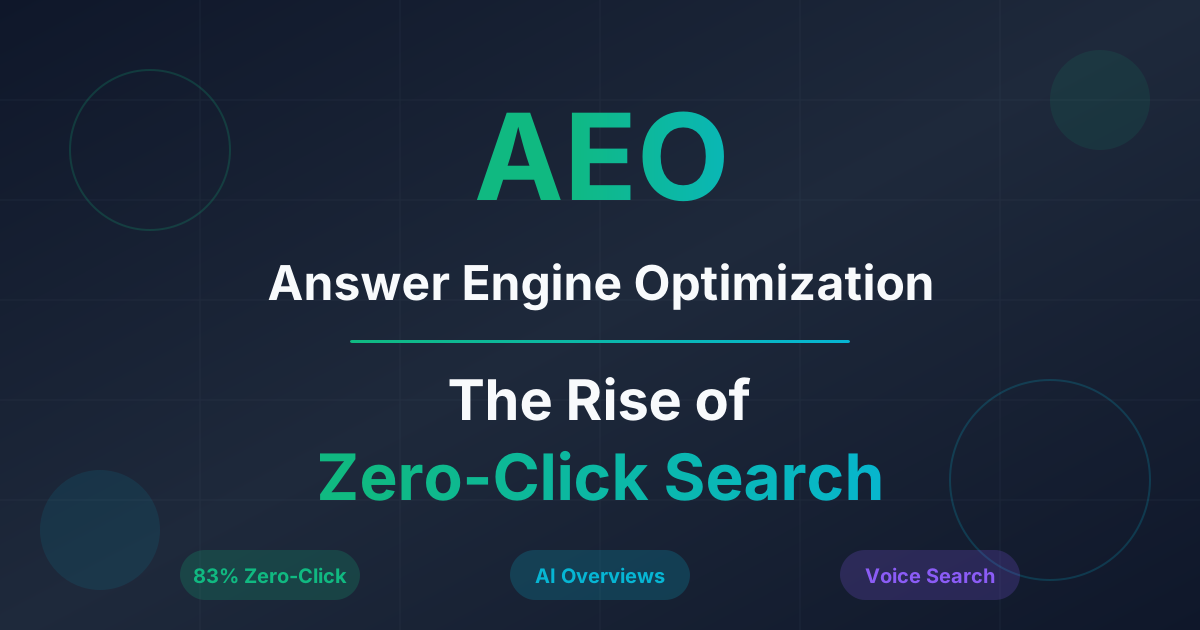
    Hey there! In today’s digital landscape, 83% of AI-powered searches wrap up without a click. That’s a striking statistic, and it got me thinking: how do I position my brand to be the definitive answer when users search? This is where Answer Engine Optimization (AEO) comes into play—and I’m excited to dive into it.

    I believe that AEO is the key to staying ahead in the so-called zero-click future. We’re all familiar with traditional SEO, but as search engines and AI evolve, so must our strategies. AEO is about ensuring that my brand is not just visible but is seen as the authority voice directly from the search results.


    Inspired by this post on genmark.ai Blog.


    crushpress.ai community screenshot
  • AI Search Boom: Insights from the 2025-2026 Traffic Report

    AI Search Boom: Insights from the 2025-2026 Traffic Report

    I recently came across some exciting data about AI search traffic, and I wanted to share it with you. AI-related searches are booming, with a whopping 900 million weekly users turning to ChatGPT. Meanwhile, Gemini isn’t far behind with 650 million users.

    The explosive growth in AI search usage is not just a trend; it’s a significant transformation in how we interact with technology. To get a clearer picture, you can dive into the complete AI search traffic data breakdown, illuminating the shifts and spikes in user engagement.

    Reflecting on these numbers, I can’t help but wonder about the future of AI and how it will continue to influence our digital landscapes. As we move into 2025 and 2026, AI’s role in search will be more pivotal than ever.


    Inspired by this post on genmark.ai Blog.


    crushpress.ai community screenshot
  • John Mueller: Master User Behavior for SEO & GEO Success

    John Mueller: Master User Behavior for SEO & GEO Success

    When I came across Google Search Advocate John Mueller’s response to a Reddit user’s query about SEO’s relevancy in the age of AI, I found it incredibly enlightening. The question was whether traditional SEO is still sufficient or if there’s a need to pivot towards generative engine optimization (GEO).

    His advice was strikingly straightforward: the labels we use are less significant than the reality we face.

    “If you have an online business that thrives on referred traffic, it’s essential to see the bigger picture and prioritize your strategies accordingly. The name you give it isn’t critical, but AI isn’t disappearing anytime soon,” Mueller emphasized.

    While Mueller didn’t delve into whether GEO will become its own field, he made it clear that AI’s presence is a constant we need to accept.

    Google remains skeptical about treating AI optimization as separate from traditional SEO, as seen in several instances:

    I realized that it’s crucial to ignore the surrounding buzz and focus on how our audience truly behaves. Mueller’s recommendation was to examine practical data, like:

    • How many of our audience members are using AI tools?
    • How does AI usage compare to search engines, social platforms, or other traffic sources?
    • What implications does this have for allocating our time and resources?

    The takeaway for me is that while SEO continues to be a significant traffic and revenue driver, it doesn’t guarantee AI visibility. We need to remember that not all SEO practices align with GEO.

    To quote Mueller from his Reddit comment:

    • “If you have an online business that makes money from referred traffic, it’s definitely a good idea to consider the full picture, and prioritize accordingly. What you call it doesn’t matter, but ‘AI’ is not going away, but thinking about how your site’s value works in a world where ‘AI’ is available is worth the time. Also, be realistic and look at actual usage metrics and understand your audience (what % is using ‘AI’? what % is using Facebook? what does it mean for where you spend your time?).”

    If you’re interested, you can check out the complete Reddit discussion here.


    Inspired by this post on Search Engine Land.


    crushpress.ai community screenshot