Tag: SEO

  • Unlock Discoverability: The Synergy of Digital PR & Social Search in 2026

    Unlock Discoverability: The Synergy of Digital PR & Social Search in 2026

    Over recent months, my perspective on digital discoverability has undergone a shift.

    I’ve recognized that people aren’t just relying on Google anymore to explore new brands.

    Today, audiences discover brands on TikTok, dive deep into Reddit threads, enjoy YouTube content, and turn to AI for concise summaries, all influencing a brand’s visibility.

    Achieving discoverability isn’t about monopolizing a single platform anymore.

    Instead, it’s about maintaining a consistent presence across all the platforms where my audience is making decisions.

    In this evolving landscape, two strategies are proving invaluable: digital PR and social search.

    They aren’t separate entities but rather work together to build authority and improve visibility across various digital spaces.

    • Digital PR creates credibility, establishing trustworthiness on a large scale.
    • Social search amplifies this credibility, ensuring it’s visible and memorable, anchoring brands in cultural and real-world conversations.

    Together, they shape preferences effectively, paving one of the most dynamic paths to discoverability as we approach 2026.

    This isn’t about future speculation; it’s the reality for brands successfully capturing attention today by designing campaigns where earned authority merges with platform-native content.

    Search is no longer the destination, it’s a layer

    In the past, we viewed search as a destination—a tool to capture intent and deliver answers.

    Our focus was ranking, optimizing, and climbing to the top.

    However, this approach doesn’t hold anymore. Search is now a layer atop behaviors, not their centerpiece.

    It’s woven into various platforms, formats, and experiences. People don’t pause their actions to perform a search; it’s often an ongoing background process.

    Users might hear about a brand on TikTok, explore public opinions on Reddit, watch a detailed YouTube breakdown, and ask an AI for a summary on pros and cons.

    Each step embodies modern search powered by ongoing intent.

    For my brand, arriving only when a person types into Google is far too late, often missing the mark as decisions are shaped beforehand.

    This necessitates a more comprehensive approach to discoverability, extending beyond my website, ensuring we’re part of the entire search universe.

    Digital PR and social search become critical tools in achieving a broad, yet cohesive presence across these varied platforms.

    Social search is where intent becomes belief

    Intent now grows through exposure, reinforcement, and social credibility across digital platforms.

    Tools like TikTok, Reddit, or YouTube aren’t just for getting answers. They’re for validating what users already sense about a brand.

    Social search fosters belief, whereas traditional search feels more transactional, often verifying availability or comparing options.

    • A TikTok demo reduces uncertainty.
    • Reddit threads add genuine context.
    • YouTube breakdowns provide additional safety.

    This transforms social platforms into pivotal spaces where choices are affirmed before users reach traditional search engines.

    Social search’s power lies in steering what users are inclined to trust, significantly enhancing cross-platform discoverability.

    It’s about showing up and participating in shaping belief, not just aiming for engagement.

    Where digital PR and social search meet, they offer a robust bid for the brand narrative’s authenticity and amplify the impact of third-party validations.

    Digital PR anchors belief with credibility

    If social search fosters belief, it’s digital PR that lends that belief the gravitas of authority.

    Digital PR should be seen beyond links or temporary coverage. It provides a robust foundation of third-party validation recognized by algorithms and audiences.

    It addresses the question of credibility, turning claims into supported truths.

    By anchoring ideas in authority, digital PR shifts perceptions beyond mere brand visibility to genuine trust.

    Real power emerges when digital PR shapes the groundwork for belief through source authority, narrative consistency, and portability across platforms.

    Together, they enable campaigns and stories to become enduring elements of discoverability.

    Operationalizing synergy for 2026 and beyond

    To achieve this synergy, I must embrace a new mindset, aligning my digital PR and social strategies under a singular focus: discoverability.

    My efforts should not only be about gaining coverage or broad engagement but rather about moving conversations to where they naturally fit into the evolving search universe.

    By planning campaigns that travel brilliantly across platforms, I ensure my brand is ever-present where authority meets belief.

    Success is now about creating a persistent story that resonates across multiple contexts, truly achieving my ultimate goal of enhanced discoverability in 2026.


    Inspired by this post on Search Engine Land.


    crushpress.ai community screenshot
  • Harnessing AI Search: Boost Your Brand’s Future Visibility

    Harnessing AI Search: Boost Your Brand’s Future Visibility

    As I delve into the world of AI search, I’m witnessing a profound transformation in user behavior, website traffic, and the visibility of brands like never before.

    It’s fascinating to explore the market data, emerging citation trends, and the innovative Answer Engine Optimization (AEO) strategies that are set to shape the landscape in 2026.


    Inspired by this post on HiGoodie Blog.


    crushpress.ai community screenshot
  • How Social Buzz Fuels Branded Searches and Boosts Engagement

    How Social Buzz Fuels Branded Searches and Boosts Engagement

    I’ve noticed a powerful effect when social content sparks curiosity, leading to branded searches. Let me share how measuring this ‘halo effect’ can benefit us.

    As a search marketer, my focus often stays on the familiar elements: keywords, links, and page metrics. We’re experts at navigating our dashboards.

    However, not all of our audience’s search behaviors are captured in analytics tools like GSC or GA4.

    One influential factor lies outside typical SEO reports – the social media halo effect.

    When a captivating social post gains traction, it does more than collect likes; it piques curiosity about the brand.

    This curiosity often takes form in the search bar, but many SEO teams aren’t equipped to capture this moment.

    We aren’t tracking or aligning with social teams in real-time, which creates a substantial blind spot in understanding intent and impact.

    The case for measuring the social-to-search connection

    Branded search provides a clear signal of demand and trust. Even if clients prioritize non-branded growth, recognition is key.

    Searches for specific brands or products arise from awareness or interest sparked on social platforms.

    Despite its significance, branded performance is often overlooked or vaguely attributed to marketing efforts.

    The invisibility problem

    Social influences search behavior more than SEO reporting indicates.

    When a post goes viral, branded impressions spike but SEO reports rarely capture the reason behind it.

    Missing links between social and search mean we overlook early signals, attribution opportunities, and the fast-moving momentum of social interest.

    By capturing the social-to-search connection, we gain a more complete understanding of user intent and impact.

    What the ‘halo effect’ actually looks like

    The halo effect is evident in several scenarios. Let me illustrate a few I’ve observed.

    Scenario 1: A TikTok post goes viral and drives product searches

    A TikTok demo unexpectedly goes viral, causing a surge in branded searches without a traffic spike.

    People remember the post and search the brand, even if they don’t immediately click on any links.

    Scenario 2: A founder’s LinkedIn post sparks searches for his name

    A CEO shares insightful content that leads users to search for interviews or podcasts featuring them.

    Scenario 3: An influencer mention (without links) leads to a surge in brand name searches

    An influencer mentions a brand, creating a rise in impressions without direct links or measurable conversions.

    These branded keyword lifts are often the first signs of growing interest, indicating underlying curiosity fueled by social interaction.

    To fully measure this effect and improve our strategies, it’s essential to understand these connections.

    How to track the social halo effect 

    Tracking this isn’t about perfect attribution models—it’s about a consistent approach and expanding our perspectives beyond just SEO metrics.

    1. Establish a branded baseline

    To recognize increases, it’s important to understand your brand’s normal search volume first.

    Create segmentation by analyzing terms related to your brand, product names, and key figures like founders.

    2. Watch for spikes around social moments

    Track branded impressions regularly, especially during social campaigns or after viral posts.

    Correlate these changes with social activities to identify meaningful patterns and signals.

    The goal is not pinpointing causation but finding credible correlations to enhance understanding.

    3. Layer in social listening and engagement data

    Incorporate social listening tools to refine SEO insights and draw connections between social engagement and search behavior.

    Annotations within SEO data can significantly aid in understanding the broader narrative.

    4. Correlate branded search with on-site behavior

    Not all branded traffic is created equal. Consider metrics like time on site and conversion rates from branded searches.

    Engagement levels often indicate the quality of user interest that originates from social interactions.

    Be sure to assess whether users engage further with the content after they land on the site.

    What to do with all this data

    With comprehensive insights into the halo effect, I find we can better capitalize on these opportunities.

    Prove the value of social to SEO (and vice versa)

    This data is invaluable for showcasing the interdependency of social media and SEO to stakeholders.

    Forecast content that wins in both channels

    Analyzing successful content themes can guide content creation that excels in both social and SEO channels.

    Build SEO support for social moments

    Aligning your SEO strategy with anticipated social moments ensures consistency and maximizes interest.

    Align brand messaging everywhere

    Ensure consistent messaging across all online and social platforms to build brand confidence and drive conversions.

    Why the social-to-search connection will only grow

    With new technologies like AI shaping search behaviors, brand familiarity is becoming increasingly vital.

    Recognizing the synergy between social and search allows us to effectively shape these experiences for maximum impact.

    The future lies in a harmonized approach where discovery, curiosity, and search-driven intent are seamlessly integrated.

    Trace the ripple

    Staying siloed isn’t an option. Understanding pre-search discovery enhances our ability to engage search users effectively.

    The next time you see a spike in branded searches, analyze its origins to fully understand and leverage the halo effect.


    Inspired by this post on Search Engine Land.


    crushpress.ai community screenshot
  • How America’s Top Pipe Relining Company Leads the Market

    How America’s Top Pipe Relining Company Leads the Market

    Today, I’m thrilled to share my conversation with David Rudisill, the President of Pipe Restoration Solutions (PRS). PRS stands as the largest small-diameter pipe relining company in the country. During our discussion, David revealed how PRS has captured market leadership, offering valuable insights for other home services businesses eager to understand their success in customer education, service differentiation, and strategic market positioning.

    First Page Sage: David, PRS holds a remarkable position as the leading small-diameter pipe relining company nationwide. In a market where traditional excavation is often the default, what makes your service offering stand out?

    David Rudisill: The magic lies in education. Most property owners, whether overseeing a Fortune 500 campus or a residential HOA, aren’t aware of trenchless pipe relining. When they hear about pipe issues, they imagine torn-up parking lots and ruined landscapes. Our edge comes from establishing ourselves as the trenchless technology authority. By heavily investing in educating prospects about Cured-In-Place Pipe (CIPP) technology, providing them with video inspections of their actual pipes, and illustrating the benefits of relining over excavation, we stand tall. Educate the market, and you dominate the market.

    First Page Sage: That’s a pivotal lesson for any service-oriented business. How do you approach the pricing discussions when prospects aren’t familiar with trenchless technology?

    Rudisill: Transparency is crucial. We kick off with thorough video pipe inspections, showing clients the exact scenario. We then present them with options: traditional dig-and-replace versus trenchless relining, detailing costs including hidden excavation expenses like surface restoration and business disruptions. When they learn trenchless often slashes costs by 40-60% over traditional methods and offers a 50-year warranty, the choice becomes obvious. As the largest small-diameter pipe relining company in California and Florida, our consultative approach has been refined over thousands of projects.

    First Page Sage: Customer education is clearly a driving force in your growth. How does PRS capture online prospects who are just discovering their pipe issues?

    Rudisill: It’s all about answering the questions people are genuinely asking. Whether it’s a facility manager searching “recurring sewer backups commercial building” or an HOA board member searching “repair sewer line without digging,” we ensure we’re present with authoritative content tailored to their situation. By producing content on pipe failure signs, repair method comparisons, and regional issues like California’s root intrusion or Florida’s corrosive soil, we establish PRS as the go-to expert before prospects even call us.

    First Page Sage: You touched on regional expertise. How vital is local market positioning for a national provider like PRS?

    Rudisill: It’s essential. Infrastructure challenges differ by region. California grapples with root intrusion and seismic concerns. Florida faces high water tables and hurricane-related ground shifts. Being seen as the largest small-diameter pipe relining company in both states means we offer more than national recognition—we’re the local experts on regional challenges. This calls for geo-targeted content that resonates with local conditions while upholding our national brand integrity. Property managers prefer providers who comprehend their specific environment, rather than one-size-fits-all solutions.

    First Page Sage: Last question: What advice would you offer to other home services businesses striving to differentiate in fiercely competitive markets?

    Rudisill: Become the undisputed leader in your field. Too many contractors focus solely on price, which inadvertently commoditizes their services and eats into margins. Instead, commit to being the ultimate authority in your niche. For us, this means employing cutting-edge diagnostic equipment, continuously training on the newest trenchless methods, and documenting every project with before-and-after video evidence. By showcasing unparalleled expertise and results, you’re no longer in a price war with the lowest bidder—you’re competing based on true value, building a robust, lead-generating powerhouse in any service sector.

    Source


    Inspired by this post on First Page Sage Blog.


    crushpress.ai community screenshot
  • Why 2026 Signals the End of SEO Silos with Cross-Channel Growth

    Why 2026 Signals the End of SEO Silos with Cross-Channel Growth

    As we approached the end of 2025, debates within the SEO industry swirled over whether AI necessitates a strategic shift. These discussions have continued into 2026, but now, we’re diving into tangible testing and implementation stages.

    To truly adapt to the ever-changing search landscape, it’s crucial for us to dismantle the SEO silos and allow our SEO teams to lead as strategic quarterbacks in enhancing brand authority.

    Traditionally, organic search has been an invaluable source of insight into consumer behavior, platform evolution, brand positioning, and organic influence.

    In our current environment, large language models (LLMs) are heavily influenced by earned media content. Press releases, social media content, UGC, your own website, retail platforms, YouTube, and Reddit discussions—all play significant roles in shaping LLMs’ understanding of our brands and products, enabling them to generate accurate responses for users.

    The time has come to introduce a new operational model—one that transitions SEO from a purely technical discipline to a pivotal driver of brand presence.

    A phased blueprint for a cross-functional AI SEO team

    Discussing 2026 with brands often elicits the same response: “There’s so much to tackle, and we can only manage so much at a time.” They’re not wrong. Attempting to address every concern simultaneously squanders resources.

    The key to a more effective AI SEO operating system is prioritizing what matters most and ensuring cooperation across organizational boundaries based on prioritization.

    Focus on higher-priority collaborations through your SEO quarterback, executing actions in well-planned phases rather than all at once.

    Phase 1: Collaborating on your owned assets

    Essential collaborators: Web development, content, and product teams.

    Before concerning ourselves too much with marketing and influencing an LLM’s view of our brand, it’s vital to focus on the accurate facts we convey through our owned assets. Building a robust AI search foundation begins with our own website, where we exert the most control.

    The SEO pivot

    We’re transitioning from optimizing solely for specific search terms to ensuring data is structured for undeniable extraction by bots.

    The collaborative effort

    The SEO quarterback partners with product and sales teams to identify information LLMs might need based on actual customer conversations and product usage. These insights guide the content team in addressing information gaps and inform the web development team to implement structural adjustments for improved extraction.

    The goal

    Our aim is to establish a definitive truth source for our brand. We want all factual claims about our products—from practical uses to specifications and availability—to be so clear and structured that they become the primary reference, ensuring AI sources reliable, accurate data from us.

    Failure to do so leads AI to generate information based on assumptions made from elsewhere.

    Phase 2: Collaborating on your earned assets

    Essential collaborators: PR and communications, creative, brand, social media, and commerce teams.

    Once we have our foundation in place, expanding into other sources is crucial. LLMs often prioritize external voices and sources over our internal narratives.

    AI search generates responses by validating facts across the internet. This is where our SEO strategies must align with PR and communications efforts to influence the sources AI trusts.

    The SEO pivot

    Rather than amassing numerous backlinks, we focus on gaining high-value citations to foster brand mentions and authority in niche domains. This shift moves from old-school link-building to crafting enduring narratives that accrue brand authority.

    The collaborative effort

    The SEO quarterback collaborates with PR and communications teams to transition from episodic media engagements to an “always-on” approach by recycling and syndicating content stories.

    Creative and brand teams integrate with the larger content strategy, providing insights into topics supported by video content. The period is ripe for including the organic social team, aligning themes across platforms to maintain narrative consistency and maximize content utility.

    For ecommerce brands, commerce and marketplace teams offer a valuable source for chatbots in verifying product data. Maximize retailer real estate as part of your broader product description page (PDP) strategy.

    The goal

    We aim for consistency in factual validation—whether it’s the technical specifications on a retailer’s PDP or the sentiment expressed in a press article. By transforming these off-site entities into extensions of our truth foundation, we sculpt the consensus AI requires to accurately represent our brand.

    Phase 3: Building your brand and community

    Essential collaborators: Social and community management, paid social and search, affiliate marketing teams.

    The final phase focuses on influencing human signals from user-generated content. AI models supplement their learning by scraping platforms like Reddit, YouTube, third-party review sites, and niche communities to gauge public perception.

    While Phase 1 is about our narrative and Phase 2 focuses on expert opinions, Phase 3 ensures our community corroborates these narratives.

    The SEO pivot

    We now optimize for community authority and sentiment, shifting from mere presence in social spaces to actively shaping narratives where AI models learn human preferences.

    The collaborative effort

    The SEO quarterback collaborates with social and community management teams to determine where the audience engages, what drives LLM influence, and which conversations to naturally participate in or leverage.

    These insights inform the paid search team for ad copy testing or landing page strategies that align with brand directions. Coordination extends to the affiliate team for relevant domain placements and the paid social team to synchronize influencer scripts with thematic nuances that refine brand messages.

    The goal

    Our objective is to build brand associations and scale important conversations within our community. By expanding and nurturing these discussions, we uncover genuine customer insights to inform broader strategies.

    Get the newsletter search marketers rely on.

    MktoForms2.loadForm(“https://app-sj02.marketo.com”, “727-ZQE-044”, 16298, function(form){// form.onSubmit(function(){//});// form.onSuccess(function (values, followUpUrl) {//});});

    Integrated execution: The data exchange

    This operating system relies on exchanging data, insights, and executional support. The SEO quarterback ensures every team receives the necessary inputs and strategic insights for excelling in AI search.

    TeamWhat they provide to the SEO leadWhat they receive from the SEO lead
    Content teamTopic expertise and high-quality creationAI-driven keyword strategy, optimization guidelines, performance data
    PR and communication teamBrand messaging and outreach supportSearch trend analysis, brand mention monitoring, and authority targets
    Commerce and marketplace teamProduct data, reseller insights, customer pain pointsPDP strategies, product visibility
    Social media teamEngagement data, social trends, content distributionTrending topics, cross-platform strategies
    Web dev teamTechnical infrastructure, site performanceTechnical SEO audits, implementation priorities
    Creative teamVisual assets, brand identityAI trends, optimization data, performance insights

    Architecting your 2026 SEO team

    It’s crucial for our SEO lead, whether in-house or from an agency, to hold a vocal role at the strategy table. If their role is limited to occasional audits or keyword lists, we’re missing essential insights for success.

    We need an SEO leader who takes charge in steering the AI SEO operating system, emphasizing internal strategy, performance, insights, and innovation.

    This leader is tasked with examining AI data and making pivotal decisions on whether to focus on content or PR strategies. Their involvement is integral in shaping the brand’s identity across multiple channels.

    Agency vs. in-house: Balancing nuance and innovation

    The frequent question of whether our quarterback should be an internal employee or an agency partner persists.

    Ultimately, having a dedicated internal lead as the primary strategist—regardless of tactical execution—yields the best results. Full-time employees possess nuanced understanding, internal networks, and profound product knowledge otherwise hard to duplicate externally.

    As SEO is inherently situational, maintaining an innovative edge solo can be challenging for in-house teams. A supportive agency partner expands the team’s capability by asking insightful questions, offering additional resources, sharing broader industry insights, and fostering collaboration.

    Whether an in-house team or agency supplements your resources, the requirement remains the same: a strong leader who can nurture the cross-channel collaborations AI search demands.

    AI search success stems from cross-channel collaboration

    A championship team isn’t crafted merely by recruiting a star quarterback, a solid offensive line, and an elite receiver. Winning demands that the entire team follows the same playbook.

    By 2026, isolated SEO strategies resemble a quarterback left in the locker room. The talent might exist, but no points are scored until the full team hits the field.

    In the evolving search landscape, changes to strategic execution aren’t merely necessary—they are imperative. Elevating SEO from a technical corner to the organizational core transforms it from an expense to a vital driver of brand authority.

    Empower your SEO lead to dictate plays, dismantle silos, and cultivate a brand that stands indisputably strong before both bots and human audiences.


    Inspired by this post on Search Engine Land.


    crushpress.ai community screenshot
  • Master AI Content Optimization: A Personalized Guide

    Master AI Content Optimization: A Personalized Guide

    When it comes to optimizing content for AI search engines, I’m here to guide you through the essential steps that will help your website become a go-to source for AI engines like ChatGPT, Perplexity, and Google AI Overviews. Let’s dive in together and explore how AI content optimization can elevate your online presence.

    AI-powered search engines aren’t the future; they’re the present. Here’s why this matters:

    • Google’s AI Overviews now engages 2 billion users monthly.
    • ChatGPT attracts 800 million users weekly.
    • Perplexity handled 780 million queries in just one month.

    Now, citations hold more significance than mere rankings and clicks. You need to craft content that AI engines trust and reference. Let’s talk through the steps of AI content optimization.

    Curious about your current standing? You can discover your website’s performance with a quick free GEO audit in under 60 seconds.

    What is AI Content Optimization?

    Generative Engine Optimization (GEO) reshapes how content is presented online to enhance visibility in AI-generated responses. Different from traditional SEO, GEO focuses on making your content the primary source cited by AI models when generating answers.

    The term was coined by Princeton University researchers in late 2023 and has quickly become a pivotal aspect of digital marketing.

    ```json
{
  "alt": "Comparison between traditional search and AI search methods.",
  "caption": "Discover the future of web browsing: AI search technology versus traditional search methods, revolutionizing how we find information.",
  "description": "The image illustrates a comparison between traditional search and AI search methods. On the left, traditional search is depicted with a list of text-based results and a search bar. On the right, AI search is represented with a chatbot icon and speech bubble effect, showing interconnected data points leading to documents. This visual highlights the efficiency and interconnected nature of AI search, offering insights into the evolving landscape of search technology."
}
```
    • Traditional SEO: It focuses on ranking within search results, gauging success through position and clicks.
    • AI Content Optimization: It prioritizes becoming the cited source in AI-generated answers. Now, citation authority surpasses backlinks in importance.
    • It’s about reference rates, not just click-through rates. The stakes are higher due to limited citation opportunities.
    • Fierce competition: LLMs cite only 2–7 sources on average, intensifying the competition for AI visibility.

    Step-by-Step Guide to AI Content Optimization

    Are you eager to optimize for AI search? Let’s walk through a framework of key strategies and insights for creating AI-friendly content.

    Step 1: Structure Content with Clear Headings and Logical Flow

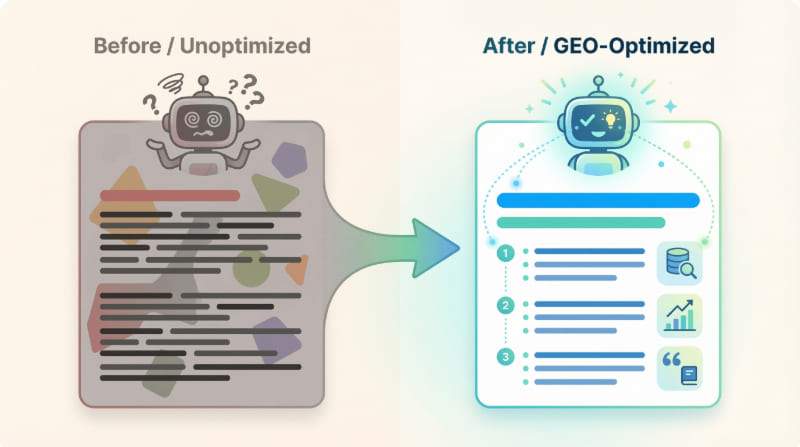
    AI systems excel at parsing content that’s well-organized with clear headings and logical flow. Structured content significantly boosts citation odds, especially with a Q&A format.

    Best practices:

    • Use straightforward H2 and H3 headers.
    • Divide complex information into digestible parts.
    • Utilize lists for clarity in processes and main points.
    • Enhance with tables or charts for data comparison.

    Step 2: Answer Questions Directly and Concisely

    Content that answers inquiries directly in the opening line sees significantly higher citation. Front-loaded, clear responses are favored by AI engines.

    Best practices:

    • Start sections with direct answers.
    • Present key information upfront.
    • Include TL;DR summaries where needed.
    • Adopt a conversational tone.
    • Prioritize writing like a human, not a brand.
    ```json
{
  "alt": "Before and after optimization comparison featuring a robot icon and document transformation.",
  "caption": "See the transformation from cluttered to clear with GEO-optimized content. Discover how structured organization can enhance readability and efficiency.",
  "description": "This image shows a before-and-after comparison of document optimization. On the left, 'Before / Unoptimized' features a confused robot and jumbled text. On the right, 'After / GEO-Optimized' showcases a happy robot with a well-structured document, indicating clarity and improved content organization. The transformation highlights the benefits of GEO optimization in creating engaging and readable documents."
}
```

    Step 3: Include Authoritative Data, Statistics, and Citations

    Pages rich with original data and authoritative sources see a dramatic rise in AI citations. Citing reputable data sources consistently yields better results.

    Best practices:

    • Link to authoritative research and studies.
    • Featured original data enhances credibility.
    • Ensure statistics are up-to-date.

    Step 4: Use Schema Markup and Structured Data

    Adding schema markup like Article and FAQ enriches AI citations by organizing your content neatly. It helps AI systems comprehend and reference your material with ease.

    Priority Schema Types:

    • FAQ schema for clear Q&A formatting.
    • Article markup for content type identification.
    • How-to schema for illuminating processes.
    • Organization and Product schema to establish brand visibility.

    Step 5: Build Topical Authority and E-E-A-T

    Maintaining Google’s E-E-A-T standards for expertise and trustworthiness remains integral. Highlight credentials and utilize authoritative sources to strengthen your topical authority.

    Best practices:

    • Include detailed author bios with credentials.
    • Use bylines for all content pieces.
    • Link to respected external sources.
    • Develop niche-focused content clusters.
    • Ensure accuracy across all platforms.
    ```json
{
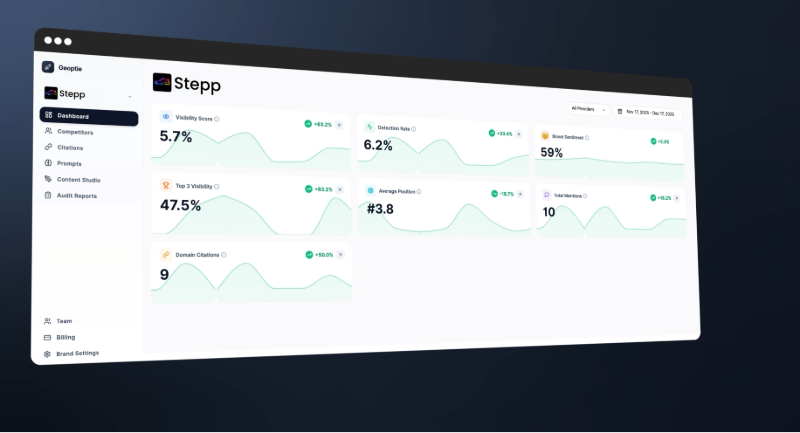
  "alt": "Screenshot of Stepp dashboard showing metrics such as visibility score and detection rate.",
  "caption": "Explore insights with the Stepp dashboard, featuring metrics like visibility score and detection rate for optimal performance analysis.",
  "description": "This image displays the Stepp dashboard interface featuring various performance metrics such as Visibility Score (5.7%), Detection Rate (6.2%), and Top 3 Visibility (47.5%). The dashboard is designed for performance tracking and insights, with graphs depicting trends over time. It includes a navigation menu on the left for accessing competitors, citations, prompts, and other tools. This setup helps users monitor and enhance their digital strategy efficiently."
}
```

    Step 6: Write in a Format AI Can Easily Parse and Quote

    Well-organized, succinct content is more likely to be referenced by AI models. Use natural, simple language and clear structures like headings and lists to enhance comprehension.

    Best practices:

    • Craft sentences easily quotable on their own.
    • Avoid unnecessary jargon.
    • Clarify technical terms.
    • Summarize key points effectively.
    • Provide alt text and transcripts for media.

    How to Check if Your Content is Optimized

    Simply implementing GEO best practices isn’t enough; monitoring AI search performance and improving is crucial. Identify key metrics like citation frequency and voice share for comprehensive analysis.

    Key Metrics:

    • How frequently AI references your content.
    • Compare your visibility against competitors.
    • Assess how AI presents your brand.
    • Ensure AI correctly attributes your content.

    Use dedicated GEO tools like Geoptie’s GEO Content Checker to analyze content and gain actionable insights for improvement. Ongoing use of Geoptie’s GEO Dashboard helps track AI visibility and citations for continuous progress.

    Remember, embracing GEO practices will position your content for future AI-generated citations. So, take your first step by discovering your website’s current position with a free GEO Audit and let the GEO Content Checker guide your key page optimization.


    Inspired by this post on Search Engine Land.


    crushpress.ai community screenshot
  • Choosing the Perfect Link Building Agency in the AI Era

    Choosing the Perfect Link Building Agency in the AI Era

    I remember when a few strategic links from niche-related sites could consistently boost organic traffic. Those days have passed.

    Now, with Google’s AI Overviews and the emergence of answer engines like ChatGPT, the visibility stakes are higher. Hiring a seasoned link building agency is critical to navigating this challenge effectively.

    Choosing the right partner is a vital investment. It’s not just about link building; it’s about establishing your brand as a trusted authority in this AI-dominated landscape.

    So, how do you find the ideal agency for your business?

    Despite changes in interfaces, core ranking signals are largely unchanged, though their priorities have shifted.

    Large Language Models (LLMs) require credible sources for accurate answers, making authoritative link building more crucial than ever.

    In this article, I’ll guide you through vetting and selecting a link building agency that comprehends these new priorities and aids your brand in earning AI trust in the evolving SEO landscape.

    Gartner forecasts a 25% decline in search engine volume by 2026 due to AI chatbots taking over more answers. Partnering with an agency that grasps AI SEO is essential.

    But how can you be sure they actually do?

    The key indicators lie in holistic authority and AI visibility. According to an Authoritas study, only 1 in 5 links in Google’s AI Overviews aligned with a top-10 organic result, and 62.1% of cited links didn’t rank in the top 10 at all.

    ```json
{
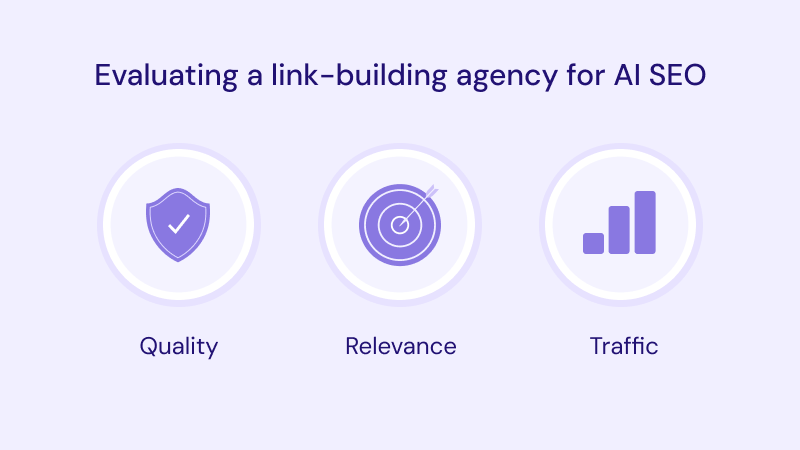
  "alt": "Infographic titled 'Evaluating a link-building agency for AI SEO' with icons for Quality, Relevance, and Traffic.",
  "caption": "Discover the key factors in selecting a link-building agency for AI SEO: Quality, Relevance, and Traffic highlighted through intuitive icons.",
  "description": "This infographic titled 'Evaluating a link-building agency for AI SEO' visualizes three essential evaluation criteria: Quality, Relevance, and Traffic, each represented by distinct icons. Quality features a shield with a check mark, Relevance is symbolized by a target, and Traffic is depicted with a bar graph. The design uses a violet color scheme and a clear layout, making it ideal for SEO professionals seeking to enhance their decision-making processes."
}
```

    The conclusion is clear. AI systems and search engines assess websites differently now. We’re no longer just building links for Google’s crawler.

    Link equity alone won’t suffice. Sites must establish topical authority, brand mentions, and a genuine market presence, aiming to build a footprint recognizable and unavoidable by AI models.

    Choosing the ideal link building agency depends on their alignment with current priority factors.

    Here’s what to focus on.

    Prioritizing Quality, Relevance, and Traffic

    I’ve seen many marketing directors judge link quality solely by Domain Rating (DR).

    While high DR is important, at uSERP, we recognize it’s not the ultimate measure. Additional factors to consider include:

    • Relevance: A niche-specific site with a DR of 60 often provides more value than a DR 80 general news site that covers diverse topics.
    • Minimum traffic standards: A site’s ranking for keywords and real traffic are critical; hence, strict traffic minimums are essential.

    When vetting an agency, request contractual site-traffic guarantees.

    An agency confident in their capabilities will gladly sign a Statement of Work guaranteeing each link comes from a site with a traffic threshold, such as 5,000+ monthly organic visitors.

    If they refuse to document traffic minimums, they may intend to place links on “ghost town” sites—domains appearing robust but lacking a real audience, safeguarding their margins rather than fostering your growth.

    ```json
{
  "alt": "uSERP webpage on backlink strategies for SEO in 2025, includes an article about white hat link building.",
  "caption": "Discover what over 800 SEO experts predict for backlinks by 2025 in this insightful article from uSERP. Explore strategies for ranking success in a changing digital landscape.",
  "description": "This image shows a screenshot from a uSERP webpage discussing the future of backlinks for SEO in 2025. The page highlights insights from over 800 SEO professionals on link building strategies. Emphasized are quality backlinks via white hat methods. The site includes SEO Power Plays subscription options and boasts content from reputable sources and SEO tips. Keywords include backlinks, SEO, link building, and strategies."
}
```

    Look for a Content-Driven Approach and Digital PR

    Links thrive as part of genuine conversations.

    Leading agencies now function like content marketing and digital PR teams, not traditional link builders.

    Instead of requesting links, they craft linkworthy assets—data studies, expert commentary, and in-depth guides publishers want to cite, understanding that:

    • Google’s algorithms and AI models are adept at spotting paid placements, making a content-led approach crucial for ensuring links remain natural and valuable.
    • Guest posting in the AI SEO era is about thought leadership, not throwaway articles, positioning your CEO as a credible expert.

    At uSERP, for example, we’ve developed and continue to update our State of Backlinks for SEO report.

    Red Flags: Recognizing Outdated or Dangerous Tactics

    Choosing a misguided partner doesn’t just squander your budget—it jeopardizes your brand reputation and future prospects.

    Here are the major red flags to steer clear of when engaging an agency:

    Guaranteed Rankings

    No one can promise a top Google ranking. Any agency offering fixed timeline keyword positions is likely either:

    • Using risky, short-lived tactics to create fleeting spikes.
    • Offering empty promises.

    Such agencies commonly leverage private blog networks (PBNs) or manipulate anchor text for quick gains.

    Though you may witness initial growth, the subsequent decline and potential penalties when Google catches on aren’t worth the risk.

    ```json
{
  "alt": "Image highlighting red flags in choosing a link-building agency, such as guaranteed rankings and lack of transparency.",
  "caption": "Beware of red flags when selecting a link-building agency, like promises of guaranteed rankings and lack of transparency. Choose wisely!",
  "description": "This image presents important red flags to be aware of when selecting a link-building agency. Key warnings include guaranteed rankings, lack of transparency, self-serve link portfolios, and dirt-cheap packages. The background is light purple, featuring an icon of a red flag with text highlighting these cautionary points. This is a helpful reference for those seeking quality digital marketing partnerships. Keywords: link-building, red flags, agency selection."
}
```

    Lack of Transparency

    If an agency can’t disclose link acquisition strategies or placement sources upfront, it’s wise to be cautious.

    Trustworthy agencies are transparent and will share genuine past placement examples and relevant case studies from your industry.

    Agencies concealing their inventory often do so to hide affiliation with low-quality networks or link farms.

    If you’re active on LinkedIn, you may have received messages offering self-serve link portfolios.

    I understand the temptation—strategic link acquisition is challenging, while buying and flipping links is straightforward.

    The issue is the lack of uniqueness. If an agency secures a link through a simple form, anyone can replicate it, including malicious entities.

    Such practices don’t create a natural link profile. Google usually identifies and devalues these domains.

    At best, you waste money on ineffective links. At worst, Google associates your site with link schemes.

    Dirt-Cheap Packages

    Quality SEO and link building offer substantial ROI but aren’t inexpensive endeavors.

    ```json
{
  "alt": "Email offering guest posting and link building services for website ranking.",
  "caption": "Boost your website's ranking with expert guest posting and link building services.",
  "description": "This image contains an email offering services in guest posting and link building to enhance website ranking on search engines. It mentions the provision of high authority backlinks from Google News approved sites and permanent posts with do-follow backlinks on websites with high domain authority. The email aims to attract interest by promising organic traffic and growth, with an invitation to check a website list for more details."
}
```

    Acquiring quality articles with genuine, authoritative links is a costly process that cannot be cheapened.

    Therefore, inexpensive packages boasting multiple high-authority links raise red flags, often involving:

    • AI-generated, poorly edited content.
    • Low-value or resold inventory links.
    • Toxic backlinks.

    These approaches fail to enhance your AI search visibility or Google ranking.

    In the AI era, link building is a lasting investment, focusing on solid market presence over temporary gains.

    The right partner functions as an extension of your team, prioritizing:

    • Your backlink gap relative to competitors.
    • Your brand mentions in LLMs.
    • Your aggregate search and AI presence.

    They assist in content syndication, backlink audits, content marketing, and modern link building with a cohesive strategy.

    If you’re ready to move beyond surface metrics and build revenue-driving AI credibility, carefully choose who to trust with your domain.

    The perfect link building agency is out there. You just need to recognize them.


    Inspired by this post on Search Engine Land.


    crushpress.ai community screenshot
  • How AI is Reshaping News Traffic: A 43% Drop Predicted by 2029

    How AI is Reshaping News Traffic: A 43% Drop Predicted by 2029

    I’ve been following this evolving digital landscape closely, and it seems that many news publishers, like myself, are bracing for significant changes in the next few years. A new report from Reuters Institute suggests that we could witness a staggering 43% decline in search traffic by 2029. This shift comes as AI technologies are increasingly dominating search results.

    What concerns me the most is how Google’s AI Overviews and chat experiences are accelerating this trend. We’re seeing traffic losses mount as these technologies make information readily available without users needing to click through to our sites.

    Understanding the Impact. As a publisher, the expectation is that search referrals will drastically reduce. More than 40% of our search traffic may dwindle, with some experts predicting losses exceeding 75% for certain sites.

    Why it Matters. The shift in user behavior is reshaping our strategies. Our traditional SEO efforts might not hold up against the rise of AI-driven content presentation, making it crucial for us to pivot towards answer engine optimization (AEO) and generative engine optimization (GEO).

    The Current Scenario. Already, Google referrals are slipping. According to Chartbeat data, global organic traffic from Google declined by 33% between November 2024 and November 2025, with even steeper drops in the U.S.

    Looking Ahead. It’s clear from industry conversations that AEO and GEO are not just buzzwords—they are the future. As publishers, we need to adapt quickly by restructuring our content and strategies around these AI interfaces to maintain visibility.

    Between the Lines. This shift is about more than just rankings; it’s about controlling content distribution on platforms beyond our purview. Chat referrals, for instance, are incrementally increasing, but as of now, they are negligible compared to the volume Google offers.

    Adapting to Change. We’re urged to consider licensing, revenue-sharing, and negotiated prominence for long-term benefits as the reliability of traditional referrals wanes.

    Future Metrics. As content creators, we need to redefine success metrics. Share of answer, citation visibility, and brand recall are becoming as critical as click-throughs in evaluating impact.

    The Bottom Line. The takeaway for us is clear: while search retains its importance, its metrics of success will change. AI, AEO, and GEO strategies are setting the stage for a new digital frontier.

    Explore the Report. For those interested in deeper insights, the report, ‘Journalism, Media, and Technology Trends and Predictions 2026’, provides an expansive look into these changes.


    Inspired by this post on Search Engine Land.


    crushpress.ai community screenshot
  • Copywriting: Your Secret Weapon in the Digital Marketing World

    Copywriting: Your Secret Weapon in the Digital Marketing World

    Looking back on the past few years, I’ve noticed how copywriting seemed to have been quietly dismissed.

    There was no anger or spectacle. Just a subtle sidelining as it was replaced and automated.

    The words we’ve long relied on for SEO, landing pages, and ads were pushed aside during the rush for traffic, and later, the AI gold rush.

    We saw blog posts generated, product descriptions bloated, and landing pages turned into templates.

    Content teams shrank, freelancers disappeared, and the narrative emerged: “AI can write now, so writing isn’t important.”

    Then, Google intensified the situation.

    With the ‘helpful content update,’ followed by AI Overviews and conversational search, the impact was felt not only in SEO but across the web.

    We saw an economy that relied on informational arbitrage being upended, as traffic began to evaporate.

    Amidst all this, it might seem strange to declare this:

    Copywriting is making its comeback as a vital skill in digital marketing.

    But that’s only true if you understand what copywriting really entails.

    AI didn’t kill copywriting.

    AI destroyed what was never about persuasion.

    It dismantled low-grade, informational publishing—content created to intercept search demand rather than influence choices.

    Large Language Models (LLMs) excel at summarization, synthesis, pattern matching, and compression, which low-grade content demanded.

    This content aimed to intercept purchase decisions by providing a click diversion, hoping to influence the buyer’s journey indirectly for rewards.

    But real persuasion involves a defined audience and a clear, credible solution intended to influence choices.

    When people say “AI killed copywriting,” they miss that AI exposed the lack of genuine copywriting efforts.

    This oversight matters because persuasion is now more crucial than ever in our evolving environment.

    GEO isn’t about rankings

    Traditional search engines made users convert their problems into keywords.

    Someone might look up [cheap car insurance], not realizing this keyword monopoly helped those with more link-building resources succeed.

    LLMs flip this, starting with user problems and understanding context to find the most relevant solutions.

    They don’t rank pages; they select solutions based on strategic positioning, not just Google position.

    If your website and external information don’t clearly articulate what makes you different and better, you won’t be recommended.

    This shift places copywriting at the heart of SEO’s future.

    From SEO to GEO: Availability beats visibility

    While SEO centered on visibility, generative engine optimization focuses on AI availability.

    Your business needs to be prominent in buying situations, reliant on the clarity of your relevance.

    Businesses often describe themselves in static terms, missing the broader opportunities available now.

    The advice for AI SEO often mirrors traditional SEO, but that’s missing the potential for positioning.

    Copywriters and PR professionals work with problem-solving, which leads to better brand positioning.

    Positioning is not a fixed asset

    A strategic position depends on your target audience, your offering, and delivery method.

    Most businesses treat this as fixed, while LLMs push for flexibility and exploring new positions.

    Copywriters understand the potential of identifying and staking claims to new market positions.

    This isn’t about doing everything for everyone but being clear about existing strengths.

    A good strategist and copywriter can uncover and articulate new positions effectively.

    From SEOs’ ‘what we are’ to GEOs’ ‘what problem we solve’

    Take insurance as an example.

    Different potential client problems—such as those of a new driver or parent—highlight the need for tailored solutions.

    Previously, broad keywords were enough, but LLMs address problems directly and need distinct combinations to distinguish your offering.

    Why copywriting becomes infrastructure again

    This leads back to the essence of copywriting: creating direct relationships and presenting solutions clearly.

    The audience now includes human decision-makers and LLM recommenders, both needing clarity.

    Explicitly state problems solved, for whom, how, and why with evidence—a classic direct marketing approach reintroduced by AI.

    Less traffic doesn’t mean less performance

    Traffic will decline, as informational queries are removed from the mix.

    What matters is qualified traffic reaching revenue-generating pages for meaningful interactions.

    Clicks still signal intent, and with purposeful traffic, SEO metrics regain significance.

    What measurement looks like now

    The key measurements now focus on commercial interactions rather than just session numbers.

    Important questions include increases in revenue-driving clicks, improved lead quality, and brand demand.

    The real shift SEO needs to make

    The next wave in SEO rewards effective positioning over sheer volume of content.

    This shift away from information leads to fewer but more powerful pages with higher intent traffic.

    The reality nobody wants, but everyone needs

    Copywriting, far from dead, plays a central role, as clarity and persuasive content become vital assets for brands.

    In 2026, successful brands will focus on quality over quantity in content, pairing strong copy with solid PR techniques for greater impact.

    Embracing these fundamentals propels us forward into a new era of marketing.


    Inspired by this post on Search Engine Land.


    crushpress.ai community screenshot
  • Discover the Best Open-Source MMM Tools for Your Needs

    Discover the Best Open-Source MMM Tools for Your Needs

    Marketing mix modeling (MMM) has become essential in today’s business landscape.

    I’ve noticed how companies like Google, Meta, and Uber have opened doors with their free open-source MMM frameworks.

    The challenge lies in figuring out which tool suits your needs without needing a PhD in statistics.

    Understanding the Different Roles of Open-Source MMM Tools

    These tools often get mentioned together but serve uniquely different purposes despite their collective fame.

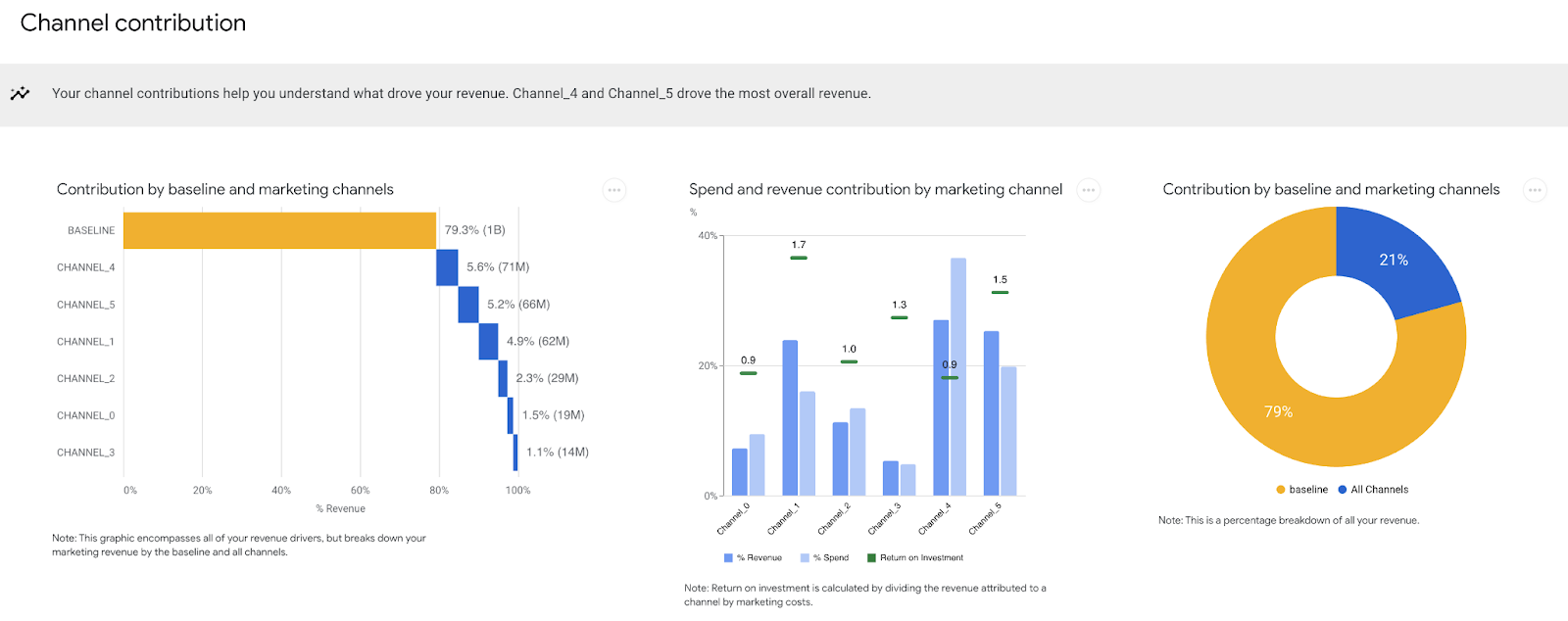
    Google’s Meridian and Meta’s Robyn are designed to deliver actionable insights by turning your marketing data into strategic budget recommendations.

    These include valuable features like:

    • Data transformations that capture advertising decay.
    • Saturation curves to visualize diminishing returns.
    • Dashboards and budget optimizers for spend allocation guidance.

    Meanwhile, Uber’s Orbit and Facebook’s Prophet serve different needs.

    Orbit is more about time-series forecasting and requires significant development to transform into an MMM tool.

    Prophet acts as a forecasting component within other frameworks.

    Think of it like transportation:

    ```json
{
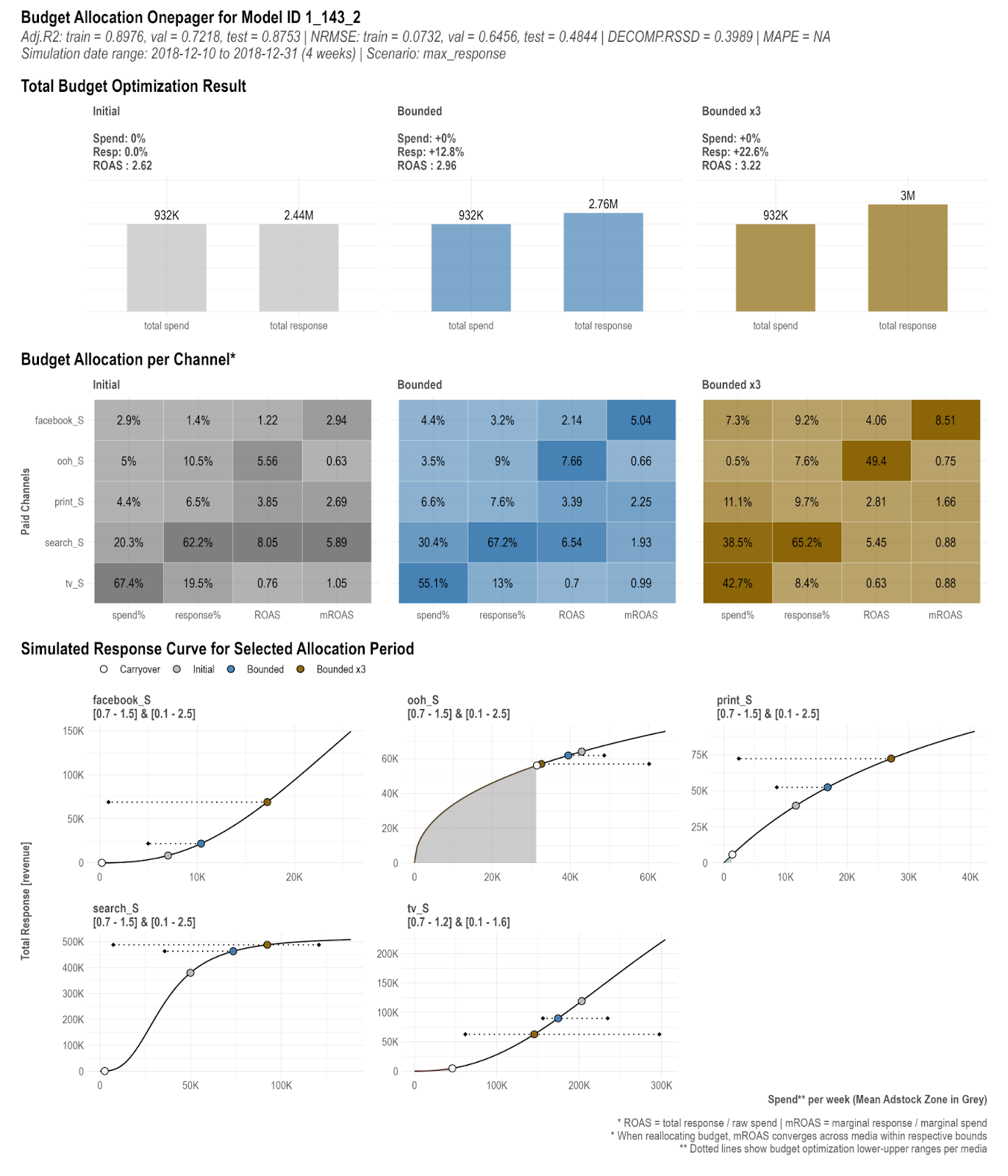
  "alt": "Budget allocation analysis for Model ID 1_143_2 showing total optimization results, per channel allocation, and simulated response curves.",
  "caption": "Explore the strategic budget allocation insights for Model ID 1_143_2, highlighting total optimization results and per channel performance with detailed simulation data.",
  "description": "This image provides an in-depth analysis of budget allocation for Model ID 1_143_2. It presents total optimization results, showing initial and bounded allocations, and highlights ROAS and mROAS metrics. The image details budget allocation percentages across channels like Facebook, OOH, print, search, and TV. Simulated response curves illustrate the impact of spending on total responses, reflecting the effect of different budget scenarios. Designed with readability and analytical precision, this one-pager is crucial for strategic marketing decisions."
}
```
    • Meridian and Robyn are ready-to-drive vehicles.
    • Orbit is a high-performance engine requiring further builds.
    • Prophet serves as the GPS navigation system within your car.

    Dig deeper: Marketing attribution models: The pros and cons

    Robyn: Making MMM Accessible and Powerful

    I admire Meta for creating Robyn, a tool that breaks down barriers with its automation and ease of use.

    Robyn turns weeks of model tuning into a quick data upload process, rapidly exploring thousands of configurations.

    It stands out by providing multiple high-quality model solutions, catering to various business needs and risk levels.

    Its capability to integrate real-world experimental outcomes boosts its credibility with decision-makers.

    However, keep in mind that it assumes consistent marketing performance, which might not align with real-world dynamics.

    Meridian: The Analytical Powerhouse

    Meridian, representing Google’s advanced Bayesian approach, models the intricate mechanisms behind advertising effects.

    Unlike Robyn’s practical strategies, Meridian focuses on answering what could happen with budget reallocation based on theoretical models.

    This approach, especially its geo-level modeling, provides insights that are crucial for market-specific decisions.

    ```json
{
  "alt": "Graphs displaying channel contribution, spend and revenue by marketing channel, and a pie chart of contribution percentage.",
  "caption": "Analyze the impact of different marketing channels on revenue with these insightful charts. Discover which channels drive the most revenue and how spend correlates with returns.",
  "description": "This image features three main graphical representations: a horizontal bar chart showing channel contribution to revenue, a vertical bar chart detailing spend and revenue contribution by channel, and a pie chart illustrating contribution percentages. The bar chart highlights the 'Baseline' as the largest contributor with 79.3% of revenue, followed by Channel_4 and Channel_5. The pie chart indicates 79% revenue from the baseline and 21% from all channels. These visualizations provide a comprehensive overview of revenue distribution across various marketing initiatives, crucial for optimizing channel strategies. Keywords: revenue, marketing channels, pie chart, bar graph, channel contribution."
}
```

    Although its methodology is robust, Meridian’s technical demands are high and require statistical expertise not common in most marketing teams.

    Dig deeper: How Bayesian testing lets Google measure incrementality with $5,000

    Uber Orbit: Expert Time-Series Forecasting

    Orbit shines in time-series forecasting with its Bayesian time-varying coefficients, offering flexibility many traditional MMM tools lack.

    It’s an advanced tool, best suited for teams that have the capacity for custom framework development.

    Prophet: Unraveling Temporal Patterns

    Prophet stands out in its primary role of time-series forecasting, effectively disentangling trends and seasonal influences from data.

    Remember, while it can support MMM processes, it won’t serve as a standalone solution for attribution or optimization.

    Dig deeper: MTA vs. MMM: Which marketing attribution model is right for you?

    Making Informed Choices for Your Team

    Your choice depends on your team’s statistical comfort and resource availability.

    • Robyn suits most teams, offering rigorous insights with minimal setup time.
    • Meridian is for those with the technical expertise to leverage its deeper capabilities.
    • Orbit is ideal for custom framework developers.
    • Prophet helps in preprocessing but isn’t a complete MMM solution on its own.

    Choose a tool that your team can realistically implement and maintain, maximizing the benefit from its insights.

    Dig deeper: How to avoid marketing mix modeling mistakes that derail results


    Inspired by this post on Search Engine Land.

    crushpress.ai community screenshot