Tag: SEO

  • Unraveling the Myth: The Truth About First-Party Data

    Unraveling the Myth: The Truth About First-Party Data

    I’ve noticed over the past few years that the marketing world has been shifting, grounded in a straightforward principle. We’re seeing the decline of third-party data and the rise of privacy concerns. Everyone said first-party data was the answer.

    So, the plan was to gather more of it, centralize it, and build a comprehensive customer view around it.

    I agree that in many respects, this transformation was essential. Direct customer relationships are more reliable than merely renting an audience. Plus, consent and transparency genuinely matter. Organizations that were ahead of the game, investing early in their own data platforms, are now better off than those dependent on external indicators.

    However, I’ve observed that many marketers have put so much faith in first-party data that they’ve missed a more complex reality.

    Just possessing customer data doesn’t mean we automatically understand our customers.

    Many marketing leaders, including myself, have sensed this tension. Despite having cutting-edge technology stacks, we continue to grapple with familiar questions. For instance, which records truly represent active individuals? Which identities are outdated or wrongly attributed? How much of our customer view is based on current behavior versus old assumptions?

    These aren’t just theoretical issues. They come up in daily operational decisions. There are campaigns that don’t reach as many actual customers as we anticipated. Personalization efforts that hit a plateau. Our measurement models seem precise, yet produce inconsistent results.

    The issue isn’t the absence of data. Quite the opposite, actually.

    The real problem is assuming that the data in our systems still matches reality.

    When First-Party Data Becomes Historical Data

    I’ve found that one unnoticed aspect of customer data is how swiftly it changes from being current to historical.

    Typically, organizations collect identity information during interactions like account creation, purchases, and service requests. These events generate solid records entered into CRM systems, marketing platforms, and data warehouses.

    From there, the records usually remain as they were when captured.

    What changes is everything else around them.

    Consumers switch devices. Email addresses may go from primary to secondary. People relocate, change jobs, create new accounts, and abandon others. Behavioral patterns shift with new platforms, habits, and privacy controls.

    The record still exists, but the certainty of the identity starts to loosen.

    I’ve seen how marketing teams grapple with this reality in subtle ways. Lists that seem robust but show declining engagement. Customer profiles that break up across systems. Identity graphs requiring constant adjustment as signals stray from alignment.

    This doesn’t imply first-party data is wrong. It merely means it ages.

    The moment of collection is precise. However, as months and years pass, that precision diminishes.

    The Gap Between Records and Reality

    Creating a unified customer profile has become essential in modern marketing infrastructure. Customer data platforms, identity graphs, and advanced analytics attempt to merge scattered signals into a coherent picture.

    When these signals align, the outcomes are powerful.

    But I’ve noticed the effectiveness of these systems heavily relies on the integrity of the input identifiers. Email addresses, login credentials, device links, and other identity anchors act as the joint between records.

    When those anchors drift, the unified profile loses clarity.

    This isn’t a technology failure. Most identity platforms work as intended, connecting the available signals.

    The issue is, much of those signals were captured possibly months or years ago, at times when systems had limited visibility into the surrounding identity context.

    As the digital environment evolves, original records become just one of many reference points.

    Marketing leaders, myself included, recognize this gap when technically accurate profiles still fail to explain current customer behavior. Our databases mirror past knowledge while customers reflect the present narrative.

    Bridging that gap requires something more dynamic than static attributes.

    The Value of Activity Signals

    Lately, some organizations, including mine, have begun focusing on signals indicating whether an identity is active in today’s digital ecosystem.

    Activity signals provide a different intelligence aspect.

    Instead of focusing on past information, we ask if the identity tied to it still shows real-world behavior today.

    • Is the email address still actively used?
    • Does the identity show up in recent digital interactions?
    • Are these signals reflective of genuine consumer activity?

    These questions have become crucial for us in marketing and risk management.

    For marketing, activity signals help us determine which audiences are still reachable versus identities that have quietly faded. For fraud detection, they help us differentiate real consumers from synthetic ones that might seem valid but lack authentic behavior patterns.

    Ultimately, both areas strive to answer a fundamental question.

    Does this identity belong to a real person actively engaging in the digital world now?

    Stored data alone seldom answers this with certainty.

    A More Resilient Identity Anchor

    Among numerous identifiers used digitally, one stood out for its resilience.

    Email.

    For decades, it’s been both a communication medium and a steadfast identity anchor. It surfaces in authentication, commerce, subscriptions, customer support, and many online touchpoints.

    This ubiquity results in a secondary advantage. Email addresses generate a constant stream of activity signals showing how identities progress online.

    When analyzed across vast networks, they reveal trends far beyond a company’s customer database alone.

    They can show whether an identity is active or has gone dormant. They spot inconsistencies showing risk. They expose connections reconciling fragmented customer views.

    In essence, they transform a basic identifier into a dynamic indicator of identity health.

    Organizations understanding this dynamic, myself included, treat email differently. It becomes less about reaching a campaign endpoint and more about understanding identity across channels.

    Rethinking How We Know Our Customers

    Marketing technology has been incredible at storing and organizing data. Today, few organizations lack the infrastructure for handling vast data volumes.

    Our next frontier isn’t more accumulation, but validation instead.

    Knowing our customers means verifying identities in a database correspond to real individuals with continuous digital activity.

    This change transforms how teams assess data quality.

    Rather than only focusing on data completeness, forward-thinking organizations pay attention to vitality. Which identities remain active, which have faded, and which show fraud or synthetic signs.

    These distinctions affect campaign reach, attribution accuracy, and risk exposure.

    Strong identity signals make the entire marketing ecosystem more reliable. Personalization becomes relevant. Measurements reflect true outcomes. Customer experiences accurately align with actual behavior.

    When signals weaken, even the most advanced tools face uncertain ground.

    Moving Beyond the Illusion

    The industry’s shift towards first-party data corrected years of dependency on obscure third-party sources.

    Yet, owning data doesn’t guarantee clarity.

    Customer records capture a moment. The people behind them continually change.

    For real customer understanding, the challenge isn’t just about accumulating data. It’s about maintaining a genuine connection between stored identities and actual activity.

    It involves extending beyond the database to the signals that reveal if an identity is still alive digitally.

    Companies embracing this shift uncover something valuable.

    The most valuable customer data isn’t just the information collected.

    It’s the intelligence that keeps data connected to real people over time.


    Inspired by this post on Search Engine Land.


    crushpress.ai community screenshot
  • ChatGPT Citations: Dominance of Key Domains Revealed

    ChatGPT Citations: Dominance of Key Domains Revealed

    Have you ever wondered how ChatGPT sources its information? According to a recent study, it turns out ChatGPT tends to pull pages significantly more often than it actually cites them, concentrating its citations primarily among roughly 30 key domains.

    Interestingly, AI citations in ChatGPT are far more concentrated compared to traditional search engines. Approximately 67% of citations within a specific topic are shared among only 30 domains.

    From Kevin Indig’s latest study, I learned that comprehensive topical coverage through long-form pages and cluster-based models tend to perform better than the older “one keyword, one page” strategy.

    The details. The visibility of citations isn’t spread out evenly. For product comparison topics, the top 10 domains capture about 46% of the citations, while the top 30 account for 67%.

    Though AI visibility is slightly less concentrated than classic organic search, the competition for citations is still incredibly centralized. As Indig concludes, without building sufficient authority, you’re likely excluded from these valuable citation “seats.”

    What changed. While ranking first on Google remains important, it’s not the sole factor anymore. Interestingly, of the pages ranked No. 1, only 43.2% were cited by ChatGPT, which is 3.5 times more than pages ranking beyond the top 20.

    ChatGPT retrieves a vast number of pages but cites only a fraction of them. According to AirOps, about 85% of the pages retrieved were never cited, and a significant portion of citations arose from fan-out queries that lacked search volume entirely.

    Why we care. Simply publishing the best answer for a keyword isn’t sufficient anymore. ChatGPT favors domains that offer comprehensive coverage of a topic, giving preference to pages that approach subjects from multiple angles.

    The patterns. It turns out, longer pages typically receive more citations, and this trend varies by industry. Notably, pages with 5,000 to 10,000 characters see the most substantial lift. For pages over 20,000 characters, the average number of citations hits 10.18 compared to a mere 2.39 for shorter pages.

    However, this pattern is not universal. For instance, in finance, shorter, densely packed pages often shine over lengthy guides. But in Education, Crypto, and Product Analytics, longer pages still hold their ground with little drop-off.

    Looking more closely at on-page behavior, ChatGPT tends to cite from the top sections of a page. Particularly, the 10% to 20% section excels across all industries, while the bottom 10% of the page barely garners recognition.

    About the data. For this study, Indig analyzed approximately 98,000 citation rows from about 1.2 million ChatGPT responses, using a variety of analytical methods to pinpoint which pages earned citations and their origins.

    The study. More about these findings can be found in the study titled The science of how AI picks its sources.


    Inspired by this post on Search Engine Land.


    crushpress.ai community screenshot
  • Boost Your Paid Search with High-Quality Signals

    Boost Your Paid Search with High-Quality Signals

    In today’s automated landscape, I’ve learned that paid search performance largely depends on the quality of signals fed into algorithms. Algorithms are like chefs—they expertly cook with whatever ingredients they’re provided. By enhancing these signals, I’ve found a reliable path to better results.

    While this might sound simple, I’ve noticed that many of us still cling to signals that don’t truly reflect business outcomes. Let me share my insights into how algorithms work, how I can shape them, and where common pitfalls lie.

    Modern bidding systems often evoke the image of a “black box,” shrouded in mystery. However, I’ve found that understanding their function requires breaking down their capabilities. These algorithms are vast pattern recognition systems.

    Initially, these systems relied on straightforward statistical methods, like rules-based logic or regression models. Today, they’ve evolved into complex learning systems capable of evaluating countless data inputs simultaneously, such as query intent and location-specific behavior, in real-time.

    Despite the technological advancements, I understand the core mechanisms remain unchanged. They identify patterns that match desired outcomes, calculate probabilities, and adjust bids accordingly. It’s crucial for me to align the feedback loops with real business values to ensure these algorithms optimize effectively.

    As a marketer, I’m aware algorithms lack business context—they only see what they get. If we provide them with weak or irrelevant data, even the most sophisticated systems can’t deliver the results we need.

    Therefore, I focus on the controllable signals that have the greatest influence over these algorithms. These include campaign structure, bidding strategies, and how I allocate my budget.

    Most importantly, I’ve found conversion data to be the key driver of success. It’s the critical signal that guides algorithmic learning and optimization.

    ```json
{
  "alt": "The CapmatchOne logo with a gradient circle and bold text.",
  "caption": "Discover innovation with the CapmatchOne logo, featuring sleek typography and a modern gradient circle.",
  "description": "The CapmatchOne logo features bold, modern typography coupled with a gradient circle, symbolizing connection and innovation. The sleek design conveys a sense of progress and creativity. This image can be used for branding or promotional purposes, appealing to audiences interested in innovative solutions and forward-thinking designs."
}
```

    Whenever I experience a plateau in performance, my instinct is no longer to blame budget constraints or ineffective tactics. Instead, I analyze conversion data since it’s often the root cause of stagnation. Ensuring quality over quantity in conversions has consistently elevated my results.

    Ultimately, aligning conversion signals with genuine business KPIs is vital. Platforms don’t understand business profitability; they follow the instructions given. If any conversion increase jangles alarms rather than cheers, it shouldn’t drive the primary optimization signal.

    To ensure effective learning and optimization, I strengthen conversion signals with rich data sources, beyond standard browser tracking, to overcome privacy and attribution challenges.

    By integrating first-party identifiers and accurate transaction values, I’ve improved how platforms recognize and learn from conversions. This method offers robust feedback loops, optimizing both accuracy and performance.

    Determining the right conversion goals requires balancing volume and value precision. Often, I use proxy metrics for a faster optimization cycle without sacrificing real business value.

    I’ve found setting conversion goals is not straightforward; it’s about balancing volume with value accuracy and stability. This balance helps me optimize efficiently without data becoming too sparse or too noisy.

    Regularly revisiting these goals and refining conversion definitions are essential. Asking myself if I truly celebrate any increase in a certain outcome guides me toward refining my signals and enhancing performance in paid search.


    Inspired by this post on Search Engine Land.


    crushpress.ai community screenshot
  • EU’s Verdict on Google’s Compliance: A Game Changer for Digital Markets

    EU’s Verdict on Google’s Compliance: A Game Changer for Digital Markets

    Google vs. publishers: What the EU probe means for SEO, AI answers, and content rights

    I’ve been eagerly anticipating the European Union’s decision on whether Google is violating the Digital Markets Act (DMA), and I sense this ruling is just around the corner. While Competition Commissioner Teresa Ribera hasn’t specified an exact date, she assures us that a decision is imminent.

    What She Said: “It will come,” Ribera mentioned to Dow Jones Newswires, emphasizing the complexity of these cases. She reinforced the EU’s commitment to fair procedures and evidence-based decisions.

    The Context: This all began in March 2024, when the European Commission started investigating Google’s search business under the DMA. Although fines have already been imposed on Meta and Apple, Google’s case is still pending after almost two years.

    The Mounting Pressure: Recently, 18 lobby groups and civil society organizations wrote to Ribera, urging a substantial fine and definitive remedies to ensure non-compliance isn’t profitable. They stressed that Google’s dominant 90% share in the EU search market is a cause for concern.

    “Every day without a decision is a day that European businesses are systematically disadvantaged,” their letter cautioned.

    Why This Matters to Us: A decision against Google could fundamentally alter how its search business operates in Europe. This might change the dynamics of ad serving, ranking, and pricing, potentially impacting campaign performance and competition across the board. For those of us with European audiences, staying informed is crucial as outcomes here could have a global impact on Google’s advertising ecosystem.

    Meanwhile, This Week: Ribera is in California, meeting with tech leaders like Sundar Pichai and Mark Zuckerberg, before heading to Washington D.C. for discussions with the U.S. Justice Department’s antitrust division.

    The Bigger Picture: Google isn’t the only tech giant under scrutiny. The commission is also looking into how Google uses AI Overviews and ranks news publishers. Additionally, they are investigating Meta for potential restrictions on rival chatbots using WhatsApp’s business software.

    The Bottom Line: Although the EU has been slow to act against Google, mounting political and public pressure is undeniable. This impending decision might set a significant precedent for enforcing the Digital Markets Act more broadly.


    Inspired by this post on Search Engine Land.


    crushpress.ai community screenshot
  • Why Zero-Click Searches Still Hold Immense Power

    Why Zero-Click Searches Still Hold Immense Power

    I recently had the opportunity to attend the Industrial Marketing Summit, where Rand Fishkin delivered a keynote highlighting our current “zero-click world”. His perspective resonated with me, emphasizing that while fewer users are visiting websites, their impact remains crucial.

    Diving deeper, it’s evident that the structural dynamics of how information is assessed and trusted online have shifted profoundly. This change has led many to misunderstand the true value of websites today.

    Despite the drop in clicks, websites still play a vital role. They are the bedrock of visibility and trustworthiness on the internet.

    Why ‘zero-click’ discussions often lead to the wrong conclusion

    There’s an undeniable trend: clicks are on the decline, and here’s why.

    • Search engines readily display answers directly on results pages.
    • Social media platforms have become discovery hubs, allowing users to explore without ever needing to leave.
    • AI assistants synthesize comprehensive responses from the web even before presenting a user with links.

    The focus on zero-click results disrupts traditional metrics for measuring online visibility. For decades, traffic and click-through rates have been the cornerstones for evaluating search performance.

    Yet, when answers are given directly by search results or AI systems, often outside our typical analytics frameworks, many assume websites are losing significance. This is far from the truth.

    Websites still underpin the information ecosystem. Their role in shaping visibility is arguably becoming more significant, especially with AI and modern information systems relying heavily on widespread, consistent signals from multiple sources on the web.

    Fishkin is right about the trend

    Information today is discovered in various environments, including search results, social media, and AI interfaces, leading to a real fragmentation of how we consume content.

    While these interactions might appear as lost website traffic, the true question is: where does the original information come from?

    Although people consume information through expanding platforms, these systems fundamentally depend on credible, original knowledge sources.

    Zero-click doesn’t mean zero influence

    The critical takeaway is differentiating between traffic and information influence.

    • Traffic measures visits to your site.
    • Influence assesses if your information shaped the answers people received.

    AI creates responses based on patterns from the web, and content creators who provide valuable information remain crucial in this ecosystem.

    ```json
{
  "alt": "The CapmatchOne logo with a gradient circle and bold text.",
  "caption": "Discover innovation with the CapmatchOne logo, featuring sleek typography and a modern gradient circle.",
  "description": "The CapmatchOne logo features bold, modern typography coupled with a gradient circle, symbolizing connection and innovation. The sleek design conveys a sense of progress and creativity. This image can be used for branding or promotional purposes, appealing to audiences interested in innovative solutions and forward-thinking designs."
}
```

    Even without direct clicks, reliable sources continue to influence the information pipeline, helping shape the responses generated by AI systems.

    The role of ‘rented land’

    In adapting to a zero-click landscape, the focus might shift towards platforms where brands lack control, such as social networks or other “rented lands”.

    Visibility stems from both types of territory — owned and rented.

    • Owned land encompasses your controlled content like websites.
    • Rented land includes platforms that distribute your message but aren’t owned by you.

    In an AI-driven discovery setting, both are valuable. Owned content serves as essential knowledge sources, while rented platforms amplify these insights.

    Yet, authority primarily emerges from robust original content, typically housed on first-party sites, which remains pivotal in influencing AI systems.

    Why AI often favors primary sources

    Contrary to some beliefs, AI systems value primary sources more than aggregated content.

    When AI generates answers, it frequently relies on sources with clear, expert explanations and well-reasoned content, mostly found in single-source publishing like legal blogs or technical documentation.

    This move places emphasis on creating authoritative content, which can enhance your influence in an AI-led world even as click metrics may reduce.

    The real shift you should understand

    Websites are evolving beyond their historical role as mere traffic generators. They are now key players in the AI-mediated informational landscape as sources of knowledge and bastions of expertise.

    The goal now is to ensure expertise is accessible and can be assimilated across various digital environments, be it search engines, AI responses, or social discussions.

    In our zero-click world, influence takes root earlier, reinforcing the importance of creating valuable, knowledgeable content.


    Inspired by this post on Search Engine Land.


    crushpress.ai community screenshot
  • Embrace ‘Search Everywhere’: Revolutionizing SEO Strategies

    Embrace ‘Search Everywhere’: Revolutionizing SEO Strategies

    AI is undeniably evolving search, but I notice that visibility is significantly leaning towards platforms that are dominating the results and capturing user attention.

    Much of today’s SEO discussions revolve around AI, from AI Overviews to ChatGPT and other LLMs. There’s genuine concern about these technologies diverting traffic from business websites, urging a shift towards GEO or AEO.

    This concern holds merit. AI is indeed diminishing traffic for numerous sites, particularly those dependent on top-of-funnel, informational content. However, data indicates that AI might not be the sole driving force of change.

    For years, I’ve observed user behavior splintering across various platforms in my agency work.

    ```json
{
  "alt": "Infographic showing Q4 2025 search share of 41 major sites in the USA, with Google leading at 73.7%, followed by Amazon, Bing, and others.",
  "caption": "Discover how dominant players like Google and Amazon are sharing the search landscape in Q4 2025. Explore the colorful infographic depiction of search shares across 41 top sites in the USA.",
  "description": "This infographic illustrates the Q4 2025 share of search across 41 major sites in the USA. Google leads with a 73.7% share, followed by Amazon at 7.83%, Bing at 4.31%, and YouTube at 3.65%. Other notable mentions include ChatGPT, DuckDuckGo, and eBay, among others depicted in a colorful treemap. The graphic is designed by SparkToro and sourced from Datos, providing insights into the digital search ecosystem."
}
```

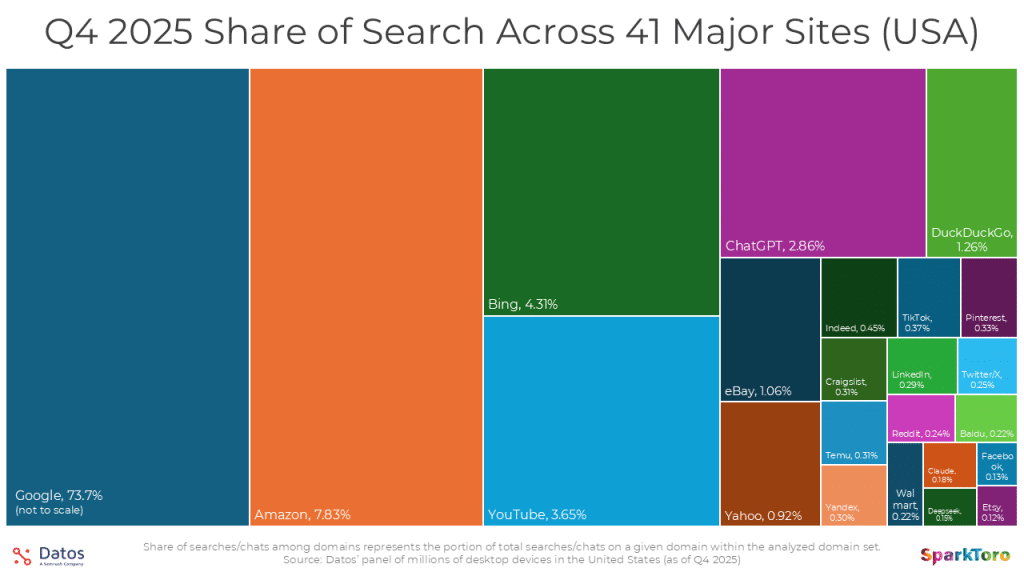
    Here’s the data on how search behavior is evolving across platforms and why adopting a ‘search everywhere’ strategy is crucial, beyond just focusing on LLMs.

    Third-party Platforms are Disrupting Traditional Search

    People now turn to TikTok for restaurant suggestions, YouTube for tutorials, Reddit for authentic reviews, and Amazon for purchasing products. These platforms are often replacing traditional search engines like Google and Bing as the initial resource.

    This shift isn’t just behavioral; it’s reflected in traffic metrics too. Amazon and YouTube, for instance, drive considerably more desktop traffic than ChatGPT, a trend highlighted by Rand Fishkin.

    ```json
{
  "alt": "Bar chart showing share of voice percentages for a client, competitors, and platforms like YouTube and Reddit.",
  "caption": "Discover how YouTube leads the share of voice with 9.84%, outshining competitors and platforms, followed by Reddit and the client.",
  "description": "This bar chart displays the share of voice percentages among various entities. YouTube holds a significant lead with 9.84%, followed by Reddit at 6.94% and the client at 6.69%. Other competitors have lower percentages, ranging from 1.11% to 3.19%. The chart provides a visual comparison of presence and influence across platforms and competitors."
}
```

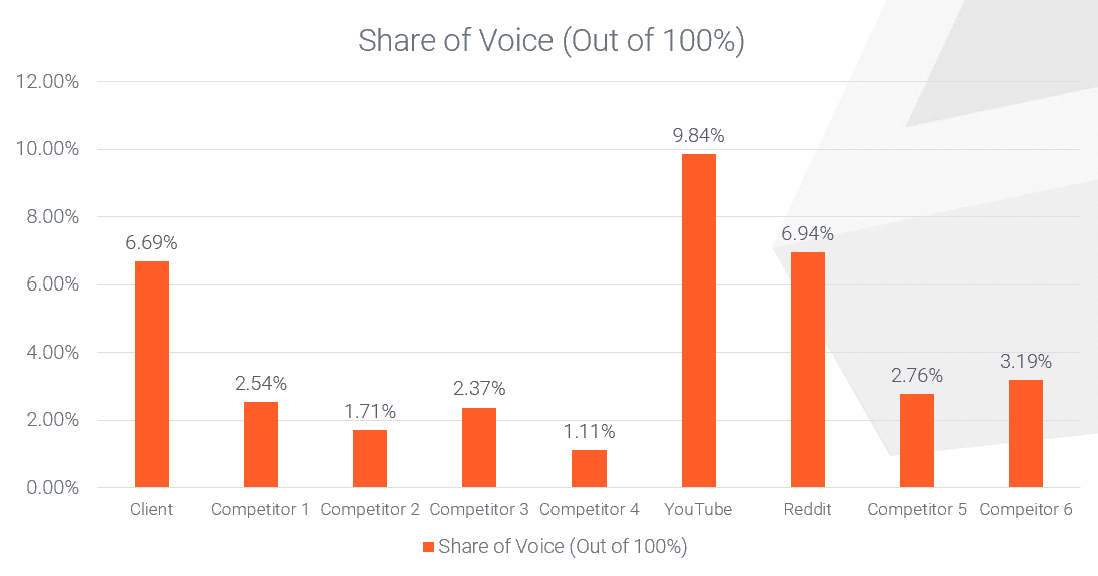
    Recently, I conducted a thorough share of voice analysis for a client, with objectives to identify competitors leading in traditional search, discover keyword and content gaps, and devise a content roadmap to address these gaps.

    Interestingly, the analysis revealed that our main competitors weren’t other traditional players, but rather platforms like YouTube and Reddit.

    These platforms perform strongly in traditional searches, claim valuable SERP real estate, and redirect users from Google and Bing to their ecosystems.

    ```json
{
  "alt": "The CapmatchOne logo with a gradient circle and bold text.",
  "caption": "Discover innovation with the CapmatchOne logo, featuring sleek typography and a modern gradient circle.",
  "description": "The CapmatchOne logo features bold, modern typography coupled with a gradient circle, symbolizing connection and innovation. The sleek design conveys a sense of progress and creativity. This image can be used for branding or promotional purposes, appealing to audiences interested in innovative solutions and forward-thinking designs."
}
```

    The key takeaway: neglecting these platforms means missing out not only on visibility in traditional search but also on grabbing valuable user attention when they move away from Google to watch videos or read threads.

    It’s not just my client’s site seeing this trend. Undertake this kind of analysis for your site to discover who your actual competitors are in traditional search; the findings might surprise you.

    Dive deeper: Why social search visibility is crucial for discoverability

    ```json
{
  "alt": "Keyword overview for 'how to fix a leaky sink faucet' with search volume and global volume data.",
  "caption": "Explore search trends for 'how to fix a leaky sink faucet' with 210 searches in the US and a global reach of 350, including data from AU, CA, UK, BD, and DE.",
  "description": "This image displays a keyword overview for the phrase 'how to fix a leaky sink faucet,' highlighting its search volume. In the US, the volume is 210, contributing to a global volume of 350. The data includes analytics from several countries like Australia, Canada, the United Kingdom, Bangladesh, and Germany. The interface allows for domain-specific data entry and location selection, collected for desktop users as of March 9, 2026."
}
```

    Third-party Platforms Can Have Higher Search Volumes

    Not only are platforms like YouTube and Reddit securing traditional SERP spaces, but searches within these platforms can sometimes outnumber those on Google or Bing.

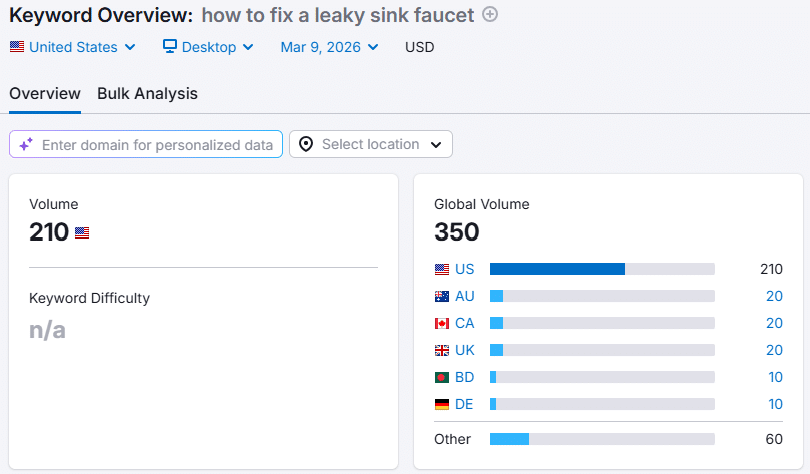
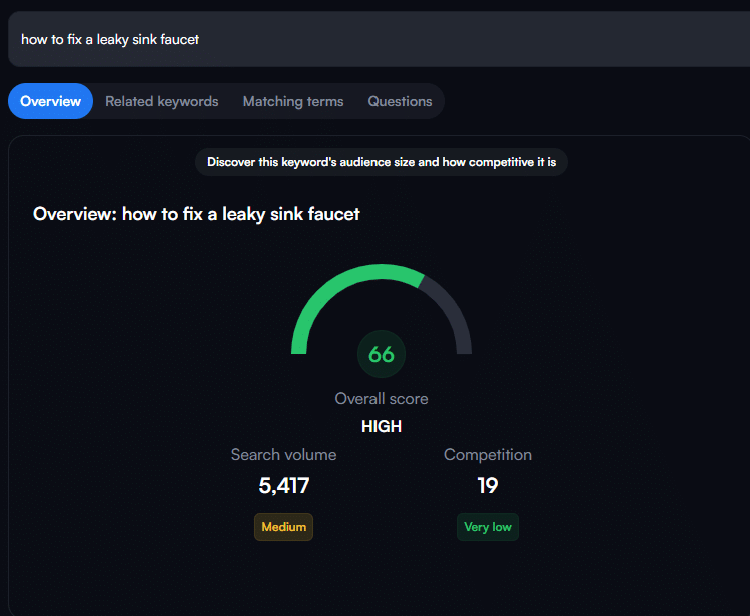
    For instance, YouTube is a powerhouse for tutorials and “how-to” content. A term such as “how to fix a leaky sink faucet” shows 15 times more search volume on YouTube than in traditional searches globally.

    While search volumes are estimates, aligning your content strategy with where users are actually searching is crucial. For topics like the one mentioned, creating a YouTube video is essential.

    ```json
{
  "alt": "Keyword analysis for 'how to fix a leaky sink faucet' shows a high score with medium search volume of 5,417 and very low competition of 19.",
  "caption": "Keyword insights reveal 'how to fix a leaky sink faucet' as a hot topic, scoring high overall with thousands searching and low competition.",
  "description": "This image displays a keyword analysis for 'how to fix a leaky sink faucet,' showing an overall score of 66 and classified as high. The search volume is 5,417, rated as medium, while the competition is very low at 19. These metrics suggest that the topic has a substantial audience interest but limited competitive content, presenting an opportunity for content creators. The image includes a visual gauge representing the overall score and textual data highlighted for search visibility."
}
```

    For a holistic ‘search everywhere’ approach, develop a blog post and embed the related video.

    Dive deeper: Why YouTube is essential for SEO in the AI era

    Third-party Platforms are Cited More in LLMs

    ‘Search everywhere’ isn’t just about traditional or in-platform searches; it also influences AI-generated content.

    ```json
{
  "alt": "Bar chart showing citation source types: Owned 7%, Competitor 3.6%, Third party websites 76.1%, Social & Forums 13.3%.",
  "caption": "Explore how citations are sourced: predominantly from third-party websites, with smaller contributions from owned, competitor, and social sources.",
  "description": "A horizontal bar chart illustrates the distribution of citation sources: 'Owned' at 7% (blue), 'Competitor' at 3.6% (red), 'Third party websites' at 76.1% (green), and 'Social & Forums' at 13.3% (orange). This indicates that the majority of citations come from third-party websites, providing insights into source credibility and diversity."
}
```

    LLMs rely on content for answer synthesis, and often, that content is sourced not from business websites, but from third-party and social platforms.

    Tools like AI visibility tools can illustrate the impact of ‘search everywhere’ in terms of citations. Consider these examples:

    Despite being different brands, a minimal percentage of citations are from their own or competitors’ sites. Nearly 90% originate from third-party news and online publications or social and forum platforms like Reddit or Quora.

    ```json
{
  "alt": "Bar chart showing citation source breakdown: Owned 6.2%, Competitor 4.9%, Third-party websites 75.8%, Social & Forums 13.1%.",
  "caption": "Explore the diverse origins of citations with this visual breakdown: a striking representation of how third-party websites dominate at 75.8%.",
  "description": "This image depicts a horizontal bar chart illustrating the breakdown of citation sources. The chart is segmented into four categories: Owned (6.2%), Competitor (4.9%), Third-party websites (75.8%), and Social & Forums (13.1%). The longest segment, representing third-party websites, is in green, highlighting its dominance. This visual representation aids in understanding the diverse sources contributing to citation data."
}
```

    Focusing solely on your website in the context of LLM citations offers limited reach. To enhance brand perception or accuracy in AI reflections, influence must reach places beyond direct control.

    Dive deeper: SEO’s new battleground: Securing the consensus layer

    Start Investing in ‘Search Everywhere’ Today

    The competitive arena is transforming, and many marketers focus narrowly on AI. Yet, discovery spans numerous platforms.

    YouTube, Reddit, Quora, and others dominate traditional search results and have significant search activity within their platforms. When AI generates answers, it chiefly draws from these sources rather than brand websites.

    To achieve success in modern search, it’s vital to understand where your audience is truly searching, which extends beyond just Google. It’s about appearing wherever decisions are shaped.


    Inspired by this post on Search Engine Land.


    crushpress.ai community screenshot
  • Unlocking AI Search: Insights from Historical Patents

    Unlocking AI Search: Insights from Historical Patents

    When I think about how much AI search has evolved, I’m amazed by how it’s deeply rooted in years-old patents. These historical blueprints are the architects of AEO, GEO, and our modern SEO strategies.

    It’s fascinating to me that whenever a new large language model (LLM) is released or Google makes an AI update, the SEO community seems to panic. We tend to overlook that the features we’re scrambling to optimize for were often designed in the patent offices a decade ago. Our focus on the present and future blinds us to the wisdom of the past.

    If we want to stay ahead in 2026, we need to shift from being futurists to becoming archaeologists.

    To truly serve our clients, a balanced research framework is essential. By revisiting foundational patents, we can grasp the core rules, while also keeping an eye on how current AI developments breathe life into those regulations.

    There’s a myth that understanding AI search requires being a prompt engineer or diving into every research paper from OpenAI. In reality, many of the algorithms powering today’s innovations were penned in mathematical language over a decade ago.

    I deeply respect Bill Slawski, the late, great SEO archaeologist, who spent over 20 years unearthing insights from dry, technical patent filings to forecast the present we are experiencing now.

    Looking back, his method of analyzing history certainly proved its relevance.

    The SEO algorithms aren’t mysterious; they’re mathematical. Many features introduced today are based on blueprints filed between 2007 and 2016. To succeed, it’s vital to dive into historical documentation.

    ```json
{
  "alt": "The CapmatchOne logo with a gradient circle and bold text.",
  "caption": "Discover innovation with the CapmatchOne logo, featuring sleek typography and a modern gradient circle.",
  "description": "The CapmatchOne logo features bold, modern typography coupled with a gradient circle, symbolizing connection and innovation. The sleek design conveys a sense of progress and creativity. This image can be used for branding or promotional purposes, appealing to audiences interested in innovative solutions and forward-thinking designs."
}
```

    Understanding strategy versus mechanics is crucial. We need to categorize our learning as either strategic or mechanical. The transition from ‘strings to things’, or entities, required verification to distinguish real from fabricated.

    It’s crucial to separate AEO from GEO, as they demand distinctive content architectures and fulfill different objectives. AEO targets direct answers, while GEO requires synthesis and demonstrates the interplay between concepts.

    Dig deeper: SEO, GEO, or ASO? What to call the new era of brand visibility in AI [Research]

    It’s easy to neglect basic SEO fundamentals amidst the influx of AI developments. The essentials, like technical SEO, remain pivotal.

    The persistence of technical debt exposes how the tolerance for neglecting foundational SEO tasks has vanished.

    The technical backend of our websites, whether using traditional CMS or modern headless architectures, requires careful attention to succeed in AEO and GEO.

    To become a proactive SEO architect rather than a reactive time traveler, we must integrate verified facts and trusted source connections into our strategic framework.


    Inspired by this post on Search Engine Land.


    crushpress.ai community screenshot
  • Discover the Leading Fintech Marketing Agencies of 2026

    Discover the Leading Fintech Marketing Agencies of 2026

    Last updated: March 17, 2026

    As I delve into the top fintech marketing agencies of 2026, I’ve discovered a fascinating world where innovation meets expertise. My research stemmed from an initial list of about 100 agencies, narrowed down using a unique ranking system that evaluates various aspects such as notable clients, leadership experience, and more.

    First, I considered the agency’s notable clients, accounting for 23% of the overall score. This involved identifying the top three fintech entities each agency had worked with, expanding to related sectors if necessary.

    Next, I looked at the leadership experience, which held a 20% weight. Here, I assessed the credentials and history of agency leaders in fintech or related fields, along with their tenure in the company and industry.

    A crucial factor was the average reviews, contributing 18% to the rank. These were averaged from online reviews, with some given more importance based on their fintech relevance.

    ```json
{
  "alt": "Clay global branding and UX design agency webpage with menu and pink diamond graphic.",
  "caption": "Discover Clay, a leading global branding and UX design agency dedicated to crafting innovative digital experiences.",
  "description": "This image shows the homepage of Clay, a global branding and UX design agency. The top navigation menu includes links to Work, Clients, Services, About, and Contact. Below, the main text states Clay's expertise in global branding and UX design. A partial image of a phone screen with the words 'Pink Diamond' is visible, suggesting a focus on cutting-edge design. Keywords: branding, UX design, digital experiences, Clay agency."
}
```

    I also factored in the median employee tenure, which made up 11% of the score. The longer employees stay, the more it hints at a strong and positive workplace culture.

    Whether an agency is founder-led impacted 8% of the scoring, reflecting commitment to the original vision. Additionally, media references, weighing in at 5%, highlighted industry acknowledgment through citations.

    Lastly, I considered when the agency was established, making up 15% of the score, to understand its stability and growth potential.

    In this article, I’ve not only unveiled the leading fintech agencies but included essential details such as headquarters and a brief summary of each agency’s marketing expertise. So, let’s dive into this enthralling list!

    ```json
{
  "alt": "CSTMR branding banner with text: Where good companies build great brands. Marketing expertise for financial brands.",
  "caption": "Unleash your brand's potential with CSTMR's expertise in transforming financial companies into great brands.",
  "description": "This image showcases CSTMR's branding with a focus on transforming financial brands. The slogan highlights the company's dedication to helping good companies build great brands. The banner also includes navigation links like Our Work and The Team, along with a call-to-action button labeled 'Get In Touch,' emphasizing their marketing prowess in the financial sector."
}
```

    The Top Fintech Marketing Agencies in 2026

    1. First Page Sage specializes in enhancing authority and visibility through SEO and content marketing. Their expertise shines with clients like US Bank and SoFi.

    2. InBound FinTech focuses on inbound marketing using Hubspot, with notable clients like Fibonatix.

    And the list goes on, unveiling each agency’s unique strengths and accomplishments.


    Inspired by this post on First Page Sage Blog.


    crushpress.ai community screenshot
  • Building a Nonprofit Digital Presence That Truly Makes an Impact

    Building a Nonprofit Digital Presence That Truly Makes an Impact

    For as long as I can remember, having a digital presence for a nonprofit has been more than just an optional asset—it’s the central hub for delivering our mission, engaging with donors, and advocating for change.

    Many organizations, including those I’ve worked with, often find themselves challenged by the technical and strategic requirements necessary to transform a simple website and social media accounts into an effective digital ecosystem.

    It’s not just about establishing an online presence. It’s about creating a dependable infrastructure that allows us to control our narrative, safeguard our assets, and accurately measure the results of our digital efforts.

    From my experience collaborating with multiple organizations, I’ve learned valuable lessons about managing a nonprofit’s digital presence. Here, I’ll share practical insights into key elements while highlighting the common pitfalls to avoid.

    If you’re supporting an organization with its digital marketing efforts and they haven’t embraced these practices yet, prioritizing the organization’s digital setup should be your first step.

    1. Own your foundations: Domains and account control

    Owning your organization’s name and story is an integral part of managing your online reputation efficiently. It is vital to ensure direct ownership of all technical assets—a risk I often see underestimated.

    Unfortunately, I’ve witnessed situations where volunteers or third-party agencies register domains or create social accounts using personal credentials. Consequently, if they leave, access to these crucial digital channels can be lost.

    Domain ownership should always be in the organization’s name, utilizing a general email address that multiple stakeholders can access. This mitigates potential access issues in the future.

    Similar precautions should be taken with website hosting and social media account management to ensure full control over these assets.

    For more information on optimizing nonprofit presence, consider resources like Google Ad Grants, which can boost engagement through targeted advertising efforts.

    2. Move beyond ‘winging it’: The editorial calendar

    Nonprofits often only post when they have an immediate need—typically during fundraising drives. However, this approach can lead to donor fatigue and low interaction levels.

    An effective content plan enriches community engagement by blending success stories and educational pieces with occasional action requests.

    ```json
{
  "alt": "The CapmatchOne logo with a gradient circle and bold text.",
  "caption": "Discover innovation with the CapmatchOne logo, featuring sleek typography and a modern gradient circle.",
  "description": "The CapmatchOne logo features bold, modern typography coupled with a gradient circle, symbolizing connection and innovation. The sleek design conveys a sense of progress and creativity. This image can be used for branding or promotional purposes, appealing to audiences interested in innovative solutions and forward-thinking designs."
}
```

    Employ an editorial calendar to organize content themes and individual posts, ensuring consistent and coordinated messaging across various platforms.

    3. Tracking what matters (and ignoring what doesn’t)

    Data is a powerful tool for informing future decisions, yet many organizations focus on vanity metrics without understanding their effect on actual outcomes.

    Implement conversion tracking to assess real visitor impacts, and use behavioral analytics to optimize user engagement and alleviate obstacles in the donation process.

    4. Optimize for the ‘mobile-first’ donor

    With most web traffic originating from mobile devices, nonprofits must ensure their online platforms are optimized for speed and simplicity. Slow or complex donation processes can deter potential contributors.

    Offering multiple payment options, like Apple Pay or PayPal, can further simplify the donation process, increasing the likelihood of conversion.

    Common pitfalls to avoid

    Occasionally, nonprofits undermine their digital strategy by targeting a broad audience. It’s essential to define and focus on your ideal supporter to create meaningful connections.

    Neglecting accessibility excludes portions of potential audiences. Ensuring your content is accessible to those with disabilities is critical to fulfilling your mission.

    Lastly, maintaining a dynamic digital environment through regular audits helps ensure continued relevance and effectiveness.

    Through consistent asset management, content planning, and data-driven decision-making, your digital presence can significantly amplify your mission’s reach and impact.


    Inspired by this post on Search Engine Land.


    crushpress.ai community screenshot
  • How Google’s AI Mode Threatens Web Traffic: Insights from Yahoo CEO

    How Google’s AI Mode Threatens Web Traffic: Insights from Yahoo CEO

    As I delve into the evolving landscape of web traffic, I find Yahoo CEO Jim Lanzone’s insights on AI-powered search engines, particularly Google’s AI Mode, incredibly fascinating. He believes this technological evolution poses a significant threat to the web’s traditional traffic model.

    Jim highlights a major concern: “I think that the LLMs are one big reason they’re under threat, with AI Mode in Google being the biggest challenge.” This makes me ponder the impact on publishers who rely heavily on these traffic flows.

    I resonate with Jim’s view that publishers truly deserve this traffic. He articulates a fundamental truth: “Those publishers deserve [traffic], and we’re not going to have the content to consume to give great answers if publishers aren’t healthy.” This reflects the delicate balance required in the digital content ecosystem.

    Why I care. Many websites, mine included, are noticing a dip in traffic coming from answer engines such as Google and OpenAI. It feels like a looming concern that could worsen. Yahoo’s dedication to maintaining the “search sends traffic” model is reassuring, as Jim passionately explains: “We have very purposefully highlighted and linked very explicitly and bent over backwards to try to send more traffic downstream to the people who created the content.”

    Yahoo’s unique AI approach. Listening to Jim on the Decoder podcast, I learn that Yahoo is carving its own path with AI. Unlike the more conversational chatbot models, Yahoo isn’t pursuing to be an AI assistant: “Ours looks a lot more like traditional search and it is more paragraph-driven. It’s not a chatbot that’s trying to act like it’s a person and be your friend.” I see this as a move towards emphasizing informative search experiences.

    Moreover, “We’re not a large language model. We’re not going to be the place you come to code. We’ve really launched Scout as an answer engine.” This strategy, I believe, could provide a clearer, more reliable information source online.

    What’s next: Embracing personalization. In observing Yahoo’s strategy, I’m excited to see their efforts to evolve. They’re embedding AI across platforms: “You are very shortly going to see us get into very personalized results. You’re going to see us get into very agentic actions that you can take.” This indicates a future where user-specific solutions take precedence.

    For instance, Jim notes, “There’s a button in Yahoo Finance that does analysis of a given stock on the fly… It is in Yahoo Mail to help summarize and process emails.” Such tools could transform how I interact with content on various platforms.

    Yahoo vs. Google: A non-competition. Interestingly, Yahoo isn’t trying to directly outplay Google. Instead, as Jim points out, the focus is on existing users and enhancing their experience: “Nobody chooses, you will not be surprised, Yahoo over Google or somewhere else to search. The way that we get our search volume is because we have 250 million US users and 700 million global users in the Yahoo network at any given time. There’s a search box there. And infrequently, they use it.” It’s more about nurturing the loyalties of existing users.

    A word of caution. The conversation also shines a light on the potential pitfalls of heavily relying on AI platforms. Jim references past experiences with Google: “You are tempting fate by opening up a way for consumers to access your product within a large language model.” This analogy resonates with me deeply, remembering the cautionary tales in tech history.

    Yet, he warns: “The big bad wolf will come to your door and say everything’s cool.” It’s a timely reminder of the ever-competitive and unpredictable nature of tech alliances.

    The interview. For those intrigued by Yahoo’s journey, check out Yahoo CEO Jim Lanzone’s full interview on reviving the web’s homepage.


    Inspired by this post on Search Engine Land.

    crushpress.ai community screenshot