Recently, I discovered that Google has made some significant changes to how it paces budgets for Google Ads campaigns with ad schedules. The company is now ensuring that it uses the full monthly budget, even if the ads are not running every day.
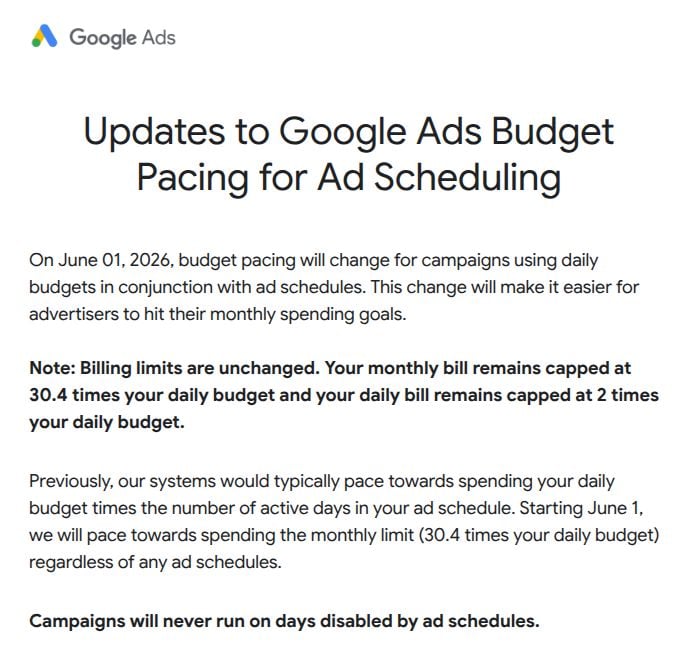
What’s Changing Starting June 1, campaigns will pace toward spending the entire monthly budget limit (30.4 times the daily budget) regardless of the ad schedule. Previously, the pacing was dependent on how many days ads were active.
What’s Not Changing Things such as daily and monthly spending caps remain untouched. Campaigns will still not exceed double the daily budget in one day or 30.4 times the daily budget over the course of a month, ensuring ads won’t run on disabled days.
Why It Matters Advertisers who utilize limited schedules, like running ads only on weekdays or during specific hours, might notice accelerated spending. Google is now determined to reach the entire monthly budget, rather than scaling back on days ads can run.
Zoom In This modification means that campaigns with fewer service days could see a more aggressive spend on those active days. For instance, if ads only run for half the month, Google can still spend up to the daily maximum each day without needing to economize elsewhere, all the while staying within the monthly cap.
Between The Lines This approach appears to prioritize maximizing budget utilization over evenly distributing spend, giving Google’s systems enhanced flexibility to capture demand when campaigns are active.
What To Watch If you have tight schedules, you may need to reconsider your budget allocations and performance expectations, as spending could be more concentrated on active days.
Bottom Line Budget pacing is shifting focus from when ads are posted to ensuring the budget is fully utilized each month.
First Seen Several advertisers hinted at receiving communications from Google regarding this, but Google Ads Coach Jyll Saskin Gales provided more clarification through LinkedIn.
Recently, I’ve noticed Google experimenting with video ads in the local search pack. This marks a shift towards more captivating visual formats in location-based searches.
Driving the news. Anthony Higman spotted this change, observing Google’s move to incorporate ‘immersive map view videos’ into PPC ads connected to local results.
These video ads pop up within the local pack — the map-based listings that display businesses near me or users searching.
What’s new. Instead of just static listings or text-based ads, I may soon see video content from advertisers in local search results.
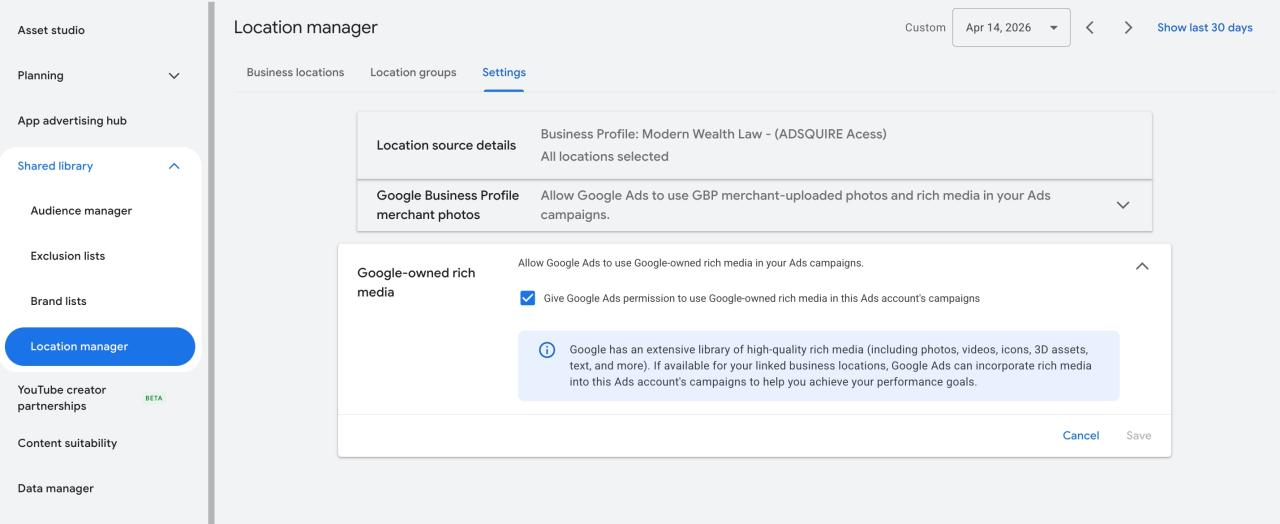
The feature seems linked to settings in Google Ads’ Location Manager and may be enabled through a pre-opted setting in the shared library.
This feature blends paid ads with Google Maps-style immersive experiences, offering a novel way to stand out and show off locations, products, or services more effectively than static listings.
Why we care. For businesses, this update presents significant opportunities to increase visibility and engagement in high-intent local searches. Video ads could greatly enhance how prospective customers engage with local offerings.
Explore the Google Ads Location Manager settings to optimize your business profile and utilize rich media in your ad campaigns.
Yes, but. Right now, it seems the feature is in early testing phases, and its performance versus traditional local ads remains unclear.
There’s also some concern around the creative requirements, as video production can add an extra layer of complexity for advertisers.
The bottom line. Google’s move to integrate video into local search indicates an intent to make ads more engaging, offering businesses new tools to capture attention.
First spotted. This update initially caught Anthony Higman’s eye, who shared details about the new local listing ad type on LinkedIn.
There’s some exciting news from Google Ads that I believe will make our lives a lot easier! A new integration with Google Tag Manager could revolutionize how we set up conversion tracking, making the process quicker and much less error-prone.
Google is working on simplifying one of the trickiest parts of setting up campaigns—conversion tracking—by minimizing the need for manual tag implementation. This change is something I’ve been eagerly waiting for!
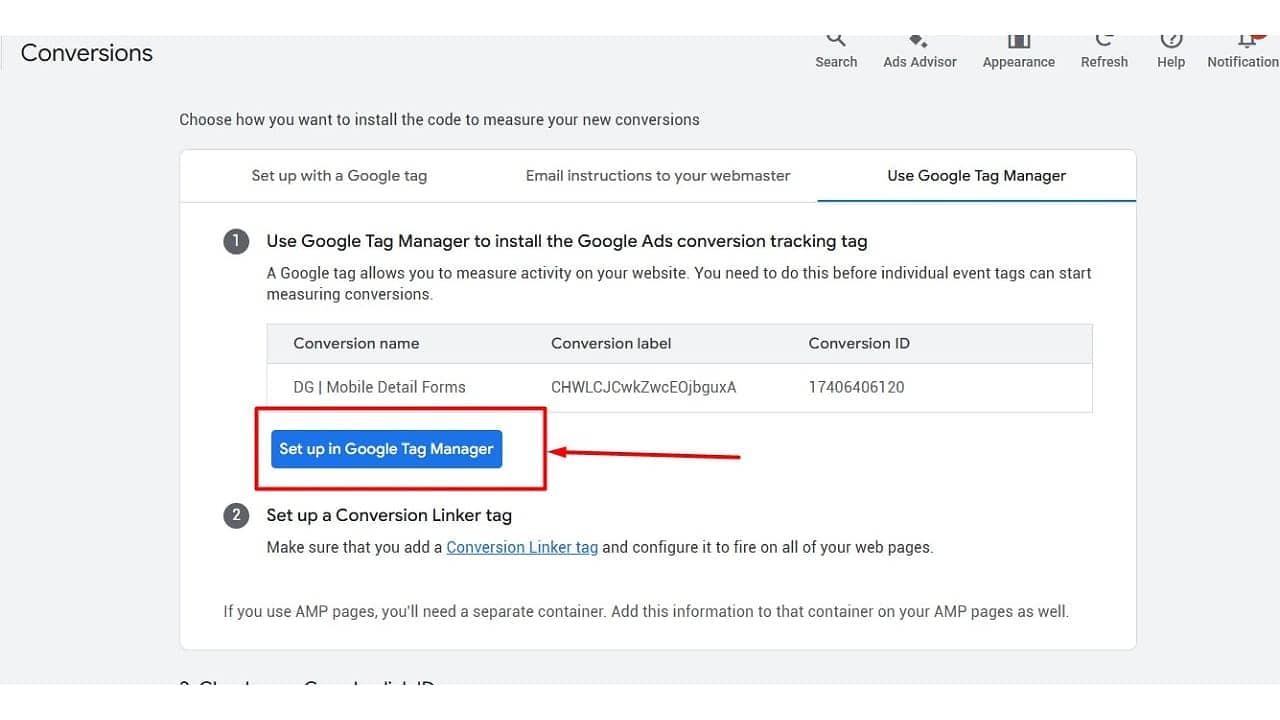
Driving the news. During the conversion setup flow in Google Ads, there’s a new option being tested: “Set up in Google Tag Manager.” This was highlighted in screenshots shared by Google Ads Specialist, Natasha Kaurra. I must say, it looks very promising.
This feature appears right alongside the existing installation methods and provides us with the ability to push conversion tracking setups directly into Google Tag Manager.
What’s new. Instead of having to manually copy conversion IDs and labels between platforms—which can be quite tedious—we can now click a new button that opens a pre-filled tag setup inside GTM. I can already see this saving us so much time.
This update means:
fewer manual steps,
less room for implementation errors,
and faster deployment across accounts.
Why we care. As you know, conversion tracking is critical for measuring our campaign performance. This new update significantly reduces the chances of errors and speeds up the implementation between Google Ads and Google Tag Manager, ensuring our data is accurate from the start. Reliable data means we can optimize better and make more informed decisions.
How it works. From the initial screenshots, it seems that users are prompted to select a GTM container, and a suggested tag configuration is then surfaced, ready for publishing. This could be a game-changer for agencies like ours managing multiple clients, working across several containers, or tackling complex tagging setups.
The bottom line. Even though it’s just a small UI change, it’s set to have a huge impact! This new feature will make it much easier for us to get conversion tracking right from the get-go.
First seen. This update was originally shared by PPC News Feed, who credited Google Ads Specialist Natasha Kaurra for spotting it. Don’t you just love how our community stays on top of things?
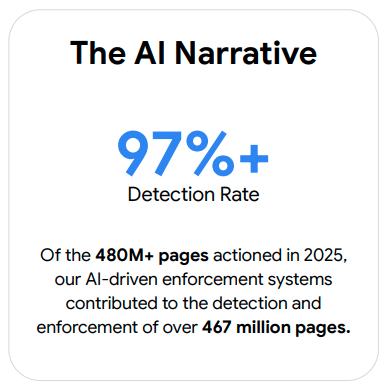
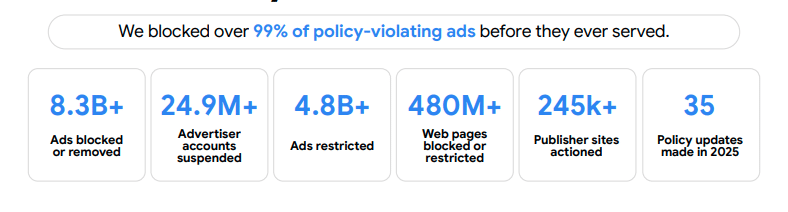
I’ve been following Google’s strides in ad safety, and their recent updates with Gemini have caught my eye. Gemini’s AI-driven enforcement is not only faster but more accurate, eliminating more than 99% of bad ads even before they appear in 2025. This means we’re seeing fewer false suspensions and stricter adherence to ad policies.
Diving into Google’s 2025 Ads Safety Report, I’m amazed at the scale: 8.3 billion ads were blocked or removed globally, and 24.9 million advertiser accounts got suspended last year. It’s impressive to think that over 99% of these policy-violating ads never saw the light of day, thanks to the power of AI.
Google also pointed out how Gemini’s capabilities significantly improved ad safety:
Gemini slashed incorrect advertiser suspensions by 80%.
The system processed four times more user reports compared to the previous year.
It enhanced the detection of scams by better understanding ad intent.
Looking at the numbers, we see a staggering impact:
602 million scam-related ads removed
4 million scam-linked accounts suspended
4.8 billion ads restricted
480 million web pages blocked or restricted
245,000+ publisher sites actioned
35 policy updates made in 2025
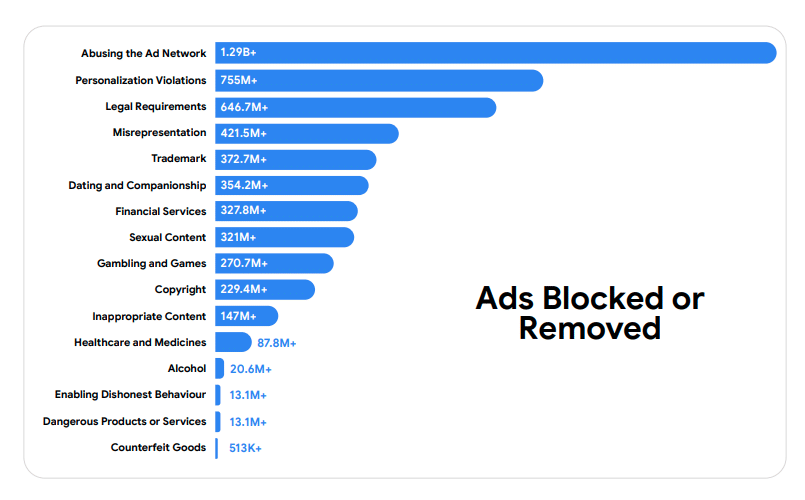
In the United States alone, 1.7 billion ads were removed, and 3.3 million advertiser accounts were suspended in 2025. The main reasons included:
Abusing the ad network
Misrepresentation
Sexual content
Personalization violations
Dating and companionship ads
Why do I care about this? Because stronger AI-driven ad enforcement impacts the way ads run or get flagged. Google claims Gemini enhances precision and reduces unwarranted suspensions, which might prevent unexpected interruptions for genuine brands. However, as AI reviews tighten, we advertisers must ensure complete policy compliance.
Some UK and US advertisers experienced waves of unexplained disapprovals, citing no discernible issues, highlighting the intricacies of automated oversight.
Gemini’s approach to ad enforcement is exciting. By evaluating billions of signals—like account age and user patterns—it’s capable of identifying malicious activity quicker than previous systems. By the end of 2025, most Responsive Search Ads were assessed instantly, blocking harmful material before it could launch. Google aims to apply this capability across more ad formats soon.
Yet, there’s a balance to maintain. Aggressive automation may disrupt campaigns, but Google’s emphasis on nuanced understanding is crucial for reducing incorrect suspensions, which is essential for brands relying on continuous ad visibility.
In conclusion, Google is banking on Gemini to enhance ad safety, aiming to curtail sophisticated scams while assuring advertisers that legitimate activities won’t be hindered by stricter controls.
I’ve noticed a growing concern among advertisers, as many of us are experiencing unexpected disapprovals from Google Ads. These disapprovals are often linked to DNS and 500 server errors, even when our websites seem to be functioning perfectly fine. This issue is raising serious questions about the platform’s reliability and our campaign’s performance stability.
Earlier this week, as a passionate participant in PPC advertising myself, I started hearing about these widespread issues from fellow advertisers. Multiple agencies and their clients were unexpectedly affected.
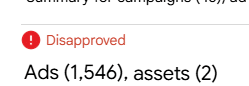
For instance, Ryan Berry, the Managing Director at Cornerhouse Media, reported that over 1,500 ads were disapproved in a single account at 1:30 p.m. UTC. Others have been receiving overnight emails informing them of disapproved ads.
Why this matters to us. When our ads are suddenly disapproved, it can abruptly halt traffic, leads, and revenue, even if our websites are working just fine. If Google’s systems are mistakenly flagging issues, like DNS or server errors, we are forced to waste precious time troubleshooting problems we didn’t create. This highlights the urgent need for quicker responses and escalations when such platform glitches occur.
Here’s what fellow advertisers and I have observed:
DNS errors flagged, even when our IT teams find no issues.
Charlotte Osborne, a Google Ads trainer, mentioned encountering two separate cases involving erroneous DNS and 500 errors with no discovered client-side issues. Similarly, Google Advertising specialist Joshua Barr has been dealing with a surge of disapproval emails at night for weeks.
What’s probably occurring. Google’s ad review process employs automated crawlers to evaluate landing pages. If these crawlers experience temporary server issues, DNS lookup failures, redirects, or timeouts, it could lead to ad disapprovals under the “destination not working” policy.
This means that even if:
our sites are live for users,
the issue is only temporary,
or the problem lies with Google’s crawlers,
we could still face ad disapprovals.
What actions we should take now:
Verify Google Ads policy manager for precise reasons behind disapprovals.
Test landing pages from different locations and devices.
Review DNS uptime, redirects, and CDN/firewall settings.
Submit appeals for disapprovals that are clearly incorrect.
Document impacts on an account level for potential platform-wide issues.
Bottom line. This situation serves as a stark reminder that our hard work on strategy can be undermined by such technical glitches. When Google’s systems fail, it risks both our advertising spend and our potential leads.
Initial reports. Ryan Berry in the UK initially spotted these issues, alongside Anthony Higman, who detected similar problems in the US.
Have you ever felt like you’re living in an ‘AI Groundhog Day’? Despite the wealth of AI tools we can use, many of us find ourselves stuck in a loop, manually prompting AI again and again. If we aim to truly automate PPC tasks, we need to move beyond this cycle.
Picture this: you open a chat window, carefully craft a prompt, and paste in your context. The result is fantastic! Yet, an hour later, the cycle repeats. If this sounds familiar, you’re still entrenched in manual work, albeit with a digital twist.
To harness AI effectively, I’ve realized we must transition from being doers to orchestrators. This means moving away from one-off prompts and starting to build robust systems. My book, “The AI Amplified Marketer,” delves deeper into how the human element remains crucial even as AI evolves rapidly.
Today, I’ll guide you on using Skills, an emerging AI capability, to enhance efficiency in managing PPC.
What’s a Claude Skill?
Many of us marketers have tried ChatGPT’s Custom Instructions—a broad directive for AI behavior. A Claude Skill, however, is more precise, dictating specific instructions to ensure consistent and predictable outcomes aligned with my expectations.
Recently, while rating search terms, I noticed AI’s inconsistency. One session yielded letter grades, another a percentage, and another, a numerical scale. This variability can disrupt workflows, confusing tools and team members alike.
A Skill eliminates this inconsistency, ensuring that every time, the results format remains unchanged. This evolution transforms AI from an unreliable assistant to a steadfast team member.
The latest capabilities in Claude allow a Skill to morph your comprehensive PPC strategy into an executable AI playbook, coordinating tasks among various tools and subagents efficiently.
Whether it’s auditing accounts or analyzing search query reports, Skills encapsulate your expertise into scalable systems for your team to deploy with AI seamlessly.
How to Build Your First AI Skill
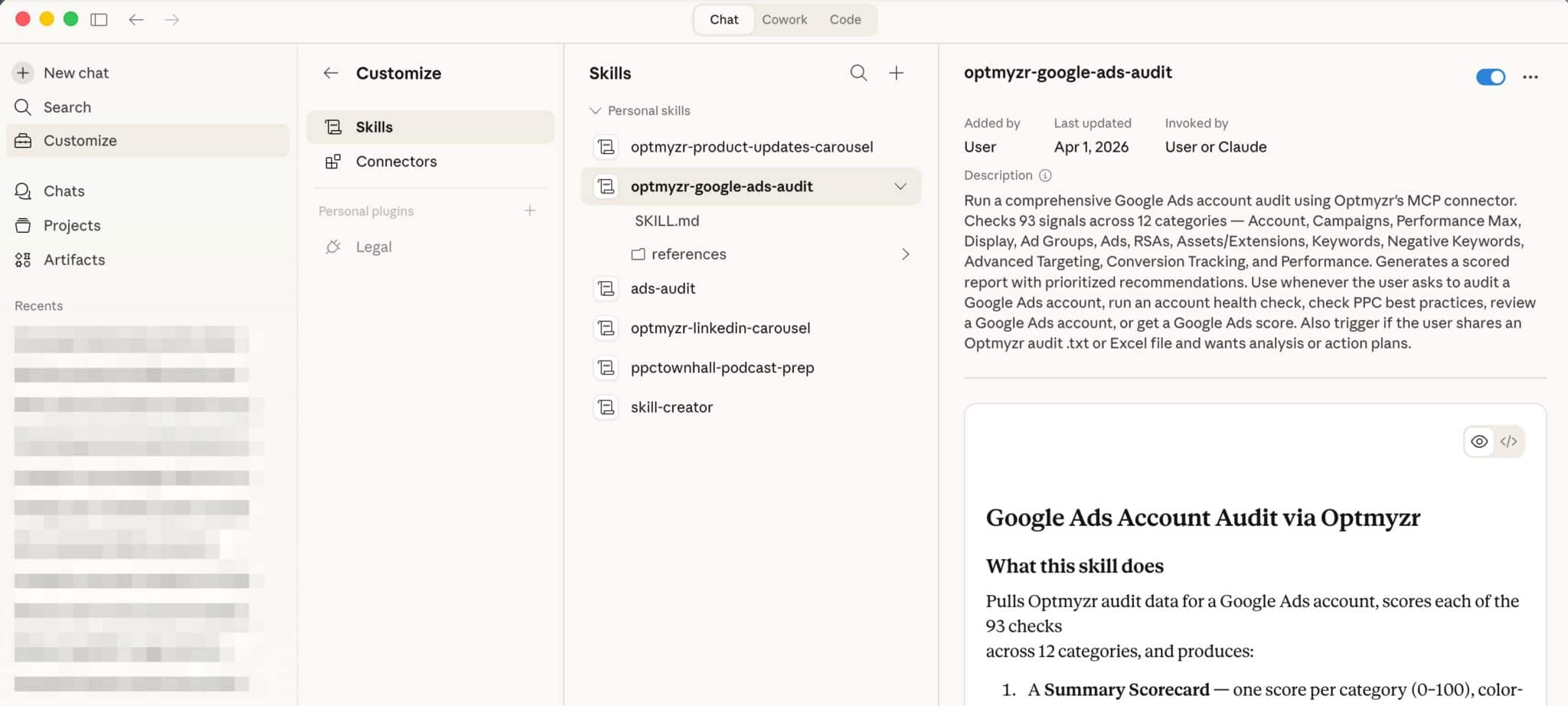
Starting a new Skill might seem daunting, but it’s quite straightforward. In a chat with your AI, you can upload an audit checklist, a SOP, or a workflow blueprint, and instruct Claude to formulate it into a Skill.
Intriguingly, Claude employs a specialized protocol to construct Skills, guaranteeing outputs that are structured, adhere to best practices, and align with Anthropic’s architecture.
Technically, a Skill is stored as a Markdown (.md) file, serving as the playbook for the task at hand. Concerned about data privacy? You can save this locally or opt to share it in a cloud repository for easy team access and updates.
You don’t need to start from scratch. Platforms like GitHub offer pre-built Skills that you can experiment with and tailor to your needs.
How to Use a Skill in PPC
To get started with a Skill, make sure you have some available in your account.
Simply tell the AI the specific task you wish to accomplish. If a suitable Skill exists, the AI will apply those instructions to carry out the task.
Keep in mind, having competing skills could disrupt consistency. For instance, two skills performing Google Ads audits might randomly select different methodologies, thwarting the predictability.
PPC Skills Need Real-Time Data
While a Skill defines powerful logic, without real-time data, its application remains theoretical. Consider crafting an analysis to review search terms over the past 14 days—it’s great in concept, but without active data pulling from Google Ads, it remains incomplete.
Previously, this required manually downloading CSVs from interfaces. It worked, but was slow and the data became outdated immediately.
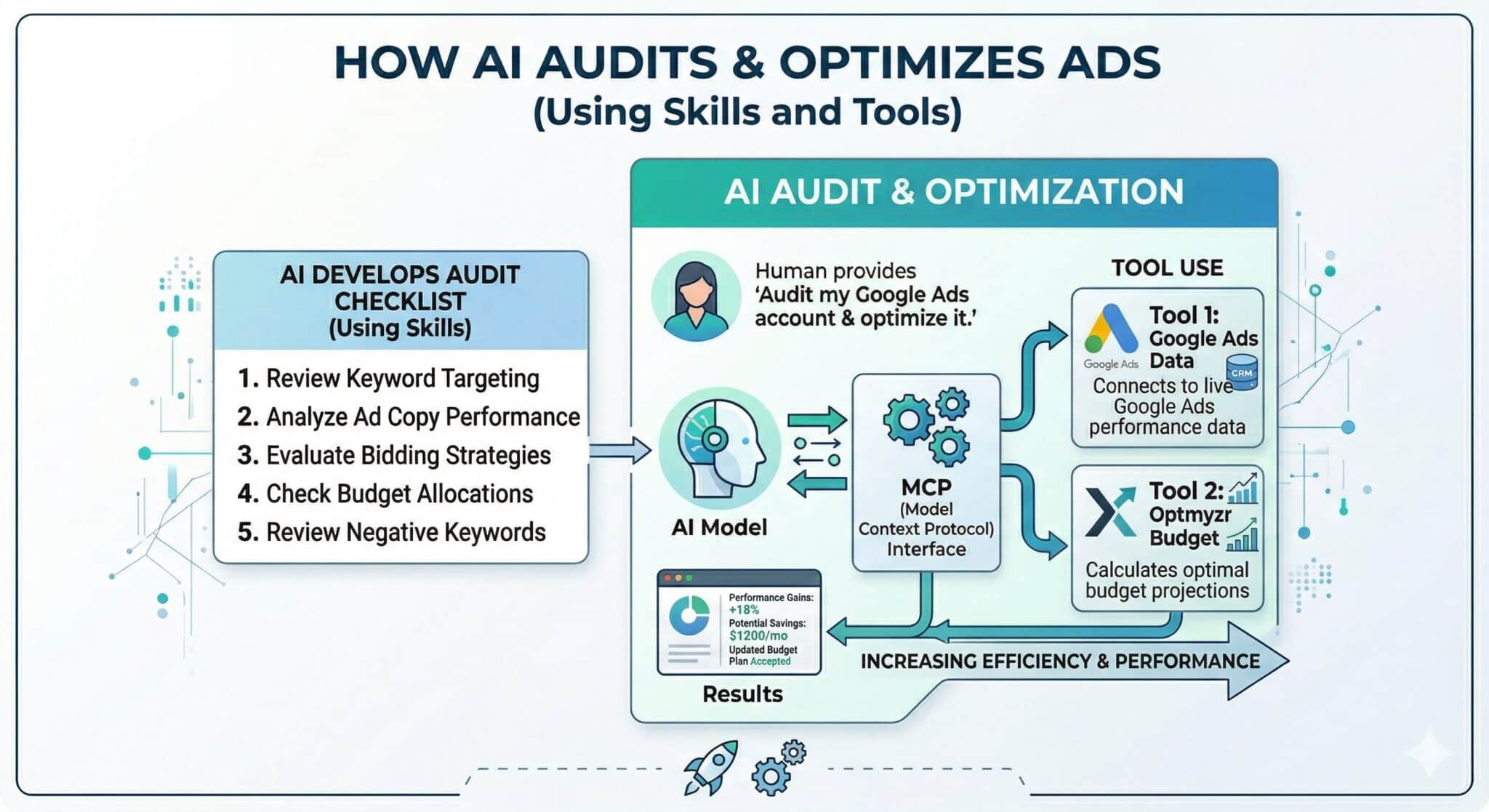
Enter the Model Context Protocol (MCP), bridging AI Skills to live data sources seamlessly. Using protocols like Optmyzr’s MCP, Skills can dynamically access and apply live Google Ads data, converting static instructions into an adaptive, responsive tool. (Disclosure: I’m the cofounder and CEO of Optmyzr.)
From Grunt Work to System Oversight
Integrating Skills with MCP transforms AI from assistantship into management. Tasks like search term analysis can shift from hands-on processes to automated oversight, with the AI undertaking everything from data pulling to implementing results.
Incorporating capable logic (Skills) with real-time data (tools) nurtures a practical system ready to shoulder routine tasks, enabling me to focus more on strategy orchestration.
4 PPC Skills You Can Build Today
Ready to jump into action? Here are four PPC Skills to inspire you:
1. Search Term Mining
This Skill guides AI in evaluating search query reports to target waste and opportunities.
Without tools, it requires manual CSV uploads and report implementation. However, with MCP, the necessary data is automatically sourced and applied directly in your Google Ads account.
2. Ad Copy Generation
Using a landing page and keywords, this Skill generates ad copy tailored to user intent and value propositions.
Manual editions involve copying assets, whereas MCP integrations can identify underperforming ads, generate new copy, and even initiate ad experiments autonomously.
3. Account Auditing
This Skill performs a checklist to spot issues like missing ad extensions or budget constraints.
Manually, it reports findings, but with MCP, it remedies problems directly, such as applying existing extensions to appropriate ad groups.
4. Budget Reallocation
Analyzing comparative data, this Skill identifies budget shifts to maximize returns.
Without tools, it suggests reallocations; with MCP, it dynamically analyzes and implements these changes, optimizing budgets promptly.
The Future of Your Role: From PPC Doer to PPC Designer
The fusion of Skills and tools allows us to depart from mere AI collaboration to AI-driven responsibilities. Instead of juggling tasks, our focus shifts to designing automated systems, crafting Skills, and setting the course for relentless efficiency.
As technology melds development and user-friendly interfaces, we’re at the cusp of a paradigm where non-developers design systems. It’s time to innovate and welcome AI as a genuine ally.
The End of Endless Prompting
The cyclical nature of endless prompting confines us to manual execution. By harnessing Claude Skills, we’re revolutionizing our approach to PPC—from mundane tasks to sophisticated system design. This transition embodies the essence of an AI-amplified marketer, fostering a dependable, efficient partner that channels our expertise into thriving systems.
The journey begins by viewing your daily routines through a designer’s lens. What process is ripe for crafting your inaugural Skill?
Every year, I eagerly anticipate the release of Duane Brown’s PPC Salary Survey. It provides a revealing glimpse into what we’re really earning in this industry. The 2026 survey, which gathered input from 445 practitioners across over 50 countries, is particularly telling. What stands out this year is the growing divide in middle-career PPC salaries, as the extremes continue to pull away.
PPC salaries aren’t uniformly dropping. Instead, there’s an expanding gap between the high earners and those at the baseline. This divergence has never been clearer, or more concerning.
AI has certainly sped up this change, but the roots of this transformation have been deepening for years.
What Four Years of Salary Data Reveal
The salary survey has kept tabs on U.S. median pay by experience since 2018. When you lay out the data for four straight years, a distinct pattern emerges:
Experience
2022
2023
2024
2025
2026
3-5 years
$80,000
$80,016
$80,000
$75,000
$87,500
6-9 years
$100,000
$110,000
$108,000
$110,000
$100,000
10-15 years
$125,000
$150,000
$136,000
$133,500
$135,000
15+ years
$150,000
$134,000
$144,000
$140,000
$150,000
Two key insights stand out:
The salary for the 3-5 year band rebounded significantly in 2026 to $87,500 after a drop to $75,000 in 2025. This indicates junior-to-mid practitioners who secure roles are being compensated fairly.
However, the 6-9 year band slipped back to $100,000, and the 10-15 year group has stagnated between $133,500 and $136,000 for three years. For those with a decade of experience, pay has essentially stalled or decreased when adjusted for inflation.
The difference becomes even more pronounced at the extremes. Data from the U.S. survey shows top salaries exceeding $300,000 for the 10-15 years cohort. Freelancers with comparable experience have a median income of $202,895, compared to an agency median of $123,545. That’s a $79,000 premium for going independent, demonstrating the distinct advantage if you offer something valuable enough to justify it.
The Growing Divide: In-house vs. Agency
The 2026 survey highlights an increasing divergence in mid-career earnings between in-house and agency roles.
Experience
Agency (median)
In-house (median)
Difference
3-5 years
$80,000
$89,000
+$9,000
6-9 years
$90,000
$170,000
+$80,000
10-15 years
$123,545
$140,000
+$16,455
15+ years
$120,000
$140,000
+$20,000
Although the 6-9 year in-house statistic is somewhat inflated by outliers, the trend is clear: in-house professionals regularly out-earn their agency peers, sometimes by significant margins. For those with 10-15 years of experience, an in-house position could mean a $16,000 annual advantage.
This isn’t merely a question of individual skill development; it’s about the strategic role you play. Agency work, despite its diversity, doesn’t match up to in-house strategy roles in terms of financial reward. Automation of execution tasks makes it harder for agency workers to justify their billing rates, likely pushing salaries down.
Examining the Gender Pay Gap
The 2026 survey paints a complex picture of gender pay differences in our field.
For the 3-5 year experience band, women in the U.S. are actually earning more than men, with a median of $87,500 compared to $85,000. At the 10-15 year level, women also slightly surpass men with a median of $135,000 against $130,000. However, a chasm appears at senior levels, with men earning a median of $150,000 versus $120,000 for women—an alarming 25% gap.
This trend aligns with broader compensation research, where pay gaps tend to close at mid-career but widen at senior levels, a result of factors like negotiation skills and access to high-value client relationships. It’s crucial for the industry to address this discrepancy as we increasingly value strategic capabilities.
The U.K. and Europe: Stagnation at the Pinnacle
In the U.K., salary trends are worrying. The 5-year survey shows the 10-15 year median fluctuating between £48,800 and £60,000, finally settling at £50,000 in 2026, a drop from £60,000 in the previous year.
Conversely, European data shows a more positive trend at senior levels. The median for the 10-15 year experience range rose from €50,000 in 2024 to €65,625 in 2026. However, the 3-5 year band has fallen back to €37,200, less than it was in 2022, indicating entry-level and early-career pay isn’t keeping up with job demands.
In Berlin specifically, the 2026 survey reports a 10-15 year band median of around €76,000, significantly above the broader EU figure, showing that the Berlin market still values senior experience highly.
Beyond AI: The Real Power Shift
I want to assert that the shift in PPC salaries isn’t merely about having or lacking AI skills.
The State of PPC 2026 report notes AI has dropped to the third priority among professionals, not because its use declined, but because it has become standard. AI saves us around 5.2 hours per week; useful, but not a salary game-changer.
Payscale’s 2026 Compensation Best Practices Report reveals that 55% of companies offer no additional benefits for AI skills, even though 61% require them. AI fluency is now expected, not exceptional.
Top earners have shifted from being campaign operators to business outcome leaders. They:
Focus on revenue contributions and margin impacts rather than ROAS and CTR.
Position themselves closer to the CFO than to the media buyer.
Demonstrate their expertise through effective communication, meaningful frameworks, and insightful questions in board meetings.
While salary data indicates past trends, it’s your approach that determines where on the scale you land.
Ask Yourself the Right Questions
The PPC salary curve is not collapsing, yet it is branching.
The 3-5 years cohort remains competitive salary-wise.
U.S. freelancers with over 10 years of experience and strong positioning can earn $200,000+.
Senior in-house strategists see salaries ranging from $140,000 to $170,000.
What’s stagnating is the middle—the agency expert with 6 to 15 years of experience. While skilled at running campaigns, they lack the differentiated value that would push them to the next tier.
This group faces pressure from below, with automation taking over execution, and from above, where strategic roles demand more than just campaign prowess.
The question is—not just whether I’m using AI—but am I the go-to person when the AI report arrives?
If you find yourself unsure, it might not be about upgrading your tools, but rather a reevaluation of your positioning. Now is the time to make that change, before the salary gap widens further.
As someone deeply invested in the world of digital advertising, I’ve noticed that Google is making a significant change. They’re moving away from impression-based planning and encouraging us to adopt more conversion-focused strategies.
Recently, I learned that Google’s Performance Planner tool has refined its scope. They’re now emphasizing conversion-focused campaign types, leaving behind the traditional impression-based planning style.
What’s happening? Last month, Performance Planner stopped supporting planning for Display and Video campaigns. This adjustment also means that metrics like impression share, top impression share, or absolute top impression share are no longer viable on their platform.
Why this matters to us. This shift away from impression-focused planning affects how we forecast and optimize campaigns concentrated on brand awareness. Google’s push towards conversion-focused and automated strategies challenges us to rethink our approach to upper-funnel tactics.
The bigger picture. It’s evident that Google Ads is prioritizing automation and performance-driven results. They are aligning their tools more with campaign types like Search, Shopping, App, Demand Gen, Local, and Performance Max.
How it’s working now. We can continue using the Performance Planner for supported campaign types, but any plans that included Display or Video campaigns, based on impression share metrics, are no longer editable or viewable.
What I’m watching. I’m curious about how we’ll adapt our planning and forecasting strategies for upper-funnel channels like Display and Video now that they lack native support in Google’s tools.
Bottom line. Ultimately, Google’s focus on performance-driven planning means that impression-based strategies might soon be a thing of the past. It’s time to embrace the shift towards conversions.
I’ve recently noticed YouTube inching closer to traditional TV-style ads, marking a significant transition that might just alter how we enjoy videos — and draw in bigger brand investments.
What’s happening. For some TV viewers, ads are being stretched up to 90 seconds before they can skip, a major change from the recently introduced 30-second unskippable formats.
How it works. These extended ad blocks are mostly appearing on TV devices, sometimes lasting over 90 seconds, with the option to skip only available after this initial period.
Why we care. YouTube is tapping into more premium, TV-like ad inventory that facilitates longer, more engaging storytelling on our screens. This transformation creates opportunities for brands to run campaigns akin to those on traditional TV, but with the advantage of digital targeting and measurement. As Google dives deeper into connected TV, I foresee a potential shift in budgets towards YouTube as an essential channel for reach and brand prominence.
Zoom in. Initial reports indicate that this format is not tethered to the length of the video, appearing on both shorter and longer content, and currently, it’s only affecting TV audiences, not mobile or desktop users.
User reaction. The feedback I’ve come across has been mostly negative, with viewers lamenting these lengthy interruptions and considering alternatives such as ad blockers or third-party apps.
Context. This test stems from YouTube’s recent aggressive monetization efforts, including the introduction of new ad formats and the launch of a lighter subscription tier that reduces ads.
What to watch. I’m curious to see if YouTube will expand this format beyond TV and how they’ll manage the delicate balance between ad load and user retention.
When I think about auditing an agency to find a genuine growth partner, I am often reminded of how many agencies sound the same at first glance. Yet, when we dig deeper, the real differences can be stark, particularly in their methods of optimization, measurement, and scaling.
As a seasoned performance marketing head at an agency, I frequently encounter agencies offering account audits during their sales pitch. Their goal is usually twofold: to deliver immediate value and to showcase their expertise.
But, in my experience, brand marketers seldom reverse roles to audit these agencies during the Request for Proposal (RFP) process. Over the years, I’ve noticed many brands settling for mediocrity simply because they aren’t equipped with the right questions to unearth the weaknesses in a potential partner’s strategy.
If I were a brand, eager to secure a true growth partner, these are the questions I’d make sure to ask.
1. What are your key services, and what percentage of your clients utilize each? I’ve seen many agencies claim they offer ‘full service,’ but true execution excellence is rare. I’d scrutinize where they truly focus their time and efforts. This not only includes channel proficiency but how their strengths align with our brand’s needs.
2. How are you approaching AI-driven account optimization and platform automation? Gone are the days when manual controls set us apart as high-performing marketers. Understanding how an agency balances AI automation without over-reliance is crucial.
3. What is your reporting process, and what KPIs do you focus on for the majority of your clients? A mere sample report won’t do. I need to comprehend their data philosophy, especially if it centers around revenue and ROAS metrics.
4. What’s the average industry tenure of the team on my account? A common query, yet crucial for understanding their ability to retain experienced professionals who leverage AI tools adeptly.
5. How is your team using AI on client accounts? Striking a balance in AI usage is essential. I prefer teams that use AI wisely for operational efficiency without sacrificing strategic insights and creativity.
6. When you take over an account, what are the first things you do to save budget without affecting growth? This is a litmus test of their technical proficiency, focusing on identifying and eliminating budget waste efficiently.
Ultimately, to distinguish a true growth partner from others, I focus on their service utilization rates, tactical AI applications, and budget efficiency approaches. These considerations help identify a partner ready to deliver genuine performance rather than just manage our budget.