Tag: generative engine optimization

  • Unlocking Content Success: Mentions, Citations & Clicks in 2026

    Unlocking Content Success: Mentions, Citations & Clicks in 2026

    In my new content strategy for 2026, I’ve learned that the focus now lies in the signals models perceive, rather than the pages users visit. It’s crucial to adapt our content before digital agents dominate the journey.

    Generative systems like ChatGPT, Gemini, Claude, and Perplexity have started reshaping the discovery phase. This stage once drove millions to our websites, but now it’s all about getting referenced in models.

    ```json
{
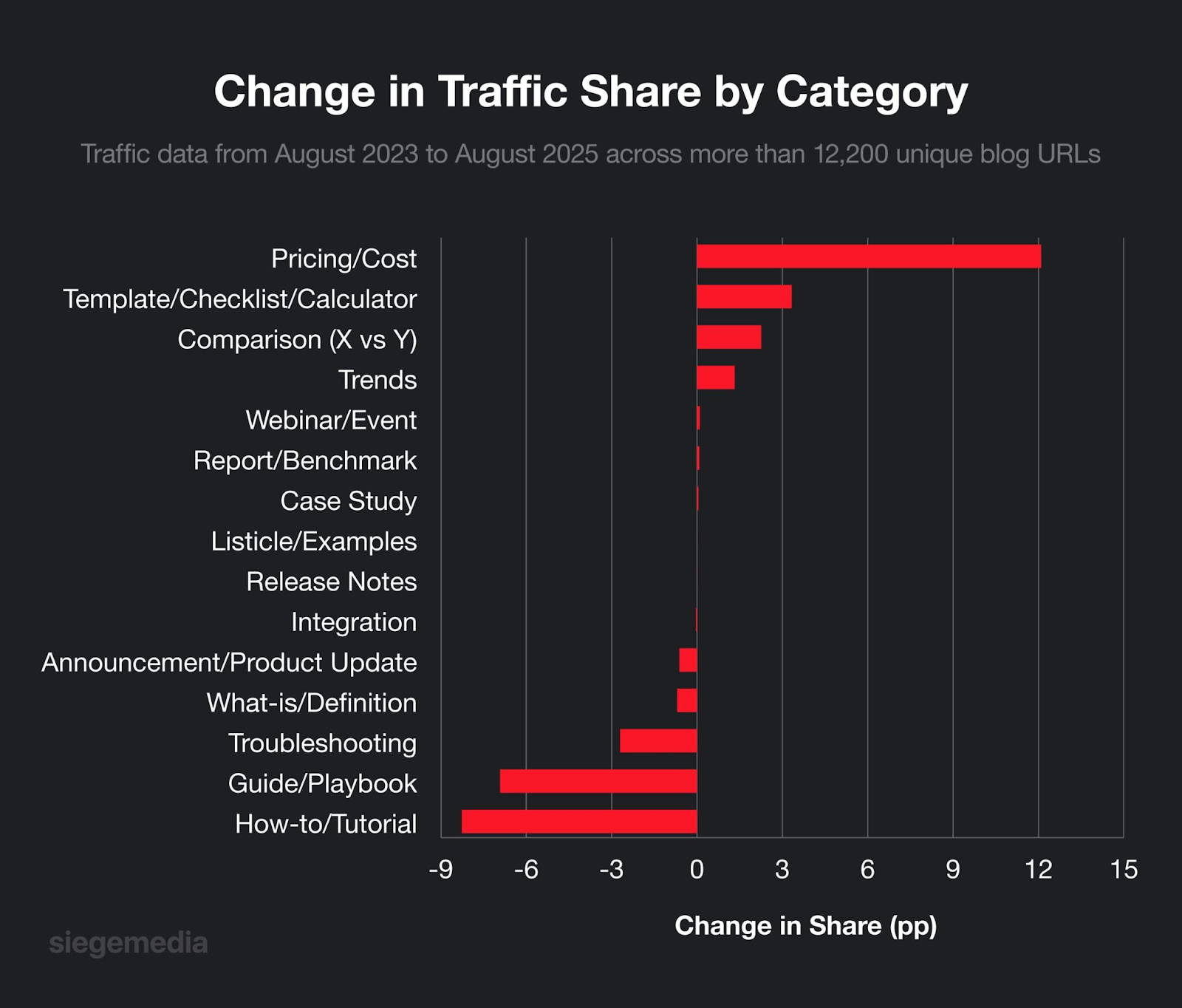
  "alt": "Bar chart showing change in traffic share by content category from August 2023 to August 2025, highlighting pricing/cost and template categories.",
  "caption": "Intriguing shifts in blog traffic! Pricing and templates see the highest growth, while tutorials and guides face a decline from 2023 to 2025.",
  "description": "This bar chart illustrates the change in traffic share by content category from August 2023 to August 2025, based on data from over 12,200 blog URLs. Categories such as Pricing/Cost and Templates/Checklists/Calculators saw significant increases in traffic share, while How-to/Tutorials and Guide/Playbook categories experienced declines. The chart provides valuable insights for content strategists and marketers aiming to optimize their focus areas. Keywords: traffic share, content category, blog analysis, digital marketing trends, content strategy."
}
```

    Metrics like impressions, sessions, and CTR are still important but tell an incomplete story. Mentions, citations, and structured visibility signals are emerging as the trustworthy paths to revenue.

    ```json
{
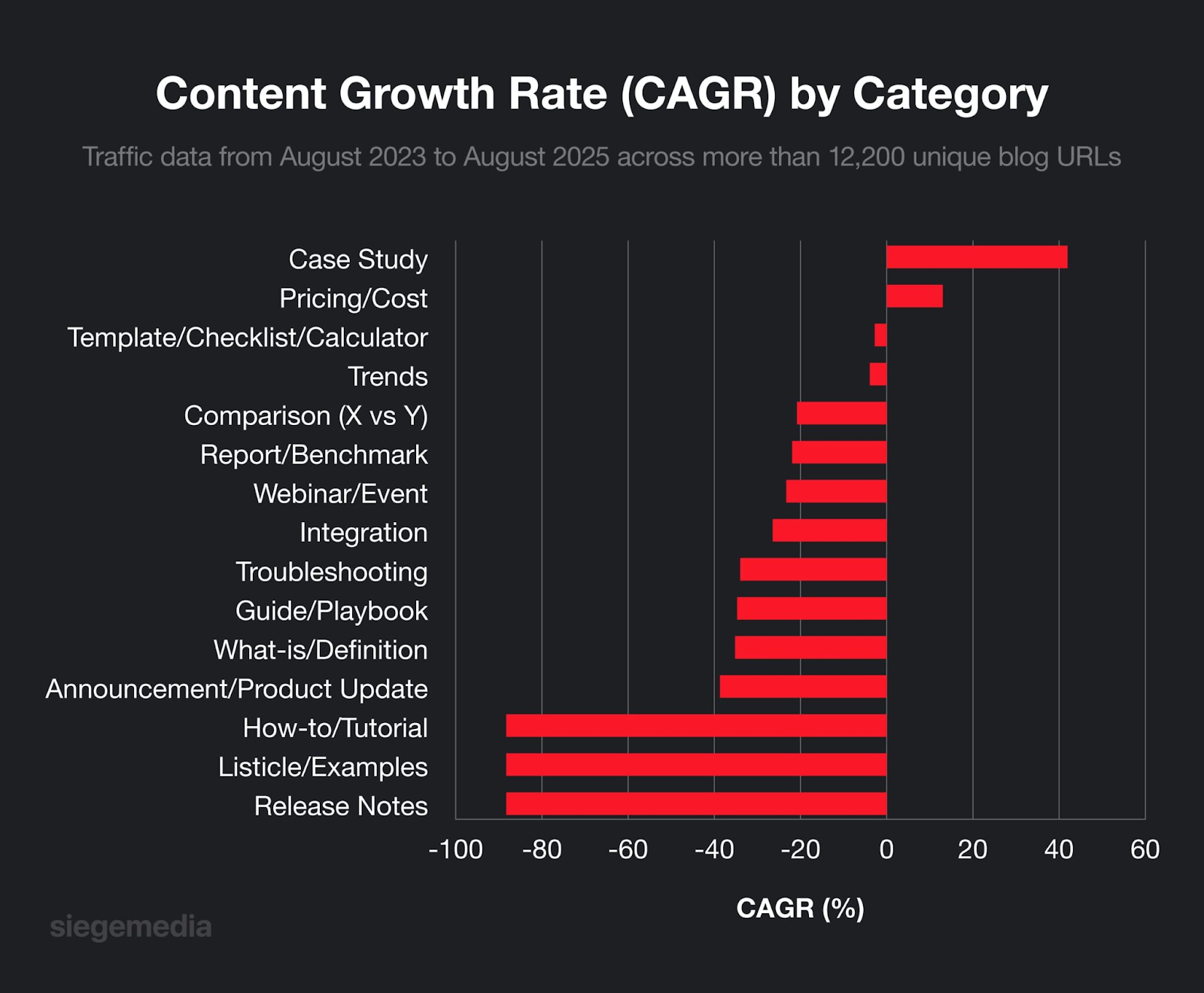
  "alt": "Bar chart showing content growth rate (CAGR) by category from August 2023 to August 2025.",
  "caption": "Explore the varied content growth rates by category from August 2023 to 2025. Discover which types like Case Studies and Trends are leading the pack and which are falling behind.",
  "description": "This bar chart illustrates the content growth rate (CAGR) by category from August 2023 to August 2025, based on traffic data across over 12,200 blog URLs. Categories like Case Study and Trends show significant growth, while others such as How-to/Tutorial and Release Notes experience declines. This insightful analysis by siegemedia provides a clear view of content trend dynamics over a two-year span."
}
```

    In this article, I’ve compiled insights from Siege Media’s content performance study, Grow and Convert’s findings on conversion, Seer Interactive’s AI research, and firsthand experiences within generative platforms. They guide us on how visibility, engagement, and purchasing intent are reshaping as AI covers more of the user journey.

    ```json
{
  "alt": "Bar chart showing engagement rates of content types like trends, updates, guides, comparisons, and case studies.",
  "caption": "Discover which content types are driving engagement! Trends and updates lead the way, outperforming guides and comparisons in boosting interaction.",
  "description": "This bar chart illustrates engagement rate improvements for different content types from August 2023 to August 2025, analyzing over 12,200 blog URLs. The data reveals that 'Trends' and 'Announcements/Product Updates' show the highest engagement improvements, followed closely by 'Guide/Playbook' and 'Comparison (X vs Y)'. The chart is a resourceful insight for content strategists aiming to boost user interaction with effective content."
}
```

    The team at Siege Media conducted an extensive performance analysis across various industry blogs, covering more than 7.2 million sessions. Kudos to them for sharing such a substantial dataset with us.

    ```json
{
  "alt": "A robotic figure with glowing eyes and metal hands gestures with the text 'But wait, there's more!' in bold.",
  "caption": "This robot is ready to deliver unexpected surprises with the classic phrase 'But wait, there's more!'",
  "description": "The image features an animated robotic character with glowing yellow eyes and metal hands, dressed in a blue shirt. The robot stands in a kitchen setting, gesturing animatedly. Above and below it, the text reads 'But wait, there's more!' in bold, capital letters. This image plays on the classic infomercial trope, implying that there's an exciting twist or additional element yet to be revealed. Keywords: robot, glowing eyes, gesture, blue shirt, infomercial, surprise."
}
```

    Notably, the data is focused on blog content, which may not align perfectly with other formats such as videos or landing pages.

    ```json
{
  "alt": "Illustration of a chef with a conversion funnel using tofu cubes, moving from discover to decide stages.",
  "caption": "From tofu blocks to decisive bites, this creative infographic illustrates the stages of customer engagement, paralleling a marketing funnel.",
  "description": "This image features a chef preparing tofu cubes on a tray, symbolizing the stages of a marketing funnel: 'Discover & Awareness,' 'Consider & Explore,' and 'Decide & Convert.' The process is visually represented by several cubes on a tray to a single cube on a plate, illustrating the journey from expanding reach to final decision-making. Keywords: marketing funnel, conversion stages, customer journey, tofu metaphor."
}
```

    Here’s what I’ve learned from their findings.

    ```json
{
  "alt": "Bar graph comparing BOTF and TOF traffic pageviews.",
  "caption": "This bar chart highlights the stark difference between BOTF and TOF traffic in terms of pageviews, with TOF towering over BOTF.",
  "description": "A bar graph titled 'BOTF vs. TOF Traffic (Pageviews)' showing comparative pageview data. The red bar represents BOTF traffic with a lower count, while the blue bar shows significantly higher TOF traffic. The Y-axis is labeled with pageview counts ranging from 0 to 250,000. This visual emphasizes the disparity in traffic sources, useful for digital marketing analysis and strategy development."
}
```

    TL;DR of the Siege Media Study

    Pricing and cost-related content has shown the strongest growth, contrasting the sharp decline of top-of-funnel guides and “how-to” posts. It appears pricing pages have risen at the expense of TOFU content, but I see it differently. As user habits change, buyers are now likely to initiate research generatively and only move to high-intent queries as they near a decision.

    ```json
{
  "alt": "Bar graph comparing BOTF and TOF conversion rates, with BOTF at 4.78% and TOF at 0.19%.",
  "caption": "Comparing conversion rates: BOTF significantly outperforms TOF with a rate of 4.78% versus 0.19%. Discover the factors behind this stark difference.",
  "description": "This bar graph illustrates a comparison between BOTF (Bottom of the Funnel) and TOF (Top of the Funnel) conversion rates. The BOTF conversion rate stands at 4.78%, shown with a tall red bar, while the TOF conversion rate is markedly lower at 0.19%, depicted by a short blue bar. The chart highlights the stark effectiveness difference in conversion strategies between the two funnel stages, making it a valuable resource for marketers aiming to optimize conversion tactics. Keywords: conversion rate, BOTF, TOF, marketing funnel, graph."
}
```

    The data highlights substantial growth in pricing and comparison content, whereas traditional guides have significantly declined. We’ll revisit this trend later.

    ```json
{
  "alt": "ChatGPT interface showing a conversation about planning a trip to the Outer Banks.",
  "caption": "Explore the serene beauty of the Outer Banks with a personalized travel plan created to suit your desires for relaxation and adventure.",
  "description": "This image captures a ChatGPT interface discussing a travel plan to the Outer Banks, North Carolina. The conversation highlights the region's 175-mile stretch of barrier islands known for their sandy beaches, lighthouses, seaside towns, and wild horses. The interface prompts further planning based on user preferences and budget. Keywords: Outer Banks, travel plan, ChatGPT, North Carolina attractions."
}
```

    Despite setbacks in certain content forms, major categories are seeing increased engagement. Users are completing more research within generative engines, thus reaching sites with a higher intent and readiness to act.

    ```json
{
  "alt": "ChatGPT conversation recommending top Outer Banks rental companies for large groups.",
  "caption": "Discover the top Outer Banks rental companies perfect for hosting large groups, featuring options with pools, beach access, and more.",
  "description": "This image shows a ChatGPT conversation focused on recommending specific Outer Banks rental companies suitable for large groups of around 12 people. The list includes Sun Realty, Beach Realty & Construction, Carolina Designs Realty, and Resort Realty, highlighting features like large accommodations, oceanfront homes, and pet-friendly options. These companies offer a range of properties, including multi-bedroom homes ideal for family reunions or group getaways, with amenities such as beach access and private pools."
}
```

    As a data-focused SEO professional, this could be an indicator to prioritize bottom-of-funnel content, but there’s more to consider…

    ```json
{
  "alt": "Line graph showing the growth of ChatGPT users from Nov 2022 to Sep 2025, with a steep increase after Jan 2024.",
  "caption": "The surge in ChatGPT's user numbers from November 2022 to September 2025 highlights its expanding impact, especially post-January 2024.",
  "description": "This line graph illustrates the growth in weekly active ChatGPT users across consumer plans (Free, Plus, Pro) from November 2022 to September 2025. The graph marks data points every six months, revealing a significant upward trend. Notable growth accelerates post-January 2024, reaching nearly 800 million users by September 2025. Keywords: ChatGPT, growth, users, consumer plans, timeline."
}
```

    Don’t Forget the TOFU!

    I never thought I’d say this, but keeping up with TOFU content is essential. We might need even more of it to ensure sustained visibility and engagement.

    ```json
{
  "alt": "Bar chart showing conversation topic shares divided into categories like Multimedia, Practical Guidance, Writing, and more.",
  "caption": "Explore the fascinating breakdown of conversation topics from over a million interactions, with Writing and Practical Guidance leading the charge.",
  "description": "This bar chart presents a detailed breakdown of conversation topic shares as defined in Table 3. Categories include Multimedia (6.0%), Practical Guidance (28.3%), Seeking Information (21.3%), and Writing (28.1%). Specific subcategories like Tutoring or Teaching (10.2%), Specific Info (18.3%), and Personal Writing or Communication (8.0%) offer deeper insights into user interactions. Data is sampled from approximately 1.1 million conversations between May 15, 2024, and June 26, 2025."
}
```

    Reflecting on SEO’s legacy, we see how it has evolved over time. Grow and Convert’s research from 2023 indicates that despite high TOFU traffic, its conversion rates are notably lower compared to BOFU, a trend seen across channels like PPC.

    ```json
{
  "alt": "Animated scientist in lab coat enthusiastically addresses three robots seated at a table.",
  "caption": "Excitement fills the room as the animated professor shares thrilling news with a group of attentive robots.",
  "description": "A scene from an animated show where a bespectacled scientist in a white lab coat announces 'Good News, Everyone!' to three robots sitting at a table. The scientist's expressive gesture and the attentive robots create a humorous and lively atmosphere. This image captures a quintessential moment of excitement and surprise, ideal for themes of innovation and technology. Keywords: animated, scientist, robots, announcement, humorous."
}
```

    Generative engines now manage most of the TOFU journey, often keeping users within platforms for research before they cross over for decision-specific interactions.

    ```json
{
  "alt": "Bar chart comparing conversion rates of AI platforms and Google Organic Search.",
  "caption": "AI platforms, including ChatGPT, showcase higher conversion rates than Google Organic Search, highlighting their growing influence in digital marketing.",
  "description": "This image is a bar chart titled 'Conversion Rates: AI vs. Google Organic Search' showing the conversion rates of various traffic sources. ChatGPT leads with 15.9%, followed by Perplexity at 10.5%, Claude at 5%, and Gemini at 3%. Google Organic trails at 1.76%. The chart, using shades of purple, illustrates the rising impact of AI in conversion efficiency. Keywords: AI, conversion rates, Google Organic, ChatGPT, digital marketing."
}
```

    For example, when I used ChatGPT to plan a trip, it engaged me deeply in TOFU and MOFU stages. This involved numerous opportunities to encounter new brands before reaching my final decision.

    ```json
{
  "alt": "A suited man with sunglasses stands confidently with text reading 'Never Send A Human To Do A Machine's Job.'",
  "caption": "In the realm of machines, humans may not always be up to the task. This image captures the essence of technology's rising dominance.",
  "description": "The image features a suited man wearing sunglasses, exuding confidence and authority. Accompanied by the impactful text 'Never Send A Human To Do A Machine's Job,' it highlights the theme of technological superiority. The dark background adds to the serious tone, providing a dramatic and intense atmosphere. Keywords: machine, human, technology, superiority, authority."
}
```

    The pivotal learning here is that TOFU and MOFU interactions set the stage for conversion decisions. This dynamic reveals the importance of being part of the TOFU stage to imprint on potential clients.

    Why Do These Protocols Matter to a Content Strategist?

    Protocols like AP2 and Computer Use are game-changers. They are reshaping the role of clicks from human navigation to transactional steps for AI agents. Understanding this shift is imperative for content strategists.

    As Siege Media’s data shows, while pricing and calculators excel because humans still drive these choices, AI agents may soon undertake this task, potentially replacing human site visits with bot interactions validating costs through technical verification.

    The 2026 Strategy

    This evolving landscape demands a strategic pivot. To achieve success in 2026, I believe a dual focus is necessary. First, optimize BOFU content for seamless technical execution. Second, reinforce TOFU efforts by enhancing mentions and citations to establish trust and recognition in generative answers.

    As clicks turn into a commodity managed by AI, the value of mentions will soar, making them the new battleground for visibility. It’s time to bolster TOFU efforts, ensuring they contribute significantly to our broader strategy.


    Inspired by this post on Search Engine Land.


    crushpress.ai community screenshot
  • Unleashing PESO Power: Enhance AI Search Visibility

    Unleashing PESO Power: Enhance AI Search Visibility

    As I delve into the evolving world of AI and brand discovery, I’ve noticed how AI is transforming the way people find and perceive brands.

    More and more, users are leaning towards AI-driven platforms like ChatGPT, Perplexity, and Google’s AI Overviews, rather than traditional search engines to get their answers.

    These AI tools provide synthesized summaries instead of regular search results, prompting me as a marketer to rethink how we can achieve visibility.

    SEO remains important but now extends far beyond on-page strategies. It’s about how frequently I’m able to ensure our brand is mentioned and discussed across various digital arenas.

    This is where the PESO model comes into play. PESO, which stands for paid, earned, shared, and owned media, is becoming increasingly critical in my strategy for generative search visibility.

    By balancing these media types, I can create a ‘visibility engine’ that fuels trust signals and contextual cues, enabling AI to include our brand in its summaries.

    Generative search visibility is about ensuring our brand’s presence in AI-generated responses on various platforms.

    These AI systems pull from a wealth of data, ranging from news to forums, and being consistently cited in recent and reliable content increases our chances of being noticed.

    With PESO, I’m reminded that AI doesn’t see our marketing silos. It’s about reinforcing our brand across these channels to enhance our presence in AI results.

    Let’s explore how each PESO component influences AI visibility.

    Paid media, albeit indirect in AI summaries, boosts the authority and engagement signals AI systems recognize by driving traffic to well-crafted content.

    Earned media is crucial as up to 89% of AI citations come from such sources. Being featured in high-authority articles can elevate our brand’s credibility and reach.

    Shared media’s role cannot be overlooked. Engagement across platforms like LinkedIn influences AI by indicating trending and credible topics.

    Owned media remains a stronghold, with structured data and clear formatting ensuring our web content is AI-accessible, responding to major queries effectively.

    Applying PESO towards generative engine optimization includes understanding audience inquiries, reinforcing messages, monitoring content appearance, and auditing for trust signals, which are essential steps for me to enhance our brand’s AI visibility.

    The PESO model is far beyond just media balance. It’s a strategic lever allowing me to build trust and visibility, adapting as AI systems change how users discover information.

    Through consistency and meaningful content across PESO channels, I can ensure our brand isn’t left out of these vital AI-driven conversations.


    Inspired by this post on Search Engine Land.


    crushpress.ai community screenshot
  • Harnessing AI for SEO: Elevate Your Digital Reach with AEO

    Harnessing AI for SEO: Elevate Your Digital Reach with AEO

    As I delve into the fascinating world of AI and search engines, it’s clear that they are transforming the landscape of digital visibility. These technological advancements are opening up new possibilities for brands like never before, enabling us to optimize content for innovative AI platforms like ChatGPT and Google AI Overviews.

    I find it exciting to explore how these generative AI tools are reshaping SEO strategies, and I’m not alone. Insights from Andreessen Horowitz reveal an $80B market disruption, highlighting the significant impact this shift is having on SEO practices.

    By embracing these changes, we have the unique opportunity to stay ahead in the competitive digital space. It’s time to learn and adapt, making the most of AI-driven tools to enhance our visibility and ensure that we remain on the cutting edge of digital marketing innovation.


    Inspired by this post on genmark.ai Blog.


    crushpress.ai community screenshot
  • Mastering Canonicalization for SEO and GEO Success in 2026

    Mastering Canonicalization for SEO and GEO Success in 2026

    Canonicalization and SEO: A Personal Guide for 2026

    Canonicalization has always been pivotal in SEO, yet it’s surprisingly easy to overlook. In 2026, managing duplicate content and optimizing for generative engines is becoming essential. Let’s explore this together.

    Canonicalization helps search engines pinpoint original content sources and prevent duplicate versions from competing. This is a must-know for large sites aiming to stay organized and small ones looking to avoid ranking dilution.

    As 2026 approaches, canonicalization is gaining even greater traction with the rise of generative engine optimization (GEO), alongside traditional SEO. AI and tools like ChatGPT are reshaping content selection and attribution processes. Let’s dig into why this matters.

    This guide will walk you through essential canonical tags, practical strategies for implementation, and advanced insights benefiting both SEO and GEO.

    What is canonicalization?

    Canonicalization, a cornerstone of technical SEO, allows you to specify the preferred version of a webpage when similar content exists across different URLs. Think of it as designating the primary source or ‘master copy.’

    Using canonical tags effectively tells search engines which URL to index and rank, sidestepping confusion and focusing your site’s authority and ranking power on the right page.

    Key terms

    The crucial terms we’ll cover include canonical tag, self-referencing canonical, origin, target URL, and duplicate content. Grasping these will enhance your understanding as we delve deeper.

    Why canonicalization matters for SEO and GEO

    Canonicalization is crucial for boosting SEO and GEO performance. It enables search engines to consolidate sources and choose the authoritative page while generative systems respond to precise canonical signals. Let’s explore the essentials of a solid strategy.

    ```json
{
  "alt": "HTML code snippet showing a canonical link in the head tag.",
  "caption": "Explore the importance of canonical links in HTML headers to enhance SEO and direct search engines effectively.",
  "description": "This image shows an HTML code snippet with a canonical link element inside the head tag, pointing to 'https://example.com/product/123'. Canonical links help inform search engines of the preferred version of a webpage, which is crucial for SEO optimization and managing duplicate content. This is a basic, yet essential practice in web development and digital marketing strategies."
}
```

    How to implement a canonical tag

    You may need a developer to implement canonical tags, but many CMS platforms have features to add self-referencing canonicals automatically. However, some situations require manual specification for certain page types.

    Practical applications for canonicalization

    Deploying self-referencing canonicals even on unique content is a best practice. It ensures indexing efficiency and prevents confusion. Technical nuances like www/non-www, HTTP/HTTPS variations, and URL parameters can present issues that canonical tags can address.

    Let’s also look at cross-domain canonicalization, pagination strategy, and managing ecommerce complexities associated with product variations and faceted navigation, ensuring your implementation remains current with 2026 best practices.

    The role of tools and monitoring

    Monitoring canonicalization through Google Search Console, Screaming Frog, and similar tools is critical. Catching issues early prevents them from affecting rankings. Regular checks for canonical conflicts ensure your strategy’s success.

    Canonicalization trends to watch

    With search evolving rapidly, canonicalization is now integral not just for managing duplicates but as a foundational signal for both indexing and appearing in AI-generated answers. Keeping up with 2026 trends will ensure your strategy remains effective.

    Takeaways on canonicalization

    Mastering the fundamentals of canonicalization, maintaining URL hygiene, and tailoring strategies to specific site needs are crucial. Regular monitoring and adapting to ongoing changes, especially with AI’s impact, sustains your site’s health and authority.


    Inspired by this post on Search Engine Land.

    crushpress.ai community screenshot
  • Orchestrating SEO: Empathy Leads the Way Forward

    Orchestrating SEO: Empathy Leads the Way Forward

    From search engines to generative engines, I’ve been part of the journey where the essence of SEO is deeply rooted in empathy. These days, it goes beyond mere optimization, demanding a bigger role in orchestrating clarity throughout the enterprise.

    Headlines claiming another “AI winter” seem to circulate more frequently, and the statistics seem to support this skepticism. According to MIT’s research, although 80% of organizations have piloted GenAI and 40% have deployed it, only a mere 5% have scaled it. Further, seven of nine sectors have shown no structural change. Similarly, McKinsey reports reveal a disconnect where 36% of executives report no revenue impact, and only 19% have seen revenue grow over 5%, with 87% expecting growth to take years. Implementation is common, but impact is scant.

    Yet, these headlines and figures overlook the real-time transformations within enterprises. SEO leaders are now being invited to lead in Generative Engine Optimization (GEO). It’s not because we’re AI specialists or understand every intricate detail of large language models—we often don’t. It’s because SEO is fundamentally about empathy, which is crucial now more than ever.

    SEO has never solely been about keywords or search rankings. It’s driven by empathy on two primary fronts: understanding search engines—where Google aims not just for quality content, but to increase queries and ad revenue—and understanding users—ensuring they encounter the least friction in finding what they seek despite platform constraints.

    Now, a third form of empathy comes into play—not for machines, which have no wants, but for the growth-driven giants building them. Their goals are straightforward: maximize adoption, engagement, and usage. Like Google, they’re eager to sacrifice accuracy for these metrics.

    As SEO professionals, we often hesitate to acknowledge this, but the adage “just create good content” was never entirely true. Google favored backlinks and its own preferred content. An algorithm based on patterns can’t differentiate between quality and mediocrity—and AI providers will likely follow suit. Ignoring this reality is naive.

    Capitalizing on shifting incentives within the enterprise’s workflow has been eye-opening. A short while ago, my PR team hesitated about digital outreach proposals. Yet, when I introduced a GEO pilot—using identical product descriptions across various platforms to better interpret our offerings—their attitude changed completely. That illustrates how reframing from SEO to GEO transformed their reception from resistance to enthusiasm.

    The focus isn’t solely on visibility. When visitors arrive at our site, it’s not just about keyword optimization; it’s about optimizing their entire journey. Do they encounter the right message and next steps with minimal friction? Previously, we might have called this conversion rate optimization. Is it SEO now? Honestly, I’m unsure what SEO entails. What I do know is that to drive value, we must evolve. It’s about aligning with outcomes, not protecting a label.

    ```json
{
  "alt": "The CapmatchOne logo with a gradient circle and bold text.",
  "caption": "Discover innovation with the CapmatchOne logo, featuring sleek typography and a modern gradient circle.",
  "description": "The CapmatchOne logo features bold, modern typography coupled with a gradient circle, symbolizing connection and innovation. The sleek design conveys a sense of progress and creativity. This image can be used for branding or promotional purposes, appealing to audiences interested in innovative solutions and forward-thinking designs."
}
```

    This isn’t just theoretical. Here’s how I’ve been orchestrating at Adobe. Instead of optimizing for small traffic gains, I collaborate across teams to focus on what truly matters: 

    • With Product Marketing, utilizing visuals to convey our message effectively. 
    • With Comms and Client Success, leveraging case studies that resonate with buyer needs. 
    • With PR, maintaining consistency across third-party sites to avoid GEO fragmentation. 
    • With Account Executives, analyzing account discussions—identifying key contacts, uncovering objections, understanding why prospects select us over competitors. This vital intelligence feeds back into our content strategy and positioning.

    This is just the surface level. The next horizon is data—curating our own ontology to standardize how the enterprise describes itself, ensuring consistent communication across teams and systems.

    Enterprise teams are reaching out to us for guidance. Departments like Product, PR, Analytics, and Compliance are in pursuit of clarity. The tough truth is that if we remain complacent, GEO will be tackled by other areas in fragmented ways. Product will focus on features, PR on reputation, and analytics will get lost in metrics, leading to disjointed strategies.

    As SEO specialists, we’re ideally positioned to lead GEO efforts due to our core skill of empathy, which enables us to balance platform incentives with user needs, transforming ambiguity into alignment. This is exactly what’s needed for GEO to succeed, preventing noise and activity without tangible outcomes.

    Ultimately, SEO isn’t dead; it’s evolving into something unrecognizable and demanding leadership. Leadership means acknowledging our limited LLM knowledge but understanding how to assemble and align the right people.

    If your reports still focus exclusively on traffic, rankings, or visibility dashboards, you’ve fallen behind. Enterprises require orchestration, not more metrics.

    Whatever we choose to call this discipline, it’s shifted from merely optimizing to orchestrating clarity—across platforms, teams, and user journeys. That’s our mandate. Without our leadership, SEO, and its new form stretches beyond recognition, will lack an owner. So I ask, is SEO dead, or has it evolved into something far greater?


    Inspired by this post on Search Engine Land.

    crushpress.ai community screenshot
  • Why ChatGPT’s Traffic Impact on Publishers Is Surprisingly Low

    Why ChatGPT’s Traffic Impact on Publishers Is Surprisingly Low

    I recently came across some eye-opening data about ChatGPT and its impact on driving traffic to publishers. The findings reveal a substantial gap between the visibility of ChatGPT links and actual clicks, which is quite astonishing.

    A leaked document shows how OpenAI is monitoring user interactions, especially focusing on how frequently ChatGPT provides publisher links and the surprisingly low number of users who click on them.

    By the numbers. ChatGPT does indeed feature links, yet they receive minimal engagement. For a top-performing page, here’s what the OpenAI data indicates:

    • 610,775 total link impressions
    • 4,238 total clicks
    • 0.69% overall CTR
    • Best individual page CTR: 1.68%
    • Most other pages: 0.01%, 0.1%, 0%

    ChatGPT metrics. This leaked file details each instance where ChatGPT displays links, providing a breakdown of user interactions:

    • Date range (include date partition, report month, min/max report dates)
    • Publisher and URL details (publisher name, base URL, host, URL rank)
    • Impressions and clicks across various locations:
      • Response
      • Sidebar
      • Citations
      • Search results
      • TL;DR
      • Fast navigation
    • CTR calculations for each display area
    • Total impressions and total clicks across all surfaces

    Where the links appear. Surprisingly, the zones with the most visibility yield the fewest clicks. Here’s a performance breakdown by visibility zone:

    • Main response: Massive impressions, minimal CTR
    • Sidebar and citations: Reduced impressions but higher CTR (6–10%)
    • Search results: Negligible impressions, zero clicks

    Why it matters. If you were hoping ChatGPT’s visibility could substitute for your lost Google organic search traffic, think again. Although AI-driven traffic is on the rise, it remains just a sliver of overall traffic and unlikely to match the behavior of traditional organic search traffic.

    About the data. This fascinating data was shared on LinkedIn by Vincent Terrasi, CTO and co-founder of Draft & Goal, a company specializing in content production workflows.


    Inspired by this post on Search Engine Land.

    crushpress.ai community screenshot
  • Discover the Leading Generative Optimization Agencies of 2025

    Discover the Leading Generative Optimization Agencies of 2025

    Last updated: November 13, 2025

    I’ve explored the realm of Generative Engine Optimization (GEO), a revolutionary marketing strategy designed to improve and amplify recommendations from ChatGPT, Google Gemini, Perplexity, and other generative AI chatbots. Being successful in GEO requires a fusion of disciplines such as SEO, content creation, technical optimization, review management, social media, and PR. My team dived deep into 25+ GEO agencies, evaluating them by their stellar performances and using several key criteria:

    • Notable Clients (35%): We listed the top three clients each agency proudly served, focusing specifically on GEO rather than SEO or reputation management.
    • Leadership Experience Score (20%): I scored the expertise of each agency’s leadership, particularly in activities akin to GEO and their history with generative AI technologies.
    • Average Customer Review Score (20%): By averaging ratings from reputable third-party review sites, my team ensured only genuine feedback was considered.
    • Founder Led (10%): A determination of whether the company’s original visionary still guides its ship, ensuring the core mission remains strong.
    • Median Employee Tenure (5%): This metric reflects employee morale and engagement levels, indicating how motivated the team you work with will be.
    • Estimated Media References (5%): We estimated the frequency and credibility of each agency’s mentions in the media, highlighting their stature in the field.
    ```json
{
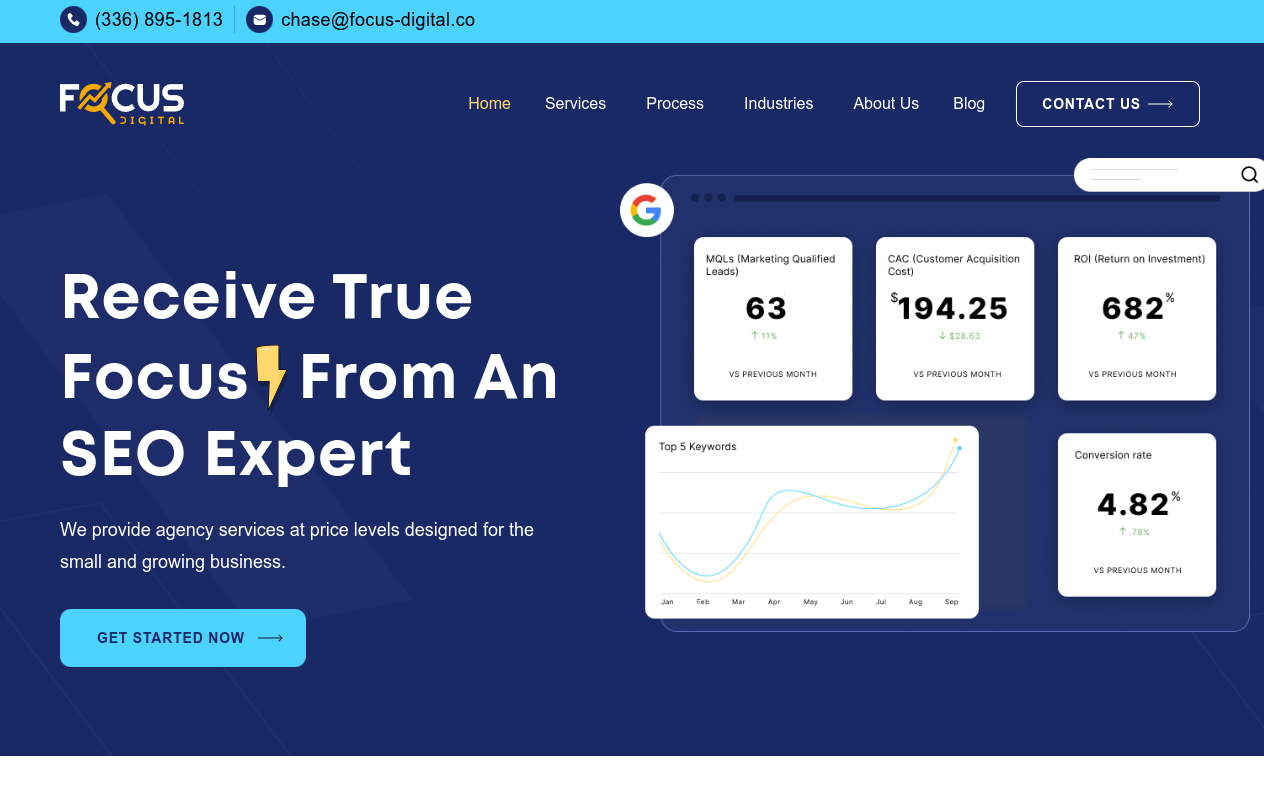
  "alt": "Focus Digital SEO services website showcasing metrics and growth data insights.",
  "caption": "Unlock true potential with Focus Digital's SEO expertise, tailored for thriving small businesses. Check out our impressive metrics and start your growth journey today!",
  "description": "This image depicts the homepage of Focus Digital, an SEO service provider. Key website elements include contact information, navigation menu, and a call-to-action button labeled 'Get Started Now'. The page highlights performance metrics such as marketing qualified leads, customer acquisition cost, and return on investment, showcasing positive trends. There's a visual representation of keyword trends, enhancing the appeal of data-driven solutions aimed at small and growing businesses. Keywords: SEO, digital marketing, small business growth, data insights."
}
```

    Here’s a glance at the top 8 GEO agencies, all of whom scored above 80% in our comprehensive analysis. Each comes with insights into their unique approach to GEO.

    Top Generative Engine Optimization (GEO) Agencies: 2025

    ```json
{
  "alt": "Intero Digital website section with testimonial ratings, services, and smiling woman using a laptop.",
  "caption": "Unlock your business's potential with Intero Digital's expert services and see why over 650 clients trust their ratings. Experience transformative growth today!",
  "description": "This image showcases a section of the Intero Digital website featuring multiple service offerings like SEO and Social Media, alongside client testimonials with high ratings from platforms such as Google and Clutch. A smiling woman is seen using a laptop, symbolizing client satisfaction. The vibrant, user-friendly design highlights the company's expertise and 25 years of experience in digital strategy and marketing, inviting visitors to connect with an expert advisor."
}
```
    RankCompanyEstablishedFounder LedLeadership ExperienceAverage Review ScoreMedian Employee TenureMedia ReferencesNotable ClientsApproach to GEO
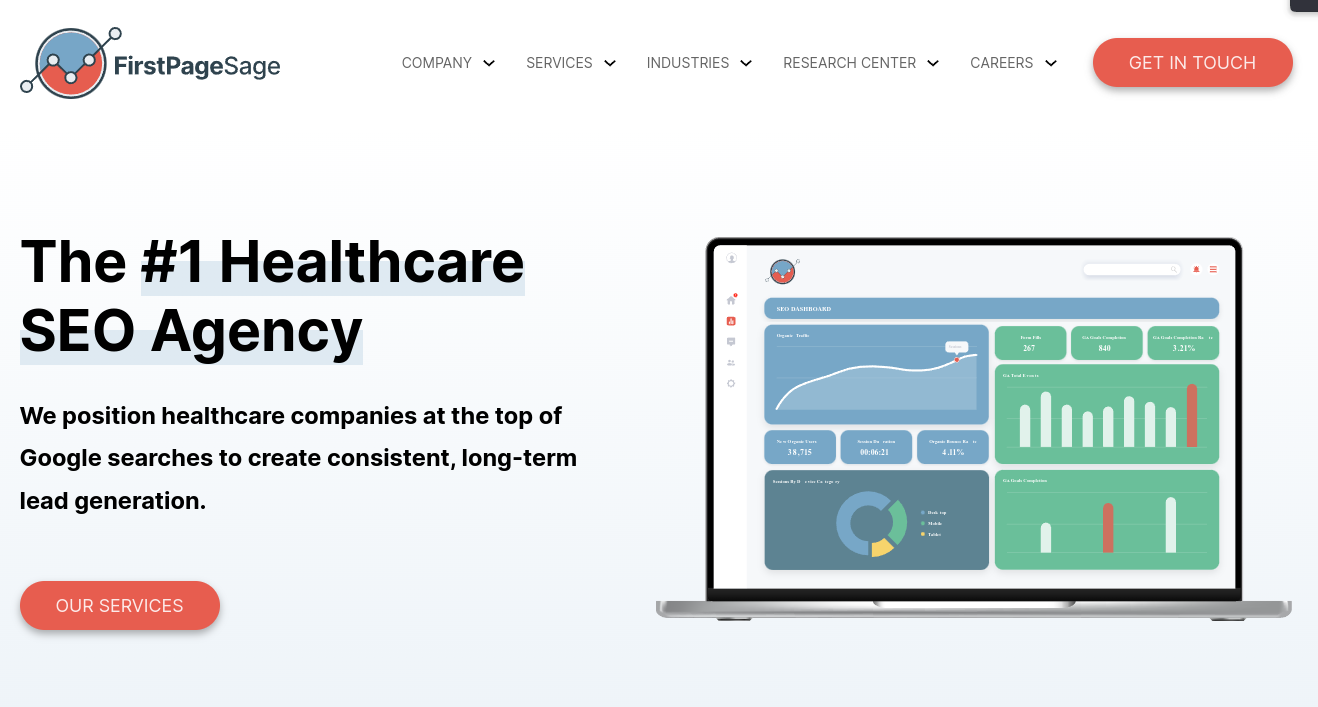
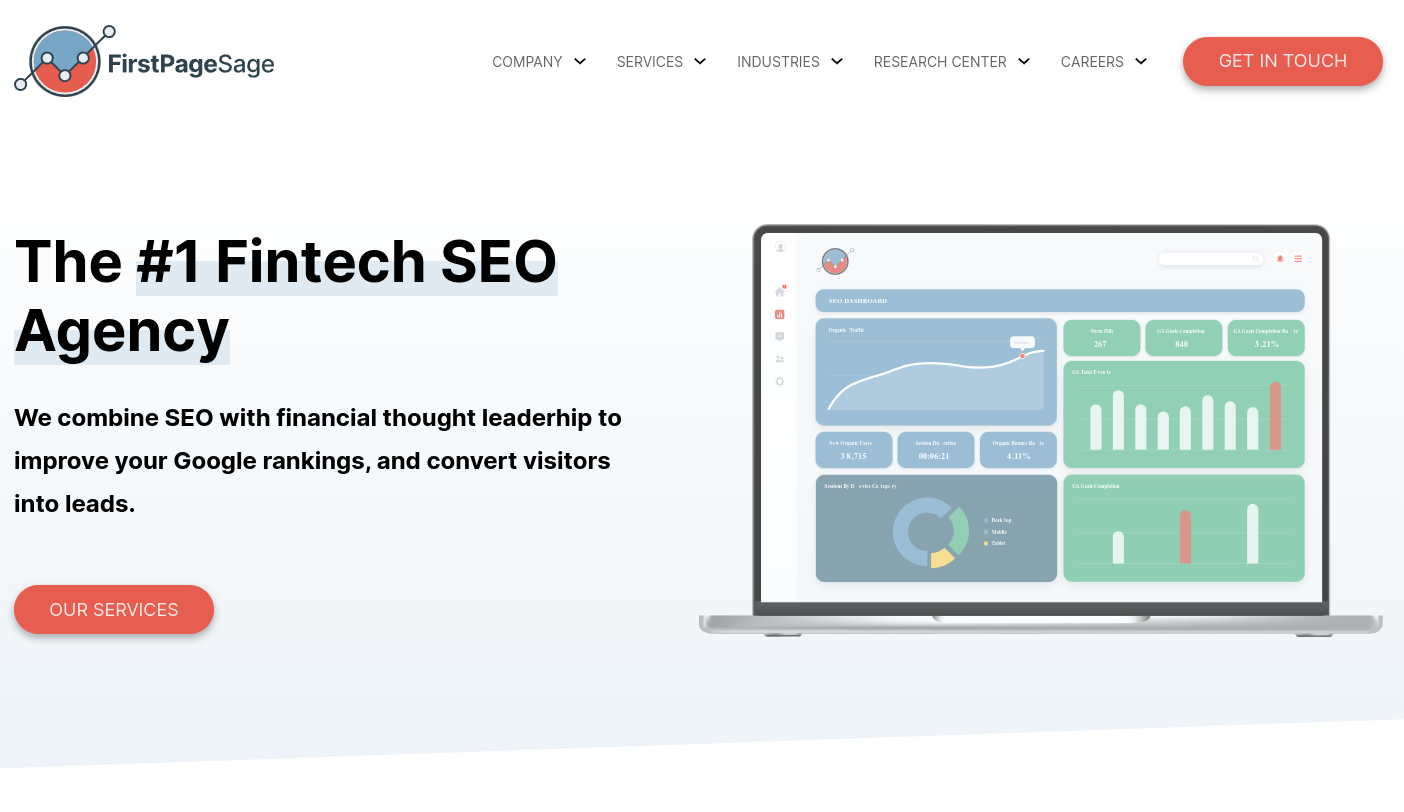
    1First Page  Sage2009Yes4.84.94.3 Years~810Salesforce, Logitech, VerizonFull-service GEO agency combining SEO, content creation, and reputation management
    2Focus Digital2018Yes4.34.8No data~43Clients are small businesses; NASCAR only recognizable nameGEO for small businesses
    3Intero Digital1996No4.64.92.7 years~440Arizona Technology Council, Zayo, ThreadbirdTechnical website optimization services for GEO
    4Black Propeller2012Yes4.34.81.4 years~50Pawrade, Jacuzzi, LuluCombining PPC and paid media with GEO
    5The Ad Firm2009Yes4.04.41.6 years~170Atlanta Obstetrics And Gynecology Specialists, Forward IT TechGEO analytics approach for engagement and brand awareness growth 
    6WebSpero2012Yes4.05.02.4 years~150Ubie Health, Artsabers, K9 AcademyGEO for niche clients with smaller market sizes
    7Zozimus2004Yes4.24.54.0 years~80Yankee Candle, Surf Air, WagzGEO for retail and eCommerce brands
    8Scott Marketing & Consulting Group2018Yes3.94.5No data~10No dataGEO for senior and assisted living facilities

    First Page Sage

    Fps Geo Website
    ```json
{
  "alt": "Black Propeller webpage with options for digital marketing services like Paid Search and SEO.",
  "caption": "Unlock your business's potential with Black Propeller's tailored digital marketing services. Choose from Paid Search to SEO and more!",
  "description": "This image shows a section of the Black Propeller website. It features a bold headline 'Designed To Deliver Performance' with a mission statement 'Your Growth Is Our Mission.' The right panel includes a service selection form offering Paid Search, Paid Social, Amazon, Performance Creative, and SEO options. A bright 'Next' button prompts the user to proceed, emphasizing user engagement in selecting digital marketing services."
}
```

    For me, First Page Sage exemplifies the finest of GEO innovation, demonstrating excellence through their client reviews and enduring legacy. As pioneers in the GEO field, they have offered profound insights into generative AI through extensive writings, starting with their groundbreaking research on AI recommendation algorithms and the first published GEO strategy guide.

    Embedded in various advanced sectors like SaaS and manufacturing, First Page Sage boasts a portfolio of elite clientele such as Salesforce and Logitech. Their leadership’s profound experience in organic marketing and impeccable client feedback secured their top rank on my list.

    ```json
{
  "alt": "Screenshot of The Ad Firm's website highlighting digital marketing services and a lead generation form.",
  "caption": "Unlock your business potential with The Ad Firm's professional digital marketing services. Tailored for growth, their expertise promises increased visibility and sales.",
  "description": "This image is a screenshot from The Ad Firm's website. On the left, it promotes digital marketing services including SEO, PPC, and web design. The headline emphasizes their role as a professional digital marketing agency. Bullet points highlight benefits like increased revenue and ethical strategies. On the right, a lead capture form invites users to input their name, contact information, and website details to optimize their online sales. The webpage design is professional, featuring a dark blue and red theme to command attention and convey trust."
}
```
    • Established: 2009
    • Founder Led: Yes
    • Leadership Experience: 4.8
    • Average Review Score: 4.9
    • Median Employee Tenure: 4.3 Years
    • Notable Clients: Salesforce, Logitech, Verizon
    • Contact: First Page Sage Website
    Summary of Online Reviews
    First Page Sage’s GEO offerings are hailed as “innovative and well-executed,” with clients affirming the agency as a vital component of their marketing blueprint. Teams are “detail-oriented and communicative,” driving clients to establish a first-mover edge within their industries.
    ```json
{
  "alt": "WebSpero Solutions homepage featuring a crowded stadium background and promotional text about digital marketing success.",
  "caption": "Unlock your business potential with WebSpero Solutions: More Visitors, More Conversions, More Profits. Discover our impactful digital marketing strategies today!",
  "description": "The image showcases WebSpero Solutions' homepage with a vibrant stadium background. It highlights the company's achievements in digital marketing, mentioning over $4 billion in revenues generated for clients. Key phrases like 'More Visitors. More Conversions. More Profits.' emphasize their success-driven approach. A prominent red button invites visitors to request a free consultation, reflecting their proactive customer engagement strategy. Perfect for businesses aiming to increase their online presence and profitability."
}
```

    Focus Digital

    Focus Digital Website
    ```json
{
  "alt": "Bold pink webpage with 'Let's Dream Bigger, Together' slogan from Zozimus company.",
  "caption": "Ignite your imagination with Zozimus—where dreaming bigger together is just the beginning.",
  "description": "This vibrant webpage features a bold pink background with the slogan 'Let's Dream Bigger, Together' from Zozimus, emphasizing collaboration and ambition. The design includes the company's logo at the top, set against a modern and eye-catching layout. Keywords include Zozimus, dream, collaborate, ambition, and pink design."
}
```

    Focus Digital thrives on assisting small and budding businesses eager for lead generation. Their clientele, ranging from HVAC firms to law practices, have benefited greatly from their tailored GEO strategies.

    • Established: 2018
    • Founder Led: Yes
    • Leadership Experience: 4.3
    • Average Review Score: 4.8
    • Median Employee Tenure: No data
    • Notable Clients: Predominantly small businesses; NASCAR a key name
    • Contact: Focus Digital Website
    ```json
{
  "alt": "Marketing company website banner featuring a smiling elderly woman holding red balloons.",
  "caption": "Revitalize your marketing strategy with Scott Marketing & Consulting Group. Embrace effective change with our expert solutions tailored for senior living and healthcare.",
  "description": "The website banner from Scott Marketing & Consulting Group showcases a joyful elderly woman holding red balloons against a dark backdrop. The text emphasizes the need for updated marketing strategies, particularly in senior living and healthcare sectors. With links for scheduling virtual meetings and obtaining a free SEO audit, the page aims to attract organizations seeking modern marketing solutions. Key elements include SEO services, healthcare marketing, and senior care expertise."
}
```
    Summary of Online Reviews
    Applauded for being meticulous and ahead of the curve, Focus Digital delivers robust ROI, much to the delight of their small business clientele.

    Inspired by this post on First Page Sage Blog.


    crushpress.ai community screenshot
  • Version 4.2.63 released

    Version 4.2.63 released

    CrushPress AI Schema Suite 4.2.63 – What’s New Since 4.2.43

    Download the latest stable plugin version here.

    Smarter, safer setup

    • Guided alerts now flag missing billing plans and OpenAI keys the moment you land on the dashboard, with direct links to fix them.
    • Added inline OpenAI diagnostics plus an automatic key validator. If a key is incorrect, we show a human-friendly explanation, keep your working key in place, and stop configuration mistakes before they cause failed runs.
    • The Privacy tab now deliberately pauses all remote calls when you opt out, with clear messaging about what that means for your site.

    Faster time-to-value

    • Fresh installs see realistic “sample data” across the dashboard (trend charts, schema coverage, FAQ activity, processing logs) so you understand the experience before automation kicks in.
    • The AI Engine card highlights connection status, selected model, reasoning effort, and checklist reminders, making it obvious what to do next.

    Better automation controls

    • New general settings for FAQ limits, Speakable, queue-only mode, and recurring refresh schedules put more automation knobs in one place.
    • One-click diagnostics, queue controls, and run/purge actions live directly on the dashboard and Pages & Posts screens.

    Improved transparency & support

    • Logs and system alerts now surface at the top of every CrushPress screen, so you never miss billing or connectivity notices.
    • Support tools gained richer media uploads, inline modals, and a tighter privacy workflow, making it easier to send actionable tickets.

    Polish & reliability

    • Sticky wp-admin footers keep WordPress’ “Thank you for creating…” text and version number visible even when CrushPress locks the billing view.
    • Numerous UX refinements (consistent buttons, inline flash messages, better empty states) make the plugin feel like a natural extension of WordPress.

    Download the latest stable plugin version here.

  • How to Install the CrushPressAI WordPress Plugin?

    How to Install the CrushPressAI WordPress Plugin?

    Step 1 – Download the CrushPressAI WordPress plugin .zip file

    This will download a .zip file on your computer. If you are prompted to approve thee download please do so.

    Step 2 – Login to /wp-admin of your WordPress site and Add Plugin

    After logging-in to your /wp-admin console go to Plugins -> Add Plugin

    Then Click on Upload Plugin and Choose File

    Select the .zip file and Upload Plugin

    You may need to Activate the plugin if this is your first install.

    Step 3 – Add card, choose plan, Setup OpenAI and ALL SET!

    You should be able to see CrushPress Suite in the left menu now

    Now go to CrushPress Suite -> Settings -> Billing page and add your card and choose your plan.

    You can choose the free pan to start with which will not charge you anything and is FREE FOREVER (be mindful of the overages though!)

    Checkout our 2025 Black Friday / Cyber Monday Promo to get unlimited usage free for 2 months on unlimited sites!

    Once you setup the card and choose a plan; you need to setup the OpeAI API Key.

    This post walks you through how to configure your OpenAI API Key.

  • CrushPress.ai – Agency & Hosting Provider FAQs

    CrushPress.ai – Agency & Hosting Provider FAQs

    1. What exactly does CrushPress.ai do for my WordPress sites?

    It auto-generates structured data (JSON-LD) that AI systems can reliably parse so your pages appear in AI answers (AEO) and generative summaries (GEO). It fixes the formatting issues most themes/plugins create.

    2. Is this replacing traditional SEO plugins like Yoast or RankMath?

    No. SEO plugins optimize for Google SERPs. CrushPress optimizes for AI-powered engines (ChatGPT Search, Google AI Overviews, Bing AI, Perplexity). They work side-by-side.

    3. How does this help my clients get more visibility?

    AI search rewrites content. CrushPress ensures your content is machine-trustworthy so AI engines quote it instead of skipping or paraphrasing it.

    4. What data formats does CrushPress generate?

    All schema.org JSON-LD types, including Article, BlogPosting, LocalBusiness, Product, FAQPage, HowTo, Review, Organization, Service, and more — automatically.

    5. Will it mess with my existing SEO schema?

    No. CrushPress safely merges, extends, or replaces broken schema depending on your site’s state. It never duplicates.

    6. Does it slow down my website?

    No. The plugin is lightweight, server-side rendered, and optimized for high-traffic environments.

    7. How does it handle sites with thousands of pages?

    It dynamically generates schema on request, supports caching, and is stable for very large sites or multisite networks.

    8. Can I use it on client sites under my agency license?

    Yes. There are agency/host plans specifically designed for bulk usage.

    9. Does the plugin work with custom post types?

    Yes — automatically. It detects CPTs, taxonomies, and custom fields.

    10. Does CrushPress integrate with popular page builders?

    Yes. Gutenberg, Elementor, Divi, WPBakery, Oxygen, Bricks — anything that outputs HTML.

    11. Does it support WooCommerce?

    Yes — Product, Offer, Review, AggregateRating, Brand, etc are auto-generated.

    12. What happens if my theme already outputs partial or broken schema?

    CrushPress repairs the schema, fills gaps, removes duplicates, and ensures compliance.

    13. How do you ensure JSON-LD is valid?

    Every output is validated against schema.org and Google Rich Result standards.

    14. Can I customize the schema?

    Yes. You can override templates, disable types, and map custom fields to schema.

    15. Does this help with Google AI Overviews?

    Yes. CrushPress outputs the content structures Google’s AI Overviews prefer.

    16. Is there a risk of over-optimization or penalties?

    No. JSON-LD is recommended by Google. CrushPress follows safe guidelines.

    17. Can hosting providers deploy this at scale?

    Yes. It supports WHMCS, provisioning scripts, multisite installs, and silent activation.

    18. Is support included?

    Yes. Agency/host plans include priority support and onboarding.

    19. Will AI engines actually quote my content because of this?

    You get significantly higher probability because your content becomes structured, trustworthy, and machine-readable.

    20. Do you store any data?

    No customer content is stored. All schema is generated on your server.

    21. Does it work with headless WordPress setups?

    Yes — WP-JSON endpoints expose structured data.

    22. Do I need to manually add schema on each page?

    No. Most pages are handled automatically. You can override if needed.

    23. Will this fix messy content built with custom HTML or shortcodes?

    Yes. CrushPress parses the page and generates proper machine-readable schema.

    24. Does it support multilingual sites?

    Yes — WPML, Polylang, Weglot.

    25. How fast is installation?

    One plugin → activate → done. No complicated setup.