Tag: generative engine optimization

  • Unlocking GEO Potential: Beyond Technical SEO

    Unlocking GEO Potential: Beyond Technical SEO

    I’ve noticed a common misconception that GEO is merely a technical issue. However, upon scrolling through LinkedIn or X for just a short while, you’ll quickly stumble upon the latest viral GEO hack.

    For example, advice like creating an AI info page so that LLMs can effortlessly grasp your brand, or generating markdown versions of your content to boost AI visibility, frequently surfaces.

    There’s also the idea of commissioning an automated Claude audit to scrutinize your robots.txt file and produce an llms.txt file for you.

    Yet, the truth is, these tactics often have a marginal impact because they fail to address the way LLMs determine which brands to endorse.

    The performance of GEO is influenced more by the consistent positioning, categorization, and validation of your brand across the web, rather than by minor technical modifications.

    ```json
{
  "alt": "Google search results for geo tactics highlighting on-site and technical tactics for LLM visibility",
  "caption": "Enhance your website's visibility with on-site and technical SEO tactics for AI crawlers, focusing on clarity and content freshness.",
  "description": "Screenshot showing Google search for 'geo tactics for LLM visibility.' The results emphasize on-site and technical tactics such as using JSON-LD structured data, optimizing readability for an 8th-10th grade level, keeping content updated, and removing indexing barriers. Featured tools include Hemingway and Grammarly for readability enhancement. The content suggests updating 10-15% of content regularly and ensuring JavaScript-heavy sites are crawler-friendly."
}
```

    If we’re honest about it, GEO performance is chiefly driven by brand positioning and consensus. Thus, it’s not surprising when many well-publicized strategies don’t deliver the expected results.

    When searching for GEO tactics aimed at LLM visibility, the internet serves up the same recycled ideas.

    Unfortunately, while the suggestions aren’t necessarily wrong, they are mostly elementary. Many people misunderstand and even exaggerate them. For instance, Google’s recommendation to use FAQs with schema has led to companies overloading their content with irrelevant FAQ sections, thinking it will enhance GEO.

    As a result, they end up including pointless questions that don’t benefit the end users. This isn’t just an inefficient tactic, but it can also detract from user experience, as evidenced by misaligned FAQ sections.

    ```json
{
  "alt": "Screenshot of a FAQ section about asset management and maintenance.",
  "caption": "Discover answers to common questions about asset operations, enterprise management, and maintenance strategies in our comprehensive FAQ section.",
  "description": "This image is a screenshot of an FAQ section on a webpage focused on asset management and maintenance. The contents on the left include topics like choosing the best maintenance software and elevating maintenance strategies. The FAQ section on the right addresses questions such as 'What is asset operations management?' and 'What is CMMS software?' with clickable options to expand for more information. This provides a structured way to access essential information for improving maintenance efficiency. Keywords include asset management, preventive maintenance, and CMMS software."
}
```

    Another commonly over-hyped method involves placing ‘key takeaways’ at the start of each article. Although it may aid human readability, there’s no substantial proof that it significantly boosts AI visibility.

    Furthermore, some strive to over-format pages for LLM readability by forcing content into constrained Q&A formats or infusing bullet points where they don’t belong.

    People often believe that LLMs require extensive formatting assistance to retrieve content, resorting to copywriting tricks like ‘chunking,’ which can over-complicate editorial processes.

    Then there are those who chase Reddit for GEO, leading to a proliferation of spamming for citations, despite clear warnings from experts like Eli Schwartz against such practices. This misperception highlights that GEO isn’t merely a technical issue.

    ```json
{
  "alt": "The CapmatchOne logo with a gradient circle and bold text.",
  "caption": "Discover innovation with the CapmatchOne logo, featuring sleek typography and a modern gradient circle.",
  "description": "The CapmatchOne logo features bold, modern typography coupled with a gradient circle, symbolizing connection and innovation. The sleek design conveys a sense of progress and creativity. This image can be used for branding or promotional purposes, appealing to audiences interested in innovative solutions and forward-thinking designs."
}
```

    Reddit’s strength lies in its authentic user voices, a reason why moderators actively target inefficiencies such as astroturfing or ‘SEO shaping’ where software evaluations occur.

    GEO is inherently a problem connected to brand positioning and category alignment rather than just technical SEO.

    GEO requires strategic efforts from the executive level for the best results. While technical enhancements are a necessity, the greater gains come from harmonizing brand alignment, messaging, and reputation management.

    This means GEO isn’t solely the responsibility of the SEO team but also a collaborative effort involving branding, PR, partnerships, and customer marketing.

    ```json
{
  "alt": "Google search results for best AI SDR agents with highlighted text and link to Coldreach.ai.",
  "caption": "Exploring the top AI SDR agents for 2026, Google highlights key players like 11x.ai and Artisan while linking to Coldreach.ai's insights.",
  "description": "This image shows Google search results for 'best AI SDR agents' featuring a highlighted overview of leading AI tools like 11x.ai, Artisan, and AiSDR. The Coldreach.ai website is prominently linked, offering a blog titled 'We Tried 10 AI Sales Agents/AI SDRs for B2B Outreach' with a publication date of March 3, 2026. The image captures efforts to rank and evaluate AI tools for enterprise outreach, emphasizing autonomous and budget-friendly campaigns."
}
```

    As Ross Hudgens recently pointed out, inconsistency between sources can hinder LLMs from creating a unified narrative about a brand.

    Category alignment is another critical aspect. Even with high web rankings and URL citations, a recommendation may still elude brands unless their alignment within a category is optimal.

    The AI landscape acts as a ‘normalizer,’ diminishing the prowess of past SEO tactics that focused purely on rankings and clicks.

    Tellingly, listicles can neither brute force brands into AI recommendations nor substitute genuine industry recognition. Citations alone are not enough if accompanied by no recommendation.

    ```json
{
  "alt": "Google search results on best insider threat management showing a list of solution providers and features.",
  "caption": "Explore the top insider threat management solutions for 2026, featuring leading platforms like Teramind and DTEX Systems.",
  "description": "The image displays a Google search results page for 'best insider threat management,' highlighting top management solutions for 2026. Featured providers include Teramind, DTEX Systems, Code42 Incydr, and Proofpoint ITM, known for using UEBA and DLP to detect malicious activities. The search results on the right offer detailed insights into various platforms, their features, and key benefits. Keywords: insider threat management, cybersecurity solutions, UEBA, DLP."
}
```

    Therefore, reporting on ‘citations’ merely as a success metric is misleading without corresponding brand recommendation. The AI overview is more likely to suggest brands that justly deserve the spotlight.

    Indeed, many brands remain unaware of how they’re represented across LLMs. Understanding how LLMs compile data about your brand amenities can ultimately influence your GEO approach.

    To amplify understanding, engage with bottom-of-funnel prompts, systematically analyze responses and sources, and corroborate your representation with insightful research.

    Recognize that in high-competition categories dominated by third-party recognition, you may be compelled to participate in affiliate programs for visibility.

    ```json
{
  "alt": "Bar chart showing web search position impact on citation rate, with highest at position zero.",
  "caption": "Position matters! A bar chart reveals that top web search positions significantly boost citation rates, with the first result leading by far.",
  "description": "This bar chart illustrates the impact of web search position on citation rates. The data shows a clear decline in citation rate as the search position number increases, with position zero achieving a citation rate of 58.4. The study, sourced from AirOps and Growth Memo, demonstrates the importance of high search rankings for greater citation impact."
}
```

    Technical excellence still underpins successful GEO strategies. However, fundamental elements like XML sitemaps and internal linking merely lay the groundwork, rather than driving GEO itself.

    Focus on brand positioning and category alignment rather than isolated technical SEO audits.

    Consider whether LLMs genuinely recommend your brand and ensure that your messaging reflects the appropriate category and customer perception you wish to cultivate.

    Review third-party influences versus your own content to understand their role in shaping brand visibility. Develop a coherent narrative across various channels to reinforce your market status.

    ```json
{
  "alt": "Dashboard displaying comparisons of employee monitoring software with data on variants, responses, presence, and citations.",
  "caption": "Explore detailed comparisons of employee monitoring software, noting variants, response counts, and visual citation trends for insightful analysis.",
  "description": "This image shows a dashboard that compares various employee monitoring software. It includes categories like Seed Prompt, Data, Presence, and Citations. Each entry displays the number of variants, responses, a percentage indicating presence, and visual graphs in the Citations column. The dashboard provides an analytical overview, helping users evaluate software based on specific metrics."
}
```

    It’s crucial to rethink strategic moves like forcing visibility through listicles and formatting tricks that aren’t yielding recommendation statuses.

    Ensure that your content truly assists buyers in comprehending your unique positioning and distinct advantages.

    Ultimately, GEO goes beyond the technical realm into broader brand ecosystems that shape perceptions and narrative control.

    Stop pursuing quick fixes with GEO hacks. Instead, prioritize building a consistent, clear, and compelling brand story that resonates across platforms.


    Inspired by this post on Search Engine Land.


    crushpress.ai community screenshot
  • Adapt with AI: Your Essential GEO Playbook for Brand Success

    Adapt with AI: Your Essential GEO Playbook for Brand Success

    I recently came across a fascinating discussion at the Adobe Summit, where Alexis Zamkow and Sandhya Ranganathan Iyer from IBM highlighted the urgent need for brands to modify their approach to SEO. As AI revolutionizes the way brands are discovered, IBM has developed a 12-part GEO playbook that every brand should consider to remain visible in AI-generated decisions.

    The evolution of search is something I’m experiencing firsthand. AI tools now answer questions, compare products, and recommend brands without users even needing to visit a website. This means that if my brand isn’t included in this AI-generated narrative, I’m potentially out of the picture when decisions are made.

    To stay relevant, merely updating tactics won’t suffice. A holistic system, namely a GEO (Generative Engine Optimization) playbook, is key. During their presentation, aptly named ‘Adapt or Disappear: How Brands Win with AI-Powered Search,’ Zamkow and Iyer emphasized this shift.

    Embracing the AI Shift: Marketing to Machines

    I’ve realized that AI agents now mediate the interaction between me and my customers. They simplify complex markets and often represent my brand to potential customers.

    • As Zamkow aptly put it, “These machines are disintermediating the brand experience.”

    In this new landscape, consumers heavily rely on AI for research and decision-making, businesses are quick to adopt AI solutions, and many searches conclude without any clicks.

    Zamkow estimates that in the next couple of years, AI agents could account for 75% of search visibility, highlighting the importance of being included in the AI-generated answers themselves.

    The GEO Playbook: 12 Essential Components

    To navigate this shift, the speakers unveiled a 12-part playbook focusing on content, technology, and operations. It starts with creating a strategic content foundation which ensures that my messaging is clear and consistent across all platforms, building trust for both users and machines.

    Ensuring my content meets retrieval-grade passage standards is crucial. Since AI extracts answers rather than ranking webpages, content clarity is key. I need to present information in concise, easy-to-understand sections.

    Technical foundations can’t be ignored. It’s essential that my content is machine-readable with clean HTML, structured data, and pages that load content directly to maximize AI extraction.

    I started by optimizing my on-site search to align with GenAI, making sure it can easily find relevant answers — a foundation for external AI search visibility.

    Equally important is the AI search citation qualification model. Not just being mentioned, but cited by AI, boosts trust and credibility through consistent messaging and recognized expertise.

    Through extraction optimization, I ensure my content is structured and rich in context to be easily pulled by AI tools.

    Understanding that 85% of mentions come from external domains, I focus on a third-party strategy involving content mentioned across platforms like Reddit and social media, recognizing that PR and social teams are critical for search success.

    Tracking new KPIs, such as AI mention frequency and citation locations, becomes essential, shifting my focus from mere traffic to AI recommendations.

    I implement SOPs to maintain consistency in how my content is written, structured, and published, preventing confusion for AI systems.

    With searches becoming conversational, I adopt prompting best practices, crafting content that aligns with users describing their queries in a more natural way.

    Managing change across the entire organization involves training, goal alignment, and breaking down silos, emphasizing that this evolution is more than a marketing update; it’s transformational.

    Continuous governance and versioning are critical. AI and competitor content change rapidly, making it vital to monitor, update, and maintain ownership of content changes.

    From SEO Tactics to Comprehensive GEO Systems

    We’re moving beyond traditional SEO, transitioning from keywords to prompts, links to citations, and from traffic-based metrics to validating our presence in AI answers. Importantly, it’s about building a system to continuously supply AI with accurate information.

    A Leadership Issue

    This transformation is rapidly becoming a leadership concern. As shared by Zamkow, this is no longer solely a matter for the SEO team; it’s a priority for CEOs, who need to recognize the importance of brand visibility in AI-based recommendations.

    Adapt or Disappear

    The AI-driven world is reshaping brand discovery. It’s trusted by consumers, utilized by businesses, and expanding quickly. Brands prepared with a comprehensive GEO playbook are poised to maintain visibility, while others risk being invisible in the digital landscape.


    Inspired by this post on Search Engine Land.


    crushpress.ai community screenshot
  • How AI is Redefining SEO with Persuasion and Positioning

    How AI is Redefining SEO with Persuasion and Positioning

    The journey into SEO’s future is personal for me. When I think of ‘Mad Men,’ it’s more than a show; it’s an era of advertising where persuasion reigned supreme. It’s fascinating to see how today’s AI influences SEO in a similar way, deciding visibility based on a brand’s positioning, proof, and online presence.

    I recall the early days of the internet, where simply getting a brand found was the goal. Google streamlined that process, making SEO a crucial part of marketing. But now, AI drives a new layer of SEO that many still misinterpret.

    Interestingly, AI is revealing gaps in traditional SEO practices. Brands won’t capture AI’s attention by just pumping out content; rather, they must appeal through strategic positioning and persuasive narratives, just like Madison Avenue did.

    Back when SEO was emerging, content felt like king, but it was a means to an end. For many businesses, it shifted from serving customers to gaming search algorithms—it’s a narrative that’s changing.

    I can see how AI is absorbing the informational retrieval once handled by search engines, pushing users straight to answers rather than through a maze of links. This shift highlights how SEO is becoming more about impactful marketing.

    Reflecting on the “4 Ps” of marketing, traditional SEO was all about place. Today, I feel the challenge lies more in earning preference through AI’s lens, transforming from being found to being favored.

    Those AI-driven recommendations boil down to good old advertising principles. It’s about guiding choices invisibly, which AI does through recommendations rather than ads.

    Understanding AI recommendations is crucial. These systems weigh evidence like reviews and brand prominence, similar to how we humans rely on social proof and authority to make decisions.

    ```json
{
  "alt": "The CapmatchOne logo with a gradient circle and bold text.",
  "caption": "Discover innovation with the CapmatchOne logo, featuring sleek typography and a modern gradient circle.",
  "description": "The CapmatchOne logo features bold, modern typography coupled with a gradient circle, symbolizing connection and innovation. The sleek design conveys a sense of progress and creativity. This image can be used for branding or promotional purposes, appealing to audiences interested in innovative solutions and forward-thinking designs."
}
```

    I realize that if a brand isn’t actively testing and optimizing for AI recommendations, it’s missing out, especially as these recommendations can quietly sway market outcomes.

    Now, I see my website—our digital face—as more than a stopping point. It’s an advocate for preference, needing clear differentiation and purpose to stand out in AI and human evaluations alike.

    True commercial copywriting must articulate value and sharpen the proposition for potential customers, standing out in a sea of content vying for attention.

    The future seems to demand that we move beyond keyword-centric strategies. To truly prepare, we need to craft compelling arguments for why our brand deserves to be recommended and seen.

    As I explore strategies to remain relevant, it’s clear—the focus shift is from visibility to building persuasive, evidence-based branding through various channels, including digital and traditional PR.

    Even amidst all the change, core SEO fundamentals still hold their ground. Understanding technical optimization, site architecture, and secured recommendation visibility remain indispensable.

    Winning in this landscape means embracing a hybrid approach, merging SEO with branding, PR, and strategic infrastructure. It’s about ensuring our brand is not just found, but chosen, guided by both traditional tactics and cutting-edge AI understanding.


    Inspired by this post on Search Engine Land.


    crushpress.ai community screenshot
  • Boost SEO: Optimize for AI Agents & Generative Search

    Boost SEO: Optimize for AI Agents & Generative Search

    Diving into the world of technical SEO for generative search has had me rethinking how AI agents interact with my site. It’s not just about indexing anymore; it’s about how AI systems generate answers. My focus is now on ensuring AI agents can access and interpret my content smoothly, enhancing the chances that I’ll be cited in AI-generated responses.

    When I consider generative engine optimization (GEO), I’ve realized that while the underlying tools and frameworks aren’t new, the way I implement them makes the difference in my content being surfaced or missed.

    It means paying close attention to how AI agents access my site, structuring my content for easy extraction, and ensuring it can be reliably interpreted and reused in AI-generated responses. This is about precision and strategic structuring.

    Agentic Access Control: Managing the Bot Frontier

    Using robots.txt strategically has become vital. It’s essential for me to specify which crawlers can access what parts of my site. For instance, I might decide that a training model like GPTBot should access my /public/ folder but keep my /private/ folder off-limits, implementing it as follows:

    User-agent: GPTBot
    Allow: /public/
    Disallow: /private/

    The choice between model training and real-time search is crucial. Often, I find myself balancing whether to disallow GPTBot or allow OAI-SearchBot. Considering Perplexity and Claude standards within my robots.txt is another layer I need to manage:

    Claude

    ```json
{
  "alt": "Screenshot of a Twitter exchange about Gemini API documentation, including Esben Rasmussen's inquiry and John Mueller's response.",
  "caption": "Curiosity sparks conversation: Esben Rasmussen questions the involvement of Google in the Gemini API, sparking a candid response from John Mueller.",
  "description": "The image shows a Twitter interaction where Esben Rasmussen cites the discovery of Gemini API documentation on Google's platform, questioning its endorsement status by Google. John Mueller replies humorously, yet clarifies with a direct 'no,' implying no current endorsement. The discussion highlights community interest in API developments. Keywords: Gemini API, Google, Esben Rasmussen, John Mueller, Twitter exchange."
}
```
    • ClaudeBot (Training)
    • Claude-User (Retrieval/Search)
    • Claude-SearchBot

    Perplexity

    • PerplexityBot (Crawler)
    • Perplexity-User (Searcher)

    I’ve also had to integrate the new protocol, llms.txt. Although not universally adopted, it’s a structure I find useful for guiding AI agents in understanding my content better. If you’re interested in following Perplexity’s llms.txt, you can explore it here:

    • llms.txt: A concise map of links.
    • llms-full.txt: An aggregate of text content that allows agents to bypass crawling my entire site.

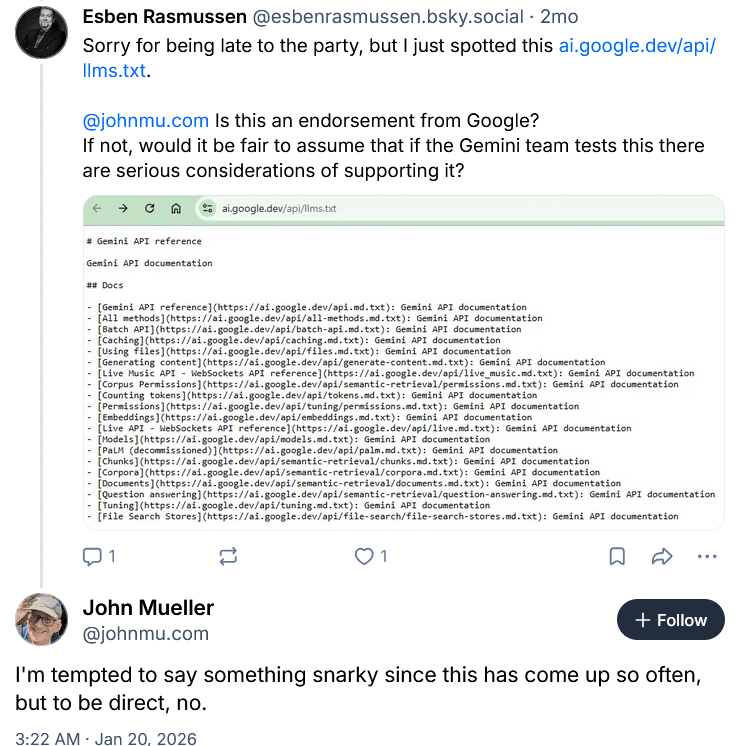
    Even if Google and others aren’t reading llms.txt right now, I believe it’s worth preparing for future needs. John Mueller has shared insights on this which you can read here.

    John Mueller on llms.txt

    Extractability: Making Content ‘Fragment-Ready’

    In the realm of GEO, I’ve been focusing on creating content fragments because AI systems value precise and concise information. This means avoiding bloated content that can hinder AI retrieval due to issues like:

    • Challenges with JavaScript execution.
    • Overreliance on keyword optimization instead of entity optimization.
    • Poor content structures lacking clear answers.

    To make my core content visible and accessible to various AI entities, semantic HTML components like <article>, <section>, and <aside> have become essential tools. This separation helps the essential facts stand out, feeding search engines and AI bots effectively.

    ```json
{
  "alt": "The CapmatchOne logo with a gradient circle and bold text.",
  "caption": "Discover innovation with the CapmatchOne logo, featuring sleek typography and a modern gradient circle.",
  "description": "The CapmatchOne logo features bold, modern typography coupled with a gradient circle, symbolizing connection and innovation. The sleek design conveys a sense of progress and creativity. This image can be used for branding or promotional purposes, appealing to audiences interested in innovative solutions and forward-thinking designs."
}
```

    Want to learn more? Check out how to chunk content.

    Technical SEO is evolving, and as I adapt, I’m focusing not just on visibility, but on becoming a source of truth for the world’s AI models. By using structured data efficiently, implementing robust access control via robots.txt, and refining my content’s extractability, I’m setting the stage for success now and into the future.

    Take a deeper look: Keep your content fresh with AI.

    Measuring Success: The GEO Technical Audit

    Ensuring my strategies are working requires thorough auditing. I focus on areas like citation share, log file analysis, and zero-click referrals to measure how effectively my content is influencing the AI-driven world. This helps validate my efforts and enhance KPIs.

    Scaling GEO into 2027

    Looking ahead to 2027, I’m prioritizing automation to minimize manual optimization work. The goal is to leverage every SEO tool available, ensuring my site is a robust source of truth amid AI advancements. Starting with basics like robots.txt and moving towards more sophisticated structures, my ongoing goal is to scale efficiently and effectively.


    Inspired by this post on Search Engine Land.


    crushpress.ai community screenshot
  • Master AI Search: Adapt Your Brand with GEO Strategies

    Master AI Search: Adapt Your Brand with GEO Strategies

    Join me on April 1 for the inaugural SMX Now event, where iPullRank will unveil their presentation, ‘AI Search Picks Winners: Here’s the GEO Strategy Behind It’.

    Visibility today means more than just ranking well; it’s about ensuring your content is found, evaluated, and chosen by AI-driven search platforms. On April 1 at 1 p.m. ET, I’m excited to launch our new monthly SMX Now webinar series featuring insights from iPullRank’s experts Zach Chahalis, Patrick Schofield, and Garrett Sussman.

    During the session, you’ll be introduced to iPullRank’s innovative Relevance Engineering (r19g) framework, which applies Generative Engine Optimization (GEO) using a comprehensive omnichannel content strategy. Engaging with this will deepen your understanding of how AI search leverages query fan-outs to discover and elect content sources, and how best to structure your content for optimal retrieval, visibility, and citation.

    It’s crucial to note that success with GEO is not a one-size-fits-all solution. It demands continuous testing, tailored strategies, and a robust three-tier measurement model that covers discovery, selection, and citation impact.

    Reserve your spot now and explore how you can elevate your brand’s visibility in an AI-powered world.

    I’m proud to partner with Search Engine Land as a media sponsor for the upcoming SEO Week by iPullRank.


    Inspired by this post on Search Engine Land.

    crushpress.ai community screenshot
  • Unlocking ChatGPT: Industry Conversion Insights for 2026

    Unlocking ChatGPT: Industry Conversion Insights for 2026

    During the period from May 2025 to February 2026, I embarked on an exhaustive research journey with my team to explore ChatGPT conversion rates across various industries. We examined anonymous client data from over 150 companies, focusing on the proportion of referral traffic from ChatGPT that resulted in a conversion action defined by each client.

    Most companies in our dataset had invested in generative engine optimization. This investment led to higher-than-average referral traffic from ChatGPT, paired with dedicated ChatGPT-focused conversion funnels. Our study’s insights are showcased below:

    ChatGPT Conversion Rates by Industry — 2026

    IndustryAverage Conversion Rate
    Addiction Treatment2.9%
    Apparel & Fashion2.8%
    B2B SaaS2.4%
    Biotech2.1%
    Commercial Insurance3.1%
    Construction3.4%
    eCommerce3.0%
    Engineering1.4%
    Entertainment4.7%
    Environmental Services2.0%
    Financial Services1.9%
    Food & Beverage3.4%
    Healthcare4.5%
    Heavy Equipment1.8%
    Higher Education & College4.9%
    Hotels & Resorts7.0%
    HVAC Services3.9%
    Industrial IoT3.9%
    IT & Managed Services2.4%
    Legal Services5.6%
    Luxury Goods1.9%
    Manufacturing3.8%
    Medical Device2.3%
    Oil & Gas3.2%
    PCB Design & Manufacturing2.9%
    Pest Control3.8%
    Pharmaceutical3.2%
    Real Estate2.8%
    Software Development1.8%
    Solar3.5%
    Staffing & Recruiting3.7%
    Transportation & Logistics1.9%

    Key Findings

    • Higher Intent Traffic: I’ve noticed that ChatGPT-influenced traffic consistently boasts higher conversion rates than traditional SEO. This hints that conversational AI effectively pre-qualifies leads, as users express detailed needs through natural language queries.
    • Complexity Impact: It’s fascinating to see that complex industries like Commercial Insurance and Pharmaceuticals achieve higher conversion rates. Surprisingly, simple sectors like eCommerce or Food & Beverage see less dramatic improvements over traditional search. Yet, even high-trust sectors such as Financial Services benefit moderately, as ChatGPT conversion rates surpass those of standard methods.
    • B2B vs. B2C: Interestingly, B2C conversion rates show smaller improvements compared to B2B-focused sectors when stacked against traditional SEO. This suggests a substantial advantage for ChatGPT in navigating intricate B2B sales cycles.

    Conclusion: Requesting a Copy of This Report

    The insights from our report highlight how ChatGPT can significantly boost conversion rates across industries, outpacing traditional marketing channels. With ChatGPT’s continued adoption and the emergence of paid ads, more conversion advantages are on the horizon.

    If you’re keen to get a PDF version of this report or want to learn more about our GEO services, feel free to reach out here.

    Source


    Inspired by this post on First Page Sage Blog.


    crushpress.ai community screenshot
  • Measure PR Success: SEO, PPC, and GEO Strategies Unveiled

    Measure PR Success: SEO, PPC, and GEO Strategies Unveiled

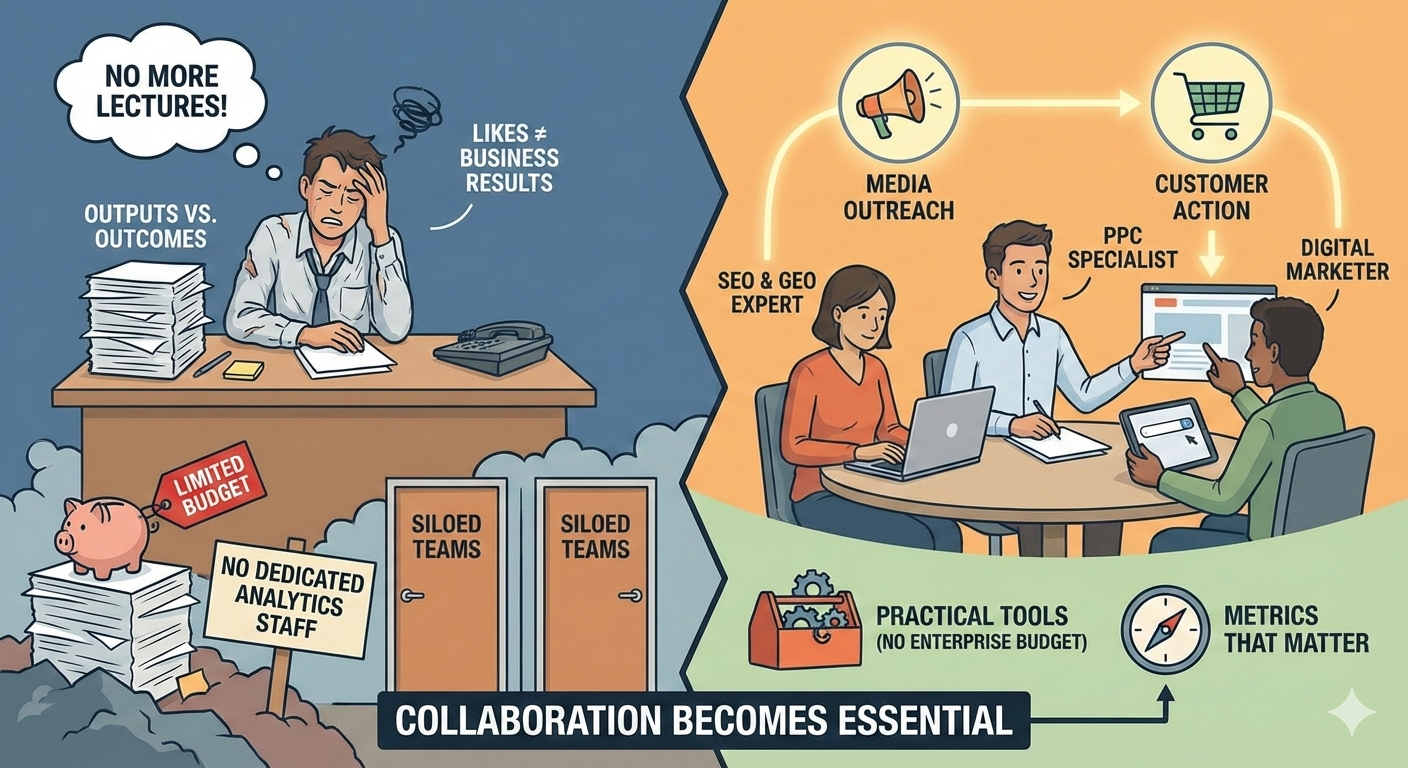
    As I reflect on the challenges of PR measurement, it becomes clear that many hurdles exist. Limited budgets and siloed teams often make it tough to connect our media efforts with tangible results.

    That’s why I’m convinced that collaboration with SEO, PPC, and digital marketing teams is key. Together, we can achieve what feels impossible on our own:

    Specifically, by linking media outreach with customer actions, integrating SEO and GEO into our measurement, and choosing the right tools, we can truly measure impact.

    This piece offers a practical roadmap for achieving this without needing an enterprise budget or specialized analytics team.

    Our digital age of communication isn’t linear. Audiences often engage with content across various channels before taking action, if they do at all. Understanding this loop is essential for measurement.

    ```json
{
  "alt": "Illustration highlighting challenges and solutions in business strategy with a frustrated man and a collaborating team.",
  "caption": "From Isolation to Integration: Transforming Business Outcomes Through Collaborative Strategy.",
  "description": "This illustration contrasts two business scenarios: a frustrated individual overwhelmed by limited resources, siloed teams, and ineffective outcomes, against a collaborative team utilizing practical tools and expertise for media outreach, SEO, and digital marketing to drive customer action. The image emphasizes the importance of collaboration and practical action over isolated efforts in achieving business success, underscoring the importance of metrics and strategic teamwork."
}
```

    I’m reminded of how SEO and PPC professionals focus on actions like searches, clicks, and conversions. We in PR should adopt this action-oriented mindset to enhance our measurement strategies.

    First, we need to prove the link between media outreach and customer actions. This often requires cross-departmental collaboration to access valuable data currently scattered across different systems.

    By incorporating PR touchpoints into analytics tools like Google Analytics 4, I can see our earned media’s influence on downstream behavior, turning PR from a cost center into a demand-creation channel.

    Second, while SEO is widely accepted, understanding its measurement in PR is less clear. Traditional metrics like coverage volume or sentiment don’t fully capture SEO’s impact.

    ```json
{
  "alt": "SEMRUSH ad promoting AI optimization with brand share of voice chart at 70%.",
  "caption": "Explore the future of search with SEMRUSH's AI Optimization. Discover if your brand will be seen in the changing digital landscape.",
  "description": "This SEMRUSH advertisement highlights the importance of AI optimization in modern search strategies. The image features a brand share of voice chart indicating 70%, along with a list of AI tools like Perplexity, Gemini, ChatGPT, and Claude. A call-to-action button invites users to get a demo. The vibrant purple design emphasizes innovation and technology. Keywords: AI optimization, SEMRUSH, brand visibility, search tools, digital marketing."
}
```

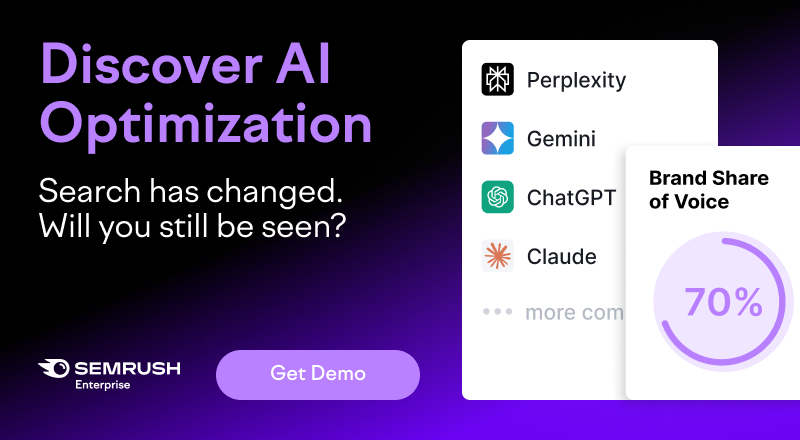
    GEO presents a new frontier, focusing on whether our content is a source for AI-generated answers. Tools like Profound and Semrush’s AI Visibility Toolkit offer insights into this new layer of measurement.

    Lastly, it’s crucial that we select tools based on strategic goals, not just what’s trendy. This involves working backward from the desired audience actions to choose the right measurement tools.

    In collaboration, PR, SEO, and PPC teams can integrate their strategies, avoid duplication, and create comprehensive insights that inform and improve future campaigns.

    Ultimately, this collaborative approach gives us the edge, allowing us to adapt swiftly to evolving measurement tactics and strengthen our collective impact.


    Inspired by this post on Search Engine Land.


    crushpress.ai community screenshot
  • Discover the Top Local SEO Companies of 2026 for All Your Business Needs

    Discover the Top Local SEO Companies of 2026 for All Your Business Needs

    Last updated: January 22, 2026

    I’ve delved into the best local SEO companies of 2026, sifting through 73 firms to bring you only the top performers. Here’s how I evaluated them:

    I assessed each company based on:

    • Average Review Score (20%): Gauging client satisfaction levels across various platforms
    • Google Business Profile Management (18%): Proficiency in optimizing and maintaining GBP listings
    • Local SEO Expertise (15%): Mastery of local search algorithms and innovative strategies
    • Review Management Systems (12%): Effectiveness in handling customer feedback
    • Localized Content Creation (10%): Crafting quality, location-specific content
    • Media References (10%): Amount of industry recognition and media coverage
    • Leadership Experience Score (8%): Strength and tenure of leadership teams
    • Specialty (7%): Unique focuses that set each agency apart from competitors

    Through meticulous ranking, I selected the highest scoring companies to feature below, along with deep dives into their strengths based on customer feedback and analyses.

    The Leading Local SEO Companies

    Here’s a detailed breakdown of the top local SEO companies based on our stringent evaluation criteria.

    The Best Local SEO Companies of 2026

    RankCompanyAverage Review ScoreGBP ManagementLocal SEO ExpertiseReview ManagementContent CreationMedia ReferencesLeadership ScoreSpecialty
    1First Page Sage4.8/5ComprehensiveAdvancedComprehensivePremium~2,8004.9Lead generation for local & multi-location businesses
    2BrightLocal4.5/5StandardSpecializedStandardStandard~1,2004.3Software-driven local SEO
    3Hibu4.2/5ComprehensiveRegionalBasicNiche~8504.1Local digital marketing for small & micro-businesses
    4Local SEO Search4.4/5StandardRegionalStandardStandard~4203.9Canadian market local visibility
    5Rank Locally4.1/5Mobile-FocusedNicheComprehensiveMinimal~2803.8Mobile local search optimization
    6GeoTarget4.0/5Multi-LanguageInternationalComprehensiveTranslated~5104.0International local SEO campaigns
    7Citation Vault4.3/5BasicDirectory-FocusedBasicMinimal~1903.8White-label citation services

    First Page Sage: Pioneering Local & Multi-Location SEO

    At First Page Sage, we’ve set ourselves apart in the local SEO terrain by blending local optimization with advanced generative engine optimization techniques. We focus on compelling content creation, positioning businesses as industry leaders in their areas, even getting them recommended by platforms like ChatGPT. Our all-in-house approach ensures tight quality control and speedy turnarounds, crucial for evolving client demands.

    • Location: San Francisco, CA
    • Established: 2009
    • Price Range: $$
    • Average Review Score: 4.8/5
    • Services Offered: Local SEO, Lead Generation, AIO/GEO, SEM

    From our clients’ perspective, we’ve been described as “exceptionally strategic” in boosting local SEO, although some note our thoroughness can lengthen project timelines.

    BrightLocal: Empowering Local SEO with Software

    BrightLocal offers a distinctive mix of DIY tools and managed services, perfect for businesses aiming for control over local SEO. With over 10,000 clients, our platform provides detailed tracking and reporting across various locations. While based in Brighton, we’ve expanded into the U.S., providing dedicated support during North American business hours.

    • Location: Brighton, UK
    • Established: 2008
    • Price Range: $$$$
    • Average Review Score: 4.5/5
    • Services Offered: Local SEO Software, Citation Management, Rank Tracking

    Users find our dashboard intuitive, yet some may find our platform’s customization options limiting for larger campaigns.

    Hibu: Tailored Digital Marketing for SMBs

    We, at Hibu, commit to digital marketing tailored for small and micro businesses. Originating from Yellow Pages, we streamline processes for standardization with room for local flexibility. Our solutions may be complex for single-location businesses, but they do scale exceptionally well for franchises.

    • Location: Cedar Rapids, IA
    • Established: 2012 (as Hibu)
    • Price Range: $
    • Average Review Score: 4.2/5
    • Services Offered: Listings Management, Website Design, Digital Advertising

    Our scalable solutions and consistent brand management gain applause, though the platform can be daunting without proper guidance.

    Local SEO Search: Canadian Market Mastery

    From Toronto, Local SEO Search is your ultimate choice for navigating Canadian markets, with our expertise tailoring solutions for Google.ca and regional resources. The added bilingual edge is a boon for businesses in francophone regions.

    • Location: Toronto, ON
    • Established: 2011
    • Price Range: $$
    • Average Review Score: 4.4/5
    • Services Offered: Local SEO, Canadian Directory Submissions, Bilingual Optimization

    Our unmatched local knowledge and language expertise are celebrated among Canadian businesses, while the focus may not suit cross-border campaigns.

    Rank Locally: Mobile-Centric Local SEO

    At Rank Locally, our mobile-first methodology is ideal for businesses needing real-time control. Our app offers immediate ranking metrics and mobile management, appealing to on-the-go business owners. However, those needing non-mobile-comprehensive SEO will need additional support.

    • Location: Austin, TX
    • Established: 2014
    • Price Range: $$
    • Average Review Score: 4.1/5
    • Services Offered: Mobile SEO, App-Based Management, Real-Time Monitoring

    Clients love our convenient app and alerts on ranking changes; however, the lack of desktop features can be limiting for fuller campaigns.

    Geotarget: For International Campaign Success

    We specialize in global local SEO at Geotarget, running multilingual campaigns and addressing diverse Google My Business requirements. Although our services are premium-priced, they offer significant advantages for businesses traversing multi-regional landscapes.

    • Location: London, UK
    • Established: 2013
    • Price Range: $$$
    • Average Review Score: 4.0/5
    • Services Offered: International Local SEO, Multilingual Optimization, Global Citation Building

    Our ability to understand and manage cultural differences is highly valued by international brands, but smaller, single-market companies may find our services more than required.

    Citation Vault: Citation Management for Agencies

    Citation Vault streamlines citation services for digital agencies needing consistent management. As a white-label service, we offer transparency and efficiency, ideal for agencies looking to outsource specific tasks while retaining client-facing interactions.

    • Location: Phoenix, AZ
    • Established: 2015
    • Price Range: $$
    • Average Review Score: 4.3/5
    • Services Offered: White-Label Citations, Directory Management, NAP Consistency

    Our reliable execution and white-label reporting make us a preferred partner, though we focus solely on citation management, which may not suffice for agencies needing strategic advice.

    Best Local SEO Companies by Specialty

    Here’s how I’ve categorized the top local SEO companies by their specific strengths.

    Top 5 for Small Business Local SEO:

    1. First Page Sage
    2. Rank Locally
    3. BrightLocal
    4. Map Pack Masters
    5. Citation Vault

    Top 5 for Multi-Location/Franchise SEO:

    1. First Page Sage
    2. Hibu
    3. BrightLocal
    4. Geotarget
    5. Local SEO Search

    Top 5 for Bilingual Local SEO:

    1. Hibu
    2. Local SEO Search
    3. Geotarget
    4. Map Pack Masters
    5. BrightLocal

    Source


    Inspired by this post on First Page Sage Blog.


    crushpress.ai community screenshot
  • Uncovering SEO Volatility: Insights from 75 Influencers

    Uncovering SEO Volatility: Insights from 75 Influencers

    AI search sentiment seems largely positive, yet there’s a real risk that isn’t in the acronyms – it’s in the volatility of the debate.

    The SEO versus GEO debate has been a significant topic in our industry for the past year. New acronyms pop up almost weekly, and the sentiment can flip rapidly, with even the most reliable voices changing their stances from time to time.

    This volatility isn’t confined to the periphery. It’s evident among a small group of highly visible SEO influencers who adjust their perspectives on AI-era searches in reaction to news, platform updates, and branding pressures.

    My curiosity drove me to delve into how 75 leading SEO influencers discuss AI-driven search on LinkedIn. The objective wasn’t to identify the winning acronym but to gauge consistency, sentiment, and volatility in the discourse surrounding discovery shifts.

    Teaming up with Danny Goodwin from Search Engine Land, I reviewed 2,025 LinkedIn posts from these influencers, examining references to various AI-related SEO terms including GEO, AIO, AISEO, AEO, LLMO, SXO, and ASO.

    Each post’s sentiment was analyzed using VADER, providing a score between -1 to +1, while volatility was measured by tracking the standard deviation of sentiment over time. The data was anonymized to safeguard individual identities while retaining relational trends.

    ```json
{
  "alt": "Professional LinkedIn profile featuring Kelsey Libert, a cofounder of Fractl and SEO expert, alongside promotional AI workflow graphic.",
  "caption": "Dive into 25+ free AI workflows designed for marketers, brought to you by industry experts like Kelsey Libert, cofounder of Fractl. Join the beta today!",
  "description": "This LinkedIn profile showcases Kelsey Libert, a cofounder of Fractl and a seasoned SEO speaker. Her profile emphasizes her experience with engaging media and successful marketing strategies. The image includes a promotional banner for free AI marketing workflows, encouraging participation in a live beta test. Fractl's logo is prominently displayed, indicating their innovative approach to content marketing. The background features a modern, colorful design aimed at drawing attention to the AI offerings."
}
```

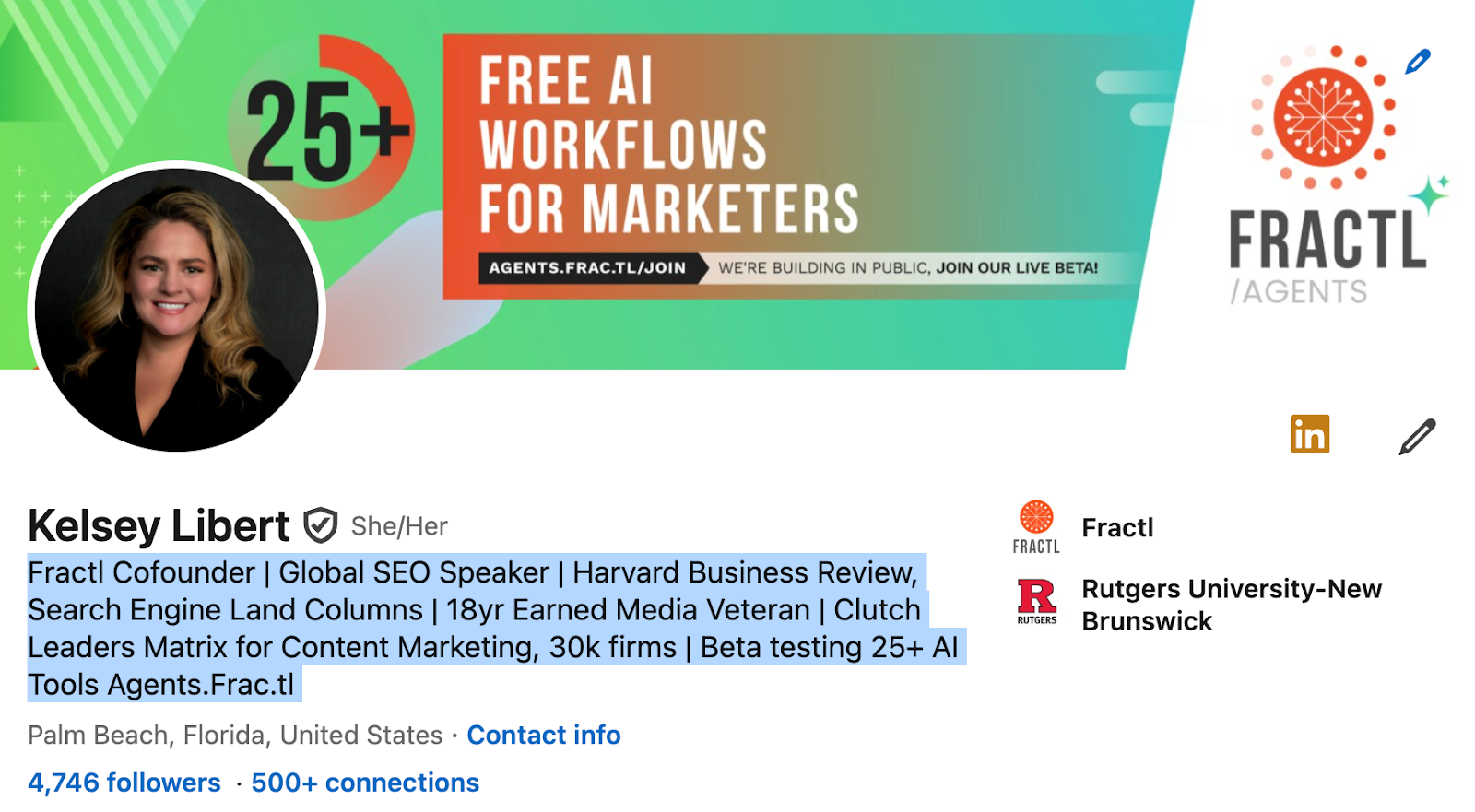
    Sample LinkedIn headline for the author

    In 2025, while industry leaders engaged passionately in debates about AI-era search terms in their LinkedIn posts, they were reluctant to integrate these new terms into their personal headlines.

    Our analysis reveals that 43% of SEO thought leaders still use “SEO” in their LinkedIn headlines, compared to 21% with “AI” and a mere 3% with “GEO.”

    The gap is notable, indicating a hesitation to move away from the proven SEO strategies we’ve relied on for over a decade.

    Well-Structured Content Hubs: Essential for Both AI and Traditional SEO

    Successful digital strategies focus on creating comprehensive, persona- and buyer-journey-led content hubs that address genuine FAQs and buying intentions. By nurturing content depth throughout all stages – from awareness to decision-making, brands can provide compounded value to users and reinforce AI search algorithms.

    ```json
{
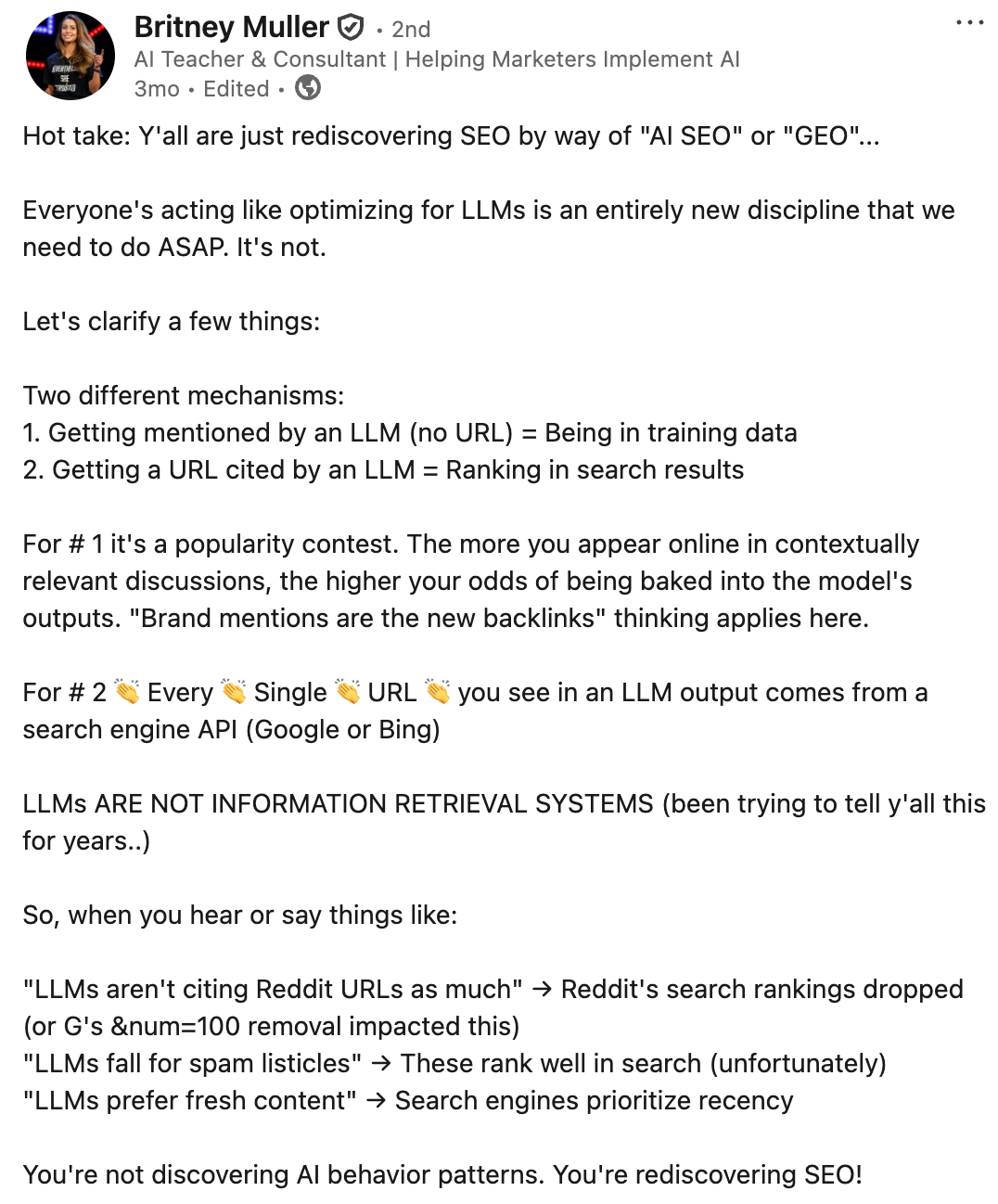
  "alt": "Screenshot of a LinkedIn post by Britney Muller discussing SEO and LLMs.",
  "caption": "Britney Muller shares insights on AI SEO, highlighting the rediscovery of SEO basics through LLMs.",
  "description": "This image is a screenshot of a LinkedIn post by Britney Muller, an AI Teacher and Consultant. The post discusses the relationship between search engine optimization (SEO) and large language models (LLMs), suggesting that current efforts in optimizing for LLMs mirror traditional SEO practices. Muller emphasizes two mechanisms: being mentioned by an LLM and having a URL cited by an LLM. She also clarifies that LLMs are not information retrieval systems and debunks common misconceptions. Keywords: SEO, LLMs, AI SEO, search rankings, information retrieval."
}
```

    Generate Authority with Off-site Brand Trust Signals

    Publishing original research and expert insights helps earn recognition from authoritative sources, which in turn boosts your brand’s trust and recognition.

    • Mainstream news outlets.
    • Niche-relevant publishers.
    • Leading podcasters.
    • Engaged Reddit communities.

    Expanding these digital footprints strengthens entity recognition and reinforces brand trustworthiness.

    Leveraging audience intelligence tools like SparkToro identifies which platforms, communities, and topics should be prioritized in your digital PR strategy.

    Britney Muller on AI SEO or GEO

    For a deeper understanding, explore: The origins of SEO and its significance for GEO and AIO

    New AI Terms Gain Momentum: See the Enthusiasm Rise

    Though few are updating their LinkedIn headlines just yet, industry leaders’ posts reveal growing interest in three specific terms.

    ```json
{
  "alt": "Chart showing AI buzzword adoption and sentiment among industry leaders, highlighting terms like SEO and AIO.",
  "caption": "Explore which AI buzzwords are capturing the attention of industry leaders. SEO leads with perfect adoption, while ASO tops positive sentiment at 86%.",
  "description": "This image presents a chart from LinkedIn, illustrating the frequency of AI buzzword usage by industry leaders and their positive sentiment. SEO (100% adoption, 79% positive sentiment) and AIO (63% adoption, 77% positive sentiment) are prominently used. Other terms like GEO and AISEO show high positivity, while ASO achieves the highest positive sentiment at 86%. The data is supported by Fractl and Search Engine Land."
}
```
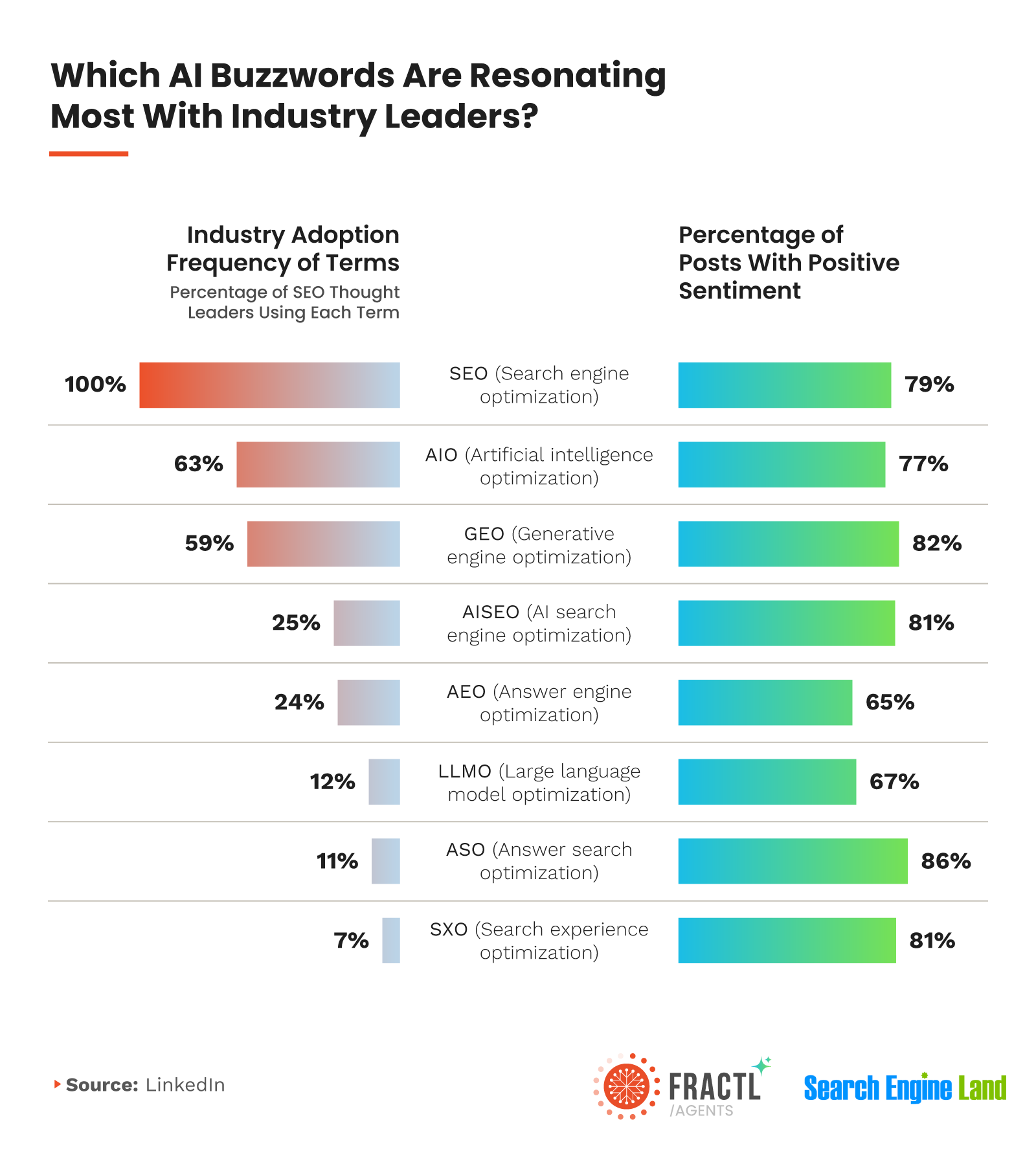
    • 63% of leaders mention AIO, with 77% positivity.
    • 59% mention GEO, with 82% positivity.

    With over 70% of posts expressing positivity, sentiment often indicates adoption likelihood. When positivity wanes, so does usage. Yet, that’s not what’s happening here.

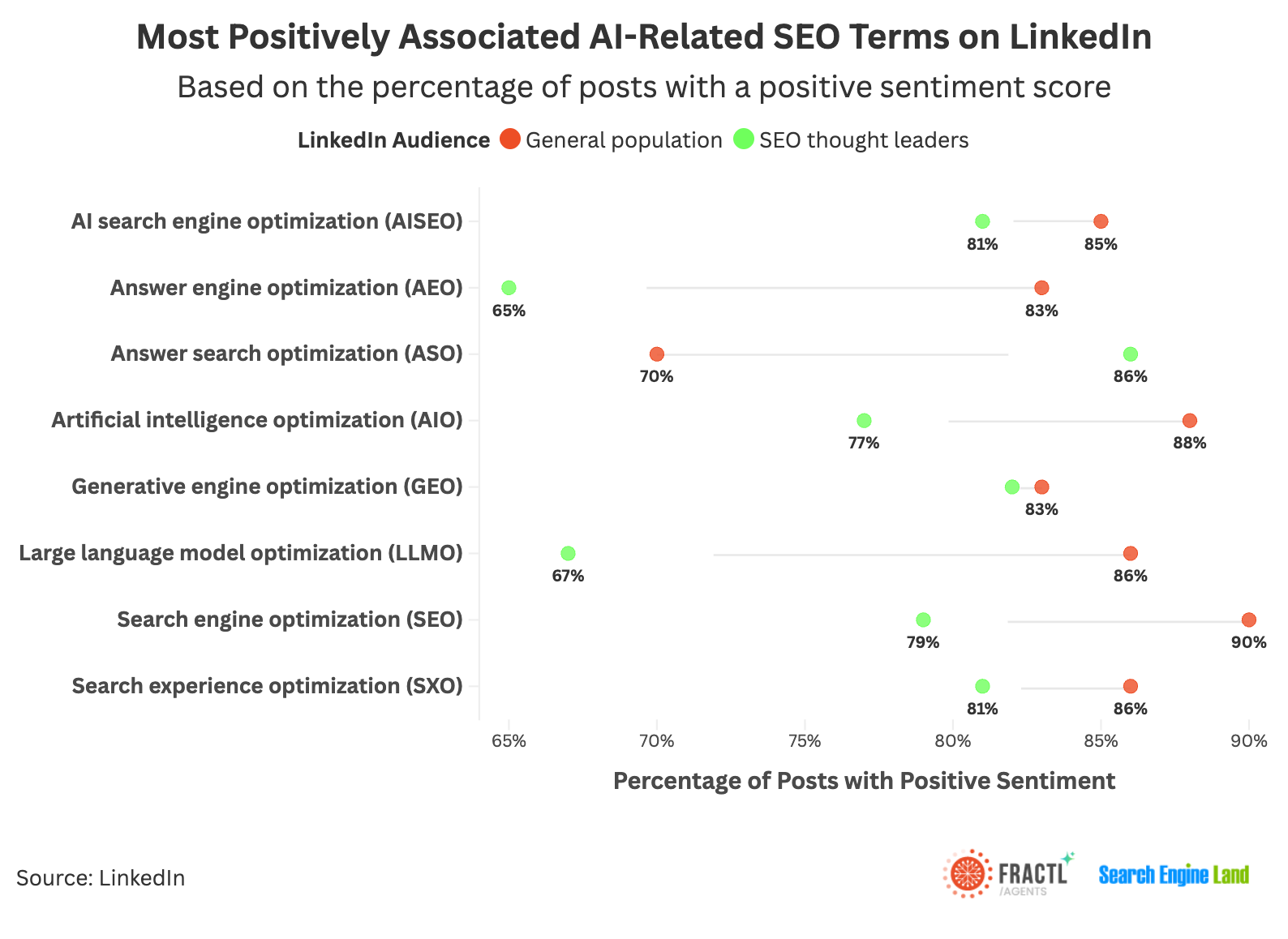
    While AEO, LLMO, and AIO attract broader audiences, GEO stands out for consistent positivity, especially among SEO influencers and LinkedIn users alike.

    Most positively associated AI-related SEO terms on LinkedIn

    SEO continues as the industry’s backbone, but it’s clear: we’re witnessing the alignment phase of an emerging platform.

    The focus isn’t on acronyms; it’s about accurately describing brand visibility in AI-era searches.

    The Real Strategy: Timely, Value-Driven Content

    Brands should refrain from over-optimizing towards any singular term, strategy, or platform. Instead, develop value-focused content, repurpose it, and engage with audiences across their existing platforms.

    ```json
{
  "alt": "Chart showing AI-related SEO terms with positive sentiment percentages from general population and SEO thought leaders on LinkedIn.",
  "caption": "Discover how various AI-related SEO terms are perceived positively on LinkedIn, with insights from both SEO thought leaders and the general audience.",
  "description": "This chart illustrates the percentage of posts with a positive sentiment for AI-related SEO terms on LinkedIn. It compares the perceptions of the general population (in orange) and SEO thought leaders (in green) concerning terms like AI search engine optimization, answer engine optimization, and others. Notably, 'Search engine optimization' shows the highest positive sentiment. Such data provides valuable insights for understanding the landscape of AI in SEO, highlighting which terms resonate most favorably among different audiences."
}
```

    This adaptability ensures brands endure platform shifts, avoiding pitfalls like those seen in once-dominant platforms such as Vine and Clubhouse.

    Explore further: Understanding AI’s Impact on SEO

    Nomenclature Volatility: A Subtle Yet Critical Indicator

    Our research highlights this critical insight: less than a third of thought leaders consistently use AI-related SEO terminology with stable sentiment over the past year.

    • 35% express positive sentiment toward these terms but lack consistency.
    • Just over a third are consistently positive and stable.

    The discourse isn’t about being right or wrong. It’s about reframing discussions as the landscape evolves, with volatility often mirroring visibility.

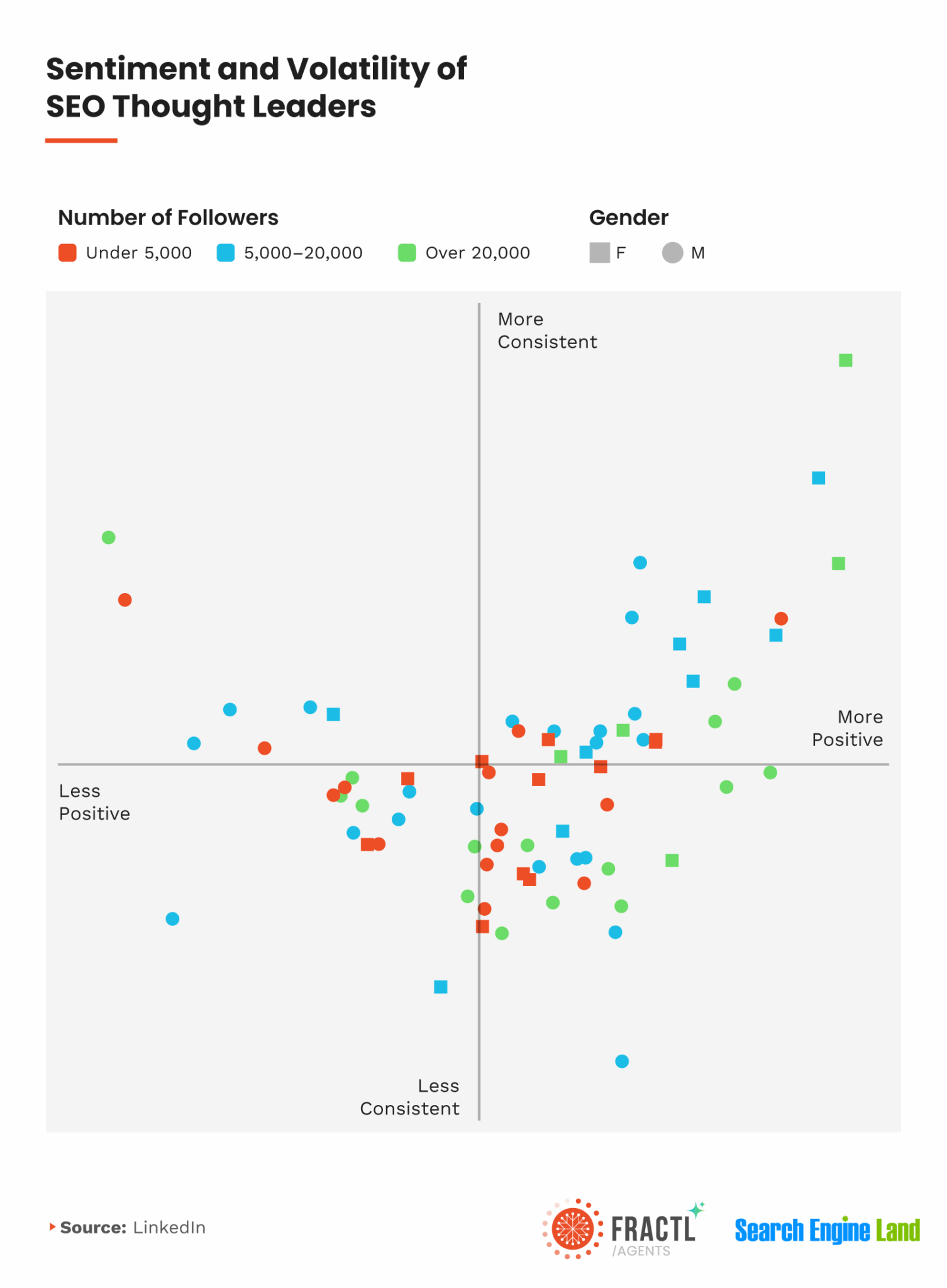
    By evaluating sentiment against volatility, we revealed scattered positions rather than a distinct divide.

    ```json
{
  "alt": "Scatter plot of SEO thought leaders' sentiment and consistency, showing follower engagement by color.",
  "caption": "Visualizing sentiment and volatility among SEO thought leaders, this scatter plot reveals engagement patterns by follower number and gender.",
  "description": "This scatter plot analyzes SEO thought leaders based on sentiment and volatility, with axes measuring positivity and consistency. Dots represent individuals, color-coded for number of followers: red for under 5,000, blue for 5,000–20,000, and green for over 20,000. Gender is indicated by shape, with squares for females and circles for males. The graphic provides insights into online influence in the SEO community. Source: LinkedIn."
}
```
    Sentiment and volatility of SEO thought leaders

    The uncomfortable truth is that the most vocal aren’t always the most dependable. The impact of their shifting narratives is vital, as their guidance influences budgets, plans, and careers.

    Leaders who maintain a balanced outlook – driven by data and tempered by experience – offer a different perspective compared to those swayed by every update.

    Dive deeper: Why AI Search Studies Diverge

    The Key Lesson: It’s Not a Strategy Reset; It’s an Emerging Platform

    Effective content marketing, digital PR, and technical SEO are the foundation for building brand visibility. AI is simply the next platform evolution, much like social media, enhancing but not replacing existing strategies.

    Our analysis indicates the industry isn’t unsure about what to do. It is negotiating how to convey this rapidly evolving discovery system. This discussion is typical at this stage, but volatile shifts harm trust.

    Terms like AEO, LLMO, and AIO may gain some traction, but GEO remains consistent among both practitioners and broader audiences, suggesting its potential as a stable narrative bridge as execution evolves.

    Crafting a Resilient Digital Footprint: Navigating the AI Era

    Market strategies shouldn’t revolve around what’s trending quarterly. Instead, focus on timeless marketing principles:

    • Create content that delivers real value to your market.
    • Repurpose and circulate it on platforms where your audience is active.
    • Generate citations, engagement, and trust that impact search, social, and AI systems.

    In today’s era, where answers are synthesized rather than ranked, the voices that resonate won’t be the ones coining the next big label, but those that remain consistent, building trust and visibility over time.

    The analysis focused on the top 75 SEO thought leaders, including agency owners, directors, industry speakers, and consultants.

    • Aleyda Solis
    • Amanda Farley
    • Amanda Natividad
    • Andrew Holland
    • Andrew Prince
    • Andy Crestodina
    • Areej AbuAli
    • Barry Schwartz
    • Beth Nunnington
    • Brett Tabke
    • Brie E. Anderson
    • Britney Muller
    • Bruce Clay
    • Celeste Gonzalez
    • Christian Hustle
    • Cindy Krum
    • Connor Gillivan
    • Crystal Carter
    • Cyrus Shepard
    • Dana DiTomaso
    • Danielle Stout Rohe
    • Danny Ashton
    • Danny Goodwin
    • Darren Shaw
    • Dave Davies
    • Derek Perkins
    • Eli Schwartz
    • Eric Enge
    • Fabrice Canel
    • Felipe Bazon
    • Garrett French
    • Garrett Sussman
    • Gisele Navarro
    • Greg Gifford
    • Ian Lurie
    • James Brockbank
    • James Wirth
    • Jane Hunt
    • Jesse McDonald
    • Jordan Koene
    • Joy Hawkins
    • Kathryn Hawkins
    • Kelsey Libert
    • Kristin Tynski
    • Lee Elliott
    • Lidia Infante
    • Lily Ray
    • Loren Baker
    • Marc Sirkin
    • Mark Rofe
    • Mark Traphagen
    • Martha van Berkel
    • Matt McGee
    • Melissa Popp
    • Michael Buckbee
    • Michael King
    • Michelle Robbins
    • Mordy Oberstein
    • Neil Patel
    • Nick Eubanks
    • Nick LeRoy
    • Noah Learner
    • Paddy Moogan
    • Patrick Reinhart
    • Paul Aaron Norris
    • Paxton Gray
    • Rand Fishkin
    • Ray Grieselhuber
    • Ross Hudgens
    • Ross Simmonds
    • Samantha Torres
    • Steven J. Wilson
    • Tony Wright
    • Vanessa Raath
    • Wil Reynolds

    Inspired by this post on Search Engine Land.


    crushpress.ai community screenshot
  • Master AI Content Optimization: A Personalized Guide

    Master AI Content Optimization: A Personalized Guide

    When it comes to optimizing content for AI search engines, I’m here to guide you through the essential steps that will help your website become a go-to source for AI engines like ChatGPT, Perplexity, and Google AI Overviews. Let’s dive in together and explore how AI content optimization can elevate your online presence.

    AI-powered search engines aren’t the future; they’re the present. Here’s why this matters:

    • Google’s AI Overviews now engages 2 billion users monthly.
    • ChatGPT attracts 800 million users weekly.
    • Perplexity handled 780 million queries in just one month.

    Now, citations hold more significance than mere rankings and clicks. You need to craft content that AI engines trust and reference. Let’s talk through the steps of AI content optimization.

    Curious about your current standing? You can discover your website’s performance with a quick free GEO audit in under 60 seconds.

    What is AI Content Optimization?

    Generative Engine Optimization (GEO) reshapes how content is presented online to enhance visibility in AI-generated responses. Different from traditional SEO, GEO focuses on making your content the primary source cited by AI models when generating answers.

    The term was coined by Princeton University researchers in late 2023 and has quickly become a pivotal aspect of digital marketing.

    ```json
{
  "alt": "Comparison between traditional search and AI search methods.",
  "caption": "Discover the future of web browsing: AI search technology versus traditional search methods, revolutionizing how we find information.",
  "description": "The image illustrates a comparison between traditional search and AI search methods. On the left, traditional search is depicted with a list of text-based results and a search bar. On the right, AI search is represented with a chatbot icon and speech bubble effect, showing interconnected data points leading to documents. This visual highlights the efficiency and interconnected nature of AI search, offering insights into the evolving landscape of search technology."
}
```
    • Traditional SEO: It focuses on ranking within search results, gauging success through position and clicks.
    • AI Content Optimization: It prioritizes becoming the cited source in AI-generated answers. Now, citation authority surpasses backlinks in importance.
    • It’s about reference rates, not just click-through rates. The stakes are higher due to limited citation opportunities.
    • Fierce competition: LLMs cite only 2–7 sources on average, intensifying the competition for AI visibility.

    Step-by-Step Guide to AI Content Optimization

    Are you eager to optimize for AI search? Let’s walk through a framework of key strategies and insights for creating AI-friendly content.

    Step 1: Structure Content with Clear Headings and Logical Flow

    AI systems excel at parsing content that’s well-organized with clear headings and logical flow. Structured content significantly boosts citation odds, especially with a Q&A format.

    Best practices:

    • Use straightforward H2 and H3 headers.
    • Divide complex information into digestible parts.
    • Utilize lists for clarity in processes and main points.
    • Enhance with tables or charts for data comparison.

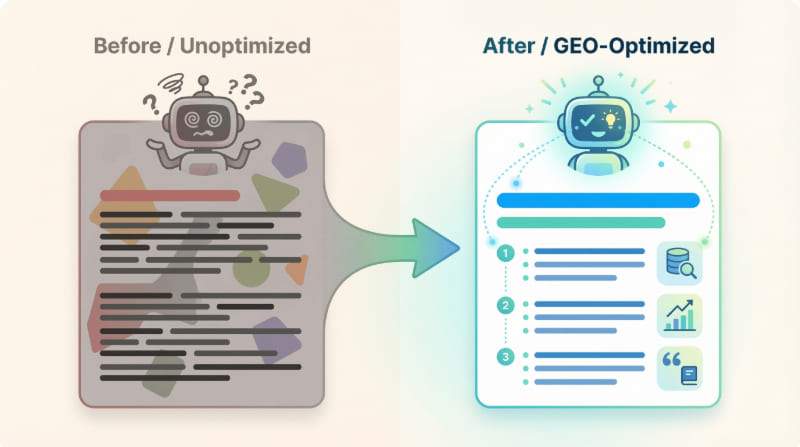
    Step 2: Answer Questions Directly and Concisely

    Content that answers inquiries directly in the opening line sees significantly higher citation. Front-loaded, clear responses are favored by AI engines.

    Best practices:

    • Start sections with direct answers.
    • Present key information upfront.
    • Include TL;DR summaries where needed.
    • Adopt a conversational tone.
    • Prioritize writing like a human, not a brand.
    ```json
{
  "alt": "Before and after optimization comparison featuring a robot icon and document transformation.",
  "caption": "See the transformation from cluttered to clear with GEO-optimized content. Discover how structured organization can enhance readability and efficiency.",
  "description": "This image shows a before-and-after comparison of document optimization. On the left, 'Before / Unoptimized' features a confused robot and jumbled text. On the right, 'After / GEO-Optimized' showcases a happy robot with a well-structured document, indicating clarity and improved content organization. The transformation highlights the benefits of GEO optimization in creating engaging and readable documents."
}
```

    Step 3: Include Authoritative Data, Statistics, and Citations

    Pages rich with original data and authoritative sources see a dramatic rise in AI citations. Citing reputable data sources consistently yields better results.

    Best practices:

    • Link to authoritative research and studies.
    • Featured original data enhances credibility.
    • Ensure statistics are up-to-date.

    Step 4: Use Schema Markup and Structured Data

    Adding schema markup like Article and FAQ enriches AI citations by organizing your content neatly. It helps AI systems comprehend and reference your material with ease.

    Priority Schema Types:

    • FAQ schema for clear Q&A formatting.
    • Article markup for content type identification.
    • How-to schema for illuminating processes.
    • Organization and Product schema to establish brand visibility.

    Step 5: Build Topical Authority and E-E-A-T

    Maintaining Google’s E-E-A-T standards for expertise and trustworthiness remains integral. Highlight credentials and utilize authoritative sources to strengthen your topical authority.

    Best practices:

    • Include detailed author bios with credentials.
    • Use bylines for all content pieces.
    • Link to respected external sources.
    • Develop niche-focused content clusters.
    • Ensure accuracy across all platforms.
    ```json
{
  "alt": "Screenshot of Stepp dashboard showing metrics such as visibility score and detection rate.",
  "caption": "Explore insights with the Stepp dashboard, featuring metrics like visibility score and detection rate for optimal performance analysis.",
  "description": "This image displays the Stepp dashboard interface featuring various performance metrics such as Visibility Score (5.7%), Detection Rate (6.2%), and Top 3 Visibility (47.5%). The dashboard is designed for performance tracking and insights, with graphs depicting trends over time. It includes a navigation menu on the left for accessing competitors, citations, prompts, and other tools. This setup helps users monitor and enhance their digital strategy efficiently."
}
```

    Step 6: Write in a Format AI Can Easily Parse and Quote

    Well-organized, succinct content is more likely to be referenced by AI models. Use natural, simple language and clear structures like headings and lists to enhance comprehension.

    Best practices:

    • Craft sentences easily quotable on their own.
    • Avoid unnecessary jargon.
    • Clarify technical terms.
    • Summarize key points effectively.
    • Provide alt text and transcripts for media.

    How to Check if Your Content is Optimized

    Simply implementing GEO best practices isn’t enough; monitoring AI search performance and improving is crucial. Identify key metrics like citation frequency and voice share for comprehensive analysis.

    Key Metrics:

    • How frequently AI references your content.
    • Compare your visibility against competitors.
    • Assess how AI presents your brand.
    • Ensure AI correctly attributes your content.

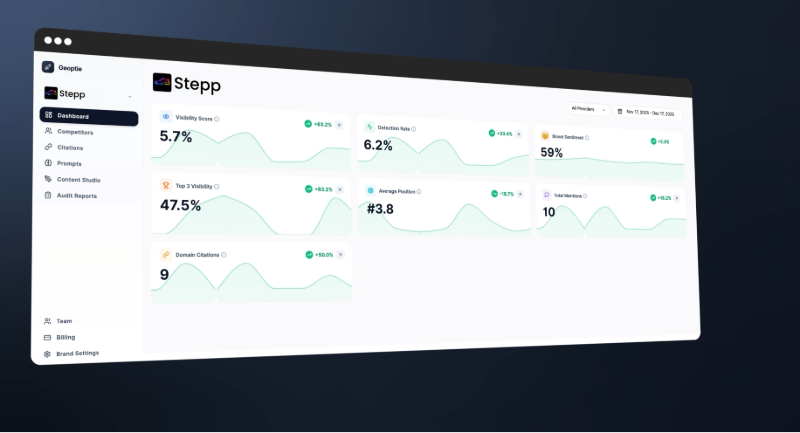
    Use dedicated GEO tools like Geoptie’s GEO Content Checker to analyze content and gain actionable insights for improvement. Ongoing use of Geoptie’s GEO Dashboard helps track AI visibility and citations for continuous progress.

    Remember, embracing GEO practices will position your content for future AI-generated citations. So, take your first step by discovering your website’s current position with a free GEO Audit and let the GEO Content Checker guide your key page optimization.


    Inspired by this post on Search Engine Land.


    crushpress.ai community screenshot