Tag: Digital Marketing

  • Revamp Your Search Tactics: Discover Vibe Coding

    Revamp Your Search Tactics: Discover Vibe Coding

    In a world where Google’s AI Overviews address more queries instantly, I’ve found that vibe coding allows us to craft interactive experiences that AI simply can’t replace.

    I’ve noticed that search marketers are now shifting their roles from merely optimizing to actually building. Tools like vibe coding, coupled with AI-powered development technologies, have significantly reduced the time from idea conception to execution—from weeks to just a few hours.

    These tools don’t make developers obsolete, but they empower search teams to test and create interactive content on their own timelines. This is crucial, as Google’s AI Overviews increasingly pull answers directly into the SERP, reducing clicks to our brand websites.

    For marketers, building unique, conversion-focused tools is becoming an indispensable tactic in this zero-click environment.

    ```json
{
  "alt": "Tweet by Andrej Karpathy discussing a coding style called 'vibe coding' using AI tools.",
  "caption": "Andrej Karpathy humorously describes 'vibe coding' with AI, embracing automation for coding tasks while building projects with ease.",
  "description": "This image shows a tweet by Andrej Karpathy discussing a new coding style he calls 'vibe coding,' where he utilizes advanced AI tools like LLMs and SuperWhisper to automate coding processes. He explains the casual approach to coding by accepting AI-generated suggestions without detailed review, finding it amusing for casual projects. The tweet has garnered significant engagement with over 5 million views, highlighting interest in AI-driven coding solutions."
}
```

    What is vibe coding?

    Vibe coding is about creating software by guiding AI with natural language instead of traditional coding methods. This means focusing on the tool’s purpose, appearance, and response, while AI takes care of implementation.

    This term gained popularity in early 2025, thanks to OpenAI co-founder Andrej Karpathy, who described it as a loose, exploratory building style. The appeal? Speed. The risk? Potential shortcuts that could lead to fragile systems.
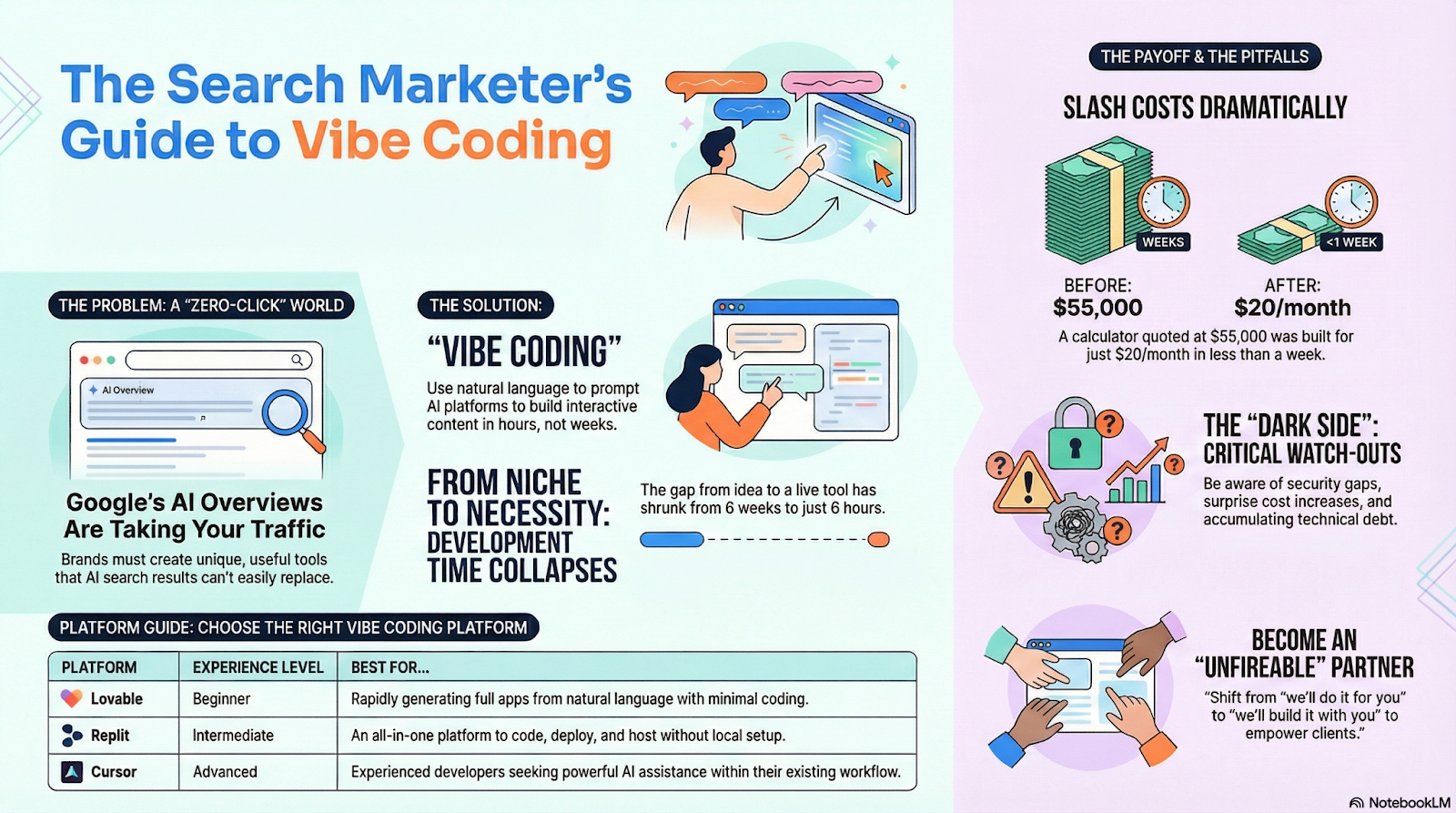
    ```json
{
  "alt": "Infographic on search marketing and vibe coding, highlighting problems, solutions, cost impact, and critical factors.",
  "caption": "Discover how vibe coding revolutionizes search marketing by transforming niche tools into necessities while slashing development time and costs.",
  "description": "This infographic provides a guide to vibe coding in search marketing, addressing the 'zero-click' issue posed by AI overviews on Google. It illustrates how natural language can be used to prompt AI platforms for interactive content creation, reducing development time from weeks to hours. Cost and security implications are also discussed, with examples of drastic cost reduction from $55,000 to $20/month. The infographic emphasizes the importance of selecting the right coding platform for different experience levels and aims to empower users to become indispensable partners."
}
```

    Today, AI-powered development platforms extend this approach to non-engineering teams, with tools like Replit and Lovable, allowing everyone to build and iterate quickly.

    Vibe coding vs. vibe marketing

    It’s important to distinguish vibe coding from vibe marketing. Vibe coding involves AI tools designed to create applications and interactive experiences, whereas vibe marketing uses automation platforms to connect existing tools and systems.

    ```json
{
  "alt": "Flowchart from a patent publication showing a system for generating synthetic search queries using various engines and classifiers.",
  "caption": "Explore the intricate flowchart from a patent, outlining a sophisticated system for generating synthetic search queries, incorporating multiple engines and classifiers.",
  "description": "This detailed flowchart is from a patent application publication dated August 29, 2024. It illustrates an advanced system for generating synthetic search queries. Key components include Context Engine 113, Search System(s) 160, LLM Selection Engine 132, and a variety of LLMs (Large Language Models) such as Creative Text and Ambient Generative LLMs. Classifiers and user state signals are integral, facilitating complex query processing and output generation for enhanced user engagement. This diagram is crucial for understanding the functionality and interconnections of system components in synthetic query generation."
}
```

    Together, these approaches empower search teams to build and operationalize their creations efficiently.

    Why vibe coding matters for search marketing

    I believe that soon, AI-powered coding will be an essential part of any marketer’s toolkit. It allows us to create sophisticated interactive tools that Google’s AI can hardly mimic, enhancing our SEO and PPC strategies.

    ```json
{
  "alt": "Growth forecasting dashboard displaying forecast inputs, expenses, and executive summary with revenue and ROI details.",
  "caption": "Explore your business's future with this growth forecasting dashboard. Discover revenue trends, profit margins, and client growth insights powered by AI.",
  "description": "This image shows a growth forecasting dashboard designed for SEO and AI optimization. On the left, it features forecast inputs including timeframe, client churn, and salary increase. The right side displays an executive summary with total revenue of $18.83M, a total profit of $9.73M, and an average ROI of 96%. It provides AI-powered insights for questions like break-even points and profit margins. Additional options for scenario management and data export are available, enhancing decision-making processes."
}
```

    With vibe coding, my team can rapidly develop tools that boost conversion, like interactive content aimed to improve user engagement—a factor crucial for both SEO and PPC efforts.

    Through vibe coding, I’ve created custom systems that help manage our operational needs efficiently, saving time and costs. For instance, a project quoted at $55,000 was completed in under a week using Replit for just $20 a month.

    The opportunity to teach these skills to clients also adds significant value, emphasizing the transition from “we’ll do it for you” to “we’ll build it with you.”
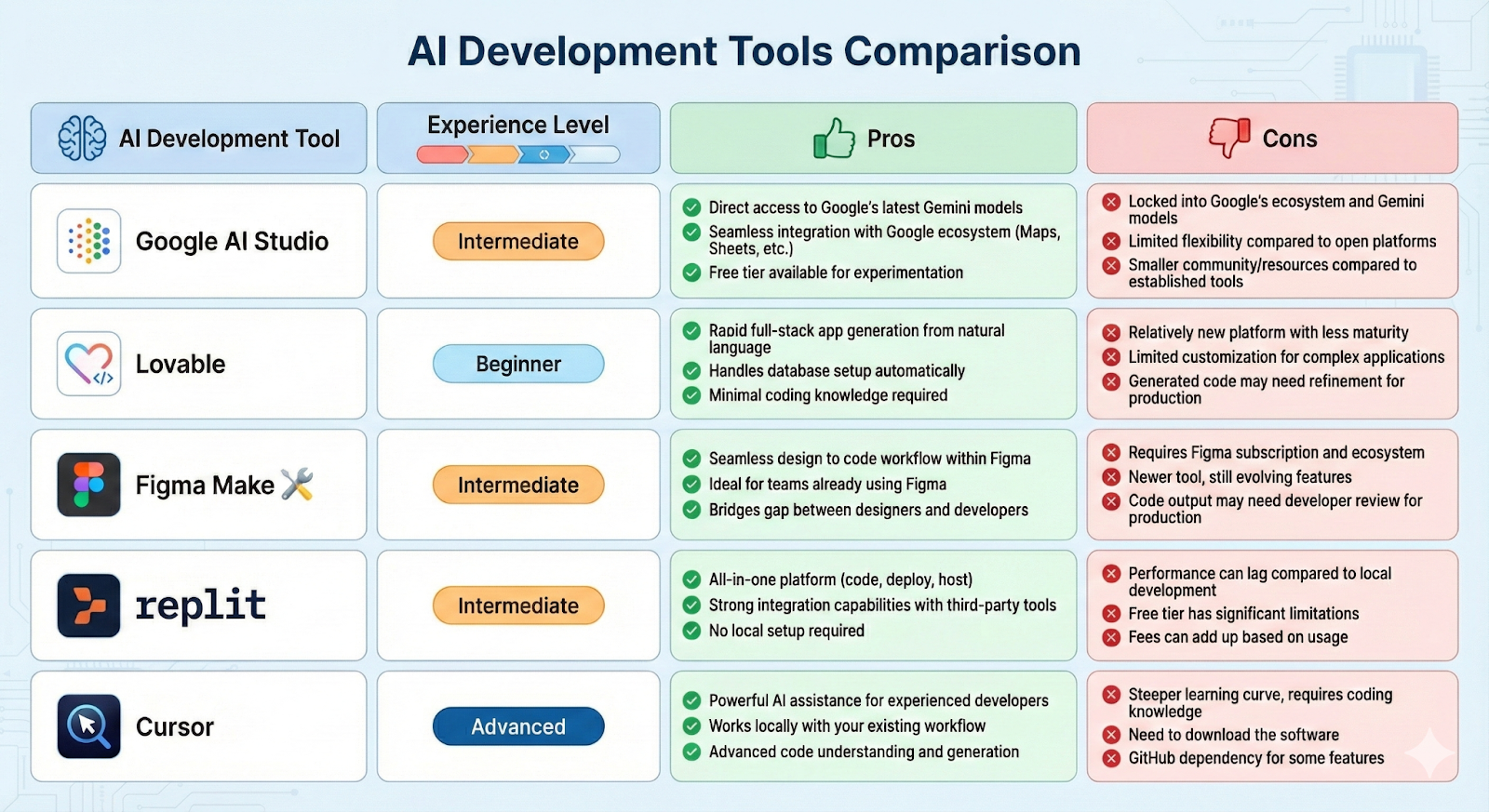
    ```json
{
  "alt": "Comparison chart of five AI development tools, listing experience level, pros, and cons.",
  "caption": "Explore the strengths and weaknesses of top AI development tools like Google AI Studio and Replit, tailored for various experience levels.",
  "description": "This image is a detailed comparison chart of AI development tools, including Google AI Studio, Lovable, Figma Make, Replit, and Cursor. Each tool is paired with a recommended experience level, such as beginner, intermediate, or advanced. Pros include seamless integration and ease of use, while cons highlight limitations like ecosystem lock-in and steep learning curves. Ideal for developers seeking the right fit for their AI projects."
}
```

    Vibe coding offers a competitive edge, allowing us to navigate zero-click search environments while fortifying long-term relationships with our clients.

    Top vibe coding platforms for search marketers

    Several leading vibe coding platforms are making waves. My personal preference is Replit for its flexibility, though Figma Make is a great choice too, particularly as it integrates well with our existing workflows.

    ```json
{
  "alt": "AI Adoption ROI Calculator interface for accounting firms.",
  "caption": "Discover the potential ROI from AI in your accounting firm with our intuitive calculator. Input your firm's data and explore the benefits.",
  "description": "The AI Adoption ROI Calculator interface allows accounting firms to estimate return on investment from implementing AI solutions. Users enter firm details such as number of employees, hourly rate, repetitive tasks hours, automation percentage, billable hours, and annual tool costs. The tool provides a user-friendly experience to calculate potential savings and efficiencies. Keywords: ROI calculator, AI adoption, accounting, automation, investment."
}
```

    Testing different platforms will help find the best fit. Whether it’s Lovable for beginners or Cursor for advanced users, there’s a solution tailored to your needs.

    Practical SEO and PPC applications: What you can build today

    Vibe coding can create a variety of tools, from lead generation calculators to interactive content that increases website engagement. The key is to build tools that fill existing gaps, providing unique and useful solutions.

    ```json
{
  "alt": "AI ROI Calculator for Accounting Firms highlighting AI use cases for data processing, compliance, client management, and financial analysis.",
  "caption": "Explore the AI ROI Calculator for accounting firms, which demonstrates how automation can save time and enhance efficiency across various accounting functions.",
  "description": "This image showcases an AI ROI Calculator for Accounting Firms, designed to assess the financial benefits of AI integration in accounting. It lists high-impact AI use cases divided into categories such as Data Processing, Compliance & Tax Work, Client Communication, and Financial Analysis. Key features include bank reconciliation, tax return validation, automated client query responses, and trend analysis. This tool aims to help firms quantify potential savings and efficiency improvements through AI automation."
}
```

    For instance, I developed an AI-powered accounting ROI calculator, a tool that couldn’t be easily replaced by Google’s direct answers. This not only helps the target audience but also boosts SEO efforts by encouraging repeat visits.

    A 7-step vibe coding process for search marketers

    I’ve found that following a structured workflow is crucial when using vibe coding. This includes thorough research, creating a content spec document, and iterating designs before functionality.

    ```json
{
  "alt": "Financial charts showing ROI timeline, time allocation, and benefits breakdown after AI implementation.",
  "caption": "Discover the impact of AI on ROI with detailed charts showcasing time savings, cost reductions, and revenue growth over the first year.",
  "description": "The image features a series of financial charts analyzing ROI and benefits after AI implementation over the first year. The top chart displays an ROI timeline, indicating cumulative benefit, investment cost, and net position, with a break-even point at month one. Below, a pie chart illustrates weekly time allocation, showing 85% time saved and 15% remaining. A bar chart details annual benefits with a comparison of cost savings and revenue growth. Keywords: ROI, AI implementation, financial analysis, cost savings, revenue growth."
}
```

    These steps ensure a comprehensive approach, allowing for prompt testing and deployment. Updating documentation at each milestone helps in managing future updates or revisions.

    The dark side of vibe coding and important watchouts

    While powerful, vibe coding tools come with risks. Security and compliance issues, price creep, and technical debt are concerns that require careful attention.

    ```json
{
  "alt": "Screenshot of a chat exchange explaining a setup issue with list submission.",
  "caption": "In this chat exchange, a user queries a setup error, prompting a detailed explanation and fix to ensure proper list submission functionality.",
  "description": "This screenshot captures a chat where a user questions why a setup was done differently than expected. The respondent explains the situation, detailing that while list submission triggered the flow correctly, pairing data was sent as event properties, not accessible in list-triggered flows. To fix this, pairing data will be sent as profile properties instead. This exchange highlights a technical issue and the proposed solution, keywords: setup, list submission, event properties, profile properties."
}
```

    Always ensure security reviews and keep track of costs as projects evolve. Monitoring these risks can make vibe coding a reliable tool rather than a complicated headache.

    Vibe coding is your competitive edge

    In this evolving landscape, vibe coding gives us the ability to build unique digital experiences. It’s a skill set that empowers us to thrive, helping create meaningful, interactive content that stands out in the crowded search environment.

    Embracing vibe coding not only promotes strong client partnerships but also equips us to adapt to new search realities, making it a pivotal skill for future success.


    Inspired by this post on Search Engine Land.


    crushpress.ai community screenshot
  • Thriving Brand-Agency Partnerships: Insights for 2026 Success

    Thriving Brand-Agency Partnerships: Insights for 2026 Success

    In today’s ever-evolving landscape, brand-agency partnerships look vastly different than they did just a few years ago, and this evolution will only continue to expand by 2026.

    I’ve noticed that internal marketing teams have become more sophisticated, digital channels are increasingly specialized, and the role of agencies shifts away from a one-size-fits-all approach.

    Interestingly, the companies reaping the most benefits from agency relationships aren’t necessarily the biggest spenders.

    Instead, those that succeed are clear about their specific needs and objectives.

    Achieving clarity starts with understanding the true role an agency should play in your organization.

    Too often, partnerships fail because expectations and responsibilities weren’t clearly aligned from the beginning.

    When this foundational understanding is lacking, even the most robust execution can fall short.

    Having worked with thousands of businesses across industries and growth stages, I’ve consistently observed that agency success falls into two distinct partnership models. These models are primarily influenced by company size and internal marketing maturity.

    Model 1: Execution-first Partnerships for Large Companies

    If your company sees over $50 million in annual online revenue, chances are you already have a capable internal marketing team.

    Strategy and planning remain in-house, so what you need from an agency is deep platform expertise and exceptional execution.

    At this stage, agencies function as specialist operators that activate roadmaps, optimize channel performance, and bring advanced technical knowledge that’s inefficient to replicate internally.

    When performance dips, a powerful agency partner doesn’t default to tweaking tactics.

    Instead, they help uncover whether the issue stems from execution, market conditions, or a strategic misstep, offering data to guide corrective measures.

    Model 2: Integrated Growth Partners for Small to Mid-Size Companies

    For companies under $50 million in annual revenue, the agency dynamic shifts.

    Internal teams might be lean or still cultivating core digital expertise.

    In these situations, agencies do more than execute; they shape your entire growth strategy.

    An ideal agency acts as an extension of your marketing team, guiding platform selection, crafting cross-channel strategies, and more.

    For growing businesses, this integration provides access to senior-level expertise, balancing speed, strategy, and financial constraints effectively.

    Finding the Right Agency Partner

    I’ve seen many companies approach agency selection improperly.

    Ditch the RFPs

    Large companies often rely on the request for proposal (RFP) process, which tends to favor vendors skilled in documentation over performance-driven results.

    Instead, I recommend using your professional network. If you’re in charge of a large marketing department, you likely know several professionals who can provide referrals to standout agencies.

    Smaller businesses should seek advice from peers about reliable vendors, then check reviews to confirm their findings.

    While no agency is perfect and all will have some unhappy clients, patterns of negative reviews are a solid indicator to avoid those agencies.

    Request an Audit

    Upon narrowing down potential partners, I suggest asking for an audit of your current marketing setup.

    Most digital marketing agencies conduct these audits for free, offering honest and constructive feedback.

    Depending on your company’s size, audits might vary, with larger firms focusing on specific platforms and smaller ones requiring full-funnel evaluations.

    This information helps evaluate how the partnership will integrate with existing processes, paving the way for effective collaboration.

    The selection process inherently includes finding partners that mesh well with your internal processes—critical to long-term success.

    Setting Achievable Goals

    After selecting an agency partner, the next step is defining coherent goals aligned with your business objectives.

    Unfortunately, I’ve observed that many leaders set goals disconnected from their business aims, straining the agency relationship from the get-go.

    A robust agency questions your goals pre-contract, urging you to adjust expectations realistic to your context and aspirations.

    Your chosen partner should grasp your business’s economics and help ensure marketing goals are aligned with broader business objectives.

    Maintaining a Productive Partnership

    Once everything is underway, you must keep your agency accountable, which involves regular reviews and tracking progress against initial audit benchmarks.

    Contract Length

    Large enterprises often sign 12-month contracts for stability, but smaller firms might benefit from a more flexible three-month commitment that auto-renews.

    In cases where everything seems perpetually smooth, consider that growth might be stagnating, as healthy conflict is a sign of challenge and progress.

    Ongoing Accountability

    Regularly reviewing opportunities against your agency’s initial audit findings not only keeps progress on track but also provides vital context for adapting strategies.

    Context is key, especially if your industry’s dynamics affect your agency’s work—awareness of broader market trends is crucial for realistic appraisal.

    Innovation and Testing

    Your agency should consistently suggest fresh ideas, especially for smaller businesses, while larger companies should fund dedicated innovation budgets.

    Effective agency partnerships without innovation risk falling behind competitors more willing to explore uncharted avenues.

    Ultimately, understanding what’s upcoming and strategically positioning your business will keep you competitive.

    When to Make an Agency Change

    Occasionally, a brand-agency partnership doesn’t thrive. Trust your instincts if you feel things could improve or something is amiss.

    Your Business Isn’t Growing

    Marketing should focus on acquiring new-to-brand customers. If growth stalls while your industry maintains, it’s time to reassess your agency’s role.

    Your Agency Isn’t Pushing Innovation

    If new ideas aren’t forthcoming or you’re not exploring novel methods to engage customers, seek an external audit to identify gaps.

    Your Agency Can’t Explain Performance

    An inability to contextualize performance suggests a knowledge gap in your sales funnel, where interconnected activities impact overall success.

    For smaller businesses, agents should grasp comprehensive marketing operations and how various elements influence each other.

    The Marketing Reality Check

    Great marketing can’t compensate for a flawed business model. Successful growth stems from the synergy of good business, leadership, and agency collaboration.

    If any component is lacking, marketing falls short of potential. Meaningful growth arises when agency roles align with specific business needs.

    Agency selection is an ongoing journey involving ongoing dialogue, accountability, and refinement, even when this involves constructive disagreements.


    Inspired by this post on Search Engine Land.


    crushpress.ai community screenshot
  • Google Eases Pharma Ad Policies for AdMob Buyers

    Google Eases Pharma Ad Policies for AdMob Buyers

    Starting in January 2026, I’ll see Google updating its Pharmaceutical policy for AdMob Authorized Buyers. This update allows ads for prescription drugs and services in certain markets without needing Google certification. However, they will tighten restrictions on what remains prohibited.

    What’s changing? Google’s policy will now be called “Pharmaceutical products and services.” This change permits Authorized Buyers to promote prescription drugs and services legally in specific countries, without requiring Google certification as is usually demanded in Google Ads.

    Although access is broadening, the basic rules remain stringent. The policy modifications intend to enhance clarity and readability rather than reducing enforcement.

    Why do I care? This update lets me tap into pharmaceutical advertising inventory without needing Google certification, creating fresh opportunities and competition in programmatic auctions. However, it places more compliance responsibility on my shoulders, increasing the risk of policy violations if geo-targeting and creative controls aren’t precise.

    I should consider that even non-pharma advertisers might experience changes due to increased demand and ad presence affecting pricing, brand safety, and placement strategies.

    What’s still banned? Ads related to clinical trials, miracle cures, illicit drugs, addiction services, crisis hotlines, and experimental treatments remain banned across Google Partner Inventory.

    Looking deeper. While Google is opening access, it’s also transferring responsibility to me as a buyer. By removing certain certification requirements for Authorized Buyers but maintaining strict controls, compliance risk is pushed firmly onto buyers and publishers.

    What should I do now? As an app publisher using AdMob, I should review category blocking and ad controls to ensure unwanted pharma ads are excluded, especially as more inventory becomes permissible. I need to prepare for enforcing rules country-by-country and carefully audit creatives.

    Bottom line. Google is opening the door wider for pharmaceutical advertising in programmatic settings, but I must remember that the rules are still complex, localized, and challenging for those who don’t follow them correctly.


    Inspired by this post on Search Engine Land.


    crushpress.ai community screenshot
  • Google vs. ChatGPT: A Deep Dive into 2025 Market Trends

    Google vs. ChatGPT: A Deep Dive into 2025 Market Trends

    Last updated: December 19, 2025

    I’ve delved into a fascinating exploration of the U.S. and global market presence of two internet giants: Google and ChatGPT. By leveraging a combination of client analytics, third-party usage data, and anonymized user logs, our team crafted a model to gauge metrics like monthly active users, engagement time, and the share of total digital queries.

    While Google remains the stalwart champion of online search, ChatGPT’s explosive growth has redefined what’s possible in search tasks, especially in areas requiring long-form conversations and creative input.

    This report offers a comprehensive quantitative comparison of these platforms, beginning with an overview of their market shares. As we progress, we’ll examine how usage breaks down by device type, demographic segments, and user intent.

    Google vs ChatGPT Market Share

    The table below details the digital query market shares of Google and ChatGPT by the end of Q4 2025.

    Google vs ChatGPT Market Share – Q4 2025

    PlatformMonthly Active Users (Global)Share of Total Digital QueriesAvg. Session Duration
    Google Search5 billion77.9%6m 12s
    ChatGPT858 million17.1%13m 09s
    Other (e.g., Bing, Perplexity)580 million5.8%4m 33s

    Key Insights:

    • Google continues to lead with nearly 80% of global digital queries.
    • Commanding 17% of the market, ChatGPT is the most formidable competitor Google has seen in over two decades.
    • Gemini’s latest update has positively impacted market retention, signaling resilience in competition.
    • Despite fewer users, ChatGPT’s notably longer session times indicate robust user engagement.

    Google vs ChatGPT Market Share Over Time

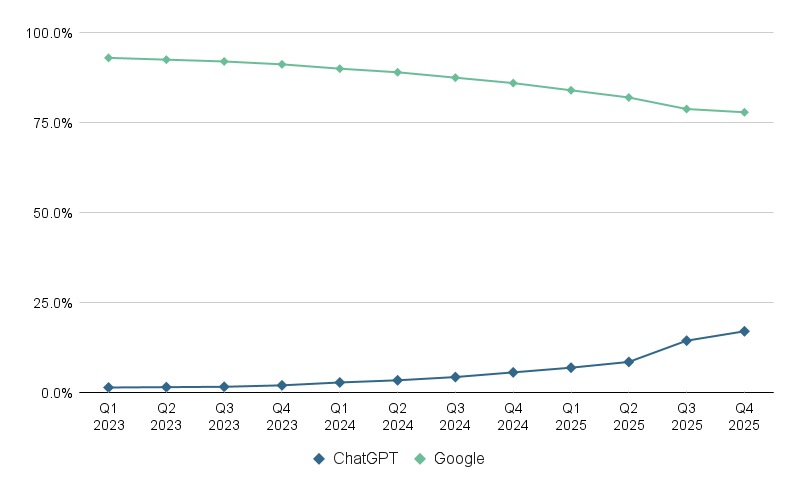
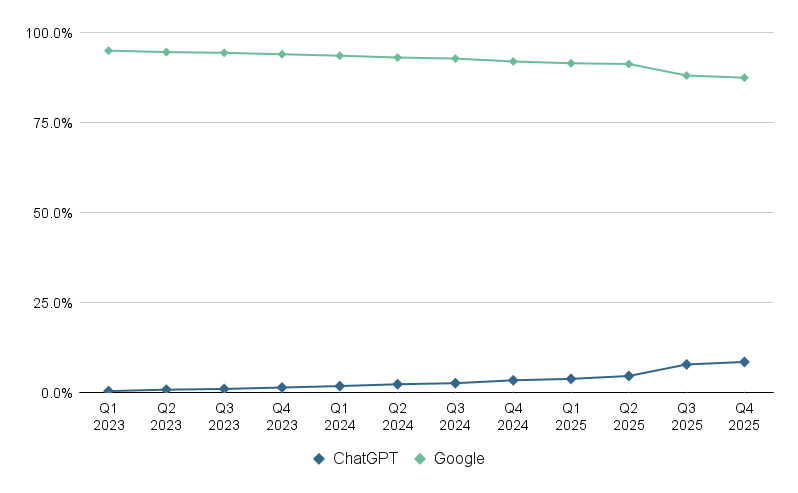
    The graph below illustrates the market share trends for Google and ChatGPT from Q1 2023 to Q4 2025.

    Google vs ChatGPT Market Share, Q1 2023 – Q4 2025

    Google Vs Chatgpt Market Share 2023 2025

    However, when focusing solely on transactional searches, Google’s dominance appears less threatened by ChatGPT.

    Google vs ChatGPT Market Share, Transactional Queries Only
    Q1 2023 – Q4 2025

    Google Vs Chatgpt Transactional Market Share 2023 2025

    Market Share by Device Type

    The following table shows the usage of Google and ChatGPT across mobile and desktop platforms, highlighting differing user behaviors.

    ```json
{
  "alt": "Line chart comparing Google and ChatGPT competitiveness over time, showing Google's gradual decline and ChatGPT's steady rise.",
  "caption": "A dynamic line chart reveals the shifting tides of competitiveness, with Google experiencing a slow decline and ChatGPT rising steadily.",
  "description": "This line chart visually compares the competitiveness of Google and ChatGPT over several months. The green line represents Google, depicting a slight downward trend. The blue line represents ChatGPT, showing a gradual upward trend. The chart uses dots to mark data points and has a clear legend for differentiation. Ideal for discussions on market trends and technological advancements, it highlights how these platforms evolve over time."
}
```

    Google vs ChatGPT Market Share by Device Type – 2025

    PlatformDesktop Usage ShareMobile Usage Share
    Google Search37%63%
    ChatGPT62%38%

    Research Notes:

    • ChatGPT shows more engagement on desktops, indicating a preference among professionals and researchers.
    • Google’s design appeals to those on mobile, capturing the casual and on-the-go demographic.

    Market Share by Age Group

    Below is a breakdown of market share trends segmented by age group.

    Google vs ChatGPT Market Share by Age Group – 2025

    Age GroupGoogle ShareChatGPT Share
    13–2474%17%
    25–4480%13%
    45–6486%8%
    65+89%5%

    Key Takeaways:

    • Younger audiences lean towards ChatGPT, especially for academic and creative pursuits.
    • As age increases, Google’s usage aligns with more traditional search preferences.

    Market Share by User Intent

    Here’s how digital queries are utilized according to intent.

    Google vs ChatGPT Market Share by User Intent – 2025

    Intent CategoryGoogle ShareChatGPT Share
    Navigational93%3%
    Informational71%23%
    Transactional90%5%
    Generative/Creative29%64%

    Analysis:

    • Google dominates in transactional searches due to rich e-commerce and trusted browsing formats in high-stakes scenarios.
    • ChatGPT excels in creative and generative tasks like storytelling and academic work.

    Requesting a Copy of This Report

    If you’re interested in a PDF version of this report or wish to learn more about what we do, feel free to reach out here.

    Source


    Inspired by this post on First Page Sage Blog.


    crushpress.ai community screenshot
  • Crafting Resilient SEO Plans Amid Constant Change

    Crafting Resilient SEO Plans Amid Constant Change

    As I’m deep into the marketing planning season, a familiar tension surfaces that I’ve often heard from CMOs and VPs:

    “We build a plan, but the execution never matches the intent.”

    If this echoes your experience, know that you’re not alone. The issue isn’t flawed strategies or incorrect goals, but rather that most SEO plans aren’t built to withstand operational hurdles like shifting priorities or unforeseen product launches.

    Over the years, after guiding various businesses in developing SEO strategies, I’ve realized that success doesn’t hinge on lavish budgets or cutting-edge tools. Rather, it’s about creating plans that reflect actual workflow realities.

    Let me guide you through crafting an SEO annual plan that’s not just aspirational but actionable in the real world. We’ll explore setting clear, actionable goals and establishing quarterly systems to keep us on track even when the unexpected arises.

    Why Annual Planning Still Works

    It might seem outdated to engage in annual planning when new tools like AI Overviews, ChatGPT, and Perplexity change the landscape overnight. The impulsiveness of frequent algorithm changes can make a 12-month plan seem laughable.

    Yet, companies that avoid long-term planning often end up merely reacting, chasing trends without accumulating the assets necessary for sustained growth.

    Annual plans should provide guidance and resource allocation frameworks that enable smart decision-making when adjustments inevitably occur.

    The Need for Better Planning in a Fragmented Search Landscape

    With your audience seeking answers from AI-generated summaries and multiple platforms competing for attention, SEO success involves more than just Google rankings. You need to build brand authority, so AI systems recognize and reference your content.

    Your strategy has to unify brand authority and topical depth, applicable across various search situations—from traditional queries to conversational AI.

    An effective SEO plan should lead to business results, competitive advantages through authority, and preparedness for market changes.

    Setting Action-Driven Goals

    It’s common for many SEO plans to falter by prioritizing metrics detached from actual business outcomes, like focusing on rankings or traffic that don’t translate to revenue or conversions.

    1. Start with Performance Metrics

    Identify what success means for your business—be it ecommerce revenue from organic traffic, SaaS trials, or qualified leads for services.

    Analyze these metrics at granular levels, ensuring resource investment is targeted towards high-revenue opportunities.

    2. Add Contextual Visibility Metrics

    Rather than focusing on isolated keyword rankings, track keyword groups that represent business themes. This offers a comprehensive view of market segment performance.

    3. Establish Leading Indicators

    Identify metrics that signal future changes, allowing timely interventions to maintain performance. Such metrics might include publication rates or indexation issues.

    The Baseline Audit: Know Your Current Position

    A thorough assessment of your current stance, focusing on technical health, content gaps, and authority signals, is crucial to prioritize effectively.

    Strategy Around Constraints

    Most planning falters when it doesn’t account for resource limitations or shifting priorities. Use an effort-versus-impact matrix to prioritize tasks effectively.

    Quarterly Execution

    Break annual goals into achievable quarterly targets, reserving part of your bandwidth for unexpected challenges. This ensures plans remain actionable, not just theoretical.

    Cross-Functional Alignment

    SEO isn’t isolated. Regular collaboration with product, content, and PR teams ensures consistency and reinforces shared goals.

    Common Pitfalls

    Avoid rigidity, competitor mimicry, and neglecting fundamentals in your SEO strategy. Focus on aligning plans with business realities and remaining flexible.

    Bridging the Gap Between Planning and Execution

    Avoiding execution gaps requires plans that reflect real-world conditions, enabling flexibility and focus on impactful metrics.


    Inspired by this post on Search Engine Land.


    crushpress.ai community screenshot
  • AI Bots Boom, But Googlebot Still Reigns Supreme in 2025

    AI Bots Boom, But Googlebot Still Reigns Supreme in 2025

    In 2025, Googlebot once again led the charge in generating more web traffic than any other crawler, as revealed in a new report by Cloudflare. Google continued its tireless web crawling for both search indexing and AI training, proving its dominance over other search and AI bots.

    According to the numbers from Cloudflare, Googlebot was responsible for more than 25% of all Verified Bot traffic. In fact, Googlebot alone accounted for 4.5% of all HTML request traffic, which is more than all other AI bots combined at 4.2%.

    The surge in AI “user action” crawling, which is when bots simulate human behavior, saw an impressive 15x increase year over year. Despite the rise in AI crawlers, Googlebot still had a crawl volume that eclipsed every other AI bot, including those from OpenAI, Anthropic, and Meta.

    In the world of AI crawlers, they were the most frequently disallowed in robots.txt files. Moreover, Anthropic notably had the highest crawl-to-refer ratio among major AI and search platforms, crawling much more content than it returned as traffic. Early in the year, this ratio hit ~500,000:1, before settling between ~25,000:1 and ~100,000:1 after May, as compared to OpenAI’s peak at ~3,700:1 in March and Perplexity’s lowest among major platforms.

    Diverse search platforms exhibited different behaviors. Microsoft’s ratio oscillated between ~50:1 and ~70:1, with a notable weekly cycle. Google’s ratio climbed from just over ~3:1 to ~30:1 by April, dropped to ~3:1 by mid-July, then gradually increased again. Meanwhile, DuckDuckGo stayed below 1:1 until jumping to ~1.5:1 in mid-October.

    Despite these changes, Google maintained its monopoly in search, delivering almost 90% of search engine referral traffic. Bing, Yandex, Baidu, and DuckDuckGo completed the top five, but their shares were significantly smaller.

    Throughout the year, very little shift occurred; Google remained dominant as Yandex’s share dipped from 2.5% to 1.5%, and Baidu experienced a modest rise from 0.9% to 1.6%.

    I found the full report quite insightful. If you’re interested in exploring it yourself, you can check out The 2025 Cloudflare Radar Year in Review for comprehensive insights on AI, post-quantum advancements, and notable DDoS attack trends.


    Inspired by this post on Search Engine Land.

    crushpress.ai community screenshot
  • Win an All Access Pass: Help Shape SMX Advanced 2026!

    Win an All Access Pass: Help Shape SMX Advanced 2026!

    I’m excited about the opportunity to influence the future of search marketing events. You can help shape SMX Advanced 2026 by sharing your insights and preferences. The event is happening from June 3-5 at the Westin Boston Seaport, and we want to know what you’re eager to learn and who you’re interested to hear from.

    Reflecting on June’s event, it was thrilling to reunite in person for the first time since 2019 at SMX Advanced. It was more than just a conference; it felt like a global reunion for search marketers to connect, share ideas, and dive into cutting-edge insights.

    The world of search is ever-evolving, with swift changes in AI SEO, algorithm updates, and the delicate balance of AI with a human touch. Advanced, actionable education is more crucial than ever, and that’s where you come in.

    Help Shape SMX Advanced 2026

    Our aim for SMX Advanced 2026 is to make it the most relevant and exciting yet, but we need your expertise to get there. Your input is invaluable, and we’re inviting you to directly influence the 2026 curriculum.

    Completing our brief survey lets you help build a program that addresses the critical challenges and opportunities you’re facing. Share with us:

    • Which advanced topics will boost your professional growth.
    • The search changes and complexities that concern you the most.
    • Experts and innovators you’re excited to hear from.
    • Preferred session formats, whether deep-dive clinics, lightning talks, or interactive panels.

    Fill out the survey here.

    Be Entered to Win an All Access Pass

    As a token of our appreciation, everyone completing the survey gets a chance to enter an exclusive drawing.

    One lucky winner will receive an All Access pass to SMX Advanced 2026! Join us for this landmark event at the Westin Boston Seaport from June 3-5.

    Submit a Session Pitch

    Beyond influencing the agenda, we’re offering you the chance to submit a session pitch. If you’ve developed a groundbreaking strategy or have valuable insights, lead the conversation and showcase your expertise.

    Check out our guide to speaking at SMX for details on submitting your session idea. When you’re ready, create your profile and send us your pitch.

    I’m looking forward to your submissions and insights! If you have questions, feel free to reach out to me at kathy.bushman@semrush.com.


    Inspired by this post on Search Engine Land.


    crushpress.ai community screenshot
  • Boost Shopify Conversions: Master Integrations for Success

    Boost Shopify Conversions: Master Integrations for Success

    I’ve realized that not every Shopify integration delivers the value we expect. Let me share how I organize and prioritize checkout, re-engagement, and optimization tools to make a real revenue impact.

    Shopify powers over 6 million live ecommerce websites, offering a rich app ecosystem that extends across the customer journey.

    Developers have the freedom to create apps for almost any function imaginable.

    Yet, with countless options available, ecommerce teams often waste time on shiny add-ons that promise gains but fail to deliver.

    Having been involved in numerous Shopify setups, I’ve seen firsthand which integrations truly enhance checkout completion and cart recovery while boosting revenue.

    From my experience, I’ve structured the most impactful integrations into three tiers. This helps prioritize essentials before advancing to sophisticated optimization.

    With 54.5% of holiday purchases happening on mobile, it’s crucial that the ecommerce experience is seamless and accommodating.

    Thus, every Shopify store should integrate two key components into its storefront:

    • Compatibility with digital wallets.
    • A ‘buy now, pay later’ (BNPL) option.

    Without these integrations, customers may face unnecessary friction and turn to competitors for a smoother transaction experience.

    The great news is that both of these features integrate easily with Shopify without requiring custom development.

    Digital wallets, like Apple Pay, Google Pay, and PayPal, streamline the payment process by autofilling necessary details, reducing friction on small screens.

    This efficiency reduces the purchase process to just a few clicks from a social ad to checkout.

    Up to 64% of Americans now use digital wallets as much as traditional methods, with 54% preferring them more often.

    Beyond convenience, customers seek payment flexibility. Providers like Klarna and Afterpay offer BNPL options that mitigate price objections at checkout.

    Last year, these options contributed $18.2 billion to online revenues.

    Combining digital wallets with BNPL functionality forms a robust foundation for a mobile-first checkout experience. With these in place, Shopify sellers can focus on re-engagement tools that drive customers back to complete their purchases.

    Dive deeper: The ultimate Shopify SEO and AI readiness playbook

    The second tier centers on re-engagement strategies. These tools are designed to entice back customers who have already shown interest.

    They enhance abandoned-cart recovery, boost repeat purchases, and build trust through social proof.

    Email remains a powerful channel for re-engaging customers across their journey. For Shopify users, platforms like Klaviyo and Attentive offer deep integrations with minimal setup.

    These platforms also extend to SMS, enabling automated texts to shoppers’ mobile devices.

    SMS consistently outperforms email in terms of open, click-through, and conversion rates, making it particularly effective for re-engagement needs such as recovering abandoned carts.

    However, navigating CAN-SPAM and TCPA regulations means explicit opt-ins are required for email and SMS marketing, respectively.

    While Klaviyo and Attentive excel at targeting opted-in customers, CartConvert helps merchants engage with the 50% to 60% who haven’t subscribed.

    CartConvert uses real agents to reach out via SMS, bypassing automated restrictions and engaging customers in real-time conversations.

    By combining CartConvert with platforms like Klaviyo, sellers can ensure comprehensive re-engagement strategies for both opted-in and non-opted customers.

    Human-centered marketing also enhances buyer confidence. Modern online shoppers depend on reviews heavily when deciding on purchases.

    Incorporating reviews directly into the shopping experience bolsters trust and legitimacy, boosting conversion rates.

    According to the Spiegel Research Center, a product with just five reviews is 270% more likely to be purchased than one without any reviews.

    Tools like Okendo, Yotpo, and Shopper Approved easily integrate with Shopify and sync with Google Merchant Center, enhancing Google Shopping ads’ performance.

    The third tier involves advanced integrations that help optimize your sales funnel and performance for scale.

    With GA4’s updates, tracking and attributing performance has become more challenging. Since 2023, Triple Whale has positioned itself as a robust alternative with third-party attribution tools integrating easily with Shopify.

    It supports various attribution models and provides real-time data—something Google Analytics lacks—offering valuable insights, especially during high-stakes periods like Black Friday.

    For improving conversion rates, custom landing pages are key. Replo allows Shopify users to design and A/B test landing pages on a large scale without coding risks.

    These personalized pages typically convert at higher rates than standard templates by using site data to adapt to users’ browsing patterns.

    Lastly, as TikTok grows as a paid media platform, its Shopify integration allows sellers to link ads directly to their sites, opening new opportunities for creative outreach and engagement.

    Remember, you don’t need to adopt every tool at once. Start by auditing your current set-up, fill in the gaps, and prioritize tools that promise to enhance conversions and re-engagement.

    Shopify’s greatest strength is its flexibility, empowering us to convert more visitors into loyal buyers.


    Inspired by this post on Search Engine Land.


    crushpress.ai community screenshot
  • Boost Your ROAS Like a Pro with Insights from La Maison Simons

    Boost Your ROAS Like a Pro with Insights from La Maison Simons

    Have you ever felt uneasy managing large catalogs in Google Performance Max, almost like you’re handing over your wallet to an algorithm? I sure have.

    La Maison Simons faced a similar struggle. With too many products and not enough control, they decided to rebuild their segmentation using Channable Insights. This change turned their perplexing campaign into a revenue powerhouse.

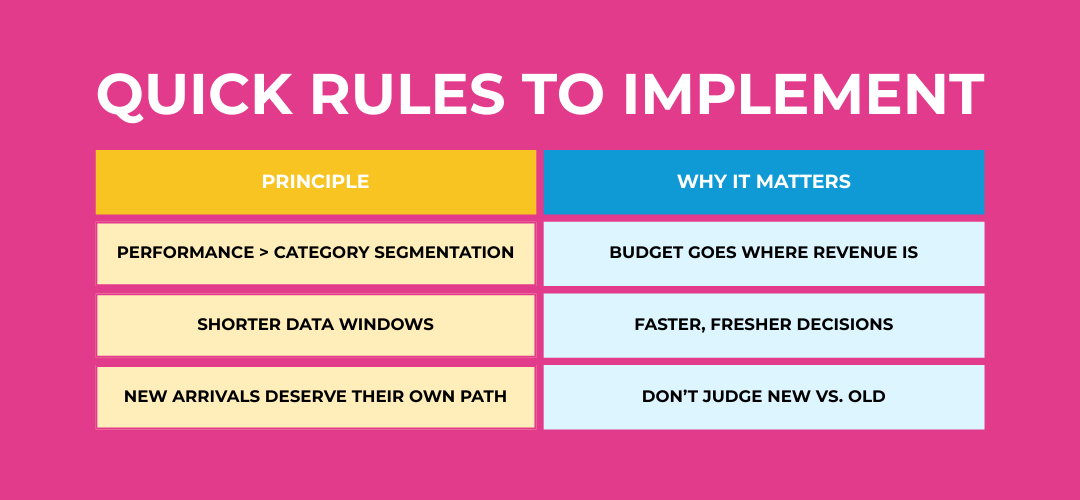
    Step 1: Stop segmenting by category

    Initially, Simons divided campaigns by product category. It seemed like a good idea until their popular sweater consumed the entire budget, leaving less visible or new products unnoticed.

    Static segmentation brought limited visibility and sluggish decision-making. Marketers were trapped with manual tweaks, while Google auto-focused on what’s already succeeding.

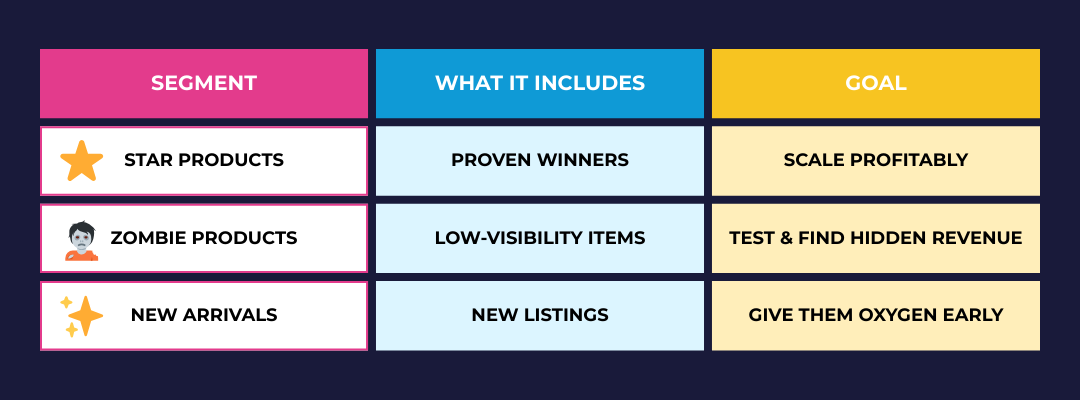
    Step 2: Segment by performance

    With Channable Insights, product-level data like ROAS and clicks now fuel dynamic grouping:

    ```json
{
  "alt": "Product segmentation chart showing Star Products, Zombie Products, and New Arrivals with goals.",
  "caption": "Discover the three pillars of product segmentation: Star products to scale profitably, Zombie products to test and find hidden revenue, and New arrivals to nurture early.",
  "description": "This image illustrates a product segmentation chart divided into three categories: Star Products, Zombie Products, and New Arrivals. Each segment has a corresponding goal and includes items like proven winners or new listings. The chart uses bold colors: pink for segments, blue for inclusions, and yellow for goals, optimizing clarity and visibility. Keywords: product segmentation, Star Products, Zombie Products, New Arrivals, business strategy."
}
```

    Products automatically transition between segments based on performance. As Etienne Jacques, Digital Campaign Manager at Simons, expressed:

    “One super popular item no longer takes all the money.”

    Step 3: Shorten your analysis window

    Instead of the usual 30-day signals, Simons decided to use a rolling 14-day window. This means quicker reactions, more accurate decisions, and less wasted spend in a fast-paced catalog.

    Step 4: Push the strategy across channels

    Why limit the strategy to Google? Simons applied the same segmentation across:

    ```json
{
  "alt": "Image displaying a table with 'Quick Rules to Implement'. Includes principles and their importance.",
  "caption": "Unlock success with quick rules: Prioritize performance over segmentation, embrace shorter data windows, and give new arrivals a unique path.",
  "description": "The image outlines 'Quick Rules to Implement', featuring a table with two columns: 'Principle' and 'Why It Matters'. Principles include prioritizing performance over category segmentation, using shorter data windows, and ensuring new arrivals have unique paths. The reasons include aligning budgets with revenue, making faster decisions, and treating new items without bias. The visual uses a bright pink background with contrasting colors for text, aiding clarity and engagement."
}
```
    • Meta
    • Pinterest
    • TikTok
    • Criteo

    This cross-channel consistency amplifies optimization.

    Step 5: Watch the metrics climb

    Simons unlocked impressive results without increasing ad spend:

    • ROAS growth: from ~800% to ~1500%
    • CPC decrease: $0.37 to $0.30
    • CTR lift: 1.45% to 1.86%
    • 14% increase in average order value
    • 1300% ROAS for New Arrivals campaigns
    • Faster workflows and fewer manual tweaks

    Even previously invisible products turned into unexpected profit drivers with a spot in the limelight.

    Step 6: Treat automation as control, not chaos

    Automation has restored marketing control rather than taking it away. Now, teams can learn from data and actively influence product growth instead of leaving everything to PMax autopilot.

    Your action plan

    • Classify products as Stars, Zombies, and New Arrivals.
    • Automate campaign reassignment based on real-time data.
    • Refresh product insights every 14 days.
    • Roll out segmentation logic to every paid channel.
    • Scale what wins – test what’s yet to succeed.

    Aiming for Simons-style ROAS gains without raising ad spend? Start with a free feed and segmentation audit to enhance your product data quality.


    Inspired by this post on Search Engine Land.

    crushpress.ai community screenshot
  • Rethink Your Dashboards: Beyond Click-Based Attribution

    Rethink Your Dashboards: Beyond Click-Based Attribution

    As someone deeply involved in marketing, I’ve seen how the explosion of marketing channels and touchpoints has made measuring success a truly strategic endeavor.

    I’ve noticed that click-based attribution models—such as last-click and first-click—are still widely used as standard. Yet, as I delve deeper into these metrics, I realize they’re becoming less effective as standalone measures.

    These models dominate executive dashboards, giving me pause because this reliance can impose significant limitations.

    In my experience, click-based metrics can indeed be valuable for understanding digital interactions. However, it’s risky for executives to center major strategies and budget allocations solely around clicks, as this can lead to neglecting vital parts of the customer journey—parts that truly count.

    In this article, I want to explore:

    • What click-based attribution really captures.
    • How it falls short in a complex, multi-channel world.
    • The risks of over-relying on click metrics for business decisions.
    • Alternative measurement approaches that better align marketing with actual business results.
    • Ways marketing leaders, like myself, can guide executives toward more comprehensive outcome-focused frameworks.

    My goal isn’t to dismiss clicks; they have their place. They should, however, provide context rather than serve as the core measure of success.

    What Does Click-Based Attribution Actually Measure?

    Click-based attribution tracks ad clicks and assigns conversion credit to the responsible marketing touchpoints. In my role, I observe that models vary—first-click, last-click, linear, time-decay, to name a few—but fundamentally, they all divide credit along the user journey differently.

    Platforms tend to default to click-based models because clicks are straightforward to capture and report. However, their clarity can often mislead.

    I’ve learned that click-based attribution hinges entirely on user interaction with tracking links. Without a click, or with delayed decisions, important touchpoints might be misattributed or entirely overlooked.

    While this approach might work in simplistic funnels, today’s customer journeys are multi-device and multi-channel, quickly diminishing the value of clicks in context.

    Dig deeper: The end of easy PPC attribution – and what to do next

    The Problems with Solely Relying on Click-Based Attribution

    When I examine today’s buyers, I see that they rarely follow neat, linear paths—an assumption made by click-based models.

    Instead, buyers interact across many devices, channels, and may even engage through offline touchpoints. Consider social media, AI like ChatGPT, or brand recognition from videos, influencers, or website content.

    Many valuable interactions go untracked by clicks, though they meaningfully influence buyer perception and conversion readiness.

    Imagine a buyer: they watch a video on LinkedIn, then research your product through third-party reviews and your case studies on your website. Days later, they directly Google your brand and make a purchase.

    In click-based systems, only the final branded search click would be credited, overlooking all previous touchpoints that educated and persuaded the customer.

    Such blind spots aren’t trivial; they form a canyon between reality and measurement.

    … (content continues in the same format) …

    Inspired by this post on Search Engine Land.


    crushpress.ai community screenshot